Saturday, September 8, 2012

Obama to boy: Where’s your birth certificate?

http://news.yahoo.com
Not every kid gets asked for his birth certificate by the president of the United States. But that's what happened to a Florida lad, Andre Wupperman, when he met Barack Obama at a Florida sports bar and family joint on Saturday.
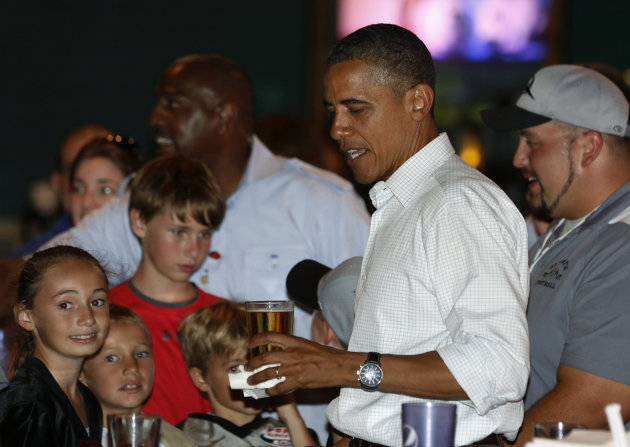
Obama made an unannounced stop at Gators Dockside -- one of many surprise visits he makes to local businesses as a candidate for reelection -- and mingled with the patrons. Upon hearing that Andre, who turns seven next week, was born in Hawaii, the president asked: "You were born in Hawaii? You have a birth certificate?" The joke got laughs, according the pool reporter Helene Cooper of the New York Times. And according to the Associated Press, Obama had greeted Andre with the "shaka" sign, a gesture often associated Hawaii. The president also stopped at another table and led a group in singing "Happy Birthday" to Sorina Terrell.

Pakistani Christian 'blasphemy girl' released on bail

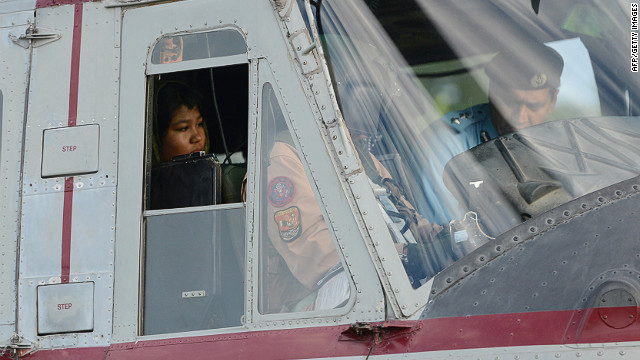
After spending more than three weeks in jail on blasphemy allegations, 14-year-old Christian girl Rimsha Masih was released from Adiala Jail on Saturday. After getting released from the jail, Rimsha was flown to Islamabad in a government helicopter. Her release comes a day after her bail was approved against two surety bonds worth Rs 0.5 million each. While the juvenile girl was being brought to the helicopter, her face was covered with a sheet of cloth to protect her identity. “We have shifted her to a safe place where she was reunited with her family,” Rimsha’s counsel Tahir Naveed Chaudhry told Pakistan Today.
Rimsha was arrested on August 16 from the Mahra Jafar area in Islamabad after her neighbor accused her of burning pages of a Noorani Qaeda. Amid tight security, she was brought from jail in an armored vehicle to the nearest helipad, before flying to the Shakarparian Helipad in Islamabad. From Shakarparian, she was shifted to an armored van and driven to an undisclosed location due to security reasons. Police sources told Pakistan Today that before shifting Rimsha to a safe place, she was allowed a brief meeting with her relatives residing in Mehra Jafar. Sources further said that Rimsha’s father Misrak Masih met her after her release, and went to their house in Mehra Jafar and picked their necessary belongings before leaving for the undisclosed location in police custody. At the time of her release from jail, a large number of security personnel, members of Christian community and representatives of media were present. While rumors are circulating that Rimsha might be shifted to some other country, her lawyer Tahir Naveed categorically opposed the idea. “Let me make it clear, Rimsha will not be shifted to any other country. She will live in Pakistan. Although some NGOs are working on these lines, but we will not allow them to do this,” the lawyer said. The All Pakistan Minorities’ Alliance (APMA) paid the sureties bond worth Rs 1 million for Rimsha’s release. On Friday, Sessions Judge Mohammad Azam Khan granted bail to Rimsha after conducting lengthy proceedings that saw heated arguments over the girl’s release. Declaring Rimsha a “juvenile”, the court referred to a medical report, pointing out that her mental age appears to be less than her physical age. The panel of Rimsha’s lawyers had pleaded before the court that their client was a minor girl, and according to Pakistani laws, minors were entitled to bails in all cases except terrorism, killing and kidnapping. Upon this, the court gave decision in Rimsha’s favor.

Let us walk together, India’s FM Krishna tells Pakistan

Pakistan and India vowed to improve their bilateral relations, as their foreign ministers agreed to move forward in normalising ties in a joint press conference held in Islamabad on Saturday. The ministers spoke after both countries agreed to ease visa procedures, which introduce a number of measures “aimed at easing travel of business persons, tourists, pilgrims, elderly and children, thereby facilitating contacts between peoples of the two countries.” The agreement was the culmination of a visit by Indian Foreign Minister S. M. Krishna to Pakistan as part of a tentative peace process that froze after the attacks in Mumbai in November 2008, killing 166 people.
India’s Minister for External Affairs S. M. Krishna spent two days in Islamabad, holding talks with Pakistan President Asif Ali Zardari, Prime Minister Raja Pervez Ashraf, Foreign Minister Hina Rabbani Khar and Interior Minister Rehman Malik. “A step-by-step approach is what will take the relationship forward,” said FM Krishna. The joint statement also referred to a “commitment” given by Pakistan last May to bring the perpetrators of the Mumbai attacks to justice “expeditiously”. “The Pakistani side reiterated its commitment to bring to justice all perpetrators of Mumbai attack expeditiously, in accordance with due process of law,” said Kishna. Pakistan charged the seven men over the 2008 Mumbai attacks in 2009, but insists it needs to gather more evidence in India before proceeding further. New Delhi has branded Pakistan’s attempts at prosecuting the alleged conspirators a “facade” and insists it has already handed over enough evidence to convict the accused. Both ministers “reaffirmed the strong commitment of the two countries to fight terrorism in an effective and comprehensive manner so as to eliminate the scourge in all its forms and manifestations,” the joint statement said. “We will move forward… We will not be held hostage to history,” Khar told a joint news conference with Krishna. “We must learn from the past and not miss any more opportunities. Pakistan is committed not to lose any opportunities. Pakistan is committed to creating new opportunities,” she said. Khar cited Pakistan’s move to normalise trade ties with India as a strong message of its intentions to forge ahead towards an improved relationship. “We are looking at India with a completely different mindset. When Pakistan decides to change a position it has held to for 40 years and liberalise trade ties with India, Pakistan is sending a very very strong message of being willing to forge ahead without being hostage to the past,” Khar said while addressing reporters. Krishna, meanwhile, insisted that both countries must set their sights on the future, saying, “let us walk the talk together.” “Let us not look back as you have rightly said, let us not be held hostage to whatever has happened earlier. I think we will have to keep our sight to the future,” he said.

Pakistan, India sign comprehensive visa agreement

Interior minister Rehman A Malik and Indian external affairs minister SM Krishna inked the agreement. Under the new agreement citizens, aged 65 and above, would now be able to walk across the border between the two countries and need not go through the hassles of getting a visa from embassies in New Delhi and Islamabad. Artists would be able to have triple entry while people aged more than 65, children below 12 and eminent businessmen are exempted from police reporting. The new visa policy between India and Pakistan, has eased restrictions on visitors from both the countries. Another ease for senior citizens is that they will be granted visas on arrival at the Attari and Wagah border in India and Pakistan respectively.There was no such provision available for senior citizens of both countries. Under the new arrangement, senior citizens will be granted a visa on arrival valid for 45 days. "The senior citizens can visit the other country easily now," an official said. The new accord will bring about several changes aimed at easing the visa regime. There will be a single-entry visitor visa for a maximum period of six months but the stay cannot exceed three months at a time and for five places (currently limited to three places). Group tourist visas, for groups of 10-50 people, has also been introduced for the first time. This will also be available for students provided they do not seek admission in the other country. Also, business visa has been separated from visitor visa, a communiqué said. The business visa will have to be issued within five weeks. Another simplified rule will allow people to enter and exit from different check posts and change their mode of travel. This was not permitted earlier. "However, this is subject to the exception that exit from Wagah/Attari, by road (on foot) cannot be accepted, unless the entry was also by foot via Attari/Wagah," the communiqué said. Under a new category, a visitor visa for a maximum of five specified places may be issued for a longer period of up to two years with multiple entries to senior citizens (above 65); spouse of a national of one country married to person of another country and children below 12 accompanying parent(s). Also, transit visa will now be issued within 36 hours instead of 72 hours.

Pakistan media gives a thumbs up to Krishna's visit

indiatimes.com
Even before the first things were put in fine print and signed, media in Pakistan on Saturday gave a thumbs-up to the visit of external affairs minister S.M. Krishna visit to Pakistan saying that both countries had reached a milestone. The context was India and Pakistan finally agreeing to sign the much-awaited visa accord, which will mark a big change in the visa regime and make things simpler for the common people of both countries. Leading newspaper, The Dawn, which carried a lead story Friday saying that Krishna was arriving amid "low expectations", too lauded the ground covered by both countries to arrive at the visa pact. It talked about the "liberalised visa regime" being signed. Most newspapers, English and vernacular, had the visit and the visa pact as their lead story with enough space being devoted to related stories, including Krishna's meetings with top political leaders and even his panel discussion with Pakistani media. The News daily said that both Pakistan and India appeared "upbeat" after talks at the foreign secretaries' level here Friday. It spoke of the eight categories for which the visa regime will be liberalised, including group tourist visas, on-arrival visas for over 65 years, 36-hour transit visa, five-city visa for businessmen and visas for civil society, media, diplomatic and non-diplomatic categories. The newspaper, quoting diplomatic community in Pakistan, said that they were "expressing cautious optimism" about the latest developments but added that "continuation of talks between the two countries is itself an achievement". In another story on Krishna's panel interview with Pakistani media, The News quoted Krishna saying: " All problems cannot be solved in one go. India has always taken the position of following a step-by-step movement and that is the approach we are taking right now." India's desire to see a stable and peaceful Pakistan is "not only encouraging but a key to many outstanding issues that need resolution sooner rather than later", said the Daily Times in an editorial. "The issues besetting the two countries are well known and have been talked about plenty of times," it said, adding that terrorism, water disputes and Kashmir have been highlighted in the foreign secretary level talks held Friday. The daily observed that "with the realization finally dawning on India and Pakistan about the importance of interdependence within the present global context, the much sought after development in the visa regime is set to materialise with the signing of a liberalised visa issuance policy by the foreign minister of Pakistan Hina Rabbani Khar and Krishna".

PML-N trying to break Pakistan

Muttahida Qaumi Movement (MQM) chief Altaf Hussain called an emergency workers’ conference in Karachi on Saturday. In his telephonic address, Hussain alleged that the Pakistan Muslim League – Nawaz (PML-N), along with the “so-called” Sindh nationalist parties, wants to break Pakistan but the MQM will not let PML-N’s dream come true. “The PML-N has looted the rights of people in Seraiki and Bahawalpur provinces. Altaf Hussain, till his last breath, will fight for the rights of the people in South Punjab and Hazara,” he vowed.

All hail my sectarian God

By Kiran Nazish
In Pakistan a mosque is not the house of God, but the house of a sectarian God. Although Muslim sects across the world have their own separate mosques for the reasons of Imamat, procedure and methodology of prayers, no one is ever stopped from entering a place of worship or called a Kafir inside one just because they do not come from the same sect. Recently, I was told by a non-Sunni friend how he was tormented by fellow worshipers at a Sunni mosque during Friday prayers. He was on the road and getting late for jamaat (congregation), so he went for the nearest mosque he could find - only to discover later that he was a Kafir for doing so. He was identified as a Shia when he did not raise his forefinger for Shahadat during the prayers. We are led to believe that Pakistan is divided by its provincial politics, and our biggest insecurities come from India and the US, but some of the worst and the most real and physical crimes that people commit against each other in this country are based on religion. It is our pride in sectarian exclusivity that has valiantly strengthened our dissections. We sideline our minorities as people, because we fear them and they fear us. The only one being we trust and fight for is our exclusive sectarian God. Sectarianism divides our politics, our military, our media and even our militant groups. Eventually our people divide themselves. We have sectarian terrorist groups that are out to kill Shias and Ahmadis, so as to ensure their specific God's name is saved from the "evil of these sects". The most recent example of this phenomenon is the killing of over 200 people in sectarian violence in Gilgit-Baltistan on 28th February and 3rd April - including the selective slaughtering of more than a 100 Shias in one go. Looking for political mileage, Imran Khan blamed the PPP government for the violence in a statement on April 7. If at any point in this country's history, any politician had been genuinely concerned about sectarianism, we would not have been in the state we are in. In Gilgit-Baltistan, where Shias and the Sunnis once had intermarriages, community gatherings, and common hospitals and schools, they have separated their areas with precise boundaries. They cannot even use the same roads, markets and streets, let alone mosques. The entire politics of the region are sectarian based. Before partition, sectarianism was almost unidentifiable. Much of this could be because of the influence of Sufis and Pirs, but people were generally peaceful. In the contemporary Pakistan, things started changing and the sectarian divide increased between the 1950s and 1970s. It all started with the identifying of Ahmadis as non-Muslims, on which both Sunnis and Shias strictly agreed. Then a few Shia-Sunni clashes took place, but they seemed more politically driven and people remained genuinely peaceful amongst themselves. It was in January 2005 when Agha Zia-ud-din Rizvi, the popular and respected Shia cleric got killed that people were outraged and a real animosity was seen amongst them. Grave fear ran through the entire region. Sunni mosques were attacked, and there was an outburst of gunfire in different areas. Gilgit's polo ground was so volatile that army and paramilitary troops were called to cordon the area off and search for weapons. About 35 arrests were made, before Section 144 was imposed. But the arrested suspects were later allowed to go. And that is where the problem lies. Every time any arrests are made in G-B, the culprits are either facilitated in the escape, or are officially released. Both Sunni and Shia communities suffer because justice is not served. The second major issue is with the discourse. Every time there is violence and bloodshed, our intellectuals indulge in rants, discussions, op-eds and research papers on sectarian violence. There has been no study on what actually compels people from the same country and the same religion to kill each other. Since the media are not very efficient in the region and editors are based in bigger cities, there is a disconnect between the news desk and the on-ground situation. That allows for biased reporting, or in many cases, misreporting. When I compare the statistic of killings since the 1980s, I find a very close link between retaliatory Sunni killings in small tribal areas and Shia killings in major cities. In the case of Gilgit-Baltistan, Hangu and Parachinar - where Sunnis are in minority - Sunni killings are never recorded or reported, which makes it a challenge for anyone like me to even cite them. Shia killing are on a much greater scale and frequency but to understand what really exaggerates sectarianism in any place, is it not important to take into account both sides of the story? I have spoken to dozens of Shias, Sunnis and Ismailis from these areas, and they all have one thing in common - the fear of the other. Many families in G-B who have had Shia-Sunni intermarriages before the conflict worsened in the 1980s, have sent their children out to other parts of the country or abroad, because they feel threatened from both sides. Political negligence, lawlessness, military regimes, and terrorist attacks have caused sectarian hatred among the people, and we have started to worship our own sectarian Gods rather than one God. Yes, we wept with our Ahmadi brothers in the 2010 carnage, but we are still out to get them in schools, colleges and workplaces. We do cry over Shia killings in tribal areas, but still have no space for them in our mosques. I would end with an excerpt from a poem called Psalm by Iranian-born German poet SAID. Lord stay by me even if I nourish myself from ashes and salt be still and listen to that name which I lend to you because I want to distinguish you from the idols grant me patience to endure those who are vain with their empty words and the converts who are zealous to confirm their opposite and grant that my waiting be full of revolt Kiran Nazish is a journalist and activist. She is currently researching on difficult issues and areas of Pakistan. She tweets @kirannazish

Fears for safety of Christian girl in Pakistan after judge grants bail in blasphemy case

http://www.telegraph.co.uk
A young Christian girl accused of blasphemy will need an armoured car and bodyguards to keep her safe once she is freed on bail, according to her lawyer.
A Pakistani judge granted bail to Rimsha Masih on Friday, in a case that has attracted international condemnation and exposed the country's violent religious divide. The girl, whom supporters say is 11 and has learning difficulties, has been held in a high-security prison for three weeks since being accused of burning pages of religious script. In a sweltering courtroom in Islamabad, Judge Muhammad Azam Khan ordered her release and set bail at 1million rupees (£6,900). The decision is highly unusual in blasphemy cases. Such is the public hysteria, judges are under intense pressure to refuse bail and find defendants guilty. However, her lawyer said the decision came too late for surety to be paid and Rimsha would face one more night in prison.Tahir Naveed Chaudhry told The Daily Telegraph she would not be released until her supporters could guarantee her safety, which would mean an armoured car and armed guards. "We are working with the government and are confident we can keep her safe," he said. "She will be taken to a secret location and reunited with her family." Blasphemy suspects have been subjected to mob justice in the past. Two high-profile politicians were assassinated last year after they demanded reform of the controversial law and the release of Asia Bibi, a Christian woman sentenced to death. This time around Rimsha's youth and learning difficulties have led to more sympathetic coverage in local media and a less febrile atmosphere. Several influential clerics have offered support and asked for the case to be dropped. The breakthrough, however, came last weekend when three witnesses came forward to say they had seen the imam of a local mosque adding pages of a Koran to ashes in Rimsha's bag. Pakistan's minister for national harmony, whose brother was one of the politicians assassinated last year after calling for the blasphemy law to be reformed, said that the revelation would help protect Rimsha. "She will not face threats because everybody believes she is innocent," said Paul Bhatti, adding that he was working with the interior ministry and police to ensure Rimsha's safety. Her parents have already been taken into protective custody at a secret location. Alice Jay, of the campaign group Avaaz, welcomed the decision. "Now she and her family and community must be protected from mob violence, and the authorities should initiate a full review of the blasphemy laws that led to this childメs terror," she said.

Balochistan And the Upcoming Elections

Baloch Hal
By Malik Siraj Akbar
The Baloch nationalists are debating among themselves whether or not to participate in the upcoming general elections. So, is Balochistan’s political landscape going to change if the nationalists return to parliament? All nationalists are not on the same page on this crucial question, nor are they all equally capable of normalising the situation in the province. The moderate National Party (NP), which boasts about its middle class composition, has publicly acknowledged that it committed a “blunder” by boycotting the 2008 elections because they were immediately replaced by local rivals from the Balochistan National Party-Awami (BNP-Awami). In March 2009, the NP eventually returned to parliament by getting its leader, Hasil Bizenjo, elected as a senator with the help of the PPP, the PML-Q and some independent MPAs. The Balochistan National Party (BNP) has still not decided to contest elections but its decision is very critical. The BNP, headed by former chief minister Sardar Akhtar Mengal, is caught up in a dilemma for three reasons. Firstly, Baloch armed groups oppose the idea of elections, integration and reconciliation with Islamabad. The BNP is not a contributor to the armed insurgency. Street politics is its strongest point and a decision to participate in the elections will directly pit it against the hardline Baloch groups. Secondly, the party fears its exiled president will be assassinated on his return to Pakistan, just like Habib Jalib, the party’s secretary general. Opposition to General (retd) Pervez Musharraf had landed Sardar Mengal in a Karachi jail for 20 months. Thirdly, the BNP blames the security establishment for creating anti-nationalist underground armed groups such as the Baloch Musla Defai Tanzeem to attack the anti-government nationalists. This group has killed several senior BNP leaders, including three members of its central committee. It seems impossible for the BNP to run a safe election campaign under constant fear of assault and disruption by armed groups allegedly affiliated with the intelligence agencies. The BNP will probably participate in the elections only if powerful elements in the security apparatus assure them that no more attacks would be carried out on the party’s leaders and activists during the election campaign. Participation in the polls, nonetheless, does not guarantee nationalists’ landslide electoral victory. They are very likely to lose for the following reasons. The nationalist parties have not exercised street politics for the past many years. The absence of key leaders such as Sardar Mengal of the BNP has totally disconnected the ordinary Baloch voter from their leaders. These parties also did not show any interest in the preparation of the voters’ lists. Their rural voters are not even listed nor do many of them possess computerised identity cards. Political parties normally require at least one year to prepare for the elections whereas the Baloch nationalists do not seem to have fully completed their homework yet. Furthermore, there is simply no ‘sympathy vote’ in Baloch districts for the nationalists. The ‘kill and dump’ policies, for which intelligence agencies and the Frontier Corps are blamed, have increased support for armed groups among ordinary Balochs. They look at parliament and elections as a source of further strengthening the power of the state. The relatives of the killed or disappeared political activists support insurgent groups, instead of pro-parliament parties, in reaction to the killing of their loved ones. Finally, Baloch tribal chiefs from the PPP, the PML-Q and the BNP-Awami have accumulated so much wealth from the official treasury that it is practically impossible for the nationalists to have the same amount of finances to run election campaigns. Access to official machinery further benefits the current legislators against the nationalists. The elections will be a futile exercise if there is no change in the current composition of the Balochistan Assembly. The status quo did not change after the 2008 elections and a similar outcome this time will further block a ballot-driven solution for the Balochistan conflict. The government should make sure that intelligence agencies do not finance and influence the elections so that neutral results are achieved. (Courtesy: The Express Tribune)

Khar, Krishna to ink liberalised visa regime shortly

Foreign Minister level talks between Pakistan and India are underway in Islamabad. Foreign Minister Hina Rabbani Khar and External Affairs Minister S. M. Krishna are leading Pakistani and Indian delegations respectively. The agenda of the meeting include several crucial issues including‚ peace‚ security and confidence building measures‚ Jammu and Kashmir‚ Siachen Glacier‚ Sir Creek‚ and economic cooperation. The two Ministers will also co-chair plenary session of Pak-India Joint Commission. Both the sides are also expected to sign the new visa regime agreement. The Indian External Affairs Minister who is on an official visit to Pakistan held talks with President Asif Ali Zardari and Prime Minister Raja Pervez Ashraf in Islamabad yesterday‚ discussing the whole range of issues including the confidence building measures.

Pakistan: Silly cacophony

What is all this hullabaloo about? While the ruling PPP contends it is contacting all the opposition parties on the interim government to ensure credible elections, one strand of the PML (N) confirms it is talking but its stalwart Chaudhry Nisar insists it is not. But why all this shrill? Why this silly cacophony at all? What will change even if the elections are held? Will not the same pedigrees, the same patriarchies and the same dynasties make to the legislatures and to the governments? Over these past decades, has it not been so after each and every election held during the period? Then how do the sages preach that things will change if elections are held uninterruptedly? And why would it be any different this time round? Have the entrenched dynasts released their parties from their strangleholds and turned them into open houses to the commoners to get in and secure berths in the legislatures and the governments? Have the fat-bellied landed aristocrats and gluttonous nouveau riches freed the nation’s politics from their clenched fists and thrown it open to the commoners for the talented and meritorious from amongst them to emerge to lead and guide the nation? You must be joking. It is the status quo that is in rule. And reign and rule it will in future too. Even the rising star has demonstrated it conclusively that he too is actually a man of the status quo, not of change. Not only has he embraced warmly every traditional political player walking over to his tent. He has shown no streak in him to go for a change. Never ever has he spoken of land reforms or land redistribution to liberate the huge lot of peasantry living in the suppressive serfdom of exploitative and oppressive landed aristocrats. Not even has he made this part of the economic agenda he has announced recently. Nor has ever made mention of the emancipation of the extremely promising and talented Baloch youths struggling to get out of the enslavement of unshakably-embedded sardars and chieftains who behave as if they have the divine right to keep the Baloch commoners in their perpetual slavery. Little wonder, then, hoi polloi across the spectrum are no part of this silly cacophony. Nowhere are they huddling or crowding any street corners to talk of the upcoming election. For these din-makers, the impending poll may be an event; after all, they are after the booties and bounties of the power lustily and hungrily. But for the masses, the coming election is just a non-event when it promises that it is only the elites that will once again rule and reign over them to the complete disinterest in their good and wellbeing. So, they are not talking elections when these promise not a commoner like Atal Bihari Vajpayee or Manmohan Singh will emerge to lead them and their country to progress and advancement. But it will be a Zardari, a Mian, a Gilani, a nawab, a jaghirdar or a robber baron sitting on their thin necks to belabour them. So, they give a damn to what the sages say about frequent elections throwing out the rotten eggs and ushering in sincere and public-spirited leaders. Their practical experiences tell them that the sages are plainly lying, only indulging slyly in their pep talk to burnish their spurious credentials of being wise men. And they give too hoots to the bickering going on between the political players over the interim government to hold free, fair and transparent elections. The masses know for a fact that whether foul or fair, the elections will throw up the same elite group to divvy up the power pie amongst itself, leaving them high and dry to nurse their grievances unattended and all alone, as now. Presently, they are going through hell. Neither their lives are secure, nor do they have the means to live a livable life. Yet the political players are hardly pushed about their painful woes. They are engrossed wholly in their own power games. Verily, for its own shenanigans the political class has forfeited for all times the people’s all trust. They distrust it; they abhor it, and they hold it in deep scorn. And they know for a fact that it would once again foist on them a plutocracy, not a democracy, whose meaning this class even doesn’t know. So, why should they become part of any silly cacophony of this class? And part they actually are not. The partisans are playing their symphony in a void, with no listeners at all on the street. What a pity!

ZARDARI: PRESIDENT’S DUAL OFFICES

There is a hue and cry from day one when Mr. Asif Ali Zardari was elected as President of Pakistan. He was the first politician and from the mainstream politics of the country. There is a vilification campaign against the President of Pakistan and some functionaries are involved in whispering campaign against him to tarnish the image. He is a competent politician and he is the leader of the biggest political party of the country and enjoying the support of the broad masses. There is no individual in Pakistan to challenge his popularity among the masses. He is under constant attack from his adversaries, both political and personal. Once a former Foreign Minister of Pakistan in Benazir days disclosed that the Prime Minister had advised her spouse to keep a low profile because he was not popular among the intelligence agencies of Pakistan. He is a turn coat and recently resigned from the PPP for not making him the Foreign minister again and he joined the PTI of Imran Khan, another favourite party of the establishment. Presumably for this reason, every one in close contact with the security agencies are launching frontal attack on Mr. Asif Ali Zardari as they had been asked by the agent handlers. Dozens of TV channels are involved in character assassination of the President of Pakistan merely because he is not popular among the intelligence people. At present, the Punjab High Court is hearing the case of dual office of the President and gave a verdict asking the President to quit the Presidency or the party post. The court had also raised objection over political meetings in the Presidency. It is strange that in the past, former Presidents made the Presidency a vice den and doubtful characters, both men and women, were the frequent visitors. At that no such orders were issued to bar entry of bad character women to the Presidency and President should stop such immoral activities. It is true during the days of General Yahya Khan and General Pervez Musharraf. Some of the functions had exposed the role of former military dictator in videos that were displayed on internet for years damaging the image of the country the world over. Asif Zardari is presiding over political meetings as he is the legal head of the Party and he had the responsibility to regular the party affairs. We hope that the Punjab High Court will stop this biased hearing and allow the President of Pakistan to complete its constitutional tenure as a respectable politician and not as a dummy man.

Baseless allegations: Save the Children denies links to CIA

The Express Tribune
Save the Children has strongly reacted to allegations that it supported the CIA in its efforts to find Osama bin Laden in Pakistan. “A section of the press on Thursday cited allegations that Save the Children was involved with the CIA and Dr Shakeel Afridi in their effort to locate Osama bin Laden. We categorically deny these allegations,” it said in a statement on Friday. There is absolutely no truth to these allegations and there is no concrete evidence to support them, the organisation said. “We reiterate, Save the Children has never conducted a vaccination campaign in Abbottabad or in any other part of the country nor has provided any support to any other individual or organisation to carry out any vaccination campaign, the statement said.

Don’t set us terms, Hina tells India

Pakistan foreign minister Hina Rabbani Khar on Friday said Islamabad was keen to host Prime Minister Manmohan Singh, but the visit shouldn’t be set on conditions. “We have given strong signals we are keen on the Indian PM’s visit.(But) We don’t believe in conditional diplomacy,” Khar said in an exclusive interview. She was reacting to a question on the Indian position that Singh’s Pakistan trip should have the “right atmosphere” and a “suitable outcome”. “Engagement at the leadership level will give a serious momentum to the dialogue process and help us move closer to resolving some key issues,” Khar said. Khar recounted how Pakistan President Asif Ali Zardari took just “moments” and former Prime Minister Yousuf Raza Gilani a “few hours” to respond to invites from New Delhi. While Zardari met Singh during his private visit to Ajmer in April, Gilani came to Mohali last year to watch the India- Pakistan World Cup match. On the 26/11 attacks, Khar said the Pakistani courts would decide if the evidence given by India was strong enough to bring the attackers to justice. “The authority to take a look at the evidence, like in India or any country, is the judiciary,” she said. The minister urged India to stand by the 1989 proposal of resolving the Siachen dispute —based on redeployment of troops, avoiding use of force and fixing future ground position within the Simla Agreement. She said Pakistan was not making resolution of the Sir Creek issue conditional to resolving the Siachen problem.

Pakistan, India to sign liberalised visa regime today

Pakistan and India will on Saturday sign a liberalised visa regime and a memorandum of understanding on cultural exchanges, in addition to agreeing on new cross-LoC confidence-building measures relating to trade and travel. The new agreements will be formalised in the presence of Indian External Affairs Minister S.M. Krishna, who is on a three-day visit to Pakistan for the annual ministerial review meeting of the peace dialogue and co-chairing the revived Joint Commission.
The two foreign secretaries finalised the accords on Friday while the foreign ministers will meet on Saturday. Structured talks between the two foreign ministers and the plenary session of Joint Commission are planned for Saturday. Mr Krishna, who arrived just before noon on Friday, met President Asif Ali Zardari, Prime Minister Raja Pervez Ashraf and leaders of major parties represented in the parliament. Mr Krishna’s meetings in Islamabad would more importantly decide whether or not Indian Prime Minister Dr Manmohan Singh would visit Pakistan later this year on the invitation of President Zardari. The two foreign secretaries, meanwhile, met on Friday to finalise the agenda for the ministerial review meeting. The accord on new visa regime, which had been largely finalised during the meeting of interior/home secretaries in May, but was not initialled then, would have five new categories, including one-year multiple entry visas for businessmen which would be valid for five cities; group tourist visas; and on-arrival visas for citizens of 65 years or more. Pilgrims visiting each other’s countries and people having relatives in the other country are also expected to be facilitated. Finer details of the visa regime, which would be inked at the interior ministry, were still being worked out by officials, a source said. Interior Minister Rehman Malik, speaking to media at a reception hosted by the Indian High Commission, said that the decision to sign the new visa agreement was taken during a meeting between President Zardari and Dr Manmohan Singh on the sidelines of the NAM summit in Tehran last month. Pakistan National Council of Arts and Indian Council for Cultural Relations will also be signing an MoU for cultural exchanges between the two countries. The move for exchanges in the field of music, dance, theatre and visual arts, it is said, is meant to supplement diplomatic efforts for improvement in relations. Terming the cultural exchange agreement a major step forward, an official said, it took the two countries years to agree to this MoU. Moreover, both sides were expected to agree to additional Cross-LoC confidence building measures discussed during a meeting of the Joint Working Group on Cross-LoC CBMs’ in Islamabad in July. An Indian source said Mr Krishna had strongly raised the issue of slow progress in the trial of Mumbai attacks accused and Pakistan’s reluctance to act against groups targeting India. Mr Krishna’s protestations made Preisdent Zardari to tell him that “it is time for the two countries to move beyond reiteration of their positions to more substantive results”. Mr Zardari insisted that the two countries must not allow the derailment of normalisation process and proposed revival of an anti-terrorism mechanism that would include representatives of Foreign Office, Home/Interior and intelligence agencies of the two countries. Prime Minister Ashraf, in his meeting with Mr Krishna, said that it was important for both countries to maintain a positive outlook despite the fact that more intricate issues like Kashmir, Siachen and Sir Creek were still to be discussed. Mr Krishna told the prime minister that revival of the Joint Ministerial Commission after a long hiatus indicated the seriousness of the two sides to enhance bilateral cooperation. Earlier on arrival, Mr Krishna said: “We are committed to finding solutions to all issues that have beset our relationship through peaceful bilateral dialogue.” He further said that India was looking forward to a future where both countries were able to live together in an atmosphere of friendliness and cooperation, free from terror and violence.

Friday, September 7, 2012

Violence claims 7 more lives in Karachi

DUNYA TV
At least seven people were killed in incidents of violence in different parts of Karachi. According to details, three dead bodies were recovered from Pak Colony. Police said that the hands and feet of the victims were tied and they were shot dead after abduction from different areas of the city. The identity of the deceased is not yet known. In another incident of violence, some unidentified gunmen shot dead Abdur Rehman in Karimabad while Muhammad Nawaz was gunned down in Machco area. In yet another incident of violence, some unidentified miscreants shot dead a man named Saim in Nazimabad area while Tariq was shot dead in Shah Faisal area of Orangi Town. Meanwhile, residents nabbed a dacoit near Islamia College and subjected him to severe torture before handing him to police while two dacoits were arrested from a shop near Yousuf Plaza.

Obama takes slim post-convention lead over Romney: Reuters/Ipsos poll

REUTERS President Barack Obama regained some footing and overtook his Republican rival Mitt Romney in a new Reuters/Ipsos poll released on Friday, a day after the end of the Democratic convention. In what appears to be a convention-induced bounce, Obama jumped ahead in the latest daily tracking poll with 46 percent of 1,434 likely voters saying they would vote for him if the November 6 elections were held today, topping Romney's 44 percent. The rolling four-day online poll was conducted through early Friday. The Democratic convention in Charlotte, North Carolina, where Obama accepted his party's nomination for a second term, wrapped up late on Thursday night with the president's nationally televised speech. "The numbers only moved a little bit but they moved in the direction that suggests that we may be seeing the first inkling of a post-convention bump," Ipsos pollster Julia Clark said. Romney in the past few days had held a 1 or 2 percentage point lead in the poll in the wake of the Republican convention last week. The poll does not reflect sentiment following the Labor Department's release on Friday of August employment numbers, which showed that jobs growth slowed sharply last month. Seventy-two percent of 1,670 registered voters surveyed in the poll said the national economy and the federal budget deficit are heading in the wrong direction. Sixty-eight percent of polled voters said the same about the employment and jobs. "These are the metrics against which the candidates have to battle it out. This backdrop is very challenging and it's turning into a blame game," said Clark, repeating her earlier predictions of a very close race all the way until the election. Friday's poll likely reflected the views of those who had heard the well-received convention speech by former President Bill Clinton but not Obama's own speech that offered a steady-as-you-go message. Asked who was the more likable candidate, 52 percent of registered voters surveyed favored Obama compared to 29 percent for Romney. Among independents, Obama enjoyed a likability advantage of 50 percent to 22 percent for Romney. Obama also widened his lead over Romney in categories of "represents America" (Obama 44 percent, Romney 37 percent), "tough enough for the job" (Obama 42 percent, Romney 37 percent) and "will protect American jobs" (Obama 40 percent, Romney 37 percent). The precision of the Reuters/Ipsos online polls is measured using a credibility interval. In this case, the poll has a credibility interval of plus or minus 2.7 percentage points for all respondents.

No love lost for Hafiz Saeed: Hina

Ahead of India-Pakistan Foreign Ministers' talks in Islamabad, Pakistan Foreign Minister Hina Rabbani Khar in an exclusive interview to NDTV has said that there's no love lost for 26/11 mastermind Hafiz Saeed in Pakistani government and he is not a crony of the establishment. She also said that Pakistan will welcome any evidence against Saeed that can stand in court.

CRICKET: Pakistan seal series with tight win

Pakistan tied the Super Over but won on boundaries scored in the second Twenty20 international against Australia in Dubai on Friday, after the visitors tied the match on 151 for eight.

S M Krishna calls on President Zardari

President Asif Ali Zardari on Friday said that Pakistan had abiding interest in the promotion of regional peace and stability, which would only enable the people of the region to exploit enormous opportunities available in South Asia. During his meeting with S. M. Krishna, Indian External Affairs Minister, here at Aiwan-e-Sadr, the President said that finding amicable and just solutions to resolve outstanding issues was important for Pakistan and India to ensure lasting peace and stability in the region. Briefing about the meeting, Spokesperson to the President Senator Farhatullah Babar said that the President emphasized that it was time for the two countries to move beyond reiteration of their positions to more substantive results. He said that showing greater understanding of each others' concerns and sensitivities would help in solutions of the mutual issues. The President reiterated his call for the two countries to make determined efforts for friendly, cooperative and good neighbourly relations, treading the path of productive and result-oriented dialogue. He stressed the need for exchange of visits of businessmen and entrepreneurs of the two countries to enhance bilateral trade. He said that multifaceted cooperation between the two countries was imperative for the socio-economic development of the people and to cope with the common challenge of terrorism. He said that terrorism was a common enemy afflicting both the countries. Calling for the need to fight the menace jointly, the President said that Pakistan stood resolute to fight it till it was finished. The President also said that the two countries must not allow the derailment of normalization process. In this regard, he also suggested reviving the Anti-Terrorism Mechanism comprising representatives of Foreign Office, Home/Interior and intelligence agencies of the two countries. He said that the frequent interactions of the leadership of the two countries would help providing impetus to the efforts for ensuring peace and creating better understanding on various issues. We have great respect for Mrs. Sonia Gandhi and hold Dr Manmohan Singh in high esteem, he said and appreciated the Indian Prime Minister's vision for peace in South Asia. The Indian minister thanked the President for meeting and conveyed best wishes of the Indian leadership and people for the government and the people of Pakistan. He said that his country desired good relations with Pakistan and wanted to work together in coping with the common challenges and issues. Those present during the meeting from the Indian side included Ranjan Mathai, Foregin Secretary, Sharat Sabharwal, Indian High Commissioner, Raghavendra Shastry, and Advisor to External Affairs Minister, Y.K. Sinha and Syed Akbaruddin. Foreign Minister Ms. Hina Rabbani Khar, Secretary General M. Salman Faruqui, Spokesperson to the President Senator Farhatullah Babar, Senator Sughra Imam, Foreign Secretary Jalil Abbas Jilani, Pak High Commissioner to India Salman Bashir and Asif Durrani were present from the Pakistan side.

State Department Blacklists Militant Haqqani Network

In a report to Congress on Friday, Secretary of State Hillary Rodham Clinton formally designated the militant Haqqani network — responsible for some of the deadliest attacks against American troops in Afghanistan — a terrorist organization, two days before a Congressional deadline. Mrs. Clinton signed the order in Brunei before departing to Vladivostok for the annual Asia Pacific Economic Conference, and State Department officials began notifying senior lawmakers. She issued the report after a last round of internal debate that took place in Washington on Thursday hours before President Obama spoke at the Democratic National Convention. The decision is the culmination of nearly two years of spirited debate inside the administration that reached a peak in the past month under the pressure of Sunday’s reporting deadline. Several State Department and military officials had argued that designating the organization would help strangle its fund-raising activities in countries like Saudi Arabia and the United Arab Emirates and pressure Pakistan to open a long-expected military offensive against the militants. Many other senior officials, including several in the White House, expressed deep reservations that blacklisting the group could further damage badly frayed relations with Pakistan, undercut peace talks with the Taliban and possibly jeopardize the fate of Sgt. Bowe Bergdahl, the only American soldier known to be held by the militants. But in the past few days, supporters of designating the group apparently eased most concerns or put forward contingencies to mitigate the risks and potential consequences. “This shows that we are using everything we can to put the squeeze on these guys,” said one administration official who was involved in the process, and who spoke on the condition of anonymity on Thursday because the decision had not yet been formally announced. Another senior administration official said the designation “is a very strong signal of our resolve to combat the Haqqanis.” Mrs. Clinton and others had already discussed the issue with their counterparts in Pakistan, the State Department said. “This is an internal matter for the United States,” Sherry Rehman, Pakistan’s ambassador to the United States, said in a statement. “It’s not our business. The Haqqanis are not Pakistani nationals.” “We are not in the business of coddling terrorists and those who challenge the writ of our state,” she continued. “We will continue to work with all international partners, including the U.S., in combating extremism and terrorism.” Critics had contended that a designation by the Treasury Department or the United Nations could achieve largely the same result as adding the network to the much more prominent State Department list, with far fewer consequences. But many senior counterterrorism officials as well as top American military officers, including Gen. John R. Allen, commander of American and NATO troops in Afghanistan, had said designating the organization should be a top priority. “F.T.O. designation could reduce a critical capability of the Haqqani network by increasing the cost of doing business, reducing access to capital, and constraining the network’s financial resources, thereby limiting their freedom to operate in a local, regional, and international context,” Jeffrey Dressler, senior Afghanistan analyst for the Institute for the Study of War, a research organization here, said in a paper issued this week, referring to foreign terrorist organizations. Mr. Dressler said the Haqqani network’s business interests stretched from Afghanistan and Pakistan, to the Persian Gulf, and included car dealerships, money exchanges and construction companies, import-export operations and smuggling networks. Since 2008, Haqqani suicide attackers have struck the American Embassy and Indian Embassy in Kabul, Afghanistan, as well as the headquarters of the NATO-led International Security Assistance Force and hotels and restaurants there. American officials confirmed last week that a senior member of the Haqqani family leadership, Badruddin Haqqani, the network’s operational commander, was killed recently in a drone strike in Pakistan’s tribal areas. Pressure in Congress to add the group to the terrorist list had grown this year. “The Haqqani network is engaged in a reign of terror,” Representative Mike Rogers, a Michigan Republican who is chairman of the House Intelligence Committee, said in July. “Now is the time for action, not simply paperwork and talk.” With virtually unanimous backing, Congress approved legislation that President Obama signed into law on Aug. 10 giving Mrs. Clinton 30 days to determine whether the Haqqani network was a terrorist group, and report her decision to lawmakers by Sunday, coincidentally three days after the end of the Democratic National Convention. Critics of designating the group a terrorist organization say the action could drive a wedge between the United States and Pakistan, just as the countries are gingerly recovering from months of grueling negotiations to reopen NATO supply routes. Pakistan closed the routes through its territory after an allied airstrike near the Afghan border last November killed 24 Pakistani soldiers. These same critics say such a move would appear to bring Pakistan a step closer to being designated as a state sponsor of terrorism. American officials say Pakistan’s main spy agency, the Inter-Services Intelligence Directorate, is secretly aiding the insurgents. Pakistani officials have said the agency maintains regular contact with the Haqqanis, but deny that it provides operational support.

Chinese, Russian presidents reach consensus

President Hu Jintao has met his Russian counterpart Vladimir Putin ahead of the annual Economic Leaders’ Meeting of the APEC in the Russian city of Vladivostok. The two leaders reached an important consensus on the comprehensive strategic partnership of coordination between their countries and on regional and international issues. Hu Jintao said they had set the principles and directions of bilateral relations and priorities for cooperation during the Shanghai Cooperation Organization summit in Beijing this year. He made four proposals. First, the two sides should deepen mutual strategic trust, increase political support and ensure the bilateral political relations develop to a higher level. Second, the two sides should strengthen cooperation in investment, high technology and innovation, promote cooperation on big strategic projects, and raise the scale and quality of economic and trade cooperation. Third, the two countries should negotiate actively within the framework of the China-Russia Neighbourly Friendly Cooperation Treaty and implement the objectives, principles and spirit of the treaty. Fourth, the two countries should build a cooperation mechanism of law enforcement and security to consolidate and develop friendly relations between the two militaries.

Haqqani network is considered most ruthless branch of Afghan insurgency

Group that started as part of anti-Soviet jihad has moved into mafia-like violence, intimidation and extortion
The US has decided to blacklist as a terrorist group the Haqqani network, perhaps the most ruthless and feared branch of the Afghan insurgency, the New York Times has reported. For many, the surprise was not the decision itself, but how long it has taken. The group is believed to have been behind most of the spectacular attacks in Kabul in recent years, including a rocket assault on the US embassy, as well as deadly suicide bombings of US troops. But there have been concerns that targeting the group will worsen already difficult relations with Pakistan, long suspected of supporting the group through its feared ISI intelligence agency. Some officials also thought it might dim hopes for peace talks, although the Haqqanis have always been considered the faction least open to reconciliation. The group was founded as part of the anti-Soviet jihad by Jalaluddin Haqqani, the network's patriarch, who has now delegated most day-to-day operations to the next generation. He was once funded by the CIA and lionised by some in the US, including the congressman Charlie Wilson, who reportedly described him as "goodness personified". Haqqani joined the Taliban government as minister for tribal affairs after they captured Kabul in 1996, fleeing after they were ousted in late 2001 and taking up arms again. His stronghold is in the eastern province of Khost, a lawless area where the Afghan government over which has little control, although the group's leaders are widely believed to live across the border in Pakistan. There they are out of reach of the US forces that regularly capture senior insurgent leaders inside Afghanistan, but are still targeted by drones that last month killed Jalaluddin's son and operational commander, Badruddin Haqqani. They are considered the most sophisticated, ruthless and well-organised of the groups that make up the Afghan insurgency, and claim nominal allegiance to the Afghan Taliban. In addition to the embassy attack they are believed to have co-ordinated or supported a string of other deadly attacks including assaults on Kabul's high-end Serena and Intercontinental hotels, a bombing of the Indian embassy, and several kidnappings. Since the 1980s, however, the group has expanded beyond insurgency to become a mafia-like operation, as focused on "the pursuit of wealth and power" as it is on "the Islamist and nationalist ideals for which [they] claim to fight," according to a recent paper by Gretchen Peters, at the Combating Terrorism Centre in West Point. "Over the past three decades they have penetrated key business sectors, including import-export, transport, real estate and construction in Afghanistan, Pakistan, the Arab Gulf and beyond," Peters wrote in the paper, Haqqani Network Financing. "The Haqqanis employ violence and intimidation to extort legal firms and prominent community members and engaged in kidnap-for-ransom schemes … they protect and engage in the trafficking of narcotics and the precursor chemicals used to process heroin."

ANP announces to boycott NA session

Awami National Party (ANP) Friday voiced strong protest in National Assembly (NA) against promulgation of Sindh Local Bodies Ordinance, staged walk out and announced to boycott sitting session. Speaking on a point of order, Pervez Khan, ANP MNA, alleged President was mutilating the constitution by interfering in provincial affairs. ANP would not become part of any game on division of Sindh, he added. In the darkness of night two parties promulgated ordinance on division of Sindh, he said adding that restoration of Musharraf regime system in favorite cities of Sindh and enforcement of district council system in remaining district of the province was tantamount to dividing Sindh. Where the justice stands that a part of Sindh has been placed under Musharraf regime system through division of Sindh, he questioned. He indicated that ANP had withdrawn his minister from Sindh cabinet under protest against promulgation of this ordinance. PPP is out to dismember Pakistan and ANP will not become part of this game, he announced. He charged over 5 million Pakhtoons were settled in Karachi and their voice was being stifled. ANP denounces role played by President Asif Ali Zardari and his interference in provincial matters, he declared. Federal minister Syed Khurshid Shah said no new ordinance was promulgated in Sindh with reference to local bodies system and only old system has been changed. Government does not intend to defer general elections and they will take place on time, he announced. MQM legislator Waseem Akhtar said stake holders of Sindh had together devised a system, therefore, no one should raise any objection to it. Deputy Speaker Faisal Karim Kundi directed Syed Khurshid Shah to resolve the problem through consultation process with the coalition partners. NA session has been adjourned till Monday evening.

Pakistani court grants bail to girl in blasphemy trial

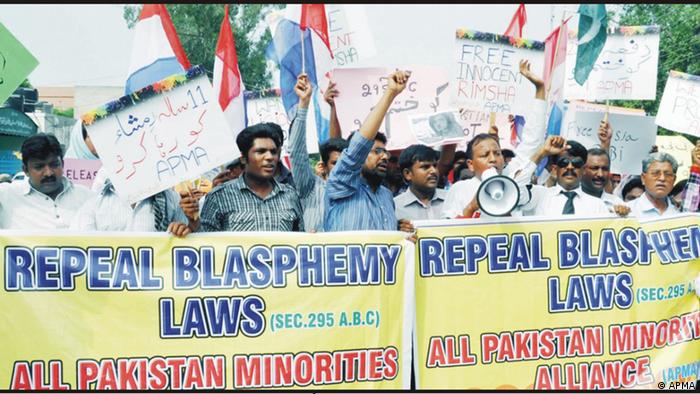
A young girl accused of burning pages of the Muslim holy book, the Koran, has been offered bail at an appeal hearing in Islamabad. The court is also investigating whether the teenage Christian could have been framed. Judge Muhammad Azam Kahn announced the decision in an Islamabad court on Friday. "I accept her bail application," the judge said. "The bail application has been accepted against two sureties of 500,000 rupees (4179 euros, $5,284) each." Rimsha Masih's lawyer, Tahir Naveed Chaudry, told reporters that his client would spend at least on more night in custody. "We are processing the bail bond but court timings have ended so my client could not be released today [Friday]," Chaudry said. "She is likely to be freed on Saturday."There are fears for her safety if she returns to her village, as she is accused of burning pages of the Muslim holy book, the Koran. Framed? The development comes almost a week after police arrested a Muslim cleric for allegedly planting evidence that led to the girl's arrest. Imam Hafiz Mohammed Khalid Chishti, who was turned in by his assistants, is accused of adding pages from the Koran to pages that the young girl had allegedly burned in an effort to strengthen the case against her. The imam claimed that he had moved to protect the girl by turning her in to the authorities. "People were demanding to burn their house," he said. "But I went to police and called them to avoid a major incident." Christi said his colleagues at the mosque had turned him in based on "fabricated" information. Human Rights Watch in Pakistan welcomed the care taken in the case with these counter-accusations, saying the courts were being unusually thorough. "They are actually taking a look at incitement to violence and false allegations. It is a welcome and positive development," HRW Pakistan director Ali Dayan Hasan said earlier in the week. The case has brought further attention to Pakistan's controversial laws on blasphemy. If convicted of committing a perceived insult against Islam, a person can be sentenced to death. Christians make up less than two percent of Paksitan's primarily Muslim population of around 180 million people. Masih is believed to be 14 years old, a panel of doctors has told the court she suffers from learning difficulties.

Terrorism not mantra of future, don't be emotional

"Terrorism was mantra of the past, terrorism is not the mantra of future," said Pakistan Foreign minister Hina Rabbani Khar on Friday ahead of her talks with Indian counterpart S M Krishna, asking India to see the Mumbai terror attack trial "realistically" and not "emotionally". She also indicated that the new visa agreement will be inked during Krishna's visit.Asserting that Pakistan has sent some very "serious signals" in viewing India in different light and on moving with India in various sectors, for instance trade relations, Khar told PTI in an interview that by doing this her country was "breaking away from many positions we have held". Making a strong pitch for the resumed dialogue process to continue, she said, moving forward will mean "Pakistan and India being able to sit around the dialogue table and convert the baby steps into medium-sized strides, which I think is already happening, and then big leaps forward and for that we need to change the mindset. "I am appalled when I am told that terrorism continues to be an issue. Who can tell me that terrorism is not an issue for Pakistan. And this is all old-time (things)..."

Pak textbooks: Alarming rise in hate content

indiatimes.com
At a time when Pakistan is plagued by terrorism, its official academia has been unable to stop the inclusion of hate material targeting Hindus, Christians and Sikhs and fanning sectarian hatred in school curriculum. This hate material included in text books being used in Punjab and Sindh provinces mainly targets the country's religious minorities - Hindus, Christians and Sikhs - and India and westerners, says the NGO National Commission for Justice and Peace. "The latest text books have more hate content than those written previously," the NGO said. According to a content analysis of books published by the Punjab and Sindh text book boards that was done by the NCJP, the hate content has increased manifold with the passage of time. "Many textbooks that had no hate material in their earlier versions, now carry such material in Punjab and Sindh provinces. The issue of religious intolerance should be discussed openly and that must lead to some action to save younger students from such influences at the outset," the NCJP said in a report entitled 'Education or Fanning Hate'. The report said there were 45 lines containing hate material in books published in Punjab during 2009-11, and the figure increased to 122 lines this year. The text books for Urdu and Pakistan Studies for Classes VII, VIII, IX and X were found to be the "most affected", as hate material increased from 15 lines to 86 lines. In all, 22 lessons in the current curriculum for primary and secondary schools have hate content, the report said. Rights and civil society groups have often blamed such contents in text books for fanning sectarian hatred and animosity towards countries like India.

Krishna hopes to see a stable Pakistan

Indian Foreign Minister SM Krishna on Friday arrived in Islamabad on a three-day visit to Pakistan to hold talks with his Pakistani counterpart Hina Rabbani Khar, saying he had come with a mandate for building trust and confidence between the two countries. “I wish to reiterate the desire of India to see a stable and prosperous Pakistan living in peace with itself and the world. That would be in the best interest of everyone,” Mr. Krishna said in an arrival statement. The minister said leadership of India and Pakistan have mandated building of trust and confidence between the two countries. “We are committed to finding solutions of all issues that have beset our relationship through peaceful bilateral dialogue,” he said. Mr. Krishna stressed: “We look to the future where our two countries are able to live together in an atmosphere of friendliness and all-round cooperation free from terror and violence.” Speaking about the objective of his visit, Mr. Krishna said, “My endeavour during this visit will be to promote the objectives that I have just mentioned“. The minister was received at the airport by Pakistan High Commissioner to India Salman Bashir and Indian High Commissioner to Pakistan Sharat Sabharwal. Mr. Krishna will call on Pakistan President Asif Ali Zardari and Prime Minister Raja Parvez Ashraf later in the day. He will also hold meeting with leaders from various Pakistan political parties. While no substantive outcome is expected from the visit, both the countries are likely to sign a new liberalised visa agreement, which would be a boost for people-to-people contact.

Blasphemy case: Rimsha granted bail

The court of the additional sessions judge in Islamabad granted bail to the girl accused of blasphemy on Friday, DawnNews reported. “I accept her bail application,” Judge Mohammad Azam Khan announced to a packed courtroom. “The bail application has been accepted against two sureties of 500,000 rupees each.” The judge also ordered that Rimsha be placed under protective custody due to security concerns. Earlier, the court had reserved its ruling after hearing the arguments made by the counsels of both the complainant and the defendant. The lawyer for the accused girl had submitted before the court that the girl was entitled to bail as she was a minor and that the FIR lodged by the police did not say that she desecrated a copy of the holy Quran. On the contrary, the complainant’s counsel alleged that the girl had confessed to her guilt and hence was not entitled for bail. The officer investigating the case told the court that Khalid Jadoon, the cleric who had been accused of tampering evidence, had deliberately added pages of the holy Quran to the plastic bag that the minor girl, who belonged to the Christian community, was carrying. The prosecution lawyer alleged that the police, including the investigating officer, and doctors were manipulating the case to get the girl freed under international pressure, adding that, they feared the accused would be immediately sent abroad if bail was granted and that then the case would come to an end. Moreover, the district attorney told the court that the blasphemy accused girl had stated her age to the magistrate as 16 years, adding that, the complainant in the case was receiving threats. A large number of security personnel, members of civil society and international media persons were present outside the court as Judge Azam Khan heard the bail application of the accused girl whose case has made headlines in the international and local media. The girl has been in custody since she was arrested in a poor Islamabad suburb more than two weeks ago after being accused of burning papers containing verses from the holy Quran. Earlier on Monday, the case was adjourned until Sept 7 because of a lawyers’ strike, following a request from the lawyer for the girl’s neighbour Hammad Malik, who had filed the original complaint against her.

Pakistan's Three ex-generals to face court martial

The services of three retired generals of the Pakistan Army have been restored for their court martial for having been involved in National Logistics Cell (NLC) scam. In a meeting of the Public Accounts Committee on Thursday, NAB officials briefed the body about the NLC scam involving corruption of billions of rupees. They said the NAB chairman has held three meetings with Chief of Army Staff about the matter. They said the army officers involved in the scandal were Lt General (r) Khalid Munir, Lt General (r) Afzal Muzaffar and Major General (r) Zaheer Akhtar. NAB said the army had assured that would inquire into the cases of three generals involved in the scandal, while NAB would hold civilian inquiries. They said the GHQ was not cooperating in the case in the beginning, but NAB then warned them of forcibly taking into custody all relevant record under the NAB ordinance. “Now the GHQ has agreed to cooperate,” they said. They added that they had been informed that the three generals had been restored on service for court martial. Audit officials said they had been informed that proceedings of court martial against three generals had already been initiated. PAC Chairman Nadeem Afal Gondal observed that these were delaying tactics and remarked that while action was taken immediately against post-office officials, there was a delay in cases of VIPs. The PAC asked the defense secretary to submit a report on progress in the case in fifteen days and asked NAB to provide the relevant record. NLC Director General Major General Junaid told the committee that the department had retrieved loan of Rs 9.5 billion and this year it earned a profit of Rs 6.5 billion. He said the NLC was no more transporting goods of Afghan transit trade, which was a business of Rs 100 billion. He said if the government so desired, they could get the contract once again. Member of the Committee Hamid Yar Hiraj said smuggling had increased after the Afghan Transit trade contract was given to the private sector. Planning Commission Secretary Javed Malik informed the PAC that 191 projects would be completed during the current financial year and it was the effort of the government that no new project was launched until December so that work was completed on the ongoing projects.

White House Backs Blacklisting Militant Organization

The Obama administration has decided to blacklist as a terrorist organization the Haqqani network, the militant organization responsible for some of the deadliest attacks against American troops in Afghanistan, several American officials said late Thursday. The decision, which is expected to be announced as early as Friday, culminates nearly two years of spirited debate inside the administration that reached a peak in the past month under the pressure of a Congressional reporting deadline this Sunday. Several State Department and military officials argued that designating the organization would help strangle the group’s fund-raising activities in countries like Saudi Arabia and United Arab Emirates and pressure Pakistan to open a long-expected military offensive against the militants. Many other senior officials, including several in the White House, expressed deep reservations that blacklisting the group could further damage badly frayed relations with Pakistan, undercut peace talks with the Taliban and possibly jeopardize the fate of Sgt. Bowe Bergdahl, the only American soldier known to be held by the militants. But in the past few days, supporters of designating the group apparently eased most concerns or put forward contingencies to mitigate the risks and potential consequences. “This shows that we are using everything we can to put the squeeze on these guys,” said one administration official who was involved in the process, and who spoke on the condition of anonymity because the decision has not been formally announced. Another senior administration official said the designation “is a very strong signal of our resolve to combat the Haqqanis.” Spokeswomen for the National Security Council and State Department declined to comment on the decision, but four administration officials said late Thursday that the government was going ahead with the designation. Critics have contended that a designation by the Treasury Department or the United Nations could achieve largely the same result as would adding the network to the much more prominent State Department list, with far fewer consequences. But many senior counterterrorism officials as well as top American military officers, including Gen. John R. Allen, commander of American and NATO troops in Afghanistan, have said that designating the organization should be a top priority. “F.T.O. designation could reduce a critical capability of the Haqqani Network by increasing the cost of doing business, reducing access to capital, and constraining the network’s financial resources, thereby limiting their freedom to operate in a local, regional, and international context,” Jeffrey Dressler, senior Afghanistan analyst for the Institute for the Study of War, a research organization here said in a paper issued this week, referring to foreign terrorist organizations. Mr. Dressler said the Haqqani network’s business interests stretch from Afghanistan and Pakistan, to the Persian Gulf, and include car dealerships, money exchanges and construction companies, import-export operations, and smuggling networks. Since 2008, Haqqani suicide attackers have struck the American Embassy and Indian Embassy in Kabul, Afghanistan, as well as the headquarters of the NATO-led International Security Assistance Force and hotels and restaurants there. American officials confirmed last week that a senior member of the Haqqani family leadership, Badruddin Haqqani, the network’s operational commander, was killed recently in a drone strike in Pakistan’s tribal areas. Pressure in Congress to add the group to the terrorist list has grown. “The Haqqani network is engaged in a reign of terror,” Representative Mike Rogers, a Michigan Republican who is chairman of the House Intelligence Committee, said this year. “Now is the time for action, not simply paperwork and talk.” With virtually unanimous backing, Congress approved legislation that President Obama signed into law on Aug. 10 giving Secretary of State Hillary Rodham Clinton 30 days to determine whether the Haqqani network is a terrorist group, and report her decision to lawmakers by Sunday, Sept. 9, coincidentally three days after the end of the Democratic National Convention. Critics of designating the group a terrorist organization say the action could drive a wedge between the United States and Pakistan, just as the countries are gingerly recovering from months of grueling negotiations to reopen NATO supply routes. Pakistan closed the routes through its territory after an allied airstrike near the Afghan border last November killed 24 Pakistani soldiers. These same critics say such a move would appear to bring Pakistan a step closer to being designated as a state sponsor of terrorism. American officials say Pakistan’s main spy agency, the Inter-Services Intelligence Directorate, is secretly aiding the insurgents. Pakistani officials have said that the agency maintains regular contact with the Haqqanis, but deny that it provides operational support. Two Pakistani officials said last week that the decision was “an internal American issue.” American analysts believe Pakistan would be reluctant to publicly protest the designation, because to do so would substantiate American beliefs that Pakistan supports the Haqqanis. Critics also voiced concern that designating the Haqqani network could undermine peace talks with the Taliban and complicate efforts to win the release of Sergeant Bergdahl. Those talks were suspended by the insurgents in March, largely over a delayed prisoner swap for Sergeant Bergdahl, who has been held by the Haqqani network since 2009. The United States would have released five insurgents from Guantánamo Bay, Cuba, to win his release.

Pakistan: Fighting out terrorism

EDITORIAL: THE FRONTIER POST
The two counter-terrorism legislative measures the federal cabinet has approved for parliamentary approval are worth it. Those indeed were long overdue. The measure aiming at stiffening the anti-terrorism law to come heavy on terrorism funding should help snap the financial lifeline that aids terrorists to acquire deadly weapons and munitions, and recruit the brigands and suicide bombers as well as carry out their murderous strikes. The bill that provides for investigations and collection of incriminating evidences by modern techniques and methods and holds emails, SMSs, phone calls and audio-visual recordings as admissible evidence should go a long way to bringing the terrorism suspects to justice, who otherwise had been getting off the hook in the courts. The measure is sure to raise heckles from sections of the rights groups, civil society and commentariat. But if adequately plugged off with tight safeguards against its misuse, the measure will certainly leave the courts with very little reason to release the suspects on the ground of insufficient evidence. But these measures would just scratch the surface. They would, at best, tackle a few symptoms, not root out the scourge goring the nation so horribly. The monstrosity of terrorism afflicting the country is too complex and multifaceted and accordingly needs a comprehensive multidimensional strategy to counter it and throw it out from its roots. Yet, appallingly, the ruling echelons are still to put in place such a strategy. A fairly comprehensive counter-terrorism strategy was hammered out at a top-level inter-provincial conference in Islamabad soon after the new rulers made their debut, which if put under execution would have certainly long ridded us considerably of the monstrosity that is clobbering our nation, our people and our country so devastatingly and fatally. It rested on security actions, political initiatives and development works. But for reasons best know to the ruling echelons, they threw the strategy into the archives to gather dust and came out with no alternative either. Not just that. They just made a hash of the worthwhile idea of creating a national counter-terrorism authority to act as the focal point of the state’s entire effort to combat terrorism and extremism. And consequently what was envisaged to become a nodal agency is lying crippled in some embryonic form in some obscure official corridor despite the passage of nearly four years. Furthermore, the move to modernise the curricula of madrassas to help produce their pupils as fuller human beings imbued richly in spirituality and modernity is now since long a wholly forgotten enterprise. Worse, the provincial administrations appear to have given themselves to the belief that fighting terrorism is exclusively the job of the federal government, particularly its military and intelligence agencies, not theirs at all. None seems to have thought out and carried out any special administrative or security plan, leave alone bigger things, to combat terrorism on their domains whereas maintenance of law and order, fighting urban terrorism and curbing extremism in their territories is primarily their job. There indeed is a queer kind of hiatus to the entire act of the ruling echelons. They are still to imbibe that fighting out terrorism is not the exclusive responsibility of the military or the federal agencies. Wherever it has been overcome successfully, it is by combining the might of the state’s military power and the civil power. But, here, while the military power is out fighting terrorism, the civil power is simply resting along with its security apparatus. Worse, systematically the military and the federal agencies are being run down at various forums, including state forums. In fighting terrorism, they are incurring huge losses in lives and limbs. Yet, quite dangerously, they are being painted as a villain of the piece and being driven to a tight corner. And wittingly or unwittingly, with gaudy shows of ostentatious self-righteousness the terrorists are being encouraged at the cost of demoralisation of the military, paramilitaries and federal agencies. Mere insinuations with no evidence to substantiate are blithely being peddled as facts of the agencies’ collusions with terrorists. And the men in uniforms are being deemed as necessarily liars and their accusers as necessarily truthful. The things are really going very bad. And if they continue like this, the country is sure to hit to rock, sooner than later. Someone has to take control of the things right now to avert this horrific eventuality. A robust counter-terrorism strategy needs to be evolved and put in place at once. The wholesale vilification of the military and federal agencies, too, must come to a halt. There are no angels staffing any of the state institutions. And none should behave as such. Human infirmity is not any particular institution’s monopoly. It spreads across all the state institutions, unexceptionably and measurably.

Indian FM S.M Krishna arrives in Islamabad

RADIO PAKISTAN
High level officials of the Foreign Ministry and the Indian High Commissioner in Islamabad Saharad Sabarwal received him at the airport Indian External Affairs Minister S M Krishna arrived in Islamabad on a two-day visit to Pakistan a shortwhile ago. High level officials of the Foreign Ministry and the Indian High Commissioner in Islamabad Saharad Sabarwal received him at the airport. During his stay in Islamabad‚ the Indian External Affairs will hold talks with Foreign Minister Hina Rabbani Khar to discuss outstanding issues between the two countries. The talks will be preceded by a meeting of the foreign secretaries of the two countries. Progress made on various issues including peace‚ security and confidence-building measures‚ Jammu and Kashmir‚ Siachen Glacier‚ Sir Creek‚ and economic cooperation will top the agenda of the talks. Both Ministers will also co-chair plenary session of Pak-India Joint Commission. It is expected that both the sides will sign agreements to improve trade ties and new visa regime. S. M. Krishna will also call on Prime Minister Raja Pervez Ashraf and President Asif Ali Zardari to discuss important matters of common interest.

2012 DEMOCRATIC CONVENTION FLOOR SPEECHES

http://www.c-span.org

VIDEO: PRESIDENT OBAMA ACCEPTS DEMOCRATIC NOMINATION

President Barack Obama accepted his party's nomination for a second term as president Thursday, with a speech that focused on the progress he has made in the past four years, and where he hopes to take the country in the next four. "When all is said and done – when you pick up that ballot to vote – you will face the clearest choice of any time in a generation," he told the delegates and guests assembled at the Time Warner Cable Center in Charlotte, N.C. "Over the next few years, big decisions will be made in Washington, on jobs, the economy; taxes and deficits; energy, education; war and peace – decisions that will have a huge impact on our lives and our children’s lives for decades to come." President Obama balanced his optimism for the future with an acknowledgement that the country is facing tough times. “Know this, America: Our problems can be solved. Our challenges can be met. The path we offer may be harder, but it leads to a better place. And I’m asking you to choose that future," he said. He recalled the first time he spoke at a Democratic Convention, saying about that speech was full of hope and change and that "eight years later, that hope has been tested." The final day of the Democratic National Convention was originally scheduled to take place at the outdoor Bank of America stadium in front of up to 74,000 people, including delegates and volunteers for the campaign. The convention made the decision Wednesday to move the proceedings into the Time Warner Cable Center where Tuesday's and Wednesday's events were held due to the risk of inclement weather.