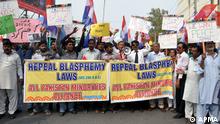
Monday, September 3, 2012

Don't trust NAB, ask Scotland Yard to probe Arsalan Iftikhar

Asma Jahangir, the former president of the Supreme Court Bar Association (SCBA), on Monday criticised the role of the Supreme Court and its decision to form a one member commission to further investigate the Dr Arsalan Iftikhar case, suggesting the Court instead turn to foreign investigation agencies if it did not trust state institutions. Talking to reporters at the Lahore High Court premises, Jahangir alleged that the Supreme Court was not meeting the requirements enshrined for delivering justice in the case against Dr Arsalan Iftikhar, son of Chief Justice of Pakistan. She also rejected the appointment of Dr Shoaib Suddle, the officer tasked by the SC to investigate the case after barring the NAB from investigating into the matter. Jahangir alleged the apex court wanted to facilitate the investigations by appointing Suddle since he enjoyed close ties with Dr Iftikhar. Suddle could therefore, not be trusted to conduct a transparent investigation. “The Supreme Court should ask the Scotland Yard to conduct the investigation of Dr Arsalan Iftikhar case if it has no confidence in the national institutions”, she said. She added that Suddle was also known to be a regular attendant of Dr Iftikhar’s events. Therefore, he could not be expected to conduct a transparent investigation into the case. While maintaining that the law of benefit of doubt should be given to Dr Iftikhar, it should be treated equally for everyone. Criticising the court’s decision, she said if there were any questions over the National Accountability Bureau’s (NAB) investigating team, then the team could have been changed instead of changing the investigating authority. August 30, the Supreme Court had accepted a review petition against its own earlier order, appointing Federal Tax Ombudsman Dr Mohammad Shoaib Suddle as the one man-commission to probe the controversial case regarding a business deal worth Rs342 million between Dr Arsalan Iftikhar and business tycoon Malik Riaz.

Hilary Clinton Decries Violence in Northwestern Pakistan

Secretary of State Hillary Rodham Clinton, on an Asian tour, is condemning a suicide bomber for ramming his car into a U.S. government vehicle in northwestern Pakistan, injuring two Americans. Clinton, in the midst of an Asian tour, says at the outset of a news conference in Jakarta that she wants to "very clearly condemn the attack on our consulate personnel in Peshawar, Pakistan." Clinton adds, "We pray for the safe recovery of both American and Pakistani victims and once again we deplore the cowardly act of suidice bombing and terorrism that has affected so many around the world." Clinton was in Indonesia's capital Monday to offer U.S. support for a regionally endorsed plan to ease rising tensions by implementing a code of conduct for all claimants to disputed islands.

Labor Day: A Changed US Holiday

http://www.voanews.com/
Americans are celebrating the Labor Day holiday, a moment born as a salute to the nation's unionized workers that now has often morphed into a day of family gatherings marking the unofficial end of summer. The first Monday in September became an official U.S. holiday in 1894 to celebrate a “wokingman's holiday,” and through the decades the country's industrialized centers often staged large parades honoring unionized factory workers. But with the growth of technology and the globalization of the world economy, the U.S. labor movement has declined sharply. Many benefits sought by unions over the years, such as the basic five-day work week and employer-paid health care and vacations, have long been enshrined in much of the U.S. workplace. Many U.S. corporations still actively oppose unionization of their workforces. Only about one-in-eight U.S. workers belongs to a union, about half the rate of 30 years ago. Many of union members work for local, state and federal governments in white-collar jobs, not in the gritty factories where the labor movement started. The U.S. Labor Day is often celebrated as a day off from work with family picnics and outings, and in some communities it is the last day before children head back to classes for the start of a new school year on Tuesday.

Afghan situation after 2014 remains challenging

"I'm a tailor. I've owned this tailor shop for eight years," said Sayed Jalal, who moved his small shop from Peshawar, Pakistan to Kabul eight years ago. "This was initially a small shop, but year after year, my business gets better. Now I own two other shops and have several workers working for me. The business is very good nowadays." Although the business is good, this shop-owner still feels concerned about his future. When asked about his prospect for post- 2014, he said, "I am a little worried about the future as the U.S. and NATO forces are getting ready to withdraw from Afghanistan. I am not optimistic and like many Afghans." "I am concerned that there might be another civil war after the pull out of the foreign forces at the end of 2014," explained Sayed. "We are afraid maybe Taliban would make a comeback and we would lose all progresses that were gained over the past 10 or 12 years." Sayed is not the only one that shares this concern. Amrullah Aman, a retired Afghan National Army general and a defense expert, told Xinhua, "If the world community once again leaves Afghanistan at lurch, it would plunge into chaos and thus all the progress we had made over the past 10 years would end in fiasco and the country will once again become the terrorists sanctuary which eventually threats the security of U.S. and the world." According to Aman, Afghan security forces haven't been ready in terms of equipment and capabilities. After coalition forces withdraw from Afghanistan in 2014, the Taliban insurgents would grow more active, worsening the currently fragile security situation. "If Taliban come back to power, it will be very difficult to work here as a tailor," said Sayed. "Because Taliban would not leave young men and women to wear new cloth and walk across the city." For others, the return of Taliban means they must once again engage in battle. "If Taliban returns, I would pick up arms and fight them once again." Abdul, a local driver, told Xinhua. In the past 10 years after Taliban regime was toppled, Afghanistan has made huge progress in all fields. Statistics from Afghan government and United Nations Assistance Mission in Afghanistan (UNAMA) shows that Afghan economy kept an annual growth rate of 8 percent while annual income per capita increased to 520 U.S. dollars in the past 9 years. Education, especially for girl students, has been greatly improved. The development of communication and energy industries also picked up paces. For the post-war reconstruction, the international community has offered huge amount of aid to Afghanistan. Figures from Oxfam, an international NGO, show that, although Afghanistan has made tremendous progress in terms of medical care and education, this Central Asian country is still one of the poorest countries in the world, with almost 97 percent of its GDP comes from foreign agencies in this country. Therefore, after foreign troops withdraw from Afghanistan in 2014, Afghan economy may very likely experience a huge blow. "Recently, and particularly since this summer, the housing business has gotten worse in comparison with the last year and the year before," said Gul Rahman, a real estate dealer in Kabul. "To be frank, there is a 50 percent decrease in the rental price for foreigners, international and non-governmental organizations agencies compared with the previous years. Why the price is cut? Because people think that majority of the aid organizations and foreign agencies are leaving the country as international aid is declining in Afghanistan." The prices of houses also dropped off at about 30 percent, according to Gul, because the investors are also not sure that the situation in the country gets better in future. They are afraid when the foreign forces leave the country, there will be no safe environment for their business. Their fear are not baseless, since the internal security situation in Afghanistan is still unstable after 10 years that Taliban regime was toppled. Peace and enduring security is still a dream for most Afghan people, causing many in Afghanistan to find their way out of the war-torn country. Homayon Shoib, a local correspondent in Afghanistan, has been working as a reporter for foreign news agencies in southern province of Kandahar since 2002. With the security situations get worse day by day, especially after Ahmad Wali Karzai, the then Governor of Kandahar province and brother of Afghan president Hamid Karzai, was assassinated in July, 2011, Shoib moved to the relative peaceful city of Kabul to continue his work. "I have had a difficult time when I was working in Kandahar office. Mostly, or to be frank in daily basis, I had covered hundreds of unpleasant incidents in the south over that period of time," Shoib told Xinhua. "One day I covered news about a huge blast in a dog fighting ground where hundreds of people were gathering to watch the dog fighting and the blast left over 200 people killed and injured." Like many Afghans who have worked for foreigners, Shoib decided to leave the country after 2014, out of the fear of Taliban's possible return. "I am a little afraid about the future, because I know, if the support of international community for Afghanistan decline, the situation here will be worse since this war-torn country still needs the help to stand on its feet," concluded Shoib.

Why 2013 will be a year of crisis

Prediction: 2013 will be a year of serious global crisis. That crisis is predictable, and in fact has already begun. It will inescapably confront the next president of the United States. Yet this emerging crisis got not a mention at the Republican National Convention in Tampa. We'll see if the Democrats do better. The crisis originates in this summer's extreme weather. Almost 80% of the continental United States experienced drought conditions. Russia and Australia experienced drought as well. The drought has ruined key crops. The corn harvest is expected to drop to the lowest level since 1995. In just July, prices for corn and wheat jumped about 25% each, prices for soybeans about 17%.These higher grain prices will flow through to higher food prices. For consumers in developed countries, higher food prices are a burden -- but in almost all cases, a manageable burden.Americans spend only about 10% of their after-tax incomes on food of all kinds, including restaurant meals and prepackaged foods. Surveys for Gallup find that the typical American family is spending one-third less on food today, adjusting for inflation, than in 1969. But step outside the developed world, and the price of food suddenly becomes the single most important fact of human economic life. In poor countries, people typically spend half their incomes on food -- and by "food," they mean first and foremost bread. When grain prices spiked in 2007-2008, bread riots shook 30 countries across the developing world, from Haiti to Bangladesh, according to the Financial Times. A drought in Russia in 2010 forced suspension of Russian grain exports that year and set in motion the so-called Arab spring. Since the days of Gamal Abdel Nasser, the Egyptian government has provided subsidized bread to the population. A disk of round flat bread costs about a penny. In the later 2000s, however, the Mubarak government found it could not keep pace with surging grain costs. As Egypt's population doubled from 20 million in 1950 to 40 million in 1980 and now more than 80 million, Egypt has gained first place as the world's largest wheat importer. The price rises of 2007-2010 exceeded the Mubarak government's resources. Cheap bread vanished from the stores. Discontent gathered. In the August 18 issue of the British magazine The Spectator, John R. Bradley, an Arabic-speaking journalist long resident in Egypt, described what happened next: "The conversations of tiny groups of Cairo's English-speaking elites, and their Western drinking companions, were a world apart from talk among the Egyptian masses. ... The main hope of those who poured into Tahrir Square was shared by the revolutionaries in Tunisia: that sudden and radical change would miraculously mean affordable food." And if food prices surge again? China is especially vulnerable to food cost inflation. In just one month, July 2011, the cost of living jumped 6.5%. Inflation happily subsided over the course of 2012. Springtime hopes for a bumper U.S. grain crop in 2012 enabled the Chinese central bank to ease credit in the earlier part of the summer. Now the Chinese authorities will face some tough choices over what to do next. The Arab Spring of 2011 is sometimes compared to the revolutions of 1848. That's apter than people realize: the "hungry '40s" were years of bad harvests across Europe. Hungry people are angry people, and angry people bring governments down. Will 2013 bring us social turmoil in Brazil, strikes in China or revolution in Pakistan? The answer can probably be read in the price indexes of the commodities exchanges -- and it is anything but reassuring.

Egypt state TV gets 1st veiled news anchor

.....WELCOME TO ISLAMIST REGIME.....

Move reflects shift in official media since overthrow of Hosni Mubarak, subsequent rise of Islamists A veiled anchorwoman read the news on Egypt's state television for the first time on Sunday, reflecting a shift in official media since the overthrow of Hosni Mubarak and the subsequent rise of Islamists. Fatma Nabil made her first appearance on the Channel 1 midday broadcast, wearing a black suit and a cream-colored scarf or hijab covering the hair and neck.Until the revolution that toppled President Hosni Mubarak last year and brought a Muslim Brotherhood president to power, women in Islamic headscarves and particularly full-face veils had been kept firmly out of the media. Women who wore hijab were allowed to work in Egypt's Radio and Television Union as long as it was off-camera.But new Islamist Information Minister Salah Abdel Maqsud told a private satellite channel on Saturday he could see no reason why a woman in hijab could not present the national news. "Finally the revolution has reached" Egyptian media, Nabil told the Muslim Brotherhood's daily newspaper, Freedom and Justice. The 2011 uprising opened the way for the long-banned but powerful Brotherhood, as well as other Islamist movements, which won a crushing victory in parliamentary elections. President Mohamed Morsi resigned from the Brotherhood – Egypt's largest and most organized political force – when he was elected president in June. Most Muslim women in Egypt wear the hijab, which covers the hair. The niqab, which covers the entire face, is also becoming more popular on the country's streets.

Syrian crisis: clash between strategic interests of foreign powers

A Syrian parliamentarian said the 17-month-old crisis in Syria is not an internal conflict between the spectra of Syrian people, but a clash over the strategic interests between regional and international powers. In a recent interview with Xinhua, Khaled Aboud said the war is between Syria, Russia, Iran and other allies on one side, and the United States, Europe, Israel and Arabs on another side. Iran and Russia "don't play a role" in the Syrian crisis, but were dragged into the fighting over interests, "which happened to be in Syria's favor," according to Aboud. Aboud charged that the United States has used several "tools" in its engagement with the Syrian side, including economic, political and diplomatic sanctions. He noted that the United States has now moved toward another tactic, which is "creating a group of tools on ground to confront the state by violence." In order to achieve the latest tactic, Aboud said, the United States needed to create another part in order to make the conflict seems realistic between the Syrian state and the opposition. Aboud said the United States supports only the opposition that totally rejects the regime, while at the same time questions and regards as "not national" those opposition that went toward reconciliation with the regime and engaged with the regime in forming a new government. On the UN Supervision Mission in Syria, Aboud contended that the mission has been formed to create a political backdoor for the United States in case it failed to topple the regime using the tools that it has been using such as sanctions, and fanning the flames of fighting on ground. On the future of the Syrian crisis, Aboud expressed optimism that "we are heading towards arranging the Syrian table and a settlement." He made a connection between a possible settlement and the regional visit of Saeed Jalili, Secretary of Iran's Supreme National Security Council, expecting that it would prepare the settlement table for the confronting parties in the Syrian issue.

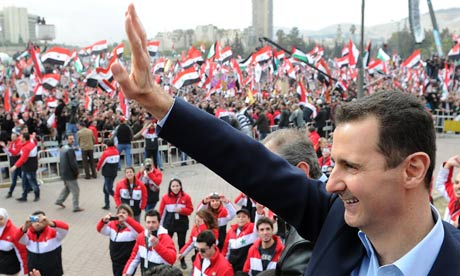
“Why I support Bashar al-Assad”

As fighting in Syria grows fiercer and the death toll continues to mount, President Bashar al-Assad still enjoys support from parts of the Syrian population. We spoke to a number of people who continue to rally behind the embattled leader.
There’s no easy political solution to ending more than 17 months of conflict in Syria, a feat made complicated partly because of deep divisions within the international community. While Western countries have called for Assad to step down, Russia, China and Iran – which all back the Syrian regime – continue to advocate for negotiations between the Syrian government and opposition forces. More than 25,000 Syrians, the vast majority of whom are civilians, have been killed since the beginning of the conflict, according to the Syrian Observatory for Human Rights (SOHR), while a further two million have been forced to flee their homes. In a report published on August 15, a panel appointed by the UN Human Rights Council found that there was enough evidence to believe that the Syrian government and pro-Assad forces had committed “crimes against humanity”. The report examined several incidents, including a May 25 Houla massacre, where 108 people – including 49 children – were slaughtered. Opposition forces have also been accused of war crimes, though not on the same scale as the Assad regime. Because the Observers Team has repeatedly given opposition activists the opportunity to shed light on atrocities committed by government forces, we felt it was important to also give Assad’s supporters a chance to express their views.
“I prefer Assad to the jihadists”
Louaï, 40, is a film editor. I support Bashar al-Assad because I am against the opposition. The only chance this country has of getting out of this crisis is if the opposition stops using violence and takes a seat at the negotiation table without any preconditions [the Syrian National Council, an opposition organisation, has said they will only enter negotiations if Assad quits power]. I am not opposed to a transfer of power, but it can’t happen without Assad. He is the only one capable of finding a solution. Those who are fighting the regime did not take up arms to fight for democracy, they are simply trying to take over power. The Free Syrian Army is made up of jihadist Salafists, many of whom have come from abroad to wreak havoc in our country. “I worry when I look at what is going on in countries that have recently had revolutions” Personally, when I look at what is going on in countries where revolutions have spurred regime change, like in Tunisia where Salafists are now trying to impose their law through violence, I find the prospect of an opposition victory in Syria is worrisome. Jaramana, where I live [about 10 kilometers or six miles outside the capital Damascus], was the calmest city in Syria until three days ago, when a car bomb exploded near a funeral convoy. Here, different communities – Christians, Sunnis, Alawites, Druze – have always lived in complete harmony. I am Shiitte, and my wife is Christian. Our peaceful coexistence, however, is now under threat. I doubt that the jihadists will adhere to democratic values and from attacking Syrians with different beliefs if they succeed in overthrowing the government.
“Assad has undertaken democratic reforms”
Nourane, 30, lives in Damascus. We must not forget that Assad was responsible for launching democratic reforms. He abolished the state of emergency [in a bid to appease opposition factions, the government adopted a series of reforms in April 2011 that brought an end to the state of emergency, abolished the Supreme State Security Court and implemented a new constitution based on political pluralism (February 26, 2012)]. I voted democratically for his reelection [Assad was reelected president in May, 2007 with 97.62 percent of the vote. The election was widely believed to be fraudulent] and for the new constitution. Should the opposition really have the right to remove an elected president? We cannot blame Assad for all of Syria’s problems. Mistakes are often made by local officials, as the president cannot be everywhere at once. Remember that the crisis started in March, 2011 in Deraa. Government forces had opened fire on protesters who were advocating the release of several teenagers that had been arrested for spray painting slogans of the Egyptian Revolution. That is what originally set things off. But we forget that the president dismissed and sanctioned the governor of Derra, Faisal Kalthoum, who was responsible for imprisoning the teenagers and opening fire on protesters. The president even made an effort to address the issue by meeting with Derra’s clan chiefs. We are all against corruption and bureaucracy, and in favour of greater liberties in Syria. But we do not want these people, who are massacring the Syrian people in the name of freedom. The president has already tried to put in place exactly these kind of reforms [faced with mounting tensions, Assad announced in February of last year plans to reduce taxes, create 67,000 government jobs, and his intention to fire hundreds of civil servants accused of corruption].

Russia, U.S. differ on Assad's future: Russian FM

Russia and the United States shared common goals on solving the Syrian crisis but differed on the future of President Bashar al-Assad, Russian Foreign Minister Sergei Lavrov said Monday. Ahead of his participation at the Asia-Pacific Economic Cooperation (APEC) summit in Russia's Far Eastern city of Vladivostok, Lavrov told local media Moscow and Washington did not "contradict each other in principle" on Syria. Both of the two countries wanted to see a peaceful transition via intra-Syria negotiations while "respecting the sovereignty, independence, unity and territorial integrity of the country," RIA Novosti news agency quoted Lavrov as saying. However, the two sides held different views on whether President Assad should go and how, said the senior Russian diplomat. Lavrov called for the crisis to be solved at the negotiating table by the Syrian people, calling the intention to dictate the future of Syria by outsiders as "counterproductive." The Russian minister is expected to meet with U.S. Secretary of State Hillary Clinton on the sidelines of the APEC summit. Lavrov said Saturday that the Western approach of demanding external interference and the resignation of Assad as a precondition of negotiations was rather unrealistic. He reiterated Russia's stance, saying Moscow "was not backing any regime or any individuals" in the Syrian crisis. Meanwhile, those "players" who spurred the opposition to fight the Syrian authorities did not care about the interests of the Syrian people and were guided by their own "geopolitical considerations," said Lavrov.

Obama eyes future with convention speech

The Greek columns may be banished and the "hope" and "change" signs gone, but President Barack Obama's
pitch to American voters at the Democratic National Convention this week will have echoes of his 2008 speech, when he cast himself as a visionary leader in touch with the nation's priorities. Dogged by a sluggish economy and in a tight race with Republican rival Mitt Romney, Obama will use his time in the spotlight on Thursday to focus on education, tax cuts for those making less than $250,000, energy, immigration and social issues, his advisers indicated. By talking in more specific terms than Romney did last week, Obama's team hopes to draw a contrast between the two men. The president's team believes that Romney missed a big chance during the Republican convention to lay out a blueprint for fixing the U.S. economy. Romney called for fewer government regulations and lower taxes but offered few details in a speech that emphasized his biography and amounted to a rebuttal of months of attacks from Obama's team. The Obama campaign has cast the former private equity executive as an aloof tycoon who is out of touch with middle-class America. Unlike the former Massachusetts governor, Obama needs no re-introduction to the American public, his campaign advisers say. So as Romney's campaign casts Obama as a failure in improving the economy, the president - trying to become the first since World War II to be re-elected with an unemployment rate above 8 percent - will argue that he has better ideas to help the country recover from the recession that began under Republican George W. Bush. "This Thursday night, I will offer you what I believe is a better path forward - a path that grows this economy, creates more good jobs, strengthens the middle class," Obama said in a preview of his remarks at a campaign stop in Iowa. "The good news is, you get to choose which path we take. We can take their path or we can take the path that I'm going to present." Obama's team aims to fill the nearly 74,000-seat Bank of America stadium in Charlotte, North Carolina, where the president will deliver his speech, and produce a populist feel that contrasts with Romney's convention. RECAPTURING MOMENTUM With tens of thousands in the stadium and millions watching on television, the prime time speech will be Obama's most prominent opportunity to date to make his case for re-election. Advisers and outside analysts said the president will use the opportunity to highlight elements from his campaign speeches: his support of a bailout that saved the U.S. auto industry, ending the war in Iraq, presiding over the death of Osama bin Laden, and championing women's rights. "Most Americans aren't hearing his stump speech except in little bits and pieces," said Jeff Shesol, a former speechwriter for Bill Clinton who worked on convention speeches in 2000, 2004, and 2008. "He absolutely shouldn't come up with a brand new message, a brand new take on who he is, where he comes from, what he's been doing and what he plans to do in the next term," Shesol said. Obama vaulted onto the national stage as an Illinois state senator in 2004, when he gave a well-received address for the Democratic presidential nominee that year, Massachusetts Senator John Kerry. Four years later in Denver, Obama delivered his own acceptance speech, drawing criticism from Republicans for the setting - a stage adorned with faux Greek columns. Still, Obama basked in the energy of a huge stadium crowd, a symbol of the momentum that helped propel him to victory that year. A lot of that momentum is gone now. Unemployment is at 8.3 percent, raising questions about whether Obama can match the huge support he received among minorities and young people four years ago. Meanwhile, new Republican-backed voter ID laws in several states could undermine turnout for minority and low-income voters in particular, as they are among the groups most likely to have difficulty obtaining the required identification. MAKING HIS CASE In Charlotte, Obama will have some significant help in making his case. His popular wife, Michelle, former president Bill Clinton and others will offer testimonials with forward-looking themes. Clark Judge, a former speechwriter for Republican President Ronald Reagan, said Obama was unlikely to dwell on the themes of "hope" and "change" because that would require him to defend promises he did not keep from 2008. "The problem with doing too much of that is he's then got to explain failure, and I'm not sure that they want to get into that," Judge said. He added that he expects Obama to keep on attacking Romney's plan to revamp Social Security and Medicare, popular safety net programs for the elderly. Obama's advisers watched the Republican convention closely but said they will not change their plans for Charlotte in response. "In terms of rebutting Republicans or altering what we're going to achieve (this) week, really, there's no impact" on the Democrats' convention strategy, said Obama deputy campaign manager Stephanie Cutter. "I think the American people are smarter than that." David Axelrod, Obama's chief campaign strategist, said Romney's speech was filled with "snarky lines" and "gauzy reminiscences of the past." He said Obama's address would be markedly different. "This speech is going to reflect the thinking of a leader who has great confidence in this country and a ... clear sense of what we need to do to continue to repair the damage that was done by the recession and to reclaim the economic security that many Americans have lost," Axelrod said.

Blasphemy case: Still no bail for Rimsha

The Express Tribune
A young Pakistani Christian girl accused of blasphemy in a case that has prompted international concern will stay in jail until at least Friday, after a bail hearing on Monday was adjourned. Rimsha has been in custody since being arrested in a poor Islamabad suburb, Mehrabadia, two and a half weeks ago, accused of burning papers containing verses from the Holy Quran, in breach of Pakistan’s strict blasphemy laws. Judge Muhammad Azam Khan adjourned the case until September 7 because of a lawyers’ strike, following a request from the lawyer for Rimsha’s neighbour Hammad Malik, who filed the original complaint against her. Police on Saturday arrested Hafiz Mohammed Khalid Chishti, the imam of the mosque in Rimsha’s area who first submitted the burnt papers as evidence against her, after his deputy told the police that he had tampered with the evidence. Chishti’s deputy Maulvi Hafiz Mohammad Zubair and two others, Mohammad Shahzad and Awais Ahmed, told a magistrate the cleric added pages from the Holy Quran to the burnt pages brought to him by a witness to beef up the case against her. A medical report last week said Rimsha appeared to be around 14 years old, which would make her a minor, and had a mental age below her true age, but the court has yet to decide whether to accept the assessment. Some reports have said Rimsha has Down’s Syndrome and her case has prompted concern from Western governments and anger from rights groups, who warn the blasphemy legislation is often abused to settle personal vendettas.

No American killed in Peshawar blast: US embassy

The US embassy in Islamabad Monday denied reports that two Americans had been killed in a suicide car bomb attack in Pakistan s northwestern city of Peshawar. An embassy spokesman said they had no reports of any Americans killed in the blast, after provincial information minister Mian Iftikhar Hussain said two had died. "The blast killed two Americans. This is a dangerous move from the terrorists -- they want to terrorise the foreigners," Mian Iftikhar Hussain told AFP, adding that two Americans were also wounded in the blast. Police have recovered a half-burnt US passport from a car badly damaged in the blast, officials said. The blast took place near residential quarters for the US consulate and foreign aid organisations, senior police officer Tahir Ayub said, adding that at least five people were killed. "The car targeted was a US consulate vehicle," one intelligence official said.

PPP to continue working for people's welfare

Pakistan People's Party is taking solid measures to improve the life of common man by providing all the basic necessities of life. Member of the PPP central executive committee Ch. Manzoor Ahmed said this while addressing a gathering after inaugurating Sui gas connections here in Gulberg colony on Monday. He assured the public gathering that PPP led government was making efforts to ease out power crisis. However, he criticised that Nawaz Sharif government disbanded the project initiated by former Prime Minister Benazir Bhutto to create 40,000 MW electricity with the cooperation of France. Ch Manzoor further criticised PML-N for politicising the loadshedding situation. However, he re-affirmed his party's resolve to continue working for democracy in the country and people's welfare.

Pakistani cleric faces possible blasphemy charge

http://www.boston.com
Pakistani police say they are investigating whether a Muslim cleric who allegedly tried to frame a Christian girl for blasphemy should be charged with insulting Islam himself. Police officer Munir Jafferi says officials registered the blasphemy case against Khalid Chisti on Monday. Police arrested Chisti on Saturday after a member of the cleric’s mosque accused him of stashing pages of a Quran in a Christian girl’s bag to make it seem like she burned the Islamic holy book. He has denied the allegation. Jafferi says Chisti could be sentenced to life in prison if he is convicted of desecrating the Quran. The Christian girl’s lawyer, Tahir Naveed Chaudhry, says his client will remain in prison until at least Friday after her bail hearing was delayed for the second time Monday.

Car bomb hits US vehicle in Pakistan

Journalist Shaukat Paracha reports on an explosion in Peshawar, Pakistan, in which an American vehicle was targeted.

Afghan refugees

The problem with being a refugee anywhere is that sooner or later — and it could be a lot later — it will be time to go home. The Afghans living in Pakistan, still the largest population of refugees anywhere in the world, now face the difficulty of leaving what for many is ‘home’ and returning to their own country — which for many is not home at all. Broadly speaking, Afghan refugees in Pakistan fall into two categories: registered and unregistered. Many of them are second-generation and were born here. Those that remain are mostly in Khyber Pakhtunkhwa, but they are scattered across the entire country to a greater or lesser degree. There may be as many as three million, and Pakistan has decided it is time for them to go home. Those that wanted to go home already have, which leaves a significant population of Afghans who have little or no desire to return to their home country.
Those registered have a valid status only until December 31 2012, those unregistered have no status whatsoever. The Khyber Pakhtunkhwa government had directed all unregistered Afghans to leave by August 31, a deadline now past. The statement is unequivocal in saying that all Afghans, registered and unregistered have to leave by December 31 2012 and a humanitarian crisis is before us. There are reports that other provinces have already been moving to clear their Afghan refugee populations, deporting them via Torkham. Those with businesses — and there are many — are being advised to pack up, liquidate their assets and move back whence they came. The statement flies in the face of that made by the United Nations High Commission for Refugees (UNHCR) last month. The UNHCR was quick to deny a report in a foreign newspaper that Pakistan was planning to repatriate the Afghans by the end of the year, a denial now clearly at variance with ground realities. There is going to be no happy or tidy end to the story and persuading — or forcing — nearly three million people back across the border in the next four months is going to be a huge logistical task. The government and the UNHCR need to be reading off the same page which is apparently not the case at the moment; and a joint statement defining the true nature and future of Afghan refugees in Pakistan would be greatly welcomed. This issue must be handled with maturity and with proper planning and resources else it turns into a major source of disturbance and violence in an already troubled situation.

US to fund Torkham road reconstruction

DAWN.COM
The US government has agreed to finance construction of Peshawar-Torkham Highway, which serves as main supply route for Nato forces in Afghanistan. According to an official statement issued here on Sunday, the US government will provide Rs5.60 billion for construction of the 45-kilometre road. Khyber Pakhtunkhwa Governor Barrister Masood Kausar has directed the quarters concerned to start work on this vital project immediately. The project, to be started this year, will be completed within 18 months. The statement said that Frontier Works Organisation, a subsidiary of army, would construct the road as National Highway Authority (NHA) would work as executing agency. To ensure timely completion of the project, Fata Secretariat would play a lead role. Work on the highway will be started on war footing as staff has been hired for the purpose. The statement said that principal agreement with United States Assistance for International Development (USAID) had been reached and an accord with the donor agency would be signed in the second week of September. After the agreement, work would be starred on the much delayed project immediately. The USAID is already helping Khyber Pakhtunkhwa government in Expansion and Refurbishing of Ring Road Project and provided Rs2 billion for the scheme that according to officials would be completed soon. Construction of Peshawar-Torkham Highway is perhaps the first major development project to be financed by the US government following melting of ice after Salala attack for which Islamabad was demanding an apology from Washington for killing its 24 officers and soldiers. The government said that transportation of supplies for Nato forces in Afghanistan was damaging road network, asking the US to rehabilitate those major highways. Officials said that roughly 10,000 small and heavy vehicles were passing through Peshawar-Torkham Highway daily. The construction of highway that passes through Khyber Agency and also serves as a trade route for Afghanistan and Central Asian Republics has been under consideration since 2001. Work on the project could not be started because of financial constraints. An official said that NHA had already completed PC-1 and conducted environmental impact assessment survey of the project. He said that the government had allocated Rs120 million for land acquisition. Initially it was planned to construct an alternate dual carriageway between Peshawar and Torkham that was to pass through Malagori and Loi Shalman. Asian Development Bank had made commitment to bear 60 per cent of the total cost of the project and Pakistan government pledged 40 per cent share. Pre-feasibility study of the proposed carriageway was carried out in 2007-08 while detailed survey was dropped. Sources in NHA that carried out pre-feasibility survey said that estimated length of the carriageway was 90 kilometres through Malagori and Shalman, while distance of existing Peshawar-Torkham Highway was about 50 kilometres.

Peshawar: Two Americans killed in blast

Two Americans were killed in a suicide car bomb attack targeting a US consulate vehicle in Peshawar on Monday, the provincial information minister said. "The blast killed two Americans. This is a dangerous move from the terrorists -- they want to terrorise the foreigners," Mian Iftikhar Hussain told AFP, adding that two Americans were also wounded in the blast.

Afghan commanders defy night operations

Frontier post
Afghan commanders have refused more than a dozen times within the past two months to act on U.S. intelligence regarding high-level insurgents, arguing that night-time operations to target the men would result in civilian casualties, Afghan officials say.The defiance highlights the shift underway in Afghanistan as Afghan commanders make use of their newfound power to veto operations proposed by their NATO counterparts.For much of the past decade, NATO commanders have dictated most aspects of the allied war strategy, with Afghan military officers playing a far more marginal role. But with the signing of an agreement last month, Afghans have now inherited responsibility for so-called night raids - a crucial feature of the war effort.To Afghan leaders, the decisions made by their commanders reflect growing Afghan autonomy from Western forces as NATO draws down, and prove that Afghan forces are willing to exercise more caution than foreign troops when civilian lives are at stake, The Washington Post reported."In the last two months, 14 to 16 [night] operations have been rejected by the Afghans," said Gen. Sher Mohammad Karimi, the top Afghan army officer. "The U.S. has said, 'This operation better be conducted. It's a high-value target.' Then my people said, 'It's a high-value target. I agree with you. But there are so many civilian children and women [in the area].' "Many of the rejected night operations are later conducted once civilians are no longer in the vicinity of the targets, Karimi said.U.S. officials point to progress they have made in their own efforts to reduce civilian casualties, and say that while the Afghans occasionally choose not to act on American intelligence, night operations are nonetheless frequently conducted. Americans continue to provide logistical support and backup, U.S. officials say, using their aircraft to deposit Afghan soldiers at the targets."The Afghans are the ones who give final say on whether or not the mission gets conducted. That's how the process works now," said a U.S. official who spoke on the condition of anonymity to discuss a sensitive issue. "The operational tempo hasn't been affected by this. I don't think there's been a night when they haven't conducted a good number of operations."But the resistance to American guidance on night operations represents the clearest indication to date that Afghan military commanders are heeding a directive from President Hamid Karzai last month. Just a day after signing a 10-year bilateral agreement with the United States, Karzai said Afghan soldiers should discard questionable information provided by the U.S. military. "If you have any doubt about an American intelligence report, do not conduct any operation based on it," he told officials at the Interior Ministry.The Afghan president grew even more disenchanted over the last week, when separate NATO airstrikes killed 18 civilians in Logar, Kapisa, Badghis and Helmand provinces, according to Afghan officials. The president and his advisers said the attacks raise questions about the newly minted partnership agreement."Karzai signed the strategic pact with the United States to avoid such incidents and if Afghans do not feel safe, the strategic partnership loses its meaning," said a presidential statement.In the past, such complaints would have been unlikely to affect military operations. But the transition to greater Afghan control of security has left Karzai and his military in a stronger position to stymie the American strategy.The transition will continue in the coming months. This summer, a number of districts and provinces will be formally entrusted to Afghan security forces, the third round of regional transitions. In September, Afghans will assume responsibility for the U.S. military prison at Bagram, with about 3,000 detainees.In the past, Western officials questioned whether Karzai's opposition to night raids and other U.S.-led operations was politically driven - aimed at proving to his people that he was capable of resisting American demands.Now, with more transitional milestones looming, Afghan political and military leaders say their growing responsibility has made the issue of civilian casualties even more delicate."Most of the people will say, 'I don't blame the foreigners if they kill us, but why do you kill me?' " Karimi said. "We have to be concerned. We have to have people on our side."Each time civilians are killed in either a NATO or Afghan operation, Karzai or one of his advisers calls the Defense Ministry for an explanation. Karimi said the president's involvement in military affairs centers largely on reducing civilian casualties rather than on dictating troop levels or strategy.NATO officials say they have greatly reduced the number of civilians killed in operations in recent years. The United Nations last year attributed 400 civilian deaths to NATO and Afghan forces, a slight decrease from 2010."We have significantly improved attention to detail when it comes to targeting," a U.S. official said.Human rights organizations say they fear that the methods and institutions developed by NATO to both track and prevent civilian casualties will not be replicated by the Afghan security forces."Right now, Afghan forces don't have systems in place to prevent and respond to civilian casualties they may cause. International forces evolved their thinking over a decade, realizing they needed a civilian casualty tracking team and policies to investigate civilian harm caused by their own forces," said Sarah Holewinski, executive director of the Campaign for Innocent Victims in Conflict. "Without those systems in place, verbal commitments from the Afghan government to not harm civilians are likely to fall flat as Afghan forces take over."

Smith contradicts Karzai over deadly Afghan raid

Defence Minister Stephen Smith has directly contradicted claims by Afghanistan's president Hamid Karzai that a deadly Australian raid on suspected insurgents was carried out without proper approvals. Two men - identified by the Afghan government as 70-year-old imam Haji Raz Mohammad and his 30-year-old son Abdul Jalil - were killed during the raid, which was carried out as part of the search for a rogue Afghan soldier who shot dead three Australians last week. Twelve other people were detained during Friday night's raid in Uruzgan province, although 11 have since been released.Mr Karzai has issued a statement strongly condemning the deaths, describing Australia's actions as a "unilateral military operation" that was carried out "without any prior coordination or approval of the provincial authorities". "The President condemns the operation as a breach of the Memorandum of Understanding signed between Afghanistan and NATO on the special military operations," the Afghan government statement says. But Mr Smith has strongly rejected the accusations, saying the partnered raid was fully authorised by the Uruzgan chief of police and the local governor. Mr Smith said the raid involved 60 Australian Defence Force personnel and 80 Afghan National Army soldiers, and the two men who were killed have been confirmed as insurgents by both Australian and Afghan sources. "The statement which has been issued by president Karzai's palace over the weekend in Kabul that this operation was not authorised is wrong," Mr Smith told reporters in Perth this morning. "That is not factually correct, and this point has been made strongly by Australia's ambassador to Afghanistan to palace and presidential officials." The raid was part of a wider search for rogue Afghan soldier Hek Matullah, who killed three Australians in a so-called green on blue attack last week. Lance Corporal Stjepan Milosevic, Sapper James Martin and Private Robert Poate were shot dead, and two other Australians were wounded, when Matullah turned his gun on them at a patrol base in Uruzgan province last Wednesday. The shooting has heightened concerns among coalition forces about the threat of insider attacks, and has prompted the International Security Assistance Force (ISAF) to suspend training for 1,000 Afghan Local Police recruits. ISAF says the move is a "precautionary measure" that will allow for an intensive re-vetting process to take place for the 16,300 current members of the local police force. Australian troops are not involved in training Afghan police, and so are not affected by the suspension. The 11,000 members of the recently inaugurated Afghan National Army Special Operations Division are also having their vetting status checked, but are continuing to carry out their duties. Mr Smith says that means partnered operations between Australian and Afghan forces will continue. The bodies of the Brisbane-based soldiers are now returning to Australia, along with those of two other diggers who died in a helicopter crash the same day. Matullah is still at large but is being hunted by Coalition and Afghan troops. A suspected insurgent leader who is accused of helping him evade the manhunt was captured during the raid. In a statement posted online, the International Security Assistance Force said: "The insurgent leader who was detained by the combined Afghan-Coalition operation in Uruzgan early on Saturday morning is confirmed to be an "IED emplacer" and was previously involved in kidnapping, murder and attacks on Afghan National Security Forces". "At the time of his capture, he was attempting to support and move the insider threat shooter who killed three Australian soldiers and wounded two on Aug[ust] 29."

Afghanistan condems Australian military for killing alleged civilians

http://www.radioaustralia.net.au
Afghanistan's President Hamid Karzai has condemned the Australian military over a raid in which two Afghan men were killed. Australian soldiers had been searching for the rogue Afghan sergeant who shot dead three Australian soldiers last week, and during their mission they captured a suspected insurgent leader who is thought to have helped the killer to escape. The Australian Defence Department says the two men who died during that operation were also suspected insurgents, but villagers have told the media they were civilians. The bodies of the five soldiers who died last week in the deadliest day for Australian forces since Vietnam are returning home. They were farewelled by their comrades in a ceremony at Tarin Kowt. Capturing Sergeant Hek Matullah, the Afghan soldier suspected of shooting Lance Corporal Stjepan Milosevic, Sapper James Martin and Private Robert Poate, remains a high priority. Sergeant Hek Matullah escaped from the patrol base straight after the killings and he's suspected to have been aided by the Taliban. After an extensive search Australian troops aided by Afghan forces have detained a suspected insurgent they say helped with the escape. But the raid has come at a cost. Two Afghan men were killed by Australian troops. The ADF says all the proper rules of engagement were followed but Afghanistan's president Hamid Karzai is furious. Local reports say those killed were a 70 year old Imam and his son. It's also been reported that the Australian troops detained a number of locals, including a woman, during the operation. President Karzai says the Australian forces acted unilaterally and he wants a full inquiry into the situation. The latest incidents have highlighted the problems "green on blue" killings are causing for western forces in Afghanistan. At least 45 Western soldiers have died at the hands of Afghan allies this year. Now ISAF has suspended the training of new recruits to the Afghan local police. NATO spokesman Colonel Thomas Collins: THOMAS COLLINS: As you know we've had a problem here with some security challenges. Eventually there will be a tightening of the vetting procedures across the force and we've already begun working with the Afghan government on how we can make the vetting process better. MICHAEL EDWARDS: Complaints about Afghan local police range from corruption within its ranks to allegations its members rape and kill innocent civilians. Heather Barr from Human Rights Watch in Afghanistan says it's a program with a range of serious problems. HEATHER BARR: First is with the vetting, which is the issue that's come up today and has finally caused a reaction. There are also serious problems with the command and control structures for the Afghan local police as well as in terms of accountability mechanisms for what's in place when something goes wrong. MICHAEL EDWARDS: ISAF has high hopes that the Afghan local police will be an effective force against the Taliban at a local level after 2014. But Heather Barr is sceptical that it can be turned into an efficient and reliable counterbalance to the insurgents. HEATHER BARR: It's really difficult to repair a program at this stage and especially with this 2014 deadline looming. So it's certainly big news that the US has seen that there are issues and is working to resolve them. But it's frustrating indeed that it took so long and that there are so many abuses and lives that have been lost in the process. MICHAEL EDWARDS: ISAF says it could take a couple of months before training of Afghan local police recruits resumes. It says training of other Afghan security forces - including the army - continues.

Peshawar: Car bomb hits US vehicle, 3 killed

Three people died while five others injured with a blast in a UNO van on Peshawar University Road. Police say a car filled with explosives rammed into a U.S. government vehicle in northwest Pakistan, killing three people and wounding ten others. Police officer Pervez Khan says the vehicle was attacked in the northwest city of Peshawar on Monday after it left the U.S. Consulate. Khan said some of the wounded were foreigners. The identities of those killed were unclear. The attack occurred in an area of Peshawar hosting several foreign organizations, including the United Nations. Local TV footage showed an SUV at the site that was completely destroyed and burned. U.S. officials could not immediately be reached for comment.

Sunday, September 2, 2012

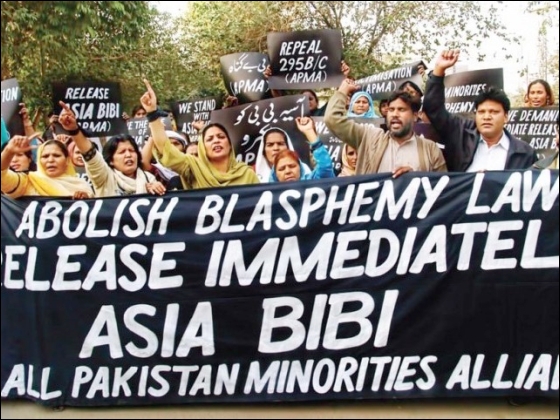
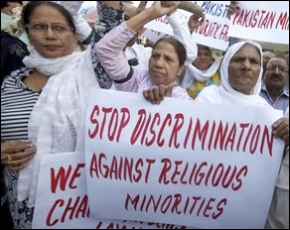
Pakistan: State against minorities

BY: Chaudhry Faisal Hussain
THE concept of a Muslim state vis-à-vis its minorities, as envisaged by those that oversaw the creation of Pakistan and the members of the first Constituent Assembly, is hardly understood today. In his Aug 11, 1947 speech, Mohammad Ali Jinnah delivered a message of freedom to not just Muslims but also the minorities living in the country.
Assuring them of equal status, he said famously: “You are free; you are free to go to your temples, you are free to go to your mosques or to any other place or worship in this state of Pakistan. You may belong to any religion or caste or creed — that has nothing to do with the business of the state.… We are starting in the days where there is no discrimination, no distinction between one community and another, no discrimination between one caste or creed and another. We are starting with this fundamental principle: that we are all citizens, and equal citizens, of one state.” Following this vision, the first Constituent Assembly adopted the Objectives Resolution which said that “adequate provision shall be made for the minorities to profess and practise their religions and develop their cultures.”
It added that there would be “guaranteed fundamental rights, including equality of status, of opportunity and before law, social, economic and political justice, and freedom of thought, expression, belief, faith, worship and association, subject to law and public morality”. There were meant to be “adequate provisions … to safeguard the legitimate interests of minorities and backward and depressed classes”. Was it sufficient to merely pass a resolution and include the rights of minorities in the constitution while doing little to actually put such ideals into practice? What steps did the state take to make the nation aware of the rights of those who are in fewer numbers? The hard fact is that constitutions or laws cannot change societies or deliver on intentions unless they have social acceptance and the full backing of the state. This is what has led Pakistan to the current pass in terms of its minorities. The bitter reality is that the state machinery has, since its creation, miserably failed to protect minorities’ rights. While on the one hand governments have been enacting rosy-looking legislation, on the other they have failed in practice to create a consensus policy agenda on minorities’ status within Pakistan that would create a more conducive national mindset. In fact, they have remained involved in painting and treating minorities as unequal. Article 5 of the constitution states that loyalty and adherence to the constitution is the basic responsibility of every Pakistani citizen. Not only does the constitution extend equality to citizens regardless of caste or creed, under Article 36 it also imposes upon citizens and the government the responsibility of safeguarding the legitimate interests of minorities. This includes due representation in the federal and provincial services as well as social and economic justice and equality for minorities in the eyes of the law. Practically, however, minorities are disempowered. Contrary to the Quaid-i-Azam’s vision and constitutional bindings, the state has been unable to ensure minorities’ vibrant participation in state affairs. How many non-Muslims have been promoted to higher bureaucratic posts? How many non-Muslim police chiefs or chief secretaries and secretaries have there been during the past 65 years? How many members of minority communities have been inducted into the Pakistan Army and promoted to top ranks? What additional qualities do our Muslim politicians possess so that the prime minister and president of Pakistan can be chosen from amongst them, and amongst them alone? At the moment, there is not one judge from the minorities amongst the superior judiciary in any of the four provinces, the Islamabad High Court or the Supreme Court. Does Article 36 of the constitution not apply to the courts? Pakistan needs reminding that its proud judicial history includes people such as Justice A.R. Cornelius and Justice Dorab Patel. The buck doesn’t stop with the state. A lack of tolerance of other sects and belief systems has seeped into not just the minds of state functionaries, but also of private citizens. The extent to which most of the population is discriminatory towards minorities is nothing short of amazing. The electronic, print and social media, too, particularly in Urdu and the regional languages that most of the citizenry taps into, have by and large served to entrench intolerance and foment religious hatred. Cases involving minorities or religious matters, especially allegations of blasphemy, are often misreported or reported with sensationalist overtones. An issue as serious as sectarian killings is treated as newsflashes to be followed by spice-laden gossip masquerading as informed analysis. The sum effect of such influences was encapsulated in the murder in broad daylight of a governor in office by a man on his own security detail. Where does the answer lie? A reasonable place to start is the education sector: everyone should have access and the curriculum should be cleansed of anything that gives rise to prejudice against religious or other minorities. Religious and sectarian tolerance needs to be taught as a school subject and in military and judicial academies. Concurrently, Pakistan needs strict state action whenever cases of forced conversions come up and in incidents of religious and sectarian hatred. The state must adopt basic measures and teach people how to live in harmony in the true sense with people belonging to other castes and creeds.

'Afghan Taliban comeback will be bad for Pakistan'

South Asian News Agency (SANA)
United Kingdom High Commissioner in Pakistan Adam Thompson has said that the return of Taliban in Afghanistan will be a bad news for Pakistan. He said that the point of view of UK on drone strikes clear, adding that this is matter between Pakistan and US and UK want to see good relations between Pakistan and US. In an interview with a private TV channel, Thompson said Afghan people had experienced Taliban atrocities in the past and if Taliban make a comeback there, it would be bad for them and for Pakistan as well. “Pakistan is a key partner in Afghanistan peace and we would like to contribute in a political settlement of Afghan issue in a positive way,” he said. To a question he said United States had its own stakes in the region and its own policies and priorities. Though we are allies but we have our own priorities, he added. Emphasizing the importance of peace and stability in Afghanistan he said Pakistan can play a key role in it. “We cannot claim to understand Afghans as closely as Pakistanis can,” he said, adding UK would love to contribute in the process of Afghan peace positively. He said UK forces will be withdrawn from Afghanistan in 2014. Dispelling the impression of UK involvement in Balochistan he said it was a fantasy. When asked some Baloch separatist leaders were living in UK and operating from there, he said all kinds of foreigners live in Britain and British government has nothing to do with their political affiliations. He categorically said that Britain would never like to harm Pakistan in any way. “Impression that UK is associated with Balochistan separatists is only a fantasy,” he said. Thompson said United Kingdom was helping Pakistan in various sectors. He strongly rejected the impression the UK was in anyway linked with Balochistan unrest. He said he always tried to convince the British community that Pakistan was not as scary a place as portrayed in the international media. Thomson said United Kingdom was helping Pakistan in education sector more than any other country, both on primary and higher education level. “We prefer Pakistan in education to any other state,” he said, adding there is research collaboration between UK and Pakistan universities.

Islamic conspiracy theory revealed in Rimsha Masih blasphemy case

http://www.pakistanchristianpost.com
Dr. Nazir S Bhatti, President of Pakistan Christian Congress PCC have paid homage to Hafiz Mohammad Zubair on takeing a very daring step to come forward to reveal truth in Rimsha Masih blasphemy case to upheld true Hafiz Mohammad Zubair to told media after recording his statement before area magistrate “The Imam of a Mosque in Mehrabad, a slum of capital city Islamabad, Khalid Jadoon, manipulated the evidence against Rimsha Masih case of blasphemy”                                                                                                  The Imam of mosque in Mehrabad slum of Islamabad urged Mohammad Ammad to lodge a complaint in Ramna Police Station on August 17, 2012, that a Christian girl have set on fire pages of Holy Quran and committed blasphemy, The Ramna Police Station Islamabad, lodged a report under Section 295 B PPC against minor disabled girl Rimsha Masih. The complainant Mohammad Ammad with collaboration of Imam Khalid Jadoon, announced on mosque loudspeaker to punish blasphemer Rimsha Masih on which area Muslim women attacked Christian girl and his mother and tortured them while Muslim men started burning homes of Christians and a Church on which hundreds of Christians fled from area to save their lives.
Minor disabled Christian girl was rescued by Police and charged under blasphemy on report of Islamic cleric and sent to Adiala jail Rawalpindi on 14 days judicial remand. Hafiz Mohammad Zubair (Who teaches Quran in mosque to children) told media “Ammad, the complainant in the case, handed over the ashes of Quranic verses to the Imam of the mosque Khalid Jadoon, who also added more verses to it and put in trash where Rimsha Masih have thrown her home garbage” The Ramna Police arrested Imam Khalid Jadoon today after statement of Hafiz Zubair and other eye witnesses and a new turn took in Rimsha Masih blasphemy case in Pakistan. The eyewitness further said in his statement that he himself along with two more Motakif protested against the manipulation of the evidences. He said that he and other eyewitnesses had asked Khalid Jadoon to present the real evidences against Rimsha. Meanwhile, the religious scholar Tahir Ashrafi has asked the Ulema as to what kind of punishment Imams like Khalid Jadoon deserved. Dr. Nazir Bhatti urged Pakistan government to immediately announce procedural amendment in lodging FIR in blasphemy cases as this Islamic law is being widely misused to settle personal scores in Pakistan against Christians and Ahamadiyya communities.

President Zardari: Govt can no more afford persistent load shedding

Radio Pakistan
The President has directed concerned departments to take coordinated steps to end electricity and gas load-shedding
President Asif Ali Zardari has urged Ministries of Petroleum‚ Finance and Water and Power to work in unison and take concerted and coordinated steps to end electricity and gas load shedding in the country. He was chairing a meeting in Karachi on Sunday to review current energy situation and the progress on various measures being taken to overcome the power shortage in the country. The President said the government can no more afford persistent loashedding as it was adversely impacting the country's economy. The President directed that he should regularly be updated about the power situation adding that the government accords high priority to improve energy situation before up-coming elections. He said local bodies elections will be held this year at all cost before general elections. He said a bill relating to local body system will be passed by the Sindh Provincial Assembly within two months. President Zardari said PPP will form alliance with the allied parties to contest the up-coming general elections hoping that it will again emerge as the majority party and form new government at centre and the provinces. He said PPP has given sacrifices for democracy and it will continue policy of reconciliation to further strengthen it. Minister for Water and Power Chaudhry Ahmad Mukhtar briefed the meeting about the latest power situation in the country and said that various immediate measures taken by the government resulted in reducing the supply and demand gap. He informed the meeting that the power situation is steadily improving and expressed the hope that with the rising water levels in reservoirs as a result of recent rains‚ the situation will improve further. Chairman WAPDA briefed the meeting on various hydel power projects. The meeting was briefed about the progress made so far in the construction of Diamir Bhasha Dam and the efforts being made to garner finances for the project. The meeting was informed that Tarbela Dam was likely to be filled soon while Mangla Dam has been filled to a level of over 1180 feet against a level of 1230 feet. Advisor to PM on Petroleum‚ Dr. Asim Hussain briefed the meeting about the availability of gas and fuel for the power generation.

Obama leadership saved auto plants

http://news.yahoo.com
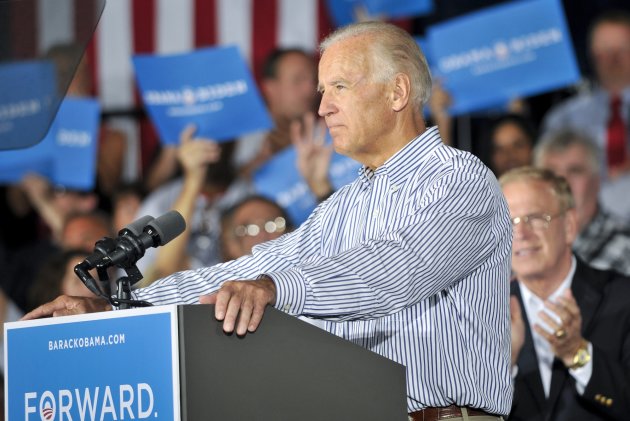
Vice President Joe Biden
mounted the Democratic counterpoint to the Republican presidential ticket Friday, drawing attention to the Obama administration's rescue of the auto industry and portraying GOP presidential challenger Mitt Romney as a foe of government efforts to save jobs. Laying out President Barack Obama's indictment of Republican polices, Biden said that Rep. Paul Ryan, Romney's running mate, has voted in Congress for measures that caused massive federal debts, including two wars, a prescription drug benefit and tax cuts for the wealthy that were not paid for. "They call their plan new, bold and gutsy," Biden told about 200 supporters in a union hall. "There is nothing gutsy about giving another trillion dollars in tax cuts to millionaires; there is nothing bold about turning Medicare into a voucher system. There is nothing bold about kicking 19 million kids and elderly off of Medicaid with no place else to go." Biden spoke about two miles from the sprawling GM plant in Lordstown in an event meant to emphasize the importance of the auto bailout to Ohio. The recoveries of GM and Chrysler have been recurrent themes in Obama's re-election campaign, particularly in states such as Michigan and the battleground of Ohio. Biden criticized Romney for opposing a taxpayer rescue of GM and Chrysler. "What they didn't acknowledge is Governor Romney's position was 'let Detroit go bankrupt,'" he said, quoting the headline on a 2008 Romney opinion piece in the New York Times. Ryan campaign spokesman Brendan Buck responded that Obama inherited a troubled economy but has made it worse. "Like many towns across America, Janesville, Wis., is still waiting for the recovery the president promised," Buck said, referring to Ryan's hometown, where a GM auto plant was idled in 2008. Biden's remarks came as Romney and Ryan left their Republican National Convention in Tampa seeking the votes of former Obama supporters who have grown disenchanted with his presidency. Obama traveled to Texas on Friday, where addressed military families on the second anniversary of the end of combat operations in Iraq.

How world opinion kidnapped by West's 'int'l community' rhetoric

Since the Industrial Revolution in Britain, the self-centered way of thinking that long formed in Western powers has been swelling with the constantly consolidated powers. One of the performances is that some Western politicians often make improper comments in the name of "international community" when they talk about the international affairs or in the Western media reports. In their eyes, they are the "international community." For example, the European and American media including the French media often make speeches on behalf of the international community, suggesting implementing more stringent sanctions on the Syrian authority, and criticize Russia and China who have a different stance on the Syrian issue in the name of "international community" for their "running counter to the international community" and "failing to join them to manage the world." In their opinion, China and Russia which have a population of over 1 billion are not included in the "international community." Moreover, Western media always criticize and attack China in the name of "international community." The author of the article has worked in Europe for more than 20 years and can often see and hear how the Western media accuse, distort and even demonize China for no reason. They criticize any things that they think "offending, untrue and disobedient" in the name of "international community." As what a very popular word in France has said, "It does not need to consider the facts and justices to criticize China because it is the 'right politics' to do so." Due to such misleading opinions, many innocent Westerners began misunderstanding China and giving birth to a bias against the state, regarding it "an oddity in international community". Thereby, some people certainly will get anxious and question about the rapid development of China. Now, the Western media dominates the international opinion, so the phenomenon of deceiving and misleading the world public opinion in the name of "international community" may have to continue for some time and is difficult to be corrected. Therefore, we must keep a clear mind about the "international community" quoted by Western media and distinguish the true "international community" from the false one.

Stop the terrorists, Pakistan tells Kabul

The Times of India
Interior Minister Rehman Malik has told the Afghan government to stop terrorists from entering Pakistan, a media report said on Sunday. Stressing that terrorists had again started their activities in Khyber Pakhtunkhwa, Quetta and Karachi after Eid, Malik said Saturday that forces wanting to destabilise Pakistan would never succeed. The Dawn newspaper quoted him as saying that attempts were being made to instigate sectarian violence in Pakistan by killing innocent people. The minister said the Taliban come into Pakistan from Afghanistan, and urged Afghan President Hamid Karzai to take effective steps to stop them from crossing over. The Taliban even had the capacity to carry out a major terrorist act in Islamabad.

Pakistani imam accused of framing Christian girl

Deutsche Welle
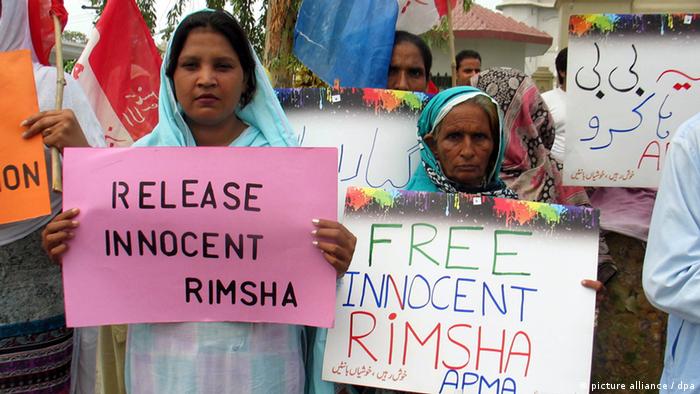
Police in Pakistan have arrested a Muslim cleric on charges of planting evidence against a young Christian girl detained under the country's anti-blasphemy law. The girl is accused of burning verses from the Koran. Pakistani police on Sunday said that Hafiz Mohammed Khalid Chishti had been arrested after his assistants turned him in for allegedly trying to frame the young Christian girl.Chishti supposedly added pages from the Koran to the pages that the young Christian girl, Rimsha Masih, allegedly burned. He filed the original evidence against Masih and serves as the imam at the mosque in her poor Islamabad suburb, Mehrabad. "Witnesses complained that he had torn pages from a Koran and placed them in her bag which had burned papers," police official Munir Hussain Jafri told the Reuters news agency.
'Conspiracy, not a mistake' Chishti claims that he originally received reports from villagers that Rimsha had burned Koranic verses and subsequently turned the girl in to police in order to avoid a violent incident. "People were demanding to burn their house," he said. "But I went to police and called them to avoid a major incident." Chishti has claimed that Rimsha was aware of what she did and had confessed. "She did it knowingly, this is a conspiracy and not a mistake," he said. "She confessed to what she did." Anti-blasphemy law Rimsha was arrested on August 16 on blasphemy charges after she was allegedly caught holding burnt pages of Koranic verses in public. There are conflicting reports regarding Rimsha's age and mental state. She is reportedly between 11 and 14 years old. Some media reports say she has Down's Syndrome. Under Pakistan's blasphemy law, anyone who defames Islam or the Prophet Mohammad commits a crime and can face the death penalty. Convictions under the law are common, but the death penalty has never been used in a blasphemy case. Critics of the law say it is often used to settle personal vendettas. Interreligious tension The reports that Rimsha had violated the anti-blasphemy law sparked anger among Muslims in Mehrabad, leading to public demonstrations demanding her punishment. Many Christians initially fled the suburb for fear of reprisals. Pakistani President Asif Ali Zadari had previously said that he took "serious note" of the case and called for the interior minister to submit a report on it. Zadari's government has been criticized by Western nations for not reforming the anti-blasphemy law. Pakistan's population of 190 million people is 95 percent Muslim, with a small minority population of Hindus and Christians.

Archbishop Desmond Tutu the 'moral compass'

Nelson Mandela once called Archbishop Desmond Tutu 'South Africa's moral compass' and he is. The other day he refused to share platform with Tony Blair, Labour Party's longest-serving prime minister - if that is a credit anymore - accusing him of prompting illegal and immoral invasion of Iraq in 2003. Blair's support for the US-led invasion was basic on doctored information, therefore "it would be inappropriate and untenable for the Archbishop to share a platform with Blair, according to Nobel Prize-winning priest". Ironically, however, the one-day conference was on 'leadership which could not be separated from morality'. Indeed, Blair's participation as speaker was a joke with history, for he was the principal inciter of the campaign to dislodge Saddam Hussain accusing the Iraqi leader of possessing weapons of mass destruction (WMD). That was never the case as after destruction in a surprise attack by Israeli airforce Iraq had permanently jettisoned its nuclear ambitions. But the oil-thirsty and pro-Israel governments in the West were out to capture Iraqi oil by hook or by crook. Having failed to convince international opinion that a minor explosion near Baghdad was 'incident in one of the Iraqi nuclear facilities' they led Saddam Hussain on to invade neighbouring Kuwait and then punished him for the adventure. But a clear victory over Saddam was required, hence the Blair's conspiratorial role and his fabricated information over Iraqi WMD stockpiles - so eagerly lapped up by the then US military chief General Colin Powell. And for the hypercritical gloss over invasion touted as a move to bring democracy to the people of Iraq, how much of it is on the ground at the cost of a quarter of a million lives and lingering instability and insecurity. One would have expected Blair was not invited to the moot given its high-sounding rubric of moralising the world leaderships. No other country in modern history has suffered at the hands of colonial oppression as of Archbishop Tutu's South Africa. And the natives' struggle against the notorious 'apartheid' policy of the colonial masters was perhaps the longest. But it was also a saga of human endurance and tolerance; it produced men like Mandela and Tutu who decided to overlook the gloomy past for a better future both for the South Africa's European and non-European segments of population. But for the Truth and Reconciliation Commission created by Bishop Tutu and others on both sides of the racial divide the 'apartheid' would have been still there taking its bloody toll. So sincere the effort on his part was that the sinners walked in without shame and embarrassment to confess their crimes and helped obtain a people at peace with their conscience. That moral compass of South Africa is the need of the hour in many parts of the world where ethnic, racial and sectarian conflicts are now raging in full fury causing immense human pain and misery. Instead of coming to the leadership conference Blair should have come to Tutu's Truth and Reconciliation Commission and confessed his crime of consigning millions of innocent Iraqis to unending war - that may have lost its military dimension but not of the Blair mischief that tends to foment insecurity and violence. Iraq today has a semblance of democracy, but it's definitely more volatile and unsafe than under the undemocratic rule of Saddam Hussain. And what kind of that war was that in the end removed from the scene one of the United States' strongest allies against its regional nemesis, Iran. Archbishop Tutu has indeed deserved world's praise for his frank 'no' to what was once known as 'Bush's poodle'.

Peshawar: Failed administrations

The thugs have struck Peshawar for the umpteenth time and yet again lethally, exacting a heavy toll on innocent lives as before. At least 11 people lay dead on the spot while another 17 were wounded, several of them critically. But where is the administration and what its security apparatus is doing? The wicked terrorists carried their deadly arsenal of explosives on a double-cabin vehicle. Obviously, that combustible vehicle had not travelled through some underground tunnel. Irrefutably, it had plied on the city's public thoroughfares in the full public view. And yet quite appallingly it went undetected and without being intercepted all the way when most of the city roads are cluttered with check posts and security barricades.This speaks volumes how meanly are the administrations failing in facing up to the monstrosity of terrorism and how culpably are their security apparatuses putting up a demeaning show of incompetence and feebleness in meeting the challenge of terrorists. After every terrorist strike, you hear the top echelons of the administration making a brave talk. Never ever would they bow down before the terrorists, they chant. But who wants them to bow down. The citizens want them to stand up and take firm steps to deal with the thugs, which they do not. They merely talk, not act. Almost the whole of the country is in the lap of terrorism and extremism and the state is virtually at war with the practitioners of this vile thuggery.But from the act of all the administrations, both the federal and the provincial, you don't get the sense if they are feeling to be in a condition of war. No strategies have they evolved to fight out this menace, even as it palpably makes up the biggest internal threat to the nation's security and the country's stability. No action plans have they put in place to take on the terrorist thugs proactively and aggressively, to snuff out the extremist outfits operating freely and finish off their lairs and sleeper cells in the urban centres. Karachi has veritably become a killing field, where no less than half a dozen people minimally are done in brutally every day in targeted killings and terrorist attacks. Quetta knows not when it would be free, if at all, from the butchery of roaming thuggish guns and the murderers for pleasure. Punjab has become the huge den of extremist and sectarian outfits, while the Khyber-Pakhtunkhwa lives on in the lengthening shadows of terrorism perpetrators and suicide bombers unremittingly. But as yet none of the provincial administrations has an answer to this rampaging monstrosity of terrorism and extremism. The only answer they have is that they would not bow down before the terrorists. But the people give a damn if they bow down or not. They want riddance from a monstrosity which is bloodying them horribly. And they are flabbergasted as much at the inertness of these administrations as at the ineptitude and incompetence of their subordinate security apparatuses. If the top echelons of these out-of-the-depth administrations are entertaining the citizens with a brave talk hogwash, their security apparatuses are amusing them with their own theatrics. After every terrorist assaults, they appear on the scene to cordon off the hit spot and harass the innocent citizens instead of going after the thugs. And instantly they start giving out the weight of the explosives used as if their task is only to give this information, not to prevent the terrorist strike.Certainly, the time has come that the administrations should get out of their stupors and get their acts together. Visibly, terrorists are in ascendancy, feeling no inhibitions at all in striking whatever they want, wherever they want and whenever they want. Palpably, they fear no resistance from the administrations and their security apparatuses; they indeed meet no such challenge in carrying out their devilish tasks. If it continues like this, the state will be in retreat everywhere and they will be on the offensive everywhere. The ultimate consequences of this nerve-wrecking phenomenon can well be imagined. The military cannot fight terrorists everywhere. Urban terrorism is fought out primarily by the civilian administrations and their security apparatuses everywhere the world over. And so has it to be here in this land, too. For a change, the civilian administrations have to pull up their socks and get cracking on their security apparatuses to do this fighting. Otherwise, we will have a Peshawar, Quetta or Karachi every other day to the nation's ultimate great gore.

Balochistan killings: Death toll rises to 8, strike observed

Another victim who was admitted in hospital in the aftermath of a firing incident that killed seven Hazaras succumbed to his injuries, taking the death toll to eight, Express News reported Sunday. A shutter-down strike is being observed in Quetta against the targeted sectarian killings carried out in different parts of Balochistan. The strike was called by Hazara Democratic Party, chief of the Hazara tribe Sardar Saadat and Azadari Council. Different political and trade unions also backed the strike. Special security arrangements have been done in order to avert any untoward incident. On Saturday, seven members of the Hazara community were killed in two apparently coordinated drive-by shooting incidents on the outskirts of the provincial capital. Gunmen riding on motorcycles had fired a volley of gunshots at a bus stop in the Hazar Ganji neighbourhood near a vegetable market, while in a separate incident, two intending pilgrims from the Hazara community were killed, while they were waiting at the bus stop to catch a bus for the Pak-Iran border town of Taftan. Soon after the first attack, a heavy contingent of police and paramilitary Frontier Corps cordoned off the area and mounted a manhunt for the killers. The senseless killings sparked violence in some neighbourhoods of the city where members of the Hazara community took to the streets. Protesters went berserk, allegedly barged into houses and harassed residents.