M WAQAR..... "A man's ethical behavior should be based effectually on sympathy, education, and social ties; no religious basis is necessary.Man would indeed be in a poor way if he had to be restrained by fear of punishment and hope of reward after death." --Albert Einstein !!! NEWS,ARTICLES,EDITORIALS,MUSIC... Ze chi pe mayeen yum da agha pukhtunistan de.....(Liberal,Progressive,Secular World.)''Secularism is not against religion; it is the message of humanity.'' تل ده وی پثتونستآن
Friday, July 6, 2012
US drone kills nine militants in Pakistan
A US drone attack
on a militant compound in Pakistan's northwestern tribal area killed nine insurgents and injured three late Friday, security officials said.
The unmanned aircraft fired two missiles on the compound in Datta Khel village, some 35 kilometres (22 miles) east of Miranshah, the main town of North Waziristan tribal district, near the Afghan border, they said.
"The US drone fired two missiles. At least nine militants have been killed and three injured," a senior security official based in Peshawar told AFP.
Two security officials in Miranshah confirmed the strike.
Datta Khel is considered a stronghold of Hafiz Gul Bahadur, a Taliban commander who is accused of sending fighters across the border to fight NATO troops in Afghanistan.
A similar attack in the region on Sunday killed six militants.
Pakistan: Shia pilgrims killed on way to Iran
Dunya TV REPORTINGAbout 18 people were gunned down by miscreants in Quetta on Friday night. According to Dunya News, the tragic mishap occurred when two unitentified armed motorcyclists started indiscriminate firing on the bus carrying pilgrims from Karachi to Iran near Turbat. As a result, 18 people died on the spot while many were injured who were shifted to hospital for treatment. According to sources, the victims mostly belong to Punjab and Khyber Pakhtunkhwa. This is second shameful incident occurred in current month.
Veena Malik stops traffic
http://www.brecorder.comTraffic came to a standstill in Bangalore yesterday not due to any accidents or demonstrations, but due to the presence of our very own Veena Malik. Bollywood’s golden girl was shooting at a bus station for her first Kannada film ‘Dirty Picture: Silk Sakkath Maga.’ Production on the film commenced last week and it was the first time outdoor scenes were being shot. The filmmakers had informed local police, and employed security personnel to shoot the scene but still the crowd managed to get out of control. Malik’s presence was kept under wraps but remained no more a secret when the masses caught a glimpse of the star and recognized her immediately. People started congregating on the spot, for a chance at the mere sighting of the Pakistani star, making it impossible for security personnel to manage the crowd. Several fans even broke down barriers just to talk to her. But Malik didn’t let that dampen her spirits and seemed to enjoy the attention. She later remarked “this response is unbelievable,” flashing a smile and signing autographs as she made her way around. This is the second time the controversial superstar has been mobbed by crazed fans. The first time was at a beach in Fiji.
1977 military coup: Zia’s coup observed as black day across country
The Express TribuneThe Pakistan Peoples Party (PPP) observed a black day on Thursday with its leadership issuing statements of condemnation and its workers holding public gatherings across the country to mark the undemocratic dismissal of Zulfikar Ali Bhutto’s government by General Ziaul Haq. Terming July 5 1977 as the “darkest day” in Pakistan’s history, PPP co-chairman President Asif Ali Zardari said in a statement that “on this day a dictator driven by his self-serving motives” attempted to seal the fate of a progressive society by deposing a constitutionally elected prime minister and systematically dismantling the constitutional edifice of the country. Echoing the president’s remarks, Prime Minister Raja Pervaiz Ashraf said the country was plunged into an “era of darkness” when Ziaul Haq’s vendetta emerged and he hanged Zulfikar Ali Bhutto. He said the people would never forget the inhuman victimisation, blatant flogging and unjust hangings perpetuated by the dictator during his 11-year rule when PPP workers were thrown into jails for demanding their democratic rights. Party workers in Punjab organised district level protests while a procession was held in the provincial capital at Aiwan-e-Iqbal where PPP Lahore president Samina Khalid Ghurki and PPP Punjab president Imtiaz Safdar Warraich addressed the gathering. Similar to other parts of the country rallies and processions were held in Azad Jammu and Kashmir (AJK) to observe black day. In Mirpur PPP AJK President Ghulam Rasool Awami attended a ceremony where speakers recounted the undemocratic actions of Ziaul Haq and called for democracy to be strengthened in the country. In Khyber-Pakhtunkhwa (K-P), the Peoples Doctors Forum organized a ceremony in Peshawar where party stalwart remembered the sacrifices of PPP workers and PPP provincial information secretary Syed Ayub Shah called for a jihad in party ranks to restore Zulfiqar Ali Bhutto’s vision of working for farmers, laborers and the poor. Party workers took the opportunity to criticise the prime minister’s recent visit to the city where he did not meet party workers. Meanwhile, the dissident PPP couple Naheed Khan and Safdar Abbasi, who have been ostracised from party circles, held a press conference to mark the black day. The couple said party policies had widened the gulf between the people and party leadership which could only be resolved with a return to the ideological roots of the party Zulfikar Ali Bhutto established. They added that fresh elections under a unanimous caretaker government were the only solution to the current crisis.
PAKISTAN:Floods damaged 10,407 educational institutes
APPThe unprecedented floods in last two years has damaged a total of 10,407 educational institutions in around 90 affected districts of the country. Of the total damaged schools, 3741 are fully destroyed and 6,666 are partially damaged. Moreover, around 32,000 teachers and 1.04 million students have been affected by the floods. According to report of Society for the Rights of the Child(SPARC), Sindh faced the largest destruction as a total number of 5,655 educational institutions are affected. While in Punjab, 2,817 schools were destroyed, followed by Khyber Pakhtunkhwa (KP), Balochistan, FATA, AJK and Gilgit-Baltistan (GB) with 915, 557, 176, 194 and 81 number of schools being affected respectively. The report manifests that the two worst affected provinces in terms of numbers of schools destroyed are Sindh and Punjab,whereas 18.5 % and 8.8% of the pre flood educational facilities have been damaged or destroyed. This is followed by 12.9% and 5.6% of pre-flood facilities damaged in Balochistan and KP. Talking to APP, Child Coordinator SPARC, Shaista Kiran said the total damage and loss for Pakistan's educational institutions has been estimated at Rs26,464.3 million. She said Sindh is considered as being the most affected with figures amounting to Rs13,354.9 million followed by Punjab with Rs7,881.3 million and KP with Rs2,859.5. Damage and loss in Balochistan is Rs775.5 million, and for AJK, FATA and GB, it is Rs842.3 million, Rs414.8 million and Rs336.2 million respectively
Karachi lawlessness: 1257 killed in just 6 months: HRCP
http://www.statesman.com.pkDespite the tall claims of government and police there is no respite in the targeted killings of Karachi, as according to the data of Human Rights Commission of Pakistan (HRCP) targeted killings and other crimes claimed at least 1257 lives in Karachi during last six months from January to June, 2012. According to statistics compiled by HRCP Karachi chapter, a total of 1257 are killed in the city during first six months of 2012, with 972 fall prey to targeted killings, which is 77% of the total killings, on different grounds including sectarian, personal enmities, bomb blasts, Lyari Gang War and abduction. While during first six months of 2011, the figure was 1138. According to HRCP report, a total 972 people were targeted killed, of them 135 gunned down were political activists, 27 shot dead in sectarian killings, 84 in Lyari gang war, 160 abducted and killed, two burnt to death, 42 killed by robbers, 87 killed due to enmity, 39 dead bodies found, seven security guards, four died in prison, eight in bomb blasts and 11 in Karo Karo (honour killing). Of total 972 targeted killings, the HRCP figure shows that 366 people with no political affiliation are killed this year in first six months while 250 killings were reported during the corresponding period of last year. According to the statistics, women killed during the same period include – 24 by relatives, 12 by unidentified culprits, 13 targeted killed, four were set on fire, four each killed by robbers, burnt to death and Lyari gang war, 12 on pretext of Karo-Kari and one each killed by stray bullets, drug addiction and in bomb blasts. Of the total 99 killings related to law enforcement agencies, 48 killed in police encounters, 44 policemen were gunned down in different incidents, three killed in police custody, three soldier/paramilitary and one person killed by soldier/paramilitary. Of the 64 children killed in different incidents, 11 killed by stray bullets, seven targeted killings, seven falling into canal/drains, five abducted and killed, six abducted, raped and killed, four Lyari gang war, five by robbers, five on grounds of personal enmity, seven newborn dumped, two killed after ransom payment, two on railway track while one by soldier/paramilitary.
Pakistan: 50pc state-run schools lack basic facilities, 400 non-functional
www.statesman.comAround 50% of state-run primary schools are deprived of basic facilities of education, while still over 400 schools are non-functional due to various reasons in Khyber Pakhtunkhwa. This was said by Sameena Imtiaz, executive director PEAD foundation here on Tuesday while addressing a seminar on "Education Policy", organized by Peace Education and Development (PEAD) foundation in collaboration with Action Aid. She said according to annual report 2011-12 of Education Management Information System as many as 45% male and female primary schools do lack electricity, bathrooms, boundary walls and availability of clean drinking water for students. Besides others, the seminar was attended by Hamid Naveed, DG director coordination Education Sector Reforms Unit KP, Shagufta Gul, principal of a private school, Tariq Hayat, programme manager PEAD, representatives of civil society and relevant stakeholders. Sameena Imtiaz further added out of over 27 thousand schools, about 400 educational institutions are not operational while according to Labor Force Survey 2009-10 literacy rate in the province is about 50% including 70% male and 32 female literacy rate. She stated drop out rate from nursery to class 5th is around 45% in the province. Hamid Naveed remarked Teacher Training Information Management System (TTIMS) and Parents Teacher Council networking system is being introduced to enhance the teacher's skills and performance and to make ensure the community participation particularly parents in growth and improvement of education system. He said ESRU has enhanced the administrative and financial role of PTC in the school management system, adding we are working on reviving and developing education sector plan and developing lesson plan according to 2006 drafted curriculum. Hamid Naveed further stated that government was focusing to increase female literacy rate and intend to spend more than 70% resources of annual development program 2012. Under the "Stury Da Khyber Pakhtunkhwa" scheme 63% packages are offered to girls while Rokhana Kur Education Program over age persons would be enrolled in schools. For establishment of probable 500 schools, one billion rupees are allocated for next fiscal year. He stressed on the need of role of civil society particularly parents for improvement of educational system. Other speakers said after 18th amendment people should get its benefits and government should make ensure adhering policies pertaining to education.
Zardari shocked over burning of blasphemy accused
Dunya NewsPresident has expressed profound grief over the incident of burning of a man alive in Bahawalpur. President Asif Ali Zardari on Thursday expressed profound grief and shock over the harrowing incident of burning of a man alive in Bahawalpur district after pulling him out of a police station. Expressing shock, the President directed the Advisor to the Prime Minister on Interior to conduct an inquiry into this unfortunate incident and submit the report to the Presidency immediately. The President said that no one should be allowed to take law into in his own hands no matter what the crime is. The President also directed the concerned to dispense justice according to the law in this case. The man, who was burnt alive, was reported to be mentally unstable and was accused of blasphemy.
Long road ahead in US-Pakistan ties after NATO deal
http://www.businesslive.co.za/Pakistan and the United States are set to resume broader talks on security cooperation, militant threats, aid and other issues in the wake of an agreement to reopen supply routes into Afghanistan, Pakistan's envoy to Washington said on Thursday.But bridging underlying differences that strained U.S.-Pakistani ties close to the breaking point will be daunting as the allies remain at odds over how to handle the twin threats of the Taliban in Afghanistan and militants in Pakistani tribal areas. The agreement reached this week prompting Pakistan to reopen NATO supply routes into Afghanistan, clinched when U.S. President Barack Obama's administration ceded to months of Pakistani demands to apologize for the U.S. air attack that killed 24 Pakistani soldiers last November, was a relief for both countries. "I certainly think it opened the door to many other issues," Ambassador Sherry Rehman told Reuters in an interview. "There's a long road ahead, but both sides can use this opportunity to build a path to durable ties," she added. After U.S. Secretary of State Hillary Clinton apologized in a phone call to Pakistani Foreign Minister Hina Rabbani Khar, Pakistan permitted trucks carrying NATO supplies to cross into Afghanistan for the first time in more than seven months. This was a boon for NATO nations that had been paying 2-1/2 times as much to bring supplies in through an alternate route. While NATO will not pay any new fees for shipping supplies into Afghanistan, Washington will give Pakistan at least $1.2 billion owed it for costs incurred while fighting militants. A U.S. official, speaking on condition of anonymity, said no specific commitments were made to increase military or counter-terrorism activities for Pakistan, but there was a 'good faith agreement' to continue talks on those issues. ALL ABOUT THE APOLOGY "A number of other things became stuck with all this," the official said. "It was never a money haggle or a transactional deal," Rehman said, speaking during a visit to Islamabad where she helped usher in the arrangement ending the months-long deadlock. The death of the 24 soldiers inflamed public opinion among Pakistanis already angered by U.S. drone strikes, the presence of CIA personnel in Pakistan and other issues. "We're a very hospitable people but we don't like being taken for granted - that was the public sentiment," she said, stressing why the apology was so vital. "You had 24 boys draped in flags ... that's not something that was going away from the public domain. At every level this percolated up and down" Pakistani society. While the breakthrough is welcome news for both sides, a harmonious road ahead is unlikely. Issues that have inflamed bilateral ties persist, including U.S. accusations that Pakistan harbors militants and meddles in Afghanistan, Pakistani chafing at U.S. drone strikes and fears on both sides that Pakistan's western neighbor will revert to chaos after most NATO troops leave by the end of 2014. Pakistan has long complained that the United States has overlooked its contribution to the fight against militants - scores of al Qaeda fighters were apprehended in Pakistan with American help - and the threat Pakistanis themselves face. Late last month, more than 100 fighters loyal to Pakistani Taliban leader Fazlullah snuck across the Afghan border and staged an ambush inside Pakistan. Several days later, the fighters released a video of what they said were the heads of 17 ambushed soldiers, along with their identification cards. It was a chilling reminder of the threat militants based in Afghanistan pose to Pakistan - the mirror image of the situation that fuels U.S. complaints about Pakistan, and a threat that would be sure to become more serious if Afghanistan were to slip back into civil war. The United States repeatedly has pressed Pakistan to pursue the Taliban and its allies, especially the Haqqani network, which it blames for a series of high-profile attacks in Afghanistan. Last month, U.S. Defense Secretary Leon Panetta said the United States was reaching the limits of its patience with Pakistan over what it deems as foot-dragging on militants. Rehman said that most of al Qaeda has been decimated with Pakistani cooperation, and that Islamabad would go after foreign fighters linked to other militants according to "Pakistan's priorities" and time frame. The immediate military priority was combating insurgents who target Pakistani security forces and civilians, she said. "We are going after our own right now - foreign fighters and militants who are on our soil, who are attacking us. If there is someone beheading me I am going to go after him first." Rehman said Pakistan stood to pay a high price if the NATO project in Afghanistan does not produce a stable country, in part because instability is likely to spill over the two countries' porous border. "For Pakistan, the stakes in Afghan stability are very high," Rehman said.
PPP in the line of fire
DAILY TIME
Riaz Ali TooriIt is wrong to say that PM Gilani declined to write this letter. In fact, he turned down this order against the president of Pakistan who is the Supreme Commander of Pakistan’s armed forces Z A Bhutto introduced democracy in Pakistan, empowered the poor and oppressed sections of our society, gave women their due rights and made Pakistan the first Islamic atomic power in the world, but was mercilessly put to death by a dictator through a judicially orchestrated murder. Benazir Bhutto knocked at the door of every court from Karachi to Peshawar, but did not get any justice. She remained a victim of dictatorship and the apathy of the Pakistani courts from the lowest tier to the apex level. The Pakistan People’s Party (PPP), its leadership and its workers have been the worst victims of both dictatorship and the prejudice of the courts. The democratically elected prime minister (PM) of Pakistan, Syed Yousaf Raza Gilani was thrown out of office. Democracy suffered dishonour and the sentiments of those who had voted for the PPP were badly hurt. In the history of Pakistan, once again an attempt was made to destabilise the PPP. Syed Yousaf Raza Gilani’s only crime was that he resisted the court’s order of writing a letter to the Swiss courts regarding the president of Pakistan. It is wrong to say that PM Gilani declined to write this letter. In fact, he turned down this order against the president of Pakistan who is the Supreme Commander of Pakistan’s armed forces. Syed Yousaf Raza Gilani, as a democratic prime minister of Pakistan, had well realised that it was not only against the national and international laws as well as against the prestige of Pakistan to write to a mere magistrate of another country to open cases against its president. Thus following his charismatic predecessors, Z A Bhutto and Benazir Bhutto, Mr Gilani preferred to be sacrificed rather than to ruin and wound the constitution and be known as its destroyer. Today, Syed Yousaf Raza Gilani is a champion in the court of the public even if he was overpowered by the judiciary. World history is rich with such examples, but history remembers them as victorious. Not only this, while two legislators of the PPP, Ms Farahnaz Ispahani and Abdul Rehman Malik were disqualified by the Supreme Court (SC) of Pakistan in the dual nationality case. Ms Farahnaz Ispahani was the first parliamentarian whose membership of the National Assembly was suspended. Here, the SC of Pakistan needed neither a commission nor time to study the case and did not need to consult parliament. Instead, the SC proceeded to order the collection of data of all parliamentarians and if anyone belonging to parties other than the PPP has dual nationality, would justice be delivered in the same manner? Ms Ispahani has a historical family background, whose grandfather Abol Hassan Ispahani was not only among the creators of Pakistan but had also supported the Pakistan movement, and later contributed in strengthening a nascent Pakistan financially. Whenever, for the movement for Pakistan, Quaid-e-Azam M A Jinnah needed financial support, the first name on his lips was that of Abol Hassan Ispahani. A nation who maltreats its great founders and benefactors seldom touches the peak of success. Rehman Malik, who was born in Pakistan, has served the country on very esteemed posts and has bravely fought terrorists. For his relentless services for the well-being of Pakistan and his fight against terrorism, the government awarded him with the highest civil awards of Sitara-e-Shujaat (gallantry) and Nishan-e-Imtiaz. His disqualification is like refusing to recognise his services even though he put his life in danger for making Pakistan a peaceful country. None can challenge both leaders’ honesty, love and loyalty for Pakistan and their services, but they are disqualified only because they belong to the PPP? Nowhere in the constitution is it written that the SC can disqualify members of parliament, because it is the duty of parliament, executive and the election commission to look into the qualification of a member. One by one, if every leader and worker of the PPP is victimised in such a way, it will definitely create a rift between the institutions. We applaud the leader of the PPP, President Asif Ali Zardari, for restraining his party’s workers from any kind of agitation against the courts after the judgment in the PM’s contempt case. Recent history is witness to the event when the workers and leadership of the Pakistan Muslim League-Nawaz, led by Nawaz Sharif as prime minister, not only battered the judges but physically attacked the building of the SC, just because he was called to appear before the SC. None of the PPP’s leaders hitherto has ever received justice from the Pakistani courts — from the hanging of its founder, Z A Bhutto, to the overthrow of Mr Gilani. The present leader and co-chairperson of the PPP remained in jail for more than a decade, but the Pakistani judiciary did not give him due justice. Today, when he is the constitutional democratic president of Pakistan, why is the SC so keen to make him answerable in the court of a magistrate of another country? Why in our malice for Mr Zardari and the PPP, do we become so biased and intolerant that we are willing to even violate Article 248 of the constitution and mortify our country and nation before the world? Why could not this judiciary finish these cases in 10 years when Mr Zardari was in jail, when we were being ruled by a dictator and the former was not the president of Pakistan? Why today can the judiciary not wait to open the cases after Mr Zardari is no more the president? Defeated in the judicial courts, the leadership of the PPP always wins in the court of the people. Today, from Parachinar to Karachi and from Gilgit-Baltistan to Balochistan, millions of hearts beat for the PPP and its leadership. Dictators like Ziaul Haq and Musharraf and their establishment, fully supported by the judiciary, could not uproot the PPP from the hearts of the poor oppressed people of Pakistan. The more it is victimised, the more it is loved. Let us all together strengthen democracy and work within the parameters laid down by the constitution. The writer is a political analyst and expert on FATA affairs.
PROTECT NATO SUPPLIES FROM ‘GHARIAT BRIGADE’ ATTACKS
It is the sole responsibility of the State to protect the NATO supplies to Afghanistan once the Government, at the highest level, had permitted to allow the cargo from Karachi Port to Afghanistan or for safe return from Afghanistan back to USA through Karachi Port. Prestige of the Pakistani state is involved in protecting the NATO supplies from all sorts of people, terrorists, saboteurs or the ‘Ghariat Brigade’ earlier launched deadly and dreadful attacks in order to disapprove the supplies to ISAF despite a Government commitment to the world community. Adviser to the Prime Minister on Internal Security had already briefed the Prime Minister about the measures to protect the NATO supplies from mischief mongers or those who opposed to the resumption of supplies to the ISAF for an early and orderly withdrawal from Afghanistan. In the past, Pakistani citizens operating the oil tankers and trucks carrying cargo from Karachi Port to Afghanistan came under attack in KPK and Balochistan and not in Sindh and Balochistan giving an impression that hostile elements to the US and policies were involved in those attacks. The Pakistanis suffered a lot, many lost their lives in deadly and indiscriminate attack without considering that the drivers and cleaners are Pakistan. They destroyed the whole caravan along with the Pakistani drivers and cleaners or helpers killing score of people. All those people lost their property in shape of trucks and oil tankers and also their lives should be compensated by the Pakistani State so that the State should realize its responsibility to protect all sort of transit goods permitted under the law by the Government. Hopefully, the rulers will not permit the ‘Ghariat Brigade’ to resume the deadly attack on one pretext or the other once the State had permitted the transit of goods, mainly fuel and essential commodities of daily use for the ISAF troops. Let us honour our commitment to the international community and protect the transit trade with full force and authority with a clear signal to lawless people that they will be punished under the law if they carried out attacks or endangered lives of the Pakistani truck and tanker operations.
Pakistan: Duel nationality blues
EDITORIAL:Frontier PostWhat else could be the intent of tinkering with the double nationality law if not to enable a select clutch of beneficiaries to keep holding on to their parliamentary memberships and ministerial jobs? The very contention of the law minister that the amended dual nationality law will be applicable to 16 countries alone indeed says it all. This, the knowledgeable people insist, would cover all those parliamentarians and ministers who the government wants to protect from being disqualified under the double nationality law as it exists now. They are even naming names of the potential beneficiaries. Indeed, the excuse the official hierarchs are trotting out for this legislative ambush is all obscene. Pakistan may be having double citizenship agreements with those 16 countries. But those deals provide only that their citizens and the Pakistani nationals could have two citizenships simultaneously. But that doesn't postulate that they would also be entitled to the parliamentary memberships and public offices. In fact, these positions are open only to the citizens holding the citizenship of only their own country, not to those in possession of double nationality. The reason is simple. In the case of double nationality, the element of conflict of interest creeps in inevitably, influencing its holder's acts in the public sphere. Not only on issues of foreign policy but even in internal matters, including economic affairs and business and trade. This could be visualised from the anecdote of a minister's reaction to the Kerry-Lugar law enacted by the US Congress for aid to Pakistan. The enactment was hinged on a set of disgraceful conditionalities that almost gave an incisive role to the US administration in our internal defence and security matters and reduced this country virtually into the status of colony of the United States. It stirred widespread anger across the cross-section of our polity. Yet the minister statedly penned down a laudatory resolution thanking the American administration and congress for this enactment profusely and brought it to the cabinet for adoption. But since the public backlash was too severe to the enactment to adopt the resolution, the minister had to be ticked off by the prime minister and he dropped it grudgingly. Indeed, the double nationality could only be anathema to the acute sensitivity of defence and security spheres. Even as one doesn't doubt the patriotism of a double citizenship holder, one cannot take chances in these spheres, so vital are these to the nation's security and stability. While the cabinet routinely is taken into confidence on highly sensitive security affairs and secrets of top confidentiality are made known to it, even the parliament's members at times are made privy to them. One may be hard put to recall how many times over these past four years or so have the parliamentarians been given in-camera security briefings, apart from the select parliamentary committees, in full house of the two chambers separately as well as collectively by the top military leadership and intelligence top echelons. With members of double nationality sitting both in the parliament and in the ministerial cabinets, one can never be sure of the confidentiality of information of highly-sensitive secrets divulged in those briefings not being breached and leaked to alien powers. Indeed, foreign powers and intelligence agencies are not unknown for planting their moles in other countries in ministerial cabinets as well as in other segments of polity, including legislatures. This is quite a known fact; and not infrequently respectable-looking figures the world over have been discovered to be the moles of foreign powers. In our case, a highly-regarded finance minister of late Ayub Khan's cabinet was latterly found to be on the US payrolls. He would often pass on the sensitive information divulged in the cabinet meetings to his contacts in the US embassy here. So, one has to be very wary of this double nationality. Voting right to the holders of double citizenship is all right. In our case, this is all the more imperative, when our overseas citizens have traditionally been a big contributor of foreign exchange to our cash-strapped exchequer. But one cannot take any risk at all with our national security. The doors of our parliamentary membership and ministerial slots certainly cannot be opened up to the double nationality holders. If they want to be in those places, they must renounce their foreign nationality. That is a must. And the government is well advised to review its act and withdraw the bill to amend the double nationality law.
Militancy: A progressive voice for tribal women silenced in targeted attack
The Express Tribune
This file photo shows Farida Afridi working in her office. PHOTO: FILEIn Farida Afridi’s death, women from the tribal belt have lost a fierce fighter. Farida, belonging to the Afridi subtribe Kokikhel, was targeted on Wednesday morning at 6.30am when she left her house in Tehsil Jamrud Ghundi Kali for her office in Hayatabad. “She was cornered by motorcyclists who shot her and she died on the way to Jamrud hospital,” said witness Abid Ali. Farida was 25. Along with her sister Noor Zia, Farida was committed to social change and economic emancipation for women from the platform of a welfare organisation called the Society for Appraisal and Women Empowerment in Rural Areas (SAWERA). Both women were among the founding members of the NGO and had a Masters degree in Gender Studies. Due to tribal customs and traditions, women in the area remain mostly restricted and unable to achieve their true potential, but Farida broke all barriers and relentlessly worked for women’s development. “We have lost a great member of our team,” said Lal Jan, the technical advisor of the organisation. To increase women’s involvement in the social and economic sphere, a few educated and aspiring women, including Farida who was still in school at that time, established SAWERA in 2004. The NGO works for the rights of women and children’s rights in the tribal belt. Farida had three sisters and four brothers and she was the second eldest. She belonged to a poor family that had no personal enmity, Lal Jan said. In an interview for The Express Tribune published in September 2011, Farida had said: “The government is oblivious to the general attitude of tribesmen towards women and the extent of inequality in our patriarchal society. This pushed us to start a struggle for their empowerment.” The sisters faced tough resistance when they told their family about the path they had chosen for themselves. “We told our parents that we would work in accordance with our religious and cultural traditions, assuring them that we would never let the family honour suffer because of our line of work. Finally, they agreed,” Noor had said. Syed Afzal Shinwari, project coordinator in Community Appraisal and Motivation Program (CAMP), said that SAWERA started small but is now an influential organisation. “Because of this brutal act, women in Fata will be discouraged to work and development will come to a halt,” he said. Condemnation “Both government and security agencies will be sleeping and people like Farida, Zartif Khan, Khan Habib Afridi and Mukarram Khan Atif will be mercilessly killed. We, the participants of civil society organisations in Peshawar, strongly condemn this tragic death and vow to raise our voice against this tyranny and brutality at the hands of anti-state elements who have been given a free hand to kill people from the civil society,” civil society group Strengthening Participatory Organisaion said in a statement. The End Violence Against Women/Girl alliance in Khyber-Pakhtunkhwa and Fata also condemned the murder. Farida’s struggle and efforts towards the empowerment of tribal women will never be forgotten.
Thursday, July 5, 2012
NATO's transition in Afghanistan an 'organised challenge'
NATO's transition from a combat to a support role in Afghanistan, to be concluded by the end of 2014, will be a challenge but a well organised one, alliance chief Anders Fogh Rasmussen said Thursday.
"It will be a well organised and planned operation to gradually transfer the lead responsibility to the Afghan security forces and gradually change the role from combat to support," Rasmussen told a joint news conference with Slovenian Prime Minister Janez Jansa.
"I could call (the transition) a logistical challenge, not a nightmare," he added.
The NATO-led International Security Assistance Force (ISAF) is to hand over security to local forces by the end of 2014.
From January 2015 onwards, NATO will remain in Afghanistan mainly for training, mentoring and assisting the Afghan forces.
"As we gradually hand over lead responsibilities, we will also adapt our troop presence," Rasmussen said, adding that the recent reopening of the supply route through Pakistan and other existing transit agreements will allow "better opportunities than we had previously" for the withdrawal of troops.
"I expect that some allies will join efforts in solving this logistical challenge," Rasmussen said.
He gave no estimate of the cost of the transition operation.
Pakistan:Hillary Clinton's $100 Million a Month Apology
By Adam Martin | The Atlantic WireSecretary of State Hillary Clinton saved the United States and its allies upwards of $100 million a month with one little word: "Sorry." Clinton announced Tuesday that she'd smoothed things over with Pakistan, which reopened a crucial supply line into Afghanistan after she apologized directly for that disastrous NATO air strike that killed 24 Pakistani troops last November. State didn't cite the economic factor as a reason for Clinton's belated apology, but that extra money was a clear benefit.As The Associated Press' Bradley Klapper notes, "with the supply lines closed, the U.S. has been forced to use more costly transportation routes through Russia and Central Asia. [Defense Secretary Leon] Panetta has estimated the cost at an extra $100 million a month." That figure had been set to grow as the U.S. withdraws from Afghanistan. As The New York Times' Eric Schmitt points out, it really was the word "sorry" that was "the clincher" for Pakistan. Clinton had previously expressed her "deepest regrets for the tragic incident," but on Tuesday she finally said the magic words: "We are sorry for the losses suffered by the Pakistani military." When Clinton finally said it, the country not only reopened the supply route but dropped its insistance that U.S. trucking companies pay as much as $5,000 transit fee per vehicle, up from $250 before the attack. The officials lowered their request to $1,000, Schmitt reported, before finally dropping it back down to the original $250. Sorry really is a powerful little word.
Obama launches first 2012 campaign bus tour, announces trade action against China
http://news.yahoo.comPresident Barack Obama kicks off his first bus tour of the 2012 campaign on Thursday with news meant to cheer struggling Rust Belt voters: His administration is taking on China over an allegedly unfair trade practice. Hours before the president was due in Ohio, the White House sent reporters a Toledo Blade report that the Obama administration would take aim at Chinese duties on some American-made cars and SUVs "including the Toledo, Ohio-made Jeep Wrangler." (Eerily excellent timing.) The World Trade Organization (WTO) complaint will accuse China—a frequent election-year villain blamed for lost American manufacturing jobs—of improperly imposing duties on about $3.3 billion of American exports, the Blade reported. A victory could see China rescind the duties. Beijing says the fees are a legitimate response to the American auto industry bailout championed by Obama, which China calls an unfair government subsidy. The WTO complaint could also give the president another opening to hit Mitt Romney, who famously opposed the bailout in stark terms. Ohio is home to a vast auto-parts manufacturing sector that benefited from the auto industry rescue.Obama was expected to hit his Republican rival at stops in Maumee, Sandusky, Parma, Akron, East Liverpool and finally Pittsburgh—his only Pennsylvania stop —before returning to Washington Friday night. The Romney campaign is bracketing the Obama visits with appearances by high-profile surrogates. And ahead of Obama's appearance in Maumee, two small planes could be seen in the sky bearing pro-Romney messages. Obama won Ohio and Pennsylvania in 2008 and hopes to capture them again in November on the road to securing the 270 Electoral College votes he needs to get a second term. Ohio has 18 electoral voters; Pennsylvania has 20. A Quinnipiac University Swing State Poll released last week showed Obama leading Romney 47 percent to 38 percent in Ohio, and 45 percent to 39 percent in Pennsylvania. The president's two-day trek began with a bit of good news on the economic front: The Labor Department reported that the number of people seeking unemployment benefits slipped to the lowest level in six weeks. Come Friday, all eyes will be on the latest jobs numbers. The economy is the top issue on voters' minds and Obama's most serious vulnerability. Ohio and Pennsylvania both had unemployment rates of 7.3 percent in May—below the national average of 8.2 percent. Obama's approach has been to blame "headwinds" beyond his control, like the European debt crisis; accuse Republicans of stalling his jobs program; and warn voters that Mitt Romney's economic policies are the same ones that fueled the 2007-2008 meltdown. He has also taken a sharply personal tack, pointing to Romney's wealth and bank accounts in Switzerland and elsewhere to paint the former Massachusetts governor as out of touch with average Americans. Obama has painted himself as a fighter for the middle class—an argument buttressed Thursday with the well-timed news about action against China. "As we have made clear, the Obama administration will continue to fight to ensure that China does not misuse its trade laws and violate its international trade commitments to block exports of American-made products," U.S. Trade Representative Ron Kirk said as he formally announced the move. "American auto workers and manufacturers deserve a level playing field, and we are taking every step necessary to stand up for them. This is the third time that the Obama administration has challenged China's misuse of trade remedies." The Toledo Blade reports: The duties cover more than 80 percent of U.S. auto exports to China, or about 92,000 vehicles. They add 15 percent to the price of an imported Jeep Wrangler or Detroit-made Jeep Grand Cherokee, 21.8 percent to a Buick Enclave and Cadillac CTS produced in Lansing, and 4.1 percent to an Acura TL sedan made by Honda of America Manufacturing Co. at Marysville, Ohio.
Poisonings' at Afghan girls' schools likely mass hysteria - not Taliban, says report
http://www.telegraph.co.uk
A spate of apparent poisonings at girls' schools across Afghanistan is probably outbreaks of mass hysteria rather than a Taliban plot, according to the most comprehensive study yet of the phenomenon.
By By Ben FarmerThe World Health Organisation (WHO) working with the Afghan government has investigated attacks for more than three years but found "no conclusive evidence of deliberate poisoning". Thousands of girls have been taken ill at schools in that time, in incidents of mass fainting and vomiting. Pressure has mounted on Hamid Karzai's government to stop the apparent attacks as their frequency has increased in recent months. Pictures of girls being carried to ambulances, or hooked up to drips in provincial hospitals, have become an increasingly common sight. The symptoms are always short-lived. The incidents have been widely interpreted as a campaign by the Taliban or other insurgent hardliners to crackdown on girls' education. The Taliban have denied this. The WHO's preliminary findings put the body at odds with the Afghanistan's security forces who say they have become convinced the attacks are genuine and have arrested numerous suspected poisoners. Seven were arrested on Tuesday and several were said to have confessed already. Security officials have blamed neighbouring Pakistan and said the poisonings were an attempt to destabilise Afghanistan and weaken its future. The poisoning of school water tanks, or the use of a gas or noxious liquid have all been suggested as potential weapons. Many girls reported smelling a strange odour before they were overcome. However an analysis given to The Daily Telegraph of 32 such incidents, all but two at girls' schools, casts significant doubt on the poisoning theory. The WHO said it and the Afghan ministry of public health were "taking every step to address this menace in the interest of public health." "According to preliminary findings, incidents' analysis and the prevailing situation, Mass Psychological Illness is the most probable cause," a statement said. A child psychologist has been drafted in to study the incidents, sources added. Poisoning could not be ruled out without further tests, but after examining more than 200 laboratory samples of blood, urine and water so far, there was "no conclusive evidence of deliberate poisoning found". The fact that few teachers had been taken ill also argued against mass poisoning. Academics who have studied mass hysteria say it has occurred before in war zones, where tensions and uncertainty are high. Similar cases were reported in the Palestinian territories in 1983 to Soviet Georgia in 1989 and Kosovo in 1990. Peter Kinderman, professor of clinical psychology at the University of Liverpool, said: "People do follow the crowd in lots of ways and we are social animals. "When it comes to these mass anxiety attacks, there have been many throughout history." If people were already worried by rumours of gas attacks and someone nearby began to appear ill, then others could soon panic, hyperventilate and become ill themselves. "They symptoms can be very convincing because in a sense they are real," he said. Earlier smaller investigations by the Nato coalition have also undermined suggestions of poisoning. In April the coalition was called in to test water supplies after girls were taken ill at a high school in Takhar province. "Results concluded that naturally occurring bacterial contamination was responsible. No toxins were found in the water," said Brian Badura, a spokesman in the coalition's Kabul headquarters. Police said they remained convinced at least some of the attacks were genuine. The seven alleged poisoners held this week in Sar-e Pul province had employed a schoolgirl to take a chemical spray into class, said Siddique Siddiqi, spokesman for the Ministry of Interior. "We have initial proof these people were involved and we have confessions," he said. The hospitalisation of thousands of female students has had a devastating effect on education in several areas, as parents have kept their children from classes. Following two incidents in Ghazni, south west of the capital, schools were allegedly closed and 36,000 students stopped going to school for some time. "The uncertainties about the cause of these incidents and growing rumours have had a significant impact on education, and especially girls' education," the WHO said.
Pakistanis fall below acceptable dietary line
DAWN.COMThe food security situation in Pakistan has worsened over the past four years, resulting in a drastic increase in the proportion of population falling below the minimum acceptable level of dietary consumption, according to a United Nations report. According to the United Nations Millennium Development Goals report for 2012, two-digit inflation and high food inflation significantly decreased the purchasing power of people, especially the poor. The report expressed fears that Pakistan was lagging behind the target of eradicating extreme poverty and hunger and indicators show that the target would not be achieved by 2015, the deadline for achieving MDGs. The report expressed concern over a number of factors that have contributed to under-achievement against most of MDGs. These include the slow economic growth or less than three per cent over the last three to four years. With a labour force increasing at a rate of 3.2 per cent, the slow economic growth is not creating sufficient jobs for the new entrants to the labour market. Besides poverty and unemployment issues, the income inequality in the country has always been on the rise. The share of consumption of the lowest quintile is currently 9.6 per cent against 40.3 per cent for the highest quintile. There also exist widespread gender inequalities. The share of women in wage employment is the slowest in South Asia and Pakistan is not an exception to it. Additionally, there are regional pockets where status of development is worst than other areas. Notwithstanding the challenges, the report said, there are a number of opportunities to build on. The increase in the share of provinces in NFC award and the 18th Amendment for decentralisation of governance at the provincial level will help development partners to work more closely with the end beneficiaries. According to the report, Pakistan adopted 18 targets and 41 indicators against which the progress is measured. However, time series data against only 33 indicators were available.Of the total 33 indicators, progress on 20 indicators is lagging behind, slow on four indicators, on track three indicators, off-track one indicator while targets against five indicators have been met. On a total of five indicators, Pakistan is either ahead or has achieved the target. With regard to access to improved water source, Pakistan achieved the target when three sources of improved water, tap water, hand pumps and electric motor propelled water, are taken into account.However, the Pakistan MDG report of 2010 has not included ‘electric motor’ in the category of improved water source which makes the status at around 63 per cent against the 92 per cent. According to the report, Pakistan has made some progress in combating HIV/Aids, malaria and other diseases; and promoting gender equality and women empowerment. However, progress rate is slow and additional efforts will be needed if the targets are to be achieved by the 2015 deadline. On a positive note, the report recognised that Pakistan has one of the highest ratios of women parliamentarians in South Asia. While bullish on the success recorded, the MDG report warns that the 2015 deadline is fast approaching and in order to achieve outstanding goals, governments, the international community, civil society and the private sector need to intensify their contributions.
ANP expresses reservations over dual nationality amendment bill
The Express TribuneExpressing reservations on the amendment bill for the dual nationality law, the Awami National Party has said that the law should only be applicable for presidents, prime ministers, the army leadership and judges, Express News reported on Thursday. Haji Adeel, a central leader of the government allied ANP, presented the party’s stance when he was contacted by President Asif Ali Zardari. He said, “If such laws are not enforced, then people like Mansoor Ijaz can also become the president of Pakistan one day.” Earlier on Wednesday, the federal cabinet had approved amendment bills pertaining to dual nationality and contempt of court laws. It was ordered in the cabinet session that the dual nationality amendment bill be brought before the National Assembly for discussion and approval.
AT LAST SUPPLY ROUTE FOR NATO REOPENED
After embarrassment, the Government had reopened the NATO supply route from Karachi to Afghanistan transporting
essential commodities to the NATO troops belonging to dozens of major countries of the world. We opposed the Government decision to make the NATO supply route a public issue taking it to Parliament, Parliamentary committees, and to the Jihadis and extremists instead of keeping it an administrative issue. In all these months, the issue was deliberately handed over to the extremists and fascist elements to use it to bash the United States as if Pakistan was going to war with the USA, sooner or later. Visibly, the political leadership in the Government remained in the sideline and supported the stand of security establishment as it is considered an issue of national security. The Jihadis and extremist elements had hurled threats that they will organize suicide attacks on the convoys if the NATO Supply Route was reopened. Mr. Tsunami Khan and his rightwing allies were on the forefront in heightening tensions and heat in politics on this issue at the same time news channels at the behest of others organize talks show propagating anti-Americanism as if the relations with Washington will not be repaired and restored to normal condition.
In any case, it is good decision though delayed. It will help repair our relations at time when the West had successfully isolated Pakistan from rest of the world and at the same time it faced a serious economic and financial crisis in absence of aid flow from the United States. General Kayani played the key role and he held talks with General Allen, the Commander of ISAF in Afghanistan who expressed his personal regrets over the Salala Check Post incidents. General Kayani agreed to open the NATO Supply route. General Kayani and General Wyne participated in the DCC meeting, chaired by the Prime Minister in which it was formally announced that Pakistan will reopen the NATO Supply Route.
With the sane decision, there are high hopes that Pakistan will meet other challenges, mainly economic and financial challenges, after receiving substantial economic and financial assistance from the United States in shape of the Coalition Support Fund. According to initial reports in the media, the US will provide 1.1 billion US dollar Coalition Support Fund to Pakistan immediately to tide over its economic and financial difficulties. All sections of the Pakistani society, mainly all elements in the Government had felt the pain of financial crunch and they were desperate to take the country out of this serious financial crunch. It was possible only by repairing the relations with the United States, the Financial Super Power of the World besides a military power. No other country had the capacity to provide liberal funds to Pakistan to take the country out of the present economic difficulties.
We hope that the Government and its institutions will stop US bashing, directly or indirectly, repair Pakistan’s relations with the United States in order to preserve its sovereignty and integrity first and later the economic prosperity of the people in general. Our Government should think about the people and the country as a whole instead of narrow interests of a section of the people in the Government. We also hope that the issue of Drone attacks on the Pakistani territory will stop and the Government of Pakistan and US will reach an agreement to fight back all terrorists, regardless of their affiliation. It is our responsibility to disallow the foreign or local terrorists using our sanctuaries in attacking the ISAF inside Afghanistan. Rather, the Pakistan Government should take a bold step by expelling all the foreign terrorists and eliminating the local ones without any delay. We should not threaten world peace by patronizing one brand of terrorist or the other. They should all be treated equally and at par and their activities be curbed with immediate effect in the interest of regional peace and security.
Pakistan Contempt law being amended: Govt move to clear judicial hurdle
With the Nato supply route controversy almost sorted out, the government on Wednesday started rolling up its sleeves to wriggle out of the problems it is facing as a result of recent judicial decisions.
At a meeting, the cabinet approved a bill to change the contempt law to clip the judiciary’s wings. The proposed bill will provide immunity to federal and provincial government leaders from being charged with or convicted of contempt of court.
Ironically, the bill is similar to what Nawaz Sharif had as prime minister introduced in 1997 during his clash with then chief justice Sajjad Ali Shah.
Legal experts believe that with the adoption of the proposed changes in the contempt law by parliament, a new round of confrontation might start between the executive and the judiciary.
Former prime minister Yousuf Raza Gilani was convicted in a contempt of court case for refusing to implement an order of the Supreme Court regarding writing a letter to Swiss authorities against President Asif Ali Zardari. His successor Raja Pervez Ashraf has been asked to submit his reply on the same issue on July 12.
Briefing newsmen after the meeting, Information Minister Qamar Zaman Kaira said the cabinet had given its approval to the Contempt of Court Bill, 2012, for introduction in either house of parliament.
If adopted with simple majority, the bill will provide a constitutional cover to the powers of top government functionaries against the effects of contempt law.
Through the bill, Mr Kaira said, “the scope of the right to appeal has been enlarged, including incorporation of other necessary provisions relevant to contempt proceedings”.
After the passage of the bill, the information minister said, contempt proceedings could not be initiated against holders of public office as mentioned in Article 248(1) of the Constitution.
Article 248(1) reads: “The President, a Governor, the Prime Minister, a Federal Minister, a Minister of State, the Chief Minister and a Provincial Minister shall not be answerable to any court for the exercise of powers and performance of functions of their
respective offices or for any act done or purported to be done in the exercise of those powers and performance of those functions.”
The minister dispelled a perception that the government intended to undermine the superior judiciary. With the enlargement of the scope of right to appeal, the minister said, once an appeal by a convict in a contempt case was accepted, his/her punishment would automatically stand suspended.
Dual nationality
Mr Kaira said: “The cabinet approved a draft bill tabled by the ministry for overseas Pakistanis proposing amendment in Article 63(1)C of the Constitution to enable Pakistanis having dual nationality to contest election for the membership of parliament.”
After threadbare discussion, the cabinet held that if top civil servants and judges who too were involved in state affairs, could hold dual nationality, why should there be this discrimination against politicians.
When approached, Supreme Court Bar Association president Yasin Azad said that although parliament had the right to amend the Constitution and law, such a move would be considered mala fide in the current circumstances.
He said only a simple majority was required to amend a law, while for making a constitutional amendment a two-thirds majority of the two houses of parliament was needed.
The Supreme Court is hearing several cases against parliamentarians and has suspended membership of a number of legislators holding dual nationality.
In reply to a question, Mr Kaira said: “According to my personal opinion, if you allow voting right to dual nationals they cannot be stopped from contesting elections, and if you don’t want them simply remove their names from the voting list.”
Ahsan Iqbal, PML-N’s Deputy Secretary General, said holders of dual nationality should be allowed to vote and contest elections, but once elected they must surrender their foreign nationality before taking oath as people’s representatives.
On the proposed changes in the contempt law, he said after the bill was presented before the house, PML-N’s legal experts would be consulted and a formal position would be taken.
APP adds: The information minister said that the cabinet unanimously endorsed the decision of the Defence Committee of the Cabinet for reopening the ground lines of communication to and from Afghanistan.
He said Prime Minister Raja Pervez Ashraf informed the cabinet that it was vindication of Pakistan’s principled stand after the unfortunate Salala incident.
Raja Ashraf said the US would have to respect Pakistan’s sovereignty so that future relations between the two countries were enduring, strategic and carefully defined for peace and security in the region.
Mr Kaira said the prime minister also informed the cabinet that in view of Pakistan’s larger objective of peace and stability in Afghanistan and the whole region and also its cooperative relations with 50 member states of Nato/Isaf “we will facilitate the
transition process to help enable Afghanistan’s national institutions to meet the challenges they are facing”.
Pindi all set to observe July 5 as black day against Zia rule
Daily Times
JULY 5TH,BLACK DAY IN THE HISTORY OF PAKISTANThe local leadership of the Pakistan People’s Party (PPP) has finalised arrangements to observe July 5 as a black day in protest of the infamous dictatorial rule of Ziaul Haq which began on the day in 1977. The strongman had toppled the democratically elected government of Zulfikar Ali Bhutto. Zia, after ousting Bhuttos, stayed in power for eleven years despite promising to hold general elections within 90 days. Rawalpindi PPP President Amir Fida Paracha told APP that the party workers would gather at Liaquat Bagh from across the district to participate in the demonstration to reiterate their commitment to the cause of democracy and express hatred against non-democratic forces. Pakistan Baitul Maal Managing Director Zammurd Khan said the PPP rendered unmatched sacrifices to strengthen democracy in the country and the workers would follow footprints of Zulfikar Ali Bhutto and Benazir Bhutto under the dynamic leadership of President Asif Ali Zardari. PPP Central Executive Committee Member Qazi Sultan Mehmood, who remained in jail for around four years during the Zia regime, termed the July 5 the darkest day in history of the country as a large number of democracy-loving people were sent behind the bars, gallows and subjected to public flogging. But they did not bow before the forces of tyranny. He asserted that Zia introduced the Kalashnikov and drug culture in the country, besides fanning sectarianism and “now we being the nation are facing a number of challenges at national and international fronts due to the policies adopted during the Zia era. What we are facing today is all the result of the seed sowed by Zia”.
July 5 a black day in history
FRONTIER POSTShazia Marri strongly condemned the long dictatorial tenures in the history of Pakistan and expressed confidence in the political forces to ensure sustained democracy in the country. In her statement recalling 5th July 1977, Marri termed the date as black day in the history of Pakistan. She further said the dictator who toppled the democratically elected government and plunged the country into darkness, forgot that ideology cannot be trampled upon. Shazia Marri stated that General Zia was a ruthless dictator who usurped power and callously removed Pakistan's first directly elected Prime Minister. She said he was a General who, by murdering Shaheed Zulfikar Ali Bhutto, killed the hopes of millions across the country and around the world. "Zia's regime was opposed by all stakeholders of society, with a very courageous role played by the journalists of Pakistan. They courted arrests from all corners of the country. But the General believed in absolute tyranny.", Marri lambasted. In her statement, Shazia Marri paid greatest tributes to Begum Nusrat Bhutto and Shaheed Mohtarma Benazir Bhutto who carried forward the mission of Shaheed Zulfikar Ali Bhutto alongwith the die hard workers of Pakistan Peoples Party. "Peoples Party is a political party that follows the ideology of Shaheed Bhutto.", Marri said. She also applauded the role of President Asif Ali Zardari for fighting against all odds in order to protect the democratic traditions and strengthen the will of the people of Pakistan. Shazia Marri said that nations who have leaders like Shaheed Bhutto can never fail and would continue to triumph against all odds.
Wednesday, July 4, 2012
Pakistan's Blasphemy: Mob burns man alive for burning Holy Quran
The Express Tribune News NetworkAn angry mob lynched a man accused of burning the Holy Quran in the Chanighot area of Bahawalpur, burning him to death after pouring petrol on him on Wednesday. The police reached the spot to control the matter but the mob refused to hand over the accused and continued to torture him. DSP Ahmadpur Rana Naveed Mumtaz, SHO Chanighot Ghulam Muhaudin Gujjar and seven constables were also injured by the mob. The protesters also set a DSP jeep and three police mobiles on fire. DPO Bahawalpur Ishaq Jahangir told The Express Tribune that it was “crystal clear” that the man who set the Holy Quran on fire was mentally unstable. He added that a police force was sent from Bahawalpur to control the situation and the police are trying to investigate the matter. He added that all those involved in the incident will be arrested, and an extra force has been deployed at the Chanighot Police Station to avoid any untoward incident. The person killed has not been identified as yet, and his body has been shifted to a hospital for an autopsy, the DPO said. The controversial blasphemy laws in Pakistan have resulted in incarceration and the death penalty being handed to scores of people. Former Punjab governor Salmaan Taseer was also shot down by his personal guard for supporting a Christian woman Aasia Bibi accused of blasphemy.
Two plots are kosher but only for Pakistan’s Supreme Court judges
Let Us Build PakistanWhile one residential plot may be an elitist entitlement for top serving bureaucrats and judges in Pakistan, it is commonly known that the allotment of two residential plots is an act of institutional bribery. In the past military generals (e.g. General Zia-ul-Haq, General Musharraf) and political governments (e.g. Nawaz Sharif) have given away two residential plots to top bureaucrats and judges in order to win illegal favours from them. Well, the following news report published in various media outlets shows that the so called champions of Jihad against corruption in Pakistan, the holiest of holies, honrouable judges of country’s apex court are not any different. According to a report submitted to to a Pakistan parliamentary panel (Public Accounts Committee PAC), fifteen serving and retired judges of Pakistan’s Supreme Court, including several confidants of present Chief Justice Iftikhar Chaudhry, received two residential plots each worth millions of rupees under a government scheme which was specially designed in relaxation of existing rules. The plots in some of the most expensive sectors of Islamabad were provided to three serving and 12 retired judges of the apex court during the regime of former military ruler Pervez Musharraf, said the report submitted by the Housing Ministry to the Public Accounts Committee. According to the report these plots were allotted during the tenure of former President General Pervez Musharraf. Justice Shakirullah Jan, Justice Tasadduqe Jilani, Justice Nasirul Mulk are included among the existing judges. All three of them are considered to be very close to the Chief Justice, were among those who were provided plots. Justice Nasir-ul-Mulk headed the bench that convicted former Premier Yousuf Raza Gilani of contempt after he refused to reopen graft cases against President Asif Ali Zardari. Gilani was subsequently disqualified by another bench headed by the Chief Justice. Several retired judges who were considered close to the Chief Justice, including Khalil-ur-Rahman Ramday and Javed Iqbal, too were among the beneficiaries. Acting Chief Election Commissioner Justice Shakirullah Jan and SC Registrar Dr Faqeer Hussain too are among the beneficiaries. In the judges recently retired, Justice Khalilur Rahman Ramday, former chief justice Abdul Hameed Dogar, Justice Javed Batar, Justice Saeed Ashhad, Justice Sardar Raza, Justice Nawaz Abbasi, Justice Faquir Khokhar, Justice Javed Iqbal, Justice Falak Sher, Justice Jamshed Ali, Justice Ghulam Rabbani and Justice Zahid Hussain are included among the beneficiaries. Chief Justice Chaudhry is no exception A few months ago, the accountability body of the Parliament, the Public Accounts Committee (PAC), received an official report from the Housing Ministry that shattered an eight-year-old perception that the incumbent Chief Justice of Pakistan (CJP) has never been given a piece of land by the government. A list compiled by the housing ministry of plot allotments to bureaucrats, judges and journalists spread over hundreds of pages, available with The Express Tribune, shows that Justice Chaudhry, then a Supreme Court judge, was given a one kanal plot on Dec 18, 2002 – six days after his 54th birthday. CJ Chaudhry was allotted a one-kanal plot during former President General Pervez Musharraf’s reign – which he owns to date in Islamabad’s residential sector G-14/4. Pakistan’s CJ Iftikahr Chaudhry (who is known on Twitter as #IftikharMental because of doubts about his mental stability) is also implicated in a million dollar scam involving his son and other family members. We are not accountable to anyone: Supreme Court’s response In a written reply submitted to the Public Accounts Committee, the Supreme Court refused to provide audit reports sought by the panel, saying parliament could not review the conduct of judges. The reply was submitted by the Registrar of the Supreme Court with the consent of full bench of the apex court. It said that the Constitution prohibits the Public Accounts Committee from calling any official of the superior judiciary, including the Registrar. The court, in its letter, told the committee that only the president can decide upon the court’s consultative ambit. Judges’ conduct also covers judiciary’s administrative and financial matters, it added. The PAC, during the chairmanship of Chaudhry Nisar Ali Khan had sent a letter to the SC asking for the audit report. The NA body, under the instruction of present Chairman Nadeem Afzal Chan made the letter public it received recently that had been issued by the SC’s Full Court. The letter also stated that according to various constitutional provisions the PAC cannot summon any official of the superior judiciary including the Registrar. ‘If the committee is interested in a formal court order, it should approach the president.’ The letter referred to Article 68 which said: “No discussion shall take place in [Majlis-e-Shoora (Parliament)] with respect to the conduct of any Judge of the Supreme Court or of a High Court in the discharge of his duties”. We wonder why doesn’t CJ Iftikhar Mental refer to the holy Quran and Rashidun Caliphs to present himself and his colleague judges for transparent accountability as per Islamic traditions and ideals? Sources: http://www.thenews.com.pk/article-57144-15-Judges-received-two-plots-each-during-Musharrafs-tenure:-PAC http://news.outlookindia.com/items.aspx?artid=767630 http://www.geo.tv/GeoDetail.aspx?ID=57153 http://criticalppp.com/archives/30329
President Zardari terms July 5 black day of history
JULY 5TH BLACK DAY OF PAKISTAN,WHEN DEMOCRACY WAS CRUSHED AND RELIGIOUS FANATICISM WAS INTRODUCED BY ONE ARMY GENERAL.
PPP Co-chairman Asif Ali Zardari has said July 5 would always be remembered as dark day of tyranny and oppression in the history of Pakistan.
“July 5, 1977 and its aftermath starkly reminds us how one military dictator spawned extremists for his political survival and how another exploited the same extremists for promoting his political agenda,” Zardari said in a statement issued here on Friday.
“This realization will help us understand better how to check militancy and terrorism,” he added.
Thirty-one years ago, on this day, an unfortunate tale of destruction was unleashed on the democratic institutions; judiciary was decimated, fundamental rights usurped and innocent people were flogged and hanged merely for political dissent.
Menace of sectarianism, religious extremism and private Jihad were deliberately promoted by the usurper to create an artificial constituency for perpetuating his rule as a reign of terror was let loose, PPP co-chairman said.
Terming the period as brutal and barbaric, he said, “The dictatorship promoted and patronized the extremist groups, who went on to form Taliban and Al-Qaeda.”
The president said if today Pakistan was the Petrie dish of international terrorism it was the product of failed international politics on the one hand and the machinations of our own dictators on the other.
“Let us resolve to banish dictatorship from Pakistan forever and restore law and order. Also pledge to confront fanaticism, terrorism and militancy wherever it rears its ugly head and not permit any dictator to use them as tools for advancing his personal political agenda,” he added.
Pakistani Film ‘Lamha’ Gets a Spot at New York Film Festival
http://www.brecorder.comLamha, a Pakistani feature film is going to be screened at the New York City International Film Festival (NYCIFF). The entire cast and production is excited and hopeful for its chances to win awards at the event. The Film Producer and CEO of Bodhicitta Works, Meher Jaffri said that out of some 3,000 film entries, Lamha is one of 100 films short-listed for the festival. Besides, the film has also been nominated in Best Producer, Best Director, Best Writer and Best Actors Awards categories. NYCIFF is an annual event held at Times Square, New York and runs alongside NY Film Market, the only film market in the US East Coast. Jaffri said, “The Festival Director, Roberto Rizzo has written good comments for the film which is not only encouraging but also increases the chances of film getting good response.” Lamha (publicized as Seedlings in English internationally), starring Mohib Mirza, Amina Sheikh and Gohar Rasheed, is a production of Meher Jaffri and Summer Nicks. The film has been directed by a new talent Mansoor Mujahid. Jaffri told the media that the story penned by Producer Nicks, “is a Pakistan-based story, encompassing human interests and does not carry any political or social agenda. However, some upcoming projects by the company would be based on current affairs.” The musical score of the film has been composed by Usman Riaz, a young musical prodigy and 2012 TEDGlobal Fellow while Zoe Viccaji has given vocals for the music. Other songs comprise of classical songs of Mehdi Hassan that have been used in their original form. It is to note that Riaz and Viccaji have also been nominated for Lux Style Awards in their respective categories this year. The NYCIFF will take place from August 9 to August 16 this year. The film is scheduled to be released in Pakistan by late fall.

Syria welcomes Geneva final communique
Syria welcomed Wednesday the final communique issued Saturday by the action group meeting on Syria, Syrian foreign ministry said.
Syria welcomes the final communique, particularly the " essential points that talked about committing to Syria's sovereignty and independence... in addition to calling for halting the violence... and not militarize the crisis," the ministry said in a statement Wednesday.
The Syrian ministry, however, said there are a few vague points in the statement that need clarification, stopping short of specifying those points. The ministry renewed the country's commitment to the six-point peace plan of UN-Arab League joint special envoy Kofi Annan.
It noted that Syria is ready to embark on a national dialogue with all parties in order to reach a consensus on a program to end the crisis, emanating from the concept that the Syrian people make the decisions to build its future.
An action group comprising of some world powers met Saturday in Geneva and agreed that a transitional government should be set up in Syria to end the 16-month-long conflict but did not stipulate the ouster of President Bashar al-Assad.
The meeting marks the first consensus among super powers regarding the Syrian issue, despite under-the-hood differences that were leaked to the media such as how Russia managed to make the new approach more balanced after the United States had stipulated the ouster of Assad as a common ground for the Geneva talks.
Video: Pervez Musharraf talks to Reuters
Former Pakistani President Pervez Musharraf tells Reuters’ Op-ed Editor James Ledbetter that the reason for the change in his country’s relationship with the U.S. lies in America's deep ties with India.
Obama to sign student loan, transportation legislation Friday
President Barack Obama, eager to show voters he is pushing federal action to spur job creation and support education, will sign into law on Friday recently passed legislation on transportation investment and student loans, officials said.
The Democratic president will use the event at the White House with construction workers and college students to highlight his campaign of pressing lawmakers to bolster the fragile U.S. economic recovery. Republicans accuse Obama of election-year posturing.
Congress last week approved a massive job-creating U.S. transportation bill that, under a rare bipartisan deal, will also keep interest rates low for millions of federal student loans and maintain federal flood insurance.
Democrats and Republicans embraced the measure, which will provide $105 billion in transportation spending over the next 27 months intended to create or save about 3 million jobs. Job creation is a key issue ahead of the November 6 congressional and presidential elections.
Obama, faced with public concern over high U.S. unemployment, had urged Congress to approve the transportation bill and take steps to prevent interest rates from doubling on federal college loans for 7.4 million students.
Republicans had sought to tie the transportation bill to an accelerated approval of TransCanada Corp.'s Keystone oil pipeline, which the White House opposed doing, but dropped the demand last week
Obama hosts new US citizens at White House
President Obama greets U.S. service members while hosting a naturalization ceremony to declare them American citizens.
U.S. 4TH OF JULY: US power outages put damper on July 4th celebrations
http://www.cbc.caHundreds of thousands of people from the U.S. Midwest to the Mid-Atlantic were preparing to spend the Fourth of July like America's founders did in 1776, without the conveniences of electricity and air conditioning. Power outages from Friday's storm altered planned celebrations in a host of ways and left powerless residents grumbling that America's birthday would hardly be a party. Cookouts were cancelled or moved to homes with power. Vacation plans were altered. Some residents without power said they weren't in a holiday mood. And even some whose power had been restored said they had run out of steam to celebrate in the way they had planned. Friday's storm arrived with little warning and knocked out power to 3 million homes and businesses in states from West Virginia to Ohio and Illinois. Officials blamed 24 deaths on the storm and its aftermath, and power companies in some places estimated it could be the weekend before everyone's power is restored. More than 900,000 homes and businesses remained without power early Wednesday.As a result, power repairs were taking priority over parties in many parts. At least four planned fireworks displays were cancelled in Maryland because of the outages, with officials saying they couldn't spare police and fire resources for the festivities. In Rockville, Md., officials called off their celebration because trees and wires were blocking two of the three entrances to the college campus where fireworks were planned. In Gaithersburg, Md., Acting City Manager Tony Tomasello said his city, about 30 minutes north of Washington, cancelled its display because a power company is using its planned celebration location, a fairgrounds, as a staging area for repairs. Hundreds of bucket trucks park there when crews finish their 16-hour shifts, and transformers, gravel and poles are being stored there too. "Everyone's disappointed. We're disappointed," Tomasello said of cancelling the celebration, adding that it would be rescheduled. In West Virginia, meanwhile, officials urged people to resist the temptation to set off fireworks at home because the risk of fire is too high. Many brown, crunchy lawns were already potential fuel, but the trees and limbs that fell during the storm have added even more tinder. Cleanup continues Some people affected by the storm were too tired or frustrated to think about fireworks, parties or planned holiday travel. Dennis Andrews, 62, of Ellicott City, Md., had planned to go to Myrtle Beach, S.C. But after spending 14 hours cutting trees that fell on his property, Andrews, who runs a construction equipment rental company, said he was ready to relax by the pool instead. Other parties were toned down, cancelled or moved. LaJuan Barnett, 44, who runs a daycare in Waldorf, Md., planned a more modest celebration with hot dogs and hamburgers after throwing out at least $350 in spoiled food and spending another $200 on groceries Tuesday. "We're on a budget," said Barnett, who got her power back on Monday night, after nearly 72 hours. Power outages and spoiled food also changed the plans of Sharvey Smith, 39, of Baltimore. Smith had begun preparing for an Independence Day party before the storm hit, buying chicken and spare ribs and planning a small gathering on her back porch. But that food spoiled when her power went out, so her party is off. She planned to spend Wednesday's holiday at her parents' house 10 minutes away, which has electricity, and where she and her family have been staying. But her patience is wearing thin. "I want to go back home," said Smith, adding that she calls the power company number three or four times a day to check on her power. So far, the estimated time it will be back on is no earlier than Thursday.
Too Quiet, Again, on Health Care
Nearly two dozen Pennsylvania residents, interviewed recently by Abby Goodnough of The Times, said they were opposed to President Obama’s health care reform law. Though almost all of them would benefit from it, they expressed fears about a loss of control over their health care that is nowhere in the law.
There are two reasons for this situation, which is repeated around the country. Business groups allied with Republicans have spent $235 million on television ads attacking the law with false accusations, with the vigorous aid of Mitt Romney and his campaign. Meanwhile, Democrats and the Obama campaign have been amazingly reluctant to speak up for the president’s biggest accomplishment and tell voters what’s in it.
The president has not even capitalized on his victory in the Supreme Court last week over his opponents’ attempt to dismantle the law on constitutional grounds. He listed some of its benefits in a low-key East Room speech after the ruling, and the campaign has sent out several direct-mail fliers on the subject to women. But the campaign has broadcast no television ads about health care, except for one in Spanish. Jack Lew, the White House chief of staff, said on “Fox News Sunday” that it was time “for the divisive debate on health care to stop,” suggesting Democrats want to move on.
Mr. Lew might consider going to a swing state and turning on the television because the debate isn’t going to stop. Republicans are happy to continue it with obvious propaganda like “Obamacare is the largest tax increase in U.S. history.” Countering this attack and, more important, building a foundation of support for a vastly important social change, will require the president and other Democrats to spend more time and more money explaining the law’s benefits, and pointing out that Republicans have no useful ideas to replace it.
The White House has been halfhearted in its sales pitch almost from the beginning of Mr. Obama’s administration. Polls showed that many middle-class voters, comfortable with their own insurance, weren’t particularly interested in a new social program that extended coverage to 30 million uninsured people, many of them poor.
Beyond simple decency, that’s a huge benefit to society as a whole, improving public health and reducing expensive emergency care that everyone pays for. In uncertain times, as well, anyone can suddenly lose health insurance. But that case was never forcefully made, and Republicans exploited the complexity of the law to persuade casual listeners that, as the House speaker, John Boehner, claimed on Sunday, “this is government taking over the entire health insurance industry.”
Expanding coverage is an idea worth defending, particularly when Republican leaders acknowledge that they have little interest in doing so, as Senator Mitch McConnell, the Republican leader, did on Sunday. And there many other aspects of the law for which Democrats should use a megaphone: an end to the Medicare “doughnut hole”; a huge expansion of coverage for mental health; an end to lifetime and annual limits on coverage and of rejection because of a pre-existing condition; a requirement that medium and large businesses provide essential coverage and pay for 60 percent of it; free access to preventive care like immunizations and mammograms.
The campaign committee for House Democrats, with little money, is making telephone calls going after Republicans for their votes to repeal the law and loosen the reins on insurance companies. It’s past time for the White House and the Obama campaign to set aside their diffidence and begin playing an equally aggressive offense.
NATO Supply Trucks Head For Afghanistan
http://www.rferl.orgTrucks carrying NATO supplies are expected to resume trips to Afghanistan on July 4 following Pakistan's decision to end a seven-month blockade. Islamabad agreed to lift the blockade one day earlier after U.S. Secretary of State Hillary Clinton offered "sincere condolences" to Pakistan over air strikes that killed 24 Pakistani soldiers in November. “They did the right thing to open [the route]," a truck driver in Karachi told RFE/RL's Radio Mashaal. "Now they should ensure its safety, and only the army can ensure the safety. Neither the police nor the security [forces] can do that." Another driver, emphasizing the financial losses accrued during the seven-month blockade, told Mashaal that many of the hauliers didn't even have the money to return to their homes to sit out the suspension with their families. Islamabad had closed the supply routes in response to the botched strikes and made their reopening conditional on a U.S. apology. The blockade had forced NATO to rely on longer, more expensive northern routes to Afghanistan through Russia and Central Asia. U.S. officials said they expected supply trucks to begin crossing into Afghanistan within the next 24 hours. The Pakistani Taliban, meanwhile, threatened to attack NATO trucks if they tried to resume supplies to troops in Afghanistan.
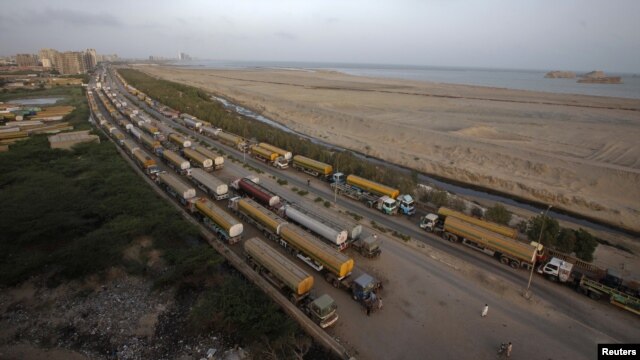
Number of AIDS patients may increase in Khyber Pakhtunkhwa
The officials of the
AIDS Control Programme, Khyber Pakhtunkhwa chapter, on Sunday feared that the number of AIDS and human immunodeficiency virus (HIV) patients might increase in the province and the adjacent tribal areas if the affected persons did not undergo medical tests to contain the spread of the fatal virus.
Talking to The News, Dr Rajwal Khan, provincial head of the AIDS Control Programme said that majority of the Acquired Immune Deficiency Syndrome (AIDS) affected persons registered with their department were those who had returned from abroad.
“Out of 997 persons with HIV positive, some 450 patients have returned from foreign countries, majority of them from the Gulf states,” he said. He said the United Arab Emirates and Saudi Arabia had sent back 257 and 84 AIDS patients, respectively.
According to information obtained from AIDS Control Programme, some 592 HIV positive patients belonging to Khyber Pakhtunkhwa, 243 to Fata, 88 to Afghanistan and eight to Punjab had been registered since December 2005.
Those testing HIV positive include 660 men, 230 women and 44 children below 14 years of age. About 360 patients have been referred by private physicians and 139 by non-governmental organisations working against AIDS. Another 193 approached the special centre at Hayatabad Medical Complex (HMC) for tests.
Dr Hilal at the Hayatabad Medical Complex said that almost all the district hospitals in Khyber Pakhtunkhwa had referred AIDS patients to the centre, adding majority of them belonged to southern districts and the adjacent tribal areas. He said the Lady Reading Hospital Peshawar had referred 86 HIV patients, Khyber Teaching Hospital 51and HMC 44.
Dr Idrees at the HMC Family Care Centre said that due to the stigma related to AIDS the majority of the affected persons were reluctant to undergo tests. He feared it might lead to increase in the number of patients in the tribal areas.
He said AIDS virus could transfer to a healthy person from a patient through blood transfusion and used syringes.
Saudi Female Athletes Fear Crackdown After Summer Games
http://olympics.time.comWhile Olympic leaders and human rights advocates are encouraged by signs that Saudi Arabia may bow to pressure and send female athletes to the Summer Games, women athletes in the ultraconservative kingdom are worried about a backlash at home. Under pressure from the International Olympic Committee to end the tradition of sending men-only teams to the Olympics, Saudi Arabia said on Monday it will allow women who qualify to compete at the London Games. The announcement came as the leadership’s favored candidate, equestrian Dalma Rushdi Malhas, was ruled out of the Olympics — sending officials on a hunt for other female athletes they could include on the Saudi team and avoid IOC sanctions a month before the start of the games. Women who play soccer and basketball in underground leagues around Saudi Arabia support those efforts, yet they also fear the hardline Muslim leaders will punish them for being pressured by the West and will crack down on women’s clandestine activities after the Olympic flame goes out in London. “We have to wait. I am afraid of their reaction, if we push too hard,” said Rawh Abdullah, a captain of a female soccer team in the Saudi capital, Riyadh. “We risk being shut down completely, and I do not want to reach a dead end because of impatience.” Also, she added, she and her teammates simply “are not ready to compete on such level” because they cannot train properly. Abdullah has given up her career as a teacher to run the all-women soccer club Al Tahaddi, Arabic for challenge. Since 2006, when the club was established, 25 team members meet four times a week to play after turning one of the players’ gardens into a field. The 28-year-old Abdullah, who serves as a coach and the captain on the team, charges each member 1,300 riyals ($350) annual fee to play. The money she gets covers players outfits, balls, makeshift goals, some fitness equipment and partly also trips to the port city of Jeddah or Dammam to play exhibition games or matches in the clandestine women’s league. There are no written laws that prohibit women from participating in sports, but women are not allowed into stadiums, and they cannot rent athletic venues. There is no physical education for girls in public schools, and no women-only hours at swimming pools. The few gyms that admit women are too expensive for most to frequent. Women cannot register sports clubs, league competitions and other female-only tournaments with the government. They are banned from entering all-male national trials, which makes it impossible for them to qualify for international competitions, including the Olympics. Female athletes like Abdullah fear that sending inadequately prepared athletes to the London Games could do more harm than good to their cause of making sports “part of our lifestyle” and achieve change for millions of women, who’s public lives are severely restricted in the kingdom. “If they do well, it will be OK, but if they have weak performance, they will turn to us, and say, ‘See, you pushed, you went, and you lost. You shamed us,’” Abdullah said. “When we are prepared in four years’ time, and they have to send us, we can say to them: ‘You want me to go and represent my country? Now train us. Give us facilities to use and coaches to work with, and we will make you proud,’” Abdullah said in an interview with The Associated Press. Saudi Arabia is the home of Islam’s holiest shrines, and women bear the brunt of their nation’s deeply conservative values. They are often the target of the unwanted attention of the kingdom’s intrusive religious police, who enforce a rigid interpretation of Islamic law and make sure that men and women do not mix in public. Besides being barred from driving, women are not allowed to vote, and they cannot be members of the Cabinet. They cannot travel either, be admitted to the hospital or take a job without permission from a male guardian. King Abdullah has taken modest steps to reform and modernize the oil-rich nation since he ascended the throne in 2005. He has faced staunch opposition from the hardline members of the royal family and the all-powerful clerics on each proposal he’s made toward easing restrictions on women. Ahmad Salem al-Marzooqi, the editor-in-chief of Shesports.net, an online magazine that aims to cover men’s and women’s sports events in the kingdom, said women need to obtain basic rights that are equal to those of men in Saudi Arabia before they can compete for their country abroad. “We are looking for ways to achieve rights for women inside Saudi Arabia,” al-Marzooqi said. “It’s a conflicting situation,” he said on the Olympics campaign. “If they send some to participate, it may be good for the future, but it’s definitely not good for the present situation. There will be side effects.” Rights groups claim a lot has to change for women in Saudi Arabia to convince international sporting community that the leadership in the conservative kingdom is — according to Monday’s announcement from the country’s embassy in Britain — “looking forward to its complete participation in the London 2012 Olympic Games.” Human Rights Watch said the statement is intended to appease international criticism ahead of the games as gender discrimination in Saudi Arabia remains “institutional and entrenched.” The New York-based group warned the IOC against becoming “complacent because one or two Saudi women are allowed to compete in the London Olympics.” “The fact that so few women are ‘qualified’ to compete at the Olympic level is due entirely to the country’s restrictions on women’s rights,” said Minky Worden, director of global initiatives for the New York-based group. Saudi officials have repeatedly suggested they’d allow Malhas, the equestrian, who won a bronze medal in showjumping at the 2010 Youth Olympics in Singapore, to compete at the London Games. But the International Equestrian Federation said Monday the 20-year-old athlete has failed to qualify after her horse was sidelined by injury and missed a month’s work during the qualifying period. Female athletes in judo and in track and field are considered possibilities for the games, sports officials familiar with the negotiations told The Associated Press speaking on condition of anonymity because talks on a special arrangement for the Saudis are ongoing. IOC President Jacques Rogge has said he is “optimistic” that Saudi Arabia will send women athletes, even though talks with the kingdom are “not an easy situation.” Saudi officials, who have publicly adamantly opposed sending women to London had left open a possibility that women, studying abroad would be able to compete outside of the team as independent athletes. However, that option was quashed after pressure from human rights groups and the IOC. It was also criticized by Saudi-based athletes like Abdullah. “It’s a pity for us. We play sports in Saudi Arabia, but they get to compete abroad because our country does not want to give us a chance to prove ourselves,” Abdullah said. “Do I have to leave my country to show what we can achieve?” Most Saudis cannot afford to study abroad, she added. Besides, she is convinced she needs to stay if she wants to make a difference. “If I don’t achieve our goal to play and compete at home for me and for my team, then I will for those who will play after us,” Abdullah said. Read more: http://olympics.time.com/2012/07/02/saudi-female-athletes-fear-crackdown-after-summer-games/#ixzz1zeMruJn5
Subscribe to:
Posts (Atom)