M WAQAR..... "A man's ethical behavior should be based effectually on sympathy, education, and social ties; no religious basis is necessary.Man would indeed be in a poor way if he had to be restrained by fear of punishment and hope of reward after death." --Albert Einstein !!! NEWS,ARTICLES,EDITORIALS,MUSIC... Ze chi pe mayeen yum da agha pukhtunistan de.....(Liberal,Progressive,Secular World.)''Secularism is not against religion; it is the message of humanity.'' تل ده وی پثتونستآن
Sunday, April 29, 2012
France Vote: Voters say ‘non’ to Sarkozy in Le Pen heartland
Far-right candidate
Marine Le Pen came top in the first round of the presidential election in the Gard region of France, but will her supporters now back right wing President Nicolas Sarkozy? FRANCE 24 met her local supporters to find out.The town of Besseges in the Gard region of southern French is a National Front stronghold and a microcosm of France’s political evolution.
The depressed former mining town of 3,000 inhabitants lies in the hilly north of the Gard administrative region, where extreme-right leader Marine Le Pen won 25.5% of the vote in the first round of the French presidential election, sending shockwaves across France.
Nationwide, Le Pen came third in the first round of the presidential election on April 22, with the National Front getting 18% of the vote. It was a record-breaking score for the far right party, beating the 16% that Le Pen’s father, Jean-Marie Le Pen, won to get through to the second round of the 2002 presidential election.
In Besseges, the blonde, 43-year-old National Front leader did even better than the Gard average in the April 22 round, winning 26.56% of the vote. Socialist François Hollande won the first round in this town with 29% of the vote while incumbent French President Nicolas Sarkozy came third with just 19%.
In the run-up to the May 6 final round, all eyes are on whether Le Pen’s supporters will choose Sarkozy, or Hollande.
With Hollande holding an average 10-point lead in the opinion polls, Sarkozy is desperately trying to woo Le Pen’s supporters by focusing on traditionally National Front issues such as immigration, national identity and tightening border controls.
But in Besseges, most far-right activists and ordinary voters expressed disappointment with Sarkozy’s track record and maintained that the French president had failed them and the country. Speaking to FRANCE 24, an overwhelming majority of Besseges residents said they would not support a president “who had broken all his promises”.
Sarkozy will 'not get my vote'
Benjamin Tallon
is a young National Front activist and a member of the Besseges town council.The 26-year-old engineer accused Sarkozy of being a hypocrite by taking up National Front issues in his “desperate bid” to secure the far-right vote.
“Sarkozy has always been after our voters,” he stated. “He promises to reduce immigration in 2007 and he’s doing it all over again. Locally, when there are election battles between the National Front and the Socialists, the UMP always tells people to vote Socialist.
“I am a natural conservative, and I would normally support the conservative candidate in the second round.
“But Sarkozy has shown the country that he is a hypocrite. He will not get my vote.”
The former Socialist
He told FRANCE 24 that he believed the work ethic in France had been undermined by a social benefits culture that allowed people to earn without working while penalising those “that get out of bed every morning and go to work”.
“I’ve voted Socialist in every single election until now,” he said. “I still believe in the social model; that there should be a safety net for people who lose their jobs.
“But it should only be for people who deserve it. You can’t simply move to this country and start claiming benefits at the expense of people who work hard.
“Marine Le Pen has promised to put a stop to this and that’s why I am voting for her. Francois Hollande has not addressed this issue. In fact he has avoided it and even said that benefits should be extended. It breaks my heart.”
The father of two said that some of his co-workers of North African descent also voted National Front and claimed this was proof that the party had shaken off its racist stigma.
“I recognise the value of immigration,” he argued. “But we should only allow people in who are prepared to work.
“As for the second round, it is my civic duty to vote. So I will go to the polling station, but I will put a blank card in the envelope. I can’t support either Sarkozy or Hollande.”
Baptiste Gazancon, 37, turned to the FN after his construction company collapsed last year.
The doctor
Jean-Francois Grillo, 61, is a radiologist who has supported the National Front all his adult life.
Like many other far-right party supporters, he sees Sarkozy’s UMP and Hollande’s Socialist Party (PS) as two sides of the same coin, and refers to both parties as the “UMPS”.
“Sarkozy’s attempts to get the National Front vote are so obvious and so shallow they are pitiful,” he declared. “I will cast a blank ballot in the second round of the election because both the Socialists and France’s mainstream conservatives have progressively destroyed this country over the last 30 years.
“But I predict a victory for Francois Hollande. What this means is that France will edge closer to the economic situation we see in Greece and in Spain.
“This will be devastating for our country, but it will mean that the National Front will become the only sensible voice of conservative opposition in France.”
The former Legionnaire
Sebastien Bosquet is a tough-looking and gruff-talking former French Foreign Legionnaire, the unit that was the alma mater of National Front founder Jean-Marie Le Pen.His opinions are direct: “We love our country the way the English love their queen, and Marine Le Pen is the one person that unites people who genuinely love France and want it to succeed.”
A public transport worker from Montpellier, Bosquet was in Besseges to visit friends, who are also National Front supporters.
Bosquet said he would not vote in the May 6 second round.
“I refuse to lend my support to candidates who insult us, and especially not Sarkozy,” he stated. “They want our votes but as citizens, as people with opinions, they couldn’t care less about us.
“Both candidates and both parties are the same and whatever the outcome of the election, nothing will change. France will continue on its downward spiral.”
The old campaigner
Yves Gailhac, 62, has been an ardent supporter of the FN all his life.Of all the voters FRANCE 24 met in Besseges, Gailhac was the most blunt.
“I’ve never been a racist and I have never been a fascist,” he argued. “That is not what the National Front is about and it never has been.
“Some National Front people are going to vote for Sarkozy because he is the conservative candidate and because he has been talking up issues like immigration.
“They’ve got it all wrong. He’s a hypocrite. Five years of Sarkozy have been terrible for France.
“I predict Hollande will win, and things will continue to be just as terrible.
“France will end up like Greece and within two years there will be a revolution. The National Front will come through as the only party with the real answers.”
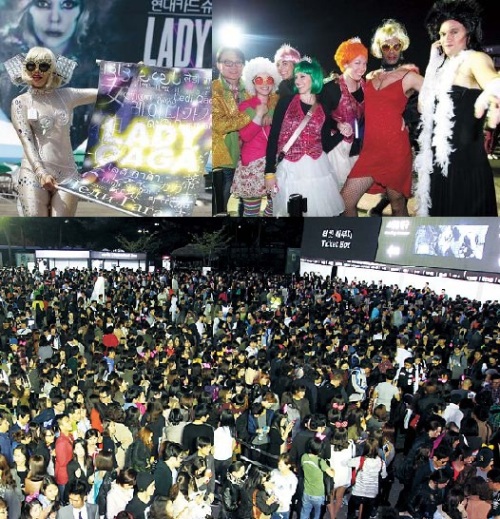
Gaga conquers packed Olympic Stadium
Despite the fervent prayers of conservative Christian groups and small protests outside Jamsil Sports Complex Stadium, Lady Gaga took to the stage Friday night, to the screams of more than 40,000 fans.
It was reportedly the largest crowd in the stadium since Michael Jackson held a concert there in 1996.
The 26-year-old singer first took to the Gothic castle-inspired stage riding a mechanical horse and donning a warrior-like outfit, complete with metal helmet during “Highway Unicorn,” She then addressed the controversy over the age ban on her concert for the first time since she arrived last weekend. All attendees had to show ID and receive “18 and over” bracelets before being allowed into the stadium. However, groups of teenage fans still showed up to show support for their idol outside the venue.
“I was told your government decided that my show was only for those 18 and over. So, I’ll make sure it will be 18 and over,” she declared.
And while she avoided the excesses of some of her more famous TV performances, Lady Gaga performed with abandon. Some of the highlights included the singer being dropped into a giant meat grinder during the song “Americano” and opening up “Born this Way” by recreating the opening of her music video where she gives birth to a new race of humans.
And no Lady Gaga show would be complete without several elaborate costume changes. The pop star started out in a rhinestone bra and harem pants and completed two costume changes within the first 30 minutes of the show.
By the end, she had worn everything from a white puff dress with a large Mardi Gras mask to a piano dress to her infamous flame-throwing bra.
Among her hit songs that she performed Friday night were “Just Dance,” “Bad Romance” and “Papparazzi.” The show also included a number of songs from her latest album such as “Heavy Metal Lover,” which was performed while riding a motorcycle around the stage.“I just forgot the words I’m so excited,” she exclaimed during her ballad “Hair.”
Made while the singer accompanied herself on a piano attached to the motorcycle, it was a mistake few would have noticed, let alone griped over.
The song was written about the singer’s childhood. “My parents didn’t always understand how I used to dress,” she said as she introduced the piece.
Between songs, Lady Gaga shared words of encouragement with the audience, telling them to just be who they are.
“You’re as free as you decide,” she said. “Breathe love and compassion.”
She ended the show with two encores of “Edge of Glory” and “Marry the Night” from her third album “Born this Way.”
Researcher Ziimaa Gatsanjamts from Mongolia said she wasn’t a big Lady Gaga fan before the show, but now hopes to start listening to her music more. She was impressed with not only the show, but the pop star herself.
“I think it was a really good show, well organized,” she said. “I think she has a strong character and personality.”
Meanwhile, Nick, an English teacher, said he’d been a fan for five years, and this was the first time he had seen Lady Gaga in concert. He said his favorite part of the show was when Gaga sang several songs while playing the piano.
“It shows that she’s a real artist,” he said.
From Seoul, Lady Gaga is taking her show onward to Hong Kong, Japan, Singapore and down to Australia.
President Obama's humor goes to the 'dogs' during annual dinner
The humor at the 98th annual White House Correspondents' Association Dinner went to the dogs.
President Barack Obama poked fun Saturday at everything, from the Secret Service scandal to the lavish spending by the Government Services Administration, to the upcoming general election.
However, it was a spoof about Mitt Romney and his dog Seamus that highlighted the president's monologue.
The joke recalled a political ad released by the Newt Gingrich campaign that took aim at Romney for admitting he once put his family dog in a cage and perched it on the top of his car.
"I know everybody is predicting a nasty election, and thankfully, we've all agreed that families are off-limits," the president said. "Dogs, however, are apparently fair game."
Afghans Call For More Pressure on Pakistan After US Talks Falter
ToloNewsAfghan political analysts reacted to the failure of Pakistan and the US to end the diplomatic deadlock between them after meetings in Islamabad last week, saying that the US needed to put more pressure on Pakistan. The New York Times reported Friday the talks failed as Pakistani officials asked for an unconditional US apology over the Nato airstrike in Pakistan which killed at least 24 soldiers on November 26 last year. It said that the US had been considering making an apology until the Taliban's coordinated attacks on Kabul and three eastern provinces of Afghanistan on April 15 which were found to be planned and mounted by the Pakistan-based Haqqani network. An Afghan military analyst responded to the failure of the talks, saying that the US should use any kind of pressure on Pakistan to make it stop supporting insurgent groups. "The US should put Pakistan under all kind of possible pressure, whether it's economical, political or even military, to make them stop the insurgency affecting other regional countries," military analyst Noorul Haq Oluomi said. Another commentator believed that the main problem between the two nations is over Pakistan encouraging pro-Pakistan figures in Afghanistan politics after 2014. "The main point of contention between US and Pakistan is not that [the apology], the main point is who will lead Afghanistan after 2014," Faizullah Jalal, Kabul University professor told TOLOnews. "Pakistan wants the Taliban to have an important role in the leadership of Afghanistan, which is very difficult for the US to accept." Pakistan has yet to announce whether it will participate at the Nato summit in Chicago which is going to be held in May this year. The US has said it would be embarrassing if it doesn't participate. A US government official told the NYT that the failure for the pair to reach an agreement in Islamabad would not be resolved quickly. "This is the beginning of the re-engagement conversation," Victoria Nuland, the State Department spokeswoman, said in Washington Friday. "We're going to have to work through these issues, and it's going to take some time." The Nato airstrike last year led to Pakistan blocking Nato's supply route to Afghanistan and boycotting the Germany-based Bonn international conference on Afghanistan, to which the US responded by suspending military aid to Pakistan, estimated to be between $1.18 billion to $3 billion. The US-Pakistan dialogue was revived after US President Barak Obama and Pakistani president Yousaf Raza Gilani met on the sidelines of the nuclear summit meeting in Seoul last month. Since then, Pakistan's Parliament has reviewed its relations with the US and called for an end to the US drone strikes which the US considers the most effective weapon against insurgents' hideouts in border regions of the Pakistan-Afghanistan borders.
Bombs hit Bangladesh capital amid strike
Nine small bombs exploded in the Bangladeshi capital Dhaka on Sunday, police said, after an opposition supporter was shot dead in clashes ahead of a fourth nationwide strike in eight days.
Security was tight across the country with around 10,000 policemen deployed in Dhaka and most shops, offices and schools were shut amid tensions over the disappearance of an opposition leader.
There was no damage or injuries from the explosions but one opposition supporter was shot dead elsewhere in clashes with ruling party activists late on Saturday, police said.
Two of the nine homemade bombs were hurled at the Secretariat, home to several government ministries and offices, deputy commissioner of police Syed Nurul Islam told AFP.
"Two unidentified youths drove motorbikes outside the Secretariat gate, stopped and then hurled two small bombs that exploded with loud noises, creating panic among officials," he said.
The opposition Bangladesh Nationalist Party (BNP) has been leading angry protests since one of its leaders, Ilias Ali, went missing on April 17 in a case it believes was an abduction by the security forces.
Five small bombs exploded at the start of the latest strike on Sunday at Mirpur in northern Dhaka and two more exploded in front of the opposition headquarters in the city, police officers told AFP.
The BNP supporter who died on Saturday was hit by three bullets in the southern town of Lakshmipur during a fight between BNP and ruling Awami League party workers, police inspector Monirul Alam said.
"He died of his wounds after he was rushed to a hospital," Alam told AFP, adding another person was also critically injured.
Three BNP activists were killed last week in clashes with police in Ali's constituency in northeastern Sylhet district.
Police found Ali's car abandoned in an upmarket district of Dhaka. His driver is also missing.
The BNP fear Ali has been killed and accuse the elite Rapid Action Battalion security force of abducting him, an allegation both the force and the government have rejected.
Ali is the highest profile opposition politician to have "disappeared" since Prime Minister Sheikh Hasina took power in January 2009.
Human Rights Watch (HRW) on Friday urged the Bangladesh government to order an independent investigation into the recent disappearances of opposition and political activists.
Quoting two Dhaka-based rights groups -- Ain-O-Sailash Kendra and Odhikar -- HRW said the disappearance of least 22 people had been documented in 2012 alone and more than 50 people since 2010.
The families of Premier Hasina and Khaleda Zia, head of the BNP, have competed for power for decades in Bangladesh with the personal rivalry between the two women often triggering street clashes between their parties.
Pak-US ties have bright future ahead: US envoy
The NationThe Untied States Ambassador Cameron Munter said on Sunday that U.S. hopes for long-term relationship with Pakistan. Talking to media persons during a visit to Shalimar Bagh Lahore, Ambassador Munter said that Pak-U.S relations exist on the people’s level also, as U.S. wanted strengthening of ties with Pakistan. The U.S. Ambassador said it is an honour for him to visit Lahore. He said that this historical city was the best place for sightseeing; its beauty and warmth have always charmed him. Accompanying the ambassador, American consulate in Lahore Nina Maria Fite said Pak-US ties have a bright future. He said that both the countries have relations on public level.
ANP gave identity to Pakhtuns
The NewsChief Minister Ameer Haider Hoti on Saturday said the Awami National Party (ANP) gave identity to the Pakhtuns by renaming the province as Khyber Pakh-tunkhwa. “The ANP-led government ushered a new era of development in the province,” he told party workers in Anwar Khan Killay in Takht Bhai tehsil in Mardan district. He said the ANP had made unprecedented sacrifices for bringing peace to the province and curbing the menace of terrorism. He said peace was a prerequisite for development. Hoti said the Khyber Pakhtunkhwa government and the security forces with the cooperation of the masses defeated the militants. He said the ANP leadership honoured all the pledges made to the people of Khyber Pakhtunkhwa and undertaken record uplift work in the province. The chief minister said that every part of the province was being paid equal attention in terms of progress and development. He added nine universities were set up during the past 60 years in the province but the ANP-led government established nine universities in four years only. Hoti said the budget of the province increased by 80 percent over the last three years and the goal of provincial autonomy was achieved. He said that loadshedding will be over in the province soon as new small and medium size hydel-power generating dams were being built in the province. On the occasion, he announced construction of several roads in the area and handed over keys of the fire-brigade vehicle to the officials of the Tehsil Municipal Administration Takhtbhai. Earlier, the CM reached the venue in a helicopter and attended a reception of Zafar Khan.
British Red Cross doc kidnapped in Pak found dead
The beheaded body of a kidnapped British doctor working for the International Committee of the Red Cross was found dumped by the roadside on Sunday in the southwestern Pakistan city of Quetta, police and Red Cross officials said.Khalil Rasjed Dale, 60, was abducted by suspected militants on January 5 while on his way home from work."The ICRC condemns in the strongest possible terms this barbaric act," ICRC director-general Yves Daccord said in a statement. "All of us at the ICRC and at the British Red Cross share the grief and outrage of Khalil's family and friends."
British foreign secretary William Hague also condemned the killing.
"This was a senseless and cruel act, targeting someone whose role was to help the people of Pakistan, and causing immeasurable pain to those who knew Mr Dale," Hague said in the statement.
Police discovered Dale's head and body wrapped in plastic near a western bypass road. His name was written on the white plastic bag with black marker.
"A sharp knife was used to sever his head from the body," said Safdar Hussain, the first doctor to examine the body. "He was killed about 12 hours ago."
Quetta is the capital of southwestern Baluchistan, Pakistan's biggest but poorest province, where Baluch separatist militants are fighting a protracted insurgency for more autonomy and control over the area's natural resources.
Pro-Taliban militants are also active in the province, which shares borders with Afghanistan and Iran.
Dale had worked for the ICRC and the British Red Cross in Somalia, Afghanistan and Iraq before coming to Pakistan. He had been managing a health programme for Baluchistan for almost a year when he was abducted, the ICRC statement said.
"We are devastated," Daccord said. "Khalil was a trusted and very experienced Red Cross staff member who significantly contributed to the humanitarian cause."
Four health workers, including two doctors, were kidnapped by militants the week before Dale's disappearance from the Pishin area of Baluchistan, near Quetta. They were freed after a shootout between police and their kidnappers.
Seraiki Province: For Seraiki nationalists, it’s a moral victory
Concerned over Prime Minster Yousuf Raza Gilani’s conviction in the contempt case, Pakistan Peoples Party loyalists and Seraiki nationalists have termed it “an attempt to revert the democratic revolution that was set to hit Pakistan.”
Chief Organiser of the Pakistan Seraiki Party Mansoor Karim Sial believes that the democratic norms that were established during the four-year rule of PPP have been attacked by the conviction of Prime Minister Gilani.
“Democracy is neither a magic wand nor it is a one-day process but in fact it is a continuous process and PPP government was leading the society towards a democratic revolution and the decision may hamper the national democratic revolution.”
The PPP representative character, Sial said, was maligned hit by the decision.
“Such verdicts are only appreciated in courtrooms, not on the roads by the public,” he told Dawn.com
“The real historic decision is not the one given by SC, it’s the decision taken by the party (PPP) to form the Seraiki province,” he added.
The decision to form a separate Seraiki province, if implemented, could be one of the most crucial ones taken during PPP’s current regime.
Zahoor Dhareja, a writer and an intellectual from Gilani’s hometown of Multan, believes the PM has been punished for raising voice for the establishment of Seraiki province and Seraiki Bank.
“A democratically elected Seraiki prime minister has been convicted for not changing his stand over the issue creating a new province for his nation” he said.
Despite the conviction, he firmly believes the “one-sided decisions” will not be able to demoralise the “Seraiki nation.”
“Victimization will strengthen the Seraiki people and it will be a blessing in disguise for them in their quest for a Seraiki identity and a province,” Dhareja said.
While it may seem that the court verdict has made the PM and his party, political martyrs, but writer and intellectual Ahsan Wagha believes that internally, the party exudes a triumphant confidence. but inside the ruling party the feeling is of winner.
“The government, especially the prime minister, will enter the Seraiki region with a brave face and the Zardari-Gilani government, having been put under pressure, may not care to move toward practicalities of the province.”
Meanwhile, member of PPP’s Central Executive Committee Haidar Gardezi was critical of the judiciary’s decision, saying that it always set selective standards by “supporting the dictators and victimising the democratic governments.”
Pakistan: Looming confrontation?
EDITORIAL:Daily TimesIn the National Assembly (NA) the other day, Prime Minister (PM) Yousaf Raza Gilani threw down the gauntlet to the opposition to move a no-confidence motion against him if they were adamant that he was no longer the PM after the Supreme Court’s (SC’s) contempt conviction. On the occasion, neither the Leader of the Opposition Chaudhry Nisar nor his PML-N colleagues were present in the house, the former having absented himself despite his blood-curdling threat to prevent (physically?) the PM’s entry into the NA, the latter for having walked out when the PM entered. Not that that prevented Chaudhry Nisar from repeating his unparliamentary threat in Nawaz Sharif’s press conference. This language, tone and message is hardly befitting of the Leader of the Opposition, considered a PM-in-waiting in parliamentary democracies. His leader, Nawaz Sharif, did not tarry far behind his lieutenant. He demanded the PM step down immediately “otherwise he will face unexpected results”. There is an implied threat in the sub-text of this message too. Both PML-N leaders need to be reminded that such language and messages would shame even a criminal denizen of Bhaati Gate in Lahore, let alone two major opposition figures. In the meantime, reports suggest the PML-N is reaching out to all the opposition parties and even the government’s coalition allies to try and create a front against the PM to stage protests throughout the country. So far, however, the latter are standing firm with the PM, while the latter present a picture of differing perspectives, not all of which may serve the PML-N’s purpose. For example, the other opposition parties in the NA did not follow the PML-N out of the NA but instead chose to listen to the PM’s speech. Outside parliament, Imran Khan’s Tehreek-i-Insaaf (PTI) presents the PML-N with a dilemma. Convergence of interests against the PPP-led coalition government notwithstanding, the two parties are at daggers drawn because each views the other as its real rival, especially in Punjab, the PML-N’s traditional stronghold. How to square this with the need to come together against the PM is the conundrum for both sides. The US State Department spokesperson meanwhile has stated that Washington recognises and will continue to work with the PM. There are reports that in the light of the SC verdict, the PPP is mulling over the possibility of moving a resolution in the NA reiterating presidential immunity. The PML-N is not the only party contemplating street mobilisation in its cause. The PPP workers have already been out in anger at the SC verdict. Sporadic such protests continue. If the PML-N succeeds in mobilising its own and other opposition forces’ cadres on the streets, there is every likelihood that the PPP will not take this lying down. If it were in turn to mobilise or even turn a blind eye to the spontaneous mobilisation of its workers, a looming confrontation cannot be ruled out. Such a confrontation could throw the country into new uncertainty and chaos to add to the crises that already afflict us. It is interesting to note that on the very day the SC delivered its verdict against the PM, the PPP won a by-election in Multan on a seat it regained after decades. Does this presage a divide between politics and the judiciary? And yet the Sindh High Court saw fit to dismiss a petition praying for stopping the PM from working. The immediate fallout of the SC verdict is scary enough. But what may be exercising thoughtful minds even more is the danger that the possible looming confrontation may derail the entire effort to ensure a smooth democratic transition from this government to the next through the ballot box, a transition not very frequent in our unfortunate history, but critical if the democratic system is to be consolidated. The PML-N willy-nilly has a vested interest in such a transition. Wiser and more moderate heads in the PML-N are cautioning the leadership not to abandon its policy of restraint over the last four years, which has earned it the jibe of being a ‘friendly opposition’, a description not ordinarily considered disparaging in long established democracies. The restraint was dictated by our sorry history of praetorian forces waiting in the wings to take advantage of any seeds of confrontation between the two sides of the civilian political divide. If the effort for a democratic transition were to be derailed, the only beneficiary would be parties outside parliament like the PTI. Hence the discomfort of the PML-N on the horns of its dilemma.
Nawaz Sharif threatening long march to avoid Mehran Bank scam: Wattoo
FRONTIER POSTMinister for Kashmir Affairs Mian Manzoor Ahmad Wattoo Saturday said that the government accepts the verdict of the Supreme Court against Prime Minister Yusuf Raza Gilani and would file an appeal against it.Addressing a press conference here, Manzoor Wattoo said that the question of disqualification of a member of National Assembly could be decided by the speaker and she would give her decision after the detailed judgment was announced.The minister said that Nawaz Sharif was threatening long march to escape from Mehran Bank scandal but they are not afraid of such threats. He said the PPP was still following the politics of reconciliation and would not venture any action against Punjab government.Wattoo took strong exception to the statements of Sharif brothers and appealed the Supreme Court to take suo motu notice of the matter.He said by not writing a letter to the Swiss officials, Syed Yusuf Raza Gilani protected the constitution and law of the country and he is still prime minister of the country constitutionally. He pointed out that Pakistan's people court has given its verdict in the by-elections in Multan in favour of Prime Minister Gilani.Wattoo said all the allied parties went to the Supreme Court to show respect to the judiciary and express solidarity with the prime minister. He said democracy do not suits Sharif brothers and they were still doing the politics of ego.He pointed out that Nawaz Sharif filed appeal against the SC verdict after nine years and now talks of preventing Prime Minister Gilani from filing the appeal. He said after the apex court verdict, Sharif brothers have themselves become judges.The Kashmir Affairs minister said history bears testimony that when Sharifs are in power, they neither take others along nor they respect institutions. He said the PML-N is today completely isolated while the PPP is taking all the political forces along. He pointed out that these were the people who attacked the Supreme Court. He demanded an early verdict in the Mehran Bank scandal saying it is a very old case.Replying to a question, Manzoor Wattoo said President Zardari is the strongest among political leaders and the coming time will prove this. He said the prime minister went to the Supreme Court on foot proving his respect and his name would be written in history.
Pakistan: The polio battle
Last year, the government aimed to control the outbreak of polio but despite all efforts, there is still a long way to go to make Pakistan polio-free.
However, reports of the presence of the polio virus in a water sample taken in Rawalpindi is a matter of serious concern.
The twin cities had their last case of polio nearly three years ago, but the discovery led the National Institute of Health to begin investigating cases of paralysis which were reported from various parts of the country, including Islamabad.
What causes even more concern is the fact that with the porous borders - Islamabad's close proximity to the northern regions - the continual movement of people has been one of the factors that has increased number of polio cases.
The traditional, conservative culture hampers accessibility of immunisation to children in the remote areas.
Plus the controversy of the fake polio vaccination campaign carried out by CIA, which involved a Pakistani doctor, has not helped the anti-polio campaigns as paranoia runs high especially in Fata, one of the four main pockets of polio in Pakistan.
Local agencies have also acknowledged increased difficulty in administering successful polio campaigns in such areas after the Abbottabad fiasco.
The discovery of the polio virus in Islamabad is just the tipof the iceberg.
Despite being close to completely exterminating the virus from the country in 2004, complacency and natural disasters caused the relapse of this deadly disease.
Super floods of the last two years have made the health situation even more precarious and now Pakistan remains one of the last few countries which is still under the threat of polio.
What makes it difficult to handle is that out of those countries, three are Pakistan's neighbours.
Admittedly, China and India have a limited polio scare, which it is hoped would be easily handled.
It is the Durand Line border which poses the greatest threat for both Afghanistan and Pakistan.
The government needs to ensure that the polio vaccination campaigns for the next year should be carried out along with an awareness campaign.
Anti-vaccination campaigns, for all their effectiveness, fail to change cultural perceptions, which are often a major hindrance in curbing this menace.
Notice must be taken of incidents in which children who had been administered polio vaccinations in each campaign, still contacted the disease.
If there is any evidence of compliance involved in selling defective vaccines, action must be taken.
The devolution of the Health Ministry is also a reason behind the inability to devise a strategy to spread awareness.
Since it is no more a centralised policy decision anymore, provincial decision-making is not synchronised with precise requirements to deal with the threat of polio.
But since polio cases are being reported from across the country, no provincial government can afford to fall behind on this.
The issue needs to be discussed at the Council of Common Interest to develop an effective policy.
Jamrud blast kills two, injures 14
Two people were killed and fourteen others were injured when an explosive-laden vehicle exploded in a bus stand of the Zakhakhel Tribe, in Jamrud sub-division of Khyber Agency on Sunday, said officials.
The bus stand was relocated to Bypass Road in Jamrud after a car-bomb attack on January 10, 2012 left more than 30 people dead.
An explosive-laden vehicle parked near a cluster of workshops went off, injuring several people, however, two of them succumbed to their injuries.
Abid, a mechanic at one of the workshops told The Express Tribune that an Alto a man parked an Alto near one of the workshops and started walking away quickly after parking it.
“An explosion took place and the whole area was engulfed by fire” is how Abid explains the incident. “There were people lying unconscious everywhere,” he said.
Officials investigating the incident believe that it was a remote-controlled improvised explosive device (IED) that caused the damage in which three shops and a number of smaller kiosks were also destroyed.
The Zakakhel Tribe has been consistently targeted by a number of militants groups in Khyber – particularly the Lashkar-e-Islam – because of its tribal militia the Zakhakhel Qaumi Lashkar.
Assistant Political Agent Jamil Khan told the media that they had received information about an explosive-laden vehicle. “We had closed down all the routes for the vehicle to be intercepted, although we manage to restrict the vehicle to Jamrud and saved Peshawar but it had still caused damage,” he said.
The injured were shifted to Hayatabad Medical Complex (HMC) in Peshawar.
Officials said that there were around 15 people that were brought to the hospital out of which one expired at the hospital while another was received dead.
Doctors say that the condition of three injured was critical.
Sharif brothers: You are the kings of liars
THE EXPRESS TRIBUNEContinuing his diatribe against the Sharif brothers, Interior Minister Rehman Malik said on Sunday that he will prove that the PML-N leaders are the “kings of liars” . Malik has already begun preparations to file a reference to the National Accountability Bureau against the Sharif family, Express News reported. Speaking to the media in Islamabad, Malik again alleged he had evidence that the leaders had siphoned off public funds worth $32 million. The interior minister said he will present the evidence before the Supreme Court within a week, adding that if Nawaz and Shahbaz Sharif have the “courage” they can challenge his claims. “If they (Sharif brothers) are not guilty, they should prove me wrong.” He added that if PML-N threatens him, he will respond with “ten threats.” Malik claims that a high court in London passed a judgment declaring the Sharif brothers defaulters. “It was the people’s money that they had plundered and taken to London.” Pakistan Muslim League-Nawaz (PML-N) spokesperson Pervez Rasheed snubbed Malik’s allegations and said they have been rejected by different courts many times in the past.
PM’s disqualification not mentioned in verdict
PML-Q President Shujaat Hussain has said the PML-N leadership is interpreting the Supreme Court verdict the way it wants to as it is not written anywhere in the verdict that Yousaf Raza Gilani is no more the prime minister.
Talking to reporters on Saturday after visiting the Lahore Museum along with Gandhara Art Peace Mission from Korea, Shujaat said all including the government were bound by the verdict of the Supreme Court.
He said an appeal against the verdict was being filed, final decision on which the question of Gilani remaining the Prime Minister or not will arise.
He said contempt of court of should be imposed on PML-N chief Nawaz Sharif when he had stormed the Supreme Court and humiliated it. He said the people still remember the attack on the Supreme Court when the name plates of the judges were also removed from the Punjab House, and Shahbaz Sharif was asking the attackers on loudspeaker to return to Lahore after having qeema-filled naans.
To a question, Shujat said the Supreme Court had not charged Gilani with corruption or embezzlement, adding that Nawaz should not use the judiciary’s name for political purposes. He said Nawaz had a habit of causing confrontation between the constitution and institutions and wanted to exploit the opportunity for his political gains. He said well-known money laundering and Hudaibia Paper Mills cases were lying in the cold storage along with evidence.
In response to a question, Shujaat said elections should be held when they were due. Nawaz was in habit of turning political opposition into personal enmity and had repeatedly confronted during his tenures not only with the judiciary but with the army and the media.
He said Nawaz referred to the constitution and law every now and then and then asked whether he could mention any article of the constitution which allowed him confrontation with any institution or attacking the Supreme Court.
Earlier, Shujaat visited the Lahore Museum with the Korean delegation. Members of the delegation thanked Shujaat for his hospitality and said they were very happy to see that their scared places were being well kept and maintained in Pakistan. Later, the delegation visited Gandhara Art Gallery and performed their religious rites in front of the statue of Buddha. Mowahid Hussain Shah, Imran Masood, MPA Amna Ulfat and former MPA Shazia Chand were also present.
Mehrangate: Geo News receives documents of funds given to Sharifs industries
Through government sources Geo News has received the documents of funds given to the industries of the Sharif brothers.According to the documents, Mehran Bank provided Rs49.5 million to Chaudhry Sugar Mills without any security. The money was deposited into account 001-10200 on April 4, 1993.The directors of the Chaudhry Sugar Mills include Shahbaz Sharif, Hussain Nawaz and Hamza Shahbaz. The documents further state that the COO of Mehran Bank, Younus Habib had directed for the immediate release of these funds. It is also stated that the directives for the immediate disbursement of the funds came from the PM House.Two cheques amounting to Rs46 million were issued from Chaudhry Sugar Mills to Ittefaq Foundry on the same day.
Meanwhile, PML-N senator Parvez Raheed while speaking to Geo News said that this was a business loan and had nothing to do with politics. Rasheed added that the loan was paid back with twice the amount of interest.
Saturday, April 28, 2012
White House Correspondents' Association dinner
Where else will you find President Obama, Lindsay Lohan and Wolf Blitzer under the same roof? Welcome to the White House Correspondents' Association dinner.
Protesters rally for women’s rights in Richmond
http://www.washingtonpost.comAbout 300 demonstrators gathered a few blocks from the state Capitol on a cold, rainy Saturday to continue their months-long protest against proposals they say restrict women’s rights. Some protesters carried professionally printed signs that carried messages such as “Stop the War on Virginia Women.” Others waved more colorful, homemade posters: “Women’s Rights are Human Rights” and “Va. Gov. McDonnell. The Vaginal Probe Guy.” Local police were visible, but unlike demonstrations this spring on Capitol Square, the number of officers was limited in the downtown city park outside the Richmond Coliseum. There were no arrests. The rally, organized by Unite Women Virginia, is affiliated with a series of events across the nation Saturday to protest what activists have dubbed a war on women. “Women are powerful — despite the way we are treated and what we are told,” said Victoria Bragunier, president of the Richmond chapter of the National Organization of Women. Virginia has been in the national spotlight this year for legislation critics decried as designed to limit abortions. Although several abortion-related bills did not pass — including those that sought to define a fertilized egg as a person and ban abortions after 20 weeks — a measure requiring women to undergo an ultrasound before an abortion was signed into law. Several current and former female legislators spoke about the contentious General Assembly session, criticizing Republicans for failing to understand the measure before publicly supporting it. That includes the ultrasound bill, which as originally proposed mandated a transvaginal probe before an abortion could be performed. After an uproar over the legislation, Gov. Robert F. McDonnell (R) asked lawmakers to drop the requirement from the measure. “How many of the 140 legislators had a clue?” Del. Jennifer L. McClellan (D-Richmond) asked. “I guess they were too stupid to understand.” Saturday’s protest underscores the strained relationship in Richmond — and across the nation — between Democrats and Republicans, who blame each other for an election-year focus on social issues including abortion. The debate over social issues, once a daily occurrence in the state Capitol, has moved to the campaign trail in Virginia. The state is expected to play a crucial role in November’s presidential election and determining the balance of power in the U.S. Senate. Former Democratic governor Timothy M. Kaine, who is running for U.S. Senate, stopped by the rally after campaigning in Roanoke, saying the issues are important to all adults, not just women. When McClellan pointed him out, the crowd erupted: “Tim! Tim! Tim!” A series of protests this year led Democrats to blast what they called excessive police force by officers wearing riot gear and carrying semiautomatic weapons. At a rally in March, officers arrested 30 demonstrators after they refused to leave the steps of the Capitol — where protests are prohibited. Bridget Kelley-Dearing of Lexington, who was holding one side of a banner that read “Defeat Virginia’s Sexist Politicians,” said she has been to every protest in Richmond this year. “I don’t feel like my legislators are representing me,” she said.
TURKEY: Women See Worrisome Shift in Turkey
By DAN BILEFSKY and SEBNEM ARSUGokce, a soft-spoken 37-year-old mother of two, has lived on the run for 15 years, ever since her abusive husband tracked her down, broke down her door and shot her in the leg six times after she refused to return to him. Stoic and prematurely graying, she said her husband had since kidnapped her mother and stabbed her brother, trying to force them to reveal her whereabouts. She repeatedly turned to the police. But, she said, they chided her to return to her husband. Once, after her husband came to pick her up at the police station, she said she heard an officer advise him to break her legs so she could not escape. “Our state is the No. 1 enemy of women,” Gokce said recently at a women’s shelter here in Istanbul, declining to use her last name for fear of her husband. “I was 14 when my husband started to abuse me, and now I’m 37, and I am still living in fear for my life despite all my cries for help.” While reliable statistics are hard to come by, given what Turkish experts say is the serious underreporting of domestic violence here, rights groups point to a recent spate of high-profile attacks against women to raise the alarm that Turkey is backsliding on women’s rights. They say women’s progress is being undermined by Turkey’s flagging prospects for European Union membership and a Muslim-inspired government that is increasingly embracing the conservative values of the Arab world it seeks to lead. So bleak is the situation that this year one outreach group suggested that the state should simply arm women and provide shooting lessons. Fears that the governing party is diminishing women were fanned this month when President Abdullah Gul approved a controversial bill that extended compulsory education to 12 years but allowed home-schooling after the first eight, which critics said could encourage the practice of taking child brides. The government rejected such criticism, saying the changes brought Turkey in line with international education standards. The culture wars over women’s role in Turkish society also reflect tensions in a majority Muslim country where the state’s official secularism is clashing with an ascendant class of religious conservatives. With their rise, rights groups say, men appear to be increasingly acting with impunity against women. Last year there were 207,253 cases of deliberate injuries to women across the country, compared with 189,377 in 2010, according to official data collected by the National Police Headquarters in the capital, Ankara, and provided to Vildan Yirmibesoglu, the general secretary of Kader, a leading rights group. A United Nations report published last July indicated that the incidence of domestic violence against women in Turkey topped the percentages in the United States and Europe. The report — based on data from a 2009 Turkish government study in which 12,785 women were interviewed across 12 regions — said 39 percent of women in Turkey had suffered physical violence at some time in their lives, compared with 22 percent in the United States and between 3 and 35 percent in 20 European countries. In February 2011, Turkey’s justice minister shocked the country when, in response to a parliamentary question, he said that there had been a staggering increase in the murders of women, from 66 in 2002, to 953 in the first seven months of 2009. But while the change is large, the numbers are still relatively low for a country of 80 million, possibly skewed by underreporting. After the governing Justice and Development Party of Prime Minister Recep Tayyip Erdogan came to power in 2002, determined for Turkey to join the European Union, women’s rights were a priority. Laws that discriminated against women were removed. Others were added: rape within marriage was criminalized, and life sentences became possible for perpetrators of so-called honor killings. But analysts say women are now losing ground. While the governing party insists that it is simply socially conservative and pro-family, Nigar Goksel, a senior analyst at the European Stability Initiative who wrote a major study on women in Turkey, argued that rising domestic violence and women’s low participation in the work force (at 28 percent, less than half the European Union average) reflected that family integrity was valued over a woman’s individual rights. “The government started off as an unlikely feminist but has dropped the ball,” Ms. Goksel said. “Equally, the Arab Spring is pulling Turkey in a more conservative direction.” Mr. Erdogan, a pious Muslim, attracted the ire of many feminists here when during last year’s election campaign he called on women to have at least three children and argued that birth control advocates sought to weaken Turkey. With subsidized child care rare, many women protested that he was pushing them back into the kitchen. Ayse Bohurler, a founding and leading member of Justice and Development, said that the education of women had improved under the government, which she said was also taking a strong stand against domestic violence. Others argued that claims of a sexist society smacked of hyperbole, given that women in Turkey hold prominent positions in business and politics, and that the country has even had a female prime minister. In March the Turkish Parliament passed a variety of legislation friendly to women, including a law forcing husbands deemed abusive by the courts to wear electronic monitoring devices and allowing the police to issue protection orders if a family court or prosecutor is unavailable. The police are also to receive training on women’s rights. But legislation, however well intentioned, may not be enough to change mentalities in an abidingly patriarchal nation, or to ensure that new laws will be fully implemented. For instance, every municipality here with more than 50,000 people is required by law to have at least one women’s shelter. But the current count nationwide is just 79, a number that is woefully low for a nation that size, rights groups say. One local official in Ankara recently told a conservative women’s group that opening more was ill advised since they enabled women to leave home, according to a member of the group. But finding protection is proving elusive. In one murder case last year, a woman named Arzu Yildirim was shot eight times by her partner in the middle of a busy Istanbul street, even though, women’s rights groups said, she had filed for legal protection more than 10 times. A copy of her most recent letter of complaint was found in her blood-stained purse.
The evil nexus of Sharif brothers and judges
A 42-page-long tape recording of a telephonic conversation, released now by the PPP leadership, leads you to draw at least one conclusion: all notions of justice, fair play, rule of law, and supremacy of the judiciary, which the Sharif brothers
repeat like a mantra these days, is just a smoke-screen,
hardly matching with their conduct when they were at the helm of affairs with most judges at their beck and them calling the judges to keep Asif Ali Zardari behind bars in corruption cases, fake or otherwise.
The second impression one gathers after going through the transcript of the tapes is the insecurity and greed of the judges of the Lahore High Court, especially then justice Maik Muhammad Qayyum (1998 to 2001) and then chief justice of the Lahore High Court
Rashid Aziz Khan (1997 to 2000) and their respective families ever ready to be at the Sharifs' disposal no matter at what cost, at times seeking mercy for carrying out their orders on time though in the process they also suffered many a sleepless nights.
A division bench of the Lahore High Court, comprising justice Malik Muhammad Qayyum and justice Syed Najamul Hassan Kazmi, was hearing Ehtesab Reference No 30/98 and No 26 of 1998 against Zardari and Qayyum being head of the LHC bench was in troubled waters fearing pressure of the Sharifs.
Nawaz Sharif being the prime minister and therefore caring least for court procedures wanted a speedy and the hardest punishment for Asif Ali Zardari in the corruption cases and a delay in punishment was disturbing him (Nawaz).
The phone recording brings to light the helplessness and wickedness of Justice Qayyum and then LHC chief justice Khan as they, unlike judges, acted like ordinary clerks and petty servants in the face of dictates and orders coming from the Sharif government.
One day, then federal law minister Khalid Anwar called Justice Qayyum and said "someone on the top [Nawaz Sharif] is very unhappy with a delay in the decision of the cases against Zardari". "He (Nawaz) is complaining that nothing is being done in the case and asking why has it not been concluded?" the minister said referring to Nawaz's annoyance.
The minister asked Justice Qayyum to decide the case next Monday and the judge assured him that it would be done per his desire. Qayyum mentioned that "the problem is that he will have to give time to the defence counsel to argue the case as without it, they (Benazir and her counsels) will make an issue out of it and it may be dangerous for us all."
The minister said "complete it in two weeks and start hearing it on a day-to-day basis, to which Qayyum said, "Sir I am at your disposal." Later, Senator Qayyum telephoned Justice Qayyum and says, "I have checked. Nothing has happened in the case and the hearing hasn't taken place yet. You are delaying the matter." Qayyum begs pardons.
A day later, Justice Qayyum calls home and tells his wife, Rukhsana, that "things have gone worse". They have said remove him (Qayyum) and he wife asked him who said this? He says chief justice Rashid Aziz was called and told (by Prime Minister Nawaz Sharif). Why? His wife asks. Qayyum tells her that "they (Nawaz Sharif and Shahbaz Sharif) say that he has changed his loyalty".
Later, in another conversation Qayyum's wife calls MNA Malik Pervaiz (Justice Qayyum's brother) and tells him that the chief justice was called by Nawaz Sharif and asked him to remove Qayyum because due to delay in the judgement "they think he is in connivance with the other party, Benazir and Asif Zardari".
She also tells Pervaiz that "this afternoon being disturbed by the situation, Qayyum fell in the bathroom and hurt his arm". Qayyum, while talking to his brother, Pervaiz says "Senator Saifur Rehamn called me and said Nawaz Sharif is angry with me and was inquiring why it has not been done today (the date of hearing of the Zardari case)."
Pervaiz says, "I will handle it but Qayyum replies, "He (Nawaz Sharif) just gets angry for nothing." Then chief justice Rashid Aziz phones Qayyum and says that "today Nawaz Sharif personally called me and asked me to advise you". Rashid tell him to announce the order in the case early otherwise "he (Nawaz) is going to issue death warrants for both of us". Qayyum assures him that "I will announce a short order tomorrow".
Rashid says "he (Nawaz Sharif) cannot sleep at night". Then Senator Saif calls Qayyum and tells him that Nawaz wants a "full dose of punishment for Zardari that is seven years in the corruption reference". Qayyum says, "I will give five years, otherwise it will become an issue."
Saif makes another request to Qayyum saying, "How will you their Swiss accounts which are twenty or twenty-two their London accounts which are ceased and other properties so that this money cannot transferred?" Qayyum suggests that "for confiscation of properties better give additional application as it is required and we will grant a court order".
About delay he asks "how much time will you give to Zardari's counsel Pirzada. Qayyum says "just one day otherwise they will make a hue and cry". The judge says "Do not worry it (order) is already prepared in written on advice of chief justice Rashid". Both laugh. Next day Saif says to Qayyum that "I want to clarify whether this judgement covers the inherited properties or not" to which Qayyum assures him that "Total is to be done. Nothing is to be left."
Next day, Justice Qayyum and Justice Kazmi announce the short order on April 27, 1998 with five years in jail for Zardari and confiscation of all moveable and immoveable property inherited or otherwise and then phone calls congratulating him start.
Then CM Shahbaz Sharif calls Qayyum and Qayyum says "Sir." Shahbaz Sharif says, "I had requested you to do something." "Sir, I finished that," Qayyum says, referring to the Zardari case.
In response, Shahbaz says "thank you very much but I also asked about matter regarding Ch Sarwar. The CM says, "My elder brother has asked me to tell you that MNA Ch Sarwar should be favoured in disqualification case." "So you want Ch Sarwar to be looked after?" Qayyum asks for clarity and Shahbaz say "Yes, Yes."
Qayyum assures the CM that it is all right. It will be done per Mian Sahib's (PM Nawaz) desire. Then came carrots, the order with regards to freezing of properties and assets of Zardari and Benazir was passed on April 27, 1998 while on April 30, 1998,
prime minister Nawaz Sharif approved the grant of diplomatic passports to Judge Qayyum and his wife ignoring the formidable objection raised by the Ministry of Foreign Affairs that judges could not be issued diplomatic passports.
No such thing as ‘state capitalism’ in China
Certain Western officials and scholars have repeatedly criticized China for implementing “state capitalism,” claiming that China encourages its state-owned enterprises (SOEs) to monopolize resources and stifle the growth of foreign investment. Based on what they believe to be unfair competition practices, they have called for restrictions on overseas investment by Chinese SOEs. However, their claim is totally untenable.
First, China is marching on the road of socialism with Chinese characteristics, instead of implementing “state capitalism.” The country adheres to the basic economic system with the public sector remaining dominant and diverse sectors of the economy developing side by side as it suits the country’s development level and serves the interests of the Chinese people.
The Chinese government has carried out the SOE reform, made efforts to solve the financing problems facing small and medium-sized enterprises, and encouraged and guided private investment in sectors not prohibited by laws. The country has gradually deepened various reforms, which have yielded positive results. The market economy is growing to maturity in China, where the relationship between state-owned and private companies will become more harmonious, and the people’s welfare will be further improved.
Second, China does not support domestic companies’ pursuit of oligopolistic interests, and treats foreign and domestic companies equally. More and more multinational corporations are willing to set up their regional headquarters as well as research and development centers in China because the Chinese government has long been committed to creating an open, transparent, and fair market and legal environment and to strengthening the protection of intellectual property rights. The increasing openness of the huge Chinese market has become the primary determinant of multinational corporations’ investment in the country.In terms of foreign trade and cooperation, China does not deliberately pursue a trade surplus, and has made great efforts to increase imports, which has been unfortunately hindered by certain countries’ export controls. China has actively carried out cooperation with other countries in key areas such as nuclear power, high-speed railways, space exploration, and petrochemicals, while a number of private Chinese companies have been denied access to certain non-sensitive industries in certain “free countries” for no reason.
Criticizing China for implementing “state capitalism” and calling for restrictions on the overseas development of Chinese SOEs reflect that certain people are still reluctant to recognize the rapidly growing economic power of emerging markets and developing countries such as China.
While trying to hinder China’s development, they fail to realize that China is the main engine driving the world’s economic development, and has been contributing more than 20 percent to the world economic growth annually for quite a long time. The train of the world economy could not run fast without China. Their attempt to hinder China’s development by hyping up “state capitalism” does no one good, and is bound to fail.
Russia says 'Syria terrorists need decisive rebuff'
Russia on Saturday said it backed delivering a "decisive rebuff" to "terrorists" operating in Syria a day after state television reported 11 people killed in a bomb blast outside a Damascus mosque.
"We are convinced that the terrorists operating in Syria need a decisive rebuff, and that all domestic and outside players need to prevent any support" from reaching the rebel forces, the foreign ministry said in a statement.
Syrian state television on Friday reported that 11 people were killed and 28 wounded in a suicide attack in the historic Midan neighbourhood in the heart of the capital.
It said the attack near the Zein al-Abidine mosque took place "while worshippers were making their way out."
Russia has previously argued that a ceasefire brokered by international envoy Kofi Annan was largely holding despite periodic episodes of violence and has urged all sides to engage in direct talks.
But its criticism of the rebels has been more explicit than its condemnation of attacks observers pin on the Syrian army.
Damascus is a long-standing Russian ally and Moscow blocked two rounds UN sanctions against Bashar al-Assad's regime in the past year.
Russia on Saturday accused the rebels of trying to undermine Annan's peace efforts as part of a broader campaign to get foreign powers drawn into the conflict.
"Moscow resolutely condemns these barbaric acts," the foreign ministry said.
"We are especially concerned by attempts by Syria's intransigent opposition -- even at the cost of the death of innocent civilians -- to intensify the situation in the country and incite violence," the statement said.
Sharif brothers involved in embezzlement
Rehman Malik presented evidence against Sharif brothers during a press conference.
Interior Minister Rehman Malik on Saturday uncovered involvement of Mian Nawaz Sharif and his family in US $32 million money laundering scam, saying he would expose their more such corruption acts.
Addressing a press conference, Rehman Malik said that Shehbaz Sharif was declared defaulter by High Court of Queen’s bench London. Nawaz Sharif was also the defaulter of 6 billion rupees of different banks.
‘They are not honest therefore cannot be in politics,’ Malik added.
When asked that why is he bringing up these allegations at this time, rehman Malik replied that during Benazir’s second term General Amjad of National Accountability Bureau asked for my assistance against Sharif brothers but Benzair refused to do so.
The Interior Minister said he would send a reference of that scam to the National Accountability Bureau (NAB) next week and to present all documents in the court if called.
‘Fearing the investigations Nawaz Sharif signed first NRO with Farooq Laghari and second NRO then with Musharaf,’ said Rehman Malik.
Rehman Malik asked the Supreme Court to take a suo moto notice of the scam in which the precious money of national exchequer was sent abroad.
Sarkozy snaps at DSK as France poll approaches
French President Nicolas Sarkozy
has rejected claims by Dominique Strauss-Kahn that his party was behind the former IMF chief's downfall.
Mr Sarkozy told reporters Mr Strauss-Kahn should keep quiet and "spare the French his remarks."
Mr Strauss-Kahn told Britain's Guardian newspaper that sex allegations against him were orchestrated by opponents.
He said although he did not believe he had been set up, events were "shaped by those with a political agenda."
The Guardian said it was clear that he was referring to people working for Nicolas Sarkozy and his UMP party.
Mr Strauss-Kahn was forced to stand down as head of the International Monetary Fund (IMF) in May last year when he was arrested in New York and accused of sexually assaulting a hotel maid.
The charges were later dropped, but he has since been embroilled in new allegations that he was involved in a prostitution ring.
On the campaign trail Mr Sarkozy dismissed Mr Strauss-Kahn's interpretation of events.
"Enough is enough!" he said, "I would tell Mr Strauss-Kahn to explain himself to the law."
Libyan 'support'
Mr Sarkozy is trailing in the polls in the run up to the second and decisive round of France's presidential election on 6 May.
And he is faced with further damaging allegations about his links to Libya under former leader Col Muammar Gaddafi.
A left-wing political website, Mediapart, claims to have documentary evidence that Mr Sarkozy's 2007 presidential campaign received 50m euros ($66m) from the Gaddafi regime.
The document - dated 2006 and written in Arabic - appears to have been signed the then Libyan foreign intelligence chief Musa Kusa.
It refers to an "agreement in principle to support the campaign for the candidate for the presidential elections, Nicolas Sarkozy, for a sum equivalent to 50m euros."
The website made similar claims last month.
Mr Sarkozy said the claims were "grotesque", and said that if Gaddafi had financed his campaign "I wasn't very grateful" - a reference to the role he played in the former leader's overthrow in 2011.
Ex-Israeli spy boss attacks Netanyahu and Barak over Iran
Harriet Sherwood in JerusalemPM and defence chief not fit to lead Israel and are misleading the public over Iran, warns former Shin Bet boss Yuval Diskin Israel's former security chief has censured the country's "messianic" political leadership for talking up the prospects of a military stike on Iran's nuclear programme. In unusually candid comments set to ratchet up tensions over Iran at the top of Israel's political establishment, Yuval Diskin, who retired as head of the internal intelligence agency Shin Bet last year, said he had "no faith" in the abilities of the prime minister, Binyamin Netanyahu, and the defence minister, Ehud Barak, to conduct a war. The pair, who are the foremost advocates of military action against Iran's nuclear programme, were "not fit to hold the steering wheel of power", Diskin told a meeting on Friday night. "My major problem is that I have no faith in the current leadership, which must lead us in an event on the scale of war with Iran or a regional war," he said. "I don't believe in either the prime minister or the defence minister. I don't believe in a leadership that makes decisions based on messianic feelings. Believe me, I have observed them from up close ... They are not people who I, on a personal level, trust to lead Israel to an event on that scale and carry it off. "They are misleading the public on the Iran issue. They tell the public that if Israel acts, Iran won't have a nuclear bomb. This is misleading. Actually, many experts say that an Israeli attack would accelerate the Iranian nuclear race." Government aides described Diskin's comments as irresponsible and motivated from personal frustration. Diskin's remarks followed a furore over comments made on Wednesday by Israel's serving military chief, Benny Gantz, which starkly contrasted with Netanyahu's rhetoric on Iran. Gantz said he did not believe the Iranian leadership was prepared to "go the extra mile" to acquire nuclear weapons because it was "composed of very rational people" who understood the consequences. In what was seen as a veiled rebuke to the prime minister, Gantz added: "Decisions can and must be made carefully, out of historic responsibility but without hysteria." The chief of staff later attempted to gloss over suggestions of a breach between the military and political leaderships, telling reporters there was "really no distance" between his view and the prime minister's. Neither Netanyahu nor Barak have moderated their rhetoric. The prime minister recently said that those who downplayed the threat from a nuclear Iran "have learned nothing from the Holocaust". He added: "The Iranian regime is openly calling for our destruction and working frantically for the development of nuclear weapons as a means to that end." On Thursday, Barak said the chances of Iran halting its nuclear programme in response to international sanctions appeared low. Iran, he said, was not "rational in the western sense of the word". Diskin's comments also put him in agreement with the former head of the Mossad, Meir Dagan, who has said that attacking Iran was "the stupidest thing I have ever heard" and that the Iranian regime was rational.
Nawaz Sharif involved in money laundering
Interior Minister Rehman Malik on Saturday alleged that PML-N Chief and former Prime Minister Nawaz Sharif was involved in money laundering.
Addressing a news conference in Islamabad, he said evidence against Nawaz Sharif would be placed before the Supreme Court and National Accountability Bureau (NAB) for alleged corruption of $32 million.
Rehman Malik said a commission may be formed to investigate alleged involvement of Nawaz Sharif in money laundering.
He appealed to the Supreme Court to call him and he would present all evidence. He further alleged that Nawaz Sharif made an NRO with former President Farooq Ahmed Leghari and as a result, Benazir Bhutto’s elected government was unconstitutionally dismissed in November 1996.
Rehman Malik also alleged that Nawaz Sharif made a second NRO with dictator Pervez Musharraf and went abroad after signing an agreement and violated the Charter of Democracy (COD) he signed with Benazir Bhutto in 2006.
Tehran police in new dress code crackdown
Police in Tehran are conducting a new crackdown on women
wearing mandatory headscarves improperly or in "vulgar" dress, the city's police chief said, according to media reports on Saturday.
Such operations, which see police screening foot and vehicle traffic at major junctions and shopping centres, are conducted fairly often in Iran.
The latest one was ordered days ahead of the May 4 second round of parliamentary elections, and as the onset of warm spring weather prompts Iranian women to don lighter clothing.
The police chief, Hossein Sajedinia, said the crackdown was "asked for by the people," the Fars news agency reported.
Women wearing "bad headscarves, bad dress, and model-type women in vulgar dress" would be stopped, he said.
Typically, such women are fined or detained in police stations until relatives collect them hours later with more modest clothing.
Sajedinia said that companies importing "illegal clothes" that do not comply with Islamic dress standards would be given a warning or closed.
The police chief said that "thugs" disrupting public order and men "who bother other people's daughters and wives" would also be confronted by officers.
Secularism: A concept most misunderstood!
by:Dur-e-AdenIt is almost a sin to mention the word secularism in Pakistan. Suddenly you are bombarded with labels of being pro-western, anti-Islam, ashamed of your values, threat to identity of the nation, as a result of which you are not a true Pakistani or a good Muslim. People associate secularism with the images of clubbing, partying, drinking, promiscuity, prostitution, broken family structure, mental diseases and all other ills that are associated with western culture. The idea being that when these societies moved away from religion, they became materialistic and lost their sense of morality, as a result of which they are suffering from these social disasters today. It is very true that religion is an important source of morality. Some of our basic senses of right and wrong come from religious teachings whether it’s respect for human life, caring for the poor, modesty and respect in personal relationships or refraining from materialistic pursuits of the world; these are very important and valuable concepts that help to build up the character of a person. The misguided idea however, is that to build such a character among people, religion has to be a part of the state structure and imposed on people forcefully. Muslims who demand a religious state forget to notice that it is actually Muslims who prove this idea wrong that secularism is a threat to your religious values. For example, there is a large number of Muslims who live in secular western societies where Islam is not part of the state, yet they don’t do any of the things that are common place in those countries and which we think are not “our values.” Even though Islam is not a part of western governmental structure, this doesn’t mean that it is a threat to the beliefs of Muslims living in those countries. This is a very important point that people need to understand. Secularism merely means separation of church/mosque and the state. In other words, your state and its institutions don’t adhere to a religion. It certainly doesn’t mean that you yourself have to leave your religion. In fact, in a secular society, you will have more freedom to practice your particular interpretation of a religion which is very much limited in a state where anyone ideological religion interpretation is part of the state apparatus. Let’s talk about Pakistan. Here we have Brelvies, Deobandis, Imamis, Ismaelis, Zikris, mystic Sufis, Wahabis and Ahmadis. Now if we want to make Pakistan an “Islamic” country, this means that Islam has to be a part of the state and all its functions, from education, to laws, to foreign policy, to treatment of minorities etc. Now which version are we going to adopt? (Especially when even within one version, there are disagreements. Not all Hanafis agree on everything, neither all Shafi’s). Moreover, what gives one particular version the right to impose itself on others? (I am not even talking about non-Muslim minorities here, just talking about divisions within Muslims). May be if we agreed on what “Islam” is, the argument to make Pakistan an “Islamic” country would be stronger, but considering the diversity that we have within Islam, incorporation of religion with the state is only going to increase resentment among the groups who would be left out, and sectarian violence by those who would consider their version right and others’ wrong. We have already experimented with this bloody business during Zia years when one ideological interpretation of religion became part of the state and now that cancer has engulfed our society. Secondly, the moral degradation of western societies is not a result of secularism. It’s a result of abandonment of religion or other sources of moral ethics in their personal sphere as well, something that we don’t have to worry about. It is because in our society, along with all the modernity, religion is still and will continue to be a very important part of our everyday lives. That is why I think that secularism would be perfect for our society as even though we may differ on complex matters regarding interpretations, there are a lot of commonalities that we take pride in by calling them “our values.” Moreover, if you look at Pakistan today, it’s not an “Islamic” country in the full sense of the word (whatever that means in the first place?). Despite the inclusion of certain religious clauses, our laws are largely secular and so is our society in their everyday lives. We have people wearing niqabs and people wearing jeans, we have women running for Parliament and stay at home mothers, we have people with beards and those who are clean-shaven, we have people listening and performing music and those who tend to refrain from such activities. Now I am pretty sure none of these classes of society would want their way of life to be banned, and that can only happen in a secular society. Otherwise, if you have one religious interpretation guiding the lives of people who come from diverse social and ethnic backgrounds, result will be chaotic. People don’t really like much interference in their personal lives and state should be concerned with matters that affect the society as a whole. Now getting back to “our values” which are always so threatened, I just want to give one example, let’s take drinking. Majority of the Muslims don’t like the idea of legalizing alcohol as it is clearly prohibited by Islam. However, if you want to make a law regarding its prohibition in the country, you can and should make other logical/valid arguments as to why it is harmful, because it causes addiction, drunk driving accidents, can be a cause of increase in domestic violence/abusive families etc. Moreover, other countries ban drugs too depending on how much harm they will cause to a society so there is no clear cut line as to what drugs should and shouldn’t be legalised. As far as minorities are concerned, if they are not discriminated on other more important basic rights, they probably won’t mind as they also understand that sometimes majority considerations are important in order to avoid conflicts. For example, when Muslims live in other countries that do sell alcohol, they might not fully agree with it they have to accept the decision of what the majority wants. My point here is certainly not to say that minority voices are not important or that they should be ignored at the expense of majority. I just want to point out a political reality. Even the most liberal/modern/secular societies haven’t been able to completely remove the influence of religion on their political decisions. It is a thing that people take seriously and you cannot completely erase its influence in the public sphere especially when adherents of one particular faith have such a vast majority (97% Muslims in case of Pakistan). The point that I want to emphasize is that when majority won’t see their values being compromised, they won’t see minorities as a threat and this will stop strong anti-minority feelings to be developed. As a result, more important issues of minorities can be brought to forefront and resolved. Moreover, generally I have observed that minorities in Pakistan don’t have a huge list of demands and I think that they do understand that being in a Muslim majority country, certain practices of Muslims will affect their public life. Still, all minorities want is to be treated equally with regards to other citizens and not discriminated in their day to day affairs on the basis of their identity. This thing can be seen in the West as well that when certain Muslim practices are suddenly seen as a threat to modern, liberal values, it only ends up increasing discrimination against them; whereas Muslims normally just want to have the freedom to go about their everyday lives without being hunted on the basis of their identity. There are certain policies in the west that clearly run against Islamic principles/values, but even if those Muslims disagree with them, changing them at the state level is not a part of their agenda. Politics is a business of compromises as you can never make everyone happy. Using this analogy, I think that minorities in Pakistan would prefer that we give them complete freedom in their private sphere and treat them as equal citizens with regards to fundamental rights that everybody should be entitled to including the right to vote and run for office and have a voice in making of policies. As a result they would also accept and realize that sometimes national policies might be more influenced by majority demands than that of minorities, even when minority voices are listened to and accounted for. A secular, democratic state is what our founders thought Pakistan would grow up to be when this country was born. When our grandparents migrated from across the border leaving everything behind, they came to be a part of the country where in the course of time Hindus would cease to be Hindus and Muslims would cease to be Hindus, not in a religious sense, because that’s everyone’s private matter, but in the political sense, as citizens of the state. A country where everything is being blown into pieces and whose countrymen are always so ready to be at each other’s throat is not the land of pure that was formed after years of struggles. Just as people were united for the formation of this country despite many different ethnic and religious identities, that unity is now needed more than ever to sustain it which belongs to us, all of us, irrespective of our religion, caste or creed. That was the Pakistan that Jinnah gifted us, and that is the Pakistan that we have to get back. It’s ours and God willing, it will remain ours.
Subscribe to:
Posts (Atom)