M WAQAR..... "A man's ethical behavior should be based effectually on sympathy, education, and social ties; no religious basis is necessary.Man would indeed be in a poor way if he had to be restrained by fear of punishment and hope of reward after death." --Albert Einstein !!! NEWS,ARTICLES,EDITORIALS,MUSIC... Ze chi pe mayeen yum da agha pukhtunistan de.....(Liberal,Progressive,Secular World.)''Secularism is not against religion; it is the message of humanity.'' تل ده وی پثتونستآن
Sunday, April 22, 2012
Khyber Pakhtunkhwa Rescue 1122 launches awareness week from tomorrow
Emergency Response Rescue 1122, Khyber Pakhtunkhwa will launch a weeklong awareness campaign from Monday (tomorrow).
Briefing the newsmen regarding the activities of the awareness week, Director General (DG), Rescue 1122, Khyber Pakhtunkhwa, Dr Shams-ul-Haq said that the organisation is providing services and facilities to the people of Peshawar for last two years and had provided services on thousands of phone calls on average time of 5 minutes.
The organisation has provided service in both big tragedies and daily routine emergencies like heart attacks, electrocutions, accidents and delivery cases of mothers, which are helped in speedy shifting to hospitals.
However, he said that despite these activities, a large number of people are still unaware about the Rescue 1122 service and its utilisation.
He said that the unawareness was evident from the arrival of unnecessary and obnoxious telephone calls, which create hurdles in the way of the people facing emergency situation.
The purpose of the celebration of awareness week is to deal with this bad practice.
The awareness week will begin with the holding of the road show of the Rescue vehicles and staff on Monday.
The road show beginning from Civil Defence, G.T.
Road and will culminate at Rehman Baba Square.
The road show will be followed by media seminar for about 200 participants from print and electronic media, business community and members of parliament in the local hotel.
Senior Minister, Khyber Pakhtunkhwa, Bashir Ahmad Bilour will be the chief guest on the occasion.
The services of the Rescue 1122 will be displayed on bill boards, banners and streamers at different places of the city while pamphlets and brochures will also be distributed in the respective areas of the service.
PTV Home on the first day of the awareness week will broadcast a 20-minute documentary on Rescue 1122 while the local cable system, F.M Radio etc will broadcast documentary, rescue songs, video sports, scroll and display of rescue logo.
The newspapers will publish special supplements on different messages and rescue 1122 services etc.
On the second day of the week, a certificate distribution ceremony will be held for the trainees of Government Girls' Degree College, Kohat Road, Peshawar in Rescue Headquarters while awareness campaign will also carried out in the universities, colleges and schools.
The weeklong awareness campaign will culminate with a closing ceremony in the Provincial Assembly Secretariat with Speaker, Khyber Pakhtunkhwa Assembly, Kiramatullah Khan in the chair.
The closing ceremony will be attended by all eleven members of provincial assembly from district Peshawar.
Dr Shams-ul-Haq said that all formalities will be completed for giving legal cover to the services, saying a draft bill has prepared by the department of law, which would be presented in the provincial assembly soon.
He called for the completion of the legal formalities to prevent the service from lapse.
He said that efforts are being made for the extension of the services of Rescue 1122 to all divisional headquarters of the province.
He said that by the end of the current month the service will be made fully operationalize in Mardan and will be extended to other five divisional headquarters by the end of the current calendar year.
Talking about the performance of the service, he said that they respond to 96 percent minor emergency incidents within a short response period of five minutes.
He said that since August 21, 2010 the Rescue 1122 had received 517506 telephone calls and they responded to 507,506.
Militants blow up two govt schools, doctor’s clinic in Peshawar, Dera Islamail Khan
Anti literacy militants blew up government schools in Peshawar and Dera Islamail Khan districts on Sunday. The police also defused two bombs in another school. Miscreants blasted a private clinic in Peshawar.
According to details, unknown miscreants had planted explosives in Mithra area of Peshawar which went off with a big bang on Sunday morning. The school building was partially damaged due to the blast but no loss of life was reported. Another bomb weighing 12kg installed in another school located in Mithra area was recovered and defused.
The miscreants late Saturday night laying explosives outside a doctor’s clinic run by one Misal Khan located in Sulemankhel Kali in the vicinity of Badber police station blew it up with remote control.
Police collecting the evidences from the site of the incident have started investigation.
In Dera Islmail Khan, miscreant blasted a government run primary school located in Township with explosives destroying three rooms completely and damaging others.
However, no casualties were reported in both the incidents as schools were closed on Sunday.
The police recovered and defused another bomb from near the scene of the blast. According to Incharge Bomb Disposal Squad Inayatullah the bomb weighed 18 kilogram could have caused massive losses if it had exploded.
Peshawar Court promises to probe new polio cases
The Express TribuneContinuing its efforts to curb polio resurgence, the Peshawar High Court has said that it will hold a judicial inquiry if a new polio case surfaces in Khyber-Pakhtunkhwa or Fata. “[We] will fix responsibility and [those responsible] will be taken to task, whether it is negligence on part of parents, government or the head of a polio team,” PHC Chief Justice Dost Muhammad Khan said on Saturday, speaking at the court premises during the inauguration ceremony of a national immunisation campaign that is to be launched on April 23. The chief justice also asked the government to direct security forces to either halt a military operation in tribal areas for two to three weeks or provide protection to polio teams so that children in those war-ravaged areas can be inoculated. According to an official of the Expanded Programme on Immunisation, the campaign has been delayed in South Waziristan owing to a military operation in the area. Justice Khan said that political agents of all agencies must utilise all resources to reach inaccessible areas. The chief justice also had words of advice on how the federal government can help counter the resurgence of polio in the country. “The Peoples’ Representation Act should be amended to make it mandatory for voters and candidates to produce polio vaccination certificates [for their family] at the time of election. Those who fail to do so should not be allowed to contest the election or vote.” He also proposed that the federal government should direct NADRA and the Passport Office to not entertain requests for a computerised national identity card or passport if a certificate is not provided. Earlier, the court had made it mandatory for litigants to provide the certificates when moving the court and ruled that those seeking Watan and Ration Cards under the federal government’s Benazir Income Support Programme must provide polio vaccination certificates to be eligible. The court has also ordered the Provincial Disaster Management Authority to set up 20 polio vaccination centres at the Jalozai camp, which houses over 170,000 people. He also suggested that at the time of admission, schools should ask parents to present vaccination certificates.
Saturday, April 21, 2012
Iran urges Bahrain to end 'suppression'
Iran urged Bahrain on Friday to "end suppression and pay attention to its people's demands," ahead of the controversial Grand Prix race there, the official IRNA news agency reported.
Clashes between security forces and protesters left several people wounded across Bahrain's Shiite villages ahead of the Formula 1 race, and authorities beefed up security for the first practice sessions on Friday.
"The most appropriate solution for Bahrain is to seriously pay attention to the demands of its people and end the suppression," the deputy foreign minister in charge of Arab and African affairs, Hossein Amirabdolahian, was quoted as saying.
"Bahrain should pay serious attention to preparing the ground for effective and real talks" with the opposition, Amirabdolahian said after being asked why Bahrain insists on going ahead with the race while clashes have intensified.
Relations between predominantly Shiite Iran and Bahrain have been strained since last spring when the Sunni-dominated kingdom crushed pro-democracy protests led by members of the majority Shiite population.
Iran has repeatedly condemned the crackdown that followed in which a government commission said 35 people were killed.
Tehran's relations with the Gulf Cooperation Council, which includes Bahrain has soured again in recent days after President Mahmoud Ahmadinejad visited Abu Musa island in the Gulf, sparking a storm of protest from the United Arab Emirates, which claims the island, and its Gulf Arab allies.
Iran took control of the islands in 1971, when Britain granted independence to its Gulf protectorates and withdrew its forces.
Abu Musa was placed under joint administration in a deal with Sharjah, now part of the UAE.
On April 17, GCC called the visit "a flagrant violation of the sovereignty of the United Arab Emirates over its three islands."
Formula One lives in a Bahrain bubble

While demonstrators hurled petrol bombs at the police a half hour's drive away, the only smoke that reached the Bahrain Grand Prix paddock on the eve of Sunday's race was laid on by the organizers at the "relaxed Bahraini-style barbecue".
Formula One's Bahrain experience has been a tale of two parallel universes, with the drivers and team bosses staying in luxury hotels and safely sheltered inside their paddock bubble of familiar routine, while running battles are fought on the streets and in villages.
Protesters, mainly from the Shi'ite Muslim majority who say they are oppressed by a Sunni ruling family, have been clashing with police nightly, denouncing the Formula One Grand Prix here as a lavish spectacle glorifying a repressive government.
On Saturday, the body of a demonstrator was discovered on a rooftop after a battle at which witnesses said police fired birdshot at crowds. His funeral could be held on Sunday, setting the stage for riots on the day of the race itself.
Marchers have held up banners depicting Formula One race car drivers as riot police, bashing protesters.
But for those within the sport's entourage who have not ventured out to see a different reality, talk of petrol bombs, death and torture might as well be from another planet.
"THE STUFF THAT REALLY MATTERS: TYRE TEMPERATURES"
Red Bull's world champion Sebastian Vettel said shortly after arrival on Thursday that he thought much of what was being reported was hype.
He looked forward to getting in the car and dealing with the "stuff that really matters - tyre temperatures, cars."
Added the German, who will start the race on pole position: "I think generally being in the paddock it seems to be no problem."
At Saturday evening's barbecue, rows of palm trees down the middle of the paddock were lit up with red and white lights in the colors of the Bahraini flag. Groups of Formula One people chilled out under the stars with a glass of wine.
There was traditional music for anyone in the mood, with work over for the day and the cars locked up until Sunday morning.
After the race on Sunday night, teams will pack up and head directly for the airport for flights in the early hours back to their European bases or holiday locations.
Not all of the Formula One family were spared glimpses of the violence. A few employees of the Sauber and Force India teams were caught up in petrol bomb incidents earlier in the week as they headed back to their Manama hotels.
Members of the media were able to get out to cover the unrest, although the government denied visas to journalists who normally cover Mid-East politics rather than motor sports.
Scores of police cars line the broad highway on the morning 30km drive from the skyscrapers of central Manama to the track in the dusty south. But it has been perfectly possible for most to travel to and from the circuit without seeing more than one or two armored vehicles and encountering no demonstrations.
With the demonstrations mainly confined to Shi'ite areas outside the city centre, much of Manama is experiencing business as usual, with people going to shopping malls and tourists sunning themselves by hotel pools.
Inside the race circuit, behind the fences and past the electronic turnstiles that keep out anyone without a pass, Formula One is on familiar territory - apart from the heat, palm trees and a reduced presence in the media centre.
Teams have gone about their regular activities with drivers holding media briefings and discussing tyres, tactics and technical issues.
Attempts to get them to discuss the political situation have largely failed, although team principals did say they felt "comfortable" with security measures when asked by an official questioner at a news conference organized by the governing International Automobile Federation (FIA).
FIA President Jean Todt broke a 10-day media silence on Saturday to say that he was sorry "about what has been reported" rather than expressing any doubts about giving the green light to the race at a time when the Gulf kingdom was still undergoing so much turmoil.
"I am not sure that all that has been reported corresponds to the reality of what is happening in this country," added the Frenchman.
There was also some resentment within the paddock at the intervention of politicians, including British lawmakers who called for a boycott by teams and sponsors at the 11th hour.
"We were committed to this race and after the race we will make a proper judgment of what happened and come to a conclusion," Mercedes team boss Ross Brawn told reporters.
"I find it very frustrating that politicians in the UK were saying that we should withdraw once we got here. Why didn't they say anything beforehand?"
Martin Whitmarsh, whose McLaren team is half owned by Bahrain's sovereign wealth fund Mumtalakat and who has Britain's 2008 and 2009 world champions Lewis Hamilton and Jenson Button as his drivers, agreed.
"I don't think it's helpful to wake up this morning and hear we shouldn't be here when we are already here, so I endorse what Ross says," he said on Saturday.
India: Flexing its military muscle
Al JazeeraAs India fires an intercontinental ballistic missile capable of hitting China, we ask if an arms race is brewing. India has fired a long-range intercontinental ballistic missile capable of carrying a nuclear warhead. The Agni-V missile has a range of 5,000km - which would give India the capability to hit most major cities in China, Iran and south-east Asia. The weapon, which has been in the works for over 20 years and cost the Indian government more than $500m, is among India's most sophisticated. But the launch has attracted none of the criticism from the West that North Korea faced when it tried to send up a similar rocket last week.China is now criticising the West's silence, saying it is ignoring India's disregard for nuclear treaties. India wants to join the elite group of countries that openly have long-range weapons that can carry nuclear warheads. That club includes the US, Britain, France, Russia and, of course, China. India began by testing the Agni-II, which had a range of 2,000km, more than a decade ago. It has since tested other missiles that can travel much further. In comparison, China's vast military arsenal includes the Dongfeng 5A with an estimated range of 13,000km. China also has 66 land-based intercontinental missile launchers, while India has none. India says the Agni-V is the answer to China's missiles deployed in the Tibetan Autonomous Region. Rahul Bedi from Jane's Defence Weekly told Al Jazeera's Prerna Suri: "India is developing the missile as a dissuasive deterrent against China because all its nuclear programmes, as well as missile programmes, are focused on China. In fact, when India carried out its 1998 nuclear tests, it declared that it was doing so in response to what the Chinese were doing as far as their nuclear weapons were concerned." But India's nuclear programme has come a long way since 1998, when it last tested a nuclear device. Sanctions that were previously slapped against it were withdrawn when India and the US signed a Civilian Nuclear Agreement in 2008. And these latest tests are not expected to attract any new sanctions, partly because of this tacit support. But in a country where more than half of the people live on less than a dollar-and-a-half a day, many are questioning the high costs. In 2011, India spent more than $46bn buying weapons. That compares to a little over $11.5bn spent on education and $6bn on health. So, does this open the door to a new arms race with China? And is that really in the interests of either country? Joining Inside Story to discuss this are: Srikanth Kondapalli, a professor at Jawaharlal Nehru University; Richard Hu, an associate professor at the University of Hong Kong; and Martin McCauley, an international affairs analyst from the University of London.
Afghan Parliament Approves Federal Budget
tolonewsAfghanistan's House of Representatives finally approved the budget for the current fiscal year on Saturday after having rejected it twice in the past month. This year's budget for 1381 was approved after the Ministry of Finance made changes to the allocated amounts for the President and Kabul Bank, Afghan Minister of Finance Hazrat Omar Zakhilwal said. Speaking at the House of Representatives, Zakhilwal said $1 million was deducted from the President's allocated budget and $15 million was deducted from Kabul Bank's allocation. The previous draft rejected by Parliament had allocated $80 million to Kabul Bank. Previously, Afghan parliamentarians had called the budget unbalanced and criticised it for over-allocating to the President and Kabul Bank.Some MPs had said that giving $80 million to Kabul Bank would be a national treason if approved. After the budget was rejected for a second time, the Finance Deputy Minister Mustafa Mastoor said that MPs had rejected it because they wanted an increase in their own budget.In reaction to his comments the MPs called for him to be sacked or they would never approve the budget. Zakhilwal said he did consider the matter. "I discussed the issue with Afghan President, he said that Mustafa Mastoor is an educated person and should remain in his position," he said.
Afghan women are capable of doing anything men do'
Afghanistan's first female director, risks death to go to work each day – shooting a film in Kabul is a brave act of defiance. Here she talks passionately about women's equality and her fear that the return of the Taliban could kill Afghan cinema for ever
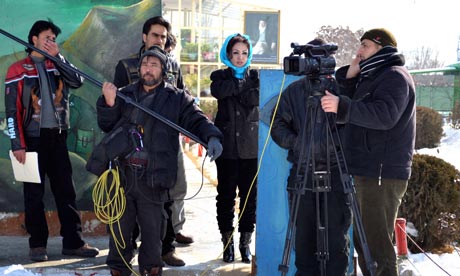
It's four degrees below zero in a high-security police compound in south-west Kabul. Inside several thick concrete walls topped with razor wire, 60 officers from the city's antiterrorist unit stand to attention in neat rows, blinking in the harsh winter sunlight, waiting for their orders. But today the commands won't come from their general. Today the boss is Saba Sahar – actress, screenwriter and Afghanistan's first-ever female film director.
"Cut!" shouts Sahar. She turns to the general standing awkwardly on the sidelines beside her soundman. "The troops are too far away from the camera, Mr Commander," she says. "We can't see them."
Fourteen years after the Taliban ordered all Kabul households to blacken their windows so women could not be seen from the outside, Sahar is striding in front of the camera, in shiny stilettoes, with sparkling blue eye shadow and a gold nose ring. The full-length burqa is still the choice of many Afghan women should they ever go out in public but Sahar prefers a turquoise headscarf, held in place by oversize sunglasses. She radiates Hollywood glamour, Kabul-style.
In a country where only 12% of women can read and few have jobs, Sahar is directing her sixth production. Commissioner Amanullah is a 24-part series on the Afghan police force. She's also playing the lead: a bold, incorruptible female cop, fighting terrorism in a man's world.
All Sahar's productions have been police dramas and the heroine of each, played by Sahar, is a female officer, standing up for justice and integrity against the bad guys, be they Taliban, warlords or drug barons. She's a kind of superhero, doing kung fu high-kicks in traditional dress, carrying victims to safety over her shoulder or riding a motorbike with no hands while firing a gun.
Sahar trained as a police officer herself and began working for the Interior Ministry 22 years ago, aged 14. She still works part-time for the Kabul police and that may account for the ease with which she directs armed troops as her extras. She's equally comfortable ordering a crew of foreign journalists around: I'm making a documentary about the Afghan film industry for Channel 4's Unreported World and she's allowed me on set so long as I don't get in the way.
"I want to show that Afghan women are capable of doing anything men do," she tells me. "I want to show the conservatives who lock their daughters and wives at home that they should let them out to get an education, earn some money and help rebuild Afghanistan." She's determined that her two sons and two daughters will grow up in a country where everyone is equal.
But living by example comes at a price. "Every morning when I leave the house I know I might get killed, might never see my family again," Sahar says. A few years ago, anonymous callers started bombarding her mobile with death threats. "They told me to say goodbye to my loved ones because I'd soon be dead."
She reported the threats to the Interior Ministry and the calls were traced to a phone in Kandahar. But they didn't stop. "They called me again and asked why I'd gone to the authorities. They said that even if the whole government is behind you we will still kill you. We will murder you on the street, in public."
Sahar now never leaves the house without her pistol and armed bodyguard.
She grew up at a time when Kabul was full of record shops, theatres and cinemas and always wanted to be an actress. She first appeared on stage at Kabul theatre as an eight-year-old, bold and controversial even then, because she did it without her family's permission. Her family tried to stop her but when her father saw her perform, he gave his blessing.
She was writing her first screenplayin 1996 when the Taliban seized power and outlawed cinema. They declared that moving images were heretical and that music, films and dancing led to "moral corruption". That year, militiamen stormed the offices of Afghanistan's state-run film company, burning whatever they found, destroying most of the country's archives. Sahar fled to Pakistan. Several of her friends died from police beatings after they were caught watching films.
She applied for asylum in the US and was granted a visa in 2001, but turned down the chance of a new life in the west when the Taliban fell. Sahar returned to Kabul and founded her production company, joining the brave few directors striving to rebuild the Afghan film industry, spurred by the promises of freedom brought with the arrival of foreign troops.
When her first film, The Law, had its 2004 premiere in Kabul, the cinema's owner feared the movie would cause a riot and demanded police protection. But the screening was peaceful and The Law became an unexpected hit, outselling the Bollywood classics that had begun to see a roaring trade in Kabul's DVD bazaars.
In 2012, two different Afghanistans co-exist, uneasily: a new generation fighting for a more liberal and open future and a strict, conservative Afghanistan willing to punish any behaviour considered un-Islamic.
Death threats are only part of the challenge dissenters face. In a country where women used to be flogged, imprisoned or killed for being visible in public, film directors have to find actresses prepared to perform on screen. Even if they can find the cast, equipment, crew and funding, they're still working in a war zone.
"Making movies is my love," Sahar says. "I love my country. I want to show people that there's more to Afghanistan than fighting, drugs and terrorism. If I die for asking for my rights and inspiring other women to fight for theirs, then I'm ready to lose my life."
The Taliban are fully prepared to take it from her. In a safe house on the outskirts of Kabul, I meet a Taliban commander. "The kind of movies that are for entertainment are against sharia," he says, calmly, his voice muffled beneath the turban that hides all but his eyes. "Any film that is against the law and the principle of sharia should be banned."
Makers of these films, he continues, should be told that what they are doing is wrong. "If that doesn't stop them, we will punish them according to sharia." That punishment, he says, is death.
The commander is relaxed, quietly confident. He has reason to be. Everyone I speak to in Kabul – from actors and directors to the officers at the police compound – is convinced the Taliban will soon have a stake in power and that Afghanistan will return to fundamentalism once foreign troops leave in 2014. All the Taliban need do is bide their time.
But you'd never guess it if you took a walk through Kabul's heaving DVD bazaars. Towers of brash covers encased in cellophane line every surface. This is where Afghan movies meet their audience: Kabul's six cinemas only show Indian and Pakistani films and are often empty. Most viewers would choose the security of their home rather than brave the city streets to watch a film.My guide is Salim Shaheen, Afghanistan's most prolific film star. He's a ball of theatrical energy bouncing through the bazaar. I'd believe his claim that he's only 42 if he hadn't already told me he's been a making films for more than 30 years. Shaheen has directed and performed in 107 low-budget, high-octane action movies, with titles such as Champion, Destiny and Unbeatable, several made while he was in exile in Pakistan during Taliban rule. He's one of the most recognisable faces in Afghan cinema. "Not everyone can become a superstar," he says with a grin as he waves a path for me to walk through his fans.
Action films have the lion's share of the market; in a country beset by violence, audiences expect to see it on screen, often in graphic, bloodthirsty detail. Shaheen's face peers from the black, orange and red movie posters, often wielding a Kalashnikov, sometimes with a rag tied across his forehead like Rambo – a constant source of inspiration, he says.
Bollywood films have sold well here since the fall of the Taliban, but few Afghans can understand Hindi and subtitles are almost useless when literacy levels are so low. Over the past few years, there's been an explosion in the popularity of films shot in Dari and Pashto. Viewers want films in their own languages, telling stories that relate to their own culture and experience. One trader tells me that when a new Afghan film is released he can sell 1,300-1,400 copies a day, even though, at 80 pence each, they cost more than a day's wages for most people.
"All my films are different. Each has a different message for society," says Shaheen. "My stories are about violence against women, stopping drug use and putting an end to terrorism, not only in Afghanistan but worldwide. We work hard on the script to make sure we have positive messages for our nation."
Shaheen knows that Afghan cinema is a deadly business. He lost eight members of his crew in 1993, when a rocket hit one of his film sets. It was during the turmoil of the civil war and Shaheen never discovered who was behind the attack, although he's convinced he was targeted deliberately. "I've paid for the 107 films I've made with the blood and lives of my crew," he says. "I will continue in their name. I'll never give up making films."
But if the Taliban come back, films will be banned and Shaheen says he will have to leave. He's convinced the new, liberal Afghanistan he's been helping create will disappear with the departure of foreign troops. "I'm not a military man or a politician, I'm a film-maker. But I believe there's going to be a civil war. If you come back here you won't see a living soul – Afghanistan will be covered in dead bodies."
I arrange to see Sahar again on a Saturday. Meeting at her house is out of the question – her brother-in-law is deeply religious and strongly disapproves of her and she fears my presence would make her home life even more fraught – so we meet at her office. She's drinking steaming tea, curled up on a sofa, surrounded by her crew, even though no one is supposed to be working today.
Sahar won't talk about her husband and children. I later learn she's become estranged from them – something almost unheard of in Afghanistan.
"I've sacrificed many friendships. I have fewer visits from my family. My uncle now refuses to see me because he's against what I'm doing," she says with a heavy sigh.
"My mum, my sisters and my brothers support me but the rest of my family doesn't."
It seems Sahar has found another family to replace those who have abandoned her: the family of people who make films with her. Even on her day off, they are the people she relies on for support and warmth. But she knows this family, too, could be torn apart. "If the Taliban come back in any form, women like me won't be free to act in films or make them. I'll have to leave the country."
For now, Sahar would rather focus on the present: a golden age for Afghan cinema, a precious period where homegrown films can thrive, so long as the people who make them are brave enough to go to work each day.
Her next project will be a film about the Taliban. "I'm hoping it will get prizes at Cannes and the Oscars," she tells me. "I'm not sure whether I'll be alive or not after I make that film. But with God's help, I will."
Two more Shia Hazaras shot dead in Quetta
DAILY TIMESAnother two Shia Hazaras were gunned down on Saturday on Brewery Road in Quetta in a spate of sectarian killing. The Frontier Corps (FC) claimed to have arrested three suspects allegedly involved in the killing. The officials also claimed to have seized arms from them. According to police, two people, Baban Ali and Hussain Ali, were riding a motorcycle on Brewery Road when an unidentified man opened fire on them. Baban died on the spot while Hussain Ali was shifted to the Combined Military Hospital where he succumbed to his injuries. The deceased were the residents of Hazara Town. “A man on foot opened fire on the men riding a motorcycle,” police official Amir Dasti said while quoting witness accounts. He said it was a case of sectarian killing and investigation was underway. Strong contingents of police and security forces reached the spot and shifted the body to the Bolan Medical Complex. “The victims were shot in head and chest,” hospital sources said. Dozens of Shias staged a protest demonstration on Brewery Road. They burnt tyres and blocked the road. The charged protesters shouted slogans against the government and law enforcement agencies for their failure to protect the Hazara community. Meanwhile, the Frontier Corps spokesman said the killers had been apprehended after officials deployed on Brewery Road chased the criminals. “The attackers after targeting two people tried to escape from the scene. Security forces chased the killers with the help of local people,” he said in a press release. Those arrested were identified as Guharam Soori Khan and Mian Khan Mengal. Later, another suspect was arrested on the information gathered from the accused during interrogation. The arrested suspects were handed over to Brewery Police for further interrogation, the FC official said, adding that the people present on the spot had also identified the target killers. In the last one week, as many as 29 Shias have been gunned down in Quetta.
Bhoja plane crash: People caught looting belongings of crash victims
A dirty picture at the site of Bhoja Airline plane crash emerged as few people from nearby areas remained busy in looting the luggage and expensive items of the victims of the crash.
The culprits were collecting jewelry, watches, imported bags and key items of the travelers who were flying from Karachi to Islamabad Friday night.
The heirs of victims reached the capital through a special flight by Pakistan Airlines.
“How is it possible for a human being to loot money and jewelry brewed in blood and flesh of a human,” said a person at the spot. “It is disgusting to see such things around dead bodies and wreckage of a plane,” he added.
Later the culprits were caught by security officials when police reached the spot.
Haqqani receives threats on social networking sites
Hussain Haqqani received death threats on social networking websites.Former Pakistani ambassador to United States, Husain Haqqani, has said that some elements are threatening him on social networking websites.
According to details, Haqqani received threats on Facebook, Twitter and other social networking websites.Former envoy has also lodged a complaint and submitted proof in US Federal Bureau of Investigation (FBI) to track the culprits.
Husain Haqqani had to resign after a Pakistani-American businessman Mansoor Ijaz had claimed that he was asked by Husain Haqqani to deliver a memo to the former US military chief General Mike Mullen, seeking US support to avert a military takeover following the killing of Osama bin Laden in May.He has been denying writing and sending any secret memo to US Admiral and terms it a conspiracy against him.
British activists oppose Bahrain F1 race
Dozens of the British activists have staged a protest outside the Formula One office in London to voice their opposition against Bahrain’s Formula One Grand Prix 2012.
The activists urged the Formula 1's governing body, the FIA, to cancel the sport event in response to the suppression of anti-regime protests by the Bahraini forces. The protesters believed that the al-Khalifa regime would use the auto race to cover up mounting human rights violations in the country.
Human rights campaigner Peter Tatchell also participated in the protest organized by campaign group Justice for Bahrain. He accused the F1 of supporting the killings of pro-democracy protesters in the Persian Gulf kingdom.
"I would appeal to Lewis Hamilton and Jenson Button to withdraw from the Bahrain grand prix. By participating, they'll be giving respectability to the regime. They'll be sending out the message that it's business as usual," he said.
The protesters also sent an open letter to Formula 1 management, stressing the Grand Prix should be stopped due to the rising protests against the Bahraini regime, whose forces have brutally attacked anti-regime protesters since pro-democracy demonstrations began last year.
“No sport as usual while Bahrain tyrants kill civilians,” read a protester’ banner. “Cancel Bahrain Grand Prix … No collusion with Bahrain dictators,” said another.
Seventeen British MPs have signed a House of Commons motion, calling for the cancellation of the auto race. The MPs warned that the Bahraini regime would use the race as "an endorsement of its policies of suppression of dissent.”
Labour leader Ed Miliband also condemned the controversial race being held in Bahrain despite brutality exercised by the regime forces. He also urged Prime Minister David Cameron to join the international calls for the cancellation of the event.
However, Cameron resisted the pressure that F1 would endorse the Manama regime. Failing to notice the humanitarian crisis in Bahrain, Cameron claimed that it was "a matter for Formula One.”
Bhoja Air: All safety checks were compromised: Experts
Startling new revelations about Bhoja Air came to light on Saturday as to how the airline allegedly used political pressure to get licence to operate after a lapse of some 10 years despite being a defaulter to the tune of Rs6.9 million as well as the health of aircraft Boeing 737-200 that crashed near Islamabad on Friday killing at least 127 people on board.
After contacting people associated with the aviation industry this scribe learnt that the airline operations were allowed allegedly due to “immense political pressure” on Pakistan’s aviation watchdog Civil Aviation Authority (CAA) currently managed by friends and cronies of the highest authorities of the country as well as the Ministry of Defence.
According to the experts in the CAA, the 28-year-old plane stood idle for the last 10 years after being dumped by another private airline, Shaheen Air, due to safety reasons and was recently acquired by Bhoja Air from British Airways, South Africa, on a dry lease.
It is also learnt that the original inaugural flight from Karachi to Islamabad was scheduled couple of days back but the airline had to delay it till the fateful Friday owing to alleged fitness problems of the doomed Boeing 737-200.
Incidentally all 737-200 series aircraft that first rolled out of the Boeing Assembly lines in 1967 are not allowed to operate in Europe although a few perhaps are operational in African countries.
The aviation insiders also claim that the ill-fated aircraft was allowed to commence flights from April 20 without taking proper procedures and professional checks and in total haste ignoring all the safety aspect of the plane already consigned to the junkyard by another carrier. It is also reported here that the two engines of the aircraft had different thrust levels which is not allowed at any cost.
Financial bankruptcy and lack of aircraft — previously it had old Russian-built planes in its fleet — left the airline with no option but to stop its operations in 2001 although it maintained a fully functional headquarter office in Karachi as well as an operation and ramp office at Karachi Airport.
All flight safety rules were compromised by the CAA officials for Bhoja Air to operate its flights in Pakistan on different domestic sectors following a decade of non-operation allegedly under pressure from political cronies of the present government.
Bahrain forces arrest Khawaja's daughter Zainab
Saudi-backed Bahraini security forces have arrested the daughter of Abdulhadi al-Khawaja, the prominent jailed activist, who has been on a hunger strike for more than two months.
Asia to become international economic center by 2050

It is an open secret that the center of global economy has been moving from the West towards the East.
Financial experts say that the number of money bags in South-East Asia, China and Japan has increased considerably while North American millionaires and billionaires continue to experience nothing but losses. What does the future hold for Russia?
The financial situation in the East has been more of less stable. The West continues to struggle with the debt crisis and tries to rescue several countries from bankruptcy. Many may wonder, how the developing countries managed to survive the devastating storm of the world economic crisis. It would be enough to recollect the year 1997, when all Asian markets literally collapsed. Nevertheless, the Asian countries have never stopped their attempts to win foreign capital.
As a result, China, India and the countries of South-East Asia rose from the ashes in nearly two years and continued their triumphant recovery. The global list of billionaires can be an example to prove the decline of investors' interest in Europe and North America. City Private Bank, which services world's wealthiest people, confirmed that the number of multimillionaires in the Asian region would continue to grow during the upcoming five years (by approximately 37%).India is said to become the major exporter of men of fortune. For the time being, India has only two dollar billionaires. Russia may also become one of the leaders of the financial race. Russia's Alisher Usmanov is not included on the list of world's 20 richest men, but Forbes has already named him Russia's richest man.
North America has to move over with its 17,000 multi-millionaires: the role of developing countries in global economy continues to grow. Many Asian countries will have to turn to Russia to provide its growing industry with fuel. One may assume that the center of global economy will move to Asia (between India and China) by 2050. Russia will only profit from the Asian economic boom.
Needless to say that the Asians have not built their economies on the patriotism of their own citizens. Asia's economic rise began during the 1980s. In Japan, for example, the economic growth began with the development of such concerns as Mitsubishi, Mitsui, Yasuda and Sumitomo.
Developing countries demonstrate an impressive growth of their economies with the help of the exports of raw materials. Investors also point out the rise of financial centers in the Asian countries. The Shanghai Stock Exchange, for example, is ranked sixth in the world on the capitalization of its companies. The stock index of the exchange grew by 303% after the international financial crisis.
One should also take account of the huge markets of those countries and their contribution to the IPO. Local companies have attracted nearly $300 billion in the course of the placement of primary bonds. It is worthy of note that the BRICS countries accounted for 39 percent of that amount. Investors turn their heads to Asia and invest in China ($55 billion) and Eastern Europe ($276 billion).
Pakistani Airline 'Bears Responsibility' For Crash That Killed 127
http://www.rferl.orgThe Pakistani government says the airline that owned the Boeing 737 that crashed on April 20 near Islamabad, killing all 127 aboard, bears responsibility for the accident. Interior Minister Rehman Malik said Bhoja Air "seems to be at fault as it had acquired a very old aircraft." He added that if an airline "doesn't have enough money, it doesn't mean you go and buy a 30-year-old or more aircraft as if it were a rickshaw and start an airline." Malik also said that Farooq Bhoja, the airline's owner, had been put on a list of people not permitted to leave Pakistan while investigation into the accident continues. The plane was flying from the southern city of Karachi to Islamabad when it went down in bad weather a few kilometers away from the Benazir Bhutto International Airport. Investigators are still trying to find the cause of the disaster.
Obama to Sudan and S.Sudan: War Is Not Inevitable
South Sudan and Sudan must stop all military actions against each other and resolve their disputes through negotiations to avoid going back to war, U.S. President Barack Obama said, as he outlined what needs to be done to prevent the conflict from escalating further.
Addressing the people of Sudan and South Sudan in a videotaped message released Friday, Obama said that the heated rhetoric from the two countries has raised the risk of war, but conflict is not inevitable.
"It doesn't have to be this way...You still have a choice. You still have a chance to avoid being dragged back into war, which only leads to one place — more suffering; more refugees; more death; more lost dreams for you and your children," he said.
Obama said the government of Sudan must stop its military actions, including aerial bombardments in the South and it must give aid workers the access they need to save lives. Sudan must also end its support for armed groups inside the South, he said.
Likewise, he said the government of South Sudan must end its support for armed groups inside Sudan and it must cease its military actions across the border.
"And all those who are fighting including in Southern Kordofan and Blue Nile must recognize that there is no military solution. The only way to achieve real and lasting security is to resolve your differences through negotiation," Obama said.
Sudan and South Sudan have been drawing closer to a full scale war in recent months over the unresolved issues of sharing oil revenues and a disputed border. The disputes began even before the south seceded from the north in July 2011. The South's secession was part of a 2005 peace treaty which ended decades of war that killed 2 million people.
Sudan and South Sudan both claimed Friday to be in control of a contested oil town near the countries' ill-defined border after the south said it was withdrawing its troops to avert a return to war.
Last week, South Sudanese troops took over the border town of Heglig, which they call Panthou, sending Sudanese troops fleeing and sparking condemnation from the U.N., America and Britain.
Sudan's President Omar Al-Bashir on Wednesday threatened to topple the South Sudan government after accusing the south of trying to take down his Khartoum-based government. Al-Bashir continued his hardline rhetoric on Thursday in an address to a "popular defense" brigade headed to the Heglig area.
Negotiations between the two countries over the unresolved disputes that were being mediated by the African Union, broke down in Ethiopia earlier this month.
Obama said the presidents of Sudan and South Sudan must have the courage to resume negotiations and resolve the disputes peacefully.
"You will never be at peace if your neighbor feels threatened. You will never see development and progress if your neighbor refuses to be your partner in trade and commerce. It's easier to start wars than to end them," he said.
France election 2012: a flash of bling as Nicolas Sarkozy hides his £50,000 watch

Sarkozy manque de perdre sa montre à la Concorde by LeNouvelObservateur Who thought Ray Bans and chunky watches were a thing of the past with Nicolas Sarkozy, chastened by disapproval for his love of glitz early on in the presidency? A furtive scene caught on camera proves he is still a die-hard fan of designer watches. As he shakes hands minutes before addressing a crowd of thousands at Paris’s Place de la Concorde, Sarkozy can be seen quickly whipping off his watch and stuffing it into his pocket. According to Novel Observateur, it was a white gold Patek Philippe worth 55,000 euros – a gift from his then fiancée Carla Bruni in January 2008. The French press seem split in their commentaries over whether the gesture was to due to fear of theft or of recalling the “bling bling” period the President has been at pains in this campaign to say he regrets. If Sarkozy hid the watch, perhaps it is because he didn't want to get a taste of his own medicine. In 2008, he was caught on camera pocketing a flashy fountain pen after a signing with the Romanian president.
Curbing polio resurgence: PHC to hold judicial inquiries into new cases
http://tribune.com.pkContinuing its efforts to curb polio resurgence, the Peshawar High Court has said that it will hold a judicial inquiry if a new polio case surfaces in Khyber-Pakhtunkhwa or Fata. “[We] will fix responsibility and [those responsible] will be taken to task, whether it is negligence on part of parents, government or the head of a polio team,” PHC Chief Justice Dost Muhammad Khan said on Saturday, speaking at the court premises during the inauguration ceremony of a national immunisation campaign that is to be launched on April 23. The chief justice also asked the government to direct security forces to either halt a military operation in tribal areas for two to three weeks or provide protection to polio teams so that children in those war-ravaged areas can be inoculated. According to an official of the Expanded Programme on Immunisation, the campaign has been delayed in South Waziristan owing to a military operation in the area. Justice Khan said that political agents of all agencies must utilise all resources to reach inaccessible areas. The chief justice also had words of advice on how the federal government can help counter the resurgence of polio in the country. “The Peoples’ Representation Act should be amended to make it mandatory for voters and candidates to produce polio vaccination certificates [for their family] at the time of election. Those who fail to do so should not be allowed to contest the election or vote.” He also proposed that the federal government should direct NADRA and the Passport Office to not entertain requests for a computerised national identity card or passport if a certificate is not provided. Earlier, the court had made it mandatory for litigants to provide the certificates when moving the court and ruled that those seeking Watan and Ration Cards under the federal government’s Benazir Income Support Programme must provide polio vaccination certificates to be eligible. The court has also ordered the Provincial Disaster Management Authority to set up 20 polio vaccination centres at the Jalozai camp, which houses over 170,000 people. He also suggested that at the time of admission, schools should ask parents to produce vaccination certificates.
Lenin still wanted and translated
http://rt.com/Russian is not “lost in translation”. On the contrary, it appears to be one of the most popular and translated languages in the world, with thanks in part to the rich heritage of the Father of the Bolshevik Revolution, Vladimir Lenin. According to the Unesco Index Translatonium, an electronic database that numbers over two million entries concerning 500,000 authors in 148 countries, the revolutionary Soviet leader is among the top five most translated authors in the world, along the likes of William Shakespeare, Agatha Christie and Stephen King. According to the data collected since 1979, Lenin's works have not exceeded their sell-by-date yet. Apart from the key Soviet communist, the list of the world’s most translated authors also features several more “fathers”, the "Father of Science Fiction", Jules Verne, as well as Pope John Paul II, ranked 22nd. This year UNESCO marks the 80th anniversary of its Index Translatonium containing information about published translations provided by national libraries, translators, linguists, researchers and databases worldwide.
Life is hard in Jalozai Camp
FRONTIER POSTEight year old Abdullah who was displaced due to the military operation in Khyber Agency and is now working at Jalozai Camp catering food on a push cart, say this job is the only source of income for him. Abdullah is also like other thousand of children who migrated from Khyber Agency to Jalozai Camp said to The Frontier Post that they were shifted from Khyber Agency to Jalozai camp in very difficult circumstances as every where the voice of bullets and mortar shell deafened their ears. Abdullah said that he was studying in class three at Jalozai Camp and after the school he came out with his push cart wheel to earn some money for his family. Taimur Afridi standing in a long row said to The Frontier post that he has come early in the morning but still has inot received the daily food items. He also complained that due to the migration of people belonging to different agencies of Fata where operation was still continuing people of these areas were searching for rented houses as the property dealers and owners of the houses increase the rent of their houses and take advantage of their problems. The 50-year old Rahim Jan Afridi said that the weather was getting there was no electricity facility in his camp because of that their children and family members could not not take proper rest. He said there also was fear of Dangu virus.
Nawaz's compounding of his folly
The Frontier PostHad he had to compound his folly? In itself, Mian Nawaz Sharif's foolish call for unilateral withdrawal by Pakistan from the Siachen glacier was a stunning absurdity. It had left the nation utterly aghast and bewildered, and may have embarrassed even the few sensible people in his own party. But was that not enough of it that he had also to mix up his folly with an astounding naivety? He says if Pakistan pulls out from the glacier, India too would follow suit. Really? If indeed it is that simple, why didn't he pull out the troops from there during his two stints of the prime ministership and lay to the grave for good this imbroglio that has cost so many precious lives and so much treasure to us, though no lesser to India? And by his own same logic, couldn't he unilaterally withdraw troops from Azad Kashmir as well that would have led up to the occupied Kashmir's vacation by India, which if nothing else would have at least saved the Kashmiris from the continuing brutalisation by a trigger-happy Indian military, which has inflicted untold atrocities on them to quell their indigenous uprising for freedom? He says even the army chief has endorsed his views on the issue. But General Ashfaq Parvez Kayani has spoken very sensibly. He has not talked of any unilateral pullout. He has spoken of the glacier's demilitarisation through negotiations, which in any case are on since long futilely, primarily for the obduracy of the Indian military establishment. Nonetheless, no lesser is despicable the perfidy with which the Indian officialdom and our own palmed-off galaxy of commentariat and chattering classes have received the general's statement and are playing it out to their own end. Both are feigning as if this is some sort of a unique statement, representing some kind of a change in the stance of the Pakistan military, whereas our military establishment has throughout been on board for a negotiated settlement of the issue. Yet the thrust of their discourse is more than obvious: it is to hold the Pakistan military responsible for the continuing tiff over the demilitarisation of the glacier. But the spoiler in reality is none else but the Indian military establishment which wants the settlement to be wholly on its own terms and conditions. Almost a dozen rounds of talks have gone through over the issue. But a settlement remains elusive for the Indian military's adamancy alone. It doesn't want to vacate certain top peaks and air force facilities in any settlement, and wants its 1984 aggression on the glacier to be represented in bold ink on the map too. But why is Nawaz so resolved to get on this deeply-wronged harried nation's nerves with his one stupidity after the other in endless succession, with no contrition or remorse? When a true leader commits a folly, he shows the great grit to confess his mistake and say sorry for it. A lesser leader lets his folly pass, keeps his mouth shut, hoping it would pass away undamagingly and vowing in his heart never ever again to commit such blunder. But then Nawaz is no leader in the real sense. He is the product of a conspiracy of circumstances that has catapulted him to where he is, not befittingly. Still, he can afford some sense of shame. He must not drag on his initial sin to the nation, by compounding his stupidity by piling folly upon folly. He cannot imagine with his foolish call how potent a handle has he put in the hands of the Indians to beat Pakistan with over the Siachen issue. The poor Pakistani negotiators will feel its hurt to their great grief when they meet their Indian interlocutors to talk the Siachen imbroglio's settlement. Let there be no doubt about it, such a cruel cut has Nawaz imparted to this wretched nation with his unpardonable stupidity. It is not an ostentatious bravado he should now put on display to wash off the embarrassment of talking an utter nonsense. It is the repentance that he must show to clean the slur on his face for being so sinful to the nation's cause.
Obama leads Romney on foreign policy
http://www.examiner.comVoters believe President Barack Obama has a significant edge over Massachusetts governor Mitt Romney when it comes to international affairs according to recent polling, which is a surprising development considering the GOP has been perceived as stronger on defense in every election since the Vietnam era. According to a Quinnipiac survey released on Thursday more Americans trust Obama over Romney on foreign policy matters by a 46 to 40 margin while last week’s Washington Post-ABC poll showed Obama with a commanding 17 point lead on this issue. A solid majority of experts believe President Barack Obama’s foreign policy record will boost his reelection bid according to the National Journal Insiders Poll published two weeks ago.Polls also indicate that the economy and job creation are Romney strong suits while overall figures show a tight race, with the lead fluctuating by the day. Based on these results it seems logical for Romney to make the economy the centerpiece of his campaign strategy, yet he continues to hammer Obama for being weak on global leadership. Some experts believe Romney ought to avoid discussing foreign policy issues because he has a record of flip-flopping while some of his stances seem downright outlandish, including his decision to peg Russia as America’s number one geopolitical enemy. An area of weakness Romney could exploit is Afghanistan, but it is hard to determine how Romney’s position differs from the president’s. Romney has blasted Obama for ignoring the advice of the generals and withdrawing troops from Afghanistan too quickly – a stance that runs counter to national sentiment. Public support for maintaining troops in Afghanistan has reached a new low per a Pew research survey that came out on Thursday. Just 32% of the public believes the U.S. should keep troops in Afghanistan until the situation stabilizes, while 60% favor removing the troops as soon as possible. One Romney advisor claimed the former governor prefers “peace through strength” rather than just managing the gradual decline of the nation’s military. However, this will be hard for many voters to swallow given that the Obama administration spent approximately $895 billion on defense in 2011, 40% more than the Bush regime spent at its peak in 2008. It will also be difficult for Romney to portray Obama as weak on defense considering he quadrupled the size of Bush’s drone program; he had a U.S. citizen living abroad assassinated for being a terrorist; and he authorized the bombardment of Libya. Not to mention, it was during Obama’s reign that the U.S. finally eliminated the world’s most wanted terrorist, a feat the Obama campaign is already leveraging. During a campaign stop in Romney’s native home state of Michigan the president bragged about a specific change many wouldn’t have associated with candidate Obama four years ago:
Afghan security intercepts insurgents with 10,000 kgs of explosives
AL ARABIYA NEWSAfghan security forces have detained five insurgents in Kabul, with 10,000 kilograms (22,046 lbs) of explosives they intended to use in a massive attack on crowded areas in the capital, an Afghan intelligence spokesman said on Saturday. “If this amount of explosives had been used, it could have caused large-scale bloodshed,” National Directorate of Security spokesman Shafiqullah Tahiri told a news conference. The explosives were found stuffed into 400 bags and hidden under piles of potatoes in the back of a truck on the city outskirts. “Three Pakistani terrorists and two of their Afghan collaborators who placed the explosives under bags of potatoes in truck were caught,” said Tahiri. The men, he said, had received training from members of the Pakistani Taliban, who have strong links with the Afghan Taliban. Afghan officials have long accused Pakistan of using insurgent groups like the Afghan Taliban as proxies in Afghanistan. Pakistan’s government denies supporting or giving sanctuary to insurgents on its territory. Insurgents this week launched a coordinated assault on four provinces, targeting diplomatic and government areas of Kabul with rockets and gunfire in what they said was retaliation for abuses of Afghans by U.S. soldiers. The attacks showed the insurgency's resilience nearly 11 years since the Afghan Taliban were toppled. The Afghan Taliban claimed responsibility for the attacks and said it planned similar assaults in coming months.
Bahrain Grand Prix tensions mount

The body of a man was found Saturday in a village outside Manama, police said, as opposition activists accused the government of cracking down on demonstrations ahead of the Bahrain Grand Prix.
Police have not confirmed the identity of the body, which local residents say was found on a rooftop on a farm.
Residents say he was a young opposition activist shot Friday night as police chased a group of protesters in the area.
There are mounting fears that civil unrest in Bahrain could upend Sunday's race and pose a threat to Formula 1 teams and fans.
Last year's race was canceled twice because of the unrest, but the sport's governing body said Friday the event would go ahead as planned despite tension on Bahrain's streets.
Check points are in place on the streets of Manama and near the race circuit Saturday but the security presence is less heavy than Friday, witnesses say.The body was found in the village of Shakura, north of Manama.
Police and protesters clashed in the area Friday night, residents said, with security forces making use of tear gas and stun grenades.
The Bahraini government played down any risk to visitors Friday, when preliminary race events got under way, saying the Grand Prix would act as a unifying force amid the nation's civil unrest.
"The government guarantees the safety of everyone. We are very confident about our security measures that we have in place," Fahad Albinali, spokesman for the Bahrain Information Affairs Authority, told CNN.
Crown Prince Salman bin Hamad Al-Khalifa told reporters that canceling the race would play into extremists' hands, according to a report Friday in the state-run Bahrain News Agency.
"The Formula 1 race allows us to build bridges between communities, get people working together," said the crown prince. "It allows us to celebrate our nation as an idea that is positive, not one that is divisive."
He and Albinali echoed a government statement issued earlier that reported there are no problems.
"The three-day Bahrain Grand Prix began today absolutely safely and without incident. Bahrain is a safe country and there is no reason for any Formula 1 team to have concerns about security," the government said.The statement was in response to remarks by former lawmaker Mattar Mattar, who said the government had increased the number of arrests in the days leading up to the event.
"So the government decided to control the situation just by excess of force and by using more violence, and this is the policy that the regime has used always," he said.
A human rights activist, Nabeel Rajab, also accused the government of detaining and torturing "at least half" of the Formula 1 staff in Bahrain.
"We don't want Formula 1 to look like it is a sport of dictators. We need it to look like it is a sport of those people who love the sport," he said.
The crown prince said demonstrations that took place Friday were part of the political process, like in any country, the Bahrain News Agency reported.
Claiming that some security personnel who had been heavy-handed in the past have been held accountable, he condemned violence on all sides -- including by demonstrators trying to get, in his words, the world's attention.
Specifically, the government denied that any torture or mistreatment of Bahraini racing employees has occurred, adding that it takes such allegations seriously.
"The Grand Prix has always had widespread domestic support and will clearly act as an important unifier, following a challenging period where significant and important lessons have been learnt," the government statement said.
On Friday, tens of thousands attended an anti-government demonstration in the capital, Manama, and many then began marching toward the former Pearl Roundabout, the center of last year's revolt, activist Mohammed Muscati told CNN.
Some of the protesters called for the release of Abdulhadi al-Khawaja, a human rights activist who has drawn international attention with a hunger strike he's sustained for more than two months. One of his daughters, Maryam, says he has now stopped drinking water and taking fluids intravenously and is at serious risk of death.
Four U.S. senators -- Richard Durbin, Robert Casey, Marco Rubio and Ron Wyden -- sent a letter to the crown prince urging him to release al-Khawaja, according to rights advocacy group Freedom Now.
The controversy about the race spilled over into cyberspace Friday, with the apparent hacking of the Formula 1 website. The site was shut down, and a message was left condemning the government and the Formula 1's decision to hold the race.
The website appeared to be operating normally again Saturday.
Bahrain has declined to extend the visas of non-sports reporting crews from CNN, Reuters and other news agencies and told them they would not be allowed to stay for the race, which is a big draw, both in terms of investment and fans.
Formula 1 is the world's most popular motor sport, and races have a TV audience of more than 500 million. When Bahrain canceled the race last year, it lost an estimated $480 million to $800 million of investment that would have come from hosting it.
The unrest in Bahrain makes hosting the race precarious because the racers must pass through some areas where clashes have occurred to get to the circuit, which is in the desert.
Friday, April 20, 2012
White House rebukes Palin Secret Service row
The White House said Friday it was "preposterous" and "ridiculous" for Republicans, including Sarah Palin, to try to blame President Barack Obama for the Secret Service sex scandal.
Palin, Republican Senator Jeff Sessions and others have said the scandal, and other embarrassments for the government are somehow symptomatic of a lack of authority within Obama's government.
White House spokesman Jay Carney dismissed any attempt to link the scandal in Colombia, a row over a lavish conference held by the government's administrative agency and a furor over soldiers who had posed with corpses in Afghanistan.
"It is preposterous to politicize the Secret Service, to politicize the behavior of the terrible conduct of some soldiers in Afghanistan in a war that's been going on for 10 years," Carney said.
"What they're doing is trying to turn these incidents, one that's still under investigation, to political advantage.
"It's a ridiculous assertion that trivializes both the very serious nature of the endeavor that our military is engaged in in Afghanistan and the very serious nature, both of the work that the Secret Service does."
In an interview with Fox News on Thursday, Palin, the former Republican vice presidential nominee, suggested that scandal over Secret Service agents who consorted with prostitutes in Colombia last week was a symptom of a government "run amok."
"The president, the CEO of this operation called our federal government, has got to start cracking down on these agencies," Palin said.
"He is the head of the administrative branch."
Palin also condemned one of the agents who lost his job due to the Colombia episode, who reportedly wrote on a Facebook page that he was "checking her out" while guarding her during the 2008 election.
"Well, check this out bodyguard, you're fired," Palin said.
The Washington Post named two of the three agents ousted by the agency over the affair as David Chaney, a senior supervisor and Greg Stokes, a member of the Secret Service's K-9 division.
Air Force Two carrying Biden struck by birds, lands safely
The Air Force Two plane
carrying Vice President Joe Biden was struck by birds in California on Thursday, a spokeswoman for his office said, but it landed without problem and the vice president, passengers and crew were safe at all times.
The incident occurred on Thursday night as Air Force Two was landing in Santa Barbara, California. A person familiar with the situation said the landing felt normal to people on board.
"The vice president left Santa Barbara this afternoon as scheduled, aboard an alternate U.S. Air Force aircraft," the spokeswoman said.
Lieutenant Gregg Johnson of the 89th Airlift Wing at Andrews Air Force Base in Maryland, which is responsible for transporting the president, vice president and other senior U.S. officials, said the crew and passengers of Air Force Two had been "safe at all times."
"There was no emergency - no emergency landing declared," he said, adding it was not possible at this stage to characterize the level of damage, if any, that the modified Boeing 757 aircraft sustained in the bird strike.
Another bird strike on Thursday forced a Delta Air Lines flight bound for Los Angeles to make an emergency return to New York's John F. Kennedy International Airport.
In January 2009, a US Airways flight made a successful emergency landing in the Hudson River after it struck a flock of geese shortly after take-off from New York's LaGuardia airport. All 155 passengers and crew survived.
Air safety incidents involving the U.S. president or vice president are rare, but not unprecedented.
Air Force One aborted a landing due to bad weather while carrying President Barack Obama to an event in Connecticut last May. One month earlier, an aircraft carrying first lady Michelle Obama was ordered to abandon its landing approach to Andrews Air Force Base in order to avoid another plane.
Easy availability of fast food spurs unhealthy lifestyles
http://gulfnews.com
Populations in many countries around the globe are getting dangerously overweight and obese and doctors complain that it's because of fast foods which are cheaper and convenient.
With a diet rich in saturated fats, salt and high caloric content, comes heart disease, the number one cause of death in many countries, including the UAE.
Heart disease was earlier said to be a rich man's disease because of the rich foods and unhealthy diet of the glitterati, but now, even the poor have access to a hamburger or roasted chicken (with skin) and fries, which cost much less than good, wholesome food.
With our fast-paced life of today, while we know the right thing to do, if there is no time to prepare a hot, nutritious breakfast for our school-going children, we opt for convenience foods and snacks such as chips, muffins or other unhealthy choices.
But is fast food or convenience food alone to blame for the epidemic of diabetes, obesity and a host of non-communicable diseases, the diseases that are not contagious, but that are due to some extent because of our bad choice of foods?
And if so what is a good and nutritious diet?
"I know several people who have made a lot of money writing books about this but they end up confusing the public," says Dr George A. Mensah, Vice-President, nutrition, global research and development, PepsiCo. He is in Dubai for the World Congress on Cardiology and speak on early heart attacks among American women.
"Eat what you enjoy. What is delicious and what is culturally relevant and important to you and that which allows you the social community with friends and family," he says.
Dr Mensah said what science suggests is very simple. "The best diet is one rich in fruit and vegetables, rich in whole grains, low in saturated fats and low in calories. But even that, if you don't couple with moderate levels of physical activity, it cannot be the best thing for you."
Sad story
He said there is really nothing from science that says one food is a bad food and another is a good food.
"It's really moderation, a balanced diet with appropriate fibre, protein, carbohydrates and good fats."
He said it was a sad story, but not too long ago the world wasn't this fat. He was responding to a comment from Gulf News that America is now rated the fattest nation in the world today. "Dubai is getting there too... and so is Mexico," he said.
The doctor recalled his growing up days in Africa. He said he was lucky as his village had a school, but he still walked six miles every day.
Obesity
"We ate all the wrong things. You must have heard of Cassava [a shrubby plant grown for its starch-filled roots], it has a highest concentration of calories, easily about 600 calories."
He said but with all that walking there was no way anyone could get fat. "I have pictures and you could never find an overweight person [in it]," he said.
With the obesity epidemic steadily moving across the globe and changing the physique of the younger generation, some western governments have asked food manufacturers to join in the fight against fat and provide nutritious food to the public.
In Europe, the food and drink industry is working to reformulate foods and drinks to reduce salt, fat, sugar and other nutrients of concern.
Britain, for instance, has asked for reduced salts because of the growing dangers of hypertension, the killer disease of high blood pressure.
Researchers, the private sector representatives, policy-makers have been meeting to discuss the challenges of removing or replacing ingredients in a wide range of food products.
But a researcher said the challenge with reformulation was that there was no ‘one size fits all' for food producers. But it is working to some extent and reformulation is responsible for two thirds of the positive change in salt reduction in the UK.
Wider options
Dr Mensah said PepsiCo through its Quaker brand is committed to increasing wholegrain, dairy, fruits and vegetables and nuts and seeds in its functional foods. He said more such foods will come into the market that will give consumers wider options for healthier diets.
But he hinted that there is still no huge demand from people for healthier foods. "Health communities, where ever they may be, have a responsibility to make people aware of healthier foods and provide them access to these foods," he said.
The nutrition expert also noted that very little money was going into research on diet and the food systems.
"There's more to health than just treatment and drugs," he said and quoted Hippocrates, the father of modern medicine: "Let food be thy medicine and medicine be thy food."
Bhoja Airline's crash
According to one of the eyewitnesses, the passenger plane caught fire in the air, Geo News reported.
Talking to Geo News, a local resident said the plane was already on fire in the midair and seemed like a ball of fire coming at them.
President Asif Zardari and Prime Minister Yousuf Raza Gilani expressed deep grief and sorrow over the passenger plane crash and ordered immediate investigation into the incident, Geo News reported.
They also expressed condolence with the heirs of the victims and prayed to Almighty Allah to rest the departed souls in eternal peace and grant courage to the family members to bear the irreparable losses.
6.1-quake rattles off northern Sumatra: USGS
The Jakarta Post, JakartaA 6.1-magnitude earthquake struck the west coast of North Sumatra on Saturday morning, the United States Geological Survey (USGS) reported. The quake struck at 5:14 a.m. with an epicenter located at a depth of 34 kilometers, 368 km southwest of Meulaboh or 427km southwest of Banda Aceh. The tremor, however, did not trigger a tsunami. There were also no immediate reports of damage. Less than two weeks ago, Aceh and its surrounding areas were struck by an 8.5-magnitude quake and dozens of aftershocks, which also triggered a mini-tsunami. The earthquake claimed five lives, mostly due to heart attacks.
Socialist favoured as France heads for elections
France votes in the first round of a presidential election Sunday with Socialist Francois Hollande the favourite over incumbent Nicolas Sarkozy, whose personal style and handling of the economy alienated many voters.
Moment of truth looms for a 'desperate' Sarkozy
French President Nicolas Sarkozy told supporters on Friday the "moment of truth" had come. But with the first round of the presidential election less than 48 hours away it appears the pressure is beginning to take its toll on the head of state.French President Nicolas Sarkozy chose the last official day of campaigning before Sunday’s first round vote to lash out at election rules - as well as issue an apology to the nation.
The incumbent president is under pressure, with most opinion polls showing him trailing behind Socialist Party candidate Francois Hollande by up to three points for the first round.At his final campaign rally in Nice on Friday evening, the president himself declared that “the moment of truth” had arrived.
“This is the moment when the people of France will tell the truth”, he told supporters.
But with less than 48 hours to go before polling stations open across France it appears the pressure is beginning to tell on the man the French call “Sarko”.
After issuing a vague threat that the election will “teach everyone a lesson” in a speech on Thursday, Sarkozy turned his ire on the rules governing the election.
Sarkozy is furious that all 10 candidates in the first round of voting had to be given equal air time by the media during the one month of official campaigning, despite the fact many will only get a tiny percentage of the vote.
Chief rivals Sarkozy and Hollande have had to share air time with fringe candidates like the extreme left’s Nathalie Arthaud and Philippe Poutou as well as the eccentric Jacques Cheminade, who wants to create a thermo-nuclear corridor from earth to Mars.
“Sarkozy getting desperate”
“I have been in a battle, where for the past four weeks it has been me alone against nine other candidates,” Sarkozy complained to the French daily Le Figaro.
Insisting the regulations must be changed in future he said: “It will be the last election with these rules because all this leads to is a caricature of our democracy. The rules reflect equality but not the reality.”
University College London’s Philippe Marliere believes Sarkozy’s anger is a sign of the President’s increasing “desperation”.
“His argument is a bit ironic considering he has been in power for five years with so much media exposure,” said the French politics professor.
“The rule is only for a month and it shows all the candidates are equal before the law. It’s like he’s a child complaining about everyone ganging up on him. It really smacks of desperation,” Marliere added. “It’s a sign of someone who knows he is on course to lose.”
Others, however, believe the election rules could benefit Sarkozy.
Bernard Debré, former minister from Sarkozy’s UMP party believes the coverage given to fringe candidates will help the president.
“The fact there are such absurd candidates could actually reflect well on the president,” Debré said.
Second round is a “different story”Despite strong showings from far right candidate Marine Le Pen and the far lefts Jean-Luc Melanchon, the president is still expected to reach the second round run-off vote on May 6.
The decisive vote to choose France’s next president will be “a totally different story”, Sarkozy believes.
“I will go from having 10 percent of air time to having 50 percent and we will finally face each other, project against project, personality against personality,” he said.
Marliere believes Sarkozy must take advantage of his time on television if he is to have any chance of convincing French voters to back him in the crucial run-off vote.
“His biggest hope is the live TV debates which are held between the two rounds of voting,” said Marliere.
“They are emotionally and politically charged and there will be a chance to take on Hollande because he believes he’s a better debater,” Marliere said.
“But it would take Hollande to do or say something extremely foolish or be seen to be totally out of his depth for him to turn it around and I don’t think that will happen.”
Asking for forgiveness
Sarkozy also showed an air of contrition on his final day of campaigning once again issuing a “mea culpa” for the “mistakes” he made following his election triumph in 2007.
He was heavily criticised in the French media in the aftermath of that victory for his perceived flashy lifestyle, which many in France thought unbecoming of a head of state.
Pictures of him holidaying on multi-million pound yachts in the Mediterranean and his whirlwind romance with supermodel Carla Bruni earned him the derisive nickname of the ‘bling-bling’ president.
After apologising at the start of this year’s election campaign, Sarkozy felt the need to remind the French public on Friday that he deeply regretted his errors.
In a contrite interview with RTL radio station he claimed to not have immediately understood “the symbolic dimension of the role of president” and accepted that he had lacked a certain amount of “somberness”.
“I will not make the same mistake again, now that I know the job,” he said.
With opinion polls showing Hollande holding as much as a 10 point lead over Sarkozy for the run-off vote, the chances of the president being able to make up for his previous mishaps appear ever slimmer.
French voters’ ambivalence makes it tougher to predict presidential race
washingtonpost.comEmmanuelle Lellig was having none of it. The candidates in France’s presidential election, she sneered, spend their time hurling insults at one another and throwing out promises that they have no intention of keeping.“How can we believe them?” she asked between sips of morning coffee at an outdoor cafe this week. “They’re not going to do what they say, anyway. For me, the campaign goes in one ear and out the other.” Lellig, a 24-year-old intern at a public relations agency in this graceful old city 150 miles southwest of Paris, has not made up her mind whether to vote Sunday in the first round of France’s election, much less in the second round May 6. Even if she votes, she said, she has not decided whether to back President Nicolas Sarkozy, main rival Francois Hollande of the Socialist Party or one of the eight minor candidates spread from the far right to the far left. Lellig, in short, is emblematic of the joker that could produce surprises in France’s presidential race. Despite opinion polls that for months have put Sarkozy and Hollande neck and neck in the first round and given Hollande a decisive edge in the runoff, a number of polls have predicted that nearly one-third of France’s 43.2 million registered voters will make up their minds on whether to vote at the last minute or will not decide on a candidate until the day they cast their ballots. This marks a shift from past French elections, in which voter sentiment largely crystallized before the final week of campaigning, polling experts explained. The participation rate is likely to be around 75 percent, they estimated. By U.S. standards, that would be a massive turnout. But by French standards it marks a continuing decline and, they emphasized, could leave the country with a bloc of voters whose preferences are hard to predict. Jacques Le Goff, a law professor at the University of Nantes, lamented the trend in a front-page editorial Thursday in the main regional newspaper, Ouest-France. “How can it be that this act that is such a strong symbol, a manifestation of popular sovereignty and an incarnation of citizenship, ends up so pale and faded?” he asked. Many of those who abstain or cannot make up their minds are young people who have not yet fully integrated into society’s civic responsibilities. But many are also older adults who have grown disgusted with a political system they see as remote and unresponsive to the people. This is particularly true in distant suburbs and provincial cities, where the political fervor of Paris seems like frivolity from another world. “Nobody believes in it any more,” said Eric Fairnand, 38, the owner of a chic brasserie strategically located just in front of St. Peter’s Cathedral, the main Nantes church. “The candidates make all kinds of promises that they never keep. Whether they are on the left or the right, they treat us like we are sheep, like we are stupid jerks.” In that vein, the leftist news magazine Marianne headlined this week’s issue, over photos of the five most popular presidential candidates: “The biggest lies of the campaign. Who lies the most? Who lies the best?”Fairnand, who owns other businesses in this port city of 600,000 residents, said he voted for the conservative Sarkozy in 2007 and probably will do so again, chiefly because he fears a victory by Hollande would mean higher taxes for entrepreneurs. But he expressed dismay at Sarkozy’s record over his five-year term and said that Sarkozy was making campaign gestures, such as rescuing factories threatened with bankruptcy, that he should have been working on long ago. Some abstentions, analysts pointed out, could be blamed on the coincidence of having Sunday’s first-round voting at the tail end of Easter vacations, when large numbers of families are still in the Alps for end-of-season skiing. Beyond that, experts have tried to determine what has been triggering voters’ doubts and hesitations but have not come to widely accepted conclusions. Some point to a 24-hour news cycle on France’s relatively recent all-news television channels. The pressure to create several headlines a day to grab jaded viewers’ attention, they said, prevents candidates from focusing on a single issue long enough to explain their proposals. Others cite the number of candidates — 10 — and laws requiring that each get an equal amount of television and radio time, including one who proposes that France should colonize the moon. As a result of both factors, polling experts complained, the campaign often appears to many people, particularly outside Paris, like a confetti storm of declarations and denunciations unconnected to their daily lives. Sarkozy, in an interview Friday in Le Figaro newspaper, promised that this will be the last presidential election with equal-time rules, no matter who comes out the victor. “All this leads to a caricature of democracy,” he said. “We are in a formal equality that is not a real equality.” Hollande, also eager to counter the trend, emphasized in a recent interview that he has promised nothing that he cannot carry out if he is elected. But Pierre Ndiaye, a 19-year-old communications student at the University of Nantes, said he plans to stay away from the polling booths — and urges others to do the same — because the French political system does not work. Candidates such as Hollande can make all kinds of promises during the campaign, he said, but there is no system for making them adhere to what they pledged once they become president or members of parliament for five-year terms. “It’s cynical,” he declared. “Now he does it?” Fairnand jeered. “He could have started five years ago.”
Subscribe to:
Posts (Atom)