Tuesday, March 27, 2012
Support in U.S. for Afghan War Drops Sharply, Poll Finds

After a series of violent episodes and setbacks, support for the war in Afghanistan has dropped sharply among both Republicans and Democrats, according to the latest New York Times/CBS News poll.
The survey found that more than two-thirds of those polled — 69 percent — thought that the United States should not be at war in Afghanistan. Just four months ago, 53 percent said that Americans should no longer be fighting in the conflict, more than a decade old.
The increased disillusionment was even more pronounced when respondents were asked their impressions of how the war was going. The poll found that 68 percent thought the fighting was going “somewhat badly” or “very badly,” compared with 42 percent who had those impressions in November.
The latest poll was conducted by telephone from March 21 to 25 with 986 adults nationwide. It has a margin of sampling error of plus or minus three percentage points.
The Times/CBS News poll was consistent with other surveys this month that showed a drop in support for the war. In a Washington Post/ABC News poll, 60 percent of respondents said the war in Afghanistan had not been worth the fighting, while 57 percent in a Pew Research Center poll said that the United States should bring home American troops as soon as possible. In a Gallup/USA Today poll, 50 percent of respondents said the United States should speed up the withdrawal from Afghanistan.
Negative impressions of the war have grown among Republicans as well as Democrats, according to the Times/CBS News poll. Among Republicans, 60 percent said the war was going somewhat or very badly, compared with 40 percent in November. Among Democrats, 68 percent said the war was going somewhat or very badly, compared with 38 percent in November. But the poll found that Republicans were more likely to want to stay in Afghanistan for as long as it would take to stabilize the situation: 3 in 10 said the United States should stay, compared with 2 in 10 independents and 1 in 10 Democrats.
Republicans themselves are divided, however, over when to leave, with a plurality, 40 percent, saying the United States should withdraw earlier than the end of 2014, when under an agreement with the Afghan government all American troops are to be out of the country.
The poll comes as the White House is weighing options for speeding up troop withdrawals and in the wake of bad news from the battlefield, including accusations that a United States Army staff sergeant killed 17 Afghan civilians and violence set off by the burning last month of Korans by American troops.
The poll also follows a number of high-profile killings of American troops by their Afghan partners — a trend that the top American commander in Afghanistan suggested on Monday was likely to continue.
“It is a characteristic of this kind of warfare,” Gen. John R. Allen, the commander of NATO forces in Afghanistan, told reporters at a Pentagon news conference. He said that in a counterinsurgency conflict like the one in Afghanistan, where American forces are fighting insurgents while training Afghan security forces, “the enemy’s going to do all that they can to disrupt both the counterinsurgency operation, but also disrupt the integrity of the indigenous forces.” American commanders say that the Taliban have in some cases infiltrated Afghan security forces to attack Americans, but that most cases are a result of personal disputes between Afghans and their American trainers.
In follow-up interviews, a number of poll respondents said they were weary after more than a decade of war in Afghanistan, and impatient with the slow progress of Afghan security forces. “I think we should speed up when we’re bringing our troops home,” said Melisa Clemmons, 52, a Republican and a coordinator for a wireless carrier system from Summerville, S.C. “If we’ve been there as many years as we’ve been there, what’s another two years going to get us?” she asked, adding, “These Afghanistan people are turning around and shooting our people. Why is it taking this long for the Afghan troops to be policing themselves?”
Paul Fisher, 53, a Republican from Grapevine, Tex., who works in the pharmaceutical business, said the United States should no longer be involved in the war, although he opposed setting a specific timetable. “After a while enough is enough, and we need to get out and move on and let Afghanistan stand on its own merits,” he said.
Peter Feaver of Duke University, who has long studied public opinion about war and worked in the administration of President George W. Bush, said that in his view there would be more support for the war if President Obama talked more about it. “He has not expended much political capital in defense of his policy,” Mr. Feaver said. “He doesn’t talk about winning in 2014; he talks about leaving in 2014. In a sense that protects him from an attack from the left, but I would think it has the pernicious effect of softening political support for the existing policy.”
The drop in support for the war among Republican poll respondents mirrors reassessments of the war among the party’s presidential candidates, traditionally more hawkish than Democrats. Newt Gingrich declared this month that it was time to leave Afghanistan, while Rick Santorum said that one option would be to withdraw even earlier than the Obama administration’s timeline. Mitt Romney has been more equivocal, although he said last summer that it was “time for us to bring our troops home as soon as we possibly can, as soon as our generals think it’s O.K.”
Michael E. O’Hanlon, a military expert at the Brookings Institution who is close to American commanders in Afghanistan, said that the opinion polls reflected a lack of awareness of the current policy, which calls for slowly turning over portions of the country to Afghan security forces, like the southern provinces, where American troops have tamped down the violence.
“I honestly believe if more people understood that there is a strategy and intended sequence of events with an end in sight, they would be tolerant,” Mr. O’Hanlon said. “The overall image of this war is of U.S. troops mired in quicksand and getting blown up and arbitrarily waiting until 2014 to come home. Of course you’d be against it.”
Among poll respondents, 44 percent said that the United States should withdraw sooner than 2014, while 33 percent said the administration should stick to the current timetable, 17 percent said the United States should stay as long as it would take to stabilize the current situation and 3 percent said the United States should withdraw now.
Global polio emergency might be declared in Pakistan in 3 months
The Express Tribune
Global polio emergency would be declared in Pakistan if the situation is not improved within three months time particularly in Balochistan, Khyber Pakhtunkhwa (K-P) and the Federally Administered Tribal Areas (Fata), said World Health Organisation (WHO) team leader in Pakistan Wahab Alanesi.
Speaking during a meeting organised by the United Nations Children’s Fund (UNICEF) and the government of Balochistan regarding polio cases in the province, Alanesi said global polio emergency situation would bar Pakistani nationals from travelling anywhere in the world.
Present at the meeting, different speakers expressed their dissatisfaction towards polio campaign teams, media, politicians and other officials involved in anti-polio drive.
As many as 14 cases of polio were reported in Pakistan, five from Fata, four from K-P, two each from Sindh and Balochistan, while one case in Punjab. There are around 400,000 children at risk of getting infected with polio virus in three districts of Balochistan.
“These three districts [Quetta, Pishin and Qila Abdullah] have also jeopardised the neighbouring districts as virus was detected in nearby areas where no cases were reported earlier,” he added.
“Pakistan, along with Nigeria and Afghanistan, had failed to eradicate police virus till now. Though, only two cases have been so far reported but Balochistan is at high risk as the region had 73 reported cases in 2011,” he said, adding that most of the cases were reported due to inaccessibility or teams had failed to reach the areas.
He also mentioned that lack of awareness, propaganda against anti-polio drive or refusal to get vaccinated were not the main hurdles faced during the anti-polio campaign.
“Media is not playing its due role in anti-polio drive,” he stated.
The WHO team leader further revealed that there was a dramatic rise in reported polio cases in 2011 as 73 new cases were reported in a single year, which was almost equal to all the cases reported from 2005 to 2010.
Yusuf Bezinjo of Expanded Programme on Immunisation (EPI) said that most of the polio cases were reported in Pashtun dominated areas while a few in pre-dominantly Baloch areas. “The religious scholars and local leaders in Pashtun areas must come forward and spread awareness about this incurable disease,” he said.
Global polio emergency would be declared in Pakistan if the situation is not improved within three months time particularly in Balochistan, Khyber Pakhtunkhwa (K-P) and the Federally Administered Tribal Areas (Fata), said World Health Organisation (WHO) team leader in Pakistan Wahab Alanesi.
Speaking during a meeting organised by the United Nations Children’s Fund (UNICEF) and the government of Balochistan regarding polio cases in the province, Alanesi said global polio emergency situation would bar Pakistani nationals from travelling anywhere in the world.
Present at the meeting, different speakers expressed their dissatisfaction towards polio campaign teams, media, politicians and other officials involved in anti-polio drive.
As many as 14 cases of polio were reported in Pakistan, five from Fata, four from K-P, two each from Sindh and Balochistan, while one case in Punjab. There are around 400,000 children at risk of getting infected with polio virus in three districts of Balochistan.
“These three districts [Quetta, Pishin and Qila Abdullah] have also jeopardised the neighbouring districts as virus was detected in nearby areas where no cases were reported earlier,” he added.
“Pakistan, along with Nigeria and Afghanistan, had failed to eradicate police virus till now. Though, only two cases have been so far reported but Balochistan is at high risk as the region had 73 reported cases in 2011,” he said, adding that most of the cases were reported due to inaccessibility or teams had failed to reach the areas.
He also mentioned that lack of awareness, propaganda against anti-polio drive or refusal to get vaccinated were not the main hurdles faced during the anti-polio campaign.
“Media is not playing its due role in anti-polio drive,” he stated.
The WHO team leader further revealed that there was a dramatic rise in reported polio cases in 2011 as 73 new cases were reported in a single year, which was almost equal to all the cases reported from 2005 to 2010.
Yusuf Bezinjo of Expanded Programme on Immunisation (EPI) said that most of the polio cases were reported in Pashtun dominated areas while a few in pre-dominantly Baloch areas. “The religious scholars and local leaders in Pashtun areas must come forward and spread awareness about this incurable disease,” he said.
Will Saudi women make Olympics debut?

One of the great Olympic ideals is the importance of taking part, bringing together athletes of all backgrounds from all around the world.
But not everyone has had the chance to compete. Saudi Arabia is one of only three countries -- along with Qatar and Brunei -- which have never sent female athletes to an Olympic Games.
That may change in London this year after a groundbreaking meeting with Olympic and Saudi officials, but it raises a bigger question -- are the Arab kingdom's women actually ready to compete in top international sporting competitions?
The plan, at this stage, is to send Saudi women to the UK capital for the July 27-August 12 event. The International Olympic Committee (IOC) met with Saudi Arabian Olympic officials this week.Olympic dreams elude Saudi women
"A list of potential female athletes for the Games was presented. This will now be studied by the IOC together with the relevant International Sports Federations in order to assess the level of each athlete," ran a statement on the IOC's website.
It's a significant development, says Rima Maktabi, host of CNN's Inside the Middle East, but the move might come a bit too late for Saudi Arabia's female athletes.
"When you talk to Saudi women, even those who are professionals, they tell you that they are not even qualified," Maktabi said.
"We're not even close," says Lina Al-Maeena, co-founder of Jeddah United Sports Company.
"At this point, we are trying to make it on a national level, integrate into public schools and then maybe compete on a regional level before we even think of the Olympics," Al-Maeena, who is also captain of the Saudi women's basketball team, told CNN.
Al-Maeena says that Qatar and Brunei's non-participation at the Beijing Olympics four years ago wasn't because they didn't allow women to compete, but rather their female athletes just weren't at the required Olympic standard.
"We will need a long time," she concedes.
Saudi Arabia is a conservative country which has historically failed to promote women's participation in sport, says Christoph Wilcke of Human Rights Watch.
"Government policy hasn't been effectively challenged -- there is a predominant conservative view in society that doesn't afford women equality in a number of issues, including sports," Wilcke, senior researcher in the organization's Middle East and North Africa Division, told CNN.
The IOC says an assessment of each athlete's capabilities will make up part of a formal proposal which will be submitted to the IOC Executive Board next meeting which takes place in Quebec in May.
"The IOC is confident that Saudi Arabia is working to include women athletes and officials at the Olympic Games in London in accordance with the International Federations' rules," the IOC said.
Wilcke believes the move is a "very positive" development.
"I think international public pressure by the IOC and public media pressure helped get us where we are today," he said. "The goal has to be trying to open up the possibilities, the access for women to sports in Saudi Arabia."
But he added a note of caution.
"The female participation in the Olympics is a symbolic leap forward, but in order for it not to remain symbolic it's really for the Saudi authorities to start acting," Wilcke said.
"If sporting opportunities truly increase, I think it will have a broader impact on life for women."
Maktabi said recent Saudi government reforms, aimed at putting more women in the workforce, gave them encouragement for a greater role in society.
"There is high unemployment, it is 17% across Saudi Arabia -- 7% among men, and 28% among women," she said.
"But it is interesting that 55-57% of the university graduates are women. So Saudi women are ready. This decision is quite symbolic -- even if it's only on the sports level, it will reflect on all levels in Saudi Arabia, on the economy.
"Definitely it will get women more involved. However, women are battling with conservative views. Many people in Saudi Arabia think it's un-Islamic to work, un-Islamic to be in sports.
"Even some of these ladies I saw, among the sports team, they had to veil just to prove that they are conservative, very Islamic and traditional, but that they can play sports and compete internationally."
Syria accepts UN peace proposal
irishtimes.com
Syria has accepted a six-point peace plan that was proposed by Kofi Annan and backed by the UN Security Council, Annan said in a statement issued by his spokesman in Beijing today.
Mr Annan, the joint special envoy of the United Nations and the Arab League, "views this as an important initial step that could bring an end to the violence and the bloodshed, provide aid to the suffering, and create an environment conducive to a political dialogue that would fulfil the legitimate aspirations of the Syrian people," the statement said.
But implementation of the plan will be key and Mr Annan would be working with all parties at all levels to ensure it was implemented, the statement added.
Meanwhile, Syrian troops crossed into Lebanon today, destroying farm buildings and clashing with Syrian rebels who had taken refuge there, residents and local security sources said.
They said Syrian forces crossed a few hundred metres into Lebanese territory. A security source in Beirut said clashes had taken place near the poorly marked border but did not confirm Syrian troops had entered Lebanon.
Shells hit north Lebanon last week and residents say Syrian troops have briefly crossed the frontier while pursuing fleeing rebels in recent months.
"More than 35 Syrian soldiers came across the border and started to destroy houses," said Abu Ahmed (63) a resident of the mainly Sunni Muslim rural mountain area of al-Qaa.
Another resident said that the soldiers, some travelling in armoured personnel vehicles, fired rocket-propelled grenades and exchanged heavy machinegun fire with rebels. He said soldiers destroyed one house with a bulldozer.
The Lebanese army blocked off the area, where hundreds of Syrian refugees - some of them active members of the rebel Free Syrian Army - have fled a year-long revolt by mostly Sunni Muslim dissidents against President Bashar al-Assad, a member of Syria's Alawite minority, an offshoot of Shia Islam.
Residents said the Syrian troops remained 200-500 metres inside Lebanese territory. Lebanon has had a complicated relationship with Syria, which continues to exercise some influence over its neighbour despite the 2005 departure of thousands of Syrian troops and intelligence operatives from Lebanese soil.
Syria said yesterday that armed "terrorist groups" in Syria have been receiving weapons from supporters in Lebanon.
"Experts, officials and observers are unanimous that weapons are being smuggled into Syrian territory from bordering States, including Lebanon," Syria's UN Ambassador Bashar Ja'afari said in a letter sent last week to the UN Security Council and Secretary-General Ban Ki-moon.
Syria has accepted a six-point peace plan that was proposed by Kofi Annan and backed by the UN Security Council, Annan said in a statement issued by his spokesman in Beijing today.
Mr Annan, the joint special envoy of the United Nations and the Arab League, "views this as an important initial step that could bring an end to the violence and the bloodshed, provide aid to the suffering, and create an environment conducive to a political dialogue that would fulfil the legitimate aspirations of the Syrian people," the statement said.
But implementation of the plan will be key and Mr Annan would be working with all parties at all levels to ensure it was implemented, the statement added.
Meanwhile, Syrian troops crossed into Lebanon today, destroying farm buildings and clashing with Syrian rebels who had taken refuge there, residents and local security sources said.
They said Syrian forces crossed a few hundred metres into Lebanese territory. A security source in Beirut said clashes had taken place near the poorly marked border but did not confirm Syrian troops had entered Lebanon.
Shells hit north Lebanon last week and residents say Syrian troops have briefly crossed the frontier while pursuing fleeing rebels in recent months.
"More than 35 Syrian soldiers came across the border and started to destroy houses," said Abu Ahmed (63) a resident of the mainly Sunni Muslim rural mountain area of al-Qaa.
Another resident said that the soldiers, some travelling in armoured personnel vehicles, fired rocket-propelled grenades and exchanged heavy machinegun fire with rebels. He said soldiers destroyed one house with a bulldozer.
The Lebanese army blocked off the area, where hundreds of Syrian refugees - some of them active members of the rebel Free Syrian Army - have fled a year-long revolt by mostly Sunni Muslim dissidents against President Bashar al-Assad, a member of Syria's Alawite minority, an offshoot of Shia Islam.
Residents said the Syrian troops remained 200-500 metres inside Lebanese territory. Lebanon has had a complicated relationship with Syria, which continues to exercise some influence over its neighbour despite the 2005 departure of thousands of Syrian troops and intelligence operatives from Lebanese soil.
Syria said yesterday that armed "terrorist groups" in Syria have been receiving weapons from supporters in Lebanon.
"Experts, officials and observers are unanimous that weapons are being smuggled into Syrian territory from bordering States, including Lebanon," Syria's UN Ambassador Bashar Ja'afari said in a letter sent last week to the UN Security Council and Secretary-General Ban Ki-moon.
The End of “Pakistan Day” in Balochistan?
Editorial:http://www.thebalochhal.com
It seems that the forced marriage between Balochistan and Pakistan is not working anymore. When countries reach such a critical stage when their citizens assertively whine about state-sponsored torture and brutality, the best thing for the governments in such circumstances is to ensure damage control.
In Balochistan’s context, the government could have saved its face provided that it had agreed that March 23rd was not the right time to celebrate the Pakistan Day in a province where a freedom movement has been gaining momentum. It is not as if that the government functionaries did not know the facts and the ground situation. In fact, all these facts were deliberately kept aside to please the ego of an arrogant military.
We need to address at least three basic questions in the wake of the disgraceful events of March 23rd when Pakistani authorities shut down mobile phone services across Balochistan to ‘protect’ the province from ‘terrorists’.
First, has Balochistan historically been an enthusiastic celebrator of the Pakistan Day?
Second, is Balochistan in the partying mood at a time when the country’s armed forces are blamed for killing at least four hundred disappeared young Baloch activists while still illegally detaining thousands others?
Third, does the Constitution of Pakistan entrust the army and the Frontier Corps (FC) the responsibility to organize, promote and, in worse cases, enforce events on national holidays? Why do we need such activities in the first place? How many countries in the world give their armies the task to make people ‘patriotic citizens’?
All of the above questions need detailed debate. We just know that the Pakistan army is officially provoking the Baloch. Provocation from the army is not something aline to the Baloch who have seen it in worst shapes in the past in the form of arrests, disappearance, torture and murder. The other methods of provocation have also included formation of underground anti-nationalist armed groups, disruption of political and cultural events, registration of fake cases against dissenting political leaders and induction of widespread internet censorship.
In Pakistan, the political leadership has historically remained corrupt but has at least proven itself a lot more wise as compared to the army. The military, on the other hand, has not only created a number of problems but it has also enormously contributed to their further deterioration. In addition, the military has blocked every effort by the political leadership, civil society and the media to at least open a door for reconciliation and resolution of political disputes. The men in khaki remain absolutely disdainful to the idea of peace. They think use of brute face can fix every problem.
The suspension of the entire cell phone service in Balochistan on March 23rd shows that the actual powerful folks who are officially responsible to deal with Balochistan suffer from serious mental illnesses. Their actions must worry us because they can go to the extent of shutting down the whole network of mobile phone service and officially describing every civilian as a ‘terrorist’ or at least ‘terror suspect’ to justify their ignorance and arrogance. Having taken all these ridiculous measures, the non-Baloch-non-Balochistani Commander of the Southern Command tells us that the “active participation of the people of Balochistan…is a slap on the face of all those miscreants who are creating rifts among their own countrymen and doing negative propaganda against the country at the behest of their foreign masters.”
If Islamabad has decided to mark the Pakistan Day in Balochistan in this style from now on, we must be brutally honest and note that the generals have brought an other chapter of Pakistan’s history to an end. As we stand at crossroads of the history, we classify the Pakistan Day celebrations into two categories. First, school children (used to) mark the Pakistan Day by singing national songs and participating in speech contests. Second, the army and FC shut down mobile phone services, censor the internet, influence the electronic media to celebrate the Pakistan day inside garrison and army-administered schools. We know that Baloch children have already discarded the first pattern of history for some years now while the army and FC now take control of the future style of celeberations. We will probably not see any Pakistan Day celebrations in Balochistan in the future where people voluntarily and smilingly participate in national celebrations. Gun is not an appropriate tool to win public hearts nor is the use of brute force the right channel to make citizens love a country.
Patriotism flourishes amid democracy, equality and justice. Balochistan lacks all of the above fundamental reasons to join rest of Pakistan to mark the so-called Pakistan Day.
Who has benefited from ‘forced celebrations” ? Baloch nationalists, of course. Sher Mohammad Bugti, a spokesman for the Baloch Republican Party (BRP), congratulated the entire Baloch nation for Islamabad’s expression of unprecedented desperation,insecurity and possessiveness. We have no option but to trust his claim that Islamabad has become too afraid of the increasing popularity of the Baloch nationalist movement.Even the British, during the colonial days, did not treat the Baloch so disrespectfully and violently as Pakistan is doing today.
These idiotic measures taken by the army will inevitably popularize the nationalist movement in Balochistan in the future.
It seems that the forced marriage between Balochistan and Pakistan is not working anymore. When countries reach such a critical stage when their citizens assertively whine about state-sponsored torture and brutality, the best thing for the governments in such circumstances is to ensure damage control.
In Balochistan’s context, the government could have saved its face provided that it had agreed that March 23rd was not the right time to celebrate the Pakistan Day in a province where a freedom movement has been gaining momentum. It is not as if that the government functionaries did not know the facts and the ground situation. In fact, all these facts were deliberately kept aside to please the ego of an arrogant military.
We need to address at least three basic questions in the wake of the disgraceful events of March 23rd when Pakistani authorities shut down mobile phone services across Balochistan to ‘protect’ the province from ‘terrorists’.
First, has Balochistan historically been an enthusiastic celebrator of the Pakistan Day?
Second, is Balochistan in the partying mood at a time when the country’s armed forces are blamed for killing at least four hundred disappeared young Baloch activists while still illegally detaining thousands others?
Third, does the Constitution of Pakistan entrust the army and the Frontier Corps (FC) the responsibility to organize, promote and, in worse cases, enforce events on national holidays? Why do we need such activities in the first place? How many countries in the world give their armies the task to make people ‘patriotic citizens’?
All of the above questions need detailed debate. We just know that the Pakistan army is officially provoking the Baloch. Provocation from the army is not something aline to the Baloch who have seen it in worst shapes in the past in the form of arrests, disappearance, torture and murder. The other methods of provocation have also included formation of underground anti-nationalist armed groups, disruption of political and cultural events, registration of fake cases against dissenting political leaders and induction of widespread internet censorship.
In Pakistan, the political leadership has historically remained corrupt but has at least proven itself a lot more wise as compared to the army. The military, on the other hand, has not only created a number of problems but it has also enormously contributed to their further deterioration. In addition, the military has blocked every effort by the political leadership, civil society and the media to at least open a door for reconciliation and resolution of political disputes. The men in khaki remain absolutely disdainful to the idea of peace. They think use of brute face can fix every problem.
The suspension of the entire cell phone service in Balochistan on March 23rd shows that the actual powerful folks who are officially responsible to deal with Balochistan suffer from serious mental illnesses. Their actions must worry us because they can go to the extent of shutting down the whole network of mobile phone service and officially describing every civilian as a ‘terrorist’ or at least ‘terror suspect’ to justify their ignorance and arrogance. Having taken all these ridiculous measures, the non-Baloch-non-Balochistani Commander of the Southern Command tells us that the “active participation of the people of Balochistan…is a slap on the face of all those miscreants who are creating rifts among their own countrymen and doing negative propaganda against the country at the behest of their foreign masters.”
If Islamabad has decided to mark the Pakistan Day in Balochistan in this style from now on, we must be brutally honest and note that the generals have brought an other chapter of Pakistan’s history to an end. As we stand at crossroads of the history, we classify the Pakistan Day celebrations into two categories. First, school children (used to) mark the Pakistan Day by singing national songs and participating in speech contests. Second, the army and FC shut down mobile phone services, censor the internet, influence the electronic media to celebrate the Pakistan day inside garrison and army-administered schools. We know that Baloch children have already discarded the first pattern of history for some years now while the army and FC now take control of the future style of celeberations. We will probably not see any Pakistan Day celebrations in Balochistan in the future where people voluntarily and smilingly participate in national celebrations. Gun is not an appropriate tool to win public hearts nor is the use of brute force the right channel to make citizens love a country.
Patriotism flourishes amid democracy, equality and justice. Balochistan lacks all of the above fundamental reasons to join rest of Pakistan to mark the so-called Pakistan Day.
Who has benefited from ‘forced celebrations” ? Baloch nationalists, of course. Sher Mohammad Bugti, a spokesman for the Baloch Republican Party (BRP), congratulated the entire Baloch nation for Islamabad’s expression of unprecedented desperation,insecurity and possessiveness. We have no option but to trust his claim that Islamabad has become too afraid of the increasing popularity of the Baloch nationalist movement.Even the British, during the colonial days, did not treat the Baloch so disrespectfully and violently as Pakistan is doing today.
These idiotic measures taken by the army will inevitably popularize the nationalist movement in Balochistan in the future.
Wednesday, March 21, 2012
Swiss letter cannot be written

Pleading before the seven-strong bench of the Supreme Court (SC) hearing contempt case against Prime Minister Syed Yousuf Raza Gilani, Aitezaz Ahsan Wednesday said his client never said the judicial order should not be implemented.
Clarifying his point before the apex court’s panel that began contempt proceedings against the PM Gilani, Barrister Aitezaz said his client just has this viewpoint that the apex court’s ruling cannot be put into action for the time being.
Heading the bench, Justice Nasirul Mulk queried, ‘The court wrote in its order that the verdict should summarily be implemented?’
Ahsan replied the charge sheet against the PM Gilani is of negative nature.
So, in this case, delaying the implementation is not tantamount to non-implementation?, asked Justice Mulk.
Aitezaz said the PM Gilani received show cause-notice on January 16 and the judicial order dated January 10 was addressed to the Attorney General, adding the AG did not tell the court as a witness that he delivered the judicial order to the premier.
The Prime Minister’s counsel further argued that Jan. 16 order has it that the AG after the delivery of the order, gave statement that he had nothing new to tell.
Do you want to give the impression that you were not delivered the order, asked Justice Asif Saeed Khosa.
Replying to this, Aitezaz said the AG is up to prove it, adding, “The AG should have stated this on oath before the court; and, in this case, he will have to face my cross-question.”
Aitezaz continued that it is not aptly written in January 19 interim order that PM’s counsel emphasized on the immunity of the President under Article-248, adding, “The matter relating the immunity under Article-248-I will come under discussion only when you have the issue of President or governor before you.”
Pakistan: Chief ministers’ assets: Hoti ‘poorest’, Raisani ‘richest’
The Express Tribune
Of the chief ministers of three smaller provinces whose asset details for 2011-12 were made public on Tuesday, Amir Haider Khan Hoti of Khyber Pakhtunkhwa is the ‘poorest’ while his counterpart from Balochistan is the ‘richest.’
K-P chief
Hoti, who comes from a family of ‘nawabs,’ posses few assets in his own name – the few that he did mention in the annual statement submitted to the election commission for last year, are in the name of his spouse. The K-P chief minister had declared that he has Rs300,000 cash-in-hand while his three bank accounts had Rs3,000, Rs2,000 and Rs2,000 in balance respectively. Furniture and articles under his personal use are valued at Rs300,000 while he, nor his wife, own any car for their personal use.
He declared that his wife owns 148 kanals of land in Mardan valued at Rs10.9 million, a 24% share in a business in Dubai valued at Rs3.3 million, shares in two CNG businesses in Pakistan valued at Rs6.4 and Rs5 million each, and 20 tolas of jewellery.
Sindh chief
Chief Minister Sindh Syed Qaim Ali Shah declared various properties in his name, but declared total worth of his assets, including all properties, at Rs15.25 million.
The Sindh chief does not own any car in his name but his daughter owns a Honda city valued at Rs1.5 million. He owns jewellery worth Rs200,000 while he has Rs2.6 million cash-in-hand.
He has a total of Rs13.6 million balance in four bank accounts and is using furniture and other items of personal use worth Rs550,000.
Balochistan chief
Nawab Aslam Khan Raisani declared that the total worth of his assets was Rs227.79 million.
He owns a mining company worth Rs6.5 million, a security company worth Rs10 million, two Land Cruisers valued at Rs1 and Rs3.2 million, a Hummer H2 gifted by a friend from UAE valued at Rs18 million, and a 2010 Harley Davidson motorcycle worth Rs3.2 million. His spouse owns gold weighing 120 grams while he has around Rs11 million in bank accounts and cash-in-hand.
Of the chief ministers of three smaller provinces whose asset details for 2011-12 were made public on Tuesday, Amir Haider Khan Hoti of Khyber Pakhtunkhwa is the ‘poorest’ while his counterpart from Balochistan is the ‘richest.’
K-P chief
Hoti, who comes from a family of ‘nawabs,’ posses few assets in his own name – the few that he did mention in the annual statement submitted to the election commission for last year, are in the name of his spouse. The K-P chief minister had declared that he has Rs300,000 cash-in-hand while his three bank accounts had Rs3,000, Rs2,000 and Rs2,000 in balance respectively. Furniture and articles under his personal use are valued at Rs300,000 while he, nor his wife, own any car for their personal use.
He declared that his wife owns 148 kanals of land in Mardan valued at Rs10.9 million, a 24% share in a business in Dubai valued at Rs3.3 million, shares in two CNG businesses in Pakistan valued at Rs6.4 and Rs5 million each, and 20 tolas of jewellery.
Sindh chief
Chief Minister Sindh Syed Qaim Ali Shah declared various properties in his name, but declared total worth of his assets, including all properties, at Rs15.25 million.
The Sindh chief does not own any car in his name but his daughter owns a Honda city valued at Rs1.5 million. He owns jewellery worth Rs200,000 while he has Rs2.6 million cash-in-hand.
He has a total of Rs13.6 million balance in four bank accounts and is using furniture and other items of personal use worth Rs550,000.
Balochistan chief
Nawab Aslam Khan Raisani declared that the total worth of his assets was Rs227.79 million.
He owns a mining company worth Rs6.5 million, a security company worth Rs10 million, two Land Cruisers valued at Rs1 and Rs3.2 million, a Hummer H2 gifted by a friend from UAE valued at Rs18 million, and a 2010 Harley Davidson motorcycle worth Rs3.2 million. His spouse owns gold weighing 120 grams while he has around Rs11 million in bank accounts and cash-in-hand.
Afghanistan's answer to 'Million Dollar Baby'?
Visit msnbc.com for breaking news, world news, and news about the economy
Education keeps America safe
The United States is an exceptional nation. As a people, we are not bound by blood, nationality, ethnicity or religion. Instead, we are connected by the core belief that it does not matter where you came from; it matters only where you are going. This belief is what makes our country unique. It is also what makes education critically important, more so today than ever.
While our political leanings may be different, our careers have taught us that education is inextricably linked to the strength of this country and our leadership in the international community.Today, globalization and the technological sophistication of our economy are widening already troubling socioeconomic disparities, rewarding those who acquire the right skills and punishing brutally those who do not. Much is at stake.
It is not hyperbole to say that the state of education in our country is a challenge to our national security. Human capital has never been more important for success in our increasingly competitive world economy. Yet, although the United States invests more in education than almost any other developed nation, its students rank in the middle of the pack in reading and toward the bottom in math and science. On average, U.S. students have fallen behind peers in Korea and China, Poland and Canada and New Zealand. This puts us on a trajectory toward massive failure.
Our schools simply must do better. It is essential, too, that we provide a base of knowledge for our students in order to produce citizens who can serve in the Foreign Service, the intelligence community and the armed forces. The State Department is struggling to recruit enough foreign language speakers, U.S. generals are cautioning that enlistees cannot read training manuals for sophisticated equipment, and a report from the XVIII Airborne Corps in Iraq found that out of 250 intelligence personnel, fewer than five had the "aptitude to put pieces together to form a conclusion."
Schools of Thought blog: Report calls education a national security issue
For the United States to maintain its role of military and diplomatic leadership, it needs highly qualified and capable men and women to conduct its foreign affairs. Knowledge of the world and of foreign languages is essential.
Finally, we must also foster a deeper understanding of America's core institutions and values. Successfully educating our young people about our country, its governmental institutions and values — what is sometimes called "civics" — is crucial to our coherence as a population and for informed citizenry.
A year ago, we brought together leaders in education, politics, business, academia and the armed forces and diplomatic communities to assess the nation's educational challenges in the context of national security. We believe education is posing direct threats to our nation: to economic growth, to intellectual property and competitiveness, to the protection of U.S. physical safety and to U.S. global awareness, unity and cohesion.
Based on our consultations with these leaders, we offer three recommendations that build upon our core American strengths and the work already under way in schools, districts and states across the nation. America must compete successfully globally, but reform must have a distinctly American character, tapping our creativity, capacity for innovation and the power of competition. Our recommendations are as follows:
• Implement educational expectations and assessments in subjects vital to protecting national security. States should expand the Common Core State Standards and implement assessments that more meaningfully measure student achievement. Children in every state must have strong foundations in science, technology, and foreign language, and skills like creative thinking and problem solving if they are to be competitive nationally and globally.
• Make structural changes to provide all students with meaningful choices. States and school districts should give parents a much wider range of educational options so children are not trapped in failing schools. Choice is especially important for poor parents who are more likely to live in districts with underperforming schools; mobility gives these children vital options. Enhanced choice and competition among schools, in an environment of equitable resource allocation, will fuel the innovation necessary to transform results.
• Launch a "national security readiness audit" to hold schools and policymakers accountable for results and to raise public awareness. We need a stronger and more coordinated effort to assess school-level information — from basic educational outcomes, like the proportion of students passing courses and graduating from high school to specific national security-related skills, such as mastering foreign languages and computer skills.
America's greatest strengths stem from the freedom to innovate, create, compete and succeed. Without a wide base of educated and capable citizens, our strengths will fade, and the United States will lose its capacity to lead in the international community.
We embarked on this project because we believe the crucial question for our generation is whether, on our watch, the American dream becomes the American memory.
We hope and believe that if the country refocuses and reprioritizes, the American dream can be sustained for future generations.
Tuesday, March 20, 2012
U.S. General Sees No Sudden Afghan Drawdown
By THOM SHANKER and JOHN H. CUSHMAN Jr.
WASHINGTON — The top allied commander in Afghanistan told Congress on Tuesday that he would not be recommending further American troop reductions until late this year, after the departure of the current “surge” forces and the end of the summer fighting season.
That timetable would defer one of the thorniest military decisions facing President Obama — the pace at which the United States removes its forces from Afghanistan by the end of 2014 — until after the November elections.
Gen. John R. Allen, a Marine four-star general who commands the American-led allied forces in Afghanistan, said that he remained optimistic about eventual success but that it was too early to begin shifting forces from battles in the south to the country’s turbulent eastern provinces.
He also acknowledged the deep sensitivities, especially given the current diplomatic crisis with Afghanistan, involved in handing over complete security control to Afghan forces, including over the commando night raids that American commanders say are critical to the war effort. These are the subject of intense negotiation, he testified.
General Allen said that only after reviewing the results of the next six months of fighting — at the end of which there will be 68,000 American troops remaining there — would he turn his attention to the pace of further reductions in the force.
But he repeatedly said that by the end of next year, Afghan forces would have taken over primary responsibility for operations across the country, allowing NATO’s combat role to be finished by the end of 2014, as currently scheduled.
He spoke during a lengthy hearing of the House Armed Services Committee, where the questions and comments of members showed a deep exhaustion with overseas conflict after two wars carried out over the decade since the attacks of Sept. 11, 2001.
General Allen’s testimony also came after a troubling, violent period in Afghanistan, beginning with public protests and a series of murders of American troops by Afghan security forces, after the burning of Korans by United States military personnel. That was followed by a rampage attributed to an American soldier that left 16 Afghan civilians dead.
The general said that in addition to the criminal inquiry into the massacre, there would be an administrative investigation into the headquarters organization and the command of the soldier’s unit.
In his opening statement, he did not stray from the line taken by the White House and the Pentagon in recent weeks: that the progress toward what the Obama administration calls an “orderly and responsible” transfer of the fight against insurgents from the American-led alliance to the fledgling Afghan Army is going smoothly, and that the schedule should not be altered.
He said he recognized the challenges, and deplored the Koran burnings and the killings. But he and members of the committee both described those events as isolated, if unfortunate, and there was little discussion of them at the hearing.
Instead, it focused on the schedule and mechanics of the withdrawal, a subject that is being reviewed by NATO, whose member countries are assembling their leadership in May in Chicago, and in talks between Washington and the government of President Hamid Karzai.
On one delicate subject, the night raids carried out by Special Operations forces that have unsettled the Afghans but are credited with weakening the insurgency’s command structure, General Allen said the Afghans would be taking control of them, too, eventually. Twelve Afghan strike teams are being trained for that purpose, he testified.
He said it was important not to rob the surprise raids of “their momentum, which gives them their effectiveness.” And he said it was “very premature” to say what the outcome of the talks would be. Ultimately, he said, as the Afghans take control of operations, the requirements of the Afghan Constitution would need to be respected.
“Throughout history, insurgencies have seldom been defeated by foreign forces,” General Allen said. “Instead, they have been ultimately beaten by indigenous forces. In the long run, our goals can only be achieved and then secured by Afghan forces. Transition, then, is the linchpin of our strategy, not merely the ‘way out.’ ”
The possibility of an accelerated withdrawal order by Mr. Obama has angered senior Republicans on the House Armed Services Committee. The chairman, Representative Howard P. McKeon of California, said, “With our eyes at the exits, I am uncertain whether we will be able to achieve the key tenets of the president’s own strategy, due to the constraints that the president himself has put in place.”
Mr. McKeon made the case that “with friend and foe alike knowing that the U.S. is heading for the exits, our silence is likely viewed as a preamble to retreat. And, in warfare, when the mission becomes redeployment, rather than mission success, the outcome can quickly become disorderly.”
General Allen emphasized that Afghan security forces were growing stronger, having reached 330,000, and that their buildup remained on track.
And James N. Miller, the acting under secretary of defense for policy, testified that attacks initiated by the enemy were down 22 percent in the first two months of this year compared with last year, after falling 9 percent in 2011.
Representative Walter B. Jones, Republican of North Carolina, captured the war-weariness expressed by many members as he offered a heartfelt plea to General Allen and Mr. Miller to answer a fundamental question about the war in Afghanistan that had been posed to him by a wounded Marine.
Over the past 10 years, “I have been hearing from the administration and those who were in your position prior to you being in here today,” Mr. Jones said. “Everything is: ‘Our gains are sustainable, but there will be setbacks. We are making progress, but it’s — it’s fragile and reversible.’ ”
He paused, and asked, “Why are we still there?”
Peshawar bomb kills 4 cops
Four police personnel including a sub-inspector were killed and two others seriously injured when an explosive device hit a police van on Kohat Road here on Tuesday evening.
The blast occurred when the police vehicle was on a routine patrolling on Kohat Road. The explosion caused fear and panic across the area and large number of people rushed to the site.
The blast badly damaged the police vehicle which resulted in killing of four police personnel and injuring of two others seriously.
Soon after the incident rescue teams and Edhi ambulances rushed towards the site and shifted the injured persons to Lady Reading Hospital Peshawar where they were provided emergency medical treatment.
Heavy contingent of police rushed to the blast site and cordoned off the area. Police and Bomb Disposal Squad collected evidences from blast site and started search in the area.
According to Bomb Disposal Squad, around one kilogram explosive were used in the attack and its target was Additional Station House Officer Hazrat Ali.
The killed personnel included Hussain Khan while two others personnel were injured.
It is worth mentioning here that in the last few months attacks against police have increased and several police personnel were killed in the last few months of 2012 in the fresh spate of terrorism.
The blast occurred when the police vehicle was on a routine patrolling on Kohat Road. The explosion caused fear and panic across the area and large number of people rushed to the site.
The blast badly damaged the police vehicle which resulted in killing of four police personnel and injuring of two others seriously.
Soon after the incident rescue teams and Edhi ambulances rushed towards the site and shifted the injured persons to Lady Reading Hospital Peshawar where they were provided emergency medical treatment.
Heavy contingent of police rushed to the blast site and cordoned off the area. Police and Bomb Disposal Squad collected evidences from blast site and started search in the area.
According to Bomb Disposal Squad, around one kilogram explosive were used in the attack and its target was Additional Station House Officer Hazrat Ali.
The killed personnel included Hussain Khan while two others personnel were injured.
It is worth mentioning here that in the last few months attacks against police have increased and several police personnel were killed in the last few months of 2012 in the fresh spate of terrorism.
Nawaz’s mantra
Editorial:Frontier Post
But who will tell Mian Nawaz Sharif that democracy in itself is no magic ring that if rubbed on the stone, all the country’s difficulties and all the people’s grievances would stand swished off just like that. A panacea of it has to be made of to do that miracle. And that comes about not by chirping ad nauseam a democracy chant but by thinking out creative ideas, innovative schemes and pragmatic strategies to address the people’s problems and the country’s difficulties. But on that score, he has showed a stunning bankruptcy. Hadn’t it been so, wouldn’t Punjab where he acts palpably acts its uncrowned csar have become a land flowing with rivers of milk and canals of honey, which it is not so visibly? So much of democracy mantra has he chanted over these past few years that going by his recipe the province would have become a model of progress and prosperity, worthy to emulate not just nationally but globally as well.
But it remains as mired in people’s woes as the country’s any other part. It is only he, his younger sibling heading the provincial government and their toadies who project it otherwise, but so incredibly. If indeed Karachi’s residents are spending sleepless nights for fear of ravaging lawlessness, so do Lahore’s denizens for the dread of dacoits, thugs, thieves and professional killers. If the citizens of Peshawar and rest of Khyber-Pakhtunkhwa are in the throes of a stalking blood-soaked terrorism, their compatriots of Lahore are living no lesser in the dreadful shadows of prowling extremists who have made of Punjab their sprawling lair. And if Balochistan is a veritable mess of public services, Punjab figures no better, where indeed unfortunate people have recently been done in numerously by a deadly dengue fever for lack of preventive measures and killed by substandard medication at a government-run cardiology facility. And if the Zardari & Co. is running an inept and corrupt administration at the centre, the Sharif Inc. too is leading an administration reeking with incompetence and sleaze.
Had the democracy chant been such a charming spell, none of these adversities would have befallen the people of Punjab. There indeed are limits even to human skullduggery. But Nawaz knows of none. His perfidy is just unlimited. His pretences are stunning and obscene. He talks as if he has been a paragon of virtues, knowing not that the public perceptions about him and his sibling Shahbaz are as damning as are those about Zardari and Gilani. And if the people are talking about Zardari’s piles, on their tongues are no lesser tales about the Sharifs’ mounds. The Ittefaq Foundry since long exists sneeringly in the people’s mind as notoriously as does the Swiss slush money. In a nutshell, the people view Nawaz not as he himself and his hangers-on project him to be. He comes across to them as a compulsive tergiversator, changing stances to suit his political expediencies.
He is still to come up with a plausible explanation for ditching so unceremoniously his companions of the All Parties Democratic Movement (APDM), which he himself had cobbled up in his London exile-redoubt. The APDM congregation had vowed not to participate in an election under dictator Pervez Musharraf. But when the plunge came, he blinked not eyelid to fly into the ring, leaving the comrades nursing their wound he inflicted on them with his betrayal. Naturally, the people are taking with not just pinch but bags of salt his pretences of now being a hardboiled reinvented democrat, particularly so as he is still to confess and regret unambiguously his old associations with praetorian generals and also as he is yet to give a real democracy to his faction of the Pakistan Muslim League, of whom he has made practically his family fiefdom, where nomination not election to party offices is rule, not exception.
Indeed, his pretentious posturing has become a source of mirthful jokes to an otherwise deeply depressed citizenry not just in Punjab but all over the country. His toadies may not have told him but he really throws his listeners into guffaws when he says so vaingloriously that had he not been toppled by Musharraf he was about to transform Pakistan into an Asian Giant. For, all the people know of is that he was leading Pakistan not to become any giant but to become a theocratic caliphate with him perched on it as lifelong Amirul Momineen. And it is only his shoal of toadies who get mesmerized by his brag that he withstood formidable international pressure and went ahead with retaliatory nuclear testing after the Indian adventurism. The street is least amused. For, had it been even a Mooda Joker in his place, he too would have gone for it as the public pressure was so tremendous that not even a giant of leader would have been able to withstand it and survive in his job.
Nawaz must understand his jiggery-pokery is too slim. He has to do a lot to rehabilitate himself with the masses. Such hogwash as democracy per se being an answer to the country’s all problems is too shallow to wash with a deeply sceptical public. It is ideas to get over them counts for all. Those he must spell out, if any, given his proverbial intellectual superficiality. Otherwise, he should spare this harried nation of his absurd talk.
But who will tell Mian Nawaz Sharif that democracy in itself is no magic ring that if rubbed on the stone, all the country’s difficulties and all the people’s grievances would stand swished off just like that. A panacea of it has to be made of to do that miracle. And that comes about not by chirping ad nauseam a democracy chant but by thinking out creative ideas, innovative schemes and pragmatic strategies to address the people’s problems and the country’s difficulties. But on that score, he has showed a stunning bankruptcy. Hadn’t it been so, wouldn’t Punjab where he acts palpably acts its uncrowned csar have become a land flowing with rivers of milk and canals of honey, which it is not so visibly? So much of democracy mantra has he chanted over these past few years that going by his recipe the province would have become a model of progress and prosperity, worthy to emulate not just nationally but globally as well.
But it remains as mired in people’s woes as the country’s any other part. It is only he, his younger sibling heading the provincial government and their toadies who project it otherwise, but so incredibly. If indeed Karachi’s residents are spending sleepless nights for fear of ravaging lawlessness, so do Lahore’s denizens for the dread of dacoits, thugs, thieves and professional killers. If the citizens of Peshawar and rest of Khyber-Pakhtunkhwa are in the throes of a stalking blood-soaked terrorism, their compatriots of Lahore are living no lesser in the dreadful shadows of prowling extremists who have made of Punjab their sprawling lair. And if Balochistan is a veritable mess of public services, Punjab figures no better, where indeed unfortunate people have recently been done in numerously by a deadly dengue fever for lack of preventive measures and killed by substandard medication at a government-run cardiology facility. And if the Zardari & Co. is running an inept and corrupt administration at the centre, the Sharif Inc. too is leading an administration reeking with incompetence and sleaze.
Had the democracy chant been such a charming spell, none of these adversities would have befallen the people of Punjab. There indeed are limits even to human skullduggery. But Nawaz knows of none. His perfidy is just unlimited. His pretences are stunning and obscene. He talks as if he has been a paragon of virtues, knowing not that the public perceptions about him and his sibling Shahbaz are as damning as are those about Zardari and Gilani. And if the people are talking about Zardari’s piles, on their tongues are no lesser tales about the Sharifs’ mounds. The Ittefaq Foundry since long exists sneeringly in the people’s mind as notoriously as does the Swiss slush money. In a nutshell, the people view Nawaz not as he himself and his hangers-on project him to be. He comes across to them as a compulsive tergiversator, changing stances to suit his political expediencies.
He is still to come up with a plausible explanation for ditching so unceremoniously his companions of the All Parties Democratic Movement (APDM), which he himself had cobbled up in his London exile-redoubt. The APDM congregation had vowed not to participate in an election under dictator Pervez Musharraf. But when the plunge came, he blinked not eyelid to fly into the ring, leaving the comrades nursing their wound he inflicted on them with his betrayal. Naturally, the people are taking with not just pinch but bags of salt his pretences of now being a hardboiled reinvented democrat, particularly so as he is still to confess and regret unambiguously his old associations with praetorian generals and also as he is yet to give a real democracy to his faction of the Pakistan Muslim League, of whom he has made practically his family fiefdom, where nomination not election to party offices is rule, not exception.
Indeed, his pretentious posturing has become a source of mirthful jokes to an otherwise deeply depressed citizenry not just in Punjab but all over the country. His toadies may not have told him but he really throws his listeners into guffaws when he says so vaingloriously that had he not been toppled by Musharraf he was about to transform Pakistan into an Asian Giant. For, all the people know of is that he was leading Pakistan not to become any giant but to become a theocratic caliphate with him perched on it as lifelong Amirul Momineen. And it is only his shoal of toadies who get mesmerized by his brag that he withstood formidable international pressure and went ahead with retaliatory nuclear testing after the Indian adventurism. The street is least amused. For, had it been even a Mooda Joker in his place, he too would have gone for it as the public pressure was so tremendous that not even a giant of leader would have been able to withstand it and survive in his job.
Nawaz must understand his jiggery-pokery is too slim. He has to do a lot to rehabilitate himself with the masses. Such hogwash as democracy per se being an answer to the country’s all problems is too shallow to wash with a deeply sceptical public. It is ideas to get over them counts for all. Those he must spell out, if any, given his proverbial intellectual superficiality. Otherwise, he should spare this harried nation of his absurd talk.
Monday, March 19, 2012
Michelle Obama to Letterman: ‘This isn’t ‘Oprah’! Where are the laughs?’
news.yahoo.com
Michelle Obama made her first appearance on the "Late Show With David Letterman" on Monday. And during a discussion about the importance of family, the first lady told Letterman about her father.
"My father had multiple sclerosis," she said. "I never knew him to be able to walk, but my dad worked so hard and he loved us so much, and I think from him I learned just absolute, complete unconditional love, the notion that kids really don't need anything but to know that their parents adore them."
She continued: "We had rules, we had boundaries, but there wasn't anything my dad wouldn't do for us, and, uh--don't make me cry. This isn't 'Oprah'! It's supposed to be 'Letterman.' What's up? Where are the laughs?"
"Did somebody tell you this was 'Oprah'?" Letterman joked. "Is that why you're here? Oh my, someone misled the first lady."
Earlier in the show, Letterman tried to wrangle some presidential gossip out of her, but the first lady did not take the bait.
"Hypothetically speaking, at the end of the day, has your husband ever come home and said to you, 'Oh, that John Boehner, what an idiot'?" Letterman asked.
"It has never happened, never, never," she replied. "He is always upbeat, particularly about Congress."
While it was her first "Late Show" appearance, the first lady is no stranger to late-night talk shows. In January, Michelle appeared on "The Tonight Show," telling Jay Leno that the president likes to sing to her at home in the White House.
"He does have a beautiful voice, and he sings to me all the time," Mrs. Obama told Leno. "He doesn't hesitate to show off his lungs to his wife."
Michelle Obama made her first appearance on the "Late Show With David Letterman" on Monday. And during a discussion about the importance of family, the first lady told Letterman about her father.
"My father had multiple sclerosis," she said. "I never knew him to be able to walk, but my dad worked so hard and he loved us so much, and I think from him I learned just absolute, complete unconditional love, the notion that kids really don't need anything but to know that their parents adore them."
She continued: "We had rules, we had boundaries, but there wasn't anything my dad wouldn't do for us, and, uh--don't make me cry. This isn't 'Oprah'! It's supposed to be 'Letterman.' What's up? Where are the laughs?"
"Did somebody tell you this was 'Oprah'?" Letterman joked. "Is that why you're here? Oh my, someone misled the first lady."
Earlier in the show, Letterman tried to wrangle some presidential gossip out of her, but the first lady did not take the bait.
"Hypothetically speaking, at the end of the day, has your husband ever come home and said to you, 'Oh, that John Boehner, what an idiot'?" Letterman asked.
"It has never happened, never, never," she replied. "He is always upbeat, particularly about Congress."
While it was her first "Late Show" appearance, the first lady is no stranger to late-night talk shows. In January, Michelle appeared on "The Tonight Show," telling Jay Leno that the president likes to sing to her at home in the White House.
"He does have a beautiful voice, and he sings to me all the time," Mrs. Obama told Leno. "He doesn't hesitate to show off his lungs to his wife."
Saudi ban on women in sports is shocking
www.ottawacitizen.com
Spring's here, but it's hard to be hopeful when another International Women's Day has been ushered in among the challenges that women continue to face.
But what really riled me last week was an article tucked into the sports section. Apparently there are subversive elements among Saudi womanhood - the "shameless girls" who, as intrepid members of the Jeddah United women's basketball team, just want to dribble down the court and shoot hoops.
I read this shocking item after a long day at work during which I repeated the unglamorous preventive health drill that we can all recite in our sleep: coaxing, cajoling and counselling recalcitrant couch potatoes to heave their sluggish bodies into the vertical position to walk, run or bike. Whatever it takes for their sclerotic arteries to reverse the inexorable slide towards a heart attack or stroke is fine with me.
Waiting for my daughter at the pool, I was struck by the sage advice from the Supreme Council of Religious Scholars who justified the ban on sports for women because "it will lead to following in the footsteps of the devil." To prevent such moral decline, there are no gym facilities for girls at Saudi state schools, nor is teaching physical education permissible.
The real clincher comes from a cleric who refuses to be coy. He explains that the excessive "movement and jumping" that characterizes vigorous sport might cause hymenal tears and compromise girl's virginity. Ah, there we have it. The steadfast quest to control women's bodies.
Recall the dearth of women in sport across history. The ancient Olympics must have been a stirring spectacle but women were absent - classical Greeks even reserved citizenship for men.
Women have been kept off playing fields forever because of notions of female frailty. The rough and tumble of the physical realm is simply inconsistent with womanly dignity. Finally, the idea of women moving for the simple joy of sport - the exhilaration of diving into a blue jewel of a lake on a July day, the sublime agony of reaching the pinnacle of a mountain, surrounded by the majesty of silent peaks - the experiences which make the heart dance and the spirit soar - these moments are merely hammer blows eroding the mystique of female purity.
Hogwash.
These baseless arguments are simply code for control. Let common sense prevail over common nonsense. Exercise is a cure for just about anything that ails the human body or spirit. Until its benefits can be transformed into pill form, I'll keep proselytizing for physical activity.
Here's to Jeddah United - keep your hoop dreams. To sorrowful sheiks everywhere, my daughter passed her exam - she's officially a lifeguard.
Read more: http://www.ottawacitizen.com/health/Saudi+women+sports+shocking/6322179/story.html#ixzz1paCOQsue
Spring's here, but it's hard to be hopeful when another International Women's Day has been ushered in among the challenges that women continue to face.
But what really riled me last week was an article tucked into the sports section. Apparently there are subversive elements among Saudi womanhood - the "shameless girls" who, as intrepid members of the Jeddah United women's basketball team, just want to dribble down the court and shoot hoops.
I read this shocking item after a long day at work during which I repeated the unglamorous preventive health drill that we can all recite in our sleep: coaxing, cajoling and counselling recalcitrant couch potatoes to heave their sluggish bodies into the vertical position to walk, run or bike. Whatever it takes for their sclerotic arteries to reverse the inexorable slide towards a heart attack or stroke is fine with me.
Waiting for my daughter at the pool, I was struck by the sage advice from the Supreme Council of Religious Scholars who justified the ban on sports for women because "it will lead to following in the footsteps of the devil." To prevent such moral decline, there are no gym facilities for girls at Saudi state schools, nor is teaching physical education permissible.
The real clincher comes from a cleric who refuses to be coy. He explains that the excessive "movement and jumping" that characterizes vigorous sport might cause hymenal tears and compromise girl's virginity. Ah, there we have it. The steadfast quest to control women's bodies.
Recall the dearth of women in sport across history. The ancient Olympics must have been a stirring spectacle but women were absent - classical Greeks even reserved citizenship for men.
Women have been kept off playing fields forever because of notions of female frailty. The rough and tumble of the physical realm is simply inconsistent with womanly dignity. Finally, the idea of women moving for the simple joy of sport - the exhilaration of diving into a blue jewel of a lake on a July day, the sublime agony of reaching the pinnacle of a mountain, surrounded by the majesty of silent peaks - the experiences which make the heart dance and the spirit soar - these moments are merely hammer blows eroding the mystique of female purity.
Hogwash.
These baseless arguments are simply code for control. Let common sense prevail over common nonsense. Exercise is a cure for just about anything that ails the human body or spirit. Until its benefits can be transformed into pill form, I'll keep proselytizing for physical activity.
Here's to Jeddah United - keep your hoop dreams. To sorrowful sheiks everywhere, my daughter passed her exam - she's officially a lifeguard.
Read more: http://www.ottawacitizen.com/health/Saudi+women+sports+shocking/6322179/story.html#ixzz1paCOQsue
Thousands of Bahrainis attend funeral of anti-regime protester
Press TV
Thousands of Bahrainis have attended the funeral procession of an anti-government protester killed by Saudi-backed regime forces near the capital, Manama.
Bahraini demonstrators also chanted slogans against the ruling Al Khalifa dynasty and Saudi Arabia on Monday as they mourned for 27-year old Sabri Mahfud, who died one day earlier due to inhalation of tear gas fired by regime forces on protesters north of Manama.
Mahfud died a day after another Bahraini, 41-year-old Ja’far Jassim Radhi, also died after inhaling tear gas in the village of al-Muqsha. Witnesses say regime forces attacked Radhi's funeral, which was held on Sunday, after mourners chanted anti-government slogans and condemned violence used by security forces to disperse demonstrations.
Bahraini troops heavily rely on tear gas and stun grenades to disperse peaceful anti-government protesters. Several Bahraini civilians, mostly senior citizens and kids, have also died from asphyxia after regime troops fired tear gas in residential areas and into homes in violation of international standards that Bahrain is a signatory to.
Amnesty International has warned about the Bahraini government's misuse of tear gas against anti-regime protesters and has called for an investigation into the tear gas-related deaths.
Bahrainis have been staging demonstrations since mid-February 2011, demanding political reform and a constitutional monarchy, a demand that later changed to an outright call for the ouster of the ruling Al Khalifa family following its brutal crackdown on popular protests.
Scores of people have also been killed and many others have been injured in the Saudi-backed crackdown on peaceful protesters in Bahrain.
Thousands of Bahrainis have attended the funeral procession of an anti-government protester killed by Saudi-backed regime forces near the capital, Manama.
Bahraini demonstrators also chanted slogans against the ruling Al Khalifa dynasty and Saudi Arabia on Monday as they mourned for 27-year old Sabri Mahfud, who died one day earlier due to inhalation of tear gas fired by regime forces on protesters north of Manama.
Mahfud died a day after another Bahraini, 41-year-old Ja’far Jassim Radhi, also died after inhaling tear gas in the village of al-Muqsha. Witnesses say regime forces attacked Radhi's funeral, which was held on Sunday, after mourners chanted anti-government slogans and condemned violence used by security forces to disperse demonstrations.
Bahraini troops heavily rely on tear gas and stun grenades to disperse peaceful anti-government protesters. Several Bahraini civilians, mostly senior citizens and kids, have also died from asphyxia after regime troops fired tear gas in residential areas and into homes in violation of international standards that Bahrain is a signatory to.
Amnesty International has warned about the Bahraini government's misuse of tear gas against anti-regime protesters and has called for an investigation into the tear gas-related deaths.
Bahrainis have been staging demonstrations since mid-February 2011, demanding political reform and a constitutional monarchy, a demand that later changed to an outright call for the ouster of the ruling Al Khalifa family following its brutal crackdown on popular protests.
Scores of people have also been killed and many others have been injured in the Saudi-backed crackdown on peaceful protesters in Bahrain.
Pakistan : More schools destroyed
Editorial:
WITH military claims that the battle against extremists in the northwest is meeting with success, certain optimistic circles think that militancy is being brought under control. This false sense of security should give way to a realistic view. The militants are very much present as evidenced in the coordinated attacks on schools at five different locations in Khyber Pakhtunkhwa on Friday and Saturday. Explosive devices were set off at three boys’ schools in Dhoda and Zer Janu villages in Lakki Marwat district and in the Babozai area of Katlang tehsil in Mardan district; a government high school was destroyed in Khaddi village in Swabi district; and a primary school was blown up in the Kotangi Marchoongi area of Kohat district. While police have started investigation, the reality is that the extremists have been targeting educational institutions since the beginning of their campaign many years ago, and continue to do so.
The coordinated nature of the bombings demonstrates that despite security operations, the militant network remains strong. With the scope of their target increasing to include boys’ schools, the militants have proved that it is not merely girls’ education that they oppose, as some members of these outfits have claimed, but education — and development — in general. These attacks should constitute an urgent and renewed reminder to the administration that the threat posed by the militants is far from over. The military operations may have succeeded in clearing out certain pockets, but much more is needed to neutralise the whole network of militants. Meanwhile, the ANP-led administration of Khyber Pakhtunkhwa must buttress the military’s efforts with an efficient civilian security apparatus. Attacks on ‘soft’ targets such as educational institutions are often opportunistic crimes (even though they fit into the militants’ overall strategy of terror and retrogression), which civilian forces such as the police with their knowledge of the area are better positioned to control. The only long-term solution lies in an effective civilian security network stepping in after the withdrawal of the military. Bringing a battle-hit area and populace back to normalcy is a complex and multifaceted task, but it must be undertaken urgently.

WITH military claims that the battle against extremists in the northwest is meeting with success, certain optimistic circles think that militancy is being brought under control. This false sense of security should give way to a realistic view. The militants are very much present as evidenced in the coordinated attacks on schools at five different locations in Khyber Pakhtunkhwa on Friday and Saturday. Explosive devices were set off at three boys’ schools in Dhoda and Zer Janu villages in Lakki Marwat district and in the Babozai area of Katlang tehsil in Mardan district; a government high school was destroyed in Khaddi village in Swabi district; and a primary school was blown up in the Kotangi Marchoongi area of Kohat district. While police have started investigation, the reality is that the extremists have been targeting educational institutions since the beginning of their campaign many years ago, and continue to do so.
The coordinated nature of the bombings demonstrates that despite security operations, the militant network remains strong. With the scope of their target increasing to include boys’ schools, the militants have proved that it is not merely girls’ education that they oppose, as some members of these outfits have claimed, but education — and development — in general. These attacks should constitute an urgent and renewed reminder to the administration that the threat posed by the militants is far from over. The military operations may have succeeded in clearing out certain pockets, but much more is needed to neutralise the whole network of militants. Meanwhile, the ANP-led administration of Khyber Pakhtunkhwa must buttress the military’s efforts with an efficient civilian security apparatus. Attacks on ‘soft’ targets such as educational institutions are often opportunistic crimes (even though they fit into the militants’ overall strategy of terror and retrogression), which civilian forces such as the police with their knowledge of the area are better positioned to control. The only long-term solution lies in an effective civilian security network stepping in after the withdrawal of the military. Bringing a battle-hit area and populace back to normalcy is a complex and multifaceted task, but it must be undertaken urgently.
Afghan killings fallout could see troop return within weeks:Retired general
As the attorney for an Army soldier accused of killing 16 Afghan civilians prepared to meet his client for the first time Monday, a retired U.S. general suggested the fallout from the massacre could see American troops begin to return home from Afghanistan within weeks.
Staff Sgt. Robert Bales stands accused of a shooting rampage in southern Afghanistan's Kandahar province, allegations that have significantly heightened already tense U.S.-Afghan relations and intensified a debate about whether to pull American troops ahead of 2014 planned withdrawal.
Following the March 11 shootings in two neighboring villages just outside a U.S. outpost in the Panjwai district, Afghan President Hamid Karzai demanded troops withdraw from villages and return to their bases. He said relations between the two countries were "at the end of their rope."
If U.S. troops are not allowed to return to the villages and resume their mission, "the United States mission is changed," retired Maj. Gen. James A. "Spider" Marks, a former commander of the U.S. Army Intelligence Center, told CNN's Don Lemon on Sunday."Our commanders on the ground will determine that probably within about another week. Within a couple of weeks, it would not be unusual if there has not been a change in our posture inside those bases, that you can see forces coming back. It's not inconceivable that that could happen."
Karzai is pressing for the NATO-led International Security Assistance Force to hand over security responsibility to Afghan forces by 2013, a year ahead of an agreed upon plan.
President Barack Obama has made clear he intends to stick to the timetable set by NATO, though he is facing a growing demand inside and outside the United States to bring troops home early.
Afghans are demanding that the suspect in the shootings be returned to face trial in the country where the crime allegedly occurred, even as villagers and lawmakers question the U.S. military's account of what happened.
U.S. officials have said that Bales left his outpost and single-handedly carried out the killings in the villages that left nine children, three women and four men dead.
One villager, Ali Ahmed, told CNN there were multiple attackers, who had come into a home before dawn, asking his uncle where the Taliban were and shot him dead. Another villager, a boy, claimed it was just one person.
Afghanistan's ambassador to the United States insisted that his nation trusts the U.S. investigation into the rampage. U.S. Defense Secretary Leon Panetta promised Karzai a full investigation and said the United States will bring the shooter to justice.
Bales is currently being held at the U.S. military prison at Fort Leavenworth, Kansas, where the military is preparing charges.
"You couldn't imagine a more difficult case, I don't think," John Henry Browne, Bales' civilian attorney, told reporters shortly after arriving Sunday at the Kansas City, Missouri, airport.
"This case has political ramifications. It has legal ramifications. It has social ramifications."
Accounts from the military, Bales' family, friends and neighbors paint a portrait of a man who bore scars from wounds he received during previous combat tours to Iraq but remained passionately committed to service to his country, deploying to Afghanistan in January.Bales suffered a traumatic brain injury during a roadside bomb explosion and lost part of his foot in separate tours in Iraq, his attorney has said.
In between deployments, he settled down with his wife and their two young children near Joint Base Lewis-McChord outside Tacoma, Washington.
Family friends who knew Bales growing up in the Cincinnati suburb of Norwood, Ohio, couldn't reconcile the allegations against the man they described as "quiet" and "very nice."
But the accounts also show a man facing enormous financial pressure, being forced to put his Lake Tapps home on the market last week while another property was foreclosed.
The family owned a townhouse in a modest, middle-class neighborhood in Auburn, about 30 minutes from the base, before purchasing a house in 2006 for $280,000 near Lake Tapps, according to realty records.
Tim Burgess, whose Auburn townhouse shared a wall with that of the Bales family, described his former neighbor as "a really good guy (who) just wanted to serve."
"I know he just wanted to go back and serve overseas, that was his goal," Burgess recalled from their conversations, while noting the two hadn't spoken in about five years.
Robert Baggett, president of the Riverpark Homeowners Association, said after the Bales moved out there were occasional renters.
But several years ago, their townhouse was foreclosed upon, according to Baggett and Burgess. The Bales also didn't pay homeowners association fees for "at least three or four years," said Baggett.
"We don't know what happened," Baggett said of the Bales and their Auburn property, which Sunday had a notice posted on its door that read "Do Not Occupy."
Balochistan: Terror in Mand
Editorial:The Baloch Hal
In yet another act of senseless use of violence against innocent civilians, armed men killed five Punjabi laborers in the border town of Mand Bulo in Kech district. While no group has still claimed responsibility for the mass murder, this tragic incident traces its roots to a similar attack by the Baloch Liberation Front (BLF) on February 15 in which seven construction workers were killed in the same district of Kech (formerly known as Turbat).
There are conflicting reports what the Punjabi citizens were doing in Kech. One account of the incident says they had freshly returned from Iran after performing pilgrimage while another accounts suggests that they were planning to illegally cross the Iranian border so that they could eventually go to Europe from there. Every year, thousands of people, mainly unemployed youth from the Punjab province, attempt to cross the Pakistan-Iran border. Some of them succeed while most of them are detained by the Federal Investigation Agency (FIA).
Balochistan Chief Minister Nawab Mohammad Aslam Raisani has rightly condemned the incident and asked responsible authorities to take action against criminals responsible for this ugly episode. Considering the previous undetected attacks on unarmed Punjabi and Urdu-speaking people in Balochistan, one sees little hope that the Balochistan government will do anything to bring the murderers to justice.
As the self-proclaimed Baloch nationalists continue to brutally target kill innocent settlers, they seem to have embarked upon the final chapter of their movement.With these killings, we see a sad but destined end of the Baloch nationalists coming as was witnessed in Sri Lanka in case of the Tamil Tigers. There is no political philosophy or movement more valuable than human life. Every movement that is based on hatred against humanity and sponsors violence should be condemned and discouraged. The Baloch movement is not an exception to the rule. Lack of protest to these killings from moderate nationalist groups such as the Balochistan National Party, National Party and the Jamori Watan Party sadly reminds us that the true and ideological nationalists have given in to a bunch of apolitical, violent criminals who violate Baloch cultural, historical and political traditions by employing violence to the members of the working class. The Baloch movement has either been hijacked by this group of hardliners or it has simply become an umbrella for all criminal sections of the society to pursue their personal goals under the pretext of nationalism.
We have repeatedly warned the Baloch nationalists that they are not immune to international laws. They are not only undermining their own cause but are also increasingly embarrassing the supporters of Balochistan, such as human rights activists, journalists and lawyers, who have stood for many years with the Baloch for whatever their democratic demands have been. These friends of Balochistan have even gone to the extent of totally and unconditionally supporting the Baloch right to self-determination. Is this (embarrassment) all the nationalists have got to offer to their friends in return of their support?
The Baloch nationalist movement lacks internal accountability. No one knows who feeds these nonsensical doctrines in the minds of the youths to encourage target killing of people who do not share the same ethnicity with them. A further alarming trend among the Balochs is the quick acceptance of conspiracy theories. They are even worse than Pakistani mullahs when it comes to embracing and trusting conspiracy theories. Some defend these killings of settlers as a ‘justified reaction’ while the others call every victim as an “ISI agent”. Worst still, if one criticizes such brutal killings, one also gets labelled as an ISI agent too.This is a deplorable level of political immaturity. This is not how political movements run. Politics and rigidity do not, and of course cannot, go side by side. Those who can’t play politics resort to guns and those who don’t know how to use a gun end of killing innocent people.
Al-Qaeda offers another example of failure of using violence as a tool to get support for the ‘oppressed people”. It made religion a tool to justify its terrorist activities. It chose verse after verse from the Quran to provide a pretext for whatever it was doing. Did the free world give in to Al-Qaeda excuses? Of courses not. Nationalism is surely not as appealing as religion to mass population. If religion failed, rather was collectively defeated, when it was used to defend terrorist attacks we see no reason for nationalism to have solid footing to justify acts of terror.
We would once again like to call upon the nationalist leadership to abandon these disgraceful operations. They must respect human rights because they have remained a victim of extraordinary human rights violations by Islamabad. Those who are pushing the Baloch movement to the brink of being declared a terrorist movement are surely not the friends of Balochistan.
In yet another act of senseless use of violence against innocent civilians, armed men killed five Punjabi laborers in the border town of Mand Bulo in Kech district. While no group has still claimed responsibility for the mass murder, this tragic incident traces its roots to a similar attack by the Baloch Liberation Front (BLF) on February 15 in which seven construction workers were killed in the same district of Kech (formerly known as Turbat).
There are conflicting reports what the Punjabi citizens were doing in Kech. One account of the incident says they had freshly returned from Iran after performing pilgrimage while another accounts suggests that they were planning to illegally cross the Iranian border so that they could eventually go to Europe from there. Every year, thousands of people, mainly unemployed youth from the Punjab province, attempt to cross the Pakistan-Iran border. Some of them succeed while most of them are detained by the Federal Investigation Agency (FIA).
Balochistan Chief Minister Nawab Mohammad Aslam Raisani has rightly condemned the incident and asked responsible authorities to take action against criminals responsible for this ugly episode. Considering the previous undetected attacks on unarmed Punjabi and Urdu-speaking people in Balochistan, one sees little hope that the Balochistan government will do anything to bring the murderers to justice.
As the self-proclaimed Baloch nationalists continue to brutally target kill innocent settlers, they seem to have embarked upon the final chapter of their movement.With these killings, we see a sad but destined end of the Baloch nationalists coming as was witnessed in Sri Lanka in case of the Tamil Tigers. There is no political philosophy or movement more valuable than human life. Every movement that is based on hatred against humanity and sponsors violence should be condemned and discouraged. The Baloch movement is not an exception to the rule. Lack of protest to these killings from moderate nationalist groups such as the Balochistan National Party, National Party and the Jamori Watan Party sadly reminds us that the true and ideological nationalists have given in to a bunch of apolitical, violent criminals who violate Baloch cultural, historical and political traditions by employing violence to the members of the working class. The Baloch movement has either been hijacked by this group of hardliners or it has simply become an umbrella for all criminal sections of the society to pursue their personal goals under the pretext of nationalism.
We have repeatedly warned the Baloch nationalists that they are not immune to international laws. They are not only undermining their own cause but are also increasingly embarrassing the supporters of Balochistan, such as human rights activists, journalists and lawyers, who have stood for many years with the Baloch for whatever their democratic demands have been. These friends of Balochistan have even gone to the extent of totally and unconditionally supporting the Baloch right to self-determination. Is this (embarrassment) all the nationalists have got to offer to their friends in return of their support?
The Baloch nationalist movement lacks internal accountability. No one knows who feeds these nonsensical doctrines in the minds of the youths to encourage target killing of people who do not share the same ethnicity with them. A further alarming trend among the Balochs is the quick acceptance of conspiracy theories. They are even worse than Pakistani mullahs when it comes to embracing and trusting conspiracy theories. Some defend these killings of settlers as a ‘justified reaction’ while the others call every victim as an “ISI agent”. Worst still, if one criticizes such brutal killings, one also gets labelled as an ISI agent too.This is a deplorable level of political immaturity. This is not how political movements run. Politics and rigidity do not, and of course cannot, go side by side. Those who can’t play politics resort to guns and those who don’t know how to use a gun end of killing innocent people.
Al-Qaeda offers another example of failure of using violence as a tool to get support for the ‘oppressed people”. It made religion a tool to justify its terrorist activities. It chose verse after verse from the Quran to provide a pretext for whatever it was doing. Did the free world give in to Al-Qaeda excuses? Of courses not. Nationalism is surely not as appealing as religion to mass population. If religion failed, rather was collectively defeated, when it was used to defend terrorist attacks we see no reason for nationalism to have solid footing to justify acts of terror.
We would once again like to call upon the nationalist leadership to abandon these disgraceful operations. They must respect human rights because they have remained a victim of extraordinary human rights violations by Islamabad. Those who are pushing the Baloch movement to the brink of being declared a terrorist movement are surely not the friends of Balochistan.
PM Gilani voices mistrust over 7-member contempt case bench

Prime Minister Syed Yousuf Raza Gilani expressed mistrust over the seven-judge bench of the Supreme Court (SC) hearing the contempt of court case against him, SAMAA reports Monday.
The PM Gilani says he acknowledges the apex court; but, he declines to do so for the bench hearing the contempt case.
The PM Gilani said the January 10 verdict of the seven-judge bench mirrors the pre-calculated approach of the bench against him, noting the verdict stands in violation of the right of fair trial as he was not given any chance of hearing prior to the verdict.
The Article-10A of the Constitution entitles every citizen with the right of fair trial, he added.
It should be mentioned here that the PM Gilani’s counsel Aitezaz Ahsan filed today a 24-page rejoinder in the contempt case through MS Khattak, Advocate on Record.
Later on this afternoon, the premier called an emergency meeting of the Pakistan People’s Party (PPP) core group to discuss multiple issues including the rejoinder filed in contempt case.
Declining to write a letter to the Swiss authorities to re-open graft cases against President Asif Ali Zardari, the PM Gilani asserted in his rejoinder that the President of the State cannot be thrown before any foreign magistrate.
The court should send the matter to the Parliament, the PM Gilani’s statement said.
Russia Demands Nato Not Leave Afghanistan Unstable
tolonews.com
Russia's Foreign Minister Sergei Lavrov said international military forces must remain in Afghanistan until they properly fulfill the UN Security Council mandate they entered the country with, insisting that Russia had a right to demand this, during an interview with TOLOnews.
Lavrov said the Nato-led mission entered Afghanistan with a mandate to establish a stable government and an adequate defence force, and they should not leave until that job is done.
"We see it from the point of international law. The presence of the international stabilisation force in Afghanistan has been mandated by the UN Security Council. The mandate is clear. They must fulfill this mandate before they leave, and before they leave, they must report to the Security Council that the mandate has been fulfilled," Lavrov said during a Moscow-based interview with TOLOnews.
"Everyone understands that by the time the international forces are withdrawn from Afghanistan, the Afghan government itself must possess the capabilities to maintain law and order and to be able to address all security problems inside the country."
He said Russia had a right to demand for the mandate to properly implement because of its support of the Nato-led mission in providing transit possibilities through Russian territories.
"I think the Northern Route has become the major supply route for Isaf in Afghanistan - I think two third of deliveries are done by the northern route," he said.
"We believe this is our contribution to fulfill the mandate which the international forces received from the Security Council and we have the right to demand this mandate, to which we contribute, is implemented before the operation is over."
Lavrov said Russia was especially concerned about the growing insurgency in the north of Afghanistan which had previously been more stable as terrorists were pushing further north and infiltrating Russia's Central Asian neighbours.
He said that the US plan to maintain military bases in Afghanistan after 2014 was illogical and would not help regional instability, suggesting the plan was tantamount to a failed Nato mission.
"It's strange that while insisting that in 2014 the American troops, Nato troops I assume, will leave Afghanistan, at the same time Washington is discussing with Afghanistan very purposefully about establishing four or five military bases for the post 2014 period," he said.
"If you need the military presence, then you are continuing to implement the mandate of the Security Council. If you don't want to implement the mandate of the Security Council or if you believe that you have implemented the mandate already, but still want to establish and keep the military bases, I don't think that's logical."
"We want to understand what the reason is for it and why this is needed. We don't think it would be helpful for the stability in the region."
Lavrov said Russia supported all efforts towards "national reconciliation" in Afghanistan but refused to be drawn specifically on whether the Afghan government should engage in talks with the Taliban, saying it was not Russia's place to give assessments of the political discussions going on within a sovereign country.
Russia's Foreign Minister Sergei Lavrov said international military forces must remain in Afghanistan until they properly fulfill the UN Security Council mandate they entered the country with, insisting that Russia had a right to demand this, during an interview with TOLOnews.
Lavrov said the Nato-led mission entered Afghanistan with a mandate to establish a stable government and an adequate defence force, and they should not leave until that job is done.
"We see it from the point of international law. The presence of the international stabilisation force in Afghanistan has been mandated by the UN Security Council. The mandate is clear. They must fulfill this mandate before they leave, and before they leave, they must report to the Security Council that the mandate has been fulfilled," Lavrov said during a Moscow-based interview with TOLOnews.
"Everyone understands that by the time the international forces are withdrawn from Afghanistan, the Afghan government itself must possess the capabilities to maintain law and order and to be able to address all security problems inside the country."
He said Russia had a right to demand for the mandate to properly implement because of its support of the Nato-led mission in providing transit possibilities through Russian territories.
"I think the Northern Route has become the major supply route for Isaf in Afghanistan - I think two third of deliveries are done by the northern route," he said.
"We believe this is our contribution to fulfill the mandate which the international forces received from the Security Council and we have the right to demand this mandate, to which we contribute, is implemented before the operation is over."
Lavrov said Russia was especially concerned about the growing insurgency in the north of Afghanistan which had previously been more stable as terrorists were pushing further north and infiltrating Russia's Central Asian neighbours.
He said that the US plan to maintain military bases in Afghanistan after 2014 was illogical and would not help regional instability, suggesting the plan was tantamount to a failed Nato mission.
"It's strange that while insisting that in 2014 the American troops, Nato troops I assume, will leave Afghanistan, at the same time Washington is discussing with Afghanistan very purposefully about establishing four or five military bases for the post 2014 period," he said.
"If you need the military presence, then you are continuing to implement the mandate of the Security Council. If you don't want to implement the mandate of the Security Council or if you believe that you have implemented the mandate already, but still want to establish and keep the military bases, I don't think that's logical."
"We want to understand what the reason is for it and why this is needed. We don't think it would be helpful for the stability in the region."
Lavrov said Russia supported all efforts towards "national reconciliation" in Afghanistan but refused to be drawn specifically on whether the Afghan government should engage in talks with the Taliban, saying it was not Russia's place to give assessments of the political discussions going on within a sovereign country.
Khyber Pakhtunkhwa unsafe for foreigners

Pakistan's Khyber Pakhtunkhwa province is unsafe for foreigners and "this sorry state of affairs is unlikely to improve", a daily said on Monday.
An editorial in the News International pointed out that the circumstances surrounding the freeing of a pair of Swiss hostages last Thursday remains unclear since reports differ as to "whether they were released by their captors after the payment of a ransom or they made good their own escape".
Olivier Och and Daniela Widmer were kidnapped last July in Baluchistan.
The editorial said: "They will disappear into obscurity, but other hostages remain and the problem is now considered so severe as to warrant the issuance of fresh guidelines for foreigners wishing to visit Khyber Pakhtunkhwa".
The provincial government has issued fresh security directives for NGOs and their foreign employees.
Al Qaeda has said it will not free an elderly American development expert kidnapped in Lahore in August last year until its demands are met, said the daily.
Pak: `Khyber Pakhtunkhwa unsafe for foreigners`
"Other westerners are also in the hands of unknown groups, their whereabouts a mystery and their fates uncertain.
"Whether they are tourists or are engaged in humanitarian or relief work, Pakistan is officially at least as far as Khyber Pakhtunkhwa is concerned unsafe for foreigners. This sorry state of affairs is unlikely to improve as extremism tightens its grip and westerners are tarred with the same brush being assumed to be American (or simply 'foreign spies') and thus fair game," it added.
Legendary actor Muhammad Ali’s 6th death anniversary on March 19
The News
The 6th death anniversary of legendry film actor of Pakistan Muhammad Ali falls on Monday March 19. He had passed away on March 19, 2006 and was laid to rest in Lahore.
Muhammad Ali was born in a religious family in Rampure‚ India on April 19‚ 1931. His first film was Shakir, which was renamed as ‘Charagh Jalta Raha’, in which he chose to work as villain. However he got his breakthrough as one of the successful actors of his time through his film "Khamosh Raho" released in 1964.
His family had migrated soon after partition from India to Hyderabad, Sindh‚ and after some days‚ they moved to Multan. He joined school there in 7th class‚ then soon in 9th class due to his intelligence.
He passed Matric from Millat High School Multan and moved back to Hyderabad. His house was in a street near Firdous Cinema‚ Hyderabad.
He passed B.A. from City College Hyderabad. He got many prizes for best speaker.
His elder brother Irshad Ali was doing service as a broadcaster in Radio Pakistan Hyderabad‚ so Muhammad Ali also joined Radio Hyderabad as a broadcaster in 1956. Here he worked in Radio dramas and recorded many programs for children.
The 6th death anniversary of legendry film actor of Pakistan Muhammad Ali falls on Monday March 19. He had passed away on March 19, 2006 and was laid to rest in Lahore.
Muhammad Ali was born in a religious family in Rampure‚ India on April 19‚ 1931. His first film was Shakir, which was renamed as ‘Charagh Jalta Raha’, in which he chose to work as villain. However he got his breakthrough as one of the successful actors of his time through his film "Khamosh Raho" released in 1964.
His family had migrated soon after partition from India to Hyderabad, Sindh‚ and after some days‚ they moved to Multan. He joined school there in 7th class‚ then soon in 9th class due to his intelligence.
He passed Matric from Millat High School Multan and moved back to Hyderabad. His house was in a street near Firdous Cinema‚ Hyderabad.
He passed B.A. from City College Hyderabad. He got many prizes for best speaker.
His elder brother Irshad Ali was doing service as a broadcaster in Radio Pakistan Hyderabad‚ so Muhammad Ali also joined Radio Hyderabad as a broadcaster in 1956. Here he worked in Radio dramas and recorded many programs for children.
Sitara-i-Imtiaz for Muhammad Qavi Khan
President Asif Ali Zardari has approved conferment of Sitara-i-Imtiaz upon renowned actor Muhammad Qavi Khan in recognition of his services in the field of performing arts.
Mohammad Qavi Khan is among the few artists who have earned great fame in all the fields of performing arts. Starting his career in 1952 from Radio Pakistan and earning Life Time Achievement Award, he was the first hero of TV drama when Pakistan Television was started in 1964.
Mohammad Qavi Khan is among the few artists who have earned great fame in all the fields of performing arts. Starting his career in 1952 from Radio Pakistan and earning Life Time Achievement Award, he was the first hero of TV drama when Pakistan Television was started in 1964.
Pakistan: Basant Lal’s concern over rise in kidnapping Hindus

As many as four girls and three boys of Hindu community forcibly converted into Islam in 2011 and the community is not raising their voice out of fear. “At least 50 Hindu families have migrated from Quetta alone,” he told the Express Tribune. “The families migrated to interior Balochistan and Sindh because situation is worst in Quetta where rights of minorities are not protected.”
According to Mr. Gulshan, the cases of forced conversion into Islam were reported in Loralai, Chaman and Sibi but there has been no investigation into any case.
He also criticized the Balochistan Government for its lack of interest on this crucial issue. “I took up the issue with Chief Minister and also spoke on the floor of the house. They are not sincere and serious in addressing the grievances of minorities.”
Commenting on increasing incidents of kidnapping for ransom in Balochistan, Basant Lal Gulshan said around 25 people belonging to his community were kidnapped in 2012. “There were 55 cases of kidnappings of Hindu people in last year while this year we are witnessing a sharp rise in this menace,” he added.
Dr. Rajesh Kumar, a pharmacist, was kidnapped in broad daylight in front of Bolan Medical College Complex in Quetta one and half month ago and his whereabouts is yet to be traced.
According to a rough estimate, around 200,000 Hindu people are residing in different parts of Balochistan and most of them area businessmen and traders. “Hindus are considered soft target and easy earning for criminals,” the Minister added.
Responding to a query that he is also part of Balochistan Cabinet and his reservations are not being listened, he said what he can do is to raise the voice of his community. “My colleagues in Cabinet often say that this is not happening only with Hindu people. They justify the kidnapping for ransom in some way, he claimed. Muslims are also being kidnapped,” he said, adding that government should have to show seriousness and take some concrete steps otherwise it will give bad name to our country in the world.
Human Rights Organization of Pakistan (HRCP), Balochistan chapter in his statement expressed strong resentment over the kidnapping of Hindu people and asked the government to improve the situation by curbing this menace. Rajesh Kumar was also member of HRCP Balochistan Chapter.
They blamed powerful and influential people of behind the business of kidnapping for ransom.
Senate chairman declares Shahbaz Sharif ‘mentally unstable’
The Express Tribune
The newly elected chairman senate, Nayyar Bukhari, proclaimed the Punjab chief minister, Shahbaz Sharif, ‘mentally unstable’, on a visit to Garhi Khuda Bux on Sunday.
Bukhari said that Sharif’s party, the Pakistan Muslim League- Nawaz (PML-N), was under tremendous political pressure and that was the reason behind his statements against President Asif Ali Zardari. “There was nothing in the President’s fifth parliamentary address that could not be ‘understood’,” said Bukhari in rebuttal to the opposition’s comments.
Bukhari said that the Pakistan Peoples Party Parliamentarian has entered into its fifth year, which is also the year of the general elections. He accused the party’s political opponents of not acknowledging the government’s achievements during the last four years.
Paying tributes to Zulfikar Ali Bhutto and Benazir Bhutto, he said that both the leaders sacrificed their lives for democracy and the constitution. He thanked Prime Minister Yousaf Raza Gilani and leaders of other coalition parties for their confidence in him, while assuring that he would perform his duties to the best of his abilities.
Earlier, the chairman senate paid his respects at the mazars of the Bhutto family. The Larkana deputy commissioner, Abdul Aleem Lashari, and Naudero House media coordinator, Ghulam Mustafa Leghari, accompanied Bukhari.
The newly elected chairman senate, Nayyar Bukhari, proclaimed the Punjab chief minister, Shahbaz Sharif, ‘mentally unstable’, on a visit to Garhi Khuda Bux on Sunday.
Bukhari said that Sharif’s party, the Pakistan Muslim League- Nawaz (PML-N), was under tremendous political pressure and that was the reason behind his statements against President Asif Ali Zardari. “There was nothing in the President’s fifth parliamentary address that could not be ‘understood’,” said Bukhari in rebuttal to the opposition’s comments.
Bukhari said that the Pakistan Peoples Party Parliamentarian has entered into its fifth year, which is also the year of the general elections. He accused the party’s political opponents of not acknowledging the government’s achievements during the last four years.
Paying tributes to Zulfikar Ali Bhutto and Benazir Bhutto, he said that both the leaders sacrificed their lives for democracy and the constitution. He thanked Prime Minister Yousaf Raza Gilani and leaders of other coalition parties for their confidence in him, while assuring that he would perform his duties to the best of his abilities.
Earlier, the chairman senate paid his respects at the mazars of the Bhutto family. The Larkana deputy commissioner, Abdul Aleem Lashari, and Naudero House media coordinator, Ghulam Mustafa Leghari, accompanied Bukhari.
Pakistan Govt ready for referendum in Balochistan
Daily Times
Prime Minister Yousaf Raza Gilani said on Sunday the government was willing to take any initiative within the constitution, including holding a referendum in Balochistan, to determine the wish of people of the province.
Talking to reporters, the prime minister said the army was not conducting any operation in Balochistan. However, he added, the Frontier Constabulary (FC) was in the province on the provincial government’s request. Any provincial government can call the FC to maintain order and “the force’s presence in Balochistan is not an extraordinary step”, he said.
Expressing his commitment to resolve the Balochistan issue, Gilani said the government would act according to desires of Baloch people.
The prime minister said he had meetings with the army chief, Inter-Services Intelligence (ISI) director general and newly elected senators from Balochistan in order to devise a strategy to deal with the province’s problems.
To a query about the role of ISI in politics, Gilani said the agency was an important national institution but it should not be controversial. “As far as closure of the political wing of the ISI is concerned, I have not had a meeting with new ISI DG and, therefore, could not say any thing about it.”
The prime minister faces imprisonment for his failure to obey the Supreme Court’s order of writing a letter to Swiss authorities for re-opening of graft cases President Asif Ali Zardari.
He told reporters he would happily resign if this could help resolve the controversy, asking, “Will my resignation be enough? Because the new prime minister will also have to face the similar situation?”
He said the president enjoyed immunity under the constitution. Even the president himself could not remove the immunity that had been granted to him by parliament, the prime minister said.
He said the Supreme Court should refer the issue of immunity to parliament for its reconsideration.
About the future of Pak-US ties, Gilani said that it had been established since long that new rules of engagement were needed in relations with the US. He added parliament would decide on Pakistan’s new terms of relationship with Washington.
Commenting on the Most Favoured Nation for India, the prime minister said that Pakistan could not afford a war with India and it was taking decisions in the larger national interests. “When China, the US and rest of the world is establishing trade relations with India, why shouldn’t Pakistan do so?” he asked.
Gilani alleged that the Punjab government was against the formation of Saraiki province, but the federal government would strive to fulfil constitutional rights of the people of southern Punjab.
Prime Minister Yousaf Raza Gilani said on Sunday the government was willing to take any initiative within the constitution, including holding a referendum in Balochistan, to determine the wish of people of the province.
Talking to reporters, the prime minister said the army was not conducting any operation in Balochistan. However, he added, the Frontier Constabulary (FC) was in the province on the provincial government’s request. Any provincial government can call the FC to maintain order and “the force’s presence in Balochistan is not an extraordinary step”, he said.
Expressing his commitment to resolve the Balochistan issue, Gilani said the government would act according to desires of Baloch people.
The prime minister said he had meetings with the army chief, Inter-Services Intelligence (ISI) director general and newly elected senators from Balochistan in order to devise a strategy to deal with the province’s problems.
To a query about the role of ISI in politics, Gilani said the agency was an important national institution but it should not be controversial. “As far as closure of the political wing of the ISI is concerned, I have not had a meeting with new ISI DG and, therefore, could not say any thing about it.”
The prime minister faces imprisonment for his failure to obey the Supreme Court’s order of writing a letter to Swiss authorities for re-opening of graft cases President Asif Ali Zardari.
He told reporters he would happily resign if this could help resolve the controversy, asking, “Will my resignation be enough? Because the new prime minister will also have to face the similar situation?”
He said the president enjoyed immunity under the constitution. Even the president himself could not remove the immunity that had been granted to him by parliament, the prime minister said.
He said the Supreme Court should refer the issue of immunity to parliament for its reconsideration.
About the future of Pak-US ties, Gilani said that it had been established since long that new rules of engagement were needed in relations with the US. He added parliament would decide on Pakistan’s new terms of relationship with Washington.
Commenting on the Most Favoured Nation for India, the prime minister said that Pakistan could not afford a war with India and it was taking decisions in the larger national interests. “When China, the US and rest of the world is establishing trade relations with India, why shouldn’t Pakistan do so?” he asked.
Gilani alleged that the Punjab government was against the formation of Saraiki province, but the federal government would strive to fulfil constitutional rights of the people of southern Punjab.
Asia is world's top weapons importer

Asia leads the world when it comes to weapon imports, according to a study released Monday by the Stockholm International Peace Research Institute (SIPRI).
Globally the volume of international transfers of major conventional weapons was 24 percent higher in the period 2007-11 compared to the 2002-06 period, the report said.
Over the past five years, Asia and Oceania accounted for 44 percent in volume of conventional arms imports, the institute said.
That compared with 19 percent for Europe, 17 percent for the Middle East, 11 percent for North and South America, and 9 percent for Africa, said the report.
India was the biggest arms importer in the period covered, 2007-11, accounting for 10 percent in weapons volume.
It was followed by South Korea (6 percent), China and Pakistan (both 5 percent), and Singapore (4 percent), according to the independent institute which specialises in arms control and disarmament matters.
These five countries accounted for almost a third, 30 percent, of the volume of international arms imports, said SIPRI.
"India's imports of major weapons increased by 38 percent between 2002-06 and 2007-11," SIPRI said.
"Notable deliveries of combat aircraft during 2007-11 included 120 Su-30MKs and 16 MiG-29Ks from Russia and 20 Jaguar Ss from the United Kingdom," it said.
While India was the world's largest importer, its neighbour and sometime foe Pakistan was the third largest.
Pakistan took delivery of "a significant quantity of combat aircraft during this period: 50 JF-17s from China and 30 F-16s," the report added.
Both countries "have taken and will continue to take delivery of large quantities of tanks," it also noted.
"Major Asian importing states are seeking to develop their own arms industries and decrease their reliance on external sources of supply," said Pieter Wezeman, senior researcher with the SIPRI Arms Transfers Programme.
China, which in 2006 and 2007 was the world's top arms importer, has now dropped to fourth place.
"The decline in the volume of Chinese imports coincides with the improvements in China's arms industry and rising arms exports," according to the report.
But "while the volume of China's arms exports is increasing, this is largely a result of Pakistan importing more arms from China," it added.
"China has not yet achieved a major breakthrough in any other significant market."
China is however the sixth largest world exporter of weapons behind the United States, Russia, Germany, France and Britain.
In Europe, Greece was the largest importer between 2007 and 2011, the institute said.
Between 2002 and 2011, Syria increased its imports of weapons by 580 percent -- the bulk supplied by Russia -- while Venezuela boosted its imports over the same period by 555 percent, it reported.
Throughout the Middle East as a whole, weapons imports decreased by eight percent over the period of the survey.
However SIPRI warned "this trend will soon be reversed."
Tunisia, where mass protests ousted strongman Zine El Abidine Ben Ali early last year, launched the so-called Arab Spring and inspired similar movements in Egypt, Libya and elsewhere.
"During 2011, the governments of Bahrain, Egypt, Libya, Tunisia and Syria used imported weapons in the suppression of peaceful demonstrations among other alleged violations of human rights and international humanitarian law.
"The transfer of arms to states affected by the Arab Spring has provoked public and parliamentary debate in a number of supplier states," the report said.
The volume of deliveries of "major conventional weapons" to African nations increased by a massive 110 percent in 2007-2011 over the previous five-year period, with deliveries to North Africa up by 273 percent.
Morocco saw its own imports increase by 443 percent, the report added.
Sunday, March 18, 2012
The Joker Named Shahbaz Sharif
Let Us Build Pakistan
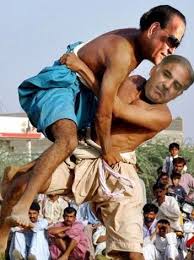
While it is amusing to see the fake revolutionary in Shahbaz Sharif most of the time, but this time he has gone out of his mind. In his desperation and hatred for the PPP and it’s targeted leadership of President Asif Zardari he has gone mad. Previously singing Jalib and also making slogans like an orchestra maestro, Shahbaz Sharif went the extra mile on Friday, March 16, 2012, in Gujranwala when he said:


“Agar hum nay, itikhabat kay baad, iss Zardari ko, Larkana, Karachi, Peshawar aur Lahore kee sarkon par na ghaseeta to mera naam Shahbaz Sharif nahee”.
Let’s hope this joker is able to stay in Pakistan after elections unlike his brother who runs away to London on the pretext of his wife’s health. And what can be Shahbaz Sharif’s name? “Geedar Badmaash” might just be appropriate or “Bhand Gujjar”. By the way, as we mentioned in our post “Mian Sahab, better to stay quiet – It will only get muddier for you“, Nawaz Sharif has conveniently gone to London at a time when his party are facing the biggest allegation of corruption and subversion of constitution through the Mehran Bank Scandal and the reason is his wife’s health. Probably this is the difference between these inqalabis and PPP. When the President fell ill and went to Dubai for his check ups, he ensured his son, Bilawal Bhutto Zardari stayed in Pakistan just to tell the world we haven’t run away. On the other hand, these jokers run away quietly and our media doesn’t even spend time probing the PML-N. Off course, why would they…they are in bed with the Sharifs.
One also has to ask our media, which has been doing discussions on what the President said in his address to the parliament, analyzing and re-analyzing continuously to spend a few minutes and ask these champions of democracy about the language they are using in public.
While it is amusing to see the fake revolutionary in Shahbaz Sharif most of the time, but this time he has gone out of his mind. In his desperation and hatred for the PPP and it’s targeted leadership of President Asif Zardari he has gone mad. Previously singing Jalib and also making slogans like an orchestra maestro, Shahbaz Sharif went the extra mile on Friday, March 16, 2012, in Gujranwala when he said:
“Agar hum nay, itikhabat kay baad, iss Zardari ko, Larkana, Karachi, Peshawar aur Lahore kee sarkon par na ghaseeta to mera naam Shahbaz Sharif nahee”.
Let’s hope this joker is able to stay in Pakistan after elections unlike his brother who runs away to London on the pretext of his wife’s health. And what can be Shahbaz Sharif’s name? “Geedar Badmaash” might just be appropriate or “Bhand Gujjar”. By the way, as we mentioned in our post “Mian Sahab, better to stay quiet – It will only get muddier for you“, Nawaz Sharif has conveniently gone to London at a time when his party are facing the biggest allegation of corruption and subversion of constitution through the Mehran Bank Scandal and the reason is his wife’s health. Probably this is the difference between these inqalabis and PPP. When the President fell ill and went to Dubai for his check ups, he ensured his son, Bilawal Bhutto Zardari stayed in Pakistan just to tell the world we haven’t run away. On the other hand, these jokers run away quietly and our media doesn’t even spend time probing the PML-N. Off course, why would they…they are in bed with the Sharifs.
One also has to ask our media, which has been doing discussions on what the President said in his address to the parliament, analyzing and re-analyzing continuously to spend a few minutes and ask these champions of democracy about the language they are using in public.
‘Shahbaz should be put in mental hospital’
The Express Tribune
Chief Minister Shahbaz Sharif should be put in mental hospital with harnesses and restraints on so he can’t hurt other patients, said Opposition Leader in the Punjab Assembly Raja Riaz on Saturday as he escalated an ugly war of words between the two sides.
Reacting to television footage showing Sharif vowing to drag President Asif Zardari through the streets of Karachi, Lahore and Larkana should the Pakistan Muslim League-Nawaz (PML-N) win the general elections, Riaz said that he would put Sharif on a leash and drag him by the collar through Lahore’s streets like a pet dog should the Pakistan Peoples Party (PPP) win the elections, “otherwise my name won’t be Raja Riaz”.
Speaking at a press conference at the assembly cafeteria, Riaz said that chief justice of the Lahore High Court should take notice of the chief minister’s statements about the president.
He said that the president had actually helped Sharif become chief minister, since the PML-N did not have the required strength in the Punjab Assembly.
He said that if the PPP won the next general elections, he would drag Sharif to the house of Ayesha Ahad, who claims to be the former wife of Sharif’s son Hamza Shahbaz, so she could finally get justice. He said he would drag Sharif through the streets and ask the victims of his bad policies to come out of their houses and punish him.
Chief Minister Shahbaz Sharif should be put in mental hospital with harnesses and restraints on so he can’t hurt other patients, said Opposition Leader in the Punjab Assembly Raja Riaz on Saturday as he escalated an ugly war of words between the two sides.
Reacting to television footage showing Sharif vowing to drag President Asif Zardari through the streets of Karachi, Lahore and Larkana should the Pakistan Muslim League-Nawaz (PML-N) win the general elections, Riaz said that he would put Sharif on a leash and drag him by the collar through Lahore’s streets like a pet dog should the Pakistan Peoples Party (PPP) win the elections, “otherwise my name won’t be Raja Riaz”.
Speaking at a press conference at the assembly cafeteria, Riaz said that chief justice of the Lahore High Court should take notice of the chief minister’s statements about the president.
He said that the president had actually helped Sharif become chief minister, since the PML-N did not have the required strength in the Punjab Assembly.
He said that if the PPP won the next general elections, he would drag Sharif to the house of Ayesha Ahad, who claims to be the former wife of Sharif’s son Hamza Shahbaz, so she could finally get justice. He said he would drag Sharif through the streets and ask the victims of his bad policies to come out of their houses and punish him.
Health woes: Outbreak of measles, the ‘mysterious disease’
The Express Tribune
An outbreak of measles in a remote village of Swat has created panic among locals, who are adamant their children have become victims of a ‘mysterious disease’, despite assurances by doctors.
The outbreak was reported in Sar Sardarey village of Mangalwar union council (UC), from where dozens of children were brought to Saidu Teaching Hospital in neighbouring Mingora.
Durrani,whose five children are being treated for the disease at the teaching hospital, claimed that his children’s condition was critical.
“They keep vomiting and haven’t slept for days. God knows what this disease is and what will become of my children,” he said.
The children’s symptoms include vomiting, high fever, fatigue and red spots and rashes, all of which are symptoms of measles, said Dr Ishaq of Saidu Teaching Hospital.
Rejecting the rumours, he said “The outbreak is of measles and not some mysterious disease”.
In a majority of cases, the children were infected by measles are because immunisation campaigns could not be carried out in the area due to militancy, said Dr Ishaq. The lack of awareness among parents is also causing the disease to spread.
There is no hospital for the entire union council, which has a population of 22,000, the majority of whom live below the poverty line.
Villagers complained that due to lack of medical facilities, they had to walk for over four hours to reach the teaching hospital in Mingora, some 20 kilometres from the union council.
“There is no road and we had to walk for hours in four to five feet of snow to reach the hospital,” said Sabz Ali Khan, who had brought his nephew in for treatment.
Executive District Officer Health Swat rejected the claim that medical facilities were not available in the villages. He said after cases of measles were reported, a number of medical teams equipped with medicines had been sent.
A team of doctors from the World Health Organisation based in Islamabad is going to Swat to collect samples from the infected children to determine the nature of the disease.
An outbreak of measles in a remote village of Swat has created panic among locals, who are adamant their children have become victims of a ‘mysterious disease’, despite assurances by doctors.
The outbreak was reported in Sar Sardarey village of Mangalwar union council (UC), from where dozens of children were brought to Saidu Teaching Hospital in neighbouring Mingora.
Durrani,whose five children are being treated for the disease at the teaching hospital, claimed that his children’s condition was critical.
“They keep vomiting and haven’t slept for days. God knows what this disease is and what will become of my children,” he said.
The children’s symptoms include vomiting, high fever, fatigue and red spots and rashes, all of which are symptoms of measles, said Dr Ishaq of Saidu Teaching Hospital.
Rejecting the rumours, he said “The outbreak is of measles and not some mysterious disease”.
In a majority of cases, the children were infected by measles are because immunisation campaigns could not be carried out in the area due to militancy, said Dr Ishaq. The lack of awareness among parents is also causing the disease to spread.
There is no hospital for the entire union council, which has a population of 22,000, the majority of whom live below the poverty line.
Villagers complained that due to lack of medical facilities, they had to walk for over four hours to reach the teaching hospital in Mingora, some 20 kilometres from the union council.
“There is no road and we had to walk for hours in four to five feet of snow to reach the hospital,” said Sabz Ali Khan, who had brought his nephew in for treatment.
Executive District Officer Health Swat rejected the claim that medical facilities were not available in the villages. He said after cases of measles were reported, a number of medical teams equipped with medicines had been sent.
A team of doctors from the World Health Organisation based in Islamabad is going to Swat to collect samples from the infected children to determine the nature of the disease.
Subscribe to:
Posts (Atom)