Thursday, December 22, 2011

Ex-President Carter sends condolences to Kim Jong-un


Former President Jimmy Carter has sent North Korea a message of condolence over the death of Kim Jong-il and wished "every success" to the man expected to take over as dictator, according to the communist country's state-run news agency.

A dispatch from the Korean Central News Agency (KCNA) said Mr. Carter sent the message to Kim Jong-un, Kim Jong-il's son and heir apparent.

"In the message Jimmy Carter extended condolences to Kim Jong Un and the Korean people over the demise of leader Kim Jong Il. He wished Kim Jong Un every success as he assumes his new responsibility of leadership, looking forward to another visit to [North Korea] in the future," the KCNA dispatch read.

When contacted by The Washington Times for comment, the Carter Center provided an email contact to a spokeswoman who is out of the office until the New Year.

North Korea is routinely labeled as one of the world's most oppressive governments under an eccentric personality cult surrounding the Kim family. Harrowing reports from defectors describe North Korea as a dirt-poor nation filled with concentration camps and Communist propaganda. Kim Jong-il ran the reclusive country according to a "military first" policy since the mid-1990s, after a famine that may have killed as many as 2 million people.

Mr. Carter has visited North Korea twice — including a 1994 visit for talks on nuclear issues that led to a deal in which North Korea agreed to dismantle its nuclear-weapons program in exchange for oil deliveries and the construction of two nuclear reactors. That deal collapsed in 2002.

The former U.S. president also downplayed a 2010 North Korean attack on a South Korean island and disclosure of a uranium enrichment facility, saying the acts were merely "designed to remind the world that they deserve respect in negotiations that will shape their future."

Aussie Beer Wins Global Vote

wsj.com

Australia’s favorite beers are gaining traction overseas.
Following SABMiller’s acquisition of Foster’s Group for over US$10 billion, Coopers Brewery has been named the world’s top family business of 2011 by London magazine CampdenFB.

Coopers

which enters its 150th year of operation in 2012 — received 38% of votes, trailed by Denmark’s Lego Group and Kenyan retailer Nakumatt which received 20% and 13% respectively. Readers were asked to consider a company’s financial performance as well as its commitment to best practice in areas including government and succession planning.

The largest Australian-owned brewery, in its fifth generation of ownership, defeated other contenders including U.S.-based cosmetic and perfume group Estee Lauder, Ford Motor and Spanish perfume and fashion house Puig.

On Wednesday, Coopers announced it has a 4% market share of all beer sales in Australia and produced a record 62.9 million liters of beer in the 2011 financial year, a touch above the 62 million liters recorded in 2010.

“Coopers has now enjoyed 10% compound annual growth in beer volumes for the past 15 years,” managing director Dr. Tim Cooper said in a statement. “Exports were steady at about 5% of revenue, despite the impact of the high Australian dollar,” he added.

Despite higher production levels, overall turnover in 2011 fell to 173 million Australian dollars (US$173 million) compared with the record A$179 million in 2010 while profit after tax fell to A$23 million from A$23.5 million.

With all this attention, Coopers may soon be known as Australian for beer.

Pakistan army wants Zardari out but not a coup

www.reuters.com

Pakistan's powerful army is fed up with unpopular President Asif Ali Zardari

and wants him out of office, but through legal means and without a repeat of the coups that are a hallmark of the country's 64 years of independence, military sources said.

Tensions are rising between Pakistan's civilian leaders and its generals over a memo that accused the army of plotting a coup after the U.S. raid that killed Osama bin Laden in May.

"Who isn't fed up with Zardari? It's not just the opposition and the man on the street but people within the government too," said one military source who asked not to be named.

"But there has to be a proper way. No action is being planned by the army. Even if we tried, it would be very unpopular and not just with the government and the opposition but most Pakistanis too."

The Pakistani military spokesman declined comment.

General Ashfaq Kayani has pledged to keep the military out of Pakistani politics since taking over as army chief in 2007.

Any coup -- Pakistan has had three since independence in 1947 -- could further tarnish the military's public image which has already taken a battering after the bin Laden operation, widely seen in Pakistan as a violation of sovereignty.

But the army remains the arbiter of power and analysts say it has plenty of ways to pressure Zardari to step down, especially if a link is established between him and the memo, which sought the Pentagon's help in averting a feared coup.

Businessman Mansoor Ijaz, writing in a column in the Financial Times on October 10, said a senior Pakistani diplomat had asked that a memo be delivered to the Pentagon with a plea for U.S. help to stave off a military coup in the days after the raid that killed al Qaeda leader Osama bin Laden in May.

Ijaz later identified the diplomat as Pakistan's ambassador to Washington, Husain Haqqani, who denied involvement but resigned over the controversy. No evidence has emerged that the military was plotting a coup and the Pentagon at the time dismissed the memo as not credible.

Friction between Pakistan's civilian government and military have bedeviled the nuclear-armed South Asian country for almost its entire existence, with the military ruling for more than half its 64-year history after a series of coups.

In the past the army has asked Pakistani civilian leaders to resign and influenced judicial proceedings against them.

Haqqani's resignation was seen by many analysts as further weakening the civilian government, which is already beset by allegations of corruption and incompetence in the face of many challenges, including a weak economy and a Taliban insurgency.

MEMOGATE

Zardari returned to Pakistan this week from medical treatment in Dubai that raised speculation he would resign under pressure from the military over what has been dubbed "memogate."

Although his position is largely ceremonial, he wields considerable influence as leader of the ruling party and his forced departure would be a humiliation for the civilian leadership and could throw the country into turmoil.

One of the military sources suggested that no direct action would be needed against the government because it had already made so many mistakes.

"If the government is digging its own grave, we are not going to look for spades," the source said.

The military has reasserted itself after a November 26 NATO cross-border air attack killed 24 Pakistani soldiers and the memo has also given it political ammunition.

In a statement submitted to the Supreme Court, which is looking into a petition demanding an inquiry into who may have been behind the memo, Kayani said it was a serious matter which required an investigation.

"We want anyone involved, be they in government or elsewhere, to be punished. But it is not for us to do anything. If the army moves to do anything it would have national as well as international repercussions," said another military source.

"So that is not likely. Anything that has to be done has to be done by the Supreme Court."

Officials from Zardari's ruling party have played down friction with the military and say they don't fear a coup.

But they fear that some judges in the increasingly aggressive Supreme Court dislike Zardari and could move against him.

"I am not bothered about the army. I think they are acting very sensibly and would not derail the system at the moment," a senior ruling party leader told Reuters.

"The worry probably would be what the Supreme Court does. They look in a mood to manipulate things."

The government's anxiety over memogate was highlighted in comments made by Prime Minister Yusuf Raza Gilani on Thursday.

"Let me make clear to you today that there are intrigues, conspiracies afoot to pack up the elected government," he said in a speech at the National Art Gallery.

New Afghan opposition coalition says can check Karzai


Dozens of Afghan political parties launched a new coalition bloc on Thursday hoping to pose a stronger challenge to the government of President Hamid Karzai, which they say is corrupt and misuses funds meant to rebuild their war-torn state.

In a room packed with hundreds of representatives from Afghanistan's provinces and ethnic groups, speakers said the bloc had secured enough support, including from a number of MPs, to provide a real counterweight to Karzai.

Karzai has ruled since soon after the Taliban government was toppled by U.S-backed Afghan forces in late 2001, but his grip on power has come under increasing pressure since a fraud-marred presidential election in 2009.

The National Coalition of Afghanistan, led by Abdullah Abdullah, an ophthalmologist who was Karzai's main rival in the 2009 vote, said the government had done little to rebuild the economy, erect infrastructure and bring people out of endemic poverty during Karzai's 10 years running the country.

Thousands of lives and billions of dollars have failed to secure Afghanistan and only fragile gains have been made in education and women's rights, falling well short of promises made a decade ago.

"We don't have any enmity with our friends who lead the country, but they have lost their way. Afghanistan's people are supporting the government but the gap between people and the government is growing day by day," Abdullah told the crowd.

The political battle has been undermining international efforts to foster good governance, particularly as the West starts handing over control of security to Afghan forces.

The NATO-led force in Afghanistan, which stands at about 130,000, is due to withdraw the last of its combat troops by the end of 2014.

Political parties in Afghanistan rarely have the structure or discipline of parties in Western political systems. The new coalition is meant to present a joint opposition ahead of the next presidential vote, also due in 2014.

The bloc called for a more decentralized political system, with proper checks and balances, so the fate of the country is not dictated by a political elite. It also questioned Karzai's desire to negotiate a peace deal with the Taliban.

One speaker accused Karzai of luring opposition members with money or government positions to sustain their support.

The bloc also accused Karzai of planning to change the constitution to be able to run for a third term in power when his current five-year term ends, an allegation the president has so far denied.

"Ten years for a president of a country is enough time. When will you stop corruption, stop the mafia?" said Humayun Shah Asifi, a 2004 presidential candidate.

Public holiday in Sindh on Benazir Bhutto anniversary

Sindh Chief Minister Syed Qaim Ali Shah has announced public holiday on the occasion of 4th death anniversary of Shaheed Benazir Bhutto

on December 27 (Tuesday), Geo News reported on Thursday.

The 4th death anniversary of slain leader of PPP chairperson and former prime minister of Pakistan is being observed across the country on December 27.

Arrangements are being made in Garhi Khuda Bux, the final resting place of Zulfiqar Ali Bhutto and his other deceased family members and the central point for marking the anniversary of BB.

The widower of BB, President Asif Ali Zardari besides Prime Minister Yusuf Raza Gilani and other PPP leaders will be attending the anniversary programmes to be held in Garhi Khuda Bux on December 27.

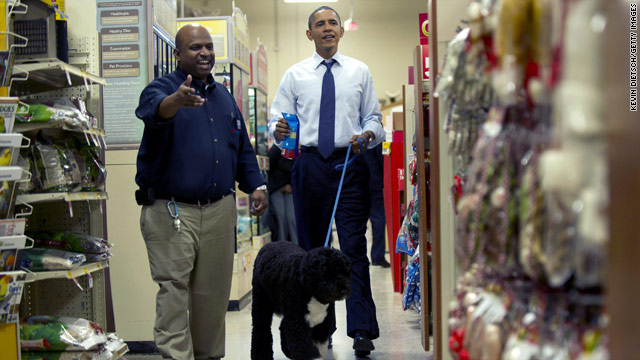
Obama's last minute Holiday shopping trip


With Christmas only four days away, President Obama did some last-minute holiday shopping escaping the legislative stalemate in Congress over the payroll tax extensions.

The president took first dog Bo with him to visit an Alexandria, Virginia shopping center.

First stop: PetSmart – where Bo checked out a small poodle named "Cinnamon," according to its owner.

On the same day the White House website asked "what does $40 mean to you?" the president spent $41 for a rubber chew toy and a large bone.

His next stop: Best Buy – where the president said, "this [stop] is for the girls now." After browsing games in the Wii section, he settled on Just Dance 3 for first daughters Sasha and Malia.

"The girls beat me every time on these dance games," the president said. "But you'll never get a picture of me (playing) because I get graded F every time."

His total bill came to almost $200 for the dance game, the Sims 3 Pets video game and two $50 Apple gift cards. As he pulled out his credit card at the big box store the president joked, "Let's see if my credit card still works."

All that shopping can leave a president hungry, so stop #3: a local pizzeria where he purchased three large pizzas to-go.

Grand total: The president spent nearly $300 on his last-minute shopping trip.

First Lady Michelle Obama and their daughters are already in Hawaii on vacation. Hopefully, they have been busy enjoying the beach and not reading online about their famous father's shopping excursion! Gifts are so much better when they are a surprise.

PML-N leader Javed Hashmi all set to join PTI

The PML-N leader Makhdoom Javed Hashmi is all set to join Imran Khan’s Pakistan Tehreek-e-Insaf (PTI).
Reliable sources informed Online that all formalities have been duly fulfilled for a formal announcement within next few days. Makhdoom Javed Hashmi has been reported to be quite agitated over being constantly ignored/bypassed/sidetracked, and is known to have publicly criticided PML-N’s leadership in meetings.
Seeking no peace of mind, he has finally decided to resign from PML-N and join PTI. Sources have informed that he was constantly in touch with Imran Khan over the issue and Imran Khan eventually acquiesced to his (Makhdoom Javed) request.
Sixty-three years old leader of the PML-N Javed Hashmi is a key opposition leader in Pakistan, and one of the prominent leaders of the Alliance for Restoration of Democracy (ARD) which campaigned against the Musharraf regime.
He started his career in politics during his university days from the platform of Islami Jamiat Tulaba (IJT), the student wing of Jamaat-e-Islami. In the capacity of his practical politics, he has also served in Zia-ul-Haq‘s cabinet.
On April 12 2004, he was sentenced to 23 years in prison for inciting mutiny in the army, forgery and defamation, by circulating a letter written by military officers calling for an investigation into alleged corruption in the armed forces and criticising President Pervez Musharraf and his relationship with US President George W Bush.

ANP to back resolution on Hazara province: minister

Minister of State for Health Sardar Shahjahan Yusuf Wednesday claimed that the Awami National Party would support the Hazara province resolution in the Khyber Pakhtunkhwa Assembly.

Speaking at a press conference, he said that Prime Minister Yusuf Raza Gilani had taken the ANP leader Asfandyar Wali on board on the issue. He said the Pakistan People’s Party, Pakistan Muslim League-Nawaz and Pakistan Muslim League-Quaid and other political parties would also vote in favour of the Hazara resolution that would soon be tabled in the provincial assembly.

Sardar Shahjahan said the prime minister was already in contact with the Punjab and Khyber Pakhtunkhwa governments on the issue of creating more provinces in the country. He said that work on the Hazara Expressway would soon be inaugurated and would cost Rs47 billion as the Asian Development Bank had approved funds for the project. The minister said the commissioner Hazara division had removed the hurdles in the construction of the expressway and the compensation process for the landowners was in progress.

Report blames both US, Pakistan for Nato attack

THE NEWS


The US investigations into the Nov 26 border attack by Nato forces that killed 24 Pakistani soldiers has reportedly concluded that both US and Pakistan forces bear responsibility for the incident, The New York Times reported.

The report said: "Mistakes by both American and Pakistani forces led to airstrikes against Pakistani border posts that killed 24 Pakistani Army soldiers last month".

Even though it spread blame between both countries, the key finding of the investigation is likely to further enrage Pakistan: that the airstrikes were ultimately justified because Pakistani soldiers fired first on a joint team of Afghan and American special operations forces operating along the often poorly demarcated frontier between Afghanistan and Pakistan, American and Western officials, who asked not to be identified because the report of the investigation had not yet been released, said Thursday.

The report says that the joint Afghan-American patrol, which was operating in a remote and mountainous area between the Afghan province of Kunar and the Pakistani tribal area of Mohmand, came under machine gun and mortar fire from at least one of the Pakistani border posts sometime around midnight on Nov. 26, American and Western officials said. The American official said the Afghan and American special operations forces believed they were being attacked by militants, at least initially, and called for air support.

Why the Pakistanis were firing remains unclear, the American official said. But in the days after the airstrikes, another American official in Washington provided part of an explanation: the Pakistanis apparently had intelligence that the Taliban was planning to attack the border posts and the Pakistani soldiers may have mistaken the Afghan and American troopers for militants.

The United States military report lends credence to that theory: the officials said it finds that NATO did not inform Pakistan that the operation on the border was taking place, and thus the Pakistani soldiers would not have known to expect allied forces near their posts. NATO and Pakistani forces are supposed to inform each other when launching operations on the border precisely to avoid the kind of mistake that took place on Nov. 26.

The second American mistake came when the airstrikes were called in. The Americans apparently gave the Pakistani Army the wrong coordinates that were to be struck by Apache attack helicopters and an AC-130 gunship, the officials said.

It wasn't immediately clear whether the Pakistanis cleared the strikes after getting the wrong coordinates. They have said they did not; regardless, the strikes began before their officers based at NATO coordination posts in Afghanistan had a chance to check with superiors in Pakistan, according to the Pakistani account of what took place.

But, as the report shows, even if Pakistan did clear the strikes, the posts still probably would have been hit because the Pakistanis had been given the wrong coordinates.

Another safeguard also failed, according to the report: Pakistan never told NATO it had established the border posts, which had been up for about three months, said a Western official in Kabul. Both sides are supposed to inform each other when setting up new positions along the border, another measure intended to avoid strikes against each other.

Whether any American service members will be disciplined in connection with the incident has not been decided, the American and Western officials said.

NATO's Afghanistan headquarters and the United States Embassy in Kabul declined to comment on the investigation, referring queries to the Defense Department and State Department in Washington. Pakistani officials did not offer any immediate reaction.

But given the indignant Pakistani response to the raid - "They killed our sons and we can never forgive this," said one senior Pakistani defense official in a recent interview, speaking anonymously because he still works with Americans - Washington was bracing for another round of recrimination, said the American and Western officials.

A ban on the shipment of NATO supplies through Pakistan, which was put in place after the strike, is expected to remain for some time, the officials said. NATO officials have said the blockade is not affecting operations because less than 30 percent of supplies for coalition forces in Afghanistan are currently shipped through Pakistan.

More damaging is the faltering military and counter-terror cooperation between Washington and Islamabad after a year of crises that began with the shooting of two Pakistanis by a CIA contractor in the city of Lahore. The two sides no longer conduct joint operations along the border, which they had started doing a few years ago, and intelligence-sharing on a range of threats from al Qaeda to lesser known Islamist militant groups has also fallen off, the American and Western officials said.

Pakistan’s Gilani spells out fear of being ousted

www.firstpost.com

As talk of a rift between his government and the military gathers pace, Pakistan Premier Yousuf Raza Gilani today said “no institution can be a state within a state” and warned that “conspiracies” are being hatched to “pack up” his democratically-elected government.

People will have to decide whether they want “elected people or a dictatorship”, he added.“I want to make it clear today that there are intrigues and conspiracies going on and the conspiracy is to pack up the elected government,” Prime Minister Gilani said while addressing a function organised to commemorate the birth anniversary of Pakistan’s founder Muhammad Ali Jinnah.

“I want to tell them that whether we are in government or opposition or among the people, we will fight for the rights of the people of Pakistan,” he said without giving details of who was behind the conspiracies against his government.

The premier made a veiled reference to the differences between his government and the army, saying “no institution can be a state within a state”.

He added: “Nobody can say they are not under the government. Every institution of this country, including the Ministry of Defence, is under the prime minister.

“There should be no ambiguity that anybody can claim that I am independent…If any individual thinks they are not under the government, they are mistaken.

“They are under the government and will remain under the government because we are the elected, chosen representatives of the people of Pakistan.”

Gilani said the people have to decide whether they want “elected people or a dictatorship”.

The prime minister’s unusual remarks came in the backdrop of tensions between the civilian government and the powerful military over the memogate scandal.

The army and ISI have urged the Supreme Court to conduct a probe into the alleged memo made public by Pakistani-American businessman Mansoor Ijaz that had sought US help to prevent a feared coup in Pakistan after the killing of Osama bin Laden in May.

However, the government has challenged the apex court’s jurisdiction to hear a batch of petitions seeking a probe into the memogate scandal, saying the matter is already being investigated by a parliamentary panel.

Meanwhile, in another twist in the memogate case, the defence ministry on Wednesday informed the apex court in an affidavit that it had “no operational control” over the military or the ISI.

The ministry stated it was not in a position to confirm or deny the stand taken by the military and ISI on the memo issue.

During his address today, Gilani said his government had the “highest regard and respect for the army” because it had stood up against terrorism and extremists, but made it clear that no institution could function without the support of the people.

Gilani said he had worked for public “ownership” of military operations by taking “responsibility for all military actions in country”.

He further said: “No military can fight against anybody without the support of the masses. If there is no support, no war can be won.”

At the same time, he appeared to hold out an olive branch to the army by saying: “My military is disciplined and they follow the constitution of Pakistan”.

Pakistan has been ruled by the military for almost half of its history and no elected leader has been able to complete his full term.

Wednesday, December 21, 2011

Bashir Bilour asks Fazlullah, other militants to face courts

Bashir Bilour, who is parliamentary leader of the Awami National Party in the Khyber Pakhtunkhwa Assembly, asked the fugitive leader of the Swat Taliban, Maulana Fazlullah, and his comrades to face courts in Pakistan. He said the militants’ dream to establish a parallel administration was not going to come true. “It’s not the rule of Muttahida Majlis-e-Amal, which handed over the whole Malakand region and Swat to the Taliban,” he remarked.

The minister said that the Pakhtuns were being subjected to atrocities and terrorism through a well-hatched conspiracy, which was mainly due to the disunity among them. “Had Pakistan avoided interfering in the internal affairs of its neighbouring countries, there would not have been bloodshed on our soil,” he argued.

Bashir Bilour said the dream of renaming the province as Khyber Pakhtunkhwa came true after a long struggle and the longstanding problems being faced by the Pakhtuns were being resolved after getting provincial autonomy. “The day is not far off when the federation would only have foreign and defence departments while all the remaining ministries will be devolved to the provinces, which will go a long way in putting the provinces on the path to prosperity,” he hoped.

The 18th Amendment, he said, would herald an era of prosperity in Khyber Pakhtunkhwa, as the provincial government would shortly start work on Munda and Spaylanai power projects. He said these projects would not only cater to the energy needs of the province but also provide sufficient water for irrigation purposes.

Mass March by Cairo Women in Protest Over Abuse by Soldiers


Several thousand women demanding the end of military rule marched through downtown Cairo on Tuesday evening in an extraordinary expression of anger over images of soldiers beating, stripping and kicking female demonstrators in Tahrir Square.

“Drag me, strip me, my brothers’ blood will cover me!” they chanted. “Where is the field marshal?” they demanded of the top military officer, Field Marshal Mohamed Hussein Tantawi. “The girls of Egypt are here.”

Historians called the event the biggest women’s demonstration in modern Egyptian history, the most significant since a 1919 march against British colonialism inaugurated women’s activism here, and a rarity in the Arab world. It also added a new and unexpected wave of protesters opposing the ruling military council’s efforts to retain power and its tactics for suppressing public discontent.

The protest’s scale stunned even feminists here. In Egypt’s stiffly patriarchal culture, previous attempts to organize women’s events in Tahrir Square during this year’s protests almost always fizzled or, in one case in March, ended in the physical harassment of a small group of women by a larger crowd of men.

“It was amazing the number of women that came out from all over the place,” said Zeinab Abul-Magd, a historian who has studied women’s activism here. “I expected fewer than 300.”

The march abruptly pushed women to the center of Egyptian political life after they had been left out almost completely. Although women stood at the forefront of the initial revolt that ousted President Hosni Mubarak 10 months ago, few had prominent roles in the various revolutionary coalitions formed in the uprising’s aftermath. Almost no women have won seats in the early rounds of parliamentary elections. And the continuing demonstrations against military rule have often degenerated into battles in which young men and the security police hurl rocks at each other.

On the fifth day of clashes that have killed at least 14 people, many women in the march said they hoped their demonstration would undercut the military council’s efforts to portray demonstrators as little more than hooligans, vandals and arsonists. “This will show those who stay home that we are not thugs,” said Fadwa Khaled, 25, a computer engineer.

The women’s demand for a voice in political life appeared to run counter to the recent election victories of conservative Islamists. But the march was hardly dominated by secular liberals. It contained a broad spectrum of Egyptian women, including homemakers demonstrating for the first time and young mothers carrying babies, with a majority in traditional Muslim head scarves and a few in face-covering veils. And their chants mixed calls for women’s empowerment with others demanding more “gallantry” from Egyptian men.

Their voice was evidently heard at military headquarters. Even before the march broke up, the ruling generals reversed themselevs to offer an apology to women for unspecified “violations.”

“The Supreme Council of the Armed Forces expresses its utmost sorrow for the great women of Egypt, for the violations that took place during the recent events,” the council said in a statement. “It stresses its great appreciation for the women of Egypt.”

The statement asserted that the council had already taken “all the legal actions to hold whoever is responsible accountable.” But it gave no indication that anyone in the military has been publicly investigated or charged for any misconduct, and the statement also reprised the council’s recent attempt to pin blame for the clashes on the protestors themselves. The generals urged calm “until we can reveal the infiltrating and paid agents of thuggery that aim at destruction, sabotage and damaging the revolution and the great Egyptian youth.”

Egypt’s military rulers came under fire from international human rights groups soon after they took power in February for performing invasive, pseudo-medical “virginity tests” on several women detained after a protest in March. But in Egypt’s conservative culture, few of the women subjected to that humiliation have come forward to criticize the generals publicly.

The spark for the march on Tuesday came over the weekend, when hundreds of military police officers in riot gear repeatedly stormed Tahrir Square, indiscriminately beating anyone they could catch. Videos showed more than one instance in which officers grabbed and stripped female demonstrators, tearing off their Muslim head scarves. And in the most infamous case caught on video, a half-dozen soldiers beat a supine woman with batons and ripped off her abaya to reveal a blue bra. Then one of them kicked her in the chest.

Recalling that event at a news conference Tuesday, the woman’s friend Hassan Shahin said he had told the soldiers: “I’m a journalist, and this is a girl. Wait, I’ll take her away from here.” But, he said, “nobody listened, and one of them jumped on me, and they started beating me with batons.”

No doubt fearful of the stigma that would come with her public humiliation, the victim has declined to step forward publicly, so some activists now refer to her only as “blue bra girl.” The photos of her beating and disrobing, however, have quickly circulated on the Internet and have been broadcast by television stations around the world.

In Washington on Monday, Secretary of State Hillary Rodham Clinton called the recent events in Egypt “shocking.”

“Women are being beaten and humiliated in the same streets where they risked their lives for the revolution only a few short months ago,” Mrs. Clinton said.

“Women are being attacked, stripped and beaten in the streets,” she added, arguing that what she called the systematic degradation of Egyptian women “disgraces the state and its uniform.”

As recently as Tuesday morning, however, many activists here said that because relatively few Egyptians have access to the Internet, read independent newspapers or watch independent satellite television news, the blue bra video was far more widely familiar in the United States than in Egypt.

“Four blocks from here, no one knows about this,” said Aalam Wassef, a blogger and an activist, at a meeting Tuesday morning in which activists announced a plan to set up screens in cities and towns around the country where people could see that video and others that contradict the generals’ version of events. (Other scenes include security forces hurling rocks and gasoline bombs, military police officers firing rifles and handguns and protesters bloodied by bullets.)

Some men who had seen the images questioned why the woman had been in the square, suggesting that her husband or father should have kept her at home. Other men have argued that she must have wanted the exposure because she wore fancy lingerie, or they have said she should have worn more clothes under her abaya.

But the woman’s ordeal began to receive new attention on Monday when Gen. Adel Emara, a member of the ruling military council, acknowledged what had happened during a news conference on state television. General Emara argued that the scene had been taken out of context and that the broader circumstances would explain what happened.

At the same news conference, a veteran female journalist who reports on the military stood up to ask the general for an apology to Egyptian women. “Or the next revolution will be a women’s revolution for real,” the journalist warned. The general tried to interrupt her — he said the military had learned of a new plan to attack the Parliament — and then he brushed off her request.

Many Egyptian women said later that they were outraged by his response.

When core activists called for a march Tuesday evening to protest the military’s treatment of women — organizers on Twitter used the hash tag “#BlueBra” — few could have expected the magnitude of the response.

The crowd seemed to grow at each step as the women marched, calling up to the apartment buildings lining the streets to urge others to join them. “Come down, come down,” they shouted in an echo of the protests that led to Mr. Mubarak’s ouster in February.

“If you don’t leave your house today to confront the militias of Tantawi, you will leave your house tomorrow so they can rape your daughter,” one sign declared.

“I am here because of our girls who were stripped in the street,” said Sohir Mahmoud, 50, a homemaker who said she was demonstrating for the first time.

“Men are not going to cover your flesh, so we will,” she told a younger woman. “We have to come down and call for our rights. Nobody is going to call for our rights for us.”

Along the sidewalks beside the march, some men came out to gawk and stare. Others chanted along with the women, “Freedom, freedom.”

“I came so that girls are not stripped in the streets again,” said Afaf Helal, 67, who was also demonstrating for the first time, “and because my daughters are always going to Tahrir. The army is supposed to protect the girls, not strip them!”

Afghanistan opening first major train service


Operators ran the first train down Afghanistan's first major railroad Wednesday, clearing the way for a long-awaited service from the northern border that should speed up the U.S. military's crucial supply flow and become a hub for future trade.

A cargoless train chugged into a newly built station in the northern city of Mazar-i-Sharif on Wednesday after a 47-mile (75-kilometer) trial run from the border with Uzbekistan, said Deputy Public Works Minister Noor Gul Mangal, who was on hand for the arrival.

The new rail line is the first stage of an ambitious plan to link landlocked Afghanistan to its neighbors' extensive railways for the first time, eventually opening up new trade routes for goods traveling between Europe and Asia.

Afghanistan has never had a functional rail network, though many projects have been begun and later abandoned, victims of maneuvers of the 19th century Great Game rivalry between Russia and Britain, and then political bickering in the early 20th century. Soviet occupiers abandoned a few rail projects in the 1980s, and later years of bitter civil war made such construction impossible.

So the line from the border town of Hairatan to Mazar-i-Sharif marks a milestone in a violence-wracked country eager for good news on the horizon. It also could be a key route for the U.S. troop withdrawal beginning next year and, eventually, a gateway for Afghan exports that would travel its neighbors, said Fred Starr, chairman of the Central Asia-Caucasus Institute at Johns Hopkins University in Washington

"It's actually a big deal. It's very significant both practically and symbolically," Starr said.

In the short term, service will help release a bottleneck at Hairatan dry port that is now holding up goods — including fuel and other supplies for American troops — while they are loaded off of trains and onto trucks for a hazardous journey over Afghanistan's northern mountain roads.

"This port of Hairatan is where the bulk of commercial cargo is coming from into the country, so it is very important," said Juan Miranda, head of Central and West Asia Department of the Asian Development Bank, which funded the $165 million project.

Allowing trains to come straight in will help Hairatan handle up to 10 times as much cargo, from 4,000 tons per month now to 25,000-40,000 tons per month once the service is fully operating, the ADB says. Once in Mazar-i-Sharif, the goods can be transferred to most of the rest of Afghanistan on surface roads.

Uzbekistan's state-owned SE Sogdiana Trans will run the commercial train service, ADB's Afghanistan representative Noriko Sato said.

A U.S. military spokesman says the new railway will be key to supplying American troops — and possibly also withdrawing non-lethal cargo during the American troop pullout set to begin next year.

"We do not have numbers yet, (but) we anticipate that the rail line will be able to speed the transit of cargo into Afghanistan and out of it," said Cmdr. Bill Speaks of the Office of the Secretary of Defense.

The U.S. has recently shifted much of its supply line to the north from routes going through Pakistan, and the northern routes' importance was brought into sharp focus last month when Pakistan — angered by a disputed NATO strike that killed 24 Pakistani soldiers — closed its two border crossings for U.S. supplies.

Just three years ago, about 90 percent of nonmilitary supplies to Afghanistan went through Karachi, Pakistan. Today, close to 75 percent of cargo is shipped through the northern network.

Just as the Pakistani supply line has been attacked by insurgents, the newer northern routes through Mazar-i-Sharif and other cities are likely to also become targets. In 2009, Taliban forces in the northern province of Kunduz hijacked two fuel trucks, resulting in a fiery NATO airstrike that killed dozens.

While many fear instability or even civil war in Afghanistan after 2014 when most foreign forces leave, others are busy planning for a future in which the country could be a hub in a New Silk Road reconnecting spice and silk routes from centuries past.

The 10-country Central Asia Regional Economic Cooperation project — supported by the ADB along with the U.N., World Bank and International Monetary Fund — envisions a network of some 2,250 miles (3,600 kilometers) of roads and 1,250 miles (2,000 kilometers) of railway linking China and India to the Middle East and Europe, although the project is far from complete.

For years, Afghanistan's poor roads and rails have been the project's missing link to much of that network.

With the northern Hairatan rail line ready to open for business, Afghan officials are already planning to expand its infant railroad with another proposed line to Turkmenistan to the northwest, Mangal said Wednesday.

He said a delegation would meet with Turkmenistan officials to discuss the expansion at the official inauguration for the Hairatan-Mazar-i-Sharif line, which he said would come soon though he wouldn't give a date.

"This is the first railway in Afghanistan and of course when we inaugurate it there will be a big ceremony, Mangal said.

Pakistan should follow independent policy, says Karzai

Afghan President Hamid Karzai on Tuesday urged Pakistan not to forge its policy on Afghanistan based on its rivalries with either India or the United States.

`We want Pakistan to have an independent policy towards Afghanistan. It should not look at Afghanistan based on its relations with India and America. Pakistan should approach us as its neighbour, Mr Karzai told the local television.

Relations between Pakistan and the US, which is fighting a 10-year war against the Taliban, have fallen to a new low following the Nov 26 Nato air strikes which killed two dozen Pakistani soldiers.

Mr Karzai said he was trying not to involve his country in regional rivalries, so that when Nato-led foreign combat troops withdraw in 2014, Afghanistan can become a successful centre for international business.

`We are trying to turn Afghanistan into a country where in the years between 2014 and 2024 it won`t be a scene of negative rivalries and clashes,` he said.

`Instead it will be a place for cooperation, business and economy, and a main transition route between central, south and east Asia.

Indian involvement in Afghanistan is extremely sensitive because of the delicate and often deadly power games in South Asia, with Pakistan vehemently opposed to India meddling in what it considers its backyard.

Meanwhile, the Afghan deputy foreign minister appealed for international help to boost talks with the Taliban and other armed opposition groups.

At a UN Security Council debate, Jawed Ludin stressed the government`s determination to pursue reconciliation efforts despite Taliban attacks and assassinations.-Agencies

Polls to be held on time: President Zardari

Geo


President Asif Ali Zardari asked those who are dreaming of sending the government back to wait until the next elections, Geo News reported.

Next elections would be held on time, President Zardari said.

The President met with various leaders here on Tuesday at Bilawal House including Prime Minister Syed Youuf Raza Gilani, PPP Chairman Bilawal Bhutto Zardari, ANP Chief Asfandyar Wali, Interior Minister Rehman Malik and Sindh Chief Minister Qaim Ali Shah.

According to sources, the Prime Minister and the President discussed prevailing political situation, Abbottabad Commission and memogate issues. ANP chief and Sindh CM also attended the President-PM meeting. They inquired about President’s health after his treatment in a Dubai hospital.

President Zardari said: " I am not among those who runaway. I had gone for treatment but the anti-democratic forces projected it as I had fled. People of Pakistan had elected the PPP government".

It is to be mentioned here that Tuesday's meeting was the first between PM Gilani and President Zardari after his return from Dubai.

Earlier, Interior Minister Rehman Malik also called on the President and briefed him on the current law and order situation of the country.

Tuesday, December 20, 2011

Khyber Pakhtunkhwa to launch 31 million euro livelihood, infrastructure uplift project

Business Recorder

The Khyber Pakhtunkhwa government, with the financial assistance of Germany, is going to launch a 31 million Euro livelihood and infrastructure development project in five selected districts of the province.

The project to be launched in districts Swabi, Haripur, Buner, D I Khan and Chitral on livelihood programmes in these areas.

The department of finance, she said, had already received the fund, which would be utilised on initiating livelihood and infrastructure development projects in the province.

This was stated by Khyber Pakhunkhwa Minister for Social Welfare and Women Development, Sitara Ayaz while speaking in a Meet-the-Press Programme under the auspices of Khyber Union of Journalists (KhUJ) here at Peshawar Press Club (PPC) on Monday.

She said that another 8 million Euro olive cultivation project is already in progress in district Swabi.

Talking about children protection, she said that the provincial government has established Child Protection Units in eight districts under Child Protection and Welfare Act 2010.

eight more will become functional before March next year.

She said that children would be provided all kind of protection and they will be given legal cover.

She said that a memorandum of understanding (MoU) has been signed with the department for imparting training to the teachers against the corporal punishment in schools.

The purpose of the training, she said, is to create awareness amongst the teachers against the corporal punishment.

In first phase, she said the teachers of the public sector schools would be given training, which will be followed by the teachers of the private sector schools in the province.

The provincial minister said that since 2008 the budget of the Social Welfare Department had been tripled and now the department like other departments is initiating development schemes.

Sitara Ayaz said that the ANP led provincial government of Khyber Pakhtunkhwa is a head of other provinces in the matters relating to women development.

She said that an Inter-Ministerial Group has also been established, which is headed by her.

She said that women facilitation centres have been established in the three districts of Khyber Pakhtunkhwa with the helpline number 1121 to provide assistance to the women both inside and outside their houses.

The provincial minister said three centres have been opened in Mardan for provision of training in beautician, computer and sewing.

She said that the province is lacking women tailors, adding the provincial government is ready to support women in opening of tailoring shops.

She disclosed that the provincial government has opened a Shelter Home for women in Hayatabad, which was included in the annual development programme (ADP) of the current financial year.

She said that a shelter home of the international standard will become operational next month.

She said that the number of widows is higher in Peshawar as most of the terror incidents occurred here, saying they are conducting study on it.

She said that the widows of the victims will be given priority in imparting skills in vocational centres.

Similarly, she said they will be provided loans under Bacha Khan Khpal Rozgar Scheme.

Petition in Pak seek removal of ISI chief

A petition seeking the immediate removal of ISI chief Lt Gen Ahmed Shuja Pasha has been filed in Pakistan's Supreme Court, alleging his involvement in efforts to oust President Asif Ali Zardari.

In his petition filed on Monday, Communist Party of Pakistan chairman Jameel Ahmed contended that Pasha was not eligible to hold the high post.

He based his petition on articles in the foreign media which said Pasha had allegedly sought and received approval from Arab leaders to sack President Zardari.

"Till date these allegations have not been denied by both the ISI Director General and the Inter-Services Public Relations," Ahmed said.

Petition in Pak seek removal of ISI chief
He requested the apex court to declare that Pasha's continuance in office was in direct contravention of Article 244 of the Constitution, which deals with the oath of the armed forces.

As interim relief, the court should direct the federal government to suspend the ISI chief till the disposal of the petition, Ahmed said.

Controversial Pakistani-American businessman Mansoor Ijaz has claimed that Pasha visited several Arab countries to seek approval for the ouster of Zardari after the May 2 US raid that killed Osama bin Laden in Abbottabad.

Ijaz also made public the alleged memo in which US help was sought to prevent a feared coup in Pakistan after the killing of bin Laden.

Ahmed said in his petition: "If whatever stated by Mansoor Ijaz about the 'memogate' is correct, then what about his opinion concerning the ISI (DG) that he got approval from the Arab world for the removal of the President."

Petition in Pak seek removal of ISI chief
He added: "This is alarming and shows involvement of the ISI DG."

Petition in Pak seek removal of ISI chief Ahmed contended that Pasha's alleged meetings with Arab leaders certainly came under the purview of politics.

Prime Minister Yousuf Raza Gilani has had to face embarrassing questions from the media on whether Pasha had sought his permission to visit Arab countries in the aftermath of the raid against bin Laden.

Petition in Pak seek removal of ISI chief Bushra Gohar, a senior leader of the Awami National Party, which is part of the ruling coalition, has demanded that the ISI chief should resign following Mansoor Ijaz's revelations.

Petition in Pak seek removal of ISI chief Shortly after the US raid in Abbottabad, Pasha had secretly visited China, Saudi Arabia and some other countries.

White House Stands by Biden Statement That Taliban Isn't U.S. Enemy


The White House on Monday defended Vice President Joe Biden for saying that the Taliban isn't an enemy of the United States despite the years spent fighting the militant Islamic group that gave a home to Al Qaeda and its leader Usama bin Laden while he plotted the Sept. 11 terror attacks.

"It's only regrettable when taken out of context," White House spokesman Jay Carney said of the vice president's remarks in an interview published Monday.

"It is a simple fact that we went into Afghanistan because of the attack on the United States on Sept. 11, 2001. We are there now to ultimately defeat Al Qaeda, to stabilize Afghanistan and stabilize it in part so that Al Qaeda or other terrorists who have as their aim attacks on the United States cannot establish a foothold again in that country," Carney continued.

During Biden's interview with Newsweek last week, the vice president said it's "good enough" for the U.S. if Afghanistan stops being a "haven for people who do damage and have as a target the United States of America" and its allies. He added that the U.S. is supportive of a reconciliation process between the Afghan government and the Taliban even if it's questionable whether a reconciliation is possible.

"Look, the Taliban per se is not our enemy. That's critical," Biden said. "There is not a single statement that the president has ever made in any of our policy assertions that the Taliban is our enemy, because it threatens U.S. interests. If, in fact, the Taliban is able to collapse the existing government, which is cooperating with us in keeping the bad guys from being able to do damage to us, then that becomes a problem for us."

Biden said that the U.S. is on a dual track in Afghanistan -- keep the pressure on Al Qaeda and support a government that is strong enough to "negotiate with and not be overthrown by the Taliban."

Carney said the U.S. did not send the military into Afghanistan because the Taliban were in power, and the vice president's point was that "while we are fighting them, it is not the elimination -- the elimination of the Taliban is not the issue here."

Indeed, the U.S. entered Afghanistan just weeks after the Sept. 11, 2001, terror attacks that killed nearly 3,000 Americans to rid the country of Al Qaeda, whose leader had been an invited guest and offered safe haven for years by the Taliban government that ruled Afghanistan with an iron fist.

Today, fewer than 200 Al Qaeda terrorists reportedly remain in the country. But military officials say the primary attacks against U.S. forces in Afghanistan are being conducted by fighters loyal to the Taliban and the Taliban-tied Haqqani network, both of which are based out of neighboring Pakistan and freely cross the treacherous border.

According to Reuters, U.S. officials are hopeful that 10 months of secret negotiations with Taliban insurgents will soon result in a breakthrough that will allow the U.S. to leave Afghanistan as scheduled by 2014 without leaving the country to the whims of the hardline group.

Reuters reported Sunday the deal the U.S. is considering would include a prisoner release of Taliban detainees in Guantanamo Bay in exchange for a renunciation of violence and international terrorism, part of reconciliation talks with the government headed by Afghan President Hamid Karzai.

The U.S. also would offer unequivocal support for establishing a Taliban office in an Islamic country that it could use as a diplomatic headquarters, Reuters reported, and would demand preconditions such as a renunciation of violence, a break with Al Qaeda and respect for the Afghan constitution. Carney said Monday that the U.S. has been clear that those conditions "would need to be met."

Republican presidential candidate Mitt Romney said Biden's remarks -- as well as Biden's and President Obama's belief that the Taliban are not the enemy -- are "bizarre, factually wrong and an outrageous affront our troops carrying out the fight in Afghanistan." He said the comments also reflect the administration's policy of "appeasement."

"The Taliban harbored the terrorists who killed 3,000 Americans on Sept 11. The Taliban continues to wage war against us and our allies, a conflict in which we have lost over 1,800 troops. The Taliban receives arms and training from Iran. And the Taliban seeks to reinstate a tyrannical government that violently rejects basic notions of human rights and oppresses minorities. The Taliban is clearly a bitter enemy of the United States," Romney said in a statement late Monday.

Malala Yousafzai receives National Peace Award

THE NEWS

Prime Minister Yousuf Raza Gilani gave the National Peace Award for Youth to Malala Yousafzai here on Tuesday, Geo News reported.


Thirteen-year-old Malala, who fought for rights of girls’ education during Talibanisation in her hometown Swat, was given the award in a ceremony held at Prime Minister House, Islamabad. She is the first Pakistani student to receive this award.

Earlier, PM Gilani had directed the cabinet division to constitute the National Peace Prize to be awarded to extra-ordinary children on an annual basis.

Monday, December 19, 2011

North Korea official news agency mourns for Kim Jong Il

The Democratic People's Republic of Korea (DPRK)'s official news agency KCNA issued an article on Monday to mourn the death of DPRK top leader Kim Jong Il.

The DPRK is overcome with bitter sorrow at the demise of Kim Jong Il who had energetically worked day and night for prosperity of the country and the happiness of people all his life, the KCNA said in the article entitled "Kim Jong Il will always live" .

"Its army and people's loyalty and sense of obligation to him are now growing higher than ever before," the article said.

"They are resolutely rising up to change their sorrow into great strength and courage with the noble sense of moral obligation and immovable faith and will to hold Kim Jong Il in high esteem forever and glorify his feats for all ages," the article said.

Though the DPRK has suffered the great loss, the people are decisively rising up as they have Kim Jong Un, great successor to the revolutionary cause and prominent leader of the party and the army and people of the DPRK, the article stressed.

No force on earth can block the revolutionary advance of the DPRK party, army and people led by Kim Jong Un, the article added.

Kim Jong Il, general secretary of the Workers' Party of Korea (WPK), chairman of the DPRK National Defense Commission and supreme commander of the Korean People's Army (KPA), passed away from a great mental and physical strain at 08:30 on Dec.17 (2330 GMT Friday), on a train during a field guidance tour, the KCNA reported Monday.

China expresses "deep condolences" on death of Kim Jong Il

China on Monday offered its "deep condolences" on the death of Kim Jong Il, top leader of the Democratic People's Republic of Korea (DPRK).

"We are shocked to learn that DPRK top leader comrade Kim Jong Il passed away and we hereby express our deep condolences on his demise and send sincere regards to the DPRK people," Foreign Ministry spokesman Ma Zhaoxu said in a statement when responding to a question about media reports on Kim's death last Saturday.

Ma said that comrade Kim Jong Il was the great leader of the DPRK people, and an intimate friend of the Chinese people, and he had made important contribution to developing the DPRK's socialist cause and promoting good-neighborly and cooperative relations between China and the DPRK.

"We believe the DPRK people will definitely be able to turn sorrow into strength and remain united as one to continuously push forward the socialist cause of the DPRK," he added.

"China and the DPRK will work together to continue to make positive contribution to consolidating and developing traditional party-to-party, state-to-state and people-to-people friendship between the two sides and maintaining peace and stability of the Korean Peninsula and the region," said the spokesman.

According to media reports, Kim, who was general secretary of the Workers' Party of Korea (WPK), chairman of the DPRK National Defence Commission and supreme commander of the Korean People's Army (KPA), died from a great mental and physical strain at 08:30 on Dec. 17 (2330 GMT Friday), on the train during a field guidance tour.

Zardari to address Garhi Khuda Bux gathering on Dec27

Sindh Home Minister Manzoor Wasan on Monday said that President Asif Ali Zardari’s return had silenced the country’s political pundits.
Speaking to media representatives at the Sindh Assembly, Wasan said Zardari would also be addressing a gathering at Garhi Khuda Bux on Dec 27.
Responding to a question regarding MQM-H Chairman Afaq Ahmed, Wasan said that all political leaders in Sindh, including Afaq, were free to partake in political activities.
He said that the current government believed in political freedoms and that restrictions were only imposed in previous regimes.

President Zardari meets Governor and Chief Minister Sindh


After his return to Pakistan, President Asif Ali Zardari has resumed political activity at the Bilawal House, Geo News reported.


President Zardari has held meetings with Governor Sindh Dr. Ishrat ul Ebad and Chief Minister Sindh Qaim Ali Shah.

Interior Minister Rehman Malik has also arrived at the Bilawal House.

President Zardari returned to Pakistan late on Sunday night after receiving medical treatment in Dubai for 12 days.

DG ISI should have resigned after Abbottabad operation: Asma

DAWN.COM
Asma Jahangir, counsel for Pakistan’s former ambassador to the United States Husain Haqqani, said on Monday that Director-General Inter-Services Intelligence (ISI) Ahmed Shuja Pasha should have resigned when Al Qaeda leader Osama bin Laden was found and killed in Abbottabad, DawnNews reported.

Speaking to media representatives outside the Supreme Court, Asma said appropriate methods should be adopted to criticise the court’s decisions and a lawyer should especially be very careful in this regard.

Asma said she was disappointed that copies of Mansoor Ijaz’s reply, which was sent through an email, was immediately distributed to others but was provided after a delay to her.

Asma said she was satisfied with today’s hearing and that she was prepared to defend her client to her utmost capabilities.

NATO will continue Afghan night raids

smh.com.au
NATO says night time raids that target suspected insurgents will continue, despite repeated protests by Afghan President Hamid Karzai.

NATO spokesman Brigadier General Carsten Jacobson said on Monday that Afghan special forces, however, take part in nearly all night raids and their participation is increasing.

The kill-and-capture raids have become a flashpoint for anger over foreign meddling in Afghanistan and whether detention operations will be run by the Afghans or Americans. Karzai has demanded that foreign troops stop entering Afghan homes.
Advertisement: Story continues below

Coalition officials counter that the raids remain the safest form of operation to take out insurgent leaders. Jacobson says they account for less than one per cent of civilian casualties, and in 85 per cent of cases no shots are fired.

Exclusive: Secret U.S., Taliban talks reach turning point


After 10 months of secret dialogue with Afghanistan's Taliban insurgents, senior U.S. officials say the talks have reached a critical juncture and they will soon know whether a breakthrough is possible, leading to peace talks whose ultimate goal is to end the Afghan war.

As part of the accelerating, high-stakes diplomacy, Reuters has learned, the United States is considering the transfer of an unspecified number of Taliban prisoners from the Guantanamo Bay military prison into Afghan government custody.

It has asked representatives of the Taliban to match that confidence-building measure with some of their own. Those could include a denunciation of international terrorism and a public willingness to enter formal political talks with the government headed by Afghan President Hamid Karzai.

The officials acknowledged that the Afghanistan diplomacy, which has reached a delicate stage in recent weeks, remains a long shot. Among the complications: U.S. troops are drawing down and will be mostly gone by the end of 2014, potentially reducing the incentive for the Taliban to negotiate.

Still, the senior officials, all of whom insisted on anonymity to share new details of the mostly secret effort, suggested it has been a much larger piece of President Barack Obama's Afghanistan policy than is publicly known.

U.S. officials have held about half a dozen meetings with their insurgent contacts, mostly in Germany and Doha with representatives of Mullah Omar, leader of the Taliban's Quetta Shura, the officials said.

The stakes in the diplomatic effort could not be higher.

Failure would likely condemn Afghanistan to continued conflict, perhaps even civil war, after NATO troops finish turning security over to Karzai's weak government by the end of 2014.

Success would mean a political end to the war and the possibility that parts of the Taliban - some hardliners seem likely to reject the talks - could be reconciled.

The effort is now at a pivot point.

"We imagine that we're on the edge of passing into the next phase. Which is actually deciding that we've got a viable channel and being in a position to deliver" on mutual confidence-building measures, said a senior U.S. official.

While some U.S.-Taliban contacts have been previously reported, the extent of the underlying diplomacy and the possible prisoner transfer have not been made public until now.

There are slightly fewer that 20 Afghan citizens at Guantanamo, according to various accountings. It is not known which ones might be transferred, nor what assurances the White House has that the Karzai government would keep them in its custody.

Guantanamo detainees have been released to foreign governments - and sometimes set free by them - before. But the transfer as part of a diplomatic negotiation appears unprecedented.

The reconciliation effort, which has already faced setbacks including a supposed Taliban envoy who turned out to be an imposter, faces hurdles on multiple fronts, the U.S. officials acknowledged.

They include splits within the Taliban; suspicion from Karzai and his advisers; and Pakistan's insistence on playing a major, even dominating, role in Afghanistan's future.

Obama will likely face criticism, including from Republican presidential candidates, for dealing with an insurgent group that has killed U.S. soldiers and advocates a strict Islamic form of government.

But U.S. officials say that the Afghan war, like others before it, will ultimately end in a negotiated settlement.

"The challenges are enormous," a second senior U.S. official acknowledged. "But if you're where we are ... you can't not try. You have to find out what's out there."

NEXT STEPS?

If the effort advances, one of the next steps would be more public, unequivocal U.S. support for establishing a Taliban office outside of Afghanistan.

U.S. officials said they have told the Taliban they must not use that office for fundraising, propaganda or constructing a shadow government, but only to facilitate future negotiations that could eventually set the stage for the Taliban to reenter Afghan governance.

On Sunday, a senior member of Afghanistan's High Peace Council said the Taliban had indicated it was willing to open an office in an Islamic country. [ID:nL3E7NI2GF]

But underscoring the fragile nature of the multi-sided diplomacy, Karzai last week announced he was recalling Afghanistan's ambassador to Qatar, after reports that nation was readying the opening of the Taliban office. Afghan officials complained they were left out of the loop.

On a possible transfer of Taliban prisoners long held at Guantanamo, U.S. officials stressed the move would be a 'national decision' made in consultation with the U.S. Congress.

Obama is expected to soon sign into law the 2011 defense authorization bill, including changes that would broaden the military's power over terror detainees and require the Pentagon to certify in most cases that certain security conditions will be met before Guantanamo prisoners can be sent home.

Ten years after the repressive Taliban government was toppled, a hoped-for political resolution has become central to U.S. strategy to end a war that has killed nearly 3,000 foreign troops and cost the Pentagon alone $330 billion.

While Obama's decision to deploy an extra 30,000 troops in 2009-10 helped push the Taliban out of much of its southern heartland, the war is far from over. Militants remain able to slip in and out of lawless areas of Pakistan, where the Taliban's senior leadership is located.

Bold attacks from the Taliban-affiliated Haqqani network have undermined the narrative of improving security and raised questions about how well an inexperienced Afghan military will be able to cope when foreign troops go home.

In that uncertain context, officials say that initial contacts with insurgent representatives since U.S. Secretary of State Hillary Clinton publicly embraced a diplomatic strategy in a February 18, 2011, speech have centered on establishing whether the Taliban was open to reconciliation, despite its pledge to continue its 'sacred jihad' against NATO and U.S. soldiers.

"The question has been to the Taliban, 'You have got a choice to make. Life's moving on," the second U.S. official said. "There's a substantial military campaign out there that will continue to do you substantial damage ... Are you prepared to go forward with some kind of reconciliation process?"

U.S. officials have met with Tayeb Agha, who was a secretary to Mullah Omar, and they have held one meeting arranged by Pakistan with Ibrahim Haqqani, a brother of the Haqqani network's founder. They have not shut the door to further meetings with the Haqqani group, which is blamed for a brazen attack this fall on the U.S. embassy in Kabul and which U.S. officials link closely to Pakistan's intelligence agency.

U.S. officials say they have kept Karzai informed of the process and have met with him before and after each encounter, but they declined to confirm whether representatives of his government are present at those meetings.

EVOLVING TALIBAN POSITION?

Officials now see themselves on the verge of reaching a second phase in the peace process that, if successful, would clinch the confidence-building measures and allow them to move to a third stage in which the Afghan government and the Taliban would sit down in talks facilitated by the United States.

"That's why it's especially delicate -- because if we don't deliver the second phase, we don't get to the pay-dirt," the first senior U.S. official said.

Senior administration officials say that confidence-building measures must be implemented, not merely agreed to, before full-fledged political talks can begin. The sequence of such measures has not been determined, and they will ultimately be announced by Afghans, they say.

Underlying the efforts of U.S. negotiators are fundamental questions about whether - and why - the Taliban would want to strike a deal with the Western-backed Karzai government.

U.S. officials stress that the 'end conditions' they want the Taliban to embrace - renouncing violence, breaking with al Qaeda, and respecting the Afghan constitution - are not preconditions to starting talks.

Encouraging trends on the Afghan battlefield - declining militant attacks and a thinning of the Taliban's mid-level leadership - are one reason why U.S. officials believe the Taliban may be more likely now to engage in substantive talks.

They also cite what they see as an overlooked, subtle shift in the Taliban's position, based in part on statements this year from Mullah Omar that, despite fiery rhetoric, indicate some openness to talks. They also condemn civilian deaths and advocate development of Afghanistan's economy.

In July, the Taliban reiterated its long-standing position of rejecting talks as long as foreign troops remain. In October, a senior Haqqani commander said the United States was insincere about peace.

But U.S. officials say the Taliban no longer wants to be the global pariah it was in the 1990s. Some elements have suggested flexibility on issues of priority for the West, such as protecting rights for women and girls.

"That's one of the reasons why we think this is serious," a third senior U.S. official said.

RISKY STRATEGY

Yet as it moves ahead the peace initiative is fraught with challenge.

At least one purported insurgent representative has turned out to be a fraud, highlighting the difficulty of vetting potential brokers in the shadowy world of the militants.

And it as dealt a major blow in September when former Afghan President Burhanuddin Rabbani, who headed Karzai's peace efforts, was assassinated in an attack Afghanistan said originated in neighboring Pakistan.

Since then, Karzai has been more ambivalent, ruling out an early resumption in talks. He said Afghanistan would talk only to Pakistan 'until we have an address for the Taliban.'

The dust-up over the unofficial Taliban office in Qatar, with a spokesman for Karzai stressing that Afghanistan must lead peace negotiations to end the war, suggests tensions in the U.S. and Afghan approaches to the peace process.

Speaking in an interview with CNN aired on Sunday, Karzai counseled caution in making sure that Taliban interlocutors are authentic -- and authentically seeking peace. The Rabbani killing, he said, "brought us in a shock to the recognition that we were actually talking to nobody."

Critics of Obama's peace initiative are deeply skeptical of the Taliban's willingness to negotiate given that the West's intent to pull out most troops after 2014 would give insurgents a chance to reclaim lost territory or nudge the weak Kabul government toward collapse.

While the United States is expected to keep a modest military presence in Afghanistan beyond then, all of Obama's 'surge' troops will be home by next fall and the administration - looking to refocus on domestic priorities -- is already exploring further reductions.

Another reason to be circumspect is the potential spoiler role of Pakistan, which has so far resisted U.S. pressure to crack down on militants fueling violence in Afghanistan.

Such considerations make for a divisive initiative within the Obama administration. Few officials describe themselves as optimists about the peace initiative; at the State Department, formally leading the talks, senior officials see the odds of brokering a successful agreement at only around 30 percent.

"There's a very real likelihood that these guys aren't serious ... which is why are continuing to prosecute all of the lines of effort here," the third senior U.S. official said.

While NATO commanders promise they will keep up pressure on militants as the troop force shrinks, they are facing a tenacious insurgency in eastern Afghanistan that may prove even more challenging than the south.

Still, with Obama committed to withdrawing from Afghanistan, as the United States did last week from Iraq, the administration has few alternatives but to pursue what may well prove to be a quixotic quest for a deal.

"Wars end, and the end of wars have political consequences," the second official said. "You can either try to shape those, or someone does it to you."


Govt can’t set up commission on every issue, says Hina Rabbani Khar

Foreign Minister

Hina Rabbani Khar on Sunday said that it was not possible to constitute commissions for every issue and neither Supreme Court could be contacted for each and every issue.

“Unity is the need of the hour and we showed unity after NATO attack and shut down the NATO supply,” she said.

Talking to the media at the prize distribution ceremony of the 27th National Women Hockey Championship at National Hockey Stadium on Sunday, she said that parliament would take decisions on ties with the US in the larger interest of the country and the nation.

Khar said that breaking off diplomatic ties with other countries was not in the national interest.

“We must dispel the impression that an issue created on the whims of an unreliable individual can force us to demand constitution of a national commission or a Supreme Court bench,” she responded.

Earlier, Khar announced a grant of Rs 50 million on behalf of Prime Minister Yousaf Raza Gilani and gave away prizes among successful teams of the national hockey championship.

ANP comes down hard on JI chief

Awami National Party (ANP) Sindh President Shahi Syed said on Sunday the nation did not forget the 17th Amendment revolution of Munawar Hassan’s mullah-military alliance.
He said that failed politicians would not get attention of the people by raising the issues of corruption and revolution in the country, saying the masses were suffering because of the US’s war against terror.
He alleged that the purpose of revolutionary slogans of the JI chief was merely to get power in Islamabad.
He said the WikiLeaks had exposed the so-called enmity of Mullah-Military alliance with America.
Shahi Syed urged leaders of politico-religious parties to tender apology in front of the graves of Bacha Khan and Khan Abdul Wali Khan for using the Pukhtoon community in the war between two superpowers.

Militancy in Khyber Agency: Three children injured in girls school explosion

The Express Tribune

Three children were injured when militants blew up a government-run girls high school in Khyber agency’s Jamrud area on Sunday.


According to sources, militants placed a bomb at the back of a school in Malik Khan Wali Sikandar Kalay. As a result, four rooms and the outer portion of the school were completely destroyed. The watchman Baaz Muhammad, whose house is located near the school, told The Express Tribune he was guarding the front gate of the school when the massive explosion took place. “There was dust everywhere, when I ran towards my house I saw that the roof had collapsed, three of my children were injured,” he said.

Noor Khan Afridi, a resident of the area, said that the explosion took place around 1:30pm. When he ran outside on hearing the blast, he saw that the building was destroyed. Baaz Muhammad said that apart from the four rooms, there were two other rooms that were partially destroyed.

Eight-year-old student Ghazala told The Express Tribune that if the government re-constructs the school she would continue to study there. “Otherwise, I will have to take admission somewhere else,” she said, “because I want to continue my education”.

When contacted, local education officer Hashim Khan Afridi said that most of the schools in Khyber Agency which had been targeted were located in Bara, but that the number was steadily on the rise, reaching 61 in total with Sunday’s attack.

Published in The Express Tribune

N Korean leader Kim Jong-il dies

BBC.COM


North Korean leader Kim Jong-il has died at the age of 69, state-run television has announced.

Mr Kim, who has led the communist nation since the death of his father in 1994, died on a train while visiting an area outside the capital, the announcement said.

He suffered a stroke in 2008 and was absent from public view for months.

His designated successor is believed to be his third son, Kim Jong-un, who is thought to be in his late 20s.

North Korea's state-run news agency, KCNA, urged people to unite behind the younger Kim.

"All party members, military men and the public should faithfully follow the leadership of comrade Kim Jong-un and protect and further strengthen the unified front of the party, military and the public," the news agency said. State media also referred to him as the "great successor to the revolutionary cause" in what appeared to be the first such reference.

A funeral for Kim Jong-il will be held in Pyongyang on 28 December and Kim Jong-un will head the funeral committee, KCNA reports. A period of national mourning has been declared from 17 to 29 December

Zardari's return proves rumor-mongers wrong

President Zardari's return to the country from Dubai has proved rumor-mongers wrong, said Information Minister on Monday.
Information Minister Firdous Ashiq Awan said that those who were making speculations about the President Zardari's trip to Dubai for medical treatment should apologize.
Rumors arose following Zardari's sudden leave for Dubai for medical treatment about two weeks ago. There were reports saying that President Zardari would resign due to the Memogate issue in which President Zardari was allegedly involved in seeking the U.S. help in reining in the Pakistani army following the May 2 raid by the U.S. special task forces, which killed the former al-Qaida chief Osama bin Laden in Pakistan's northwest city of Abbottabad.
Information Minister Firdous Ashiq Awan said that President Zardari would consult his legal team for submission of reply in the Supreme Court on memogate issue.
She said that everyone would be informed about the best outcome of the discussion of the president and the legal team.
The minister also said the government, in the leadership of President Asif Ali Zardari, is ready to face any challenge.
President Zardari returned to Pakistan on Monday after nearly two-week-long medical treatment in Dubai. He arrived by a special plane at a Pakistan Air Force base in Karachi in the wee hours of Monday.
Prior to Zardari's return, media quoted the Presidential spokesman as saying that Army chief General Ashfaq Parvez Kayani had phoned Zardari and during the conversation the army chief had inquired about the health of the President.
A spokesman for Bilawal House, Zardari's official residence in Karachi, said that President Zardari would resume political activities and meet party leaders from Monday.
The spokesman also said that the president will leave for Islamabad after spending some days in Karachi.

Sunday, December 18, 2011

North Korea state TV says Kim Jong-il has died

North Korean leader Kim Jong-il died Saturday on a train trip, a tearful state television announcer, dressed in black, reported Monday.

President Zardari arrives in Karachi from Dubai

President Asif Ali Zardari, who was in Dubai for nearly two weeks for medical treatment, arrived in Karachi on late Sunday night, Geo News reported.

The President arrived in a special plane that landed at PAF base Masror. The plane landed two minutes late.

In the President's plane all medical facilities as well as his personal doctor and other medics were also present. The President was accompanied by his daughter.

Earlier, the medical team of President Asif Ali Zardari declared him completely fit, allowing him to resume his official activities.

President Zardari expected to return tonight: sources


President Asif Ali Zardari

is due to arrive in Karachi in tonight. The Presidential Spokesman Farhatullah Babar also hinted on the early arrival of Zardari.

According to the sources the arrival arrangements for President Zardari are in its final stages. He is expected to arrive in Karachi where he will stay at his residence Bilawal House.

There have been tight security arrangements made for his route from Shahrah-e-Faisal to Bilawal House. Sources also said the president has been declared healthy by a team of doctors in Dubai.

The Chairman of the Pakistan Peoples Party, Bilawal Bhutto Zardari is also expected in Karachi before the arrival of the president.

Obama 'very pleased' with tax cut vote

Arrests as Occupy Protest Turns to Church

NYT.COM

From his spot at the center of Duarte Square in Lower Manhattan, Matt Sky watched on Saturday as hundreds of protesters streamed into the public areas of the triangle-shaped space at the center of an ideological tug of war between onetime allies turned adversaries: Occupy Wall Street and Trinity Church. That began a long day of demonstrations and marches that extended as far as Times Square and resulted in at least 50 arrests.

By noon, protesters had streamed into the square from all directions under cold, cloudy skies to reinforce the vibrancy of a movement swept last month from another space, Zuccotti Park, and signal a resolve against ecclesiastical leaders resisting their wish to set up an encampment on property owned by the venerable Episcopal church.

“Everything about this movement is momentum,” said Mr. Sky, 27, an Internet consultant from the East Village. “We need to show people that we are still relevant.”

Even before the protesters were displaced on Nov. 15, Trinity gave many of them hot chocolate, blankets and a place to rest at a space owned by the church. But when the Occupy movement expressed an interest in setting up an organizing camp on vacant Trinity property at Canal Street and Avenue of the Americas, the church said no.

The Occupy Wall Street forces then directed their skills at the church: They took their arguments to the streets. In familiar fashion, police officers converged on the area, standing around the perimeter.

A flier distributed by protesters summed up their mood: “While the event may include a reoccupation, the event itself is a broader celebration and expansion of Occupy Wall Street,” it said. It also advised people to bring backpacks, warm clothes and sleeping bags.

About 3 p.m., several hundred people began to slowly march along the blocks around the park. They went about five blocks north, then circled back. They were carrying homemade wooden ladders, draped with yellow banners. At Grand Street, the protesters made a move: They threw a ladder fashioned into a portable staircase against a chain-link fence separating the sidewalk from the church’s property.

Many people went over the fence that way. Others lifted the fence from the bottom, allowing protesters to squeeze into the space. The protesters were joined by a few clerics, including Bishop George Packard, a retired former supervisor of Episcopal military chaplains.

Within minutes, police officers began taking people into custody. About 4:15 p.m., Bishop Packard was led into a police van.

On the sidewalk, other officers pushed into a line of protesters, ordering them to disperse.

But hundreds of demonstrators marched up Seventh Avenue on Saturday evening, in the street and on the sidewalk — and against traffic.

Police vehicles — cars, scooters, vans — followed, and there were more arrests.

“Is there a problem?” said one protester, who was on a bicycle, as a police officer grabbed him on West 29th Street, near Seventh Avenue.

“The problem is you’re under arrest,” an officer replied.

Earlier in the day, the Rev. Stephen Chinlund, 77, an Episcopal priest who retired seven years ago, held a placard reading: “Trinity Hero of 9/11. Be a Hero Again.”

The mission of the church was to help those in need, he said.

The church’s rector, the Rev. Dr. James H. Cooper, expressed sadness over the protesters’ actions on Saturday.

“O.W.S. protestors call out for social and economic justice; Trinity has been supporting these goals for more than 300 years,” Dr. Cooper said in a statement. “We do not, however, believe that erecting a tent city at Duarte Square enhances their mission or ours.”

Pakistan’s elected parliament must remove Chief Justice Iftikhar Chaudhry


Author: Ahmed Iqbalabadi

Recently our fellow contributor and supporter, Peja Mistri wrote an excellent article titled “IMC – A monumental failure”. The article was written by Peja with apparent frustration due to the approach of Chief Justice Iftikhar Mohammad Chaudhry’s conduct in court and the lofty hopes people had pinned with the restored judiciary. This article never reached Iftikhar Mohammad Chaudhry as it was not published in The News and Jang, which are the two newspapers IMC and his fellow judges reach. It was not covered by Geo News, which is the channel they see and for sure it was not penned by Ansar Abbasi, Shaheen Sehbai, Hamid Mir or Mohammed Mallick that would require Iftikhar Mohammad Chaudhry to pounce on any opportunity to make a joke of the judicial system he is supposed to head and protect.

Last week, a renowned columnist, Kamran Shafi penned an open letter to Iftikhar Mohammad Chaudhry which had all humble submissions for him to consider. Published in a newspaper which apparently doesn’t go through the partial views of Iftikhar Mohammad Chaudhry, Express Tribune, Kamran Shafi has very simply asked “that if Mansoor Ijaz is considered to have told the truth about exactly who wrote the memo and at whose behest, surely he has spoken the truth about the ISI and its dreaded ‘S’ Section too?”.

A few weeks back, a big time supporter of Iftikhar Mohammad Chaudhry and a Pervez Musharraf hater (read Pervez Musharraf and not military rule hater), Matiullah Jan conducted an interview of Justice Khalil ur Rehman Ramday and called referred to the Lawyers Movement that will be noted in history “sunheray huroof” (Golden letters). Let’s hope Matiullah was being sarcastic, but knowing his love for the Lawyers Movement, we think he was quite serious.

There are some questions that we would like to pose to the readers on the conduct of the Lawyers Movement and the restored judges, specifically the CJP.

* Was it the Lawyers Movement that dislodged Musharaf or was it the result of 2008 General Elections that paved the way for the ouster of the General?

* Hasn’t the Lawyers Movement restored some of the most biased and compromised judges in Pakistan; judges that had validated a military coup and sustained it for 8 years and were all PCO and LFO judges having given an Oath, not the Constitution of Pakistan but to a military dictator?

* Hasn’t the Lawyers Movement restored judges that are brazenly Pro- PML N, Pro-murderers, pro-terrorists and anti-PPP and anti-folk singers?

* Hasn’t the Lawyers Movement restored judges (LHC CJ) made public statements of bigotry where the blame Pakistan’s persecuted and peaceful Hindu community for terrorism and NOT the Taliban who shameless take credit for them.

* Hasn’t the Lawyers Movement restored judges completely ignored judicial reforms and inducting and promoting judges on merit to the higher judiciary.

* Haven’t the restored judges openly interfered in the executive and legislature and undermined the elected government?

* With the Constitution the will of the people’s representatives, haven’t the restored judges entertained petitions against legislation passed by parliament?

* Is it not the restored judges have placed themselves above the constitution with such invented / borrowed terms as “Basic Structure”

* Have not the restored judges banned social media and search engines in order to placate and please their important Jamaat-e-Islami backers?

* Hasn’t the restored CJ openly made public statements of intent of opposing legislation that would make Pakistan a secular country?

* The anjuman-e-tehseen bahami judges addressed rallies and give each other extensions?

* Are the movement’s restored judges immune to practicing cronyism as many of them are related to the PML N provincial government leaders and ministers?

* Wasn’t it the CJP who gave an epic judgment that a super store be brought down and amenity plot brought back to its previous state? The previous state was a dumping ground in Lines Area, Karachi. We are talking about Makro judgment! Where in the world investors would consider such a judgment as pro-business?

* Wasn’t it the CJP who gave judgment on McDonalds in a public park in Islamabad, which was operating since 2006?

* Didn’t the Supreme Court cause a lot of worries on the Reko Diq project in Balochistan, forcing the operating company to publish full page ads defending themselves? Aren’t these judgments/cases good enough to keep an investor from doing business in the country? (Company Rejoinder, Fact Sheet)

* Didn’t the Supreme Court give a Judgment against promotion of civil servants despite the executive prerogative of a Prime Minister to promote bureaucrats to grade 22?

* Didn’t the CJ called for a conclave of judges last year on rumors that the government was to take away the executive order that restored them?

* Isn’t Khwaja Sharif one of the restored judges who is likely to appear on behalf of Mumtaz Qadri in his appeal against a death sentence?

* Wasn’t it the restored judiciary who freed the rapists of Mukhtaran Mai, which was nothing but a disgusting verdict? Some judge mentioned “How can two brothers rape someone at same time? In our society there’s so much respect for elder brother”

On top of this, we got the shocker of our life when we read that the CJP has accepted a letter written by a Canadian Pakistani as a petitioner in the “memogate” scandal and issued fresh notices to the President, Prime Minister, ISI Chief and former Ambassador Husain Haqqani!!!! Iftikhar Muhammad Chaudhry, please read our website and use the material against yourself, your partners in judiciary, media and the intelligence to take suo moto notices!

Looking at all the points mentioned above, we can safely say that during the last two and half years, Chief Justice and his colleagues have made a mockery of the judicial system only focusing on the political government and playing to the galleries that has their mai-baaps (Army) and humnawas (Media) sitting! Question is, will another Naeem Bukhari stand up and write a letter demanding action against CJP? Will Pakistan’s elected parliament stand up to the challenge and take appropriate action by removing Chief Justice Iftikhar Chaudhry from his current post in view of his political bias and anti-democracy tactics? We hope so!