M WAQAR.....
"A man's ethical behavior should be based effectually on sympathy, education, and social ties; no religious basis is necessary.Man would indeed be in a poor way if he had to be restrained by fear of punishment and hope of reward after death."
--Albert Einstein !!!
NEWS,ARTICLES,EDITORIALS,MUSIC... Ze chi pe mayeen yum da agha pukhtunistan de.....(Liberal,Progressive,Secular World.)''Secularism is not against religion; it is the message of humanity.''
تل ده وی پثتونستآن
Applying makeup while driving can now get you pulled over and fined. If texting, speaking on mobiles phones and reading newspapers while driving is dangerous, so is applying make-up, said a top traffic official."
Commerce Minister Makhdoom Amin Faheem has said that Pervez Musharraf and Nawaz Sharif are responsible for the energy crises as they failed to produce even one megawatt of electricity during their tenures.
While speaking to journalists after inaugurating the 6th Expo 2011 here on Thursday, he said that PPP was in the power and PML-N was strolling in the streets.
The country was facing acute energy crisis, he said further adding that it was also expected fact that most of the business community was shifting its investment to foreign countries.
He said the government was working on the projects of power generation besides huge dams and small water reservoirs. Pak Iran gas pipeline and start of Diamir Bhasha Dam was the important developments in this regard, he said and added that the condition of law and order in the country was also getting improving slowly.
Earlier while speaking to the inaugural ceremony of the Expo 2011, the minister said the federal cabinet would give approval regarding trade policy soon. He said the expo would not only promote the business related activates in the country but would al
Even before confirmation of ousted Libyan leader Moammar Gadhafi's death came from the nation's interim government Thursday, Libyans erupted in jubilation after early reports said he had been captured or killed.
A "cacophony of celebration" could be heard in Tripoli as ships and cars blasted their horns and shots were fired into the air, said CNN's Dan Rivers.
"It is very, very loud -- a lot of excitement," Rivers said.
"It's a great moment," said Mahmoud Shammam, information minister for Libya's National Transitional Council. "I've been waiting for this moment for decades, and I'm thanking God that I'm alive to see this moment."
Muammar Gaddafi called the rebels who rose up against his 42-years of one-man rule "rats," but in the end it was he who was captured cowering in a drainage pipe full of rubbish and filth.
"He called us rats, but look where we found him," said Ahmed Al Sahati, a 27-year-old government fighter, standing next to two stinking drainage pipes under a six-lane highway.
Government fighters, video evidence and the scenes of sheer carnage nearby told the story of the dictator's final hours.
Shortly before dawn prayers on Thursday, Gaddafi surrounded by a few dozen loyal bodyguards and accompanied by the head of his now non-existent army Abu Bakr Younis Jabr broke out of the two-month siege of Sirte and made a break for the west.
But they did not get far.
NATO said its aircraft struck military vehicles belonging to pro-Gaddafi forces near Sirte at about 8:30 a.m. (0630 GMT) on Thursday, but the alliance said it was unsure whether the strikes had killed Gaddafi.
Fifteen pick-up trucks mounted with heavy machine guns lay burned out, smashed and smoldering next to an electricity sub station some 20 meters from the main road, about two miles west of Sirte.
They had clearly been hit by a force far beyond anything the motley army the former rebels have assembled during eight months of revolt to overthrow the once feared leader.
But there was no bomb crater, indicating the strike may have been carried out by a helicopter gunship, or had been strafed by a fighter jet.
Inside the trucks still in their seats sat the charred skeletal remains of drivers and passengers killed instantly by the strike. Other bodies lay mutilated and contorted strewn in the grass. Some 50 bodies in all.
Gaddafi himself and a handful of his men escaped death and appeared to have ran through a stand of trees toward the main road and hid in the two drainage pipes.
But a group of government fighters were on their tail.
"At first we fired at them with anti-aircraft guns, but it was no use," said Salem Bakeer, while being feted by his comrades near the road. "Then we went in on foot.
"One of Gaddafi's men came out waving his rifle in the air and shouting surrender, but as soon as he saw my face he started shooting at me," he told Reuters.
"Then I think Gaddafi must have told them to stop. 'My master is here, my master is here', he said, 'Muammar Gaddafi is here and he is wounded'," said Bakeer.
"We went in and brought Gaddafi out. He was saying 'what's wrong? What's wrong? What's going on?'. Then we took him and put him in the car," Bakeer said.
At the time of capture, Gaddafi was already wounded with gunshots to his leg and to his back, Bakeer said.
Other government fighters who said they took part in Gaddafi's capture, separately confirmed Bakeer's version of events, though one said the man who ruled Libya for 42 years was shot and wounded at the last minute by one of his own men.
"One of Muammar Gaddafi's guards shot him in the chest," said Omran Jouma Shawan.
Army chief Jabr was also captured alive, Bakeer said. NTC officials later announced he was dead.
Fallen electricity cables partially covered the entrance to the pipes and the bodies of three men, apparently Gaddafi bodyguards lay at the entrance to one end, one in shorts probably due to a bandaged wound on his leg.
Four more bodies lay at the other end of the pipes. All black men, one had his brains blown out, another man had been decapitated, his dreadlocked head lying beside his torso.
Joyous government fighters fired their weapons in the air, shouted "Allahu Akbar" and posed for pictures. Others wrote graffiti on the concrete parapets of the highway.
"Gaddafi was captured here," said one simply.
From there Gaddafi was taken to the nearby city of Sirte where he and his dwindling band of die-hard supporters had made a last stand under a rain of missile and artillery fire in a desperate two-month siege.
Video footage showed Gaddafi, dazed and wounded, but still clearly alive and gesturing with his hands as he was dragged from a pick-up truck by a crowd of angry jostling group of government soldiers who hit him and pulled his hair.
He then appeared to fall to the ground and was enveloped by the crowd. NTC officials later announced Gaddafi had died of his wounds after capture.
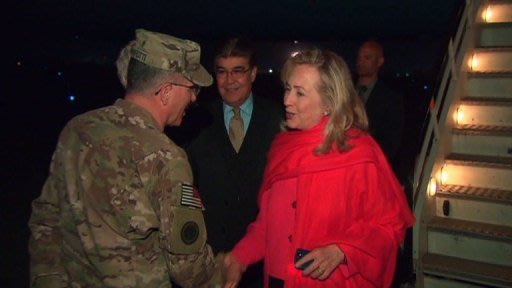
on Thursday flew into Pakistan for crunch talks with the leadership after calling on Islamabad to "do more".
She touched down at the Chaklala military airbase shortly after 7:00pm (1400 GMT) and was expected to head straight into a first round of meetings, said a correspondent travelling with her.
Earlier Hillary Clinton demanded that Pakistan dismantle Taliban safe havens, stepping up the pressure on Islamabad as American troops pressed a major offensive along the border.
She warned the Taliban to be part of a peaceful future or face a continuing assault, but urged Islamabad to play a "constructive" role in bringing militants to negotiations aimed at ending the 10-year war in Afghanistan.
"And now it's a question as to how much cooperation Pakistanis will provide in going after those safe havens," she said.
"We intend to push the Pakistanis very hard as to what they are willing and able to do with us... to remove the safe havens and the continuing threats across the border to Afghans," said Clinton.
She warned militants that "we are going to seek you in your safe havens" on both sides of the Afghan-Pakistani border and confirmed a US operation against the hardline Haqqani network it blames for some of the worst war attacks.
"There was a major military operation inside Afghanistan in recent days that has been rounding up and eliminating Haqqani operatives on this side of the border," Clinton told reporters in a leafy plaza of Karzai's palace.
She later flew into Pakistan, where she was to be joined by CIA chief David Petraeus and top US military officer Martin Dempsey for her talks.
But policy makers in Islamabad fundamentally disagree with US strategy in Afghanistan, believing military options are limited and that now is the time to press for a comprehensive reconciliation ahead of a NATO withdrawal in 2014.
It is Clinton's first visit to the region since a siege of the US embassy in Kabul and a truck bombing on a NATO outpost that wounded 77 Americans last month.
Washington blamed the attacks on the Haqqanis, who have a haven in Pakistan.
Dempsey's predecessor Admiral Mike Mullen called the Haqqani network the "veritable arm" of Pakistan's Inter-Services Intelligence and accused Pakistani spies of being involved in the embassy siege, dramatically worsening ties.
US commanders say the Haqqanis are their most potent enemy in eastern Afghanistan and increasingly capable of launching high-profile attacks in Kabul. It is an Afghan Taliban faction, loyal to Taliban leader Mullah Omar.
In what Pakistanis are likely to interpret as a contradiction, Clinton said her talks will focus on "how to increase pressure on the safe havens" while urging Pakistan to support efforts at negotiations.
"We believe that they can play either a constructive or a destructive role in helping to bring into talks those with whom the Afghans themselves must sit across the table and hammer out a negotiated settlement," she said.
"We will be looking to the Pakistanis to take the lead because the terrorists operating outside of Pakistan pose a threat to Pakistanis, as well as to Afghans and others," she said.
Karzai spoke of "shifting the focus" of the peace effort to Pakistan, saying that establishments there control to a "very, very great extent" the Taliban.
Pakistani security officials say privately that contacts are maintained with insurgent groups to facilitate any eventual settlement in Afghanistan -- a possibility that would be squandered if it launched any new offensive.
Islamabad argues that it has already made tremendous sacrifices, losing 3,000 soldiers and thousands of civilians in bomb attacks on its soil, and that it cannot do what the Americans demand when the relationship is so unpopular.
Minutes before Clinton arrived, the paramilitary announced that at least three soldiers and up to 34 militants were killed in a gun battle in the tribal district of Khyber, a key route for NATO supplies into Afghanistan.
"When the Americans ask us to do more, why don't they try to understand our problems and address our reservations and concerns?" one Pakistani security official told AFP on condition of anonymity.
"Pakistan will tell the Americans that the military options are getting limited in Afghanistan and there is a need to promote a genuine Afghan-led peace process," he added.
Secretary Information Pakistan People’s Party Punjab chapter, Dr. Fakhar ud Din Chaudhry has said that Sharif brothers were involved in Rs. 50 million corruptions in purchasing medicines for flood affected people.
Addressing a press conference at National Press Club here on Thursday Dr Fakhar Uddin Chaudhry said that sharif brothers purchased medicines worth of Rs. 80 million for the flood affected people without releasing any tender. The actual amount spent for the medicines is Rs 50 million, he claimed.
He said that Punjab government purchased all the medicines from fake pharmaceutical companies. He said that the provincial government spent Rs 19.80 on a blister pack of tablets, however, the real prices of this pack in open market is Rs. 3.30 while syrup of Rs 10.95 has been purchased at Rs 39.00.
The Information Secretary further said that sharif brothers used national exchequer for their personal benefits, as they spent Rs 80 billion of PWB for their accommodations and Rs 70 million of Sui gas used for their residence. He said that sharif brothers used Rs 300 million for the construction of a road which goes to their house while 180 million used for construction of a canal for the renovation of the house.
He said that telephone cable worth of Rs 220 million has been stretched and Rs 50 million has been spent to lay down electric cable to facilitate the sharif brothers.
Dr Fakhar uddin further said that sharif brothers are also involved transferring money to the other countries though different currencies but no action has been seen so far against them. He alleged that sharif brothers have close links with banned outfits and Punjab government is providing “chanda” to these banned outfits.
Talking about the mismanagement of Board Of Intermediate & Secondary Education he said that provincial government is will fully destroying the educational system of the province as they hired services of Dr Majid who is close relative of Ishaq Dar and is right hand of the provincial government.
He demanded that Chief Justice of Pakistan should take suo moto against the corruption of Punjab government and all the details should be disclosed to the masses.
Answering to question Provincial secretary information that their party respects the verdicts of Supreme Court however; it is our opinion that justice should be implemented equally in all provinces. Supreme Court’s verdict should be implemented with its true spirit, he added.
He said that Chief Justice should take notice of corruption of Punjab government.
To another question, he said that his party jointly worked with PML-N in the great interest of the country and initially Nawaz sharif assured them that with combined efforts we would succeed to control the problems of our country.
He said that law enforcement agencies are providing protocol services to sharif brothers and their blue eyed personalities.
He said that chief minister Shahbaz sharif visited flood affected areas on motorcycle and mocked with the affected people.
Former Libyan leader Moammar Gadhafi has been killed, interim Prime Minister Mahmoud Jibril said in Tripoli today.
Gadhafi reportedly shot on the run
Fighters attacked the house where Moammar Gadhafi was hiding and shot him when he tried to flee, a spokesman for Libya's new government says.
Gadhafi reportedly shot on the run
Fighters attacked the house where Moammar Gadhafi was hiding and shot him when he tried to flee, a spokesman for Libya's new government says.
A Bahraini military court has given six-month jail terms to 20 more people arrested during anti-regime protests in the tiny Persian Gulf country.
Thursday's verdicts came as the court issued more than 130 convictions related to anti-government demonstrations against the ruling monarchy.
The harsh sentences have drawn international criticism. UN Secretary-General Ban Ki-moon has expressed “deep concern” over the sentences and called for the release of all political detainees in Bahrain.
The Saudi-backed Al Khalifa regime of Bahrain has been dealing with protesters harshly since the popular uprising began in the Persian Gulf sheikhdom in mid-February.
Dozens of people have been killed and hundreds of others, including physicians and academics, have been jailed.
Some of them say they were tortured while in custody. International lawyers have filed suit against the Bahraini regime at the International Criminal Court at The Hague.
Two dozen Occupy Wall Street (OWS) protesters that had been arrested for trespassing on state property have appeared in a US court, pleading not guilty and asking for jury trials.
Some of the detained protesters were released while others were charged and fined. Yet, several more protesters that refused to plead guilty have demanded a jury trial.Some of the protesters had previously warned that they would demand a jury trial and pursue charges against arresting officers if the charges against them weren't dropped, Bloomberg reported.In an apparent attempt to bring an end to the steadily growing protest rallies, the New York police had previously arrested hundreds of anti-Wall Street protesters for joining a demonstration on the Brooklyn Bridge on October 1.
The OWS protest began September 17 in the US in opposition to the corporatism that overshadows the country. It has now become a popular widespread movement against capitalism and corporatism throughout the US. The people of Britain, France, Germany, Greece, Italy and others are also protesting along similar lines. According to a Press TV survey, many believe that the American Awakening -- represented by the OWS movement -- is in direct response to the misguided financial policies of the US establishment, thought to be behind the country's current economic crisis.
Global anti-capitalism protesters also demand an end to widespread corruption and inequality that accompany capitalism. European demonstrators have expressed solidarity with the OWS movement by often using the keyword occupy for their mottos and slogans in protest rallies.
aljazeera.net
Abdul Hakim Belhaj, a NTC military chief, has confirmed that Muammar Gaddafi has died of his wounds after being captured near Sirte.
Another NTC commander said that Moussa Ibrahim, former spokesman for Muammar Gaddafi's fallen government, was captured near the Sirte.
Abdul Hakim Al Jalil, commander of the 11th brigade, also said he had seen the body of the chief of Gaddafi's armed forces, Abu Bakr Younus Jabr.
"I've seen him with my own eyes," he said and showed Reuters a picture of Jabr's body.
"Moussa Ibrahim was also captured and both of them were transferred to (our) operations room."
Earlier, Jamal abu-Shaalah, a field commander of NTC, told Al Jazeera that the toppled leader had been seized, but it was not clear whether he was dead or alive.
"He's captured. He's wounded in both legs ... He's been taken away by ambulance," Abdel Majid, a senior NTC military official said.
The news came shortly after NTC claimed capturing Sirte, Gaddafi's hometown, after weeks of fighting.
NATO and the US state department said it cannot confirm any reports. Meanwhile in Benghazi, crowds gathered in the streets to start celebrating the reports of Gaddafi's death.
Former Libyan leader Moammar Gadhafi is dead, reported Al-Ahrar, a National Transitional Council TV station. It didn't cite a source and the news couldn't be independently confirmed.
Setting the stage for a high-level diplomatic showdown, Secretary of State Hillary Rodham Clinton bluntly warned Pakistan’s leaders on Thursday that they would face serious consequences if they continued to tolerate safe havens for extremist organizations that have crossed the border to attack Americans and Afghans. “There’s no place to go any longer,” Mrs. Clinton said, referring to Pakistan’s leadership, in some of the Obama administration’s most pointed language to date. “The terrorists are on both sides” of the border between Afghanistan and Pakistan. “They are killing both peoples,” she said.
“No one should be in any way mistaken about allowing this to continue without paying a very big price,” Mrs. Clinton said before leaving for Pakistan for what is certain to be a tense visit by an unusually powerful American delegation sent to demand greater Pakistani cooperation in fighting Al Qaeda and other extremists groups.
Mrs. Clinton will be joined by the new chairman of the Joint Chiefs of Staff, Gen. Martin E. Dempsey, and the new director of the Central Intelligence Agency, David H. Petraeus, who stepped down as the senior military commander in Afghanistan this year.
Senior administration officials have described the delegation as an attempt by the administration to display a united front to a Pakistani government that appears increasingly suspicious toward — if not openly hostile to — American policies in Afghanistan and Pakistan. While those officials suggested they hoped to persuade the Pakistanis to cooperate, Mrs. Clinton’s remarks here in Afghanistan’s capital suggested the delegation would deliver a much sharper warning as well.
Her remarks underscored the fact that the war in Afghanistan — along with the hopes for a smooth American withdrawal by 2014 — has become fully intertwined with Pakistan’s own insurgents, some of whom have the support of the country’s security services.
That has brought the relationship with Pakistan to a new low following a year of tensions — from the arrest of a C.I.A. officer , to the secret raid that killed Osama bin Laden in Pakistan in May, to the attack on the United States Embassy here last month, which General Dempsey’s predecessor, Adm. Mike Mullen, blamed on elements within Pakistan’s top spy agency, Inter-Services Intelligence.
Mrs. Clinton, appearing with Afghanistan’s president, Hamid Kazai, said that Pakistan could “either be helping or hindering” efforts to find both a military and a political resolution to the war here. It is now, she said, “a time for clarity.”
“We will be delivering a very clear message to the government of Pakistan and to the people of Pakistan because they too have suffered,” she said, beneath a canopy of trees at the presidential palace here. “They have suffered at the hand of the same kind of terrorists. So there should be no support and no safe haven anywhere for people who kill innocent, men women and children.”
Mr. Karzai, who has repeatedly accused Pakistan of interference in Afghanistan, echoed her remarks, saying that Pakistan has long harbored enemies of his government, including the Taliban, whose leadership fled there after the American invasion in 2001.
While the Obama administration has pressed Afghanistan to seek reconciliation with some elements of the Taliban, Mr. Karzai said on Thursday that that would not be possible without the positive involvement of Pakistan.
“We believe that the Tabilan to a very, very great extent — to a very, very great extent — are controlled by establishments in Pakistan, stay in Pakistan, have their headquarters in Pakistan, launch attacks from Pakistan,” he said.
Tentative and still-fruitless efforts to lure the Taliban into a peace process were dealt a severe setback when a man purporting to be a peace envoy killed Burhanuddin Rabbani, the leader of Afghanistan’s High Peace Council and a former president, using a bomb hidden in his turban.
His assassination, shortly after a carefully planned attack on the American Embassy last month, raised doubts about how many, if any, members of the Taliban are interested in a peace agreement.
Mrs. Clinton met Mr. Rabbani’s son, Salahuddin, at a meeting with Afghan lawmakers, officials and advocates at the American Embassy here on Thursday morning, expressing her condolences even as she encouraged a continuation of the efforts he began. “He was a brave man, trying to do the right thing,” she told him.
“We will make sure we continue his vision,” Mr. Rabbani replied.
Revolutionary fighters have captured deposed Libyan leader Moammar Gadhafi, Libyan television said Thursday, citing the Misrata Military Council.
That report, however, could not be independently confirmed.
Horns blared and celebratory gunfire burst into the air in Tripoli.
"It's a great victory for the Libyan people," said Libyan Information Minister Mahmoud Shammam.
Gadhafi ruled Libya with an iron fist for 42 years. The mercurial leader came to power in a bloodless coup against King Idris in 1969, when he was just an army captain.
By the end of his rule, he claimed to be "King of Kings," a title he had a gathering of tribal leaders grant him in 2008.
But a February uprising evolved into civil war that resulted in ousting the strongman from power.
But whether Thursday turns out to be the biggest day in recent Libyan history was still uncertain. Statements made by representatives of Libya's new leadership in the past have not always turned out to be true.
Many were waiting for photographs as proof of Gadhafi's capture.
Earlier, anti-Gadhafi fighters said they had wrested control of the last holdout of loyalists in Gadhafi's hometown of Sirte. They said they were still battling pockets of resistance, but they were in control of the district.
Sirte has been the big prize for Libya's National Transitional Council, waiting for the coastal city to fall to officially declare liberation.
Most residents abandoned Sirte in the many weeks of fierce battles that raged there. Revolutionary forces have fought Gadhafi's men street by street, cornering the last vestiges of the old regime to that last district.
Gadhafi, wanted by the International Criminal Court in The Hague, Netherlands, for alleged crimes against humanity has not been seen in public in months. Many believed he was hiding out in Sirte after rebel forces marched into Tripoli in August.
US Secretary of State Hillary Clinton was to hold talks with the Afghan president in Kabul Thursday, pushing diplomatic moves ahead of international conferences aimed at ending the 10-year war.
The top US diplomat was expected to meet President Hamid Karzai for talks before lunch, as she seeks to build on the "diplomatic surge" she announced earlier this year, a senior state department official told travelling media.
Ten years after the US-led invasion, Karzai's reconciliation efforts were derailed by the September assassination of peace broker Burhanuddin Rabbani and the Taliban are perceived to pose an increasingly wide threat in Afghanistan.
Concern is also growing among Afghans about the prospect of a return to civil strife after 2014, when the US-led NATO mission is scheduled to withdraw combat troops and hand over responsibility to Afghan security forces.
"She will want to emphasise that the United States remains committed to Afghan reconciliation," a senior US official said, particularly in the wake of the September 20 assassination of Rabbani, a former president of Afghanistan.
Rabbani headed a government council seeking a political settlement with the insurgents. A powerful Tajik, he was a leader in the Northern Alliance that fought the former Taliban regime and assisted US troops in the 2001 invasion.
Before seeing Karzai, Clinton met civil society leaders in the capital, including Rabbani's son Salahuddin Rabbani, who now heads his father's political party, Jamiat-e-Islami.
A conference of regional powers to be held in Istanbul in early November, and an international meeting of foreign ministers in Bonn, Germany, in early December, would be part of discussions.
"She'll want to talk to President Karzai about the importance of Afghanistan being linked to the region... so she'll want to talk about our diplomatic efforts coming up in Istanbul," said the senior official.
After 10 years of military conflict in Afghanistan that has cost thousands of lives and hundreds of billions of dollars, Washington is grappling for a negotiated exit to the war ahead of the 2012 US presidential elections.
Tentative discussions with the Taliban aimed at full peace talks have so far come to nothing, officials acknowledge, and Western powers have been attempting to draw in the help of Afghanistan's neighbours, with little success so far.
Many Afghans hold Pakistan responsible for the war's long course, given that senior Taliban and Al-Qaeda-linked militants have strongholds along the restive border that separates the two countries.
Clinton is due in Pakistan after her talks in Kabul, where she is expected to step up pressure on Islamabad to take action against Taliban havens.
Nevertheless, the United States needs to tread a careful line, knowing that the nuclear-armed nation will be a key stakeholder in any eventual political settlement in Afghanistan.
"(Clinton) agrees with President Karzai that Pakistani cooperation is critical on the issues in Afghanistan, so she'll consult with him," the senior official added.
Nearly two years ago, the United States sent an extra 33,000 troops into Afghanistan in a bid to break the back of the Taliban insurgency.
Despite touted successes in the Taliban heartland in the south, violence has spread to previously peaceful parts in the west and north, and the perception of security in Kabul has deteriorated after some high-profile attacks there.
The first tranche of those troops returned home this summer, while the remaining 23,000 troops are set to return by the end of summer 2012, with all NATO-led combat forces scheduled to leave by the end of 2014.
There are currently 98,000 US troops out of a total NATO-led force of 130,000 deployed to Afghanistan, fighting an insurgency that remains virulent across the country, with the war now focused on the eastern border with Pakistan.
But experts doubt the ability of the Afghan army and police to fight the Taliban alone, and US officials and officers have suggested that a smaller US military contingent could remain beyond the 2014 deadline in a combat role.
Long-term strategic arrangements between the two countries would also be discussed during Clinton's visit, the senior official said.
Federal Minister for Information and Broadcasting Dr Firdaus Ashiq Awan said on Wednesday that PML-N President Nawaz Sharif had backstabbed PPP leadership by forgetting that he owed to Benazir Bhutto for returning to the country. Speaking at a hurriedly convened press conference, Firdaus lashed out at the PML-N for targeting President Asif Ali Zardari by carrying out character assassination of the ‘symbol of federation’. The minister urged Nawaz not to unleash a covert war in Sindh under the guise of sympathising with the flood-affected people and rather urged him to adopt a political discourse in order to politically counter the PPP. “Rather than making covert political attacks in Sindh disguised as sympathising with the flood victims, Nawaz should make a political move and we will welcome him,” she said, adding that Sharif was shedding crocodile tears to win the support of flood victims but was doing nothing for them.
Interior Minister Rehman Malik has said the government is going to implement immigration system along Pak-Afghan border in Chaman and Torkham from November.
Addressing a news conference at Chief Minister’s Secretariat on Wednesday, Malik said the government would revive the biometric computerised system by November 30 to screen all people travelling across the Pak-Afghan border.
The move has been made after frequent terror attacks and increase in sectarian violence in Balochistan.
The interior minister said he had come to Quetta with the task to discuss three issues, including illegal cross border activities, target killings of Hazara community and negotiations with those angry Baloch nationalists who had taken to hills. He was accompanied by Home Minister Zafarullah Zehri on the occasion. Malik visited the Chaman border and also held meetings with members of the Hazara community and Sunni leaders in Quetta.
Speaking about biometric computerised system, he said, “It will be most modern system aimed at preventing illegal immigrants from crossing into Pakistan, and keep a check on cross-border activities.” He added, “I have talked to officials and tribesmen on either side of the border and they have expressed their willingness to extend their cooperation to curb the activities of illegal immigrants.”
He said people would not be allowed to enter or exit through Pak-Afghan border without screening by November 30. He disclosed that he had intelligence reports that terrorists, including those behind sectarian violence in Balochistan, were operating from prisons in the province and had contacts with banned organisations in Punjab.
He said massive crackdown had been launched in different jails following the intelligence reports. “Officials have recovered mobile phones and other things, which indicate involvement of terrorists in sectarian attacks,” he added.
He said that terrorists had contacts with Punjab based banned outfits.
He announced that the government intended to convene a ‘Peace Conference’ in Quetta in November, which will be attended by all the Islamic scholars, intellectuals and religious leaders, including Imam-e-Kaaba.
“It is meant to give a clear message of peace,” he said. He said efforts were underway to supplement the Evidence Act after suggestions made by the provincial home minister and home secretary that the Act needed to be supplemented in order to improve the process.
About reconciliation process in Balochistan, the interior minister reiterated that the government was serious in addressing the grievances of people of Balochistan.
“I again offer to those Baloch angry people who took to hills: For God sake lay down your arms and join the negotiation process,” he asserted.
The three-day Afghan Cultural and Industrial Exhibition concluded at the Nishtar Hall here on Wednesday with a positive note that more such events would be held in future to strengthen the cultural bonds between Pakistan and Afghanistan.
The exhibition, arranged by the culture wing of the Afghan Consulate General in Peshawar, was visited by a large number of people, including Khyber Pakhtunkhwa ministers Mian Iftikhar Hussain, Syed Aqil Shah and Sardar Hussain Babak, students from various public and private schools, colleges and universities, artisans and people from various walks of life.
About 20 stalls of handmade carpets, handicrafts, Afghan jewellery, paintings, garments and footwear were set up at the Nishtar Hall gallery. The portraits of Afghan heroes and former rulers including Ahmad Shah Abdali, Ghazi Amanullah Khan, Mahmud Ghaznavi, Mirwais Neeka and legends in literature, art and culture were also displayed.
Parveen Malal, cultural attaché at the Afghan Consulate General, told The News that such events would strengthen the bonds between the two brotherly countries and promote cultural activities.
Expressing satisfaction over the provincial government’s cooperation, she said the event provided an opportunity to Afghan traders to showcase their products and attract customers. She said it also provided an opportunity to the younger generation to know about their heroes, forefathers’ dresses, customs and traditions and the way of life.
“The television channels in Afghanistan will show the event. It will help promote our centuries-old culture and trade activities,” she said, adding that such exhibitions should be held in Kabul and Jalalabad and also in Islamabad.
The Afghan Students Union, Peshawar took an active part in the event. President Riaz, Vice-President Najeeb Nangyal and External Affairs In-Charge Waheedullah of the union were present to receive and guide the guests.
Haji Khan and Qari Zareef were among those manning their stalls of hand-woven carpets. They said they have been doing carpet business at Khyber Bazaar since 1980s, though they complained about decline in their trade due to various reasons. They said business was lucrative in the 1980s and even till the late 1990s but the wave of militancy affected it to a great extent.
“Eight out of the 15 carpet markets in Khyber Bazaar have been closed due to the decline in the business. The militancy and insecurity in the region affected our business while the electricity loadshedding and economic crisis aggravated the situation,” argued Qari Zareef.
He said about 70 percent carpets were imported from Afghanistan and 30 percent were made locally. He and the other carpet makers complained that traders from Punjab and other cities were also contributing to the decline of the carpet business in Khyber Pakhtunkhwa by running a propaganda campaign about the law and order situation and thus discouraging customers to come to the province.
They also complained that Afghan nationals having refugee cards were not allowed to open bank accounts and get driving licence in Pakistan. They asked the government to facilitate them by resolving these issues. They also demanded that the police should be directed not to harass the traders while shifting their carpets and other products legally and ease custom duty on the carpets imported from Afghanistan.
US Secretary of State Hillary Clinton arrives in Islamabad on Thursday for talks with Pakistani leaders aimed at jump-starting a troubled relationship.
Secretary Clinton, who was in Kabul on Wednesday, and her team are expected to meet Pakistan’s civil and military leadership, including President Asif Ali Zardari, Prime Minister Yousuf Raza Gilani and army chief Gen Ashfaq Parvez Kayani.
The visit is her own initiative and has been portrayed in the US media as “a list-ditch effort” to salvage America’s partnership with Pakistan.
She is coming at a time when US-Pakistan relations have plunged to a new low following accusations by senior American officials that the Inter-Services Intelligence agency is using the Haqqani network to wage a proxy war in Afghanistan and to attack US and foreign forces. It also takes place against the backdrop of a reported US and Afghan troop build-up along the Afghanistan-Pakistan border.
On Wednesday, State Department’s spokesman Mark Toner told a briefing in Washington that the US wanted to engage Pakistan constructively and was also seeking to improve relations between Pakistan and India and Pakistan and Afghanistan.
“We need good relations between Pakistan and India. We need good, constructive relations between India and Afghanistan, between Afghanistan and Pakistan so that all three countries can prosper and increase stability and peace in the area,” he said.
“Certainly, an important element of that in Pakistan and elsewhere is strengthening democratic institutions and democratic governance.”
CIA Director David Petraeus, Chairman of the Joint Chiefs Gen Martin Dempsey and Under-Secretary of Defence for Policy Michele Flournoy will join Secretary Clinton in Islamabad.
They may be the first family of reality TV, but not everyone is interested in
“Keeping Up with the Kardashians.” Especially…the patriarch of the First Family.
Michelle Obama reveals that her husband isn’t too keen on the couple’s two daughters watching the E! reality show.
“Barack really thinks some of the Kardashian – when they watch that stuff – he doesn’t like that as much,” she said, “but I sort of feel like if we’re talking about it, and I’m more concerned with how they take it in – what did you learn when you watched that. And if they’re learning the right lessons, like, that was crazy, then I’m like, okay.”
The First Lady had been asked about her children’s viewing habits during a roundtable interview with iVillage.com.
She explained that Malia, 13, and Sasha, 10, are not allowed to watch TV or be on the computer (unless it’s for school) during the week but that she and the girls check out some programs together on the weekends … and “The Kardashians” airs on Sunday nights on E!, which she feels play out like precautionary tales.
“They’re terrific girls, they’re poised and they’re kind and they’re curious,” Obama said, adding with a laugh, “And like any mother, I am just hoping that I don’t mess them up.”
Interior Minister Rehman Malik said Wednesday that he could bring forward several corruption cases of Nawaz Sharif if the party allowed him, Geo News reported.
Malik was speaking with party workers and sent a message to the PML-N chief "criticise but fix your language."
Malik also accused the PML-N-led Punjab government of using fake Dengue sprays adding that Nawaz Sharif had no room to criticise the PPP.
The Interior Minister added that slogans could not remove the PPP government because the nation loved Bhutto, Benazir and Asif Ali Zardari.
Yemeni Nobel Peace Prize winner Tawakkul Karman joined about 100 protesters Tuesday outside the United Nations to call for President Ali Abdullah Saleh to stand down.
"We came here to tell that Ali Abdullah Saleh and (Syrian leader) Bashar al-Assad are both criminals and they have to be held accountable and prosecuted," Karma said.
"People are living on sidewalks and are being killed everyday... All because they asked for democracy and justice.
"These regimes are a danger to international security," she added, speaking through a translator.
Karman, who shared the 2011 Nobel prize with Liberian President Ellen Johnson Sirleaf and "peace warrior" Leymah Gbowee also from Liberia, has called on the United Nations to act immediately to halt the Yemeni government's crackdown on pro-democracy protests.
"As a Yemeni leader, as a Nobel Prize winner, as a leader of the Arab Spring, I came here to tell them to stand up for these rights," Karman said.
"We're calling on them to treat the revolutions in Yemen and Syria just like they did in Libya.
"I feel shamed that tonight I will be sleeping in a hotel and my people will be sleeping in the streets."
She plans to hand a letter to UN Secretary-General Ban Ki-moon on Wednesday, and she has called on the International Criminal Court to investigate the actions of the Yemeni government.
Karman and tens of thousands of other pro-democracy activists have camped out in Sanaa's Change Square for months, marching against Saleh despite a violent crackdown by government troops that has killed hundreds since the mass protest movement began in late January.
At least seven protesters were killed and dozens wounded on Tuesday as gunmen loyal to Saleh opened fire on demonstrators in the Yemeni capital, medics and the opposition said.
It was the third time in four days that demonstrators had attempted to march from their base in Change Square on loyalist-held areas of the capital to be met by deadly gunfire.
Despite months of protests and international pressure, Saleh has refused to end his 33-year rule and step down despite a plan drawn up by the Gulf monarchies for a peaceful transfer of power.
At least 861 people have been killed and 25,000 wounded since protests first erupted, according to a letter from Yemen's youth movement sent to the United Nations earlier this month.
Syrian state television is showing tens of thousands rallying in a major city in a demonstration of support for the country's embattled President Bashar Assad.
The pro-regime gathering in Aleppo comes a week after a similar rally in the capital, Damascus.
Damascus and Aleppo are the largest cities in Syria and economic powerhouses. The regime is counting on their support to halt the momentum of a 7-month-old uprising.
Also Wednesday, the British-based Syrian Observatory for Human Rights said pro-government gunmen killed two people in the restive city of Homs.
The U.N. says more than 3,000 people have been killed in a crackdown on the uprising and international pressure is building on Assad to step down.
has warned the US that it will have to think "10 times" before taking any unilateral action in North Waziristan.
He said that the US should focus on stabilising Afghanistan instead of pushing Pakistan to attack militant groups in the crucial border region.
Washington has for many years urged Islamabad to deal with militants in the area, especially the Haqqani network.
It has been blamed for a series of recent attacks in Afghanistan.
"If someone convinced me that all problems will be solved by taking action in North Waziristan, I'd do it tomorrow," a parliamentarian who attended a briefing given by Gen Kayani quoted him as saying.
"If we need to take action, we will do it on our schedule and according to our capacity."
Gen Kayani told the closed-door parliamentary defence committee meeting in Rawalpindi that any withdrawal of American assistance would not affect Pakistan's defence capabilities.
'Very focused'
The Haqqani network - believed to be linked to the Taliban and al-Qaeda - is
accused of carrying out last month's 19-hour siege of the US embassy in Kabul.
Some reports say that during the briefing Gen Kayani defended Pakistani contacts with the group as "useful" for intelligence gathering.
The verbal and military fight waged by the US against the network has intensified in recent months and is the main cause of tension between the US-led coalition in Afghanistan and Pakistan.
US national security adviser Thomas E Donilon is reported to have told Gen Kayani at a secret meeting in Saudi Arabia earlier this month that Pakistan must either kill the Haqqani leadership, help the US to kill them or persuade them to join a peaceful, democratic Afghan government.
In September outgoing Joint Chiefs of Staff Chairman Adm Mike Mullen called the Haqqanis a "veritable arm" of the Pakistani intelligence agency, accusing it of directly supporting the militants who had mounted the attack on the US embassy.
But Pakistan has been reluctant to give in to US pressure on the issue. Last month Prime Minister Yousuf Raza Gilani said that his country "will not bow to US pressure" on fighting militancy.
A senior official in Afghanistan said on Tuesday that the coalition was "very focused" now on the Haqqani network. He said that the Haqqani network operates mainly in Khost, Paktia and Paktika provinces, but there has been a significant increase in its activities in Wardak and Logar provinces.
Afghan and Nato officials argue that Pakistan's reluctance to confront the Haqqani network has forced them to increase missile strikes against them in their safe haven of North Waziristan.
For months, the US has been targeting militants, including members of the Haqqani group, in Pakistan's tribal areas near the Afghan border - some in the US Congress are now calling for it to go beyond drone strikes.
Pakistan's military was deeply angered and humiliated when US commandos killed al-Qaeda leader Osama Bin Laden in a secret raid on Pakistani soil in May.
While Pakistan has long denied supporting the Haqqani group, BBC correspondents say it has a decades-old policy of pursuing foreign policy objectives through alliances with militants.
The top NATO commander in Afghanistan says the international coalition has unleashed a new offensive against one of the country's most lethal militant networks and will ramp up operations next year along the Pakistan border to better secure the Afghan capital before the U.S. drawdown gathers steam.
In an interview Wednesday with The Associated Press, Marine Gen. John Allen said the "high-intensity" operation is focused on the Haqqani group, a militant network affiliated with the Taliban and al-Qaida.
Allen also says the transfer of security to Afghan forces is going to move faster than initially planned.
And he says roughly one-third of the 10,000 U.S. troops President Barack Obama ordered withdrawn from Afghanistan this year will come from combat units.
US forces are massing on the Pakistan border in eastern Afghanistan amid reports of an imminent drone missile offensive against fighters from the feared Haqqani Network, a Taliban faction which operates from safe havens in Pakistan's North Waziristan Agency, Pakistan Army sources have confirmed.The scale of the American build-up, including helicopter gunships, heavy artillery and hundreds of American and Afghan troops, caused panic in north Waziristan where tribal militias who feared they could be targeted gathered in the capital Miranshah to coordinate their response.
Local officials in the Federally-Administered Tribal Areas (FATA) warned that Pakistan's armed forces would repel any incursion across the border by American forces, but military sources in Islamabad and Afghan officials suggested the build-up was part of a coordinated operation.
Relations between Washington and Islamabad have deteriorated dramatically in recent months as American officials increased pressure on Pakistan to launch an offensive against the Haqqani Network, which mounts attacks on Nato forces in Afghanistan from bases in North Waziristan.
Islamabad has fiercely resisted American pressure, claiming its forces are overstretched and stating its priority is to fight Taliban factions which have declared war on Pakistan, rather than those, like the Haqqanis, who focus on cross-border attacks on Nato forces.
Last month Admiral Mike Mullen, the chairman of the U.S Joint Chiefs of Staff, recently accused Pakistan's ISI intelligence service of plotting the attack on the US embassy in Kabul with Haqqani network fighters and claimed the militant group was a "veritable arm" of the ISI.
Islamabad and Washington have traded accusations since then, but the massing of American troops on the Afghan border appears to suggest some understanding may have been reached.
According to Pakistan Army sources, the U.S had informed Islamabad about the planned build-up and described it as part of a "cordon and search operation" in which Haqqani Network fighters will be pushed over the Afghan border from North Waziristan and then "encircled, arrested or killed" by American forces lying in wait.A spokesman for the International Security Assistance Force (ISAF) in Kabul declined to comment on the build-up. A spokesman for the Pakistan Army said it had not been informed about the number of American troops on the border but it was reported that American and Afghan troops had established curfews in eastern Khost province, conducted house to house searches, established checkpoints and occupied hilltops close to Ghulam Khan on the Pakistan side of the border.
The Haqqani Network and militant allies have increased in strength on both sides of the border over the last two years and have been blamed for a summer increase in cross-border raids on Nato positions in eastern Afghanistan.
The dastardly ambush by the militants in Khyber Agency is yet another instance of the TTP continuing on its deadly course of destabilizing Pakistan. Those who had hoped that with Islamabad still declining to undertake military operation in North Waziristan, insurgency and attacks inside Pakistan would come to an end have thus been proved wrong. Coming as it does amidst reports of Pakistani agencies trying to deradicalise groups of local terrorists, the ambush is all the more disturbing. Taliban networks, including the most lethal Hakimullah Mehsud group, which is supposedly behind the attack, have been camping for long in North Waziristan. What is the justification for not taking action in the agency if attacks of the sort that killed FC soldiers continue to take place?
Having said this, there is a need on the part of the US also to give proper weight to Pakistan’s constraints. What one has seen happening during the last nine months indicates this is not being done. The US policymakers continue to ignore the ground realities in the region. Washington has failed to realise that lack of cooperation between the US and Pakistan can only facilitate the terrorists. By putting on hold the promised civilian and military aid, Washington has forced Pakistan to fight militancy through its own meager resources. Islamabad has thus been left with no alternative other than limiting its targets instead of conducting an all-out operation against terrorists of all brands. This has also led to the thinking among powerful circles that there is a need to open talks with domestic terrorist groups.
A Pentagon spokesman has talked about an increase in attacks from inside Pakistan this summer. Pakistan is facing a similar situation. During the last few months raids by militants operating from Afghanistan have increased manifolds. About 100 members of Pakistan’s security forces have been killed in these incidents. Mullah Fazlullah is currently organising attacks from inside Afghanistan. ISAF has not taken action against these groups. This underlines that unless the two countries urgently reach an understanding, giving due consideration to the ground realities and displaying the much needed flexibility, there will be peace neither in Afghanistan nor Pakistan.
Kohat Commissioner Sahibzada Muhammad Anis on Tuesday asked the Afghan refugees in Pakistan to follow the state law and stay away from illegal activities, and warned of strict action against violators of the law. He was speaking at a high-level meeting in his office, attended by senior representatives from the United Nations Refugee Agency (UNHCR), Police department, commissioner and additional commissioner for Afghan refugees, and district coordination officers of Karak, Kohat and Hangu.
The Kohat commissioner said the authorities were taking steps to ensure a peaceful living for the refugees in Pakistan, particularly in Kohat Division. He asked them to follow the country’s code of conduct and maintain law and order in their areas. He asked the UNHCR to provide basic amenities to the refugees. He also asked the police to give legal cover to Afghans who possessed identity cards for refugees issued by Pakistan. Regarding reports that some Afghan refugees had destroyed their identity cards, he said warned the refugees involved in the practice and told police to take action against those found guilty.
Interior Minister Rehman Malik said on Monday that Shahbaz Taseer, son of the murdered governor of Punjab Salmaan Taseer, was alive and that his kidnappers were holding him in a place close to the Pakistan-Afghanistan border. He went on to say something even more startling – that information had been received about a fortnight ago that Al-Qaeda and the TTP were planning on kidnapping the son of President Zardari and chairman of the PPP, Bilawal Bhutto Zardari. He offered no supporting evidence for either claim and given his propensity for what might charitably be called a slackness of tongue, we are unable to be sure of the veracity of either statement.
It is unlikely that Malik deliberately would have exacerbated the already difficult position of Shahbaz Taseer, but by disclosing his knowledge of Taseer’s whereabouts he may have alarmed his abductors. Similarly, if there really was a plot to kidnap Bilawal Bhutto Zardari then those who were doing the plotting are now alerted to the possibility of their actions being under surveillance. There are times when secrets, genuinely and for good reason, have to be kept. Disclosure may harm the chances of release or jeopardise negotiations in the case of Taseer; and in the case of Bilawal Bhutto Zardari perhaps expose an intelligence asset in their company or a leak in their communications. Either way, offering statements like this, completely unsupported, does nothing for the credibility of the interior minister. Ministers need to speak and act with discretion, be guarded and circumspect in their unscripted moments and mindful of their broader responsibilities.
MQM leader Haider Abbas Rizvi responded to Nawaz Sharif and said banned organisations were the militant wing of the PML-N.
Speaking to Geo News Rizvi said he was astonished over Sharif’s statement and said terrorism in Pakistan started during the era of General Zia.
Rizvi added that the MQM did not need clearance from anyone and it would be the PML-N who would be losing support in Punjab in the near future due to its affiliations with banned organisations.
PML-N Chief Nawaz Sharif on Wednesday said that terrorism in Pakistan started when the MQM entered politics.
A comprehensive survey of the country’s nutritional status reveals a grim picture, particularly for Balochistan where the prevalence of chronic malnutrition is 52.2 per cent and maternal anemia is 47.3 per cent.
Similarly, the prevalence of acute malnutrition among children is 16.1 per cent, particularly alarming considering the World Health Organisation guidelines which term anything above 15 per cent as a ‘state of emergency.’
To tackle the situation, the Health Department of Balochistan convened a one day dissemination ceremony of the survey’s findings. The ceremony took place on Tuesday at the Sikandar Jamali Auditorium and was chaired by Chief Secretary of the province.
The secretaries of Food, Education, Agriculture, Population Welfare department and other stack holders also participated in the meeting.
Balochistan’s government will endorse the findings of the survey and will devise an integrated nutrition strategy with the help of all concerned departmemts, NGOs and stake holders to address the crisis immediately.
The advocate general submitted before a bench of the Balochistan High Court on Tuesday a report of the Crimes Investigation Department (CID) which stated that an important clue had been found in the Mastung massacre, but said that details could not be disclosed because that would affect further investigation.
Twenty-nine members of the Shia Hazara community were killed by gunmen near Mastung on Sept 20.
The bench comprising Chief Justice Qazi Faez Isa and Justice Abdul Qadir Mengal accepted the counsel’s request that due to sensitivity of the matter the report be kept under wraps.
A report prepared by the Frontier Corps was also submitted which said the Levies Force did not coordinate with them in the investigation.
The court noted that although the government had restored the Levies Force, it was not properly trained to combat terrorism and other crimes and directed the government to take steps to improve the force’s performance.
The court also called for measures aimed at better coordination among different law-enforcement agencies to stop terrorist incidents and other heinous crimes. The hearing was adjourned till Nov 23.
Interior Minister Rehman Malik on Wednesday said the government would call a peace conference of local and foreign religious scholars in Quetta to control violence caused by sectarianism.
“Religious scholars and other stakeholders from different walks of life from across the country and abroad will be invited to attend the peace conference in Quetta to end sectarian hatred and violence,” Mr Malik said.
He was talking to media at the Sarawan House Quetta after meeting with Pakistan People’s Party (PPP) leader Haji Lashkari Raisani.
The minister said that some extremist elements were involved in activities to damage peace in Balochistan and added that the government would utilise all the resources available to it to resolve the province’s law and order issues.
“We will not allow anti-peace elements to implement their nefarious designs,” he said.
Referring to the missing persons issue, he said the total number of missing persons hailing from Balochistan was 54 and not 6,000.
“I have discussed the missing persons issue with Lashkari Raisani and I will inform President Asif Ali Zardari about the reservations of Raisani in this regard,” he said, adding that both federal and provincial governments had been making efforts to resolve the issue as soon as possible.
He added that the commission set up on the missing persons issue was active and discharging its services effectively. He said that the PPP-led government was aware of Balochistan’s conditions and wanted to put the province on the track of progress and prosperity.
“Balochistan province is rich in mines and minerals and the government will utilise the wealth of natural resources for the development of the province,” Mr Malik pledged.
On this occasion, Mr Raisani said that Balochistan was a victim of an international great game. He emphasised the need to ensure the recovery of missing persons. He said that the interior minister had assured him that he would take up the issue with relevant authorities. “The interior minister has assured me that the federal government would make efforts to bring angry Baloch youth into mainstream,” he said.
There are an estimated 1.4 million sex slaves in the world today and international trafficking is on the rise.
Slavery: A 21st Century Evil .These women do not voluntarily enter prostitution, but have been forced under the threat of violence to have sex with men who pay their 'owners'.
Sex slavery is present in every country of the world.
In some cases, categorised as 'domestic', women are sold into brothels within their own country. But international sex trafficking of women and children is on the rise.
In this episode, Al Jazeera's Rageh Omaar investigates the enslavement and trafficking of women from Moldova, the poorest country in Europe, to wealthier European countries, in particular to the red light district of Amsterdam, one of Europe's most profitable sex markets and a major international tourist attraction.
Pakhtuns are famous for their tribal system and traditional culture. But this unfortunate nation has been the victim of internal and external intrigues since the British colonial period.Their land is green and fertile but without enough employment opportunities. This is because the Khyber Pakhtunkhwa province has never been given its due share of the developmental projects launched in Pakistan.There is no dearth of talent among the Pakhtuns, but prejudiced politicians and elite have kept the community away from development. To survive in this situation the people have spread throughout the world to earn their livelihood. The Pakhtuns have some special qualities and habits for which they are respected not only in Pakistan but throughout the entire world, but one cannot find those qualities by studying Pakhtuns working in the UAE. The complaint is not for all the Pakhtuns but is focused on those who are uneducated, hailing from the far-flung areas of Khyber Pakhtunkhwa.I have been working in the UAE since 2005. I feel very sad to see the ever-decreasing cultural values of Pakhtuns. In the 1970s, the construction boom of the Gulf countries attracted huge manpower from the South Asian countries. To benefit from the employment opportunities a large number of jobless Pakhtuns turned to the Gulf countries especially to the UAE and Saudi Arabia.According to a rough estimate more than 500,000 Pakhtuns are currently employed in the UAE. They are engaged in different professions — about 70 per cent of them in the transport industry and the remaining 30 per cent are employed in construction companies and odd jobs.Technology has revolutionised the world and the job market demands highly qualified workforce. But the Pakhtun youth who come to the UAE do not possess the required skills. Thus they cannot compete with other expats in this much advanced job market.Another problem is that the community members have to work in a multinational environment in the UAE, but few of them know how to deal with other staff members.It has also been observed that the people working here in various companies are not into nurturing healthier relationships for their own development. As a result of their inappropriate attitude, companies do not favour Pakhtun candidates at the time of recruitment.The financial position of the community is also not good as one can see huge businesses of Indians and Arab expatriates in the UAE market, whereas Pakhtuns only know how to drive taxis.Unfortunately, a Pakhtun generally does not have a financial plan to keep a balance between his income and expenditure. He earns money but does not know how to save it. Even when he sends money to his family back home it is without any specific schedule. It has also been noted that Pakhtuns spend lavishly on unnecessary things when they go back home on leave.The economic situation in the region has made their position weak and the salary structures of the workers are not very satisfactory in today’s recessionary environment. It is said that Pakhtuns are famous for their social contacts, but when it comes to those working in the UAE, the matter is quite different. They have developed a poor social system. The famous codes of Pakhtunwali such as hospitality, respect of the elderly, helping the sick and the needy no longer exists in the community here.Their joint accommodations (called dhara in the local dialect) are ruled by jealousy and they have failed to keep the inherited community values in their life in the UAE.Those elderly members of the community who have been living here since many decades do not help those who seek jobs although they can request their bosses.The community should have welfare organisations to assist its people in time of distress like other communities have in the country.A branch of AVT Khyber TV channel exists in Dubai but unfortunately it has never concentrated on problems confronted by the community. Its anchor focuses only on showing high-rise buildings and organises music shows which attract the Pakhtun youth to Dubai but they do not know the ground realties. The anchor has never pointed out the grievances and difficulties faced by the community.It is mentioned here the purpose of my description is not to devalue Pakhtun culture, rather I want to inform the ANP Khyber Pakhtunkhwa government of the problems the Pakhtun community isfacing in various Arab countries, particularly in the UAE. It would be better if the local government of the province appoints a commission of experts in Peshawar to examine the job markets in these countries and then evolve a comprehensive strategy to train the youth according to the job requirements. Also, the commission should be set up a small institute in Peshawar where the new overseas workforce will get preliminary information about the countries they wish to go before leaving the Khyber Pakhtunkhwa. Only then, they can regain their lost image, preserve their jobs and revive the traditions of Pakhtunwali. Now, with the advent of two Pashto TV channels -— the AVT Khyber and Shamshad TV – both can play a pivotal role in restoring the centuries’ old Pakhtun culture. The programmes, especially the cultural ones which are run on these channels are extremely fruitful for our new generation. This is why the channels are becoming popular among the Pakhtuns by leaps and bounds. I would like to remind their distinguished anchors to initiate such programmes which could create awareness among the expatriate Pakhtuns to cope with the challenges faced by them in the Arab Gulf countries.To make a long story short, lack of modern education, English language proficiency, latest job skills, rude attitude and ineptness at social interaction and dealings are the impediments being faced by Pakhtuns not only in the UAE but throughout the Mideast.
The PPP remembered martyrs of Karsaaz tragedy on Tuesday, as different party cadres held functions across the country to mark the day.
In Lahore, a good number of PPP’s women activists gathered outside Governor’s House and lit candles in memory of those who lost their lives as a result of the massive bomb blast which occurred four years ago in Karachi on late Benazir Bhutto’s return from exile. President, Lahore women wing, Faiza Malik had organised the show.
PPP’s Punjab Finance Secretary, Aurangzeb Burki organised a ceremony in National Assembly constituency of NA-121 (Lahore) to mark the day. Addressing party workers on the occasion, Burki said that October 18 would be remembered as black day in country’s history. He said PPP was proud of its martyrs who sacrificed their lives for democracy. PPP’s youth wing also arranged similar events at divisional and district headquarters in connection with the day. Quran Khawani was held for the departed souls.
Addressing a gathering of youth in Lahore, President Peoples Youth, Punjab, Mian Ayyub termed the October 18 tragedy an attack on democracy, and said that party workers will not hesitate from making any sacrifice to save the country and the democratic system.
The United States believes the Pakistani government is capable of working with it on shared challenges, with the State Department expressing support for a strong democracy in the key South Asian country.
“Much of our work in Pakistan is geared towards building the kind of institutions that will strengthen Pakistani democracy,” State Department Spokesman Mark Toner said in answer to a question at the daily briefing.
“Clearly, we want to see a strong democracy emerge in Pakistan that works side by side with the military and that is to the benefit of Pakistani people moving forward,” he added.
Asked if the US had confidence in the current Pakistani government’s ability and intent to work with the United States on shared challenges, the spokesman replied: “We do believe they’re capable of it, and certainly for our part, we’re willing to work with them to address those shared challenges.” Questioned about the outcome of US Special Representative Marc Grossman’s recent visit to Islamabad, the spokesman said he has not received readout from Grossman’s trip but reaffirmed Washington’s desire to work constructively with Pakistan on dealing with shared challenges.
“I would just say that, as he (Grossman) has said multiple times, that we’re working together with Pakistan. We want to find ways that we can act jointly on our shared challenges. We continue to pursue those interests. We’re obviously as we’ve said many times, Pakistan is under enormous threat from extremist groups. We want to find ways to work constructively with them to address these challenges.” Experts say despite differences, a cooperative US-Pakistan relationship remains critical to a successful outcome of the decade-old Afghan conflic
First Lady Michelle Obama honors schools that met the First Lady's goal to double the number of participants in the HealthierUS School Challenge in a year.
President Obama "has suffered the most unrelentingly negative treatment" of all presidential candidates over the past five months, according to a study released Monday from the Pew Research Center's Project for Excellence in Journalism.
Pew found that Mr. Obama was the subject of negative assessments nearly four times as often as he was the subject of positive assessments. It found he received "positive" coverage nine percent of the time, "neutral" coverage 57 percent of the time and "negative" coverage 34 percent of the time.
The study, which was conducted using a combination of "traditional media research methods [and] computer algorithms to track the level and tone of coverage," cuts against the widespread conservative claim that the "liberal media" aides Mr. Obama and other Democrats while attacking Republicans.
Pew says it looked at coverage from more than 11,500 news outlets, including local and national broadcasts, news websites and blogs.
Mr. Obama's negative coverage could be explained in part by the fact that he is "covered largely as president rather than a candidate," Pew said - and coverage of him is linked to the struggling economy.
Among the Republican presidential candidates, Pew found that Rick Perry has received the most positive coverage of all the candidates, with 32 percent positive coverage. He was followed by Sarah Palin (31 percent), Michele Bachmann (31 percent), Herman Cain (28 percent) and Mitt Romney (26 percent.) Palin, a vocal critic of the media, ultimately decided not to seek the GOP nomination.
Perry had the best ratio of any candidate, with 32 percent positive coverage to 20 percent negative coverage, a 12 percent net positive ratings in terms of coverage. He was followed by Palin (with 9 percent net positive coverage), Bachmann (8 percent net positive), Cain (5 percent net positive), Ron Paul and Jon Huntsman (both with 4 percent net positive coverage.) Pew found that Cain surged in positive coverage starting in late August - even before he did so in the polls.
The only candidate who received more negative coverage than Mr. Obama was Newt Gingrich, whom Pew found was the subject of negative coverage 35 percent of the time. That can be attrubited in part to his early stumbles, including his criticism of the House GOP Medicare plan and the decision by top staffers to abandom Gingrich's campaign. While Pew found that Mr. Obama received just nine percent positive coverage, however, Gingrich received 15 percent positive coverage.
The candidates with the worst coverage ratio were Mr. Obama (25 percent net negative coverage), Gingrich (20 percent net negative), Rick Santorum (3 percent net negative) and Mitt Romney (1 percent net negative.)
As Politico's Keach Hagey notes, Pew found that Mr. Obama had widely positive media coverage during his first 100 days in office, with 42 percent positive coverage and 20 percent negative coverage.
Here's how Pew in part explains its meathodology - more can be found here:
To assess the tone of coverage, PEJ researchers then employed computer algorithmic software from Crimson Hexagon. Researchers conducted a tone analysis and then "trained" the algorithm to follow the same rules as they had themselves. PEJ also conducted inter-coder tests to ensure the computer coding was replicable and valid by comparing human coding to the results derived by the algorithm. The project also had different people build the algorithms separately to ensure that they were achieving consistent results. Each computer algorithm was then additionally tested for reliability by having multiple researchers review the content assessed and the results.
The tone analysis was conducted on two different samples. The first was of the coverage and commentary on more than 11,500 news outlets, based on their RSS feeds. While the content is text based, the material on various television news sites often closely resembled the stories that had aired on television, and in some cases were exact transcripts. The second was from hundreds of thousands of blogs. (Facebook and Twitter feeds were not included after researchers found that the political assessment offered there was typically quite brief or referred to blog or news content.)
In a twist on his 2008 campaign slogan, President Obama suggested that Republicans were adopting a "No, we can't" approach to the jobs crisis, blocking steps to boost the economy to deal him a political setback.
Obama spoke at a high school Tuesday on the second day of his bus tour through North Carolina and Virginia, a campaign-style trip in which he is trying to pressure Congress to pass his jobs package. He is also trying to rebuild his standing in the two battleground states.
The president warned that opponents of his $447-billion jobs bill risked a public backlash if they rejected proposals that would stave off teacher layoffs and boost hiring to fix aging public infrastructure. Those lawmakers will need to explain their votes to angry constituents, he said.
Obama rallied voters during his first run for the White House with an affirming message, "Yes, we can." Recalling those headier times, he urged people to phone, write and tweet their support for his jobs plan.
"I need your voices heard," Obama said. "I need you to give Congress a piece of your mind. Tell these members of Congress they're supposed to be working for you."
He continued: "Remind them that 'No, we can't' is not a good motto."
Republicans have dismissed the bus tour and are showing no more appetite for Obama's proposed American Jobs Act, a piece of which may be voted on by the Senate this week.
"The president has become convinced that the economy is not likely to be much better a year from now," Senate Republican leader Mitch McConnell of Kentucky said to reporters Tuesday. "So he has started the campaign 13 months early, and he's trying to convince the American people that it's anybody else's fault but his that we're where we are."
Between speeches devoted to his jobs plan, Obama is working in some campaign visuals. His armored black bus has stopped in small towns for quick visits to stores and lunch spots. He cooed over a baby at a general store in Boone, N.C., on Monday after scooping up gobs of Halloween candy.
On Tuesday he stopped at Reid's House Restaurant near the North Carolina-Virginia border to shake hands with the lunchtime crowd.
One man told the president he was in the funeral business. That's "important work," Obama told him.
Conscious of Obama's sagging poll numbers, some prominent Democrats don't seem eager to appear with him. Tim Kaine, a former Democratic Party chairman who is running for a U.S. Senate seat from Virginia, didn't appear at Obama's stop here. A Kaine spokeswoman said he was in northern Virginia helping legislative candidates who face an upcoming election. Kaine appeared with Obama at a rally in Richmond last month and will attend more events with Obama as the election approaches, she said.
Obama is using the bus tour partly to reintroduce himself to voters after nearly three years of slow economic progress and fierce partisan clashes in Washington. Polls show Obama's approval rating is down in both North Carolina and Virginia — states he captured in 2008. Obama's advisors say they are not writing off either state, but experts say the president's relationship with voters needs repair.
"What these bus tours do is remind people who supported Obama why they supported him and build up some enthusiasm, so that people will want to work for Obama in the 2012 election," said Stephen Farnsworth, author of "Spinner-in-Chief: How Presidents Sell Their Policies and Themselves."
The trip is producing some good publicity. The lead story Tuesday in the Winston-Salem Journal was headlined "Obama Reaches Out" and included a front-page picture of Obama swarmed by supporters.
Although he is inviting Republicans to vote for his jobs plan, Obama is making no special effort to court them. He has painted a grim picture of a competing GOP proposal, and says Republicans are less interested in creating jobs than in rolling back some of the legislation passed early in his term.
"You can't pretend that creating dirtier air and water for our kids and fewer people on healthcare and less accountability on Wall Street is a jobs plan," he said Tuesday during a stop in Jamestown, N.C. "I think more teachers in the classroom is a jobs plan. More construction workers rebuilding our schools is a jobs plan. Tax cuts for small-business owners and working families is a jobs plan."
"That's the choice we face. And it's up to you to decide which plan is the real American Jobs Act."
Anti-Wall Street demonstrators marched against New York police on Tuesday, accusing some officers of excessive force when carrying out arrests during a month-long protest campaign against economic inequality.
Nearly a thousand people have been arrested and police have used pepper spray at rallies in New York by the Occupy Wall Street movement, which set up camp in a Lower Manhattan park on September 17 and has sparked global protests.
The protests, driven by social media, culminated in global rallies on Saturday that were mostly peaceful apart from in Rome, where riots broke out.
"They tackled me," protester Zach Welch, 24, of Rochester, said of his recent arrest by New York police during a protest outside a bank. "They stepped on me. They slammed my hands into the van ... They charged me with resisting arrest."
Welch was among about 100 demonstrators who protested outside the Manhattan District Attorney's office on Tuesday.
In New York, more than 700 people were arrested on October 2 during an attempted unauthorized march on the Brooklyn Bridge, while another 92 were arrested on Saturday on minor charges.
"We've received about 500 arrests from the NYPD (so far)," Manhattan District Attorney Cyrus Vance told reporters on Tuesday. He declined to say if any police officers were being investigated in response to the protesters' complaints.
A law enforcement source said police handling of several protest incidents was being investigated by prosecutors. New York police did not respond to requests for comment.
Holding a photocopied paper sign in one hand that read "End NYPD Violence", 24-year-old Milo Gonzalez of Manhattan shouted to protesters on Tuesday: "I'd love to hold this up with both hands, but I can't."
He accused police officers of damaging tendons in his arms when they arrested him during a September 24 protest. He said he was arrested again later on the Brooklyn Bridge.
NO TEA PARTY RIVAL
The Occupy movement has sprung up in cities across America and prompted hundreds of arrests from Boston and Washington to Denver, Chicago, San Francisco, San Diego and Austin, Texas.
Occupy Arrests, a Twitter feed compiling arrests related to Occupy Wall Street, said that 1,770 people had been arrested around the world so far.
The protesters say they are upset that the billions of dollars in bank bailouts doled out during the recession allowed banks to resume earning huge profits while average Americans have had no relief from high unemployment and job insecurity.
They also believe the richest 1 percent of Americans do not pay their fair share in taxes. But it remained unclear if the protesters' movement can sustain momentum. Critics have accused it of lacking a clear message or goal.
New York Times columnist Nate Silver has estimated that about 70,000 protesters attended protests in 150 U.S. cities on Saturday during the global day of action. He compared that to the first large protests by the conservative Tea Party group in 2009, which were attended by an estimated 300,000 people.
"We shouldn't rival the Tea Party but rather we should invite them to join us as they are part of the 99 percent," Occupy Wall Street posted on Twitter on Tuesday.
On Friday, a showdown between protesters and New York police was averted when the owner of the publicly accessible Zuccotti Park, Brookfield Office Properties, postponed a cleanup that demonstrators had feared was a guise to remove them.
"The constitution doesn't protect tents. It protects speech and assembly," New York City Mayor Michael Bloomberg told reporters on Monday.
Bloomberg's longtime girlfriend Diana Taylor is on the board of directors at Brookfield Office Properties, but the mayor said: "I can tell you that pillow talk in our house is not about Brookfield or Occupy Wall Street."