A 5.2-magnitude earthquake struck Afghanistan's mountainous Hindu Kush region early Thursday, US seismologists said.
The quake hit at 04:22am (2352 GMT Wednesday) just over 200 kilometres (130 miles) north of the capital Kabul, the United States Geological Survey said.
Its epicentre was 55 kilometres deep.
Northern Afghanistan and Pakistan are frequently hit by earthquakes, especially around the Hindu Kush range near the collision of the Eurasian and Indian tectonic plates.
A 7.6-magnitude earthquake in Pakistan in October 2005 killed 74,000 people and displaced 3.5 million.
Wednesday, August 17, 2011
Peshawar University VC found involved in plagiarism
University of Peshawar Vice Chancellor Dr Azmat Hayat Khan has been found involved in plagiarism by the three-member committee of Higher Education Commission (HEC) that was constituted to probe into the matter.
According to sources, HEC has submitted its report to Governor Khyber-Pakhtunkhwa (KPK) who is also the Chancellor of the University in which it has been clearly stated that the VC has been involved in plagiarism.
According to the information, Dr Khan, a former director of the Area Study Centre has been accused by a university teacher Muhammad Zubair, of including in his book titled ‘The Durand Land: Its Geo Strategic Importance’, published in 2000 by Area Study Centre, University of Peshawar, and Hanns Seidel Foundation, some passages from the book ‘Pak-Afghan Relations’, written by Dr Kulwant Kaur of Jammu University, Jammu, and published by Deep and Deep publications in 1985.
As per plagiarism policy, vice chancellors are responsible to constitute the plagiarism standing committee and committee will report to him but in this case the complaint is against the VC himself.
Muhammad Zubair has also approached Supreme Court of Pakistan (SC) and in his appeal dated May 3, 2011 in which he said that HEC policy on plagiarism, if made applicable to charges of plagiarism against the sitting VC, is fundamentally flawed and illegal as it authorises the VC to investigate the charges of plagiarism and constitute the Plagiarism Standing Committee of the University for that matter. The policy makes the VC a judge in his own cause and that if the VC takes no action in pursuance of the HEC’s direction, nothing could be done by the HEC till the expiry of 90 days.
Finding itself toothless in the said situation, HEC asked the Governor KPK to intervene and conduct an independent, impartial and unbiased enquiry against the incumbent VC, being fully in charge of the university.
However, the Governor wrote letter to HEC and authorised it to constitute a committee to probe into the matter. “Keeping in view the gravity of the situation, the Governor/chancellor has been pleased to desire that the HEC may constitute a committee under its own supervision and furnish findings/ recommendations for the perusal of the honourable Governor KPK,” The letter said.
It is pertinent to mention here that Challenging the jurisdiction and authority of Higher Education Commission (HEC) in dealing with the cases of plagiarism, University of Peshawar Vice Chancellor (VC) Dr Azmat Hayat Khan has filed a writ petition in Peshawar High Court in which he has asked the apex court to refrain the commission from taking any action on the grounds of alleged plagiarism against him.
According to the copy of petition available to this scribe, the petitioner claimed that HEC cannot assume unto it jurisdiction to entertain and adjudicate upon any alleged act of plagiarism hence the very initiation of proceedings to this effect would have no backing from law laid down on the subject hence liable to interference by this august court in exercise of constitutional jurisdiction.
Talking to ‘The News’, HEC Chairperson Dr Javaid Laghari confirmed that the report of the inquiry committee has been submitted to KPK, however, he has refused to make any comment on the findings of the report.
On the other hand, the complainant Mohammad Zubair believes that some political leaders of ANP were trying to cover VC by stopping the Governor to take any action against him. “What is the point for not taking any action against the VC when the findings have been submitted to the Governor,” he said.
Balochistan: false promises
EDITORIAL:Daily Times


The government is at it again: making promises it will never be able to fulfil when it comes to Balochistan. Apparently, the federal government has ‘authorised’ the provincial government of Balochistan to begin dialogue with all political forces in the province. This is akin to just going through the motions because the provincial government itself confesses to being powerless. On August 14, Prime Minister Gilani said, “The government is in touch with leaders of Balochistan and the effort and desire is that a uniform strategy should be drawn in consultation with the leadership.” Now this is something that we have been hearing for a long time but has the government made any effort to find someone who can reach out to the Baloch leadership is the question that needs to be asked. So far there are no signs on the ground that can point to the government’s ‘plan’ of reaching out to the Baloch leadership. As far as the provincial government is concerned, it has no power to stop the military operation going on in Balochistan. If the government is serious about negotiating with the Baloch leaders, those in Pakistan and those living in exile, it has to first end the ongoing military operation. Every single day, the Frontier Corps (FC) and our intelligence agencies whisk away Baloch people, torture them and in most cases kill them. Bullet-riddled bodies of the Baloch are found all over the province on any given day. If this is the way things are going to be, no Baloch leader would be willing to talk to the government.
The government cannot keep dishing out packages like the Aghaz-e-Haqooq-e-Balochistan package while completely ignoring the genocide of the Baloch. The government should also pay attention to what the members of the National Assembly’s Standing Committee on Inter-Provincial Coordination said about giving due representation to the people of Balochistan in the oil and gas companies. PML-N’s Javed Hashmi pointed out, “If I were a resident of Balochistan, I would also stand for independence because of successive military operations that pushed the people of the province towards the wall.” The government has to realise that the separatist sentiment in Balochistan is gaining momentum. On August 14, the people of Balochistan were not celebrating ‘Independence Day’; they were protesting against state oppression and asking for azaadi (freedom). More recently, Mir Humayun Marri and Jamil Bugti are being harassed by the authorities and Marri has accused them of plotting to kill him. Intimidation of Mir Humayun Marri and Jamil Bugti is not an isolated incident. It is a clear message to Jamil Bugti who is pursuing Nawab Akbar Bugti’s murder case while targeting Humayun Marri may be an attempt to indirectly hit at Nawab Khair Bux Marri. This is how our military and intelligence agencies operate in Balochistan.
By creating a climate of fear, intimidation and terror, the military is not doing the federation of Pakistan any favour. The Baloch cannot be cowed down by oppression. The sooner the military understands this the better. The federal government keeps whitewashing the situation by talking about a dialogue but negotiations with the Baloch are a non-starter under the prevailing circumstances. The Baloch are asking for the right of self-determination and there are some big powers in the world who would not oppose this. If the government and the military establishment want to save Pakistan, they need to wake up and smell the coffee instead of massacring the Baloch.
China appeals to US to focus on economic recovery

Chinese commentators are marking a visit by Vice President Joseph Biden

by offering a struggling United States advice: Stop flooding your economy with cheap credit.
The prescriptions awaiting Biden, who arrived Wednesday in Beijing, range from cutting government budget deficits to fighting poverty. They were similar to the advice of Western analysts but unusually pointed for China where communist leaders say governments should stay out of each others' affairs, and show the shifting fortunes of the two powers.
"The United States has entered a long period of decline," wrote economist Xia Bin, who advises China's Cabinet and central bank, on his blog.
The main purpose of Biden's mission is get a better bead on Vice President Xi Jinping, who is expected to take over as Communist Party chief next year and will visit Washington later this year. Biden is also expected to get an earful on Tibet and Taiwan, the democratic island Beijing claims and which Washington provides arms to. But Chinese worries about the U.S. economy are the subtext for the five-day visit.
Beijing's biggest fear is a possible third round of bond-buying by the Federal Reserve, known as quantitative easing or QE. It is supposed to push down interest rates and boost investment by injecting money into the economy, but Beijing worries that it will boost prices of commodities traded in dollars, fuel inflation and erode the value of its $1.2 trillion in Treasury debt.
"The U.S. should refrain from launching QE3 and tighten its monetary policy to raise the world's confidence in the dollar," the chairman of state-owned Bank of China, Xiao Gang, wrote Wednesday in China Daily, an English-language newspaper aimed at foreign readers.
Beijing has repeatedly appealed to Washington to protect foreign investors and the dollar. It has avoided publicly making specific demands but this week's commentaries in the entirely state-controlled press make clear what it wants to see.
"China has much at stake over U.S. economic policy changes and a stable U.S. dollar," the official Xinhua News Agency said. Resolving economic problems in a "responsible manner" would improve U.S.-Chinese relations, it said.
Other governments complain earlier Federal Reserve efforts to reduce interest rates prompted investors to move money to developing economies in search of higher returns, pushing up the value of their currencies and prices of their exports.
China's own government debt is low compared with those of the United States, Japan and European countries, even after a huge stimulus that helped it rebound quickly from the 2008 global crisis.
The press campaign also might help Beijing diffuse criticism it faces from some Chinese in comments posted on Internet sites questioning its decision to invest so much of its $3.2 trillion in foreign reserves in Treasury debt. Treasurys are seen as one of the lowest-risk assets but the debate in Washington over raising the government debt limit and downgrade of the U.S. credit rating by Standard & Poor's caused alarm in China.
"By focusing concern on the failures of U.S. policymaking, as China sees it, Chinese officials are able to deflect attention from their own part in creating some of the global imbalances and the decision that lay entirely in their hands to invest so much in U.S. Treasurys," said Capital Economics analyst Mark Williams.
Beijing faces its own debt problem after it disclosed that local governments owe $1.6 trillion in bank loans that paid for public works and other expenses. But analysts say high economic growth means it should be easily manageable.
Bank of China's Xiao and other commentators said Washington should focus on longer-term reforms to cut its budget and trade deficits, raise savings and create jobs.
"They should set out to solve the poverty issue," a researcher at Peking University's Development Research Institute, Xu Jianguo, wrote in the Global Times, published by the Communist Party flagship newspaper People's Daily.
Kaira asks Nawaz to focus on elections instead of long march
:Pakistan People’s Party Information Secretary and former federal minister, Qamar Zaman Kaira said on Wednesday that PML-N chief Mian Nawaz Sharif should focus on the next general elections instead of long march as it would be useless.Talking to media at Allama Iqbal international Airport here before leaving for India, he said that staging long march was right of everyone but the PML-N president should give causes for it and tell the masses if it was for toppling the government.
He said the PPP wanted stability in the country and it was effort of the government and the party to resolve issues of the nation by taking all parties on board.
He advised Mian Nawaz Sharif “to resolve problems within the PML-N and to prepare for the next elections which were only only one-and-half year away.”
To a question, he said that dead-locks in the alliances were a normal thing and democracy itself resolves such issues.
Kaira said the PPP-led government always said that national interests and not the US interests were its priority and questioned what would the critics of the government say now when there was tension between the two countries.
He said that Pakistan did not want any kind of tension with any nation of the world.
To a question, he said the PML-Q was a coalition partner of the PPP the leadership of the two parties would decide how to participate in the next general elections.

Education key to fight extremism, terrorism and ignorance: PM
Prime Minister Syed Yusuf Raza Gilani on Wednesday said education was the key to fight against ignorance, extremism and terrorism, therefore the government had taken a number of steps to promote educational facilities, both for boys and girls.
Addressing Islamabad Model Schools for Boys and Girls here at PM Staff Colony, after inaugurating the new buildings of these two institutions, he said, “We do have financial constraints but fully determined to promote educational facilities and it is at top of the priorities of the government.”
The Prime Minister said once the Muslims were at the top in the world, mainly due to the progress in education.
He said lack of education was the main cause of the downward trend of the Muslims. He said education played an effective and key role in the progress and prosperity of the society, to keep it united and make it more stronger.
He said, “After the 18th Amendment, the education has become a provincial subject, but the Federal Government is still making sincere efforts and contributing a lot in the improvement of educational facilities in the country.”
The Prime Minister said the Federal Government has been in consultation with the chief ministers to have a coordinated, correlated and unified system of education throughout the country for providing equal opportunities to the students.
He said education was important for the progress and prosperity of the country, and added that illiteracy is root-cause of all destructions including the extremism and terrorism.
The Prime Minister said, “There is need to give due importance to education to fulfil the dreams of Quaid-e-Azam Muhammad Ali Jinnah and Allama Iqbal and aspirations of Shaheed Zulfiqar Ali Bhutto and Shaheed Benazir Bhutto to make Pakistan a strong, stable and prosperous state with promotion of educational facilities for every one.”
He said the youth of Pakistan was dynamic, energetic and intelligent but they just needed good opportunities and facilities to groom their talent.
The Prime Minister said, “We should not under-estimate our youth as if they will be provided adequate opportunities, they have the talent and they could project the name of the country and their parents in the world.”
He said the government will take important decisions to promote education and special emphasis will be given on teachers training and creating harmony among the teachers and parents to improve educational facilities.
The Prime Minister said teachers and parents should be role- model for the children so that they could be motivated to get education without any hesitation and difficulty to play a due role in nation building.
Gilani said youth played important role in Pakistan Movement and Quaid-e-Azam Muhammad Ali Jinnah considered the youth as his main force.
He said the youth had proved it that they could play important role in any difficulty and challenge either earthquake, floods or extremism.
The Prime Minister said extremism, terrorism and ignorance were the main hurdles in the progress and prosperity of the country and only promotion of education could provide a solid force to face these challenges.
1 in 5 American children live in poverty
14.7 million children were poor in 2009
By CRISTINA SILVA

Karla Washington worries how she will afford new school uniforms for her five-year-old daughter.
Washington, an undergraduate student, earns less than $11,000 a year from a part-time university job. The salary must cover food, rent, health care, child care and the occasional splurge on a Blue's Clues item for her only child.
"My biggest fear is not providing my daughter with everything that she needs to be a balanced child, to be independent, to be safe, to feel like she is of value," said Washington, 41.
Washington's economic woes are seen throughout Nevada, where the nation's highest unemployment and foreclosure rates have combined to devastate families and empty neighborhoods and construction yards.
A national study on child well-being to be published Wednesday found Nevada had the highest rate of children whose parents are unemployed and underemployed. The state is also home to the most children affected by foreclosures — 13 percent of all Silver State babies, toddlers and teenagers have been kicked out of their homes because of an unpaid mortgage, the study found.
Across the nation, the research by the Annie E. Casey Foundation found that child poverty increased in 38 states from 2000 to 2009. As a result, 14.7 million children, 20 percent, were poor in 2009. That represents a 2.5 million increase from 2000, when 17 percent of the nation's youth lived in low-income homes.
Recession hits hard
In the foundation's first examination of the impact of the recession on the nation's children, the researchers concluded that low-income children will likely suffer academically, economically and socially long after their parents have recovered.
"People who grew up in a financially secure situation find it easier to succeed in life, they are more likely to graduate from high school, more likely to graduate from college and these are things that will lead to greater success in life," said Stephen Brown, director of the Center for Business and Economic Research at the University of Nevada, Las Vegas. "What we are looking at is a cohort of kids who as they become adults may be less able to contribute to the growth of the economy. It could go on for multiple generations."
The annual survey monitored by policy makers across the nation concludes that children from low-income families are more likely to be raised in unstable environments and change schools than their wealthier peers. As a result, they are less likely to be gainfully employed as adults.
There are other social costs. Economically disadvantaged children can result in reduced economic output, higher health expenditures and increased criminal justice costs for society, the survey concludes. The research is based on data from many sources, including the Mortgage Bankers Association, National Delinquency Survey and U.S. Census Bureau.
"Even if you don't care about kids and all you care about is your own well-being, then you ought to be concerned," said Patrick McCarthy, president of the Baltimore, Md.-based charity. "... We've got to think about what kind of state, what kind of country we can expect to have if we are not investing in the success of our children."
The report found some bright spots.
In the two decades since researchers began compiling the annual report, infant mortalities, child and teen deaths and high school dropout rates have declined. But the number of unhealthy babies have increased, and there were far more children living in low-income families.
Programs such as food stamps, unemployment insurance and foreclosure meditation have acted like a dam against the flood of poverty, McCarthy said, but that assistance has been threatened by federal and state government budget cuts.
Mississippi in last place
Mississippi kept its overall last place ranking in child welfare for the 10th consecutive year, according to the survey. It was closely trailed by neighboring Louisiana and Alabama, a nod to the poverty that plagues southern states. Nevada ranked 40th overall, its worst ranking in 10 years, largely because of its economic decline.
The rankings are determined by a state's achievement in 10 indicators that reflect child poverty, such as undernourished infants, infant mortalities, teen births and children in single-parent families. The top state for children was New Hampshire, ahead of Minnesota, Massachusetts and Vermont.
In Mississippi, 31 percent of children were living in poverty — the highest level in the U.S.
New Hampshire had the smallest population of low-income children at 11 percent. The federal poverty level this year is $22,350 a year for a family of four, but child advocates claim that figure should be higher.
Nevada, Florida, Arizona and California and other states grappling with high foreclosures rates also were home to the largest populations of children affected by the mortgage crisis. North Dakota had the fewest, followed by South Dakota, Vermont, Wyoming and Alaska. In all, more than 5.3 million children have been affected by foreclosure, the study found.Mississippi's rankings were least affected by the recession, only because it long ago secured its worst-case standing. Overall, Mississippi ranked last in seven of the survey's child well-being indicators.
"We are really tired of being in 50th place," said Linda Southward, a social science research professor at Mississippi State University. She said state policy makers have closely followed the rankings and have strived to promote early education as part of its strategy to reduce overall poverty.
"We are just extremely challenged given the economic hardships that we have," she said.
Dreaming of a savings nest
Nevada, meanwhile, has long had a challenging record on child issues because of its historically low-performing schools.
Dreaming of a savings nest
Nevada, meanwhile, has long had a challenging record on child issues because of its historically low-performing schools.
The Kids Count survey found 11 percent of Nevada teens were not in school and had not graduated from high school in 2009, the worst rate in the nation. New Hampshire was best at 3 percent.
At least 34 percent of Nevada's children were living in families with both parents not working full-time in 2009, the largest increase in the nation, according to the survey.
Television may contribute to a shortened lifespan, a new study suggests.


Spending your days in front of the television may contribute to a shortened lifespan, a new study suggests.
Researchers in Australia found that people who averaged six hours a day of TV lived, on average, nearly five years less than people who watched no TV.
For every hour of television watched after age 25, lifespan fell by 22 minutes, according to the research led by Dr. J. Lennert Veerman of the University of Queensland.
But other experts cautioned that the study did not show that TV watching caused people to die sooner, only that there was an association between watching lots of TV and a shorter lifespan.
Though a direct link between watching TV and a shortened lifespan is highly provocative, the harms of TV are almost certainly indirect, said Dr. David L. Katz, director of the Prevention Research Center at Yale University School of Medicine.
"As a rule, the more time we spend watching TV, the more time we spend eating mindlessly in front of the TV, and the less time we spend being physically active," Katz said. "More eating and less physical activity, in turn, mean greater risk for obesity, and the chronic diseases it tends to anticipate, notably diabetes, heart disease and cancer."
Another explanation for the possible link may be that people who watch excessive amounts of TV "are lonely, or isolated, or depressed, and these conditions, in turn, may be the real causes of premature mortality," he added.
The report was published in the Aug 15 online edition of the British Journal of Sports Medicine.
In the study, researchers used data on 11,000 people aged 25 and older from the Australian Diabetes, Obesity and Lifestyle Study, which included survey information about how much TV people watched in a week. Researchers also used national population and mortality figures.
In 2008, Australian adults watched a total of 9.8 billion hours of TV. People who watched more than six hours of TV were in the top 1 percent for TV viewing.
The statistics suggest that too much TV may be as dangerous as smoking and lack of exercise in reducing life expectancy, the researchers said.
For example, smoking can shorten of life expectancy by more than four years after the age of 50. That represents 11 minutes of life lost for every cigarette and that's the same as half an hour of TV watching, the researchers said.
Without TV, researchers estimated life expectancy for men would be 1.8 years longer and for women, 1.5 years longer.
"While we used Australian data, the effects in other industrialized and developing countries are likely to be comparable, given the typically large amounts of time spent watching TV and similarities in disease patterns," the researchers noted.
Dr. Gregg Fonarow, associate chief of cardiology at the David Geffen School of Medicine at University of California, Los Angeles, said that "there is increasing evidence that the amount of time spent in sedentary activity such at TV watching, distinct from the amount of time spent in purposeful exercise, may adversely impact health."
And although participating in a regular exercise program can help, it may not be enough to offset the risks of spending too much of the rest of the day -- while at work or at home -- getting no exercise whatsoever.
"Staying active and reducing time spent sedentary may be of benefit in reducing the risk of cardiovascular disease and may be considered as part of a comprehensive approach to improve cardiovascular health," Fonarow added.
Dr. Robert J. Myerburg, a professor of medicine at the University of Miami Miller School of Medicine, added that "a sedentary lifestyle can reduce life expectancy."
Myerburg isn't sure why sitting around is not good for your health. "It's better to look at it from a positive prospective," he said. "That is: a physically active lifestyle is protective."
Pakistan's Human Rights Commission slams murder, abduction of journalists
The Human Rights Commission of Pakistan (HRCP) has condemned the murder of a journalist in Khuzdar and abduction of another in North Waziristan and called upon the authorities to take measures to address the threats to journalists’ safety and end impunity for violence against them.
In a statement, the Commission chairperson, Zohra Yusuf, said: “HRCP is alarmed at the murder of journalist Munir Shakir in Khuzdar, the fourth killing of a journalist in the district in the last 12 months. Equally disturbing is the abduction of another journalist, Rehmatullah Darpakhel, from Miranshah in North Waziristan on August 11.”
The Human Rights Commission of Pakistan chairperson said the sharp rise in killings and other forms of violence against journalists is linked directly to the fact that in almost all cases in the last few years where journalists have been killed or attacked on account of their work the culprits remain unidentified and unpunished.
She urged the authorities to investigate Munir Shakir’s killing to identify and prosecute his killers, and take immediate steps to ensure the safe recovery of Rehmatullah. “The government must do all it can to make certain that Rehmatullah’s abduction does not end in an unfortunate manner as did Hayatullah Khan’s, another journalist from Waziristan who was abducted in December 2005 and whose bullet-riddled body was found six months later.”
It is disconcerting that findings of a probe into Hayatullah’s death by a judge of the high court are yet to be made public, she added.
China Rejects Report of Bin Laden Raid Copter Access
China on Tuesday dismissed a report that Pakistan gave it access to an advanced U.S. "stealth" helicopter that crashed during the raid that kDuring the raid, one of two Blackhawk helicopters -- believed to use advanced stealth technology -- crashed, forcing U.S. commandos to abandon it. The Financial Times reported on Sunday that Pakistani authorities gave China access to the wreckage, despite CIA requests to Islamabad to keep the wreckage under wraps.
China's Ministry of Defense denied this in a one-sentence statement, Beijing's first public response to the report.
"This report is totally unfounded and extremely absurd," said the statement on the ministry's website. (www.mod.gov.cn)
Pakistan's Inter-Services Intelligence Directorate, the country's top spy agency, also earlier denied the report.
The Financial Times said Pakistan allowed Chinese intelligence officials to take pictures of the crashed helicopter and take samples of its special skin that helped the American raid evade Pakistani radar.
One U.S. official, speaking on condition of anonymity, earlier told Reuters there was reason to believe Pakistan had allowed the Chinese to inspect the aircraft. But the official could not confirm with certainty that this had happened.
The surviving tail section of the downed helicopter was returned to the United States after a trip by U.S. Senator John Kerry in May, a spokesman for the U.S. embassy told Reuters.
Pakistan's already tense relationship with the United States, its major donor, was badly bruised after U.S. forces killed bin Laden in May in Pakistan where he appears to have been in hiding for several years.
Meanwhile, China and Pakistan call each other "all-weather friends" and their close ties have been underpinned by long-standing wariness of their common neighbor, India, and a desire to hedge against U.S. influence across the region.
After the raid that killed bin Laden -- the mastermind of the September 11, 2001, terror attacks -- China called the event a "progressive development" but also defended the Pakistani government, which has been criticized in the U.S. for failing to find bin Laden, if not harboring him.illed Osama bin Laden in May.
Pakistan witnessed 4,448 cases of violence against women current year...
3,035 cases reported from Punjab, 819 from Sindh, 389 from KP and 133 from Balochistan and 72 from Islamabad
Aurat Foundation’s Policy Data Monitor-Violence Against Women (PDM) Programme has observed sharp increase in the reported cases of violence against women during January to June 2011 as compared to the same time period in last year.
The statistics revealed that a total of 4,448 cases of Violence Against Women (VAW) were reported during January to June 2011, as compared to 4,061 reported during same period in year 2010.
Out of the total 4,448 cases of VAW during first six months of the current year, 3,035 cases were reported from Punjab, 819 from Sindh, 389 from Khyber Pakhtunkhwa (KP) and 133 from Balochistan, whereas 72 cases were reported from Islamabad Capital Territory (ICT).
Abduction and kidnapping topped the list of violence against women with 1,137 cases reported in only six months. Murder of women for various reasons (including property dispute, men going for more marriages etc, but not including the ‘honour’ crime) was the second largest crimes with 799 number of women murdered during the reported period. Rape / gang rape were the third largest category with 396 cases reported. Increase in committing suicide among youth, was another alarming factor which indicated the violent environment women of the country live in – During the reporting period, 402 precious lives were lost as they killed themselves.
Contrary to overall increase in reported cases of violence against women in the country, the number of reported cases in Sindh province shows a decline in violence against women, compared to the figures composed last year. This might be due to fact that print media put on its priority the coverage of law and order situation in Sindh during the reporting period. Compared to last year’s figure of 940 cases, this year, during the same period, i.e. January to June 2011, 819 incidents of violence against women were reported in 23 districts of Sindh.
The foundation believes that these statistics are just the tip of the iceberg and majority of VAW cases remain unrecorded due to social and traditional norms. Lack of access to reporting system of violence which women face, the so-called tradition of ‘keeping family’s respect unbroken’.
Aurat Foundation has entered its fourth year in monitoring and highlighting the cases of violence against women from all the provincial regions of Pakistan and the ICT (not including the region of Gilgit-Baltistan (GB); however, Aurat Foundation is in a process of setting an office in GB, and monitoring the violence against women in the region). The objective behind releasing qualitative and quantitative analysis on bi-annual and annual basis has always been to lobby with legislators, particularly women legislators in the National Assembly, the Senate of Pakistan, and the four provincial assemblies, for recognizing violence against women as an offence and mobilizing law enforcing agencies and communities to take necessary measures like introducing required legislation, effective arrangement for legal literacy on the issue to the concerned implementing state institutions including lower courts, and sensitizing police institutions towards reporting cases of violence against women properly.
Nawaz shattered Two-Nation Theory through 'rhetoric'
Jamaat-e-Islami Punjab Ameer Dr Syed Waseem Akhtar lashed out at PML-N Quaid Mian Nawaz Sharif on Tuesday, saying he shattered two nation theory through his pro-India statement and badly hurt the sentiments of entire Muslim Ummah.
“If he is that fond of Indian culture, he should return to his ancestor’s lad Jati Umra,” he added while talking to media here at JI office. He said that the contents of Mian Nawaz Sharif’s statement were highly worrying for the entire nation. “He (Sharif) says that Muslims and Hindus worship same God. It sounds as if he is ignorant of basic teachings of Islam,” he maintained. He said that Nawaz Sharif’s claim that Hindus and Muslims possessed same culture and language was no more than a hilarious statement.
“If he is that fond of Indian culture, he should return to his ancestor’s lad Jati Umra,” he added while talking to media here at JI office. He said that the contents of Mian Nawaz Sharif’s statement were highly worrying for the entire nation. “He (Sharif) says that Muslims and Hindus worship same God. It sounds as if he is ignorant of basic teachings of Islam,” he maintained. He said that Nawaz Sharif’s claim that Hindus and Muslims possessed same culture and language was no more than a hilarious statement.
Tuesday, August 16, 2011
Approval of U.S. Congress ties historic low: poll

Public approval of

U.S. Congress's performance has tied its historic low of 13 percent, according to Gallup poll results released Tuesday.
The previous low point was set in December 2010, during the lame-duck session. Meanwhile, disapproval of Congress hit an all-time high of 84 percent, eclipsing the 83 percent disapproval rating last December.
The results are based on an Aug. 11-14 Gallup poll, the first update on Congress's job approval rating since the government reached agreement on a deal to raise the debt ceiling after contentious and protracted negotiations between President Barack Obama and congressional leaders.
Standard & Poor's subsequently downgraded the United States' credit rating, partially citing the current political environment in Washington. That sparked a week of intense volatility in the stock market, with days of sharp losses and large gains.
Americans have usually not held Congress in high regard, but currently they have a more negative view of the institution than any other time Gallup has measured, according to the polling agency.
Frustration with Congress was evident immediately after the debt ceiling agreement, with a record-low 21 percent of registered voters in an Aug. 4-7 USA Today/Gallup poll saying most members of Congress deserve re-election.
Obama's job approval rating has also declined in recent days, reaching a low of 39 percent.
When Gallup last measured Congress's job approval rating in early July, 18 percent approved and 77 percent disapproved. That poll came while the debt ceiling discussions were underway but well before the talks dragged on to just before the Treasury Department's Aug. 2 deadline.
Coalition tries to build cadre of Afghan leaders
The local Afghan leader's community meeting was off to an unpromising start.
Hours after the meeting, called a shura, was supposed to begin, only seven old men waited at the gate of U.S. Marine Patrol Base Salaam Bazaar in the northern part of Helmand province.
Frustrated, Naw Zad District Chief Said Murad Sadtak chastised an Afghan army commander.
"Why did you not invite more people?" he demanded. "It was your task to tell the people and make sure that they come to see us so we can discuss their problems. It's kind of a waste that I am here."
The army commander had invited locals to the small fortified camp, but sometimes those invitations were extended during gunfights when soldiers and U.S. Marines were using private Afghan homes and farmers' poppy fields for cover.
Sadtak continued to complain and his American mentor, U.S. Marine Maj. Aniela Szymanski, moved to the old man's side.
"Maybe we should welcome those who have come to see you," she said gently.
In Helmand, unpracticed local leaders are wielding the levers of a fragile government for the first time.
They urge local communities to support the government and reject the Taliban, often in places where the insurgency is more conspicuous than the new Afghan state.
But many local Afghan leaders still lack skills and resources to address severe problems facing Helmand communities, including drought, joblessness and the chaos of living between two determined combat forces. Others are cut off from their constituents by insecurity. Some are corrupt.
This is the challenge for the international coalition: create a cadre of Afghan leaders and institutions robust enough to resist the Taliban's advances after NATO withdraws combat forces by the end of 2014.
Filling government positions remains difficult due to illiteracy and insecurity. Provincial officials are under constant threat of assassination, so they live within Western military installations and must be escorted outside by U.S. military convoys and helicopters.
The week Sadtak met with tribal elders in Siraqula, the mayor of Kandahar's provincial seat was assassinated by a suicide attacker who detonated a bomb hidden in his turban. A few days later, a dozen policemen were killed by a suicide bomber in Helmand's provincial capital, Lashkar Gah.
Lashkar Gah was one of five provincial capitals and two provinces chosen to start the transition from NATO to Afghan control. The coalition hopes to use the security zone around the provincial capital and the central Helmand River Valley as a foothold to push Afghan governance into outlying areas like Kajaki.
"My son was blown up," a village elder told Kajaki District Chief Mohammad Salim Khan Rodi during a recent meeting at his compound inside a Marine camp. "Can you compensate me? I am just a poor man. My oldest son was my right hand. Without him we have nothing."
Rodi offered his condolences, but no funds.
There were 20 local elders at the meeting in Kajaki, a good showing at a small, mine-encircled Marine camp. Rodi has hosted four other shuras in the last six months; none of them drew more than 24 men. The old men told him that drought is withering their crops and that they need more electricity from the Kajaki Hydroelectric Power Station to run irrigation pumps on their wells. And they demanded the Marines stop night raids in nearby villages.
Rodi offered his visitors no promises. Electrical power is low because the Taliban illegally tap the power lines, he said, and insurgent checkpoints and bomb threats are delaying a long overdue upgrade to the power plant.
"You yell at me to turn the power on," Rodi told them. "But go tell the Taliban to let you have more electricity and see what they say."
And night raids would cease when residents stand up to the Taliban, the district chief said.
"The government is here to serve the people, but you have to tell the Taliban to stop planting IEDs," Rodi said. "The other day, two policemen who protect me — they are as close to me as my own sons — were hurt because they stepped on an IED."
The villagers said they were afraid of mines too, but had to defer to the Taliban in the absence of a government security presence outside of Kajaki's district center. About 90 Afghan policemen are in Kajaki, but they remain within the Marines' perimeter. Namatullah, 55, a village elder who voiced many of the delegation's concerns, said he got permission from the Taliban to visit the district chief.
"In this situation, if we stand on our feet, they will cut them out from under us," Namatullah said. "If they kill 800 men or one man, no one cares, no one will help us."
There are no functioning government schools or medical clinics in Kajaki district. Marines in Kajaki are in a defensive position around the dam. In the area, the insurgency prevents Afghan governance from taking hold, Rodi said.
"I'm so isolated from the people," Rodi said in an interview after the shura. "And I'm not able to offer them my help the way I'd like to."
In many of Afghanistan's most insecure areas, Western diplomats and military commanders provide key links between local Afghan officials and provincial and national institutions. Western advisers organize travel and payment transfers for Afghan officials. Advisers also hold daily meetings with their Afghan counterparts to impart their best political counsel.
Bryan Jalbert, a political officer for the State Department, meets every afternoon with the Musa Qala district chief at his office at the Marines' battalion headquarters.
They discuss joint coalition and Afghan projects that will lend credibility to the local government. Sometimes they share pictures and stories about their families.
Jalbert says he walks a fine line between teaching Afghans officials how to serve their own people and reinforcing a culture of dependency on transient foreigners.
"I had an Afghan official come to me and he wanted to show me the rashes on his legs from the heat. He wanted me to find him a new air conditioner," said Jalbert. "I don't do that. If he wants an air conditioner, he can get it through their process."
Whenever possible, Jalbert said he runs funding and planning of projects through provincial institutions to develop Afghan independence and to help the state win the allegiance of the local population.
The most prominent project of this sort in Musa Qala is a British-funded $970,000 grand mosque. It will replace another mosque that NATO bombed after the Taliban used it as an armory.
The district chief, Naimatullah, who goes by one name, is managing the project and Afghan contractors are providing local labor. Apart from funding, the coalition takes a low profile on the mosque project. Jalbert is monitoring the construction, but discretely.
"I fly high cover on that one," he said. "You have to keep in mind, you're an adviser. This is not your country."
Despite the progress in Musa Qala, less than a third of provincial staff positions were filled.
"This has a very negative effect on my administration," Naimatullah said. "I do not have a judge or criminal investigator. I do not have any legal or irrigation officials. So the government cannot solve problems related to these matters, like legal or water disputes."
And Naimatullah is worried that his Western partners are counting the days before their departure. His district government would not last long without the coalition, he said.
"If America left now," he said, "it would be a kind of betrayal."
Bahraini hunger striker hospitalized

A female Bahraini prisoner on hunger strike has been transferred to a hospital after her grave health conditions deteriorated.
Vice President of the Bahrain Teachers Association (BTA), Jalila al-Salman, was hospitalized on Tuesday with chest pains following a 10-day hunger strike to protest her continuing torture and ill treatment while in custody, a Press TV correspondent reported.
Salman is among several board members of BTA arrested in Manama after the group called for a teachers' strike amid wide-scale anti-government protests in March.
On Saturday, the Bahraini regime fired some 14 university teachers for taking part in demonstrations against the ruling Al Khalifa family.
Since the beginning of Bahrain's revolution, large numbers of anti-government protesters have poured into the streets across the Persian Gulf state, demanding more rights, freedom and wide-ranging political reforms in the political system of their country.
According to local sources, dozens of people have been killed and hundreds arrested so far during the harsh government clampdown on peaceful demonstrations.
According to Bahrain Center for Human Rights -- a non-governmental organization -- there are currently over 1,000 political detainees inside the country.
India battles poverty at 64
CNN.COM
 In New Delhi's upscale diplomatic district, Ram Dhan lives in a parallel world.
For years, his home has been a rickety shanty that he shares with his ailing wife, a young son, a daughter-in-law and two grandchildren.
Now 62, Dhan has lived through India's journey as an independent nation. He finds little reason to rejoice as the country celebrates Monday, the 64th anniversary of freedom from British rule.
"The poor have hardly benefited," he says.
Sitting on a cot in his shack huddled in a squalid slum in one of the richest neighborhoods of the Indian capital, he bitterly recalls how flooding in his native village ravaged his ancestral land way back in 1978 and forced him to move to the city in search of work.
But today, Dhan says, the family of six can barely manage $130 a month. "This is no development ... or growth. I think we have moved backwards," he says.
Dhan typifies the hand-to-mouth existence millions of Indians still live despite the nation's rise as Asia's third-largest economy.
In a speech on the eve of his country's independence in 1947, India's first prime minister, Jawaharlal Nehru, made an impassioned call to fight and end "poverty and ignorance and disease."
Sixty-four years later, his successors accept that that fight is far from over.

"We have to banish poverty and illiteracy from our country. We have to provide the common man with access to improved health services," Prime Minister Manmohan Singh said in his annual Independence Day address Monday.
According to the World Bank, India is home to one-third of the world's poor.
The twin monsters India faces today are inflation and corruption, both of which could derail the India growth story.
Corruption, policymakers have agreed over the years, is a major culprit.
"Corruption manifests itself in many forms," Singh said in what has been a refrain by Indian planners on the chronic scourge. "In some instances, funds meant for schemes for the welfare of the common man end up in the pocket of government officials. In some other instances, government discretion is used to favor a select few. There are also cases where government contracts are wrongfully awarded to the wrong people. We cannot let such activities continue unchecked."
Singh's remarks came ahead of a hunger strike anti-corruption activists have planned to press for an anti-graft law stronger than the legislation introduced in Parliament this month to create a citizen ombudsman.
Indian leaders concede no single measure will work to combat corruption, which is believed to be deeply entrenched in the system.
"I believe that there is no single big step which we can take to eradicate corruption. In fact, we will have to act simultaneously on many fronts," Singh said. He disapproved of hunger strikes as a means to push demands.
As India's finance minister, Singh unleashed economic reforms in the 1990s that dismantled stiffening regulations and opened the nation to foreign capital.
This year, India also marked another milestone event: the 20th anniversary of liberalization. But the occasion has been clouded by massive corruption scandals in Singh's administration and a rigid inflation crushing impoverished groups and the country's growing middle-class alike.
Criticism is mounting against the nation's political establishment.
"The twin monsters India faces today are inflation and corruption, both of which could derail the India growth story. To keep that story going, today's dysfunctional political class will need to radically re-invent itself," wrote the Times of India in an editorial headlined "Batting at 64."
India's marginalized communities often feel forced to compromise skills that are key to eliminating poverty.
Fears haunt Dhan that his grandchildren, like his son, also might not be able to achieve higher education if economic conditions at home do not improve.
And Dhan's cab-driver son, Ashok Kumar, leaves it to luck.
"I am trying my best to see that my children don't face the same circumstances that I went through. I am putting my best efforts. The rest is their luck," Kumar said.
For years, his home has been a rickety shanty that he shares with his ailing wife, a young son, a daughter-in-law and two grandchildren.
Now 62, Dhan has lived through India's journey as an independent nation. He finds little reason to rejoice as the country celebrates Monday, the 64th anniversary of freedom from British rule.
"The poor have hardly benefited," he says.
Sitting on a cot in his shack huddled in a squalid slum in one of the richest neighborhoods of the Indian capital, he bitterly recalls how flooding in his native village ravaged his ancestral land way back in 1978 and forced him to move to the city in search of work.
But today, Dhan says, the family of six can barely manage $130 a month. "This is no development ... or growth. I think we have moved backwards," he says.
Dhan typifies the hand-to-mouth existence millions of Indians still live despite the nation's rise as Asia's third-largest economy.

In a speech on the eve of his country's independence in 1947, India's first prime minister, Jawaharlal Nehru, made an impassioned call to fight and end "poverty and ignorance and disease."
Sixty-four years later, his successors accept that that fight is far from over.
"We have to banish poverty and illiteracy from our country. We have to provide the common man with access to improved health services," Prime Minister Manmohan Singh said in his annual Independence Day address Monday.
According to the World Bank, India is home to one-third of the world's poor.
The twin monsters India faces today are inflation and corruption, both of which could derail the India growth story.
Corruption, policymakers have agreed over the years, is a major culprit.
"Corruption manifests itself in many forms," Singh said in what has been a refrain by Indian planners on the chronic scourge. "In some instances, funds meant for schemes for the welfare of the common man end up in the pocket of government officials. In some other instances, government discretion is used to favor a select few. There are also cases where government contracts are wrongfully awarded to the wrong people. We cannot let such activities continue unchecked."
Singh's remarks came ahead of a hunger strike anti-corruption activists have planned to press for an anti-graft law stronger than the legislation introduced in Parliament this month to create a citizen ombudsman.
Indian leaders concede no single measure will work to combat corruption, which is believed to be deeply entrenched in the system.
"I believe that there is no single big step which we can take to eradicate corruption. In fact, we will have to act simultaneously on many fronts," Singh said. He disapproved of hunger strikes as a means to push demands.
As India's finance minister, Singh unleashed economic reforms in the 1990s that dismantled stiffening regulations and opened the nation to foreign capital.
This year, India also marked another milestone event: the 20th anniversary of liberalization. But the occasion has been clouded by massive corruption scandals in Singh's administration and a rigid inflation crushing impoverished groups and the country's growing middle-class alike.
Criticism is mounting against the nation's political establishment.
"The twin monsters India faces today are inflation and corruption, both of which could derail the India growth story. To keep that story going, today's dysfunctional political class will need to radically re-invent itself," wrote the Times of India in an editorial headlined "Batting at 64."
India's marginalized communities often feel forced to compromise skills that are key to eliminating poverty.
Fears haunt Dhan that his grandchildren, like his son, also might not be able to achieve higher education if economic conditions at home do not improve.
And Dhan's cab-driver son, Ashok Kumar, leaves it to luck.
"I am trying my best to see that my children don't face the same circumstances that I went through. I am putting my best efforts. The rest is their luck," Kumar said.
Al-Jazeera journalist detained by Israel
http://www.cpj.org
The Committee to Protect Journalists calls on Israel to clarify the legal basis for holding Al-Jazeera correspondent Samer Allawi, who has been in Israeli state custody since Tuesday.
Allawi, the Kabul bureau chief for Al-Jazeera, was arrested at al-Karama border crossing between Jordan and the West Bank while leaving the Occupied Territories after a three-week vacation in his hometown near Nablus, Al-Jazeera reported. Allawi's brother, Musaab, told Al-Jazeera that the journalist intended to cross into Jordan then travel back to Kabul. He had entered the West Bank at the same crossing without difficulty three weeks earlier.
"Israel must clarify why it continues to hold Samer Allawi," said Mohamed Abdel Dayem, CPJ Middle East and North Africa program coordinator. "Our concern for Allawi's well-being and his legal rights is amplified with every passing day that he is held without due process."
On Tuesday, Israeli authorities informed Allawi's family that he was in custody and would be held for four days for questioning. At the time, the authorities provided no justification for holding the journalist, who carries a Jordanian passport, and said only that it was a "security-related arrest," Al-Jazeera reported. On Thursday, Israeli authorities informed Allawi's employer that his detention would be extended to eight days, but again failed to provide a reason.
Majed Khader, program editor and head of assignments at Al-Jazeera, said Allawi told Salim Waqeem, a lawyer hired for him by Al-Jazeera, that he would be charged with transferring money and orders from Afghanistan to the West Bank if he refused to act as an informant. Allawi will appear with Waqeem in front of an Israeli military judge at the Salim military checkpoint, south of Jenin, on Tuesday, Khader told CPJ. Khader also said that Allawi has not been charged with any crime thus far.
Several local human rights and press freedom groups released statements condemning Allawi's arrest and calling for his immediate release. CPJ has documented persistent press freedom violations in the West Bank, including detentions, censorship, and physical attacks by Israeli soldiers. In March 2010, CPJ called on Israel to end the harassment of journalists and bring the military's practices in line with international standards for press freedom, allowing journalists to conduct their work without interference.
Peshawarites are happy with traffic cops!
thefrontierpost.com

It has become routine for the residents of the provincial capital that commuters face daily problems when travelling by public transport.Sometimes they have to face shortage of the transport during peak hours, while sometimes shortage of seats in buses and wagons and have either to stand, pushed and pressed from all side and trying to get a breathe of fresh air in the damp and sweltering hot weather or, when travelling in a wagon stuffed with passengers when has to stand in a stooped position and still be pressed and pushed from all sides and gasping for fresh air. Over and above the aforementioned conditions the drivers of the city buses and wagons have now caught on a new habit: Drivers don’t fully stop their vehicles and want the passengers, lady commuters included, to climb in and out of the vehicles with a jump and a hop. This is totally against the law— traffics laws mean nothing on the roads of Peshawar, so lets pass this point without further comment. It however is also against the safety and security of passengers, which again, I mean the lives of passengers, have no importance for the traffic cops and the drivers no matter how much the passengers hold their lives dear. The newspaper is just reporting what is happening; the reader nor the commuters should expect any action from the top cops, they have too many other things to do: one of them being to look the other way when the cops on the road close their eyes against all kinds of traffic violations committed by the drivers of the public transport. The public transport plying city roads are driven by some very expert drivers who can sham the kids of rich parents driving motorbikes on the roads of Islamabad. Passing in front of them thinking that they are too far away and will be travelling normal speed and so one can cross the read before the vehicles reach the point is considered a dangerous game, in fact risking one’s life. To bypass it is very risky for any small vehicle as these buses and wagons while speeding straight on the road can make a slight turn and start travelling diagonally and can either squeeze towards the raised edge of the footpath or throw you off the road. These drivers do not bother if the passenger is women or man, young or old; they keep on moving at high speed and if you cannot move in time; well, bad luck. Women and and elderly passengers fall to the ground while trying to do the hop and a jump climb up in or climb down from buses as the bus simply slows down on the bus stops instead of stopping completely as used to happen years back. Well if the girls, young women, elderly men and women get hurt in the process: too bad again far Peshawar is becoming very modern and either move fast or move out of the city is now the new slogan for Peshawarites. Even the traffic police wardens to not bother to take action against such drives and punish them for the sins they commit, for rush-driving on roads has been legalised by the cops and drivers by word of mouth, written laws and written words are not as respected in Peshawar as they used to be. Drivers while picking up a passenger do not obey the bus stop obligation on them and break the rules by stopping even in the middle of the road just to pick up a passenger. The new and word of mouth law agreed between the drivers and the traffic police has overtaken the written traffic rules. When it comes to dropping \passenger,s the same drivers try to stop at a place where they could pick some more passengers and for that they even miss slowing down at a designated bus stop which forces passengers to walk back to their stops. The residents of Peshawar demand nothing of the traffic officials, high and low. They know that high traffic officials have better things to do than supervise their juniors on the roads in hot or cold weathers. They also feel that it is they, the people of Peshawar, who should be aware of the change in the rules of traffic agreed upon verbally between the traffic cops and public transport drivers. Of course, they hear that when the buses and wagons come out early in the morning, the first thing is that each driver gives a piece of paper, bearing the photo of the father of the nation. And in respect of that picture-bearing paper, the verbally agreed law meaning that the drivers can do what they want on the roads of Peshawar, is reaffirmed
It has become routine for the residents of the provincial capital that commuters face daily problems when travelling by public transport.Sometimes they have to face shortage of the transport during peak hours, while sometimes shortage of seats in buses and wagons and have either to stand, pushed and pressed from all side and trying to get a breathe of fresh air in the damp and sweltering hot weather or, when travelling in a wagon stuffed with passengers when has to stand in a stooped position and still be pressed and pushed from all sides and gasping for fresh air. Over and above the aforementioned conditions the drivers of the city buses and wagons have now caught on a new habit: Drivers don’t fully stop their vehicles and want the passengers, lady commuters included, to climb in and out of the vehicles with a jump and a hop. This is totally against the law— traffics laws mean nothing on the roads of Peshawar, so lets pass this point without further comment. It however is also against the safety and security of passengers, which again, I mean the lives of passengers, have no importance for the traffic cops and the drivers no matter how much the passengers hold their lives dear. The newspaper is just reporting what is happening; the reader nor the commuters should expect any action from the top cops, they have too many other things to do: one of them being to look the other way when the cops on the road close their eyes against all kinds of traffic violations committed by the drivers of the public transport. The public transport plying city roads are driven by some very expert drivers who can sham the kids of rich parents driving motorbikes on the roads of Islamabad. Passing in front of them thinking that they are too far away and will be travelling normal speed and so one can cross the read before the vehicles reach the point is considered a dangerous game, in fact risking one’s life. To bypass it is very risky for any small vehicle as these buses and wagons while speeding straight on the road can make a slight turn and start travelling diagonally and can either squeeze towards the raised edge of the footpath or throw you off the road. These drivers do not bother if the passenger is women or man, young or old; they keep on moving at high speed and if you cannot move in time; well, bad luck. Women and and elderly passengers fall to the ground while trying to do the hop and a jump climb up in or climb down from buses as the bus simply slows down on the bus stops instead of stopping completely as used to happen years back. Well if the girls, young women, elderly men and women get hurt in the process: too bad again far Peshawar is becoming very modern and either move fast or move out of the city is now the new slogan for Peshawarites. Even the traffic police wardens to not bother to take action against such drives and punish them for the sins they commit, for rush-driving on roads has been legalised by the cops and drivers by word of mouth, written laws and written words are not as respected in Peshawar as they used to be. Drivers while picking up a passenger do not obey the bus stop obligation on them and break the rules by stopping even in the middle of the road just to pick up a passenger. The new and word of mouth law agreed between the drivers and the traffic police has overtaken the written traffic rules. When it comes to dropping \passenger,s the same drivers try to stop at a place where they could pick some more passengers and for that they even miss slowing down at a designated bus stop which forces passengers to walk back to their stops. The residents of Peshawar demand nothing of the traffic officials, high and low. They know that high traffic officials have better things to do than supervise their juniors on the roads in hot or cold weathers. They also feel that it is they, the people of Peshawar, who should be aware of the change in the rules of traffic agreed upon verbally between the traffic cops and public transport drivers. Of course, they hear that when the buses and wagons come out early in the morning, the first thing is that each driver gives a piece of paper, bearing the photo of the father of the nation. And in respect of that picture-bearing paper, the verbally agreed law meaning that the drivers can do what they want on the roads of Peshawar, is reaffirmed
Tribal elders welcome Governor's statement

Tribal elders from Frontier Regions (FR) Lakki, Bannu and Tank have welcomed the declaring these areas as cleared from militancy.
They appreciate the announcement of the Governor, Barrister Masood Kausar, saying the people of the FRs are jubilant over the statement.
Addressing a news press conference here in Peshawar Press Club on Monday Malik Sabir Khan Bettani, Malik Abdur Rahman and Malik Haji Afzal said that the elders of the concerned areas have called on the Governor Khyber Pakhtukhwa under the leadership of Zafar Baig Bettani MNA and brief the Governor about the problems of the three FRs.
They said that Governor Barrister Masood Kausar had declared FR Lakki, Bannu and Tank cleared of militancy and announced the establishment of a grid station at Jandola.They demanded the Governor to compensate the owners of 750 shops and 200 houses damaged in Jandola in the operation against terrorism.
They presented tributes to Governor for the announcement.
Awan wants judicial probe into Shahbaz's statement
Pakistan People's Party (PPP) Finance Secretary, Babar Awan, has said his party has taken a serious note of the statement made by Punjab Chief Minister, Shahbaz Sharif, expressing that his life could be endangered by President Asif Ali Zardari.
"The PPP condemns the irresponsible statement by Shahbaz Sharif and asks the chief justice to institute a judicial inquiry and nominate a senior judge to inquire into the statement," he said, while addressing a press conference here at the Press Information Department (PID) on Monday.
Awan, who is also a close aide of President Zardari, said: "No politician has ever made such a statement in the past and so a judicial inquiry should be set up.î He said the PPP had never believed in politics of slogans and always took practical steps for the betterment of the people. He said President Zardari was the only president of Pakistan elected through a two-thirds majority.
Awan said the PPP would continue its policy of reconciliation and dialogue and would work for the consolidation of democracy and democratic institutions. He rebutted the statement of Opposition Leader in the National Assembly, Chaudhry Nisar Ali Khan, about alleged hindrances in the working of the Public Accounts Committee (PAC) and said the government extended full cooperation to the committee led by Chaudhry Nisar. "Nobody will be allowed to create hurdles in the working of the PAC. I hope politicians will avoid point scoring," he added.
APP adds: Urging the Punjab government to make public the inquiry report on the murder plan of former LHC chief justice Khwaja Sharif, Awan said according to his information, some senior officials in the provincial bureaucracy had been nominated in the report.
INP adds: Awan said accounts considered by the PAC until now related to the Musharraf government and the PPP had no connection or concern with them. He also pointed out that the PAC had so far not seen the latest report of the auditor general.
Monday, August 15, 2011
Stop coddling the super-rich: Buffett

Billionaire Warren Buffett urged U.S. lawmakers to raise taxes on the country's super-rich to help cut the budget deficit, saying such a move will not hurt investments.
"My friends and I have been coddled long enough by a billionaire-friendly Congress. It's time for our government to get serious about shared sacrifice," The 80-year-old "Oracle of Omaha" wrote in an opinion article in The New York Times.
Buffett, one of the world's richest men and chairman of conglomerate Berkshire Hathaway Inc , said his federal tax bill last year was $6,938,744.
"That sounds like a lot of money. But what I paid was only 17.4 percent of my taxable income - and that's actually a lower percentage than was paid by any of the other 20 people in our office. Their tax burdens ranged from 33 percent to 41 percent and averaged 36 percent," he said.
Lawmakers engaged in a partisan battle over spending and taxes for more than three months before agreeing on August 2 to raise the $14.3 trillion U.S. debt ceiling, avoiding a U.S. default.
"Americans are rapidly losing faith in the ability of Congress to deal with our country's fiscal problems. Only action that is immediate, real and very substantial will prevent that doubt from morphing into hopelessness," Buffett said.
Buffett said higher taxes for the rich will not discourage investment.
"I have worked with investors for 60 years and I have yet to see anyone - not even when capital gains rates were 39.9 percent in 1976-77 - shy away from a sensible investment because of the tax rate on the potential gain," he said
"People invest to make money, and potential taxes have never scared them off."
Pakistan, Iran Discussed as Chinese Military Chief Visits Israel
VOA.COM
Chinese military chief Chen Bingde is in Israel, becoming the most senior Chinese officer ever to visit the country.
Chen met with Defense Minister Ehud Barak and Israeli defense chief General Benny Gantz after his arrival Sunday for a three-day visit described by Israeli officials as “historic.”
Israel's defense ministry said the officials discussed relations with Pakistan, Iran and the Palestinian Authority, as well as the fight against global terrorism.
The visit repays a trip to China in June by Barak, who became the first Israeli defense minister to visit that country in a decade.
The Jerusalem Post quoted Israeli defense officials saying the visit does not signal any change in Israeli policy on defense exports to China. Israeli has backed out of two arms sales to China since 2000 because of U.S. pressure, and Israeli companies have been barred from selling weapons to the Chinese military.
However the Israelis were expected to bring up a United Nations report accusing China of supplying Iran with missile technology and components from North Korea.
Israel is also seeking to persuade other countries to vote against a bid by the Palestinians for recognition as a state at the U.N. General Assembly next month.
China's official Xinhua news agency said China and Israel will work together “to tackle all kinds of threats and challenges.”
U.S. Aides Believe China Examined Stealth Copter


American spy agencies have concluded that it is likely that Chinese engineers — at the invitation of Pakistani intelligence operatives — took detailed photographs of the severed tail of the Black Hawk helicopter equipped with classified technology designed to elude radar, the officials said. The members of the Navy Seals team who conducted the raid had tried to destroy the helicopter after it crashed at Bin Laden’s compound in Abbottabad, but the tail section of the aircraft remained largely intact.
American officials cautioned that they did not yet have definitive proof that the Chinese were allowed to visit to Abbottabad. They said that Pakistani officials had denied that they showed the advanced helicopter technology to other foreign governments. One military official said Sunday that Pakistani officials had been directly confronted about the American intelligence.
One person with knowledge of the intelligence assessments said that the American case was based mostly on intercepted conversations in which Pakistani officials discussed inviting the Chinese to the crash site. He characterized intelligence officials as being “certain” that Chinese engineers were able to photograph the helicopter and even walk away with samples of the wreckage. The tail has been shipped back to the United States, according to American officials.
Pakistan has a close military relationship with China, and large numbers of Chinese engineers work at military bases inside Pakistan. Pakistani officials have even suggested that the Chinese Navy might eventually have its own base along Pakistan’s coastline.
Several Pakistani officials reached on Sunday declined to comment. The American assessments were disclosed Sunday by The Financial Times. The newspaper cited Pakistani officials who denied the accusations.
When pictures of the helicopter’s tail emerged in the days after the Bin Laden raid, defense experts said it bore little resemblance to a standard Black Hawk helicopter. They said that the helicopter in Abbottabad appeared to have a special coating designed to elude air defenses, and that the Black Hawk’s sharp edges seemed to have been replaced with curved parts that could further confuse ground radar systems.
Pakistan’s anger about the Bin Laden operation was so intense that officials in Islamabad, the capital, hinted in news reports in May that they might allow the Chinese to see the helicopter wreckage, but it was unclear at the time whether Pakistan’s government might follow through on the veiled threats. Pakistani officials also made a high-profile trip to Beijing shortly after the Abbottabad raid, part of a not-so-subtle campaign to show the strength of Pakistan’s alliance with China amid faltering relations between Washington and Islamabad.
Meanwhile, the intelligence services of the two countries have quietly carried out their own spy games. Pakistan’s military spy service, the Directorate for Inter-Services Intelligence, or ISI, arrested a group of Pakistani citizens in May who the agency suspected were working with the Central Intelligence Agency in the months leading up to the Bin Laden raid.
One of those arrested was a Pakistani doctor who had helped the C.I.A. set up a phony vaccination program in Abbottabad. The doctor had set up the vaccination scheme in the hope of gaining access to the Bin Laden compound and getting hard evidence that Bin Laden was hiding there. The doctor remains in Pakistani custody, according to American officials.
The C.I.A., for its part, has continued to carry out missile strikes inside Pakistan using armed drone aircraft, a campaign that has been tacitly blessed by Pakistani leaders but that has further aggravated relations between the C.I.A. and the ISI.
The relationship between the spy services began fraying in the months before the Bin Laden raid, after a C.I.A. contractor was charged with murder and jailed in Lahore. The contractor, Raymond A. Davis, killed two men at a crowded traffic stop in Lahore in January, in what American officials described as an act of self-defense after the two men tried to rob Mr. Davis.
Mr. Davis was eventually released from jail, but American relations with Pakistan declined steadily in subsequent weeks and sank even lower after the Bin Laden raid.
However, amid the recriminations and threats by members of Congress to cut all military aid to Pakistan, some senior members of the Obama administration have tried to dial back tensions before they do permanent damage to the shaky alliance.
Despite the headaches of an alliance marked by mutual distrust and competing agendas, the officials argue, the prospect of Washington permanently severing ties with a nuclear-armed country as volatile as Pakistan would be far more dangerous.
Pakistan: still waiting for a new dawn
EDITORIAL:
Daily Times
Pakistan celebrated its Independence Day yesterday. As is the norm, there were official ceremonies and colourful tributes were paid to our forefathers who struggled for an independent state. In 1947, Pakistan may have gotten its independence from the British Raj but 64 years later, with a moth-eaten country, we are still waiting for a new dawn. Every year, the people of Pakistan wait for some miraculous transformation of this country’s situation but with each passing day, things go from bad to worse. Once again Prime Minister Gilani reiterated Pakistan’s “unhindered moral, diplomatic and political support” to the Kashmiris for their rights but where is this ‘support’ for the people of Balochistan? Prime Minister Gilani might be “ready to go to all Baloch leaders” as the government wants “to bring them in the national mainstream” but on the day he delivered this address, and while the people of Pakistan were celebrating August 14, the people of Balochistan were mourning their dead after an explosion in Dera Allahyar killed more than a dozen and injured many others. In a separate incident, journalist Munir Shakir was gunned down in Khuzdar. No wonder the people of Balochistan want their right of self-determination in the face of state oppression. Pakistani leaders continue to talk about state oppression outside Pakistan, be it Kashmir or Palestine, but when it comes to their own people, our leaders are in a habit of sweeping everything under the rug.
How long will Pakistan continue to pursue policies that have not just hurt us but the outside world as well? Cross-border terrorism has resulted in Pakistan being treated like a pariah state by the whole world. Supporting jihadi networks has made this country into one of the most dangerous countries in the world. Bomb blasts, suicide attacks, sectarian violence, Baloch genocide, political warfare in Karachi are just the tip of the iceberg. Dependency on foreign aid and loans has pushed us into one of the worst economic crises ever. Inflation keeps rising and so does unemployment. The energy crisis has led to the shutdown of many businesses and also made the lives of our citizens miserable. Corruption, both in the military and the civilian set-up, continues unabated. The military still calls the shots when it comes to our foreign and security policies. Instead of protecting our borders, the military is far too busy meddling in other affairs of the state. Our children are being taught distorted history in schools, colleges and universities. Madrassas keep churning out religious zealots who wreak havoc in the name of religion. The majority cannot even afford to send their children to schools, which is why child labour is still rampant. In his August 14 address, President Zardari said, “Youth is the real future of the country and they are the hope for the progress and prosperity of the country.” If the government is really serious about bringing progress and prosperity in Pakistan, it must do so by investing more time and money to improve the education system. We must also protect the rights of our minorities who are treated like second class citizens in their own homeland. For this, the government needs to repeal draconian laws promulgated by General Ziaul Haq. Crimes against women must also be stopped. A society cannot progress unless and until women are treated equally. Our justice system needs to be revamped in order to bring speedy justice to perpetrators of terror and other heinous crimes.
Only a secular, tolerant, educated, egalitarian and just Pakistan can survive. Continuing with the same old policies of abetting religious extremism, terrorism and intolerance will lead to anarchy and self-destruction.
President confers Nishan-e-Imtiaz on Taseer
Former Punjab governor Salmaan Taseer, who served as governor from May 15, 2008 to January 4, 2011, was awarded with the Nishan-e-Imtiaz by President Asif Ali Zardari for his services to the country.
The former governor was assassinated in Islamabad by his own security guard, who disagreed with Taseer’s views about Pakistan’s blasphemy laws. On January 4 one of Taseer’s bodyguards, Malik Mumtaz Qadri, shot him 26 times at Kohsar Market, Islamabad, as he was returning to his car after having lunch with a friend in a restaurant in the market.
The former governor was assassinated in Islamabad by his own security guard, who disagreed with Taseer’s views about Pakistan’s blasphemy laws. On January 4 one of Taseer’s bodyguards, Malik Mumtaz Qadri, shot him 26 times at Kohsar Market, Islamabad, as he was returning to his car after having lunch with a friend in a restaurant in the market.
Sunday, August 14, 2011
Pakistan army eyes permanent bases in Swat

New threats risk delaying a handover to civilian leaders in Pakistan’s Swat valley, where the army remains in force two years ago after stamping out a Taliban insurgency and restoring peace.
After years of violence, a military offensive and devastating floods, Pakistani tourists this summer started coming back to the lush valleys, bubbling rivers and superb mountains of the famed northwestern district.
But if the scenery hasn’t changed, visitors from Islamabad, Lahore or Karachi need to negotiate a more recent fixture: the omnipresent uniformed soldiers and beige military vehicles.
In the summer of 2009, the army sent 30,000 troops into battle against Taliban fighters controlled by Maulana Fazlullah, who since 2007 had terrorised people with a campaign of beheadings, violence and attacks on girls’ schools.
By July 2009 the army declared the region back under control and said the rebels had all been killed, captured or had fled.
Since then, Swat has lived in peace. There has been no deadly attack since a suicide bombing in the main town of Mingora in July 2010.
But two years on, there are still more than 25,000 soldiers in Swat filling the void left by years of conflict.
Former administrative offices, luxury homes or hotels with panoramic views from Mingora to the northern reaches of the valley, the army has requisitioned dozens of buildings to house its troops.
Some make fun of the prolonged stay in a beautiful landscape with a climate far less punishing than the heat-blasted plains of the south.
“They’re taking advantage. The clear air, the countryside, the luxury homes are better than ordinary camps,” smiles Iftikhar Ali, 24, a student in the suburbs of the town of Madyan.
Everyone knows, however, that the army came to save them twice in the last two years: in kicking out the Taliban and during floods last year, which cut off 80 percent of the population of Swat from the rest of the country.
“The army did a lot for us. They cleared roads, rebuilt bridges, gave us food rations, while the government was all promises and didn’t give us a single penny,” said Mohammed Iqbal, who sells clothes in Behrain, a tourist town partly devastated by the floods.
But the population of Swat, for a long time an autonomous princely state and without any military bases before 2009, is getting tired of the overt military presence, particularly the numerous checkpoints which hinder free movement.
Sardar Ali, 30, a worker in Mingora, acknowledged that checkpoint practices had eased in recent months, but said he was still fed up.
“Soldiers don’t listen to people’s complaints. Sometimes they are brutal and cruel, they beat people who rush to go through, even when it is for a medical emergency,” he told AFP.
“The army should stay in Swat, because the Taliban can come back. But soldiers have to stay in cantonments, not on the streets,” said Inayat Ur Rehman, a 40-year-old peasant, a view shared by a number of Swatis.
The army says 80 percent of its checkpoints have been dismantled or handed over to police in the last year. It also insists it will hand over control to the civilian administration.
The army has ruled Pakistan for more than half its existence, most recently from 1999 until 2008, when the current civilian government was elected.
General Javed Iqbal, commander of the area, talked about a civilian transfer within “several months” as part of a “gradual process” in which “several steps still have to be taken”.
But it seems a return to normal could take much longer.
The army is planning to move into three or four cantonments, says Iqbal.
The construction of the buildings alone, will take two years.
Then there is a spike in unrest in the neighbouring district of Dir, where the Taliban assaulted a police post in early June killing 10 policemen.
Dir borders the Afghan provinces of Kunar and Nuristan where a number of security officials believe Fazlullah and some of his fighters sought refuge.
“I am concerned,” admits Iqbal. “It is going to impact the process, but will not derail it.”The head of the civilian administration in Swat, Kamran Rehman, says he is ready to take over immediately, but that it’s up to the army.
“Maybe in the coming one year,” he mused.
But one security official dismissed that out of hand. “My guess is it will take two or three more years,” he said.
Pakistan quizzes suspects over abducted American
Pakistani police have detained a number of people for questioning in connection with the kidnapping of an American development expert in the eastern city of Lahore, investigators said on Sunday.
In a pre-dawn raid on Saturday, six to eight assailants broke into the house of the man, identified by the U.S. State Department as Warren Weinstein, and abducted him after overpowering security guards.
"We have detained a few people for questioning, including guards posted at the house," Lahore police chief Ahmed Raza Tahir told Reuters.
"We hope to recover him soon," he added, without giving further details.
U.S. embassy spokesman Alberto Rodriguez said they had not yet been informed about any progress in the case. "Police are investigating. We are waiting."
No one claimed responsibility for the abduction.
Kidnapping for ransom is relatively common in Pakistan, although foreigners are not often targets. Militants also occasionally take foreigners hostage but these incidents have taken place in the volatile western regions bordering Afghanistan, where Islamist insurgents are very active.
Weinstein has been identified as working for J.E. Austin & Associates, an Arlington, Virginia-based consulting firm, on a development project in lawless tribal areas where Pakistani troops have been battling Islamist insurgents for years.
Police said the gunmen barged into house on the pretext of sharing a meal with the guards, a common practice during the Muslim fasting month of Ramadan, which started early this month. The attackers then forced Weinstein's driver to knock on his bedroom door. When he opened it, they took him.
The victim, in his 60s, had been living in Pakistan for five to six years, according to police. He mostly lived in Islamabad but had been traveling to Lahore.
Relations between Pakistan and the United States have sharply deteriorated since January, when a CIA contractor killed two Pakistanis in Lahore, and worsened after U.S. Navy SEALS killed al Qaeda chief Osama bin Laden in a raid in northwestern Pakistan that Islamabad termed a breach of its sovereignty.
Pakistani Taliban, linked to al Qaeda, have claimed responsibility for kidnapping a Swiss couple in July in the volatile southwestern province of Baluchistan.
Eight Pakistani employees of a U.S.-based aid organization, American Refugee Committee (ARC), were kidnapped in Baluchistan last month.
AUGUST 14, That enduring shame

TODAY is officially a day of celebration — of sorts — for the ruling clique and a sizeable portion of the 180-plus million who inhabit this unfortunate republic.
The latter have little (if anything) to celebrate in their lives, so rushing around on mutilated motorbikes, one must suppose, is better than nothing.
On this 64th anniversary of the birth of what was Jinnah’s Pakistan one can only be repetitive — as repetition is the name of the game as far as our governments, who ceaselessly repeat the mistakes made over the decades, are concerned. What all should be asking themselves today is should we be celebrating or tearing out our hair in sorrow and shame?
The sole celebration that springs to mind is that the country Pakistan still exists, though in truncated state, despite the best efforts of the string of governments that have done their best to run it into the ground. But then, what is left, bears no resemblance to the country envisaged by Mr Jinnah.
Internationally somewhat isolated, internally strife-ridden and at odds with itself, the nation somehow manages to trundle on albeit each and every pillar of state and institution is tarnished (including the mighty armed forces) and battered (including the judiciary).
Religiosity has spawned dangerous discord which stalks the land. The founder’s aim was a modern, free-thinking liberal, secular state (the word ‘secular’ now regarded as being almost treasonous when applied to Pakistan).
Three months prior to partition, in an interview with Doon Campbell of Reuters, Jinnah said: “The new state will be a modern democratic state with sovereignty resting in the people and the members of the new nation having equal rights of citizenship regardless of religion, caste or creed.” This was repeated in no mean terms three days before the country’s birth to the members of the constituent assembly. The speech bears repetition continually, and Jinnah’s words were prominently highlighted in the press this Aug 11.
He could not have been more explicit; he stressed two factors which can make or break a country — that religion is not the business of the state and that the primary duty of any government is to impose and maintain law and order, both factors having been negated by successive governments.From Day Two, which followed Jinnah’s death, the mullah faction, which has always had the upper hand (other than for a brief period in the 1960s) over the politicians, however clad, and the so-called self-styled intellectual fraternity, has sown dispute and divergence of views, disagreement and differences. All that Jinnah stood for has been firmly repudiated.
We are as shameless as the men and women we have allowed to ‘lead’ (in the wrong direction), or misrule or misgovern, we are as guilty as they for having brought the country to the impasse in which it now stands. We have allowed ourselves to be led by the nose, even acquiesced, whilst those who have been shot to power through various means have collectively and dissolutely danced along the way, down 64 years, whilst dipping at will into the national exchequer, promulgating constitutions and making and breaking laws to suit their individual purposes.
We have accepted kings of straw, decked out in the colour of the time, and with them have denied and abrogated the founder’s creed. Where stand we now?
Democracy has by this present regime been declared a form of revenge — not that it ever was anything else when wielded by those who have sneaked in through the ballot box, voted in by a minority of the millions who have purposefully and with intent been kept in a state of illiteracy, ignorance and poverty, all whilst being brainwashed into the practice and application of a brand of religion peculiar to this country.
We are rent by sectarian and ethnic killings, by intolerance and bigotry, and by discriminatory laws (which no one has the guts to do away with) that murder and maim. Corruption and mendacity have become a way of life.
Are any of those who sit atop the powerhouses of the capital and its neighbouring city worrying about what they should be worrying about? No. They are intent on keeping themselves where they are, an intent they do not even bother to pretend to cover. The politicians’ every act is geared towards the next election, and the military that runs them cannot shake off an ingrained mindset.
How stands the population growth? In dire straits if statistics are anything to go by. Successive governments have refused to even consider a curb, so some 40 per cent of the 180-plus million exist beneath the poverty line, and, frighteningly, almost 70 per cent is below the age of 25. What is their future? Literacy is at a standstill — thinking realistically it would seem that a mere 20 per cent are actually literate. Literacy frightens the feudal mindset which cannot come to terms with a 21st-century world, which believes in murder in the name of honour and many other antiquated practices. So until we are rid of the old and in with something new, the millions are doomed.
Do we celebrate the anarchy that reigns in the northern border areas and in our southern port city, or do we repent? And in what form should be that repentance? Or do we give up, and merely hang our heads in shame at the betrayal of what could have been a perfectly viable country?
After Britain riots, many ask 'Why,' but find no clear answers

Outside a London court last week, as those accused of looting and rioting in the most destructive and widespread violence in recent British history faced justice, a mother turned to her 11-year-old son, accused of theft, and asked simply, "Why?"

That question has been at the heart of a fraught national debate as Britons puzzle over what drove even some previously law-abiding people to steal, sometimes risking arrest for nothing more than bottles of water. The debate has often divided people into predictable camps.
The Conservative Prime Minister, David Cameron, stood up in Parliament as Britain smoldered around him on Thursday and railed against "mindless violence and thuggery." His critics on the left blame deep mistrust of the police in poor communities, and income inequality they say will worsen as his government pursues sweeping cuts in spending and social welfare.
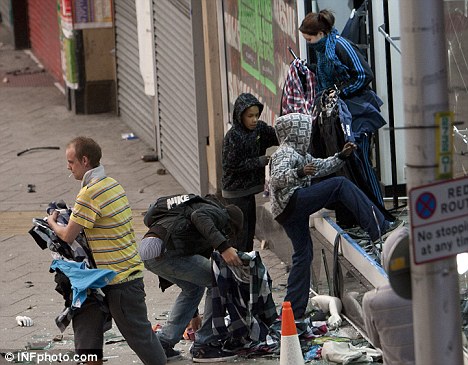
Some commentators have blamed modern society at large. The Daily Telegraph struck a popular chord when it blamed a "culture of greed and impunity" that it said extended to corporate boardrooms and the government itself. Many politicians, meanwhile, have lashed out at technology - including the instant messaging that encouraged looting - for whipping up the crowds.
But as more details of the crimes emerge, the picture has become infinitely more complicated, and confusing. In some of the more shocking cases, the crimes seemed to be rooted in nothing more than split-second decisions made by normally orderly people seduced by the disorder around them.
An aspiring social worker, Natasha Reid, 24, turned herself in after stealing a $500 television. Nicolas Robinson, a young engineering student who had never been in trouble with the law, grabbed bottles of water because, his lawyer said, he was thirsty.
The 11-year-old, the youngest looter arrested, stole a trash can.

At several of the riots last week, those perpetrating the violence had no ready explanation for their behaviour. One young man, kicking trash cans into the street, shrugged when asked why. And the atmosphere in Hackney's Pembury Road low-income housing projects was sometimes one of adrenaline-driven glee. Looters whooped as they stripped a convenience store bare, yards from the police.
Even some Londoners who had initially condemned the riotous behaviour joined in. Bystanders had watched in shock as rioters lined up against police officers on Tottenham's main street last weekend, setting fires and looting. The mood shifted dramatically, though, after officers moved in, dogs barking and horses charging. One man, suddenly emboldened, grabbed a box of pears from outside a convenience store. A woman carried off an armful of coconuts. Another man, seemingly conflicted, sprinted, then turned back briefly to snatch a crate of bottled water.
Clifford Stott, a social psychologist at the University of Liverpool who studies riots, says that behaviour, at least, is not unusual. Bystanders, he said, often turn against the police when they themselves get swept up in a broad crackdown. "That confrontation makes them start to think that the police are wrong, not the rioters," he said.
But he added that crowd dynamics are incredibly complex and cannot be readily reduced to blame people, or to explain away their behaviour.
The condemnation of social media, said Pamela Rutledge, who studies the intersection of the media and human psychology, is equally glib. It is true, she said, that social media "accelerates behaviours because it creates social modelling - people see that other people are involved and they're encouraged." But, she said, these "tools" are not only in the hands of the rioters; the police, for instance, have used social media to inform worried local residents about the state of rioting in their areas. "You can use a hammer to build something or destroy it," Dr. Rutledge said. "It's just a tool."
Especially difficult to explain, both psychologists said, are the rapid-fire decisions behind the snatching of small and often cheap goods.
In Wood Green last weekend, where looters were allowed a free rein for four hours before the police arrived, some rioters set upon an eyeglass shop. And three men stood just outside a GNC, debating whether stealing the vitamins and food supplements was worth the trouble. "Shall I take this?" asked one as he lifted a tub of a nutritional supplement. "Nah, man, don't bother," his friends replied. He took it anyway.
So far, the police say more than 1,200 people have been arrested in connection with "violence, disorder and looting." Of those, 725 have been charged and some are being handed stringent sentences by courts that run 24 hours in some areas. Many have prior convictions, and court records reveal that some were armed, or carrying quantities of drugs when arrested - the "criminals" that many political figures have blamed for the riots.
Others, like Ms. Reid and Mr. Robinson, are not so readily pigeonholed. Ms. Reid is a university graduate. She put her head in her hands in court, and her mother told reporters that she had been sobbing in her bedroom since her arrest over the stolen television. "She didn't want a TV," her mother said. "She doesn't even know why she took it. She doesn't need a telly."
Mr. Robinson, the engineering student, was walking home at 2:40 a.m. on Monday when he looted a supermarket in Brixton. Mr. Robinson, the court heard from his lawyer, "got caught up in the moment" and was now "incredibly ashamed." He was sentenced to six months.
The story of Chelsea Ives, an 18-year-old athlete who had been chosen to be one of the faces of London's coming Olympic Games, has dominated the front pages of newspapers in Britain. She has been accused of burglary, violent disorder and throwing bricks at a police car, according to media reports. She was turned in by her mother, Adrienne. "I had to do what was right," her mother told reporters.
Another woman listed on court documents was accused of stealing "six bottles of nail varnish" and a tin of food.
Dr. Rutledge said that in times of unrest, people craved clarity. "In the same way we want to blame social media, we want an answer to this. But individuals are individual," she said. "So what if these people didn't have criminal records? We can't know what they were feeling."
Dr. Stott said that people, in a rush to judgment, often latch on to the idea that a mob mentality has taken hold. "There's an excitement and an intensity to those situations that are really quite profound," he said, "and the tendency is to say, 'Well, these people are upstanding citizens, like me, something must have gone wrong with their brains. It must be mob mentality.' "
But he said the theory that people in mobs become mindless had been widely discredited, and he warned that focusing on such a simplistic explanation would prevent an important national discussion about the underlying causes of the riots.
When faced with difficult questions about the role that policing, government policies, and societal ills might have played, Dr. Stott said: "You can see it becomes very useful to portray it all as just mindless. Why did that young man steal bottles of water? We may never know."
Subscribe to:
Posts (Atom)