Tuesday, August 16, 2011

Approval of U.S. Congress ties historic low: poll


Public approval of

U.S. Congress's performance has tied its historic low of 13 percent, according to Gallup poll results released Tuesday.

The previous low point was set in December 2010, during the lame-duck session. Meanwhile, disapproval of Congress hit an all-time high of 84 percent, eclipsing the 83 percent disapproval rating last December.

The results are based on an Aug. 11-14 Gallup poll, the first update on Congress's job approval rating since the government reached agreement on a deal to raise the debt ceiling after contentious and protracted negotiations between President Barack Obama and congressional leaders.

Standard & Poor's subsequently downgraded the United States' credit rating, partially citing the current political environment in Washington. That sparked a week of intense volatility in the stock market, with days of sharp losses and large gains.

Americans have usually not held Congress in high regard, but currently they have a more negative view of the institution than any other time Gallup has measured, according to the polling agency.

Frustration with Congress was evident immediately after the debt ceiling agreement, with a record-low 21 percent of registered voters in an Aug. 4-7 USA Today/Gallup poll saying most members of Congress deserve re-election.

Obama's job approval rating has also declined in recent days, reaching a low of 39 percent.

When Gallup last measured Congress's job approval rating in early July, 18 percent approved and 77 percent disapproved. That poll came while the debt ceiling discussions were underway but well before the talks dragged on to just before the Treasury Department's Aug. 2 deadline.

Coalition tries to build cadre of Afghan leaders


The local Afghan leader's community meeting was off to an unpromising start.
Hours after the meeting, called a shura, was supposed to begin, only seven old men waited at the gate of U.S. Marine Patrol Base Salaam Bazaar in the northern part of Helmand province.
Frustrated, Naw Zad District Chief Said Murad Sadtak chastised an Afghan army commander.
"Why did you not invite more people?" he demanded. "It was your task to tell the people and make sure that they come to see us so we can discuss their problems. It's kind of a waste that I am here."
The army commander had invited locals to the small fortified camp, but sometimes those invitations were extended during gunfights when soldiers and U.S. Marines were using private Afghan homes and farmers' poppy fields for cover.
Sadtak continued to complain and his American mentor, U.S. Marine Maj. Aniela Szymanski, moved to the old man's side.
"Maybe we should welcome those who have come to see you," she said gently.
In Helmand, unpracticed local leaders are wielding the levers of a fragile government for the first time.
They urge local communities to support the government and reject the Taliban, often in places where the insurgency is more conspicuous than the new Afghan state.
But many local Afghan leaders still lack skills and resources to address severe problems facing Helmand communities, including drought, joblessness and the chaos of living between two determined combat forces. Others are cut off from their constituents by insecurity. Some are corrupt.
This is the challenge for the international coalition: create a cadre of Afghan leaders and institutions robust enough to resist the Taliban's advances after NATO withdraws combat forces by the end of 2014.
Filling government positions remains difficult due to illiteracy and insecurity. Provincial officials are under constant threat of assassination, so they live within Western military installations and must be escorted outside by U.S. military convoys and helicopters.
The week Sadtak met with tribal elders in Siraqula, the mayor of Kandahar's provincial seat was assassinated by a suicide attacker who detonated a bomb hidden in his turban. A few days later, a dozen policemen were killed by a suicide bomber in Helmand's provincial capital, Lashkar Gah.
Lashkar Gah was one of five provincial capitals and two provinces chosen to start the transition from NATO to Afghan control. The coalition hopes to use the security zone around the provincial capital and the central Helmand River Valley as a foothold to push Afghan governance into outlying areas like Kajaki.
"My son was blown up," a village elder told Kajaki District Chief Mohammad Salim Khan Rodi during a recent meeting at his compound inside a Marine camp. "Can you compensate me? I am just a poor man. My oldest son was my right hand. Without him we have nothing."
Rodi offered his condolences, but no funds.
There were 20 local elders at the meeting in Kajaki, a good showing at a small, mine-encircled Marine camp. Rodi has hosted four other shuras in the last six months; none of them drew more than 24 men. The old men told him that drought is withering their crops and that they need more electricity from the Kajaki Hydroelectric Power Station to run irrigation pumps on their wells. And they demanded the Marines stop night raids in nearby villages.
Rodi offered his visitors no promises. Electrical power is low because the Taliban illegally tap the power lines, he said, and insurgent checkpoints and bomb threats are delaying a long overdue upgrade to the power plant.
"You yell at me to turn the power on," Rodi told them. "But go tell the Taliban to let you have more electricity and see what they say."
And night raids would cease when residents stand up to the Taliban, the district chief said.
"The government is here to serve the people, but you have to tell the Taliban to stop planting IEDs," Rodi said. "The other day, two policemen who protect me — they are as close to me as my own sons — were hurt because they stepped on an IED."
The villagers said they were afraid of mines too, but had to defer to the Taliban in the absence of a government security presence outside of Kajaki's district center. About 90 Afghan policemen are in Kajaki, but they remain within the Marines' perimeter. Namatullah, 55, a village elder who voiced many of the delegation's concerns, said he got permission from the Taliban to visit the district chief.
"In this situation, if we stand on our feet, they will cut them out from under us," Namatullah said. "If they kill 800 men or one man, no one cares, no one will help us."
There are no functioning government schools or medical clinics in Kajaki district. Marines in Kajaki are in a defensive position around the dam. In the area, the insurgency prevents Afghan governance from taking hold, Rodi said.
"I'm so isolated from the people," Rodi said in an interview after the shura. "And I'm not able to offer them my help the way I'd like to."
In many of Afghanistan's most insecure areas, Western diplomats and military commanders provide key links between local Afghan officials and provincial and national institutions. Western advisers organize travel and payment transfers for Afghan officials. Advisers also hold daily meetings with their Afghan counterparts to impart their best political counsel.
Bryan Jalbert, a political officer for the State Department, meets every afternoon with the Musa Qala district chief at his office at the Marines' battalion headquarters.
They discuss joint coalition and Afghan projects that will lend credibility to the local government. Sometimes they share pictures and stories about their families.
Jalbert says he walks a fine line between teaching Afghans officials how to serve their own people and reinforcing a culture of dependency on transient foreigners.
"I had an Afghan official come to me and he wanted to show me the rashes on his legs from the heat. He wanted me to find him a new air conditioner," said Jalbert. "I don't do that. If he wants an air conditioner, he can get it through their process."
Whenever possible, Jalbert said he runs funding and planning of projects through provincial institutions to develop Afghan independence and to help the state win the allegiance of the local population.
The most prominent project of this sort in Musa Qala is a British-funded $970,000 grand mosque. It will replace another mosque that NATO bombed after the Taliban used it as an armory.
The district chief, Naimatullah, who goes by one name, is managing the project and Afghan contractors are providing local labor. Apart from funding, the coalition takes a low profile on the mosque project. Jalbert is monitoring the construction, but discretely.
"I fly high cover on that one," he said. "You have to keep in mind, you're an adviser. This is not your country."
Despite the progress in Musa Qala, less than a third of provincial staff positions were filled.
"This has a very negative effect on my administration," Naimatullah said. "I do not have a judge or criminal investigator. I do not have any legal or irrigation officials. So the government cannot solve problems related to these matters, like legal or water disputes."
And Naimatullah is worried that his Western partners are counting the days before their departure. His district government would not last long without the coalition, he said.
"If America left now," he said, "it would be a kind of betrayal."

Bahraini hunger striker hospitalized


A female Bahraini prisoner on hunger strike has been transferred to a hospital after her grave health conditions deteriorated.


Vice President of the Bahrain Teachers Association (BTA), Jalila al-Salman, was hospitalized on Tuesday with chest pains following a 10-day hunger strike to protest her continuing torture and ill treatment while in custody, a Press TV correspondent reported.

Salman is among several board members of BTA arrested in Manama after the group called for a teachers' strike amid wide-scale anti-government protests in March.

On Saturday, the Bahraini regime fired some 14 university teachers for taking part in demonstrations against the ruling Al Khalifa family.

Since the beginning of Bahrain's revolution, large numbers of anti-government protesters have poured into the streets across the Persian Gulf state, demanding more rights, freedom and wide-ranging political reforms in the political system of their country.

According to local sources, dozens of people have been killed and hundreds arrested so far during the harsh government clampdown on peaceful demonstrations.

According to Bahrain Center for Human Rights -- a non-governmental organization -- there are currently over 1,000 political detainees inside the country.

India battles poverty at 64

CNN.COM
In New Delhi's upscale diplomatic district, Ram Dhan lives in a parallel world.
For years, his home has been a rickety shanty that he shares with his ailing wife, a young son, a daughter-in-law and two grandchildren.
Now 62, Dhan has lived through India's journey as an independent nation. He finds little reason to rejoice as the country celebrates Monday, the 64th anniversary of freedom from British rule.
"The poor have hardly benefited," he says.
Sitting on a cot in his shack huddled in a squalid slum in one of the richest neighborhoods of the Indian capital, he bitterly recalls how flooding in his native village ravaged his ancestral land way back in 1978 and forced him to move to the city in search of work.
But today, Dhan says, the family of six can barely manage $130 a month. "This is no development ... or growth. I think we have moved backwards," he says.
Dhan typifies the hand-to-mouth existence millions of Indians still live despite the nation's rise as Asia's third-largest economy.


In a speech on the eve of his country's independence in 1947, India's first prime minister, Jawaharlal Nehru, made an impassioned call to fight and end "poverty and ignorance and disease."
Sixty-four years later, his successors accept that that fight is far from over.

"We have to banish poverty and illiteracy from our country. We have to provide the common man with access to improved health services," Prime Minister Manmohan Singh said in his annual Independence Day address Monday.
According to the World Bank, India is home to one-third of the world's poor.
The twin monsters India faces today are inflation and corruption, both of which could derail the India growth story.

Corruption, policymakers have agreed over the years, is a major culprit.
"Corruption manifests itself in many forms," Singh said in what has been a refrain by Indian planners on the chronic scourge. "In some instances, funds meant for schemes for the welfare of the common man end up in the pocket of government officials. In some other instances, government discretion is used to favor a select few. There are also cases where government contracts are wrongfully awarded to the wrong people. We cannot let such activities continue unchecked."
Singh's remarks came ahead of a hunger strike anti-corruption activists have planned to press for an anti-graft law stronger than the legislation introduced in Parliament this month to create a citizen ombudsman.
Indian leaders concede no single measure will work to combat corruption, which is believed to be deeply entrenched in the system.
"I believe that there is no single big step which we can take to eradicate corruption. In fact, we will have to act simultaneously on many fronts," Singh said. He disapproved of hunger strikes as a means to push demands.
As India's finance minister, Singh unleashed economic reforms in the 1990s that dismantled stiffening regulations and opened the nation to foreign capital.
This year, India also marked another milestone event: the 20th anniversary of liberalization. But the occasion has been clouded by massive corruption scandals in Singh's administration and a rigid inflation crushing impoverished groups and the country's growing middle-class alike.
Criticism is mounting against the nation's political establishment.
"The twin monsters India faces today are inflation and corruption, both of which could derail the India growth story. To keep that story going, today's dysfunctional political class will need to radically re-invent itself," wrote the Times of India in an editorial headlined "Batting at 64."
India's marginalized communities often feel forced to compromise skills that are key to eliminating poverty.
Fears haunt Dhan that his grandchildren, like his son, also might not be able to achieve higher education if economic conditions at home do not improve.
And Dhan's cab-driver son, Ashok Kumar, leaves it to luck.
"I am trying my best to see that my children don't face the same circumstances that I went through. I am putting my best efforts. The rest is their luck," Kumar said.

America's fractured relationship with Pakistan

Al-Jazeera journalist detained by Israel

http://www.cpj.org
The Committee to Protect Journalists calls on Israel to clarify the legal basis for holding Al-Jazeera correspondent Samer Allawi, who has been in Israeli state custody since Tuesday.
Allawi, the Kabul bureau chief for Al-Jazeera, was arrested at al-Karama border crossing between Jordan and the West Bank while leaving the Occupied Territories after a three-week vacation in his hometown near Nablus, Al-Jazeera reported. Allawi's brother, Musaab, told Al-Jazeera that the journalist intended to cross into Jordan then travel back to Kabul. He had entered the West Bank at the same crossing without difficulty three weeks earlier.

"Israel must clarify why it continues to hold Samer Allawi," said Mohamed Abdel Dayem, CPJ Middle East and North Africa program coordinator. "Our concern for Allawi's well-being and his legal rights is amplified with every passing day that he is held without due process."

On Tuesday, Israeli authorities informed Allawi's family that he was in custody and would be held for four days for questioning. At the time, the authorities provided no justification for holding the journalist, who carries a Jordanian passport, and said only that it was a "security-related arrest," Al-Jazeera reported. On Thursday, Israeli authorities informed Allawi's employer that his detention would be extended to eight days, but again failed to provide a reason.

Majed Khader, program editor and head of assignments at Al-Jazeera, said Allawi told Salim Waqeem, a lawyer hired for him by Al-Jazeera, that he would be charged with transferring money and orders from Afghanistan to the West Bank if he refused to act as an informant. Allawi will appear with Waqeem in front of an Israeli military judge at the Salim military checkpoint, south of Jenin, on Tuesday, Khader told CPJ. Khader also said that Allawi has not been charged with any crime thus far.

Several local human rights and press freedom groups released statements condemning Allawi's arrest and calling for his immediate release. CPJ has documented persistent press freedom violations in the West Bank, including detentions, censorship, and physical attacks by Israeli soldiers. In March 2010, CPJ called on Israel to end the harassment of journalists and bring the military's practices in line with international standards for press freedom, allowing journalists to conduct their work without interference.

Peshawarites are happy with traffic cops!

thefrontierpost.com

It has become routine for the residents of the provincial capital that commuters face daily problems when travelling by public transport.Sometimes they have to face shortage of the transport during peak hours, while sometimes shortage of seats in buses and wagons and have either to stand, pushed and pressed from all side and trying to get a breathe of fresh air in the damp and sweltering hot weather or, when travelling in a wagon stuffed with passengers when has to stand in a stooped position and still be pressed and pushed from all sides and gasping for fresh air. Over and above the aforementioned conditions the drivers of the city buses and wagons have now caught on a new habit: Drivers don’t fully stop their vehicles and want the passengers, lady commuters included, to climb in and out of the vehicles with a jump and a hop. This is totally against the law— traffics laws mean nothing on the roads of Peshawar, so lets pass this point without further comment. It however is also against the safety and security of passengers, which again, I mean the lives of passengers, have no importance for the traffic cops and the drivers no matter how much the passengers hold their lives dear. The newspaper is just reporting what is happening; the reader nor the commuters should expect any action from the top cops, they have too many other things to do: one of them being to look the other way when the cops on the road close their eyes against all kinds of traffic violations committed by the drivers of the public transport. The public transport plying city roads are driven by some very expert drivers who can sham the kids of rich parents driving motorbikes on the roads of Islamabad. Passing in front of them thinking that they are too far away and will be travelling normal speed and so one can cross the read before the vehicles reach the point is considered a dangerous game, in fact risking one’s life. To bypass it is very risky for any small vehicle as these buses and wagons while speeding straight on the road can make a slight turn and start travelling diagonally and can either squeeze towards the raised edge of the footpath or throw you off the road. These drivers do not bother if the passenger is women or man, young or old; they keep on moving at high speed and if you cannot move in time; well, bad luck. Women and and elderly passengers fall to the ground while trying to do the hop and a jump climb up in or climb down from buses as the bus simply slows down on the bus stops instead of stopping completely as used to happen years back. Well if the girls, young women, elderly men and women get hurt in the process: too bad again far Peshawar is becoming very modern and either move fast or move out of the city is now the new slogan for Peshawarites. Even the traffic police wardens to not bother to take action against such drives and punish them for the sins they commit, for rush-driving on roads has been legalised by the cops and drivers by word of mouth, written laws and written words are not as respected in Peshawar as they used to be. Drivers while picking up a passenger do not obey the bus stop obligation on them and break the rules by stopping even in the middle of the road just to pick up a passenger. The new and word of mouth law agreed between the drivers and the traffic police has overtaken the written traffic rules. When it comes to dropping \passenger,s the same drivers try to stop at a place where they could pick some more passengers and for that they even miss slowing down at a designated bus stop which forces passengers to walk back to their stops. The residents of Peshawar demand nothing of the traffic officials, high and low. They know that high traffic officials have better things to do than supervise their juniors on the roads in hot or cold weathers. They also feel that it is they, the people of Peshawar, who should be aware of the change in the rules of traffic agreed upon verbally between the traffic cops and public transport drivers. Of course, they hear that when the buses and wagons come out early in the morning, the first thing is that each driver gives a piece of paper, bearing the photo of the father of the nation. And in respect of that picture-bearing paper, the verbally agreed law meaning that the drivers can do what they want on the roads of Peshawar, is reaffirmed

Tribal elders welcome Governor's statement


Tribal elders from Frontier Regions (FR) Lakki, Bannu and Tank have welcomed the declaring these areas as cleared from militancy.
They appreciate the announcement of the Governor, Barrister Masood Kausar, saying the people of the FRs are jubilant over the statement.
Addressing a news press conference here in Peshawar Press Club on Monday Malik Sabir Khan Bettani, Malik Abdur Rahman and Malik Haji Afzal said that the elders of the concerned areas have called on the Governor Khyber Pakhtukhwa under the leadership of Zafar Baig Bettani MNA and brief the Governor about the problems of the three FRs.
They said that Governor Barrister Masood Kausar had declared FR Lakki, Bannu and Tank cleared of militancy and announced the establishment of a grid station at Jandola.They demanded the Governor to compensate the owners of 750 shops and 200 houses damaged in Jandola in the operation against terrorism.
They presented tributes to Governor for the announcement.


Awan wants judicial probe into Shahbaz's statement

Pakistan People's Party (PPP) Finance Secretary, Babar Awan, has said his party has taken a serious note of the statement made by Punjab Chief Minister, Shahbaz Sharif, expressing that his life could be endangered by President Asif Ali Zardari.

"The PPP condemns the irresponsible statement by Shahbaz Sharif and asks the chief justice to institute a judicial inquiry and nominate a senior judge to inquire into the statement," he said, while addressing a press conference here at the Press Information Department (PID) on Monday.

Awan, who is also a close aide of President Zardari, said: "No politician has ever made such a statement in the past and so a judicial inquiry should be set up.î He said the PPP had never believed in politics of slogans and always took practical steps for the betterment of the people. He said President Zardari was the only president of Pakistan elected through a two-thirds majority.

Awan said the PPP would continue its policy of reconciliation and dialogue and would work for the consolidation of democracy and democratic institutions. He rebutted the statement of Opposition Leader in the National Assembly, Chaudhry Nisar Ali Khan, about alleged hindrances in the working of the Public Accounts Committee (PAC) and said the government extended full cooperation to the committee led by Chaudhry Nisar. "Nobody will be allowed to create hurdles in the working of the PAC. I hope politicians will avoid point scoring," he added.

APP adds: Urging the Punjab government to make public the inquiry report on the murder plan of former LHC chief justice Khwaja Sharif, Awan said according to his information, some senior officials in the provincial bureaucracy had been nominated in the report.

INP adds: Awan said accounts considered by the PAC until now related to the Musharraf government and the PPP had no connection or concern with them. He also pointed out that the PAC had so far not seen the latest report of the auditor general.

Monday, August 15, 2011

Stop coddling the super-rich: Buffett


Billionaire Warren Buffett urged U.S. lawmakers to raise taxes on the country's super-rich to help cut the budget deficit, saying such a move will not hurt investments.

"My friends and I have been coddled long enough by a billionaire-friendly Congress. It's time for our government to get serious about shared sacrifice," The 80-year-old "Oracle of Omaha" wrote in an opinion article in The New York Times.

Buffett, one of the world's richest men and chairman of conglomerate Berkshire Hathaway Inc , said his federal tax bill last year was $6,938,744.

"That sounds like a lot of money. But what I paid was only 17.4 percent of my taxable income - and that's actually a lower percentage than was paid by any of the other 20 people in our office. Their tax burdens ranged from 33 percent to 41 percent and averaged 36 percent," he said.

Lawmakers engaged in a partisan battle over spending and taxes for more than three months before agreeing on August 2 to raise the $14.3 trillion U.S. debt ceiling, avoiding a U.S. default.

"Americans are rapidly losing faith in the ability of Congress to deal with our country's fiscal problems. Only action that is immediate, real and very substantial will prevent that doubt from morphing into hopelessness," Buffett said.

Buffett said higher taxes for the rich will not discourage investment.

"I have worked with investors for 60 years and I have yet to see anyone - not even when capital gains rates were 39.9 percent in 1976-77 - shy away from a sensible investment because of the tax rate on the potential gain," he said

"People invest to make money, and potential taxes have never scared them off."

Pakistan, Iran Discussed as Chinese Military Chief Visits Israel

VOA.COM
Chinese military chief Chen Bingde is in Israel, becoming the most senior Chinese officer ever to visit the country.

Chen met with Defense Minister Ehud Barak and Israeli defense chief General Benny Gantz after his arrival Sunday for a three-day visit described by Israeli officials as “historic.”

Israel's defense ministry said the officials discussed relations with Pakistan, Iran and the Palestinian Authority, as well as the fight against global terrorism.

The visit repays a trip to China in June by Barak, who became the first Israeli defense minister to visit that country in a decade.

The Jerusalem Post quoted Israeli defense officials saying the visit does not signal any change in Israeli policy on defense exports to China. Israeli has backed out of two arms sales to China since 2000 because of U.S. pressure, and Israeli companies have been barred from selling weapons to the Chinese military.

However the Israelis were expected to bring up a United Nations report accusing China of supplying Iran with missile technology and components from North Korea.

Israel is also seeking to persuade other countries to vote against a bid by the Palestinians for recognition as a state at the U.N. General Assembly next month.

China's official Xinhua news agency said China and Israel will work together “to tackle all kinds of threats and challenges.”

U.S. Aides Believe China Examined Stealth Copter

In the days after the raid that killed Osama bin Laden, Pakistan’s intelligence service probably allowed Chinese military engineers to examine the wreckage of a stealth American helicopter that crashed during the operation, according to American officials and others familiar with the classified intelligence assessments. Such cooperation with China would be provocative, providing further evidence of the depths of Pakistan’s anger over the Bin Laden raid, which was carried out without Pakistan’s approval. The operation, conducted in early May, also set off an escalating tit-for-tat scuffle between American and Pakistani spies.

American spy agencies have concluded that it is likely that Chinese engineers — at the invitation of Pakistani intelligence operatives — took detailed photographs of the severed tail of the Black Hawk helicopter equipped with classified technology designed to elude radar, the officials said. The members of the Navy Seals team who conducted the raid had tried to destroy the helicopter after it crashed at Bin Laden’s compound in Abbottabad, but the tail section of the aircraft remained largely intact.

American officials cautioned that they did not yet have definitive proof that the Chinese were allowed to visit to Abbottabad. They said that Pakistani officials had denied that they showed the advanced helicopter technology to other foreign governments. One military official said Sunday that Pakistani officials had been directly confronted about the American intelligence.

One person with knowledge of the intelligence assessments said that the American case was based mostly on intercepted conversations in which Pakistani officials discussed inviting the Chinese to the crash site. He characterized intelligence officials as being “certain” that Chinese engineers were able to photograph the helicopter and even walk away with samples of the wreckage. The tail has been shipped back to the United States, according to American officials.

Pakistan has a close military relationship with China, and large numbers of Chinese engineers work at military bases inside Pakistan. Pakistani officials have even suggested that the Chinese Navy might eventually have its own base along Pakistan’s coastline.

Several Pakistani officials reached on Sunday declined to comment. The American assessments were disclosed Sunday by The Financial Times. The newspaper cited Pakistani officials who denied the accusations.

When pictures of the helicopter’s tail emerged in the days after the Bin Laden raid, defense experts said it bore little resemblance to a standard Black Hawk helicopter. They said that the helicopter in Abbottabad appeared to have a special coating designed to elude air defenses, and that the Black Hawk’s sharp edges seemed to have been replaced with curved parts that could further confuse ground radar systems.

Pakistan’s anger about the Bin Laden operation was so intense that officials in Islamabad, the capital, hinted in news reports in May that they might allow the Chinese to see the helicopter wreckage, but it was unclear at the time whether Pakistan’s government might follow through on the veiled threats. Pakistani officials also made a high-profile trip to Beijing shortly after the Abbottabad raid, part of a not-so-subtle campaign to show the strength of Pakistan’s alliance with China amid faltering relations between Washington and Islamabad.

Meanwhile, the intelligence services of the two countries have quietly carried out their own spy games. Pakistan’s military spy service, the Directorate for Inter-Services Intelligence, or ISI, arrested a group of Pakistani citizens in May who the agency suspected were working with the Central Intelligence Agency in the months leading up to the Bin Laden raid.

One of those arrested was a Pakistani doctor who had helped the C.I.A. set up a phony vaccination program in Abbottabad. The doctor had set up the vaccination scheme in the hope of gaining access to the Bin Laden compound and getting hard evidence that Bin Laden was hiding there. The doctor remains in Pakistani custody, according to American officials.

The C.I.A., for its part, has continued to carry out missile strikes inside Pakistan using armed drone aircraft, a campaign that has been tacitly blessed by Pakistani leaders but that has further aggravated relations between the C.I.A. and the ISI.

The relationship between the spy services began fraying in the months before the Bin Laden raid, after a C.I.A. contractor was charged with murder and jailed in Lahore. The contractor, Raymond A. Davis, killed two men at a crowded traffic stop in Lahore in January, in what American officials described as an act of self-defense after the two men tried to rob Mr. Davis.

Mr. Davis was eventually released from jail, but American relations with Pakistan declined steadily in subsequent weeks and sank even lower after the Bin Laden raid.

However, amid the recriminations and threats by members of Congress to cut all military aid to Pakistan, some senior members of the Obama administration have tried to dial back tensions before they do permanent damage to the shaky alliance.

Despite the headaches of an alliance marked by mutual distrust and competing agendas, the officials argue, the prospect of Washington permanently severing ties with a nuclear-armed country as volatile as Pakistan would be far more dangerous.

Pakistan: still waiting for a new dawn

EDITORIAL:
Daily Times
Pakistan celebrated its Independence Day yesterday. As is the norm, there were official ceremonies and colourful tributes were paid to our forefathers who struggled for an independent state. In 1947, Pakistan may have gotten its independence from the British Raj but 64 years later, with a moth-eaten country, we are still waiting for a new dawn. Every year, the people of Pakistan wait for some miraculous transformation of this country’s situation but with each passing day, things go from bad to worse. Once again Prime Minister Gilani reiterated Pakistan’s “unhindered moral, diplomatic and political support” to the Kashmiris for their rights but where is this ‘support’ for the people of Balochistan? Prime Minister Gilani might be “ready to go to all Baloch leaders” as the government wants “to bring them in the national mainstream” but on the day he delivered this address, and while the people of Pakistan were celebrating August 14, the people of Balochistan were mourning their dead after an explosion in Dera Allahyar killed more than a dozen and injured many others. In a separate incident, journalist Munir Shakir was gunned down in Khuzdar. No wonder the people of Balochistan want their right of self-determination in the face of state oppression. Pakistani leaders continue to talk about state oppression outside Pakistan, be it Kashmir or Palestine, but when it comes to their own people, our leaders are in a habit of sweeping everything under the rug.

How long will Pakistan continue to pursue policies that have not just hurt us but the outside world as well? Cross-border terrorism has resulted in Pakistan being treated like a pariah state by the whole world. Supporting jihadi networks has made this country into one of the most dangerous countries in the world. Bomb blasts, suicide attacks, sectarian violence, Baloch genocide, political warfare in Karachi are just the tip of the iceberg. Dependency on foreign aid and loans has pushed us into one of the worst economic crises ever. Inflation keeps rising and so does unemployment. The energy crisis has led to the shutdown of many businesses and also made the lives of our citizens miserable. Corruption, both in the military and the civilian set-up, continues unabated. The military still calls the shots when it comes to our foreign and security policies. Instead of protecting our borders, the military is far too busy meddling in other affairs of the state. Our children are being taught distorted history in schools, colleges and universities. Madrassas keep churning out religious zealots who wreak havoc in the name of religion. The majority cannot even afford to send their children to schools, which is why child labour is still rampant. In his August 14 address, President Zardari said, “Youth is the real future of the country and they are the hope for the progress and prosperity of the country.” If the government is really serious about bringing progress and prosperity in Pakistan, it must do so by investing more time and money to improve the education system. We must also protect the rights of our minorities who are treated like second class citizens in their own homeland. For this, the government needs to repeal draconian laws promulgated by General Ziaul Haq. Crimes against women must also be stopped. A society cannot progress unless and until women are treated equally. Our justice system needs to be revamped in order to bring speedy justice to perpetrators of terror and other heinous crimes.

Only a secular, tolerant, educated, egalitarian and just Pakistan can survive. Continuing with the same old policies of abetting religious extremism, terrorism and intolerance will lead to anarchy and self-destruction.

President confers Nishan-e-Imtiaz on Taseer

Former Punjab governor Salmaan Taseer, who served as governor from May 15, 2008 to January 4, 2011, was awarded with the Nishan-e-Imtiaz by President Asif Ali Zardari for his services to the country.

The former governor was assassinated in Islamabad by his own security guard, who disagreed with Taseer’s views about Pakistan’s blasphemy laws. On January 4 one of Taseer’s bodyguards, Malik Mumtaz Qadri, shot him 26 times at Kohsar Market, Islamabad, as he was returning to his car after having lunch with a friend in a restaurant in the market.

Sunday, August 14, 2011

Pakistan army eyes permanent bases in Swat

DAWN.COM
New threats risk delaying a handover to civilian leaders in Pakistan’s Swat valley, where the army remains in force two years ago after stamping out a Taliban insurgency and restoring peace.

After years of violence, a military offensive and devastating floods, Pakistani tourists this summer started coming back to the lush valleys, bubbling rivers and superb mountains of the famed northwestern district.

But if the scenery hasn’t changed, visitors from Islamabad, Lahore or Karachi need to negotiate a more recent fixture: the omnipresent uniformed soldiers and beige military vehicles.

In the summer of 2009, the army sent 30,000 troops into battle against Taliban fighters controlled by Maulana Fazlullah, who since 2007 had terrorised people with a campaign of beheadings, violence and attacks on girls’ schools.

By July 2009 the army declared the region back under control and said the rebels had all been killed, captured or had fled.

Since then, Swat has lived in peace. There has been no deadly attack since a suicide bombing in the main town of Mingora in July 2010.

But two years on, there are still more than 25,000 soldiers in Swat filling the void left by years of conflict.

Former administrative offices, luxury homes or hotels with panoramic views from Mingora to the northern reaches of the valley, the army has requisitioned dozens of buildings to house its troops.

Some make fun of the prolonged stay in a beautiful landscape with a climate far less punishing than the heat-blasted plains of the south.

“They’re taking advantage. The clear air, the countryside, the luxury homes are better than ordinary camps,” smiles Iftikhar Ali, 24, a student in the suburbs of the town of Madyan.

Everyone knows, however, that the army came to save them twice in the last two years: in kicking out the Taliban and during floods last year, which cut off 80 percent of the population of Swat from the rest of the country.

“The army did a lot for us. They cleared roads, rebuilt bridges, gave us food rations, while the government was all promises and didn’t give us a single penny,” said Mohammed Iqbal, who sells clothes in Behrain, a tourist town partly devastated by the floods.

But the population of Swat, for a long time an autonomous princely state and without any military bases before 2009, is getting tired of the overt military presence, particularly the numerous checkpoints which hinder free movement.

Sardar Ali, 30, a worker in Mingora, acknowledged that checkpoint practices had eased in recent months, but said he was still fed up.

“Soldiers don’t listen to people’s complaints. Sometimes they are brutal and cruel, they beat people who rush to go through, even when it is for a medical emergency,” he told AFP.

“The army should stay in Swat, because the Taliban can come back. But soldiers have to stay in cantonments, not on the streets,” said Inayat Ur Rehman, a 40-year-old peasant, a view shared by a number of Swatis.

The army says 80 percent of its checkpoints have been dismantled or handed over to police in the last year. It also insists it will hand over control to the civilian administration.

The army has ruled Pakistan for more than half its existence, most recently from 1999 until 2008, when the current civilian government was elected.

General Javed Iqbal, commander of the area, talked about a civilian transfer within “several months” as part of a “gradual process” in which “several steps still have to be taken”.

But it seems a return to normal could take much longer.

The army is planning to move into three or four cantonments, says Iqbal.

The construction of the buildings alone, will take two years.

Then there is a spike in unrest in the neighbouring district of Dir, where the Taliban assaulted a police post in early June killing 10 policemen.

Dir borders the Afghan provinces of Kunar and Nuristan where a number of security officials believe Fazlullah and some of his fighters sought refuge.

“I am concerned,” admits Iqbal. “It is going to impact the process, but will not derail it.”The head of the civilian administration in Swat, Kamran Rehman, says he is ready to take over immediately, but that it’s up to the army.

“Maybe in the coming one year,” he mused.

But one security official dismissed that out of hand. “My guess is it will take two or three more years,” he said.

Pakistan quizzes suspects over abducted American

Pakistani police have detained a number of people for questioning in connection with the kidnapping of an American development expert in the eastern city of Lahore, investigators said on Sunday.

In a pre-dawn raid on Saturday, six to eight assailants broke into the house of the man, identified by the U.S. State Department as Warren Weinstein, and abducted him after overpowering security guards.

"We have detained a few people for questioning, including guards posted at the house," Lahore police chief Ahmed Raza Tahir told Reuters.

"We hope to recover him soon," he added, without giving further details.

U.S. embassy spokesman Alberto Rodriguez said they had not yet been informed about any progress in the case. "Police are investigating. We are waiting."

No one claimed responsibility for the abduction.

Kidnapping for ransom is relatively common in Pakistan, although foreigners are not often targets. Militants also occasionally take foreigners hostage but these incidents have taken place in the volatile western regions bordering Afghanistan, where Islamist insurgents are very active.

Weinstein has been identified as working for J.E. Austin & Associates, an Arlington, Virginia-based consulting firm, on a development project in lawless tribal areas where Pakistani troops have been battling Islamist insurgents for years.

Police said the gunmen barged into house on the pretext of sharing a meal with the guards, a common practice during the Muslim fasting month of Ramadan, which started early this month. The attackers then forced Weinstein's driver to knock on his bedroom door. When he opened it, they took him.

The victim, in his 60s, had been living in Pakistan for five to six years, according to police. He mostly lived in Islamabad but had been traveling to Lahore.

Relations between Pakistan and the United States have sharply deteriorated since January, when a CIA contractor killed two Pakistanis in Lahore, and worsened after U.S. Navy SEALS killed al Qaeda chief Osama bin Laden in a raid in northwestern Pakistan that Islamabad termed a breach of its sovereignty.

Pakistani Taliban, linked to al Qaeda, have claimed responsibility for kidnapping a Swiss couple in July in the volatile southwestern province of Baluchistan.

Eight Pakistani employees of a U.S.-based aid organization, American Refugee Committee (ARC), were kidnapped in Baluchistan last month.

Obama says political divide is hurting economy

AUGUST 14, That enduring shame


TODAY is officially a day of celebration — of sorts — for the ruling clique and a sizeable portion of the 180-plus million who inhabit this unfortunate republic.

The latter have little (if anything) to celebrate in their lives, so rushing around on mutilated motorbikes, one must suppose, is better than nothing.

On this 64th anniversary of the birth of what was Jinnah’s Pakistan one can only be repetitive — as repetition is the name of the game as far as our governments, who ceaselessly repeat the mistakes made over the decades, are concerned. What all should be asking themselves today is should we be celebrating or tearing out our hair in sorrow and shame?

The sole celebration that springs to mind is that the country Pakistan still exists, though in truncated state, despite the best efforts of the string of governments that have done their best to run it into the ground. But then, what is left, bears no resemblance to the country envisaged by Mr Jinnah.

Internationally somewhat isolated, internally strife-ridden and at odds with itself, the nation somehow manages to trundle on albeit each and every pillar of state and institution is tarnished (including the mighty armed forces) and battered (including the judiciary).

Religiosity has spawned dangerous discord which stalks the land. The founder’s aim was a modern, free-thinking liberal, secular state (the word ‘secular’ now regarded as being almost treasonous when applied to Pakistan).

Three months prior to partition, in an interview with Doon Campbell of Reuters, Jinnah said: “The new state will be a modern democratic state with sovereignty resting in the people and the members of the new nation having equal rights of citizenship regardless of religion, caste or creed.” This was repeated in no mean terms three days before the country’s birth to the members of the constituent assembly. The speech bears repetition continually, and Jinnah’s words were prominently highlighted in the press this Aug 11.

He could not have been more explicit; he stressed two factors which can make or break a country — that religion is not the business of the state and that the primary duty of any government is to impose and maintain law and order, both factors having been negated by successive governments.From Day Two, which followed Jinnah’s death, the mullah faction, which has always had the upper hand (other than for a brief period in the 1960s) over the politicians, however clad, and the so-called self-styled intellectual fraternity, has sown dispute and divergence of views, disagreement and differences. All that Jinnah stood for has been firmly repudiated.

We are as shameless as the men and women we have allowed to ‘lead’ (in the wrong direction), or misrule or misgovern, we are as guilty as they for having brought the country to the impasse in which it now stands. We have allowed ourselves to be led by the nose, even acquiesced, whilst those who have been shot to power through various means have collectively and dissolutely danced along the way, down 64 years, whilst dipping at will into the national exchequer, promulgating constitutions and making and breaking laws to suit their individual purposes.

We have accepted kings of straw, decked out in the colour of the time, and with them have denied and abrogated the founder’s creed. Where stand we now?

Democracy has by this present regime been declared a form of revenge — not that it ever was anything else when wielded by those who have sneaked in through the ballot box, voted in by a minority of the millions who have purposefully and with intent been kept in a state of illiteracy, ignorance and poverty, all whilst being brainwashed into the practice and application of a brand of religion peculiar to this country.

We are rent by sectarian and ethnic killings, by intolerance and bigotry, and by discriminatory laws (which no one has the guts to do away with) that murder and maim. Corruption and mendacity have become a way of life.

Are any of those who sit atop the powerhouses of the capital and its neighbouring city worrying about what they should be worrying about? No. They are intent on keeping themselves where they are, an intent they do not even bother to pretend to cover. The politicians’ every act is geared towards the next election, and the military that runs them cannot shake off an ingrained mindset.

How stands the population growth? In dire straits if statistics are anything to go by. Successive governments have refused to even consider a curb, so some 40 per cent of the 180-plus million exist beneath the poverty line, and, frighteningly, almost 70 per cent is below the age of 25. What is their future? Literacy is at a standstill — thinking realistically it would seem that a mere 20 per cent are actually literate. Literacy frightens the feudal mindset which cannot come to terms with a 21st-century world, which believes in murder in the name of honour and many other antiquated practices. So until we are rid of the old and in with something new, the millions are doomed.

Do we celebrate the anarchy that reigns in the northern border areas and in our southern port city, or do we repent? And in what form should be that repentance? Or do we give up, and merely hang our heads in shame at the betrayal of what could have been a perfectly viable country?

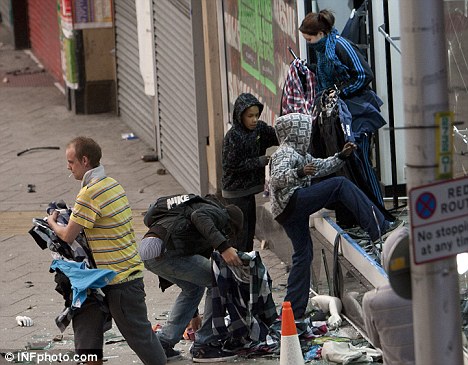
After Britain riots, many ask 'Why,' but find no clear answers


Outside a London court last week, as those accused of looting and rioting in the most destructive and widespread violence in recent British history faced justice, a mother turned to her 11-year-old son, accused of theft, and asked simply, "Why?"


That question has been at the heart of a fraught national debate as Britons puzzle over what drove even some previously law-abiding people to steal, sometimes risking arrest for nothing more than bottles of water. The debate has often divided people into predictable camps.

The Conservative Prime Minister, David Cameron, stood up in Parliament as Britain smoldered around him on Thursday and railed against "mindless violence and thuggery." His critics on the left blame deep mistrust of the police in poor communities, and income inequality they say will worsen as his government pursues sweeping cuts in spending and social welfare.


Some commentators have blamed modern society at large. The Daily Telegraph struck a popular chord when it blamed a "culture of greed and impunity" that it said extended to corporate boardrooms and the government itself. Many politicians, meanwhile, have lashed out at technology - including the instant messaging that encouraged looting - for whipping up the crowds.

But as more details of the crimes emerge, the picture has become infinitely more complicated, and confusing. In some of the more shocking cases, the crimes seemed to be rooted in nothing more than split-second decisions made by normally orderly people seduced by the disorder around them.

An aspiring social worker, Natasha Reid, 24, turned herself in after stealing a $500 television. Nicolas Robinson, a young engineering student who had never been in trouble with the law, grabbed bottles of water because, his lawyer said, he was thirsty.

The 11-year-old, the youngest looter arrested, stole a trash can.


At several of the riots last week, those perpetrating the violence had no ready explanation for their behaviour. One young man, kicking trash cans into the street, shrugged when asked why. And the atmosphere in Hackney's Pembury Road low-income housing projects was sometimes one of adrenaline-driven glee. Looters whooped as they stripped a convenience store bare, yards from the police.

Even some Londoners who had initially condemned the riotous behaviour joined in. Bystanders had watched in shock as rioters lined up against police officers on Tottenham's main street last weekend, setting fires and looting. The mood shifted dramatically, though, after officers moved in, dogs barking and horses charging. One man, suddenly emboldened, grabbed a box of pears from outside a convenience store. A woman carried off an armful of coconuts. Another man, seemingly conflicted, sprinted, then turned back briefly to snatch a crate of bottled water.

Clifford Stott, a social psychologist at the University of Liverpool who studies riots, says that behaviour, at least, is not unusual. Bystanders, he said, often turn against the police when they themselves get swept up in a broad crackdown. "That confrontation makes them start to think that the police are wrong, not the rioters," he said.

But he added that crowd dynamics are incredibly complex and cannot be readily reduced to blame people, or to explain away their behaviour.

The condemnation of social media, said Pamela Rutledge, who studies the intersection of the media and human psychology, is equally glib. It is true, she said, that social media "accelerates behaviours because it creates social modelling - people see that other people are involved and they're encouraged." But, she said, these "tools" are not only in the hands of the rioters; the police, for instance, have used social media to inform worried local residents about the state of rioting in their areas. "You can use a hammer to build something or destroy it," Dr. Rutledge said. "It's just a tool."

Especially difficult to explain, both psychologists said, are the rapid-fire decisions behind the snatching of small and often cheap goods.

In Wood Green last weekend, where looters were allowed a free rein for four hours before the police arrived, some rioters set upon an eyeglass shop. And three men stood just outside a GNC, debating whether stealing the vitamins and food supplements was worth the trouble. "Shall I take this?" asked one as he lifted a tub of a nutritional supplement. "Nah, man, don't bother," his friends replied. He took it anyway.

So far, the police say more than 1,200 people have been arrested in connection with "violence, disorder and looting." Of those, 725 have been charged and some are being handed stringent sentences by courts that run 24 hours in some areas. Many have prior convictions, and court records reveal that some were armed, or carrying quantities of drugs when arrested - the "criminals" that many political figures have blamed for the riots.

Others, like Ms. Reid and Mr. Robinson, are not so readily pigeonholed. Ms. Reid is a university graduate. She put her head in her hands in court, and her mother told reporters that she had been sobbing in her bedroom since her arrest over the stolen television. "She didn't want a TV," her mother said. "She doesn't even know why she took it. She doesn't need a telly."

Mr. Robinson, the engineering student, was walking home at 2:40 a.m. on Monday when he looted a supermarket in Brixton. Mr. Robinson, the court heard from his lawyer, "got caught up in the moment" and was now "incredibly ashamed." He was sentenced to six months.

The story of Chelsea Ives, an 18-year-old athlete who had been chosen to be one of the faces of London's coming Olympic Games, has dominated the front pages of newspapers in Britain. She has been accused of burglary, violent disorder and throwing bricks at a police car, according to media reports. She was turned in by her mother, Adrienne. "I had to do what was right," her mother told reporters.

Another woman listed on court documents was accused of stealing "six bottles of nail varnish" and a tin of food.

Dr. Rutledge said that in times of unrest, people craved clarity. "In the same way we want to blame social media, we want an answer to this. But individuals are individual," she said. "So what if these people didn't have criminal records? We can't know what they were feeling."

Dr. Stott said that people, in a rush to judgment, often latch on to the idea that a mob mentality has taken hold. "There's an excitement and an intensity to those situations that are really quite profound," he said, "and the tendency is to say, 'Well, these people are upstanding citizens, like me, something must have gone wrong with their brains. It must be mob mentality.' "

But he said the theory that people in mobs become mindless had been widely discredited, and he warned that focusing on such a simplistic explanation would prevent an important national discussion about the underlying causes of the riots.

When faced with difficult questions about the role that policing, government policies, and societal ills might have played, Dr. Stott said: "You can see it becomes very useful to portray it all as just mindless. Why did that young man steal bottles of water? We may never know."


President Obama sends best wishes on Pakistan’s independence day anniversary

The US ambassador in Pakistan Cameron Munter, on behalf of President Obama, has sent best wishes on the joyous anniversary of Pakistan’s independence on August 14. In his statement on the occasion of Pakistan’s independence day (August 14) the US ambassador said, “ On behalf of President Obama, I send best wishes on the joyous anniversary of Pakistan’s independence on August 14. May you continue to build on the great legacy of your founder Quaid-e-Azam Muhammad Ali Jinnah and realize his vision for a strong, stable, and secure country.”

Training Afghan soldiers a tough mission

There's no let-up in the violence in Afghanistan. On Friday, a U.S. service member was killed by a roadside bomb. Forty Americans have died this past week -- most in last Saturday's Chinook helicopter crash. At least 51 have died this month.

For the U.S., the way out of Afghanistan depends on training Afghans to fight their own battles. American taxpayers have already spent more than $27 billion on that training. CBS News correspondent Seth Doane went to violent Kandahar province to see if it's working.

On the front lines, there's more than just fighting. Training the 170,000 soldiers in the Afghan National Army is essential -- as President Obama hopes Afghanistan will add an additional 100,000 Afghan troops by 2015 to create an army of more than a quarter million that can stand on its own.

"What have you learned from the U.S. Army?" Doane asked an Afghan trainee.

"I learned how to shoot, how to search a compound, and how to go on missions," he said.

On publicity posters and at checkpoints, the effort is to make Afghans the face of security -- even if coalition forces are usually right behind them, like U.S. Army Lt. John Cote.

"They're the locals, they can distinguish who is who," he said. "And if we have a positive influence on them, then they can assist us."

The frequent Afghan saying in the region is "shona-ba-shona" or "shoulder to shoulder." But while working on the story, CBS News saw a number of cases where the U.S. seemed to have to prod the Afghan forces, whether it was to just show up on time or to stay at their posts. In some cases, they would leave checkpoints after our cameras turned off.

So it begs the question: Are these two forces really standing side-by-side, or are the Afghans leaning too much on the Americans?

"What people tend to forget is they're never going to be the United States Army," said U.S. Army Maj. Brian Ducote, "and we should stop expecting them to be that. They're going to be the Afghan National Army. It's going to be an army that is capable of defeating the insurgency."

But building an army with that capability is a tough mission. Fewer than half of the Afghan soldiers can read and write. Their basic pay is only about $165 a month. And roughly one in four quit after their three-year hitch ends.

Still, Afghan forces add manpower to most every mission. And on average, three are killed in this war everyday -- sharing the sacrifices with the Americans training them, shoulder-to-shoulder.

August 14,1947 Sixty-four years of slavish independence


DAILY TIMES
BY:LAL KHAN


There was not one but two national liberation struggles. Their aims and interests were diametrically opposed. One was led by the local elites and the other was that of the workers, peasants and youth. The first wanted to keep the system intact and the other’s inspiration was a revolutionary transformation of the system of the imperialists


Sixty-four years after the bloody partition in 1947 the plight of about a quarter of the human race that inhabits this South Asian subcontinent is excruciating and awful. More than 40 percent of the world’s poverty torments this tragic land. While the ruling elites continue to multiply their billions, the rest of the population is in a dire state of existence. The condition of the masses has continuously been in a downward spiral and now life has become a living hell for the working classes. Living conditions today are even worse than under the British colonial rule for the vast majority of the population. In these six and a half decades the ruling classes of Pakistan, India, Bangladesh and other states of the region have failed to solve any single problem of society. The agrarian revolution is far from accomplished, parliamentary democracy is a farce and a deception. It is a democracy of the rich by the rich and for the rich. Instead of creating unified nation states, national and ethnic strife rages on with centrifugal forces tearing society apart. The Indian ruling elite boasts of a secular constitution and yet India has more religious riots and killings than perhaps any other country of the world. Pakistan, a country that was supposed to protect the rights of a certain religious community, today is being pillaged by the very same religious ideologies. The social and physical infrastructure is crumbling and the access to basic needs like water, electricity, health and education for the ordinary people is in a despicable state. The masses are bewildered and in anguish at this pathetic notion of independence.

This so-called independence and very hasty withdrawal of the British Raj was achieved through a conscious compromise and a negotiated agreement between the imperialists and the local Hindu and Muslim elites who were trained and propped up by the Raj. They manipulated the mass revolt by bringing religion into politics, in connivance with their imperial masters. It was to produce a cleavage in the national liberation movement that was rapidly moving onto the path of class struggle. The callous attitude of Gandhi and other leaders of the local elite to the assassination of Bhagat Singh in 1931 is a glaring proof of this treachery. With the red storm raging in China and throughout Asia, the imperialists were terrified of a national liberation that would have very quickly moved on to social and economic liberation. They were extremely fearsome of the class struggle that would overthrow capitalism and put an end to imperialist exploitation and extortion.

The mouthpiece of the British ruling class, the London Times, wrote in its editorial of January 29, 1928, “There is no real connection between these two unrests, labour and the congress opposition. But their very existence and coexistence, explains and fully justifies the attention, which Lord Irwin gave to the labour problems.”

There was not one but two national liberation struggles. Their aims and interests were diametrically opposed. One was led by the local elites and the other was that of the workers, peasants and youth. The first wanted to keep the system intact and the other’s inspiration was a revolutionary transformation of the system of the imperialists. The proletarian struggle was derailed by its traditional leadership at the helm of the Communist Party of India in the early 1940s. Their criminal blunder of capitulating to the British in the name of the anti-fascist war and supporting the imperialists was due to their slavish submission to the dictates of Moscow that prioritised its own national interests to those of proletarian internationalism. In this act, they handed over the movement on a platter to the bourgeois nationalists.

But such was the momentum of the movement that these bourgeois leaders could not control the raging struggle and ultimately tried to divide it on religious and ethnic lines. Despite this reactionary policy imposed on the national liberation struggle, there was the historic revolt of the sailors in the British Indian Navy in February 1946. It not only shook the British imperial military establishment in British India but gave rise to a militant strike wave of the workers in textile, railways and other sectors from Karachi to Madras, paralysing the whole subcontinent. The imperial Raj was shaken and the commander in chief of the British Indian Army General Claude Auchinleck sent a wire to Whitehall in London saying that if they were not given freedom in three days they will take it themselves. The Raj was stunned. The native bourgeois leaders again intervened to save the British by acting as scabs and strike-breakers.

The new reformist Labour government of Clement Attlee, which had come to power after defeating the Conservatives led by Churchill, were terrified of the bloodshed and massacres that would result in the wake of a partition. They sent the Cabinet Mission in March 1946 that convinced Jinnah against partition and settle for a confederation. But Nehru provoked Jinnah at the behest of Churchill, who manipulated him through Edwina Mountbatten and wrecked the deal.

As the elitist leaders in India and Pakistan were celebrating this moth-eaten independence, hundreds of thousands of innocent people were being slaughtered, especially in Punjab and Bengal in this ethnic frenzy. More than two million lives perished in this madness. Much more have been the victims of poverty, starvation, misery and disease ever since. They lost their lives long before their time. They were the victims of another economic genocide, which is going on unabated. The imperialists dictate every policy. The ruling elites, acting as their comprador agents, have their share of the plunder. In their extreme suffering, the toiling masses are being asked to celebrate this independence, the independence of the elite to repress and plunder, where the masses suffer and toil. The rulers celebrate their vulgar luxury; the masses have only their woes and misery to curse.

Ustad Daman expressed the plight of the ordinary people after partition in his famous verse:

“The freedoms that devastated us alike,

The redness of our eyes betrays, that wept we too have alike.”

The genuine independence of the masses can only be achieved through a socialist revolution. It was treacherously crushed in 1946. Conditions are intolerable for the masses in both India and Pakistan. The differences are superficial and secondary. Capitalist exploitation and the problems of the masses are the same. A mass upheaval can erupt instantaneously. Today if there is a revolutionary victory in any country of the subcontinent, like the Arab revolution; it will spread throughout the region. Victorious socialist revolutions do not only transform the state and society, they change the course of history and the divisions of geography.


FATA reforms

EDITORIAL: Daily Times


President Asif Ali Zardari on Friday signed two decrees: Amendments to the Frontier Crimes Regulation (FCR), 2011 and Extension of the Political Parties Order 2002 to the Tribal Areas. The reforms in FCR carry immense importance for the people of FATA to bring the tribal areas into the national mainstream. The more than a century-old FCR is a remnant of the British Raj. Since then, the tribal areas have been administered through political agents (PAs). The amendments to the FCR have brought an end to the practice of collective responsibility and collective punishment for children, women and people over the age of 65. The people of FATA can now appeal against the decisions of the PAs. Under the old system, if an individual was accused of committing a crime, the entire tribe was penalised. It was, therefore, imperative to introduce political reforms in the tribal areas, as the tribal people are very much citizens and entitled to the same rights and privileges as enjoyed by people living in other parts of the country. The Political Parties Order 2002 will allow political parties to operate in FATA. There is weight in the argument that had FATA been part of mainstream politics throughout, the extremist elements would not have been able to create problems for Pakistan. Though the amendments in the FCR can be seen as a first step towards promoting moderate trends to prevail over extremism, the next step is to abolish this traditionally conservative system. The British, facing problems during the colonial era on the Frontier, imposed a special governance and administrative system by creating tribal agencies and appointing PAs under the governor of Khyber Pakhtunkhwa. As part of this arrangement of tribal autonomy, the maliks (local chiefs/elders) were bought off with money and asked to keep lawlessness in check.

It has finally dawned on the government after a century to correct the anomalies left by our colonial masters. Since that system worked for the British, it was portrayed as being the wishes of the tribal people whereas the truth is that the colonial authorities were indifferent to the public’s views. Maliks had a vested interest in the previous system, which is why it continued till now. There is a consensus that the FCR must be completely abolished but so far the government has done it haltingly by only partially amending the FCR.

The people of FATA do not have representation in any provincial assembly. Either they should be made part of Khyber Pakhtunkhwa or a new province should be formed, but only through the free and democratic expression of the people’s will, i.e. through a referendum. Other tiers of governance like local governments and the advantages of development should then be provided to the long deprived people of FATA.

Another question that needs to be addressed is that of the jihadi networks operating in the tribal belt. The cover to the jihadi networks like the Haqqanis is embedded in the tribal system. With the military going into the tribal areas from 2004 onwards, it became a very important player there as well. Whether this seemingly hesitant approach of the government is a purely well thought through incremental process of reforms or is intended to avoid ruffling the feathers of some very powerful institutions remains to be seen. There are obviously some pressures in the way of a wholesale, complete, consistent reform package. But if the Haqqanis are shifted to Kurram Agency, if they have not been already, will the military welcome these reforms is an important question. It is hoped that the government would not bow to any pressures as the people of FATA need complete mainstreaming, freedom, transparency and democratic expression.

McCain seeks end to NoC curb on US diplomats

US Senator John McCain met Prime Minister Syed Yusuf Raza Gilani her on Saturday and demanded withdrawal of NoC requirement on US diplomats.McCain, accompanied by US ambassador to Pakistan Cameron Munter, said it would be against American interests to not have ties with Pakistan. He said relationalship with Pakistan is important. He said Pakistan should allow US diplomats to move freely without the curb of No-Objection Certificate.“Pakistan is a main ally of the US in war on terror. It should restore the old traveling system in mutual cooperation,” the US senator said.PM Gilani assured McCain and Munter of looking into the restriction on the movement of American diplomats. He also said stable, sovereign and prosper Afghanistan is in the interest of Pakistan.Recently, US diplomats were barred from entering Peshawar because they didn’t have NoCs. Syed Yusuf Raza Gilani said Pakistan wants to have an enduring partnership with the United States and the relationship should go beyond cooperation on terrorism.The Prime Minister said that he would welcome the visit by the US Secretary of State Mrs. Hilary Clinton. We look forward to a deeper level of engagement with the US in all areas of our bilateral relations including energy, social sector and economic cooperation, the Prime Minister said. He also appreciated Senator John McCain’s continued support to Pakistan in the US Congress.Senator McCain who is a Ranking Member of US Senate Armed Services Committee, acknowledged that relations between US and Pakistan had seen difficult times in the past. US considers Pakistan as an important country. He said it is not in the US national interest to abandon Pakistan once again. He assured the Prime Minister of the United States’ continued support to the people of Pakistan in their endeavour to secure a stable and prosperous future.Minister for Interior, Rehman Malik, Senator, Syeda Sughra Imam and other senior officials were also present in the meeting.Senator John McCain, former presidential candidate and Republican senator from Arizona, also called on President Asif Ali Zardari.He was accompanied by Cameron P. Munter, US Ambassador in Islamabad, Christine Brose, Vance Serchuk and Ms. Maggie Goodlander. Pak side included A. Rehman Malik, Federal Minister for Interior, M. Salman Faruqui, Secretary General to the President, Senator Syeda Sughra Imam and other officials. Matters concerning Pak-US relations, war against terror and the regional situation were discussed during the meeting. Briefing the media Spokesperson to the President Farhatullah Babar said that the President during the meeting reiterated his call for both the countries to work more closely in institutionalizing the mutual cooperation and cement bilateral relations based on mutual interest and mutual respect. The President reiterated call for specifying clear and unambiguous terms of engagements in the war against the militants in order to avoid adverse impacts on bilateral relations owing to difference of opinion and stances on various issues. We need to build framework for an enduring strategic partnership, he added.The President said that Pakistan wanted to build a long-term, sustainable and multidimensional relationship with the US that was marked by mutual understanding of each others’ interest, mutual trust and respect. The President said that a stable, long-term and multifaceted relationship of the two countries was not only in the mutual interests of the two countries but would also serve the purpose of stability for region. The President said that the war against terror was a long drawn war. He said that it was important that root causes of militancy and reasons for drift towards extremism were also addressed. He said that a multi-pronged strategy encompassing socio-economic, political and educational measures besides judicious use of power could address the challenge of militancy and militant mindset. He said that Pakistan has been the worst sufferer of this scourge and has suffered losses that exceed in quantum to any other nation. He said that with direct and indirect economic losses equalling to $68 billion and 35000 martyrs behind us, we were determined to pursue this war till its logical conclusion. Our commitment remains above-board and without even slightest shadow of doubt, the President emphasized. The President said that besides the economic losses, the impacts of the war on our social fabric were equally devastating. He said that the Government, despite tremendous losses and toll, was committed to the uplift of the people especially of those who have been worst hit by the menace of militancy. The President said that he had been continuously pleading before the international the case for socio-economic development of the people of the hard hit areas especially that of tribal areas. FATA remains our top most priority, the President emphasized. He said that the Government was committed to bring about qualitative change in the lives of the people of tribal areas by bringing socio-economic development in the tribal areas. Through good education and providing the youth better economic opportunities we can effectively wean them away falling into the traps of militants, the President said. The President also raised the issue of recent moves in the Congress to reduce assistance under Kerry-Lugar-Berman. The issue of delays in flow of assistance, ROZ legislation and Enterprise Fund was also discussed during the meeting. Discussing regional situation, the President reiterated Pakistan support for efforts to contribute towards lasting peace in Afghanistan and helping in the development of the country. Senator McCain thanked the President for meeting the delegation and appreciated Pakistan’s countless sacrifices and struggle against the militants.

Climbers scale Afghanistan's highest peak

Foreign and local climbers have recently scaled Afghanistan's highest mountain, indicating that some areas of the war-torn country are ready for a revival of international tourism.
An expedition member says the summit of Mount Noshaq,

located in the Wakhan Corridor of northeastern Afghanistan, was reached by a team on Aug. 4.
Anthony Simms of the New York-based Wildlife Conservation Society says foreign tourists are already visiting the region — an oasis of peace but which suffers grinding poverty.
Simms said Sunday that the Noshaq expedition involved two Australians, including himself, two Afghan climbers and two Afghan support personnel. The 24,580-foot (7,492-meter) mountain was first climbed in 1960 by a Japanese team.

Obama, Cameron and Saudi King urge Syria end violence

President Barack Obama spoke with the leaders of Saudi Arabia and Britain on Saturday and all three called for an immediate end to the Syrian government's crackdown on protests against President Bashar al-Assad, the White House said.
Obama and Saudi King Abdullah "agreed that the Syrian regime's brutal campaign of violence against the Syrian people must end immediately, and to continue close consultations about the situation in the days ahead," the White House said in a statement.
Similar language was used in a statement after a separate Obama conversation with British Prime Minister David Cameron.
That statement also noted that the two leaders "agreed to closely monitor the actions that the Syrian government is taking and to consult on further steps in the days ahead."
Syrian troops killed three people as tanks swept into a coastal city on Saturday, activists said, the latest action in a military campaign that activists say has killed 1,700 civilians in five months.
The United States has stopped short of calling for Assad to step down from power, but it slapped additional sanctions on Syria earlier this week and urged countries to stop buying Syrian oil and gas.
King Abdullah on Monday called for an end to the bloodshed in Syria and recalled the Saudi ambassador from Damascus.
European U.N. Security Council members including Britain warned Syria on Wednesday that it could face tougher U.N. action if it continued the crackdown.
Saturday's killing in the Syrian seaside city of Latakia came a day after security forces shot dead 20 people during nationwide marches demanding that Assad surrender power.

Obama sets sights on rural America to talk jobs


Trading Washington's hot house for states critical to his re-election prospects, President Barack Obama

is headed to the Midwest after a summer of discontent over a protracted debt showdown with Republicans and the downgrade in the nation's credit rating.
Obama's bus tour, his first as president, begins Monday and will take him to prairie communities in Minnesota and through Iowa and Illinois, with stops in the farmland and rural towns that launched his first White House bid.
The former Illinois senator is expected to tell audiences that he agrees with their frustrations about a dysfunctional federal government.
"What we've seen in Washington the last few months has been the worst kind of partisanship, the worst kind of gridlock — and that gridlock has undermined public confidence and impeded our efforts to take the steps we need for our economy," Obama said Thursday in Michigan. "It's made things worse instead of better."
Obama won a clean sweep in 2008 of Iowa, Minnesota, Wisconsin, Illinois and Michigan, a region that has supported Democratic presidential candidates since 2000, except for President George W. Bush's narrow victory in Iowa in 2004.
But Obama's standing in these states, like elsewhere, has grown precarious as the economy has slumped.
Republican governors are now in charge in three of those five states and Obama's approval rating, as measured by Gallup, is hovering around 50 percent in most of the region.
"We got a president who got a decrease in the credit rating of our nation, and that's because our president simply doesn't understand how to lead and how to grow an economy," Republican hopeful Mitt Romney said in Thursday's Iowa debate.
Romney and his GOP rivals blamed Obama for the growth of the federal deficit and the credit downgrade by Standard and Poor's, the first in the nation's history.
The GOP race intensified with Texas Gov. Rick Perry's entry Saturday. When Obama arrives at a town hall meeting in Decorah, Iowa, on Monday afternoon, Perry intends to meet with voters in eastern Iowa, about 100 miles away.
Nationally, Obama's approval rating is comparable to President Ronald Reagan's ratings in August 1983. But recent Gallup polls found that Obama's approval rating was hovering between 44 percent and 49 percent in 10 states closely watched by his political advisers. Those states include Iowa, Pennsylvania, Virginia and Florida.
Obama's standing with independents, who helped him win in traditionally Republican states such as Indiana and North Carolina, has fallen, too.
"The country is in an unbelievably angry mood," said Democratic pollster Stan Greenberg.
Most presidents like to get away from the nations' capital, and this excursion couldn't come at a better time.
As a candidate, Obama said he would tame Washington's gridlock. Yet it was political paralysis that scuttled his quest for a "grand bargain" with congressional Republicans on increasing the country's borrowing limit and forced him to agree to smaller spending cuts without higher taxes on the rich, as he demanded.
Days later, Standard & Poor's downgraded the U.S. credit rating and stocks on Wall Street plummeted, undermining confidence in an economic turnaround. The Federal Reserve said Tuesday that economic growth had been "considerably slower" than expected this year and outlined a glum forecast.
Obama will have a tough sales job on the road. Unemployment is high, foreclosures are rampant and Wall Street is jittery.
While considered official White House travel, the bus tour will put Obama in campaign-like settings with small-business owners and workers in rural areas.
If 2008 was about hope and change, 2012 may be about hard-knuckle politics. Behind the scenes, Obama advisers are planning to draw sharp contrasts with some of the leading Republicans.
Yet Obama also finds himself under pressure from the left to generate jobs and raise taxes on the wealthy.
Most Democrats, said MoveOn.org's Justin Ruben, "have not been offering a clear prescription for actually getting the economy moving."
Obama told workers in Michigan that he plans to roll out more economic plans "that will help businesses hire and put people back to work." That's an approach Democrats hope will set the tone for next year's election in the Midwest and beyond.

Saturday, August 13, 2011

David Cameron is sounding a lot like Hosni Mubarak


David Cameron doesn't look like Hosni Mubarak -- hated scourge of Egyptians. That would be Robert De Niro.

Nor does dapper Dave look like Tunisia's ousted strongman Zine El Abidine Ben Ali, or Syria's aptly-onomatopoeaic Bashar al-Assad, or any other tyrant from Pyongyang to Minsk.
But in making a reflexive call to curtail social media, Cameron sure is sounding a lot like a potentate, and perhaps forgetting, in a moment of madness, his place in history, as an encourager-in-chief of this year's democratic uprisings across the Middle East.
Cameron's call, made to British parliamentarians in the wake of this past week's appalling riots, seems to echo the very tactics deployed by Mubarak and his ilk to stay in power -- and we know what happened there.
And it would be wrong, as everyone from academics, technologists and anarcho-bloggers in bedsits have been quick to remind him. Curtailing social media won't stop people rioting. Effective policing, perhaps organized via social media, might be a better idea.That also seems to be the view from the millions across the deserts of North Africa and the Middle East who secured their liberty from dictatorship in large part by artful deployment of Twitter, Facebook, Flickr et al and, yes, BlackBerry Messenger. And still are, as they secure their revolutionary accomplishments.
On communal TVs in poor villages across the sprawling Nile Delta or the sweltering backstreets of teeming Cairo, Egyptians watched the violence from London and were as appalled and flummoxed as any right-minded folk from England's gentle shires.
Poor, desperate, burdened by a future uncertain and a sclerotic, rudderless government -- if anyone could be excused a bit of cathartic anarchy, it's Egyptians.
But unfailingly polite and good-natured, they can't understand why people in the rich West, possessed of worldly items beyond their dreams, would trash and steal.These are people who think that Facebook helped deliver them from tyranny. That has elevated social media in the Middle East to a status it probably doesn't yet deserve, as some magical panacea to deliver just about everything -- a voice, hope and much-needed prosperity.In some places, it is taking over government function. Access to the new administration in Tunis is best done by Facebook these heady post-revolutionary days. Tunisian civil servants seem to barely pick up their mobiles to speak or text these days, so absorbed are they by Facebook. For a few months, there was even a blogger in the cabinet, until he fell out with his colleagues because he was live-tweeting their meetings.
With the Mubaraks and their cronies blamed for Egypt's poverty, and as fingers are pointed at corruptors embedded inside Cairo's dysfunctional government, Egypt's apprentice democrats promise that with plurality will come a meritorious economy with jobs, healthy incomes, hope for the future.
In this, they are egged on by Western leaders. Indeed, David Cameron was the first world leader to visit Cairo after the revolution, just 10 days after Mubarak stepped down in February.
That's all very well, but for all the talk of "Facebook Revolutions," penetration and connectedness to the net and even to mobiles is still very limited in Egypt, beyond the big cities.
But the surprising outcome of the revolution sent Egyptians a subliminal message that being connected -- whatever that meant to people who weren't -- can deliver extraordinary results.
So more Egyptians than ever are now spending larger portions of their limited incomes to get online, because they think -- misguidedly perhaps -- that being online is an automatic way out of grinding poverty.
In the main, it is very encouraging. And democratic.
But wait! On that village TV, beaming from the place Egyptians now know as the mother of parliaments, the same man who rushed to their capital to tell them their digitally-inspired revolution was a wonderful thing for them and humanity, is now saying that the facilitating medium that helped them make history should be curtailed?
How very Mubarak.