Daily Times
By Daud Khattak
No one noticed last month when Shazia, 19, was stoned, burnt with acid, and then shot dead for an unknown sin in Mardan, the second largest town in northern Pakistan after Peshawar.
Originally from a village in the Swat Valley, Shazia was taken away by her ex-husband from her mother to the mountains, tortured, and eventually killed. Her mother, Noor Jehan, a widow with no male relatives, has lodged complaints at three different police stations about her daughter’s fate, but her wailing has so far fallen on deaf ears. Law-enforcement personnel keep telling her that “investigations are under way.”
Days before Shazia’s heinous murder, another woman was stripped and paraded around Haripur, a city near the now-infamous suburb of Abbottabad, the last dwelling of al Qaeda chief Osama bin Laden. The woman, in her 50s, was punished because her son was found guilty of having illicit relations with the wife of another man.
This was local jirga’s sentence to ‘restore’ man’s honour – although it dishonoured an innocent woman. These two women are not exceptions. A Thomson Reuters Foundation expert poll lists Pakistan as the third most dangerous country for women in the world, just behind its war-ravaged neighbour, Afghanistan, and the Congo.
The Human Rights Commission of Pakistan (HRCP) says, “Around 3,000 women were raped and another 791 murdered for honour in 2010 alone.” This is apart from thousands of unreported cases when women are bartered, exchanged to settle family disputes, harassed in their workplaces, forced into marriage in childhood, or married off to men double and triple of their ages.
I still remember the daylight murder of a budding female singer, Ayman Odhas, in the city of Peshawar in 2009 by her own brothers for appearing on television, a move that defied the family norms. Although Odhas was an adult, living with her husband who had no objection to her singing on television and the stage, her brothers felt the act dishonoured them.
One morning they knocked on her door, before shooting her repeatedly when she stepped out to meet her visitors. This shows the collective mentality of a society where women, instead of being thought of as equals, are dealt as a commodity owned by men - father, brother, or husband – from birth to death.
These owners reserve every right to treat her as a commodity in terms of settling honour or blood disputes, monetary matters, marriage, or any other situation that may arise. Domestic violence is often ignored as a petty dispute and has become part of the culture where many people are living in a joint-family system. Interestingly enough, no Pakistani political or religious party has paid any attention to the woman paraded in Haripur or the murder of Shazia in Mardan.
They were vocal, however, about the detention of Dr Aafia Siddiqi, who was sentenced last year in the United States to 86 years in prison after being found guilty of attempting to kill her US interrogators in Afghanistan.
With the exception of a few statements from HRCP or the Aurat Foundation, a women’s advocacy organisation, no feathers are ruffled in Pakistani government circles at the federal or provincial levels, where the secular Pakistan People’s Party (PPP) of late Benazir Bhutto and Awami National Party (ANP) are ruling the roost, respectively.
Perhaps killing, forced marriage, or the dishonouring of a woman is not that important for a government in a country where scores are killed and maimed in bomb explosions in the name of religion.
It is a sad irony that these so-called religious warriors struggle throughout their life to attain several beautiful women in the afterlife.
Wednesday, July 6, 2011
Tuesday, July 5, 2011
Chavez, back in Venezuela, says he will win 'battle for life'
Venezuelan President Hugo Chavez returned unexpectedly Monday to his nation's capital, where he vowed to win the "battle for life" after undergoing emergency surgery in Cuba.
Five killed in FC convoy attack in Ketch


A Frontrier Corps (FC) convoy was attacked in Gormazai area of District Kaich by a remote-controlled roadside bomb, killing five security personnel and injuring four others, Geo News reported Tuesday.
According to sources, Gormazai is located approximately 800 kilometers from Quetta where the FC convoy was attacked. After the convoy was ambushed with a road-side bomb, firing was also reported, however the FC spokesman in Quetta did not confirm the reports.
Pakistan’s Spies Tied to Slaying of a Journalist

Obama administration officials believe that Pakistan’s powerful spy agency ordered the killing of a Pakistani journalist who had written scathing reports about the infiltration of militants in the country’s military, according to American officials.
New classified intelligence obtained before the May 29 disappearance of the journalist, Saleem Shahzad, 40, from the capital, Islamabad, and after the discovery of his mortally wounded body, showed that senior officials of the spy agency, the Directorate for Inter-Services Intelligence, directed the attack on him in an effort to silence criticism, two senior administration officials said.
The intelligence, which several administration officials said they believed was reliable and conclusive, showed that the actions of the ISI, as it is known, were “barbaric and unacceptable,” one of the officials said. They would not disclose further details about the intelligence.
But the disclosure of the information in itself could further aggravate the badly fractured relationship between the United States and Pakistan, which worsened significantly with the American commando raid two months ago that killed Osama bin Laden in a Pakistan safehouse and deeply embarrassed the Pakistani government, military and intelligence hierarchy. Obama administration officials will deliberate in the coming days how to present the information about Mr. Shahzad to the Pakistani government, an administration official said.
The disclosure of the intelligence was made in answer to questions about the possibility of its existence, and was reluctantly confirmed by the two officials. “There is a lot of high-level concern about the murder; no one is too busy not to look at this,” said one.
A third senior American official said there was enough other intelligence and indicators immediately after Mr. Shahzad’s death for the Americans to conclude that the ISI had ordered him killed.
“Every indication is that this was a deliberate, targeted killing that was most likely meant to send shock waves through Pakistan’s journalist community and civil society,” said the official, who like others spoke on the condition of anonymity because of the delicate nature of the information.
A spokesman for the Pakistan intelligence agency said in Islamabad on Monday night that “I am not commenting on this.” George Little, a spokesman for the Central Intelligence Agency, declined to comment.
In a statement the day after Mr. Shahzad’s waterlogged body was retrieved from a canal 60 miles from Islamabad, the ISI publicly denied accusations in the Pakistani news media that it had been responsible, calling them “totally unfounded.”
The ISI said the journalist’s death was “unfortunate and tragic,” and should not be “used to target and malign the country’s security agency.”
The killing of Mr. Shahzad, a contributor to the Web site Asia Times Online, aroused an immediate furor in the freewheeling news media in Pakistan.
Mr. Shahzad was the 37th journalist killed in Pakistan since the 9/11 attacks, according to the Committee to Protect Journalists.
Pakistan’s civilian government, under pressure from the media, established a commission headed by a Supreme Court justice to investigate Mr. Shahzad’s death. The findings are scheduled to be released early next month.
Mr. Shahzad suffered 17 lacerated wounds delivered by a blunt instrument, a ruptured liver and two broken ribs, said Dr. Mohammed Farrukh Kamal, one of the three physicians who conducted the post-mortem.
The anger over Mr. Shahzad’s death followed unprecedented questioning in the media about the professionalism of the army and the ISI, a military-controlled spy agency, in the aftermath of the Bin Laden raid.
Since that initial volley of questioning, the ISI has mounted a steady counter-campaign. Senior ISI officials have called and visited journalists, warning them to douse their criticisms and rally around the theme of a united country, according to three journalists who declined to be named for fear of reprisals.
Mr. Shahzad, who wrote articles over the last several years that illuminated the relationship between the militants and the military, was abducted from the capital three days after publication of his article that said Al Qaeda was responsible for an audacious 16-hour commando attack on Pakistan’s main naval base in Karachi on May 22.
The attack was a reprisal for the navy’s arresting up to 10 naval personnel who had belonged to a Qaeda cell, Mr. Shahzad said.
The article, published by Asia Times Online, detailed how the attackers were guided by maps and logistical information provided from personnel inside the base.
Particularly embarrassing for the military, Mr. Shahzad described negotiations before the raid between the navy and a Qaeda representative, Abdul Samad Mansoor. The navy refused to release the detainees, Mr. Shahzad wrote. The Pakistani military maintains that it does not negotiate with militants.
Mr. Shahzad prided himself on staying out of the mainstream press, preferring, he wrote in a preface to his recently published book, “Inside Al Qaeda and the Taliban,” to challenge the “conventional wisdom.”
He had submitted articles to Asia Times Online, which claims 150,000 readers, since 2001, when he was a reporter in Karachi uncovering corruption in the public utility, the editor of the Web site, Tony Allison, said.
He broke into the limelight two years ago with an interview with Ilyas Kashmiri, a highly trained Pakistani militant allied to Al Qaeda. Mr. Kashmiri is believed to have been killed in a drone attack in early June.
According to associates, Mr. Shahzad cultivated contacts inside the military and the intelligence agency and members of militant groups, some from his student days in Jamaat Islami, a religious political party.
Some of his stories were threaded with embellishments. Soon after the Bin Laden raid, Mr. Shahzad wrote that Gen. David H. Petraeus visited the chief of the Pakistani Army, Gen. Ashfaq Parvez Kayani, and informed him, an account the White House strongly disputes. Pakistani journalists questioned the authenticity of some of Mr. Shahzad’s reporting: whether those doubts arose from professional jealousy or were well founded was never clear.
But the ISI had been interested in Mr. Shahzad for some time. In an e-mail written to Ali Dayan Hasan, the head of Human Rights Watch in Pakistan, which Mr. Shahzad instructed Mr. Hasan to release if something happened to him, Mr. Shahzad gave details of an Oct. 17 meeting at ISI headquarters, where two senior officials in the press section wanted to discuss an article he had written about the release of an interrogated Afghan Taliban commander, Abdul Ghani Baradar.
At the end, Mr. Shahzad said, he had been given what Mr. Hasan said he understood to be a veiled death threat from the head of the press section, Rear Adm. Adnan Nazir. “We have recently arrested a terrorist and recovered a lot of data, diaries and other material during the interrogation,” Mr. Shahzad quoted Admiral Nazir saying. “The terrorist had a list with him. If I find your name in the list, I will certainly let you know.”
In its statement after the death of Mr. Shahzad, the ISI said the agency notifies “institutions and individuals alike of any threat warning received about them.” There were no “veiled or unveiled threats” in the e-mail, the ISI said.
Hameed Haroon, the publisher of Dawn, an English-language newspaper and the head of the newspaper publishers’ association in Pakistan, said that the journalist had confided to him that “he had received death threats from various officers of the ISI on at least three occasions in the past five years.”
It was possible that Mr. Shahzad had become too cavalier, said Ayesha Siddiqa, a Pakistani columnist and author.
“The rules of the game are not completely well defined,” she said. “Sometimes friendly elements cross an imaginary threshold and it is felt they must be taught a lesson.”
The efforts by the ISI to constrain the Pakistani news media have, to a degree, worked in recent days. The virulent criticism after Mr. Shahzad’s death has tempered a bit.
A Pakistani reporter, Waqar Kiani, who works for the British newspaper The Guardian, was beaten in the capital after Mr. Shahzad’s death with wooden batons and a rubber whip, by men who said: “You want to be a hero. We’ll make you a hero,” the newspaper reported. Mr. Kiani had just published an account of his abduction two years earlier at the hands of intelligence agents.
Pakistanis thriving in Afghan market
http://surgar.net
With the Americans and their subsidiary companies – construction, supplies, telecom etc. – now running the show, Afghanistan has emerged as another labour market for the Pakistanis.
Security in Afghanistan is precarious and even Kabul wears the look of a war zone. The Afghan officials waste no opportunity to show their dislike, even hatred, for anything Pakistani. Yet underneath the political tensions between Pakistan and Afghanistan, the market appears to define and rule the relationship between Pakistani labour and their employers in Afghanistan. There are, according to unofficial estimates, over 70,000 Pakistanis working in different sectors – hotels, telecom and banking – and some are even running printing presses.
According to the Pakistanis working in and around Kabul, two factors – dollarisation of the Afghan economy and prevalence of English language – have opened the Afghan market to labour from Pakistan.
The Americans, one way or the other, are pumping over $100 billion into Afghanistan. “Even if three to four per cent of this money trickles down to a common man, it is more than enough to lift his economy,” says Haris Ali, country head of Aircom International in Afghanistan. Artificially pegged to dollar, the Afghani has improved to 45 Afghanis to a dollar; meaning that an Afghani is almost worth two Pakistani rupees. This exchange rate, though artificial as per economists’ claims, has become major attraction for the Pakistani labour, he concludes.
All major contracts, civil or military, go to the American companies, which, in turn, sub-let them to local or regional contractors. These contractors then need people who can write, speak and understand English and interact with American managers. That is where the Pakistanis as also the Afghan refugees who have been educated in Pakistan enter the picture.
“All the Afghans, who went to Iran during war, were put in secluded camps and Persian was their medium of instruction,” says a Pakistan diplomat in Afghanistan. In Pakistan, however, they lived in cities and were, by and large, integrated into the society and the education system.
This has turned out to be another advantage for Pakistanis. Even the mid-level Afghan managers feel much more comfortable with the Pakistani managerial staff and labour because of their own recent history and language affinity. Almost all of them also know Urdu language and can easily communicate with the Pakistani community. In fact, they became bridge between the American companies and the Afghan government, which hired local Afghans for all mid-level jobs and they in turn brought in the Pakistanis, the diplomat explains.
Afghanistan, even Kabul, is still not a family station. All the foreigners keep their families out because of security reasons. This situation also helps Pakistanis. “It takes only four hours to enter Pakistan by road from here,” says Shah Saleem – a hotel manager in Kabul, who hails from Hunza. Since it is a war zone salaries are higher. A worker gets salary either in dollars or Afghanis; both currencies are far better placed than the Pakistani rupee.
“I was employed at a Lahore hotel at a monthly salary of Rs17,000. Here, I am getting 35,000 Afghanis, which come to about
70,000 Pak rupees. All my boarding and lodging is covered,” Saleem said.
The hotel industry is booming because of a steady stream of foreigners who visit Afghanistan for different reasons. The NGO sector has become very vibrant for the last few years and their meetings – local, regional and international – generate a lot of business here.
The Pakistani labour gets one week off after three weeks of work, says Shahbaz Khan – who manages a printing press in one of busiest Kabul market. So, a man works for 21 days and earns more than double of what he gets in Pakistan after toiling for a month. The working hours are not long; by 7pm, everyone pulls the shutters down due to the Taliban scare and gets home
before dark.
Labour from Pakistan is a win-win proposition both for the Afghan employers and Pakistani workers. Pakistan workers get more money and the Afghans get cheap labour as compared to others. A mid-level American costs much more than a Pakistani. Then, they have to be supplied special food and taken to India or Dubai if they fall ill. In case of Pakistanis, food and health cover is not a problem: they eat the same food and dash back to Pakistan in case of an illness. And before long they are back, having either been treated at their own expense and at lower costs even if the company is paying, Shahbaz Khan said.
The telecom sector has turned out to be the most vibrant sector in Afghanistan, covering even the actual war zone and all those areas that fall under the Taliban control. Pakistanis’ presence in the sector is most dominating and visible too. “Call rates are much higher as compared to Pakistan as the companies also include war zone charges and insurance for the equipment,” says Abdul Hayee, from Azad Kashmir, working in Afghanistan for a cellular company.
The companies do not suffer as much losses on their equipment as they charge from the consumers. Since the Taliban are also beneficiaries of the system, they hardly ever are indiscreet enough to damage the company towers, etc. All the income coming in shape of war charges is companies’ profit. The telecom sector is certainly making huge profits, and Pakistanis being expert in the sector are also beneficiaries.
All these factors put together have made the Afghan economy attractive for labour, and the Pakistanis, given the proximity and historical ties, seem to be capitalising on it. Since most of them have also learnt Pashto and can hardly be distinguished from other Afghans, it only works to their added advantage in a market, which is open and thriving, even if on borrowed money and time.
With the Americans and their subsidiary companies – construction, supplies, telecom etc. – now running the show, Afghanistan has emerged as another labour market for the Pakistanis.
Security in Afghanistan is precarious and even Kabul wears the look of a war zone. The Afghan officials waste no opportunity to show their dislike, even hatred, for anything Pakistani. Yet underneath the political tensions between Pakistan and Afghanistan, the market appears to define and rule the relationship between Pakistani labour and their employers in Afghanistan. There are, according to unofficial estimates, over 70,000 Pakistanis working in different sectors – hotels, telecom and banking – and some are even running printing presses.
According to the Pakistanis working in and around Kabul, two factors – dollarisation of the Afghan economy and prevalence of English language – have opened the Afghan market to labour from Pakistan.
The Americans, one way or the other, are pumping over $100 billion into Afghanistan. “Even if three to four per cent of this money trickles down to a common man, it is more than enough to lift his economy,” says Haris Ali, country head of Aircom International in Afghanistan. Artificially pegged to dollar, the Afghani has improved to 45 Afghanis to a dollar; meaning that an Afghani is almost worth two Pakistani rupees. This exchange rate, though artificial as per economists’ claims, has become major attraction for the Pakistani labour, he concludes.
All major contracts, civil or military, go to the American companies, which, in turn, sub-let them to local or regional contractors. These contractors then need people who can write, speak and understand English and interact with American managers. That is where the Pakistanis as also the Afghan refugees who have been educated in Pakistan enter the picture.
“All the Afghans, who went to Iran during war, were put in secluded camps and Persian was their medium of instruction,” says a Pakistan diplomat in Afghanistan. In Pakistan, however, they lived in cities and were, by and large, integrated into the society and the education system.
This has turned out to be another advantage for Pakistanis. Even the mid-level Afghan managers feel much more comfortable with the Pakistani managerial staff and labour because of their own recent history and language affinity. Almost all of them also know Urdu language and can easily communicate with the Pakistani community. In fact, they became bridge between the American companies and the Afghan government, which hired local Afghans for all mid-level jobs and they in turn brought in the Pakistanis, the diplomat explains.
Afghanistan, even Kabul, is still not a family station. All the foreigners keep their families out because of security reasons. This situation also helps Pakistanis. “It takes only four hours to enter Pakistan by road from here,” says Shah Saleem – a hotel manager in Kabul, who hails from Hunza. Since it is a war zone salaries are higher. A worker gets salary either in dollars or Afghanis; both currencies are far better placed than the Pakistani rupee.
“I was employed at a Lahore hotel at a monthly salary of Rs17,000. Here, I am getting 35,000 Afghanis, which come to about
70,000 Pak rupees. All my boarding and lodging is covered,” Saleem said.
The hotel industry is booming because of a steady stream of foreigners who visit Afghanistan for different reasons. The NGO sector has become very vibrant for the last few years and their meetings – local, regional and international – generate a lot of business here.
The Pakistani labour gets one week off after three weeks of work, says Shahbaz Khan – who manages a printing press in one of busiest Kabul market. So, a man works for 21 days and earns more than double of what he gets in Pakistan after toiling for a month. The working hours are not long; by 7pm, everyone pulls the shutters down due to the Taliban scare and gets home
before dark.
Labour from Pakistan is a win-win proposition both for the Afghan employers and Pakistani workers. Pakistan workers get more money and the Afghans get cheap labour as compared to others. A mid-level American costs much more than a Pakistani. Then, they have to be supplied special food and taken to India or Dubai if they fall ill. In case of Pakistanis, food and health cover is not a problem: they eat the same food and dash back to Pakistan in case of an illness. And before long they are back, having either been treated at their own expense and at lower costs even if the company is paying, Shahbaz Khan said.
The telecom sector has turned out to be the most vibrant sector in Afghanistan, covering even the actual war zone and all those areas that fall under the Taliban control. Pakistanis’ presence in the sector is most dominating and visible too. “Call rates are much higher as compared to Pakistan as the companies also include war zone charges and insurance for the equipment,” says Abdul Hayee, from Azad Kashmir, working in Afghanistan for a cellular company.
The companies do not suffer as much losses on their equipment as they charge from the consumers. Since the Taliban are also beneficiaries of the system, they hardly ever are indiscreet enough to damage the company towers, etc. All the income coming in shape of war charges is companies’ profit. The telecom sector is certainly making huge profits, and Pakistanis being expert in the sector are also beneficiaries.
All these factors put together have made the Afghan economy attractive for labour, and the Pakistanis, given the proximity and historical ties, seem to be capitalising on it. Since most of them have also learnt Pashto and can hardly be distinguished from other Afghans, it only works to their added advantage in a market, which is open and thriving, even if on borrowed money and time.
Pakistan launches military offensive in tribal region

The Pakistani military has launched a fresh offensive against militants in its tribal region, the country's top military spokesman said Monday.
The offensive is targeting militants in Kurram, one of seven districts in Pakistan's tribal region bordering Afghanistan, Maj. Gen. Athar Abbas said. He gave no further details.
Pakistani security forces have conducted operations in Kurram as far back as 2009, but this appears to be the largest.
A Pakistani military official said air force fighter jets were "softening" targets on the ground to open the way for ground troops. The official asked not to be named because he is not authorized to speak to the media on the record.
Thousands of troops are taking part in the operation, according to two officials who did not want to be named because they are not authorized to speak to the media.
The offensive coincides with several others taking place in Pakistan's tribal region and is likely to please U.S. officials who are pressing Pakistan to do more in the fight against militancy.
The military has launched more than 10 offensives against violent extremists in northwest Pakistan in recent years, but for the United States, what matters most is North Waziristan, which U.S. officials call an epicenter of terrorism and a haven for the Haqqani network and other al Qaeda-linked militants killing American troops across the border in Afghanistan.
Washington has pressured Pakistan to launch a major offensive in North Waziristan, but the Pakistani military has refused. Some U.S. officials fear that the army here has held off because Pakistan's spy agencies have links with militant groups in North Waziristan.
Kurram is just north of North Waziristan and is believed to be a destination for many militants escaping other offensives in the region.
‘ZA Bhutto ruling on hearts, minds of millions of people’
Pakistan People’s Party (PPP) will observe black day on July 5 (today) as 34 years ago the then Chief of Army Staff General Zia-ul-Haq on July 5, 1977 imposed Martial Law by overthrowing the elected government of the PPP.
The dictator suspended the constitution, dissolved the National Assembly, the Senate and provincial assemblies and arrested the then elected prime minister Zulfikar Ali Bhutto.
The dictator later hanged the premier.
PPP will hold several programmes all over the province to commemorate the black day. Regarding the day, Members of Provincial Assembly (MPAs) Sindh belonging to PPP said that even after a passage of 34 years the ideology of Zulfikar Ali Bhutto had been alive in the hearts of poor people and it would remain so for centuries to come.
These and similar views were expressed by MPAs Saleem Khursheed Khokhar, Shama Arif Mithani, Farheen Moughal, Nadeem Ahmad Bhutto and others, when a survey was conducted by the Daily Times here on Monday.
Saleem Khursheed Khokhar said that it was first time when a man, who belonged to elite class came to common people informing them that they were true source of power in a democracy. According to Khokhar, Bhutto informed the common people that ‘you are the ultimate pillar of the strength,’ adding Bhutto empowered people of Pakistan and he also gave freedom of expression to them.
Khokhar further said, a dictator over-turned an elected government of the people of Pakistan and later hanged the leader. Bhutto had a revolutionary personality and he never compromised on his vision and the rights of the poor people, Khokhar added.
MPA Shama Arif Mithani said that the dictator had hoped to crush Bhuttoism by hanging Bhutto but that was his mistake. The day of July 5 was not only a black-day for Pakistan and Pakistanis but it was also a sad day for Muslims and all those people, who were living in third world, she added.
Mithani further said that the people of Pakistan from July 5, 1977 to this day had been observing this day as a black day for reminding those elements in society, which wanted to get the government by back-door or wanted to win elections through the help of anti-people forces.
MPA Farheen Moughal said that there was a time, when people were given two to three year of jail time for shouting the slogan ‘Jeay Bhutto.’ But the people fought against the martial law and several people had given their lives for the democracy but they eventually won, she added.
MPA Nadeem Ahmad Bhutto said that it was a wish of every dictator to eradicate PPP and the ideology of Bhutto but they were living in fools’ heaven. Those forces were unaware that every common person in Pakistan was fighting against the dictators and anti-people and anti-democratic forces.
The MPA said no one dictator had ever been remembered in the history for good deeds rather they had been recalled as dictator and enemy of people, adding, it was truth of the history that the ideology of Bhutto was alive and it would live in the hearts of poor people for centuries.
Sindh Chief Minister’s Special Assistant Ismail Dahri said the PPP protected the sovereignty of the country and the entire nation, protected the rights of the provinces, and gave a unanimously approved Constitution of 1973.
Dahri said it was the vision of Bhutto and Shaheed Benazir Bhutto (BB) to keep the nation united. He said that Shaheed Bhutto gave a unanimous Constitution, which was approved by all political parties and that was the first reconciliation policy of Bhutto.
Dahri claimed that BB re-launched the reconciliation policy and President Asif Ali Zardari had been continuing the same tradition.
The dictator suspended the constitution, dissolved the National Assembly, the Senate and provincial assemblies and arrested the then elected prime minister Zulfikar Ali Bhutto.

The dictator later hanged the premier.
PPP will hold several programmes all over the province to commemorate the black day. Regarding the day, Members of Provincial Assembly (MPAs) Sindh belonging to PPP said that even after a passage of 34 years the ideology of Zulfikar Ali Bhutto had been alive in the hearts of poor people and it would remain so for centuries to come.
These and similar views were expressed by MPAs Saleem Khursheed Khokhar, Shama Arif Mithani, Farheen Moughal, Nadeem Ahmad Bhutto and others, when a survey was conducted by the Daily Times here on Monday.
Saleem Khursheed Khokhar said that it was first time when a man, who belonged to elite class came to common people informing them that they were true source of power in a democracy. According to Khokhar, Bhutto informed the common people that ‘you are the ultimate pillar of the strength,’ adding Bhutto empowered people of Pakistan and he also gave freedom of expression to them.
Khokhar further said, a dictator over-turned an elected government of the people of Pakistan and later hanged the leader. Bhutto had a revolutionary personality and he never compromised on his vision and the rights of the poor people, Khokhar added.
MPA Shama Arif Mithani said that the dictator had hoped to crush Bhuttoism by hanging Bhutto but that was his mistake. The day of July 5 was not only a black-day for Pakistan and Pakistanis but it was also a sad day for Muslims and all those people, who were living in third world, she added.
Mithani further said that the people of Pakistan from July 5, 1977 to this day had been observing this day as a black day for reminding those elements in society, which wanted to get the government by back-door or wanted to win elections through the help of anti-people forces.
MPA Farheen Moughal said that there was a time, when people were given two to three year of jail time for shouting the slogan ‘Jeay Bhutto.’ But the people fought against the martial law and several people had given their lives for the democracy but they eventually won, she added.
MPA Nadeem Ahmad Bhutto said that it was a wish of every dictator to eradicate PPP and the ideology of Bhutto but they were living in fools’ heaven. Those forces were unaware that every common person in Pakistan was fighting against the dictators and anti-people and anti-democratic forces.
The MPA said no one dictator had ever been remembered in the history for good deeds rather they had been recalled as dictator and enemy of people, adding, it was truth of the history that the ideology of Bhutto was alive and it would live in the hearts of poor people for centuries.
Sindh Chief Minister’s Special Assistant Ismail Dahri said the PPP protected the sovereignty of the country and the entire nation, protected the rights of the provinces, and gave a unanimously approved Constitution of 1973.
Dahri said it was the vision of Bhutto and Shaheed Benazir Bhutto (BB) to keep the nation united. He said that Shaheed Bhutto gave a unanimous Constitution, which was approved by all political parties and that was the first reconciliation policy of Bhutto.
Dahri claimed that BB re-launched the reconciliation policy and President Asif Ali Zardari had been continuing the same tradition.
July 5 is a Black Day in the history of country
Prime Minister Yusuf Raza Gilani said that July 5, will always be remembered as a Black Day in the history of the country. It was on this day that a dictator overthrew a democratically elected government of Shaheed Zulifqar Ali Bhutto and plunged the country into darkness of martial law for eleven-long years, he said in his message marking the day.
He said today all the political forces should pledge to work for strengthening democracy and promote a culture of dialogue, instead of sabotaging he democratic order.
He further said that the democratic forces should demonstrate political sagacity, wisdom of thought and maturity of action for further strengthening the country, which was attained by rendering supreme sacrifices.
Prime Minister saidhad the people’s will been respected and their government allowed to serve them, Pakistan must have become politically and economically a great power both in the region as well as beyond.
He said the multiple challenges facing the country today owe themselves to lack of continuity of the democratic system.
Prime Minister Gilani said democracy and representative rule is the only way forward to secure country’s interests.
He said no nation can aspire to have any role at the regional and global level unless its institutions are strong, which is, otherwise, a function of strong democracy.
Prime Minister Yusuf Raza Gilani said the day also reminds us of the heroic struggle waged by the workers of Pakistan People’s Party against the dictatorial regime and for restoration of people’s inalienable right to determine their future through their elected representatives.
On July 5, let us pledge to work even harder for strengthening democracy in the country, he added.
He said today all the political forces should pledge to work for strengthening democracy and promote a culture of dialogue, instead of sabotaging he democratic order.
He further said that the democratic forces should demonstrate political sagacity, wisdom of thought and maturity of action for further strengthening the country, which was attained by rendering supreme sacrifices.
Prime Minister saidhad the people’s will been respected and their government allowed to serve them, Pakistan must have become politically and economically a great power both in the region as well as beyond.
He said the multiple challenges facing the country today owe themselves to lack of continuity of the democratic system.
Prime Minister Gilani said democracy and representative rule is the only way forward to secure country’s interests.
He said no nation can aspire to have any role at the regional and global level unless its institutions are strong, which is, otherwise, a function of strong democracy.
Prime Minister Yusuf Raza Gilani said the day also reminds us of the heroic struggle waged by the workers of Pakistan People’s Party against the dictatorial regime and for restoration of people’s inalienable right to determine their future through their elected representatives.
On July 5, let us pledge to work even harder for strengthening democracy in the country, he added.
Monday, July 4, 2011
PML-N leaders political terrorists
Chairperson Benazir Income Support Program (BISP) Farzana Raja Sunday said Sharif brothers should seek apology from Kashmiri people on putting ‘for sale’ label on them and called the N-League leaders ‘political terrorists’.
At a news conference, Raja described Nawaz Sharif, the PML-N Chief, as ‘an enemy’ of the people.
She said Rs65 billion had been allocated for BISP but added that the amount was insufficient and the Prime Minister had promised to increase it.
“Benazir Income Support Program is purely a public welfare initiative and it is not a political one,” she maintained.
Farzana Raja clarified that no funds had secretly been distributed for Kashmir elections and that forms were given away to the people many months prior to the polls.
At a news conference, Raja described Nawaz Sharif, the PML-N Chief, as ‘an enemy’ of the people.
She said Rs65 billion had been allocated for BISP but added that the amount was insufficient and the Prime Minister had promised to increase it.
“Benazir Income Support Program is purely a public welfare initiative and it is not a political one,” she maintained.
Farzana Raja clarified that no funds had secretly been distributed for Kashmir elections and that forms were given away to the people many months prior to the polls.
Fireworks, parades mark July 4th celebrations
msnbc.msn.com
Obama to host White House barbecue celebrating nation's 235th birthday

People across the U.S. are marking the 4th of July with parades, fireworks, barbecues — and competitive eating.
Thousands of revelers camped out near the Washington Monument to catch a glimpse of the fireworks.
Wet weather around the country put a damper on celebrations on Sunday from St. Louis, where a concert and fireworks display was cancelled, to Washington D.C., where Capitol Police evacuated where spectators on the National Mall who were watching rehearsals for Monday's "Capitol Fourth" show.A statement on the White House's website said Michelle Obama had sent a message to its email list, "wishing them a Happy Independence Day and encouraging all Americans to honor our brave men and women in uniform by volunteering to give back to the military families who sacrifice so much to keep us safe."
"We know that when our troops are called to serve, their families serve right along with them. For military kids, that means stepping up to help with the housework and putting on a brave face through all those missed holidays, bedtimes and ballet recitals," she said. "For military spouses, it means pulling double-duty, doing the work of both parents, often while juggling a full-time job or trying to get an education."
Story: Petraeus hails US troops in Afghanistan as patriots
"Our troops give so much to this country and they ask us for just one thing in return: to take care of their families while they’re gone. So we’ve put out a call to action. We’re urging all Americans to ask themselves one question: What can I do to give back to these families that have given so much?" the First Lady added.
She urged people to go to JoiningForces.gov and learn more about can be done to help military families.
Clarion call for freedom'
House Speaker John Boehner said these were "anxious days for people who cherish freedom."
"Every day, I meet Americans concerned about whether their kids and grandkids will enjoy the same blessings and opportunities they've been given," he said.
But he added that there was "no force more unstoppable than a free people who seize an opportunity to do something big and have the vigilance to see it through. That's we how keep the Spirit of '76 alive and well."
"America is much more than a point on a map, and Independence Day is no ordinary birthday. It is an annual clarion call for freedom," Boehner said. "We raise the flag and light up the skies to remind the world that the revolution continues. What those brave patriots helped create we must — and we will — help preserve."In New York City, more than 40,000 fireworks will be ignited on floating barges.
The gigantic Macy's fireworks show boasts it's the largest in the country. This year, Beyonce and Brad Paisley were slated to perform.
Coney Island will host the annual Nathan's July Fourth hot dog eating contest.
Champion Joey Chestnut, who put away a record 68 hot dogs in 2009, is looking to win his fifth title.
Obama to host White House barbecue celebrating nation's 235th birthday

People across the U.S. are marking the 4th of July with parades, fireworks, barbecues — and competitive eating.
Visit msnbc.com for breaking news, world news, and news about the economy
President Barack Obama planned to host a barbecue at the White House to celebrate the nation's 235th Independence Day.Thousands of revelers camped out near the Washington Monument to catch a glimpse of the fireworks.
Wet weather around the country put a damper on celebrations on Sunday from St. Louis, where a concert and fireworks display was cancelled, to Washington D.C., where Capitol Police evacuated where spectators on the National Mall who were watching rehearsals for Monday's "Capitol Fourth" show.A statement on the White House's website said Michelle Obama had sent a message to its email list, "wishing them a Happy Independence Day and encouraging all Americans to honor our brave men and women in uniform by volunteering to give back to the military families who sacrifice so much to keep us safe."
"We know that when our troops are called to serve, their families serve right along with them. For military kids, that means stepping up to help with the housework and putting on a brave face through all those missed holidays, bedtimes and ballet recitals," she said. "For military spouses, it means pulling double-duty, doing the work of both parents, often while juggling a full-time job or trying to get an education."
Story: Petraeus hails US troops in Afghanistan as patriots
"Our troops give so much to this country and they ask us for just one thing in return: to take care of their families while they’re gone. So we’ve put out a call to action. We’re urging all Americans to ask themselves one question: What can I do to give back to these families that have given so much?" the First Lady added.
She urged people to go to JoiningForces.gov and learn more about can be done to help military families.
Clarion call for freedom'
House Speaker John Boehner said these were "anxious days for people who cherish freedom."
"Every day, I meet Americans concerned about whether their kids and grandkids will enjoy the same blessings and opportunities they've been given," he said.
But he added that there was "no force more unstoppable than a free people who seize an opportunity to do something big and have the vigilance to see it through. That's we how keep the Spirit of '76 alive and well."
"America is much more than a point on a map, and Independence Day is no ordinary birthday. It is an annual clarion call for freedom," Boehner said. "We raise the flag and light up the skies to remind the world that the revolution continues. What those brave patriots helped create we must — and we will — help preserve."In New York City, more than 40,000 fireworks will be ignited on floating barges.
The gigantic Macy's fireworks show boasts it's the largest in the country. This year, Beyonce and Brad Paisley were slated to perform.
Coney Island will host the annual Nathan's July Fourth hot dog eating contest.
Champion Joey Chestnut, who put away a record 68 hot dogs in 2009, is looking to win his fifth title.
Sunday, July 3, 2011
Nawaz Sharif gave party positions to opportunists: Saranjam
Senior Pakistan Muslim League leader from Khyber Pakhtunkhwa Saranjam Khan has blamed the PML-N Quaid Mian Nawaz Sharif for awarding important offices of the party to opportunists, hardliners and those having soft corner for extremists.
Talking to a private TV channel here on Sunday, Saranjam Khan said that reason behind his resignation from party’s basic membership was the discriminatory attitude of the leadership towards senior office bearers and activists.
It is worth mentioning that Saranjam Khan remained associated with Muslim League for almost half a century and served as Central Secretary General and Provincial Chief.
He announced to resign from the basic membership of the party last week.
Mr. Khan said that he was not satisfied with the Nawaz Sharif’s decision to prefer new faces over his recommendations from Mardan district therefore he in protest against the decision resigned.
However, he said that he could rejoin the party if his nominees were appointed for party posts in Mardan. Saranjam Khan blamed that Nawaz Sharif was misguided by Sardar Mehtab Abbasi and Iqbal Zafar Jhagra.
The PML leader said that he had stood by Nawaz Sharif during critical times when his close associates were seeking patchup with the rulers to save their skin. He regretted that now the party Quaid, misled by party leaders was giving no importance to his recommendations.
Mr Khan said that he would unveil his future plans on Monday July 04. Meanwhile PML-Q President Chaudhry Shujaat Hussain, Salim Saifullah and Amir Muqam have reportedly contacted the disgruntled PML leader to persuade him to join their ranks.
Talking to a private TV channel here on Sunday, Saranjam Khan said that reason behind his resignation from party’s basic membership was the discriminatory attitude of the leadership towards senior office bearers and activists.
It is worth mentioning that Saranjam Khan remained associated with Muslim League for almost half a century and served as Central Secretary General and Provincial Chief.
He announced to resign from the basic membership of the party last week.
Mr. Khan said that he was not satisfied with the Nawaz Sharif’s decision to prefer new faces over his recommendations from Mardan district therefore he in protest against the decision resigned.
However, he said that he could rejoin the party if his nominees were appointed for party posts in Mardan. Saranjam Khan blamed that Nawaz Sharif was misguided by Sardar Mehtab Abbasi and Iqbal Zafar Jhagra.
The PML leader said that he had stood by Nawaz Sharif during critical times when his close associates were seeking patchup with the rulers to save their skin. He regretted that now the party Quaid, misled by party leaders was giving no importance to his recommendations.
Mr Khan said that he would unveil his future plans on Monday July 04. Meanwhile PML-Q President Chaudhry Shujaat Hussain, Salim Saifullah and Amir Muqam have reportedly contacted the disgruntled PML leader to persuade him to join their ranks.
Pakistani Military Still Cultivates Militant Groups
The Pakistani military continues to nurture a broad range of militant groups as part of a three-decade strategy of using proxies against its neighbors and American forces in Afghanistan, but now some of the fighters it trained are questioning that strategy, a prominent former militant commander says.
The former commander said that he was supported by the Pakistani military for 15 years as a fighter, leader and trainer of insurgents until he quit a few years ago. Well known in militant circles but accustomed to a covert existence, he gave an interview to The New York Times on the condition that his name, location and other personal details not be revealed.
Militant groups, like Lashkar-e-Taiba, Harakat-ul-Mujahedeen and Hizbul Mujahedeen, are run by religious leaders, with the Pakistani military providing training, strategic planning and protection. That system was still functioning, he said.
The former commander’s account belies years of assurances by Pakistan to American officials since the Sept. 11, 2001, attacks that it has ceased supporting militant groups in its territory. The United States has given Pakistan more than $20 billion in aid over the past decade for its help with counterterrorism operations. Still, the former commander said, Pakistan’s military and intelligence establishment has not abandoned its policy of supporting the militant groups as tools in Pakistan’s dispute with India over the border territory of Kashmir and in Afghanistan to drive out American and NATO forces.
“There are two bodies running these affairs: mullahs and retired generals,” he said. He named a number of former military officials involved in the program, including former chiefs of the intelligence service and other former generals. “These people have a very big role still,” he said.
Maj. Gen. Zaheer ul-Islam Abbasi, a former intelligence officer who was convicted of attempting a coup against the government of Benazir Bhutto in 1995 and who is now dead, was one of the most active supporters of the militant groups in the years after Sept. 11, the former commander said.
He said he saw General Abbasi several times: once at a meeting of Taliban and Pakistani militant leaders in Khyber-Pakhtunkhwa Province as they planned how to confront the American military in Afghanistan; and twice in Mir Ali, which became the center for foreign militants in Pakistan’s tribal areas, including members of Al Qaeda.
There were about 60 people at the Taliban meeting in late 2001, soon after the Taliban government fell, the former commander said. Pakistani militant leaders were present, as were the Taliban ambassador to Pakistan, Abdul Salam Zaeef, and Muhammad Haqqani, a member of the Haqqani network.
Several retired officials of Pakistan’s premier spy agency, the Directorate for Inter-Services Intelligence, or ISI, were also there, he said, including a man known as Colonel Imam but who was actually Brig. Sultan Amir, a well-known trainer and mentor of militants, and General Abbasi. The militant groups divided Afghanistan into separate areas of operations and discussed how to “trip up America,” he said.
The Pakistani military still supports the Afghan Taliban in their fight to force out American and NATO forces from Afghanistan, he said, adding that he thought they would be successful.
The ISI also still supports other Pakistani militant groups, even some of those that have turned against the government, because the military still wants to keep them as tools for use against its archrival, India, he said. The military used a strategy of divide and rule, encouraging splits in the militant groups to weaken and control them, he said.
Although the military has lost control of many of the firebrand fighters, and has little influence over the foreign fighters in the tribal areas who belong to Al Qaeda — some of whom openly oppose the Pakistani government — it was reluctant to move against them, he said. Pakistan could easily kill the notoriously vicious militant leader of the Pakistani Taliban, Hakimullah Mehsud, but chose not to, he said. “If someone gave me 20,000 rupees, I would do it,” he said, citing a price of about $235.
“The government is not interested in eliminating them permanently,” he said. “The Pakistani military establishment has become habituated to using proxies.” He added that there were many sympathizers in the military who still supported the use of militants.
Pakistan has 12,000 to 14,000 fully trained Kashmiri fighters, scattered throughout various camps in Pakistan, and is holding them in reserve to use if needed in a war against India, he said.
Yet Pakistan has been losing the fight for Kashmir, and most Kashmiris now want independence and not to be part of Pakistan or India, he said. Since Sept. 11, Pakistan has redirected much of its attention away from Kashmir to Afghanistan, and many Kashmiri fighters are not interested in that fight and have taken up India’s offer of an amnesty to go home.
Others, like the former commander, have gotten out because of their disillusionment over the way they were being used to fight Osama bin Laden’s war, or used for the aims of a few top generals who had allied Pakistan with the United States to gain access to its military and financial aid. “There are a lot of people who do not think they are doing the right thing,” he said of the military.
“This is extremely wrong to sacrifice 16,000 people for a single person,” he said, referring to Bin Laden. “A person should sacrifice himself for 16,000 people.” He said he was using the figure of 16,000 just as an example.
“The Taliban lost a whole government for one person,” he said, again referring to Bin Laden. “And Pakistan went to war just for a few generals and now for President Zardari,” he said, referring to Asif Ali Zardari. “A real war is for a country.”
Many of the thousands of trained Pakistani fighters turned against the military because it treated them so carelessly, he said. “Pakistan used them and then, like a paper tissue, threw them away,” he said. “Look at me, I am a very well-trained fighter and I have no other option in life, except to fight and take revenge.”
Indeed, he was first trained for a year by the Pakistani militant group Lashkar-e-Taiba at a camp in Kunar Province, in Afghanistan, in the early 1990s. The war against Soviet troops in Afghanistan was over, and Pakistan turned to training fighters for an insurgency in the Indian-controlled part of Kashmir.
He became skilled at firing Russian-made rocket-propelled grenades, and he was sent to fight, and train others, in Kashmir, Bosnia, Chechnya and Afghanistan. Over the years he worked with different militant groups, and he estimated that he personally trained up to 4,000 fighters.
The entire enterprise was supported by the Pakistani military and executed by Pakistani militant groups, he said. He was paid by a wing of the ISI, which is an integral part of the army.
Fighters were paid about $50 a month, he said, and commanders about $500.
But now, he said, Pakistan and the United States would be much better able to counter terrorism if they could redirect the legions of militants toward the correct path of Islam to rebuild and educate communities, he said.
“Pakistan, and especially America, needs to understand the true spirit of Islam, and they need to project the true spirit of Islam,” he said. “That would be a good strategy to stop them.”
U.S. turns to other routes to supply Afghan war as relations with Pakistan fray
The U.S. military is rapidly expanding its aerial and Central Asian supply routes to the war in
http://www.washingtonpost.com
Afghanistan, fearing that Pakistan could cut off the main means of providing American and NATO forces with fuel, food and equipment.

Although Pakistan has not explicitly threatened to sever the supply lines, Pentagon officials said they are concerned the routes could be endangered by the deterioration of U.S.-Pakistan relations, partly fed by ill will from the cross-border raid that killed Osama bin Laden.
Memories are fresh of Pakistan’s temporary closure of a major crossing into Afghanistan in September, resulting in a logjam of hundreds of supply trucks and fuel tankers, dozens of which were destroyed in attacks by insurgents.
While reducing the shipment of cargo through Pakistan would address a strategic weakness that U.S. military officials have long considered an Achilles’ heel, shifting supply lines elsewhere would substantially increase the cost of the war and make the United States more dependent on authoritarian countries in Central Asia.
A senior U.S. defense official said the military wants to keep using Pakistan, which offers the most direct and the cheapest routes to Afghanistan. But the Pentagon also wants the ability to bypass the country if necessary.
With landlocked Afghanistan lacking seaports, and hostile Iran blocking access from the west, Pentagon logisticians have limited alternatives.

“It’s either Central Asia or Pakistan — those are the two choices. We’d like to have both,” the defense official said, speaking on the condition of anonymity to avoid alienating Pakistan. “We’d like to have a balance between them, and not be dependent on either one, but always have the possibility of switching.”
U.S. military officials said they have emergency backup plans in case the Pakistan routes became unavailable.
“We will be on time, all the time,” said Vice Adm. Mark D. Harnitchek, deputy commander of the U.S. Transportation Command, which oversees the movement of supplies and equipment.
In such an event, however, the military would have to deliver the bulk of its cargo by air, a method that might not be sustainable; it costs up to 10 times as much as shipping via Pakistan.
“We’d have to be a little bit more mindful of what we put in the pipe,” Harnitchek said.
The Defense Department is already boosting the amount of cargo it sends to Afghanistan by air. To save on costs, the military is shipping as many of those supplies as possible to seaports in the Persian Gulf before loading them on planes bound for the war zone.
As recently as 2009, the U.S. military moved 90 percent of its surface cargo through Pakistan, arriving by ship at the port in Karachi and then snaking through mountain passes, deserts and remote tribal areas before crossing the border into Afghanistan. The Pakistan supply lines are served entirely by contractors instead of U.S. military convoys and are vulnerable to bandits, insurgents and natural disasters.
Today, almost 40 percent of surface cargo arrives in Afghanistan from the north, along a patchwork of Central Asian rail and road routes that the Pentagon calls the Northern Distribution Network. Military planners said they are pushing to raise the northern network’s share to as much as 75 percent by the end of this year.
Obama administration officials said they are negotiating expanded agreements with Kazakhstan, Uzbekistan and other countries that would allow for the delivery of additional supplies to the Afghan war zone. Washington also wants permission to withdraw vehicles and other equipment from Afghanistan as the U.S. military prepares to pull out one-third of its forces by September 2012.
By shifting the burden to Central Asia, however, the U.S. military has become increasingly reliant on authoritarian countries, prompting criticism from human rights groups that the Obama administration is cozying up to dictators.
For instance, more than one-third of the northern-route cargo passes through tiny Azerbaijan, a country saddled by “pervasive corruption,” according to the State Department’s annual human rights report. U.S. defense officials also say the northern supply lines would not be possible without the cooperation of Russia. One new route runs through Siberia.
The biggest potential choke point, however, lies in Uzbekistan, a former Soviet republic that borders northern Afghanistan. It previously had kicked the U.S. military out of the country after Washington complained about the killing of hundreds of protesters in 2005.
But as the United States has deepened its involvement in Afghanistan, relations with Uzbekistan have warmed up again. Today, more than 80 percent of supplies shipped along the Northern Distribution Network pass through the country.
Expanded supply lines
The northern routes were developed in the waning days of the George W. Bush administration. Since then, the U.S. government has expanded the network into a spiderweb of supply lines.
Some start at Baltic seaports and run through Russia and Central Asia by rail. Another key line picks up traffic on the Black Sea and funnels it through the Caucasus region. One winding truck route begins at a U.S. Army depot at Germersheim, Germany, and ends, an average of 60 days later, at Bagram air base in Afghanistan. As with the Pakistan routes, the deliveries are all made by contractors.
“If you look at what we’ve done there in the last two years, we look at it more or less as a logistics miracle,” said Alan F. Estevez, the Pentagon’s principal deputy assistant secretary for logistics.
There are two big limitations, however, on what the Pentagon can ship through Central Asia. First, supplies are generally restricted to food, water and construction material; ammunition, weapons and other “lethal” cargo are prohibited.
Also, the routes are strictly one-way. Nothing can be shipped back out of the war zone.
U.S. officials said they are trying to negotiate deals with several countries to remove those restrictions. That will be crucial as the United States withdraws 33,000 troops from Afghanistan over the next 15 months, military leaders said.
Perhaps the most vital section in the northern network is a rail line that crosses south through Uzbekistan and over the Amu Darya river to reach Hairaton, Afghanistan. About five out of every six cargo containers travel this route.
“In reality, Uzbekistan is really at the center of all these routes,” said Alexander Cooley, a Barnard College professor and an expert on U.S. military relations in Central Asia. “They’re certainly in the catbird seat. And they know it.”
The final leg of the Uzbek rail line, from the city of Karshi to the Afghan border, underscores how the U.S. military has been forced to rely on rickety routes to sustain its troops.
In November 2009, U.S. embassy officials in Tashkent, the Uzbek capital, were warned by a confidential source that the tracks were brittle and at risk of fracturing if trains carried more than half their usual loads. On top of that, the Soviet-era locomotives carrying U.S. cargo were not designed to cross steep mountains; engineers had to apply the brakes almost constantly as they moved downhill.
“By the time the trains have descended from the mountains, the wheels are glowing red hot,” the embassy reported in a diplomatic cable. The source, an engineer, said he was “appalled by how long it takes to transport anything by rail in Uzbekistan” and that he refused to take the train for fear of a crash.
The cable, titled “Uzbek Rail: Red Hot Wheels to Afghanistan” and obtained by the anti-secrecy Web site WikiLeaks, concluded that “a train wreck is possible in the literal sense.”
U.S. military officials said they knew of no accidents or safety problems on the 200-mile rail segment. In February, Uzbekistan announced it had obtained a $218 million loan from Japan to upgrade the line to the Afghan border.
Human rights concerns
Uzbekistan has been assailed by human rights groups for repression under President Islam Karimov, who has ruled the country since the breakup of the Soviet Union. Freedom House, a Washington-based advocacy group, ranks it as one of the nine worst countries in the world for civil liberties and political rights.
From 2001 to 2005, the U.S. military relied on an Uzbek air base as a hub for combat and supply missions to Afghanistan. U.S. forces were evicted from the base after Washington pressured Karimov to allow an international probe into the deaths of hundreds of anti-government protesters in the province of Andijan.
Since 2008, however, Washington has steadily worked to repair relations. A stream of U.S. military leaders and diplomats has visited Tashkent, including Secretary of State Hillary Rodham Clinton in December and Denis McDonough, the deputy national security adviser, in late May. Uzbekistan, in turn, has reopened its railroads, highways and airspace for U.S. cargo.
Thomas M. Sanderson, an analyst with the Center for Strategic and International Studies, said that the Obama administration has continued to raise human rights concerns with Uzbekistan but that the Afghan supply routes usually take precedence.
“There is no doubt about it. We are there for one primary reason, and that is to enable our operations in Afghanistan,” said Sanderson, who has studied the Northern Distribution Network.
State Department officials said they do not hesitate to press Uzbekistan to improve its human rights record. When Clinton visited Tashkent, they noted, she made a point of meeting activists and calling for the release of jailed journalists.
“We’ve made a real effort to try to engage Uzbekistan on human rights and in trafficking persons, and in some cases there’s been some progress,” said Robert O. Blake, assistant secretary of state for South and Central Asia. “This is something that’s in their own interest to do, to allow greater freedom of religion and greater freedom of expression.”
Diplomatic cables, however, show Uzbek officials have not hesitated to demand U.S. restraint on human rights in exchange for cooperation on the supply routes.
In March 2009, shortly after the State Department gave an award to an Uzbek human rights activist, Foreign Minister Vladimir Norov made an “implicit threat” to suspend deliveries to Afghanistan, according to a cable signed by Richard B. Norland, the U.S. ambassador in Tashkent at the time.
An angry Karimov also complained to Norland personally.
“Put yourself in my place,” Karimov told the ambassador, according to the cable. “Would you trust me if I had done this?”
In that cable and others to Washington, Norland counseled the Obama administration to check its public criticism of Karimov to maintain the viability of the supply lines. In advance of a visit to Tashkent by a senior State Department official, Norland advised using “private, but frank diplomacy” to cajole Uzbekistan rather than “more openly coercive measures.”
“Uzbek pride often gets the better of rationality and officials here will think nothing of cutting off their nose to spite their face,” Norland added in a July 2009 cable.
http://www.washingtonpost.com
Afghanistan, fearing that Pakistan could cut off the main means of providing American and NATO forces with fuel, food and equipment.

Although Pakistan has not explicitly threatened to sever the supply lines, Pentagon officials said they are concerned the routes could be endangered by the deterioration of U.S.-Pakistan relations, partly fed by ill will from the cross-border raid that killed Osama bin Laden.
Memories are fresh of Pakistan’s temporary closure of a major crossing into Afghanistan in September, resulting in a logjam of hundreds of supply trucks and fuel tankers, dozens of which were destroyed in attacks by insurgents.
While reducing the shipment of cargo through Pakistan would address a strategic weakness that U.S. military officials have long considered an Achilles’ heel, shifting supply lines elsewhere would substantially increase the cost of the war and make the United States more dependent on authoritarian countries in Central Asia.
A senior U.S. defense official said the military wants to keep using Pakistan, which offers the most direct and the cheapest routes to Afghanistan. But the Pentagon also wants the ability to bypass the country if necessary.
With landlocked Afghanistan lacking seaports, and hostile Iran blocking access from the west, Pentagon logisticians have limited alternatives.

“It’s either Central Asia or Pakistan — those are the two choices. We’d like to have both,” the defense official said, speaking on the condition of anonymity to avoid alienating Pakistan. “We’d like to have a balance between them, and not be dependent on either one, but always have the possibility of switching.”
U.S. military officials said they have emergency backup plans in case the Pakistan routes became unavailable.
“We will be on time, all the time,” said Vice Adm. Mark D. Harnitchek, deputy commander of the U.S. Transportation Command, which oversees the movement of supplies and equipment.
In such an event, however, the military would have to deliver the bulk of its cargo by air, a method that might not be sustainable; it costs up to 10 times as much as shipping via Pakistan.
“We’d have to be a little bit more mindful of what we put in the pipe,” Harnitchek said.
The Defense Department is already boosting the amount of cargo it sends to Afghanistan by air. To save on costs, the military is shipping as many of those supplies as possible to seaports in the Persian Gulf before loading them on planes bound for the war zone.
As recently as 2009, the U.S. military moved 90 percent of its surface cargo through Pakistan, arriving by ship at the port in Karachi and then snaking through mountain passes, deserts and remote tribal areas before crossing the border into Afghanistan. The Pakistan supply lines are served entirely by contractors instead of U.S. military convoys and are vulnerable to bandits, insurgents and natural disasters.
Today, almost 40 percent of surface cargo arrives in Afghanistan from the north, along a patchwork of Central Asian rail and road routes that the Pentagon calls the Northern Distribution Network. Military planners said they are pushing to raise the northern network’s share to as much as 75 percent by the end of this year.
Obama administration officials said they are negotiating expanded agreements with Kazakhstan, Uzbekistan and other countries that would allow for the delivery of additional supplies to the Afghan war zone. Washington also wants permission to withdraw vehicles and other equipment from Afghanistan as the U.S. military prepares to pull out one-third of its forces by September 2012.
By shifting the burden to Central Asia, however, the U.S. military has become increasingly reliant on authoritarian countries, prompting criticism from human rights groups that the Obama administration is cozying up to dictators.
For instance, more than one-third of the northern-route cargo passes through tiny Azerbaijan, a country saddled by “pervasive corruption,” according to the State Department’s annual human rights report. U.S. defense officials also say the northern supply lines would not be possible without the cooperation of Russia. One new route runs through Siberia.
The biggest potential choke point, however, lies in Uzbekistan, a former Soviet republic that borders northern Afghanistan. It previously had kicked the U.S. military out of the country after Washington complained about the killing of hundreds of protesters in 2005.
But as the United States has deepened its involvement in Afghanistan, relations with Uzbekistan have warmed up again. Today, more than 80 percent of supplies shipped along the Northern Distribution Network pass through the country.
Expanded supply lines
The northern routes were developed in the waning days of the George W. Bush administration. Since then, the U.S. government has expanded the network into a spiderweb of supply lines.
Some start at Baltic seaports and run through Russia and Central Asia by rail. Another key line picks up traffic on the Black Sea and funnels it through the Caucasus region. One winding truck route begins at a U.S. Army depot at Germersheim, Germany, and ends, an average of 60 days later, at Bagram air base in Afghanistan. As with the Pakistan routes, the deliveries are all made by contractors.
“If you look at what we’ve done there in the last two years, we look at it more or less as a logistics miracle,” said Alan F. Estevez, the Pentagon’s principal deputy assistant secretary for logistics.
There are two big limitations, however, on what the Pentagon can ship through Central Asia. First, supplies are generally restricted to food, water and construction material; ammunition, weapons and other “lethal” cargo are prohibited.
Also, the routes are strictly one-way. Nothing can be shipped back out of the war zone.
U.S. officials said they are trying to negotiate deals with several countries to remove those restrictions. That will be crucial as the United States withdraws 33,000 troops from Afghanistan over the next 15 months, military leaders said.
Perhaps the most vital section in the northern network is a rail line that crosses south through Uzbekistan and over the Amu Darya river to reach Hairaton, Afghanistan. About five out of every six cargo containers travel this route.
“In reality, Uzbekistan is really at the center of all these routes,” said Alexander Cooley, a Barnard College professor and an expert on U.S. military relations in Central Asia. “They’re certainly in the catbird seat. And they know it.”
The final leg of the Uzbek rail line, from the city of Karshi to the Afghan border, underscores how the U.S. military has been forced to rely on rickety routes to sustain its troops.
In November 2009, U.S. embassy officials in Tashkent, the Uzbek capital, were warned by a confidential source that the tracks were brittle and at risk of fracturing if trains carried more than half their usual loads. On top of that, the Soviet-era locomotives carrying U.S. cargo were not designed to cross steep mountains; engineers had to apply the brakes almost constantly as they moved downhill.
“By the time the trains have descended from the mountains, the wheels are glowing red hot,” the embassy reported in a diplomatic cable. The source, an engineer, said he was “appalled by how long it takes to transport anything by rail in Uzbekistan” and that he refused to take the train for fear of a crash.
The cable, titled “Uzbek Rail: Red Hot Wheels to Afghanistan” and obtained by the anti-secrecy Web site WikiLeaks, concluded that “a train wreck is possible in the literal sense.”
U.S. military officials said they knew of no accidents or safety problems on the 200-mile rail segment. In February, Uzbekistan announced it had obtained a $218 million loan from Japan to upgrade the line to the Afghan border.
Human rights concerns
Uzbekistan has been assailed by human rights groups for repression under President Islam Karimov, who has ruled the country since the breakup of the Soviet Union. Freedom House, a Washington-based advocacy group, ranks it as one of the nine worst countries in the world for civil liberties and political rights.
From 2001 to 2005, the U.S. military relied on an Uzbek air base as a hub for combat and supply missions to Afghanistan. U.S. forces were evicted from the base after Washington pressured Karimov to allow an international probe into the deaths of hundreds of anti-government protesters in the province of Andijan.
Since 2008, however, Washington has steadily worked to repair relations. A stream of U.S. military leaders and diplomats has visited Tashkent, including Secretary of State Hillary Rodham Clinton in December and Denis McDonough, the deputy national security adviser, in late May. Uzbekistan, in turn, has reopened its railroads, highways and airspace for U.S. cargo.
Thomas M. Sanderson, an analyst with the Center for Strategic and International Studies, said that the Obama administration has continued to raise human rights concerns with Uzbekistan but that the Afghan supply routes usually take precedence.
“There is no doubt about it. We are there for one primary reason, and that is to enable our operations in Afghanistan,” said Sanderson, who has studied the Northern Distribution Network.
State Department officials said they do not hesitate to press Uzbekistan to improve its human rights record. When Clinton visited Tashkent, they noted, she made a point of meeting activists and calling for the release of jailed journalists.
“We’ve made a real effort to try to engage Uzbekistan on human rights and in trafficking persons, and in some cases there’s been some progress,” said Robert O. Blake, assistant secretary of state for South and Central Asia. “This is something that’s in their own interest to do, to allow greater freedom of religion and greater freedom of expression.”
Diplomatic cables, however, show Uzbek officials have not hesitated to demand U.S. restraint on human rights in exchange for cooperation on the supply routes.
In March 2009, shortly after the State Department gave an award to an Uzbek human rights activist, Foreign Minister Vladimir Norov made an “implicit threat” to suspend deliveries to Afghanistan, according to a cable signed by Richard B. Norland, the U.S. ambassador in Tashkent at the time.
An angry Karimov also complained to Norland personally.
“Put yourself in my place,” Karimov told the ambassador, according to the cable. “Would you trust me if I had done this?”
In that cable and others to Washington, Norland counseled the Obama administration to check its public criticism of Karimov to maintain the viability of the supply lines. In advance of a visit to Tashkent by a senior State Department official, Norland advised using “private, but frank diplomacy” to cajole Uzbekistan rather than “more openly coercive measures.”
“Uzbek pride often gets the better of rationality and officials here will think nothing of cutting off their nose to spite their face,” Norland added in a July 2009 cable.
Kashmiris not to accept dictation from Raiwind
President Pakistan Muslim League-Quaid Chaudhry Shujaat Hussain Saturday said that when Kashmiris never accepted dictation from India how they could accept dictation from Raiwind.
“Nawaz Sharif and Shahbaz Sharif stayed in Azad Kashmiri for 5 days and wherever they addressed rallies, their candidates lost election,” he said while talking to the Newsmen here Saturday after holding a meeting along with Senior Minister Chaudhry Parvaiz Elahi with AJK Prime Minister Sardar Attique Ahmed Khan.
During the meeting post-election political situation in the AJK was discussed.
Talking to newsmen after the meeting, Chaudhry Shujaat Hussain said it was the right of Kashmiris to elect their representatives without any outside interference. “The intervention of Raiwind in the politics in Kashmir should be ended and elections in AJK should be held without any outside interference,” he said. Chaudhry Shujaat said the personal politics would cause damages to the Kashmir cause. He said Nawaz Sharif’s interference in the politics of Kashmir for his personal agenda has negated Quaid-e-Azam view on Kashmir.
Senior Federal Minister Parvaiz Elahi said Kashmir is ours and will remain with Pakistan and it is time that all political parties should leave their political difference to stand united on one point agenda on Kashmir.
“Nawaz Sharif and Shahbaz Sharif stayed in Azad Kashmiri for 5 days and wherever they addressed rallies, their candidates lost election,” he said while talking to the Newsmen here Saturday after holding a meeting along with Senior Minister Chaudhry Parvaiz Elahi with AJK Prime Minister Sardar Attique Ahmed Khan.
During the meeting post-election political situation in the AJK was discussed.
Talking to newsmen after the meeting, Chaudhry Shujaat Hussain said it was the right of Kashmiris to elect their representatives without any outside interference. “The intervention of Raiwind in the politics in Kashmir should be ended and elections in AJK should be held without any outside interference,” he said. Chaudhry Shujaat said the personal politics would cause damages to the Kashmir cause. He said Nawaz Sharif’s interference in the politics of Kashmir for his personal agenda has negated Quaid-e-Azam view on Kashmir.
Senior Federal Minister Parvaiz Elahi said Kashmir is ours and will remain with Pakistan and it is time that all political parties should leave their political difference to stand united on one point agenda on Kashmir.
Cameron should not lecture China on human rights


on human rights as he attempts to win over the emerging power in a bid to get Britain's economy back on track, says Hamish McRae in an op-ed piece in The Independent on June 29, 2011.
Britain's economic relationships with China are hugely important both as an inward investor and as an exporter, notes McRae, associate editor of The Independent. But he also points out that there are may be other relationships that are just as important. "There are more students from China in Britain than in any other country, more even than the United States. We have the historic link with China through Hong Kong, which became a model for the Chinese mainland free trade and enterprise zones, which in turn triggered the country's astounding economic take-off."
Additionally, all experience of Chinese economic relations reflects that politics is not allowed to intervene in economics, McRae opines. The Chinese will pursue what they believe is their self-interest. "So it is not really a question of our damaging trade relations with them; it is more a question of our still not quite grasping the scale of what is happening in China – or how unimportant our views are to the Chinese."
As China's economic growth is becoming more generally appreciated, two things are worthy of attention, says the piece. One has been "the gradual, relentless overhauling of the West by China, passing France, Britain, Germany and last year, Japan in economic size". The other has been "the way the recession has speeded up the shift". China kept growing, its banks did not need rescuing and its living standards kept on rising. And now as the West stumbles out of recession, China's debts are lower than those of any G7 economy.
Actually, Western views on human rights might be inconsistent, according to McRae. Colonel Gaddafi was once feted by, among other countries, Britain, and now is reviled. And they are also seen as patronizing in their relationship with Africa, with African leaders telling Chinese investors that they find it much easier to deal with them, the Chinese, than with the coordinators of Western aid programs.
The relative economic failure has diminished the political influence of the West, believes McRae. "It does not matter what we say or think, not so much because we might lose trade opportunities if we speak our mind, but because we are not respected any more. The West's judgment on how to run economies has been proved wrong, so why should anyone listen to our judgment on how to run societies?"
Shelling, militant raids dog thaw with Afghanistan
Days ahead of the start of a drawdown of US troops from Afghanistan, Islamabad and Kabul are locked in fresh acrimony and tension over cross-border raids by militants into Pakistan and firing of mortar rounds.
The friction is threatening to undermine the recent improvement in relations between the two countries achieved after years of hostility, something that was being billed as this year’s only positive story on the foreign relations front other than revival of peace talks with India, which too have lately run into problems.
President Hamid Karzai’s spokesman Waheed Omar, talking to Dawn from Kabul, accused the Pakistan government of not responding to his country’s concerns about incidents of shelling of Afghan border areas.
He said the matter had been raised by President Karzai with President Asif Zardari, Army chief Gen Ashfaq Parvez Kayani and Foreign Secretary Salman Bashir over the past few days, but “there has been no response on Pakistan’s part”.
Pakistan army had earlier this week said that the mortar rounds could have “accidentally crossed the border” and denied that the shelling was intentional.
However, the issue got complicated with the Afghan National Army (ANA) firing rounds into Pakistani territory.
The Karzai administration has come under increased pressure from the eastern Afghan provinces and several public protests have been held against the mortar firing incidents in Kabul, Jalalabad and other cities.
Omar said the shelling from Pakistan “has caused a lot of public anger”.
He said the Afghan government was seeking to convey the message to Islamabad through diplomatic channels and did not want to “destroy the trust”.
A journalist from Kabul seconded the spokesman’s view about the pressure, but said the Afghan president was likely to show a lot of restraint because of his compulsions.
Pakistani military commanders say the root of the problem lies in Afghanistan where militants have sanctuaries in areas bordering Pakistan from where they “launch attacks on our posts”.
There have been five major raids by militants based in eastern Afghanistan. The militants, many of whom had fled operations in Bajaur, Mohmand and Swat, are occupying an area between River Kunar and the border because of a void created by withdrawal of Isaf forces from the area.
“They attack the Pakistani areas to regain the territory lost because of army operations,” a military official said. Pakistan has protested over militant attacks with the Afghan government, Isaf and ANA.
Military officials say when Pakistani forces retaliate against the militant attacks some rounds possibly land in Afghan territory.
“We have told Isaf and the ANA about the presence of Swati Taliban and militants led by Faqir Mohammad (Bajaur) and Abdul Wali (Mohmand),” a military official said, adding no action was being taken against their sanctuaries.
Another official said there was no doubt that they had tacit support of regional leaders and some elements within the Afghan government.
“There could be no other explanation for groups of 200-300 militants moving in Kunar to launch attacks on Pakistani posts. They have a continuous supply line of arms and finances in addition to logistical support.”
He expressed fear that a ‘game’ was being played at the behest of some regional stakeholders who were averse to Pakistan-Afghan rapprochement.
During a recent operation against militants, the army seized a large quantity of Indian, American, Russian and Chinese weapons and ammunition.
The friction is threatening to undermine the recent improvement in relations between the two countries achieved after years of hostility, something that was being billed as this year’s only positive story on the foreign relations front other than revival of peace talks with India, which too have lately run into problems.
President Hamid Karzai’s spokesman Waheed Omar, talking to Dawn from Kabul, accused the Pakistan government of not responding to his country’s concerns about incidents of shelling of Afghan border areas.
He said the matter had been raised by President Karzai with President Asif Zardari, Army chief Gen Ashfaq Parvez Kayani and Foreign Secretary Salman Bashir over the past few days, but “there has been no response on Pakistan’s part”.
Pakistan army had earlier this week said that the mortar rounds could have “accidentally crossed the border” and denied that the shelling was intentional.
However, the issue got complicated with the Afghan National Army (ANA) firing rounds into Pakistani territory.
The Karzai administration has come under increased pressure from the eastern Afghan provinces and several public protests have been held against the mortar firing incidents in Kabul, Jalalabad and other cities.
Omar said the shelling from Pakistan “has caused a lot of public anger”.
He said the Afghan government was seeking to convey the message to Islamabad through diplomatic channels and did not want to “destroy the trust”.
A journalist from Kabul seconded the spokesman’s view about the pressure, but said the Afghan president was likely to show a lot of restraint because of his compulsions.
Pakistani military commanders say the root of the problem lies in Afghanistan where militants have sanctuaries in areas bordering Pakistan from where they “launch attacks on our posts”.
There have been five major raids by militants based in eastern Afghanistan. The militants, many of whom had fled operations in Bajaur, Mohmand and Swat, are occupying an area between River Kunar and the border because of a void created by withdrawal of Isaf forces from the area.
“They attack the Pakistani areas to regain the territory lost because of army operations,” a military official said. Pakistan has protested over militant attacks with the Afghan government, Isaf and ANA.
Military officials say when Pakistani forces retaliate against the militant attacks some rounds possibly land in Afghan territory.
“We have told Isaf and the ANA about the presence of Swati Taliban and militants led by Faqir Mohammad (Bajaur) and Abdul Wali (Mohmand),” a military official said, adding no action was being taken against their sanctuaries.
Another official said there was no doubt that they had tacit support of regional leaders and some elements within the Afghan government.
“There could be no other explanation for groups of 200-300 militants moving in Kunar to launch attacks on Pakistani posts. They have a continuous supply line of arms and finances in addition to logistical support.”
He expressed fear that a ‘game’ was being played at the behest of some regional stakeholders who were averse to Pakistan-Afghan rapprochement.
During a recent operation against militants, the army seized a large quantity of Indian, American, Russian and Chinese weapons and ammunition.
Clinton to Obama: Don't blink on debt-ceiling showdown
Former President Bill Clinton urged the Obama White House to remain steadfast over its pledge to increase the federal debt ceiling by August 2.
"This is the political equivalent of the government shutdown when I was president," Clinton said. "The White House could blink. I hope not."
Clinton made his argument in front of a large crowd at the left-leaning Aspen Ideas Festival in Colorado Saturday. Should the United States default on its payments, the country's credit ratings will decline, Clinton said, and interest rates could rise.
Growing anti-government forces like the Tea Party are truly affecting healthy government reform, Clinton said. "It's astonishingly good politics," he admitted, "but poor economic policy."An economic recovery will require both a healthy private sector and an effective government, Clinton said.
To prove that point, President Barack Obama and the Democrats should immediately accept previously agreed-upon spending cuts with Republicans that would allow the government to continue to run for another six to eight months. Then both parties must work together toward serious budget reform, which cannot possibly happen by August 2, he added.
Republicans have done the right thing by conceding on defense cuts and reducing ethanol subsidies, Clinton said. Still, both parties must accept many of the recommendations of a bipartisan commission led by former Republican Senator Alan Simpson and former Clinton Administration Budget Director Erskine Bowles. Among these proposals, tax loopholes would be eliminated and Medicare reformed.
Clinton went a step further and proposed that corporate tax rates be reduced to 25% from the current range of 35%-23%, depending on filing. Then, with tax loopholes eliminated, revenues could rise $1 trillion, as indicated by the Bowles-Simpson report.
Still, no budget plan can be passed without focusing on rising health care premiums in the private sector, Clinton said. Republican Congressman Paul Ryan's proposal is serious, he said, but it's wrong because it blames government for rising health care costs.
Medicare premiums are based the costs of private-industry premiums, Clinton explained. Thus, the Ryan plan could actually increase Medicare expenditures. "This country cannot afford to mess up this debate," Clinton passionately said. "There's a lot of stuff out there that is pure bull."
Clinton also handicapped the upcoming 2012 Republican contest, lauding former Utah governors Jon Huntsman and Mitt Romney. Minnesota Congresswoman Michele Bachmann is "a much better candidate than I thought," Clinton admitted. "I don't agree with anything she says, but she's got a lot of juice and she appeals to the anti-government crowd."
Regardless of the Republican field, however, Clinton believes Obama will be re-elected in 2012. Under Obama's leadership, Wall Street has been salvaged, and the automotive industry has been saved, Clinton said. Also, manufacturing jobs have increased with the United States now building 20% of the solar batteries globally -- up from 2%. That could go up as high as 40% by 2014, the former president added.
Obama has also delivered on national security with the killing of Osama bin Laden and increased drone activity in terrorist countries, Clinton said. Domestically, he has offered laudable education and health care reforms, as well as student loan reforms that allow borrowers longer time to pay back their debts, Clinton said.
Clinton also said Obama has been very good on gay rights -- a serious sticking point for the Clinton presidency, which created the "Don't Ask, Don't Tell" policy.
And, at a time when European multiculturalism is apparently failing, Obama's been able to speak to the diverse sectors of the U.S. population, Clinton said.
"This is the political equivalent of the government shutdown when I was president," Clinton said. "The White House could blink. I hope not."
Clinton made his argument in front of a large crowd at the left-leaning Aspen Ideas Festival in Colorado Saturday. Should the United States default on its payments, the country's credit ratings will decline, Clinton said, and interest rates could rise.
Growing anti-government forces like the Tea Party are truly affecting healthy government reform, Clinton said. "It's astonishingly good politics," he admitted, "but poor economic policy."An economic recovery will require both a healthy private sector and an effective government, Clinton said.
To prove that point, President Barack Obama and the Democrats should immediately accept previously agreed-upon spending cuts with Republicans that would allow the government to continue to run for another six to eight months. Then both parties must work together toward serious budget reform, which cannot possibly happen by August 2, he added.
Republicans have done the right thing by conceding on defense cuts and reducing ethanol subsidies, Clinton said. Still, both parties must accept many of the recommendations of a bipartisan commission led by former Republican Senator Alan Simpson and former Clinton Administration Budget Director Erskine Bowles. Among these proposals, tax loopholes would be eliminated and Medicare reformed.
Clinton went a step further and proposed that corporate tax rates be reduced to 25% from the current range of 35%-23%, depending on filing. Then, with tax loopholes eliminated, revenues could rise $1 trillion, as indicated by the Bowles-Simpson report.
Still, no budget plan can be passed without focusing on rising health care premiums in the private sector, Clinton said. Republican Congressman Paul Ryan's proposal is serious, he said, but it's wrong because it blames government for rising health care costs.
Medicare premiums are based the costs of private-industry premiums, Clinton explained. Thus, the Ryan plan could actually increase Medicare expenditures. "This country cannot afford to mess up this debate," Clinton passionately said. "There's a lot of stuff out there that is pure bull."
Clinton also handicapped the upcoming 2012 Republican contest, lauding former Utah governors Jon Huntsman and Mitt Romney. Minnesota Congresswoman Michele Bachmann is "a much better candidate than I thought," Clinton admitted. "I don't agree with anything she says, but she's got a lot of juice and she appeals to the anti-government crowd."
Regardless of the Republican field, however, Clinton believes Obama will be re-elected in 2012. Under Obama's leadership, Wall Street has been salvaged, and the automotive industry has been saved, Clinton said. Also, manufacturing jobs have increased with the United States now building 20% of the solar batteries globally -- up from 2%. That could go up as high as 40% by 2014, the former president added.
Obama has also delivered on national security with the killing of Osama bin Laden and increased drone activity in terrorist countries, Clinton said. Domestically, he has offered laudable education and health care reforms, as well as student loan reforms that allow borrowers longer time to pay back their debts, Clinton said.
Clinton also said Obama has been very good on gay rights -- a serious sticking point for the Clinton presidency, which created the "Don't Ask, Don't Tell" policy.
And, at a time when European multiculturalism is apparently failing, Obama's been able to speak to the diverse sectors of the U.S. population, Clinton said.
Nawaz Sharif: Not words but deeds.
Editorial:The Frontier Post
Nawaz Sharif, lifelong-anointed head honcho of his own faction of Pakistan Muslim League, is being quoted saying only stronger “democratic” political parties could guarantee Pakistan’s security, prosperity and its stability as a federation.
Well said certainly; but unarguably not even understood by him himself, and definitely standing little prospects of being materialised practically at his own hands, let alone anyone else. Just look around, and can you say honestly if any of the parties occupying the national centre-stage is democratic even remotely. Aren’t they almost all the fiefdoms of dynasties and overbearing individuals? His own is in the grab of family siblings and scions. Political parties become strong and grow stronger if they are democratic internally. And that means if they apply the recognised democratic principles to their working and functioning. Can you say of this about the outfits parading on our national political landscape as political parties? Except for Jamaat-e-Islami, none holds even true party elections. They all go through a fake ritual just to meet certain legal requirements. In reality, it is just nomination, no election at all. When these parties are so spurning of electing their leaders and office bearers, how can you expect they would be giving full play to democratic norms, principles and practices in their running? Truly, these parties are nothing more than principalities of princes and princesses where their word is the writ and final. And these eminences’ pretences of leading democratic outfits are a huge charade, which indeed sits perpetually banefully at the nation’s democracy project. For the founding, nurturing and promoting of a democratic polity, democratic parties are of essence. But never ever we have had them. It is only the dynasty or individual dominated entities that have become our eternal companions. And that has stifled the process of constant infusion of fresh blood, fresh vigour and fresh vitality in the political parties, so essential for the growth and advancement of democracy in a country.
Change is indeed palpably an anathema to this nation’s political parties, in any event. Ironically, at this point in time when certain political “leaders” are asking for the heads of the services’ chiefs for some recent military collapses, none from amongst them ever steps down after their parties’ electoral humiliating defeats. Instead, they go out yelling they had been cheated out of victory.But this is quite a norm in established democracies the world over; as for one, in Britain, which our self-styled democratic leaders of their spurious democratic parties hold up as their model of democracy and democratic practices. There, a party’s defeat is owned up by the leader who lays down the baton at once for the election of a new leader. This is just unimaginable here. And so are the intensive internal party debates to evolve party policies and lines on national issues that the British political parties undertake, as do their peers everywhere in established democracies. Here it is the party “leader” who has the first and the final say. And in Britain their political parties are the ladders for talented and promising commoners to get atop in political prominence, party stewardship and national leadership. Here, the parties are the crushers of talent, promoters of mediocrity and pushers of servile obeisance and fealty. In his own PML (N), where are those strong-willed brave leaders who had kept the party afloat in the teeth of a dictator’s tyranny while Nawaz himself was luxuriating abroad on a bargained-exile to escape the torture of imprisoned life?
All thrown out of the party’s inner counsels; isn’t it? In any case, now that he has spoken of stronger democratic parties for the country’s wellbeing, will he set the pace? For now being quite a frequent resident of Britain, he would know after the Labour party’s defeat in the last British election, two Miliband brothers contested the party poll for its new leader, with the younger sibling clinching the post. Expecting of Nawaz to open up his party to a leadership from outside the dynasty is expecting too much. But for the strength of his party and for the strength of democracy in the country, would he set a party poll in which the two Sharif brothers like the Miliband siblings would contest for the party leadership in the true sense to make it a little bit democratic? Will pigs fly? Let’s see.
Nawaz Sharif, lifelong-anointed head honcho of his own faction of Pakistan Muslim League, is being quoted saying only stronger “democratic” political parties could guarantee Pakistan’s security, prosperity and its stability as a federation.
Well said certainly; but unarguably not even understood by him himself, and definitely standing little prospects of being materialised practically at his own hands, let alone anyone else. Just look around, and can you say honestly if any of the parties occupying the national centre-stage is democratic even remotely. Aren’t they almost all the fiefdoms of dynasties and overbearing individuals? His own is in the grab of family siblings and scions. Political parties become strong and grow stronger if they are democratic internally. And that means if they apply the recognised democratic principles to their working and functioning. Can you say of this about the outfits parading on our national political landscape as political parties? Except for Jamaat-e-Islami, none holds even true party elections. They all go through a fake ritual just to meet certain legal requirements. In reality, it is just nomination, no election at all. When these parties are so spurning of electing their leaders and office bearers, how can you expect they would be giving full play to democratic norms, principles and practices in their running? Truly, these parties are nothing more than principalities of princes and princesses where their word is the writ and final. And these eminences’ pretences of leading democratic outfits are a huge charade, which indeed sits perpetually banefully at the nation’s democracy project. For the founding, nurturing and promoting of a democratic polity, democratic parties are of essence. But never ever we have had them. It is only the dynasty or individual dominated entities that have become our eternal companions. And that has stifled the process of constant infusion of fresh blood, fresh vigour and fresh vitality in the political parties, so essential for the growth and advancement of democracy in a country.
Change is indeed palpably an anathema to this nation’s political parties, in any event. Ironically, at this point in time when certain political “leaders” are asking for the heads of the services’ chiefs for some recent military collapses, none from amongst them ever steps down after their parties’ electoral humiliating defeats. Instead, they go out yelling they had been cheated out of victory.But this is quite a norm in established democracies the world over; as for one, in Britain, which our self-styled democratic leaders of their spurious democratic parties hold up as their model of democracy and democratic practices. There, a party’s defeat is owned up by the leader who lays down the baton at once for the election of a new leader. This is just unimaginable here. And so are the intensive internal party debates to evolve party policies and lines on national issues that the British political parties undertake, as do their peers everywhere in established democracies. Here it is the party “leader” who has the first and the final say. And in Britain their political parties are the ladders for talented and promising commoners to get atop in political prominence, party stewardship and national leadership. Here, the parties are the crushers of talent, promoters of mediocrity and pushers of servile obeisance and fealty. In his own PML (N), where are those strong-willed brave leaders who had kept the party afloat in the teeth of a dictator’s tyranny while Nawaz himself was luxuriating abroad on a bargained-exile to escape the torture of imprisoned life?

All thrown out of the party’s inner counsels; isn’t it? In any case, now that he has spoken of stronger democratic parties for the country’s wellbeing, will he set the pace? For now being quite a frequent resident of Britain, he would know after the Labour party’s defeat in the last British election, two Miliband brothers contested the party poll for its new leader, with the younger sibling clinching the post. Expecting of Nawaz to open up his party to a leadership from outside the dynasty is expecting too much. But for the strength of his party and for the strength of democracy in the country, would he set a party poll in which the two Sharif brothers like the Miliband siblings would contest for the party leadership in the true sense to make it a little bit democratic? Will pigs fly? Let’s see.
Saturday, July 2, 2011
Kvitova stuns Sharapova to claim Wimbledon crown

Petra Kvitova

stunned Maria Sharapova in straight sets 6-3 6-4 to claim the Wimbledon women's singles title Saturday.
The 21-year-old Czech had gone into the final as the underdog against three-time grand slam champion Sharapova, but belied that status with a high-class display on Centre Court.
She is the third player representing the Czech Republic, after Martina Navratilova and Jana Novotna, to take a Wimbledon singles crown.
Both were in the Royal Box to witness her triumph and Kvitova paid them both a compliment as she savored her victory.
"It's hard to find some words, to see the great players in the Royal Box," said Kvitova, the first left-hander since Navratilova in 1990 to win the title."It's very nice when they're watching me all the time and supporting me, it's great."
Russia's Sharapova was bidding to repeat her success as 17-year-old in 2004, but despite breaking Kvitova in her very first service game was largely second-best against an opponent hitting with pace and accuracy.
Eighth seed Kvitova, beaten in the semifinals by eventual winner Serena Williams last year, responded with two breaks of Sharapova's service to take the first set in 40 minutes.
She immediately broke Sharapova at the start of the second set and appeared to be in control, but the fifth seed retrieved it to level at two games all.
Sharapova looked to gain momentum but she surrendered her service again only to show great resilience to break back again.
But it was her last glimpse of glory as Kvitova broke again for 4-3 to close on her maiden grand slam title.
Serving for the championship at 5-4, Kvitova carved out three match points and clinched it with an ace, sinking to the turf in triumph.
But in contrast, it was a bitter disappointment for Sharapova, who has battled back to the top of the game after serious shoulder surgery.
"It's great to be back at this stage and holding the runner-up plate -- but I wanted the big one today," said Sharapova.
"But it's something I want to be back for and holding again one day."
Defending champion Rafael Nadal and new world No.1 Novak Djokovic contest the men's singles final Sunday.
PPP sends 1,600 blood bags to KP, Army
Daily News
Pakistan Peoples Party (PPP) Sindh as a gesture of solidarity in war against terror and as a tribute to the memory of Shaheed Benazir Bhutto has sent gifts of 1,000 bags of donated blood to Khyber- Pakhtunkhwa province and another 600 bags to Pakistan Army.
These bags of donated blood were sent aboard PIA flights to Islamabad and Peshawar yesterday evening. This was announced by Secretary Information of PPP Sindh, Waqar Mehdi. He said that in a message on the occasion, President PPP Sindh and Sindh Chief Minister, Syed Qaim Ali Shah said that collection of 23,000 bags of blood by the Sindh PPP on the 58th birthday of Shaheed Mohtarma Benazir Bhutto, was a humble tribute to the memory of our beloved leader. Syed Qaim Ali Shah also thanked the National Airline for making excellent arrangements for carrying the donated blood to its destination free of cost.
Pakistan Peoples Party (PPP) Sindh as a gesture of solidarity in war against terror and as a tribute to the memory of Shaheed Benazir Bhutto has sent gifts of 1,000 bags of donated blood to Khyber- Pakhtunkhwa province and another 600 bags to Pakistan Army.
These bags of donated blood were sent aboard PIA flights to Islamabad and Peshawar yesterday evening. This was announced by Secretary Information of PPP Sindh, Waqar Mehdi. He said that in a message on the occasion, President PPP Sindh and Sindh Chief Minister, Syed Qaim Ali Shah said that collection of 23,000 bags of blood by the Sindh PPP on the 58th birthday of Shaheed Mohtarma Benazir Bhutto, was a humble tribute to the memory of our beloved leader. Syed Qaim Ali Shah also thanked the National Airline for making excellent arrangements for carrying the donated blood to its destination free of cost.
PML-N faces first split against Nawaz
: Renowned PML-N leader from Khyber Pakhtunkhwa province, Saranjam Khan, has resigned from the basic membership of the party, lashing out at party boss Mian Nawaz Sharif for what he described as dictatorial decisions.
Khan, who served as Vice President and Secretary General, is the first key PMLN leader who has publicly challenged Sharif since his 2007 comeback after a long exile.
"We did not accept Zia and Musharraf's dictatorship and how is it possible to tolerate Nawaz Sharif who is following in their footsteps in what is an absolute negation of democracy and democratic norms," Khan told The News shortly after he quit the party.
The dispute, which infuriated the former vice president, is over the appointment of PML-N head of Mardan district of Khyber- Pakhtunkhwa Nawab Arsla Khan.
Khan, who served as Vice President and Secretary General, is the first key PMLN leader who has publicly challenged Sharif since his 2007 comeback after a long exile.
"We did not accept Zia and Musharraf's dictatorship and how is it possible to tolerate Nawaz Sharif who is following in their footsteps in what is an absolute negation of democracy and democratic norms," Khan told The News shortly after he quit the party.
The dispute, which infuriated the former vice president, is over the appointment of PML-N head of Mardan district of Khyber- Pakhtunkhwa Nawab Arsla Khan.
No imminent threat of floods in Khyber Pakhtunkhwa

There is no imminent threat of floods encountering Khyber Pakhtunkhwa in the near future, a testimony given by National Weather Forecasting Centre, Pakistan Meteorological Department and Irrigation Department Khyber Pakhtunkhwa.
People are advised to consult reliable informational sources instead of relying on false rumors.
Shakeel Qadir Khan, Director General Provincial Disaster Management Authority (PDMA) said while briefing Zafar Qadir Chairman National Disaster Management Authority (NDMA) during a meeting which took place at Provincial Disaster Management Authority Office at Secretariat on Saturday.
While addressing the members he assured that the information sharing from Meteorological and Irrigation departments was done on regular basis and the gaps in response and relief towards preparedness measures are scrutinized for immediate rectifications.
General FATA Disaster Management Authority (FDMA), Zulfiqar Ali Shah Director Relief Provincial Disaster Management Authority (PDMA), Asghar Ali Director Administration Provincial Disaster Management Authority (PDMA). Besides these, officials from Food, Health, Education, Irrigation, UNOCHA, Communication & Works (C&W) departments also shared their mutual views towards floods preparedness.
Zafar Qadir Chairman National Disaster Management Authority (NDMA) abetting the efforts of PDMA emphasized the need of water resource and small Dams formation, escalating the possibility of inundation in case of floods onset.
Talks for acquisition of Doppler Radars are also in progress with China, he added.
China's communist party's 90 years
Celebrations are taking place across China to mark the 90th anniversary of the founding of the Chinese Communist Party (CCP).
Tourists have flocked to caves in Ya'nan, in the country's north-west, where Mao Zedong and his followers started the guerrilla war which saw them later take over the country.
Performances have recreated the civil war, with tourists dressing up in revolutionary garb.
Visitors have also seen the mud cave houses where Mao Zedong and his fellow communists lived in and planned their conquest of China.
One visitor said he is using the day to reaffirm his commitment to the CCP.
"We have come with a tour organised for the communist party members of Beijing's Pinggu district," he said.
"We are here to pay our tribute to the CCP, and to mark its anniversary on July first, we have renewed our vows of faith and fidelity. We will integrate our learning here with our work and life."But Chinese president Hu Jintao used the celebrations to warn that corruption could threaten the party's legitimacy at the helm of the world's second-largest economy.

Mr Hu made the comments in a keynote address at a ceremony in the Great Hall of the People to party leaders and members gathered to celebrate the anniversary of the CCP's founding in 1921.
"The whole party is confronted with growing pains," Mr Hu said, telling the thousands-strong audience that "incompetence" on the part of some members and their "being divorced from the people" had created problems.
"It is more urgent than ever for the party to impose discipline on its members.
"The party's development over the past 90 years has told us that firmly punishing and effectively preventing corruption is key to the winning or losing of people's support and the life or death of the party."
Mr Hu also hailed the achievements of the party "in revolution, development and reform" since it was founded.
"Today a vibrant socialist China has emerged in the East and the 1.3 billion Chinese people are marching ahead, full of confidence under the great banner of socialism with Chinese characteristics," he said.
China, which likes to mark official anniversaries with pomp, has already released a star-studded patriotic film, featuring many of China's biggest stars.
And on the eve of the anniversary, premier Wen Jiabao launched a new $33 billion high-speed train line between Beijing and Shanghai - an event that was widely covered in the media.
Tourists have flocked to caves in Ya'nan, in the country's north-west, where Mao Zedong and his followers started the guerrilla war which saw them later take over the country.
Performances have recreated the civil war, with tourists dressing up in revolutionary garb.
Visitors have also seen the mud cave houses where Mao Zedong and his fellow communists lived in and planned their conquest of China.
One visitor said he is using the day to reaffirm his commitment to the CCP.
"We have come with a tour organised for the communist party members of Beijing's Pinggu district," he said.
"We are here to pay our tribute to the CCP, and to mark its anniversary on July first, we have renewed our vows of faith and fidelity. We will integrate our learning here with our work and life."But Chinese president Hu Jintao used the celebrations to warn that corruption could threaten the party's legitimacy at the helm of the world's second-largest economy.
Mr Hu made the comments in a keynote address at a ceremony in the Great Hall of the People to party leaders and members gathered to celebrate the anniversary of the CCP's founding in 1921.
"The whole party is confronted with growing pains," Mr Hu said, telling the thousands-strong audience that "incompetence" on the part of some members and their "being divorced from the people" had created problems.
"It is more urgent than ever for the party to impose discipline on its members.
"The party's development over the past 90 years has told us that firmly punishing and effectively preventing corruption is key to the winning or losing of people's support and the life or death of the party."
Mr Hu also hailed the achievements of the party "in revolution, development and reform" since it was founded.
"Today a vibrant socialist China has emerged in the East and the 1.3 billion Chinese people are marching ahead, full of confidence under the great banner of socialism with Chinese characteristics," he said.
China, which likes to mark official anniversaries with pomp, has already released a star-studded patriotic film, featuring many of China's biggest stars.
And on the eve of the anniversary, premier Wen Jiabao launched a new $33 billion high-speed train line between Beijing and Shanghai - an event that was widely covered in the media.
Yemenis condemn Saudi interference
Anti-regime protesters in Yemen have held fresh rallies denouncing the interference of Saudi Arabia and the US in their country's internal affairs.

“Listen, Al Saud! We are protesting in millions despite plots!” the demonstrators chanted on Saturday.
The protesters also called for the formation of a transnational council while they chanted slogans against Yemen's Ali Abdullah Saleh, AP reported.
Saleh, who has been hospitalized in the Saudi capital of Riyadh, has not appeared in public since June 3, when explosions at his presidential compound killed 11 people and wounded 124 others.
Yemen has witnessed nationwide anti-government demonstrations, demanding the ouster of Saleh after being more than three decades in power, since late January.
Demonstrators also demand the trial of Saleh for murdering hundreds of Yemenis during the regime's crackdown on the protests.
Yemeni protesters have told the Saudi government to stop its efforts to obstruct their revolution.
Moreover, Riyadh has claimed that al-Qaeda militants may try to take advantage of the situation if the Yemenis continue to hold demonstrations.
Foreign intervention has been condemned by thousands of Yemenis during demonstrations across the country over the past few weeks.

“Listen, Al Saud! We are protesting in millions despite plots!” the demonstrators chanted on Saturday.
The protesters also called for the formation of a transnational council while they chanted slogans against Yemen's Ali Abdullah Saleh, AP reported.
Saleh, who has been hospitalized in the Saudi capital of Riyadh, has not appeared in public since June 3, when explosions at his presidential compound killed 11 people and wounded 124 others.
Yemen has witnessed nationwide anti-government demonstrations, demanding the ouster of Saleh after being more than three decades in power, since late January.
Demonstrators also demand the trial of Saleh for murdering hundreds of Yemenis during the regime's crackdown on the protests.
Yemeni protesters have told the Saudi government to stop its efforts to obstruct their revolution.
Moreover, Riyadh has claimed that al-Qaeda militants may try to take advantage of the situation if the Yemenis continue to hold demonstrations.
Foreign intervention has been condemned by thousands of Yemenis during demonstrations across the country over the past few weeks.
Obama: ending tax breaks required to cut deficit
President Barack Obama pressed his case on Saturday for achieving deficit reduction, in part by ending tax breaks and singling out hedge fund managers, oil companies and billionaires to take the hit.
Obama is locked in a dispute with Republicans over how to bring down the deficit as part of a deal to raise the debt ceiling and prevent Washington from default.
Democrats insist that some tax increases be included in a deficit-cutting package.
Republicans say that would be bad for the economy.
"Now, it would be nice if we could keep every tax break, but we can't afford them," Obama said in his weekly radio and Internet address.
"Because if we choose to keep those tax breaks for millionaires and billionaires, or for hedge fund managers and corporate jet owners, or for oil and gas companies pulling in huge profits without our help - then we'll have to make even deeper cuts somewhere else."
Obama listed a range of areas, some of which are considered top Democratic political priorities, that would face the chopping block if such tax breaks were allowed to continue.
"We've got to say to a student, 'You don't get a college scholarship.' We have to say to a medical researcher, 'You can't do that cancer research.' We might have to tell seniors, 'You have to pay more for Medicare,'" he said.
"That isn't right, and it isn't smart. We've got to cut the deficit, but we can do that while making investments in education, research and technology that actually create jobs."
Senator Dan Coats, delivering the weekly Republican address, said reducing spending was the key.
"The president and Democrats in Congress must recognize that their game plan is not working," he said. "It's time to acknowledge that more government and higher taxes is not the answer to our problem. It's time for bold action and a new plan to address our current crisis."
TIT FOR TAT
Treasury Secretary Timothy Geithner has warned of huge risks if Congress fails to raise the $14.3 trillion debt ceiling by August 2, potentially triggering a default that could send shivers through an already-fragile banking system.
Obama said both sides agreed spending cuts were necessary and said he and Vice President Joe Biden had made progress in getting lawmakers to agree on areas to cut.
"Over the last few weeks, the vice president and I have gotten both parties to identify more than $1 trillion in spending cuts," Obama said.
"But after a decade in which Washington ran up the country's credit card, we've got to find more savings to get out of the red. That means looking at every program and tax break in the budget - every single one - to find places to cut waste and save money."
Fears of a default, which could disrupt everything from debt payments to retirement benefits, rose after Republicans walked out of budget negotiations led Biden last week.
Coats said Obama had to step up to get a deal done.
"Now is the time for decisive leadership from this president," he said. "It's time to cast aside the false safety of political denial and re-election hopes and put the future of our country above all else."
Obama is locked in a dispute with Republicans over how to bring down the deficit as part of a deal to raise the debt ceiling and prevent Washington from default.
Democrats insist that some tax increases be included in a deficit-cutting package.
Republicans say that would be bad for the economy.
"Now, it would be nice if we could keep every tax break, but we can't afford them," Obama said in his weekly radio and Internet address.
"Because if we choose to keep those tax breaks for millionaires and billionaires, or for hedge fund managers and corporate jet owners, or for oil and gas companies pulling in huge profits without our help - then we'll have to make even deeper cuts somewhere else."
Obama listed a range of areas, some of which are considered top Democratic political priorities, that would face the chopping block if such tax breaks were allowed to continue.
"We've got to say to a student, 'You don't get a college scholarship.' We have to say to a medical researcher, 'You can't do that cancer research.' We might have to tell seniors, 'You have to pay more for Medicare,'" he said.
"That isn't right, and it isn't smart. We've got to cut the deficit, but we can do that while making investments in education, research and technology that actually create jobs."
Senator Dan Coats, delivering the weekly Republican address, said reducing spending was the key.
"The president and Democrats in Congress must recognize that their game plan is not working," he said. "It's time to acknowledge that more government and higher taxes is not the answer to our problem. It's time for bold action and a new plan to address our current crisis."
TIT FOR TAT
Treasury Secretary Timothy Geithner has warned of huge risks if Congress fails to raise the $14.3 trillion debt ceiling by August 2, potentially triggering a default that could send shivers through an already-fragile banking system.
Obama said both sides agreed spending cuts were necessary and said he and Vice President Joe Biden had made progress in getting lawmakers to agree on areas to cut.
"Over the last few weeks, the vice president and I have gotten both parties to identify more than $1 trillion in spending cuts," Obama said.
"But after a decade in which Washington ran up the country's credit card, we've got to find more savings to get out of the red. That means looking at every program and tax break in the budget - every single one - to find places to cut waste and save money."
Fears of a default, which could disrupt everything from debt payments to retirement benefits, rose after Republicans walked out of budget negotiations led Biden last week.
Coats said Obama had to step up to get a deal done.
"Now is the time for decisive leadership from this president," he said. "It's time to cast aside the false safety of political denial and re-election hopes and put the future of our country above all else."
Janet Jackson revives brother's memories with virtual duet


Janet Jackson is opening up for the first time about a duet with her brother that she's reviving two years after his death.
Jackson took to the stage in London on Thursday and performed their 1995 song Scream as video of Michael Jackson played and his voice filled Royal Albert Hall.
The reworked duet follows in the footsteps of jazz pianist and singer Nat King Cole and his daughter, Natalie Cole. In 1991 she turned her father's famous 1961 recording "Unforgettable" into a father-daughter duet.
Janet Jackson said she did the original duet at the request of her brother years ago.
"I was on the Rhythm Nation tour and Mike actually asked me to do a song with him and I told him no. I didn't want to do it. I felt I hadn't come into my own and I hadn't fully made a name for myself ... and I didn't want to ride anyone's coattails," she said. "And I remember being in the Janet Tour a few good years later and he asked me again if I would do a song with him. And I felt, at that point, I'd carved my own little niche in this world of music and I felt okay, I can do this now and that's how it came about."
Jackson said that performing the song alongside her brother again isn't difficult.
"It feels great -- just listening to and hearing his voice," she said, adding that on stage she finds herself, "remembering the experience of recording it."
Jackson decline to comment to the press on the two-year mark of her brother's death, instead taking to social media this week with a simple message on Twitter on the June 25 anniversary: "I miss you, I love you."
Jackson wraps up the European leg of her tour this week then heads to North America, Australia and Africa.
ANP likes President Zardari: Mian Iftikhar
Minister for Information Mian Iftikhar Hussain Friday said whether anyone likes President Zardari or not ANP does like him the best, Geo News reported.
Addressing a program to celebrate ‘provincial autonomy’, the Minister said ‘the man who fulfilled our deepest desires, we cannot help but feel love for him’.
He said provincial autonomy will strengthen democracy in the country and that ANP would take all the political parties along.
Pukhtun nationalists have fought long and hard for changing the colonial name of the province and to gain Provincial Autonomy and to receive the net hydel profit. During the present Government of PPP & ANP all the issues have been resolved to some extent. President Zardari might have a bad reputation but for the Pukhtun Nationalist he has proved to be a catalyst.
Addressing a program to celebrate ‘provincial autonomy’, the Minister said ‘the man who fulfilled our deepest desires, we cannot help but feel love for him’.
He said provincial autonomy will strengthen democracy in the country and that ANP would take all the political parties along.
Pukhtun nationalists have fought long and hard for changing the colonial name of the province and to gain Provincial Autonomy and to receive the net hydel profit. During the present Government of PPP & ANP all the issues have been resolved to some extent. President Zardari might have a bad reputation but for the Pukhtun Nationalist he has proved to be a catalyst.
Friday, July 1, 2011
AJK High Court returns PML-N petition

Azad Jammu and Kashmir (AJK) High Court has returned the petition, filed by the PML-N against rigging and postponement of polls in the AJK Legislative Assembly elections, after putting reservations on it, Geo News reported.
The petition filed by PML-N lawyer Raja Sadaqat stated that rigging took place at three AJK legislative assembly seats and candidates who won these seats should be stopped from taking oath.
The petition also stated that elections on seats where polls were postponed be conducted only after new voter lists were prepared. The petition was heard by a full bench which ruled that the petition be filed again after it is amended. The full bench was of the opinion that the election tribunal should be approached.
Meanwhile the petition, seeking to cancellation re-polling in LA-17 has been dismissed. The AJK High Court also heard the petition filed by Qayum Niazi against re-polling in LA-17. The court ruled that re-polling should be conducted according to schedule.
Michelle Obama hits Hub to raise funds
First lady Michelle Obama
visited Boston and Vermont yesterday, as she and President Obama made a final dash for cash before the close of a fund-raising quarter that will provide the first relative measure of the strength of the 2012 White House contenders.
Republican front-runner Mitt Romney, making his second bid for the presidency, posted an early marker Tuesday when his staff announced he expected to raise $15 million to $20 million.
The first lady’s stops yesterday were expected to raise more than $1.2 million for the Democratic National Committee, whose primary focus now is ensuring the president’s reelection. The president had his own fund-raising trip to Philadelphia.
Final reports for the quarter are due in the middle of July.
Michelle Obama’s visit to the Chestnut Hill home of philanthropists Elaine and Gerald Schuster, the fifth such stop on a fund-raising tour that started in May, provided her with the opportunity to to make her financial pitch in very frank and personal terms.
She told an audience of about 120, which included Governor Deval Patrick but was mostly women, about her transformation as a political wife, as well as the toll the presidency takes on her husband each day.
“I see the worry creasing his face. I hear the passion and determination in his voice. ‘You won’t believe what these folks are going through.’ He told me that last night. ‘Michelle, it is not right. We’ve got to fix this. We have to do more,’ ’’ she said.
Yet as her husband did a day earlier during a news conference, Obama urged patience as the administration works to help the country emerge from a recession.
“Barack always reminds me that we are playing a long game,’’ she said. “He reminds me, as I said to you, too, that change is slow. He reminds me that change doesn’t happen all at once, but that if we keep showing up, if we keep fighting the good fight, doing what we know is right, then eventually we will get there.’’
Similarly, Obama echoed her husband as she evoked the image of their two young daughters, Malia and Sasha, in trying to stir Democratic supporters.
“The truth is that no matter what happens, my girls will be OK,’’ she said. “My girls will have plenty of advantages and opportunities in their lives. And that’s probably true for many of your kids as well.
“But I think that the last four years have shown us the truth of what Barack has always said: That if any child in this country is left behind, then that matters to all of us, even if she’s not our daughter, and even if he’s not our son. If any family in this country struggles, then we cannot be fully content with our own family’s good fortune, because that is not what we do in this country,’’ she said.
In opening her remarks, Obama also described how campaigning in 2008 helped her overcome her fears about her husband running for president.
“I was proud of the work that he was doing in the Senate. And I thought that he would make a phenomenal president. That wasn’t the issue,’’ she said. “But, like a lot of folks, I still had some cynicism about politics. And with two young daughters at home, I was worried about the toll that a presidential campaign would take on our family.
“So it took some convincing on Barack’s part. And by ‘some,’ I mean a lot; he’s still paying back,’’ she said.
Obama said she warmed to the decision as she began campaigning in backyards in Iowa and New Hampshire.
“It’s about meeting people one-on-one, hearing what’s going on in their lives,’’ she said.
Besides the governor, those in the audience included Diane Patrick, Attorney General Martha Coakley, and former Boston television anchor Liz Walker.
After leaving Boston, Obama flew to Burlington, Vt., for an event recognizing the military and the family sacrifices endured by the armed forces, and two fund-raisers.
They were organized by Jane Stetson, a Vermont resident who is national finance chairwoman for DNC.
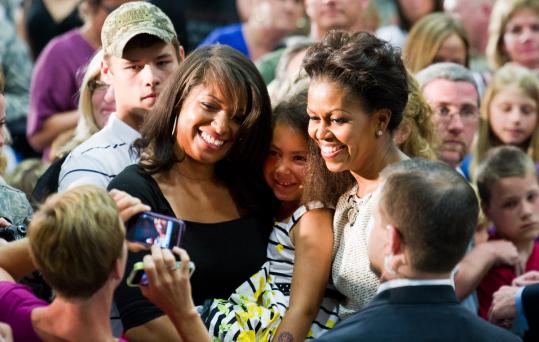
visited Boston and Vermont yesterday, as she and President Obama made a final dash for cash before the close of a fund-raising quarter that will provide the first relative measure of the strength of the 2012 White House contenders.
Republican front-runner Mitt Romney, making his second bid for the presidency, posted an early marker Tuesday when his staff announced he expected to raise $15 million to $20 million.
The first lady’s stops yesterday were expected to raise more than $1.2 million for the Democratic National Committee, whose primary focus now is ensuring the president’s reelection. The president had his own fund-raising trip to Philadelphia.
Final reports for the quarter are due in the middle of July.
Michelle Obama’s visit to the Chestnut Hill home of philanthropists Elaine and Gerald Schuster, the fifth such stop on a fund-raising tour that started in May, provided her with the opportunity to to make her financial pitch in very frank and personal terms.
She told an audience of about 120, which included Governor Deval Patrick but was mostly women, about her transformation as a political wife, as well as the toll the presidency takes on her husband each day.
“I see the worry creasing his face. I hear the passion and determination in his voice. ‘You won’t believe what these folks are going through.’ He told me that last night. ‘Michelle, it is not right. We’ve got to fix this. We have to do more,’ ’’ she said.
Yet as her husband did a day earlier during a news conference, Obama urged patience as the administration works to help the country emerge from a recession.
“Barack always reminds me that we are playing a long game,’’ she said. “He reminds me, as I said to you, too, that change is slow. He reminds me that change doesn’t happen all at once, but that if we keep showing up, if we keep fighting the good fight, doing what we know is right, then eventually we will get there.’’
Similarly, Obama echoed her husband as she evoked the image of their two young daughters, Malia and Sasha, in trying to stir Democratic supporters.
“The truth is that no matter what happens, my girls will be OK,’’ she said. “My girls will have plenty of advantages and opportunities in their lives. And that’s probably true for many of your kids as well.
“But I think that the last four years have shown us the truth of what Barack has always said: That if any child in this country is left behind, then that matters to all of us, even if she’s not our daughter, and even if he’s not our son. If any family in this country struggles, then we cannot be fully content with our own family’s good fortune, because that is not what we do in this country,’’ she said.
In opening her remarks, Obama also described how campaigning in 2008 helped her overcome her fears about her husband running for president.
“I was proud of the work that he was doing in the Senate. And I thought that he would make a phenomenal president. That wasn’t the issue,’’ she said. “But, like a lot of folks, I still had some cynicism about politics. And with two young daughters at home, I was worried about the toll that a presidential campaign would take on our family.
“So it took some convincing on Barack’s part. And by ‘some,’ I mean a lot; he’s still paying back,’’ she said.
Obama said she warmed to the decision as she began campaigning in backyards in Iowa and New Hampshire.
“It’s about meeting people one-on-one, hearing what’s going on in their lives,’’ she said.
Besides the governor, those in the audience included Diane Patrick, Attorney General Martha Coakley, and former Boston television anchor Liz Walker.
After leaving Boston, Obama flew to Burlington, Vt., for an event recognizing the military and the family sacrifices endured by the armed forces, and two fund-raisers.
They were organized by Jane Stetson, a Vermont resident who is national finance chairwoman for DNC.
Subscribe to:
Posts (Atom)