Despite allocation of Rs 18.4 billion for law and order, the much-awaited explosive detectors have still not been provided to the militancy-plagued Khyber Pakhtunkhwa though the Chinese government has already provided it through soft loan of $ 2.96 million in July 2009.
These modern gadgets have already been installed in Islamabad and also in Swat during military operation of 2009 but it is not known yet that why these scanners have not been installed at important entry points of Peshawar especially the routes from Darra Adam Khail and Khyber Agency.
In the wake of frequent terror attacks in the provincial capital, comprehensive security measures are the need of the hour as the residents of Peshawar are no more ready to see their nears and dears in this blood bath.
To tackle the menace of terrorism, both the provincial and Federal government should take preventive measures and identify the roots through which the high quality explosives are being supplied to the heart of the city.
Rs 18.4 billion is a huge amount to restore law and order situation in the province but proper utilisation of this budget would need due consideration. Two year back in July, 2009, full road modern scanners provided by the Chinese government under soft loan of 2.96 million dollars but these scanners could not installed in the areas which were badly suffered in militancy. At that time Chinese Ambassador Luo Zhaohui who inked agreement with Interior Ministry had said that the scanners have no side effects and these are effective tool to foil the sabotaging bids of the terrorisms. However, the Pakistani Radiologist said that, these high resolution scanners have also some negative impacts of radiation if people passing again and again through it. They said that the scanners are suitable for border areas where people infrequently passing through these security gadgets.
Friday, June 17, 2011
Saudi Facebook campaign sees women drive cars
Daily Telegraph
A Saudi Arabian Facebook and Twitter campaign saw a number of Saudi women drive cars on Friday in response to calls for nationwide action to break a traditional ban.
The call to defy the ban that spread through the social networking sites is the largest en masse action since November 1990, when a group of 47 Saudi women were arrested and severely punished after demonstrating in cars.
"We've just returned from the supermarket. My wife decided to start the day by driving to the store and back," said columnist Tawfiq Alsaif on his Twitter page.
"I took King Fahd Road (Riyadh artery) and then Olaya Street, along with my husband, I decided that the car for today is mine," Maha al-Qahtani tweeted.
Her husband Mohammed al-Qahtani tweeted that she carried her necessary belongings "ready to go to prison without fear."
Another woman posted online a video of her driving after midnight Thursday as the first woman to answer the call for protest. The veiled woman drove along nearly-empty main roads until she parked at a supermarket. "All that we need is to run our errands without depending on drivers," said the unnamed woman in the video. "I believe that the society is ready to welcome us."
Police patrols were at normal levels on the streets of Riyadh on the first day of the weekend, according to witnesses.
Many Saudi women had pledged on Facebook and Twitter to answer the call to defy the deeply entrenched ban.
But instead of staging demonstrations, which are strictly banned in the absolute monarchy, women with driving licences obtained abroad were encouraged to take individual action.
Veteran women's rights activist Wajiha al-Huwaidar said on Friday that she did not expect a huge turnout as hoped for by sympathisers abroad because of the severe response by officials to women who have taken the lead in recent weeks.
"I do not expect something big as people abroad imagine," she said, adding that jailing activist Manal al-Sherif and others has scared some women off.
Sharif, a 32-year-old computer scientist, found herself behind bars for two weeks last month after driving in the Eastern Province and posting footage of her actions on the Internet.
Six other women were also briefly detained after being caught learning to drive on an empty plot of land in north Riyadh.
Women in Saudi Arabia face an array of constraints, ranging from having to cover from head to toe in public and needing a male guardian's permission to travel, to having restricted access to jobs because of strict segregation rules.
The protests are the climax of a two-month online campaign riding the winds of the so-called Arab spring which has spread mass revolts across the region and toppled two regimes.
The main Facebook page campaign, dubbed Women2Drive, says the action will start on Friday and keep going "until a royal decree allowing women to drive is issued."
"Saudi Arabian authorities must stop treating women as second-class citizens and open the kingdom&£8217;s roads to women drivers," London-based Amnesty International said on Thursday.
"Not allowing women behind the wheel in Saudi Arabia is an immense barrier to their freedom of movement, and severely limits their ability to carry out everyday activities as they see fit, such as going to work or the supermarket, or picking up their children from school," said Philip Luther, Amnesty International's Deputy Director for the Middle East and North Africa.
There is no law banning women from driving in the oil-rich kingdom, but the interior ministry imposes regulations based on a fatwa, or religious edict, stipulating women should not be permitted to drive.
The last en masse protest against the ban was held in November 1990 when a group of women stunned Saudi men by driving around Riyadh in 15 cars before being arrested.
The women were provoked at the time by the sight of US female soldiers who were taking part in the first Gulf War driving military vehicles freely in their own country while they are banned.
Some of them reportedly said then that as their country was in war after Iraqi troops invaded neighbouring Kuwait, they felt like "sitting ducks" as they could not drive in case they needed to save their families.
The 47 women who took part in that protest were severely punished, with authorities suspending many from public sector jobs and reprimanding their male guardians.
They also faced a defamatory campaign with pamphlets calling them whores.
"If you get arrested, do not be scared. You will only be asked to sign a pledge" not to drive, read one of several recommendations posted on the campaign's Facebook page.
A Saudi Arabian Facebook and Twitter campaign saw a number of Saudi women drive cars on Friday in response to calls for nationwide action to break a traditional ban.
The call to defy the ban that spread through the social networking sites is the largest en masse action since November 1990, when a group of 47 Saudi women were arrested and severely punished after demonstrating in cars.
"We've just returned from the supermarket. My wife decided to start the day by driving to the store and back," said columnist Tawfiq Alsaif on his Twitter page.
"I took King Fahd Road (Riyadh artery) and then Olaya Street, along with my husband, I decided that the car for today is mine," Maha al-Qahtani tweeted.
Her husband Mohammed al-Qahtani tweeted that she carried her necessary belongings "ready to go to prison without fear."
Another woman posted online a video of her driving after midnight Thursday as the first woman to answer the call for protest. The veiled woman drove along nearly-empty main roads until she parked at a supermarket. "All that we need is to run our errands without depending on drivers," said the unnamed woman in the video. "I believe that the society is ready to welcome us."
Police patrols were at normal levels on the streets of Riyadh on the first day of the weekend, according to witnesses.
Many Saudi women had pledged on Facebook and Twitter to answer the call to defy the deeply entrenched ban.
But instead of staging demonstrations, which are strictly banned in the absolute monarchy, women with driving licences obtained abroad were encouraged to take individual action.
Veteran women's rights activist Wajiha al-Huwaidar said on Friday that she did not expect a huge turnout as hoped for by sympathisers abroad because of the severe response by officials to women who have taken the lead in recent weeks.
"I do not expect something big as people abroad imagine," she said, adding that jailing activist Manal al-Sherif and others has scared some women off.
Sharif, a 32-year-old computer scientist, found herself behind bars for two weeks last month after driving in the Eastern Province and posting footage of her actions on the Internet.
Six other women were also briefly detained after being caught learning to drive on an empty plot of land in north Riyadh.
Women in Saudi Arabia face an array of constraints, ranging from having to cover from head to toe in public and needing a male guardian's permission to travel, to having restricted access to jobs because of strict segregation rules.
The protests are the climax of a two-month online campaign riding the winds of the so-called Arab spring which has spread mass revolts across the region and toppled two regimes.
The main Facebook page campaign, dubbed Women2Drive, says the action will start on Friday and keep going "until a royal decree allowing women to drive is issued."
"Saudi Arabian authorities must stop treating women as second-class citizens and open the kingdom&£8217;s roads to women drivers," London-based Amnesty International said on Thursday.
"Not allowing women behind the wheel in Saudi Arabia is an immense barrier to their freedom of movement, and severely limits their ability to carry out everyday activities as they see fit, such as going to work or the supermarket, or picking up their children from school," said Philip Luther, Amnesty International's Deputy Director for the Middle East and North Africa.
There is no law banning women from driving in the oil-rich kingdom, but the interior ministry imposes regulations based on a fatwa, or religious edict, stipulating women should not be permitted to drive.
The last en masse protest against the ban was held in November 1990 when a group of women stunned Saudi men by driving around Riyadh in 15 cars before being arrested.
The women were provoked at the time by the sight of US female soldiers who were taking part in the first Gulf War driving military vehicles freely in their own country while they are banned.
Some of them reportedly said then that as their country was in war after Iraqi troops invaded neighbouring Kuwait, they felt like "sitting ducks" as they could not drive in case they needed to save their families.
The 47 women who took part in that protest were severely punished, with authorities suspending many from public sector jobs and reprimanding their male guardians.
They also faced a defamatory campaign with pamphlets calling them whores.
"If you get arrested, do not be scared. You will only be asked to sign a pledge" not to drive, read one of several recommendations posted on the campaign's Facebook page.
Thursday, June 16, 2011
Terror leader lives freely near Pakistani capital

On the outskirts of the Pakistani capital lives a militant considered so powerful that Osama bin Laden consulted with him before issuing a fatwa to attack American interests.
Fazle-ur-Rahman Khalil heads Harakat-ul-Mujahedeen, a terrorist group closely aligned with al-Qaida and a signatory to bin Laden's anti-U.S. fatwa in 1998. Khalil has also dispatched fighters to India, Afghanistan, Somalia, Chechnya and Bosnia, was a confidante of bin Laden and hung out with 9/11 mastermind Khalid Sheikh Mohammed.
Pakistani authorities are clearly aware of Khalil's whereabouts. But they leave him alone, just as they tolerate other Kashmiri militant groups nurtured by the military and its intelligence agency to use against India.
Khalil is also useful to the authorities because of his unusually wide contacts among Pakistan's many militant groups, said a senior government official who is familiar with the security agencies and who spoke on condition he not be identified fearing repercussions.
Khalil's presence in an Islamabad suburb, confirmed to The Associated Press by Western officials in the region, underscores accusations that Pakistan is still playing a double game — fighting some militant groups while tolerating or supporting others — even after the solo U.S. raid that killed bin Laden on May 2.
The U.S. Congress, enraged that bin Laden found refuge for at least five years down the street from Pakistan's equivalent of West Point, has threatened to cut off the billions of dollars in aid being spent here.
Obama administration officials and U.S. Army officers are trying to rebuild the relationship, considered vital to American hopes of negotiating an end to the Afghan war, but if anything the two sides appear to have drifted further apart in recent weeks.
Pakistan's intelligence service has arrested five Pakistanis who fed information to the CIA before the American raid that killed bin Laden, according to a Western official in Pakistan.
The group of detained Pakistanis included the owner of a safe house rented to the CIA to observe bin Laden's compound in the military town of Abbottabad, a U.S. official said. The owner was detained along with a "handful" of other Pakistanis, said the official.
Also, CIA Director Leon Panetta confronted Pakistan's intelligence service about tipping off militants running bomb factories aimed at killing U.S. soldiers in Afghanistan. Pakistan denied tipping them off. The militants belong to the Haqqani network, an Afghan Taliban faction that has ties to al-Qaida.
Khalil's Harakat-ul-Mujahedeen, blamed for a deadly attack on the American Consulate in Karachi in 2002, has links to the Haqqanis and is considered a terrorist organization by the U.S. Hundreds of militants are thought to belong to his organization, though the strength of these groups are the links they share with each other, say analysts.
Khalil himself is not on any U.S. wanted list. In the Islamabad suburb of Golra Sharif, he lives in a nondescript two-story compound that includes a seminary or religious school, hidden behind a traditional high wall protected by barbed wire.
Reached by the AP on his cell phone last month, Khalil dismissed suggestions that he may have been in touch with bin Laden while the al-Qaida leader was hiding in Abbottabad.
"It is 100 percent wrong, it's rubbish," Khalil said. "Osama did not have contact with anybody." The AP obtained Khalil's phone number from a former aide who has since left the terror organization.
The Pakistani senior government official who spoke with AP said Khalil has been arrested twice but each time was released on orders from Pakistan's intelligence agency.
"He was significant for Osama bin Laden," the official said. "He has connections with all these groups in Waziristan but he is living here and we don't go after him. He is the one you go to when you need to get to these groups," tracking kidnap victims for example.
Khalil was once the boss of terror leader Ilyas Kashmiri, believed killed in a drone strike on June 3.
Like most of the militant groups that get a wink and a nod from Pakistan's security agencies, Harakat-ul-Mujahedeen's primary focus is Kashmir, a picturesque region divided between India and Pakistan and claimed by each in its entirety. Kashmir has been the cause of two of three wars between the South Asian neighbors and brought them perilously close to a nuclear confrontation in 2000.
Khalil's group has kidnapped foreigners in Indian Kashmir, killing one. His group also helped in the 1999 hijacking of an Indian airlines plane that resulted in the release of three militants, including Ahmed Omar Saeed Sheikh, who is now on death row for his part in the 2002 killing of Wall Street Journal reporter Daniel Pearl.
Khalil's militant ties include the anti-Indian Lashkar-e-Taiba group, blamed for masterminding the November 2008 assault on Mumbai that killed 166 people. The AP learned from the same official that seven training camps are operating in Pakistani Kashmir and most of them are run by Jamaat-ud-Dawwa, the name Lashkar-e-Taiba took after being banned.
"There are seven jihadi camps working in Kashmir right now, giving them explosives training," the official said. He said military and intelligence agencies say the camps provide Pakistan with "strategic depth."
"They say we need them, otherwise India will treat us like the rest of South Asia, like they can dictate," he said. "It is only the military and intelligence. The government has no say."
Pakistan has said it has severed its links with these Kashmiri militant groups, though many suspect that is not the case. But it does recognize the dangers posed by some militant groups in another corner of Pakistan — near the Afghan border.
Since deploying troops in 2004 to the region near the Afghan border, Pakistan has lost 3,000 soldiers to militant attacks, more casualties than NATO has suffered over 10 years in Afghanistan.
"Our concern at this point in time is our involvement with northwest Pakistan. We cannot manage to open a new front in central Punjab and in south Punjab," where these groups are headquartered, said a senior military official on condition of anonymity. "Our army is not well trained for counterterrorism in urban centers and we do not have the capacity in our civil law enforcement agencies" to go after these groups.
But many Pakistanis wonder how they got to this place, besieged by militants who bomb them daily while suffering a litany of criticisms and perceived humiliations from their U.S. allies for not doing enough.
Dr. Pervez Hoodbhoy, a physicist, columnist and peace activist, recently dubbed his homeland "Jihadistan," saying it wasn't always this way. He laid the blame on an array of players for the current state of affairs in Pakistan.
In a recent column, he first pointed the finger at former military dictator Gen. Mohammed Zia ul Haq. Zia made Islamic radicalism the centerpiece of his military and political strategy, launching the country and the security forces on a path of religious extremism.
Hoodbhoy then blamed Washington's Cold War doctrine that partnered the United States with Saudi Arabia, Egypt and Zia's Pakistan in the 1980s to embrace Islamic radicalism to defeat Soviet forces in Afghanistan. The partnership brought Islamic radicals from across the Middle East to Pakistan.
The strategy worked, and the Russians left Afghanistan. But the cost of victory was a toxic mix of Islamic radicals.
"Jihadistan is a messy place these days, a far cry from the simple bastion of anti-communism in the 1980s," he wrote. "Today the military must kill some of its former proteges and some radicals even as it secretly supports others."
A former U.S. ambassador to Islamabad says throwing money at Pakistan won't wean it off jihadi groups so long as its fear of India dictates its security policies.
"It is the perception of India as the primary threat to the Pakistani state that colors its perceptions of the conflict in Afghanistan and Pakistan's security needs," Anne Patterson said in a 2009 cable made public by WikiLeaks.
She said the United States should discourage India from excessive involvement in Afghanistan, and scale back American military sales to New Delhi.
"We need to reassess Indian involvement in Afghanistan and our own policies toward India, including the growing military relationship through sizable conventional arms sales, as all of this feeds Pakistani establishment paranoia and pushes them closer to both Afghan and Kashmir-focused terrorist groups while reinforcing doubts about U.S. intentions," Patterson said in the memo.
___
TRUSTLAW POLL-Afghanistan is most dangerous country for women

Afghanistan tops expert poll of dangers to women

* Congo plagued by rape as weapon of war
* Pakistan blighted by acid attacks and 'honour killings'
* India cited for trafficking and sexual slavery
* Somalia seen as having full gamut of risks
(Corrects attribution of quotation in paragraphs 3-4)
LONDON (TrustLaw) - Violence, dismal healthcare and brutal poverty make Afghanistan the world's most dangerous country for women, with Congo a close second due to horrific levels of rape, a Thomson Reuters Foundation expert poll said on Wednesday.
Pakistan, India and Somalia ranked third, fourth and fifth, respectively, in the global survey of perceptions of threats ranging from domestic abuse and economic discrimination to female foeticide, genital mutilation and acid attacks.
"Ongoing conflict, NATO airstrikes and cultural practices combined make Afghanistan a very dangerous place for women," said Clementina Cantoni, a Pakistan-based aid worker with ECHO, the European Commission's humanitarian aid department.
"In addition, women who do attempt to speak out or take on public roles that challenge ingrained gender stereotypes of what's acceptable for women to do or not, such as working as policewomen or news broadcasters, are often intimidated or killed."
The poll by TrustLaw, a legal news service run by Thomson Reuters Foundation, marked the launch of its new TrustLaw Women section, a global hub of news and information on women's legal rights.
TrustLaw asked 213 gender experts from five continents to rank countries by overall perceptions of danger as well as by six risks. The risks were health threats, sexual violence, non-sexual violence, cultural or religious factors, lack of access to resources and trafficking.
Some experts said the poll showed that subtle dangers such as discrimination that don't grab headlines are sometimes just as significant risks for women as bombs, bullets, stonings and systematic rape in conflict zones.
"I think you have to look at all the dangers to women, all the risks women and girls face," said Elisabeth Roesch, who works on gender-based violence for the International Rescue Committee in Washington.
"If a woman can't access healthcare because her healthcare isn't prioritised, that can be a very dangerous situation as well."
LITANY OF PERILS
Afghanistan emerged as the most dangerous country for women overall and worst in three of the six risk categories: health, non-sexual violence and lack of access to economic resources.
Respondents cited sky-high maternal mortality rates, limited access to doctors and a near total lack of economic rights. Afghan women have a one in 11 chance of dying in childbirth, according to UNICEF.
Democratic Republic of Congo (DRC), still reeling from a 1998-2003 war and accompanying humanitarian disaster that killed 5.4 million people, came second mainly due to staggering levels of sexual violence in the lawless east.
More than 400,000 women are raped in the country each year, according to a recent study by U.S. researchers. The United Nations has called Congo the rape capital of the world.
"Statistics from DRC are very revealing on this: ongoing war, use of rape as a weapon, recruitment of females as soldiers who are also used as sex slaves," ECHO's Cantoni said.
The fact that the government is corrupt and that female rights are very low on the agenda means that there is little or no recourse to justice."
Rights activists say militia groups and soldiers target all ages, including girls as young as three and elderly women. They are gang-raped, raped with bayonets and have guns shot into their vaginas.
Pakistan ranked third largely on the basis of cultural, tribal and religious practices harmful to women. These include acid attacks, child and forced marriage and punishment or retribution by stoning or other physical abuse.
"Pakistan has some of the highest rates of dowry murder, so-called honour killings and early marriage," said Divya Bajpai, reproductive health advisor at the International HIV/AIDS Alliance.
Some 1,000 women and girls die in honour killings annually, according to Pakistan's Human Rights Commission.
TRAFFICKING
India ranked fourth primarily due to female foeticide, infanticide and human trafficking.
In 2009, India's then-Home Secretary Madhukar Gupta estimated that 100 million people, mostly women and girls, were involved in trafficking in India that year.
"The practice is common but lucrative so it goes untouched by government and police," said Cristi Hegranes, founder of the Global Press institute, which trains women in developing countries to be journalists.
India's Central Bureau of Investigation estimated that in 2009 about 90 percent of trafficking took place within the country and that there were some 3 million prostitutes, of which about 40 percent were children.
In addition to sex slavery, other forms of trafficking include forced labour and forced marriage, according to a U.S. State Department report on trafficking in 2010. The report also found slow progress in criminal prosecutions of traffickers.
Up to 50 million girls are thought to be "missing" over the past century due to female infanticide and foeticide, the U.N. Population Fund says.
Some experts said the world's largest democracy was relatively forthcoming about describing its problems, possibly casting it in a darker light than if other countries were equally transparent about trafficking.
Somalia ranked fifth due to a catalogue of dangers including high maternal mortality, rape and female genital mutilation, along with limited access to education, healthcare and economic
resources.
"I'm completely surprised because I thought Somalia would be first on the list, not fifth," Somali women's minister Maryan Qasim told TrustLaw.
"The most dangerous thing a woman in Somalia can do is to become pregnant. When a woman becomes pregnant her life is 50-50 because there is no antenatal care at all. There are no hospitals, no healthcare, no nothing.
"Add to that the rape cases that happen on a daily basis, the female genital mutilation that is being done to every single girl in Somalia. Add to that the famine and the drought. Add to that the fighting (which means) you can die any minute, any day."
Poll respondents included aid professionals, academics, health workers, policymakers, journalists and development specialists.
Monday, June 13, 2011
Female Afghan journalist: 'I have no plans to stop'


Mina Habib is doing what would have been unthinkable during the Taliban era. She is one of the few working female Afghan journalists.
For Habib, journalism is a passion, but it also helps support her family. Her father is unemployed, and her mother is partially paralyzed by a stroke.
From Kabul, Habib talked to CNN's Asieh Namdar about the challenges for women in Afghanistan and the inspiration, fears and risks associated with being a female journalist.
Q: Why did you want to be a journalist? Weren't you scared by the obvious risks?
A: I was aware of all the risks involved. Being a female journalist is not socially accepted. But I wanted to highlight the problems of women and children in Afghanistan. I felt I had a responsibility to tell their stories. I knew it would be a huge challenge and there would be many obstacles along the way, but I felt I had to do it, because my country needs Afghan journalists to tell the stories of their own people, to convey the problems that still exist.
Q: Were you inspired by anyone in particular? What are your favorite stories to cover?
A: It was my childhood dream to be a journalist, but no one [person] really inspired me. I like covering politics, exposing corruption and doing stories that involve children. My proudest story was exposing people who use sick children as beggars. A government commission banned the practice after my story.
Q: Were you ever threatened while covering these types of stories?
A: Yes. One of my reports had to do with child labor/child smuggling and children being used for suicide attacks. It was a story that had to be told. I came home that evening and found a letter on my door. I don't know who wrote it. It said my life would be in danger if continued my work as a journalist. I continued! I was also wounded last year while covering a suicide bombing in Kabul. My family blamed all this on my work. But I have no plans to stop.
Q: What's been the reaction, in your family and otherwise, to you wanting to be a journalist?
A: Like many Afghan families, they were totally against it. They wanted me to be a teacher or doctor. My family was worried about how I would be viewed and my safety. They thought it would be a tough job for a woman. They never supported me in this area.
Others are skeptical as well. They consider journalism "immoral work." I can hear them asking, "What is a girl doing outside the home, being a journalist?"
Q: How has life changed for you since the fall of the Taliban?
A: During the Taliban era, women could not work or get an education. They lived in fear. I'm working now, doing something I love. In Kabul, things are better, but in provinces, women are still afraid to work or study. Women can't appear in the media, work or study outside the home.
Q: How do you want to see yourself 10 years from now?
A: I want to be a successful and respected journalist -- to do my job, with freedom, without being threatened or harassed.
Q: What is your biggest fear today?
A: People standing in the way of me doing my work. Those who want to stop me from being a journalist. ... I blame cultural and social barriers that don't see women as equal to men. Even Islam says men and women are equal. But many still don't want to believe that. These are the same people who think it is inappropriate for women to even appear in public. I also blame government officials for not doing enough to ensure laws are balanced and fair for women.
Q: What do you do on your day off?
A: I live with my family, so I try to spend time with them. I help my mother and sisters. Sometimes, I bring my work home, writing my reports. My family gets upset. They want me to help with things around house more, instead of on my work.
Q: Do you think you yourself face greater dangers than international journalists who come to Afghanistan to report?
A: I think all journalists who are here to report the truth face danger.
Q: What do you want the world to know about you?
A: I want them to know that despite the obstacles before me, I will continue to work hard and be the best journalist I can be. I'm doing this for the children of Afghanistan because they are the future of this country.
Mina Habib writes for the daily Chiragh newspaper and the Institute for War & Peace Reporting. She received her journalism degree at Kabul University.
Islamabad Suicide bomber kills 1 in rare attack
A suicide bomber blew himself up at a busy market in the Pakistani capital on Monday, killing at least one person in the first bombing in Islamabad in over a year and a half, police said.
No group immediately claimed responsibility for the bombing but the Pakistani Taliban have pledged to carry out attacks in retaliation for the U.S. raid that killed Osama bin Laden last month in an army town not far from Islamabad.
The suicide bomber tried to enter the bank building at the market but was stopped by a security guard, said Islamabad police chief Wajid Durrani. The bomber then detonated his explosives, killing the guard and wounding four others, Durrani said.
The blast ripped through the ground floor of the bank, scattering body parts and pieces of broken glass on the pavement outside. Police worked to keep people from gathering at the scene for fear that there might be a second blast.
No group immediately claimed responsibility for the bombing but the Pakistani Taliban have pledged to carry out attacks in retaliation for the U.S. raid that killed Osama bin Laden last month in an army town not far from Islamabad.
The suicide bomber tried to enter the bank building at the market but was stopped by a security guard, said Islamabad police chief Wajid Durrani. The bomber then detonated his explosives, killing the guard and wounding four others, Durrani said.
The blast ripped through the ground floor of the bank, scattering body parts and pieces of broken glass on the pavement outside. Police worked to keep people from gathering at the scene for fear that there might be a second blast.
Bahrain tries ex-lawmakers, imprisons poet

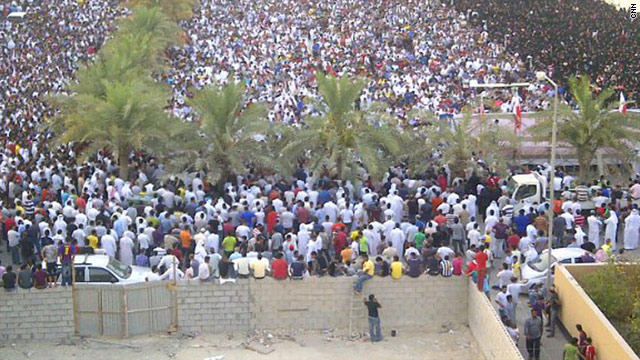
At least two former Bahraini opposition lawmakers went on trial Sunday, as a military court sentenced a 20-year-old poet to a year in prison.
Matar Matar and Jawad Fairooz were charged with "spreading malicious lies in an attempt to overthrow the government," an official in the Information Affairs Authority told CNN.
Both men pleaded not guilty and will remain in custody until their next hearing, said the official, Sheikh Abdul-Aziz bin Mubarak. He said their lawyers have been given more time to prepare their cases.
Both men were seized May 2, family members said.
The trials come after the small, strategically important Gulf kingdom was swept by protests earlier this year as part of the Arab Spring demonstrations.
The legal proceedings began Sunday without prior notice, according to a Matar family member who asked not to be named for security reasons.
Fairooz's lawyer only found out the charges once he appeared in court Sunday, the defendant's brother Jamsheer Fairooz said.
Jawad Fairooz said he was being treated well and looked to be in physically good condition but had "aged 10 years -- his beard and hair have both gone white," his brother said.
Matar, 35, was taken from his car by armed men in masks on May 2, according to a relative. He represented the biggest constituency in Bahrain, with approximately 16,000 people.
Elected to the lower house of Parliament in October 2010, Matar resigned along with other Wefaq lawmakers earlier this year to protest the government crackdown on demonstrators. Wefaq is a Shiite party, the predominant religion in the kingdom whose rulers are Sunni.
Bahraini human rights activist Nabeel Rajab said the trials are "not (of) an international standard," saying the defendants had "not only (had) no access to lawyer but even their families (were) not informed they were being taken court."
Meanwhile, poet Ayat al-Qormozi, 20, was found guilty of assembling at Pearl Roundabout, the epicenter of anti-government demonstrations in the kingdom earlier this year. Additional charges included speaking out against Bahrain and the king.
The Bahrain Youth Society for Human Rights said she read a poem criticizing government policy at the Roundabout.
Mubarak, the government official, said Bahrain had freedom of speech, but that there were limits.
"Freedom of speech in this country has its boundaries and cannot touch on the leadership, and cannot call for the overthrow of the government," he said.
Her poem, he said, "caused incitement and hatred to his majesty the king and to the prime minister" with lines such as "we are people who kill humiliation" and "assassinate misery."
Amnesty International called the charges "unfair" in a statement after the sentence.
"By locking up a female poet merely for expressing her views in public, Bahrain's authorities are demonstrating how free speech and assembly are brutally denied to ordinary Bahrainis," said Malcolm Smart, Amnesty International's Director for the Middle East and North Africa.
Al-Qormozi had been detained since March 30, after her father led security forces to her in the face of threats to his other children's lives, a family member said.
She alleges that she received electrical shocks to her face and was beaten with a hose while in detention, according to the relative, who asked not to be named for security reasons.
Her mother and father were the only family members allowed in court, the relative said, adding that a lawyer was present with her.
Bahraini security forces went to her house around midnight a few days before she was detained, but she was not home, the relative said.
The security forces broke things in the house and told the family they would return the following day for her. They returned the next night but she was still in hiding, the relative said.
The family member said security forces then took two of the poet's four brothers and threatened them with guns in their faces. The father, fearing for his family's lives, took the security forces to her. The family was assured that she would not be harmed, the family member said.
Bahrain's government declined to comment on the specifics of al-Qormozi's case, but said: "All detention centers conform to the conditions set down under international human rights regulations and the detainees are treated as innocent until proven guilty."
Thousands of Bahrainis protested their government Saturday in a rally organized by the Wefaq party.
Unafraid, pro-reform demonstrators hit the streets with their faces uncovered, said a journalist at the scene who was not identified for security reasons.
Rajab, the human rights activist, put the turnout at "no less than 10,000," while police put it at 4,000, the national news agency said.
Rajab said the march went off peacefully, with no security forces present.
It was the second such protest since the government last week lifted emergency laws that were imposed in mid-March, allowing a crackdown on political leaders and journalists.
Bahrain's ruling royal family -- Sunnis in a majority-Shiite nation -- accuses protesters of being motivated by sectarian differences and supported by Iran.
Ali Salman, the secretary general of al Wefaq, told the large crowds that he supports the government's offer of dialogue but said he could not endorse it fully until the conditions for such talks were clear.
Bahraini Prime Minister Prince Khalifa bin Salman Al Khalifa pledged cooperation from the government "to reach national consensus so as to ensure a better future for the kingdom," the state-run Bahrain News Agency said.
Crown Prince Salman, who met with U.S. officials in Washington Wednesday, thanked President Barack Obama for his backing of a national dialogue in Bahrain.
Bahrain is home to the U.S. Navy's Fifth Fleet, and the United States has been concerned about the instability in the Persian Gulf island state.
CNN's Jenifer Fenton contributed to this report.
Afghan Police Recruits Impose ‘Islamic Tax’

Ghulam Hazrat should be a poster boy for the peaceful reintegration of insurgents who want to switch sides. Six months ago he was a Taliban commander in the troubled Imam Sahib district of northern Kunduz Province. Now he and 10 of his followers are in the process of becoming police officers, at which point the government will start paying them salaries.
In the meantime, however, Mr. Hazrat is raising money the same way he did as a Taliban commander, by imposing an “Islamic tax” on people in his district.
“The government is telling me to fight the Taliban and protect your area so we must ask people for help in order to take care of myself and my friends,” he said in an interview. He and other militiamen who have declared for the government and hope to join the local police, a group known as arbakai, insist that people give the money voluntarily.
Judging by the public outcry, however, the donors see things differently. They are often forced to hand over a tenth of their earnings, just as they were when the Taliban ran things. In Kunduz, where the police training program has been operating since late last year, radio talk shows have been flooded by angry callers complaining about the arbakai militias, meetings of elders have denounced their behavior, and even provincial government officials have expressed concern.
The American-financed program aims to convert insurgents into village self-defense forces called Afghan Local Police, distinct from the existing national police force. It is a favorite initiative of the NATO commander in Afghanistan, Gen. David H. Petraeus, who considers it a key part of his counterinsurgency strategy.
Afghan police officials see it as an inexpensive way to beef up their forces, particularly in remote areas. The Afghan Local Police are organized and trained by American Special Forces units in cooperation with the Afghan authorities and, working at the village level, are paid half of what national police officers earn.
So far the program has trained 6,200 officers in 41 districts, and aims to recruit 30,000 in 100 districts in 14 provinces by the end of the year.
But it has aroused concern among aid workers and United Nations officials, who say it risks empowering local warlords who have little regard for human rights or proper behavior.
Many Afghans fear a return to the warlord days of the civil war years, from the late 1980s to the early 1990s, even more than they fear the Taliban, who came to power in large measure because people were fed up with feuding local militias. A recent study by Oxfam and three other nongovernment groups concluded that the program had “in all cases failed to provide effective community policing,” and has instead produced forces that have “generally been feared by the communities they are supposed to protect.”
A United Nations report in March noted that while the program was still too new to render hard judgments, “Concerns have been raised regarding weak oversight, recruitment, vetting and command-and-control mechanisms.”
The controversy in Kunduz arose just as farmers began harvesting their crops, only to find that many of the new arbakai groups, armed and acting as a de facto police force before they had begun the training program, were demanding their tithe.
“We have many times said through local television that no one should give anything to anyone, and arbakai have no right to collect Islamic tax,” said Sarwar Hussaini, the spokesman for the Kunduz Province police chief.
But refusing to pay can have consequences.
The headmaster and assistant headmaster of the Haji Mir Alam girls’ school in the provincial capital, Kunduz city, refused. Two arbakai commanders with 30 armed men stormed the school on Wednesday, beating both men with rifle butts in front of the students until they fell unconscious, according to Muhammad Zahir Nazam, head of the provincial education department.
“The education department strongly condemns this attack, which was a clear attack on education,” he said. Both school officials were hospitalized and are in comas, he said, and the school has been closed.
A group of 100 tribal elders gathered afterward and denounced the attack. “The government should arrest and bring these people to justice,” said a spokesman for the group, Haji Nesar Ahmad. Mr. Hussaini, the police spokesman, said no official complaints had been filed over arbakai abuses.
But Mr. Nazam, the education official, said he reported the attack to security officials several times, and “no steps have been taken and no one arrested.”
A spokeswoman for the NATO-led military coalition referred questions about the episodes to Afghan officials. The Afghan Local Police “is an Afghan-led program where we’re in a supporting role,” said the spokeswoman, Lt. Cmdr. Kathleen D. Sweetser. She said it helped provide security in “contested areas that are important to the campaign but beyond the reach” of available coalition and Afghan forces.
Kunduz, where there are 1,500 arbakai militiamen and 1,200 slots authorized for Local Police officers, has one of the largest programs. So far, though, only 105 arbakai have graduated to become officers, Mr. Hussaini said. NATO officials say 220 Local Police officers have been trained in Kunduz.
The arbakai militias who have drawn so many complaints are in the early stages of the process. Many have not yet been accepted into the training program.
“If the government gave us food and paid us, then there would be no reason to collect tax from people,” said Mr. Hazrat, the arbakai commander.
Afghan and international officials acknowledge the program has flaws. An international official with knowledge of the program who spoke on the condition of anonymity said the training program had not geared up fast enough to accommodate the numbers of arbakai.
“There’s more demand than there is capacity,” the official said. “Whatever we are doing, we have to do it correctly.”
Mohammad Ayoub Haqyaar, governor of the Imam Sahib district, where Mr. Hazrat’s forces range, said, “The best way to prevent them from taking tax from people will be to hire them as Local Police and start paying them.”
But American rules do not allow the recruits to be paid until they have been trained and vetted by the Special Forces, as well as local elders and Afghan officials. And while the Americans also object to giving them guns and ID cards before then, local governments have handed them out anyway.
Yaar Mohammad, a 40-year-old farmer in the Imam Sahib district, has just harvested 4,600 pounds of wheat from his six acres of land, and the local arbakai asked for 460 pounds of that. “I refused, and they threatened me, and I finally had to give it to them,” he said. In the Khan Abad district, also in Kunduz Province, a farmer named Faizullah has not yet harvested his 12 acres of wheat, but plans to hand over a tenth after the local commander announced in the mosque that everyone had to do so.
“We must give it to them,” he said. “If we don’t then they’ll create problems.”
“People are complaining that arbakai are taking their money and their cellphones and sometimes beating them up,” said Col. Abdul Rahman Aqtash, the deputy police chief in Kunduz. “We’ve cleared Kunduz of the armed opposition, but if the situation continues like this then people will keep their distance from the government and it will prepare the ground for armed opposition.”
Saudi Arabia’s Freedom Riders


On the surface, when a group of Saudi women used Facebook, Twitter and YouTube to organize a mass mobile protest defying the kingdom’s ban on women driving, it may have seemed less dramatic than demonstrators facing bullets and batons while demanding regime change in nearby countries. But underneath, the same core principles — self-determination and freedom of movement — have motivated both groups. The Saudi regime understands the gravity of the situation, and it is moving decisively to contain it by stopping the protest scheduled for June 17.
The driving ban stems from universal anxiety over women’s unrestrained mobility. In Saudi Arabia that anxiety is acute: the streets — and the right to enter and leave them at will — belong to men. A woman who trespasses is either regarded as a sinful “street-walker” or expected to cover herself in her abaya, a portable house. Should she need to get around town, she can do so in a taxi, with a chauffeur (there are 750,000 of them) or with a man related to her by marriage or blood behind the wheel.
Although the Islamic Republic of Iran could not implement similarly draconian driving laws after the 1979 revolution, given that women had driven cars there for decades, the theocratic regime did denounce women riding bikes or motorcycles as un-Islamic and sexually provocative. Iran’s supreme leader, Ayatollah Ali Khamenei, proclaimed in 1999 that “women must avoid anything that attracts strangers, so riding bicycles or motorcycles by women in public places involves corruption and is forbidden.”
The Saudi regime, like the Islamic Republic of Iran, the Taliban in Afghanistan, the military junta in Sudan and the Islamic Salvation Front in Algeria, ordains the exclusion of women from the public sphere. It expects women to remain in their “proper place.”
Indeed, the rulers in Saudi Arabia are the most gender-segregated in the world today. In official ceremonies, and in countless photographs, posters and billboards, the royal family seems to be composed solely of men.
This desire to deny women entrance into the public arena is inaccurately presented as a religious mandate. Yet there is no basis for such exclusion in the Koran. On the contrary, in the early years of Islam, women were a vital presence in Muslim communities. They attended mosques, engaged in public debates and got involved in decision-making processes. Aisha, one of the wives of the Prophet Muhammad, commanded an army of men while riding on a camel. If Muslim women could ride camels 14 centuries ago, why shouldn’t they drive cars today? Which Koranic injunction prohibits them from driving?
Gender apartheid is not about piety. It is about dominating, excluding and subordinating women. It is about barring them from political activities, preventing their active participation in the public sector, and making it difficult for them to fully exercise the rights Islam grants them to own and manage their own property. It is about denying women the basic human right to move about freely.
That is why the women defying the ban on motorized mobility are in fact demanding an eventual overhaul of the entire Saudi political system. They want not just to drive but to remap the political geography of their country.
These women know the value of a car key. Like the man who faced down tanks in Tiananmen Square, like the unprecedented number of women participating in protests across the Middle East and North Africa, the Saudi women’s campaign for the right to drive is a harbinger of a new era in the region.
It may require decades to see an end to the Middle East’s gender apartheid and the political reconfigurations that would necessarily follow. One thing is certain though: the presence of women and men demonstrating side by side in the streets of Iran, Tunisia, Egypt, Bahrain, Yemen and Syria is a sign of more seismic upheavals ahead. Old categories have broken down and the traditional distribution of power and space is no longer viable.
The women demonstrating for the right to drive in Riyadh are seasoned negotiators of confined spaces and veteran trespassers of closed doors and iron gates. They are a moderating, modernizing force to be reckoned with — and an antidote to extremism.
Their refusal to remain silent and invisible or to relinquish their rights as citizens is an act of civil disobedience and moral courage. Their protest, and those of their sisters across the Middle East, represent a revolution within revolutions — and a turning point in the contemporary history of Islam.
Farzaneh Milani, chairwoman of the Department of Middle Eastern and South Asian Languages and Cultures at the University of Virginia, is the author of “Words, Not Swords: Iranian Women Writers and the Freedom of Movement.”
Sunday, June 12, 2011
Lawmakers push for new Afghan strategy

Democratic leaders on Capitol Hill are applying fresh pressure on the Obama administration to draw down U.S. troops in Afghanistan faster than many military leaders say is responsible, forcing the president to balance his party’s demands with his generals’ on-the-ground assessment as he nears another milestone in the war.
When he announced his war strategy 18 months ago, President Obama set July as the point when he would begin bringing home the approximately 100,000 U.S. service members in Afghanistan. Administration officials have portrayed the reduction as just another planned step in the president’s strategy.
But Sen. John F. Kerry, chairman of the Senate Foreign Relations Committee, is among a growing number of congressional leaders urging Obama to take full advantage of progress achieved over the past 18 months by narrowing the mission’s focus.
These lawmakers argue that, at a time of fiscal stress at home, the administration should concentrate on targeting al-Qaeda and protecting other U.S. security interests in the region, rather than on maintaining the broad military deployments across much of southern and eastern Afghanistan and the costly nation-building elements of the counter-insurgency strategy.
This political push could force the White House to revisit a contentious internal debate that unfolded in fall 2009, when Obama’s civilian advisers challenged the uniformed military over how best to change the course of a flagging war effort. But Obama is now making his decision amid a difficult reelection effort and when the killing of Osama bin Laden has made some lawmakers argue that the time is ripe to dramatically scale back the U.S. war effort.
“The president ought to take advantage of that success and push us in a direction that accelerates the ability of the Afghans” to take over operations, said Kerry (D-Mass.).
Obama is awaiting a set of recommendations from his military commanders on how many troops to bring home in July and the pace of withdrawal over the months ahead. Defense Secretary Robert M. Gates, who on Friday concluded an 11-day trip that took him to Afghanistan, could deliver Gen. David H. Petraeus’s proposed options to Obama in the next week.
“The president obviously is very mindful of how we use our resources and setting priorities for how we use our resources,” White House spokesman Jay Carney told reporters Thursday. “The fact is that we believe we are making progress. . . . And when he announces the decision he makes in terms of the drawdown, I’m sure he will also put it in the context of the implementation of the strategy he put in place in December 2009.”
That month Obama announced his decision to send an additional 30,000 troops to Afghanistan, largely adopting a surge strategy recommended by the military leadership.
For his civilian advisers worried about the scope of the escalation, Obama also set next month as the beginning of the end of the surge. As that deadline approaches, the argument over how quickly or slowly to leave a nearly decade-old war is intensifying.
When he adopted the strategy in 2009, Obama was a relatively new commander in chief still working out his relationship with his commanders. Obama has more experience as a wartime leader today, and his risky decision to authorize the raid deep inside Pakistan that killed bin Laden last month has burnished his reputation as a president who has faith in his military. Outside analysts say he may feel more able to turn down his generals’ advice.
The debate over how many troops to pull out next month has been far more muted than that months-long, leak-filled 2009 strategy review. White House officials say Obama, who receives a weekly Afghanistan update from the State Department and runs a monthly session on the war with his senior national security team, does not need an extensive internal debate or review to make this decision.
“The debates are going to be about the specifics of implementing the strategy we have embarked on. I don’t really see why we’d be focusing on revising it,” said a senior administration official who, like others interviewed, spoke on the condition of anonymity to describe internal White House discussions.
The official said that there is “huge pressure on the Taliban” and that an “Afghan-led political process that didn’t exist before is taking some shape. Al-Qaeda is on its heels; bin Laden is dead.”
“Right now, when we do these discussions, we’re looking at how do you sustain these gains and do the transition in a way that maximizes the chances of keeping the American people safe,” the official said.
But in recent weeks, a pair of high-profile proxies have emerged representing the two sides of the administration’s internal discussion over the pace of the troop withdrawal — Kerry and Gates.
Kerry has called the war’s $10 billion-a-month cost “unsustainable,” and on Wednesday, his committee issued a report critical of the economic assistance program that is a key part of the counterinsurgency strategy’s goal of bringing stability and government to parts of the country once controlled by the Taliban.
Kerry is a longtime friend and former Senate colleague of Vice President Biden, who in the 2009 war strategy review argued for a smaller U.S. military mission in Afghanistan that would focus on weakening a-Qaeda, rather than on defeating the indigenous Taliban insurgency.
With bin Laden’s death, the civilian advisers who favor that approach, led by national security adviser Thomas E. Donilon, have a fresh argument for a more targeted — and less expensive — military mission at a time of severe fiscal strain at home. A second senior administration official said, “Kerry is obviously someone who is respected here, and he would be heard,” adding that others would be as well.
In an interview, Kerry said that “part of the struggle here is to get people here, my colleagues included,” to focus on “what is the objective.”
“What I would urge, and what the president needs to think about here, is what is the best way now to take advantage of that so that you don’t go backwards, but that you also don’t necessarily stick with the kind of reach that you had because you don’t need to,” he said. “I don’t see this as changing the current strategy because it’s somehow not working.”
But Gates has said that Obama should move cautiously in removing troops from a battlefield where the gains, in the White House’s own assessment, remain “fragile and reversible.” Obama has relied on Gates as a trusted liaison to the uniformed military, and he ends his five-year tenure this month.
“I can tell you there will be no rush to the exits,” Gates said Friday in a speech in Brussels.
He went on to say that “the vast majority of the surge forces that arrived over the past two years will remain through the summer fighting season.”
“Far too much has been accomplished, at far too great a cost, to let the momentum slip away just as the enemy is on its back foot,” he said.
While White House officials say electoral politics is not a factor in the decision, Obama is campaigning for reelection next year at the head of a party deeply opposed to the Afghanistan war.
Bringing home the surge troops by the end of the year would allow Obama to demonstrate to his party, particularly its liberal grass roots, that he is winding down the war in Afghanistan, just as he has in Iraq.
Advisers say he will probably use his commanders’ recommendations as a base line to draw from, adopting some elements and coming up with others of his own, as he did in 2009. They say there is no timeline for the decision or for his speech outlining the path ahead, other than his commitment to withdraw the first surge troops before the end of July.
“He knows this is the longest war we’ve been in and there’s war weariness in the country,” the second senior administration official said. “This isn’t about people getting his ear and persuading him. He understands. And he wants the strategy he put in place to succeed.”
Afghanistan upbeat after Pakistan talks on Taliban

Pakistan is more willing than before to play a role in Afghanistan's tentative peace process with the Taliban, Afghan President Hamid Karzai's top officials said Sunday after a visit to Islamabad.
Taliban havens in Pakistan and Islamabad's reputed ties to insurgent leaders in the Afghan Taliban and Haqqani network make neighbouring Pakistan's involvement vital in any sustainable peace deal.
Karzai, who met Prime Minister Yousuf Raza Gilani, called on the Pakistani government to help Taliban rebels take part in any peace negotiations, said Mohammad Masoom Stanikzai, secretary of a peace council set up by Karzai.
"During the talks, the message of the Afghan government was very clear," he said.
"The message was that those (rebels) who want to join the peace process and reconcile should be facilitated and the means should be prepared for them in order to enable them to join the negotiations," he added.
But those who do not want to join the reconciliation process "must be dropped... No room should be left (for them to) arrange and organise and encourage people to fight and continue the war."
In response, Pakistan was "much more welcoming than at any other time", said Karzai's spokesman Waheed Omer.
"The acceptance was better and (Pakistan) made some promises about practical actions and we are hopeful that (the promises) are practised in action," he added, although he did not disclose what those promises were.
The upbeat comments came after Karzai and a raft of top aides held two days of meetings in Islamabad, just weeks after US Navy SEALs killed Osama bin Laden in Pakistan, heightening calls within the United States for a peaceful settlement in Afghanistan.
But relations between Kabul and Islamabad are often shrouded in distrust and mutual recrimination over the violence plaguing both countries.
The Taliban have rejected peace overtures in public. But some experts believe the death of bin Laden, whom Taliban supreme leader Mullah Omar refused to surrender after the September 11, 2001 attacks, could be a spur.
Pakistan was a main ally of the Taliban until joining the US-led "war on terror" following the attacks on New York and Washington and subsequently started fighting a homegrown Taliban insurgency along the Afghan border.
But Pakistan's feared intelligence services are thought to maintain links to Afghan insurgents with strongholds on its territory, namely the Haqqani network, one of the staunchest US enemies in Afghanistan, and Taliban leaders.
Afghanistan-Pakistan peace commission meets
Afghanistan and Pakistan on Saturday held the first meeting of a joint peace commission, vowing to fight terrorism and cooperate towards establishing peace in the violence-wracked region.
Afghan President Hamid Karzai was in Islamabad for a second day of talks, just weeks after US Navy SEALs killed Osama bin Laden in Pakistan, heightening calls within the United States for a peaceful settlement in Afghanistan.
Relations between Kabul and Islamabad are often shrouded in distrust and mutual recriminations over the violence plaguing both their countries.
But the presence of Taliban havens in Pakistan and Pakistan's reputed ties to insurgent leaders in the Afghan Taliban and Haqqani network make its involvement vital in any sustainable peace deal in Afghanistan, experts say.
The Pakistani military said CIA chief Leon Panetta, who has been nominated to replace US Defense Secretary Robert Gates on July 1, was also in town, although there was no immediate word on whether he met Karzai.
The army said he held talks with Pakistani military and intelligence officials on ways to strengthen intelligence sharing in the fallout of the bin Laden raid, which severely strained the already troubled US-Pakistani alliance.
The Taliban-led insurgency in Afghanistan is now into a 10th year with violence at record levels. Pakistan is also fighting a homegrown Taliban insurgency in its northwest and there are near daily militant bomb attacks.
Karzai and Pakistani Prime Minister Yousuf Raza Gilani led the first meeting of a joint commission for reconciliation and peace, pledging that the body would meet again in Kabul but without announcing a date.
They committed to an Afghan-led process of reconciliation and peace, and called for the support of all Afghanistan?s international allies, the Pakistani foreign ministry said.
Both sides committed to work "closely together" for reconciliation and peace in a "holistic and comprehensive manner", and to intensify intelligence and military cooperation, it added.
"We are fighting our own war," Zardari told reporters with Karzai on Friday.
"We support the people and the government of Afghanistan. We support them. We cannot expect peace in the region without peace in Afghanistan," he added.
Karzai said the relationship between the "twin" countries had improved. "The struggle (to fight terror) is the struggle of all and the victory will be in the interests of all," he said.
Former Afghan president Burhanuddin Rabbani, who heads Karzai's High Council for Peace, urged Pakistan to help end the conflict in Afghanistan after talks with pro-Taliban cleric Fazlur Rehman, who heads a prominent Islamic party.
Karzai set up the council last year to seek talks with the Taliban in return for them laying down their arms and accepting the constitution.
The Taliban have rejected peace overtures in public, although some experts believe the death of bin Laden, whom Taliban supreme leader Mullah Omar refused to surrender after the September 11, 2001 attacks, could be a spur.
Pakistan was a main ally of the Taliban until it joined the US-led "war on terror" following the attacks on New York and Washington and subsequently started fighting a homegrown Taliban insurgency along the Afghan border.
But its feared intelligence services are thought to maintain links to Afghan insurgents with strongholds on its territory, namely the Haqqani network, one of the staunchest US enemies in Afghanistan, and Afghan Taliban leaders.
Fighting between the Taliban and US-led NATO troops in Afghanistan has become deadlier each year since the 2001 invasion, with Washington sending an extra 30,000 American troops last year in order to deliver a decisive blow.
The 130,000 international troops today in the country are due to start limited withdrawals from July with the Afghan police and army scheduled to take control of security gradually before the end of 2014.
In Pakistan, more than 4,400 people have been killed in attacks blamed on Taliban and other Islamist extremist networks based in the tribal belt since government troops stormed a radical mosque in Islamabad in 2007.
Afghan President Hamid Karzai was in Islamabad for a second day of talks, just weeks after US Navy SEALs killed Osama bin Laden in Pakistan, heightening calls within the United States for a peaceful settlement in Afghanistan.
Relations between Kabul and Islamabad are often shrouded in distrust and mutual recriminations over the violence plaguing both their countries.
But the presence of Taliban havens in Pakistan and Pakistan's reputed ties to insurgent leaders in the Afghan Taliban and Haqqani network make its involvement vital in any sustainable peace deal in Afghanistan, experts say.
The Pakistani military said CIA chief Leon Panetta, who has been nominated to replace US Defense Secretary Robert Gates on July 1, was also in town, although there was no immediate word on whether he met Karzai.
The army said he held talks with Pakistani military and intelligence officials on ways to strengthen intelligence sharing in the fallout of the bin Laden raid, which severely strained the already troubled US-Pakistani alliance.
The Taliban-led insurgency in Afghanistan is now into a 10th year with violence at record levels. Pakistan is also fighting a homegrown Taliban insurgency in its northwest and there are near daily militant bomb attacks.
Karzai and Pakistani Prime Minister Yousuf Raza Gilani led the first meeting of a joint commission for reconciliation and peace, pledging that the body would meet again in Kabul but without announcing a date.
They committed to an Afghan-led process of reconciliation and peace, and called for the support of all Afghanistan?s international allies, the Pakistani foreign ministry said.
Both sides committed to work "closely together" for reconciliation and peace in a "holistic and comprehensive manner", and to intensify intelligence and military cooperation, it added.
"We are fighting our own war," Zardari told reporters with Karzai on Friday.
"We support the people and the government of Afghanistan. We support them. We cannot expect peace in the region without peace in Afghanistan," he added.
Karzai said the relationship between the "twin" countries had improved. "The struggle (to fight terror) is the struggle of all and the victory will be in the interests of all," he said.
Former Afghan president Burhanuddin Rabbani, who heads Karzai's High Council for Peace, urged Pakistan to help end the conflict in Afghanistan after talks with pro-Taliban cleric Fazlur Rehman, who heads a prominent Islamic party.
Karzai set up the council last year to seek talks with the Taliban in return for them laying down their arms and accepting the constitution.
The Taliban have rejected peace overtures in public, although some experts believe the death of bin Laden, whom Taliban supreme leader Mullah Omar refused to surrender after the September 11, 2001 attacks, could be a spur.
Pakistan was a main ally of the Taliban until it joined the US-led "war on terror" following the attacks on New York and Washington and subsequently started fighting a homegrown Taliban insurgency along the Afghan border.
But its feared intelligence services are thought to maintain links to Afghan insurgents with strongholds on its territory, namely the Haqqani network, one of the staunchest US enemies in Afghanistan, and Afghan Taliban leaders.
Fighting between the Taliban and US-led NATO troops in Afghanistan has become deadlier each year since the 2001 invasion, with Washington sending an extra 30,000 American troops last year in order to deliver a decisive blow.
The 130,000 international troops today in the country are due to start limited withdrawals from July with the Afghan police and army scheduled to take control of security gradually before the end of 2014.
In Pakistan, more than 4,400 people have been killed in attacks blamed on Taliban and other Islamist extremist networks based in the tribal belt since government troops stormed a radical mosque in Islamabad in 2007.
Shahbaz Sharif,s election’ Budget
Daily Times
The ruling PML-N in Punjab led by Chief Minister Shahbaz Sharif clearly had an eye on the next elections when framing its Budget for 2011-12. That explains the attempt to include ‘populist’ measures intended to consolidate and hopefully expand its electoral outreach. In this political endeavour that may or may not make economic and financial sense, the PML-N has been immeasurably helped by the increased allocations to the provinces after the 18th Amendment and the National Finance Award. But flush coffers should not blind anyone to the need for prudent financial and economic management, particularly in the current recessionary situation. As it is, there is a lot of criticism concerning some populist measures of the Punjab government that have badly backfired and disappeared without a trace.
But first things first. The Budget 2011-12 envisages an outlay of Rs 655 billion, of which Rs 220 billion is for development. This is even more ambitious than the allocation for last year of Rs 193 billion, of which not more than Rs 123 bullion could actually be spent in the outgoing financial year. Apart from the inherent bottleneck in all the provinces, and Punjab is no exception, of lacking the capacity to absorb larger and larger development budgets and actually implement them by spending the allocations, Shahbaz Sharif’s province has an additional quirk. That is the hands-on, one-man show style of governance of the younger Sharif. This involves ignoring his own party ministers, MPAs and workers and relying only on serving and retired favourite bureaucrats. Such a non-political, highly centralised decision-making and implementation regime cannot but add to the implementation bottleneck. The current budget is miserly in allocations for the social sector, partly perhaps because of the Punjab’s ‘declaration’ of foregoing US aid.
Punjab hopes to receive Rs 531 billion from the federal divisible pool, Rs 86 billion from the provincial tax revenues and Rs 22 billion from non-tax revenues. While this means no additional taxes have had to be imposed, marginal increases in certain taxes/levies have been proposed that may have more to do with wanting to cash in on popular sentiment rather than making any significant difference to the province’s coffers. For example, taxes are to be imposed on large farmhouses (a fashion that has become one of the favourite retreats of the elite), private swimming pools, elite club members’ fees, increased token tax on cars of 1300 cc and above, and there is a proposal to tax luxury vehicles that requires the consensus of the other provinces. None of these promises huge returns.
On the other hand, the ‘populist’ measures include 15 percent increase in provincial government employees’ salaries, and a 15-20 percent increase in pensions. Also, a 20 percent increase in conveyance allowance for grades 1-15. Entertainment tax is being brought down from 65 percent to 20 percent for theatres and circuses, and a three year exemption from the tax for cinemas is proposed. The Punjab Rozgar (Employment) Scheme envisages a revival of Nawaz Sharif’s Yellow Cabs plus interest-free loans of Rs 20,000-100,000 for skilled educated persons. Rs 30 billion is marked for various subsidies like cheap roti (bread), etc. There is an attempt to tilt such employment-generating measures in favour of the deprived southern Punjab, lately restive with calls for the carving out of a Seraiki and/or Bahawalpur province.
Electoral considerations aside, the Punjab government needs seriously to revisit the failed populist measures of the recent and not so recent past. The Yellow Cabs scheme came a cropper on recoveries. The Sasti Roti (Cheap Bread) scheme swallowed billions without trace. The Food Stamps handouts are heard of no more. Unless the design of the revived or new measures is seriously examined in the light of the flaws and failures of the past, they are likely to end up like their predecessors or even worse, given the changed negative economic climate. In its own interest, the Punjab government must not shut its eyes to the pitfalls of seemingly popular measures that end up causing more harm than good in the long run.
The ruling PML-N in Punjab led by Chief Minister Shahbaz Sharif clearly had an eye on the next elections when framing its Budget for 2011-12. That explains the attempt to include ‘populist’ measures intended to consolidate and hopefully expand its electoral outreach. In this political endeavour that may or may not make economic and financial sense, the PML-N has been immeasurably helped by the increased allocations to the provinces after the 18th Amendment and the National Finance Award. But flush coffers should not blind anyone to the need for prudent financial and economic management, particularly in the current recessionary situation. As it is, there is a lot of criticism concerning some populist measures of the Punjab government that have badly backfired and disappeared without a trace.
But first things first. The Budget 2011-12 envisages an outlay of Rs 655 billion, of which Rs 220 billion is for development. This is even more ambitious than the allocation for last year of Rs 193 billion, of which not more than Rs 123 bullion could actually be spent in the outgoing financial year. Apart from the inherent bottleneck in all the provinces, and Punjab is no exception, of lacking the capacity to absorb larger and larger development budgets and actually implement them by spending the allocations, Shahbaz Sharif’s province has an additional quirk. That is the hands-on, one-man show style of governance of the younger Sharif. This involves ignoring his own party ministers, MPAs and workers and relying only on serving and retired favourite bureaucrats. Such a non-political, highly centralised decision-making and implementation regime cannot but add to the implementation bottleneck. The current budget is miserly in allocations for the social sector, partly perhaps because of the Punjab’s ‘declaration’ of foregoing US aid.
Punjab hopes to receive Rs 531 billion from the federal divisible pool, Rs 86 billion from the provincial tax revenues and Rs 22 billion from non-tax revenues. While this means no additional taxes have had to be imposed, marginal increases in certain taxes/levies have been proposed that may have more to do with wanting to cash in on popular sentiment rather than making any significant difference to the province’s coffers. For example, taxes are to be imposed on large farmhouses (a fashion that has become one of the favourite retreats of the elite), private swimming pools, elite club members’ fees, increased token tax on cars of 1300 cc and above, and there is a proposal to tax luxury vehicles that requires the consensus of the other provinces. None of these promises huge returns.
On the other hand, the ‘populist’ measures include 15 percent increase in provincial government employees’ salaries, and a 15-20 percent increase in pensions. Also, a 20 percent increase in conveyance allowance for grades 1-15. Entertainment tax is being brought down from 65 percent to 20 percent for theatres and circuses, and a three year exemption from the tax for cinemas is proposed. The Punjab Rozgar (Employment) Scheme envisages a revival of Nawaz Sharif’s Yellow Cabs plus interest-free loans of Rs 20,000-100,000 for skilled educated persons. Rs 30 billion is marked for various subsidies like cheap roti (bread), etc. There is an attempt to tilt such employment-generating measures in favour of the deprived southern Punjab, lately restive with calls for the carving out of a Seraiki and/or Bahawalpur province.
Electoral considerations aside, the Punjab government needs seriously to revisit the failed populist measures of the recent and not so recent past. The Yellow Cabs scheme came a cropper on recoveries. The Sasti Roti (Cheap Bread) scheme swallowed billions without trace. The Food Stamps handouts are heard of no more. Unless the design of the revived or new measures is seriously examined in the light of the flaws and failures of the past, they are likely to end up like their predecessors or even worse, given the changed negative economic climate. In its own interest, the Punjab government must not shut its eyes to the pitfalls of seemingly popular measures that end up causing more harm than good in the long run.
Saudi Arabia executions on the rise, Amnesty International says
Saudi Arabia must halt the death penalty, as state-sanctioned beheadings increased exponentially in the past six weeks, the London based Amnesty International said Saturday.
"The Saudi Arabian authorities must halt this disturbing pattern, which puts the country at odds with the worldwide trend against the death penalty," said Philip Luther, Amnesty International's deputy director for the Middle East and North Africa, in a press release.
About 27 people were executed in Saudi Arabia this year so far, the same as the total number of people executed in 2010. Fifteen were executed in May, AI announced.
Five of those executed this year are foreign nationals. Amnesty International has previously documented the disproportionately high number of executions of foreign nationals from developing countries.
About 100 prisoners, many foreigners, are on death row, Luther said.
Prisoners are not allowed legal resources that would allow them due process, AI claims.
"The Saudi authorities must immediately stop executions and commute all death sentences, with a view to abolishing the death penalty completely," he said.
CNN has tried to reach Saudi Arabian officials with no response. CNN cannot independently verify AI's reports and claims.
In Saudi Arabia, Comedy Cautiously Pushes Limits

You know you are attending a Saudi Arabian comedy night when the sprawling performance tent is pitched 50 miles out into the desert to avoid the morals police and, astonishingly, the ushers are women, even if they remain shrouded by the standard-issue black garments.
Then the swirling disco lights and giant speakers thumping out “I Gotta Feeling” by the Black Eyed Peas go still for evening prayer. And sex determines the seating — bachelors on the right, families including women on the left.
“I love Riyadh!” the master of ceremonies starts in Arabic, eliciting a tepid response from the audience of about 1,000 people with his next line: “When you walk on the streets, you don’t see any women!”
Stand-up comedy in Saudi Arabia remains a somewhat clandestine affair, emerging from the raw local performers hired as warm-up acts for the mostly Arab-Americans who began touring the Middle East a few years ago. But Saudi comics are now coming into their own.
Two have established wildly popular shows on YouTube — not least because the Web has emerged as the one public space in the kingdom where it is O.K. to endorse the Arab uprisings. Comedy nights have just switched to Arabic from English, broadening their appeal, and comedians have even been asked to entertain at Koran conferences.
“It is really convenient for Saudi society because it is one person on stage; there is no acting, no women on stage, no men dressed as women,” said Ahmad Fathaldin, a 25-year-old medical student and one of six twentysomethings who write and perform the hit series “On the Fly” on YouTube. “Socially it is accepted.”
It helps that comedy’s main competition for evening entertainment basically consists of cruising the gargantuan Saudi malls — movie theaters or places that might encourage the mingling of the sexes are all banned.
Another factor that helped spawn the comedy phenomenon, and pushed it onto YouTube in the first place, is the stifling sameness of most Arab television networks.
“TV is dying a slow and painful death in this region,” said Fahad Albutairi, 26, a geophysicist and self-described skinny nerd who graduated from the University of Texas at Austin, where he first tried comedy at open-mike nights. Last November he started the other hit Saudi show on YouTube, “La Yekthar,” or “Zip It.”
Among the nearly 19 million Saudis, about 70 percent are under 30. They cannot abide yet another 200 episodes of some Turkish soap opera, Mr. Albutairi said.
“The programs don’t reflect things that matter to the average Saudi,” he said. “We broadcast out of Saudi for Saudi people by Saudi people.”
Omar Hussein, a wiry 25-year-old, supervises a diaper production line for an American conglomerate and uses his free time to star as the main mocking newscaster in “On the Fly.” Last year he and the other founders sought to create “socially responsible comedy” that riffs on the news and national chatter.
Both shows exude a Comedy Central feel and have rejected television, fearful of being censored to avoid offending advertisers. Online, they can push the limits, although not too far.
The shows avoid mentioning the royal family and the absence of the Arab Spring in the kingdom. Nor have they noted that the deposed Tunisian president, Zine el-Abidine Ben Ali, received asylum here; and they rarely touch on the judiciary system or other bastions of Islamic puritanism.
It is a measure of the freer speech available on YouTube that they can go even as far as they do. The popular revolts rocking the Arab world have horrified the Saudi monarchy, to the point that Saudi Arabia deployed troops to smother the uprising in Bahrain.
Of the two shows, “On the Fly” skates a little closer to the precipice on political and social taboos. It ran with a sardonic news report, which the writers described as a gift, of a judge’s defending himself publicly against accusations of graft by saying that the devil possessed him. It also reported the news that a member of the religious police stabbed a man, possibly with nail clippers, after the two fought over a remark that the man’s wife should cover her face.
The most popular episode, released in February amid the upheaval in Egypt and elsewhere, received more than 635,000 hits. “We took a very clear position on the events,” said Dima Ikhwan, 23. She and Lama Sabri, a 22-year-old psychology major, are the two female writers on the show — another departure from the Saudi norm.
The episode cleverly took the form of an Arabic grammar lesson to express the popular mood. The model sentences went from “I understand, your excellency the president” to “Irhal!” or “Leave!” — a sign often brandished by protesters — to “Uff, you’re still here!”
The show also mocked a private Saudi-owned satellite channel for sticking with programs like “Arabs Got Talent” while most other networks broadcast live from the uprisings. It also ridiculed state television for showing a cooking show while devastating flash floods inundated Jidda in late January, leaving 13 people dead.
“What, are we supposed to starve because it’s raining?” Mr. Hussein deadpanned.
The show is not overtly political, however, and tries to take on all sides, particularly since Jidda, where the writers live, has a reputation among Saudis for verging on the decadent.
“On the Fly” has escaped the ire of the country’s powerful religious lobby, perhaps in part because Mr. Hussein subtly telegraphs his own faith through vocabulary and subject matter. One religious viewer commented online, “This show is great, but I wish you did it without the music and the women.”
The show exudes wit — creating short vignettes, for example, to explain the elastic uses of the word “Inshallah,” or “God willing,” including “be patient,” “scram” and “dream on.” And it endears itself by skewering reviled state institutions like Saudia, the national airline, for having 29 vice presidents, including “vice president for making sure people praying in the aisles don’t dawdle.”
Fans love that Mr. Hussein cuts to the chase while the mainstream media dances around issues. “He captures the culture, he captures the attitude and he really highlights the ridiculous on issues that are blocking us,” said Fatin Yousef Bundagji, a business consultant and activist.
The YouTube shows use humor to treat sensitive issues that result in riots elsewhere. When Terry Jones, the Florida pastor, burned Korans, Mr. Albutairi joked on “Zip It” that Mr. Jones had mistakenly ignited a few Bibles and children’s books because they were in Arabic, and he suggested that Saudi high school students send the pastor their biology textbooks.
His most popular episode, with more than 800,000 hits, was mostly about the ill-starred Saudi soccer team. “The majority of Saudis are not political, and you have to take that into account,” Mr. Albutairi said.
At the stand-up comedy show outside Riyadh, the jokes concentrated on foreign laborers and the differences between the sexes — almost none referred to the regional turmoil.
Young Saudis said they enjoyed the show. “They were not cracking me up, but you can see the potential,” said Hassan Mansouri, 27, a banker who frequented comedy clubs while studying in Boulder, Colo. “It was nice to see a Saudi flavor.”
In Saudi Arabia, both religious tradition and political suppression hinder public gatherings. So, with comedy suddenly all the rage, performers are bombarded with requests, many they consider oddly inappropriate.
“Everybody wants to do stand-up comedy everywhere and anywhere and they find any excuse,” Mr. Hussein said. He added, imitating a caller, “ ‘We have this workshop about the Koran, Omar, come do some stand-up comedy.’ I get invites like that.”
Driving While Female: More Saudi Women Stopped On The Road


Six women said they were briefly detained in Riyadh, the capital of Saudi Arabia, after they drove two cars in the northwestern part of city.
As we've reported before, the ability for women to drive legally gained international attention after Manal al-Sharif was arrested twice for getting behind the wheel. Her story has inspired a movement.
The six women arrested Thursday say they met each other on Twitter a few weeks ago, and for some of them it wasn't the first time challenging government and social restrictions. As NPR's Soraya Sarhaddi Nelson reported, in an effort to champion women's voting rights, some in the group decided to go to registration centers and demand voting cards even though the government prohibits it.
Rasha Alduwaisi, a woman rights activist, told us this time around, they decided to drive around so one woman in the group could teach others how to drive. They chose an empty block with no traffic, a spot they used the week before to do the same thing.
"I love driving," said one of the women, who asked we not use her name because she feared for her safety. "I used to dress like a man and drive in the streets of Riyadh."
On Thursday morning she tweeted: "I gotta feeling that this afternoon will be a great afternoon."
She said they managed to drive for roughly 15 minutes before they found themselves surrounded by six police cars. She and the other five women were then taken to the police station where they were held for two hours in what seemed like a storage room, she said. The women were asked to call their male guardians to come and bail them out. The women and their guardians had to sign an affidavit saying they will not drive or even attempt to learn to drive again.
In Saudi Arabia, an absolute monarchy, women are subject to a male guardianship system, which requires they show proof of permission from their guardian — father, brother or husband — to travel, work, or sometimes receive medical treatment at a hospital.
Senior Saudi officials have said in the past that whether women are allowed to drive is a social issue and it is society who should decide when women can drive. But society remains divided around the issue. After traffic laws were updated in 2008, Fahad al-Bishr, director of the Traffic Department in the Kingdom, said there is nothing in the law that bans women from driving.But Prince Ahmad bin Abdulaziz, deputy minister of interior, recently said in a press conference that for women, driving is against the law.
"A statement was issued in 1990 prohibiting women from driving cars in the Kingdom. The Ministry of Interior's task is to implement an order. It is not our job to say something is right or wrong," he said.
Alduwaisi, 30, a stay-at-home mother who has been actively involved with an online effort to promote women's rights in the country, was one of the six women detained on Thursday. "We're waiting in a tiny dirty dusty room!" she posted on Twitter. Waiting in that room for her husband to come bail her out, she was nervous, thinking about her two children.
The 23-year-old woman who requested anonymity said a feeling of injustice started to sink inside her while in detention.
"Why are we being dragged like drug dealers over something that is not big of a deal?" she asked. Women cannot simply wait for the government to give them the right to drive cars, she said. "We have to fight for driving."
A Facebook group created in May is calling for Saudi women to take to the streets in their cars en masse on June 17. Al-Sharif, one of the leaders behind the Facebook group, was arrested on May 22, after she drove and posted a video on YouTube of herself while driving. Al-Sharif was detained for nine days before being released. After her release, al-Sharif announced she will no longer take part in the campaign. But a statement published on the Facebook group said the campaign is still on track and that "June 17 will be the day when women start driving their own cars."
However, several women activists that we spoke to said they remain pessimistic about the prospects of the campaign. The detention of Manal al-Sharif in addition to the arrest of the six girls on Thursday would be enough to intimidate most women, they said.
"I don't think anything will happen," Alduwaisi said, "but I want to be surprised."
Pakistan got $30b from US after 1948

As the US lawmakers are contemplating the feasibility of massive aid to Pakistan in the aftermath of bin Laden’s killing, a congressional report has informed them that since 1948 Islamabad has got over $30 billion aid from America, two-thirds of which came after 9/11 attacks.
“Some question the gains from the aid, saying there is a lack of accountability and reform by the Pakistani government, and any goodwill generated by it is offset by widespread anti-American sentiment among the Pakistani people,” Congressional Research Service (CRS) informed the Congress in a 47-page internal report this week. The report says that Pakistan has been among the leading recipients of US foreign assistance both historically and in FY2010.
PML (N) legislators .....Put them on mat

Never ever have they harboured any illusions about their caliber or faculties. They know for sure intellectual bankruptcy, mental superficiality and political immaturity are the dominant traits of the nobility gracing the nation’s elected chambers in the garb of people’s chosen representatives.
Still, they had hoped the legislators would give a patient hearing to the minister’s speech and then rip into it and tear it apart for its speciousness during the budget debate. For, never ever have had this nation such harrowing times as is it having under the incumbent rulers presently. On their watch, their economic woes are multiplying by leaps and bounds on daily-basis. And they had hoped the opposition legislators would show the rulers the mirror to look into and spit at their ugly images for being so apathetic to the people’s ravaging miseries. Not that the PML (N) mob would be braying like wild asses and behaving even worse than street urchins, with an eye not on the budget books, but on the gallery.
Indeed, the street behaved at once honourably and respectably. For the most part, it ignored the speech but broke no windowpanes and indulged in no such bunkum show as offering a piece of bread to anybody or throwing bangles at anyone. It just took no notice of the speech, thus registering its protest against the raw deal the incumbent rulers have dealt it and its distrust in them of delivering anything good.
Those who had listened were measured in their responses, saying they were not impressed though, but would await fuller details to make an informed view. But the PML (N) mob rejected the budget out of hand without even turning a page of bulky budget documents resting untouched on its tables.
What? Are the PML (N) eminences some kind of little emperors and this country their sultanate and its people their slaves? Or, are they some sort of colonial rulers and this land their colony and its residents their subjects? Or, is this country their mama-papas’ real state and its 170 million people their serfs? Why did they create that uncalled-for abominable rumpus? Since they discharged no duty to the electorate on the day, if they have some sense of morality and shame, will they surrender their day’s emoluments?
The educated urban youths, at least, must rise up and demand this and get this. They must show themselves up no lesser than those admirable Arab youths shaking up entrenched autocracies and embedded parasitic elitist gentries from the roots.
Budgets of Punjab and Sindh...Budgets of expediency
Editorial:THE FRONTIER POST
The most conspicuous of a number of commonalities in the budgets of Punjab and Sindh, is that neither ruling party has ventured to tax the farm income and once again let feudal barons continue to evade tax that they have been doing since the creation of Pakistan. Very obviously, the ruling parties — the Pakistan People’s Party and the Pakistan Muslim League-N – have their eyes focused on the next general election due in 2013 and can ill-afford to annoy the powerful feudal class that has a decisive political clout. Conspicuously, the MQM also failed to make their output to Sindh budget. Both provinces do not either seem eager to mobilize their internal resources. They rather depended heavily on the federation giving them their due under the Seventh NFC Award. Both the provinces have not either given indication of holding the next local government elections.
Punjab presented Rs654.7 billion budget earmarking Rs220 billion for the annual development programme (ADP). But taxation schemes seem poor as it envisages additional levies on motor vehicle (token) tax on engines greater than 1,000CC in power, swimming pools and farmhouses of more than four kanals in area. This scheme appears like a half-hearted taxation measure in not likely to give the government of the largest province a revenue more than Rs2 billion. The claimants of breaking the “begging bowl” will also get an American financial assistance of $200 million for development schemes. Punjab also hopes it would obtain a Rs48.61 billion loan to replenish its fiscal management from multilateral and lenders.
However, the most cruel joke junior Sharif’s administration has cut is that it would provide Rs20,000 one-time interest-free loan to 100,000 educated unemployed youth to start their small business. The budget revived the controversial yellow cab scheme that in 1992 robbed banks of Rs17 billion. The yellow cab scheme saw PML-N middle hierarchy cartels booking hundreds of the taxi cabs and later selling them in market at much a higher price. Both are said to be self-employment schemes but will Mr Shahbaz Sharif please tell the “small” business that can be started with Rs20,000.
However, what excels Punjab is its bid to generate some 500 MW of hydroelectric, thermal and solar power in public-private partnership for which a handsome amount of Rs9.4 billion has been earmarked and an energy department established that will also be responsible for small dams. A Chinese firm is coordinating in 120MW Taunsa Barrage hydroelectric power. Five more similar projects are also on the cards in addition to solar tube wells.
Sindh presented Rs457 billion budget with revenue receipts of Rs458.4 showing a surplus of Rs882 million. The annual development outlay is Rs161 billion while revenue from federal divisible pool is estimated at Rs251.9 billion, up by 21 per cent over the ongoing fiscal.
The largest and the second largest provinces of the country which have a population of more than 75 per cent, have shown no special initiative for education, health, safe drinking water, rural development and mitigating the sufferings of the people. They have also not given any scheme for poverty alleviation either, rather considering the Benazir Income Support Programme as a sufficient safety net for the poorest of the poor.
The most conspicuous of a number of commonalities in the budgets of Punjab and Sindh, is that neither ruling party has ventured to tax the farm income and once again let feudal barons continue to evade tax that they have been doing since the creation of Pakistan. Very obviously, the ruling parties — the Pakistan People’s Party and the Pakistan Muslim League-N – have their eyes focused on the next general election due in 2013 and can ill-afford to annoy the powerful feudal class that has a decisive political clout. Conspicuously, the MQM also failed to make their output to Sindh budget. Both provinces do not either seem eager to mobilize their internal resources. They rather depended heavily on the federation giving them their due under the Seventh NFC Award. Both the provinces have not either given indication of holding the next local government elections.
Punjab presented Rs654.7 billion budget earmarking Rs220 billion for the annual development programme (ADP). But taxation schemes seem poor as it envisages additional levies on motor vehicle (token) tax on engines greater than 1,000CC in power, swimming pools and farmhouses of more than four kanals in area. This scheme appears like a half-hearted taxation measure in not likely to give the government of the largest province a revenue more than Rs2 billion. The claimants of breaking the “begging bowl” will also get an American financial assistance of $200 million for development schemes. Punjab also hopes it would obtain a Rs48.61 billion loan to replenish its fiscal management from multilateral and lenders.
However, the most cruel joke junior Sharif’s administration has cut is that it would provide Rs20,000 one-time interest-free loan to 100,000 educated unemployed youth to start their small business. The budget revived the controversial yellow cab scheme that in 1992 robbed banks of Rs17 billion. The yellow cab scheme saw PML-N middle hierarchy cartels booking hundreds of the taxi cabs and later selling them in market at much a higher price. Both are said to be self-employment schemes but will Mr Shahbaz Sharif please tell the “small” business that can be started with Rs20,000.
However, what excels Punjab is its bid to generate some 500 MW of hydroelectric, thermal and solar power in public-private partnership for which a handsome amount of Rs9.4 billion has been earmarked and an energy department established that will also be responsible for small dams. A Chinese firm is coordinating in 120MW Taunsa Barrage hydroelectric power. Five more similar projects are also on the cards in addition to solar tube wells.
Sindh presented Rs457 billion budget with revenue receipts of Rs458.4 showing a surplus of Rs882 million. The annual development outlay is Rs161 billion while revenue from federal divisible pool is estimated at Rs251.9 billion, up by 21 per cent over the ongoing fiscal.
The largest and the second largest provinces of the country which have a population of more than 75 per cent, have shown no special initiative for education, health, safe drinking water, rural development and mitigating the sufferings of the people. They have also not given any scheme for poverty alleviation either, rather considering the Benazir Income Support Programme as a sufficient safety net for the poorest of the poor.
Rs249bn budget for Khyber Pakhtunkhwa
Keeping in view the next general election, the coalition government of Khyber Pakhtunkhwa presented on Saturday a Rs249.151 billion balanced budget for 2011-12, one-third of which is to be spent on the Annual Development Programme (ADP).
Finance Minister Mohammad Humayun Khan presented the budget in the provincial assembly amid an unusual calm as the opposition did not cause any problem.
The budget proposed no new levy, but an increase in the rates of taxes and water cess and bringing private professional colleges into the tax net will increase the cost of different services.
Relief in penalties on late registration of vehicles and reduction in sales tax on services from 17 to 16 per cent in line with the federal budget are part of the budgetary proposals.
Apart from an all-time high Rs85.141 billion ADP, the provincial government announced self-employment schemes for skilled people, stipend for outstanding students, technical education programmes and continuation of some ‘pro-poor’ plans. The schemes will cost Rs4.5 billion.
Discretionary funds of MPAs have been doubled to Rs20 million to let them undertake maximum development schemes.
A new provincial department for rehabilitation and reconstruction will be set up and 6,992 posts created.
In line with the federal government’s announcement, salary and pension of government servants has been raised by 15 to 20 per cent. Conveyance allowance has been extended to employees of grades 1 to 15 across the province. Earlier, only employees serving in Peshawar district were entitled to the allowance.
The budget outlay is almost 16 per cent lower than the current year’s budget mainly because borrowings from commercial banks for procurement of wheat and grains have not been made part of the estimates.
According to budget documents, the provincial government intends to generate Rs87.706 billion against the head. The size of the budget including this figure is Rs336.857 billion.
It envisages revenue receipts of Rs232.788 billion, compared to Rs200.7 billion revised estimates for the current financial year — an increase of 14 per cent.
Of the general revenue receipts, a major chunk of Rs149.988 billion is to be received from the federal divisible pool under the National Finance Commission award.
The province’s share in funds specified for offsetting the impact of the war on terror has grown by almost Rs4 billion to Rs18.022 billion.
According to the revised estimates for 2010-11, the province has secured the second Rs25 billion instalment of net hydel profit arrears in accordance with a commitment by Prime Minister Yousuf Raza Gilani.
A similar projection has also been made for the next financial year in addition to the provinces royalty on hydroelectric power generation capped at Rs6 billion.
Straight transfers (royalty on oil and gas) appear to be a growing source of income as the province estimated the receipt of Rs14.649 billion by the end of this month against an initial estimate of Rs9.368 billion.
An amount of Rs13.806 billion has been projected in the budget and officials expect the figure to rise after an expected increase in gas tariff.
The budget proposals envisage Rs7.349 billion as the province’s own receipts through tax and non-tax measures against this year’s revised estimate of Rs6.937 billion.
This indicates that the province’s own contribution to its budget has plummeted to less than three per cent, raising serious questions about the abilities of both tax and non-tax collecting agencies.
The budget envisages a current revenue expenditure of Rs149 billion —almost seven per cent higher than the revised estimates for this year.
Of the expenditures, the police budget tops all the sectors at Rs18.81 billion.
Education and health jointly get Rs13.12 billion, irrigation Rs2.34 billion, technical education Rs1.23 billion, housing and communications Rs2.32 billion, pension and insurance Rs16 billion and district salaries Rs50.82 billion.
The province will spend Rs10.6 billion on debt serving and Rs2.5 billion as subsidy on wheat. The size of the ADP is 19 per cent larger than the development budget for 2010-11.
Of the Rs85.141 billion, Rs69.028 billion will be generated from the provinces’ own resources and Rs16.112 billion foreign component. The programme comprises 1,035 projects — 632 ongoing and 403 new.
A major portion of the funds has been earmarked for ongoing schemes to ensure the completing of maximum projects during the year.
The pro-poor schemes to the launched include the Pakhtunkhwa Hunermand Scheme which envisages provision of small loans of Rs50,000 to Rs300,000 to skilled people through the Bank of Khyber.
The Satoori da Pakhtunkhwa (stars of Pakhtunkhwa) scheme aims at giving a monthly stipend of Rs10,000 to Rs15,000 to outstanding students of matriculation and intermediate for two years.
A special capacity building programme for nurses of public sector hospitals will cost Rs500 million.
Finance Minister Mohammad Humayun Khan presented the budget in the provincial assembly amid an unusual calm as the opposition did not cause any problem.
The budget proposed no new levy, but an increase in the rates of taxes and water cess and bringing private professional colleges into the tax net will increase the cost of different services.
Relief in penalties on late registration of vehicles and reduction in sales tax on services from 17 to 16 per cent in line with the federal budget are part of the budgetary proposals.
Apart from an all-time high Rs85.141 billion ADP, the provincial government announced self-employment schemes for skilled people, stipend for outstanding students, technical education programmes and continuation of some ‘pro-poor’ plans. The schemes will cost Rs4.5 billion.
Discretionary funds of MPAs have been doubled to Rs20 million to let them undertake maximum development schemes.
A new provincial department for rehabilitation and reconstruction will be set up and 6,992 posts created.
In line with the federal government’s announcement, salary and pension of government servants has been raised by 15 to 20 per cent. Conveyance allowance has been extended to employees of grades 1 to 15 across the province. Earlier, only employees serving in Peshawar district were entitled to the allowance.
The budget outlay is almost 16 per cent lower than the current year’s budget mainly because borrowings from commercial banks for procurement of wheat and grains have not been made part of the estimates.
According to budget documents, the provincial government intends to generate Rs87.706 billion against the head. The size of the budget including this figure is Rs336.857 billion.
It envisages revenue receipts of Rs232.788 billion, compared to Rs200.7 billion revised estimates for the current financial year — an increase of 14 per cent.
Of the general revenue receipts, a major chunk of Rs149.988 billion is to be received from the federal divisible pool under the National Finance Commission award.
The province’s share in funds specified for offsetting the impact of the war on terror has grown by almost Rs4 billion to Rs18.022 billion.
According to the revised estimates for 2010-11, the province has secured the second Rs25 billion instalment of net hydel profit arrears in accordance with a commitment by Prime Minister Yousuf Raza Gilani.
A similar projection has also been made for the next financial year in addition to the provinces royalty on hydroelectric power generation capped at Rs6 billion.
Straight transfers (royalty on oil and gas) appear to be a growing source of income as the province estimated the receipt of Rs14.649 billion by the end of this month against an initial estimate of Rs9.368 billion.
An amount of Rs13.806 billion has been projected in the budget and officials expect the figure to rise after an expected increase in gas tariff.
The budget proposals envisage Rs7.349 billion as the province’s own receipts through tax and non-tax measures against this year’s revised estimate of Rs6.937 billion.
This indicates that the province’s own contribution to its budget has plummeted to less than three per cent, raising serious questions about the abilities of both tax and non-tax collecting agencies.
The budget envisages a current revenue expenditure of Rs149 billion —almost seven per cent higher than the revised estimates for this year.
Of the expenditures, the police budget tops all the sectors at Rs18.81 billion.
Education and health jointly get Rs13.12 billion, irrigation Rs2.34 billion, technical education Rs1.23 billion, housing and communications Rs2.32 billion, pension and insurance Rs16 billion and district salaries Rs50.82 billion.
The province will spend Rs10.6 billion on debt serving and Rs2.5 billion as subsidy on wheat. The size of the ADP is 19 per cent larger than the development budget for 2010-11.
Of the Rs85.141 billion, Rs69.028 billion will be generated from the provinces’ own resources and Rs16.112 billion foreign component. The programme comprises 1,035 projects — 632 ongoing and 403 new.
A major portion of the funds has been earmarked for ongoing schemes to ensure the completing of maximum projects during the year.
The pro-poor schemes to the launched include the Pakhtunkhwa Hunermand Scheme which envisages provision of small loans of Rs50,000 to Rs300,000 to skilled people through the Bank of Khyber.
The Satoori da Pakhtunkhwa (stars of Pakhtunkhwa) scheme aims at giving a monthly stipend of Rs10,000 to Rs15,000 to outstanding students of matriculation and intermediate for two years.
A special capacity building programme for nurses of public sector hospitals will cost Rs500 million.
Subscribe to:
Posts (Atom)