Friday, April 8, 2011
Pakistan:Raise more tax from the rich
British PM tells Pakistan elite: 'Many of your richest people are getting away without paying much tax at all – and that's not fair'
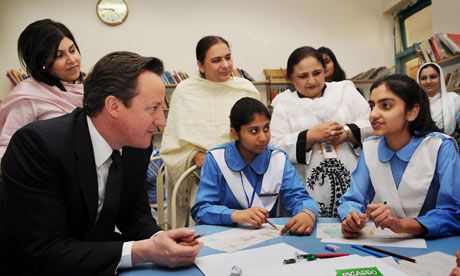
David Cameron has told the Pakistan elite that they have to start paying more tax and cut out government waste and weakness if the British public are to back his plans to pour £650m in UK aid into Pakistani schools.
Pakistan is now to become the single largest recipient of UK aid, but Cameron issued his warning in a wide-ranging speech in Islamabad, setting out his plans for a fresh start with the Pakistan government after a turbulent year in which he criticised them for "facing both ways" on terrorism.
The prime minister is keen to put the relationship on a more even footing and move away from the previous stance encapsulated in the phrase "Pakistan must do more".
He said the British people would need convincing that every penny of the aid designed to help recruit 90,000 extra teachers and put 4 million children into education was going to the right places.
He added: "My job is made more difficult when people in Britain look at Pakistan, a country that receives millions of pounds of our aid money, and see weaknesses in terms of government capacity and waste."
He pointed out that Pakistan "currently spends only 1.5% of its GDP on education and, what's more, you have one of the lowest tax to GDP ratios in the world".
He said the Pakistan was simply "not raising the resources necessary to pay for things that a modern state and people require".
The Pakistani fiscal position was a serious one because "too few people pay tax. Too many of your richest people are getting away without paying much tax at all – and that's not fair", he said.
He said this tax avoidance was neither fair "on ordinary Pakistanis, who suffer at the sharpest end of this weak governance, or on British taxpayers, who are contributing to Pakistan's future".
Cameron is acutely aware that he is taking a risk in increasing aid to a country that is seen as both corrupt and the source of the biggest terrorist threat to the UK. Pakistan is also buying six submarines from China.
But he claimed the 17 million Pakistanis of school age not in education represented an emergency, adding that it cost the country more per year than a flood such as the one that hit last year. He also said such an education gap represented a breeding ground for extremism.
He also defended the war in Libya, saying it was not an attack on Islam and pointing out that, as in Afghanistan, Britain was there as part of a coalition and under a UN mandate.
Although he praised Pakistan for having fought hard against terrorism, he urged a wider crackdown in North Waziristan, saying: "It's right that neither the Pakistan army nor Nato forces must ever tolerate sanctuaries for people plotting violence."
His remarks masked Pakistan's anger over the use of US drones to bomb terrorist cells in North Waziristan, on the border with Afghanistan, and the lack of action by the army to send troops in.
Britain's imperial past
Cameron later sparked controversy about Britain's imperial past by claiming it was responsible for many of the world's problems.
He made his remark as a semi-jocular aside at the end of a question and answer session at a university in Islamabad.
Asked what Britain might be able to do settle the war in Kashmir, he replied: "I don't want to try to insert Britain in some leading role where, as with so many of the world's problems, we are responsible for the issue in the first place."
The left has normally been associated with the cringe about Britain's past, and Cameron wrote two years ago that the last Conservative government "gave the country a new confidence that we weren't the sick man of Europe".
Cameron has been one of many British prime ministers that has felt forced to apologise for historic misdemeanours including Bloody Sunday and, as Conservative opposition leader, for Britain's role in apartheid in South Africa.
Tony Blair, worried by the prospect of compensation claims, apologised for the potato famine and expressed his deep sorrow over slavery.
David Cameron has told the Pakistan elite that they have to start paying more tax and cut out government waste and weakness if the British public are to back his plans to pour £650m in UK aid into Pakistani schools.
Pakistan is now to become the single largest recipient of UK aid, but Cameron issued his warning in a wide-ranging speech in Islamabad, setting out his plans for a fresh start with the Pakistan government after a turbulent year in which he criticised them for "facing both ways" on terrorism.
The prime minister is keen to put the relationship on a more even footing and move away from the previous stance encapsulated in the phrase "Pakistan must do more".
He said the British people would need convincing that every penny of the aid designed to help recruit 90,000 extra teachers and put 4 million children into education was going to the right places.
He added: "My job is made more difficult when people in Britain look at Pakistan, a country that receives millions of pounds of our aid money, and see weaknesses in terms of government capacity and waste."
He pointed out that Pakistan "currently spends only 1.5% of its GDP on education and, what's more, you have one of the lowest tax to GDP ratios in the world".
He said the Pakistan was simply "not raising the resources necessary to pay for things that a modern state and people require".
The Pakistani fiscal position was a serious one because "too few people pay tax. Too many of your richest people are getting away without paying much tax at all – and that's not fair", he said.
He said this tax avoidance was neither fair "on ordinary Pakistanis, who suffer at the sharpest end of this weak governance, or on British taxpayers, who are contributing to Pakistan's future".
Cameron is acutely aware that he is taking a risk in increasing aid to a country that is seen as both corrupt and the source of the biggest terrorist threat to the UK. Pakistan is also buying six submarines from China.
But he claimed the 17 million Pakistanis of school age not in education represented an emergency, adding that it cost the country more per year than a flood such as the one that hit last year. He also said such an education gap represented a breeding ground for extremism.
He also defended the war in Libya, saying it was not an attack on Islam and pointing out that, as in Afghanistan, Britain was there as part of a coalition and under a UN mandate.
Although he praised Pakistan for having fought hard against terrorism, he urged a wider crackdown in North Waziristan, saying: "It's right that neither the Pakistan army nor Nato forces must ever tolerate sanctuaries for people plotting violence."
His remarks masked Pakistan's anger over the use of US drones to bomb terrorist cells in North Waziristan, on the border with Afghanistan, and the lack of action by the army to send troops in.
Britain's imperial past
Cameron later sparked controversy about Britain's imperial past by claiming it was responsible for many of the world's problems.
He made his remark as a semi-jocular aside at the end of a question and answer session at a university in Islamabad.
Asked what Britain might be able to do settle the war in Kashmir, he replied: "I don't want to try to insert Britain in some leading role where, as with so many of the world's problems, we are responsible for the issue in the first place."
The left has normally been associated with the cringe about Britain's past, and Cameron wrote two years ago that the last Conservative government "gave the country a new confidence that we weren't the sick man of Europe".
Cameron has been one of many British prime ministers that has felt forced to apologise for historic misdemeanours including Bloody Sunday and, as Conservative opposition leader, for Britain's role in apartheid in South Africa.
Tony Blair, worried by the prospect of compensation claims, apologised for the potato famine and expressed his deep sorrow over slavery.
Revival of Red-pass to cross Pak-Afghan border Asks donor agencies to provide for refugees, compensate locals

The Khyber Pakhtunkhwa Minister for Information and Public Relations Mian Iftikhar Hussain said that the people in Afghanistan and Khyber Pakhtunkhwa had common culture, therefore, there is need for more simplifying the process of traveling and suggested that if possible the old system of Red -pass should be re-introduced. He urged international donor agencies to consider Afghan refugees as refugees and provide them the facilities of health, education and other basic amenities of life in accordance with international standards so that they did not burden the local economy. He expressed these views on Thursday while presiding over a meeting regarding the management and repatriation strategy of Afghan. He also urged the international donor agencies to mobilize additional support for the local communities in Pakistan, especially in Khyer Pakhtunkhwa, who had been generously hosting millions of Afghan refugees for the last three decades. This would help minimize the problems of illiteracy and militancy in this region. The Provincial Ministers; Arshad Abdullah, Sitara Ayaz, United Nations High Commission for Refugees (UNHCR) Country Head, Mengesha Kebede, Joint Secretary SAFRON, Provincial Secretaries Information, Home, FATA and representatives of police, Frontier Corp and FIA were also present on this occasion. The Minister said that restoration of peace and tranquility in Peshawar was linked with peace in Afghanistan and until peace was restored in Afghanistan, the complete repatriation of Afghan refugees was practically impossible. He said that the people in Afghanistan and Khyber Pakhtunkhwa had common culture, therefore, there is need for more simplifying the process of traveling and if possible the old system of Red -pass should be re-introduced. Arshad Abdullah while addressing on the occasion said that if the Afghan refugees wanted to live here, we should think about a law to give them legal status and accept them with open heart. Ms. Sitara Ayaz said that the provincial government would extend full cooperation to UNHCR in the process of repatriation and data collection of refuges. Mengesha Kebede thanked Pakistani government for hosting millions of Afghan refugees on their soil and extending all kinds of basic facilities to them. He said that UNHCR has mobilized additional support for local communities in Pakistan that generously host millions of Afghan refugees for the last three decades. He said in this regard, during this year, projects worth nearly 8.5 million USD of infrastructural development, water and sanitation, health and education, had been initiated through the refugee affected and hosting areas. He added the voluntary return operation resumed this March after the winter break. So far, 2,500 individuals have gone back home to Afghanistan. At least 3.7 million Afghans have returned home from Pakistan with UNHCR's help since 2002.
Gwadar: Pakistan's new Great Game
Rina Saeed Khan

Miles away from the war on terror being fought in Pakistan's north on the border with Afghanistan is another insurgency whose hub is the port city of Gwadar,
located near Iran on the Makran coast. Unlike the battle against the Taliban, this uprising receives little international attention, although it is set against the backdrop of competing superpower interests, reminiscent of the Great Game when Russia and the British empire fought for control over this region.
Eight years ago, the dream was for the small fishing port of Gwadar in Pakistan's Balochistan province to be transformed into a duty-free port and a free economic zone. The hope was that Gwadar would become a regional hub of shipping, commercial and industrial activities, providing a link between Pakistan and the vast oil and gas reserves of central Asia.
A real estate frenzy followed as land was bought from locals at exorbitant prices. Billboards proclaiming future housing estates and resorts were put up overnight and work began on the port with Chinese help. A two-lane highway linking Gwadar with Karachi was completed in record time. Today, the port has been finished and is ready for ships but Gwadar looks more like a ghost town than a gold-rush town. Empty plots of land still await the buildings that were promised but never built. Oddly enough, instead of handing the port over to the Chinese government, it was leased out to the Singapore government three years ago. It is only used at half its capacity and the cranes are already getting rusty from lack of use.
Located near an important shipping lane, the deep seaport was built by the China Harbour Engineering Company Group. The Chinese government invested heavily in this project, up to $200m some say, so that landlocked western China could benefit from access to the sea. As an emerging superpower hungry for energy, China needs access to the oil and gas rich Central Asian states. The Chinese have also been keen to assist Pakistan in building other roads to acquire a 3,500km link between Kashgar (near the border with Pakistan) and Gwadar.
They are currently helping the Pakistan government to widen the Karakoram highway that connects Islamabad to China through Pakistan's high mountain ranges. It appears that there is a long-term plan to eventually connect the Karakoram highway with Gwadar. This is upsetting the other emerging superpower of the region, India, who does not want China's security establishment to have safe passage to the Arabian Sea. The fear they have been articulating is that Gwadar might become a naval outpost for the Chinese.
The local people, who hoped to benefit from the construction of the port, are crushed by the disappointing turn of events. "We were expecting change to come," says Asghar Shah, a local resident who works for an NGO. "But it was a big let down – we are victims of the new Great Game." The government of Pakistan was allegedly pressured not to hand the port over to the Chinese. In fact, the Americans eye Gwadar as a potential military base, given the proximity of Iran. The locals are reluctant to criticise their government's handling of Gwadar, though. "People disappear in Gwadar – their bodies are found dumped in a remote area a few days or weeks later. No one knows who is behind it," says Asghar Shah, refusing to speculate further.
There is a more immediate problem at present. The Baloch nationalists are opposed to any development in Gwadar because they say these mega projects will marginalise the local Baloch population. Balochistan's development record is dismal. Covering nearly 350,000 square kilometres, it is by far the largest province in the country but houses less than 7% of Pakistan's population. The basic quality of life indicators are abysmal. On-tap drinking water is available to less than 5% of the population. The female literacy rate is under 15%.
The Baloch people are demanding more autonomy for the province. For decades, Pakistan's Balochistan province has been the scene of sporadic clashes between government troops and guerrillas who are fighting for autonomy. In the past few years, the rebels have again stepped up their attacks. Government troops and installations across the province have come under rocket attack and bombings, especially Gwadar town. Last month, seven army personnel and three labourers building a road near the Iranian border were killed by unidentified gunmen. The Baloch nationalists fear that if Gwadar grows into a modern city, the Baloch people will become a minority in their own province. No one is quite sure who is funding them, but there are rumours that they get support from India.
Gwadar is today a deserted town where outsiders are looked upon with suspicion. Most of the educated young people have moved out to look for jobs in the other big towns and cities of Pakistan. The new and luxurious Pearl Continental Hotel built on a cliff overlooking the port and the town below is empty – it has been closed down for "renovations". The road leading to the small airport outside the town is heavily guarded by security forces. There are no tourists now – most have been scared off by the attacks. Foreigners do not dare to venture here either.
For centuries, Gwadar has also been a smuggler's paradise – it was once infamous for its human trafficking in slaves and it is still a place where illegal immigrants are smuggled into the Middle East and beyond. The idea had been to capitalise on its location, but the dream of Gwadar remains just that. Pakistan's strategic location as a gateway to the oil and gas riches of central Asia means that it will remain a battleground for competing interests for the foreseeable future. The Great Game continues well into the 21st century.

Miles away from the war on terror being fought in Pakistan's north on the border with Afghanistan is another insurgency whose hub is the port city of Gwadar,

located near Iran on the Makran coast. Unlike the battle against the Taliban, this uprising receives little international attention, although it is set against the backdrop of competing superpower interests, reminiscent of the Great Game when Russia and the British empire fought for control over this region.
Eight years ago, the dream was for the small fishing port of Gwadar in Pakistan's Balochistan province to be transformed into a duty-free port and a free economic zone. The hope was that Gwadar would become a regional hub of shipping, commercial and industrial activities, providing a link between Pakistan and the vast oil and gas reserves of central Asia.
A real estate frenzy followed as land was bought from locals at exorbitant prices. Billboards proclaiming future housing estates and resorts were put up overnight and work began on the port with Chinese help. A two-lane highway linking Gwadar with Karachi was completed in record time. Today, the port has been finished and is ready for ships but Gwadar looks more like a ghost town than a gold-rush town. Empty plots of land still await the buildings that were promised but never built. Oddly enough, instead of handing the port over to the Chinese government, it was leased out to the Singapore government three years ago. It is only used at half its capacity and the cranes are already getting rusty from lack of use.
Located near an important shipping lane, the deep seaport was built by the China Harbour Engineering Company Group. The Chinese government invested heavily in this project, up to $200m some say, so that landlocked western China could benefit from access to the sea. As an emerging superpower hungry for energy, China needs access to the oil and gas rich Central Asian states. The Chinese have also been keen to assist Pakistan in building other roads to acquire a 3,500km link between Kashgar (near the border with Pakistan) and Gwadar.
They are currently helping the Pakistan government to widen the Karakoram highway that connects Islamabad to China through Pakistan's high mountain ranges. It appears that there is a long-term plan to eventually connect the Karakoram highway with Gwadar. This is upsetting the other emerging superpower of the region, India, who does not want China's security establishment to have safe passage to the Arabian Sea. The fear they have been articulating is that Gwadar might become a naval outpost for the Chinese.
The local people, who hoped to benefit from the construction of the port, are crushed by the disappointing turn of events. "We were expecting change to come," says Asghar Shah, a local resident who works for an NGO. "But it was a big let down – we are victims of the new Great Game." The government of Pakistan was allegedly pressured not to hand the port over to the Chinese. In fact, the Americans eye Gwadar as a potential military base, given the proximity of Iran. The locals are reluctant to criticise their government's handling of Gwadar, though. "People disappear in Gwadar – their bodies are found dumped in a remote area a few days or weeks later. No one knows who is behind it," says Asghar Shah, refusing to speculate further.
There is a more immediate problem at present. The Baloch nationalists are opposed to any development in Gwadar because they say these mega projects will marginalise the local Baloch population. Balochistan's development record is dismal. Covering nearly 350,000 square kilometres, it is by far the largest province in the country but houses less than 7% of Pakistan's population. The basic quality of life indicators are abysmal. On-tap drinking water is available to less than 5% of the population. The female literacy rate is under 15%.
The Baloch people are demanding more autonomy for the province. For decades, Pakistan's Balochistan province has been the scene of sporadic clashes between government troops and guerrillas who are fighting for autonomy. In the past few years, the rebels have again stepped up their attacks. Government troops and installations across the province have come under rocket attack and bombings, especially Gwadar town. Last month, seven army personnel and three labourers building a road near the Iranian border were killed by unidentified gunmen. The Baloch nationalists fear that if Gwadar grows into a modern city, the Baloch people will become a minority in their own province. No one is quite sure who is funding them, but there are rumours that they get support from India.
Gwadar is today a deserted town where outsiders are looked upon with suspicion. Most of the educated young people have moved out to look for jobs in the other big towns and cities of Pakistan. The new and luxurious Pearl Continental Hotel built on a cliff overlooking the port and the town below is empty – it has been closed down for "renovations". The road leading to the small airport outside the town is heavily guarded by security forces. There are no tourists now – most have been scared off by the attacks. Foreigners do not dare to venture here either.
For centuries, Gwadar has also been a smuggler's paradise – it was once infamous for its human trafficking in slaves and it is still a place where illegal immigrants are smuggled into the Middle East and beyond. The idea had been to capitalise on its location, but the dream of Gwadar remains just that. Pakistan's strategic location as a gateway to the oil and gas riches of central Asia means that it will remain a battleground for competing interests for the foreseeable future. The Great Game continues well into the 21st century.
Jimmy Carter on Women's Rights
Jimmy Carter discusses the unrest in Ivory Coast and the impact of the Arab Spring on women's rights.
Will Indian protests end corruption?
It is being called India's version of Tahrir Square after Egypt's protests that toppled the president. Jantar mantar, the country's historic stretch, is flooded with thousands of Indians. They're singing, chanting, dancing, painting, holding up placards in 45 degrees heat - all for one cause: corruption.
"Politicians are getting richer and we're paying the price for it. We don't have jobs and while we're suffering they're living it up," says 22-year-old Swati, a university graduate. She's supposed to be the face of 'shining India', where opportunities are available in plenty, but her presence in these protests is defying that image.
In the last few months, ordinary Indians have had enough. A barrage of corruption scandals revealed how billions, not millions, of dollars were pocketed by politicians in collusion with businessmen and beauracrats. From favouring contractors in the Commonwealth games to selling under-priced telecommunication licences to favoured companies - Indians have seen it all. Until now, people had no outlet to vent their anger or frustration.
Then came Anna Hazare, a 72-year-old former army soldier. He turned to social activism after seeing firsthand how corrupt officials exploited people in his village in the 1960s. Since then he's been seen as one of those activists who actually walk the talk. Now he's become the face of this rising anger.
He's pledged to 'fast until death' (this is the land of Gandhi, after all) until the government accepts a new anti-graft piece of legislation. And his resolve seems to be working. An entire nation's collective conscience seems to have been pricked with this man's actions.
"Anna is an inspiration for all of us. We need less talk and more action before our country is completely ruined. This is not the freedom we fought for," 52-year-old Raj Shekhar tells me.
He's travelled all the way from Lucknow in India's northern state of Uttar Pradesh to join Anna's growing caravan of soldiers. And he says he's not going to give up.
Others are joining as well. From Mumbai to Chennai, from New Delhi to Ahemdabad thousands are finally speaking out.
The root of this issue remains corruption. It's endemic in every indian institution. From the police to the state hospitals people need to pay up or remain deprived.
So while people clearly have had enough of this and much of India seems to have woken up, the question remains whether it's enough to bring about a real revolution. And whether the establishment is really listening. Else, Anna's resolve may just go to a waste.
"Politicians are getting richer and we're paying the price for it. We don't have jobs and while we're suffering they're living it up," says 22-year-old Swati, a university graduate. She's supposed to be the face of 'shining India', where opportunities are available in plenty, but her presence in these protests is defying that image.
In the last few months, ordinary Indians have had enough. A barrage of corruption scandals revealed how billions, not millions, of dollars were pocketed by politicians in collusion with businessmen and beauracrats. From favouring contractors in the Commonwealth games to selling under-priced telecommunication licences to favoured companies - Indians have seen it all. Until now, people had no outlet to vent their anger or frustration.
Then came Anna Hazare, a 72-year-old former army soldier. He turned to social activism after seeing firsthand how corrupt officials exploited people in his village in the 1960s. Since then he's been seen as one of those activists who actually walk the talk. Now he's become the face of this rising anger.
He's pledged to 'fast until death' (this is the land of Gandhi, after all) until the government accepts a new anti-graft piece of legislation. And his resolve seems to be working. An entire nation's collective conscience seems to have been pricked with this man's actions.
"Anna is an inspiration for all of us. We need less talk and more action before our country is completely ruined. This is not the freedom we fought for," 52-year-old Raj Shekhar tells me.
He's travelled all the way from Lucknow in India's northern state of Uttar Pradesh to join Anna's growing caravan of soldiers. And he says he's not going to give up.
Others are joining as well. From Mumbai to Chennai, from New Delhi to Ahemdabad thousands are finally speaking out.
The root of this issue remains corruption. It's endemic in every indian institution. From the police to the state hospitals people need to pay up or remain deprived.
So while people clearly have had enough of this and much of India seems to have woken up, the question remains whether it's enough to bring about a real revolution. And whether the establishment is really listening. Else, Anna's resolve may just go to a waste.
U.S. report slams Bahrain for repressing Shi'ites

Sunni-ruled Bahrain was guilty of human rights abuses including arbitrary detentions, censorship and discrimation against majority Shi'ites before its violent crackdown on street protests, the United States said on Friday.Bahrain last month saw the worst sectarian clashes since the 1990s after protesters, inspired by uprisings in Tunisia and Egypt, took to the streets, prompting the government to impose martial law and invite in troops from Sunni-ruled neighbors.
"Discrimination on the basis of gender, religion, nationality, and sect, especially against the Shia (Shi'ite) majority population, persisted," the U.S. State Department said in its Human Rights Report for 2010.
"Authorities arbitrarily arrested activists, journalists, and other citizens and detained some individuals incommunicado... The government restricted civil liberties, including freedoms of speech, press, assembly, association, and some religious practices," it said.
The report cited allegations of mistreatment and torture, especially of activists and said Shi'ites were under-represented in the civil service, police and security forces.
The government censored stories especially those related to sectarianism, national security, or criticism of the royal family, the Saudi royal family, or the judiciary, it said.
"According to some members of the media, government officials contacted editors directly and asked them to stop writing about certain subjects or asked them not to publish a press release or a story," the U.S. report said.
Shi'ites, who make up at least 60 percent of the population, have long complained of discrimination when competing for jobs and services. They are demanding better representation and a constitutional monarchy, but radicals calling for an overthrow of the monarchy alarmed the Sunni minority.
On Friday, Human Rights Watch denounced what it called arbitrary detentions and said freed detainees interviewed reported incidents of beatings and abuse. The U.S.-based rights group called on Bahrain to give a reason for all detentions.
Afghan refugees suffer, thanks to world apathy
Khyber Pakhtunkhwa Information Minister Mian Iftikhar Hussain on Thursday said that sufferings of the Afghan refugees in Pakistan had increased for the last many years owing to apathy of the international community, which would have a negative impact on social, economic and law and order situation in the province.

Speaking at a roundtable conference held at a hotel on the ‘Management and Repatriation Strategy of Afghan Refugees in Pakistan (AMRS)’, the minister said the government wanted repatriation of Afghan refugees in a honourable way but at the same time there should also be a proper mechanism under which the peoples of Pakistan and Afghanistan should continue their trade and business.
“The Afghans living under proper legal documents pose no threats to our economy and the security,” he said, adding that the under-privileged and illegal Afghan national could become a threat to the law and order. He said that the Khyber Pakhtunkhwa and tribal areas, bordering Afghanistan, had been adversely affected during the Afghan war due to the influx of refugees.
In his speech, Minister for Law and Parliamentary Affairs Barrister Arshad Abdullah said that there should be a proper law for providing permanent settlement to those Afghans who had been living in Pakistan for decades. He said the volunteer repatriation processes till near past had proved to be a futile exercise as the Afghan families were either reluctant to go back to their homeland or manage to come back to Pakistan soon after entertaining the UNHCR-sponsored repatriation.
Provincial Minister for Social Welfare and Women Development Sitara Ayaz also addressed the conference. The conference was told that about 40 to 50 per cent Afghans living in Pakistan did not want to go back for unstable security situation, etc.
About 70 per cent of the Afghans living in Pakistan belonged to five bordering provinces of Afghanistan including Nangarhar, Kunar, Khost, Paktia and Paktika. As AMRS initiative, the UNHCR has mobilised additional support for local communities in Pakistan that generously host millions of Afghan refugees for the last three decades.
In this regard, during this year, projects worth nearly $8.5 million of infrastructure development, water and sanitation, health and education, have been initiated through the Refugee-Affected and Hosting Areas (RAHA).
The voluntary return operation resumed this March after the winter break. So far, 2,500 individuals have gone back home to Afghanistan. At least 3.7 million Afghans have returned home from Pakistan with the help of the UNHCR since 2002.
Speaking at a roundtable conference held at a hotel on the ‘Management and Repatriation Strategy of Afghan Refugees in Pakistan (AMRS)’, the minister said the government wanted repatriation of Afghan refugees in a honourable way but at the same time there should also be a proper mechanism under which the peoples of Pakistan and Afghanistan should continue their trade and business.
“The Afghans living under proper legal documents pose no threats to our economy and the security,” he said, adding that the under-privileged and illegal Afghan national could become a threat to the law and order. He said that the Khyber Pakhtunkhwa and tribal areas, bordering Afghanistan, had been adversely affected during the Afghan war due to the influx of refugees.
In his speech, Minister for Law and Parliamentary Affairs Barrister Arshad Abdullah said that there should be a proper law for providing permanent settlement to those Afghans who had been living in Pakistan for decades. He said the volunteer repatriation processes till near past had proved to be a futile exercise as the Afghan families were either reluctant to go back to their homeland or manage to come back to Pakistan soon after entertaining the UNHCR-sponsored repatriation.
Provincial Minister for Social Welfare and Women Development Sitara Ayaz also addressed the conference. The conference was told that about 40 to 50 per cent Afghans living in Pakistan did not want to go back for unstable security situation, etc.
About 70 per cent of the Afghans living in Pakistan belonged to five bordering provinces of Afghanistan including Nangarhar, Kunar, Khost, Paktia and Paktika. As AMRS initiative, the UNHCR has mobilised additional support for local communities in Pakistan that generously host millions of Afghan refugees for the last three decades.
In this regard, during this year, projects worth nearly $8.5 million of infrastructure development, water and sanitation, health and education, have been initiated through the Refugee-Affected and Hosting Areas (RAHA).
The voluntary return operation resumed this March after the winter break. So far, 2,500 individuals have gone back home to Afghanistan. At least 3.7 million Afghans have returned home from Pakistan with the help of the UNHCR since 2002.
Over 300 suicide bombers being trained in Waziristan

The arrested bomber of the Sakhi Sarwar shrine in Dera Ghazi Khan, apologised to the Pakistani nation on Friday and said that he had been told to bomb the areas of non-Muslims.
During investigations, Omar told officials that there were 350 people receiving suicide bombing training in the militant hideouts of Waziristan. He said that these included Uzbeks, Tajiks, Arabs and Punjabis.
Omar said that he used to be blindfolded and taken for training. He said that the in-charge of the camp was Sangeen Khan who used to constantly be away on travel.
He also disclosed that the second bombing was supposed to take place between the rescue and media teams.
Protesters shot dead in southern Yemen
Two people have been killed after Yemeni security forces fired at protesters in the southern Yemeni city of Taiz, leaving more than two dozen others wounded.
Hospital sources said about 200 people were hurt after inhaling tear gas during Friday's protests..
Witnesses reported gunshots near the site of an anti-government sit-in in the flashpoint city to the south of Sanaa, while dozens of others suffered from bullet wounds or tear gas inhalation.
The protesters had been carrying the bodies of five people killed earlier in the week to their gravesites when they ran into security forces.
The fresh clashes on Friday between anti-government protesters and the police came as Ali Abdullah Saleh, the Yemeni president, rejected a new deal for him to leave after 32 years in power.
Some 21 people have died in clashes this week in Taiz and the Red Sea port of Hudaida.
In the port city of Aden, once the capital of an independent south, thousands of anti-government protesters gathered peacefully and in Hudaida, some 15,000 gathered to mourn protester deaths and demand Saleh step down.
Al Jazeera's special correspondent in Sanaa who is not being named for security reasons said scenes of Friday's pro-Saleh demonstrations in front of the presidential palace was very similar to those seen in recent weeks.
"It is very difficult for Al Jazeera to go anywhere near those protests, we have to rely on what we're seeing on Yemen state television … we can see the mass crowds turning out week after week.
"But according to some people in Change Square, where the rival protests are, those people are not there because they genuinely support Saleh but because they are either government forces dressed in civilian clothes or are being paid by the ruling party."
Our special correspondent says such accusations have been going around for weeks, with pro-democracy protesters saying that the more Saleh loses control the more he is seen firing on anti-government protesters to make sure his own supporters continue to attract a large crowds.
Protesters have been calling since January for the departure of Saleh, who has been in power since 1978.
Offer rejected
Saleh initially accepted an offer by Saudi Arabia and other Gulf Arab states trying to broker an end to bloody protests and hold talks with the opposition.
But he later rejected the plan for his exit in a speech broadcast on state television on Friday.
"We were born free, and we have free will, and they have to respect our wishes. We reject any coup against democracy, the constitution and our freedom," he told supporters in the capital.Saleh said: "Our power comes from the power of our great people, not from Qatar, not from anyone else. This is blatant interference in Yemeni affairs."
Sheikh Hamad bin Jassem Al-Thani, Qatar's prime minister, said on Thursday that members of the Gulf Co-operation Council "hope to reach a deal with the Yemeni president to step down."
However, Abu Bakr al-Kurbi, Yemen's foreign minister, said Yemen's government is studying an initiative by Gulf Arab states to end a months-long confrontation with anti-regime protesters, in a statement published on Friday.
Opposition groups had welcomed the Gulf countries' mediation offer.
Meanwhile, tens of thousands of Yemenis have converged in the capital for rival demonstrations - with some demanding the president's ouster and others showing their support.
Police and army units were deployed to prevent any friction between the two sides.
More than 120 people have been killed since Yemen's protests calling for an end to Saleh's rule began on February 11, inspired by popular uprisings in Tunisia and Egypt.
The six-nation Gulf Co-operation Council has invited Saleh and the opposition to a mediation session in Saudi Arabia. But Saleh's government described the proposal as unconstitutional.
Hospital sources said about 200 people were hurt after inhaling tear gas during Friday's protests..
Witnesses reported gunshots near the site of an anti-government sit-in in the flashpoint city to the south of Sanaa, while dozens of others suffered from bullet wounds or tear gas inhalation.
The protesters had been carrying the bodies of five people killed earlier in the week to their gravesites when they ran into security forces.
The fresh clashes on Friday between anti-government protesters and the police came as Ali Abdullah Saleh, the Yemeni president, rejected a new deal for him to leave after 32 years in power.
Some 21 people have died in clashes this week in Taiz and the Red Sea port of Hudaida.
In the port city of Aden, once the capital of an independent south, thousands of anti-government protesters gathered peacefully and in Hudaida, some 15,000 gathered to mourn protester deaths and demand Saleh step down.
Al Jazeera's special correspondent in Sanaa who is not being named for security reasons said scenes of Friday's pro-Saleh demonstrations in front of the presidential palace was very similar to those seen in recent weeks.
"It is very difficult for Al Jazeera to go anywhere near those protests, we have to rely on what we're seeing on Yemen state television … we can see the mass crowds turning out week after week.
"But according to some people in Change Square, where the rival protests are, those people are not there because they genuinely support Saleh but because they are either government forces dressed in civilian clothes or are being paid by the ruling party."
Our special correspondent says such accusations have been going around for weeks, with pro-democracy protesters saying that the more Saleh loses control the more he is seen firing on anti-government protesters to make sure his own supporters continue to attract a large crowds.
Protesters have been calling since January for the departure of Saleh, who has been in power since 1978.
Offer rejected
Saleh initially accepted an offer by Saudi Arabia and other Gulf Arab states trying to broker an end to bloody protests and hold talks with the opposition.
But he later rejected the plan for his exit in a speech broadcast on state television on Friday.
"We were born free, and we have free will, and they have to respect our wishes. We reject any coup against democracy, the constitution and our freedom," he told supporters in the capital.Saleh said: "Our power comes from the power of our great people, not from Qatar, not from anyone else. This is blatant interference in Yemeni affairs."
Sheikh Hamad bin Jassem Al-Thani, Qatar's prime minister, said on Thursday that members of the Gulf Co-operation Council "hope to reach a deal with the Yemeni president to step down."
However, Abu Bakr al-Kurbi, Yemen's foreign minister, said Yemen's government is studying an initiative by Gulf Arab states to end a months-long confrontation with anti-regime protesters, in a statement published on Friday.
Opposition groups had welcomed the Gulf countries' mediation offer.
Meanwhile, tens of thousands of Yemenis have converged in the capital for rival demonstrations - with some demanding the president's ouster and others showing their support.
Police and army units were deployed to prevent any friction between the two sides.
More than 120 people have been killed since Yemen's protests calling for an end to Saleh's rule began on February 11, inspired by popular uprisings in Tunisia and Egypt.
The six-nation Gulf Co-operation Council has invited Saleh and the opposition to a mediation session in Saudi Arabia. But Saleh's government described the proposal as unconstitutional.
Thursday, April 7, 2011
Bahrain hospital abuse


An international humanitarian organization said Thursday that Bahraini authorities turned hospitals into "places to be feared" during a deadly crackdown on anti-government protesters in the Gulf country.

Doctors Without Borders condemned the arrest of injured opposition supporters being treated at medical facilities. In a statement, the organization said Bahrain's security forces used hospitals and health centers as "bait to identify and arrest those (protesters) who dare seek treatment."
The capital's Salmaniya medical complex, in particular, was at the center of the country's turmoil, treating hundreds of injured demonstrators. The military took control of the facility, and doctors and patients there said soldiers and policemen interrogated and detained them.
Bahrain declared emergency rule last month and cracked down on protests by the country's Shiite majority against the Sunni monarchy. The protests have called for sweeping political reforms and equal rights for Shiites. At least 27 people were killed.
Hundreds have been injured in clashes with riot police and security sweeps.
On Thursday, Bahrain's Crown Prince Salman bin Hamad Al Khalifa warned the government's opponents against trying to restart their demonstrations, saying they were a small group and accusing them of trying to create sectarian divisions on the island.
"Those who seek to cleave our society into two will not be dealt with easily," Al Khalifa said in a short televised speech. "The story of (Bahrain's) success that we are living cannot be corrupted by a small group that seek its fall."
The crown prince also said the monarchy would press on with reforms, but did not provide specific examples.
Syrian president attempts to appease minority Kurds
aljazeera.net
Bashar al Assad,
the Syrian president, has issued a decree granting nationality to thousands of Kurds living in the eastern al-Hasaka region as part of efforts to ease resentment over nearly five decades of strict Baathist rule.
It was not immediately clear how many would get nationality, but the announcment on Thursday is due to affect around 150,000 Kurds currently registered as foreigners as a result of a 1962 census in the region.
But Kurdish leader Habib Ibrahim said that Kurds would press their non-violent struggle for civil rights and democracy to replace autocratic rule despite Assad's decision.
"Our cause is democracy for the whole of Syria. Citizenship is the right of every Syrian. It is not a favour. It is not the right of anyone to grant," Ibrahim, who heads the Democratic Unity Kurdish Party, told the Reuters news agency.
Governor sacked
State television also said that Assad had fired the governor of Homs province, one of the areas affected by recent protests calling for greater freedoms. Replacing the governor was one of the main demands of protesters last week.
In another move to appease the ethnic Kurds, Syrian Observatory for Human Rights said 48 Kurds were released on Tuesday, more than a year after they were arrested in the eastern city of Raqqa.
The Syrian leader also met provincial leaders from the Kurdish east of the country earlier in the week to listen to their demands, the official news agency reported.
Assad cracked down on ethnic Kurds, who make up about 10-15 per cent of Syria's 20 million people, after they launched violent demonstrations against the state in 2004.
Recent popular protests have shaken mainly Sunni Muslim Syria for nearly three weeks, with demonstrators demanding an end to emergency law and one-party rule by the Baath Party.
The pro-democracy protests first erupted in the southern city of Deraa, where many Sunni Muslim tribes resent the power and wealth accumulated by the Alawites, an offshoot sect of Shia Islam.
Syria's ruling hierarchy has not tolerated any dissent and has used emergency laws to justify arbitrary arrests, including those of other minorities such as Kurds who say they are discriminated against.
In a move to mollify conservative Muslims, Syria also lifted on Wednesday a ban on teachers wearing the full face veil and ordered the closure of the country's only casino.
Bashar al Assad,
the Syrian president, has issued a decree granting nationality to thousands of Kurds living in the eastern al-Hasaka region as part of efforts to ease resentment over nearly five decades of strict Baathist rule.
It was not immediately clear how many would get nationality, but the announcment on Thursday is due to affect around 150,000 Kurds currently registered as foreigners as a result of a 1962 census in the region.
But Kurdish leader Habib Ibrahim said that Kurds would press their non-violent struggle for civil rights and democracy to replace autocratic rule despite Assad's decision.
"Our cause is democracy for the whole of Syria. Citizenship is the right of every Syrian. It is not a favour. It is not the right of anyone to grant," Ibrahim, who heads the Democratic Unity Kurdish Party, told the Reuters news agency.
Governor sacked
State television also said that Assad had fired the governor of Homs province, one of the areas affected by recent protests calling for greater freedoms. Replacing the governor was one of the main demands of protesters last week.
In another move to appease the ethnic Kurds, Syrian Observatory for Human Rights said 48 Kurds were released on Tuesday, more than a year after they were arrested in the eastern city of Raqqa.
The Syrian leader also met provincial leaders from the Kurdish east of the country earlier in the week to listen to their demands, the official news agency reported.
Assad cracked down on ethnic Kurds, who make up about 10-15 per cent of Syria's 20 million people, after they launched violent demonstrations against the state in 2004.
Recent popular protests have shaken mainly Sunni Muslim Syria for nearly three weeks, with demonstrators demanding an end to emergency law and one-party rule by the Baath Party.
The pro-democracy protests first erupted in the southern city of Deraa, where many Sunni Muslim tribes resent the power and wealth accumulated by the Alawites, an offshoot sect of Shia Islam.
Syria's ruling hierarchy has not tolerated any dissent and has used emergency laws to justify arbitrary arrests, including those of other minorities such as Kurds who say they are discriminated against.
In a move to mollify conservative Muslims, Syria also lifted on Wednesday a ban on teachers wearing the full face veil and ordered the closure of the country's only casino.
Blame Hamid Karzai for massacre in Mazar
www.surgar.net
The Koran protests in Afghanistan began with an Iranian propaganda initiative that was set in motion on March 24, a full week before the Massacre in Mazar. Afghan president Hamid Karzai
played a central role in the affair. The bloody skirmishing that has left at least two dozen people dead across Afghanistan has gone so far as to cast a shadow over the future of the UN’s operations in the country. In other words, it’s working.
Of all places in Afghanistan for a UN compound to be turned into a human abattoir, we’re supposed to be shocked that it would be in the contented little metropolis of Mazar-i-Sharif, the capital of the peaceful northern province of Balkh. We’re supposed to be astonished that the murderers of those seven UN workers arose from a frenzied mob at the head of a procession that started out at the city’s famous Blue Mosque.
We should not be surprised at all.
On March 24, the Iranian foreign ministry, Iran’s Lebanese proxy Hezbollah, and Karzai’s office issued simultaneous alarms about Jones’ Koran-burning. Iranian foreign ministry spokesman Ramin Mehman-Parast said the incident was part of American “hegemonic plots.” Karzai called for Jones’ arrest and prosecution.
Karzai’s statement was widely reported in Iran’s government-controlled press but got limited play even in the Afghan news media. Then the Netherlands-based BNO News got involved. After making its mark in 2007 when it sold Reuters a videotaped speech by Osama Bin Laden, BNO went on to become a popular Twitter feed and is now a low budget social-media hybrid, part press-release clearinghouse and part amateur-journalism vector. When BNO began circulating a report headlined “Afghanistan, Iran condemn Koran burning in U.S.,” the story went viral.
The first Afghan protests about the Koran-burning were staged by the Shura-e Olama-e Shiia, the Kabul-based Shiite religious council dominated by Asif Mohseni, the leading Khomeinist ayatollah in Afghanistan. Mohseni is best known for having persuaded Karzai to sign off on the incendiary Afghan “rape law” in 2009 (which effectively legalized marital rape), an event that prompted protests by Afghan women and howls of international indignation.
The Khomeinist-led Koran demonstrations in Kabul were the first that most Afghans had even heard about Jones’ vulgar escapade. (You always know it’s a Khomeinist event by the tell-tale slogan, Marg Bar Yahood—Death to the Jews). This brings us back to Mazar, to the Tomb of the Exalted where most Afghans prefer to believe that the son-in-law of the Prophet Mohammed is buried, and to the famous Blue Mosque.
From accounts of last Friday’s massacre that I’ve received from several Afghan human rights activists and journalists, what emerges is a picture of an opportunity that was just waiting for a pretext. What happened did not simply result from a protest march that began at the Blue Mosque and got terribly out of hand. . .
That’s from my piece today in Dissent.
The Washington Post provides some useful and rare insight into the distance Karzai has moved from his American benefactors, although nothing about the Khomeinist orbit within which Karzai has allowed himself to be drawn. For insight into that, all you need to do is follow the money.
There is a lot of money to follow. The Iranian payments, which officials say total millions of dollars, form what amounts to an off-the-books “presidential slush fund” that Iran fills up regularly so that Karzai can buy Afghan legislators, tribal elders and Taliban commanders. It’s quite the racket, and it has been happening under the Americans’ noses for quite some while.
Briefcases full of it. Bakshish by the barge load. And that just scratches the surface.
For an Afghan view from the front lines of the Koran-burn frenzies, here’s a report from Ehsanullah Ehsan in Kandahar. And I see that Christopher Hitchens, running on instinct alone, gets it dead to rights anyway, as usual. Karzai went out of his way to intensify mob feeling. “This caps a long period where his behavior has come to seem like a conscious collusion with warlordism, organized crime, and even with elements of the Taliban.”
Why would Karzai behave this way? Start asking that kind of question and nowhere will the discomfort be felt more acutely than in and around the White House. Well, too bad. It’s time to start asking these awkward questions, before it’s too late.
The Koran protests in Afghanistan began with an Iranian propaganda initiative that was set in motion on March 24, a full week before the Massacre in Mazar. Afghan president Hamid Karzai

played a central role in the affair. The bloody skirmishing that has left at least two dozen people dead across Afghanistan has gone so far as to cast a shadow over the future of the UN’s operations in the country. In other words, it’s working.
Of all places in Afghanistan for a UN compound to be turned into a human abattoir, we’re supposed to be shocked that it would be in the contented little metropolis of Mazar-i-Sharif, the capital of the peaceful northern province of Balkh. We’re supposed to be astonished that the murderers of those seven UN workers arose from a frenzied mob at the head of a procession that started out at the city’s famous Blue Mosque.
We should not be surprised at all.
On March 24, the Iranian foreign ministry, Iran’s Lebanese proxy Hezbollah, and Karzai’s office issued simultaneous alarms about Jones’ Koran-burning. Iranian foreign ministry spokesman Ramin Mehman-Parast said the incident was part of American “hegemonic plots.” Karzai called for Jones’ arrest and prosecution.
Karzai’s statement was widely reported in Iran’s government-controlled press but got limited play even in the Afghan news media. Then the Netherlands-based BNO News got involved. After making its mark in 2007 when it sold Reuters a videotaped speech by Osama Bin Laden, BNO went on to become a popular Twitter feed and is now a low budget social-media hybrid, part press-release clearinghouse and part amateur-journalism vector. When BNO began circulating a report headlined “Afghanistan, Iran condemn Koran burning in U.S.,” the story went viral.
The first Afghan protests about the Koran-burning were staged by the Shura-e Olama-e Shiia, the Kabul-based Shiite religious council dominated by Asif Mohseni, the leading Khomeinist ayatollah in Afghanistan. Mohseni is best known for having persuaded Karzai to sign off on the incendiary Afghan “rape law” in 2009 (which effectively legalized marital rape), an event that prompted protests by Afghan women and howls of international indignation.
The Khomeinist-led Koran demonstrations in Kabul were the first that most Afghans had even heard about Jones’ vulgar escapade. (You always know it’s a Khomeinist event by the tell-tale slogan, Marg Bar Yahood—Death to the Jews). This brings us back to Mazar, to the Tomb of the Exalted where most Afghans prefer to believe that the son-in-law of the Prophet Mohammed is buried, and to the famous Blue Mosque.
From accounts of last Friday’s massacre that I’ve received from several Afghan human rights activists and journalists, what emerges is a picture of an opportunity that was just waiting for a pretext. What happened did not simply result from a protest march that began at the Blue Mosque and got terribly out of hand. . .
That’s from my piece today in Dissent.
The Washington Post provides some useful and rare insight into the distance Karzai has moved from his American benefactors, although nothing about the Khomeinist orbit within which Karzai has allowed himself to be drawn. For insight into that, all you need to do is follow the money.
There is a lot of money to follow. The Iranian payments, which officials say total millions of dollars, form what amounts to an off-the-books “presidential slush fund” that Iran fills up regularly so that Karzai can buy Afghan legislators, tribal elders and Taliban commanders. It’s quite the racket, and it has been happening under the Americans’ noses for quite some while.
Briefcases full of it. Bakshish by the barge load. And that just scratches the surface.
For an Afghan view from the front lines of the Koran-burn frenzies, here’s a report from Ehsanullah Ehsan in Kandahar. And I see that Christopher Hitchens, running on instinct alone, gets it dead to rights anyway, as usual. Karzai went out of his way to intensify mob feeling. “This caps a long period where his behavior has come to seem like a conscious collusion with warlordism, organized crime, and even with elements of the Taliban.”
Why would Karzai behave this way? Start asking that kind of question and nowhere will the discomfort be felt more acutely than in and around the White House. Well, too bad. It’s time to start asking these awkward questions, before it’s too late.
Music In The Time Of Extremism

In Pakistan, radical clerics have unleashed a religious fervor that is chilling secular voices and diminishing free speech.
Two high profile murders — the governor of the Punjab, Salman Taseer, in January, and the only Christian Cabinet minister, Shahbaz Bhatti, in March — have people from the political class to the artistic community feeling the pressure of the religious right.
We sat down with two flourishing female musicians from Lahore for their insights into making music in the time of extremism.

Singer Zeb Bangash and guitarist Haniya Aslam have chosen to write songs that are the antithesis of turmoil: Now working on their second album, the 32-year-old cousins have written a piece simply titled, "The Happy Song."
"Despite everything, there are beautiful things happening in this country," Zeb says, "there are moments of happiness, there's happiness all around, so we thought it might actually be nice to bring that together into a song."
The two women have won critical acclaim in a country where female musicians face challenges simply because they're women.
Their origins have also helped distinguish them. They are Pashtuns from the heart of the Northwest Frontier Province renamed Khyber-Pakhtunkhwa, where tradition and custom have kept women largely out of the public eye. Pursuing a career in entertainment goes against the grain of the conservative Pashtu culture.
Haniya, a graduate of Smith College, however, says she doesn't necessarily see herself as "secular.""I don't see myself as religious or secular," she says. "I think we all inhabit a space which really straddles both of them. I don't think anyone here is entirely this or that or the other."
Zeb and Haniya performed one evening this week at a U.S. Embassy event in Islamabad. They are vying for the chance to tour the United States as part of a State Department cultural exchange.
The U.S. is spending millions of dollars on public diplomacy in Pakistan.
There is alarm from Islamabad to Washington that tolerance for secular life in Pakistan is fast retreating as evidenced by the shocking murders of the governor of the Punjab and the Minority Affairs Minister.
The space for artistic expression is narrowing. Zeb says the obligation for artists like her is to keep "reclaiming" the space. Haniya says their work reflects the growing instability around them, but in an unexpected way.
"The more violence that starts taking place outside, the more sort of serene and calm our music begins to get. I think because it's a way of creating an alternate universe, right? You create work that would reflect the world that you want to be in rather than the one you are in," she says.
The two were educated in the United States — Zeb attended Mount Holyoke and Haniya went to Smith College in Massachusetts. They are of a generation of Pakistanis that is comfortable connecting with many worlds.Their musical roots lie in a city where cultures have collided and merged over a millennium — Peshawar, a portal to Central Asia. Zeb says the intricacy of their culture gets lost in today's projection of Pakistan as "the most dangerous place in the world."
She rejects the perception of a Pakistan mired in backwardness and conflict. Zeb says it's a misperception that many Americans hold. And she says that makes it difficult to engage with Americans.
"Because they have their own idea, and then I think what's also happening is that the religion has come under attack," Zeb says. "And that is not something that we are completely comfortable with because no matter now progressive we might be, we have roots which are Islamic and we believe in those, at least a large part of us do."
Haniya chimes in that "you don't have the good Pakistanis and the bad evil Pakistanis divided in half, and one wears black and one wears white. It's just not that simple."
Haniya says she is optimistic about what lies ahead for Pakistan. "I have to be. It's something I've worked at for about three years now," she says with a laugh. "It will absolutely get better."
They live comfortably in a leafy neighborhood of Lahore with Zeb's mother and father, a retired general. But the two musicians have gained a following with their fluid ability to incorporate traditional songs from Afghanistan and beyond with their own modern composition.
They continue to make discoveries about their own work. The hit "Paimana Bitte," or "Bring the Chalice (and Let Me Be Intoxicated)," was not the folk song they thought it was when they sang it as children in their grandmother's parlor. The daughter of the composer for the Afghan King Zahir Shah heard them perform the song and told them it was one her father had written for the Court 40 years ago.
Despite all of the turmoil in their country, Zeb and Haniya have no interest in living anywhere but Pakistan, exploring their vast musical heritage and interpreting it for a new turbulent time.
US, UK to stop aid if corruption continues
The US and Britain will stop helping Afghanistan if corruption is not rooted out,
the High Office of Oversight and Anti-Corruption said. Head of the High Office of Oversight and Anti-Corruption, Azizullah Ludin, expressed grave concern that the US and Britain will not be willing to continue helping Afghanistan if no serious action is taken to root out corruption. Mr Ludin urges international community and the Afghan government to join hands in fighting against corruption. "We have to work together to eradicate corruption and reassure the US and Britain that their aid is not wasted in Afghanistan," Mr Ludin said. The High Office of Oversight and Anti-corruption has also urged Britain to freeze all bank accounts of the former Afghan cabinet minister Sediq Chakari and extradite him to Afghanistan. The issue has been raise with British officials who have pledged to cooperate with the Afghan government. According to Mr Ludin, Chakri has many cases of embezzlement filed against him and in addition he has around $800,000m in his Dubai bank account. Mr Ludin also hinted to the disappearance of 42 million dollars of donation to the Afghan National Army Hospital in Kabul. "It is clear that 42 million dollars has been donated to the hospital and disappeared. This case should be addressed seriously," said Mr Ludin. He believes not only Afghans but also "some others" are involved in this misappropriation. Corruption in Afghanistan is one of the biggest concerns of donor countries. Some of the high ranking officials have been accused of corruption, but it is believed that the Afghan government, in the last 9 years, has not been able to bring a single corrupt official to justice.

the High Office of Oversight and Anti-Corruption said. Head of the High Office of Oversight and Anti-Corruption, Azizullah Ludin, expressed grave concern that the US and Britain will not be willing to continue helping Afghanistan if no serious action is taken to root out corruption. Mr Ludin urges international community and the Afghan government to join hands in fighting against corruption. "We have to work together to eradicate corruption and reassure the US and Britain that their aid is not wasted in Afghanistan," Mr Ludin said. The High Office of Oversight and Anti-corruption has also urged Britain to freeze all bank accounts of the former Afghan cabinet minister Sediq Chakari and extradite him to Afghanistan. The issue has been raise with British officials who have pledged to cooperate with the Afghan government. According to Mr Ludin, Chakri has many cases of embezzlement filed against him and in addition he has around $800,000m in his Dubai bank account. Mr Ludin also hinted to the disappearance of 42 million dollars of donation to the Afghan National Army Hospital in Kabul. "It is clear that 42 million dollars has been donated to the hospital and disappeared. This case should be addressed seriously," said Mr Ludin. He believes not only Afghans but also "some others" are involved in this misappropriation. Corruption in Afghanistan is one of the biggest concerns of donor countries. Some of the high ranking officials have been accused of corruption, but it is believed that the Afghan government, in the last 9 years, has not been able to bring a single corrupt official to justice.
Wednesday, April 6, 2011
Education should be Pakistan's top priority
http://www.guardian.co.uk
Pakistan's government has failed to provide its people with primary education, but for the country's long-term stability it's more important than spending on defence and security
A few months after the earthquake hit Pakistan in 2005, I toured the devastated town of Batal in the north where a community owned primary school had been rebuilt with donations from overseas. Inside the only functioning classroom located on a hillside, girls and boys of varying ages were seated together behind tiny desks. The boys all wanted to grow up to be doctors, the girls all wanted to be teachers.

A community elder, Ghulam Jan, who had donated his land for the building of the school, told me: "Our time is over ... We want our children to study so that they can become something when they grow up."
This plea has been echoed by communities in struggling coastal towns in the south to remote mountain valleys in the north of Pakistan. Wherever I have gone to cover stories from sea intrusion to glacier melt, I have heard the same demand – we want schools for our children; we want them to have better lives. But the community in Batal is just one of the lucky few to have a functioning primary school for its children.
For more than 60 years now, the government of Pakistan has failed abysmally to provide its people with primary education; a basic right enshrined in article 25A of its constitution which assigns the state with providing free and compulsory education to all children aged between five and 16 years. A recent report written by the Pakistan Education Task Force, a non-partisan body that includes representatives from the federal and provincial governments and NGOs, paints a dismal picture of the state of education in the world's sixth most populous country.
The report, Education Emergency Pakistan, was published in March, before David Cameron's recent visit to Pakistan where he announced £650m in aid for education. The report says that about 10% of the world's primary school-age children who do not attend school live in Pakistan. In the global ranking of out-of-school children, Pakistan is in second place.
"Pakistan is crippled by an education emergency that threatens tens of millions of children," the report says. "The economic impact of the education emergency is as expensive as a flood every year," according to the report. Last summer's extensive floods caused about $10bn worth of damage, including destroying or damaging a thousand schools.
To make matters worse, the Pakistani government is yet to announce its reconstruction strategy. The delay has meant that urgent rebuilding and recovery work has barely started eight months after the flooding, according to Oxfam.
Given such a bleak situation, any money that will go towards education is more than welcome, and Cameron's promise of aid, which is to be spent on 4m primary school places and 90,000 teachers will go a long way in improving the situation, provided the money is channelled through trustworthy organisations such as the community based organisation that built the school in Batal. At the moment, however, it appears that the funds are to be allocated to the provincial governments where the fear is the money might just slip through the cracks of poor governance.
The report also notes the striking gender disparity in schooling in Pakistan. Fewer than half of Pakistani women have had any formal education. The figure is even worse in rural areas, where just one in three women has ever attended school. For most families, the archaic thinking is that girls must marry and look after their husbands and in-laws, so why bother wasting precious money on their education? According to the report, there is "zero chance" that Pakistan will reach the millennium development goal for education by 2015.
"This is not just another emergency declared, this is a matter of Pakistan's survival," said Shenaz Wazir Ali, a member of the national assembly and co-chair of the Education Task Force, who also served as the head of the Higher Education Commission of Pakistan.
The government has allocated less than 1.5% of the country's GDP for education. Cameron made it a point to criticise Islamabad for spending only 1.5% of its national income on education and asked it to improve its tax revenues.
Perhaps more important, the Pakistani government has to get its priorities right. Pakistan spends almost all its resources on defence and state security, leaving aside little for education. If it really wants improve its long-term security it should be pouring money into education, which – as David Cameron pointed out – is actually the best antidote to terror.
Pakistan's government has failed to provide its people with primary education, but for the country's long-term stability it's more important than spending on defence and security
A few months after the earthquake hit Pakistan in 2005, I toured the devastated town of Batal in the north where a community owned primary school had been rebuilt with donations from overseas. Inside the only functioning classroom located on a hillside, girls and boys of varying ages were seated together behind tiny desks. The boys all wanted to grow up to be doctors, the girls all wanted to be teachers.
A community elder, Ghulam Jan, who had donated his land for the building of the school, told me: "Our time is over ... We want our children to study so that they can become something when they grow up."
This plea has been echoed by communities in struggling coastal towns in the south to remote mountain valleys in the north of Pakistan. Wherever I have gone to cover stories from sea intrusion to glacier melt, I have heard the same demand – we want schools for our children; we want them to have better lives. But the community in Batal is just one of the lucky few to have a functioning primary school for its children.
For more than 60 years now, the government of Pakistan has failed abysmally to provide its people with primary education; a basic right enshrined in article 25A of its constitution which assigns the state with providing free and compulsory education to all children aged between five and 16 years. A recent report written by the Pakistan Education Task Force, a non-partisan body that includes representatives from the federal and provincial governments and NGOs, paints a dismal picture of the state of education in the world's sixth most populous country.
The report, Education Emergency Pakistan, was published in March, before David Cameron's recent visit to Pakistan where he announced £650m in aid for education. The report says that about 10% of the world's primary school-age children who do not attend school live in Pakistan. In the global ranking of out-of-school children, Pakistan is in second place.
"Pakistan is crippled by an education emergency that threatens tens of millions of children," the report says. "The economic impact of the education emergency is as expensive as a flood every year," according to the report. Last summer's extensive floods caused about $10bn worth of damage, including destroying or damaging a thousand schools.
To make matters worse, the Pakistani government is yet to announce its reconstruction strategy. The delay has meant that urgent rebuilding and recovery work has barely started eight months after the flooding, according to Oxfam.
Given such a bleak situation, any money that will go towards education is more than welcome, and Cameron's promise of aid, which is to be spent on 4m primary school places and 90,000 teachers will go a long way in improving the situation, provided the money is channelled through trustworthy organisations such as the community based organisation that built the school in Batal. At the moment, however, it appears that the funds are to be allocated to the provincial governments where the fear is the money might just slip through the cracks of poor governance.
The report also notes the striking gender disparity in schooling in Pakistan. Fewer than half of Pakistani women have had any formal education. The figure is even worse in rural areas, where just one in three women has ever attended school. For most families, the archaic thinking is that girls must marry and look after their husbands and in-laws, so why bother wasting precious money on their education? According to the report, there is "zero chance" that Pakistan will reach the millennium development goal for education by 2015.
"This is not just another emergency declared, this is a matter of Pakistan's survival," said Shenaz Wazir Ali, a member of the national assembly and co-chair of the Education Task Force, who also served as the head of the Higher Education Commission of Pakistan.
The government has allocated less than 1.5% of the country's GDP for education. Cameron made it a point to criticise Islamabad for spending only 1.5% of its national income on education and asked it to improve its tax revenues.
Perhaps more important, the Pakistani government has to get its priorities right. Pakistan spends almost all its resources on defence and state security, leaving aside little for education. If it really wants improve its long-term security it should be pouring money into education, which – as David Cameron pointed out – is actually the best antidote to terror.
‘British responsible for Kashmir’
British Prime Minister David Cameron has held his own country responsible for many of the world’s historic problems, including the Kashmir conflict between India and Pakistan. Cameron’s remarks came during his one-day visit to Pakistan on Tuesday, when he was asked at a university in Islamabad as to how Britain could help to end the row over Kashmir.
“I don’t want to try to insert Britain in some leading role where, as with so many of the world’s problems, we are responsible for the issue in the first place,” The Telegraph quoted Cameron, as replying.
His remarks about Kashmir were greeted warmly by the Pakistani audience, but drew accusations from historians that the premier was wrongly apologising for Britain’s past.
Daisy Cooper, the director of the Commonwealth Policy Studies Unit, said: “This is typical of the UK’s schizophrenic relationship with former colonies where it is both proud and embarrassed about its past.
“I don’t want to try to insert Britain in some leading role where, as with so many of the world’s problems, we are responsible for the issue in the first place,” The Telegraph quoted Cameron, as replying.
His remarks about Kashmir were greeted warmly by the Pakistani audience, but drew accusations from historians that the premier was wrongly apologising for Britain’s past.
Daisy Cooper, the director of the Commonwealth Policy Studies Unit, said: “This is typical of the UK’s schizophrenic relationship with former colonies where it is both proud and embarrassed about its past.
Scientists find superbugs in Delhi drinking water
A gene that makes bugs highly resistant to almost all known antibiotics has been found in bacteria in water supplies in New Delhi used by local people for drinking, washing and cooking, scientists said on Thursday.

The NDM 1 gene, which creates what some experts describe as "super superbugs," has spread to germs that cause cholera and dysentery, and is circulating freely in other bacteria in the Indian city capital of 14 million people, the researchers said.
"The inhabitants of New Delhi are continually being exposed to multidrug-resistant and NDM 1-positive bacteria," said Mark Toleman of Britain's Cardiff University School of Medicine, who published the findings in a study on Thursday.
A "substantial number" of them are consuming such bacteria on a daily basis, he told a briefing in London. "We believe we have discovered a very significant underlying source of NDM 1 in the capital city of India," he said.
NDM 1, or New Delhi metallo-beta-lactamase 1, makes bacteria resistant to almost all antibiotics, including the most powerful class, called carbapenems.
It first emerged in India three years ago and has now spread across the world. It has been found in a wide variety of bugs, including familiar pathogens like Escherichia coli, or E. coli.
No new drugs are on the horizon for at least 5-6 years to tackle it and experts are concerned that only a few major drug companies, such as GlaxoSmithKline and AstraZeneca, still have strong antibiotic development programmes.
Toleman's study, carried out with Cardiff University's Timothy Walsh and published in The Lancet Infectious Diseases journal, investigated how common NDM 1-producing bacteria are in community waste seepage -- such as water pools or rivulets in streets -- and tap water in urban New Delhi.
The researchers collected 171 swabs from seepage water and 50 public tap water samples from sites within a 12 kilometer radius of central New Delhi between September and October 2010.
The NDM 1 gene was found in two of the drinking-water samples and 51 of seepage samples, the researchers said, and bacteria positive for NDM 1 were grown from two drinking-water samples and 12 seepage samples.
"We would expect that perhaps as many as half a million people are carrying NDM 1-producing bacteria as normal (gut) flora in New Dehli alone," Toleman said.
Experts say the spread of superbugs threatens whole swathes of modern medicine, which cannot be practiced if doctors have no effective antibiotics to ward off infections during surgery, intensive care or cancer treatments like chemotherapy.
In a commentary about Walsh and Toleman's findings, Mohd Shahid from Jawaharlal Nehru Medical College and Hospital in Uttar Pradesh, India, said global action was needed.
"The potential for wider international spread of ... NDM 1 is real and should not be ignored," he wrote.
The World Health Organization (WHO) has designated April 7 as World Health Day and under the slogan "No action today, no cure tomorrow" it is campaigning about the risks of life-saving antibiotics losing their healing power.
"We are at a critical point in time where antibiotic resistance is reaching unprecedented levels," said Zsuzsanna Jakab, the WHO's regional director for Europe.
"Given the growth of travel and trade in Europe and across the world, people should be aware that until all countries tackle this, no country alone can be safe."


The NDM 1 gene, which creates what some experts describe as "super superbugs," has spread to germs that cause cholera and dysentery, and is circulating freely in other bacteria in the Indian city capital of 14 million people, the researchers said.
"The inhabitants of New Delhi are continually being exposed to multidrug-resistant and NDM 1-positive bacteria," said Mark Toleman of Britain's Cardiff University School of Medicine, who published the findings in a study on Thursday.
A "substantial number" of them are consuming such bacteria on a daily basis, he told a briefing in London. "We believe we have discovered a very significant underlying source of NDM 1 in the capital city of India," he said.
NDM 1, or New Delhi metallo-beta-lactamase 1, makes bacteria resistant to almost all antibiotics, including the most powerful class, called carbapenems.
It first emerged in India three years ago and has now spread across the world. It has been found in a wide variety of bugs, including familiar pathogens like Escherichia coli, or E. coli.
No new drugs are on the horizon for at least 5-6 years to tackle it and experts are concerned that only a few major drug companies, such as GlaxoSmithKline and AstraZeneca, still have strong antibiotic development programmes.
Toleman's study, carried out with Cardiff University's Timothy Walsh and published in The Lancet Infectious Diseases journal, investigated how common NDM 1-producing bacteria are in community waste seepage -- such as water pools or rivulets in streets -- and tap water in urban New Delhi.
The researchers collected 171 swabs from seepage water and 50 public tap water samples from sites within a 12 kilometer radius of central New Delhi between September and October 2010.
The NDM 1 gene was found in two of the drinking-water samples and 51 of seepage samples, the researchers said, and bacteria positive for NDM 1 were grown from two drinking-water samples and 12 seepage samples.
"We would expect that perhaps as many as half a million people are carrying NDM 1-producing bacteria as normal (gut) flora in New Dehli alone," Toleman said.
Experts say the spread of superbugs threatens whole swathes of modern medicine, which cannot be practiced if doctors have no effective antibiotics to ward off infections during surgery, intensive care or cancer treatments like chemotherapy.
In a commentary about Walsh and Toleman's findings, Mohd Shahid from Jawaharlal Nehru Medical College and Hospital in Uttar Pradesh, India, said global action was needed.
"The potential for wider international spread of ... NDM 1 is real and should not be ignored," he wrote.
The World Health Organization (WHO) has designated April 7 as World Health Day and under the slogan "No action today, no cure tomorrow" it is campaigning about the risks of life-saving antibiotics losing their healing power.
"We are at a critical point in time where antibiotic resistance is reaching unprecedented levels," said Zsuzsanna Jakab, the WHO's regional director for Europe.
"Given the growth of travel and trade in Europe and across the world, people should be aware that until all countries tackle this, no country alone can be safe."
Stop flirting with extremism, Dhaka daily tells politicians
A prominent Dhaka daily newspaper has urged political parties to take note of ‘what has happened in Pakistan’ and ‘stop flirting with religious extremism’ as had happened during Monday’s strike.
The Daily Star Wednesday took serious note of some Islamist activists wearing ‘the Holy Quran around their necks or under their loosely fitted outer garments’, while being part of the strike called by a conglomerate of Islamist organisations. The strike was ‘tacitly’ supported by main opposition Bangladesh Nationalist Party (BNP).
‘Knowing full well what happens when there is a street fight with the police, bringing the holy book on to the streets is a clear indication that these people wanted the Holy Quran to be exposed to situations when it might be unwittingly and unintentionally desecrated,’ the daily said.
‘The aim appears to have been to show on TV screen and in newspaper photographs that our holy book was desecrated by police. This then could be used to fan anti-government sentiment,’ the newspaper wrote.
‘Such blatant, shameless, and cynical use of religion and of our Quran had never been seen in the past, and must be condemned by all,’ it said.
‘To us nothing exposes the moral bankruptcy of these agitators as the sight that they stooped to using our Holy Quran for their narrow political purpose.’
The newspaper said: ‘Pakistan serves as a good example as to what happens if extremism is not tackled with a firm hand…’
Supporting the government in fighting religious extremism, the newspaper said: ‘We must also acknowledge, other than Sheikh Hasina’s government none dared to take the bull by the horn, and fight extremism with courage, determination, and a lot of political and personal risk.’
‘The opposition must study what has happened in Pakistan, and stop flirting with religious extremism just because it gives an additional number of cadres to harass the government,’ the newspaper said.
Bangladesh was East Pakistan between 1947 and 1971.
‘During our time with Pakistan, the oft-used propaganda against Awami League was that it was a party against Islam. It is ironic that the slogans and propaganda tactics that we heard and saw in the late fifties, sixties, and in the freedom fighting days of the early seventies — are now being repeated,’ the newspaper noted.
‘We must remember that extremism has done no good to any people any where in the world,’ the newspaper’s editor in chief Mahfuz Anam wrote.
The Daily Star Wednesday took serious note of some Islamist activists wearing ‘the Holy Quran around their necks or under their loosely fitted outer garments’, while being part of the strike called by a conglomerate of Islamist organisations. The strike was ‘tacitly’ supported by main opposition Bangladesh Nationalist Party (BNP).
‘Knowing full well what happens when there is a street fight with the police, bringing the holy book on to the streets is a clear indication that these people wanted the Holy Quran to be exposed to situations when it might be unwittingly and unintentionally desecrated,’ the daily said.
‘The aim appears to have been to show on TV screen and in newspaper photographs that our holy book was desecrated by police. This then could be used to fan anti-government sentiment,’ the newspaper wrote.
‘Such blatant, shameless, and cynical use of religion and of our Quran had never been seen in the past, and must be condemned by all,’ it said.
‘To us nothing exposes the moral bankruptcy of these agitators as the sight that they stooped to using our Holy Quran for their narrow political purpose.’
The newspaper said: ‘Pakistan serves as a good example as to what happens if extremism is not tackled with a firm hand…’
Supporting the government in fighting religious extremism, the newspaper said: ‘We must also acknowledge, other than Sheikh Hasina’s government none dared to take the bull by the horn, and fight extremism with courage, determination, and a lot of political and personal risk.’
‘The opposition must study what has happened in Pakistan, and stop flirting with religious extremism just because it gives an additional number of cadres to harass the government,’ the newspaper said.
Bangladesh was East Pakistan between 1947 and 1971.
‘During our time with Pakistan, the oft-used propaganda against Awami League was that it was a party against Islam. It is ironic that the slogans and propaganda tactics that we heard and saw in the late fifties, sixties, and in the freedom fighting days of the early seventies — are now being repeated,’ the newspaper noted.
‘We must remember that extremism has done no good to any people any where in the world,’ the newspaper’s editor in chief Mahfuz Anam wrote.
Pakistan lacks plan to defeat Taliban: US
situation in FATA deteriorating
Operation against Taliban in Mohmand Agency and Bajaur Agency hampered by terrorist resistance, poor weather, need to settle IDPs and discovery of caches of IEDsg Report says Pak-US military cooperation survived outcry caused by Raymond Davis shooting incident
WASHINGTON: Pakistan lacks a robust plan to defeat the Taliban and its security forces struggle to hold areas cleared of the al Qaeda-linked fighters at great cost, says a critical US report which came just three months before US President Barack Obama is scheduled to announce the pace at which American troops will be withdrawn from Afghanistan.
The semi-annual White House report to Congress is designed to judge progress or otherwise towards key objectives of the war in Afghanistan and operations against al Qaeda in Pakistan.
The report notes a deterioration of the situation in the Federally Administered Tribal Areas (FATA) in the country’s northwest alongside the Afghan border between January and March this year. It details an operation in Mohmand Agency and Bajaur Agency that started in January to clear insurgent strongholds – the third time in two years that the Pakistani army has attempted to complete the task. It says the operation had been hampered by terrorist resistance, poor weather, the need to settle internally displaced people and the discovery of several caches of improvised explosive devices.
The report acknowledges that “tremendous human sacrifices” were made by Pakistani forces in the region, but concludes “what remains vexing is the lack of any indication of ‘hold’ and ‘build’ planning or staging efforts to complement ongoing clearing operations”.
“There remains no clear path toward defeating the insurgency in Pakistan, despite the unprecedented and sustained deployment of over 147,000 forces,” the Obama administration says in the report.
The critical assessment, however, emphasises that the US “must strengthen our dialogue with both Pakistan and Afghanistan on regional stability”. It also hints at the Obama administration plans to hold next round of trilateral talks with the two countries in Washington.
On a more encouraging note, the report says US-Pakistan military cooperation had survived the outcry caused by a deadly shooting incident involving a CIA operative, Raymond Davis. It also touches on strains in relations and refers to incidents involving NATO and ISAF incursions and closure of Torkham border.
The survey, portions of which remained classified, also reflects rising recent bloodshed in Afghanistan, particularly among civilians. It also warns that Pakistan still had no clear path to triumph over insurgents and that Afghanistan’s Taliban were turning more and more to soft civilian targets.
According to declassified portions of the report, Pakistan is central to US efforts to defeat al Qaeda. The report determines that “progress in our relationship with Pakisttan over the last years has been substantial, but also uneven”. It shows slight progress in the last six months in involving the international community to help stabilise Pakistan, and overall, modest progress in the US surge strategy to subdue the Taliban. But, it says that absenteeism and attrition continued to pose a risk to the quality of the Afghan national security forces that are vital to Washington’s goal of eventually drawing down its troop presence in Afghanistan. The report issued on Tuesday was not accompanied by any public statement by Obama. But, the report states clearly what many administration and Pentagon officials have long said in private: Without pressure from the Pakistani side of the border, it is virtually impossible to wipe out terrorism.
Operation against Taliban in Mohmand Agency and Bajaur Agency hampered by terrorist resistance, poor weather, need to settle IDPs and discovery of caches of IEDsg Report says Pak-US military cooperation survived outcry caused by Raymond Davis shooting incident
WASHINGTON: Pakistan lacks a robust plan to defeat the Taliban and its security forces struggle to hold areas cleared of the al Qaeda-linked fighters at great cost, says a critical US report which came just three months before US President Barack Obama is scheduled to announce the pace at which American troops will be withdrawn from Afghanistan.
The semi-annual White House report to Congress is designed to judge progress or otherwise towards key objectives of the war in Afghanistan and operations against al Qaeda in Pakistan.
The report notes a deterioration of the situation in the Federally Administered Tribal Areas (FATA) in the country’s northwest alongside the Afghan border between January and March this year. It details an operation in Mohmand Agency and Bajaur Agency that started in January to clear insurgent strongholds – the third time in two years that the Pakistani army has attempted to complete the task. It says the operation had been hampered by terrorist resistance, poor weather, the need to settle internally displaced people and the discovery of several caches of improvised explosive devices.
The report acknowledges that “tremendous human sacrifices” were made by Pakistani forces in the region, but concludes “what remains vexing is the lack of any indication of ‘hold’ and ‘build’ planning or staging efforts to complement ongoing clearing operations”.
“There remains no clear path toward defeating the insurgency in Pakistan, despite the unprecedented and sustained deployment of over 147,000 forces,” the Obama administration says in the report.
The critical assessment, however, emphasises that the US “must strengthen our dialogue with both Pakistan and Afghanistan on regional stability”. It also hints at the Obama administration plans to hold next round of trilateral talks with the two countries in Washington.
On a more encouraging note, the report says US-Pakistan military cooperation had survived the outcry caused by a deadly shooting incident involving a CIA operative, Raymond Davis. It also touches on strains in relations and refers to incidents involving NATO and ISAF incursions and closure of Torkham border.
The survey, portions of which remained classified, also reflects rising recent bloodshed in Afghanistan, particularly among civilians. It also warns that Pakistan still had no clear path to triumph over insurgents and that Afghanistan’s Taliban were turning more and more to soft civilian targets.
According to declassified portions of the report, Pakistan is central to US efforts to defeat al Qaeda. The report determines that “progress in our relationship with Pakisttan over the last years has been substantial, but also uneven”. It shows slight progress in the last six months in involving the international community to help stabilise Pakistan, and overall, modest progress in the US surge strategy to subdue the Taliban. But, it says that absenteeism and attrition continued to pose a risk to the quality of the Afghan national security forces that are vital to Washington’s goal of eventually drawing down its troop presence in Afghanistan. The report issued on Tuesday was not accompanied by any public statement by Obama. But, the report states clearly what many administration and Pentagon officials have long said in private: Without pressure from the Pakistani side of the border, it is virtually impossible to wipe out terrorism.
Obama holds urgent budget talks with lawmakers

President Barack Obama held an urgent round of budget talks with U.S. congressional leaders on Wednesday evening to try to avert a government shutdown.
With the clock ticking toward a midnight Friday deadline, Obama met at the White House with Republican House of Representatives Speaker John Boehner, and Senate Majority Leader Harry Reid, a Democrat.
Republicans and Democrats have said negotiators were making progress on a compromise that would fund government operations past Friday's deadline and keep more than 800,000 workers in their jobs.
The two parties remain at odds over about $10 billion in spending cuts, according to a Democratic aide.
The final size of the cuts for the rest of this fiscal year will likely end up closer to the $33 billion Democrats have agreed on than the Republicans' $40 billion target, the aide said.
A government shutdown, the first in 15 years, would ripple through an economy still recovering from the worst recession since the 1930s. Obama urged both parties to compromise and said failure to reach agreement would hurt the economy just as it was gaining momentum.
"Companies don't like uncertainty, and if they start seeing that suddenly we may have a shutdown of our government, that could halt momentum, right when we need to build it up," he said at a town-hall style event in Pennsylvania earlier.
A FAILURE OF LEADERSHIP
Boehner criticized Obama for a failure of leadership in the budget showdown and said the House on Thursday would consider a short-term bill to cut an additional $12 billion in spending and fund the government for another week while negotiations continued.
Obama and many of his fellow Democrats oppose another short-term extension. Some Republicans said it could serve as a legislative vehicle for a final budget deal.
"That's not just bad policy, that's a fantasy," Reid said of the temporary extension. He said it would only put off the tough choices needed to reach a deal on the budget.
The White House painted a bleak picture of the potential impact of a government shutdown, saying it could hurt recovery in the housing market and spark reactions ranging from the closure of national parks to the suspension of the weekend cherry blossom parade in the capital.
A senior administration official told reporters the processing of some tax refunds and audits, as well as small business loans would be halted, and operations of the Federal Housing Administration would be curbed.
"Having the FHA not be able to guarantee loans during this period will have a significant impact if we shut down on the housing market, which is very fragile," the official said.
The investment firm Goldman Sachs estimated a government shutdown lasting more than a week could cost the economy $8 billion in missed federal spending, dragging down growth.
Both parties blamed each other for the political showdown, which will set the stage for more budget battles ahead and also promises to echo through the 2012 election campaign.
Reid said the budget talks were "constantly evolving" and accused Republicans of changing the terms of the debate before the midnight Friday deadline.
'MOVING THE MIDDLE'
"Every time we agree to meet in the middle they move where the middle is," Reid said. "We stand here with fewer than 72 hours on the clock. ... It's time to get the job done."
Negotiators had tentatively agreed on a figure of $33 billion in spending cuts earlier this week, but Boehner is now pushing for a target of $40 billion.
The budget showdown is the biggest political test for both parties since Republicans swept to power in the House and made big Senate gains in last year's elections on promises to slash government spending and reduce the federal government.
Boehner is under pressure to push for deeper cuts from fiscal conservatives aligned with the Tea Party movement who oppose any compromise. Democrats said the Tea Party was the driving force in the showdown.
Boehner told ABC News in an interview that there was "no daylight" between him and the Tea Party. "What they want is they want us to cut spending," he said.
A new Gallup poll showed that most Americans favored a compromise. Fifty-eight percent of those surveyed wanted government leaders who share their views to back a compromise. Just 33 percent said it would be better to hold out for a budget they agree with, even if that forced a shutdown.
Monday, April 4, 2011
SC to hear ZA Bhutto reference on April 13
Supreme Court of Pakistan (SC) will hear reference filed by federation for revisiting the case of Zulfiqar Ali Bhutto on April 13.
According to the press release issued by SC, the Chief Justice Iftikhar Muhammad Chaudhry has been pleased to fix the Reference No. 01/2011, received from the President, Islamic Republic of Pakistan under Article 186 of the Constitution for revisiting the case of Zulfiqar Ali Bhutto in the Court on 13.04.2011.
Federal government filed reference to revisit the murder case of Zulfiqar Ali Bhutto with the approval of President Asif Ali Zardari in the Supreme Court on Saturday through Ministry of Law, Government of Pakistan. The law Secretary Masood Chishti filed the reference in the office of the DR Faqir Hussain, Registrar of the SC.
The federation has contended in the reference that the judges of the apex court had given biased decision in the case of Zulifqar Ali Bhutto, so the court might reopen the case and suspend the death sentence of former Prime Minister. Federation has pleaded that the court may proceed against those judges who sentenced the former premier.
It has been contended in the reference that there was contradiction in the statements of the witnesses, adding that instead of giving the benefit of doubt to the former premier court awarded the benefit to the petitioner; court should also review this aspect of the case.
Federation has annexure the statement of Justice Naseem Hassan Shah in which, he allegedly admitted that the court gave the decision of Z.A Bhutto murder case under pressure.
Three questions have been raised in the reference that ‘whether the independent court gave the decision without any pressure?
Whether legally this case was registered against Z.A Bhutto and according to that implemented law the death sentence can be given to the PM if this sentence is legal than why court do not give the reference of this particular while proceedings of the cases in the apex court.
According to the press release issued by SC, the Chief Justice Iftikhar Muhammad Chaudhry has been pleased to fix the Reference No. 01/2011, received from the President, Islamic Republic of Pakistan under Article 186 of the Constitution for revisiting the case of Zulfiqar Ali Bhutto in the Court on 13.04.2011.
Federal government filed reference to revisit the murder case of Zulfiqar Ali Bhutto with the approval of President Asif Ali Zardari in the Supreme Court on Saturday through Ministry of Law, Government of Pakistan. The law Secretary Masood Chishti filed the reference in the office of the DR Faqir Hussain, Registrar of the SC.
The federation has contended in the reference that the judges of the apex court had given biased decision in the case of Zulifqar Ali Bhutto, so the court might reopen the case and suspend the death sentence of former Prime Minister. Federation has pleaded that the court may proceed against those judges who sentenced the former premier.
It has been contended in the reference that there was contradiction in the statements of the witnesses, adding that instead of giving the benefit of doubt to the former premier court awarded the benefit to the petitioner; court should also review this aspect of the case.
Federation has annexure the statement of Justice Naseem Hassan Shah in which, he allegedly admitted that the court gave the decision of Z.A Bhutto murder case under pressure.
Three questions have been raised in the reference that ‘whether the independent court gave the decision without any pressure?
Whether legally this case was registered against Z.A Bhutto and according to that implemented law the death sentence can be given to the PM if this sentence is legal than why court do not give the reference of this particular while proceedings of the cases in the apex court.
Zardari vows to rectify “historical wrong” in Bhutto decision
President Asif Ali Zardari on Monday vowed to rectify the “historical wrong” of the “judicial murder” of Zulfikar Ali Bhutto and said it was now the judiciary’s obligation to clear its record.

He was addressing a large gathering here at the mausoleum of the Bhutto family on the 32nd death anniversary of Zulfikar Ali Bhutto in the early hours of Monday.
President Zardari said he had filed a reference and desired the record to be corrected.
“We are not like Cromwell. We are not seeking revenge. We want the history to record that a wrong was committed and it needs to be corrected.”
“There should be no objection to the reference as it is the demand of the people of Pakistan,” Zardari said.
“We do not want a clash of institutions…we want to make institutions work like institutions. That’s why we have sent you a reference to clear the wrong that you had done,” Zardari said.
President Zardari said the judiciary of today was the one for whose independence the people had rendered sacrifices.
“They too (judiciary) had learnt from Zulfikar Ali Bhutto to come out on the streets and fight for their rights,” he said.
He said in one year time the government had successfully transferred all powers to the Parliament.
“We do not believe in making headlines, we prefer in making history with our blood, like the Bhutto family did.”
President Zardari also invited political leaders to sit together to find solutions to economic challenges.
“Let’s find out how to save Pakistan, how to determine its destiny,” he said.
He said he believed in the policy of reconciliation and offered the ‘political actors’ to sit together and find solutions to their problems.
“We have come with a message of peace…talk to us…we are the largest political party …we have a philosophy and the people are with us.”
President Zardari said he still had more tests to undertake and had to hold the next general election.
He said the government restored the judiciary and the constitution and would also hold the general election on time.
“We will hold free, fair and transparent elections and if the people so desire we will return to power, or if they so choose, we will sit in opposition,” he said.

He was addressing a large gathering here at the mausoleum of the Bhutto family on the 32nd death anniversary of Zulfikar Ali Bhutto in the early hours of Monday.
President Zardari said he had filed a reference and desired the record to be corrected.
“We are not like Cromwell. We are not seeking revenge. We want the history to record that a wrong was committed and it needs to be corrected.”
“There should be no objection to the reference as it is the demand of the people of Pakistan,” Zardari said.
“We do not want a clash of institutions…we want to make institutions work like institutions. That’s why we have sent you a reference to clear the wrong that you had done,” Zardari said.
President Zardari said the judiciary of today was the one for whose independence the people had rendered sacrifices.
“They too (judiciary) had learnt from Zulfikar Ali Bhutto to come out on the streets and fight for their rights,” he said.
He said in one year time the government had successfully transferred all powers to the Parliament.
“We do not believe in making headlines, we prefer in making history with our blood, like the Bhutto family did.”
President Zardari also invited political leaders to sit together to find solutions to economic challenges.
“Let’s find out how to save Pakistan, how to determine its destiny,” he said.
He said he believed in the policy of reconciliation and offered the ‘political actors’ to sit together and find solutions to their problems.
“We have come with a message of peace…talk to us…we are the largest political party …we have a philosophy and the people are with us.”
President Zardari said he still had more tests to undertake and had to hold the next general election.
He said the government restored the judiciary and the constitution and would also hold the general election on time.
“We will hold free, fair and transparent elections and if the people so desire we will return to power, or if they so choose, we will sit in opposition,” he said.
32nd death anniversary of Shaheed Z.A Bhutto observed
LARKANA
: The 32nd death anniversary of founder- chairman of Pakistan Peoples Party (PPP) and former prime minister Shaheed Zulfikar Ali Bhutto was observed here on Monday with great fervour and solemnity.Pakistan Peoples’ Party (PPP) and PPP (Shaheed Bhutto) separately arranged programmes in this regard.Quran Khawani and Fateha Khawani were held in every corner of the country for the departed soul of Shaheed Z.A. Bhutto.People from all walks of life in their messages on the occasion paid rich tributes to Shaheed Bhutto for his services for the cause of poor and the downtrodden and for the progress and prosperity of the country.
The main death anniversary programme was held at Garhi Khuda Bakhsh Bhutto near here.
On this occasion Quran Khawani was also held at the mazar of Shaheed Zulfikar Ali Bhutto.
In this connection, the Co-Chairman of PPP and President Asif Ali Zardari, Chairman PPP Bilawal Bhutto Zardari, Prime Minister Syed Yousuf Raza Gilani, Punjab Governor Sardar Muhammad Latif Khan Khosa.
Governor Khyber- Pakhtunkhwa Barrister Syed Masood Kausar, Chief Minister Gilgit-Baltistan Syed Mehdi Shah, Sindh Chief Minister Syed Qaim Ali Shah, Chairman Senate Farooq H. Naek, Federal Interior Minister Rehman Malik, Federal Minister for Information and Broadcasting Dr. Firdous Ashiq Awan, Central Information Secretary of PPP Qamar Zaman Kaira, Federal Minister Syed Naveed Qamar, Federal Minister Syed Khursheed Ahmed Shah, Federal Minister Syed Raza Rabbani, other federal ministers, Speaker Sindh Assembly Nisar Ahmed Khuhro, Provincial Ministers also visited the graves of the founder- chairman of PPP Shaheed Zulfikar Ali Bhutto and Shaheed Mohtarma Benazir Bhutto. They placed wreath at the graves and offered fateha.
The central leaders, leaders and workers of PPP from all over the country, including Gilgit-Baltistan, Northern Areas, AJK were also among those who placed wreaths and offered fateha on the graves of Shaheed leaders in Garhi Khuda Bakhsh Bhutto.
Besides, Federal Ministers, Senators, MNAs, MPAs belonging to Pakistan Peoples Party (PPP) and Members of the Central Executive Committee (CEC) and the Federal Council (F.C) of PPP also visited the mazars of Shaheed Z.A Bhutto and Shaheed Mohtarma Benazir Bhutto and offered fateha and laid floral wreaths there.
They also visited the graves of Shaheed benazir’s brothers Shaheed Mir Murtaza Bhutto and Shaheed Mir Shahnawaz Bhutto, laid wreaths there and offered fateha.
President PPP AJK, Central leaders of PPP AJK and other PPP leaders and workers from AJK also visited the mazars of their leaders Shaheed Z.A. Bhutto and Shaheed Mohtarma Benazir Bhutto, laid wreaths and offered fateha on Sunday night.
The central leaders, leaders and workers of PPP from all over the country, including Gilgit- Baltistan, Northern Areas, AJK were also among those who laid wreaths and offered fateha on Shaheed leaders’ graves in Garhi Khuda Bakhsh Bhutto.
Besides, Federal Ministers, Senators, MNAs, MPAs belonging to Pakistan Peoples Party (PPP) and Members of the Central Executive Committee (CEC) and Federal Council (F.C) of PPP also visited the mazars of Shaheed Z.A Bhutto and Shaheed Benazir Bhutto and others and offered fateha and laid wreaths.
Workers and leaders and workers of sister’s organisations of PPP besides Bhutto’s admirers arrived at Garhi Khuda Bakhsh Bhutto from all over the country and laid wreaths and offered fateha at the mazar of their leader. Caravans of people kept flowing in here since Sunday evening to participate in the death anniversary programme and started departing after the programme was over.
The programme of the anniversary started with a Mushaira. The prominent poets from Sindh, Punjab and other parts of the country, paid tribute to Shaheed Z.A. Bhutto in poetic form.
As per past traditions, a meeting of Central Executive Committee (CEC) of PPP was held at President House Naudero on Saturday night, to make future decisions.
Chairman of PPP Bilawal Bhutto Zardari chaired the meeting.
The meeting was attended among others by the President and Co-Chairman of PPP Asif Ali Zardari, Prime Minister Syed Yousuf Raza Gilani, Central Secretary General Jahangir Badar, Syed Raza Rabbani,Qamar Zaman Kaira, Dr. Firdous Ashiq Awan, Raja Pervaiz Ashraf, Fauzia Wahab, Sherry Rehman, Syed Khursheed Ahmed Shah, Syed Naveed Qamar,Aftab Shahbaan Mirani, President PPP Sindh and Provincial Chief Minister Syed Qaim Ali Shah, Sindh Assembly Speaker Nisar Ahmed Khuhro, President PPP AJK, President PPP of Balochistan Nawabzada Lashkari Khan Raisani, Presidents of PPP NWFP, Balochistan, Punjab, presidents of sister organizations of PPP, MNAs, MPAs and the members of CEC.
The meeting took stock of the prevailing political conditions of the country. Rich tribute was paid to founder chairman of PPP Shaheed Zulfikar Ali Bhutto and profound confidence was expressed on the leadership of Party Chairman Bilawal Bhutto Zardari.
Rich tributes were also paid to Shaheed chairperson of PPP Mohtarma Benazir Bhutto for the sacrifice of her life only to achieve the rights of the down-trodden and to strengthen the democratic system in the country which is the only way to provide the poor masses with basic facilities in light of her party manifesto.
Peoples Doctors Forum (PDF) Larkana district established free medical camp to provide medical assistance to the participants of the death anniversary.
The Co-chairman of PPP and President Asif Ali Zardari, Chief Minister Syed Qaim Ali Shah, Syed Khursheed Ahmed Shah, Nisar Ahmed Khuhro, Muhammad Ayaz Soomro, Syed Mehdi Shah, Imtiaz Safdar Warraich, and other senior leaders of PPP addressing a public meeting outside of the mazar of Shaheed Bhutto in Garhi Khuda Bakhsh Bhutto late Sunday night, paid homage to his services for the country, for establishment of a democratic order and struggle for the rights of the masses.
They reiterated their pledge to carry forward the mission for which Shaheed Zulfikar Ali Bhutto laid down his life.
They also paid rich tributes to Shaheed chairperson of PPP Mohtarma Benazir Bhutto for her great sacrifice only for the survival of the poor people. They added that the present government was established due to the sacrifices of Shaheed Benazir Bhutto and will work for the betterment of poor people in the country.
On this occasion a documentary film was also shown on the life of Shaheed Zulfikar Ali Bhutto, especially his speeches at the United Nations (UN) as well as the mass contact public meetings and his achievements for the development and the people of the country, the historic Simla Agreement through which more than 70000 prisoners of war were freed from the jails of India, the organising of Islamic Summit Conference at Lahore, establishment of Steel Mills and other industries in order to provide job opportunities to the poor people of the country as well as establishing of the historic relations with China, other neighbouring countries as well as the Islamic and European countries.
Meanwhile, the leaders and workers of PPP (Shaheed Bhutto) visited Garhi Khuda Bakhsh Bhutto to offer fateha and laid wreaths on the grave of Shaheed Zulfikar Ali Bhutto. They also visited the graves of Shaheed Benazir Bhutto, Shaheed Mir Murtaza Bhutto and Shaheed Mir Shahnawaz Bhutto and offered fateha.
Later, Chairperson of PPP (Shaheed Bhutto) Ms Ghinwa Bhutto and other central leaders of PPP (SB) also addressed a big public meeting in connection with the 32nd death anniversary of Shaheed Zulfikar Ali Bhutto, in Garhi Khuda Bux Bhutto on Monday.
Provincial Police Officer (PPO) Sindh Fayyaz Ahmed Leghari had established a base camp in Naudero to monitor the security arrangements.

: The 32nd death anniversary of founder- chairman of Pakistan Peoples Party (PPP) and former prime minister Shaheed Zulfikar Ali Bhutto was observed here on Monday with great fervour and solemnity.Pakistan Peoples’ Party (PPP) and PPP (Shaheed Bhutto) separately arranged programmes in this regard.Quran Khawani and Fateha Khawani were held in every corner of the country for the departed soul of Shaheed Z.A. Bhutto.People from all walks of life in their messages on the occasion paid rich tributes to Shaheed Bhutto for his services for the cause of poor and the downtrodden and for the progress and prosperity of the country.
The main death anniversary programme was held at Garhi Khuda Bakhsh Bhutto near here.
On this occasion Quran Khawani was also held at the mazar of Shaheed Zulfikar Ali Bhutto.
In this connection, the Co-Chairman of PPP and President Asif Ali Zardari, Chairman PPP Bilawal Bhutto Zardari, Prime Minister Syed Yousuf Raza Gilani, Punjab Governor Sardar Muhammad Latif Khan Khosa.
Governor Khyber- Pakhtunkhwa Barrister Syed Masood Kausar, Chief Minister Gilgit-Baltistan Syed Mehdi Shah, Sindh Chief Minister Syed Qaim Ali Shah, Chairman Senate Farooq H. Naek, Federal Interior Minister Rehman Malik, Federal Minister for Information and Broadcasting Dr. Firdous Ashiq Awan, Central Information Secretary of PPP Qamar Zaman Kaira, Federal Minister Syed Naveed Qamar, Federal Minister Syed Khursheed Ahmed Shah, Federal Minister Syed Raza Rabbani, other federal ministers, Speaker Sindh Assembly Nisar Ahmed Khuhro, Provincial Ministers also visited the graves of the founder- chairman of PPP Shaheed Zulfikar Ali Bhutto and Shaheed Mohtarma Benazir Bhutto. They placed wreath at the graves and offered fateha.
The central leaders, leaders and workers of PPP from all over the country, including Gilgit-Baltistan, Northern Areas, AJK were also among those who placed wreaths and offered fateha on the graves of Shaheed leaders in Garhi Khuda Bakhsh Bhutto.
Besides, Federal Ministers, Senators, MNAs, MPAs belonging to Pakistan Peoples Party (PPP) and Members of the Central Executive Committee (CEC) and the Federal Council (F.C) of PPP also visited the mazars of Shaheed Z.A Bhutto and Shaheed Mohtarma Benazir Bhutto and offered fateha and laid floral wreaths there.
They also visited the graves of Shaheed benazir’s brothers Shaheed Mir Murtaza Bhutto and Shaheed Mir Shahnawaz Bhutto, laid wreaths there and offered fateha.
President PPP AJK, Central leaders of PPP AJK and other PPP leaders and workers from AJK also visited the mazars of their leaders Shaheed Z.A. Bhutto and Shaheed Mohtarma Benazir Bhutto, laid wreaths and offered fateha on Sunday night.
The central leaders, leaders and workers of PPP from all over the country, including Gilgit- Baltistan, Northern Areas, AJK were also among those who laid wreaths and offered fateha on Shaheed leaders’ graves in Garhi Khuda Bakhsh Bhutto.
Besides, Federal Ministers, Senators, MNAs, MPAs belonging to Pakistan Peoples Party (PPP) and Members of the Central Executive Committee (CEC) and Federal Council (F.C) of PPP also visited the mazars of Shaheed Z.A Bhutto and Shaheed Benazir Bhutto and others and offered fateha and laid wreaths.
Workers and leaders and workers of sister’s organisations of PPP besides Bhutto’s admirers arrived at Garhi Khuda Bakhsh Bhutto from all over the country and laid wreaths and offered fateha at the mazar of their leader. Caravans of people kept flowing in here since Sunday evening to participate in the death anniversary programme and started departing after the programme was over.
The programme of the anniversary started with a Mushaira. The prominent poets from Sindh, Punjab and other parts of the country, paid tribute to Shaheed Z.A. Bhutto in poetic form.
As per past traditions, a meeting of Central Executive Committee (CEC) of PPP was held at President House Naudero on Saturday night, to make future decisions.
Chairman of PPP Bilawal Bhutto Zardari chaired the meeting.
The meeting was attended among others by the President and Co-Chairman of PPP Asif Ali Zardari, Prime Minister Syed Yousuf Raza Gilani, Central Secretary General Jahangir Badar, Syed Raza Rabbani,Qamar Zaman Kaira, Dr. Firdous Ashiq Awan, Raja Pervaiz Ashraf, Fauzia Wahab, Sherry Rehman, Syed Khursheed Ahmed Shah, Syed Naveed Qamar,Aftab Shahbaan Mirani, President PPP Sindh and Provincial Chief Minister Syed Qaim Ali Shah, Sindh Assembly Speaker Nisar Ahmed Khuhro, President PPP AJK, President PPP of Balochistan Nawabzada Lashkari Khan Raisani, Presidents of PPP NWFP, Balochistan, Punjab, presidents of sister organizations of PPP, MNAs, MPAs and the members of CEC.
The meeting took stock of the prevailing political conditions of the country. Rich tribute was paid to founder chairman of PPP Shaheed Zulfikar Ali Bhutto and profound confidence was expressed on the leadership of Party Chairman Bilawal Bhutto Zardari.
Rich tributes were also paid to Shaheed chairperson of PPP Mohtarma Benazir Bhutto for the sacrifice of her life only to achieve the rights of the down-trodden and to strengthen the democratic system in the country which is the only way to provide the poor masses with basic facilities in light of her party manifesto.
Peoples Doctors Forum (PDF) Larkana district established free medical camp to provide medical assistance to the participants of the death anniversary.
The Co-chairman of PPP and President Asif Ali Zardari, Chief Minister Syed Qaim Ali Shah, Syed Khursheed Ahmed Shah, Nisar Ahmed Khuhro, Muhammad Ayaz Soomro, Syed Mehdi Shah, Imtiaz Safdar Warraich, and other senior leaders of PPP addressing a public meeting outside of the mazar of Shaheed Bhutto in Garhi Khuda Bakhsh Bhutto late Sunday night, paid homage to his services for the country, for establishment of a democratic order and struggle for the rights of the masses.
They reiterated their pledge to carry forward the mission for which Shaheed Zulfikar Ali Bhutto laid down his life.
They also paid rich tributes to Shaheed chairperson of PPP Mohtarma Benazir Bhutto for her great sacrifice only for the survival of the poor people. They added that the present government was established due to the sacrifices of Shaheed Benazir Bhutto and will work for the betterment of poor people in the country.
On this occasion a documentary film was also shown on the life of Shaheed Zulfikar Ali Bhutto, especially his speeches at the United Nations (UN) as well as the mass contact public meetings and his achievements for the development and the people of the country, the historic Simla Agreement through which more than 70000 prisoners of war were freed from the jails of India, the organising of Islamic Summit Conference at Lahore, establishment of Steel Mills and other industries in order to provide job opportunities to the poor people of the country as well as establishing of the historic relations with China, other neighbouring countries as well as the Islamic and European countries.
Meanwhile, the leaders and workers of PPP (Shaheed Bhutto) visited Garhi Khuda Bakhsh Bhutto to offer fateha and laid wreaths on the grave of Shaheed Zulfikar Ali Bhutto. They also visited the graves of Shaheed Benazir Bhutto, Shaheed Mir Murtaza Bhutto and Shaheed Mir Shahnawaz Bhutto and offered fateha.
Later, Chairperson of PPP (Shaheed Bhutto) Ms Ghinwa Bhutto and other central leaders of PPP (SB) also addressed a big public meeting in connection with the 32nd death anniversary of Shaheed Zulfikar Ali Bhutto, in Garhi Khuda Bux Bhutto on Monday.
Provincial Police Officer (PPO) Sindh Fayyaz Ahmed Leghari had established a base camp in Naudero to monitor the security arrangements.
Bhutto’s 32nd death anniversary today
The 32nd death anniversary of PPP founder Zulfikar Ali Bhutto observed across the country today (Monday).
The main ceremony in connection with Bhutto’s death anniversary will be held in Garhi Khuda Bakhsh, where thousands of PPP workers and leaders have started gathering. Every street of Garhi Khuda Bakhsh has been decorated with PPP flags and banners inscribed with slogans of ‘Jeay Bhutto’ and ‘Zinda Hai BB Zinda Hai’.
Sindh Home Minister Zulfiqar Mirza has directed the Sindh Inspector General of Police (IGP) to ensure foolproof security in Garhi Khuda Bakhsh during Bhutto’s death anniversary. The Sindh government has announced a public holiday today.
President Asif Ali Zardari, accompanied by PPP chairman Bilawal Bhutto Zardari, on Sunday visited the ancestral graveyard of the Bhutto family. He offered fateha and laid wreaths at the graves of Zulfikar Ali Bhutto, Benazir Bhutto, Murtaza Bhutto and Shahnawaz Bhutto.
“Bhutto is the symbol of courage, he struggled for the democracy in Pakistan and sacrificed his life for the same cause,” Senate chairman Farooq H Naek said after reaching Garhi Khuda Bux.
A Sindh government official said about 6,000 policemen had been deployed for vigilance, and more than 500 Rangers personnel would perform their duties. The official said scanners had been installed at the entry point and visitors were being frisked if required. “Around 40 acres of land has been allocated for parking of 10,000 vehicles about four to six km away from the public gathering,” he added.
The daylong ceremonies in Garhi Khuda Bux will start with Quran Khawani at the mausoleum of the PPP founder today morning. In Islamabad, a ceremony will be held at the PPP Central Secretariat to observe the death anniversary of Zulfikar Ali Bhutto. The ceremony will start with Quran Khawani and prominent PPP leaders will highlight achievements and services of Zulfikar Ali Bhutto in their speeches.
All arrangements have been completed to observe the death anniversary of the PPP founder at Jinnah Park Rawalpindi (Old jail, where Bhutto was hanged) today at 10am. The local leadership will attend the ceremony and highlight services of Bhutto.
Various programmes including seminars and workers convention will be organised in different parts of the country to pay tribute to the PPP founder. Radio Pakistan and Pakistan Television have also made arrangements for special transmission. The special transmission will highlight life, struggle, services and revolutionary achievements of Zulfikar Ali Bhutto.
The Directorate of Film and Publication (DFP) of Press Information Department (PID) has prepared volumes of speeches of President Asif Ali Zardari in English, Sindhi and Urdu languages for distribution on the occasion of death anniversary of Zulfikar Ali Bhutto in Naudero.
A three-member delegation of the MQM will also visit Garhi Khuda Bux on the death anniversary of the PPP founder.
Separately, talking to reporters at Sukkur Airport, Information Minister Dr Firdous Ashiq Awan said the Bhutto legacy was an asset of the PPP. She said the government needed the support and cooperation of all political parties on all national issues.
The minister said Bhuttoism was not confined to any single political party because the PPP founder taught the art of politicking to political parties, which were now carrying forward his philosophy.
Talking to reporters in Naudero, Interior Minister Rehman Malik said his party was working for welfare of the poor. He assured PPP workers that their problems would soon be resolved. Malik said politics of PPP was the provision of basic needs to the people, adding coming days would be dedicated to the party workers.
He said the investigation report on Benazir’s murder had been prepared and its details would be disclosed at the meeting of Central Executive Council (CEC). Paying rich tribute to Zulfikar Ali Bhutto and Benazir Bhutto, Rehman Malik pledged to do everything to achieve the mission of the PPP leadership.
Talking to the media in Larkana, PPP Secretary Information Qamar Zaman Kaira said the execution of Zulfikar Ali Bhutto was a ‘historic crime’ and nobody in the country had accepted the verdict of the case as a correct decision.
He said filing a reference in the Supreme Court was necessary to remove stigma from the judicial history as everyone considered the execution a ‘judicial murder’. “Bhutto was not only the leader of Pakistan and Islamic Ummah, but also of the entire third world,” he added.
The main ceremony in connection with Bhutto’s death anniversary will be held in Garhi Khuda Bakhsh, where thousands of PPP workers and leaders have started gathering. Every street of Garhi Khuda Bakhsh has been decorated with PPP flags and banners inscribed with slogans of ‘Jeay Bhutto’ and ‘Zinda Hai BB Zinda Hai’.
Sindh Home Minister Zulfiqar Mirza has directed the Sindh Inspector General of Police (IGP) to ensure foolproof security in Garhi Khuda Bakhsh during Bhutto’s death anniversary. The Sindh government has announced a public holiday today.
President Asif Ali Zardari, accompanied by PPP chairman Bilawal Bhutto Zardari, on Sunday visited the ancestral graveyard of the Bhutto family. He offered fateha and laid wreaths at the graves of Zulfikar Ali Bhutto, Benazir Bhutto, Murtaza Bhutto and Shahnawaz Bhutto.
“Bhutto is the symbol of courage, he struggled for the democracy in Pakistan and sacrificed his life for the same cause,” Senate chairman Farooq H Naek said after reaching Garhi Khuda Bux.
A Sindh government official said about 6,000 policemen had been deployed for vigilance, and more than 500 Rangers personnel would perform their duties. The official said scanners had been installed at the entry point and visitors were being frisked if required. “Around 40 acres of land has been allocated for parking of 10,000 vehicles about four to six km away from the public gathering,” he added.
The daylong ceremonies in Garhi Khuda Bux will start with Quran Khawani at the mausoleum of the PPP founder today morning. In Islamabad, a ceremony will be held at the PPP Central Secretariat to observe the death anniversary of Zulfikar Ali Bhutto. The ceremony will start with Quran Khawani and prominent PPP leaders will highlight achievements and services of Zulfikar Ali Bhutto in their speeches.
All arrangements have been completed to observe the death anniversary of the PPP founder at Jinnah Park Rawalpindi (Old jail, where Bhutto was hanged) today at 10am. The local leadership will attend the ceremony and highlight services of Bhutto.
Various programmes including seminars and workers convention will be organised in different parts of the country to pay tribute to the PPP founder. Radio Pakistan and Pakistan Television have also made arrangements for special transmission. The special transmission will highlight life, struggle, services and revolutionary achievements of Zulfikar Ali Bhutto.
The Directorate of Film and Publication (DFP) of Press Information Department (PID) has prepared volumes of speeches of President Asif Ali Zardari in English, Sindhi and Urdu languages for distribution on the occasion of death anniversary of Zulfikar Ali Bhutto in Naudero.
A three-member delegation of the MQM will also visit Garhi Khuda Bux on the death anniversary of the PPP founder.
Separately, talking to reporters at Sukkur Airport, Information Minister Dr Firdous Ashiq Awan said the Bhutto legacy was an asset of the PPP. She said the government needed the support and cooperation of all political parties on all national issues.
The minister said Bhuttoism was not confined to any single political party because the PPP founder taught the art of politicking to political parties, which were now carrying forward his philosophy.
Talking to reporters in Naudero, Interior Minister Rehman Malik said his party was working for welfare of the poor. He assured PPP workers that their problems would soon be resolved. Malik said politics of PPP was the provision of basic needs to the people, adding coming days would be dedicated to the party workers.
He said the investigation report on Benazir’s murder had been prepared and its details would be disclosed at the meeting of Central Executive Council (CEC). Paying rich tribute to Zulfikar Ali Bhutto and Benazir Bhutto, Rehman Malik pledged to do everything to achieve the mission of the PPP leadership.
Talking to the media in Larkana, PPP Secretary Information Qamar Zaman Kaira said the execution of Zulfikar Ali Bhutto was a ‘historic crime’ and nobody in the country had accepted the verdict of the case as a correct decision.
He said filing a reference in the Supreme Court was necessary to remove stigma from the judicial history as everyone considered the execution a ‘judicial murder’. “Bhutto was not only the leader of Pakistan and Islamic Ummah, but also of the entire third world,” he added.
Salute To Zulfikar Ali Bhutto

M WAQAR
Zulfikar Ali Bhutto was executed on April 4, 1979, a darkest day in the history of Pakistan. Bhutto wrote a book from his death cell, Titled "If I am assassinated," its last pages contained a quote from Russian author Nikolai Dostoevsky: "Man's dearest possession is his life, and since it is given to him to live but once, he must so live as not to be scared with the shame of a cowardly and trivial past, so as not to be tortured for years without purpose, that dying he can say, 'All my life and my strength were given to the first cause in the world - the liberation of mankind.' " As death stared the Z.A Bhutto in the face, he stared back. His past has no shame of cowardice. His daughter, too, gave her life in courage. "If India builds the bomb we will eat grass or leaves, we will go hungry. But we will get one of our own." This statement by Zulfiar Ali Bhutto should open up our eyes and bring back the passion of patriotism, unity and love for each others for the sake of Pakistan. I would like to express that this man is and was hero of Pakistan. Historians, Retired Judges of the Superior Courts and eminent lawyers have now unanimously admitted that Mr. Z.A Bhutto was hanged by a military dictator General Zia-Ul Haq by orchestrating a judicial trial to get rid of a popular leader. He gave Pakistan its first constitution, nuclear programme, held peace talks with India and brought 90,000 POW who were in Indian prison and were going to face war crimes. He liberated the small farmers and peasants from the repression and cruelty of big landlords and banished the jagirdari and sardari system declaring that all citizens are born equal and must live with equal rights. Z.A Bhutto was a Legend, who lived and died like a hero with courage, determination and devotion to his principles, when cruel dictator Zia was going to kill him, Z.A Bhutto could sign few papers and could live in exile but he was a real man, he was not a coward. He too could have made a deal and lived to fight another day; but only great men with principles sacrifice their life for their cause. Zulfikar Ali Bhutto earned everlasting fame in the pantheon of leaders from the Third World in the struggle against colonialism and imperialism. He had the privilege of interacting with many of those leaders who played a great role in the epic struggle for national independence in the 20th Century including Mao Tse Tung, Soekarno, Chou-en Lai, and Gamal Abdel Nasser. He belonged to a category of anti-imperialist leaders who included Jamal Nasir of Egypt and Jawahir Lal Nehru of India. He was a brilliant Diplomat who negotiated some of Pakistan's most enduring diplomatic policies as well as bargaining from a position of weakness against Indira Gandhi in Simla.

He was a great diplomat; there is a story that the American President John F. Kennedy was much impressed with then Foreign Minister Zulfikar Ali Bhutto. When they met, Kennedy walked with him in the Rose Garden and said, "Bhutto, if you were an American, you would be in my Cabinet". To which Zulfikar Ali Bhutto smilingly replied, "No, Mr. President. If I were an American, you would be in my cabinet". A Pan Islamic socialist who weakened the Feudal and tribal system.. He also pushed through Pakistan's nuclear programme despite enormous International pressure. He was also a brilliant politician whose popularity and powerful speeches impressed even his worst opponents. It took a great man to get Pakistan out of the 71 trauma.

A dynamic leader, who stood up against imperialism and looked to China and other progressive countries for an alliance. When he was Prime Minister, the country prospered and was set on a course of industrial and agricultural development. He gained popularity in villages and poor industrial areas. Bhutto was the only true leader in our history who gave us constitution, identity in international relations. You will be surprised to know when Bhutto became as Foreign Minister, at that time; we did not have ambassador level relations with so many big countries of the world like Indonesia etc. He empowers the poor of his country. Such people like Z.A BHUTTO are born rarely, who will forget his capabilities as an extempore speaker, as an writer, as an diplomat, as an leader and above all as lover of poor. On the day of his martyrdom his opponents called him as a culprit but same are now calling him as an innocent. The simple reason for this is that Zia tried his best to create divisions among people in order to finish the popularity of Bhutto. The irony is all those who hatched conspiracy against him are no more in this mortal world, all of them died a horrible death. Bhutto was the greatest leader we can think in the modern history. In his book "If I Am Assassinated", Bhutto clearly mentions his fear of 120 million Pakistanis under a defenseless sky in comparison to a nuclear India. What a vision! India could have swallowed Pakistan long ago if thanks to Bhutto we were not an atomic power. On the economic front Bhutto vision for nationalization was that Pakistanis will work hard like Chinese, but here Pakistanis failed him. The labor and the management of nationalized industry had no interest to take advantage of this opportunity. Using this as a golden opportunity, the industrialists, bureaucrats, and above all corrupt army declared him as an unsuccessful leader. Bhutto loved poor and poor loved Bhutto. This relationship is ever lasting. The first leader who legislated labor laws and enforced in Pakistan and nobody could do it till now. This is the reason of his popularity among labors. He tried to unite the Islamic world. The Pakistan is still under developing country because Bhutto is not alive. Z.A Bhutto is the first person in Pakistan who has given the voice to the common people. Z.A Bhutto was great charismatic leader, man of masses, top class negotiator, excellent communicator, a visionary, known for mercurial brilliance, wit and a highly well read person. He attracted mammoth crowds where ever he addressed public meetings even in remote regions of the country. He was a man of masses because of his personal charm and charisma and the one who spoke in the language of workers, laborers, peasants and the people in the streets. He would make the people feel that he was one of them, understood them, had solutions to their problems and give them roti, kapra aur makan. He might have given all these things to them if his government had not become target of the establishment's conspiracies. ZA Bhutto's Powerful Political Legacy Cannot be eliminated. In no time Bhutto had made a tremendous impact all around. As Minister for Fuel and Power, he had diverse explorers tapping into Pakistan's underground hidden energy resources. For the first time Russians were involved in oil and gas exploration. His time as Minister for Science and Technology was well spent. He could measure the advancements made by India in the atomic field. I can't help grieving the tragic death of a Hero who paid with his life to set an ultimate example of principled politics. I hope we honor Shaheed Bhutto by giving to the weak and less fortunate people of Pakistan the gift of unconditional empowerment through democracy and moral governance and not trade his dream for our illusions. Bourgeois battled Bhutto's populist economic and political enforcement, the bourgeois and the petty-bourgeois became ready instruments in carrying out their social propaganda against Bhutto. He was the man behind introducing democracy in the country by kicking out the dictatorial rule and finally gave a consensus constitution of 1973 with guarantees to basic human rights under the supremacy of parliament. Cruel dictators like Zia and Musharraf are responsible for bringing fundamentalists into the corridor of power, Mush, who is now trumping against them just an eye wash. Political Leaders must posses' qualities of power, vision, ethics, courage, knowledge, decision making, integrity, enthusiasms and devotion and should have principles, Z.A BHUTTO had all those qualities. Mr. Bhutto lived consciously to make history and to leave a legacy in the form of the development of his nation. He is right credited with saving Pakistan at the darkest moment of its history, as French President Giscardd' Estaing said he was the man,'' who incarnated Pakistan at a dramatic hour of its history''. Z A BHUTTO was indeed a great leader, a leader we must salute today; who gave voice to the voiceless and helped them shape their own destiny. It was under his leadership that every Pakistani given the right to passport. Education was nationalized and made available to every child. Scores of Universities were built to turn the children of the discriminated and downtrodden into lawyers, doctors and engineers liberating them from a destiny of backwardness. Bhutto pushed politics out of the posh drawing rooms into real Pakistan-into the muddy lanes and villages of the poor. The ever-lasting contribution of Bhutto was to raise the consciousness of the people for democracy. He awakened the masses, making them realize they were the legitimate fountainhead of political power. He enlightened the peasants, the industrial workers, the students, the women and the rest of the common people of their importance and of their right of franchise, which is the definite means of bringing changes and improvement in the lives of the common people. He deeply cherished democracy and democratic values and in the end gave his life for the cause of freedom. In the case of Pakistan, he viewed military rule as a negation of the very genesis of the country that came into being as a result of a democratic process and a vote. Today as the Nation pays tribute to one of its greatest sons; it is destined to move forward in the spirit of Federalism, Democracy, Autonomy and Egalitarianism which he lit through his example of courage in the defense of principles and ideals. Z.A BHUTTO was a people leader, a legend and a poet and he remained so till the last breath in his body. He was a true revolutionary; his revolution was against imperialism, against bourgeois. He was a charismatic leader and his charisma still rules the nation. Z.A Bhutto ruled the hearts of people when he was alive and till date he rules their hearts. Z.A Bhutto was a principled friend to the poor, downtrodden and oppressed. He was fearless in his beliefs and refused to bow before any man or power other than the Almighty. His contributions to an impregnable Pakistan are seen in the Kamra Aeronautical factory, Heavy Mechanical Complex at Taxila, modernization of Karachi Shipyard, creation of precision engineering works, Pakistan Steel Mills, Port Qasim, Pakistan Automobile Corporation to name a few. By signing the Simla Accord of 1972 he negotiated longest peace between India and Pakistan. His social reforms laid the foundation of an egalitarian society, his non-aligned foreign policy earned Pakistan respect in the comity of nations. He lifted the nation drowning in a sea of despair to Himalayan heights. The death cell in which his killers kept him failed to break his will or his determination to challenge military rule and stand up as the leader of the people. Bhutto was a modernizer and saw nationalism as the key to unity. He rejected fanaticism. He gave pride to the poor. As leader of the Third World he spoke boldly against racism, colonialism and imperialism. He fearlessly defended the right of nations to independence. When the 1973 Ramadan War broke out, he sent Pakistan's military to defend the borders of the Muslim countries including the Golan Heights of Syria. Bhutto's short life of fifty years was spent in the service of many international, regional and national causes. Today Pakistan is at the crossroads. Its policies relating to Nuclear, Taliban, India, Militancy, Religious Parties, Democracy and Economy are in shambles. Shaheed Bhutto believed that the army could protect its institutional competence by keeping out of politics. He said, "Those soldiers who leave the barracks to move into Government mansions lose wars and become prisoners of war as happened in 1971; his words reverberate as a warning and a guide to the country to save its honor, respect, pride and position by reverting to the golden principles that gave it birth. April 4 falls at a time when Pakistan is faced with a critical situation. The dark shadow of military dictatorship clouds the political horizon and spawns fissiparous tendencies striking at the solidarity of the country. Rocket launchers and bomb blasts kill innocents while the military is involved in operations against its own people. The rise of the suicide bomber and armed struggle is reminiscent of an earlier military dictatorship. The tyranny of General Zia's military rule led to the Kalashnikov culture where young men picked up automatic weapons. That culture has reasserted itself under the military dictatorship of General Musharraf. Except that the weapons are more dangerous than the Kalashnikovs of yesterday. Every time a General ruled Pakistan, innocent people were being killed. Today many people in Pakistan must be scared as Mr. Zardari is shaking hands with MQM, let's not forget that Mr. Bhutto and Benazir were killed by two presidents,who supported MQM.As Asfand Wali Khan has some reservations about MQM,I agree with him. Z.A Bhutto was born in 1928. He was martyred in 1979. Yet he lives in the hearts and minds of the people still shining like a star that brightens the sky motivating those caught in the prisons of oppression. No doubt, the age of Bhutto was an age of revolution. At the time of his over throw; Bhutto was emerging as a spokesman of the world of Islam and the leader of the third world. Although his life and political career were cruelly terminated, Zulfikar Ali Bhutto will always be remembered as one of the great leaders who took part in the liberation of the third world from the yoke of Imperialism and Neo Colonialism during the twentieth century. "It is better to live like a lion for one day than to live like a jackal for a thousand." Z.A.BHUTTO''.
Long Live Bhuttoism!!!!!!!!!!!!!!!!!!!!
Subscribe to:
Posts (Atom)