Second killing means Zardari must act now
The Calgary Herald
The year's second murder of a Pakistani politician over opposition to the country's notorious blasphemy law requires a forceful response from Pakistan's government if civil society is to be protected from extremists.Shahbaz Bhatti, Pakistan's Minority Affairs Minister and a member of the country's beleaguered Christian minority was killed Wednesday, allegedly by the Punjabi branch of the Taliban who left a note at the scene threatening further acts against "the world's infidels." Bhatti's murder comes almost exactly two months to the day after Salman Taseer, the Muslim governor of the Pakistani province of Punjab, was shot dead by one of his bodyguards over his opposition to the same law.
These killings represent a grave threat to Pakistan's fragile freedoms, one which the government is illequipped to meet.Successive Pakistani governments have cosied up to Islamic fundamentalists as a convenient way to muster support, and strengthening the blasphemy law has been part of these deals with the devil. The price for this short-sighted decision is proving steep.Under the tenets of the blasphemy law, slandering Islam or the Prophet Muhammad is formally considered a crime, with penalties ranging from fines to death, although no one charged has ever been executed by the state and the president retains the right of pardon. This remains cold comfort for the accused, many of whom have died at the hands of vigilantes.
The law's vague phrasing also leaves room for abuse by individuals looking to settle scores or take advantage of the vulnerable.
The prominent case of Asia Bibi, a Pakistani Christian woman facing death for blasphemy, allegedly stems from a property dispute.
President Asif Ali Zardari's government has vacillated between promises to review the law and refusals to do any such thing out of fear of antagonizing fanatics.
Widely seen as corrupt and generally viewed as incompetent, Zardari's attempts to hug the middle ground have merely left him to preside ineffectually over a battle between polarized factions with radically different views as to how Pakistan should be run.Zardari should line up against the terrorists if he is to amount to anything more than another self-serving politician unable to restore calm to the suffering nation.
Pakistan is perpetually frozen with one foot over the abyss and if it is not plunged in, potentially dragging some of its neighbours with it, its extremist enemies will have to be confronted with more than just intermittent military action.
A strong civil society overseen by a tolerant, responsive government is the best antidote to the Taliban's poison. Annulling the blasphemy law is an overdue first step.
M WAQAR..... "A man's ethical behavior should be based effectually on sympathy, education, and social ties; no religious basis is necessary.Man would indeed be in a poor way if he had to be restrained by fear of punishment and hope of reward after death." --Albert Einstein !!! NEWS,ARTICLES,EDITORIALS,MUSIC... Ze chi pe mayeen yum da agha pukhtunistan de.....(Liberal,Progressive,Secular World.)''Secularism is not against religion; it is the message of humanity.'' تل ده وی پثتونستآن
Sunday, March 6, 2011
Yemen ruler digs deeper; Oman drops 3 officials
Yemen's besieged president defiantly rejected a proposal Saturday to leave office early and possibly end weeks of protests and bloodshed, while Oman's ruler pushed out three more top-level officials in attempts to quell widening demands for economic reforms and justice for the killing of a demonstrator.In Libya, Moammar Gadhafi's forces drove out rebels near the capital, Tripoli, but opposition militias took control of a key oil port amid signs that the country could be staggering toward civil war with neither side able to mount a decisive offensive.In other parts of the region, there were bursts of anger and warnings in anticipation of unrest.
Hundreds of Egyptians gathered outside Cairo offices of the nation's internal security services — the main enforcers of Hosni Mubarak's former regime — a day after protesters beat officials inside the agency's building in the Mediterranean port of Alexandria. In Saudi Arabia, authorities banned all forms of demonstration as calls grow for protest marches Friday in the Western-allied kingdom.
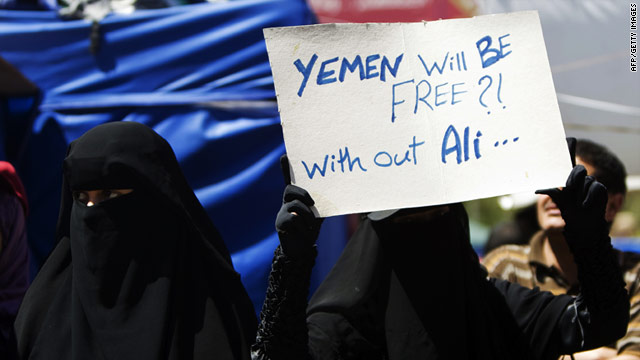
"The president should leave!" cried Redwan Massoud, a leader of the protesters at Sanaa University in Yemen as tens of thousands of demonstrators streamed through cities across the country in a show of resolve against President Ali Abdullah Saleh, who has been in power 32 years.But Saleh — a key U.S. ally in the campaign against al-Qaida — dug in deeper. He rebuffed an offer by an opposition coalition to end the country's political crisis by stepping down by the end of the year. He instead stuck to his pledge to stay in office until elections in 2013 but not seek re-election.
He then suspended classes at the universities in the capital Sanaa and the southern port of Aden, which have been the centers for daily demonstrations inspired by the uprisings in Egypt and Tunisia. Dozens have already died in clashes, including four people killed during a Friday protest in the northern town of Harf Sofyan.
There are growing cracks in Saleh's regime in the Arab world's most impoverished nation. Several members of his ruling Congress Party resigned Saturday. But his swift rejection of the early exit proposal suggested he still believes he can ride out the revolt.In neighboring Oman, meanwhile, Sultan Qaboos bin Said, who has led the nation for four decades, is tossing out more concessions to try to bring an end to a rare show of dissent. Protesters — including oil workers in the south — are pressing for more jobs and economic and political reforms. But unlike the other countries they have pledged their loyalty to the hereditary monarch.
The sultan replaced three top government positions Saturday — just a week after dismissing six other Cabinet officials.Oman's unrest remains small compared with Gulf neighbor Bahrain, but it is closely watched because of the country's strategic role as co-guardian of the Strait of Hormuz. Oman and Iran share authority over the crucial waterway at the mouth of the Gulf, which is the route for 40 percent of the world's oil tanker traffic.Saturday's shake-up included the head of the Palace Office, which oversees security affairs, in an apparent attempt to ease calls to hold officials accountable for the killing of a protester last week. Also replaced was a minister who holds the most senior adviser post and another who deals with internal matters within the ruling structure.The measures failed to halt sit-ins in the capital, Muscat, and the northern industrial city of Sohar, where the unrest began, but they were welcomed by many protesters."It was as if a black cloud has lifted. Long live the sultan, long live Oman," said Saeed Hamad, a protester outside the Sultanate's Shura council.In Libya, Gadhaf's forces and rebel units continued their give-and-take battles.Gadhafi loyalists moved back into the outskirts of Zawiya, just 30 miles (50 kilometers) west of Tripoli, with a surprise dawn attack under cover of mortar shells and later with an afternoon offensive. In the east, the pre-Gadhafi flag used by rebels flew over the key oil port of Ras Lanouf after the first major battlefield victory by forces trying to end Gadhafi's four-decade rule."We will fight them on the streets and will never give up so long as Gadhafi is still in power," said one of the rebels in Zawiya, who declined to be identified.International pressure has been building for Gadhafi to step down. There have been no moves for military intervention, but Washington has not ruled out imposing a "no-fly" zone to protect rebel forces.U.S. forces also were boosting their presence off the Libyan coast. Two Navy ships, the amphibious assault vessel USS Kearsarge and the amphibious transport dock USS Ponce, left an American base on the Greek island of Crete. Earlier this week, 400 Marines from the 2nd Marine Expeditionary Unit based at Camp Lejeune in North Carolina arrived in Crete.
The coming week includes calls for protest rallies in Kuwait on Tuesday and Saudi Arabia on Friday as the Arab groundswell for reform presses into new territory.
Saudi Arabia's Interior Ministry issued a statement outlawing all forms of demonstrations as contrary to Islamic laws and Saudi values. It warned that security forces were authorized to take action against violators.The statement came a day after about 100 Saudi Shiites demonstrated after Friday prayers in the eastern region demanding the release of detainees and a Shiite cleric, Tawfiq al-Amer, arrested last week for calling for a constitutional monarchy.
Just over the causeway in Bahrain, thousands of Shiite protesters formed a huge human chain around the capital Manama as protests against the Sunni monarchy moved into its third week in the strategic country — the host of the U.S. Navy's 5th Fleet. Organizers say some members of the Sunni minority joined Saturday's event.
Unlike the other pro-democracy movements, Algeria's demonstrations have yet to get off the ground.On Saturday, police put down three separate march bids in the capital which also drew demonstrators who turned out in favor of President Abdelaziz Bouteflika.A group that had been organizing the protests has split in two, with a political wing, which tried to march Saturday, and a grouping of human rights leaders and unions which has chosen to work more closely with the population.
Many Algerians say they are tired of conflict after being subjected to years of violence because of an Islamist insurgency.
___
Hundreds of Egyptians gathered outside Cairo offices of the nation's internal security services — the main enforcers of Hosni Mubarak's former regime — a day after protesters beat officials inside the agency's building in the Mediterranean port of Alexandria. In Saudi Arabia, authorities banned all forms of demonstration as calls grow for protest marches Friday in the Western-allied kingdom.
"The president should leave!" cried Redwan Massoud, a leader of the protesters at Sanaa University in Yemen as tens of thousands of demonstrators streamed through cities across the country in a show of resolve against President Ali Abdullah Saleh, who has been in power 32 years.But Saleh — a key U.S. ally in the campaign against al-Qaida — dug in deeper. He rebuffed an offer by an opposition coalition to end the country's political crisis by stepping down by the end of the year. He instead stuck to his pledge to stay in office until elections in 2013 but not seek re-election.
He then suspended classes at the universities in the capital Sanaa and the southern port of Aden, which have been the centers for daily demonstrations inspired by the uprisings in Egypt and Tunisia. Dozens have already died in clashes, including four people killed during a Friday protest in the northern town of Harf Sofyan.
There are growing cracks in Saleh's regime in the Arab world's most impoverished nation. Several members of his ruling Congress Party resigned Saturday. But his swift rejection of the early exit proposal suggested he still believes he can ride out the revolt.In neighboring Oman, meanwhile, Sultan Qaboos bin Said, who has led the nation for four decades, is tossing out more concessions to try to bring an end to a rare show of dissent. Protesters — including oil workers in the south — are pressing for more jobs and economic and political reforms. But unlike the other countries they have pledged their loyalty to the hereditary monarch.
The sultan replaced three top government positions Saturday — just a week after dismissing six other Cabinet officials.Oman's unrest remains small compared with Gulf neighbor Bahrain, but it is closely watched because of the country's strategic role as co-guardian of the Strait of Hormuz. Oman and Iran share authority over the crucial waterway at the mouth of the Gulf, which is the route for 40 percent of the world's oil tanker traffic.Saturday's shake-up included the head of the Palace Office, which oversees security affairs, in an apparent attempt to ease calls to hold officials accountable for the killing of a protester last week. Also replaced was a minister who holds the most senior adviser post and another who deals with internal matters within the ruling structure.The measures failed to halt sit-ins in the capital, Muscat, and the northern industrial city of Sohar, where the unrest began, but they were welcomed by many protesters."It was as if a black cloud has lifted. Long live the sultan, long live Oman," said Saeed Hamad, a protester outside the Sultanate's Shura council.In Libya, Gadhaf's forces and rebel units continued their give-and-take battles.Gadhafi loyalists moved back into the outskirts of Zawiya, just 30 miles (50 kilometers) west of Tripoli, with a surprise dawn attack under cover of mortar shells and later with an afternoon offensive. In the east, the pre-Gadhafi flag used by rebels flew over the key oil port of Ras Lanouf after the first major battlefield victory by forces trying to end Gadhafi's four-decade rule."We will fight them on the streets and will never give up so long as Gadhafi is still in power," said one of the rebels in Zawiya, who declined to be identified.International pressure has been building for Gadhafi to step down. There have been no moves for military intervention, but Washington has not ruled out imposing a "no-fly" zone to protect rebel forces.U.S. forces also were boosting their presence off the Libyan coast. Two Navy ships, the amphibious assault vessel USS Kearsarge and the amphibious transport dock USS Ponce, left an American base on the Greek island of Crete. Earlier this week, 400 Marines from the 2nd Marine Expeditionary Unit based at Camp Lejeune in North Carolina arrived in Crete.
The coming week includes calls for protest rallies in Kuwait on Tuesday and Saudi Arabia on Friday as the Arab groundswell for reform presses into new territory.
Saudi Arabia's Interior Ministry issued a statement outlawing all forms of demonstrations as contrary to Islamic laws and Saudi values. It warned that security forces were authorized to take action against violators.The statement came a day after about 100 Saudi Shiites demonstrated after Friday prayers in the eastern region demanding the release of detainees and a Shiite cleric, Tawfiq al-Amer, arrested last week for calling for a constitutional monarchy.
Just over the causeway in Bahrain, thousands of Shiite protesters formed a huge human chain around the capital Manama as protests against the Sunni monarchy moved into its third week in the strategic country — the host of the U.S. Navy's 5th Fleet. Organizers say some members of the Sunni minority joined Saturday's event.
Unlike the other pro-democracy movements, Algeria's demonstrations have yet to get off the ground.On Saturday, police put down three separate march bids in the capital which also drew demonstrators who turned out in favor of President Abdelaziz Bouteflika.A group that had been organizing the protests has split in two, with a political wing, which tried to march Saturday, and a grouping of human rights leaders and unions which has chosen to work more closely with the population.
Many Algerians say they are tired of conflict after being subjected to years of violence because of an Islamist insurgency.
___
Saudi Regime bans protests, gatherings
Saudi regime has banned all kinds of rallies and gatherings, as anti-government protests demanding democratic change and the release of political prisoners gain momentum in the monarchy.
Saudi Arabia's Interior Ministry described protests as “illegal” in a Saturday statement and declared that security forces were "authorized by law to take all measures needed against those who try to break the law."
"Regulations in the kingdom forbid categorically all sorts of demonstrations, marches and sit-ins... as they contradict Islamic Sharia law and the values and traditions of Saudi society," SPA state news agency quoted the ministry as saying.
The decision came after anti-government demonstrations were held after the Friday prayers in the Saudi capital, Riyadh, and other cities.
Hundreds of Saudi protesters took to the streets in Riyadh, for the first time, to join anti-government protests in other cities in the country, calling for the release of political prisoners.
Protesters gathered in front of Al-Rajhi Mosque in the eastern part of the capital, chanting anti-government and anti-corruption slogans.
Witnesses say Saudi security forces detained at least three people, who had chanted slogans against the Saudi monarchy, in Riyadh.
At the same time, groups of protesters continued their rallies in the towns of al-Hufuf, al-Ahsa, and al-Qatif in the Eastern Province, with demonstrators demanding the release of political prisoners, including a senior Shia cleric.
In al-Hufuf, the peaceful protest rally, which condemned the Saudi government's detention of Sheikh Tawfiq al-Amer, was held following the Friday prayers.
A similar protest, which was held in al-Qatif, was dispersed by Saudi security forces, witnesses said.
The Shia cleric was arrested on February 25 after delivering a sermon, in which he said that Saudi Arabia should become a constitutional monarchy.
In a move to intensify its crackdown on mass protests planned next week, the Saudi government also has decided to deploy thousands of anti-riot police to northeastern Saudi Arabia.
This comes against the backdrop of growing calls on Internet for a massive anti-government protest expected later in March.
A group of Saudi youths has called for a “Saudi Revolution” on March 20, using Facebook, to demand democratic and political reform in the monarchy.
The Facebook group, which has over 17,000 members, also called for a “Day f Rage” to be held on March 11. Tens of thousands of Saudis have already joined the drive.
Protests and public displays of dissent are forbidden in Saudi Arabia. The government has become increasingly nervous about the protests that have taken the Arab world by storm, toppling the Egyptian and Tunisian presidents, and recently reaching Oman, Bahrain, Yemen and Libya.
Saudi Arabia's Interior Ministry described protests as “illegal” in a Saturday statement and declared that security forces were "authorized by law to take all measures needed against those who try to break the law."
"Regulations in the kingdom forbid categorically all sorts of demonstrations, marches and sit-ins... as they contradict Islamic Sharia law and the values and traditions of Saudi society," SPA state news agency quoted the ministry as saying.
The decision came after anti-government demonstrations were held after the Friday prayers in the Saudi capital, Riyadh, and other cities.
Hundreds of Saudi protesters took to the streets in Riyadh, for the first time, to join anti-government protests in other cities in the country, calling for the release of political prisoners.
Protesters gathered in front of Al-Rajhi Mosque in the eastern part of the capital, chanting anti-government and anti-corruption slogans.
Witnesses say Saudi security forces detained at least three people, who had chanted slogans against the Saudi monarchy, in Riyadh.
At the same time, groups of protesters continued their rallies in the towns of al-Hufuf, al-Ahsa, and al-Qatif in the Eastern Province, with demonstrators demanding the release of political prisoners, including a senior Shia cleric.
In al-Hufuf, the peaceful protest rally, which condemned the Saudi government's detention of Sheikh Tawfiq al-Amer, was held following the Friday prayers.
A similar protest, which was held in al-Qatif, was dispersed by Saudi security forces, witnesses said.
The Shia cleric was arrested on February 25 after delivering a sermon, in which he said that Saudi Arabia should become a constitutional monarchy.
In a move to intensify its crackdown on mass protests planned next week, the Saudi government also has decided to deploy thousands of anti-riot police to northeastern Saudi Arabia.
This comes against the backdrop of growing calls on Internet for a massive anti-government protest expected later in March.
A group of Saudi youths has called for a “Saudi Revolution” on March 20, using Facebook, to demand democratic and political reform in the monarchy.
The Facebook group, which has over 17,000 members, also called for a “Day f Rage” to be held on March 11. Tens of thousands of Saudis have already joined the drive.
Protests and public displays of dissent are forbidden in Saudi Arabia. The government has become increasingly nervous about the protests that have taken the Arab world by storm, toppling the Egyptian and Tunisian presidents, and recently reaching Oman, Bahrain, Yemen and Libya.
Heavy machinegun fire rocks Libyan capital Tripoli
Heavy automatic weapons fire erupted in the Libyan capital Tripoli on Sunday, the first such outbreak in Muammar Gaddafi’s main stronghold in a two-week-old insurrection against his 41-year-old rule.
It was unclear who was doing the shooting, which started at 5:45 a.m. (0345 GMT), just before daybreak, or what had caused it. Machine gun volleys, some of them heavy caliber, were reverberating around central Tripoli, along with ambulance sirens, pro-Gaddafi chants, whistling and a cacophony of car horns as vehicles sped through the vicinity.
A government spokesman denied any fighting was under way in Tripoli. “I assure you, I assure you, I assure you, I assure you, there is no fighting going on in Tripoli,” said Mussa Ibrahim, a government spokesman.
“Everything is safe. Tripoli is 100 percent under control. What you are hearing is celebratory fireworks. People are in the streets, dancing in the square.” He warned, however: “I would like to advise not to go there for your safety.
The armed revolt was inspired by generally peaceful uprisings that toppled despots in neighboring Egypt and Tunisia and have spread to other Arab countries with long entrenched leaders and a deficit of democracy, good governance and jobs.
Libyan rebels were also advancing from the east on Gaddafi’s hometown Sirte, around 500 km (300 miles) from Tripoli, and clinging to positions in a western town near the capital after withstanding two armored assaults by government forces.
A tense calm settled over the western town of Zawiyah after nightfall on Saturday, with rifle-toting insurgents on rooftops and manning checkpoints on streets leading into the center.
But the rebels said they were bracing for another tank and artillery attack by government on Sunday.
A doctor in Zawiyah, some 50 km (30 miles) west of Tripoli, said at least 30 people, mostly civilians, were killed during fighting on Saturday that wrecked the town center, raising to at least 60 the death toll from two days of battles.
Almost 600 km (400 miles) to the east along Libya’s Mediterranean coast, insurgents said they took the town of Bin Jawad on Saturday, on the heels of seizing the oil port of Ras Lanuf, and were thrusting westwards toward Sirte.
Exultant after asserting control over much of the east of the vast oil-exporting North African state in a revolt against the flamboyant autocrat Gaddafi, some rebels said an assault on Sirte was imminent.
“We’re going to attack Sirte, now,” rebel fighter Mohamed Salim told Reuters, while another fighter, Mohamed Fathi, said: “Listen, we have no organization and no military plan. We go where we’re needed.”
“If (rebels) can expand down into the Gulf of Sirte … they’ve got a very good shot at independence at the least — or maybe even overturning him at the most,” said Peter Zeihan, analyst with the U.S.-based Stratfor intelligence newsletter.
But others were wary of the limitations of an undisciplined rebel force made up of soldiers who have bolted from Gaddafi’s ranks and volunteers who have more enthusiasm than experience.
It was unclear who was doing the shooting, which started at 5:45 a.m. (0345 GMT), just before daybreak, or what had caused it. Machine gun volleys, some of them heavy caliber, were reverberating around central Tripoli, along with ambulance sirens, pro-Gaddafi chants, whistling and a cacophony of car horns as vehicles sped through the vicinity.
A government spokesman denied any fighting was under way in Tripoli. “I assure you, I assure you, I assure you, I assure you, there is no fighting going on in Tripoli,” said Mussa Ibrahim, a government spokesman.
“Everything is safe. Tripoli is 100 percent under control. What you are hearing is celebratory fireworks. People are in the streets, dancing in the square.” He warned, however: “I would like to advise not to go there for your safety.
The armed revolt was inspired by generally peaceful uprisings that toppled despots in neighboring Egypt and Tunisia and have spread to other Arab countries with long entrenched leaders and a deficit of democracy, good governance and jobs.
Libyan rebels were also advancing from the east on Gaddafi’s hometown Sirte, around 500 km (300 miles) from Tripoli, and clinging to positions in a western town near the capital after withstanding two armored assaults by government forces.
A tense calm settled over the western town of Zawiyah after nightfall on Saturday, with rifle-toting insurgents on rooftops and manning checkpoints on streets leading into the center.
But the rebels said they were bracing for another tank and artillery attack by government on Sunday.
A doctor in Zawiyah, some 50 km (30 miles) west of Tripoli, said at least 30 people, mostly civilians, were killed during fighting on Saturday that wrecked the town center, raising to at least 60 the death toll from two days of battles.
Almost 600 km (400 miles) to the east along Libya’s Mediterranean coast, insurgents said they took the town of Bin Jawad on Saturday, on the heels of seizing the oil port of Ras Lanuf, and were thrusting westwards toward Sirte.
Exultant after asserting control over much of the east of the vast oil-exporting North African state in a revolt against the flamboyant autocrat Gaddafi, some rebels said an assault on Sirte was imminent.
“We’re going to attack Sirte, now,” rebel fighter Mohamed Salim told Reuters, while another fighter, Mohamed Fathi, said: “Listen, we have no organization and no military plan. We go where we’re needed.”
“If (rebels) can expand down into the Gulf of Sirte … they’ve got a very good shot at independence at the least — or maybe even overturning him at the most,” said Peter Zeihan, analyst with the U.S.-based Stratfor intelligence newsletter.
But others were wary of the limitations of an undisciplined rebel force made up of soldiers who have bolted from Gaddafi’s ranks and volunteers who have more enthusiasm than experience.
Saturday, March 5, 2011
Swat Valley, Picking up the pieces
In a few weeks the owners of a small, three-room flat above a tea-shop in a noisy Peshawar bazaar in northwestern Pakistan will be looking for a new tenant because the current occupant, Fayazullah Jan, is leaving.
The 34-year-old drummer from Swat Valley used to play at weddings to earn a living until Taliban militants seized control of the area in 2007 and declared music un-Islamic.
Out of work, Fayazullah moved from his home town of Mingora (the principal city in Swat) and rented the flat in Peshawar. But he was unable to find regular employment, and life proved hard.
“I had been doing this [playing music] since I was 12 years old, like my father and grandfather before me,” he said. Then the Taliban stopped music from being played. “I had no means of earning a livelihood and was scared for my safety. I left Swat in December 2008 for Peshawar.”
With militants on the retreat since the summer of 2009 and a victory over them declared by the military in February 2010 life has begun returning to normal in Swat and neighbouring districts such as Buner and Dir.
“I have spoken to people in Mingora and it now seems safe to go back,” Fayazullah said. He is confident he can resume earning on a regular basis and “put my three children back in school”.
Fayazullah is not alone. Many others in Swat, including barbers who were prevented by the Taliban from shaving beards or cutting hair in a stylized fashion, have resumed work.
Hopes for tourism sector
The valley, a former tourist resort area some 160km from Islamabad, has also seen evidence of a revival of tourism - a primary source of livelihood for many before the insurgency.
The conflict displaced an estimated 200,000 of Swat’s 1.8 million inhabitants in early 2009 as government forces battled Fazlullah's followers who were calling for a holy war against the government and the establishment of a strict version of Shariah law.
"My hotel, which stands by the River Swat had been damaged by floods last summer, but we had seen tourists return early in 2010 and I had earned some money [so I] had enough savings to re-build,” hotel owner Khan Muhammad told IRIN from Mingora.
He is confident there will be more tourists this year, as hotter weather in the plains brings people to the cooler north.
“The revival of tourism in an area like Swat would bring income to many households, because waiters, cooks, guides and others would be able to go back to work,” economic analyst Sikander Lodhi told IRIN.
Livelihood revival
In Malakand Division (an administrative zone of Khyber Pakhtunkhwa Province which includes Swat District), where more than three million people have suffered economically since the conflict escalated between Pakistani government forces and militants in early 2009, initiatives like the Sarhad rural support programme are helping to improve livelihoods through skills enhancement.
“The need for revival of livelihoods was felt because of the wide-ranging impact that the conflict had on the lives of local populations,” Shakeel Ahmad, a programme officer with the UN Development Programme, told IRIN.
“According to the Conflict Early Recovery Needs Assessment exercise carried out by the UN system towards the start of the return of IDPs to their home towns, 99 percent of people reported that the conflict had significantly and negatively impacted their non-farm-based livelihoods… The interventions will help people revive their sources of livelihoods.”
Mingora-based social activist Jamil Khan said: “Right now many people here are hopeful. Many have been able to resume work, especially groups such as barbers, or CD and video shop owners who were targeted by the Taliban, and this means money has again begun to come into households.”
However, with the 2 March assassination in Islamabad of Minorities Minister Shahbaz Bhatti, who had urged reforms to the blasphemy laws, nothing in Pakistan can be taken for granted.
http://www.allheadlinenews.com
Tawakkul Karman ...A woman leading change in Yemen
With two presidents unseated in Tunisia and Egypt and highly publicised protests across Libya, the recent demonstrations in Yemen are catching the world’s attention. The escalating violence is worrying and only time will tell if it will lead to a quick overthrow of Yemeni President Ali Abdullah Saleh or whether change will take much longer in Yemen. But one thing is different in Yemen: the
international face of the Yemeni pro-change movement is a woman. Profiled in high profile outlets including The Washington Post, The Toronto Star and Time Magazine, journalist and human rights activist Tawakkul Karman represents a positive image of Yemeni women. Long before she was photographed leading February’s protests against the government, she was called a brave defender of freedom of expression and human rights in Yemen. In a January 2010 interview with Al Jazeera, she spoke of detained journalists, a sheikh’s tyranny against villagers in Ibb, a governorate south of the capital, the lack of justice for the family of a murdered doctor, and - long before January’s WikiLeaks revelations - even went so far as to accuse the
government of being “in alliance” with al-Qaeda. Today, she continues to protest, demanding peaceful change. Finally a refreshing change from the “over-sized post box” image of the Yemen’s women in the niqab (a garment that covers the female body, face and hands), or the photos of child bride Nujood Ali that have fuelled Yemen’s early marriage debate since April 2008. Of course, all is not rosy for Yemen’s women. Yemeni parliamentarians (one out of 301 is a woman) still have not agreed on a minimum age for marriage to prevent girls like Nujood, nine years old at the time of her divorce, from being married before they finish school. Illiteracy among women is still a whopping 67 per cent, women are typically the first victims of food shortages (one in three Yemenis suffers from severe malnutrition according to the UN) and many have difficult and limited access to healthcare. Women’s participation in politics is minimal and, despite two female ministers, Yemen has consistently ranked at the bottom in the World Economic Forum’s Global Gender Gap Index since it was first included in the ranking in 2006. But there is hope. Karman and fellow female human rights activists, such as journalist Samia al-Aghbari, are on the frontline of protests in the Yemeni capital. They may not be representative of Yemeni women in general, but they are indeed inspiring. In fact, one Yemeni man was so impressed by al-Aghbari’s courage during the protests of 13 February when she was knocked onto the pavement by a member of security, that he wrote her a poem, “Revolution of the Green Hijab... To Samia al-Aghbari and all the other revolutionaries”, which was published the following day on the Nashwan News website. Although they are not all out on the streets, there are a number of inspiring women in Yemen. In addition to Karman and al-Aghbari, Yemeni women are human rights activists, journalists, doctors, educators, members of civil society, academics, wives of political detainees, photographers, and even tweeters. Dozens of brave women have run against all odds and lost in local council and parliamentary elections. According to Nadia al-Sakkaf, female Editor-in-Chief of the independent Yemen Times, winning is difficult without the support of a political party, and most politically ambitious women at the moment are waiting to see how the current situation develops. Then there are the women who quietly start their own revolutions. In May 2010, a literacy eradication course inspired women in rural Dhamar, a governorate south of Sana’a, to go home and ask their husbands and brothers for their rights to education, inheritance and political participation. Course organisers received phone calls from confused male family members asking what they had been discussing. Participants also rallied together and prevented a man from marrying off his 12-year-old daughter. When Karman was detained by security for organising protests on 22 January, she made the most of a bad situation by chatting to her fellow female detainees about their rights. “I was happy to discover the prison and talk to the prisoners,” she told The Yemen Times after her release. But perhaps the most inspiring thing about Karman is that she is not speaking up only for Yemeni women, but for Yemeni society as a whole, addressing national grievances such as unemployment and corruption. It may be too early for a female president in Yemen, but Karman adds a new, welcome dimension to the media coverage of a country usually associated in the Western mind with al-Qaeda, poverty and oppressed women.
international face of the Yemeni pro-change movement is a woman. Profiled in high profile outlets including The Washington Post, The Toronto Star and Time Magazine, journalist and human rights activist Tawakkul Karman represents a positive image of Yemeni women. Long before she was photographed leading February’s protests against the government, she was called a brave defender of freedom of expression and human rights in Yemen. In a January 2010 interview with Al Jazeera, she spoke of detained journalists, a sheikh’s tyranny against villagers in Ibb, a governorate south of the capital, the lack of justice for the family of a murdered doctor, and - long before January’s WikiLeaks revelations - even went so far as to accuse the
government of being “in alliance” with al-Qaeda. Today, she continues to protest, demanding peaceful change. Finally a refreshing change from the “over-sized post box” image of the Yemen’s women in the niqab (a garment that covers the female body, face and hands), or the photos of child bride Nujood Ali that have fuelled Yemen’s early marriage debate since April 2008. Of course, all is not rosy for Yemen’s women. Yemeni parliamentarians (one out of 301 is a woman) still have not agreed on a minimum age for marriage to prevent girls like Nujood, nine years old at the time of her divorce, from being married before they finish school. Illiteracy among women is still a whopping 67 per cent, women are typically the first victims of food shortages (one in three Yemenis suffers from severe malnutrition according to the UN) and many have difficult and limited access to healthcare. Women’s participation in politics is minimal and, despite two female ministers, Yemen has consistently ranked at the bottom in the World Economic Forum’s Global Gender Gap Index since it was first included in the ranking in 2006. But there is hope. Karman and fellow female human rights activists, such as journalist Samia al-Aghbari, are on the frontline of protests in the Yemeni capital. They may not be representative of Yemeni women in general, but they are indeed inspiring. In fact, one Yemeni man was so impressed by al-Aghbari’s courage during the protests of 13 February when she was knocked onto the pavement by a member of security, that he wrote her a poem, “Revolution of the Green Hijab... To Samia al-Aghbari and all the other revolutionaries”, which was published the following day on the Nashwan News website. Although they are not all out on the streets, there are a number of inspiring women in Yemen. In addition to Karman and al-Aghbari, Yemeni women are human rights activists, journalists, doctors, educators, members of civil society, academics, wives of political detainees, photographers, and even tweeters. Dozens of brave women have run against all odds and lost in local council and parliamentary elections. According to Nadia al-Sakkaf, female Editor-in-Chief of the independent Yemen Times, winning is difficult without the support of a political party, and most politically ambitious women at the moment are waiting to see how the current situation develops. Then there are the women who quietly start their own revolutions. In May 2010, a literacy eradication course inspired women in rural Dhamar, a governorate south of Sana’a, to go home and ask their husbands and brothers for their rights to education, inheritance and political participation. Course organisers received phone calls from confused male family members asking what they had been discussing. Participants also rallied together and prevented a man from marrying off his 12-year-old daughter. When Karman was detained by security for organising protests on 22 January, she made the most of a bad situation by chatting to her fellow female detainees about their rights. “I was happy to discover the prison and talk to the prisoners,” she told The Yemen Times after her release. But perhaps the most inspiring thing about Karman is that she is not speaking up only for Yemeni women, but for Yemeni society as a whole, addressing national grievances such as unemployment and corruption. It may be too early for a female president in Yemen, but Karman adds a new, welcome dimension to the media coverage of a country usually associated in the Western mind with al-Qaeda, poverty and oppressed women.
VEENA MALIK: Very Fashionable
Pakistani actor-model Veena Malik changes her pitch. After tantalising viewers on Bigg Boss 4, she's back in India to make her cricket commentary debut with two shows
Everybody in this world is hungry for publicity. I enjoy it too. I didn't know I'll grab so many eyeballs in Bigg Boss 4 or earn so much fame," says Veena Malik. A channel's website cites her age as 32, but she claims to be 26. "My date of birth is 1984. I have my passport to prove it," she says in her defence.
The Pakistani actor and model who drew the media's attention after exposing her ex-boyfriend as well as cricketer Mohammad Asif's foul play, further gained popularity for her notoriety on the reality show Bigg Boss 4, last year. She's now making her cricket commentary debut.
Malik who admires Indian commentators such as Ravi Shastri and Sunil Gavaskar is hosting not one, but two shows on cricket Cricket-o-tainment along with other experts of the game; and Big Toss with Rakhi Sawant. "People have invested a lot of money and most of all, they have invested their confidence in me," she smiles. "The channel has chosen me as the face of the World Cup."
Quiz her about the terminology of the game What happens when the no-ball goes for four runs? What does it suggest when the umpire raises his one leg? Who's the captain of Zimbabwe? she isn't entirely stumped. "If you think I am an expert, let me tell you, I am not," she says. "But I know the basics of the game. I know when Sachin Tendulkar will enter the stadium he'll break the record of Sanath Jayasuriya and even Miandad."
She promises that the glamour quotient in her cricket shows will be high and is also up for any kind of wardrobe scrutiny. "Obviously, if I am there, the fashion element is going to be there," she stands firm. "I am very fashionable.
People always love my sense of styling. So many young girls out there look up to me. But I am not all fashion and beauty only, I have brains also."
Malik's rooting for India, but her prayers are with Pakistan. "I want to see India and Pakistan in the finals and may the best team win. But if you compare the two teams, then India is in way better form. And yes, it wouldn't help for Pakistan if Asif was playing," she mentions.
It isn't only her previous liaison with the Pakistani cricketer which stimulated her interest in the game. "Like India, people in Pakistan also consider cricket a religion. I have been following the game since childhood and I am emotionally aroused towards it."
In fact, Malik insists she even exposed Asif's match-fixing scandal for the love of the game. "I am a cricket lover. He didn't cheat on me; he cheated on the crores of people who love this game. Cricket is a gentleman's game and he didn't behave like one.
When I met him, he was nobody. He was banned and had so many cases against him. I helped him out in his dark days. I used to beg him to stay away from it, but he still continued," she drawls.
However, photographer Dheeraj Dixit, who was allegedly in cahoots with Asif, has accused Malik of being a bookie. "Really? If I am a bookie then what am I doing here? I was the one who provided the contact numbers and the truth. He's one silly guy who only knows to make stupid comments. Why is he not coming up with any proof? Why is he just a babbler?" she shoots back.
Post her World Cup shows, Malik hopes to visit Mumbai to do some charity along with her 'close friend' Ashmit Patel. The two became friendly on the sets of Bigg Boss 4. "Ashmit was an emotional support inside the house. We have great chemistry. He's very much interested in working in Pakistan, but right now, I have my own problems to deal with over there," she reveals.
She has also been offered roles in Bollywood, apparently, but has rejected all of them and remains unperturbed. She does not wish to start her innings doing B or C grade films. "I am like a river dariya hota hai woh apna raasta khud bana deta hai... Likewise, I work on my own terms. Things will happen when they have to," she signs off.
Everybody in this world is hungry for publicity. I enjoy it too. I didn't know I'll grab so many eyeballs in Bigg Boss 4 or earn so much fame," says Veena Malik. A channel's website cites her age as 32, but she claims to be 26. "My date of birth is 1984. I have my passport to prove it," she says in her defence.
The Pakistani actor and model who drew the media's attention after exposing her ex-boyfriend as well as cricketer Mohammad Asif's foul play, further gained popularity for her notoriety on the reality show Bigg Boss 4, last year. She's now making her cricket commentary debut.
Malik who admires Indian commentators such as Ravi Shastri and Sunil Gavaskar is hosting not one, but two shows on cricket Cricket-o-tainment along with other experts of the game; and Big Toss with Rakhi Sawant. "People have invested a lot of money and most of all, they have invested their confidence in me," she smiles. "The channel has chosen me as the face of the World Cup."
Quiz her about the terminology of the game What happens when the no-ball goes for four runs? What does it suggest when the umpire raises his one leg? Who's the captain of Zimbabwe? she isn't entirely stumped. "If you think I am an expert, let me tell you, I am not," she says. "But I know the basics of the game. I know when Sachin Tendulkar will enter the stadium he'll break the record of Sanath Jayasuriya and even Miandad."
She promises that the glamour quotient in her cricket shows will be high and is also up for any kind of wardrobe scrutiny. "Obviously, if I am there, the fashion element is going to be there," she stands firm. "I am very fashionable.
People always love my sense of styling. So many young girls out there look up to me. But I am not all fashion and beauty only, I have brains also."
Malik's rooting for India, but her prayers are with Pakistan. "I want to see India and Pakistan in the finals and may the best team win. But if you compare the two teams, then India is in way better form. And yes, it wouldn't help for Pakistan if Asif was playing," she mentions.
It isn't only her previous liaison with the Pakistani cricketer which stimulated her interest in the game. "Like India, people in Pakistan also consider cricket a religion. I have been following the game since childhood and I am emotionally aroused towards it."
In fact, Malik insists she even exposed Asif's match-fixing scandal for the love of the game. "I am a cricket lover. He didn't cheat on me; he cheated on the crores of people who love this game. Cricket is a gentleman's game and he didn't behave like one.
When I met him, he was nobody. He was banned and had so many cases against him. I helped him out in his dark days. I used to beg him to stay away from it, but he still continued," she drawls.
However, photographer Dheeraj Dixit, who was allegedly in cahoots with Asif, has accused Malik of being a bookie. "Really? If I am a bookie then what am I doing here? I was the one who provided the contact numbers and the truth. He's one silly guy who only knows to make stupid comments. Why is he not coming up with any proof? Why is he just a babbler?" she shoots back.
Post her World Cup shows, Malik hopes to visit Mumbai to do some charity along with her 'close friend' Ashmit Patel. The two became friendly on the sets of Bigg Boss 4. "Ashmit was an emotional support inside the house. We have great chemistry. He's very much interested in working in Pakistan, but right now, I have my own problems to deal with over there," she reveals.
She has also been offered roles in Bollywood, apparently, but has rejected all of them and remains unperturbed. She does not wish to start her innings doing B or C grade films. "I am like a river dariya hota hai woh apna raasta khud bana deta hai... Likewise, I work on my own terms. Things will happen when they have to," she signs off.
SAUDI ARABIA: Demonstrators stage rare protests to demand release of political prisoners
Saudi Arabia has so far escaped the demonstrations and popular uprisings that are sweeping the region, but recent developments suggest the ultraconservative kingdom is not immune to protests and unrest.
Media reports say demonstrators took to the streets of areas of Saudi Arabia's oil-producing eastern province Thursday and Friday to demand the release of political prisoners they claim are being held without trial.
According to CNN, one of the main rallying points at Friday's protest was the outspoken Shiite prayer leader Sheikh Tawfeeq Amer who protesters claim was arrested Feb. 25 after calling in a sermon for Saudi Arabia to become a constitutional democracy.
The video above, posted on YouTube, claims to show prosteters marching in the streets in a town in the eastern province Friday to demand Amer's release.
The demonstration comes a day after around 100 Saudi Shiite Muslims gathered for a rally in the same province to call for the release of Shiite prisoners they say are being arbitraily held by the Saudi authorities.
A report from the Reuters news agency said young men were seen marching through Awwamiya, a town near Saudi Arabia's Shiite epicenter Qatif, chanting "Peaceful, peaceful" while waving pictures of Shiites they say have been detained unjustly. A group of policemen observed the protest without intervening, added the report.
Thurday's and Friday's protests, however, were reported to be much smaller in size than the demonstrations that occurred down in Awwamiya in 2009 after Saudi police launched a crackdown and search for the Shiite preacher Nimr Nimr, who back then had suggested in a sermon that Shiites could one day seek their own separate state.
The vast majority of Saudi Arabia's Shiite community lives in the country's eastern province -- home to most of the kingdom's vast oil resources and also near protest-stricken Bahrain, where members of the majority Shiite population recently have staged massive protests against their Sunni rulers.
Shiites in Saudi Arabia regularly complain about discrimination and say they still face restrictions in getting some jobs, although their situation has improved somewhat under King Abdullah and the reforms he has implemented. The government denies charges of such discrimination.
Last month, more than 100 Saudi activists and intellectuals called on the king to set up a constitutional monarchy and implement sweeping reforms.
Saudi youth push ahead with demands
Tens of thousands of Saudi youths protesting the government's policies have posted their demands for greater civil liberties on an internet website.
The website Honein Revolution calls for the election of the Consultative Assembly members by the people, the impartiality of judiciary, and the release of political prisoners as the most important demands.
The youths have called for the removal of "illegal taxes imposed on poor classes of society, wage increases and job opportunities for young people."
Saudi Arabia is suffering from a high unemployment rate among young men, according to government figures, which indicate that more than 43 percent of citizens aged between 20 and 24 years are jobless.
The young protesters in Saudi Arabia have also called for the formation of an independent organization to supervise the country's fight against corruption.
Freedom of speech, removal of "illegal restrictions” on Saudi women, and a foreign policy based on national interests are among other demands posted on the website.
Meanwhile, more than 100 Saudi academics, activists and businessmen have called for reforms, including the establishment of a "constitutional monarchy," in the conservative Arab kingdom.
"We will submit these requests to King Abdullah at a later stage," Khaled al-Dakhil, a teacher of political science at the King Saud University said in a statement published on the internet.
"We have high hopes that these reforms will be implemented. Now is the time," said the academician and one of the 123 signatories of the petition.
Saudi youths have called for protests on March 11, dubbed as the "Day of Rage"
The website Honein Revolution calls for the election of the Consultative Assembly members by the people, the impartiality of judiciary, and the release of political prisoners as the most important demands.
The youths have called for the removal of "illegal taxes imposed on poor classes of society, wage increases and job opportunities for young people."
Saudi Arabia is suffering from a high unemployment rate among young men, according to government figures, which indicate that more than 43 percent of citizens aged between 20 and 24 years are jobless.
The young protesters in Saudi Arabia have also called for the formation of an independent organization to supervise the country's fight against corruption.
Freedom of speech, removal of "illegal restrictions” on Saudi women, and a foreign policy based on national interests are among other demands posted on the website.
Meanwhile, more than 100 Saudi academics, activists and businessmen have called for reforms, including the establishment of a "constitutional monarchy," in the conservative Arab kingdom.
"We will submit these requests to King Abdullah at a later stage," Khaled al-Dakhil, a teacher of political science at the King Saud University said in a statement published on the internet.
"We have high hopes that these reforms will be implemented. Now is the time," said the academician and one of the 123 signatories of the petition.
Saudi youths have called for protests on March 11, dubbed as the "Day of Rage"
Saudi women rally for prisoners' release
A group of women in Saudi Arabia have protested their husbands' detention in Saudi prisons, amid the emerging signs of anti-government uprisings across the kingdom.
The women say their husbands have been behind bars for at least 15 years without trial.They chanted the men have been “forgotten” and have called for their immediate release.On February 24, another demonstration was held in the oil-producing Eastern province of Qatif. The protesters carried pictures of prisoners and demanded their release.Two weeks ago, a similar protest was also held in the neighboring town of Awwamiya, after which, Saudi authorities freed three prisoners.Tens of thousands of people are preparing themselves to attend the protests after Saudi youth named March 11th the Day of Rage on the social networking website, Facebook.On February 23, Saudi King Abdullah suddenly promised a $36 billion-package of extra benefits for his people, upon his return from a long medical trip to the US.He also granted pardon to some prisoners indicted in financial crimes and ordered the implementation of a 15-percent pay hike for state employees as well as an increase in the cash available for Saudi housing loans.
Analysts believe the huge hike in benefits introduced by the Saudi king is actually intended to avert an uprising in the country.
In recent weeks, a wave of revolutions and anti-government uprisings has spread across the Arab world.
The women say their husbands have been behind bars for at least 15 years without trial.They chanted the men have been “forgotten” and have called for their immediate release.On February 24, another demonstration was held in the oil-producing Eastern province of Qatif. The protesters carried pictures of prisoners and demanded their release.Two weeks ago, a similar protest was also held in the neighboring town of Awwamiya, after which, Saudi authorities freed three prisoners.Tens of thousands of people are preparing themselves to attend the protests after Saudi youth named March 11th the Day of Rage on the social networking website, Facebook.On February 23, Saudi King Abdullah suddenly promised a $36 billion-package of extra benefits for his people, upon his return from a long medical trip to the US.He also granted pardon to some prisoners indicted in financial crimes and ordered the implementation of a 15-percent pay hike for state employees as well as an increase in the cash available for Saudi housing loans.
Analysts believe the huge hike in benefits introduced by the Saudi king is actually intended to avert an uprising in the country.
In recent weeks, a wave of revolutions and anti-government uprisings has spread across the Arab world.
SAUDI ARABIA,PROTESTS NEXT WEEK......WELCOME REVOLUTION
LONG LIVE REVOLUTION
Saudis staged protests in two towns in Saudi Arabia's oil-producing Eastern Province on Thursday
Desperate to avoid mass uprisings against the House of Saud, security forces have deployed in huge numbers across the region.
King Abdullah is also reported to have told neighbouring Bahrain that if they do not put down their own ongoing Shia revolt, his own forces will.
In response to the massive mobilisation, protesters are planning to place women on the front ranks to discourage Saudi forces from firing on them.
In Yemen, President Ali Abdullah Saleh set off a deadly battle for survival last night as he rejected an opposition peace proposal and ordered troops to fire on demonstrators, killing four. Efforts to suppress demonstrations by the key ally in the “war on terror” could jeopardise rising volumes of Western aid flooding into the country, diplomats warned.
President Saleh rejected an opposition proposal that would have brought demonstrations to a standstill in return for a promise to step down by the end of the year. Yemeni troops used rockets and machineguns to attack demonstrators in the north of the country, killing four and injuring nine.
Saudis staged protests in two towns in Saudi Arabia's oil-producing Eastern Province on Thursday
Desperate to avoid mass uprisings against the House of Saud, security forces have deployed in huge numbers across the region.
King Abdullah is also reported to have told neighbouring Bahrain that if they do not put down their own ongoing Shia revolt, his own forces will.
In response to the massive mobilisation, protesters are planning to place women on the front ranks to discourage Saudi forces from firing on them.
In Yemen, President Ali Abdullah Saleh set off a deadly battle for survival last night as he rejected an opposition peace proposal and ordered troops to fire on demonstrators, killing four. Efforts to suppress demonstrations by the key ally in the “war on terror” could jeopardise rising volumes of Western aid flooding into the country, diplomats warned.
President Saleh rejected an opposition proposal that would have brought demonstrations to a standstill in return for a promise to step down by the end of the year. Yemeni troops used rockets and machineguns to attack demonstrators in the north of the country, killing four and injuring nine.
Punjab's pro-Taliban government
Naeem Tahir
The support to the PML-N is strongly committed from the violent minority. Funds, muscle and street power are all made available by exploiting the fair name of ‘Islam’. The future is incredibly depressing for those who believe in the vision of Allama Iqbal and the statesmanship of Quaid-e-Azam
The Pakistan People’s Party (PPP) has been almost ‘kicked out’ from the Punjab government. The uncomfortable marriage between the PPP and the PML-N has come to an end with little grace. The end of the ‘coalition confusion’ will, hopefully, be good for the people. The game of good cop-bad cop is over and both can show their true character. But their true characters are also a matter of concern. The PPP has so far appeared very spineless, incompetent and ineffective. The PML-N has shown a pro-Taliban mindset and support for pro-Taliban activists. The PML-N is known to have provided over 50 million worth of financial assistance to Jamaat-ud-Dawa (JuD), a banned network, in its provincial budget. Senior leaders of the PML-N are seen campaigning with extreme rightists and aggravating interfaith discord. The PML-N stands with them while inflammatory and hate speeches are delivered and ensures that the extremist, pro-Taliban vote bank continues supporting them. The PML-N leadership has shown little sensitivity to the damage they are doing to the social fabric by standing with the extremists. The PML-N has made no effort for inter-cultural harmony. It relies on ‘Punjab support’, and plays that ‘card’. It has also diverted attention from its own corruption and incompetence.
The change has come according to the PML-N game plan. The much denied document of ‘pardon’ for Nawaz Sharif and others did actually exist and the Mian sahibs informed the Saudi authorities that they have completed the period of abstinence as per the contract and now they are entering the regular political scene. In the meantime, a flirting game to keep the political image was played and the contract was also violated by Chotey (little) Mian sahib, Mr Shahbaz Sharif. Many somersaults were made; first the PML-N joined the federal government and put up an erratic behaviour. Then they realised that being in the government will gradually erase their identity and the opposition will gain as usual. So they decided to move from the treasury benches to the opposition benches. The PML-N adopted the strategy to throw the bait of sharing the government in Punjab, which left the PPP neither here nor there.
The PML-N held 60 percent of Pakistan, but sat in the opposition in the National Assembly and thus enjoyed the position of being in power as well as in the opposition! Why the PPP liked this arrangement is hard to understand. Why did the PPP not take an opposition role in Punjab from the beginning? Also, why did Prime Minister Gilani keep showing up at Raiwind every week dutifully and almost as a subordinate of the Mian brothers? It must have further demoralised the PPP workers. If one goes back in the chain of events it is evident that most of the decisions made by the PPP were endorsed by the PML-N. Then the PML-N shared the deliberations in the Constitution Committee and got everything that was in its favour. So the PML-N marked time, kept its chief minister on the basis of a stay order of the courts, played with the simple PPP prime minister and prolonged its life. On the other hand, the PPP’s Mr Gilani thought he was playing safe and ensuring the PML-N support in case the divide in his own party and the coalition partners became worrisome. As these manoeuvrings were going on to make sure that the political situation maintains the status quo, actual governance was non-existent. The PPP obviously wants to stay in power for five years and reap a rich harvest, the PML-N wants to dig deeper and consolidate with rightists, extremists, and General Zia sympathisers and their mysterious financiers. ‘Financiers’ may not be much of a mystery for those who claim with confidence that substantial funding from al Qaeda was made available to Mian Nawaz Sharif. Also something to think about is that the murdered, Benazir, Taseer, Bhatti, all were enlightened leaders from the PPP. The next target is to involve Musharraf by hook or crook.
The support to the PML-N is strongly committed from the violent minority. Funds, muscle and street power are all made available by exploiting the fair name of ‘Islam’. The recent launching of the total control of Punjab by the PML-N appears to have been ‘celebrated’ through the murder of Shahbaz Bhatti by the Punjabi Taliban.
The future is incredibly depressing for those who believe in the vision of Allama Iqbal and the statesmanship of Quaid-e-Azam.
The important question here to consider is what role the PPP is going to play now. Is the leader of the opposition in Punjab happy with the perks and will stay quiet and let the PML-N continue and expedite the process of radicalisation in Punjab? Would the PPP really stand up and expose and struggle for a Punjab free from fear? Is the federal government of the PPP going to continue to live with the murder of its leaders in Islamabad or is it going to do something about it? Is the PPP left with any commitment, energy or will to stem the tide of radicalisation? At the present time not much can be expected from this party. It seems to be content with the status quo at the cost of the blood of its leaders and maybe does not plan to be an effective political force in future. Its inner conflicts and the disappointed coalition partners are ready to write the postscript to the PPP story. The Bhuttos have been used long enough, so now what?
The PML-N strategy would be to extract every ounce of advantage and seek fresh elections. Sounds simple but politics is not always so. The masses have seen the performance of these parties, they have also seen prices sky-rocketing, law and order shattered, supply shortages, and in-fights within the parties. Would the masses still vote for these feudal and power brokers? They may, under fear.
The writer is a culture and media management specialist, a researcher, author, director and actor
The support to the PML-N is strongly committed from the violent minority. Funds, muscle and street power are all made available by exploiting the fair name of ‘Islam’. The future is incredibly depressing for those who believe in the vision of Allama Iqbal and the statesmanship of Quaid-e-Azam
The Pakistan People’s Party (PPP) has been almost ‘kicked out’ from the Punjab government. The uncomfortable marriage between the PPP and the PML-N has come to an end with little grace. The end of the ‘coalition confusion’ will, hopefully, be good for the people. The game of good cop-bad cop is over and both can show their true character. But their true characters are also a matter of concern. The PPP has so far appeared very spineless, incompetent and ineffective. The PML-N has shown a pro-Taliban mindset and support for pro-Taliban activists. The PML-N is known to have provided over 50 million worth of financial assistance to Jamaat-ud-Dawa (JuD), a banned network, in its provincial budget. Senior leaders of the PML-N are seen campaigning with extreme rightists and aggravating interfaith discord. The PML-N stands with them while inflammatory and hate speeches are delivered and ensures that the extremist, pro-Taliban vote bank continues supporting them. The PML-N leadership has shown little sensitivity to the damage they are doing to the social fabric by standing with the extremists. The PML-N has made no effort for inter-cultural harmony. It relies on ‘Punjab support’, and plays that ‘card’. It has also diverted attention from its own corruption and incompetence.
The change has come according to the PML-N game plan. The much denied document of ‘pardon’ for Nawaz Sharif and others did actually exist and the Mian sahibs informed the Saudi authorities that they have completed the period of abstinence as per the contract and now they are entering the regular political scene. In the meantime, a flirting game to keep the political image was played and the contract was also violated by Chotey (little) Mian sahib, Mr Shahbaz Sharif. Many somersaults were made; first the PML-N joined the federal government and put up an erratic behaviour. Then they realised that being in the government will gradually erase their identity and the opposition will gain as usual. So they decided to move from the treasury benches to the opposition benches. The PML-N adopted the strategy to throw the bait of sharing the government in Punjab, which left the PPP neither here nor there.
The PML-N held 60 percent of Pakistan, but sat in the opposition in the National Assembly and thus enjoyed the position of being in power as well as in the opposition! Why the PPP liked this arrangement is hard to understand. Why did the PPP not take an opposition role in Punjab from the beginning? Also, why did Prime Minister Gilani keep showing up at Raiwind every week dutifully and almost as a subordinate of the Mian brothers? It must have further demoralised the PPP workers. If one goes back in the chain of events it is evident that most of the decisions made by the PPP were endorsed by the PML-N. Then the PML-N shared the deliberations in the Constitution Committee and got everything that was in its favour. So the PML-N marked time, kept its chief minister on the basis of a stay order of the courts, played with the simple PPP prime minister and prolonged its life. On the other hand, the PPP’s Mr Gilani thought he was playing safe and ensuring the PML-N support in case the divide in his own party and the coalition partners became worrisome. As these manoeuvrings were going on to make sure that the political situation maintains the status quo, actual governance was non-existent. The PPP obviously wants to stay in power for five years and reap a rich harvest, the PML-N wants to dig deeper and consolidate with rightists, extremists, and General Zia sympathisers and their mysterious financiers. ‘Financiers’ may not be much of a mystery for those who claim with confidence that substantial funding from al Qaeda was made available to Mian Nawaz Sharif. Also something to think about is that the murdered, Benazir, Taseer, Bhatti, all were enlightened leaders from the PPP. The next target is to involve Musharraf by hook or crook.
The support to the PML-N is strongly committed from the violent minority. Funds, muscle and street power are all made available by exploiting the fair name of ‘Islam’. The recent launching of the total control of Punjab by the PML-N appears to have been ‘celebrated’ through the murder of Shahbaz Bhatti by the Punjabi Taliban.
The future is incredibly depressing for those who believe in the vision of Allama Iqbal and the statesmanship of Quaid-e-Azam.
The important question here to consider is what role the PPP is going to play now. Is the leader of the opposition in Punjab happy with the perks and will stay quiet and let the PML-N continue and expedite the process of radicalisation in Punjab? Would the PPP really stand up and expose and struggle for a Punjab free from fear? Is the federal government of the PPP going to continue to live with the murder of its leaders in Islamabad or is it going to do something about it? Is the PPP left with any commitment, energy or will to stem the tide of radicalisation? At the present time not much can be expected from this party. It seems to be content with the status quo at the cost of the blood of its leaders and maybe does not plan to be an effective political force in future. Its inner conflicts and the disappointed coalition partners are ready to write the postscript to the PPP story. The Bhuttos have been used long enough, so now what?
The PML-N strategy would be to extract every ounce of advantage and seek fresh elections. Sounds simple but politics is not always so. The masses have seen the performance of these parties, they have also seen prices sky-rocketing, law and order shattered, supply shortages, and in-fights within the parties. Would the masses still vote for these feudal and power brokers? They may, under fear.
The writer is a culture and media management specialist, a researcher, author, director and actor
Three schools blown up in northwest Pakistan
Three government-run schools were blown up by militants in northwest Pakistan’s Khyber, Kohat and Swabi regions on Saturday, DawnNews reported.
Government sources said unknown assailants used explosives and destroyed a school in Khyber tribal region’s Bara area Saturday morning.
The school’s walls and ceiling were badly damaged in the attack.
Moreover, another school was attacked by militants using explosives in the Kohat region. At least three rooms in the school building were demolished in the attack.
Whereas, in Swabi, militants blew up a government-run primary school. The school was destroyed as a result.
It is pertinent to note that over 500 schools have been destroyed in attacks across Khyber Pakhtunkhwa and the Federally Administered Tribal Areas (Fata).
Government sources said unknown assailants used explosives and destroyed a school in Khyber tribal region’s Bara area Saturday morning.
The school’s walls and ceiling were badly damaged in the attack.
Moreover, another school was attacked by militants using explosives in the Kohat region. At least three rooms in the school building were demolished in the attack.
Whereas, in Swabi, militants blew up a government-run primary school. The school was destroyed as a result.
It is pertinent to note that over 500 schools have been destroyed in attacks across Khyber Pakhtunkhwa and the Federally Administered Tribal Areas (Fata).
Peshawar to get Rs1.1bn facelift
PESHAWAR, March 4: Dusty and crowded Peshawar can hope to get a cleaner look as the Khyber Pakhtunkhwa government has reached an agreement with a Lahore-based company to establish a solid waste recycling plant in the city soon.
Not only the ambitious project is promised to improve cleanliness in the city by converting the tons of garbage it produces daily into organic fertilizer, and useful household items, but also to provide jobs to about 200 people.
Official sources said the Rs1.1 billion project was discussed at a meeting held on Friday under Senior Minister Bashir Bilour. Secretary local government Aurangzeb Khan, secretary Local Counsel Board (LCB) Attaul Haq, DCO Peshawar Siraj Ahmed and other officials attended the meeting.
Mr Attaul Haq told Dawn that the project would be inaugurated in April and the Lahore-based company would be provided all facilities for installation of the recycling plant.
Already, the provincial government has leased the company 10 kanals of land for the purpose in Dheri Baghbanan area on the outskirts of Peshawar city.
Mr Haq said that under the agreement the company would provide 12 vehicles for shifting waste from different areas to the site of the plant.
He said that solid waste would be converted into organic fertilizers, plastic chairs and other household items. He said that the government would share the profit with the company.
Mr Haq said that it was the first project of its kind in the province and after its success more such projects would be started in other cities.
The management of the proposed recycling plant will buy solid waste from the administrations of four towns at the rate of Rs100 per ton, Mr Haq said while citing rules of the agreement. He said that 1,000 tons waste would be bought daily from the four towns of Peshawar and 200 tons collected from the Cantonment areas.
The LCB secretary said that the city district government was bound to provide 500 tons of solid waste daily to the recycling plant.
Mr Bilour told the meeting that around 200 people would get jobs with the establishment of the recycling plant, says a handout issued after the meeting. He directed the company to ensure swift work on the project.
Early disposal of garbage for ensuring cleanliness in the city was a longstanding demand of the people of Peshawar. They had been calling for creation of a special office of trash commissioner to deal with the continuing garbage crisis.
Mounds of garbage spreading stinking smell could be noticed in the streets of the city. Residents have been resorting to setting trash on fire, raising fears of toxic smoke.
Dumps of garbage in certain parts of the city have been a permanent feature for the last many years, but despite repeated protests of the residents the municipal staff could not respond in an effective way to clean the areas.
Not only the ambitious project is promised to improve cleanliness in the city by converting the tons of garbage it produces daily into organic fertilizer, and useful household items, but also to provide jobs to about 200 people.
Official sources said the Rs1.1 billion project was discussed at a meeting held on Friday under Senior Minister Bashir Bilour. Secretary local government Aurangzeb Khan, secretary Local Counsel Board (LCB) Attaul Haq, DCO Peshawar Siraj Ahmed and other officials attended the meeting.
Mr Attaul Haq told Dawn that the project would be inaugurated in April and the Lahore-based company would be provided all facilities for installation of the recycling plant.
Already, the provincial government has leased the company 10 kanals of land for the purpose in Dheri Baghbanan area on the outskirts of Peshawar city.
Mr Haq said that under the agreement the company would provide 12 vehicles for shifting waste from different areas to the site of the plant.
He said that solid waste would be converted into organic fertilizers, plastic chairs and other household items. He said that the government would share the profit with the company.
Mr Haq said that it was the first project of its kind in the province and after its success more such projects would be started in other cities.
The management of the proposed recycling plant will buy solid waste from the administrations of four towns at the rate of Rs100 per ton, Mr Haq said while citing rules of the agreement. He said that 1,000 tons waste would be bought daily from the four towns of Peshawar and 200 tons collected from the Cantonment areas.
The LCB secretary said that the city district government was bound to provide 500 tons of solid waste daily to the recycling plant.
Mr Bilour told the meeting that around 200 people would get jobs with the establishment of the recycling plant, says a handout issued after the meeting. He directed the company to ensure swift work on the project.
Early disposal of garbage for ensuring cleanliness in the city was a longstanding demand of the people of Peshawar. They had been calling for creation of a special office of trash commissioner to deal with the continuing garbage crisis.
Mounds of garbage spreading stinking smell could be noticed in the streets of the city. Residents have been resorting to setting trash on fire, raising fears of toxic smoke.
Dumps of garbage in certain parts of the city have been a permanent feature for the last many years, but despite repeated protests of the residents the municipal staff could not respond in an effective way to clean the areas.
Friday, March 4, 2011
Protests across city against Bhatti’s murder
Several human rights activists, members of the civil society and a large number of Christian citizens held protest rallies across the city, on Thursday, over the assassination of the Federal Minister for Minorities, Shahbaz Bhatti.
The rallies were conducted in areas from the Lahore Press Club to The Mall. The protesters, while condemning the assassination, demanded the Pakistan People’s Party (PPP)-led government to “not only curb terrorism but also to take a clear stand on blasphemy law in the country as per their promise in the party manifesto.”
The groups and NGOs that participated in the activity included All Pakistan Minorities Alliance (APMA), Citizens for Democracy (CFD), Centre for Human Rights Education (CHRE), Christian Helpline, Pakistan Qaumi Masehi Party (Haqeeqi group), Maseehi Millat Party, Sweeper’s Union, Jharo Kash Mazdoor Union, Community Development Initiative, National Commission for Justice and Peace, Christian Lawyers Association, Punjab Bar Council, Punjab Teachers Association.
The number of protesters had increased as compared to the amount that protested on the day of the assassination.
The protesters were of the view that the cold-blooded and barbaric murder of Shahbaz Bhatti is “a murder of tolerance, diversity and respect for human rights in the country,” and said, “The freedom given to extremists was the root cause of all such heinous crimes.”
They demanded for the introduction and implementation of strict laws against communalism, spreading of hatred on the basis of colour, creed and caste. The protesters said, “The country would go further into chaos if the government did not take appropriate measures to curb extremism.” Separately, the citizens were of the view that “the government should protect all the civil society members and personalities who are struggling against the blasphemy law in the country,” adding, “It should have woken up to the challenge immediately after the assassination of former Punjab governor Salmaan Taseer”.
Meanwhile, the protests also caused massive traffic jams in the areas where they were being staged, and the traffic cops kept diverting the vehicles to alternate routes in order to avoid any untoward incident. The Federal Minister for Minorities, Shahbaz Bhatti, was killed on March 2 (Wednesday) when some unidentified terrorists sprayed bullets on his vehicle in sector I-8/3 area of Islamabad.
CHRE chief, Samson Salamat, and the PPP minority wing leader, Napolean Qayoom, while talking to Daily Times on the issue, said, “The non-Muslim communities, especially the Christians, have completely lost their faith in the government of Pakistan”.
They said that the Christians had actively participated in the creation of Pakistan and had offered unconditional support to Muhammad Ali Jinnah, who promised equal rights for all Pakistanis. They added, “No incident of religious extremism or suppressing communal rights took place in the country before the introduction of the blasphemy law by the military dictator Gen Ziaul Haq.”
They said that civil society will continue its struggle against the discriminatory law and demanded President Asif Ali Zardari to take a strict action against those who promoted hatred in the name of religion. They concluded on the note that the citizens would not let the blood of the martyred PPP leaders Salmaan Taseer and Shahbaz Bhatti go waste and they want the party to either announce the amendment of the blasphemy law as promised in their manifesto or openly withdraw from their stand.
Nowshera blast:,10 dead
At least 10 people have been killed and several injured in a blast in a mosque inside shrine of Akhond Panjo Baba shrine soon after Friday prayers, Geo News reported quoting police sources.
Protest against Bhatti's murder held
Three-day mourning is being observed throughout Pakistan over the assassination of Federal Minister for Minorities, Shahbaz Bhatti.
The case has been lodged at I/9 police station Islamabad while police have issued the sketch of a attacker.
According to police records, four gunmen attacked the minister.
On the other hand, Christian community along with women and children staged a protest in front of National Press Club Islamabad, against the killing of Bhatti.
Protesters demanded the government to chase the culprits immediately.
Bhatti was killed last day outside his mother's house situated in sector I-8/3. Two political figure, Punjab governor Salman Taseer and Bhatti, have been targeted in less than two months in Pakistan's capital, Islamabad.
The law enforcement agencies were already on high alert and a heavy contingent of police have been deployed to ensure the protest rallies bring carried out by the Christian community.
The case has been lodged at I/9 police station Islamabad while police have issued the sketch of a attacker.
According to police records, four gunmen attacked the minister.
On the other hand, Christian community along with women and children staged a protest in front of National Press Club Islamabad, against the killing of Bhatti.
Protesters demanded the government to chase the culprits immediately.
Bhatti was killed last day outside his mother's house situated in sector I-8/3. Two political figure, Punjab governor Salman Taseer and Bhatti, have been targeted in less than two months in Pakistan's capital, Islamabad.
The law enforcement agencies were already on high alert and a heavy contingent of police have been deployed to ensure the protest rallies bring carried out by the Christian community.
The targeting of college girls ......Bombers’ madness
Bombers’ madness
The targeting of college girls who had organised a function within the premises of their all-girls institute by militants in Mardan, injuring some 40 students and killing one, is another evidence of the insanity that still prevails in the North. The militants who hurled grenades into the premises as the function – a farewell for leaving students – was being staged, clearly wished to create a sense of terror. The following day a massive planted bomb of perhaps 600kg was detonated in Hangu outside a police station killing at least nine and injuring 30. This was swiftly followed by the death of six more innocent people in Khyber Agency. Within twenty-four hours almost 100 people are dead and injured. Terror is a powerful weapon and it has been used repeatedly by the Taliban who seem able to continue their acts of murder despite the many claims we have heard from the government that they had been tamed.
This quite obviously is not the case at all. At frequent intervals we hear accounts of suicide bombings, attacks on schools or the killing of security personnel. We wonder when the chapter of death will be brought to a close. Too many lives have already been lost; those who have no role in the current conflict have been among those killed. The young girl felled in Mardan is the latest to join their ranks. The casualties in Hangu were mostly civilians although the target was obviously the police. Even now we can only wonder when the next outrage will occur – and if anything can be done to stop it. Attacks such as these create a sense of hopelessness and despondency. The belief that had existed for some months that the militants had been defeated has long since faded away, and this can only leave all of us wondering what the future will hold or where the militants will strike next. They have already demonstrated many times that they have no humanity. The attacks in Mardan, Hangu and Khyber merely reinforce this perception.
The targeting of college girls who had organised a function within the premises of their all-girls institute by militants in Mardan, injuring some 40 students and killing one, is another evidence of the insanity that still prevails in the North. The militants who hurled grenades into the premises as the function – a farewell for leaving students – was being staged, clearly wished to create a sense of terror. The following day a massive planted bomb of perhaps 600kg was detonated in Hangu outside a police station killing at least nine and injuring 30. This was swiftly followed by the death of six more innocent people in Khyber Agency. Within twenty-four hours almost 100 people are dead and injured. Terror is a powerful weapon and it has been used repeatedly by the Taliban who seem able to continue their acts of murder despite the many claims we have heard from the government that they had been tamed.
This quite obviously is not the case at all. At frequent intervals we hear accounts of suicide bombings, attacks on schools or the killing of security personnel. We wonder when the chapter of death will be brought to a close. Too many lives have already been lost; those who have no role in the current conflict have been among those killed. The young girl felled in Mardan is the latest to join their ranks. The casualties in Hangu were mostly civilians although the target was obviously the police. Even now we can only wonder when the next outrage will occur – and if anything can be done to stop it. Attacks such as these create a sense of hopelessness and despondency. The belief that had existed for some months that the militants had been defeated has long since faded away, and this can only leave all of us wondering what the future will hold or where the militants will strike next. They have already demonstrated many times that they have no humanity. The attacks in Mardan, Hangu and Khyber merely reinforce this perception.
Shahbaz Bhatti’s assassination..........A bloodstained flag
EDITORIAL: Daily Times
US Secretary of State Hillary Clinton’s remarks on Federal Minister for Minorities Shahbaz Bhatti’s assassination echoed what every sane Pakistani feels. “I was shocked and outraged by the assassination...I think this was an attack not only on one man but on the values of tolerance and respect for people of all faiths and backgrounds that had been championed by Mohammad Ali Jinnah, the founder of Pakistan,” she said. On Wednesday, Pakistan lost Mr Bhatti to the extremist forces. In two months, we have lost a serving governor and a serving federal minister. This is certainly not the Pakistan our forefathers dreamt of. It has been hijacked by the very same forces that were once against the creation of this country. Mr Bhatti’s assassination has been condemned worldwide and has sent shockwaves everywhere, especially in Pakistan.
The reaction to Governor Taseer’s murder was shocking for another reason as most Pakistanis were either ambivalent or glorified his murderer, Mumtaz Qadri. But Mr Bhatti’s murder has put most of those voices on the defensive. The religious parties are not condoning Mr Bhatti’s murder like they did in Mr Taseer’s case but are blaming it on an “international conspiracy” to take the focus away from the Raymond Davis case. This is too far-fetched to be taken seriously. Instead of shifting the blame, all those who are drumming up this theory should take a good look around this ‘land of the pure’ and they will get to see the evidence of an inside hand themselves. The Punjab Taliban themselves claimed the responsibility for this callous attack on Mr Bhatti. In pamphlets left at the site of the murder, the ‘Taliban al Qaeda Punjab’ warned of sinister consequences for anyone who dared to raise their voice against the blasphemy laws.
It was surprising to see Punjab Chief Minister all riled up at Interior Minister Rehman Malik for ‘politicising’ the Punjabi Taliban issue and giving it a provincial angle. What Mr Sharif has obviously failed to understand is that Mr Malik is not fanning provincialism. The perpetrators themselves signed the pamphlets as such and later claimed responsibility as well. This is not the time for a tussle between the federal and Punjab government; it is time to stand united in order to root out the terrorist menace. All provinces and the federation have to pull together because the terrorists are now attacking political figures. It seems that the terrorists now have a hit list on the blasphemy issue. For once our politicians must rise above partisan politics and understand the gravity of the situation. The terrorists have the capability to inflict damage and pain by killing political leaders at will.
In another sad development, leading members of Pakistan’s Christian community have asked the Vatican not to give statements on their behalf. It shows the insecurity of our minorities who feel threatened that any international condemnation, especially that coming from the Vatican, might serve as fodder for the Islamist extremists who are baying for their blood in any case. The government needs to put its foot down and assure all minority communities that they are safe in Pakistan. This is as much their country as the Muslims’. President Zardari said, “We have to fight this mindset and defeat them. We will not be intimidated nor will we retreat.” Had the government stood up against the extremist forces earlier instead of trying to appease them, the terrorists would not have gained so much space. But as they say, better late than never. The government should now stand firm and challenge the extremist forces in order to defeat them. Our survival is on the line here. *
US Secretary of State Hillary Clinton’s remarks on Federal Minister for Minorities Shahbaz Bhatti’s assassination echoed what every sane Pakistani feels. “I was shocked and outraged by the assassination...I think this was an attack not only on one man but on the values of tolerance and respect for people of all faiths and backgrounds that had been championed by Mohammad Ali Jinnah, the founder of Pakistan,” she said. On Wednesday, Pakistan lost Mr Bhatti to the extremist forces. In two months, we have lost a serving governor and a serving federal minister. This is certainly not the Pakistan our forefathers dreamt of. It has been hijacked by the very same forces that were once against the creation of this country. Mr Bhatti’s assassination has been condemned worldwide and has sent shockwaves everywhere, especially in Pakistan.
The reaction to Governor Taseer’s murder was shocking for another reason as most Pakistanis were either ambivalent or glorified his murderer, Mumtaz Qadri. But Mr Bhatti’s murder has put most of those voices on the defensive. The religious parties are not condoning Mr Bhatti’s murder like they did in Mr Taseer’s case but are blaming it on an “international conspiracy” to take the focus away from the Raymond Davis case. This is too far-fetched to be taken seriously. Instead of shifting the blame, all those who are drumming up this theory should take a good look around this ‘land of the pure’ and they will get to see the evidence of an inside hand themselves. The Punjab Taliban themselves claimed the responsibility for this callous attack on Mr Bhatti. In pamphlets left at the site of the murder, the ‘Taliban al Qaeda Punjab’ warned of sinister consequences for anyone who dared to raise their voice against the blasphemy laws.
It was surprising to see Punjab Chief Minister all riled up at Interior Minister Rehman Malik for ‘politicising’ the Punjabi Taliban issue and giving it a provincial angle. What Mr Sharif has obviously failed to understand is that Mr Malik is not fanning provincialism. The perpetrators themselves signed the pamphlets as such and later claimed responsibility as well. This is not the time for a tussle between the federal and Punjab government; it is time to stand united in order to root out the terrorist menace. All provinces and the federation have to pull together because the terrorists are now attacking political figures. It seems that the terrorists now have a hit list on the blasphemy issue. For once our politicians must rise above partisan politics and understand the gravity of the situation. The terrorists have the capability to inflict damage and pain by killing political leaders at will.
In another sad development, leading members of Pakistan’s Christian community have asked the Vatican not to give statements on their behalf. It shows the insecurity of our minorities who feel threatened that any international condemnation, especially that coming from the Vatican, might serve as fodder for the Islamist extremists who are baying for their blood in any case. The government needs to put its foot down and assure all minority communities that they are safe in Pakistan. This is as much their country as the Muslims’. President Zardari said, “We have to fight this mindset and defeat them. We will not be intimidated nor will we retreat.” Had the government stood up against the extremist forces earlier instead of trying to appease them, the terrorists would not have gained so much space. But as they say, better late than never. The government should now stand firm and challenge the extremist forces in order to defeat them. Our survival is on the line here. *
Thursday, March 3, 2011
Shahbaz Bhatti.....Fiddling with enormity
Fiddling with enormity
Right in Islamabad, the seat of the national state power, was murdered not long ago Punjab governor Salman Taseer in broad daylight by his own security guard. And there now has been shot to death Shahbaz Bhatti, federal minister for minorities affairs, by unknown gunmen, again in broad daylight. And yet Islamabad’s hierarchs are just fiddling with an enormity of grave dimensions, playing the flute and harping customary condemnations and lofty vows not to bow down before terrorists or get cowed down by their vile trade of murder and mayhem. This has been their constant refrain all through since their advent three years, unchangeably and unabashedly. Every time thugs strike, they sing this hymn, probably thinking chanting of a mantra is enough to frighten away the merchants of death and destruction and nothing more is needed to put them out of their evil business. Three years is no little time. It is quite a period to impart a crippling dent on such thuggery, provided a thoughtful strategy is worked out and then worked on intently. But this Islamabad hierarchy has demonstrated this capability to be none of its forte. A counter-terrorism strategy that it had hammered out at a high-level inter-provincial conference under the prime minister long time ago, it has, by every indication, consigned to the official rut to rust. No letup is in evidence in thugs’ wickedness. They are on prowl; the state is gasping to hobble them. They come blithely, attack civilian and security targets alike bloodily and return to their lairs safely. Internal security czar Rehman Malik claims terrorism suspects do get caught but are let off by courts. But he is still to plug off the holes in the anti-terrorism law, enabling the suspects to wriggle through in the courts, although we are hearing of this tightening up of the law from him since long. If reports doing the round in the capital are to be believed, a draft of the amended anti-terrorism law to this end is merely shuttling between the interior and law ministries routinely, leaving one shuddering about the disinterest of their ministers-in-charge in a matter of such a great urgency that should receive their fullest immediate interest. But if a higher hierarchy is so tardy and dawdling in vetting this crucial law and bring it up to the parliament for its quick approval, what could one expect from it in providing security to judges, prosecutors and witnesses of terrorism cases, which the people who are in the know contend accounts no lesser for terrorism suspects’ easier release by courts? There are widespread suspicions too that for the thugs’ fear and threats, even state investigators evade to probing terrorism cases so meticulously as to stand in the court. There indeed is an imperative need to give a penetrating look to the whole issue so that at least the suspects that are caught are brought to justice and do not walk away laughing merely for the anti-terrorism law’s debility, a slipshod probe or lack of protection of judges, prosecutors and witnesses. But this could only be a tall order for a hierarchy that is so sportively toying with the establishment of a national counter-terrorism authority. Months have passed since the prime minister had announced the setting up of this authority to act as a nodal agency to fight out terrorism and extremism from the country. And as yet it has not come into existence even in embryonic form. A mere proposal on the paper is travelling from one official table to the other in just a raw form, one knowing not if ever will it get a final shape and land on the ground to become a functional reality. The latest on it is that it is now resting on the cabinet’s table, getting one postponement of deliberation on it after the other, with a section of ministers suggesting its reference first to the provincial governments for their views and recommendations. If it is to be that, and which certainly is a very sane proposal, why is this dilly-dallying? Why doesn’t the prime minister immediately convene a conference of chief ministers, who may come along with their home ministers and other relevant top officials, and have the issue of this counterterrorism authority settled in just one sitting? At least now, the Islamabad hierarchy must come alive to the bestial enormity of terrorism, playing havoc with our people’s lives and blood so grievously. For once, it must pull up its socks and jump into the ring to grapple with this monstrosity manly and effectively. The military, it must understand, can take on and vanquish organised terrorist outfits in their strongholds. But fighting urban terrorism is primarily the civilian security apparatus’s job. And so is the hounding and dismantling of extremist outfits preaching hate and practising hate crimes.
Pakistan announces three days of mourning for Bhatti
Prime Minister Yousuf Raza Gilani on Thursday announced three days of official mourning for Minority Affairs Minister Shahbaz Bhatti, who was assassinated by Taliban militants for opposing Pakistan's controversial blasphemy law. Gilani further announced that the national flag would remain at half mast on Friday.
"The white portion of the flag represents minorities, which shows Pakistan's commitment for their rights and welfare," Gilani said in a brief statement issued by his office.
Bhatti, 42, was shot dead by at least four militants, a short distance from his home in Islamabad on Wednesday.
The Tehrik-e-Taliban Pakistan claimed responsibility for the assassination, saying Bhatti was killed for calling for changes in the blasphemy law.
The killers left pamphlets at the site of the attack that warned others opposing the blasphemy law would be killed too.
Bhatti was the only Christian member of Gilani’s cabinet and a vocal campaigner for the rights of the country’s minority communities.
He earned the ire of militants and religious hardliners last year after he called on the President Asif Ali Zardari to pardon Asia Bibi, a Christian woman sentenced to death for allegedly insulting the Prophet Mohammed.
"The white portion of the flag represents minorities, which shows Pakistan's commitment for their rights and welfare," Gilani said in a brief statement issued by his office.
Bhatti, 42, was shot dead by at least four militants, a short distance from his home in Islamabad on Wednesday.
The Tehrik-e-Taliban Pakistan claimed responsibility for the assassination, saying Bhatti was killed for calling for changes in the blasphemy law.
The killers left pamphlets at the site of the attack that warned others opposing the blasphemy law would be killed too.
Bhatti was the only Christian member of Gilani’s cabinet and a vocal campaigner for the rights of the country’s minority communities.
He earned the ire of militants and religious hardliners last year after he called on the President Asif Ali Zardari to pardon Asia Bibi, a Christian woman sentenced to death for allegedly insulting the Prophet Mohammed.
Shahbaz Bhatti. A brave man like you will surely be missed.
EDITORIAL:Daily Times
Federal Minister for Minorities Shahbaz Bhatti was gunned down on Wednesday morning in Islamabad as he left his house to attend a cabinet meeting. According to reports, Mr Bhatti was ambushed by unknown assailants who shot him several times. Mr Bhatti succumbed to his injuries while he was being taken to hospital. No group initially took responsibility for the assassination but pamphlets left by Mr Bhatti’s body were attributed to the Pakistani Taliban. Later in the day, the Tehrik-i-Taliban Pakistan (TTP) claimed responsibility and issued a statement that “those proposing amendments in the blasphemy law will meet the same fate”. President Zardari and Prime Minister Gilani have strongly condemned the incident and ordered an inquiry into it. Within two months, the Pakistan People’s Party (PPP) has lost two of its prominent members. Mr Bhatti’s assassination comes almost two months after Governor Punjab Salmaan Taseer’s murder in Islamabad. Being a member of the minority community, Mr Bhatti was vocal about the misuse of the blasphemy laws. In an interview to the BBC, Mr Bhatti had said: “I was told that if I was to continue the campaign against the blasphemy law, I will be assassinated. I will be beheaded. But forces of violence, forces of extremism cannot harass me, cannot threaten me.” Mr Bhatti’s brutal assassination has once again highlighted the fact that we are fast turning into a violent society.
Governor Taseer’s assassination and now Mr Bhatti’s murder by religious zealots should serve as a wake up call for the government. If the terrorists can kill the governor of Punjab and a federal minister in broad daylight in the capital of Pakistan, the government should not rest till the perpetrators are nabbed and brought to book. The extremist groups feel that they have a free hand to do as they please, to silence voices they disagree with. The PPP was pussyfooting around Mr Taseer’s murder. It is because of the PPP government’s spineless response to Mr Taseer’s assassination that the religious right was further emboldened.
Mr Bhatti had asked for more security in the face of additional threats following Mr Taseer’s murder on January 4. Officials have so far denied that there was a security lapse in this case. Inspector General Islamabad Police Wajid Durrani said that two squads were provided to Mr Bhatti but he himself had asked that no squad be provided at his residence. Even if Mr Bhatti had made that request, in the light of the grave threats given to him, the security officials should not have entertained his request and should have insisted against it. The terrorists who killed Mr Bhatti were not met by any resistance because there was no security detail to protect him. It is also astonishing that even though the debate on any amendment or repeal of blasphemy laws died with the death of Mr Taseer, the religious right continues to play this card to justify violence.
Religious intolerance is increasing while dissident voices are being silenced in Pakistan one after another. All those who have raised their voice against the extremist mindset are being threatened or harassed. The government must not let the terrorists challenge the writ of the state anymore. This is not the time to be frightened into silence. It is time to implement the law and not surrender in front of the extremists. Our founding fathers did not wage a struggle for an intolerant society. They wanted equal rights for all human beings regardless of their caste, creed and religion. We must reclaim our tolerant heritage. Pakistan cannot let the blood of Mr Taseer and Mr Bhatti go to waste. RIP Shahbaz Bhatti. A brave man like you will surely be missed. *
Federal Minister for Minorities Shahbaz Bhatti was gunned down on Wednesday morning in Islamabad as he left his house to attend a cabinet meeting. According to reports, Mr Bhatti was ambushed by unknown assailants who shot him several times. Mr Bhatti succumbed to his injuries while he was being taken to hospital. No group initially took responsibility for the assassination but pamphlets left by Mr Bhatti’s body were attributed to the Pakistani Taliban. Later in the day, the Tehrik-i-Taliban Pakistan (TTP) claimed responsibility and issued a statement that “those proposing amendments in the blasphemy law will meet the same fate”. President Zardari and Prime Minister Gilani have strongly condemned the incident and ordered an inquiry into it. Within two months, the Pakistan People’s Party (PPP) has lost two of its prominent members. Mr Bhatti’s assassination comes almost two months after Governor Punjab Salmaan Taseer’s murder in Islamabad. Being a member of the minority community, Mr Bhatti was vocal about the misuse of the blasphemy laws. In an interview to the BBC, Mr Bhatti had said: “I was told that if I was to continue the campaign against the blasphemy law, I will be assassinated. I will be beheaded. But forces of violence, forces of extremism cannot harass me, cannot threaten me.” Mr Bhatti’s brutal assassination has once again highlighted the fact that we are fast turning into a violent society.
Governor Taseer’s assassination and now Mr Bhatti’s murder by religious zealots should serve as a wake up call for the government. If the terrorists can kill the governor of Punjab and a federal minister in broad daylight in the capital of Pakistan, the government should not rest till the perpetrators are nabbed and brought to book. The extremist groups feel that they have a free hand to do as they please, to silence voices they disagree with. The PPP was pussyfooting around Mr Taseer’s murder. It is because of the PPP government’s spineless response to Mr Taseer’s assassination that the religious right was further emboldened.
Mr Bhatti had asked for more security in the face of additional threats following Mr Taseer’s murder on January 4. Officials have so far denied that there was a security lapse in this case. Inspector General Islamabad Police Wajid Durrani said that two squads were provided to Mr Bhatti but he himself had asked that no squad be provided at his residence. Even if Mr Bhatti had made that request, in the light of the grave threats given to him, the security officials should not have entertained his request and should have insisted against it. The terrorists who killed Mr Bhatti were not met by any resistance because there was no security detail to protect him. It is also astonishing that even though the debate on any amendment or repeal of blasphemy laws died with the death of Mr Taseer, the religious right continues to play this card to justify violence.
Religious intolerance is increasing while dissident voices are being silenced in Pakistan one after another. All those who have raised their voice against the extremist mindset are being threatened or harassed. The government must not let the terrorists challenge the writ of the state anymore. This is not the time to be frightened into silence. It is time to implement the law and not surrender in front of the extremists. Our founding fathers did not wage a struggle for an intolerant society. They wanted equal rights for all human beings regardless of their caste, creed and religion. We must reclaim our tolerant heritage. Pakistan cannot let the blood of Mr Taseer and Mr Bhatti go to waste. RIP Shahbaz Bhatti. A brave man like you will surely be missed. *
Arabs oppose West military intervention in Libya: experts
(Xinhua) -- Protests sweeping the Middle East and North Africa are not expected to be faced with silence by the West, but Syrian analysts on Wednesday warned against a military action in Libya launched by the United States and its allies.
Ahmad al-Haj Ali, a Syrian political analyst, told Xinhua that Arabs reject the U.S. intervention in states of the region. "Arabs are capable to solve their own problems without any foreign intervention," he said. "It is the oil, not Arab blood, that Washington and its allies care about.
Arab League (AL) opposed on Tuesday the military intervention in Libya and urged the international community to adopt diplomatic and peaceful means before resorting to force. The step came in response to reports that the United States and other Western states were considering the military option against Libyan leader Muammar Gaddafi's regime.
On Tuesday, U.S. warships sailed toward Libya as Washington expressed its concerns that the oil-producing North African country could fall into chaos unless Qaddafi gave up power.
U.S. Defense Secretary Robert Gates said on Wednesday "we have to think about frankly the use of the U.S. military in another country in the Middle East."
Syrian political analyst Omran al-Zoubi said the United States is considering repositioning its forces in the region and finding a pretext to interfere in Arab affairs. He hailed the Syrian call for the AL to hold an urgent session to reject the military intervention in Libya.
"Arab states are not expected to do much, but an urgent meeting will be a good step," Zoubi said. "The violent power unleashed by Gaddafi loyalists against the Libyan protestors should not provide an excuse for military interference by other countries."
Saturday, February 26, 2011
Libya bleeds
EDITORIAL:Daily Times
Libya is in a state of anarchy as the revolt in the Arab world now turns dangerous. Civil war has broken out in the country with pro-Gaddafi loyalists fiercely taking up arms against the protesters who have seized control of the eastern city of Benghazi — Libya’s second largest and most important after the capital Tripoli — and the towns of Misurata and Zuara. Gaddafi’s power base is coming under increasing threat and the dictator is being reduced to little more than an isolated, hated warmonger bent on destroying his country before almost inevitably being shown the door. The situation has become such that the army is being ordered to take on the protesters by conducting a large-scale genocide. Two fighter jets defected to neighbouring Malta a few days back because they refused to bomb protesting civilians on the orders of the vehement dictator. Reports are now coming in that defying Gaddafi has its own price: troops who do not obey Gaddafi’s orders are being executed en masse. Militiamen and Gaddafi loyalists are reported to be roaming the streets on utility trucks firing at anyone who is deemed as being an opponent of the dictator. So far, the death toll has reached an alarming 650 plus with fears that the violence is only just beginning.
Muammar Gaddafi is turning out to be the most hateful of all the Arab dictators recently facing protests. He rather arrogantly declared in a televised address recently that he would “crush the revolt”. He referred to the protesters — his people — as being little more than “cockroaches” and promised that he would die a martyr instead of bowing down to the rebellion. It looks like he intends to make good on his word.
In a bizarre twist, Gaddafi blames a very unlikely instigator of the whole Libyan revolt: Osama bin Laden. Now the terrorist leader can be blamed for many things but in the words of Muammar Gaddafi, fuelling the protesters with “milk and Nescafe spiked with hallucinogens” really does not seem like al Qaeda’s cup of tea (pun intended).
In the meanwhile, the international community is sending out a strong message: curb the violence now or face tough US and EU sanctions. NATO held an emergency meeting in Brussels on Friday and discussed deploying aircraft and ships out to the Mediterranean. The UN Human Rights Council is even considering expelling the North African country. These are harsh measures but the international community is shocked at just how far one man can go to perpetuate his rule.
Somebody needs to knock some sense into the old dictator whose every move is now oozing the stench of desperation. Libya has been overtaken by the fever of dissent, a new wave of defiance in the Middle East where young, passionate citizens will no longer stand for undemocratic, dynastic governments. This internal revolt and the loud external condemnation have collided to bring the country and its dictator to a death rattle where Gaddafi is doing anything and everything left in his power to fend off the ‘martyrdom’ he so defiantly professed. Before more blood is shed and before the rebellion turns into all out genocide, Muammar Gaddafi must go the Ben Ali and Hosni Mubarak way and step down. He has had his moment of glory. It is time now that he leaves the stage for the sake of his countrymen.
Libya is in a state of anarchy as the revolt in the Arab world now turns dangerous. Civil war has broken out in the country with pro-Gaddafi loyalists fiercely taking up arms against the protesters who have seized control of the eastern city of Benghazi — Libya’s second largest and most important after the capital Tripoli — and the towns of Misurata and Zuara. Gaddafi’s power base is coming under increasing threat and the dictator is being reduced to little more than an isolated, hated warmonger bent on destroying his country before almost inevitably being shown the door. The situation has become such that the army is being ordered to take on the protesters by conducting a large-scale genocide. Two fighter jets defected to neighbouring Malta a few days back because they refused to bomb protesting civilians on the orders of the vehement dictator. Reports are now coming in that defying Gaddafi has its own price: troops who do not obey Gaddafi’s orders are being executed en masse. Militiamen and Gaddafi loyalists are reported to be roaming the streets on utility trucks firing at anyone who is deemed as being an opponent of the dictator. So far, the death toll has reached an alarming 650 plus with fears that the violence is only just beginning.
Muammar Gaddafi is turning out to be the most hateful of all the Arab dictators recently facing protests. He rather arrogantly declared in a televised address recently that he would “crush the revolt”. He referred to the protesters — his people — as being little more than “cockroaches” and promised that he would die a martyr instead of bowing down to the rebellion. It looks like he intends to make good on his word.
In a bizarre twist, Gaddafi blames a very unlikely instigator of the whole Libyan revolt: Osama bin Laden. Now the terrorist leader can be blamed for many things but in the words of Muammar Gaddafi, fuelling the protesters with “milk and Nescafe spiked with hallucinogens” really does not seem like al Qaeda’s cup of tea (pun intended).
In the meanwhile, the international community is sending out a strong message: curb the violence now or face tough US and EU sanctions. NATO held an emergency meeting in Brussels on Friday and discussed deploying aircraft and ships out to the Mediterranean. The UN Human Rights Council is even considering expelling the North African country. These are harsh measures but the international community is shocked at just how far one man can go to perpetuate his rule.
Somebody needs to knock some sense into the old dictator whose every move is now oozing the stench of desperation. Libya has been overtaken by the fever of dissent, a new wave of defiance in the Middle East where young, passionate citizens will no longer stand for undemocratic, dynastic governments. This internal revolt and the loud external condemnation have collided to bring the country and its dictator to a death rattle where Gaddafi is doing anything and everything left in his power to fend off the ‘martyrdom’ he so defiantly professed. Before more blood is shed and before the rebellion turns into all out genocide, Muammar Gaddafi must go the Ben Ali and Hosni Mubarak way and step down. He has had his moment of glory. It is time now that he leaves the stage for the sake of his countrymen.
Libya bleeds
EDITORIAL:Daily Times
Libya is in a state of anarchy as the revolt in the Arab world now turns dangerous. Civil war has broken out in the country with pro-Gaddafi loyalists fiercely taking up arms against the protesters who have seized control of the eastern city of Benghazi — Libya’s second largest and most important after the capital Tripoli — and the towns of Misurata and Zuara. Gaddafi’s power base is coming under increasing threat and the dictator is being reduced to little more than an isolated, hated warmonger bent on destroying his country before almost inevitably being shown the door. The situation has become such that the army is being ordered to take on the protesters by conducting a large-scale genocide. Two fighter jets defected to neighbouring Malta a few days back because they refused to bomb protesting civilians on the orders of the vehement dictator. Reports are now coming in that defying Gaddafi has its own price: troops who do not obey Gaddafi’s orders are being executed en masse. Militiamen and Gaddafi loyalists are reported to be roaming the streets on utility trucks firing at anyone who is deemed as being an opponent of the dictator. So far, the death toll has reached an alarming 650 plus with fears that the violence is only just beginning.
Muammar Gaddafi is turning out to be the most hateful of all the Arab dictators recently facing protests. He rather arrogantly declared in a televised address recently that he would “crush the revolt”. He referred to the protesters — his people — as being little more than “cockroaches” and promised that he would die a martyr instead of bowing down to the rebellion. It looks like he intends to make good on his word.
In a bizarre twist, Gaddafi blames a very unlikely instigator of the whole Libyan revolt: Osama bin Laden. Now the terrorist leader can be blamed for many things but in the words of Muammar Gaddafi, fuelling the protesters with “milk and Nescafe spiked with hallucinogens” really does not seem like al Qaeda’s cup of tea (pun intended).
In the meanwhile, the international community is sending out a strong message: curb the violence now or face tough US and EU sanctions. NATO held an emergency meeting in Brussels on Friday and discussed deploying aircraft and ships out to the Mediterranean. The UN Human Rights Council is even considering expelling the North African country. These are harsh measures but the international community is shocked at just how far one man can go to perpetuate his rule.
Somebody needs to knock some sense into the old dictator whose every move is now oozing the stench of desperation. Libya has been overtaken by the fever of dissent, a new wave of defiance in the Middle East where young, passionate citizens will no longer stand for undemocratic, dynastic governments. This internal revolt and the loud external condemnation have collided to bring the country and its dictator to a death rattle where Gaddafi is doing anything and everything left in his power to fend off the ‘martyrdom’ he so defiantly professed. Before more blood is shed and before the rebellion turns into all out genocide, Muammar Gaddafi must go the Ben Ali and Hosni Mubarak way and step down. He has had his moment of glory. It is time now that he leaves the stage for the sake of his countrymen.
Libya is in a state of anarchy as the revolt in the Arab world now turns dangerous. Civil war has broken out in the country with pro-Gaddafi loyalists fiercely taking up arms against the protesters who have seized control of the eastern city of Benghazi — Libya’s second largest and most important after the capital Tripoli — and the towns of Misurata and Zuara. Gaddafi’s power base is coming under increasing threat and the dictator is being reduced to little more than an isolated, hated warmonger bent on destroying his country before almost inevitably being shown the door. The situation has become such that the army is being ordered to take on the protesters by conducting a large-scale genocide. Two fighter jets defected to neighbouring Malta a few days back because they refused to bomb protesting civilians on the orders of the vehement dictator. Reports are now coming in that defying Gaddafi has its own price: troops who do not obey Gaddafi’s orders are being executed en masse. Militiamen and Gaddafi loyalists are reported to be roaming the streets on utility trucks firing at anyone who is deemed as being an opponent of the dictator. So far, the death toll has reached an alarming 650 plus with fears that the violence is only just beginning.
Muammar Gaddafi is turning out to be the most hateful of all the Arab dictators recently facing protests. He rather arrogantly declared in a televised address recently that he would “crush the revolt”. He referred to the protesters — his people — as being little more than “cockroaches” and promised that he would die a martyr instead of bowing down to the rebellion. It looks like he intends to make good on his word.
In a bizarre twist, Gaddafi blames a very unlikely instigator of the whole Libyan revolt: Osama bin Laden. Now the terrorist leader can be blamed for many things but in the words of Muammar Gaddafi, fuelling the protesters with “milk and Nescafe spiked with hallucinogens” really does not seem like al Qaeda’s cup of tea (pun intended).
In the meanwhile, the international community is sending out a strong message: curb the violence now or face tough US and EU sanctions. NATO held an emergency meeting in Brussels on Friday and discussed deploying aircraft and ships out to the Mediterranean. The UN Human Rights Council is even considering expelling the North African country. These are harsh measures but the international community is shocked at just how far one man can go to perpetuate his rule.
Somebody needs to knock some sense into the old dictator whose every move is now oozing the stench of desperation. Libya has been overtaken by the fever of dissent, a new wave of defiance in the Middle East where young, passionate citizens will no longer stand for undemocratic, dynastic governments. This internal revolt and the loud external condemnation have collided to bring the country and its dictator to a death rattle where Gaddafi is doing anything and everything left in his power to fend off the ‘martyrdom’ he so defiantly professed. Before more blood is shed and before the rebellion turns into all out genocide, Muammar Gaddafi must go the Ben Ali and Hosni Mubarak way and step down. He has had his moment of glory. It is time now that he leaves the stage for the sake of his countrymen.
Libya bleeds
EDITORIAL:Daily Times
Libya is in a state of anarchy as the revolt in the Arab world now turns dangerous. Civil war has broken out in the country with pro-Gaddafi loyalists fiercely taking up arms against the protesters who have seized control of the eastern city of Benghazi — Libya’s second largest and most important after the capital Tripoli — and the towns of Misurata and Zuara. Gaddafi’s power base is coming under increasing threat and the dictator is being reduced to little more than an isolated, hated warmonger bent on destroying his country before almost inevitably being shown the door. The situation has become such that the army is being ordered to take on the protesters by conducting a large-scale genocide. Two fighter jets defected to neighbouring Malta a few days back because they refused to bomb protesting civilians on the orders of the vehement dictator. Reports are now coming in that defying Gaddafi has its own price: troops who do not obey Gaddafi’s orders are being executed en masse. Militiamen and Gaddafi loyalists are reported to be roaming the streets on utility trucks firing at anyone who is deemed as being an opponent of the dictator. So far, the death toll has reached an alarming 650 plus with fears that the violence is only just beginning.
Muammar Gaddafi is turning out to be the most hateful of all the Arab dictators recently facing protests. He rather arrogantly declared in a televised address recently that he would “crush the revolt”. He referred to the protesters — his people — as being little more than “cockroaches” and promised that he would die a martyr instead of bowing down to the rebellion. It looks like he intends to make good on his word.
In a bizarre twist, Gaddafi blames a very unlikely instigator of the whole Libyan revolt: Osama bin Laden. Now the terrorist leader can be blamed for many things but in the words of Muammar Gaddafi, fuelling the protesters with “milk and Nescafe spiked with hallucinogens” really does not seem like al Qaeda’s cup of tea (pun intended).
In the meanwhile, the international community is sending out a strong message: curb the violence now or face tough US and EU sanctions. NATO held an emergency meeting in Brussels on Friday and discussed deploying aircraft and ships out to the Mediterranean. The UN Human Rights Council is even considering expelling the North African country. These are harsh measures but the international community is shocked at just how far one man can go to perpetuate his rule.
Somebody needs to knock some sense into the old dictator whose every move is now oozing the stench of desperation. Libya has been overtaken by the fever of dissent, a new wave of defiance in the Middle East where young, passionate citizens will no longer stand for undemocratic, dynastic governments. This internal revolt and the loud external condemnation have collided to bring the country and its dictator to a death rattle where Gaddafi is doing anything and everything left in his power to fend off the ‘martyrdom’ he so defiantly professed. Before more blood is shed and before the rebellion turns into all out genocide, Muammar Gaddafi must go the Ben Ali and Hosni Mubarak way and step down. He has had his moment of glory. It is time now that he leaves the stage for the sake of his countrymen.
Libya is in a state of anarchy as the revolt in the Arab world now turns dangerous. Civil war has broken out in the country with pro-Gaddafi loyalists fiercely taking up arms against the protesters who have seized control of the eastern city of Benghazi — Libya’s second largest and most important after the capital Tripoli — and the towns of Misurata and Zuara. Gaddafi’s power base is coming under increasing threat and the dictator is being reduced to little more than an isolated, hated warmonger bent on destroying his country before almost inevitably being shown the door. The situation has become such that the army is being ordered to take on the protesters by conducting a large-scale genocide. Two fighter jets defected to neighbouring Malta a few days back because they refused to bomb protesting civilians on the orders of the vehement dictator. Reports are now coming in that defying Gaddafi has its own price: troops who do not obey Gaddafi’s orders are being executed en masse. Militiamen and Gaddafi loyalists are reported to be roaming the streets on utility trucks firing at anyone who is deemed as being an opponent of the dictator. So far, the death toll has reached an alarming 650 plus with fears that the violence is only just beginning.
Muammar Gaddafi is turning out to be the most hateful of all the Arab dictators recently facing protests. He rather arrogantly declared in a televised address recently that he would “crush the revolt”. He referred to the protesters — his people — as being little more than “cockroaches” and promised that he would die a martyr instead of bowing down to the rebellion. It looks like he intends to make good on his word.
In a bizarre twist, Gaddafi blames a very unlikely instigator of the whole Libyan revolt: Osama bin Laden. Now the terrorist leader can be blamed for many things but in the words of Muammar Gaddafi, fuelling the protesters with “milk and Nescafe spiked with hallucinogens” really does not seem like al Qaeda’s cup of tea (pun intended).
In the meanwhile, the international community is sending out a strong message: curb the violence now or face tough US and EU sanctions. NATO held an emergency meeting in Brussels on Friday and discussed deploying aircraft and ships out to the Mediterranean. The UN Human Rights Council is even considering expelling the North African country. These are harsh measures but the international community is shocked at just how far one man can go to perpetuate his rule.
Somebody needs to knock some sense into the old dictator whose every move is now oozing the stench of desperation. Libya has been overtaken by the fever of dissent, a new wave of defiance in the Middle East where young, passionate citizens will no longer stand for undemocratic, dynastic governments. This internal revolt and the loud external condemnation have collided to bring the country and its dictator to a death rattle where Gaddafi is doing anything and everything left in his power to fend off the ‘martyrdom’ he so defiantly professed. Before more blood is shed and before the rebellion turns into all out genocide, Muammar Gaddafi must go the Ben Ali and Hosni Mubarak way and step down. He has had his moment of glory. It is time now that he leaves the stage for the sake of his countrymen.
Libya revolution: Future scenarios and the West's role
By Dr Omar Ashour Middle East analyst
Col Muammar Gaddafi's continuing defiance limits his options as well as the future scenarios for the crisis. How far will he go and how will the West respond?
"I am a glory that will not be abandoned by Libya, the Arabs, the United States, and Latin America... revolution, revolution, let the attack begin," Col Gaddafi said on Tuesday.
The rhetoric was typical of the self-declared King of African Kings, Dean of Arab leaders and Imam of all Muslims, who has ruled Libya for 42 years.
But Gaddafi's tactics have boxed him in. Should he be defeated, finding refuge abroad, as Tunisia's former President Zine al-Abidine Ben Ali did, will be difficult. And internal exile, such as that currently afforded Hosni Mubarak, will be impossible.
Chemical war
Libyan protesters burn pictures of Libyan leader Muammar Gaddafi during a demonstration in Kuala Lumpur on 25 February 2011. It would be difficult to find a country willing to take an exiled Col Gaddafi if he is defeated
Although the capacity of the regime to commit wide-scale massacres has shrunk, the cost of Col Gaddafi's defeat would be quite high in human lives.
In an extreme scenario, he might use chemical weapons - as Saddam Hussein did to the Kurds of Halabja in 1988 - or order an intensive aerial bombardment campaign - as Syria's Hafez al-Assad did to the people of Hama in 1982. Both are possible.
At that point, international intervention would be more likely than ever. One-and-a-half million Egyptians and many other nationalities, including British citizens, are present and in an extremely vulnerable position in Libya.
In his first speech, Saif al-Islam al-Gaddafi mentioned an international conspiracy involving Egyptians, Tunisians and other foreign agents - hence inciting violence against foreigners.
Military coup
Another possible scenario is a move by the army, or a significant part of it, against the colonel and his sons.
An opposition militiaman stands guard in front of the charred national security building on 24 February 2011 in Benghazi, Libya Anti-Gaddafi activists in Benghazi have been very organised
The problem with that scenario is that the Libyan army has not acted as one unit since the beginning of the protest, in contrast to the Egyptian and Tunisian armed forces.
Senior and junior members of the army defected and joined the protesters. Two air force pilots landed with their fighter jets in Malta; they were followed by a navy warship - all in defiance of Gaddafi's orders to bomb Benghazi.
Still, there are no reported splits among the Revolutionary Committees, the die-hards of Gaddafi's regime estimated to be around 20,000 fighters.
The same can be said about Brigade 32. Headed by Khamis al-Gaddafi, the brigade is in charge of protecting the Bab al-Aziziya area in Tripoli where the colonel camps.
Military Intelligence headed by Abdullah al-Senussi, the Internal Security Forces headed by al-Tuhami Khaled, and the Jamahiriya Security Apparatus are all still intact with no reported splits.
However, the deep rivalry and mistrust between the military and security apparatuses has to be taken account of. It could be a key factor in undermining the colonel's regime.
But overall the tribal nature and tribal allegiances of the Libyan army still prevent it from functioning as one unit.
Tribal war
The tribal issue may also be critical if Col Gaddafi is defeated in the coming days.
Historical rivalries, vendettas and arms are widespread among Libya's tribesmen. This may suggest that an inter-tribal war in the post-Gaddafi era is highly likely.
However, some signs from the East, a 'Gaddafi-free' area now, suggest otherwise.
Tribal rivalries are intense in eastern Libya. Despite that, the level of organisation and co-ordination has been quite impressive.
Security, medical and other committees were rapidly set up, reminiscent of the reactions of Egyptian protesters when the Mubarak regime withdrew the police force on 28 January and concurrently released thousands of convicts.
Ahmed Qadhaf al-Dam and Said Rashwan, two leading figures in the regime, have already visited Egypt and attempted to recruit tribes - with Libyan connections - to attack the Gaddafi-free East from Egypt's western desert.
The attempt failed when Awlad Ali and other tribes refused a generous offer.
Libyan civil society is not as developed as its Egyptian and Tunisian counterparts. This, however, does not mean tribal warfare is the ultimate consequence of Col Gaddafi's removal.
The lessons of Iraq were learned across the Arab-majority world and the dedication and maturity of the Tunisian and Egyptian youth became inspirational models for other Arabs claiming their freedom and dignity back from the ruling dictators.
The Libyan people may be more politically mature and sophisticated than they are given credit for.
International intervention
The international community has a major legal duty towards Libya. Well-known names head the coercive institutions responsible for the killings that occurred in the last few days.
If generals and colonels such as Abdullah al-Senussi, Abdullah Mansour, al-Tuhami Khaled, as well as Gaddafi and his sons, were placed on international watch-lists or if arrest warrants were issued against them, many of their subordinates would think twice before ordering their troops to shoot or bomb.
The West has known about crimes against humanity and terrorist plots committed by Col Gaddafi's regime for decades now, most notably the June 1996 Abu Salim massacre in which more than 1,200 political prisoners were gunned down after protesting against prison conditions.
Still there was no international inquiry, mainly due to oil interests.
The West owes it to Libya's people to protect them from another massacre. So far, the Obama administration and the Cameron cabinet have said all the right words.
Now it is time for concrete actions.
Dr Omar Ashour is a Lecturer in Middle East Politics and the Director of the Middle East Graduate Studies Program at the Institute of Arab and Islamic Studies, University of Exeter (UK). He is the author of The De-Radicalization of Jihadists: Transforming Armed Islamist Movements (London, New York: Routledge, 2009).

Col Muammar Gaddafi's continuing defiance limits his options as well as the future scenarios for the crisis. How far will he go and how will the West respond?
"I am a glory that will not be abandoned by Libya, the Arabs, the United States, and Latin America... revolution, revolution, let the attack begin," Col Gaddafi said on Tuesday.
The rhetoric was typical of the self-declared King of African Kings, Dean of Arab leaders and Imam of all Muslims, who has ruled Libya for 42 years.
But Gaddafi's tactics have boxed him in. Should he be defeated, finding refuge abroad, as Tunisia's former President Zine al-Abidine Ben Ali did, will be difficult. And internal exile, such as that currently afforded Hosni Mubarak, will be impossible.
Chemical war
Libyan protesters burn pictures of Libyan leader Muammar Gaddafi during a demonstration in Kuala Lumpur on 25 February 2011. It would be difficult to find a country willing to take an exiled Col Gaddafi if he is defeated
Although the capacity of the regime to commit wide-scale massacres has shrunk, the cost of Col Gaddafi's defeat would be quite high in human lives.
In an extreme scenario, he might use chemical weapons - as Saddam Hussein did to the Kurds of Halabja in 1988 - or order an intensive aerial bombardment campaign - as Syria's Hafez al-Assad did to the people of Hama in 1982. Both are possible.
At that point, international intervention would be more likely than ever. One-and-a-half million Egyptians and many other nationalities, including British citizens, are present and in an extremely vulnerable position in Libya.
In his first speech, Saif al-Islam al-Gaddafi mentioned an international conspiracy involving Egyptians, Tunisians and other foreign agents - hence inciting violence against foreigners.
Military coup
Another possible scenario is a move by the army, or a significant part of it, against the colonel and his sons.
An opposition militiaman stands guard in front of the charred national security building on 24 February 2011 in Benghazi, Libya Anti-Gaddafi activists in Benghazi have been very organised
The problem with that scenario is that the Libyan army has not acted as one unit since the beginning of the protest, in contrast to the Egyptian and Tunisian armed forces.
Senior and junior members of the army defected and joined the protesters. Two air force pilots landed with their fighter jets in Malta; they were followed by a navy warship - all in defiance of Gaddafi's orders to bomb Benghazi.
Still, there are no reported splits among the Revolutionary Committees, the die-hards of Gaddafi's regime estimated to be around 20,000 fighters.
The same can be said about Brigade 32. Headed by Khamis al-Gaddafi, the brigade is in charge of protecting the Bab al-Aziziya area in Tripoli where the colonel camps.
Military Intelligence headed by Abdullah al-Senussi, the Internal Security Forces headed by al-Tuhami Khaled, and the Jamahiriya Security Apparatus are all still intact with no reported splits.
However, the deep rivalry and mistrust between the military and security apparatuses has to be taken account of. It could be a key factor in undermining the colonel's regime.
But overall the tribal nature and tribal allegiances of the Libyan army still prevent it from functioning as one unit.
Tribal war
The tribal issue may also be critical if Col Gaddafi is defeated in the coming days.
Historical rivalries, vendettas and arms are widespread among Libya's tribesmen. This may suggest that an inter-tribal war in the post-Gaddafi era is highly likely.
However, some signs from the East, a 'Gaddafi-free' area now, suggest otherwise.
Tribal rivalries are intense in eastern Libya. Despite that, the level of organisation and co-ordination has been quite impressive.
Security, medical and other committees were rapidly set up, reminiscent of the reactions of Egyptian protesters when the Mubarak regime withdrew the police force on 28 January and concurrently released thousands of convicts.
Ahmed Qadhaf al-Dam and Said Rashwan, two leading figures in the regime, have already visited Egypt and attempted to recruit tribes - with Libyan connections - to attack the Gaddafi-free East from Egypt's western desert.
The attempt failed when Awlad Ali and other tribes refused a generous offer.
Libyan civil society is not as developed as its Egyptian and Tunisian counterparts. This, however, does not mean tribal warfare is the ultimate consequence of Col Gaddafi's removal.
The lessons of Iraq were learned across the Arab-majority world and the dedication and maturity of the Tunisian and Egyptian youth became inspirational models for other Arabs claiming their freedom and dignity back from the ruling dictators.
The Libyan people may be more politically mature and sophisticated than they are given credit for.
International intervention
The international community has a major legal duty towards Libya. Well-known names head the coercive institutions responsible for the killings that occurred in the last few days.
If generals and colonels such as Abdullah al-Senussi, Abdullah Mansour, al-Tuhami Khaled, as well as Gaddafi and his sons, were placed on international watch-lists or if arrest warrants were issued against them, many of their subordinates would think twice before ordering their troops to shoot or bomb.
The West has known about crimes against humanity and terrorist plots committed by Col Gaddafi's regime for decades now, most notably the June 1996 Abu Salim massacre in which more than 1,200 political prisoners were gunned down after protesting against prison conditions.
Still there was no international inquiry, mainly due to oil interests.
The West owes it to Libya's people to protect them from another massacre. So far, the Obama administration and the Cameron cabinet have said all the right words.
Now it is time for concrete actions.
Dr Omar Ashour is a Lecturer in Middle East Politics and the Director of the Middle East Graduate Studies Program at the Institute of Arab and Islamic Studies, University of Exeter (UK). He is the author of The De-Radicalization of Jihadists: Transforming Armed Islamist Movements (London, New York: Routledge, 2009).
Libya braced for battle as protests continue throughout region
Terrified Libyans braced for battles on Saturday after Colonel Gaddafi said he was ready to arm civilian supporters and a Yemen crackdown on protesters killed four more people.
The escalating revolt against Gaddafi, which his deputy envoy to the United Nations said has killed thousands, emboldened tens of thousands of protesters across the Arab world to step up demands for historic reforms.
After protests in Tunisia and Egypt forced the resignations of longtime leaders Zine El Abidine Ben Ali and Hosni Mubarak, Libya's ruler of four decades appeared to dig in for a bitter fight to the end.
"We could still hear gunfire all night," one Tripoli resident said, saying that electricity had been cut overnight.
"We were terrified. We thought that meant they were preparing for attacks. We grabbed whatever we could use as weapons and stayed by the door in case anyone broke in."
In a rabble-rousing speech that presaged a bloody battle for the capital, Gaddafi told frenzied supporters in Tripoli's Green Square on Friday that the rebels would be defeated. "We will fight them and we will beat them," he told a crowd of hundreds.
"Sing, dance and prepare yourselves," the 68-year-old leader said. "If needs be, we will open all the arsenals."
Almost the entire east of the oil-rich North African nation has slipped from Gaddafi's control since the popular uprising began in the port city of Benghazi on February 15, inspired by revolutions in neighbouring Egypt and Tunisia.
US President Barack Obama imposed sanctions on Gaddafi and four of his sons in a clear attempt to weaken his teetering regime and the UN Security Council was to hold a special meeting later Saturday to consider sanctions.
Secretary General Ban Ki-moon has warned that any delay would add to a death toll, which he said had already topped 1,000.
Protests sweeping the Middle East have railed against poor public infrastructure and demanded broader political reforms in some of the most corrupt and tightly censored countries in the world.
In Yemen, 19 people have died in almost daily clashes between police and anti-regime protesters since February 16, according to an AFP tally based on reports by medics and witnesses.
On Saturday, four more people were reported dead after security forces used live ammunition against a demonstration in the city of Aden, which some residents fear has become the front line in a state-sponsored war.
"Our neighbourhood has witnessed real scenes of war waged by forces of the Republican Guard, who have been targeting our innocent young who want to protest peacefully," one Aden resident said.
Friday saw the biggest protests yet in what is the poorest Arab country. Tens of thousands took to the streets, demanding that President Ali Abdullah Saleh step down after three decades in power.
In Iraq, which saw its first significant protests in a "Day of Rage" that left 15 people dead on Friday, the country's top Shiite Muslim cleric called on politicians to slash their benefits and improve public services.
Grand Ayatollah Ali al-Sistani said that the government had made progress but called on leaders to "cancel unacceptable benefits" given to politicians and said they must "not invent unnecessary government positions".
In Tunisia, former political prisoners are coming forward to denounce the torture and ill-treatment they endured when jailed for long periods under the toppled regime.
Egypt's ruling military council on Saturday apologised after military police beat protesters in Cairo's Tahrir Square overnight, saying that "all measures will be taken to ensure this will not happen again."
In Bahrain, tens of thousands of protesters have also been thronging the capital Manama to demand the end of the Sunni royal family's centuries-old rule over the Gulf state's Shiite majority.
Jordan saw 25 people camp out in the capital Amman overnight calling for political reforms after a "Day of Anger" organised by the powerful Islamist opposition and other parties.
The escalating revolt against Gaddafi, which his deputy envoy to the United Nations said has killed thousands, emboldened tens of thousands of protesters across the Arab world to step up demands for historic reforms.
After protests in Tunisia and Egypt forced the resignations of longtime leaders Zine El Abidine Ben Ali and Hosni Mubarak, Libya's ruler of four decades appeared to dig in for a bitter fight to the end.
"We could still hear gunfire all night," one Tripoli resident said, saying that electricity had been cut overnight.
"We were terrified. We thought that meant they were preparing for attacks. We grabbed whatever we could use as weapons and stayed by the door in case anyone broke in."
In a rabble-rousing speech that presaged a bloody battle for the capital, Gaddafi told frenzied supporters in Tripoli's Green Square on Friday that the rebels would be defeated. "We will fight them and we will beat them," he told a crowd of hundreds.
"Sing, dance and prepare yourselves," the 68-year-old leader said. "If needs be, we will open all the arsenals."
Almost the entire east of the oil-rich North African nation has slipped from Gaddafi's control since the popular uprising began in the port city of Benghazi on February 15, inspired by revolutions in neighbouring Egypt and Tunisia.
US President Barack Obama imposed sanctions on Gaddafi and four of his sons in a clear attempt to weaken his teetering regime and the UN Security Council was to hold a special meeting later Saturday to consider sanctions.
Secretary General Ban Ki-moon has warned that any delay would add to a death toll, which he said had already topped 1,000.
Protests sweeping the Middle East have railed against poor public infrastructure and demanded broader political reforms in some of the most corrupt and tightly censored countries in the world.
In Yemen, 19 people have died in almost daily clashes between police and anti-regime protesters since February 16, according to an AFP tally based on reports by medics and witnesses.
On Saturday, four more people were reported dead after security forces used live ammunition against a demonstration in the city of Aden, which some residents fear has become the front line in a state-sponsored war.
"Our neighbourhood has witnessed real scenes of war waged by forces of the Republican Guard, who have been targeting our innocent young who want to protest peacefully," one Aden resident said.
Friday saw the biggest protests yet in what is the poorest Arab country. Tens of thousands took to the streets, demanding that President Ali Abdullah Saleh step down after three decades in power.
In Iraq, which saw its first significant protests in a "Day of Rage" that left 15 people dead on Friday, the country's top Shiite Muslim cleric called on politicians to slash their benefits and improve public services.
Grand Ayatollah Ali al-Sistani said that the government had made progress but called on leaders to "cancel unacceptable benefits" given to politicians and said they must "not invent unnecessary government positions".
In Tunisia, former political prisoners are coming forward to denounce the torture and ill-treatment they endured when jailed for long periods under the toppled regime.
Egypt's ruling military council on Saturday apologised after military police beat protesters in Cairo's Tahrir Square overnight, saying that "all measures will be taken to ensure this will not happen again."
In Bahrain, tens of thousands of protesters have also been thronging the capital Manama to demand the end of the Sunni royal family's centuries-old rule over the Gulf state's Shiite majority.
Jordan saw 25 people camp out in the capital Amman overnight calling for political reforms after a "Day of Anger" organised by the powerful Islamist opposition and other parties.
Subscribe to:
Posts (Atom)