The US has broken off high-level contacts with Pakistan as it increases pressure on Islamabad to free an American official who shot dead two Pakistanis, according to sources from both countries.
US Secretary of State Hillary Clinton has already cancelled one meeting and the diplomatic row threatens talks due later this month on the war in Afghanistan.
The freeze comes as a damning US watchdog report reveals that aid money lavished on Pakistan – almost $4bn since 2009 – as part of a strategy to foster closer ties has failed to show any change.
The case of Raymond Davis has convulsed Pakistan, opening a fresh seam of anti-American anger and unleashing a wave of speculation about what an American diplomat was doing driving alone in a Honda Civic through the streets of Lahore with a Glock handgun.
Pakistan has so far refused to release Davis despite US insistence that he is entitled to diplomatic immunity.
The US has warned Pakistan that it would consider cutting aid unless Davis is freed. Buck McKeon, chair of the House Armed Services Committee, said he mentioned to Pakistani leaders that Congress was working on the budget.
Asked if aid could be at risk, Mr McKeon said: “It very well could be.”
A senior Pakistani official said the government had to balance its international commitments with the risk of provoking a backlash if it was seen to bow to Washington's pressure.
"We understand that diplomatic immunity is absolute. It's not that we don't get it," he said. "Pakistanis have been killed and there is a lot of emotion on the ground so all the Pakistani government is seeking is American understanding."
He confirmed that ministerial-level talks had been frozen.
Last week, Mrs Clinton cancelled a meeting with Shah Mehmood Qureshi, Pakistan's foreign minister, at an international security conference in Munich. The two are due to meet again in Washington on February 24, along with their Afghan counterparts.
The freeze is the latest setback in relations between two countries that have maintained an awkward alliance against al-Qaeda and Taliban fighters along the Pakistani border with Afghanistan.
Davis has been held for 12 days since shooting two men whom he claimed were trying to rob him. A third man died after being run over by a vehicle sent to rescue the American.
A massive five-year civilian aid package was meant to help stabilise the nuclear-armed country, quell rampant anti-American feeling and prove to Pakistanis that the US was not simply using the country to do its dirty work against the militant threat.
However, the inspectors general's report found that USAID had failed to come up with a set of indicators to monitor progress.
It also revealed that one fifth of posts – or 68 jobs – remained unfilled in USAID's office in Islamabad.
A key priority was to promote economic development in Pakistan's tribal areas as a way of reducing the influence of extremist groups but that has also struggled to make an impact.
"The audits found the programmes had made little progress in achieving the goal largely because of the hostile environment – the chief of party for one implementing partner was assassinated – but also because of a lack of baseline date and inadequate oversight, which resulted in questioned costs of $767,841," the report said.
Wednesday, February 9, 2011
US Aid to Pakistan Ineffective
A new U.S. government report says U.S. aid to Pakistan is not meeting its goals.
The report says little has been achieved since 2009, when Congress set aside $7.5 billion for programs to help civilians in Pakistan. The money is meant to be used over five years to develop Pakistan's infrastructure by building roads, bridges and power plants to provide electricity.
The report, which was released by the Inspectors General for the U.S. State Department, Defense Department and Agency for International Development (USAID), cites a number of reasons why the aid has proved ineffective. It says problems with staffing the programs, a hostile security environment and – in one case – fraud, have led to programs not being implemented.
The report says aid programs are understaffed by 20 percent – making oversight, implementation and measuring success difficult.
Commenting on the report Monday, USAID said that the implementation of U.S. civilian assistance programs in Pakistan "continues to face challenges."
The agency cited continued security threats in Pakistan, the effects of last year's unprecedented flooding in the country and the death of Richard Holbrooke.
The veteran diplomat was serving as the Obama administration's special envoy to Afghanistan and Pakistan when he died in December.
The report says little has been achieved since 2009, when Congress set aside $7.5 billion for programs to help civilians in Pakistan. The money is meant to be used over five years to develop Pakistan's infrastructure by building roads, bridges and power plants to provide electricity.
The report, which was released by the Inspectors General for the U.S. State Department, Defense Department and Agency for International Development (USAID), cites a number of reasons why the aid has proved ineffective. It says problems with staffing the programs, a hostile security environment and – in one case – fraud, have led to programs not being implemented.
The report says aid programs are understaffed by 20 percent – making oversight, implementation and measuring success difficult.
Commenting on the report Monday, USAID said that the implementation of U.S. civilian assistance programs in Pakistan "continues to face challenges."
The agency cited continued security threats in Pakistan, the effects of last year's unprecedented flooding in the country and the death of Richard Holbrooke.
The veteran diplomat was serving as the Obama administration's special envoy to Afghanistan and Pakistan when he died in December.
Egypt Must End Emergency Law, Broaden Talks
The United States says the Egyptian government must do more to address the demands of opposition groups. It is calling for Cairo to immediately repeal an emergency law allowing detention without charge, and to allow greater participation in transition talks.
The White House says Vice President Joe Biden spoke to his counterpart in Egypt Tuesday to emphasize that the Egyptian government must stop beating, harassing and detaining protesters and those reporting on the massive demonstrations.
Biden also told Omar Suleiman that Egypt should broaden the range of opposition groups included in developing a plan for transitioning the government, and immediately rescind the country's deeply unpopular emergency law, in place since Mr. Mubarak took office in 1981.
In New York Tuesday, U.N. chief Ban Ki-moon said the Egyptian people are frustrated and demanding "bold reforms" that should be implemented quickly - "the sooner the better." He said all parties must avoid violence and he repeated his call for an "orderly and peaceful transition."
Mr. Ban said Egypt and its president, Hosni Mubarak, are key players in the Middle East peace process, and that he hoped Cairo will continue to play an important stabilizing role in a volatile region.
Earlier, in his first public comments on the unrest, U.S. Defense Secretary Robert Gates praised the Egyptian military for its restraint, reiterated the need for an orderly and steady transition, and prodded other Arab governments in the region to reform.
Gates said the pro-democracy demonstrations in Egypt and Tunisia should inspire other Middle Eastern governments to begin moving in a "positive direction" toward addressing the political and economic grievances of their people.
U.S. President Barack Obama has called for a transition in Egypt that engages all parties and leads to democratic practices, free and fair elections, and a representative government that is responsive to the grievances of the people.
U.S. government figures indicate the State Department and U.S. Agency for International Development (USAID) provided $1.5 billion in assistance to Egypt last year, mostly for security. The budget request for 2011 is about the same. U.S. officials say there are no plans to cut off the aid, but caution the assistance will be reviewed as events unfold.
Mr. Mubarak, who has been president for nearly three decades, has responded to the protests by declaring that he will not run for a sixth term in a September election.
The White House says Vice President Joe Biden spoke to his counterpart in Egypt Tuesday to emphasize that the Egyptian government must stop beating, harassing and detaining protesters and those reporting on the massive demonstrations.
Biden also told Omar Suleiman that Egypt should broaden the range of opposition groups included in developing a plan for transitioning the government, and immediately rescind the country's deeply unpopular emergency law, in place since Mr. Mubarak took office in 1981.
In New York Tuesday, U.N. chief Ban Ki-moon said the Egyptian people are frustrated and demanding "bold reforms" that should be implemented quickly - "the sooner the better." He said all parties must avoid violence and he repeated his call for an "orderly and peaceful transition."
Mr. Ban said Egypt and its president, Hosni Mubarak, are key players in the Middle East peace process, and that he hoped Cairo will continue to play an important stabilizing role in a volatile region.
Earlier, in his first public comments on the unrest, U.S. Defense Secretary Robert Gates praised the Egyptian military for its restraint, reiterated the need for an orderly and steady transition, and prodded other Arab governments in the region to reform.
Gates said the pro-democracy demonstrations in Egypt and Tunisia should inspire other Middle Eastern governments to begin moving in a "positive direction" toward addressing the political and economic grievances of their people.
U.S. President Barack Obama has called for a transition in Egypt that engages all parties and leads to democratic practices, free and fair elections, and a representative government that is responsive to the grievances of the people.
U.S. government figures indicate the State Department and U.S. Agency for International Development (USAID) provided $1.5 billion in assistance to Egypt last year, mostly for security. The budget request for 2011 is about the same. U.S. officials say there are no plans to cut off the aid, but caution the assistance will be reviewed as events unfold.
Mr. Mubarak, who has been president for nearly three decades, has responded to the protests by declaring that he will not run for a sixth term in a September election.
Peshawar Airport yet to be renamed after Bacha Khan
PESHAWAR: Leading the two-party coalition government in Khyber Pakhtunkhwa and sharing power at the Centre, the Awami National Party (ANP) has failed to get the Peshawar International Airport renamed as Bacha Khan Airport despite the provincial assembly adopted a resolution to this effect more than two years ago.
Those who want the airport’s nomenclature changed believe that the federal government seems to be least interested in renaming the lone international airport in the province after great freedom fighter Khan Abdul Ghaffar Khan lovingly called by his admirers as Bacha Khan.
The Khyber Pakhtunkhwa government has sent several reminders to the federal government to approve the resolution and notify renaming of the airport, but to no avail. “Chief Minister Ameer Haider Hoti especially talked to the prime minister about the issue before leaving for the UK last month and handed over another copy of the resolution,” Minister for Information and Culture Mian Iftikhar Hussain told The News.
Khyber Pakhtunkhwa Senior Minister Bashir Ahmad Bilour had moved a resolution in the provincial assembly in August 2008, asking the federal government to rename the Peshawar Airport as Bacha Khan Airport. The resolution was adopted unanimously.
The resolution had stated that the people who worked for the interest of the province deserved to be appreciated by naming the places after them to pay tribute to their services in a true manner.
The federal government has already renamed the Islamabad Airport as Benazir Bhutto Airport. After the renaming of the Islamabad Airport, it was expected that the federal government would take the minimum time to meet the demand of the Khyber Pakhtunkhwa Assembly.
Mian Iftikhar said the provincial government was still hopeful that the federal government would soon honour their genuine recommendation. “I think the delay in this regard is not good. It is a genuine and simple demand and it should be accepted at the earliest,” he said.
“It has always been observed that the Punjab-dominated establishment at the Centre shows reluctance to accept demands of the Pakhtun majority pertaining to provincial rights and other nationalist issues,” said senior ANP leader Hameedur Rahman Mohammadzai while talking to The News.
A resolution adopted by the same assembly in 1997 pertaining to the renaming of the province was accepted at last when the province was renamed as Khyber Pakhtunkhwa in the 18th Amendment in April 2010.
The known facilities having the name tags of the great Pakhtun leaders are Bacha Khan Medical College in Mardan, Abdul Wali Khan University, Mardan, Abdul Wali Khan Complex at the Civil Secretariat, Peshawar and many important squares, roads and other places.
Those who want the airport’s nomenclature changed believe that the federal government seems to be least interested in renaming the lone international airport in the province after great freedom fighter Khan Abdul Ghaffar Khan lovingly called by his admirers as Bacha Khan.
The Khyber Pakhtunkhwa government has sent several reminders to the federal government to approve the resolution and notify renaming of the airport, but to no avail. “Chief Minister Ameer Haider Hoti especially talked to the prime minister about the issue before leaving for the UK last month and handed over another copy of the resolution,” Minister for Information and Culture Mian Iftikhar Hussain told The News.
Khyber Pakhtunkhwa Senior Minister Bashir Ahmad Bilour had moved a resolution in the provincial assembly in August 2008, asking the federal government to rename the Peshawar Airport as Bacha Khan Airport. The resolution was adopted unanimously.
The resolution had stated that the people who worked for the interest of the province deserved to be appreciated by naming the places after them to pay tribute to their services in a true manner.
The federal government has already renamed the Islamabad Airport as Benazir Bhutto Airport. After the renaming of the Islamabad Airport, it was expected that the federal government would take the minimum time to meet the demand of the Khyber Pakhtunkhwa Assembly.
Mian Iftikhar said the provincial government was still hopeful that the federal government would soon honour their genuine recommendation. “I think the delay in this regard is not good. It is a genuine and simple demand and it should be accepted at the earliest,” he said.
“It has always been observed that the Punjab-dominated establishment at the Centre shows reluctance to accept demands of the Pakhtun majority pertaining to provincial rights and other nationalist issues,” said senior ANP leader Hameedur Rahman Mohammadzai while talking to The News.
A resolution adopted by the same assembly in 1997 pertaining to the renaming of the province was accepted at last when the province was renamed as Khyber Pakhtunkhwa in the 18th Amendment in April 2010.
The known facilities having the name tags of the great Pakhtun leaders are Bacha Khan Medical College in Mardan, Abdul Wali Khan University, Mardan, Abdul Wali Khan Complex at the Civil Secretariat, Peshawar and many important squares, roads and other places.
Tuesday, February 8, 2011
Freed young leader energizes Egyptian protests
A young Google executive who helped ignite Egypt's uprising energized a cheering crowd of hundreds of thousands Tuesday with his first appearance in their midst after being released from 12 days in secret detention. "We won't give up," he promised at one of the biggest protests yet in Cairo's Tahrir Square.
Once a behind-the-scenes Internet activist, 30-year-old Wael Ghonim has emerged as an inspiring voice for a movement that has taken pride in being a leaderless "people's revolution." Now, the various activists behind it — including Ghonim — are working to coalesce into representatives to push their demands for President Hosni Mubarak's ouster.
With protests invigorated, Vice President Omar Suleiman issued a sharply worded warning, saying of the protests in Tahrir, "We can't bear this for a long time, and there must be an end to this crisis as soon as possible," in a sign of growing impatience with 16 days of mass demonstrations.
For the first time, protesters made a foray to Parliament, several blocks away from their camp in the square. Several hundred marched to the legislature and chanted for it to be dissolved.
In Tahrir, the massive, shoulder-to-shoulder crowd's ranks swelled with new blood, including thousands of university professors and lawyers who marched in together as organizers worked to draw in professional unions. The crowd rivaled the biggest demonstration so far, a week ago, that drew a quarter-million people.
Some said they were inspired to turn out by an emotional television interview Ghonim gave Monday night just after his release from detention. He sobbed over those who have been killed in two weeks of clashes and insisted, "We love Egypt ... and we have rights."
"I cried," a 33-year-old upper-class housewife, Fifi Shawqi, said of the interview with Ghonim, who she'd never heard of before the TV appearance. She came to the Tahrir protest for the first time, bringing her three daughters and her sister. "I felt like he is my son and all the youth here are my sons."
Tuesday's huge turnout gave a resounding answer to the question of whether the protesters still have momentum even though two weeks of steadfast pressure have not achieved their goal of ousting 82-year-old Mubarak, Egypt's authoritarian leader for nearly three decades.
Suleiman rejected any departure for Mubarak or "end to the regime. He told a gathering of newspaper editors that the regime prefers to deal with the crisis using dialogue, adding, "We don't want to deal with Egyptian society with police tools." He warned that the alternative to dialogue was "a coup" — a possible hint of an imposition of military rule. However, editors present at the meeting said he then explained he didn't mean a military coup but that "a force that is unprepared for rule" could overturn state institutions.
U.S. Vice President Joe Biden spoke by phone with Suleiman, saying Washington wants Egypt to immediately rescind emergency laws that give broad powers to security forces — a key demand of the protesters.
Ghonim's reappearance gave a clearer picture of the stunning trajectory of the protests, which swelled from the online organizing of small Internet activist groups into the first and greatest mass challenge ever to Mubarak's rule.
Ghonim is an Egyptian who oversees Google Inc.'s marketing in the Middle East and Africa from Dubai, one of the United Arab Emirates. He vanished two days after the protests began on Jan. 25, snatched off the street by security forces and hustled to a secret location.
Earlier this year, Ghonim — anonymously — launched a Facebook page commemorating Khaled Said, a 28-year-old businessman in Alexandria who was beaten to death by two policemen in June. The page became a rallying point for a campaign against police brutality, with hundreds of thousands joining. For many Egyptians, it was the first time to learn details of the extent of widespread torture in their own country.
Small-scale protests over Said's death took place for months.
The Khaled Said group worked online with other activists, including the April 6 movement named after the date of 2008 labor protests and the campaign of Nobel Peace laureate and democracy advocate Mohamed ElBaradei. Ghonim's page was "the information channel," said Ziad al-Oleimi, a pro-ElBaradei organizer.
Together they decided to hold a larger gathering on Jan. 25, announced on Ghonim's page, to coincide with Police Day — a state holiday honoring security forces. By phone and Internet, they got out the word to supporters in Cairo and other cities, but didn't expect much.
"We really thought that on Jan. 25, we will be arrested in five minutes. I am not kidding," said al-Oleimi.
They were surprised to find thousands turning out at several locations in Cairo, many inspired by mass protests in Tunisia. On the fly, organizers made a change in plans, said al-Oleimi: All protesters were to march on Tahrir Square. There, they were met by security forces that unleashed a powerful crackdown, firing water cannons and rubber bullets in battles that lasted until the evening.
Even after Ghonim's arrest, his Facebook page was an organizing point. Activists weighed in with postings on strategies and tactics.
"When we say let's organize a protest, let's think, five people sit together and plan. Imagine now 50,000 heads are put together through the Internet. Lots of creativity and greatness," said Abdel-Galil el-Sharnoubi, website manager for the fundamentalist Muslim Brotherhood, which balked at joining the first protest but two days later threw its weight behind the movement.
Ghonim's page called a Jan. 28 protest labeled "the day of rage" which brought out greater numbers. Despite a new police crackdown that day, the movement had legs. Even when the government shut down the Internet for an unprecedented five days trying to snuff out the protests, organizers now could bring out mass numbers by telephone or word of mouth.
Throughout the days that followed, Ghonim had no idea what was happening in the streets. He was in detention, often blindfolded and questioned repeatedly, he said in a Monday night television interview.
The interview, on the privately owned satellite channel Dream TV, was for most Egyptians the first time they had seen or even heard of the goateed young man. It was not even widely known that Ghonim was the administrator for the Khaled Said Facebook page.
He struck a modest tone and even said he gained respect for some of those who interrogated him in detention. But he was passionate in declaring Egyptians wanted their rights and an end to humiliation.
He repeated over and over, "We are not traitors."
When the hostess of the show showed pictures of young men killed in the protests, Ghonim slumped in sobs, saying, "It is the fault of everyone who held on tight to authority and didn't want to let go," before cutting short the interview.
Over the next 20 hours, about 130,000 people joined a Facebook page titled, "I delegate Wael Ghonim to speak in the name of Egypt's revolutionaries."
Ghonim appeared to strike a chord among the broader public, where some have absorbed a state-fueled image of the protesters as disrupting life for no reason and being directed by foreign hands.
A retired army general, Essam Salem, said the interview "showed a face of the truth which the state media tried to cover up for so long. ... Many people are coming because they saw the truth."
On Tuesday afternoon, Ghonim arrived in Tahrir, greeted by cheers and hustled up to a stage. He spoke softly and briefly to the huge crowd, offering his condolences to the families of those killed.
"We are not giving up until our demands are met," he proclaimed before shaking his fist in the air, chanting, "Mubarak, leave, leave." The crowd erupted in cheering, whistling and deafening applause.
Despite the excitement Ghonim injected into an already feverish gathering, organizers and the crowds themselves refused the idea of a single leader for their movement. Many contend its strength lies in its lack of leaders and in its nature as a mass popular uprising — perhaps wary in part of personal splits that have sabotaged past opposition movements.
Ghonim and three others were added to a now 10-member committee that represents the various activist groups to coordinate protest activities and push through the groups' demands, said al-Oleimi.
"No one can say they lead the revolution. There are leaders and units that organized inside the revolution, and they get their legitimacy from the demands of the revolution," he said. "We don't represent the people in the square. We represent the organized groups."
Some activists were seen collecting names and phone numbers of some in the crowds, talking of holding some sort of poll over who they support to represent them.
"Ghonim cannot be a leader by himself, unless he is elected by a committee elected and composed of different groups that represent all these people," said Shayma Ahmed, a 20-year-old student among the Tahrir crowds.
Ghonim as well appeared to be dismissing talk of himself as a leader.
"I'm not a hero. I was writing on a keyboard on the Internet and I wasn't exposing my life to danger," he said in the interview. "The heroes are the one who are in the street."
The protesters say they will not begin negotiations with the government over future democratic reforms until Mubarak steps down. Vice President Suleiman has tried to draw them into talks, promising extensive but still unclear change. Many protesters fear he aims to fragment the movement with partial concessions and gestures.
There were demonstrations calling for the president's ouster around the country as well with 18,000 people cramming into the main square of Alexandria, Egypt's second largest city. Some 3,000 service workers for the Suez Canal demonstrated in Suez city, while 8,000 people chanted anti-Mubarak slogans in the southern city of Assiut.
Even after nightfall, thousands remained in Tahrir, with larger numbers camping out than previously, including significant numbers of women and children. Popular singers entertained them with concerts.
___
Once a behind-the-scenes Internet activist, 30-year-old Wael Ghonim has emerged as an inspiring voice for a movement that has taken pride in being a leaderless "people's revolution." Now, the various activists behind it — including Ghonim — are working to coalesce into representatives to push their demands for President Hosni Mubarak's ouster.
With protests invigorated, Vice President Omar Suleiman issued a sharply worded warning, saying of the protests in Tahrir, "We can't bear this for a long time, and there must be an end to this crisis as soon as possible," in a sign of growing impatience with 16 days of mass demonstrations.
For the first time, protesters made a foray to Parliament, several blocks away from their camp in the square. Several hundred marched to the legislature and chanted for it to be dissolved.
In Tahrir, the massive, shoulder-to-shoulder crowd's ranks swelled with new blood, including thousands of university professors and lawyers who marched in together as organizers worked to draw in professional unions. The crowd rivaled the biggest demonstration so far, a week ago, that drew a quarter-million people.
Some said they were inspired to turn out by an emotional television interview Ghonim gave Monday night just after his release from detention. He sobbed over those who have been killed in two weeks of clashes and insisted, "We love Egypt ... and we have rights."
"I cried," a 33-year-old upper-class housewife, Fifi Shawqi, said of the interview with Ghonim, who she'd never heard of before the TV appearance. She came to the Tahrir protest for the first time, bringing her three daughters and her sister. "I felt like he is my son and all the youth here are my sons."
Tuesday's huge turnout gave a resounding answer to the question of whether the protesters still have momentum even though two weeks of steadfast pressure have not achieved their goal of ousting 82-year-old Mubarak, Egypt's authoritarian leader for nearly three decades.
Suleiman rejected any departure for Mubarak or "end to the regime. He told a gathering of newspaper editors that the regime prefers to deal with the crisis using dialogue, adding, "We don't want to deal with Egyptian society with police tools." He warned that the alternative to dialogue was "a coup" — a possible hint of an imposition of military rule. However, editors present at the meeting said he then explained he didn't mean a military coup but that "a force that is unprepared for rule" could overturn state institutions.
U.S. Vice President Joe Biden spoke by phone with Suleiman, saying Washington wants Egypt to immediately rescind emergency laws that give broad powers to security forces — a key demand of the protesters.
Ghonim's reappearance gave a clearer picture of the stunning trajectory of the protests, which swelled from the online organizing of small Internet activist groups into the first and greatest mass challenge ever to Mubarak's rule.
Ghonim is an Egyptian who oversees Google Inc.'s marketing in the Middle East and Africa from Dubai, one of the United Arab Emirates. He vanished two days after the protests began on Jan. 25, snatched off the street by security forces and hustled to a secret location.
Earlier this year, Ghonim — anonymously — launched a Facebook page commemorating Khaled Said, a 28-year-old businessman in Alexandria who was beaten to death by two policemen in June. The page became a rallying point for a campaign against police brutality, with hundreds of thousands joining. For many Egyptians, it was the first time to learn details of the extent of widespread torture in their own country.
Small-scale protests over Said's death took place for months.
The Khaled Said group worked online with other activists, including the April 6 movement named after the date of 2008 labor protests and the campaign of Nobel Peace laureate and democracy advocate Mohamed ElBaradei. Ghonim's page was "the information channel," said Ziad al-Oleimi, a pro-ElBaradei organizer.
Together they decided to hold a larger gathering on Jan. 25, announced on Ghonim's page, to coincide with Police Day — a state holiday honoring security forces. By phone and Internet, they got out the word to supporters in Cairo and other cities, but didn't expect much.
"We really thought that on Jan. 25, we will be arrested in five minutes. I am not kidding," said al-Oleimi.
They were surprised to find thousands turning out at several locations in Cairo, many inspired by mass protests in Tunisia. On the fly, organizers made a change in plans, said al-Oleimi: All protesters were to march on Tahrir Square. There, they were met by security forces that unleashed a powerful crackdown, firing water cannons and rubber bullets in battles that lasted until the evening.
Even after Ghonim's arrest, his Facebook page was an organizing point. Activists weighed in with postings on strategies and tactics.
"When we say let's organize a protest, let's think, five people sit together and plan. Imagine now 50,000 heads are put together through the Internet. Lots of creativity and greatness," said Abdel-Galil el-Sharnoubi, website manager for the fundamentalist Muslim Brotherhood, which balked at joining the first protest but two days later threw its weight behind the movement.
Ghonim's page called a Jan. 28 protest labeled "the day of rage" which brought out greater numbers. Despite a new police crackdown that day, the movement had legs. Even when the government shut down the Internet for an unprecedented five days trying to snuff out the protests, organizers now could bring out mass numbers by telephone or word of mouth.
Throughout the days that followed, Ghonim had no idea what was happening in the streets. He was in detention, often blindfolded and questioned repeatedly, he said in a Monday night television interview.
The interview, on the privately owned satellite channel Dream TV, was for most Egyptians the first time they had seen or even heard of the goateed young man. It was not even widely known that Ghonim was the administrator for the Khaled Said Facebook page.
He struck a modest tone and even said he gained respect for some of those who interrogated him in detention. But he was passionate in declaring Egyptians wanted their rights and an end to humiliation.
He repeated over and over, "We are not traitors."
When the hostess of the show showed pictures of young men killed in the protests, Ghonim slumped in sobs, saying, "It is the fault of everyone who held on tight to authority and didn't want to let go," before cutting short the interview.
Over the next 20 hours, about 130,000 people joined a Facebook page titled, "I delegate Wael Ghonim to speak in the name of Egypt's revolutionaries."
Ghonim appeared to strike a chord among the broader public, where some have absorbed a state-fueled image of the protesters as disrupting life for no reason and being directed by foreign hands.
A retired army general, Essam Salem, said the interview "showed a face of the truth which the state media tried to cover up for so long. ... Many people are coming because they saw the truth."
On Tuesday afternoon, Ghonim arrived in Tahrir, greeted by cheers and hustled up to a stage. He spoke softly and briefly to the huge crowd, offering his condolences to the families of those killed.
"We are not giving up until our demands are met," he proclaimed before shaking his fist in the air, chanting, "Mubarak, leave, leave." The crowd erupted in cheering, whistling and deafening applause.
Despite the excitement Ghonim injected into an already feverish gathering, organizers and the crowds themselves refused the idea of a single leader for their movement. Many contend its strength lies in its lack of leaders and in its nature as a mass popular uprising — perhaps wary in part of personal splits that have sabotaged past opposition movements.
Ghonim and three others were added to a now 10-member committee that represents the various activist groups to coordinate protest activities and push through the groups' demands, said al-Oleimi.
"No one can say they lead the revolution. There are leaders and units that organized inside the revolution, and they get their legitimacy from the demands of the revolution," he said. "We don't represent the people in the square. We represent the organized groups."
Some activists were seen collecting names and phone numbers of some in the crowds, talking of holding some sort of poll over who they support to represent them.
"Ghonim cannot be a leader by himself, unless he is elected by a committee elected and composed of different groups that represent all these people," said Shayma Ahmed, a 20-year-old student among the Tahrir crowds.
Ghonim as well appeared to be dismissing talk of himself as a leader.
"I'm not a hero. I was writing on a keyboard on the Internet and I wasn't exposing my life to danger," he said in the interview. "The heroes are the one who are in the street."
The protesters say they will not begin negotiations with the government over future democratic reforms until Mubarak steps down. Vice President Suleiman has tried to draw them into talks, promising extensive but still unclear change. Many protesters fear he aims to fragment the movement with partial concessions and gestures.
There were demonstrations calling for the president's ouster around the country as well with 18,000 people cramming into the main square of Alexandria, Egypt's second largest city. Some 3,000 service workers for the Suez Canal demonstrated in Suez city, while 8,000 people chanted anti-Mubarak slogans in the southern city of Assiut.
Even after nightfall, thousands remained in Tahrir, with larger numbers camping out than previously, including significant numbers of women and children. Popular singers entertained them with concerts.
___
Thursday, February 3, 2011
Crackdown in Egypt Widens to Foreign Observers


By DAVID D. KIRKPATRICK and ALAN COWELL
CAIRO — The Egyptian government broadened its crackdown on Thursday to the international news media and human rights workers, in an apparent effort to remove witnesses to the battle with antigovernment protesters.
With fighting between pro- and antigovernment forces escalating throughout the day, armed supporters of President Hosni Mubarak attacked foreign journalists, punching them and smashing their equipment. Men who protesters said were plainclothes police officers shut down news media outlets that had been operating in buildings overlooking Tahrir Square.
An informal center set up by human rights workers in the square was seized, and a group of journalists was stopped in their car near the square by a gang of men with knives and briefly turned over to the military police, ostensibly for their protection. Two reporters working for The New York Times were released on Thursday after being detained overnight in Cairo.
Two Washington Post staffers were among two dozen journalists detained by the Interior Ministry on Thursday morning, the paper reported. The moves appeared to be part of a systematic effort by government security agencies to round up foreign journalists, seize their equipment and stop their reporting.
The White House spokesman, Robert Gibbs, condemned the Mubarak government’s harassment of journalists, calling it “completely and totally unacceptable.” Speaking to reporters traveling with President Obama, Mr. Gibbs said that “any journalist that has been detained should be released immediately.”
The concerted effort to remove journalists lent a sense of foreboding to events in the square, where battles continued between the protesters and the Mubarak supporters, who human rights workers and protesters say were being paid and organized by the government. People bringing food, water and medicine to the protesters in the square were being stopped by Mubarak supporters, who confiscated what they had and threw some of it into the Nile.
In the afternoon, the fighting spread beyond the square to the October 6th Bridge, which rises above the Egyptian Museum. Shots were heard, and a surgeon assisting the antigovernment protesters said three people were killed. “It was the police or the army, we don’t know,” said the surgeon, Mohamed Ezz. “Only they have guns.”
After the shots were fired, the army moved in to separate the combatants, witnesses reported.
That followed a night of gunfire and a day of mayhem Wednesday that left at least five dead and more than 800 wounded in a battle for the Middle East’s most populous nation. With the violence rising, the United Nations ordered the evacuation of much of its staff on Thursday, while more than 4,000 passengers made their escape through Cairo airport, The Associated Press reported.
The government offered a series of conciliatory gestures in an effort to blunt international condemnation of the bloody crackdown in Tahrir Square on Wednesday. The newly appointed prime minister, Ahmed Shafiq, apologized on Thursday for the violence and vowed to investigate who had instigated it “I offer my apology for everything that happened yesterday because it’s neither logical nor rational,” he said.
The vice president, Omar Suleiman, said on state television that neither he nor the president’s son, Gamal, who some thought was being groomed to succeed his father, would be a candidate for the presidency next September.
Egypt’s public prosecutor issued a travel ban on former government ministers and an official of the National Democratic Party on suspicion of theft of public money, profiteering and fraud, state television reported. Among the four was the hated former interior minister, Habib al-Adly, who commanded a secret police force that was widely despised for its corruption and routine use of torture.
A government spokesman, Magdy Rady, denied that the authorities had been involved in the violence. “To accuse the government of mobilizing this is a real fiction. That would defeat our object of restoring the calm,” Mr. Rady told Reuters. “We were surprised with all these actions.”
Officials in Mr. Mubarak’s National Democratic Party were at pains Thursday to absolve the president of any role in the violent crackdown Wednesday on antigovernment protesters. Speaking with one voice they blamed the violence on thugs hired by a group of rich businessmen eager to support the government.
But opposition leaders dismissed that explanation as a smoke screen, saying it was highly unlikely that anyone would take such a fateful action without the approval of the president himself.
The outcome of the widening unrest is pivotal in a region where uprising and unrest have spread from Tunisia to many other lands, including Jordan and Yemen, forcing their leaders into sudden concessions to their suddenly vocal foes and stretching American diplomacy.
In Sana, the Yemeni capital, on Thursday, thousands of protesters assembled, some for and some against President Ali Abdullah Saleh. The demonstrations were peaceful, in marked contrast to the chaos that ruled in Cairo on Wednesday when Mr. Mubarak struck back at his opponents, unleashing waves of supporters armed with clubs, rocks, knives and firebombs in a concerted assault on thousands of antigovernment protesters in Tahrir Square. Calls for new protests in a number of Middle East countries were circulating on Twitter, including: Algeria, Feb. 12; Bahrain, Feb. 14; and Libya, Feb. 17.
In the clashes on Wednesday, the Egyptian military did nothing to intervene. But on Thursday for the first time, a thin line of soldiers backed by tanks and armored personnel carriers appeared to have taken up positions between the combatants and to be urging Mr. Mubarak’s supporters, numbering in the hundreds, to avoid confrontation.
For their part, several thousand antigovernment protesters, far fewer than in previous days, called for peaceful protest. “An Egyptian will not attack another,” some chanted from behind makeshift barricades thrown up to seal access to the square. “No bloodshed.”
When one man shouted an insult at a Mubarak supporter around 100 yards away, another, Mahmoud Haqiqi, told him: “Don’t say that. Stay quiet. Tell them we are here for their sake.”
After hours of bloody clashes starting on Wednesday with rocks, iron bars and firebombs into the night, the confrontation seemed to escalate early Thursday morning when the staccato rattle of automatic gunfire rang out over Cairo.
It was unclear whether the shots came from the pro-government demonstrators or from the military forces stationed in the square.
Two people were killed by the gunfire and 45 people were wounded, said a doctor at a nearby emergency clinic set up by the antigovernment demonstrators. After the initial volleys, soldiers fired into the air, temporarily scattering most of the people in the square.
More than 150 people have died in the uprising, human rights groups say.
By midmorning on Thursday, as the protesters’ numbers again began to swell, the antigovernment side held its ground in Tahrir, or Liberation, Square — the focus of the clashes — milling around and chanting slogans on the 10th day of the campaign to oust Mr. Mubarak.
Volunteers arrived carrying water, yogurt, bananas and medical supplies for the makeshift clinics that sprung up to tend the wounded. In the absence of any municipal services or authority, others tried to sweep the square of debris, using brooms, shovels and sheets of cardboard.
The violence on Wednesday and Thursday seemed to have hardened the protesters’ demands, going far beyond the ouster of Mr. Mubarak. “The people want the execution of the president,” some chanted. “Mubarak is a war criminal.”
Some low-level clashes continued, but nothing on the scale of the volleys of rocks and Molotov cocktails of the earlier fighting.
Early Thursday, the square was littered with rocks and makeshift barricades, with smoke drifting overhead. Troops guarded the Egyptian Museum, Cairo’s great storehouse of priceless antiquities dating to the time of the Pharaohs and a huge emblem of national pride.
As the fear of further clashes gripped Cairo, foreigners, including many Americans, continued their exodus.
In a statement, the American Embassy, which has ordered the compulsory evacuation of some diplomats and their families, said that more than 1,900 American citizens had been flown out of Egypt since Monday and more would leave on Thursday.
There was no indication that the antigovernment side was in a mood for retreat. On Thursday, the outlawed Muslim Brotherhood — the biggest organized opposition group — again rejected a government offer to negotiate once the protesters had left Tahrir Square.
Essam el-Erian, a senior leader of the Islamist organization, told Reuters the movement was calling for the removal of “the regime, not the state.”
“This regime’s legitimacy is finished, with its president, with his deputy, its ministers, its party, its Parliament. We said this clearly. We refuse to negotiate with it because it has lost its legitimacy,” he said.
Only two days after the military pledged not to fire on protesters, it was unclear where the army stood. Many protesters contended that Mr. Mubarak was provoking a confrontation in order to prompt a military crackdown.
Mohamed ElBaradei, who was designated to negotiate with the government on behalf of the opposition, demanded on Wednesday that the army move in and protect the protesters. The deployment of plainclothes forces paid by Mr. Mubarak’s ruling party — men known here as baltageya — has been a hallmark of the Mubarak government, and there were many signs that the violence was carefully choreographed.
The preparations for a confrontation began Wednesday morning, a day after Mr. Mubarak pledged to step down in September while insisting that he would die on Egyptian soil. The president’s supporters waved flags as though they were headed to a protest, but armed themselves as though they were itching for a fight. Several wore hard hats, one had a meat cleaver, and two others grabbed the raw materials to make firebombs from their car.
Some of the Mubarak supporters arrived in buses. When they spoke with one another, they referred to the antigovernment protesters as foreigners or traitors, and to Mr. Mubarak as Egypt’s “father.”
Several people interviewed independently said that ruling party operatives had offered them 50 Egyptian pounds, less than $10, if they agreed to demonstrate in the square on Mr. Mubarak’s behalf. “Fifty pounds for my country!” said Yasmina Salah, 29.
David D. Kirkpatrick reported from Cairo, and Alan Cowell from Paris. Reporting was contributed by Kareem Fahim, Liam Stack, Mona El-Naggar and Anthony Shadid from Cairo, Michael Slackman from Berlin, and J. David Goodman from New York.
Pakistan politician accuses prime minister of sabotaging blasphemy law reform
Sherry Rehman, who has cut back her public appearances since the assassination of another reformer, told The Daily Telegraph she would continue her campaign despite continuing threats to her life.
"Appeasement of extremism is a policy that will have its blowback," said the Member of the National Assembly for the governing Pakistan People's Party.
The issue has cast a dark shadow over Pakistan since The Daily Telegraph revealed that a Christian mother-of-five had been sentenced to death for blasphemy.
Salman Taseer, governor of Punjab, was shot dead last month after taking up her case. His killer has received widespread support in a country where few people are prepared to risk the wrath of hardline clerics.
The government has refused to consider any amendments and critics accused ministers of isolating Rehman and Taseer days before his death.Ms Rehman drafted a bill designed to make the laws – toughened up during the military reign of General Zia ul-Haq – more difficult to use in the persecution of religious minorities.
On Wednesday, Syed Yusuf Raza Gilani, the prime minister, again insisted the government had no plans to reform the law.
He said he had told Ms Rehman that the reforms should have been discussed within the party before moving ahead and that "she agreed with me".
However, a furious Ms Rehman said she had disagreed but that bill had been killed off because the prime minister had ruled out any discussion.
"It was a question of protecting our citizens from injustice done in the name of a religion that values peace and tolerance more than anything else," she said.
The law attracted a fresh wave of condemnation this week when it emerged that a 17-year-old boy had been arrested for allegedly writing a blasphemous comment on an exam paper.
"Appeasement of extremism is a policy that will have its blowback," said the Member of the National Assembly for the governing Pakistan People's Party.
The issue has cast a dark shadow over Pakistan since The Daily Telegraph revealed that a Christian mother-of-five had been sentenced to death for blasphemy.
Salman Taseer, governor of Punjab, was shot dead last month after taking up her case. His killer has received widespread support in a country where few people are prepared to risk the wrath of hardline clerics.
The government has refused to consider any amendments and critics accused ministers of isolating Rehman and Taseer days before his death.Ms Rehman drafted a bill designed to make the laws – toughened up during the military reign of General Zia ul-Haq – more difficult to use in the persecution of religious minorities.
On Wednesday, Syed Yusuf Raza Gilani, the prime minister, again insisted the government had no plans to reform the law.
He said he had told Ms Rehman that the reforms should have been discussed within the party before moving ahead and that "she agreed with me".
However, a furious Ms Rehman said she had disagreed but that bill had been killed off because the prime minister had ruled out any discussion.
"It was a question of protecting our citizens from injustice done in the name of a religion that values peace and tolerance more than anything else," she said.
The law attracted a fresh wave of condemnation this week when it emerged that a 17-year-old boy had been arrested for allegedly writing a blasphemous comment on an exam paper.
Gunfire echoes around Tahrir Square
Gunfire has been heard near Cairo's Tahrir (Liberation) Square where pro-democracy protesters are massed despite fierce clashes with loyalists of Hosni Mubarak, the country's embattled president.
Witnesses said that gunshots rang out from a bridge leading to the square, the epicentre of protests against Mubarak for the past 10 days, on Thursday afternoon.
An Al Jazeera correspondent, reporting from the scene, said it was not clear who was behind the firing.
There have been sporadic clashes throughout Thursday, as the army fanned out to separate the two sides and allowed thousands more protesters to enter their camp in the square.
Soldiers then stepped aside as the anti-government side surged ahead in the afternoon in resumed clashes.
With volleys of stones, the protesters pushed back their rivals who had swarmed onto a nearby highway overpass that the supporters of the regime had used as a high ground to pelt them.
At the same time, Mubarak supporters also carried out a string of attacks on journalists around the square.
'Blatant mistake'
A day earlier, Tahrir Square had witnessed fierce clashes, after Mubarak loyalists - some of them riding camels and horses - attacked the pro-democracy protesters.
Ahmed Shafiq, the Egyptian prime minister, made an unprecedented apology on Thursday for Wednesday's assault that turned central Cairo into a battle zone.
Shafiq said the attack on the anti-Mubarak protesters was a "blatant mistake" acknowledging that it was likely organised and promised to investigate who was behind it.
The pro-democracy protesters accuse the regime of organising the assault, using paid thugs and policemen in civilian clothes, in an attempt to crush their movement.
Egypt's state news agency has reported that the prosecutor-general has banned travel and frozen the bank accounts of three former ministers of the government that was sacked over the weekend, including the interior minister who was responsible for police.
The prosecutor-general said he ordered the same restrictions against a senior ruling party official until security is restored in the country.
Witnesses said that gunshots rang out from a bridge leading to the square, the epicentre of protests against Mubarak for the past 10 days, on Thursday afternoon.
An Al Jazeera correspondent, reporting from the scene, said it was not clear who was behind the firing.
There have been sporadic clashes throughout Thursday, as the army fanned out to separate the two sides and allowed thousands more protesters to enter their camp in the square.
Soldiers then stepped aside as the anti-government side surged ahead in the afternoon in resumed clashes.
With volleys of stones, the protesters pushed back their rivals who had swarmed onto a nearby highway overpass that the supporters of the regime had used as a high ground to pelt them.
At the same time, Mubarak supporters also carried out a string of attacks on journalists around the square.
'Blatant mistake'
A day earlier, Tahrir Square had witnessed fierce clashes, after Mubarak loyalists - some of them riding camels and horses - attacked the pro-democracy protesters.
Ahmed Shafiq, the Egyptian prime minister, made an unprecedented apology on Thursday for Wednesday's assault that turned central Cairo into a battle zone.
Shafiq said the attack on the anti-Mubarak protesters was a "blatant mistake" acknowledging that it was likely organised and promised to investigate who was behind it.
The pro-democracy protesters accuse the regime of organising the assault, using paid thugs and policemen in civilian clothes, in an attempt to crush their movement.
Egypt's state news agency has reported that the prosecutor-general has banned travel and frozen the bank accounts of three former ministers of the government that was sacked over the weekend, including the interior minister who was responsible for police.
The prosecutor-general said he ordered the same restrictions against a senior ruling party official until security is restored in the country.
Wednesday, February 2, 2011
More killed in fresh Cairo clashes


The barrage erupted in the early hours of Thursday morning (local time), after a day which saw pitched battles between pro- and anti-government supporters on the streets of the Egyptian capital.
An anti-government protester in the square told Al Jazeera that protesters were being shot at and women and children were caught in the middle of the violence.
"People are too tired to be terrified ... We cannot go back at this point," she said.
"We cannot trust a government that is sending thugs to kill us."Al Arabiya television quoted a doctor at the scene as saying one protester was killed and two more were injured by stones.
Another witness said as many as 15 people had been wounded.
Protesters have barricaded the square against supporters of Mr Mubarak who are trying to penetrate the makeshift cordon.
"This place will turn into a slaughterhouse very soon if the army does not intervene," said Ahmed Maher, who saw pro-Mubarak supporters with swords and knives.
Urging protesters to clear the streets, the armed forces told them their demands had been heard after Mr Mubarak announced that he would be not be contesting Egypt's next election later this year.
But some protesters were determined to occupy the square until Mr Mubarak quits.
Earlier, three people were reported dead and around 1,500 injured after protesters were attacked by what they said were paid thugs hired by Mr Mubarak's regime.
Pro-government partisans on camel and horseback charged demonstrators while others threw concrete blocks and makeshift petrol bombs.
Egypt's new vice-president, Omar Suleiman, has called on anti-government demonstrators to quit their protests, saying talks with the opposition will not go ahead until calm returns to the streets.
Meanwhile, US secretary of state Hillary Clinton has condemned the "shocking" bloody clashes that have rocked Cairo.
The State Department said Ms Clinton had called Mr Suleiman, telling him the violence "was a shocking development after many days of consistently peaceful demonstrations".
"The secretary urged that the government of Egypt hold accountable those who were responsible for violent acts," the state department added in a statement.
"Secretary Clinton also underscored the important role that the Egyptian Armed Forces have played in exercising restraint in the face of peaceful demonstrations and expressed concern that all parties recommit themselves to using only peaceful means of assembly."
Egyptian military's idleness raises questions

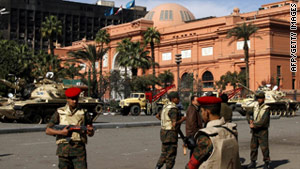
Egyptian state television on Wednesday went so far as to portray the protesters as members of a radical fringe and bluntly stated: "Let the military take over and protect you and Egypt."
"We have confirmed reports that there are radical elements heading to cause internal strife. They have balls of fire and they want to start fire in the Tahrir (Liberation) Square," Egyptian television said.
Much international media coverage has focused on the violence in Cairo's Liberation Square between antagonists and protagonists for embattled President Hosni Mubarak. It remained unclear whether such confrontations were being repeated elsewhere. Contesting rallies in Egypt's second-largest city, Alexandria, were largely peaceful. Other Cairo neighborhoods also remained calm.
But Wednesday's events in Liberation Square highlighted pro-Mubarak demonstrators charging -- dramatically on horseback and camels -- anti-Mubarak protesters, the first sign of a counter-demonstration after days of mass anti-government protests.
In stark juxtaposition, as the violence unfolded, the army did nothing.
"The military's refusal to act is a highly political act which shows that it is allowing the Egyptian regime to reconstitute itself at the top and is highly, utterly against the protesters," said Joshua Stacher, assistant professor of political science at Kent State University and an expert on Egypt. He was among more than a dozen Middle East experts who met Monday with three White House National Security Council officials to talk about the Egyptian crisis.
The absence of military action serves two purposes, Stacher said.
"(One,) make the protesters go home, and two, scare the population that isn't protesting," Stacher said. "They want the Egyptian people to submit to the police state, and they want the people to pine for their police state so that they have stability back."
"It's getting really ruthless," Stacher added.
In Egypt, Vice President Omar Suleiman issued a statement saying that dialogue with opposition forces, as ordered by Mubarak, won't begin until the demonstrations stop. Mubarak had incited another round of protests Tuesday when he said he would wait until the September elections to step down. Demonstrators said they wanted an immediate exit by Mubarak.
Meanwhile, Secretary of State Hillary Clinton has begun a round of discussions with Suleiman as the Egyptian government has begun defending the pace of change and pushing back against American criticism, according to a senior U.S. official.
Egypt's president is going to move at his own pace and not be pressured by Obama and other world leaders, an Egyptian government official told CNN.
At the same time, a senior U.S. official is expressing concern about Mubarak's ties to the violence in Cairo.
U.S. officials are suspicious that Mubarak loyalists unleashed pro-Mubarak forces to intimidate protesters, the U.S. official said. "Perhaps" Mubarak is making a mess that only he can "solve," the source added.
In a public statement, the spokesman for the State Department called for restraint.
"The use of violence to intimidate the Egyptian people must stop. We strongly call for restraint," P.J. Crowley said in a statement Wednesday.
However, an Egyptian government official said the government has a "serious problem" in how the Obama administration has been "spinning" the events yesterday to give the impression that Mubarak's statement was given under pressure or a "nudge" from Obama.
Robert Kagan of the Brookings Institute said the military appears to be facilitating the pro-government demonstrators in Cairo.
"It tells me that the military doesn't appear to be playing the neutral, benevolent role that we hoped it would," Kagan told CNN. "It does appear to be not only allowing these brutal pro-government thugs to come in and attack the protesters but maybe even facilitating it, which raises very serious questions about what role the military intends to play in this whole period of transition.
"It's a very cynical move which I hope the rest of the world, and particularly the United States, don't fall for," Kagan said.
Michele Dunne, a senior associate at the Carnegie Endowment for International Peace, said it was unclear what the military's agenda is.
"Does this mean they're committed to Mubarak, or does it mean that perhaps they're giving him one last chance, one last try to see if he can get control of the streets and get the demonstrators out?" Dunne told CNN.
"I think today we saw a very ugly face of this regime. These are tactics that are well-known in Egypt and have been used many times before -- to send regime thugs to break up peaceful demonstrations," she said.
A democratic Egypt won't threaten peace with Israel
Prime Minister Benjamin Netanyahu said Wednesday that if democracy prevails in Egypt then it will not pose a threat to peace with Israel.
"All those who value freedom are inspired by the calls for democratic reforms in Egypt," Netanyahu said during a speech to the Knesset. "An Egypt that will adopt these reforms will be a source of hope for the world. As much as the foundations for democracy are stronger, the foundations for peace are stronger."
The prime minister said that there is a risk that instability in Egypt could last for years, and called for "bolstering Israel's might" in response to the turmoil.
"The basis of our stability, our future and for maintaining peace or widening it, particularly in unstable times, this basis lies in bolstering Israel's might," he added, in his toughest response yet to the week of protests in Egypt.
Netanyahu said that Israel expects any new government in Egypt to respect the peace treaty with Israel, and warned that Iran wants Egypt to turn into Gaza. He also stressed that Israel supports forces which advance freedom and peace, and opposes forces who promote terror and war.
After eight days of anti-government protests in Egypt, riots turned violent on Wednesday as hundreds were reported wounded in clashes between supporters of Egypt President Hosni Mubarak and anti-government protesters.
On Monday, Netanyahu met with German Chancellor Angela Merkel and warned that what happened in Iran could happen in Egypt.
"Our real fear is of a situation that could develop ... and which has already developed in several countries including Iran itself -- repressive regimes of radical Islam," said Netanyahu.
Netanyahu continued, adding that although the protests may not be motivated by religious extremism, "in a situation of chaos, an organized Islamist body can seize control of a country. It happened in Iran. It happened in other instances".
"All those who value freedom are inspired by the calls for democratic reforms in Egypt," Netanyahu said during a speech to the Knesset. "An Egypt that will adopt these reforms will be a source of hope for the world. As much as the foundations for democracy are stronger, the foundations for peace are stronger."
The prime minister said that there is a risk that instability in Egypt could last for years, and called for "bolstering Israel's might" in response to the turmoil.
"The basis of our stability, our future and for maintaining peace or widening it, particularly in unstable times, this basis lies in bolstering Israel's might," he added, in his toughest response yet to the week of protests in Egypt.
Netanyahu said that Israel expects any new government in Egypt to respect the peace treaty with Israel, and warned that Iran wants Egypt to turn into Gaza. He also stressed that Israel supports forces which advance freedom and peace, and opposes forces who promote terror and war.
After eight days of anti-government protests in Egypt, riots turned violent on Wednesday as hundreds were reported wounded in clashes between supporters of Egypt President Hosni Mubarak and anti-government protesters.
On Monday, Netanyahu met with German Chancellor Angela Merkel and warned that what happened in Iran could happen in Egypt.
"Our real fear is of a situation that could develop ... and which has already developed in several countries including Iran itself -- repressive regimes of radical Islam," said Netanyahu.
Netanyahu continued, adding that although the protests may not be motivated by religious extremism, "in a situation of chaos, an organized Islamist body can seize control of a country. It happened in Iran. It happened in other instances".
Egyptian clashes leave 3 dead, hundreds hurt

Anti-government demonstrators and supporters of Egyptian President Hosni Mubarak clashed repeatedly in Cairo on Wednesday leaving three people dead and more than 611 wounded.
Shortly after 11 p.m local time, the two groups faced each other in the city's Tahrir Square. Many flaming projectiles were thrown and some demonstrators set up barricades to protect themselves.

CBC's David Common said a large amount of gunfire could be heard in the square. The gunfire appeared to be coming from military forces who were firing into the air, he said.
"There is chaos in the streets of Cairo tonight," he said.
The opposing demonstrators ignored an order from the military to go home.
Egypt has been in upheaval now for nine days. On Tuesday, Mubarak said he would not run in September elections, a move that will end his 30 years in office. However, anti-government protesters keep insisting Mubarak must step down immediately.
Three fatalities
Health Minister Ahmed Farid said two young men were taken from Tahrir Square in ambulances. He said one man was already dead, while the other died in hospital.
The third man died when he fell from a bridge near the square. Farid said the man was wearing civilian clothes but may have been a member of the security forces.
Read more: http://www.cbc.ca/world/story/2011/02/02/egypt-mubarak-military.html#ixzz1CqD7nP5m
Arab Leaders Trying to Keep Heads Above Waves of Mideast Protests
By JIM SCIUTTO
As popular protests spread from Egypt and Tunisia to Jordan, Yemen and beyond, governments in those countries -- most of them U.S. allies -- are fighting to stay ahead of the curve and stay in power.
Jordan's King Abdullah dissolved his government today and appointed a new prime minister, giving it a mandate, according to an advisor to the king, for "effective, tangible and real political reform."
The reform is intended to include a new election law encouraging a multi-party system, but does not set a date for elections.
Striking a hopeful tone despite the growing popular unrest inside Jordan and around the region, advisor to King Abdullah and now former deputy prime minister Ayman Safadi told ABC News, "King Abdullah is the strongest ally for reform. With Tunisia and Egypt, there is a new dynamic in the region. To the extent which it applies depends on the political environment in each country. The king is turning a crisis into an opportunity."
Egyptian President Hosni Mubarak has appointed a vice president and instructed him to negotiate with the opposition.
Tunisia's interim government, led by Prime Minister Mohammed Ghannouchi, reshuffled the cabinet removing some key figures associated with the ousted former president Zine El Abidine Ben Ali. But Tunisia is struggling to contain insistent protests and sporadic violence.
In Yemen, President Ali Abdullah Saleh increased wages and cut income taxes this week, and today announced that will address a special meeting of the consultative council, hoping to take some of the steam out of a "day of rage" planned for Thursday.
The question is: will those moves satisfy the opposition growing in confidence and ambitions?
In Egypt, the answer appears to be a resounding no. Protesters there are calling for nothing less than Mubarak's departure. In Yemen, the opposition says it is "too late" for dialogue. In Tunisia, they're calling for the removal of all senior officials tied to the ousted president.
In Jordan, it remains to be seen whether a new government announced today will satisfy the thousands demonstrating in six cities there.
Meanwhile, Syria is bracing itself for its own unrest, as online organizers there take inspiration from Egypt and Syria and are calling for a "day of rage" in Damascus this week.
These youth-led, technology-driven "Facebook revolutions" have leap-frogged far older and seemingly better-organized opposition groups who've fought and failed for decades to challenge their governments. In Egypt, the Muslim Brotherhood was a late arrival at this current protests.
While protests have engulfed the Arab street before, the targets have most often been outsiders, usually the U.S. and Israel. Now they have a new target: their own governments.
Israel Watches Its Arab Allies Fight for Survival
Robert Danin, the Eni Enrico Mattei Senior Fellow for Middle East and Africa Studies at the Council on Foreign Relations, calls these events " new and unprecedented".
"We've seen demonstrations in the Middle East throughout the twentieth century. That part is not new," Danin said in an interview with cfr.org. "What we're seeing that is new is that demonstrations are taking place in response to local conditions and problems that are then being fueled by, and inspired by, what is happening elsewhere in the region."
However, America's historical role in these countries is very much relevant. The principal negative factor to U.S. credibility among Muslims in the region something President Obama set out to revamp and revitalize has been its very support for leaders like Hosni Mubarak and King Abdullah.
At his 2009 speech in Cairo, the president said, "I do have an unyielding belief that all people yearn for certain things: the ability to speak your mind and have a say in how you are governed; confidence in the rule of law and the equal administration of justice; government that is transparent and doesn't steal from the people; the freedom to live as you choose. Those are not just American ideas, they are human rights, and that is why we will support them everywhere."
Muslims welcomed the words but told me, as they so often have, that actions speak louder than words. That is, they want America to support democracy, not just talk it up.
While U.S. officials now attempt to walk a fine line between backing democratic change and not abandoning old friends, for many Muslims, it's too late for U.S. officials to say anything of real value. As one Egyptian democracy activist told me over the weekend, "The U.S. is paying the piper for supporting the dictator Mubarak."
Beyond the U.S., one of the biggest losers from the upheaval could be the U.S.'s closest ally in the region, Israel.
Egypt's fall and in a nightmare scenario for U.S. and Israeli leaders, Jordan's as well would upend virtually all of Israel's peace and national security priorities.
Peace today in the region and peace in the future with the Palestinians depends on alliances with its neighbors Egypt and Jordan. Israel's national security also depends on them. Israel depends on Egypt providing a southern front against Hamas in Gaza. More troubling for Israel, Hamas is close to the Egypt's largest organized opposition group, the Muslim Brotherhood.
Ripples From Tunisia Buffet Mideast
And a Palestinian state in the West Bank would be an almost unthinkable prospect for many Israelis with an unfriendly government in Jordan.
More broadly, with Israel's relations with Turkey damaged since the Israeli assault on the Gaza flotilla, Israel could, in a worst case, find itself with no reliable Arab ally.

As popular protests spread from Egypt and Tunisia to Jordan, Yemen and beyond, governments in those countries -- most of them U.S. allies -- are fighting to stay ahead of the curve and stay in power.

Jordan's King Abdullah dissolved his government today and appointed a new prime minister, giving it a mandate, according to an advisor to the king, for "effective, tangible and real political reform."
The reform is intended to include a new election law encouraging a multi-party system, but does not set a date for elections.
Striking a hopeful tone despite the growing popular unrest inside Jordan and around the region, advisor to King Abdullah and now former deputy prime minister Ayman Safadi told ABC News, "King Abdullah is the strongest ally for reform. With Tunisia and Egypt, there is a new dynamic in the region. To the extent which it applies depends on the political environment in each country. The king is turning a crisis into an opportunity."
Egyptian President Hosni Mubarak has appointed a vice president and instructed him to negotiate with the opposition.
Tunisia's interim government, led by Prime Minister Mohammed Ghannouchi, reshuffled the cabinet removing some key figures associated with the ousted former president Zine El Abidine Ben Ali. But Tunisia is struggling to contain insistent protests and sporadic violence.
In Yemen, President Ali Abdullah Saleh increased wages and cut income taxes this week, and today announced that will address a special meeting of the consultative council, hoping to take some of the steam out of a "day of rage" planned for Thursday.
The question is: will those moves satisfy the opposition growing in confidence and ambitions?
In Egypt, the answer appears to be a resounding no. Protesters there are calling for nothing less than Mubarak's departure. In Yemen, the opposition says it is "too late" for dialogue. In Tunisia, they're calling for the removal of all senior officials tied to the ousted president.
In Jordan, it remains to be seen whether a new government announced today will satisfy the thousands demonstrating in six cities there.
Meanwhile, Syria is bracing itself for its own unrest, as online organizers there take inspiration from Egypt and Syria and are calling for a "day of rage" in Damascus this week.
These youth-led, technology-driven "Facebook revolutions" have leap-frogged far older and seemingly better-organized opposition groups who've fought and failed for decades to challenge their governments. In Egypt, the Muslim Brotherhood was a late arrival at this current protests.
While protests have engulfed the Arab street before, the targets have most often been outsiders, usually the U.S. and Israel. Now they have a new target: their own governments.
Israel Watches Its Arab Allies Fight for Survival
Robert Danin, the Eni Enrico Mattei Senior Fellow for Middle East and Africa Studies at the Council on Foreign Relations, calls these events " new and unprecedented".
"We've seen demonstrations in the Middle East throughout the twentieth century. That part is not new," Danin said in an interview with cfr.org. "What we're seeing that is new is that demonstrations are taking place in response to local conditions and problems that are then being fueled by, and inspired by, what is happening elsewhere in the region."
However, America's historical role in these countries is very much relevant. The principal negative factor to U.S. credibility among Muslims in the region something President Obama set out to revamp and revitalize has been its very support for leaders like Hosni Mubarak and King Abdullah.
At his 2009 speech in Cairo, the president said, "I do have an unyielding belief that all people yearn for certain things: the ability to speak your mind and have a say in how you are governed; confidence in the rule of law and the equal administration of justice; government that is transparent and doesn't steal from the people; the freedom to live as you choose. Those are not just American ideas, they are human rights, and that is why we will support them everywhere."
Muslims welcomed the words but told me, as they so often have, that actions speak louder than words. That is, they want America to support democracy, not just talk it up.
While U.S. officials now attempt to walk a fine line between backing democratic change and not abandoning old friends, for many Muslims, it's too late for U.S. officials to say anything of real value. As one Egyptian democracy activist told me over the weekend, "The U.S. is paying the piper for supporting the dictator Mubarak."
Beyond the U.S., one of the biggest losers from the upheaval could be the U.S.'s closest ally in the region, Israel.
Egypt's fall and in a nightmare scenario for U.S. and Israeli leaders, Jordan's as well would upend virtually all of Israel's peace and national security priorities.
Peace today in the region and peace in the future with the Palestinians depends on alliances with its neighbors Egypt and Jordan. Israel's national security also depends on them. Israel depends on Egypt providing a southern front against Hamas in Gaza. More troubling for Israel, Hamas is close to the Egypt's largest organized opposition group, the Muslim Brotherhood.
Ripples From Tunisia Buffet Mideast
And a Palestinian state in the West Bank would be an almost unthinkable prospect for many Israelis with an unfriendly government in Jordan.
More broadly, with Israel's relations with Turkey damaged since the Israeli assault on the Gaza flotilla, Israel could, in a worst case, find itself with no reliable Arab ally.
'Pro-Mubarak demonstrators are targeting the press'
Swedish reporters are held by Egyptian Army, accused of being Mossad spies; 4 Israelis arrested; Anderson Cooper is beaten up.
Pro-government protesters and Egyptian military have attacked reporters from numerous media sources around the world during Wednesday's riots in Cairo's Tahrir Square.
Two Swedish reporters were held for hours on Wednesday by Egyptian soldiers accusing them of being Mossad spies, the reporters' employer, daily newspaper Aftonbladet, reported.The soldiers reportedly attacked the reporters, spitting in their faces and threatening to kill them.
Four Israeli journalists were arrested by Egyptian military police in Cairo on Wednesday. Three of those arrested work for Channel 2 and the fourth is from Nazareth.
In addition, renowned CNN correspondent Anderson Cooper and his news crew were roughed up by mobs favoring Egyptian President Hosni Mubarak, as were Washington Post reporters. Cooper was reportedly punched in the head ten times.
Another CNN correspondent said that pro-government rioters were instructed to target the press.The US State Department condemned actions against journalists in Egypt on Wednesday.
State Department Spokesman P.J. Crowley tweeted: "We are concerned about detentions and attacks on news media in Egypt. The civil society that Egypt wants to build includes a free press."
On Sunday, Egyptian authorities ordered the closure of Al-Jazeera's offices covering the protests. A statement by Al-Jazeera called Egypt's decision an act "designed to stifle and repress" open reporting. On Monday, six Al-Jazeera journalists were arrested, and released later that day.
Pro-government protesters and Egyptian military have attacked reporters from numerous media sources around the world during Wednesday's riots in Cairo's Tahrir Square.
Two Swedish reporters were held for hours on Wednesday by Egyptian soldiers accusing them of being Mossad spies, the reporters' employer, daily newspaper Aftonbladet, reported.The soldiers reportedly attacked the reporters, spitting in their faces and threatening to kill them.
Four Israeli journalists were arrested by Egyptian military police in Cairo on Wednesday. Three of those arrested work for Channel 2 and the fourth is from Nazareth.
In addition, renowned CNN correspondent Anderson Cooper and his news crew were roughed up by mobs favoring Egyptian President Hosni Mubarak, as were Washington Post reporters. Cooper was reportedly punched in the head ten times.
Another CNN correspondent said that pro-government rioters were instructed to target the press.The US State Department condemned actions against journalists in Egypt on Wednesday.
State Department Spokesman P.J. Crowley tweeted: "We are concerned about detentions and attacks on news media in Egypt. The civil society that Egypt wants to build includes a free press."
On Sunday, Egyptian authorities ordered the closure of Al-Jazeera's offices covering the protests. A statement by Al-Jazeera called Egypt's decision an act "designed to stifle and repress" open reporting. On Monday, six Al-Jazeera journalists were arrested, and released later that day.
World leaders denounce attacks on Egyptian protesters
Leaders around the globe joined a chorus of condemnation Wednesday over the eruption of violence in Cairo as embattled Egyptian President Hosni Mubarak struggled to maintain his grip on power.
Violence between pro- and anti-government demonstrators spread through the Egyptian capital despite Mubarak's announcement that he will not seek re-election in the presidential election this year.
The time for a political transition in Egypt "is now," U.S. presidential spokesman Robert Gibbs said. The Egyptian people "need to see change," and a "meaningful transition must include opposition voices and parties being involved in this process as we move toward free and fair elections."
U.S. State Department spokesman P.J. Crowley denounced the attacks, calling them "a direct threat to the aspirations of the Egyptian people."
"The use of violence to intimidate the Egyptian people must stop. We strongly call for restraint," he said.
British Prime Minister David Cameron warned that "if it turns out that the (Mubarak) regime in any way has been sponsoring or tolerating this violence, that would be completely and utterly unacceptable.""These are despicable scenes that we're seeing, and they should not be repeated," Cameron said outside 10 Downing Street. "They underline the need for political reform and, frankly, for that political reform to be accelerated and to happen quickly."
German Foreign Minister Guido Westerwelle called on Egyptian security forces "not to use force against the demonstrators."
"Any escalation of the situation must be avoided at all costs, (and) gangs of thugs must be curbed immediately," he said. "The scenes of violence on the streets of Cairo throws into question whether the Egyptian political leadership has understood the importance of a speedy democratic reconstruction."
French President Nicolas Sarkozy said his country "renews its support for the Egyptians' aspiration for a free, democratic and diverse society."
"France will be alongside all those who intend to demonstrate peacefully," he declared.
Israeli Prime Minister Benjamin Netanyahu expressed concern over the makeup of the regime that will follow Mubarak, who has helped enforce a more than three-decade peace between Egypt and Israel.
"I am convinced that that the forces that want to bring change and democratization in Egypt will also enhance peace between Israel and the Arab world," Netanyahu told the Knesset. "But we are not there yet. The struggle has not been decided. ... We need to do everything to make sure that peace endures."
United Nations General Secretary Ban Ki-Moon called the violence in Cairo "unacceptable" and said it is important for an "orderly and a peaceful transition" to take place.
"We should not underestimate the danger of instability across the Middle East," he added.
Turkish Premier Recep Tayyip Erdogan asserted that Mubarak's administration "is not inspiring confidence for a quick transition to democracy," the Anatolia News Agency reported. "This is the people's expectation. ... A roadmap and a calendar for this should be announced, (and) I believe that such a transition should be made under an interim administration."
How much impact are the calls for change having on Mubarak? Probably not much, according to one veteran Middle East analyst.
Robert Danin, a senior fellow at the Council on Foreign Relations, noted that the apparent crackdown on anti-government protesters started the day after former U.S. Ambassador to Egypt Frank Wisner told Mubarak he should not seek another term as president.
Wisner was reportedly conveying that message from Obama.
"The timing is interesting," Danin said. "That suggests Mubarak has basically said, 'Enough. I've laid down my timeline, and now I'm digging in.' "
Danin called the eruption of violence "a clear rebuff" of the push for more immediate reform being advanced by the American and other governments.
Danin called Mubarak a man who generally "keeps his own counsel." The Egyptian leader does have a close relationship with Saudi King Abdullah, but Riyadh has generally been expressing support for Mubarak, Danin noted.
"I suspect (King Abdullah's) heart is with Mubarak right now," Danin said.
Violence between pro- and anti-government demonstrators spread through the Egyptian capital despite Mubarak's announcement that he will not seek re-election in the presidential election this year.
The time for a political transition in Egypt "is now," U.S. presidential spokesman Robert Gibbs said. The Egyptian people "need to see change," and a "meaningful transition must include opposition voices and parties being involved in this process as we move toward free and fair elections."
U.S. State Department spokesman P.J. Crowley denounced the attacks, calling them "a direct threat to the aspirations of the Egyptian people."
"The use of violence to intimidate the Egyptian people must stop. We strongly call for restraint," he said.
British Prime Minister David Cameron warned that "if it turns out that the (Mubarak) regime in any way has been sponsoring or tolerating this violence, that would be completely and utterly unacceptable.""These are despicable scenes that we're seeing, and they should not be repeated," Cameron said outside 10 Downing Street. "They underline the need for political reform and, frankly, for that political reform to be accelerated and to happen quickly."
German Foreign Minister Guido Westerwelle called on Egyptian security forces "not to use force against the demonstrators."
"Any escalation of the situation must be avoided at all costs, (and) gangs of thugs must be curbed immediately," he said. "The scenes of violence on the streets of Cairo throws into question whether the Egyptian political leadership has understood the importance of a speedy democratic reconstruction."
French President Nicolas Sarkozy said his country "renews its support for the Egyptians' aspiration for a free, democratic and diverse society."
"France will be alongside all those who intend to demonstrate peacefully," he declared.
Israeli Prime Minister Benjamin Netanyahu expressed concern over the makeup of the regime that will follow Mubarak, who has helped enforce a more than three-decade peace between Egypt and Israel.
"I am convinced that that the forces that want to bring change and democratization in Egypt will also enhance peace between Israel and the Arab world," Netanyahu told the Knesset. "But we are not there yet. The struggle has not been decided. ... We need to do everything to make sure that peace endures."
United Nations General Secretary Ban Ki-Moon called the violence in Cairo "unacceptable" and said it is important for an "orderly and a peaceful transition" to take place.
"We should not underestimate the danger of instability across the Middle East," he added.
Turkish Premier Recep Tayyip Erdogan asserted that Mubarak's administration "is not inspiring confidence for a quick transition to democracy," the Anatolia News Agency reported. "This is the people's expectation. ... A roadmap and a calendar for this should be announced, (and) I believe that such a transition should be made under an interim administration."
How much impact are the calls for change having on Mubarak? Probably not much, according to one veteran Middle East analyst.
Robert Danin, a senior fellow at the Council on Foreign Relations, noted that the apparent crackdown on anti-government protesters started the day after former U.S. Ambassador to Egypt Frank Wisner told Mubarak he should not seek another term as president.
Wisner was reportedly conveying that message from Obama.
"The timing is interesting," Danin said. "That suggests Mubarak has basically said, 'Enough. I've laid down my timeline, and now I'm digging in.' "
Danin called the eruption of violence "a clear rebuff" of the push for more immediate reform being advanced by the American and other governments.
Danin called Mubarak a man who generally "keeps his own counsel." The Egyptian leader does have a close relationship with Saudi King Abdullah, but Riyadh has generally been expressing support for Mubarak, Danin noted.
"I suspect (King Abdullah's) heart is with Mubarak right now," Danin said.
Clashes rage in Tahrir Square
Clashes have broken out between pro- and anti-government demonstrators in the Egyptian capital Cairo.
Protesters from both sides threw stones at each other in Tahrir Square, the epicentre of ongoing opposition demonstrations against President Hosni Mubarak for the past nine days
The health ministry said at least one person had been killed and another 400 injured in Wednesday's violence.
Al Jazeera correspondents, reporting from the scene, said clashes were still raging and that petrol bombs were being hurled.
"Someone - a few people actually - are dropping homemade bombs into the square from the buildings surrounding it. Gunshots occasionally ringing out across downtown," our online producer said.
Earlier, witnesses said the military allowed thousands of pro-Mubarak supporters, armed with sticks and knives, to enter the square. Opposition groups said Mubarak had sent in thugs to suppress anti-government protests.
One of our correspondents said the army seemed to be standing by and facilitating the clashes. Latest reports suggest that the centre of the square is still in control of the protesters, despite the pro-Mubarak supporters gaining ground.
'Absolute mayhem'
Witnesses also said that pro-Mubarak supporters were dragging away protesters they had managed to grab and handing them over to security forces.
Salma Eltarzi, an anti-government protester, told Al Jazeera there were hundreds of wounded people.
"There are no ambulances in sight, and all we are using is Dettol," she said. "We are all so scared."
Aisha Hussein, a nurse, said dozens of people were being treated at a makeshift clinic in a mosque near the square.She described a scene of "absolute mayhem", as protesters first began to flood into the clinic.
People are coming in with multiple wounds. All kinds of contusions. We had one guy who needed stitches in two places on his face. Some have broken bones."
Meanwhile, another Al Jazeera correspondent said men on horseback and camels had ploughed into the crowds, as army personnel stood by.
At least six riders were dragged from their beasts, beaten with sticks by the protesters and taken away with blood streaming down their faces.
One of them was dragged away unconscious, with large blood stains on the ground at the site of the clash.
The worst of the fighting was just outside the world famous Egyptian Museum, which was targeted by looters last week.
Al Jazeera's correspondent added that several a group of pro-government protesters took over army vehicles. They also took control of a nearby building and used the rooftop to throw concrete blocks, stones, and other objects.
Soldiers surrounding the square took cover from flying stones, and the windows of at least one army truck were broken. Some troops stood on tanks and appealed for calm but did not otherwise intervene.
Many of the pro-Mubarak supporters raised slogans like "Thirty Years of Stability, Nine Days of Anarchy".
Protesters from both sides threw stones at each other in Tahrir Square, the epicentre of ongoing opposition demonstrations against President Hosni Mubarak for the past nine days
The health ministry said at least one person had been killed and another 400 injured in Wednesday's violence.
Al Jazeera correspondents, reporting from the scene, said clashes were still raging and that petrol bombs were being hurled.
"Someone - a few people actually - are dropping homemade bombs into the square from the buildings surrounding it. Gunshots occasionally ringing out across downtown," our online producer said.
Earlier, witnesses said the military allowed thousands of pro-Mubarak supporters, armed with sticks and knives, to enter the square. Opposition groups said Mubarak had sent in thugs to suppress anti-government protests.
One of our correspondents said the army seemed to be standing by and facilitating the clashes. Latest reports suggest that the centre of the square is still in control of the protesters, despite the pro-Mubarak supporters gaining ground.
'Absolute mayhem'
Witnesses also said that pro-Mubarak supporters were dragging away protesters they had managed to grab and handing them over to security forces.
Salma Eltarzi, an anti-government protester, told Al Jazeera there were hundreds of wounded people.
"There are no ambulances in sight, and all we are using is Dettol," she said. "We are all so scared."
Aisha Hussein, a nurse, said dozens of people were being treated at a makeshift clinic in a mosque near the square.She described a scene of "absolute mayhem", as protesters first began to flood into the clinic.
People are coming in with multiple wounds. All kinds of contusions. We had one guy who needed stitches in two places on his face. Some have broken bones."
Meanwhile, another Al Jazeera correspondent said men on horseback and camels had ploughed into the crowds, as army personnel stood by.
At least six riders were dragged from their beasts, beaten with sticks by the protesters and taken away with blood streaming down their faces.
One of them was dragged away unconscious, with large blood stains on the ground at the site of the clash.
The worst of the fighting was just outside the world famous Egyptian Museum, which was targeted by looters last week.
Al Jazeera's correspondent added that several a group of pro-government protesters took over army vehicles. They also took control of a nearby building and used the rooftop to throw concrete blocks, stones, and other objects.
Soldiers surrounding the square took cover from flying stones, and the windows of at least one army truck were broken. Some troops stood on tanks and appealed for calm but did not otherwise intervene.
Many of the pro-Mubarak supporters raised slogans like "Thirty Years of Stability, Nine Days of Anarchy".

Egypt's Protests Inspire Russian Opposition Activists

The leaders of Russia's opposition have long been looking for a new refrain - something beyond their hackneyed chants of "Russia without Putin!" - and on Monday night, when they gathered for a protest in downtown Moscow, they seemed to have found one. It came off as a kind of Egypt envy, the revolutionary bug that has afflicted many of the world's dissidents since an uprising broke out a few weeks ago in Tunisia and spread to Egypt. For Russia's opposition, the events in the Arab world have raised some frustrating questions: What's the difference between our leaders and Egypt's teetering President? Why won't the revolution come to us?
By some measures, there doesn't seem to be much difference between the regime of Egyptian President Hosni Mubarak and that of Russian Prime Minister Vladimir Putin. Many of the social ills that have pushed Egyptians to revolt are just as bad in Russia - and in some cases, they're worse. (See pictures of the aftermath of the recent bombing at Domodedovo Airport in Moscow.)
According to Transparency International's ranking of the most corrupt countries last year, Egypt was in the 98th place, tied with Mexico, while Russia was 154th. Economic troubles like rising food prices, unemployment, poverty and the vast gap between rich and poor are also comparable in the two countries. The latest data from the U.N. Development Program shows 16.7% of Egyptians lived below the poverty line in 2005, compared with 19.6% in Russia in 2007. The jobless rate is also about equal. In Egypt it was 9.4% at the end of 2009 and it was 9.2% in Russia at the start of 2010, according to most the recent figures in the CIA's World Factbook.
On Monday night, such comparisons came easily to the leaders of the Russian opposition, who are banned from politics and frequently arrested for their activism. From atop a truck bed rigged up with a microphone in Moscow's Triumphal Square, Boris Nemtsov, the opposition's de facto leader, bellowed, "For 30 years, power has been in the hands of the corrupt and thieving dictator Mubarak. But how is he different from our leaders?" A dozen voices in the crowd responded, "They are the same!" A new slogan then seemed to catch on as the rally progressed: "We won't wait 30 years!" (See "TIME's Exclusive Photos: Turmoil in Egypt.")
Earlier, the liberal wing of President Dmitri Medvedev's Kremlin also appeared to have caught the revolutionary itch when Igor Yurgens, an economic adviser to Medvedev, warned that Russia could become like Tunisia if Putin decides to take back the presidency in 2012. "Everyone is fed up with seeing the same face," Yurgens told Bloomberg news agency on Jan. 18. For an official of Yurgens' rank, it was a shocking slight against the Prime Minister.
But for all their dramatic effect, comparisons between Russia and Egypt don't hold much water, as two of the opposition leaders admitted to TIME on the sidelines of Monday's rally. For one thing, the Arab world has seen a demographic boom in recent years that has made for a young and restless population. Many of the people setting fire to barricades and stoning police in Egypt are younger than 15, an age-group that makes up about 40% of the population. Russia is exactly the opposite, said Vladimir Ryzhkov, an ex-parliamentarian turned dissident. "Our people are aging and in decline," he said, looking around at the pensioners who made up the bulk of the meager crowd at Monday's event, a regular anti-Putin protest held on the 31st of the month. "Also," he added, "the high price of oil [Russia's main export] has allowed the regime a certain cushion of economic stability." (Comment on this story.)
There is also the timid political culture inherited from the Soviet Union, which spent four generations literally breeding dissent out of the population, says Sergei Kovalyov, a famous Soviet dissident who is now a leading campaigner for human rights. "In the field of natural selection, Josef Stalin had a real gift," says Kovalyov. Stalin realized soon after taking power in 1922 that a nation still high on the ideals of the 1917 revolution would not put up with him for long, and he slowly began to purge the population of anyone prone to free thought. By most estimates, this process killed off as many as 20 million people and nearly wiped out the intellectual class. "In the end, it created a nation genetically immunized against dissent," says Kovalyov. "This has been a great gift to our current leaders." (See the top 10 autocrats in trouble.)
Still, as the feeble opposition was preparing for Monday's rally, Russia's leadership wasn't taking any chances. The opposition's offices were raided by police on Sunday, and the antiriot troops surrounding the square outnumbered the protesters by about 3 to 1. Some of the organizers were even detained before they reached the square, with one of them, Sergei Udaltsov, stopped on suspicion of using a fake subway ticket on his way to the protest and held just long enough to miss it. (See Russia's efforts to crack down on terrorism problems.)
The rally ended less than an hour after it began, and its elderly participants peacefully dispersed, leaving their leaders to stand around discussing the fury in the Arab world. A light snow fell on their heads, and the square became quiet. It looked absolutely nothing like Cairo.
Pro- and anti-government supporters clash in Cairo
Several thousand supporters of President Hosni Mubarak, including some riding horses and camels and wielding whips, attacked anti-government protesters Wednesday as Egypt's upheaval took a dangerous new turn. In chaotic scenes, the two sides pelted each other with stones, and protesters dragged attackers off their horses.
The turmoil was the first significant violence between supporters of the two camps in more than a week of anti-government protests. It erupted after Mubarak went on national television the night before and rejected demands he step down immediately and said he would serve out the remaining seven months of his term.
Wednesday morning, a military spokesman appeared on state TV Wednesday and asked the protesters to disperse so life in Egypt could get back to normal. The announement could mark a major turn in the attitude of the army, which for the past two days has allowed protests to swell, reaching their largest size yet on Tuesday when a quarter-million peace packed into Cairo's central Tahrir Square.
Nearly 10,000 protesters massed again in Tahrir on Wednesday morning, rejecting Mubarak's speech as too little too late and renewed their demands he leave immediately.
In the early afternoon Wednesday, an Associated Press reporter saw around 3,000 Mubarak supporters break through a human chain of anti-government protesters trying to defend thousands gathered in Tahrir.
Chaos erupted as they tore down banners denouncing the president. Fistfights broke out as they advanced across the massive square in the heart of the capital. The anti-government protesters grabbed Mubarak posters from the hands of the supporters and ripped them.
The two sides began hurling stones and bottles and sticks at each other, chasing each other as the protesters' human chains moved back to try to shield the larger mass of demonstrators at the plaza's center.
At one point, a small contingent of pro-Mubarak forces on horseback and camels rushed into the anti-Mubarak crowds, swinging whips and sticks to beat people. Protesters retaliated, dragging some from their mounts, throwing them to the ground and beating their faces bloody.
Protesters were seen running with their shirts or faces bloodied, some men and women in the crowd were weeping. A scent of tear gas wafted over the area, but it was not clear who had fired it.
The army troops who have been guarding the square had been keeping the two sides apart earlier in the day, but when the clashes erupted they did not intervene. Most took shelter behind or inside the armored vehicles and tanks stationed at the entrances to Tahrir.
The turmoil was the first significant violence between supporters of the two camps in more than a week of anti-government protests. It erupted after Mubarak went on national television the night before and rejected demands he step down immediately and said he would serve out the remaining seven months of his term.
Wednesday morning, a military spokesman appeared on state TV Wednesday and asked the protesters to disperse so life in Egypt could get back to normal. The announement could mark a major turn in the attitude of the army, which for the past two days has allowed protests to swell, reaching their largest size yet on Tuesday when a quarter-million peace packed into Cairo's central Tahrir Square.
Nearly 10,000 protesters massed again in Tahrir on Wednesday morning, rejecting Mubarak's speech as too little too late and renewed their demands he leave immediately.
In the early afternoon Wednesday, an Associated Press reporter saw around 3,000 Mubarak supporters break through a human chain of anti-government protesters trying to defend thousands gathered in Tahrir.
Chaos erupted as they tore down banners denouncing the president. Fistfights broke out as they advanced across the massive square in the heart of the capital. The anti-government protesters grabbed Mubarak posters from the hands of the supporters and ripped them.
The two sides began hurling stones and bottles and sticks at each other, chasing each other as the protesters' human chains moved back to try to shield the larger mass of demonstrators at the plaza's center.
At one point, a small contingent of pro-Mubarak forces on horseback and camels rushed into the anti-Mubarak crowds, swinging whips and sticks to beat people. Protesters retaliated, dragging some from their mounts, throwing them to the ground and beating their faces bloody.
Protesters were seen running with their shirts or faces bloodied, some men and women in the crowd were weeping. A scent of tear gas wafted over the area, but it was not clear who had fired it.
The army troops who have been guarding the square had been keeping the two sides apart earlier in the day, but when the clashes erupted they did not intervene. Most took shelter behind or inside the armored vehicles and tanks stationed at the entrances to Tahrir.
Mubarak concessions 'insufficient'


Unimpressed by president Hosni Mubarak's speech on Tuesday night, in which he vowed not to renew his rule, thousands of Egyptian protesters remain holed up in Cairo's central Tahrir Square, adamant in their demand that the president must step down.
Mubarak, in his defiant speech, announced he would surrender power, but only in September at the end of his term in office, after which he would not seek re-election.
But protesters reacted angrily, jeering him and once again calling for an immediate end to his 30-year reign.
"The speech is useless and only inflames our anger," said Shadi Morkos in Tahrir square. "We will continue to protest."
"We will not leave! He will leave!" others chanted at the time.
Meanwhile, pro-Mubarak demonstrators were engaged in a standoff with anti-government protesters in Cairo on Wednesday after they marched into the anti-Mubarak rally in Tahrir Square.
The Mubarak supporters gathered earlier to reaffirm their commitment to his administration. The crowd had chanted: "With our blood and our souls, we will sacrifice for Mubarak," Al Jazeera's Jacky Rowland reported from the demonstration.
She said people were "frenzied" and the atmosphere was tense, with potential battle lines being drawn between the two sides of the Egyptian divide. Pro and anti government demonstrators have already clashed in Alexandria and Cairo following Mubarak's speech.
Standoff
Al Jazeera's Jane Dutton, reporting from Cairo, said there is now a "real standoff" between anti-government Egyptians and Mubarak, with neither side seeming to budge in the others' direction.
The ball is now in the protesters' court, Dutton said.
"[Mubarak] has given them what they want. He has said he will step down, just not yet. And he has offered them all these concessions, demands that they have made over many years, for other parties to run in the elections, for there to be a fixed term under the president."
"But it's too and little too late," Dutton added. "People are angry that these sort of changes are being imposed or suggested under a dictatorship, under this regime. They want him to go and they want him to go now."
Speaking to Al Jazeera after Mubarak's speech, protesters in Cairo echoed these same sentiments. "I want to say that this man is provoking us. This man wants to have a massacre in this country that has been good to him and his children." one male demonstrator told Al Jazeera.
'Unacceptable'
"Chants of 'Down with the regime! Down with the president!' started up again about 30 seconds after he was done with the speech," Ashraf Khalil, a journalist based in Cairo, told Al Jazeera.
"Talking to the protesters in Tahrir Square, those who are remaining have made it clear that his latest concessions are unacceptable. They have no intention of giving him some sort of eight month farewell tour. They want him gone immediately and they plan to keep the pressure up," Khalil said.
But to those demanding he leave Egypt, Mubarak said on Tuesday: "This is my country ... and I will die on its soil."
Reaction to Mubarak's speech has been strong and swift. Immediately afterwards, Barack Obama, US president, said "orderly transition must be meaningful, it must be peaceful, and it must begin now."
But much of the reaction was registered on social networking sites, which have become a vehicle for anti-government protests. A flood of responses on the microblogging site Twitter mostly seemed to favour the Egyptians call for the president to cease power.
"Mubarak said he wants to die in Egypt - careful what you wish for!" one user called Guapo Plethora tweeted.
Another, Iyad El-Baghdadi, tweeted "Live from Tahrir Square: Everyone considers Mubarak an ex-President and think his days are numbered."
Mona Eltahawy, a columnist and public speaker on Muslim and Arab issues, also tweeted saying, "It's Mubarak vs Egypt and Egypt must win. Armed forces [have] to understand. There is no way Mubarak can stay til September. OUT."
Opportunity for real change
Al Jazeera's correspondents on the ground in Egypt reported similar sentiments. "I was in Tahrir Square for Mubarak speech and once they heard offer to not run again, chanting started "get out get out". Dan Nolan tweeted.
Later he added "Nobody there believes any of his promises any more. They know this is their opportunity for real change and won't stop til it happens."
Ayman Mohyeldin, another correspondent, tweeted that "History may be repeating itself. Former Tunisian president Ben Ali gave three speeches and [vowed not to run again for elections].
Early into Wednesday, protesters in Cairo held up banners stating "Remove the regime", Al Jazeera's Dutton reported.
She said demonstrators were determined not to move, and were planning other major protests to take place after Friday prayers.
"The protesters I spoke with really do think Friday might be the day they drive Mubarak from office. They are very optimistic, they are jubilant," Ashraf Khalil said.
Tuesday, February 1, 2011
Jordan: revolution fears in Algeria, Yemen and Syria
http://www.telegraph.co.uk
With protests in several Middle East countries, there are also now fears for Algeria, Yemen and Syria.
President Abdelaziz Bouteflika, who has ruled the country since 1999, was elected on the promise to end the violence that had plagued the country for much of its history since independence from France in 1962.
To a certain extent he has succeeded, and after years of political upheaval the country is beginning to emerge as a centre of enterprise, heavily assisted by the country's huge oil and gas reserves. It has estimated oil reserves of nearly 12 billion barrels, attracting strong interest from foreign oil firms.
However, poverty remains a serious problem and unemployment high, particularly among Algeria's youth. Almost 50 per cent of Algeria's 34.6 million people are under 25, and the youthful population coupled with a lack of jobs has made Algeria something of a simmering cauldron. Endemic government corruption and poor standards in public services are also chronic sources of popular dissatisfaction.
Mounting grievances over spiralling costs and unemployment triggered the riots earlier this month, encouraged by public protests in Tunisia that forced its president Zine El Abidine Ben Ali to flee.On Monday a third Algerian died from self-immolation, while another tried to set himself alight Sunday, adding to a grim tally of Tunisia-inspired acts.
The incident on Sunday, in the capital Algiers, marked the 10th attempted self-immolation since January 12.
Syria
Syrians are organising campaigns on Facebook and Twitter that call for a "day of rage" in Damascus this week, taking inspiration from Egypt and Tunisia in using social networking sites to rally their followers for sweeping political reforms.
Like Egypt and Tunisia, Syria suffers from corruption, poverty and unemployment. All three nations have seen subsidy cuts on staples like bread and oil. Syria's authoritarian President Bashar al-Assad has resisted calls for political freedoms and jailed critics of his regime.
On Sunday a group of 39 activists and opposition figures issued a statement hailing Egypt and Tunisia's protesters, but Mr Assad has shown no signs of flinching.
In an interview with the Wall Street Journal on Monday, Mr Assad said Syria was "immune" from the turmoil affecting Egypt and Tunisia.
"We have more difficult circumstances than most of the Arab countries, but in spite of that Syria is stable. Why? Because you have to be very closely linked to the beliefs of the people," Mr Assad said.
"If you did not see the need for reform before what happened in Egypt and in Tunisia, it is too late to do any reform," he was quoted as saying.
"If you do it just because of what happened in Tunisia and Egypt, then it is going to be a reaction, not an action and ... you are going to fail."
Mr Assad, a 45-year-old British-trained eye doctor, inherited power from his father, Hafez, in 2000, after three decades of authoritarian rule.
He has since moved slowly to lift Soviet-style economic restrictions, letting in foreign banks, throwing the doors open to imports and empowering the private sector.
But Mr Assad has not matched liberal economics with political reforms and critics of the regime are routinely locked up, drawing an outcry from international human rights groups.
He is seen by many Arabs, however, as one of the few leaders in the region willing to stand up to arch enemy Israel. And his support for Palestinian and Lebanese militant groups opposed to the Jewish state as well as his opposition to the invasion of Iraq has won him more support among his people than other Arab rulers.
Yemen
Yemen's president, facing demands that he resign, has called for a meeting of parliament and the consultative council, as the opposition has declared that it is "too late" for dialogue and that he must go.
Ali Abdullah Saleh is expected to address the special meeting ahead of a "day of rage" that civil society organisations have called for Thursday.
Facing protests that have multiplied since the mid-January ouster of Tunisia's president, Mr Saleh has taken measures aimed at soothing popular discontent.
President Ali Abdallah Saleh has been in power since 1978. The authority of the central government has been challenged by southern separatists, northern rebels and al-Qaeda militants, and has recently been rocked by events in Tunisia and Egypt.
On Monday, after increasing wages and reducing incomes taxes, he ordered the creation of a fund to employ university graduates and to extend social security coverage. He also decided to exempt university students from the rest of their tuition fees for this academic year, and charged the high council of universities to reduce the cost of a degree.
A governing body of Mr Saleh's General People's Congress party called on Friday for a resumption of dialogue with opposition parties, which are currently at an impasse.
Yemenis are now calling for "changing the regime and the ouster of the president."
Yemen is one of the poorest and least developed countries in the Middle East.

With protests in several Middle East countries, there are also now fears for Algeria, Yemen and Syria.
President Abdelaziz Bouteflika, who has ruled the country since 1999, was elected on the promise to end the violence that had plagued the country for much of its history since independence from France in 1962.
To a certain extent he has succeeded, and after years of political upheaval the country is beginning to emerge as a centre of enterprise, heavily assisted by the country's huge oil and gas reserves. It has estimated oil reserves of nearly 12 billion barrels, attracting strong interest from foreign oil firms.
However, poverty remains a serious problem and unemployment high, particularly among Algeria's youth. Almost 50 per cent of Algeria's 34.6 million people are under 25, and the youthful population coupled with a lack of jobs has made Algeria something of a simmering cauldron. Endemic government corruption and poor standards in public services are also chronic sources of popular dissatisfaction.
Mounting grievances over spiralling costs and unemployment triggered the riots earlier this month, encouraged by public protests in Tunisia that forced its president Zine El Abidine Ben Ali to flee.On Monday a third Algerian died from self-immolation, while another tried to set himself alight Sunday, adding to a grim tally of Tunisia-inspired acts.
The incident on Sunday, in the capital Algiers, marked the 10th attempted self-immolation since January 12.
Syria
Syrians are organising campaigns on Facebook and Twitter that call for a "day of rage" in Damascus this week, taking inspiration from Egypt and Tunisia in using social networking sites to rally their followers for sweeping political reforms.
Like Egypt and Tunisia, Syria suffers from corruption, poverty and unemployment. All three nations have seen subsidy cuts on staples like bread and oil. Syria's authoritarian President Bashar al-Assad has resisted calls for political freedoms and jailed critics of his regime.
On Sunday a group of 39 activists and opposition figures issued a statement hailing Egypt and Tunisia's protesters, but Mr Assad has shown no signs of flinching.
In an interview with the Wall Street Journal on Monday, Mr Assad said Syria was "immune" from the turmoil affecting Egypt and Tunisia.
"We have more difficult circumstances than most of the Arab countries, but in spite of that Syria is stable. Why? Because you have to be very closely linked to the beliefs of the people," Mr Assad said.
"If you did not see the need for reform before what happened in Egypt and in Tunisia, it is too late to do any reform," he was quoted as saying.
"If you do it just because of what happened in Tunisia and Egypt, then it is going to be a reaction, not an action and ... you are going to fail."
Mr Assad, a 45-year-old British-trained eye doctor, inherited power from his father, Hafez, in 2000, after three decades of authoritarian rule.
He has since moved slowly to lift Soviet-style economic restrictions, letting in foreign banks, throwing the doors open to imports and empowering the private sector.
But Mr Assad has not matched liberal economics with political reforms and critics of the regime are routinely locked up, drawing an outcry from international human rights groups.
He is seen by many Arabs, however, as one of the few leaders in the region willing to stand up to arch enemy Israel. And his support for Palestinian and Lebanese militant groups opposed to the Jewish state as well as his opposition to the invasion of Iraq has won him more support among his people than other Arab rulers.
Yemen
Yemen's president, facing demands that he resign, has called for a meeting of parliament and the consultative council, as the opposition has declared that it is "too late" for dialogue and that he must go.
Ali Abdullah Saleh is expected to address the special meeting ahead of a "day of rage" that civil society organisations have called for Thursday.
Facing protests that have multiplied since the mid-January ouster of Tunisia's president, Mr Saleh has taken measures aimed at soothing popular discontent.
President Ali Abdallah Saleh has been in power since 1978. The authority of the central government has been challenged by southern separatists, northern rebels and al-Qaeda militants, and has recently been rocked by events in Tunisia and Egypt.
On Monday, after increasing wages and reducing incomes taxes, he ordered the creation of a fund to employ university graduates and to extend social security coverage. He also decided to exempt university students from the rest of their tuition fees for this academic year, and charged the high council of universities to reduce the cost of a degree.
A governing body of Mr Saleh's General People's Congress party called on Friday for a resumption of dialogue with opposition parties, which are currently at an impasse.
Yemenis are now calling for "changing the regime and the ouster of the president."
Yemen is one of the poorest and least developed countries in the Middle East.
Mubarak, the shah and the 30-year itch

There's a sense of deja vu about Egyptian ruler Hosni Mubarak and his crumbling 30-year dictatorship. Mubarak, who has been a staunch American ally, propped up with billions in taxpayer dollars, called a key to U.S. policy in the region and a human rights abuser, and now twisting slowly in the wind, is pledging to hold on - at least through the end of the week.
Reminds us of the Shah of Iran, Mohammad Reza Pahlavi - a staunch American ally, propped up with U.S. support, called a key to U.S. policy in the region (installed by the CIA, after all, as a bulwark against the Soviets) and toppled in 1979 after nearly 38 years in power.
In Southeast Asia we had dictator Ferdinand Marcos in the Philippines, another staunch ally, human rights violator, key to policy in the region, propped up by billions in taxpayer dollars, ousted in the People Power Revolution after a 20-year reign.
Closer to home there was Chilean dictator Augusto Pinochet, another ally and anti-communist, a major human rights abuser who ran the Chilean army for some 25 years and was president for 17 years.
Dictators past have taken a couple years or so to overthrow but, as Ken Pollak of the Brookings Institution's Saban Center observed, "the pace of change" has accelerated in recent years. In the past it's been something like a 30-year itch before the people finally begin revolt (Libya's wacky Moammar Gaddafi, on top for more than 40 years, for the moment being the exception). In the Internet age, that may no longer apply.
But, like "True Grit," seems we've seen this show before, even if we don't know the precise ending.
The author you have . . .
Finally! It's here. The book you've been waiting for - former defense secretary Donald Rumsfeld's new memoir, "Known and Unknown" (we would have preferred "Stuff Happens"), is on sale next week, and he's taking his show on the road.
The "first stop on his highly anticipated national book tour" will be next Wednesday at the National Constitution Center in Philadelphia, a center news release tells us. The book "chronicles his long career in public service," from his time in Congress - he was elected 48 years ago - to his work in the Nixon, Ford and Bush II administrations.
"Long career" is a euphemism for very, very long book, and this one weighs in at a hefty 2.6 pounds and 832 exciting pages, all for just $36. The Wednesday launch includes a "conversation" to be "facilitated by presidential historian Michael Beschloss," where Rumsfeld "will discuss previously undisclosed details and insight into the Bush administration." Tickets for that are only $15, and books will be available for purchase (and signing) right there.
The title echoes Rumsfeld's famous observations about "known knowns" and "unknown unknowns" and so on. Unclear whether there will be questions from the audience, but you should have some ready. For example, you might ask what caused the Army chief of staff at the time, Gen. Eric Shinseki - now secretary of veterans affairs - to be so completely wrong when he said the United States would need a few hundred thousand troops in Iraq.
Rumsfeld might also explain how the prediction that the war would pay for itself was pretty much on target, or perhaps how the post-invasion Iraqi turmoil was just like Germany in 1945-47, or how those weapons of mass destruction may yet be found - okay, maybe in Iran, but that's not all that far away and, after all, they are spelled similarly.
Washington memoirs are famous for settling scores, so if you're lucky enough to get a seat, buy the book , go immediately to the index and look for Colin Powell, Condoleezza Rice . . .
Not to be missed. Reservations can be made online at www.constitutioncenter.org.
A happy landing
Loop Fans may recall Sen. Jim Inhofe's little problem with the Federal Aviation Administration in October after he landed his twin-engine Cessna 340 on the main runway in Port Isabel, Tex.
The problem was there were these huge X's on the runway showing it was closed and workmen were out there painting and doing general maintenance as Inhofe (R-Okla.) zipped by.
The matter, we're happy to report, seems now to be resolved in what appears to be the aeronautic equivalent of a nolo contendere plea.
Inhofe, 76, told us Tuesday morning that he was confident he did nothing wrong and had been cleared by a controller to land on the runway. But he said he agreed to what he said was "painless" remedial training rather than go through a legal enforcement action. (That might have led to a license suspension.)
The training, done in Tulsa, consisted of four hours of instruction on the ground and three hours of flight instruction by an instructor who, oddly enough, Inhofe had trained many years ago.
The FAA, in a Jan. 4 letter Inhofe sent us, said that it had "concluded that based on your satisfactory completion of the remedial training program, legal enforcement action will not be pursued." Instead, the letter would remain on record for two years, "after which the record of this matter would be expunged. This letter constitutes neither an admission nor an adjudication of a violation."
Inhofe praised the FAA and said "I could not have been treated better" by the agency, though he acknowledged that his being a senator may have had something to do with the treatment he got. (We hear the FAA insists not.)
He said he would announce on the Senate floor Tuesday that he would introduce legislation that would give pilots greater access to controllers' records and provide for an appeal before a license is revoked.
Mubarak says he plans to step down, but crowd tells him to 'leave'

By HANNAH ALLAM AND SHASHANK BENGALI
Faced with an unprecedented popular revolt that drew record crowds of protesters to downtown Cairo Tuesday, U.S.-backed Egyptian President Hosni Mubarak said he would step down before elections this fall, a humbling end to his 30 years of authoritarian rule.
"I will say, with all honesty and without looking at this particular situation, that I was not intending to stand for the next elections because I've spent enough time serving Egypt," Mubarak said in a televised speech. "I'm now careful to conclude my work for Egypt by presenting Egypt to the next government in a constitutional way."
Mubarak acted after President Barack Obama sent a special envoy to Cairo, urging him not to seek re-election, and following calls from Turkey and Iran to step down.
Obama later telephoned Mubarak, and in a "direct and frank" 30-minute conversation, told him an orderly transition to a new regime had to begin immediately, the White House said. In a nationally televised appearance, Obama all but ignored Mubarak's announcement, declaring that "an orderly transition must be meaningful, must be peaceful and must begin now."
Initial reaction was mostly negative among protesters in Tahrir Square, where earlier Tuesday, hundreds of thousands of Egyptians - more than a million by some estimates - staged a festive rally to demand the president's ouster.
"He's leaving! He's leaving!" some protesters shouted gleefully. More than an hour after he spoke, however, chants continued to echo from Tahrir Square as protesters vowed to keep flooding Egypt's streets until Mubarak heeded their demand to resign immediately.
"We have only one condition: We need Mubarak to be out of our lives," said Mostafa Fathy, 28, an online journalist and activist. "He's supposed to be out of the game now."
The 82-year-old Mubarak appeared to make some concessions to the protesters, saying there should be presidential term limits and fewer restrictions on who can run for public office. But he didn't dissolve parliament, which is filled almost completely with members of his ruling party.
All day long, protesters had chanted, "Leave!" It came from the mouths of children draped in the Egyptian flag, bearded clerics in turbans, teenagers dancing to a drumbeat and elderly women with tears in their eyes. Long before the president's speech, cameras flashed and video recorders rolled as the protesters documented what they hoped would go down in Egyptian history as the end of Mubarak's regime.
"In my whole life, I've never known another president, and suddenly I can't imagine how he can stay for even one more day," said Tasneem Osman, 26. "He has to go. He will go."
Before Mubarak's appearance around 11 p.m., state TV stations mostly ignored the crowds in the square, instead airing call-in shows with government supporters and dismissing independent news coverage as tainted by foreign interests. The government's intense pressure on the protesters continued: an Internet shutdown, spotty phone service, a nationwide curfew, shuttered banks, no trains from other provinces and a crackdown on journalists.
Despite the obstacles, this week-old rebellion with no clearly defined leadership drew massive crowds in an atmosphere that was peaceful and jubilant well into the night. Young protesters made up chants like freestyle rappers, playing with puns and rhymes. Placards depicted Mubarak as Hitler or with devilish horns. An effigy of the president dangled from a noose tied to a traffic light.
"The people said it clearly: They want a new democratic regime and this regime has lost its legitimacy," opposition politician Mohamed ElBaradei told Al-Jazeera television. "I would have liked that President Mubarak would listen to the sounds of the millions that went out today."
Even without Mubarak's immediate ouster, the movement has achieved in a week something opposition groups have attempted in vain for decades. Mubarak was forced to name his first-ever vice president, the former intelligence chief Omar Suleiman. Habib el Adly, the interior minister who was detested for the alleged brutality of his police force, was unceremoniously sacked.
A young boy was perched on a man's shoulders, waving an Egyptian flag as he yelled a chant aimed at Suleiman. The newly appointed vice president is a strong contender for interim leadership should Mubarak leave sooner.
"We don't need America's man. Omar Suleiman, leave the country!" the boy shouted. More than a dozen adult protesters chanted along with him, cheering and snapping photos.
The anti-government movement has steadily grown more defiant - and more disciplined. While military tanks hung back on the outskirts of the square, citizen volunteers checked IDs and searched Egyptians streaming into the square. In the middle of the frenzy, ordinary people were collecting trash - a rare sight in Egypt even when the country is not in turmoil.
"I came for the liberation of my country," said Yahya Zakaria, 29, slight man with sunken cheeks who took a bus several hundred miles from southern Egypt to Cairo to participate in the Jan. 25 protest, the first major rally. He's been camping in the square ever since, and on Tuesday he picked up garbage.
Zakaria's voice was hoarse from chanting slogans such as, "Mubarak, you are cheap; Egypt is worth more than you!" He needed a change of clothes, but he seemed convinced that the only president he's ever known was on his way out.
"Before, I didn't love my country," he said. "Now I love my country a lot."
Reports that demonstrators would march en masse nearly eight miles from Tahrir Square to the presidential palace didn't materialize. At midday, cranes were laying stone roadblocks outside the palace gates and Mubarak's presidential guard forces had posted tanks to block the roads.
Activists said that they had decided such a huge crowd marching such a long distance was unwieldy and could put them in conflict with the Egyptian army, which is deployed throughout Cairo but so far has allowed the demonstrations to carry on mostly unfettered.
"We didn't want to clash with anyone, and we wanted to avoid thugs or police that might have put some traps for us," said Ahmed Salah, an activist with the April 6 youth movement, a pro-democracy group.
Some in the crowd greeted Mubarak's announcement with satisfaction. Moataz Shalaby, 27, a real-estate salesman who brought a "Mubarak, Get Out" sign to the square Tuesday afternoon, said after the speech that at least Egyptians had the end of the Mubarak era in sight.
He said he would have been happier if Mubarak said he would dissolve the parliament after his ruling National Democratic Party won 97 percent of the seats in November elections that were widely described as rigged.
"The problem is the system of that party," Shalaby said. "All of them follow the same management school, so we need another school, another system, another everything."
Subscribe to:
Posts (Atom)