Sudanese police clashed with students Sunday as protests inspired by rallies in Egypt broke out in the capital.
The students protested at a university in Khartoum, chanting "No to high prices, no to corruption" and "Tunisia, Egypt, Sudan together as one."
About 100 students hurled rocks at police officers, who forced them back. Five people were arrested, authorities said.
Students resumed the protests and tried to engage bystanders as soon as police left the area.
Sunday, January 30, 2011
Actress Veena Malik takes on clerics over dress

A Pakistani film star is pitting herself against conservative clerics after wearing shorts and swimming with Baywatch star Pamela Anderson.
After attacks from religious leaders, Veena Malik, star of more than a dozen "Lollywood" (Lahore's Hollywood) movies, has called for women to be freed from conservative dress and the horror of honour killing.
"If a woman is cool with wearing a burka, she should wear a burka. If a woman, being a Muslim, wants to wear jeans, then she should wear jeans. That's your right," she said.
Malik, 32, whose former boyfriend Mohammad Asif, the Pakistani Test cricketer, was embroiled in a betting scandal last year, has become a champion for Pakistani liberals after appearing in Bigg Boss 4, a version of Big Brother, on Indian television.
The repeated showing on Pakistani television of two clips, one in which she is seen wearing shorts and another in which she hugs an Indian actor, prompted a backlash from clerics.In a fiery confrontation on a talk show last week, Malik defended herself against Mufti Abdul Qawi, who denounced her behaviour as immoral, despite admitting he had not seen the videos.
She retorted that he was attacking her because she was a woman. "I'm a Muslim woman, and I know my limits," she yelled at Qawi, who seemed too shocked by her fury to reply.
Malik said Pakistan's culture of fear had intensified since this month's murder of Punjab governor Salman Taseer.
"I'm not scared of anything. Being a woman, you will just go for me because I'm a soft target. But I won't take it, even if I die," she said.
The actress pledged to fight for women's rights. "Why aren't men being beaten? Have you ever heard they've thrown acid in a guy's face here in Pakistan?
"We should emphasise education and improving the literacy rate, but we're still stuck in 'Look at her, she's not wearing shalwar kameez (traditional dress), she's wearing jeans'. Please, get a life."
Egyptian Protests Expected Monday Despite Curfew

A scholar said Egyptians are dissatisfied with the appointment of a vice president and will continue with their protests Monday despite an imposed curfew to press home their demands for embattled President Hosni Mubarak to step down from office.
Howayda Mostafa, professor of mass communication at the University of Cairo, told VOA the protesters do not consider the installation of Vice President Omar Suleiman as the real democratic transformation in government that they are demanding.
“Today (Monday), they will continue to protest because the nomination of the vice president and all the (others) didn’t satisfy the protesters because they consider that this change doesn’t reflect a real change because both of them are very close to the regime. They (protesters) are expecting a real change in the regime itself,” Mostafa said.
“In addition, they asked the president to go out and to make real change; and they called for another regime which respects them and their aspirations; and they are calling for a new constitution; and they are calling for a government which reflects many political forces. So, they will continue to protest till they realize these changes.”
Meanwhile, Nobel laureate and Egyptian opposition figure Mohamed ElBaradei told thousands of protesters in the capital’s Tahrir Square Sunday that they "cannot go back" after starting the uprising against Mr. Mubarak.
Mostafa said it’s impossible to predict whether the ongoing protests will force President Mubarak to step down.
“No one can be sure what will happen in the future. But, as we see now, this is the first time that the regime tried to listen to the people because it’s a real manifestation,” said Mostafa.
A crowd of some 5,000 people erupted in applause as Mr. El-Baradei called for an end to the Mubarak government so that a new Egypt of "freedom and dignity" can emerge. Cairo's Tahrir Square has become a hub of grassroots anti-Mubarak demonstrations.
Protesters also defied the government-imposed curfew in other cities, including the northern port city of Alexandria where thousands continued an hours-long march.
The government says the curfew will continue to be in effect on Monday. It also has extended the curfew one hour, starting at 3:00 pm local time (1300 GMT) instead of 4:00 pm (1400 GMT).
Media reports say police will begin returning to some streets in Cairo on Monday two days after withdrawing following violent clashes with protesters. Security sources say they will return to routine duties, but will not confront protesters.
Egypt's army has increased its presence, but has made no attempt to disperse demonstrators since being deployed. The army is popular and highly respected, while many Egyptians see the police force as corrupt and repressive.
Arab Elite Say Monarchies Are Safe From Unrest
By LIZ ALDERMAN
DAVOS, SWITZERLAND — The unrest engulfing Egypt caught business and political leaders at the World Economic Forum off guard, but it became the hottest topic among the Arab elite here. Most of those leaders tuned in to the dramatic events using iPads and BlackBerrys and huddled to debate how the uprising would affect the rest of the Arab world.
“It’s all anyone’s talking about,” said Sheik Mohammed bin Essa al-Khalifa, who leads Bahrain’s economic development board and took part in many of the discussions.For the most part, the consensus was that President Hosni Mubarak would not easily relinquish his authoritarian grip in Egypt, an outcome that became more evident as he named Omar Suleiman, the country’s intelligence chief and a close ally, as his vice president on Saturday.
But the drive for change from tens of thousands of protesters means that a near monarchical regime cloaked in democracy will inevitably end, Arab executives here concluded.
“People are saying that Gamal Mubarak doesn’t have a chance of succeeding his father,” said a business executive who insisted on anonymity, referring to Mr. Mubarak’s son. “It’s a matter of when it will end, not if.”The events in Egypt were hardly mentioned during the official programs at the Davos forum, although a few leaders issued brief statements of concern before turning to other topics.Few of the executives present expected a revolution to spread across the oil-rich nations of the Gulf, where the governments are monarchies, which often do not create the types of expectations that accompany a democracy.Rulers in these countries use their oil wealth to invest in social stability by ensuring that their own people lead comfortable lives through subsidies on things like electricity, education and food.
“Saudi Arabia and the Gulf countries are going to be spared because they are not democratic regimes,” said Jamal Khashoggi, the general manager of Al Waleed 24 News Channel. People in those countries “don’t feel cheated because there are no elections,” he said.
By contrast, he said, “I can feel the agony of an Egyptian when he sees how democracy is mocked.”
On Thursday, the Saudi prince Turki al-Faisal al-Saud had this answer when asked whether a wave of democracy across the Middle East might be even more destabilizing than a nuclear Iran: “I don’t know; in Saudi Arabia, we have neither nuclear weapons nor democracy.”
One question mark, some Arab executives said, may be Bahrain, the smallest economy in the region and a developing democracy.
Bahrain lacks the abundant oil wealth of many of its neighbors, and has moved to diversify its economy, invest heavily in education and create an unemployment safety net, the only one in the region. Shiites outnumber the Sunni population, which lost control of Parliament in elections last October.
For some, however, the situation is not comfortable enough.
“People think that we should follow this nanny state mentality of the government subsidizing everything,” Sheik Mohammed said. He noted that Kuwait had just paid $3,000 to every Kuwaiti citizen to celebrate the 50th anniversary of the country’s independence.
Referring to people in Bahrain, he said: “They don’t want to let go of electricity subsidies or other subsidies. But those who benefit most are members of Parliament, the business community, decision makers and to some extent, the press, which comes out against reforms.”
Instead, his country is funneling former subsidy money toward advanced education and the creation of jobs — one of the most important ingredients for social stability in the Arab world, where vast numbers of young people in particular are hampered by soaring levels of unemployment.
“What counts is jobs,” Sheik Mohammed said. “This is not just a problem in the Arab world; it’s a global issue that’s hitting the United States and Europe, too.”
Can Mubarak survive the revolt?
The protests in Alexandria - like those in Cairo - have been completely peaceful on Saturday and Sunday after the brutality of last Friday, when the police shot down and killed around 30 demonstrators in the city.Two of them were buried on Sunday, and many thousands of people turned out for their funeral service.
Some things are different in Alexandria - it still is a moderate city. But there is a noticeably stronger religious element here than there is in Cairo.
In other ways, though, things are very much the same: the anger against President Hosni Mubarak has the same intensity.And Mr Mubarak's tactics are the same as well: the army has now been given the task of dealing with the demonstrators, rather than the much more hated police who did the job until Friday's shootings.The army's tactics seem to be to let the demonstrations peter out rather than to stop them with force.So far here - as in Cairo and elsewhere - this system has worked, but the dangers are always present.
It seems clear that the Americans have warned President Mubarak urgently that there must be no more killings.
Can he survive with such vocal opposition in the streets?
He seems determined not to cut and run as President Ben Ali of Tunisia did, and the Americans can't want that either. The power vacuum it would create would be very dangerous indeed.
From the American point of view, the best thing that could happen would be a peaceful end to the protests, the retirement of Mr Mubarak and the continuation of some part (at least) of the system which he has created - shorn, hopefully, of its corruption.
It won't be easy and it won't appeal greatly to the demonstrators, who have condemned Mr Mubarak's entire political structure and want to bring it down.
Perhaps, though, stripping out his closest and older associates might just do the job.
So much of it depends on the demonstrators themselves: if they hold out - an easy transition to one of Mr Mubarak's associates will be much harder.
If, though, the shortages in the shops, the looting that has been going on and the general desire to get back to ordinary life bring a gradual end to the protest, then the system - if not the president himself - might survive in power.
Spotlight Again Falls on Web Tools and Change


Fear is the dictator’s traditional tool for keeping the people in check. But by cutting off Egypt’s Internet and wireless service late last week in the face of huge street protests, President Hosni Mubarak betrayed his own fear — that Facebook, Twitter, laptops and smartphones could empower his opponents, expose his weakness to the world and topple his regime.There was reason for Mr. Mubarak to be shaken. By many accounts, the new arsenal of social networking helped accelerate Tunisia’s revolution, driving the country’s ruler of 23 years, Zine el-Abidine Ben Ali, into ignominious exile and igniting a conflagration that has spread across the Arab world at breathtaking speed. It was an apt symbol that a dissident blogger with thousands of followers on Twitter, Slim Amamou, was catapulted in a matter of days from the interrogation chambers of Mr. Ben Ali’s regime to a new government post as minister for youth and sports. It was a marker of the uncertainty in Tunis that he had stepped down from the government by Thursday.
Tunisia’s uprising offers the latest encouragement for a comforting notion: that the same Web tools that so many Americans use to keep up with college pals and post passing thoughts have a more noble role as well, as a scourge of despotism. It was just 18 months ago, after all, that the same technologies were hailed as a factor in Iran’s Green Revolution, the stirring street protests that followed the disputed presidential election.
But since that revolt collapsed, Iran has become a cautionary tale. The Iranian police eagerly followed the electronic trails left by activists, which assisted them in making thousands of arrests in the crackdown that followed. The government even crowd-sourced its hunt for enemies, posting on the Web the photos of unidentified demonstrators and inviting Iranians to identify them.
“The Iranian government has become much more adept at using the Internet to go after activists,” said Faraz Sanei, who tracks Iran at Human Rights Watch. The Revolutionary Guard, the powerful political and economic force that protects the ayatollahs’ regime, has created an online surveillance center and is believed to be behind a “cyberarmy” of hackers that it can unleash against opponents, he said.
Repressive regimes around the world may have fallen behind their opponents in recent years in exploiting new technologies — not unexpected when aging autocrats face younger, more tech-savvy opponents. But in Minsk and Moscow, Tehran and Beijing, governments have begun to climb the steep learning curve and turn the new Internet tools to their own, antidemocratic purposes.
The countertrend has sparked a debate over whether the conventional wisdom that the Internet and social networking inherently tip the balance of power in favor of democracy is mistaken. A new book, “The Net Delusion: The Dark Side of Internet Freedom,” by a young Belarus-born American scholar, Evgeny Morozov, has made the case most provocatively, describing instance after instance of strongmen finding ways to use new media to their advantage.
After all, the very factors that have brought Facebook and similar sites such commercial success have huge appeal for a secret police force. A dissident’s social networking and Twitter feed is a handy guide to his political views, his career, his personal habits and his network of like-thinking allies, friends and family. A cybersurfing policeman can compile a dossier on a regime opponent without the trouble of the street surveillance and telephone tapping required in a pre-Net world.
If Mr. Mubarak’s Egypt has resorted to the traditional blunt instrument against dissent in a crisis — cutting off communications altogether — other countries have shown greater sophistication. In Belarus, officers of the K.G.B. — the secret police agency has preserved its Soviet-era name — now routinely quote activists’ comments on Facebook and other sites during interrogations, said Alexander Lukashuk, director of the Belarus service of Radio Free Europe/Radio Liberty. Last month, he said, investigators appearing at the apartment of a Belarusian photojournalist mocked her by declaring that since she had written online that they usually conducted their searches at night, they had decided to come in the morning.
In Syria, “Facebook is a great database for the government now,” said Ahed al-Hindi, a Syrian activist who was arrested at an Internet cafe in Damascus in 2006 and left his country after being released from jail. Mr. Hindi, now with the United States-based group CyberDissidents.org, said he believes that Facebook is doing more good than harm, helping activists form virtual organizations that could never survive if they met face to face. But users must be aware that they are speaking to their oppressors as well as their friends, he said.
Widney Brown, senior director of international law and policy at Amnesty International, said the popular networking services, like most technologies, are politically neutral.
“There’s nothing deterministic about these tools — Gutenberg’s press, or fax machines or Facebook,” Ms. Brown said. “They can be used to promote human rights or to undermine human rights.”
This is the point of Mr. Morozov, 26, a visiting scholar at Stanford. In “The Net Delusion,” he presents an answer to the “cyberutopians” who assume that the Internet inevitably fuels democracy. He coined the term “spinternet” to capture the spin applied to the Web by governments that are beginning to master it.
In China, Mr. Morozov said, thousands of commentators are trained and paid — hence their nickname, the 50-Cent Party — to post pro-government comments on the Web and steer online opinion away from criticism of the Communist Party. In Venezuela, President Hugo Chávez, after first denouncing hostile Twitter comments as “terrorism,” created his own Twitter feed — an entertaining mix of politics and self-promotion that now has 1.2 million followers.
In Russia, Mr. Morozov noted, Prime Minister Vladimir V. Putin has managed to co-opt several prominent new-media entrepreneurs, including Konstantin Rykov, whose many Web sites now skew strongly pro-Putin and whose anti-Georgia documentary about the Russia-Georgia war of 2008 went viral on the Web.
Mr. Morozov acknowledges that social networking “definitely helps protesters to mobilize.”
“But is it making protest more likely? I don’t think so.”
In Egypt, it appears, at least some activists share Mr. Morozov’s wariness about the double-edged nature of new media. An anonymous 26-page leaflet that appeared in Cairo with practical advice for demonstrators last week, The Guardian reported, instructed activists to pass it on by e-mail and photocopy — but not by Facebook and Twitter, because they were being monitored by the government.
Then Mr. Mubarak’s government, evidently concluding that it was too late for mere monitoring, unplugged his country from the Internet altogether. It was a desperate move from an autocrat who had not learned to harness the tools his opponents have embraced.
Al Jazeera a powerful counter to Mideast regimes


Egypt’s official MENA news agency said the outgoing information minister, Anas al-Fikki, ordered Al Jazeera’s closure in Cairo after its blanket coverage of anti-government protests sweeping the country.
The Doha-based Al Jazeera slammed the move as an attempt at “censoring and silencing the voices of the Egyptian people.”
In this time of deep turmoil and unrest in Egyptian society it is imperative that voices from all sides be heard,” the Arab satellite news channel said.
On Saturday, it broadcast an appeal from Yusef al-Qaradawi, a popular Egyptian-born television preacher and mentor of Egypt’s officially banned Muslim Brotherhood, urging President Hosni Mubarak to step down.
In Tunisia, a wave of protests earlier this month led to the ouster of president Zine El Abidine Ben Ali after 23 years in power, inspiring demonstrations in various other countries around the region, including Egypt.
“Arab governments accuse Al Jazeera of mobilising the street, and they are right, but this accusation is an honour for the channel,” said Abdel Khaleq Abdullah, a professor at United Arab Emirates University.
“There’s no doubt Al Jazeera was an important actor in the Tunisian revolution and in the events in Egypt,” he said.
Al Jazeera, which was founded in gas-rich Qatar in 1996, is no stranger to conflict with governments in the region.
Yemeni President Ali Abdullah Saleh on Thursday appealed to Qatar’s emir to “intervene with Al Jazeera to calm the situation and not resort to provocation, falsification of facts and exaggeration” in reports on protests in his country.
And in October 2010, Morocco’s communications ministry suspended Al Jazeera operations and withdrew the accreditation of its staff, following “numerous failures in (following) the rules of serious and responsible journalism.”
London-based analyst Abdel Wahab Badrakhan said Al Jazeera’s coverage of the protests in Egypt had been quite different in the first days from its coverage of the revolution in Tunisia.
“In Tunisia, Al Jazeera beat the street, but in Egypt, it followed,” he said.
“In the first days, it gave signals that it was not prepared to treat the Egyptian question the same way that it treated the uprising in Tunisia.”
While the protests were breaking out in Cairo, the channel gave precedence to its own controversial leaks on the Palestinian Authority’s position in peace negotiations with Israel, Badrakhan said.
On Tuesday, chief Palestinian negotiator Saeb Erakat accused Al Jazeera of trying to provoke the Palestinians into “a revolution against their leaders in order to bring down the Palestinian political system.”
His accusation came after Al-Jazeera began releasing 1,600 documents known as “The Palestine Papers” which exposed far-reaching concessions offered to Israel during 10 years of closed-door peace talks.
Demonstrators in the West Bank town of Ramallah on Tuesday burned portraits of Qatar’s emir, Sheikh Hamad bin Khalifa al-Thani, while others torched Israeli flags with the Al-Jazeera logo on them.
Despite the ban on Sunday, Al Jazeera vowed to “continue its in-depth and comprehensive reporting on the events unfolding in Egypt.”
Mubarak`s chances

As always, Mr Mubarak`s foreign friends are either watching the situation with fingers crossed or have already tilted to the people`s side. Even though President Barack Obama walked a tightrope, the implications of his speech must be disturbing for the Egyptian president. While he urged Mr Mubarak to deliver on his promises, and asked the crowds to express themselves peacefully, he also told his friend that “violence will not address the grievances of the Egyptian people”.
For Egyptians, foreign advice is of no consequence. Ultimately, it is Mr Mubarak`s ability to defuse the people`s fury that will matter, because the demonstrations are gaining in intensity. The shockingly low turn-out in the last parliamentary election seems to indicate the people have lost faith in the kind of `demo- cracy` that was on offer. Mr Mubarak has also indicated he will take part in the presidential election for a sixth term, and this has served in no small measure to fuel popular anger. So far the army has obeyed orders, and even though like the ruling elite it welcomes America`s average $2bn annual dole-out, it is widely believed the generals dislike the president`s son, Gamal. If the demonstrations continue to spread in intensity, we are not sure how long the army will continue to support what may appear to many as a tottering regime.
Europe's Arabs view Middle East chaos in awe, fear
Arabs living in Europe say they have watched events unfold in Tunisia and Egypt with a mixture of awe and fear as governments crumble and a breakdown of order threatens their friends and relations.
Egyptians in London spoke of frantic calls from their family in which they were told of armed criminal gangs roaming the streets after massive protests erupted against the government of President Hosni Mubarak.
"My cousin is calling me, shouting SOS. Criminals, gangs are everywhere, breaking into homes. I'm beside myself with worry. I haven't slept," said student Raouf Ghali, 41.
In Egypt, protesters defied police and the army to turn out in their thousands across the country for a sixth day to demand the end of Mubarak's 30-year rule, and in Tunisia mass protests in recent weeks have toppled the president.
Millions of Arabs have emigrated to Europe from the Middle East in recent decades, many to escape stifling autocratic rule, war or limited economic opportunity -- precisely the conditions that have sparked the demonstrations.
Some hoped the protests would spread across the region.
"I hope all Arab people rise up and take their rights. If one man can bring down government in Tunisia, then there's hope for Morocco," said a Moroccan restaurant worker on London's Edgeware Road, who gave her name only as Sanaa, 27.
The protests that brought down Tunisian leader Zine al-Abidine Ben Ali on January 14 erupted after a young man set himself on fire because police seized his grocery cart.
In other parts of Europe, some emigres said they welcomed the prospect of change in the Middle East but feared Islamist extremists could use any ensuing power vacuum to seize power.
"The worst case scenario is of an Islamist takeover of Egypt where they break the peace treaty with Israel and set back women's' rights by decades," said Albert Turquier, 65, who moved to France from Lebanon in 1972.
"There is also the cautionary lesson learned from the Iranian revolution where a popular uprising gave way to a repressive regime."
Others in London said they wanted Mubarak deposed, but were pessimistic that conditions in Egypt would improve. Poverty and unemployment have been endemic for decades, with many struggling for food.
"Democracy and a better future in Egypt? If I could, I'd get all my family out of there and bring them to the UK. Talk is cheap, and we hear a lot of it," said Mustapha Mahmoud, 27.
GOVERNMENT PLOT?
Egyptians living in Greece also were pessimistic.
"We are very sad and anxious about the way things have developed," said Yousef Samuel, head of the Association of Egyptian Workers of Greece.
"It began as a movement ... to demand a better life. But as it developed, criminal elements crept in."
Police have melted away in some areas, a move some Egyptians say is a government plot to instill fear among the people to keep them at home and away from the protests.
"The police sat on our heads for 30 years, the state spending billions on them. Now that the people need them, where are they? They were only there to protect a corrupt government," said Egyptian restaurant worker Mohammed Ismael, 46, in London.
In the oil-exporting Gulf region, where many Egyptians work to help their families back home make ends meet, were torn between wanting to head home to be with their relatives and the necessity to hold on to their livelihoods abroad.
"I am worried and want to go back," said Jaballa, 24, outside a waterfront lounge in Dubai.
"But if I go I will lose my job. We all hate the president and the government, but we don't want to risk anything in Dubai, because we wouldn't find a better life if they send us back to Egypt."
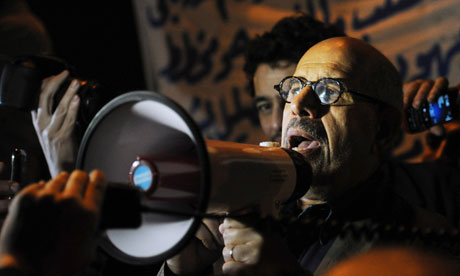
Egyptian reform leader calls on Mubarak to go

Egypt's most prominent democracy advocate took up a bullhorn Sunday to call for President Hosni Mubarak to go, speaking to thousands of protesters who defied a third night of curfew to mass in the capital's main square. Fighter jets streaked low overhead and police returned to the streets as Egypt's government tried to show its authority over a situation spiraling out of control.
Nobel Peace laureate Mohammed ElBaradei addressed the crowds in Tahrir Square, where up to 10,000 protesters gathered during the day. Even when he spoke hours after the 4 p.m. curfew, they numbered in the thousands, including families with young children, addressing Mubarak with their chants of "Leave, leave, leave."
"You are the owners of this revolution. You are the future," ElBaradei told supporters. "Our essential demand is the departure of the regime and the beginning of a new Egypt in which every Egyptian lives in virtue, freedom and dignity."
In a further sign of Mubarak's teetering position, his top ally the United States called for an "orderly transition to democracy."
Asked if Washington supports Mubarak as Egypt's leader, Secretary of State Hillary Rodham Clinton avoided a direct answer, telling Fox News in an interview, "We have been very clear that we want to see a transition to democracy, and we want to see the kind of steps taken that will bring that about."
Now in their sixth day, the protests have come to be centered in Tahrir, or Liberation, Square, where demonstrators have camped out since Friday despite the curfew, which officials announced would be moved up to 3 p.m. starting Monday. Protesters have shrugged off Mubarak's gestures of reform, including the sacking of his Cabinet and the appointment of a vice president and a new prime minister — both seen as figures from the heart of his regime.
The military was taking the lead in restoring order after police virtually vanished from the streets on Friday without explanation after initially clashing with protesters. The disappearance of the police opened the door for a wave of looting, armed robberies and arson in cities around the country.
The anarchy was further fueled when gangs of armed men attacked at least four jails across Egypt before dawn Sunday, freeing hundreds of criminals and Muslim militants. Gangs of young men with guns and large sticks smashed cars and robbed people in Cairo.
The official death toll from the crisis stood at 97, with thousands injured, but reports from witnesses across the country indicated that the actual toll was far higher.
The military, which enjoys far greater support among the public than the police, fanned out in tanks and armored vehicles around the city starting Sunday morning. At Tahrir Square, they appeared to cooperate with protesters in keeping the demonstrations orderly, and there were many scenes of affection between soldiers and protesters, who allowed troops to use their mobile phones to call home or offered them cigarettes.
"I am glad they are continuing to protest. God willing, he (Mubarak) will go," said one Air Force captain in uniform who drove by the edge of the square.
One banner held by protesters summed up the dilemma facing the military, proclaiming, "The army must chose between Egypt and Mubarak."
Minutes before the start of the curfew, at least two jets roared over the Nile, making several passes over the square, dropping lower every time and setting off alarms in parked cars. Some protesters clapped and waved to them while others jeered.
Police on Sunday began reasserting their presence, moving back into some Cairo neighborhoods. In some spots, they were jeered by residents who chanted anti-police slogans.
Interior Minister Habib al-Adly said he was ordering security forces to return to the streets in Cairo and elsewhere to work in tandem with army troops to restore order.
"It is necessary that the police role is quickly restored and that there should be cooperation in the field with the armed forces ... to defend the presence and future of the nation."
The police move could put an end to lawlessness and looting, which stunned many Cairenes and which the military struggled to control. But it could also lead to renewed clashes with protesters, among whom hatred of the black-garbed security forces runs deep — though it appeared the police would not be deployed in Tahrir Square.
In a sign of the distrust, many protesters were convinced the police intentionally allowed the looting in an attempt to spread chaos that would undermine the political demonstrations.
"Those people who are looting are from the police, they want to scare us and make us stay home and not participate in the demonstrations," said Walid Ambar, an engineer who joined the crowds in Tahrir along with his 2-year-old son and pregnant wife. "This is a campaign to scare us. But I came here to join the demonstration and I will not leave until Mubarak leaves."
In a bid to show he remained in control, the 82-year-old Mubarak met with his defense minister and Omar Suleiman, the military intelligence chief whom he named as vice president over the weekend, to review the security situation. Later Sunday, a tired looking Mubarak was shown on state TV conferring with Suleiman and the new prime minister-designate Ahmed Shafiq, like Mubarak a former air force officer.
An unprecedented Internet cutoff remained in place for a third day after the country's four primary Internet providers stopped moving data in and out of the country early Friday in an apparent move by authorities to disrupt the organization of demonstrations. Egyptian mobile-phone networks were back up but with text-messaging widely disrupted.
The lawlessness, uncertainty, and indications of an attempted exodus from Cairo were gravely damaging Egypt's economy, particularly tourism, which accounts for as much as 11 percent of the country's gross domestic product.
Banks were closed on orders from Egypt's Central Bank, and the country's stock market was shut on what is normally the first day of the trading week.
On the first day of trading across the Mideast after a weekend of protests and violence, nervous investors drove stocks down sharply. Crowds of foreigners filled Cairo International Airport, desperate and unable to leave because dozens of flights were canceled and delayed.
The U.S. Embassy in Cairo told its citizens in Egypt to consider leaving the country as soon as possible, and said it had authorized the voluntary departure of dependents and non-emergency employees, a display of Washington's escalating concern about the stability of its closest Arab ally.
ElBaradei's appearance in Tahrir Square underscored the jockeying for leadership of the protest movement, which erupted seemingly out of nowhere to shake the nation, inspired in part by protests in the nearby Arab nation of Tunisia that forced out its autocratic president.
ElBaradei, the former head of the U.N. nuclear watchdog, has gained a following among young secular democracy activists with his grassroots organizing. But some demonstrators dismissed him as an expatriate long removed from the country's problems.
"Many people feel he loves prizes and traveling abroad," said Muhammad Munir, 27. "He's not really one of the people."
The outlawed Muslim Brotherhood, which wants to establish an Islamist state in the Arab world's most populous nation, also appeared to moving for a more prominent presence after largely lying low when the protests first erupted. Sunday evening, the presence of overtly pious Muslims in the square was conspicuous, suggesting a significant Muslim Brotherhood representation. Hundreds performed the sunset prayers. Veiled women prayed separately.
A senior Brotherhood leader, Essam el-Erian, told The Associated Press he was heading to Tahrir Square to meet with other opposition leaders. Though the Brotherhood has made some statements suggesting it was willing to let ElBaradei act as pointman in any negotiations, el-Erian also suggested the movement wants a major role. He told one Egyptian TV station that the Brotherhood is ready to contact the army for a dialogue, calling the military "the protector of the nation."
Egyptian security officials said that overnight armed men fired at guards in gun battles that lasted hours at the four prisons including one northwest of Cairo that held hundreds of militants. The prisoners escaped after starting fires and clashing with guards.
Those who fled included 34 members of the Muslim Brotherhood, whose lawyer, Abdel-Monaem Abdel-Maqsoud, told The Associated Press they were among scores rounded up by authorities ahead of large anti-government demonstrations on Friday. The escapees included at least seven senior members of the group.
State TV later reported that 1,000 escaped inmates were recaptured.
In the southern city of Assiut, officials said riot police stormed the city's main prison to quell a prison riot, using tear gas and batons against inmates. An Associated Press reporter saw army tanks were deployed outside the prison, on bridges straddling the Nile and at the police headquarters.
The pan-Arab broadcaster Al-Jazeera said that Egyptian authorities ordered the closure of its Cairo news hub overseeing coverage of the country's massive street protests, denouncing the move as an attempt to "stifle and repress" open reporting.
The Qatar-based network has given nearly round-the-clock coverage to the unprecedented uprising against Mubarak and had faced criticism by some government supporters and other Arab leaders as a forum to inspire more unrest.
Egypt shuts down Al Jazeera bureau

Network's licences cancelled and accreditation of staff in Cairo withdrawn by order of information minister.
Cairo protesters stand their ground...Mohamed ElBaradei joins protesters in Cairo's Tahrir Square.

Egyptian air force fighter planes buzzed low over Cairo, helicopters hovered above and extra troop trucks appeared in a central square where protesters were demanding an end to President Hosni Mubarak's rule.
State television said that a curfew has been imposed in the capital and the military urged the protesters to go home.
But the thousands of protesters in Tahrir Square choosed to stay on Sunday.
The show of defiance came as Egypt entered another turbulent day following a night of deadly unrest, when looters roamed the streets in the absence of police.
Opposition groups in the country have called for national unity, and Mohamed Elbaradei, a leading opposition figure, is said to be heading to Tahrir Square to join the protests.
The Muslim Brotherhood movement also backed Elbaradei to negotiate with the government, a leading member said on Sunday.
ElBaradei, the former head of the International Atomic Energy Agency, came back to Egypt on Thursday.
Fighter jets swoop over Cairo in show of force


Fighter jets swooped low over Cairo Sunday in what appeared to be an attempt by the military to show its control of a city beset by looting, armed robbery and anti-government protests.
Minutes before the start of a 4 p.m. curfew, at least two jets appeared and made multiple passes over downtown, including a central square where thousands of protesters were calling for the departure of President Hosni Mubarak.
Police could be seen returning to some streets nearly two days after virtually disappearing, creating a security vacuum only partially filled by the presence of army troops backed by tanks at key sites around this city of 18 million people.
After days of escalating chaos, gangs of armed men attacked at least four jails across Egypt before dawn, helping to free hundreds of Muslim militants and thousands of other inmates. Gangs of young men with guns and large sticks smashed cars and robbed people in Cairo.
Banks were closed on orders from Egypt's Central Bank, and the stock market was shut on what is normally the first day of the trading week. Markets across the Middle East dropped on fears about the instability's damage to Egypt's economy, and the region's.
An unprecedented Internet cutoff remained in place after the country's four primary Internet providers stopped moving data in and out of the country in an apparent move by authorities to disrupt the organization of demonstrations blaming Mubarak's regime for poverty, unemployment, widespread corruption and police brutality.
The official death toll from five days of growing crisis stood at 74, with thousands injured.
The U.S. Embassy in Cairo told its citizens in Egypt to consider leaving the country as soon as possible, and said it had authorized the voluntary departure of dependents and non-emergency employees, a display of Washington's escalating concern about the stability of its closest Arab ally.
Private tour groups and corporations began trying to evacuate their clients and expatriate employees. But dozens of flights were canceled and delayed and crowds filled Cairo International Airport, desperate and unable to leave.
Secretary of State Hillary Rodham Clinton said the U.S. expects that the protests in Egypt will lead to free and fair elections as part of an "orderly" transition to "real democracy."
"I want the Egyptian people to have a chance to chart a new future," she said. "It's not a question of who retains power ... It's how are we going to respond to the legitimate needs and grievances expressed by the Egyptian people."
Israel's prime minister told his Cabinet that he was "anxiously following" the crisis, saying in his first public comments on the situation that Israel's three-decade-old peace agreement with Egypt must be preserved.
After a night of violence in many cities across Egypt, the army sent hundreds more troops and armored vehicles onto the streets starting Sunday morning. Truckloads of hundreds of police poured back into Cairo neighborhoods Sunday afternoon and took up positions on the streets.
In some spots, they were jeered by residents who chanted anti-police slogans and demanded that they only be allowed to deploy jointly with the military.
State television showed Defense Minister Hussein Tantawi in green fatigues on a central Cairo street, speaking with soldiers and civilian onlookers.
Then, as the curfew loomed, the jets roared over the Nile and toward Tahrir Square in the heart of Cairo, where thousands of protesters have gathered each day to demand the end of the administration.
The jets made several passes over the square, dropping lower every time and setting off alarms in parked cars.
Some protesters clapped and waved to them while others jeered.
"This is terrorism, they are trying to scare the people with the planes and the tanks. They are trying to make people afraid and leave the square," said Gamal Ahmed, a 40-year-old air-conditioning technician.
Lines of army tanks jammed a road leading into Tahrir, and a military helicopter hovered overhead. Soldiers working with civilian protester volunteers checked IDs and bags of people arriving to join the marches.
Mubarak, 82, perpetuated the overriding role of military men in Egyptian politics by naming his intelligence chief, former army general Omar Suleiman, to the new role of vice president on Saturday. Ahmed Shafiq, the outgoing civil aviation minister and Mubarak fellow former air force officer, was named prime minister.
State TV Sunday showed images of Mubarak during what it said was a visit to the country's military command center. The president looked somber and fatigued in his first public appearance since he addressed the nation late Friday to promise reform and annouce the dismissal of his Cabinet.
The brief footage appeared designed to project an image of normalcy.
Egyptian security officials said that overnight armed men fired at guards in gun battles that lasted hours at the four prisons including one northwest of Cairo that held hundreds of militants. The prisoners escaped after starting fires and clashing with guards.
Those who fled included 34 members of the outlawed Muslim Brotherhood, Egypt's largest and best organized opposition group. The Muslim Brotherhood's lawyer, Abdel-Monaem Abdel-Maqsoud, told The Associated Press the 34 were among scores rounded up by authorities ahead of the large anti-government demonstrations on Friday. The escapees included at least seven senior members of the group.
The security officials said several inmates were killed and wounded, but gave no specific figures. They spoke on condition of anonymity because they were not authorized to share the information with the media.
The officials told The Associated Press that army troops were hunting for the escaped prisoners, in some cases with the help of the police. State television also showed footage of what it said was dozens of prisoners recaptured by the army troops, squatting on dirt while soldiers kept watch over them.
In the southern city of Assiut, officials said riot police stormed the city's main prison to quell a prison riot, using tear gas and batons against inmates. An Associated Press reporter saw army tanks were deployed outside the prison, on bridges straddling the Nile and at the police headquarters.
Thousands of Alexandrians met to pray in downtown Alexandria, a Mediterranean port city that is a stronghold of the Muslim Brotherhood. After prayers, the crowd marched towards the city's old mosque to pray for the souls of those who died in the protests.
Egyptian mobile networks were back up after days of cutoffs but with text-messaging widely disrupted. Blackberry Messenger and mobile Internet services were operating sporadically.
The pan-Arab broadcaster Al-Jazeera said that Egyptian authorities ordered the closure of its Cairo news hub overseeing coverage of the country's massive street protests, denouncing the move as an attempt to "stifle and repress" open reporting.
The Qatar-based network has given nearly round-the-clock coverage to the unprecedented uprising against Egyptian President Hosni Mubarak and had faced criticism by some government supporters and other Arab leaders as a forum to inspire more unrest.
Saturday, January 29, 2011
London's all-encompassing student protests


Thousands of students took to the streets of London Saturday in the latest protest against tuition fee hikes. The march was meant to end at the ruling Conservative Party’s headquarters, but protesters proceeded to the Egyptian embassy.In the first major demonstrations since late last year, thousands of students in London and the northern English city of Manchester took to the streets protesting the Conservative-led coalition government’s hike in university tuition fees. Drawn up as part of a massive austerity overhaul, the reform will see students at English universities paying as much as 9,000 pounds (10,000 euros) per year for their studies, up from 3,290 pounds.
Previous protests over the controversial fee hike have descended into violence, notably a December 10, 2010, demonstration, when hundreds of students attacked a car containing Prince Charles and the Duchess of Cornwall as parliamentarians voted to increase tuition fees.
Saturday’s protests in London were largely peaceful, although scuffles between demonstrators and police broke out in Manchester.
British Prime Minister David Cameron has argued that students will benefit from the reform because they’re no longer expected to pay their fees upfront. But the worry is that students from poorer, traditionally debt-averse backgrounds, will be daunted by the prospect of loans that could take decades to pay.
Laurie, an 18-year-old student from Brighton who declined to provide his last name, had planned to study to become a paramedic. But he told FRANCE 24 that he had been scared off by the changes. “I’d be looking at leaving university with at least 30,000 [pounds in debt]. I highly doubt I’ll be able to go. Does the government want doctors, scientists, politicians for the future?”
‘Destroying a generation’
The government has said it will use the increased fees - starting in 2012 - to cover massive cuts to the higher education budget. Students only start paying back their debt once they earn over 21,000 pounds a year. But the Institute for Fiscal Studies (IFS), a London-based economic research organization, says that the average student will never pay back their loan in full because of a 30-year cut-off point, after which the loan is wiped out by the state treasury.
A group of students with scarves covering their faces who declined to be named, told FRANCE 24 that the reform would “destroy our whole generation in terms of jobs and education”.
Losing steam
The march was supposed to end on Millbank, a central London street where the ruling Conservative Party’s headquarters are located. However, the entrance to the building was blocked by security after last year’s protests ended in violent clashes between protesters and police.
Lacking direction, protesters began to trail off in various directions. Antonia Bright, from the London-based civil rights group, Movement for Justice, complained of a lack of momentum. “It felt powerful in previous protests. [What we’ve seen] today communicates that people are quieter now.”
From David Cameron... to Hosni Mubarak
Large numbers of Egyptians had tagged along to the protests to voice their discontent with their own government, and in particular, Egyptian President Hosni Mubarak. In light of the new addition, the student protesters decided to join them in heading to the Egyptian embassy in London’s upmarket Mayfair district not far from the Conservative Party headquarters.
One of them, Gavin (who declined to give his last name) from Sunderland, explained the last-minute coalition. “What’s going on in Egypt - the cuts in food and fuel subsidies - was born out of the financial crisis. So was the increase in fees here. It’s all linked”, he said.
The Egyptians certainly didn’t seem to mind. One protester, when asked if he was happy to unite with thousands of angry students, grinned and shouted, “We’re happy to have support from anybody!”
ISRAEL:Recent unrest in Arab world is not about us

By HERB KEINON
How the Egyptian revolution debunks the Israel-is-the-cause-of-Mideast-instability myth.
From an Israeli perspective, one of the most striking elements of the evolving revolution in Egypt, Tunisia and other parts of the Arab world is the degree to which all of this is not about us.For the tens of thousands of protesters who took to Egypt’s streets over the weekend, defying the curfew and calling for the departure of President Hosni Mubarak, Israel and the Palestinians were simply not on the agenda.
And the same was the case during the Jasmine Revolution in Tunisia earlier this month, and in the demonstrations intermittently taking place in Jordan, Yemen, Algeria and Morocco. No cries of death to Israel, no signs to “lift the siege” of Gaza, no chants against housing projects in Ariel.
And to all those who would answer this by asking what kind of egotistical people would think that everything is about them, that they are the center of all regional developments, just consider what everyone from US President Barack Obama, to US Chairman of Joint Chiefs of Staff Adm. Mike Mullen, to EU foreign policy chief Catherine Ashton and to French President Nicolas Sarkozy have been saying for years: that the Israeli-Palestinian issue is the main source of foment and ferment in the Middle East.
Remove that source of antagonism, this argument ran, move Israel out of the West Bank, stop building a new apartment complex in Gilo, and stability would be much easier to bring to the region.
Really? Truly? Let’s imagine that two years ago Palestinian Authority President Mahmoud Abbas had accepted with open arms Prime Minister Ehud Olmert’s offer of a Palestinian state on nearly 95 percent of the land, with a land swap for the rest, half of Jerusalem and an international consortium in control of the “Holy Basin,” would Mohamed Bouazizi in Tunisia not have set himself on fire, would rivers of people not be marching now in Egypt against Mubarak’s autocratic regime?
It’s clear that the tidal wave of popular anger against the Arab world’s “moderate” regimes would be washing over those regimes regardless of an Israeli-Palestinian peace agreement.
Why? Because Middle East instability is not about us – it is about them. It is about Arab unemployment, and Arab poverty, and Arab despair of a better future.
One of the axioms repeated ad nauseum over the years by pundits around the world is that Arab despair breeds the radicalism that breeds the terrorism, and that the source of that despair is the Palestinian issue. Take that issue away and there will be far less despair, and thus far less terrorism. Hogwash.
True, there is hopelessness in the Arab world – but the source is not the Arab masses concern about the Palestinians; the source is the Arab masses concern about their own lives, their own unemployment and their own lack of freedoms. Fix that and you get stability; ignore that, and you get revolution.
But everyone – led by the US under Obama and the EU – ignored that, fixating instead on the building of another house in Ramat Shlomo, another apartment unit in Efrat. How many times have international leaders bewailed the humanitarian situation in east Jerusalem and in Gaza? How many statements have been issued expressing righteous indignation and concern? And, by comparison, how much attention did these same leaders pay to the humanitarian situation in Egypt, Tunisia, Yemen, Morocco, Jordan and Algeria – in the “moderate” Arab states. And which situation, really, threatens the stability of the region?
The Middle East is now at a crossroads. There is a democratic moment fast approaching, but one looks at it with fear and trembling. The events in Tunisia and now in Egypt may indeed represent the Arab world’s first popular revolutions, but they are by far not the world’s first revolutions.
The fear and trembling is that what happened in France in 1789, in Russia in 1917 and in Iran in 1979 will repeat itself in Egypt and the Arab world in 2011. After the old was thumped out by the new in those countries, there was a brief moment when democratic forces arose – be it the National Constituent Assembly and the Declaration of the Rights of Man and of the Citizen in France, Alexander Kerensky in Russia, or Shapour Bakhtiar in Iran – only to be swept away by the radicals: Robespierre in Paris, the Bolsheviks in Moscow, Ayatollah Khomeini in Teheran.
In Egypt, too, democratic forces are on the march, but the radical extremists are lurking in the shadows, ready to pounce.
None of this, of course, gets Israel off the hook. The conflict with the Palestinians is real, it’s acute and huge efforts must be found to try and justly manage if not solve it. But this conflict also must be put in its proper perspective; it must not be magnified far beyond its true dimensions.
When WikiLeaks began publishing US diplomatic cables in November, the world got a good glance at the degree to which the Arab leaders themselves did not see Israel – but rather Iran – as their main threat and the primary source of regional instability.
Now on the streets of Cairo, Tunis and Saana, the world is getting a good glance at what the people see as the main threat – their own governments.
Neither the people, nor the leaders, are holding Israel and the Palestinians up as the main problem. Is the West listening? Is Obama?
Egypt protesters welcome army as it projects power

Anti-government protesters on Saturday embraced troops sent out to the streets to restore order — an outpouring of affection and faith that the soldiers are on their side.
The soldiers went along — despite a government ban on all public gatherings issued after the protests began Tuesday.
Troops allowed protesters to climb atop tanks and armored personnel carriers — an apparent attempt to show impartiality in the showdown between President Hosni Mubarak and tens of thousands of protesters demanding his ouster.
Why the soft approach?
Was the army caught between the two sides and paralyzed by uncertainty? Or simply biding its time before what could become a violent showdown with the citizens on the streets, some calling for change while others simply loot.
The army, a secretive organization that traditionally shuns media attention, offered confusing clues: treating protesters with kid gloves while issuing a single public statement warning of harsh measures against those violating a nighttime curfew or an official ban on public gatherings.
Only one thing was certain: the army remains the most powerful institution in this suddenly chaotic nation, and whatever it does next will determine the future of the Arab world's most populous country.
On Saturday, protesters jubilantly climbed atop army tanks and armored personnel carriers enforcing security in Cairo. They hugged and kissed the soldiers and posed for photographs with them. Some spray-painted the military vehicles with slogans demanding the ouster of President Hosni Mubarak.
In Tahrir Square in the center of the city, protesters hoisted an army officer waving an Egyptian flag on their shoulders and chanted "The people and the army are one hand together!"
The protests drove Mubarak to appoint intelligence chief Omar Suleiman as vice president on Saturday, clearly setting up a succession that would hand power to his close confidant, a former army general, and keep control of Egypt in the hands of military men.
There were signs that the move could exhaust demonstrators' affection for the military — many protesters said the appointment was cronyism and the government needed purging from the top.
"If he is appointed by Mubarak, then he is just one more member of the gang," 43-year-old teacher Rafaat Mubarak, no relation to the president, said in the Mediterranean port city of Alexandria. "We are not speaking about a branch in a tree, we are talking about the roots."
The military appeared to be going to great lengths to calm the country without appearing opposed to the protests. While there was no evidence of a large-scale fraying of soldiers' loyalty, they were taking pains not to antagonize demonstrators. At least one officer in Cairo ordered his troops to avoid even pushing them.
Egypt's 500,000-man army has long enjoyed the respect of citizens who perceive it as the country's least corrupt and most efficient public institution, particularly compared to a police force notorious for heavy handedness and corruption. It is touted as having defeated Israel in the 1973 Mideast War, and revered for that role.
The military, for its part, sees itself as the guarantor of national stability and above the political fray, loyal to both the government and what it sees as the interests of the general population.
The military has given Egypt all of its four presidents since the monarchy was toppled in 1952. The 82-year-old Mubarak is former chief of the air force.
It was not clear if the unrest still surging in Cairo and around the country would end up pushing the army to abandon either its easygoing stance toward the demonstrators, or its loyalty to the regime.
Some soldiers stood by Friday night and watched as looters sat upon supermarkets, shopping malls, police stations and nightclubs.
The army's enforcing order on the streets would risk the goodwill of some of the protesters although many fearful of disorder and looting would welcome it. A possible shift in the military was already evident on Saturday.
It warned it would deal harshly with "violators" and strongly advised against breaching the nighttime curfew or joining gatherings.
The military chief of staff, Lt. Gen. Sami Hafez Anan, cut short a visit to the United States and flew back to Cairo on Friday night.
Although it has almost completely withdrawn from politics since 1952, the army has added to its strength by venturing into economic activity, playing a growing role in such key service industries as food production and construction.
It stepped in 2008 during an acute shortage of bread, Egypt's main stable, which it provided from its own bakeries. It has since opened outlets for basic food items sold as vastly discounted prices.
The army was clearly projecting an image of being the ultimate power in the country, moving swiftly to protect the state TV building, parliament, the prime minister's office and the Egyptian Museum, home to priceless artifacts dating back 5,000 years.
Bloodshed on the streets as human price of Hosni Mubarak's clampdown emerges
http://www.telegraph.co.uk
The full horror of Egypt's political convulsions has emerged, as relatives gathered at morgues filled with bodies and doctors described their heroic efforts to save the wounded.
As President Hosni Mubarak installed his head of intelligence as the first vice-president of his 30-year rule in a desperate effort to cling to power, it became clear that the death toll from the past two days of violent disturbances was even higher than officials claimed.
A tally of credible figures from around Egypt collated by The Sunday Telegraph showed that at least 89 people had died, compared with the 62 admitted by officials on Saturday. A further 2,500 were said to have been injured.
Among the dead were 10 policemen — some had been attacked by protesters. The civilian dead and injured included many shot with live rounds: doctors and protesters displayed bullets they had picked up from the streets after police — and in some cases soldiers — opened fire.
The use of live ammunition against his people, with witnesses claiming that deadly rounds had been fired by units of the elite presidential guard, throws into further doubt continued American support for Mr Mubarak’s regime.
President Barack Obama telephoned his counterpart late on Friday night to urge the 82-year-old leader to take concrete steps toward reform. “Violence will not address the grievances of the Egyptian people, and suppressing ideas never succeeds in making them go away,” he said after the 30-minute conversation.David Cameron, the Prime Minister, last night spoke to President Mubarak and expressed his “grave concern” at the violence on the streets. A Downing Street spokesman said: “He emphasised that violent repression of peaceful protest was wrong and counterproductive.
“The Prime Minister urged the president to take bold steps to accelerate political reform and build democratic legitimacy, which should be reflected by an inclusive government with the credibility to carry this agenda forward.”
William Hague, the Foreign Secretary, urged Mr Mubarak to make “real and visible” reforms, adding: “We call on the government to exercise restraint and on the Egyptian people to pursue their legitimate grievances peacefully.”
Yesterday, protesters again defied tanks, bullets and a curfew to gather in Cairo and demand the removal of their president. There were scenes of high emotion at morgues around the country as wailing families demanded the bodies of those killed on Friday.
There were clashes in towns and cities across the country, as the wave of protests — now entering its sixth day and inspired by Tunisia’s Jasmine Revolution — showed little sign of abating.
Political prisoners went on the rampage in two prisons and at least 1,000 protesters throwing Molotov cocktails tried to ransack the Interior Ministry before police opened fire with live rounds, killing at least three people. There were similar protests in Alexandria, and in Suez hundreds joined in demonstrations. Thousands of foreign tourists spent the day at Cairo’s international airport as they tried to escape.
British Airways chartered a plane to bring home Britons who wanted to abandon their holidays early, although a spokesman said there were no plans for a mass evacuation.
A British Midland flight to Cairo, with 64 passengers on board, turned back midway because of the unrest and other airlines altered their schedules to avoid arriving after the 4pm curfew.
At least 25,000 Britons were holidaying at the heavily-guarded resort of Sharm-el-Sheikh and were said to be in no danger. Security forces maintained a ring round the resort, with police officers manning checkpoints along all major roads to protect the tourists and the vital source of foreign revenue which they represent. The Foreign Office warned against all but essential travel to the main cities of Egypt, including tourist sites such as Luxor, but did not include the Red Sea resort.
Armoured personnel carriers and tanks moved into the historic Cairo suburb of Giza to protect the pyramids.
President Mubarak announced early yesterday morning that he was to fire his entire cabinet and replace all his ministers in an attempt to assuage popular anger. It was the clearest indication yet that the man once considered “president for life” now knows he is locked in a battle for survival.
Within hours, Ahmed Shafiq, the country’s aviation minister and, like Mr Mubarak, a former head of the Egyptian Air Force, was appointed prime minister. But his decision to install his close confidant, Mr Suleiman, 72, as vice-president, provoked the anger of Egyptians campaigning for the end of Mr Mubarak’s autocratic, police state.
“He is just like Mubarak, there is no change,” said a protester outside the Interior Ministry.
Mohamed ElBaradei, the Egyptian former head of the UN’s nuclear energy inspection agency, who has emerged as a voice of the country’s opposition flew into Cairo on Friday. He said appointing a new vice-president and prime minister would not be enough to end the revolt.
“The system of Hosni Mubarak has failed to achieve the political, economic and social demands of the Egyptian people and we want to build a new Egypt founded on freedom, democracy and social justice,” he told Al Jazeera, the news channel. “The main demand is that President Mubarak announces clearly that he will resign, or that he will not run again.”
In a separate interview with a French television station, Mr ElBaradei said: “The protests will continue with even more intensity until the Mubarak regime falls.”
The elevation of Mr Suleiman — who has made a career of stamping down on Islamist opposition while forging closer relations with Israel — offers a possible route to the exit door for Mr Mubarak when presidential elections are held later this year.
The intelligence chief has long been tipped as the likeliest successor from within the regime, if Mr Mubarak shelved plans to groom Gamal, his US-educated son, for the job. Gordon Thomas, a British intelligence analyst, said the urbane spymaster, with clipped English vowels and a neat moustache, was well-regarded by his counterparts in MI6, the CIA and Mossad.
“He has been advising Mubarak to be very careful with the military and urged him to promise to meet the protesters, so he has a good sense of the changes that need to be made,” he said. “The question is whether Mubarak will allow him to do that.”
Last night there were unconfirmed rumours that younger members of the family — including Gamal — were fleeing to London.
The upheavals, and Mr Mubarak’s response to them, leave Western powers in an awkward situation as they support protesters’ calls for democratic reforms, but without the bringing down of their most useful Arab allies.
On Saturday, doctors gave vivid accounts of the savagery that erupted for a short while in Cairo.
Dr Mona Mina, who treated protesters at a makeshift aid station close to Tahrir Square throughout Friday night, the main scene of demonstrations in Cairo, said patients claimed they had been shot by members of the Egyptian Presidential Guard. “This was not trying to frighten people,” she said. “When you shoot into the head and chest you are killing people.”
There are fears that a political vacuum in Egypt could allow the rise of the Muslim Brotherhood, Egypt’s powerful Islamist opposition, which is officially banned.
The organisation stayed out of the protests until Thursday. Yesterday it called for Mr Mubarak to leave the country after more than 350 of its members were arrested.
“Go Mubarak, have mercy on this people and leave so as not to increase the destruction of Egypt,” said Yusuf al-Qaradawi, one of the movement’s spiritual leaders, who lives in Qatar.
Protesters remained on the streets after darkness fell as reports circulated that some police officers had taken refuge inside mosques to avoid the protesters’ wrath.
In Iran, Mir Hossein Mousavi, the main opposition leader, said the demonstrations in Egypt and Tunisia were similar to those that shook Tehran in 2009. “The Middle East is on the threshold of great events these days that can affect the fate of the region and the world.”
Pressure builds on Mubarak
The United States and other leading European nations have urged Hosni Mubarak, the Egyptian president, to refrain from violence against unarmed protesters and work to create conditions for free and fair elections.
Washington told Egyptian President Hosni Mubarak on Saturday it was not enough simply to "reshuffle the deck" with a shake-up of his government and pressed him to make good on his promise of genuine reform.
"The Egyptian government can't reshuffle the deck and then stand pat," State Department spokesman P.J. Crowley said in a message on Twitter.com after Mubarak fired his government but made clear he had no intention of stepping down.
"President Mubarak's words pledging reform must be followed by action," he said, echoing Obama's appeal on Friday for Mubarak to embrace a new political dynamic.
In a statement released in Berlin on Saturday, the leaders of Britain, France and Germany said they were "deeply worried about the events in Egypt".
"We call on President Mubarak to renounce any violence against unarmed civilians and to recognise the demonstrators' peaceful rights," the joint statement said.
"We call on President Mubarak to begin a transformation process that should be reflected in a broadly based government, as well as free and fair elections."
The European trio appealed on Mubarak to respond to his people's grievances and take steps to improve the human rights situation in the country.
"We recognise the balanced role that President Mubarak has played for many years in the Middle East. We call on him to adopt the same moderate approach to the current situation in Egypt," the statement said.
"Human rights and democratic freedom must be fully recognised, including freedom of expression and assembly, and the free use of means of communication such as telephone and Internet.
"The Egyptian people have legitimate grievances and have put great hope in a just and better future."
Vice-president appointed
Earlier on Saturday, Egyptian President Hosni Mubarak appointed the country's head of intelligence to the post of vice-president, in a move said to be a reaction to days of anti-government protests in cities across the country.
Omar Soleiman was sworn in on Saturday, the first time Mubarak appointed a vice-president during his 30-year rule. Ahmad Shafiq, a former chief of air staff, was appointed prime minister.
But Al Jazeera's correspondents in Egypt have said that many of those taking to the streets demand a total change of guard, as opposed to a reshuffling of figures in the ruling National Democratic Party (NDP).
Tens of thousands of people in the capital Cairo gathered on Saturday, demanding an end to Hosni Mubarak's presidency.The demonstrations continued in defiance of an extended curfew, which state television reported will be in place from 4pm to 8am local time.
A military presence also remains, and the army warned the crowds in Tahrir Square in Cairo that if they defy the curfew, they would be in danger.
Al Jazeera's Ayman Mohyeldin, reporting from Cairo, said that soldiers deployed to central Cairo are not intervening in the protests.
"Some of the soldiers here have said that the only way for peace to come to the streets of Cairo is for Mubarak to step down," he said.
Similar crowds were gathering in the cities of Alexandria and Suez, Al Jazeera's correspondents reported.
Cabinet resigns
The Egyptian cabinet meanwhile have formally resigned in response to the protests, and Ahmed Ezz, a businessman and senior figure in the ruling National Democratic Party (NDP) also resigned from his post as chairman of the Planning and Budget Committee.
Protesters ransacked and burned one of his company's main offices in Mohandiseen, an area of Cairo.
State media reported on Saturday that some protesters held up posters with a cross marked over the face of Ezz, who is chairman of Ezz Steel.
Armoured personnel carriers remain stationed around the British and US embassies, as well as at the state television station.
Meanwhile, some mobile phone networks resumed service in the capital on Saturday, after being shut down by authorities on Friday. Internet services remain cut, and landline usage limited.
Authorities had blocked internet, mobile phone and SMS services in order to disrupt planned demonstrations.
The Reuters news agency reported that police had fired live ammunition at protesters, but there is no independent confirmation of that report.
In Suez, Al Jazeera's Jamal ElShayyal reported that 1,000-2,000 protesters had gathered, and that the military was not confronting them.
ElShayyal quoted a military officer as saying that troops would "not fire a single bullet on Egyptians".
ElShayyal said that 1,700 public workers in Suez had gone on an indefinite strike seeking Mubarak's resignation.
The several hundred protesters in Tahrir Square demonstrated in full view of the army, which had been deployed in the city to quell the popular unrest sweeping the Middle East's most populous Muslim country since January 25.
They repeatedly shouted that their intentions were peaceful.
Mohamed ElBaradei, a leading opposition figure, told Al Jazeera that protests would continue until the president steps down.
He also stressed that the political "system" will have to change in Egypt before the country can move forward.
He termed president Mubarak's midnight speech on Friday as "disappointing", and called on him to resign.
The former head of the International Atomic Energy Agency (IAEA) also expressed "disappointment" with the US reaction to the protests, though he did stress that any change would have to come from "inside Egypt".
He said that Mubarak should put in place an interim government that would arrange free and fair elections.
'War zone'
Al Jazeera's Jane Dutton, reporting from Cairo, said the normally bustling city looked more like a war zone early on Saturday morning.
Tanks have been patrolling the streets of the capital, and a statement from the Egyptian armed forces asked citizens to respect the curfew and to avoid congregating in large groups.
"There is broken glass everywhere ... a lot of the burnt out shells of the police cars have been removed but you are aware that there were hours and hours of skirmishes on the streets of the capital city [last night]," Dutton said.
The number of people killed in protests over the past five days is reported to be in the scores, with at least 23 deaths confirmed in Alexandria, and at least 27 confirmed in Suez, with a further 22 deaths in Cairo.
The officer also said the only solution to the current unrest was "for Mubarak to leave".
Egyptians Defiant as Military Does Little to Quash Protests

By DAVID D. KIRKPATRICK
CAIRO — President Hosni Mubarak of Egypt struggled to maintain a tenuous hold on power on Saturday as the police withdrew from the major cities and the military did nothing to hold back tens of thousands of demonstrators defying a curfew to call for an end to his nearly 30 years of authoritarian rule.
As street protests flared for a fifth day, Mr. Mubarak fired his cabinet and appointed Omar Suleiman, his right-hand man and the country’s intelligence chief, as vice president. Mr. Mubarak, who was vice president himself when he took power after the assassination of President Anwar el-Sadat, had until now steadfastly refused pressure to name any successor, so the move stirred speculation that he was planning to resign.
That, in turn, raised the prospect of an unpredictable handover of power in a country that is a pivotal American ally — a fear that administration officials say factored into President Obama’s calculus not to push for Mr. Mubarak’s resignation, at least for now.
The appointments of two former generals — Mr. Suleiman and Ahmed Shafik, who was named prime minister — also signaled the central role the armed forces will play in shaping the outcome of the unrest. But even though the military is widely popular with the public, there was no sign that the government shakeup would placate protesters.
On Saturday, Mohamed ElBaradei, the Noble laureate and a leading critic of the government, told Al Jazeera that Mr. Mubarak should step down immediately so that a new “national unity government” could take over, though he offered no details about its makeup.
Control of the streets, meanwhile, cycled through a dizzying succession of stages. After an all-out war against hundreds of thousands of protesters who flooded the streets Friday night, the legions of black-clad security police officers — a reviled paramilitary force focused on upholding the state — withdrew from the biggest cities. Looters smashed store windows and ravaged shopping malls as police stations and the national party headquarters burned through the night.
Thousands of army troops then stepped in late Friday to reinforce the police. By Saturday morning, a sense of celebration took over the central squares of the capital as at least some members of the military encouraged the protesters instead of cracking down on them.
It was unclear whether the soldiers in the streets were operating without orders or in defiance of them. But their displays of support for the protesters were conspicuous throughout the capital. In the most striking example, four armored military vehicles moved at the front of a crowd of thousands of protesters in a pitched battle against the Egyptian security police defending the Interior Ministry.
But the soldiers refused protesters’ pleas to open fire on the security police. And the police battered the protesters with tear gas, shotguns and rubber bullets. There were pools of blood in the streets, and protesters carried at least a dozen wounded from the front line of the clashes.
Everywhere in Cairo, soldiers and protesters hugged or snapped pictures together on top of military tanks. With the soldiers’ consent, protesters scrawled graffiti denouncing Mr. Mubarak on many of the tanks. “This is the revolution of all the people,” read a common slogan. “No, no, Mubarak” was another.
Some speculated that the sudden withdrawal of the police from the cities — even some museums and embassies in Cairo were left unguarded — was intended to create chaos that could justify a crackdown. And widespread reports of looting did return on Saturday night.
“How come there is no security at all?” asked Mohamed Salmawy, president of the Egyptian Writers Union. “It is very fishy that the police had decided to leave the country completely to the thugs and angry mobs.”
The Mubarak government may have considered its security police more reliable than the military, where service is compulsory for all Egyptian men. While soldiers occupied central squares and guarded key institutions like the Egyptian Museum, a heavy deployment of security police officers remained guarding several closed-off blocks around Mr. Mubarak’s presidential palace.
While some Egyptians reveled in what appeared to be their new freedom, there were ominous signs of lawlessness in places where the police had abandoned their posts.
In the northern port city of Alexandria on Saturday, witnesses were unnerved by the young men on patrol with sticks, clubs and other weapons.
“We’re Egyptians. We’re real men,” said a shopkeeper, brandishing a machete. “We can protect ourselves.”
Peter Bouckaert, emergencies director of Human Rights Watch, said that he observed a group of soldiers completely surrounded by people asking for help in protecting their neighborhoods. The army told them that they would have to take care of their own neighborhoods and that there might be reinforcements Sunday.
“Egypt has been a police state for 30 years. For the police to suddenly disappear from the streets is a shocking experience,” Mr. Bouckaert said.
State television also announced the arrest of an unspecified number of members of the Muslim Brotherhood, the outlawed Islamist group long considered the largest and best organized political group in Egypt, for “acts of theft and terrorism.”
It was unclear, however, what role the Brotherhood played in the protests or might play if they succeeded in toppling Mr. Mubarak. Since then, there have been many signs of Brotherhood members marching and chanting in the crowds. But the throngs —mostly spontaneous — were so large that the Brotherhood’s members seemed far from dominant. Questions about the Brotherhood elicited shouting matches among protesters, with some embracing it and others against it.
If Mr. Mubarak’s decision to pick a vice president aroused hopes of his exit, his choice of Mr. Suleiman did nothing to appease the crowds in the streets. Long trusted with most sensitive matters like the Israeli-Palestinian talks, Mr. Suleiman is well connected in both Washington and Tel Aviv. But he is also Mr. Mubarak’s closest aide, considered almost an alter ego, and the protesters’ negative reaction was immediate.
“Oh Mubarak, oh Suleiman, we have heard that before,” they chanted. “Neither Mubarak nor Suleiman — both are stooges of the Americans.”
Many of the protesters were critical of the United States. Many complained about United States government support for Mr. Mubarak or expressed disappointment with President Obama. But either because of Mr. Obama’s Muslim family history or because of his much-publicized speech here at the start of his presidency, many of the protesters expressed their criticism by telling American journalists that they had something to tell the president.
“I want to send a message to President Obama,” said Mohamed el-Mesry, a middle-aged professional. “I call on President Obama, at least in his statements, to be in solidarity with the Egyptian people and freedom, truly like he says.”
Before the street fights late Saturday, government officials had acknowledged more than 70 deaths in the unrest, with 40 around Cairo. But the final death toll is likely to be much higher. One doctor in a crowd of protesters said his Cairo hospital alone had seen 23 people dead from bullet wounds, and he showed digital photographs of the victims.
In Sinai, officials said that the security police had withdrawn from broad portions of the territory, leaving armed Bedouin in control. At least five members of the police, both law enforcement and state security, were killed, officials said.
The unrest continued to reverberate throughout the region, where other autocratic leaders have long held on to power.
King Abdullah of Saudi Arabia blamed unnamed agitators for the demonstrations in Egypt. The Saudi Press Agency quoted him saying: “No Arab or Muslim can tolerate any meddling in the security and stability of Arab and Muslim Egypt by those who infiltrated the people in the name of freedom of expression, exploiting it to inject their destructive hatred.”
And in Yemen, dozens of protesters took to the streets of Sana in solidarity with Egyptian demonstrators, local media reported. There were large antigovernment demonstrations in Yemen last week, as government critics were inspired after street demonstrations toppled Tunisia’s government.
The government restored mobile phone connections, turned off Friday morning in an apparent effort to thwart protesters’ coordination. But Internet access remained shut off Saturday.
The army moved to secure Cairo International Airport on Saturday as The Associated Press reported that as many as 2,000 people had flocked there in a frantic attempt to leave the country.
As night fell bursts of gunfire could be heard throughout the city and the suburbs. And the groups of armed young men stopped cars at checkpoints every few blocks throughout the city. Several were visible coordinating with military officers, even setting up joint military-civilian checkpoints.
One group on the Nile island of Zamalek was ripping up sheets to make armbands that they said soldiers had instructed them to wear. A group at the base of a central bridge kept a case of beer nearby to cheer themselves. And many swelled visibly with pride at their role defending their communities and, many said, their country.
“Who controls the street controls the country,” said Dr. Khaled Abdelfattah, 38, patrolling downtown. “We are in charge now.”
Subscribe to:
Posts (Atom)