Wednesday, January 19, 2011

Tunisians speaking out as shackles of silence fall


How does it feel to speak your mind in public for the first time — and make a difference?
Tunisians silenced for the last 23 years are wasting no time finding out, now that the strongman who muzzled the nation has fled.
There is no letup in street protests, partly spurred by Facebook and cell phone mobilization, that helped push President Zine El Abidine Ben Ali into exile. Journalists at a major state-run newspaper have staged a mutiny. Everywhere, people vow to guard their newfound freedom of expression whatever the price.
"The people decided to speak and the people have spoken," said a well-known cartoonist at La Presse, a major state-run daily. Lotfi Ben Sassi helped lead the charge to push the old guard executive editor out the door this week. "I've never lived in a democracy and I'm 51 years old."
There is a pervading sense among Tunisians that they are, at last, on the doorstep of democracy and this opportunity to get it right must not be missed. Street demonstrations small and large, often dispersed in chaos by police firing tear gas, funnel the joy, anger and fear of Tunisians trying to ensure that their "people's revolution" doesn't stop.
Tunisia is a nation of contradictions. With few natural resources and only 10 million people, it has made its population its main resource, developing an educated middle class and strong tourism economy. Few visitors would recognize the repression that kept the nation silent.
Beneath that veneer of stability and modernity, journalists or others who challenged the authorities under Ben Ali faced intimidation, arrest, or worse. Less than two weeks ago, reporters who wrote about police shooting at protesters in the provinces were summoned by communications authorities to answer for their actions.This North African country, a former French colony where tourists come to soak up the Mediterranean sun, has been turning the pages of history at blinding speed since Friday when Ben Ali fled to Saudi Arabia.
In the four days that followed, an interim president was named after some stumbling, the nation's first modestly multi-party government was appointed and less than 24 hours later, four ministers resigned amid cries from the street to dismantle the entire system of the former ruling party.
"We don't believe this," said Saida Ferjani, 56, chatting Tuesday at a table in a sidewalk cafe about politics — impossible under Ben Ali's reign. "We think it's a movie. We feel like we're dreaming .... Before, when we talked, it was quietly at home. We were afraid to express ourselves."
Ferjani, like many others, credits online media and social networks for breaking the barrier of silence.
"It's thanks to the Internet and Facebook that we could topple this government. It's the young who did it," she said.
For weeks, mainstream newspapers and the state-controlled TV and radio paid virtually no attention to riots around the country that preceded Ben Ali's downfall. The protest movement began in a provincial town where a young university graduate set himself on fire Dec. 17 in despair over bleak job prospects.
It spread to other towns as Tunisians were constantly updated via blogs and Facebookers like one called the "Tunisian Girl," photos shot on cell phones and posted online, and satellite TV — particularly Al-Jazeera. Twitter has made less of an impact and video-sharing YouTube and Daily Motion were censored until last week.
A testimony to the power of bloggers was the appointment Monday of a just-released jailed blogger to the government, Slim Amamou, now minister of youth and sports. He was briefly imprisoned, then freed, in the final days of Ben Ali's regime.
Only a day before fleeing to Saudi Arabia did Ben Ali commit himself to freedom of the press, Internet and expression in general. Too late.
The press watchdog Reports Without Borders has repeatedly listed Ben Ali among the world's 40 top "predators" of the media.
"Journalists and human rights activists are the target of constant bureaucratic harassment, police violence and surveillance by the intelligence services," the group says in its 2010 report. Independent journalists suffered reprisals, and foreign journalists are assigned minders by a regime "almost obsessive about control of news and information."
Such pressures were a daily reality for journalists at the state-run paper La Presse. Inspired by the new climate, they revolted and dismissed their boss, Gawhar Chatty, and set up their own interim committee to run the paper.
When Chatty showed up at the office Monday after a call advising him to stay home, cartoonist Lotfi marched into his office for the final farewell.
"We informed him (by phone) that we're taking charge of the paper and if he comes in we'll break his face, excuse the expression," managing editor Faouzie Mezzi told AP Television News.
The other leading French language paper, Le Temps, tried to save its honor in its Friday edition, out before news of Ben Ali's quick exit — conceding that there has been a "system within a system ... a hidden lock" that kept journalists from doing their job.
The transition from silent fear to speaking out isn't automatic for everyone, and some Tunisians still prefer the shadow of anonymity or whispers.
"We made a revolution in a month and in six days we can't all demonstrate," said a woman calling herself only Malika, worried about the repercussions of having her full name published.
Facebook sites remain mostly anonymous, often using a version of the red and white Tunisian flag as a profile picture. But they have friends: 380,742 on Tuesday for a page calling itself "RCD Get Out," a reference to Ben Ali's party. Other Tunisian Facebook sites attract similar numbers.
Yes, says Ferjani, the housewife, "We're happy and we're free."

Terrorism puts future of 3.6m students at stake: Report

PESHAWAR: The fresh wave of terrorism in the province has put the future of around 3.6 million students of government schools at stake, according to a report of Education Department.
The state-run schools remain the main target of the miscreants in fresh strings of terrorism incidents in the province, report added.
It further said that more than 350 public sector schools were affected in terrorism acts in the province putting the future of thousands of students in jeopardy.
Insurgents have been targeting schools in Peshawar, Swat, Bajaur, Malakand and Khyber agency and are not sparing any opportunity to hit schools especially government educational institutes.
The security guards deployed at government schools are not properly trained and equipped to counter terrorist attacks, the report observed, adding that the rising incidents of terrorism have increased the need for initiating such trainings for the security staff.
It is worth mentioning here that at least 20 schools, most of them for girls, were blown up alone in provincial metropolis in the year 2010.
Though government claims to have taken steps for protecting educational institutions, yet it has failed to prove the claim.
No doubt, the number of subversive activities in urban areas has decreased as compared to the previous year but it seems that militants have focused on destruction of educational institutions.
A group of Taliban has claimed responsibility for attacks on schools and warned that they would continue to destroy educational institutions.

Turning beer into alcohol is a delicate brew in Russia

Washington Post


MOSCOW - Russia's Duma deputies might find it easier to turn lead into gold than make beer into alcohol.

Creating gold requires only the magic of alchemy, but the fate of a proposal to legally define beer as an alcoholic drink will depend on the even more challenging art of politics.

Russian law treats beer as a food - it could just as well be a package of pasta - and anyone who makes and sells it only has to prove that conditions are sanitary. This lack of regulation and attendant attitude, critics say, has contributed to young people starting to drink as early as age 13, paving the way to the nation's unbridled alcoholism.

Even so, approval looked far from certain when the government last week asked the Duma to pass a law defining beer as alcohol, so it could be banned at children's events and limited at the ubiquitous street kiosks where it's now practically interchangeable with soda.

Duma deputies are up for election in December, deputy Anton Belyakov pointed out, and too many of them depend on the well-off beer industry for financing.

"It's billions and billions of dollars a year," said Belyakov, a member of the minority Fair Russia party. "I want to repeat: A significant part of that financial flow goes into the building where I work."

The proposed law is relatively mild - beer could still be made without a license - and it was cast as furthering a goal set by Prime Minister Vladimir Putin and President Dmitry Medvedev to cut the nation's alcohol consumption in half by 2020.

"There are a lot of public statements about anti-alcohol measures," said Belyakov, who said he has unsuccessfully introduced about 15 such measures over the last two years, "but nothing really happens to decrease alcohol consumption."

Russian officials frequently offer horrifying statistics about the damage from alcohol: The number of children aged 10 to 14 who drink rose 15.4 percent in 2008, to 10.8 million; the population of 140 million has 2 million alcoholics; more than 23,000 people die of alcohol poisoning annually; and 500,000 die from crimes, accidents and illnesses related to alcohol.

"Frankly speaking," Medvedev has said, "alcoholism in our country has become a national tragedy."

Beer, which is usually less than 5 percent alcohol, does not rank in the public imagination with "real" alcohol, such as vodka, at 40 percent. But Belyakov said marketing beer toward young people starts a habit that is deeply ingrained by the time they turn 30 or so and begin consuming stronger drinks.

Vadim Drobiz, director of the Research Center for Federal and Regional Alcohol Markets, said that as the beer market was developing here in the 1990s, officials hoped it would prove a healthier alternative to hard liquor.

But instead, without dropping the ubiquitous vodka toast, Russians also developed a thirst for beer that required considerable slaking, contributing to a prodigious consumption of alcohol. The World Health Organization calculated that in 2005, Russians over 15 were drinking the equivalent of 15.7 liters of alcohol per capita per year. The U.S. figure for that year was 8.4 liters, according to the National Institutes of Health.

Those figures are determined by the amount of alcohol in each type of beverage: drinking 2.5 liters of vodka, for example, would amount to 1 liter of alcohol consumed.

"If you convert this into bottles of vodka," Medvedev said at a 2009 forum, "it torments the soul."

Converting it into beer, Drobiz said that Russians consume about 81 liters per capita per year, and that beer consumption in 2007 was 51/2 times greater than in 1995.

Members of the Union of Russian beer producers, who say they do not market to teenagers, say beer should not be blamed for alcoholism when it makes up only a quarter of the alcohol being consumed. They suggest that officials fix social problems first.

The drinking age is 18, but Pavel Shapkin, head of the Center for Development of a National Alcohol Policy, says even that is not strictly enforced.

"Of course beer is sold to minors," he said. "Nothing is monitored, nothing is controlled. Beer is very accessible. So if we are talking about the government trying to decrease consumption at least twice by 2020, how can you do this without restricting the consumption of beer?"

Whether the Duma will find a way to turn beer into alcohol remains unclear, but everyone agrees that lobbyists will find much to occupy them.

Jordan protesters inspired by Tunisian ripple


Nearly everyone you talk to in this little desert kingdom reacts the same way. They break into a broad smile at the mention of Tunisia.
"Everybody is happy," said one young Jordanian man huddling under his sweatshirt hood for warmth. "Because [deposed Tunisian president] Bin Ali was a bad man."
"When we saw what was happening in Tunisia it was contagious!" exclaimed Adel Shamayleh, a real estate broker who lived for years in California. "People start to go "hey, why don't we do like what the Tunisians do?""
Long before Tunisians took to the streets, Jordan was already mired in a deep economic downturn that prompted a series of protests.
But when several hundred demonstrators peacefully gathered outside the parliament in Amman last Sunday, they added a new slogan to their often-repeated complaints about government corruption and the soaring cost of living. "A salute," they shouted, "from Amman to proud Tunis."
Businessman and political commentator Labib Kamhawi said many Jordanians identify with the hardships that led Tunisians to rise up against their president.
"The Tunisians revolted against problems that exist in Jordan, exist in Egypt, exist everywhere.

Dalbandin: Two-hundred houses damaged by quake

The earthquake of 7.2 magnitude which rocked large parts of Balochistan after Tuesday midnight damaged at least 200 mud-houses in Dalbandin but caused no casualties.

“Only a woman patient suffered a heart attack when the quake struck Quetta and later died. Four people suffered light injuries in Dalbandin when roofs of their houses collapsed, an official said.

“Most of the mud-wall houses were damaged in and on the outskirts of Dalbandin town,” Deputy Commissioner of Chaghai district Dr Saeed Jamali told Dawn by phone. He said the villages of Killi Qasim Khan, Killi Khuda Bakhsh, Killi Baz Mohammad, Killi Daudabad, Chater and Yakmach were affected. A number of government offices were damaged.

“Walls of the deputy commissioner’s house, tehsil office, Levies police station and other offices were damaged,” Mr Jamali said.

He said that many people did not want to return to their damaged homes because of fears of aftershocks. “We have requested the departments concerned to send tents, blankets, food packets and other items of daily use for the affected families,” Mr Jamali said, adding that the local administration was providing maximum help to the people.

“I feel bad that my home has been damaged, but I am happy that we did not suffer any loss of life,” said Ali Dost, a resident of Dalbandin.

Some houses in Kalat and Surab were also damaged.

However, the situation in Kharan, which is close to the epicentre of the quake, was different and no damage was reported from any part of the town, except some cracks in walls.

In Quetta, people aware of the devastation caused by the 1935 earthquake in the area, spent the entire night outside their homes in freezing minus-seven degree cold.

“We cannot put our lives at risk as aftershocks are shaking the earth,” 50-year-old Mohammad Amaz told this correspondent.

Prime Minister Yousuf Raza Gilani held a meeting with the chairman of the National Disaster Management Authority in Islamabad on Wednesday and asked him to arrange relief goods for affected areas of Balochistan and remain on alert to meet any emergency.

An NDMA spokesman said that necessary relief goods, including food, tents, medicines and blankets, had been rushed to affected areas through two C-130 aircraft of PAF.

The Pakistan Air Force and Pakistan Army are on high alert and two air missions are assessing needs in quake-hit areas. In addition, a Bell and MI-17 helicopters of the Pakistan Army and a Cessna aircraft are in Quetta with three medical teams to be deployed on short notice.

Balochistan Chief Minister Nawab Aslam Raisani, who was in Islamabad, directed the Provincial Disaster Management Authority to immediately dispatch relief goods for the affected people in Dalbandin.

He directed all deputy commissioners of Balochistan to conduct a survey to assess losses caused by the quake.

The Governor of Tabuk province of Saudi Arabia, Prince Fahad Bin Sultan Bin Abdul Aziz Al-Saud, who was in a desert area of Dalbandin when the earthquake hit the region, is safe. The prince is in the area for hunting houbara bustard.

“Prince Fahad Bin Sultan and people of his entourage are safe, Chaghai Deputy Commissioner Dr Saeed Jamali told Dawn, adding that the Saudi prince was in his saloon when the earthquake jolted the area.He said the Saudi governor and his entourage had now moved to Nokundi area.

Karzai Delays Afghan Parliament as Vote Crisis Deepens

New York Times

KABUL, Afghanistan — President Hamid Karzai ordered a month’s delay in seating a new Parliament on Wednesday, heightening a constitutional crisis that threatens to fuel bitter infighting and potentially even violence among the country’s rival factions.

The move leaves Afghanistan without a Parliament five months after its September election, with the prospect of even further delays. It also puts Mr. Karzai squarely at odds with his international backers, who insist the elections were valid after investing heavily in them as a way to promote Afghanistan’s fledgling democracy.

Mr. Karzai made his decision at the request of a special court he personally appointed to hear complaints from losing candidates, who say fraud and insecurity left large parts of the population excluded from the vote. Many are from the heavily Pashtun south, where the insurgency is most intense and Mr. Karzai maintains his main political base.

Their reduced representation in the new Parliament, which was scheduled to be inaugurated Sunday, threatens to drive more Pashtun regions into the arms of the Taliban insurgency, some have warned. But Mr. Karzai’s decision — which moved the country one step closer to undoing the election — contained real risks of its own and underscored the paucity of good options since the disputed vote.

While the losing candidates say the skewed results could lead to a new dimension of violence in Afghanistan, the winning candidates are unlikely to accept any reworking of the results and threaten violent protests of their own if they are deprived of their seats.

In addition, the Karzai administration’s effort to redress the complaints have precipitated a crisis of its own and drawn charges that the president is trying to engineer a more favorable outcome for himself.

A range of Afghan and international officials consider the special court he appointed to be unconstitutional, insisting that Afghanistan’s election commission has final say over the election. The commission, which has certified the results as legitimate, has refused to cooperate with the court.

The former Parliament adjourned before the balloting last September, and as the dispute lingers Mr. Karzai has ruled by decree, further worrying his international backers.

Furious efforts had been underway on Wednesday by Western diplomats to persuade Mr. Karzai to ignore the court’s demands and inaugurate the Parliament as scheduled on Sunday, but the president rebuffed their pleas.

“We cannot afford a country without a Parliament,” said a Western diplomat in Kabul, who spoke on condition of anonymity to avoid offending Afghan politicians.

“I see a two-fold danger, a constitutional crisis and how it will affect stability in the country,” the diplomat said. “For Western taxpayers who are hungry for good news — this looks awful.”

In a news conference on Wednesday attended by scores of losing candidates who have been pressing for new elections, Sediqullah Haqiq, the chief judge of the special court, said that the elections were tainted by “huge fraud,” and that he needed at least another month — possibly longer — to rule on the elections. He suggested the court might have to order recounts in some provinces.

While the losers were jubilant at Judge Haqiq’s declaration, winning candidates, who expected to take their seats at Parliament’s inauguration Sunday, were indignant.

“The instability and insecurity you see now will grow ten times over and it will not be like regular violence, it will be worse,” said Qazi Nazir Ahmad, a newly reelected member of Parliament from Herat Province.

Western officials speaking on condition of anonymity, said that delaying the inauguration of Parliament or, even worse, annulling the election, would unravel the country’s nascent democracy. “Is a delay the endgame, or is it no parliament for another year that’s the endgame, or is it a throw-out of the Parliament altogether?” said a Western official in Kabul.

Judge Haqiq complained that when his court wrote to Afghanistan’s Independent Election Commission asking for information to help its inquiries, it was rebuffed. The commission’s reply was short and to the point:

“No other organization can question anything about the elections. If you or anyone else wants to know anything else about this, you can go to our website, www.iec.org.af.com.”

The Electoral Complaints Commission, which has already reviewed 6,000 formal complaints from the polling, similarly rejected the ad hoc court’s attempted intervention, also inviting it to view its own Web site, www.ecc.org.af, where the results of its work were published, according to Ahmad Zia Raffat, the commission’s spokesman. “According to the country’s laws and constitution, the special court is totally illegal,” he said.

Judge Haqiq said he viewed “with great sadness” the election commissions’ refusal to cooperate with the court.

“In the whole country, there was no province from which we did not receive any complaints,” said Judge Haqiq. “The whole world should know that there was a huge, enormous fraud in these elections.”

No one disputes that the parliamentary elections were badly tarnished. The election commission threw out nearly a fourth of the total votes recorded as fraudulent or tainted, which invalidated the election of many candidates — particularly members of the most numerous ethnic group, the Pashtuns.

The commissions, however, supported by the international community, ruled that their certification of the results was valid once they removed the problem voting districts and candidates in a process that was legal and transparent.

“Unfortunately losers in Afghanistan will never accept that they are losers,” said one of the winning candidates, Abdul Zuhair Qadir, who was attending orientation sessions for the new Parliament.

The special court’s actions appeared to be just the latest in moves by Mr. Karzai’s government to discredit the work of the two election commissions.

In December, 10 members of the election commission, including all seven of its commissioners and three high-ranking staffers, were indicted by the attorney general on unspecified electoral fraud and abuse of authority charges, according to Abdullah Ahmadzai, the election commission’s chief electoral officer and one of the indictees.

In addition, the attorney general indicted four prominent members of the complaints commission on the same charges, including all three of its Afghan commissioners, Mr. Ahmadzai said.

President Karzai appointed all of the election commissioners and the three Afghan complaints commissioners; the other two complaint commission members were foreigners appointed in consultation with the United Nations. They have not been charged.

“This is all happening because they feel the results need to be changed and they can’t change them,” Mr. Ahmadzai said. The election commission’s certification of the results is final and there is no legal mechanism for changing that, he said.

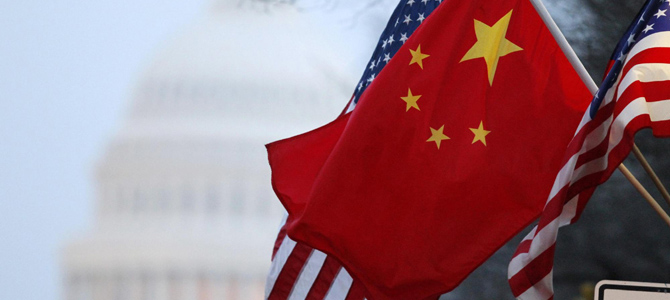
Obama says 'positive' U.S.-Chinese ties good for U.S.


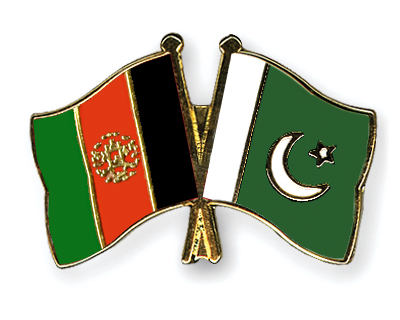
Pakistan, Afghanistan Promote Stronger Ties in Effort to End Violence


Pakistan and Afghanistan have recently concluded high-level talks aimed at accelerating the process of reconciliation and reintegration with Taliban insurgents to try to bring an end to the near decade-long Afghan conflict. The United Sates, which plans a phased withdrawal of its combat troops this summer, has welcomed the increased interaction between Kabul and Islamabad, which it believes is crucial for bringing peace to Afghanistan.

Karzai Efforting Peace with Taliban

Afghan President Hamid Karzai is trying to make peace with Taliban insurgents who are ready to denounce violence and cut ties to terrorist groups. He recently created a 70-member High Peace Council in which almost all sections and ethnic groups in Afghan society are represented.

A 25-member delegation headed by council leader Burhanuddin Rabbani travelled to neighboring Pakistan this month for the first time to seek Islamabad’s cooperation for the Afghan reconciliation process.

Members of the Afghan peace delegation held extensive discussions with top Pakistani civilian and military leaders for almost four days. Both sides have agreed to promote the Afghan reconciliation process at a people-to-people level by holding a traditional jirga meeting.
Pakistan Commits Support to Effort

But a major outcome of the delegation’s visit is an agreement to create a joint governmental commission to promote the Afghan reconciliation process.

Pakistani Foreign Minister Shah Mehmood Qureshi says his country will support the process as long as it is led and owned by Afghans themselves.

"They have to determine what they want from Pakistan, and Pakistan will facilitate. They wanted a bilateral [joint commission] to oversee the whole process and Pakistan has given a nod of approval to that. So Pakistan is serious because Pakistan feels that you need more than military operations to achieve peace, you need political engagement, you need governance, you need capacity building, and Pakistan will support Afghanistan."

Building Mutual Trust

Pakistani and Afghan officials say their primary objective is to build mutual trust and make joint efforts to try to assure insurgent groups that U.S.-led international forces are not occupying Afghanistan.

Afghan delegation member Mohammad Masoom Stanekzai says Afghanistan and Pakistan have stopped blaming each other for the security problems facing the two countries. Stanekzai says that in the past two years bilateral political and economic ties have improved, leading to the formation of the joint reconciliation mechanism.

The Afghan delegate says Pakistan’s role is important because insurgent groups fighting on both sides of the border are interlinked.

"[Pakistan] can play a role because they are sharing a long border with Afghanistan. Those who were with Taliban they mostly had spent time in Pakistan. They (Pakistan) have their political and religious leaders, who have contact with them (insurgents). Our jihadi leaders have contact with them. I do not think that their (Pakistan) contacting them (insurgent groups) will be a difficulty, but the difficulty will that how we can build confidence to overcome the misunderstandings (among Taliban groups) that Afghanistan is not occupied."

The insurgents' Pakistan connection

U.S. and Afghan officials widely believe some key leaders of Afghan insurgent groups are hiding in Pakistan and have links to Pakistani militant groups and elements within the country’s intelligence network. Analysts like international relations professor Hassan Askari believe that despite pressure from the United States and other Western allies, Pakistan may not want to cut ties to some Afghan insurgent groups.

"These ties are going to be helpful. I think the U.S. will have to reconsider its emphasis on severing all connections. Pakistan will pursue a policy that would serve its interest and on this point I think the divergence between Pakistan and the U.S will continue. It is not practical (for Pakistan) to pick up confrontation with each and every Taliban group if reconciliation is to be promoted."
US welcomes interaction

Coinciding with the Afghan High Peace Council’s visit was the arrival in Islamabad of the acting U.S. special envoy to Afghanistan and Pakistan, Frank Ruggiero. After meeting with leaders of the Afghan delegation and Pakistani officials, Ruggiero said Washington welcomes the increased interaction between Kabul and Islamabad to tackle the insurgency.

"The United States has encouraged the government of Pakistan, the government of Afghanistan to increase their interactions and to improve their relationship. And from all that we have been able to ascertain from this visit and from what we are hearing back in Washington is that there has been progress in the bilateral relations."

Despite recent violent attacks in southern Afghanistan, Ambassador Ruggiero reported progress in the military campaign against Taliban insurgents, but he acknowledged the international effort to bring peace to the country faces serious challenges.

"As you see the increase of American forces go into these places, and southern Afghanistan has been the primary area where American forces have gone, I think overall you have seen an increased improvement in the security situation. You have started to see some enhanced levels of governance that remains, frankly, a very critical challenge for us. I mean Afghanistan is a society that suffered through 30-years of civil war, so trying to find that governance structure that can work with the Afghan security forces, the American security forces, is just a challenge."

While the U.S special envoy and members of the Afghan peace delegation sounded optimistic about recent talks in Islamabad, it is still not clear how Pakistan will position itself to use its influence with some of the Afghan insurgent groups to bring them to the negotiating table. But Pakistani officials have indicated behind-the-scenes work is already underway.

No Major Damage Reported After Powerful Pakistan Quake


A magnitude 7.2 earthquake shook southwestern Pakistan early Wednesday, jolting residents of cities as far away as the country's largest city of Karachi and the Indian capital, New Delhi.

The U.S. Geological Survey said the earthquake was centered 55 kilometers west of the town of Dalbandin in Baluchistan province, which is the country's most sparsely populated area.

Local officials said the earthquake damaged some homes in Dalbandin, but there were no reports of any injuries or casualties.

The Pentagon said U.S. troops in southwestern Afghanistan felt the tremor, but there were no injuries or impact on U.S. military operations in Afghanistan or Pakistan.

U.S. officials also said Pakistan has not asked for assistance with quake relief.

Earthquakes are common in the region. A magnitude 7.6 quake on October 8, 2005 killed more than 70,000 people in northwestern Pakistan and Pakistani-administered Kashmir, and left more than 3 million people homeless.

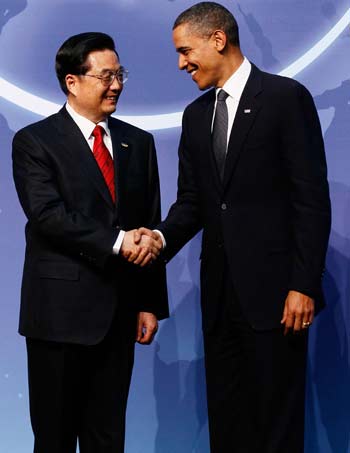
President Hu kicks off landmark US visit


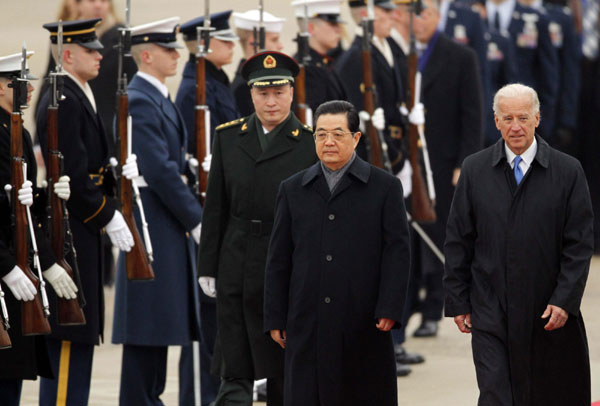
President Hu Jintao arrived in Washington Tuesday afternoon (local time) for his four-day highly-exposed state visit to the United States.

Hu is expected to lay out his blueprint on US policy during his three days in Washington, where he'll meet with President Barack Obama, top legislators and business executives, followed by a stop in Chicago.

The US has made grandeous reception for Hu, with the White House busy preparing for a State banquet on Wednesday night, prior to a private dinner given by Obama to Hu on Tuesday night.
Chicago mayor Richard Daley also said it is a "big big big deal" for Hu to come to his city for a visit, where Chinese-funded enterprises have played a considerable role in the revival of the local economy through the financial crisis.
On arriving at Andres Air Force Base, Hu said in a written speech that "vast as it is, the Pacific Ocean has not stood in the way of the friendship between the Chinese and American people."

The international situation is undergoing profound and complex changes, and China and the US have growing common interests and responsibilities and enjoy broader prospects for cooperation, according to Hu.

"The purpose of my visit is to enhance mutual trust, promote friendship, deepen cooperation and move forward the positive, cooperative and comprehensive China-US relationship for the 21st century," said Hu.

Hu said he looks forward to have in-depth discussions with President Obama on bilateral relations and major international and regional issues of shared interest.

"The long-term, sound and steady growth of China-US relations is conducive to the fundamental interests of the Chinese and American people and to world peace and development," said Hu.

"China stands ready to work with the United States to actively develop China-US relations on the basis of mutual respect and mutual benefit and join all other countries in a common effort to build a harmonious world of lasting peace and common prosperity," said Hu.

US experts have also voiced their optimism for a constructive leadership summit.

President Emeritus of Asia Society Nicholas Platt said strategic trust is something both sides should be striving for.

"We should also look below the surface to what Chinese and Americans are actually doing together before making judgment of whether we have trust or not," said Platt.

According to Douglas Spelman, deputy director of Kissinger Institute on China and the United States (Woodrow Wilson International Center for Scholars), both sides now have to give priority to the underlining common interests and not let the differences override common interests.

"One other thing I think the visit is a good opportunity not just for the leaders and other officials to get together, but for people in China and the United States to feel that this is an important relationship. It has a public aspect as well as talk among themselves," said Spelman.

According to Knneth Lieberthal, director of John L. Thornton China Center, Brookings Institution, inevitably economic and trade issues will loom very large in the leadership talks.

According to Lieberthal, China is beginning a period of economic reconstruction at home, and Americans are doing exactly the same thing. And frankly, China and the US have enormous interest in the success of the other one in their reconstruction effort.

"So I think understanding those efforts better, figuring out how we can coordinate and be mutually helpful, those efforts are very important," said Lieberthal.

Lieberthal also reminded that the two countries share some security interests, especially the issue of nuclear proliferation.

In order to solve some existing issues between two militaries, Lieberthal suggested the two countries need to string out rules and have more effective communication between the two militaries.

Hu, Obama vow to deepen China-US ties


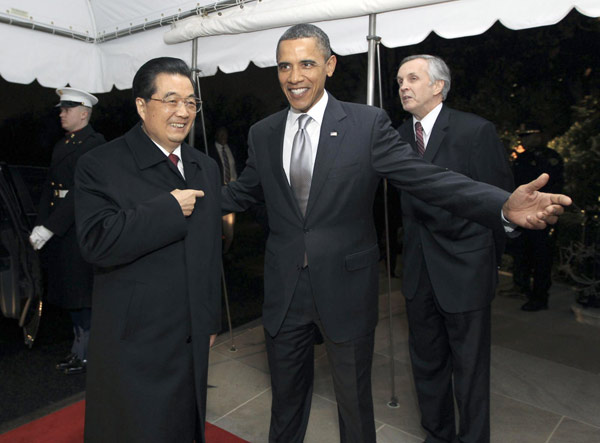
Obama held a 3+3 highly private dinner on the very night of Hu's arrival in Washington, with State Secretary Hillary Clinton and Assistant National Security Donilon on the US side, and State Councilor Dai Bingguo and Foreign Minister Yang Jiechi on the Chinese side attending the dinner.

Obama and Hu made positive evaluation on the progress made on bilateral ties, and said they are ready to further advance the existing positive, cooperative and comprehensive relationship, according to a Chinese foreign ministry press release after the dinner.

Hu said he comes to the US for the goals of enhancing bilateral understanding and mutual trust, and enlarging exchanges and cooperation, according to the press release.

Hu also comes for the goals of strengthening effective coordination between the two countries on major regional and international issues, and to embark on new era in China-US relation.

"I look forwards to exchanging in-depth views with Mr President Obama tomorrow, and jointly discuss blueprint of China-US cooperation," said Hu.

President Hu's visits U.S.

Visit msnbc.com for breaking news, world news, and news about the economy

Tuesday, January 18, 2011

Pakistan earthquake.


According to the U.S. Geological Survey, a strong 7.2 magnitude tremblor struck a remote area in southwest Pakistan at 8:23pm GMT January 18, 2011, (1:23am 1/19/2011 local time). The earthquake occurred 640 miles west-southwest of Islamabad, near the borders of Iran and Afghanistan, and was felt as far away as New Delhi, Jaipur and Dehradun in India, and in Dubai reports CNN.com.
The earthquake occurred on Wednesday, January 19, 2011 at 01:23:26 AM at the epicenter, or Tuesday, January 18, 2011 at 20:23:26 UTC. The epicenter is located at 320 km (about 200 miles) southwest of Quetta near Kharan, Balochistan.
Buildings in Karachi - about 400 km west of the epicenter - show signs of cracks. No word of fatalities have been reported.
CNN.com quotes Kurt Frankel of the Georgia Institute of Technology as saying, "It's not uncommon for this region to have earthquakes. It is where two tectonic plates come together, he said."
Pakistan Earthquake Details
Location: 28.838°N, 63.947°E
Depth: 84 km (52.2 miles)
45 km (30 miles) W of Dalbandin, Pakistan
260 km (160 miles) W of Kalat, Pakistan
310 km (190 miles) ESE of Zahedan, Iran
1035 km (640 miles) WSW of ISLAMABAD, Pakistan
Past Pakistan Earthquakes with Fatalities:
1935 05 30 - Quetta, Pakistan - Magnitude 7.5 Fatalities 30,000
1945 11 27 - Makran Coast, Pakistan - Magnitude 8.0 Fatalities 4,000
1974 12 28 - Northern Pakistan - Magnitude 6.2 Fatalities 5,300
2005 10 08 - Pakistan - Magnitude 7.6 Fatalities 86,000
2008 10 28 - Pakistan - Magnitude 6.4 Fatalities 166


Continue reading on Examiner.com: Pakistan earthquake: Major 7.2 quake near Afghanistan felt in Dubai, New Delhi - National World News | Examiner.com http://www.examiner.com/world-news-in-national/pakistan-earthquake-major-7-2-quake-near-afghanistan-felt-dubai-new-delhi#ixzz1BRxlUfyC

Pakistan earthquake felt in India


A powerful earthquake struck Pakistan early Wednesday morning, causing people to run from their homes reciting verses of the Koran. Strong tremors from the earthquake, which hit about 50 kilometers west of Dalbandin, could be felt as far away as India and the Gulf.

The earthquake, which measured 7.2 magnitude, hit at 1:23 am in a remote and sparsely populated area in Baluchistan province, near the border with Afghanistan and Iran. It struck about 50 kilometers from Dalbandin, a town so remote Pakistan used the nearby Chagai hills for nuclear tests in 1998.

There were no initial reports of casualties, AFP reports.

"I was watching TV when suddenly the TV screen began shaking. Then I realized it was a very strong earthquake," Saeeda Jehan, a mother of six in Karachi told CBS News. "Everyone said doomsday has arrived. But I was concerned about my children. It took me 10 minutes to wake them all up before we could all step out."

Tremors were felt as far away as New Delhi, about 1,3000 kilometers away, other cities in northwestern India, Abu Dhabi and Dubai, according to the US Geological Survey (USGS).


The earthquake comes as Pakistan struggles not to collapse in the face of deep divides within the country and pressure from the United States to extend its cooperation in the fight against militants in Afghanistan. The assassination of Salmaan Taseer, the governor of Punjab province, two weeks ago raised further fears about the fragility of the country. The troubled nation is also still recovering from floods that left more than 10 million people homeless last year.

"A humanitarian crisis in Pakistan caused by the earthquake will only undermine U.S. interests," a western diplomat in Islamabad told CBS News. "As it is, we must all worry about instability in a country armed with nuclear weapons and with political and economic problems," he added.

A 2005 earthquake devastated Pakistan, killing more than 70,000 people, leaving 3 million homeless and becoming one of the world's worst humanitarian crises.

Major earthquake strikes southwestern Pakistan

CNN.COM
An earthquake with a magnitude of 7.2 struck Wednesday morning in a remote area of southwestern Pakistan, but initial reports revealed no major damage.

The earthquake occurred at 1:23 a.m. (3:23 p.m. Tuesday ET) at a depth of 84 kilometers (52 miles), the U.S. Geological Survey said. It was centered 45 kilometers (30 miles) west of Dalbandin, and 1,035 kilometers (640 miles) west-southwest of Islamabad, the USGS said on its website.

Arif Mahmood, director of the Pakistan Meteorological Department, put the epicenter at 320 kilometers (about 200 miles) southwest of Quetta near Kharan, Balochistan, and said it had been felt in Punjab, Sindh, and Balochistan provinces in Pakistan, as well as parts of Iran and India.
Mahmood predicted major aftershocks. "Earthquakes with such magnitudes in the past have brought on aftershocks," he told CNN from Islamabad.
Residents near the epicenter in the districts of Kalat, Dalbadin and Kharan told CNN some mud-walled homes were damaged but no one was hurt.
An official at Quetta's Civil Hospital said a female cardiac patient suffered a fatal heart attack during the earthquake. He said two residents raced to the hospital but they proved not to have been injured, just scared.Malik Muhammad Iqbal, the police chief of Balochistan province, said he was aware of no injuries.
"Things in the headquarters started shaking and books fell off the desks," Balochistan Police Inspector Sultan Mehmood told CNN in a telephone interview. "We left the headquarters running into the streets -- scared for our lives."
In Karachi, Faraz Leghari, director general police, said he had heard no immediate reports of casualties or building damage.
USGS initially reported the quake at 7.4. Quakes of 7.0 to 7.9 are classified as major; anything over 8.0 is classified as great.
In Dubai, about 500 miles southwest of the epicenter, a reporter said he felt a moderate shaking that lasted for about 30 seconds.
Usman Zahid, a night manager at Serina Hotel in Quetta, Pakistan, felt the quake. He said it was "frightening" and estimated that it lasted about 20 seconds. It left "broken glass in the kitchen" and made a chandelier swing, but caused no major damage, he said.
People with Twitter accounts in New Delhi, Jaipur and Dehradun -- all in India -- felt the quake. People with Twitter accounts in Bahrain said they felt the quake.
In Dubai, "I was just getting ready to go to bed," said Leone Lakhani in Dubai. She said she texted her friends in Abu Dhabi and Bahrain.
"It's not uncommon for this region to have earthquakes," said Kurt Frankel of the Georgia Institute of Technology. It is where two tectonic plates come together, he said.

Pakistan Braces for Worst in Quake Aftershocks


Panic-stricken people rushed out of their homes in Pakistan late on Tuesday night after a strong earthquake shook parts of the country, underlining another dimension of the challenges faced by Washington's key south Asia ally.
Pakistan's government officials said the earthquake emanated from a remote part of Pakistan's southwestern Baluchistan province which borders Iran and Afghanistan. It measured approximately 7.4 on the Richter scale, the international yardstick to measure earthquakes, and was powerful enough that its tremors were felt as far as Dubai in the Middle East.

Massive 7.4 Earthquake Hits SW Pakistan

The earthquake's intensity was just below that of another earthquake measuring 7.6 that struck parts of northern Pakistan in 2005 and killed more than 70,000 people. Early reports suggest that the extent of damage to property and human casualties may have been limited, as the earthquake's epicenter was near Dalbandin, a remote and sparsely populated town in the western Baluchistan province.

Government officials warned Pakistan will live with the danger of possible aftershocks in coming days. In some instances such aftershocks have come within a week of previous earthquakes.

In Karachi, Saeeda Jehan, a middle aged woman and mother of six children, quietly read religious verses from an Islamic prayer book she carried as she waited for the building with her apartment to be declared safe for her return.

"I was watching TV when suddenly the TV screen began shaking. Then I realized it was a very strong earthquake," Jehan told CBS News while standing in a crowd at Karachi's Stargate neighborhood near the city's main airport.

Forced to leave her apartment after the earthquake, which shook the country around 1:26 a.m. local time, Jehan recounted her ordeal. "Everyone said doomsday has arrived. But I was concerned about my children. It took me 10 minutes to wake them all up before we could all step out."

Jameel Harris, an ambulance driver in Karachi, also forced to leave his flat with his five children and his wife, said there were no reports of heavy damage, though signs of panic were all around. "I have heard of cracks in some buildings but that is not across the board. The damage seems to have been done mostly to older buildings," he said.

In Pakistan's capital Islamabad a western diplomat warned that further damage from the earthquake, notably any of its aftershocks, could seriously undermine Pakistan's future, right at a time when the U.S. is urging the country to extend more cooperation in its campaign to fight militants.

"A humanitarian crisis in Pakistan caused by the earthquake will only undermine U.S. interests," the western diplomat told CBS News on condition of anonymity. "As it is, we must all worry about instability in a country armed with nuclear weapons and with political and economic problems," he added.

Tuesday's earthquake was a powerful reminder of the 2005 earthquake when the death toll of more than 70,000 turned it in to one of the world's biggest humanitarian tragedies.

Quake shakes Pakistan, damage seems limited


A powerful earthquake of magnitude 7.2 shook southwestern Pakistan early on Wednesday, jolting residents of cities as far apart as Delhi and Dubai, but the epicenter was far from major population centers.

The U.S. Geological Survey said the quake was more than 80 km (50 miles) underground, close to the town of Dalbandin in Baluchistan province, near the Afghan and Iranian frontiers.

Poor communications ensured there were few immediate reports from the vicinity of the quake, but despite the major strength of the shock, the great depth may have limited damage. The USGS had first said that the earthquake was very much shallower.

The USGS said the epicenter was 55 km (34 miles) west of Dalbandin, a town of about 15,000 people, and at a depth of 83 km (52 miles).

In Dalbandin, several people were injured when the roofs of their houses collapsed, provincial Transport Minister Amanullah Notizai told Reuters, but so far there were no reports of fatalities in the quake which hit at 1:23 a.m. (2023 GMT on Tuesday).

People in India's border province of Rajasthan said cracks appeared in the walls of rural dwellings.

U.S. forces across the border in Afghanistan were unaffected by the quake, according to preliminary reports from the U.S. military.

As dawn breaks and officials reach the affected area, more damage and fatalities may be revealed in an area where traditional simple structures may have fared badly under the strains of the powerful tremor.

PEOPLE FLEE THEIR HOUSES

In Quetta, the largest city in Baluchistan and 331 km (205.7 miles) northeast of the epicenter, a woman died at a city hospital from a heart attack following the quake, hospital officials said.

And in the major Pakistani port of Karachi, 400 km (250 miles) away, people woke and rushed from their homes after the tremors. An official at Edhi Foundation, the biggest private ambulance and rescue service in Karachi, said there were no reports of any damage.

"I was sleeping when the quake struck and I felt like my bed was shaking. I got up and ran to check the children...and thankfully they were all okay," said Masooma Rizvi, a housewife. "It was very scary. I have never felt anything like this before."

The Pacific Tsunami Center said the onshore quake had not triggered a tsunami in the Indian Ocean.

A major quake of this magnitude, if at a shallow depth and close to population centers, is capable of causing widespread and heavy damage. Pakistan is still reeling from devastating floods last year that left more than 10 million people homeless.

In 2005, a 7.6 magnitude quake 95 km (60 miles) northeast of the Pakistani capital Islamabad killed over 70,000 people.

Earthquake in Pakistan, with a magnitude of 7.2, felt from Dubai to Delhi


An earthquake has hit southwest Pakistan with a magnitude of 7.2. Twitter lit up with the news that people felt the earth move from Dubai to the outskirts of Delhi.

Reuters reports the quake struck 34 miles west of Dalbandin at 1:23 a.m. local time on Wednesday. The Pacific Tsunami Center said the onshore quake had not triggered a tsunami in the Indian Ocean. Dalbandin is in the most sparsely populated area of Pakistan and, so far, no damage has been reported. Quakes of this strength can cause widespread destruction. For scale, the Haiti earthquake in 2010 was 7.0 magnitude and the San Francisco earthquake in 1989 was 7.1 magnitude.

Quake shakes Pakistan, no damage reported


A powerful earthquake of magnitude 7.2 shook various parts of country early on Wednesday, jolting residents of cities as far apart as Delhi and Dubai, but the epicentre was far from major population centres.

The US Geological Survey said the quake was more than 80 km (50 miles) underground, close to the town of Dalbandin in Balochistan province, near the Afghan and Iranian frontiers.

No damage wasreported immediately. The USGS had first said that the earthquake was very much shallower.

In Karachi, 400 km (250 miles) away, people woke and rushed out of their homes in very cold conditions, reciting verses from the Holy Quran after the tremors hit at 1:23 a.m. (2023 GMT on Tuesday). The authorities there had no immediate reports of casualties or damage.

In an ominous indication of problems for the small towns and villages of Balochistan, however, people in India's border province of Rajasthan said cracks appeared in the walls of rural dwellings. The simple structures common in the area closest to the quake may fare badly under the strains of major tremors.

The USGS said the epicentre was 55 km (34 miles) west of Dalbandin, a town of about 15,000 people, and at a depth of 83 km (52 miles).

The Pacific Tsunami Center said the onshore quake had not triggered a tsunami in the Indian Ocean.

A major quake of this magnitude, if at a shallow depth and close to population centres, is capable of causing widespread and heavy damage. Pakistan is still reeling from devastating floods last year that left more than 10 million people homeless.

In 2005, a 7.6 magnitude quake 95 km (60 miles) northeast of the Pakistani capital Islamabad killed over 70,000 people.

7.2 Magnitude Earthquake In Southwestern Pakistan


A strong, 7.2 magnitude earthquake just struck in southernwestern Pakistan, the U.S. Geological Survey reports. (Update at 4:14 p.m. ET: USGS just revised the magnitude; earlier it put it at 7.4.)

Magnitude 7.4 quake hits Pakistan: USGS

A magnitude 7.4 earthquake struck southwestern Pakistan, the U.S. Geological Survey reported on Tuesday.
It said the quake was very shallow at a depth of 10 km (6.3 miles). It struck 55 km (34 miles) west of Dalbandin at 1:23 a.m. local time on Wednesday (2023 GMT on Tuesday).
There was no immediate report of damage from the area.
The Pacific Tsunami Center said the onshore quake had not triggered a tsunami in the Indian Ocean.
A major quake of this magnitude is capable of causing widespread and heavy damage.
On October 8, 2005, a 7.6 magnitude quake 95 km (60 miles) northeast of the Pakistani capital Islamabad killed over 70,000 people.

Egyptian dies after setting himself on fire


A 25-year-old unemployed man died in a hospital on Tuesday after setting himself on fire in the Egyptian port city of Alexandria, security officials said, amid a wave of self-immolation attempts possibly inspired by events in Tunisia.
Alexandria resident Ahmed Hashem el-Sayed had been unemployed for a year and suffered from depression and may have been mimicking the Tunisian man who set himself alight last month and set off a popular uprising that deposed the government there, said officials.
The death comes amid a rash of such attempts in Egypt. On Tuesday, two men attempted to set themselves on fire in downtown Cairo, just a day after another man soaked himself in gasoline and burned himself in front of parliament. All three survived, however.
El-Sayed, a construction worker, was on his roof in Alexandria when he slashed his wrists and set himself on fire Monday night, the officials added, speaking on condition of anonymity because they were not authorized to brief the media. They said el-Sayed has suffered from depression since one of his brothers set himself on fire and died five years ago.
The incidents come as protesters in Mauritania and Algeria also set themselves alight in apparent attempts to copy Tunisian Mohammed Bouazizi, 26, whose self-immolation helped inspire the protests that toppled Tunisia's authoritarian president.
While isolated, the incidents in Egypt, Mauritania and Algeria reflect the growing despair among much of the Arab public which has no real means of expressing its dissatisfaction. They are deeply symbolic means of protest in a region that has little or no tolerance for dissent.
Ben Ali ruled with an iron fist for 23 years. Similarly authoritarian rulers across much of the Arab world have been in power as long or longer, like Libya's Moammar Gadhafi, in power since 1969; Egypt's Hosni Mubarak, in office since 1981; and Yemen's Ali Abdullah Saleh, who has ruled that impoverished nation since he seized power more than 30 years ago.
The stunning collapse of the Tunisian leader drew a litany of calls for change elsewhere in the Arab world, but activists faced the reality of vast security forces heavily vested in the status quo backing hard-line regimes ready to crack down on dissent.
Self-immolation as a method of protest is uncommon in the Arab world, where many associate it with protesters in the Far East or the Indian subcontinent. But Egyptian women in rural or poor urban areas have been known to set themselves on fire to protest violent husbands, abusive parents or an unwanted suitor.

Nearly half of Egypt's estimated 80 million people live below or just above the poverty line set by the United Nations at $2 a day. The widespread poverty presents a potential threat to stability, along with the absence of any meaningful political reform.
Bahey Eddin Hassan, head of the Cairo Institute for Human Rights Studies, said the growing number of people setting themselves on fire was an indication that Egyptians were beginning to think they can emulate the Tunisian experience in their country.
"The reality is that people see their rulers as the ones responsible for their economic setbacks. People think the Tunisian recipe could work in Egypt since they have tried everything else and nothing worked," he said.

President Hu Jintao landmark trip looks to the future

China Daily


President Hu Jintao embarks on his long-expected four-day state visit to the United States on Tuesday, with the number of bilateral and global issues on the agenda putting it firmly in the international spotlight.

Observers said the visit will not only help reset bilateral ties after a rocky year, but will also help set the direction for Sino-US ties in a transformational era.

Hu's four-day visit includes stays in Washington and Chicago. It will be the first time that Hu has paid a state visit to the US since Barack Obama took office two years ago, yet it will be the eighth time that the two leaders have met for talks over the past two years, a frequency that some White House officials have described as "rare in modern US diplomacy".The Hu-Obama meeting will mainly focus on thorny bilateral issues including US arms sales to Taiwan and the bilateral trade imbalance, regional issues including the Korean Peninsula, and international issues including global economic governance and climate change.
Hu is also expected to meet local students and businesspeople in Chicago, Obama's hometown.

The Associated Press reported that Hu is to be feted in Washington with a lavish state banquet at the White House and other pomp usually reserved for close friends and allies - all of which, as the agency interprets, are intended to improve the tone of relations between a rising and prosperous China and a US superpower in a tenuous economic recovery.

Besides normal procedures involved for a state visit, the White House is also making extra efforts to ensure the success of the visit.

These arrangements include a small-scale private dinner for Obama and Hu on the day of Hu's arrival to allow for a frank and private discussion, which will help test the waters for the following day's talks.

First Lady Michelle Obama will also talk with US youngsters to encourage them to study in China, part of the plan announced by her husband during his state visit to China in November 2009 when he promised to increase the number of US youngsters learning in China to 100,000 by 2015.

Sources said Hu's visit will yield a number of agreements on bilateral trade, energy, environmental protection, infrastructure building, and cultural and personnel exchanges.

Purchases of Boeing aircraft and the building of a high-speed railway may be on the list of agreements, said sources. Diplomats from both countries have been negotiating a formal joint statement, but it remains to be seen whether Obama and Hu will issue a communiqu.

Chinese Vice-Foreign Minister Cui Tiankai said that the two sides are still discussing the content of the statement.

According to Wang Fan, an international studies expert at China Foreign Affairs University, the US is now looking at China in the context of historic shifts in the balance of power, as it figures out a strategy for its China policy, and is therefore giving China unprecedented attention.
Analysts said the significance Washington is attaching to the visit also derives from the fact that it increasingly needs Beijing's help in managing global issues, such as piracy off the African coast, Iran's nuclear program and reinvigorating the world economy.

Also, given the background of the Democrats' poor showing in the mid-term election, Obama now faces huge domestic pressure, and is hoping to reap dividends from a successful visit by Hu. That means business contracts that bring jobs to the sluggish US economy, progress on some issues that has affected bilateral ties, including trade and the Korean Peninsula issue.

China is also keen to take the opportunity to win trust and dispel suspicion in the US, which leads the developed countries. China wants to foster a favorable environment for its development.

Meanwhile, as the two are now each other's second-largest trade partner, China views the US market as crucial to its sustainable economic development.

Hu, during his four-day trip, is expected to promote China's peaceful development in a speech to business leaders and opinion-makers in Washington on Thursday and to highlight the benefits of China's market and investment when visiting Chicago.

Before Hu's departure from Beijing, high-ranking officials from each side changed the harsh tone they adopted in 2010 and became more positive regarding bilateral cooperation.

A flurry of diplomatic efforts, either visits made or speeches given by keynote officials from each country, had already been arranged prior to the visit, shedding light on the importance each side attaches to it.

Three major figures in Obama's administration - Secretary of State Hillary Clinton, Treasury Secretary Timothy Geithner and Commerce Secretary Gary Locke - have successively delivered speeches on Hu's visit, a rare occurrence in US politics.

In a speech on Friday, Clinton dismissed calls for a Cold War-style containment policy and instead described the relationship as an increasingly complex global "entanglement".

"This is not a relationship that fits neatly into the black and white categories like 'friend' or 'rival'.

"It is clear that we cannot paper over the difference between our countries; nor should we try to do so," she said. "But the future of our relationship can be strong if we each meet our responsibilities as great nations."

Chinese officials have emphasized what they see as common concerns while acknowledging the complexity of the relationship.

"When the relationship is strained, we need to bear in mind the bigger picture and not allow any individual issue to disrupt our overall cooperation," Cui said in a speech on Friday.

And for Chinese Ambassador to the US Zhang Yesui, it is not strange to see China and the US hold different views on some issues due to the different political systems, culture, history and social development.

"The key is to respect and take care of each other's core interests and major concerns, and we must solve the problems through dialogue and consultation on an equal footing."

Analysts believe it is a state visit meant to reset relations after a rocky year, and moreover it might help lay the foundations for bilateral ties in a transformational era in the near future.

Others also hold that the visit will benefit regional and international relations on the whole.
China and the US have experienced an eventful 2010, with an array of issues affecting bilateral ties, including US arms sales to Taiwan at the beginning of the year and the continuous pressure from the US on China's trade and currency rate.
"It is absolutely critical for the two sides to be setting a tone that says 'hang on a second, we are committed to an effective, positive relationship'," Center for Strategic and International Studies scholar Charles Freeman, a former trade negotiator in the George W. Bush administration, told The Associated Press.

According to Jin Canrong, deputy director of the School of International Studies at Renmin University of China in Beijing, it is unrealistic to expect that a single visit by a leader will solve all major problems between the two countries, yet more communication between the two sides will certainly help to improve mutual trust.

According to Jin, the old issues between the two countries, including Taiwan and Tibet, will continue to feature in bilateral ties, while some new issues will keep emerging, including economic competition and friction in military ties.

However, "as it is unlikely that the US will manage to confront or contain China, the only way left is to try to get China engaged in its global agenda", Jin said.

"The two will have a functional partnership by cooperating on an issue-by-issue base. Yet to achieve this, they need a mechanism to deal with their differences."

According to Wang Fan from China Foreign Affairs University, the two countries are both at a transformational stage, and, given China's growing role in global affairs, the two sides need to rebalance their relationship

According to Wang, how the two countries manage to influence and change each other in the future will influence their policies toward each other.

"There has been not so much strategic misunderstanding by the US as some assume. Instead, the US is caught in several strategic choices as it is not sure of where a growing China is heading. And China needs to work harder to dispel suspicion on the US side and increase mutual trust," Wang said.

In a signed article in The New York Times, Zbigniew Brzezinski, who served as former US president Jimmy Carter's national security adviser, said that Hu's visit to Washington will be the most important top-level encounter between the US and China since Deng Xiaoping's historic trip more than 30 years ago.

"It should therefore yield more than the usual boilerplate professions of mutual esteem. It should aim for a definition of the relationship between the two countries that does justice to the global promise of constructive cooperation between them," he wrote.

In a recent interview with Xinhua News Agency, former US secretary of state Henry Kissinger also proposed establishing "permanent consultative institutions" between the two countries. "If we have a permanent contact, then even (when) there is an occasion of difficulty, it will fit into a continuing dialogue, and I expect this to be a result of this visit," Kissinger said.

Fu Mengzi, a researcher with the Beijing-based China Institutes of Contemporary International Relations, said China-US cooperation will benefit not only both countries but also the Asia-Pacific region and the world at large.

That is due to the increasing interdependency between countries and regions in this era of globalization, he said.

Rana Mitter, a professor with the Institute for Chinese Studies at the University of Oxford, said the Hu-Obama meeting will "need to address the fact that both countries have a duty to the wider global community to solve problems that go beyond the nation-state".

Europe will be pleased that the US and China are holding such a high-level meeting. Bad relations between the US and China are not good for Europe, according to Mitter. But Europe and its large economies, such as the United Kingdom, will also want to remind China that they remain major trading partners and players in the international community, Mitter said.

Tunisia: A democratic roadmap


The road ahead for Tunisia is unknown, however with a cautious approach a durable decmocratic order can be established.

In the wake of an Arab world-shattering political development, the government of Tunisia has been effectively overthrown via an amalgamation of civil unrest, grassroots mobilization and what one could call a coup d'esprit.

Tunisia's new political masters must proceed by distancing themselves from self-congratulatory triumphalism. They will have to muster courage, display political imagination and modesty, and exercise tolerance of difference in order to fashion a durable democratic order in a post-Ben Ali Tunisia.

The question is always, of course, 'how'? Historically, whether it is the new republican order after the absolute monarchy in France more than 200 years ago, post-Franco Spain or post-Marcos Philippines, trepidation is inevitable. Skills of compromise, clear vision and purpose are needed to tread the unchartered waters of post-authoritarian construction.

Lessons from the 29 days that shook Tunisia

If anything, the bread riots that produced the Arab World's first people's power movement has served notice to the country's political class - past and present - in several ways.

One, Tunisia's people alone own the historical moment of victory against dictatorship. I think Tunisia's people have earned the right to be sovereign and treated accordingly. Any resulting political system must enshrine this moment as theirs alone. Institutionally, political reconstruction must entrust all sovereign mechanisms of checks and balances with the people.

Two, not the Western backers of the regime and not the expatriate politics of exile won the day against Ben Ali. This was a home-grown spontaneous movement.

Three, no single political movement, leader or ideology can fake political history and claim victory for a political current they neither precipitated, controlled or delivered. There is a poetic justice in this: all political actors enter the new political fray humbled and on equal footing. The Tunisian people are now handing them on a silver platter a rare chance to right many wrongs of the deposed president.

Four, spin politics and sugar-coating political performance are futile. Ben Ali's hiring spin trade and expertise from the US did not succeed to conceal the rot. No political spin could camouflage the visible political decay and loss of the last days of Ben Ali's rule. Deploying the classic technique of misdirection through the rhetoric of 'terrorism', Ben Ali failed to blind Tunisians and the Western machines of political patronage, unable to impress or stem the tide of rejection.

So spin politics must be condemned to the proverbial dustbin of history to join Ben Ali and co.

Fifth, the WikiLeaks moment means that the state can no longer withstand being 'Assanged', 'Twittered', 'Facebooked' and, consequently, denuded. Of course, Al Jazeera's own role in all of this must not be forgotten. It is about time Max Weber's template of statism is revised. Perhaps information, on which Weber says little or nothing, more so than monopoly over the technology of violence plays a decisive factor in the fate of states in the modern era.

Long live Ben Ali-ism?

Challenges remain ahead. People's power victories can be lost.

Ben Ali is gone but the vestiges of 'Ben Ali-ism' may still linger. Flushing them out will take time. Not so much in terms of personalities, political language and symbolisms, but most importantly in terms of political amorality or even immorality. Politics must be restored as a moral project with ends that transcend leaders, parties and ideologies.

The critical mass that eventually produced the flow of determination to defeat the authoritarian system, with a tipping-point provided by the national army, must now prove its fungibility in the reconstruction and transitional phase.

That is, it must be exchanged for new brand of political know-how after Ben Ali's removal in order to overthrow the system he has left behind.

But this is a political tightrope for all concerned. The endeavour to transform the system swiftly must be checked by the risk of total political vacuum. The ruling party's historical stature must be restored and it must therefore be maintained. Plus, not all Ben Ali's associates must be subjected to blanket witch-hunt or purge.

The struggle in the months ahead to maintain credibility with the Tunisian people and the world must be balanced with one conspicuous reality. Existing civil society and opposition are still fledgling. They need time to recover from the erasure of the past 54 years as well as partnership with those forces that worked for Ben Ali but are not necessarily 'Ben Ali-ist'.

The caretaker order, a remnant of the ancient regime, must therefore be allowed to act as a facilitator in the transition period. For this, the interim president and even whomever is elected after him must assume the role of an honest broker between the various political actors in the transition period.

The Islamists and the third republic

The Islamists have eaten humble pie after more than twenty years of political wilderness. This force is still to be reckoned with and must be given full rights of representation in the new political order. External considerations or reservations about a role for the Nahda party do not in the transitional period warrant its exclusion.

But the Nahda party of 2011 is not the Nahda party of 1989. Nor is Tunisia. New legitimate forces that have struggled from within Tunisia have earned the right to exist and contest power.

The Nahda party and whatever leadership is going to emerge now must absorb a few lessons of its own.

Firstly, it must get over its obsession with unity. Today's Nahda has at least two currents or factions within it. This must be viewed as enriching and pluralising and not a divisive dynamic. Secondly, it must engage with open politics away from secrecy or ideological rigidity. Thirdly, it must not return to the debates of the 1980s about the 'identity' question and its simplistic 'moralism'. Fourthly, it must act modestly and contest power with restraint, sharing the political scene with others instead of seeking domination. Lastly, it must favour political presence over absenteeism.

Nahda is a party which still has wide appeal but perhaps with a diluted following and even more political maturity. A sign of this is the tendency amongst many of its leaders today to even separate religion and politics. Nahda is not the Taliban.

No other single political entity in Tunisia can claim today to speak on behalf of all Tunisians. Let thousands of 'jasmines' of the unfolding Tunisian 'Democratic Spring' bloom on the basis of shared values of mutuality, respect, equality and modesty.

Fundamental Pact II: Learning Democracy

A new democratic order or 'workshop' will not moulded easily, irreversibly or quickly to succumb to new values of equal citizenship, continuously popularly mandated and contested power, inalienable rights for all Tunisians of all creeds and ideologies, and continuous tradition of political renewal and self-criticism.

Historically, Tunisia does not begin with a clean slate. Democratic learning should be inspired by the spirit of the 1857 Fundamental Pact ('Ahd Al-Aman), which amongst other things, sought to limit Beylical power. What begins now is akin to a 'Fundamental Pact' version II.

But Some of Tunisia's new players have just become apprentices in the politics of the state. Some have had no parliamentary experience; some not even participation at municipality level. So democratic learning begins now.

The path of democratic learning must keep in mind a threefold reality check: After the 14th of January 2011, no return to possession of the state or longevity in power will be possible; the state Tunisians have known is a state which practiced 'total politics' and learning self-government will involve trials and errors; Tunisians have rebelled for political freedoms but also for socio-economic equal opportunity and distribution, and this latter quest must not be forgotten.

Towards a transitional period

En route to democracy building and learning, short-term and long-term agendas must be clarified.

In the short-run, elections in two months must aim at producing only a transitional order. The 'rush' into elections may be premature in a society with weak political parties and until recently a heavily shackled civil society. But in this case it must proceed to organise the rules of political engagement and participation.

In the long run, the transitional order will have to work towards dismantling the presidential system. Excessive executive power must be terminated by preparing the legal and institutional grid and resources of switching into a parliamentary system. A new constitution will be needed for the new era and a transitional parliament and special commission aided by committees can be assigned this task.

The switch to a proportional electoral system can be planned in tandem with a switch to a parliamentary system.

The new order will need a free press to act as the unofficial opposition, and the security apparatus consisting of nearly quarter-of-a-million-strong force must be dismantled.

Tunisia is no island. A Truth and Reconciliation Committee, such as those of South Africa or Morocco, can institute a transitional justice system so that no blood is spilled or injustice committed in chasing after ghosts from the past.

Spain began its transition without any prior democratic experience. Its transition through a pact can serve to inform Tunisia's.

The socio-economic agenda will be challenging. But sustainable and even development along with mechanisms for governance must be allocated special resources and departments.

The 'Tunisia effect'

All Arabs feel emboldened and inspired by the overthrow of Ben Ali Baba's dictatorship. Tunisia now leads the way and others are closely watching. The Tunisia effect must be a democratic effect.

The 14th of January will go down in Tunisia's history as a milestone as significant as 1857 and 1861 when Tunisia reform produced, respectively, the Arab and Muslim world's first 'bill of rights' and constitution. Its significance equals that of March 20, 1956, Day of Independence from colonialism.

The stigma has been that the Arab societies are indefinitely confused with absence of civic cultures and self-governance potential. Tunisians have won the first battle in demolishing some condescending constructions of Arab societies. The battle ahead, to bring to fruition a sustainable 'democratic spring' has just begun. Winning it will require time, political stamina, and the will to think, act and be free.

The downfall of Ben Ali is metaphor for the storming of the 'Bastille' of political singularity. This is the 'disease' against which immunization of the new system is needed.

One of the new shared political values needed is the dynamic of difference and contradiction as a positive force in the political process and in any durable substantive democratisation. Purging, excluding or killing political difference is never possible. If it were, Ben Ali would have triumphed over the will of the Tunisian people long ago.

Tunisia's Revolt: U.S. Dilemma over Arab Democracy


By Tony Karon
"Yes We Can!" read a placard carried by one Tunisian protester last week, hours before he and his peers scored an improbable victory by forcing the autocratic President Zine el Abidine Ben Ali to flee the country. The demonstrator's confidence that standing up to sclerotic authority could bring political change carries a chilling message for the leaders of Egypt, Libya, Jordan, Syria and other Arab governments also ruled by decades-old autocracies. Like all of those regimes, Tunisia had long relied on its security services to terrify would-be challengers into submission, and its collapse has provided the world with an electrifying first contemporary example of a successful Arab rebellion, prompting speculation over a domino effect across the region.

Even before the lightning-fast collapse of Ben Ali — although not necessarily of his regime — there had been demonstrations over rising food prices in Egypt, Jordan and Algeria. The Tunisian events were hailed by small but enthusiastic demonstrations in Egypt. And there were even reports of men setting fire to themselves in Algeria, Mauritania and Egypt in protest against their governments, mimicking the action of Mohamed Bouazizi, an unemployed Tunisian whose self-immolation last month triggered his country's uprising. Still, as much as many citizens elsewhere might seek it, a domino collapse of Arab autocracy remains unlikely. (See pictures of protesters in Tunisia.)

The fall of authoritarian regimes tends to come as a surprise — a miscalculation by those in power of the scale of popular outrage; of the willingness of the citizenry to defy traditional methods of control; and, most importantly, of the willingness of the security forces to kill their compatriots in defense of the regime. Tunisia, if anything, will have put the likes of Egypt, Jordan and Syria on heightened alert over the dangers posed by widespread economic grievances, making them more likely to act early to defuse such tensions. Egyptian officials over the weekend reportedly spoke of raising subsidies on food prices to ease the burden on the poor, mindful of the danger it posed. And the security forces of Egypt, Jordan and Syria are perhaps more aware than their Tunisian counterparts were that they're sitting atop a powder keg.

Indeed, this week would be an opportune moment for key men in the security forces of the Arab autocracies to seek a pay raise. The key ingredient of last week's turnabout in Tunisia was the security forces, or a significant part of them, who refused to fire on their fellow citizens to protect the ruling family. Authoritarian regimes are innately vulnerable once economic despair strips citizens of their fear of challenging those in power. When soldiers are sent onto the streets to fire on people they recognize as their neighbors, their loyalty is far from certain. And it was clear that in Tunisia, the officer class was ready to seek a new governing arrangement once the cronyism of the rulers had ignited a popular revolt. That scenario ought to give Egypt's President Hosni Mubarak pause if, as is widely assumed, the 82-year-old autocrat plans to install his son Gamal as his successor — a move that would break the authoritarian regime's tradition of picking its leaders from within the senior ranks of the military. (Read "Why the U.S. Should Cheer Tunisia's Risky Revolution.")

Still, Tunisia is unlikely to set off copycat insurrections, for a variety of reasons that could be grouped under the principle that each country's political situation, despite similarities, has its own unique conditions that facilitate or preclude a successful rebellion. But even before the Tunisian uprising, the omens were grim for the existing authoritarian political order in the Arab world — both for regimes closely tied to the U.S., such as Egypt and Jordan, as well as those, such as Syria and Libya, traditionally hostile.

Warning that it would be premature to see Tunisia as a Berlin Wall moment for the Arab world, Beirut-based analyst Rami Khouri compares it to the uprising against Polish communism led by the Solidarity trade-union movement in 1980. While the Polish regime survived, shaken, for another nine years, the Solidarity uprising started the countdown on the final years of the Soviet satellite regimes of Eastern Europe. "As happened with an unknown electricians' union in a Gdansk shipyard in 1980 that required years more to transform an entire political universe a decade later," Khouri wrote in the Financial Times on Monday, "I suspect Tunisia's impact on the Arab world will similarly play itself out in stages ... The transformation of much of the rest of the Arab world is likely to follow in a less dramatic manner — but it will follow for sure." (Will Tunisia's "hunger revolution" spread?)

And that certainty represents a crisis for U.S. policy toward the Arab world. While President Obama saluted the courage of the Tunisian people, U.S. national-security strategy in the Middle East continues to rest heavily on autocrats lacking in popular legitimacy. Despite urging reform, Washington has shown a pronounced hesitation over the question of Arab democracy, which in most Arab countries would produce governments less closely aligned with Washington than many of the autocrats. In 2006, the Bush Administration pushed the Palestinian Authority to hold democratic elections, but when those were won convincingly by Hamas, Washington reversed itself, insisting that President Mahmoud Abbas ignore the verdict of the electorate and adopt many of the authoritarian practices for which the U.S. had chastised Yasser Arafat.

Many analysts have argued that the absence of an overt Islamist element in the Tunisian events have made them seem less threatening to the U.S. Perhaps, but the idea that Tunisian democracy would be free of an Islamist current is also premature; it remains to be seen what will happen when a more open system allows Islamists the political space that Ben Ali denied them. But in countries like Egypt and Jordan, deemed pivotal to U.S. security interests in the region, any popular rebellion — or genuinely democratic electoral challenge — would be led by Islamists, and the U.S. would likely play a more proactive role in seeking to ensure those regimes do what is necessary to survive. (Comment on this story.)

Secretary of State Hillary Clinton last week chided U.S. autocratic allies over the need for urgent reforms, warning that "in too many places, in too many ways, the region's foundations are sinking into the sand." But those leaders are banking on continued U.S. backing based on their support for U.S. national-security strategy in the region. After all, even in Iraq, where thousands of American lives and many hundreds of billions of American dollars have been invested in regime change, the resulting democratically elected government is closer to Iran than it is to Washington. What Tunisia highlights, more than anything, is the deep structural weakness of an authoritarian Arab order that has proved politically reliable in U.S. regional strategy for decades, leaving Washington caught between the democratic impulse and fear of its consequences.