The Los Angeles Times
U.S. President Barack Obama and Afghan President Hamid Karzai, accompanied by senior-level delegations, convened wide-ranging discussions on May 11-12, 2010, aimed at deepening cooperation on the shared and mutual priorities of the United States and Afghanistan. These discussions on governance, security, economic and social development, and regional issues built on past sessions of the United States Afghanistan Strategic Dialogue. President Obama and President Karzai reaffirmed their growing cooperation and their commitment to the solid, broad, and enduring strategic partnership between the governments and peoples of the United States and Afghanistan. This partnership is based on shared interests and objectives, as well as mutual respect. The two sides declared that a sovereign, stable, secure, peaceful, and economically viable Afghanistan that has friendly relations with all its neighbors and countries in the region is vital to regional stability and global security.
Securing Afghanistan's Future
President Obama recognized the courage and determination of the Afghan people to resist violent extremists and to ensure that their country does not once again become a safe haven for terrorists, including al-Qaeda. President Karzai expressed deep appreciation for the vital support of the 46 troop-contributing countries to the North Atlantic Treaty Organization's (NATO's) International Security Assistance Force, including ongoing stabilization efforts. He paid special tribute to the American men and women who have made the ultimate sacrifice alongside Afghan and international forces to secure a better future for the Afghan people. Additionally, both countries expressed regret over the tragic loss of civilian lives and committed to redouble efforts to prevent civilian casualties.
President Obama and President Karzai recognized the Afghan Government's deep resolve to assume increasing responsibility for security. They welcomed NATO's intent, endorsed by foreign ministers in Tallinn on April 22-23, to develop with Afghanistan a joint security transition framework that can be announced later this summer. Additionally, President Karzai noted his determination to see the Afghan National Security Forces conduct the majority of operations in the remaining insecure areas of Afghanistan and to take full responsibility for Afghanistan's physical security.
The Presidents further recognized that developing the Afghan National Security Forces' capabilities is necessary to facilitate implementation of an orderly, conditions-based security transition process. Towards that end, the Afghan Government welcomed the United States' pledge of continued support to train, equip, and sustain the Afghan National Security Forces, so they can increasingly take the lead in securing and defending their country against internal and external threats. President Karzai joined President Obama in reiterating the need for continued international military assistance to train and equip the Afghan National Security Forces.
Additionally, the United States reaffirmed its commitment to transitioning responsibility for detention facilities to the Afghan Government. This process will begin at the Parwan detention facility in January 2011. Both Presidents recognized that a successful transition will be an important milestone toward achieving President Karzai's inaugural pledge of having the Afghan Government assume full responsibility over detention operations. As part of this transition process, President Karzai welcomed continued U.S. assistance to build a safe, secure, and humane corrections system. Underscoring the United States' respect for Afghanistan's sovereignty, President Obama also emphasized his strong desire to see all search, arrest, and detention operations be carried out by the Afghan National Security Forces. He and President Karzai directed their senior defense advisors to accelerate and further clarify the timeline for the transition process, and also to consider additional steps to address this Afghan Government priority.
President Obama and President Karzai recognized the importance of Afghan-led peace and reconciliation efforts. Towards that end, the United States pledged its support for Afghanistan's reintegration and reconciliation processes, which allow an honorable place in society to those who cut ties with al-Qaeda, cease violence against the Afghan state, and accept the Afghan Constitution, including its protections of human rights and women's equality. The United States also welcomed planning towards the Consultative Peace Jirga and expressed support for an inclusive process that includes broad representation from across all of Afghan society – both men and women – and takes into account their concerns and priorities.
Strengthening Governance and Expanding Economic Opportunity
The United States reiterated its commitment to helping ensure that the Afghan Government is able to meet the needs of its people through developing its own institutions and resources. President Karzai expressed deep appreciation for the United States' long-term civilian commitment to supporting the Afghan people. President Obama pledged continued reconstruction and economic assistance, and he commended Afghanistan's commitment to develop a plan for more effective and accountable civilian government institutions at the national and sub-national levels. He emphasized the joint efforts by both governments to build Afghan Government capacity and pledged continued technical assistance to improve the accountability, professionalism, financial management, and oversight capacity of key Afghan ministries and institutions so that they can assume greater responsibility for Afghanistan's economic development. In this regard, the United States supports the Afghan Government's intention to launch a number of key infrastructure projects, which are vital for sustainable economic growth and private sector development. Both Presidents also reaffirmed the need for continued progress toward the United States goal of directing at least 50 percent of U.S. assistance through the Afghan Government and for additional mechanisms to enhance coordination of U.S. assistance not yet flowing through the Afghan Government. Additionally, the United States pledged to expand efforts to hire local staff and procure an increasing percentage of supplies from Afghan sources.
Countering Corruption and Enhancing Accountability
Both countries recognized that fighting against corruption emanating from any source in Afghanistan remains a top priority. President Obama noted his commitment to improving oversight of all U.S. government contracting procedures. President Karzai reaffirmed his inaugural pledge to bring to justice those involved in corrupt activities. Towards that end, the two countries resolved to work jointly to improve accountability in Afghanistan by strengthening key judicial and oversight mechanisms. The United States pledged technical and financial assistance to support President Karzai's efforts to strengthen the powers and authorities of the Major Crimes Task Force and the High Office of Oversight. President Karzai underscored the important roles of the Independent Directorate for Local Governance and Civil Service Commission in appointing competent sub-national officials. He also recognized efforts to expedite reforms aimed at improving and expanding access to the formal justice sector by increasing capacity and reducing corruption in state justice institutions.
Sustaining Afghanistan's Democratic Progress
President Obama welcomed recent steps and commitments undertaken by the Afghan Government to strengthen Afghanistan's electoral institutions. He and President Karzai recognized the importance of holding transparent and credible Parliamentary elections in 2010. The United States welcomed the leadership of the United Nations Assistance Mission in Afghanistan in coordinating international assistance in support of the further strengthening of Afghanistan's electoral process. It pledged additional technical and financial support to Afghanistan's democratic institutions.
President Karzai and President Obama reiterated the need to respect and defend fundamental human and civil rights set out in the Afghan Constitution, the United Nations Charter, and international agreements and conventions to which Afghanistan is a party. Towards that end, they underscored the importance of empowering Afghan men and women from all backgrounds to contribute peacefully to the development of Afghanistan. Recognizing that Afghanistan cannot prosper if half of its citizens cannot contribute fully, President Karzai and President Obama stressed the vital role Afghan women play in rebuilding their society and decided that additional measures must be taken to safeguard their rights. The two leaders reaffirmed that women's empowerment and civic participation are critical to Afghanistan's economic stability, security, good governance, and development.
Role of Regional Cooperation and the International Community
President Obama joined President Karzai in calling on the international community to sustain its long-term support for Afghanistan. Both Presidents stressed the importance of a robust and effective United Nations Assistance Mission in Afghanistan, and pledged to cooperate with UN-led efforts to coordinate the efforts of international donors.
Towards that end, President Obama announced that Secretary of State Hillary Rodham Clinton is to head the U.S. delegation to the Kabul Conference, to be hosted by the Afghan Government on July 20. He reiterated that the U.S. delegation looks forward to joining other international donors in discussing and supporting the Afghan Government's concrete implementation plans for accelerating efforts to build its capacity to provide its citizens with economic opportunity, security, and good governance, as committed to at the London Conference in January 2010.
President Obama and President Karzai underscored the importance of regional cooperation in promoting regional security and in combating illicit financial, criminal, and terrorist networks. Both Presidents also acknowledged the important support of Afghanistan's neighbors in facilitating trade and transit in the region, including for supplies needed for the stabilization and further development of Afghanistan.
A Forward-Looking, Long-Term Partnership
The United States and Afghanistan committed to a series of intensive, senior-level bilateral discussions to conclude with the signing of a strengthened U.S.-Afghanistan Strategic Partnership Declaration in 2010, building on the U.S.-Afghanistan Strategic Partnership Declaration of 2005. Both Presidents concurred that these discussions would constitute a reinvigorated U.S.-Afghanistan Strategic Dialogue and focus on themes critical to our long-term relationship and enduring commitment, including: sovereignty, security, democratic development and institution building, economic and social development, and regional issues. The strengthened Strategic Partnership Declaration is expected to: reiterate the United States' and Afghanistan's shared vision and commitment to Afghanistan's future; clarify how Afghanistan plans to increasingly take on responsibility for its own security, justice, and development; and articulate how the United States plans to work with Afghanistan to enhance its ability to contribute to regional stability and
Wednesday, May 12, 2010
Poison swirls around Hamid Karzai and Barack Obama
The Sunday Times
When Hamid Karzai started presenting the victims of British bombings in Helmand with medals commemorating Wazir Akbar Khan, one of the victors of the first Anglo-Afghan war, someone should, perhaps, have wondered which side Afghanistan’s president was really on.
That was in 2006 when he was furious that the British had demanded the removal of Sher Mohammad Akhundzada as governor of Helmand after finding opium in his office. Karzai still insists this move prompted a resurgence of the Taliban.
At the time British officials consoled themselves that he was angry over the bombing of civilians by US forces but could not risk alienating his main backer. Whether or not they were right, there is little love lost now between the presidential palace in Kabul and the White House.
If you commit 100,000 troops to a war, as President Barack Obama will soon have done, you do not want as your partner someone who says that you may be trying to poison him, who flirts with your enemy and threatens to join the very people you are fighting. America has now lost more than 1,000 lives in Afghanistan and is spending $73 billion there this year. After showing footage last week of Karzai lambasting the West, American talk-show host Jon Stewart spluttered in indignation. “I think the words he was looking for [were] thank you,” he said.
From the start Karzai has not known what to make of Obama but he believes the US president did not want him to win re-election last August. He reacted to a recent White House snub by inviting to Kabul President Mahmoud Ahmadinejad of Iran, who gave a fiery anti-American speech.
Karzai has seen himself described as “mad” and “paranoid” in the US media, which have also carried reports that America wants to put his brother Ahmed Wali Karzai, an alleged drug dealer, on a death list.
Peter Galbraith, a former United Nations official, even intimated Karzai was using drugs. “He’s prone to tirades,” Galbraith said. “In fact, some palace insiders say that he has a certain fondness for some of Afghanistan’s most profitable exports.”
How on earth has this happened? I have known Karzai for 23 years and while he is erratic, with mood swings, he is not mad. He is an extremely proud Afghan, answering to a nation that has defeated all its occupiers and which does not trust the Americans, having been abandoned by them before.
Appeasing both the international community and his own Pashtun tribe, which bears the brunt of fighting in southern and eastern Afghanistan, is a balancing act for which he may not be sufficiently skilled.
Since he is isolated behind high walls and seven layers of security in a palace where many of his predecessors were murdered, it is hardly surprising if he is paranoid.
Sycophantic courtiers feed him rumour and a daily digest of the foreign press with anything negative highlighted in yellow.
Unlike President George W Bush, who called Karzai his buddy and held monthly video conferences with him, Obama has distanced himself. He made his first visit to Kabul as president last week, flying for 26 hours to give Karzai a 25-minute lecture on corruption.
The Karzai family has now hit back, accusing US officials of launching a smear campaign as a prelude to abandoning the country again. “There’s a very bad policy developing towards Afghanistan,” said the president’s brother Mahmoud Karzai, a businessman who lives in Kabul. “They want to discredit the Afghan government in the eyes of the US public. I hope it’s not the beginning of an exit strategy. If it is, God help us, it will be very bad — don’t they remember what happened when they did this before in the Eighties?”
Mahmoud believes the tension goes back to before last summer’s elections. “There was a clear push by a group of US politicians to really hurt him.”
He particularly blames Galbraith, who was then the deputy UN representative, and Richard Holbrooke, the US special envoy for Afghanistan and Pakistan. “They made statements which were really outrageous,” he said. “On the second day of counting, before the results were even known, they said it would go to a second round.
“Ever since there has been a push to undermine the Afghan government. I don’t understand. I see right now the Taliban at the fence. If we continue the good work, the Taliban will be defeated, but if we continue in this way they will not.”
He was incensed by Galbraith’s suggestion that the president was on drugs. “My brother has never smoked a cigarette in his life,” he said. “He doesn’t drink or gamble. For people to make such a ridiculous attack is outrageous.
“We worry that taking sides with certain countries might be the agenda,” Mahmoud added. “Mr Holbrooke is very close to Pakistan.”
The biggest sticking point is Ahmed Wali, who runs the family interests in Kandahar and is believed to be a drug dealer. US officials have reportedly said he must be removed before a battle for control of the province.
“They say he is a drug dealer but we’ve never been shown any evidence,” Mahmoud said. “The idea that Ahmed Wali should be removed is generated by those who want to hand over Kandahar to the Taliban.”
As for the Afghan president’s reported threat to join the Taliban if the West kept attacking him, Mahmoud said: “It’s impossible. The Taliban would not allow him.” It is often forgotten that Karzai was once the Taliban’s chief fundraiser.
The argument may come down to differences over how to deal with the Taliban. Like the British, Karzai thinks negotiations should start now. The Americans want a military victory first. This will be the main topic of discussion when Karzai visits Washington next month.
Germans bemoan poor kit
German troops are complaining that they are unable to fight in Afghanistan because of poor training and a lack of proper equipment, writes Bojan Pancevski.
After the deaths of three German soldiers and five Afghan police officers killed by friendly fire last weekend, officers have blamed a shortage of weapons, ammunition, vehicles and helicopters for low morale.
Their spotter drones, needed for surveillance, could not take off in the heat. The new NH90 multi-role helicopters have proved “inappropriate”, as they lack space for machineguns.
Unlike most other Nato troops, the Germans are flying large quantities of alcohol to their Afghan bases. Annual shipments have reached 1.8m pints of beer and 70,000 litres of wine, according to defense ministry figures.
When Hamid Karzai started presenting the victims of British bombings in Helmand with medals commemorating Wazir Akbar Khan, one of the victors of the first Anglo-Afghan war, someone should, perhaps, have wondered which side Afghanistan’s president was really on.
That was in 2006 when he was furious that the British had demanded the removal of Sher Mohammad Akhundzada as governor of Helmand after finding opium in his office. Karzai still insists this move prompted a resurgence of the Taliban.
At the time British officials consoled themselves that he was angry over the bombing of civilians by US forces but could not risk alienating his main backer. Whether or not they were right, there is little love lost now between the presidential palace in Kabul and the White House.
If you commit 100,000 troops to a war, as President Barack Obama will soon have done, you do not want as your partner someone who says that you may be trying to poison him, who flirts with your enemy and threatens to join the very people you are fighting. America has now lost more than 1,000 lives in Afghanistan and is spending $73 billion there this year. After showing footage last week of Karzai lambasting the West, American talk-show host Jon Stewart spluttered in indignation. “I think the words he was looking for [were] thank you,” he said.
From the start Karzai has not known what to make of Obama but he believes the US president did not want him to win re-election last August. He reacted to a recent White House snub by inviting to Kabul President Mahmoud Ahmadinejad of Iran, who gave a fiery anti-American speech.
Karzai has seen himself described as “mad” and “paranoid” in the US media, which have also carried reports that America wants to put his brother Ahmed Wali Karzai, an alleged drug dealer, on a death list.
Peter Galbraith, a former United Nations official, even intimated Karzai was using drugs. “He’s prone to tirades,” Galbraith said. “In fact, some palace insiders say that he has a certain fondness for some of Afghanistan’s most profitable exports.”
How on earth has this happened? I have known Karzai for 23 years and while he is erratic, with mood swings, he is not mad. He is an extremely proud Afghan, answering to a nation that has defeated all its occupiers and which does not trust the Americans, having been abandoned by them before.
Appeasing both the international community and his own Pashtun tribe, which bears the brunt of fighting in southern and eastern Afghanistan, is a balancing act for which he may not be sufficiently skilled.
Since he is isolated behind high walls and seven layers of security in a palace where many of his predecessors were murdered, it is hardly surprising if he is paranoid.
Sycophantic courtiers feed him rumour and a daily digest of the foreign press with anything negative highlighted in yellow.
Unlike President George W Bush, who called Karzai his buddy and held monthly video conferences with him, Obama has distanced himself. He made his first visit to Kabul as president last week, flying for 26 hours to give Karzai a 25-minute lecture on corruption.
The Karzai family has now hit back, accusing US officials of launching a smear campaign as a prelude to abandoning the country again. “There’s a very bad policy developing towards Afghanistan,” said the president’s brother Mahmoud Karzai, a businessman who lives in Kabul. “They want to discredit the Afghan government in the eyes of the US public. I hope it’s not the beginning of an exit strategy. If it is, God help us, it will be very bad — don’t they remember what happened when they did this before in the Eighties?”
Mahmoud believes the tension goes back to before last summer’s elections. “There was a clear push by a group of US politicians to really hurt him.”
He particularly blames Galbraith, who was then the deputy UN representative, and Richard Holbrooke, the US special envoy for Afghanistan and Pakistan. “They made statements which were really outrageous,” he said. “On the second day of counting, before the results were even known, they said it would go to a second round.
“Ever since there has been a push to undermine the Afghan government. I don’t understand. I see right now the Taliban at the fence. If we continue the good work, the Taliban will be defeated, but if we continue in this way they will not.”
He was incensed by Galbraith’s suggestion that the president was on drugs. “My brother has never smoked a cigarette in his life,” he said. “He doesn’t drink or gamble. For people to make such a ridiculous attack is outrageous.
“We worry that taking sides with certain countries might be the agenda,” Mahmoud added. “Mr Holbrooke is very close to Pakistan.”
The biggest sticking point is Ahmed Wali, who runs the family interests in Kandahar and is believed to be a drug dealer. US officials have reportedly said he must be removed before a battle for control of the province.
“They say he is a drug dealer but we’ve never been shown any evidence,” Mahmoud said. “The idea that Ahmed Wali should be removed is generated by those who want to hand over Kandahar to the Taliban.”
As for the Afghan president’s reported threat to join the Taliban if the West kept attacking him, Mahmoud said: “It’s impossible. The Taliban would not allow him.” It is often forgotten that Karzai was once the Taliban’s chief fundraiser.
The argument may come down to differences over how to deal with the Taliban. Like the British, Karzai thinks negotiations should start now. The Americans want a military victory first. This will be the main topic of discussion when Karzai visits Washington next month.
Germans bemoan poor kit
German troops are complaining that they are unable to fight in Afghanistan because of poor training and a lack of proper equipment, writes Bojan Pancevski.
After the deaths of three German soldiers and five Afghan police officers killed by friendly fire last weekend, officers have blamed a shortage of weapons, ammunition, vehicles and helicopters for low morale.
Their spotter drones, needed for surveillance, could not take off in the heat. The new NH90 multi-role helicopters have proved “inappropriate”, as they lack space for machineguns.
Unlike most other Nato troops, the Germans are flying large quantities of alcohol to their Afghan bases. Annual shipments have reached 1.8m pints of beer and 70,000 litres of wine, according to defense ministry figures.
Obama, Karzai Tackle Talks with Afghan Taliban at White House Meeting

voa.com
U.S. President Barack Obama meets his Afghan counterpart, Hamid Karzai, in Washington Wednesday to improve strained relations between the two governments.
Mr. Obama will spend almost a full day with Mr. Karzai, including lunch and a joint news conference at the White House.
The two leaders are also expected to discuss Afghan plans for a national peace assembly later this month. The "jirga" is aimed at reintegrating lower-level Taliban soldiers and officers into national security forces.
There are two key issues likely to be addressed: dealing with widespread corruption in President Karzai's government and the question of whether to pursue a strategy of reconciliation or reintegration with the Taliban.
The United States wants reintegration of the Taliban as a means towards peace. This means luring foot-level soldiers back into daily life and into the mainstream of Afghan society. The United States contends most of these people are fighting for money, not ideology. As a result, the United States believes they could be easily wooed away.
Reconciliation, which President Karzai wants, seeks to bring the Taliban at all levels into the political process. The Obama administration balks at reconciliation.
These talks will raise "red lines", a term politicians and diplomats use to describe the limits of their willingness to negotiate. What is going to be the cut-off point at which you reconcile with the Taliban, at what level do you allow them to come back? And what level, do you say "No, they are too high level, they are too much in the insurgency, the U.S. cannot have them integrated into the government."
Mr. Karzai, who is in Washington on a four-day visit, met with U.S. Secretary of State Hillary Clinton on Tuesday.
The two reaffirmed the durability of the U.S.-Afghan partnership, while delicately skirting the issue of recent discord between the two countries.
As the meeting between Secretary Clinton and the Afghan leader was under way, U.S. Defense Secretary Robert Gates hosted his Afghan counterpart, Abdul Rahim Wardak, and other members of the Afghan delegation.
The officials discussed ongoing efforts to expand and improve the Afghan security forces and the need to further develop security ties with Pakistan.
Also Tuesday, President Karzai visited Washington's Walter Reed Army Medical Center, where American soldiers who have been wounded in Afghan combat are being treated. He expressed gratitude for the sacrifices of U.S. troops.
Pakistan grenade attack kills two girls in Peshawar

A grenade explosion in the Pakistani city of Peshawar has killed two young girls and injured two others.The children were playing in the Ram Krishan area when they were attacked.Their father, Rais Khan, told reporters the attackers threw a grenade at his house because he had refused to pay them "protection money".Meanwhile, angry residents have set up a road-block with the bodies on the road that links Peshawar and Charsadda town, closing it to traffic.The dead girls were named as Kulsoom and Sumayya while Mariam and Iqra were injured.
No group has claimed Wednesday's attack.
Peshawar is close to the Mohmand and Khyber regions, part of the semi-autonomous ethnic Pashtun tribal lands along the Afghan border which have become a global Islamist militant hub.
Russia urges active US role in Mideast

Russian President Dmitry Medvedev urged the United States on Wednesday to actively work to achieve peace in the Mideast with the support of other nations, saying there is a human tragedy in Gaza.His comment appeared to indicate Moscow's willingness to become an active Middle East mediator. On Tuesday, during a visit to Syria, Medvedev said Israeli-Arab tensions threaten to draw the Middle East into a new catastrophe, adding Moscow's weight to a diplomatic push to ease antagonism between Israel and Syria."The United States must be active and other nations must contribute," Medvedev told a joint news conference in Ankara with Turkish President Abdullah Gul.Washington recently launched U.S.-mediated peace talks between Israel and the Palestinians, but signs of trouble already have emerged. On Monday, Israel said it doesn't intend to halt construction of Jewish housing in east Jerusalem. The Palestinians accused Israel of undermining trust and urged President Barack Obama to intervene.Obama supports establishing an independent Palestinian state alongside Israel.Medvedev said no one should be excluded from the Mideast peace process, a clear reference to Khaled Mashaal, the exiled leader of the Palestinian militant group Hamas, which is shunned as a terrorist organization by the U.S. and European Union nations.Medvedev met Mashaal in Damascus on Tuesday. Hamas rules in the Gaza Strip, one of the territories that would one day be part of a Palestinian state.
"We have to include all conflicting parties and not exclude anyone from this process," Medvedev said.
The Russian president said countries that are not close to the region also have "responsibilities" to work for peace in the entire Mideast.
"We are facing a human tragedy in Gaza, so that there is need for more efforts, even though we can't solve all problems," Medvedev said.
Gul said the Mideast conflict is the source of "unrest" in many parts of the world and must be stopped.
Medvedev also said Iran must "adopt a constructive approach in some way," as the U.S. and its allies rally for new U.N. sanctions against Tehran regarding its nuclear program. Iran has denied charges that it is secretly building nuclear weapons."The Mideast must be a region cleared from nuclear weapons," Medvedev said. "The use of nuclear weapons in the region would be a disaster."
Medvedev said Russia would hold talks with Iran and Israel on the issue.
On Tuesday, Russia urged Israel to join the Nuclear Nonproliferation Treaty and open up its long-established but unannounced nuclear arsenal to the U.N. monitoring agency.Israel's officially unacknowledged arsenal of perhaps 80 nuclear weapons is the only such stockpile in the Mideast.Later Wednesday, Turkey and Russia were to sign a series of cooperation agreements in trade and tourism, including the lifting of entry visas in a bid to further bring the former Cold War era rivals closer.
Medvedev and Gul vowed to triple the bilateral trade volume to around US$100 billion in the next five years.
Turkey, a U.S. ally, served as NATO's foremost base during the Cold War but has seen its relations rapidly develop with Russia since the fall of the Soviet Union.
Gul said several new energy projects are on the agenda, including a pipeline that could pump Russian oil from Turkey's Black Sea coast to the Mediterranean and construction of its first nuclear power plant with Russian help.
Medvedev, meanwhile, supported reconciliation efforts between Turkey and Armenia while acknowledging that "it is a difficult issue."
Turkey wants Armenian troops to be withdrawn from Nagorno-Karabakh, an Armenian-occupied enclave in Azerbaijan, to restore diplomatic relations with Armenia and open the joint border which Turkey shut down in 1993 to protest Armenia's war with neighboring Azerbaijan. Turks share ethnic and religious bonds with Azeris.
___
Does anyone care to revamp education system?

“WHERE is Malta?’ a panelist at an interview board asked a candidate - a postgraduate in Geography - who had applied for a job to teach the same subject. “Malta?” a somewhat puzzled candidate retorted, with a cynical look. “You must be kidding me,” he remarked, still bewildered. “It’s a fruit of course and everyone knows where to find it?” pat came out the answer.
Now, for those of us, not well-versed in geography, “Malta” would certainly have meant orange, but you have to give it to a postgraduate in Geography for not knowing a fig about this Mediterranean archipelago.
But, even this gentleman can be forgiven for his ignorance, if one were to leaf through the last Annual Report of the erstwhile NWFP Public Service Commission.
It notes: “Master degree holders in specialised subjects like MCS, MSC, Physics, Chemistry, Botany and Biology etc. could not answer simple questions of Pakistan Studies, Islamiat and questions about government institutions which they should have leant at secondary school and college level.
The examples are already given that MCS (Master in Computer Science) could not answer the question ‘where Minar-i-Pakistan is located and what is its historical significance. A master degree holder in Islamiat could not differentiate between Imaan and Islam.” It said. A candidate had answered that Minar-i-Pakistan was located in Peshawar!
A law graduate was repeatedly referring to “coconut stories” while being interviewed for a post of additional prosecutor. It turned out - to the amusement of those sitting on the interview panel - that the gentleman actually meant to say “concocted stories. When asked what a coconut looked like. The candidate said: “It was just like an apple.”
Such is the state of education in Khyber Pakhtunkhwa. The tragedy is that the Khyber Pakhtunkhwa Assembly that received the PCS Report on almost annual basis passes it without bothering to leaf through its pages and address the many causes that ail our education system.
The rot has set in and it will take a Herculean effort to turn around things and improve the quality of education. This requires vision, something that is deplorably missing in the ruling elite, whose sons and daughters know not how does it feel sitting on a mat in a classroom with no ceiling fan and a bathroom with no water.
Ignorance may be forgiven but indifference is criminal and that’s what our education system has come to be treated as - with criminal indifference. A province that has little resources of its own spends Rs30 billion on education, Rs24 billion of which is spent on salaries of teachers and other allied staff.
With 174,000 employees (56 per cent), education department is the biggest service provider in the public sector in Khyber Pakhtunkhwa. And this is what we get? “Coconut stories?”
A child, who is taught who the founder father of Pakistan is long before he learns the name of his father does not know where Minar-i-Pakistan is, definitely highlights where we stand.
The quality of education has deteriorated and this speaks volumes about the incompetence of those who have been overseeing the formulation of syllabi as well as those teaching it. Does it surprise anyone that the education department is still being governed under an outdated 1935 Education Code - the so-called Bible of the Education Department - which is only now being changed, thanks to some good and dedicated officers at the helm?
A study has found that put together; the amount spent on a student in public schools by the government was enough to get him enrolled in one of the best private schools of Pakistan.
This is not to say that the elite private schools are fairing any better, where school bags are getting heavier than the weight of the kids carrying them on their all-too-weak shoulders, and where, as one dear friend put it, knowledge is hammered through their brains without so much caring for them to understand it.
But still, there is a huge difference between public and private schools in terms of quality of education. And that is because of the training the teachers are put through in private sector schools on a regular basis and where promotions are done on the basis of performance and not because teachers reach a certain ceiling of their pay to become eligible for a move-over to next grade.
Please! When was the last time public sector teachers went though a refresher training course? If it is mandatory for officers of other government department to go through management courses to become eligible for promotion to the next higher grade, why can’t it be made compulsory for the teachers to do the same?
But this may never happen. And you know why? With all due respect to the teachers, some of whom abound in politics than knowledge, there umpteen associations, some of which are associated with this or that political party, would be out on the streets, holding placards. Ever heard of teachers protesting to demand better training? Hell, No! Why should they?
This is what the many political governments have done over the last several decades; inundate schools with their own political loyalists, who owe their appointment not to the knowledge or the lack thereof, but to their political loyalties. Wonder why some of these associations suddenly come to life when their parties come into power.
And then to rub salt to your wounds, you hear ministers making statements ad-nauseum, of making education their top priority. That may be true. Because this would mean more schools; and more schools mean more recruitment and more opportunities to draft more loyalists.
But the tragedy is that nobody is concerned, not leas the people at large, who, beset by a raft of troubles, have their way, groping in the dark, not knowing which way to turn. The government, with the exception of a few good officers at the helm in the education department, is least pushed to give a policy direction and set a vision for revamping the rotten state of affairs in the education sector.
Reforms are necessary and it does not require a task force to re-invent the wheel. A glace through the PCS Annual Report lays it bare, even for those with a weak sight to diagnose the real causes behind the downfall of education in Khyber Pakhtunkhwa. The issue is not money or spending more money for that matter to improve the quality of education. Cuba is spending less than many of the Latin American countries but is competing with some of the developed countries of the world in terms of quality education. In Western Europe, Finland is spending less than Norway but tops the list of countries in quality education. What is required is an effective and merit-based recruitment system for teachers and headmasters and putting in place an effective monitoring and supervision system.
All the countries which are now competing in terms of high quality education have come to learn this through trial and error. It is time to abandon the outdated CT, PT-mode of recruitment and revamp the whole system. And this does not require money. What it requires is the political will. Does anyone care?
A fence-mending agenda for President Obama and Afghanistan's Hamid Karzai
By Zalmay Khalilzad
washingtonpost.com
Relations between the United States and Afghanistan have recently verged on crisis. Will this week's visit by Afghan President Hamid Karzai return things to a better path? That will depend on four big issues:
First, restoring confidence. There is a substantial trust deficit between the United States and Afghanistan. Karzai feels personally slighted, perhaps even disoriented, by U.S. actions, such as a senior administration official's press briefing about the March meeting between Obama and Karzai and a leaked cable by the U.S. ambassador to Afghanistan describing Karzai in unfavorable terms. He has been told by some of his advisers that the United States surreptitiously tried to defeat him in last year's presidential elections by supporting rival candidates and by focusing military operations on areas populated by his base in order to manipulate voter turnout. Hectoring by some senior administration officials underscored the credibility of these allegations in Karzai's eyes and added to his humiliation.
It appears that the Obama administration will try to soothe Karzai by giving him the red-carpet treatment. That's fine, but the improved atmosphere is just a backdrop: What is really needed is substance. The administration has developed serious doubts about Karzai's reliability and effectiveness as a partner, as well as his ability and will to deal with corruption and further the rule of law.
The presidents' meeting, therefore, must produce credible agreement on specific issues such as a new division of labor on security in Afghanistan. As he wrote in The Post on Sunday, Karzai wants a new status-of-forces-type agreement that limits coalition activities. For example, he wants coalition forces to stop entering Afghan homes or arresting Afghans. It would be good for both sides to begin negotiating a new framework for bilateral relations, perhaps by updating the five-year-old Strategic Partnership Agreement. The Obama administration should welcome Karzai's desire to take on more responsibility while noting that the Afghan leader may seek more authority than he is able to deliver on at this time.
This discussion needs to be pragmatic and realistic, not driven by pride or slogans -- a point that applies to the equally crucial issues of corruption and governance. Here, our administration needs to show a willingness to review and improve the U.S. government contracting process, which is undeniably part of the problem. This could prove to be an area of constructive collaboration, given mutual goodwill.
The third issue is dealing with the Taliban. Karzai's goals and strategy on this sensitive matter are unclear. Certainly, Afghans want an end to the warfare that has plagued their country for more than 30 years. At times it has appeared that Karzai wants the Taliban to accept the new order: Lay down its arms, acknowledge the Afghan constitution and forswear terror in exchange for amnesty and reintegration. At other times, Karzai has signaled that he wants to strike a deal with the Taliban and implied that everything is subject to negotiation, including the presence of foreign troops in Afghanistan and the validity of the constitution. And at still other times Karzai appears to believe that all hope for the future is lost and has said he would like to reconcile with the Taliban, if it would accept him. A mutual understanding of an acceptable end state on how to deal with the Taliban is critical, as are the steps that would be necessary to get there.
Fourth, all of this needs to be embedded in a coordinating regional strategy. Success in Afghanistan depends heavily on relations among key regional players, several of whom are being unhelpful. For example, Iran would like to see the United States abandon Afghanistan. Pakistan would prefer that Washington "subcontract" Afghanistan to it. Both are telling Karzai that the United States will abandon Afghanistan. Just as we are unclear on Karzai's approach to the Taliban, Karzai is confused about our relations with regional actors such as Pakistan. These points must be clarified during his visit, and a regional approach that includes the implications of a confrontation with and possible sanctions regime against Iran must be mapped out.
The United States is enormously invested in Afghanistan. In recent months it has sometimes seemed as though Karzai and the Obama administration, instead of seeking a joint way forward, were positioning themselves to blame the other for an inevitable failure in Afghanistan. The good news is that both seem to have recognized that things have gone too far and that both sides have to step back from the brink. The blame game is likely to resume, however, if they cannot develop and agree on a plan that improves the situation on the ground.
The writer, a counselor at the Center for Strategic and International Studies and president of the consulting firm Khalilzad Associates, served as U.S. ambassador to Afghanistan, Iraq and the United Nations in the George W. Bush administration
washingtonpost.com
Relations between the United States and Afghanistan have recently verged on crisis. Will this week's visit by Afghan President Hamid Karzai return things to a better path? That will depend on four big issues:
First, restoring confidence. There is a substantial trust deficit between the United States and Afghanistan. Karzai feels personally slighted, perhaps even disoriented, by U.S. actions, such as a senior administration official's press briefing about the March meeting between Obama and Karzai and a leaked cable by the U.S. ambassador to Afghanistan describing Karzai in unfavorable terms. He has been told by some of his advisers that the United States surreptitiously tried to defeat him in last year's presidential elections by supporting rival candidates and by focusing military operations on areas populated by his base in order to manipulate voter turnout. Hectoring by some senior administration officials underscored the credibility of these allegations in Karzai's eyes and added to his humiliation.
It appears that the Obama administration will try to soothe Karzai by giving him the red-carpet treatment. That's fine, but the improved atmosphere is just a backdrop: What is really needed is substance. The administration has developed serious doubts about Karzai's reliability and effectiveness as a partner, as well as his ability and will to deal with corruption and further the rule of law.
The presidents' meeting, therefore, must produce credible agreement on specific issues such as a new division of labor on security in Afghanistan. As he wrote in The Post on Sunday, Karzai wants a new status-of-forces-type agreement that limits coalition activities. For example, he wants coalition forces to stop entering Afghan homes or arresting Afghans. It would be good for both sides to begin negotiating a new framework for bilateral relations, perhaps by updating the five-year-old Strategic Partnership Agreement. The Obama administration should welcome Karzai's desire to take on more responsibility while noting that the Afghan leader may seek more authority than he is able to deliver on at this time.
This discussion needs to be pragmatic and realistic, not driven by pride or slogans -- a point that applies to the equally crucial issues of corruption and governance. Here, our administration needs to show a willingness to review and improve the U.S. government contracting process, which is undeniably part of the problem. This could prove to be an area of constructive collaboration, given mutual goodwill.
The third issue is dealing with the Taliban. Karzai's goals and strategy on this sensitive matter are unclear. Certainly, Afghans want an end to the warfare that has plagued their country for more than 30 years. At times it has appeared that Karzai wants the Taliban to accept the new order: Lay down its arms, acknowledge the Afghan constitution and forswear terror in exchange for amnesty and reintegration. At other times, Karzai has signaled that he wants to strike a deal with the Taliban and implied that everything is subject to negotiation, including the presence of foreign troops in Afghanistan and the validity of the constitution. And at still other times Karzai appears to believe that all hope for the future is lost and has said he would like to reconcile with the Taliban, if it would accept him. A mutual understanding of an acceptable end state on how to deal with the Taliban is critical, as are the steps that would be necessary to get there.
Fourth, all of this needs to be embedded in a coordinating regional strategy. Success in Afghanistan depends heavily on relations among key regional players, several of whom are being unhelpful. For example, Iran would like to see the United States abandon Afghanistan. Pakistan would prefer that Washington "subcontract" Afghanistan to it. Both are telling Karzai that the United States will abandon Afghanistan. Just as we are unclear on Karzai's approach to the Taliban, Karzai is confused about our relations with regional actors such as Pakistan. These points must be clarified during his visit, and a regional approach that includes the implications of a confrontation with and possible sanctions regime against Iran must be mapped out.
The United States is enormously invested in Afghanistan. In recent months it has sometimes seemed as though Karzai and the Obama administration, instead of seeking a joint way forward, were positioning themselves to blame the other for an inevitable failure in Afghanistan. The good news is that both seem to have recognized that things have gone too far and that both sides have to step back from the brink. The blame game is likely to resume, however, if they cannot develop and agree on a plan that improves the situation on the ground.
The writer, a counselor at the Center for Strategic and International Studies and president of the consulting firm Khalilzad Associates, served as U.S. ambassador to Afghanistan, Iraq and the United Nations in the George W. Bush administration
Tuesday, May 11, 2010
Khyber Pakhtunkhwa yet to avail PM’s relief incentives
PESHAWAR: Khyber Pakhtun-khwa could not avail the incentives, announced by Prime Minister Yusuf Raza Gilani in January for the revival of the economy of the militancy-hit province, because of the delaying tactics of the government departments and financial institutions.
The business community of the province has lamented the lethargy of the government functionaries and said that most of the incentives announced by the premier, as part of his relief package on January 7 would lapse next month.
The traders and businessmen whose businesses were badly damaged by terror incidents during 2009 would be thus unable to avail the incentives. Riaz Arshad, president of the Sarhad Chamber of Commerce and Industry (SCCI), told The News that the delaying tactics adopted by the government and banks had rendered the entire relief package useless. He said the business community of the province held numerous meetings with the concerned quarters to expedite implementation of the incentives but to no avail.
Riaz Arshad said the package was revised at the request of the business community and trade circles, but they were still confused about the incentives offered in the revised package. The SCCI chief said major part of the prime minister’s package related to the State Bank of Pakistan and Federal Board of Revenue (FBR), but they didn’t issue any proper SRO or notification.
“The notifications and SROs that were issued are ambiguous, but none of the government and banking sector institutions came out with any clarification,” he argued. He said that notifications issued about the reduction of mark-up rate to 7.5 per cent and credit guarantee scheme could not be implemented and traders continued to pay full mark-up and were still waiting for waiver on their loans.
The SCCI chief said the prime minister had issued clear directives on February 6, asking the State Bank of Pakistan, ministries of Finance, Water & Power, Commerce and Petroleum and Natural Resources, Federal Board of Revenue and the provincial government to ensure all steps necessary for the implementation of the package.
Riaz Arshad added that tax payers from the worst-hit or severely affected areas were given the waiver facility on taxes including Customs Duty, Sales Tax, Federal Excise Duty and Income Tax, Withholding Tax and Wealth Income Tax on the exports till June 30, but the ambiguous notifications and SROs deprived the people of the affected areas to avail the facility. The SCCI chief said that the Sales Tax exemption facility would also lapse on June 30 as it would not remain applicable after the introduction of Value Added Tax from July 1.
The business community of the province has lamented the lethargy of the government functionaries and said that most of the incentives announced by the premier, as part of his relief package on January 7 would lapse next month.
The traders and businessmen whose businesses were badly damaged by terror incidents during 2009 would be thus unable to avail the incentives. Riaz Arshad, president of the Sarhad Chamber of Commerce and Industry (SCCI), told The News that the delaying tactics adopted by the government and banks had rendered the entire relief package useless. He said the business community of the province held numerous meetings with the concerned quarters to expedite implementation of the incentives but to no avail.
Riaz Arshad said the package was revised at the request of the business community and trade circles, but they were still confused about the incentives offered in the revised package. The SCCI chief said major part of the prime minister’s package related to the State Bank of Pakistan and Federal Board of Revenue (FBR), but they didn’t issue any proper SRO or notification.
“The notifications and SROs that were issued are ambiguous, but none of the government and banking sector institutions came out with any clarification,” he argued. He said that notifications issued about the reduction of mark-up rate to 7.5 per cent and credit guarantee scheme could not be implemented and traders continued to pay full mark-up and were still waiting for waiver on their loans.
The SCCI chief said the prime minister had issued clear directives on February 6, asking the State Bank of Pakistan, ministries of Finance, Water & Power, Commerce and Petroleum and Natural Resources, Federal Board of Revenue and the provincial government to ensure all steps necessary for the implementation of the package.
Riaz Arshad added that tax payers from the worst-hit or severely affected areas were given the waiver facility on taxes including Customs Duty, Sales Tax, Federal Excise Duty and Income Tax, Withholding Tax and Wealth Income Tax on the exports till June 30, but the ambiguous notifications and SROs deprived the people of the affected areas to avail the facility. The SCCI chief said that the Sales Tax exemption facility would also lapse on June 30 as it would not remain applicable after the introduction of Value Added Tax from July 1.
US vows to stand by Afghanistan after combat ends

US Secretary of State Hillary Clinton said Tuesday the United States will not abandon the Afghan people after the international combat mission in the country winds down next year.
"Let me be clear. As we look toward a responsible, orderly transition in the international combat mission in Afghanistan, we will not abandon the Afghan people," Clinton said as she sat next to Afghan President Hamid Karzai.
"Our civilian commitment will remain long into the future," she told high-level US and Afghan delegations seated at a U-shaped table in a chandeliered room of the State Department.Her remarks set the tone for an intense series of meetings involving ministers on both sides aimed at cementing a US-Afghan relationship that has shown many cracks in the past.Both Clinton and Karzai anticipated further disagreements between Washington and Kabul but said such incidents would only prove the maturity and steadfastness of the relationship.The pair touched on some sore points, with Clinton repeating calls on Kabul to root out corruption and Karzai urging international forces to better protect civilians.While improving security is "an essential first step" in Afghanistan, Clinton said, long-term stability depends on economic development and good governance, which includes fighting corruption."I appreciate President Karzai's steps to fight corruption," she said.
Karzai raised his government's demands for a better relationship.
"Afghanistan will seek respect for its judicial independence. Afghanistan will be seeking protection for its civilian population," said the Afghan leader, wearing his trademark cap and robes.
"I am very thankful to General (Stanley) McChrystal for the effort that he is putting in for the protection of Afghan civilians, with results," he said, as McChrystal, the leader of US forces in Afghanistan, looked on.Karzai promised that his government would assume its responsibilities in developing Afghanistan so that his war-torn country "is no longer a burden on your shoulders."
He also pledged that his country would remain a staunch ally long into the future. "We will not forget the contribution that you have made. Afghanistan is known around the world for being a country that remembers a friend," he said.
The Afghan leader met with McChrystal and the US ambassador to Kabul, Karl Eikenberry, during his first day of talks on Monday.
His four-day visit includes not only a full day of talks at the State Department on Tuesday, but a tete-a-tete meeting with Obama and a dinner hosted by Vice President Joe Biden on Wednesday.
While their leaders meet, senior US and Afghan officials are also due to hold separate talks on cooperating over a range of issues, including agriculture and training of the Afghan army and police.
Afghanistan dissolves 172 NGOs for misconduct
Afghanistan's government, facing international pressure to wipe out corruption, said Tuesday it had dissolved 152 Afghan and 20 international aid organisations, some for misconduct.The economy ministry said licences for the non-governmental organisations (NGOs) were cancelled for three reasons -- some at their own request, some because they were unable to secure funds and some for unspecified "misconduct"."After a professional and legal investigation and examination, a decision was made that 152 domestic and 20 foreign NGOs be dissolved," the ministry said in a statement.The Filtration and Dissolution Commission, headed by economics minister Abdul Hadi Arghandiwal, was set up by President Hamid Karzai to assess the conduct of almost 1,500 aid organisations operating in Afghanistan.Karzai is currently on a state visit to the United States aimed at mending fences following a series of high-profile outbursts by both sides.Despite promising to deal with endemic corruption when he took office for five more years in November, Karzai is widely considered to have taken little action other than blaming donor nations for lax supervision of pledged aid.Tens of billions of dollars in foreign aid has poured into Afghanistan since the US invasion to rid the country of the Taliban regime in 2001, yet much of it has disappeared into private pockets with little trace.While Karzai's Washington visit is meant to return relations to an even footing, pressure for him to act tough on graft is unlikely to ease as Western public support on engagement in the country continues to fall.The United States and NATO have 130,000 troops in the country keeping Karzai in power in the face of a Taliban-led insurgency, with another 20,000 on the way by August.Dealing with ineffective aid groups is seen as one way of removing potential thorns."Some requested dissolution, some failed to present their bi-annual work reports to relevant authorities over the past two years and some were found to have engaged in activities contrary to what they pledged in their mandate," Sediq Amarkhil finance ministry spokesman told AFP.Some 1,224 domestic and 301 foreign NGOs are still registered with the ministry, operating in a various sectors.This is not the first time the Afghan government has dissolved aid organisations -- last year the commission cancelled the operating licences of 255 domestic and 13 foreign NGOs.Aid groups play a significant role in delivery of key and vital services both on humanitarian grounds, and strengthening the leadership and legitimacy of the government.They provide invaluable assistance to Afghanistan in addressing problems of poverty and inequity in a fragile, post-conflict environment.
College Education: Worst-Paying College Degrees

There's no denying the value of a college education: According to recent U.S. Census surveys, the median salary for college grads is more than $20,000 higher than that of people with only a high school diploma. And the unemployment rate for people with bachelor's degrees is almost half the rate for people without.
But some degrees are worth more than others, as PayScale.com shows in its 2010 report on the earning power of bachelor's degrees.
No surprise, engineering degrees continue to be top earners--and (also no big shocker) you have to go pretty far down the list before you see the liberal arts well represented.
But there's more to choosing a major than comparing dollar amounts. We salute and congratulate the graduates whose interests (and hard work) have led them to the following degrees--the lowest-earning degrees on PayScale's list.
10. Drama (starting annual salary: $35,600; mid-career annual salary: $56,600)
Some mega-millionaire movie stars with drama degrees (Denzel Washington and Meryl Streep, for instance) may be skewing these numbers upward--for every Denzel and Meryl, there are thousands of thespians struggling to make ends meet. But you don't study drama because you want to get rich--you study drama because you love the theater. (And an ability to act comes in handy in many professions.)
9. Fine arts (starting annual salary: $35,800; mid-career annual salary: $56,300)
Well, it takes an artist to make a thrift-store wardrobe look like a million bucks.
8. Hospitality and tourism (starting annual salary: $37,000; mid-career annual salary: $54,300)
Jobs that include tips may be skewing these numbers downward--and this is an industry that looks to be on the rebound as the economy improves. Plus, the perks associated with jobs in hospitality and tourism may compensate for the comparatively low salaries--many jobs in the industry allow extensive travel (or provide considerable travel discounts).
7. Education (starting annual salary: $36,200; mid-career annual salary: $54,100)
For the right people, teaching is an immensely rewarding career--and it's truly a noble one. The good news is, according to the U.S. Bureau of Labor Statistics (BLS), the employment opportunities for primary, secondary, and special education teachers are expected to grow by 14 percent in the coming decade. And there will be plenty of new opportunities in continuing education for adults, as professional skill requirements change ever more rapidly.
6. Horticulture (starting annual salary: $37,200; mid-career annual salary: $53,400)
It seems that a green thumb doesn't necessarily bring in the greenbacks. But when you work among flowers and plants in a nursery or garden, who needs 'em?
5. Spanish (starting annual salary: $35,600; mid-career annual salary: $52,600)
As an old proverb puts it, when you learn a new language, you "gain a new soul." Who could put a price on that? And certainly, knowing Spanish--the language with the second-highest number of native speakers (after Mandarin)--in addition to English opens up a world of job opportunities beyond Spanish teacher or translator (as a plus, you can better enjoy a world of fantastic Spanish-language music, movies, and literature).
4. Music (starting annual salary: $34,000; mid-career annual salary: $52,000)
Hey, if being a musician were easy, everyone would do it. Some of us are guitar heroes; most of us just play the video game.
3. Theology (starting annual salary: $34,800; mid-career annual salary: $51,500)
This is the perfect example of a degree earned by someone who's "not in it for the money": people who choose to study theology often feel they're pursuing a higher calling (and often feel a strong desire to do good in the world, no matter the cost).
2. Elementary education (starting annual salary: $33,000; mid-career annual salary: $42,400)
Specializing in elementary education means a lower median salary than an education degree (number 7).
1. Social work (starting annual salary: $33,400; mid-career annual salary: $41,600)
They say that crime doesn't pay. As this list seems to point out, neither does helping people. So it's a good thing that many college students seem to believe that helping others is its own reward--social workers are an indispensable safety net for people who've fallen on difficult times. And the BLS reports that the outlook for opportunities in this field are favorable--particularly for social workers who work in rural areas or with senior citizens.
(Source: PayScale salary survey. Methodology: Annual pay is for bachelor's graduates without higher degrees. Typical starting salaries are for graduates with two years of experience; mid-career salaries are for graduates with 15 years of experience. PayScale also provides salary information by college; for more information, check out PayScale's Best Colleges Report.)
An abandoned citizenry

EDITORIAL
For how long has the citizenry to live in this pathetic plight, abandoned, neglected and forgotten by the elites of every hue and stripe and of every brand and type? Or is it fated to subsist like this miserably on their empty slogans and unfulfilled promises and on their patent hypocrisy, deceptive talk and bunk rhetoric? Is there no respite in store for it? Are its hardships only to multiply? Is hope never to visit it? Is despair to keep it swamped? Have despondency, gloom and disappointment become its eternal lot? Outrageously, the prime minister says the people’s grievances had gone untackled so far as there was no system in place and that has now come about with the 18th Amendment? What? Were we a polity without a system or a law or a constitution until this amendment came in? Were we a people living in a jungle or in caves, with no rules or regulations to order our lives? What kind of a filthy excuse indeed is this that the prime minister has coined up so crudely to explain away his government’s abject stark disinterest in coming to grips with the citizens’ painful problems while remaining engrossed completely in the elitist power games and political plays? After all, what divine edict was it that forbade him from thinking about the people’s woes and going about addressing them? Can he cite even a single legal or constitutional restriction, prohibiting him from trying to liberate the citizens from the stranglehold of skyrocketing cost of living, dancing joblessness and waltzing poverty, squalor and disease? What costs him becoming truthful even now, confessing his sin that he had been really forgetful of the citizenry so far, and vowing to change and give some thought and some effort to their doleful plight’s alleviation somewhat? And had it to come to the knowledge of that provincial leader of Punjab, assuming the airs of a national leader in status no lesser than this nation’s founding fathers, Mian Nawaz Sharif only after having the constitutional restriction on the third prime ministerial term scrapped that the people are in a dire state calling for some urgent relief or respite? But who has asked him to hit the street if the government fails to rescue the distressed people from their biting adversity? No threats or ultimatums they want from him. They want to hear from him of concrete plans, schemes and ideas, if any, he has in his mind to tackle their woes. Enough of hypocritical talk they have had from him over these months. No stomach they have now to take any more of this puerility from him or any of the grandees swaggering on the national landscape so affectedly. The people’s patience has just run out with the gaggle of imposters and pretenders sitting on their necks posing as their leaders, which they are not. The people’s alienation with them is total; their disgust with them is complete. Indeed, never ever had been the disconnect between the elites and the people so stark and so yawning as is it now. The street also knows what kind of chicaners and how fake these imposters are. The people know all about their booming businesses abroad, about their flourishing industrial enterprises in foreign lands, about the five-star hotels they are constructing in world tourist resorts, about their palaces and chateaus they have bought overseas, and the hefty slush moolah they keep stashed in mounds in their foreign bank accounts. They may be thinking that the people know not of this. But the street knows it all, from end to end. These imposters may not even know that a popular perception is gaining wide currency that these charlatans have no real stake in the country. And come a crunch, they would be the first to leave the country without even looking back. But if the people’s estrangement with these pretentious grandees is so pronounced and glaring, their own ignorance of the people’s travails and distresses is just stunning. Not even the foggiest idea they have about what the grueling times the people are presently going through. While they eat well, live well, sleep well, hunger, starvation and want is mowing down the people in multitudes day in and day out. And they wouldn’t even know that while they feed gluttonously, numerous mothers starve and their children sleep hungry every night. But why are the people taking all this lying down? They must stand up stoutly and defiantly and put these imposters on notice either to deliver or just leave. The people are no slaves of any Zardaris, Gilanis, Mians, Chaudhrys or the clans of their ilk. They must demand; and get their demands. Whoever fails them, they must kick him out without even batting an eyelid.
Missile barrage kills 14 in Pakistan tribal area
PARACHINAR, Pakistan – Up to 18 American missiles slammed into a Taliban sanctuary in Pakistan close to the Afghan border Tuesday, killing 14 alleged insurgents in the third such strike since a failed car bombing in New York drew fresh attention to the region, officials said.Meanwhile, Pakistan's foreign minister said the nation's ties with the U.S. have not suffered as a result of the bombing plot, which Washington has linked to militants with bases in the lawless border regions.The number of missiles fired into North Waziristan was unusually high, reflecting multiple targets.
They struck cars, homes and tents across a wide area in the Doga area, where insurgents have hideouts and training facilities, two intelligence officials said on condition of anonymity because they were not authorized to speak to the media. The identities of the people killed in the attack were not immediately known.North Waziristan has been the target of nearly all of about 30 other American attacks this year. In recent months, it has become a new haven for militants who fled a Pakistani army offensive in their previous stronghold, neighboring South Waziristan.The strike Tuesday was the third since Pakistani-American Faisal Shahzad was arrested after allegedly abandoning a bomb-laden SUV in Times Square. He has reportedly told investigators that he received training in Waziristan and U.S. officials have said evidence showed the Pakistani Taliban played a role in the plot.Pakistan officially protests the missile strikes on its territory as violations of its sovereignty, but it is believed to aid them. The U.S. rarely discusses the unmanned-drone-fired strikes, which are part of a covert CIA program.U.S. claims that the Pakistani Taliban were behind the May 1 failed car bombing in Times Square add pressure on Pakistan's government to launch an army attack on the militant sanctuaries of North Waziristan, but few expect its stretched army to rush into any operation there.
New calls from Washington could backfire because they would create the impression the force was acting on the orders of America — a perception that would undercut the public support needed for such an operation to be successful.Aside from U.S. Secretary of State Hillary Rodham Clinton's warning over the weekend of "severe consequences" if an attack on U.S. soil is traced back to Pakistan, most U.S. officials have been careful not to criticize Pakistan in their public comments since Pakistan-American Faisal Shahzad was arrested soon after the terror attempt in New York.Pakistani Foreign Minister Shah Mahmood Qureshi said relations between the two countries remained sound.
"There's nothing to worry (about), our relationship is smooth and it is moving toward a partnership," he said.
America is limited in what it can do to tackle the threat coming from Pakistan's tribal regions.It is seen as highly unlikely that nuclear-armed Pakistan would ever allow American troops to operate there, meaning Washington must try to work through the Pakistani army, which has received billions of dollars in U.S. aid since 2001.
The Pakistani Taliban, which have previously not conducted attacks on U.S. soil, have been the target of several Pakistani army offensives over the last two years in addition to being battered by scores of American missile strikes. They are allied to al-Qaida, which has also found sanctuary in the northwest, and the Afghan Taliban just across the border.The army has not moved into North Waziristan in part because powerful insurgent commanders there have generally not attacked targets in Pakistan. In recent months, however, fleeing fighters and commanders from the Pakistani Taliban — which have launched scores of bloody suicide attacks around the country since 2007 — have moved there.
They struck cars, homes and tents across a wide area in the Doga area, where insurgents have hideouts and training facilities, two intelligence officials said on condition of anonymity because they were not authorized to speak to the media. The identities of the people killed in the attack were not immediately known.North Waziristan has been the target of nearly all of about 30 other American attacks this year. In recent months, it has become a new haven for militants who fled a Pakistani army offensive in their previous stronghold, neighboring South Waziristan.The strike Tuesday was the third since Pakistani-American Faisal Shahzad was arrested after allegedly abandoning a bomb-laden SUV in Times Square. He has reportedly told investigators that he received training in Waziristan and U.S. officials have said evidence showed the Pakistani Taliban played a role in the plot.Pakistan officially protests the missile strikes on its territory as violations of its sovereignty, but it is believed to aid them. The U.S. rarely discusses the unmanned-drone-fired strikes, which are part of a covert CIA program.U.S. claims that the Pakistani Taliban were behind the May 1 failed car bombing in Times Square add pressure on Pakistan's government to launch an army attack on the militant sanctuaries of North Waziristan, but few expect its stretched army to rush into any operation there.
New calls from Washington could backfire because they would create the impression the force was acting on the orders of America — a perception that would undercut the public support needed for such an operation to be successful.Aside from U.S. Secretary of State Hillary Rodham Clinton's warning over the weekend of "severe consequences" if an attack on U.S. soil is traced back to Pakistan, most U.S. officials have been careful not to criticize Pakistan in their public comments since Pakistan-American Faisal Shahzad was arrested soon after the terror attempt in New York.Pakistani Foreign Minister Shah Mahmood Qureshi said relations between the two countries remained sound.
"There's nothing to worry (about), our relationship is smooth and it is moving toward a partnership," he said.
America is limited in what it can do to tackle the threat coming from Pakistan's tribal regions.It is seen as highly unlikely that nuclear-armed Pakistan would ever allow American troops to operate there, meaning Washington must try to work through the Pakistani army, which has received billions of dollars in U.S. aid since 2001.
The Pakistani Taliban, which have previously not conducted attacks on U.S. soil, have been the target of several Pakistani army offensives over the last two years in addition to being battered by scores of American missile strikes. They are allied to al-Qaida, which has also found sanctuary in the northwest, and the Afghan Taliban just across the border.The army has not moved into North Waziristan in part because powerful insurgent commanders there have generally not attacked targets in Pakistan. In recent months, however, fleeing fighters and commanders from the Pakistani Taliban — which have launched scores of bloody suicide attacks around the country since 2007 — have moved there.
Monday, May 10, 2010
Warren Buffett's son preaches values as wealth
NEW YORK (Reuters) – The son of billionaire investor Warren Buffett has an old-world spiritual message for today's money-rich parents: teach your children values and do not give them everything they want.
Musician and now author Peter Buffett preaches the message in his new book "Life is What You Make it: Finding Your Own Path to Fulfillment". Recently released in the United States, it describes how he wound up a "normal, happy" person instead of a spoiled child to one of the world's richest people.
Buffett, 52, teaches the rewards of self-respect and pursuing one's own passions and accomplishments rather than buying into society's concepts of material wealth.
"I am my own person and I know what I have accomplished in my life," he said. "This isn't about wealth or fame or money or any of that stuff, it is actually about values and what you enjoy and finding something you love doing."
People who are born with a silver spoon in their mouth can fall victim to what Buffett said his father has called a "silver dagger in your back," which leads to a sense of entitlement and a lack of personal achievement.
"Entitlement is the worst thing ever and I see entitlement coming in many guises," he said. "Anybody who acts like they deserve something 'just because,', is a disaster."
But Buffett wasn't always this wise. His own family gave him $90,000 in stock when he was 19, a small sum from such immense financial wealth. After studying at Stanford University, he moved to San Francisco and lived in a studio apartment with just enough room for his musical instruments.
"I was really searching," he said, adding that he began his musical career by working for free writing music for a local television station.
"I was kind of lost, but trying to find myself. It was definitely this strange period where I didn't really know where I was going," he said.
LOOKING AT THE BIG PICTURE
As well his musical passions, the values taught to him growing up and a sense of a bigger picture in life stayed with him during those trying times, he said.
"I was not only not handed everything as a kid, I was shown that there are lots of other people out there with very different circumstances," he said.
Although many people he encounters assume that his father wanted him to go into finance, he said his father accepted his choice to become a musician beginning with commercials then his own albums and composing for television shows and films.
"It was encouraged for a moment when I was open to the idea," he said about pursuing finance. But he added that as he grew older, it became clear the financial world "was not speaking to my heart."
Along with the book, Buffett has embarked on a "Concert & Conversation" tour in which he plays the piano, talks about his life and warns against consumerist culture and damaging the environment.
He said he eventually inherited more money after his mother died in 2004, but by then he had learned his lessons. Now he works on giving back to the world -- another of his life philosophies -- which includes through working for his father's NoVo charitable foundation.
"Economic prosperity may come and go; that's just how it is," he writes in the book. "But values are the steady currency that earn us the all-important rewards."
Musician and now author Peter Buffett preaches the message in his new book "Life is What You Make it: Finding Your Own Path to Fulfillment". Recently released in the United States, it describes how he wound up a "normal, happy" person instead of a spoiled child to one of the world's richest people.
Buffett, 52, teaches the rewards of self-respect and pursuing one's own passions and accomplishments rather than buying into society's concepts of material wealth.
"I am my own person and I know what I have accomplished in my life," he said. "This isn't about wealth or fame or money or any of that stuff, it is actually about values and what you enjoy and finding something you love doing."
People who are born with a silver spoon in their mouth can fall victim to what Buffett said his father has called a "silver dagger in your back," which leads to a sense of entitlement and a lack of personal achievement.
"Entitlement is the worst thing ever and I see entitlement coming in many guises," he said. "Anybody who acts like they deserve something 'just because,', is a disaster."
But Buffett wasn't always this wise. His own family gave him $90,000 in stock when he was 19, a small sum from such immense financial wealth. After studying at Stanford University, he moved to San Francisco and lived in a studio apartment with just enough room for his musical instruments.
"I was really searching," he said, adding that he began his musical career by working for free writing music for a local television station.
"I was kind of lost, but trying to find myself. It was definitely this strange period where I didn't really know where I was going," he said.
LOOKING AT THE BIG PICTURE
As well his musical passions, the values taught to him growing up and a sense of a bigger picture in life stayed with him during those trying times, he said.
"I was not only not handed everything as a kid, I was shown that there are lots of other people out there with very different circumstances," he said.
Although many people he encounters assume that his father wanted him to go into finance, he said his father accepted his choice to become a musician beginning with commercials then his own albums and composing for television shows and films.
"It was encouraged for a moment when I was open to the idea," he said about pursuing finance. But he added that as he grew older, it became clear the financial world "was not speaking to my heart."
Along with the book, Buffett has embarked on a "Concert & Conversation" tour in which he plays the piano, talks about his life and warns against consumerist culture and damaging the environment.
He said he eventually inherited more money after his mother died in 2004, but by then he had learned his lessons. Now he works on giving back to the world -- another of his life philosophies -- which includes through working for his father's NoVo charitable foundation.
"Economic prosperity may come and go; that's just how it is," he writes in the book. "But values are the steady currency that earn us the all-important rewards."
Ash cloud to remain on the horizon
Ash cloud disruption to flights could last all summer as there are no signs that the eruption from the Eyjafjallajokull volcano in Iceland is about to end.But just where the ash plumes will drift and on which days is anybody's guess.
This means that no one can really advise would-be holidaymakers if it is a good idea or not to take a trip involving air travel this summer.Those who have booked flights will do well to wish for southerly or south-westerly winds.
The south-western is the prevailing wind affecting the British Isles and if this blows, as it normally does for much of the summer, then any ash clouds from Iceland will drift north towards the North Pole.
What has been happening lately - and this is what has been keeping the weather so unseasonably cold - is that north-westerly winds have been blowing.
This has caused the major disruption that affected UK and Ireland airports last month and the recent delays and cancellations of the last few days.
A Met Office spokeswoman said today: "We're all at the mercy of the volcano and there is just no way of knowing how long it will continue to erupt.
"We would normally be getting south-westerly winds at this time of year and it's pretty unusual to have northerly winds dominating the weather.
"It's very much a day-to-day situation at the moment. The volcano died down a bit for a spell and has now got more active."
Amid the imponderables, what is certain is that concerted efforts by airlines, engine manufacturers, aviation authorities and weather forecasters have led to a new understanding of how much of a threat to plane safety volcanic ash represents.
New guidelines have been drawn up that should mean that, even if the "wrong" winds blow ash plumes right over the UK, there will be no repeat of the complete shutdown of UK airspace that occurred last month.
A Civil Aviation Authority spokesman said: "We are now in a much better position to cope with the ash-cloud problem.
"We know now that aircraft engines can cope with certain concentrations of ash. This means we can better assess which areas of airspace have to be closed."
These kinds of assessment may have to be made for quite a while to come. The last time that Eyjafjallajokull went active - in the 1820s - eruptions continued on and off for more than a year.
Gordon Brown to resign as Prime Minister
Gordon Brown has announced he will resign as Prime Minister in the autumn even if Labour and the Liberal Democrats form a coalition government.
'Hangover' Molecule in Brain Found
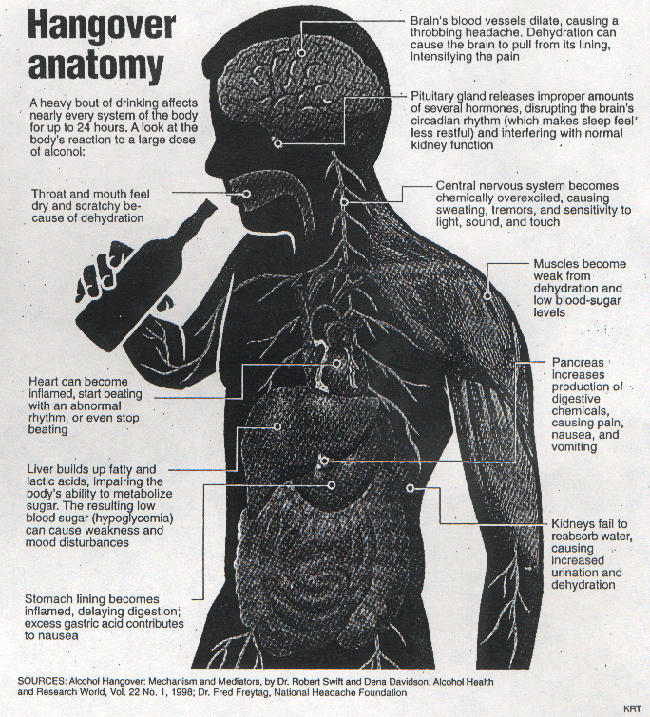


NEW YORK : Scientists have discovered the molecule in the brain that leads to hangovers. The neuropeptide, a brain-signalling molecule, is believed to cause the body to experience withdrawal symptoms as the brain tries to adapt to different intoxication levels.The neuroscientists from the University of Southampton's School of Biological Sciences studied the simple brains of C. elegans worms, which have a makeup similar enough to the human brain when intoxicated or dependent on alcohol.
What they found was striking.
Basically, when a worm brain (similarly, a human brain) is exposed to drinking over a long period of time, it becomes accustomed to certain intoxication levels.The brain experiences a series of withdrawal symptoms when the drinking stops.Typically, these hangover symptoms can include anxiety and agitation, even seizures."This research showed the worms displaying effects of the withdrawal of alcohol and enables us to define how alcohol affects signalling in nerve circuits which leads to changes in behavior," said professor Lindy Holden-Dye, a neuroscientist of the University's School of Biological Sciences and member of Southampton Neurosciences Group (SoNG), who led the study.When the worms were given small doses of alcohol during their withdrawal their irritable behaviors eased. Unfortunately, this approach to combating a hangover also increases the chances for alcohol dependency.
Alcohol dependency and abuse are among the most common mental disorders. This study, published in PLoS One journal, showed hope for an average 13 percent of the adult population that suffers from these disorders.This study identifies where and also how alcohol consumption affect the nervous system and the brain in a way that hasn't been revealed until now."This is leading to new ideas for the treatment of alcoholism," Holden-Dye said. "Our study provides a very effective experimental system to tackle this problem."
Obama picks Elena Kagan for Supreme Court

President Obama nominated Solicitor General Elena Kagan to the Supreme Court on Monday, picking her to fill the seat being vacated by retiring Justice John Paul Stevens.
If confirmed, Kagan would be the third woman on the nine-justice bench and the fourth in the history of the high court. Her confirmation also would mean that the Supreme Court would have no Protestant justices for the first time in its history. Kagan, who is Jewish, would join six Catholic and two Jewish justices.
Kagan is a "trailblazing leader" who is "open to a broad array of viewpoints" and is a proven "consensus builder," Obama said at the White House.
Kagan, 50, received her law degree from Harvard University, where she later served as dean of the law school. She previously served in the Clinton administration as associate White House counsel.
If confirmed, Kagan will become the 112th Supreme Court justice.
Obama decided on Kagan as his nominee on Sunday and called her around 8 p.m., a source close to the process said.
He did not have to look far when considering Kagan. As solicitor general, she is the administration's top lawyer before the Supreme Court and has argued several high-profile cases before the justices since taking the job in spring 2009.
"You have to admit, Elena Kagan is a brilliant woman," Sen. Orrin Hatch, a Republican on the Judiciary Committee, said during a radio interview a year ago when Kagan was being vetted for a high court seat. "She is a brilliant lawyer. If [Obama] picks her, it is a real dilemma for people," especially conservatives.
"And she will undoubtedly say that she will abide by the rule of law."
Her confirmation hearings for the solicitor general job could offer a preview of what she can expect from both Democrats and Republicans. Many saw it as a dress rehearsal of sorts for a high court job.
GOP Sen. Lindsey Graham told Kagan she presented a "positive impression." Democrats were similarly enthused.
With that endorsement, she won confirmation for her current job by a 61-31 vote.
A number of conservative groups were less enamored.
"Among Supreme Court nominees over the last 50 years or more, Kagan may well be the nominee with the least amount of relevant experience," said Ed Whelan, president of the Ethics and Public Policy Center, former law clerk for Justice Antonin Scalia, and former counsel to the Senate Judiciary Committee.
Kagan had never argued a case before the Supreme Court or any appeals court before she became solicitor general about a year ago.
"Solicitor General Kagan has been nominated with no judicial experience, a mere two years of private law practice, and only a year as solicitor general of the United States," said David McIntosh, co-founder of the Federalist Society -- a conservative and libertarian legal group -- and former congressman from Indiana. "She is one of the most inexperienced nominees to the U.S. Supreme Court in recent memory."
Kagan's position on gays in the military is virtually certain to generate controversy during her confirmation hearings. She has been strongly criticized by conservatives for her efforts to block military recruiters from Harvard because of the military's "don't ask, don't tell" policy. The policy, first enacted during the Clinton administration but opposed by Obama, prohibits homosexuals from serving openly in the armed forces.
While serving as dean at Harvard Law, Kagan said she "abhorred" the military's "discriminatory recruitment policy." She called it "a profound wrong -- a moral injustice of the first order."
Kagan supported other schools challenging a federal law requiring them to give recruiters equal access or face the loss of federal funding. The Supreme Court unanimously upheld the law in 2006.
Some liberal organizations, on the other hand, have expressed concern over Kagan's views on executive power. As chief defender of the administration's anti-terrorism strategy, Kagan has articulated a more robust defense of the White House than many civil rights and human rights groups would like.
Observers on both sides of the political aisle have noted that Kagan has a relatively short paper trail compared to other recent Supreme Court nominees.
Kagan grew up in a Jewish household on the Upper West Side of Manhattan. She went to Princeton University and Harvard Law School. She served as a law clerk for federal judge Abner Mikva and then for Justice Thurgood Marshall on the high court.
In her 1986 job application to Marshall, she matter-of-factly told the civil rights pioneer, "I would be honored to serve as your clerk." The nation's first African-American justice affectionately called the diminutive Kagan "Shorty."
Kagan later went into teaching, starting at the University of Chicago, where one of the part-time faculty was Obama. Also teaching at the time was Diane Wood, who later became a federal judge and also was a finalist for the current high court vacancy. Kagan and Wood were among the few women on the full-time faculty at that time.
President Clinton later named Kagan associate White House counsel and then appointed her to the influential Domestic Policy Council, where she earned a reputation for articulate and well-reasoned statements on tricky political issues. She was the administration's point person on passing anti-tobacco legislation, negotiating in 1998 with Republican Sen. John McCain to give the federal government the authority to control cigarettes, as it does pharmaceuticals and medical devices.
Clinton picked her in 1999 for the powerful U.S. Court of Appeals for the D.C. Circuit. But no Senate confirmation hearings were held, and the nomination lapsed. The seat was later filled by John Roberts, who quickly used the appointment as a springboard to chief justice.
Named Harvard's dean in 2003, Kagan earned a reputation for soothing longstanding tensions over a perceived liberal tilt to the faculty and curriculum.
She began pushing for the appointment of conservative professors, including Jack Goldsmith, who had been a lawyer in President George W. Bush's Justice Department. Such hires eased ideological unrest on the Harvard campus.
Rising attacks hamper anti-drugs drive - Afghan official
Drug mafias and suspected Taliban militants have increased attacks against officials trying to destroy poppy fields in Afghanistan, but the 2010 harvest may still fall from the previous year, a government official said.Zalmai Afzali, spokesman for the counter-narcotics ministry, said the provinces where the anti-poppy drive faced disruption mostly included southern and southwestern Afghanistan, where the Taliban are strongest.
The government has been conducting raids against poppy fields in ten provinces, but had to halt the drive in five provinces, largely due to increase in attacks, the official said.
"There were security challenges and attacks and police had to stop the operations," Afzali told a news conference.
The United Nations says Afghanistan remains the world's key source of poppy and in 2008 produced 90 percent of the plant, which is used in making heroin and which officials say is helping the Taliban to fund their war against foreign and Afghan forces.
Afghanistan itself had 1.5 million drug addicts.
He said police destroyed more than 2,500 hectares of poppy cultivation which would lead to a reduction in production this year.Afzali praised the United States for its aid in tackling the drugs problem, but he criticised Europe, despite being a key market for the Afghan heroin trade, for not giving enough help.He also criticised the governor for southern Kandahar province for failing to help against poppy cultivation.He said the NATO-led force did not destroy poppy fields in Marjah of district of adjacent Helmand after forces seized much of the area from the Taliban in a major offensive in February.More than 140,000 foreign troops are trying to defeat the resurgent Taliban in Afghanistan.
The government has been conducting raids against poppy fields in ten provinces, but had to halt the drive in five provinces, largely due to increase in attacks, the official said.
"There were security challenges and attacks and police had to stop the operations," Afzali told a news conference.
The United Nations says Afghanistan remains the world's key source of poppy and in 2008 produced 90 percent of the plant, which is used in making heroin and which officials say is helping the Taliban to fund their war against foreign and Afghan forces.
Afghanistan itself had 1.5 million drug addicts.
He said police destroyed more than 2,500 hectares of poppy cultivation which would lead to a reduction in production this year.Afzali praised the United States for its aid in tackling the drugs problem, but he criticised Europe, despite being a key market for the Afghan heroin trade, for not giving enough help.He also criticised the governor for southern Kandahar province for failing to help against poppy cultivation.He said the NATO-led force did not destroy poppy fields in Marjah of district of adjacent Helmand after forces seized much of the area from the Taliban in a major offensive in February.More than 140,000 foreign troops are trying to defeat the resurgent Taliban in Afghanistan.
Pakistan to come under U.S. pressure on militant hub
reuters.com
Pakistan will come under greater U.S. pressure to attack a militant stronghold in the northwest, an official said, but with the army battling in several areas and resources stretched, Pakistan's own interests must come first.
The United States is convinced that Pakistani Taliban militants allied with al Qaeda were behind the attempted bombing in New York's Times Square on May 1, U.S. officials said on Sunday.
Ally Pakistan is cooperating with U.S. investigators trying to determine the nature of the militant links of the suspected bomber, a Pakistan-born naturalised American who is under arrest in the United States.
But U.S. pressure for Pakistani action against the main militant hub left on its lawless Afghan border is bound to mount.
"The pressure from the United States to start operations in North Waziristan has been there, and after the Times Square incident, the pressure will grow," said a senior Pakistani intelligence official who declined to be identified.
The New York bomb plot suspect, Faisal Shahzad, 30, was arrested on Monday last week, two days after authorities say he parked a crude car bomb in Times Square. Authorities say he has been cooperating in the investigation.
U.S. Attorney General Eric Holder and other U.S. officials said on Sunday the Pakistani Taliban were involved.
Holder said the U.S. government was satisfied with Pakistani cooperation in the investigation, adding there was nothing to suggest the Pakistani government was aware of the plot.
The al Qaeda-linked Tehrik-e-Taliban Pakistan (Taliban Movement of Pakistan) is an alliance of factions that has killed many hundreds of people in numerous bomb attacks against the state.
Over the past year, the armed forces have mounted offensives against their strongholds in the northwest, largely clearing several areas including their bastion of South Waziristan.
LIMITATIONS
But North Waziristan has not been tackled, even though TTP members are believed to have taken refuge with allied Afghan factions based there that are not fighting the Pakistani state.
The army says it must secure the areas it has cleared before attacking there. But analysts say Pakistan sees the Afghan factions in North Waziristan as tools for its long-term objectives in Afghanistan, where Pakistan wants to see a friendly government and the sway of old rival India minimised.
"Basically, what the U.S. wishes is that we go into North Waziristan, and primarily that means targeting the Haqqani and Gul Bahadur networks," the Pakistani intelligence official said, referring to the two main Afghan Taliban factions there.
"But we have our own limitations. We are there in South Waziristan and yes, some of the militants are fleeing to Orakzai and some to North Waziristan, and we are following them. At the same time, our capacity is limited and we cannot open all fronts together. That will be against our national interest."
"We are not saying that we won't target the militants there, but we have to do that within our capacity and resources. The U.S. will keep putting pressure and we will try and take that pressure and act as best as we can while preserving our interests."
U.S. officials have in recent days been praising Pakistani efforts against militants, but Secretary of State Hillary Clinton raised eyebrows over the weekend when she told the CBS network Pakistan would face "severe consequences" if a successful attack in America was traced to Pakistan.
Retired Pakistani intelligence officer Asad Munir said U.S. blame would be counter-productive.
"If they blame Pakistan, I don't think they'll win this war," he said. "They (Pakistani forces) will go to North Waziristan but it will take time. If Pakistan is pressured, it will be disastrous."
"The 'do more' mantra will lead to thinking in the military that this is happening despite their people being killed every day and ultimately foot soldiers will be demoralised," he said.
Pakistan will come under greater U.S. pressure to attack a militant stronghold in the northwest, an official said, but with the army battling in several areas and resources stretched, Pakistan's own interests must come first.
The United States is convinced that Pakistani Taliban militants allied with al Qaeda were behind the attempted bombing in New York's Times Square on May 1, U.S. officials said on Sunday.
Ally Pakistan is cooperating with U.S. investigators trying to determine the nature of the militant links of the suspected bomber, a Pakistan-born naturalised American who is under arrest in the United States.
But U.S. pressure for Pakistani action against the main militant hub left on its lawless Afghan border is bound to mount.
"The pressure from the United States to start operations in North Waziristan has been there, and after the Times Square incident, the pressure will grow," said a senior Pakistani intelligence official who declined to be identified.
The New York bomb plot suspect, Faisal Shahzad, 30, was arrested on Monday last week, two days after authorities say he parked a crude car bomb in Times Square. Authorities say he has been cooperating in the investigation.
U.S. Attorney General Eric Holder and other U.S. officials said on Sunday the Pakistani Taliban were involved.
Holder said the U.S. government was satisfied with Pakistani cooperation in the investigation, adding there was nothing to suggest the Pakistani government was aware of the plot.
The al Qaeda-linked Tehrik-e-Taliban Pakistan (Taliban Movement of Pakistan) is an alliance of factions that has killed many hundreds of people in numerous bomb attacks against the state.
Over the past year, the armed forces have mounted offensives against their strongholds in the northwest, largely clearing several areas including their bastion of South Waziristan.
LIMITATIONS
But North Waziristan has not been tackled, even though TTP members are believed to have taken refuge with allied Afghan factions based there that are not fighting the Pakistani state.
The army says it must secure the areas it has cleared before attacking there. But analysts say Pakistan sees the Afghan factions in North Waziristan as tools for its long-term objectives in Afghanistan, where Pakistan wants to see a friendly government and the sway of old rival India minimised.
"Basically, what the U.S. wishes is that we go into North Waziristan, and primarily that means targeting the Haqqani and Gul Bahadur networks," the Pakistani intelligence official said, referring to the two main Afghan Taliban factions there.
"But we have our own limitations. We are there in South Waziristan and yes, some of the militants are fleeing to Orakzai and some to North Waziristan, and we are following them. At the same time, our capacity is limited and we cannot open all fronts together. That will be against our national interest."
"We are not saying that we won't target the militants there, but we have to do that within our capacity and resources. The U.S. will keep putting pressure and we will try and take that pressure and act as best as we can while preserving our interests."
U.S. officials have in recent days been praising Pakistani efforts against militants, but Secretary of State Hillary Clinton raised eyebrows over the weekend when she told the CBS network Pakistan would face "severe consequences" if a successful attack in America was traced to Pakistan.
Retired Pakistani intelligence officer Asad Munir said U.S. blame would be counter-productive.
"If they blame Pakistan, I don't think they'll win this war," he said. "They (Pakistani forces) will go to North Waziristan but it will take time. If Pakistan is pressured, it will be disastrous."
"The 'do more' mantra will lead to thinking in the military that this is happening despite their people being killed every day and ultimately foot soldiers will be demoralised," he said.
Pashto poet,Ex-bureaucrat Sahir Afridi living in misery
PESHAWAR: A former assistant commissioner and popular Pashto poet Zeenat Shah Sahir has been living in misery after retirement from service in 2003, especially after a paralysis attack.
Born on April 15, 1942 at Saidan Garhi, Jamrud subdivision of Khyber Agency, he received his early education from village school and later did his masters in English, Urdu and Pashto literature. He joined the civil service as section officer in 1973 in the Board of Revenue and got promoted to extra assistant commissioner (EAC), Peshawar and served in the same capacity in several districts of the erstwhile NWFP in difficult situations.
Sahir Afridi’s notable achievement was elimination of poppy cultivation from Gadoon Amazai area after successful negotiations with the elders. He retired as assistant commissioner (AC), Nowshera in 2003.
Having a sensitive soul, Zeenat Shah alias Sahir Afridi used to compose poetry since his childhood. The company of literary giants like Amir Hamza Khan Shinwari, Qalandar Momand, Prof Dr Muhammad Azam Azam and many others enabled him to improve his skills as a poet. He was strong opponent of the Malik system in the tribal areas and once in 1967 Sarfraz Khan, the former political agent of Khyber Agency, forced him to stay in Dera Ismail Khan rather than in his native Jamrud for composing a poem against the British-era privilege-based system in Fata.
On late Zulfiqar Ali Bhutto’s visit to Dera Ismail Khan, Sahir Afridi as a civil servant recited a welcome poem appreciating policies of Bhutto for the downtrodden and poor people. This upset his superiors who transferred him to Peshawar as punishment. His poetry often annoyed his seniors and high-ranking officials but being an outspoken officer he did not care much about them as he felt he ought to speak the language of the masses.Sahir Afridi attained fame when prominent singers Khayal Muhammad, Kishwar Sultan, Mehjabeen Qazalbash, Hidayatullah and others sang his poetry.
He also wrote numerous plays for Pakistan Broadcasting Corporation (PBC), Peshawar and PTV, Peshawar centre on social themes. In the early 80s he gave shelter to popular Pashto singer Shah Wali Afghan, now based in Canada, who had migrated from Afghanistan and was being hunted by militants. It was his contribution to Pashto music. Two poetry collections of Sahir Afridi namely ‘Painzaib’ and ‘Karkhey’ have been published while his short stories collection ‘Saanga’ and a novel ‘Yuwazey Yuwazey’ are unpublished.
Sahir Afridi has fallen on bad times. He has no bank balance and no plot of land even after serving as a civil servant. His meagre pension is not enough to look after the needs of his seven-member family.
A paralysis attack on June 15, 2006 rendered him bedridden. His fans told this scribe that no government official or known literati had enquired after his health. He is the registered member of Pakistan Academy of Letters (PAL) insurance policy but has not been extended any financial help for his medical treatment. His friends and fans have appealed to the PAL chairman, the president and prime minister, chief minister and governor Khyber Pakhtunkhwa to extend help to Sahir Afridi keeping in view his social and literary contribution.
Born on April 15, 1942 at Saidan Garhi, Jamrud subdivision of Khyber Agency, he received his early education from village school and later did his masters in English, Urdu and Pashto literature. He joined the civil service as section officer in 1973 in the Board of Revenue and got promoted to extra assistant commissioner (EAC), Peshawar and served in the same capacity in several districts of the erstwhile NWFP in difficult situations.
Sahir Afridi’s notable achievement was elimination of poppy cultivation from Gadoon Amazai area after successful negotiations with the elders. He retired as assistant commissioner (AC), Nowshera in 2003.
Having a sensitive soul, Zeenat Shah alias Sahir Afridi used to compose poetry since his childhood. The company of literary giants like Amir Hamza Khan Shinwari, Qalandar Momand, Prof Dr Muhammad Azam Azam and many others enabled him to improve his skills as a poet. He was strong opponent of the Malik system in the tribal areas and once in 1967 Sarfraz Khan, the former political agent of Khyber Agency, forced him to stay in Dera Ismail Khan rather than in his native Jamrud for composing a poem against the British-era privilege-based system in Fata.
On late Zulfiqar Ali Bhutto’s visit to Dera Ismail Khan, Sahir Afridi as a civil servant recited a welcome poem appreciating policies of Bhutto for the downtrodden and poor people. This upset his superiors who transferred him to Peshawar as punishment. His poetry often annoyed his seniors and high-ranking officials but being an outspoken officer he did not care much about them as he felt he ought to speak the language of the masses.Sahir Afridi attained fame when prominent singers Khayal Muhammad, Kishwar Sultan, Mehjabeen Qazalbash, Hidayatullah and others sang his poetry.
He also wrote numerous plays for Pakistan Broadcasting Corporation (PBC), Peshawar and PTV, Peshawar centre on social themes. In the early 80s he gave shelter to popular Pashto singer Shah Wali Afghan, now based in Canada, who had migrated from Afghanistan and was being hunted by militants. It was his contribution to Pashto music. Two poetry collections of Sahir Afridi namely ‘Painzaib’ and ‘Karkhey’ have been published while his short stories collection ‘Saanga’ and a novel ‘Yuwazey Yuwazey’ are unpublished.
Sahir Afridi has fallen on bad times. He has no bank balance and no plot of land even after serving as a civil servant. His meagre pension is not enough to look after the needs of his seven-member family.
A paralysis attack on June 15, 2006 rendered him bedridden. His fans told this scribe that no government official or known literati had enquired after his health. He is the registered member of Pakistan Academy of Letters (PAL) insurance policy but has not been extended any financial help for his medical treatment. His friends and fans have appealed to the PAL chairman, the president and prime minister, chief minister and governor Khyber Pakhtunkhwa to extend help to Sahir Afridi keeping in view his social and literary contribution.
Pashto film director calls for govt patronage
PESHAWAR: Noted film director Mumtaz Ali Khan has called for sincere government initiatives to revive the film industry.
Incentives and patronage from the government can help the film industry stand on its own feet and revive the cinema-going culture when cinema halls would be jampacked, he told The News.
He said the industry could be steered of crises by tax waivers and concession in duty on raw materials used in film production. “Normally, a Pashto film can be produced for Rs5 to 5.5 million, including up to Rs1.5 million of raw material expenses, while best Urdu movie costs Rs10 to 15 million,” he explained.
Seeing a bright future for Pashto films, he said there was a time when half of the audience at cinema halls would be female as films produced in the decades of 70s and 80s had no vulgar scenes and dialogues and could be watched with family members.
Mumtaz Ali said film was the best medium to mould opinion. “I have an idea of producing movie on the situation in the Pashtun belt if the Khyber Pakhtunkhwa government provides me assistance. The film would have a message and guidance for the younger generation,” said the elderly man, who has directed about 45 Pashto, Urdu and Punjabi movies.
Nowadays he is working on a documentary on Pakhtuns to be completed in two months. Born in Pabbi town of Nowshera district in December 1949, Mumtaz Ali ventured into the film industry when he was 20 years old. He said: “After passing my SSC examination in 1969, I got admission in Edwardes College Peshawar, but after four or five months I gave up studies and went to Lahore for making debut in films. Samad Hosh (late) introduced me to comedy king Rangeela who accommodated me as an assistant in Urdu films Diya Aur Toofan, Dil Aur Dunya and Rangeela. Later, I directed Pashto super hit, Darra Khyber. Orbal, Khana Badosh, Deedan, Jawargar and Naway Da Yaway Shpe were the hit movies that I produced.”
He was the first director in the subcontinent who produced one film in two languages known as Naway da Yaway Shpe and Dulhan Ek Raat Ki and both were hits. His first Punjabi film, Raakha, was also a hit.
Mumtaz Ali, starting film direction at very young age, not only earned appreciation from the industry but won award for his Urdu film, Daakoo Ki Larki. He introduced new talent including Ajab Gul, Jamil Babar, Ismail Shah, Humayun Qureshi, Mussarat Shaheen and Lubna Khattak, who later became stars.
He felt vulgar scenes and the death or exit of senior directors as major reasons for decline of the film industry, especially Pashto. He said producers and artistes like Sanobar Khan, Sher Afgan, Rafiq Shinwari, Amir Ghulam Sadiq, Aziz Tabassum, Gulnar Begum, Kishwar Sultan, etc, left the field open for fortune-makers and thus the decline in film industry started.
“Though vulgarity has been reduced to a great extent, producers, directors and artistes now produce CD films that could be made in Rs500,000 and return on it is also immediate. A CD film is produced in 10 shifts of 7 to 8 hours and is released in a week while its cost is low,” he explained. He also held cinema owners and the government responsible for the slump in the industry.
Female pilot helps Afghan air force take off
Decades ago, Afghanistan's air force was in full operation. Today, that air force is being rebuilt, with some of the same helicopters and some of the same pilots as well - including the first woman in the Afghan Air Corps and currently the only one.The only time Capt. Latifa Nabizada left the force was to flee to Pakistan when the Taliban took over in the 1990s - a woman pilot was a prime target for them."I wanted to be a pilot since I was a child," she says. "I also, as a woman, felt it was a responsibility to serve my country. So I joined 20 years ago. ... I stayed in because it's the love of my life, and I still feel the responsibility to not give it up."Today, she is one of about 50 pilots training in Kabul, with a few others elsewhere in Afghanistan. And U.S. forces are helping mentor the pilots, training them on modern air force techniques for the 50 or so aircraft in the Afghan air force fleet.Nabizada revels in the new training: "I've seen remarkable changes since we started this. We get training in air traffic control, pre-flight checklists, English language, instruments, navigation. These are skills we didn't have before."
On the training base in Kabul, a regular sight is Nabizada's 4-year-old daughter Malali. "Being a pilot and a mother is hard, actually," Nabizada says. "My husband is a doctor in the air force and we have no one to take care of her, so she comes with me every day. One day I'd like to see childcare in the air force."Until then, Malali learns first hand about her country's air force and her mother's groundbreaking role. Will she follow in her mother's footsteps in the future? "Exactly," says Nabizada. "She will be a pilot in the future."
Kagan to be Supreme Court nominee, source says
President Obama is on Monday expected to name Solicitor General Elena Kagan as his nominee to replace retiring Justice John Paul Stevens on the Supreme Court, two sources close to the process said.The announcement at the White House is expected around mid-morningKagan, 50, a New York native, was widely reported to be the front-runner for the nomination. She was a finalist for the high court vacancy last year when Justice Sonia Sotomayor was selected to replace the retiring David Souter.If confirmed, Kagan would be the third woman on the nine-justice bench and the fourth in the history of the court.Kagan received her law degree from Harvard University, where she later served as dean of the law school. She previously served in the Clinton administration as associate White House counsel.
Afghanistan's last Jew vows to stay put
Zablon Simintov is always guaranteed the best seat in his local synagogue here, but the privilege comes with a downside: he's the last Jew in Afghanistan.
The country's 800-year-old Jewish community -- an estimated 40,000 strong at its peak -- is now a party of one.But Simintov, for his part, isn't going anywhere soon. For more than a decade, he has refused to join his wife and two teenage daughters in Israel.
"My family call me all the time and say, 'Come here, you're the last Jew in Afghanistan, what are you doing there?' " he says.
Simintov, a former carpet dealer, refuses to answer that question. "I don't know why I'm still living here," he says. "It's God's will."
He hasn't seen his daughters -- now ages 14 and 16 -- since his one trip to Israel 12 years ago.But the bald and bespectacled Simintov says he is content guarding a cupboard full of dusty prayer books -- one is 400 years old, he says -- spending holidays with visitors from Europe and the U.S. and surviving off donations from Jews around the world.Historical evidence suggests a sizable Jewish community in Afghanistan since the Middle Ages, according to the American-Israeli Cooperative Enterprise, a nonprofit group.Afghanistan's Jewish population reached 40,000 in the mid-19th century, the group says, and began declining around 1870 with the passage of anti-Jewish measures.
Israel's creation in 1948 drew most of Afghanistan's remaining Jews.
Simintov's synagogue -- the last in Afghanistan's capital -- sits inconspicuously in a courtyard behind busy city streets, though a close inspection reveals Stars of David in second-story metal railings. The interior is adorned only by broken light fixtures and ceiling fans.
But Simintov says he is hardly in hiding. "They're all like my brothers here," he said of his fellow Afghans. "It doesn't make a difference whether I'm here or in Israel."That wasn't the case under Taliban rule, which ended with the U.S. invasion of Afghanistan in 2001, though Taliban forces have been resurgent in parts of the country.Simintov says he was arrested four times under Taliban rule and that he was beaten while in custody."The Taliban was a problem," he says. "They interfered in everyone's business, but now they're gone, they're finished."
Which means that Simintov is more inclined than ever to stay put.
Sunday, May 9, 2010
Afghan refugees’ stay extended till 2012



Islamabad—Government of Pakistan, United Nations High Commission for Refugees UNHCR and Afghanistan have signed an agreement of extending the stay of 1.7 million registered Afghan refugees in Pakistan till December 31, 2012.The agreement was signed in 19th meeting of the Tripartite Commission comprising Pakistan, UNHCR and Afghanistan at a local hotel in Lahore yesterday, says a press release here on Saturday.Federal Minister for State & Frontier Region (SAFRON) Najum-ud-Din Khan,UNHCR Country Head for Afghanistan Mr. Ewen Mcleod and Afghanistan Minister for Refugees and Repatriation Engineer Abdul Rahim attended the meeting.Federal Minister for SAFRON Najum-ud-Din Khan briefing the media said that as many as 1.7 million registered Afghan refugees would be facilitated for their voluntarily return to Afghanistan.He said that earlier in 2003, an agreement was signed with the Afghan government and UNHCR for the return of refugees which was expired in December 2009.
The Minister added that following the current agreement, the refugees living in various parts of the country would gradually return to Afghanistan and US$ 100 per head would be handed while the Afghan government would also provide them with shelter and other facilities there.Najum-ud-Din Khan said,the Pakistan government was committed to provide continued protection to those refugees who could not return safely to Afghanistan according to the Pakistan’s strategy.He said that three parties have reaffirmed the commitment to the return of Afghans in conditions of safety and dignity.To a question, the Federal Minister told that government already started verification of the Afghans who had got NADRA ID cards and 80,000 were cancelled so far. He added that a committee was formed to expedite the process of repatriation of 500,000 refugees till the end of this year.During the meeting, three stakeholders also took note of Pakistan’s strategy for the management of the stay of refugees and all were agreed to extend cooperation regarding VISA and border management issues.Afghan Minister Engineer Abdul Rahim thanked the Pakistan Government for its hospitality to the refugees for a long time.“Afghan government is pleased to extend this agreement which demonstrate the continued generosity of the government and people of Pakistan,” he observed.The UNHCR head told that since March 2010, a total 36,000 and from 2002 as many as 3.6 million refugees were repatriated to Afghanistan.
Subscribe to:
Posts (Atom)