Thursday, September 22, 2022

India’s economy has outpaced Pakistan’s handily since Partition in 1947 – politics explains why

Surupa Gupta

India and Pakistan inherited the same economic legacy of underinvestment and neglect from Britain when they became independent states following the Partition on Aug. 15, 1947. Their colonial economies were among the poorest in the world.

For both nations, independence almost immediately led to strong growth and fueled significant gains in education, health care and other areas of development. But it was Pakistan that saw faster growth rates during the first four decades or so, while India lagged behind.

Something began to change around the 1990s as their roles reversed and India vaulted ahead of Pakistan, eventually becoming the world’s third-biggest economy by purchasing power and the “I” in BRICS – an acronym referring to a bloc of five key emerging market countries.

What accounts for India’s growth spurt?

As a scholar of international political economy, I believe India’s stronger embrace of democracy – at the same time that Pakistan experienced frequent military dictatorships and changes in government – has a lot to do with it.

A colonial inheritance

From 1857 to 1947, Britain ruled directly over most of the territory that became the independent states of India and Pakistan.

Economic growth under British rule was minimal, averaging just 0.9% a year from 1900 to 1947. This happened largely because the colonial Indian economy was mostly agricultural, and yet the British made little investment in improving farm productivity.

Additionally, Great Britain made limited investments in the well-being of the people of India, notably by underfunding their education and health care. As a result, colonial India had one of the lowest literacy rates in the world at about 17%, and life expectancy was in the mid-30s. Britain’s neglect of the plight of Indians is perhaps best illustrated by the 1943 famine in Bengal in eastern India, in which over 1.5 million people died as result of policy failure.

Post-independence growth, led by Pakistan

Britain decided to give up its “jewel in the crown” and partition the region into Hindu-dominated India and Muslim Pakistan after facing mounting pressure from the local population and a growing nationalist movement.

This led to one of the largest forced migrations of the 20th century: Nearly 9 million Hindus and Sikhs moved into India and about 5 million Muslims to a geographically separated East and West Pakistan over the next two decades. An estimated 1 million people died amid mass violence.

Economic growth, however, took off, with both new countries growing at 3% to 4% in the first decade or so of independence as the respective governments invested more into their economies. But soon, differences emerged.

While both economies were largely state controlled, India’s government curtailed exports and adopted a protectionist trading policy in the 1960s that limited growth.

Pakistan, on the other hand, benefited from significant trade from its East Pakistan region. The newly created Pakistan was geographically separated by India – on one side of it was West and the other side East Pakistan. Each was carved out by the British due to its Muslim majority. Pakistan lost its growth engine in 1971, when East Pakistan became Bangladesh following a war of independence.

Pakistan also received billions of dollars in military aid from the U.S. Fellow oil-rich Muslim countries in the Middle East have also given aid to Pakistan. As a result, Pakistan’s growth accelerated to about 6% a year from 1961 to 1980, compared with 4% for India.

India vaults ahead

The growth script flipped in the 1990s, with India growing at a 6% rate over the next 30 years, outpacing Pakistan’s 4%.

What explains the role reversal? Economics and politics both played a part.

Pakistan has long relied on external sources of funding more than India has, receiving $73 billion in foreign aid from 1960 to 2002. And even today, it frequently relies on institutions such as the International Monetary Fund for crisis lending and on foreign governments like China for aid and infrastructure development.

The aid has allowed Pakistan to postpone much-needed but painful reforms, such as expanding the tax base and addressing energy and infrastructure problems, while the loans have saddled the country with a large debt. Such reforms, in my view, would have put Pakistan on a more sustainable growth path and encouraged more foreign investment.

While India also got a fair amount of support from international aid groups and a few countries such as the U.S. earlier in its existence, it never depended upon it – and has relied less on it in recent decades. In addition, in 1991, India liberalized trade, lowered tariffs, made it easier for domestic companies to operate and grow, and opened the door to more foreign investment.
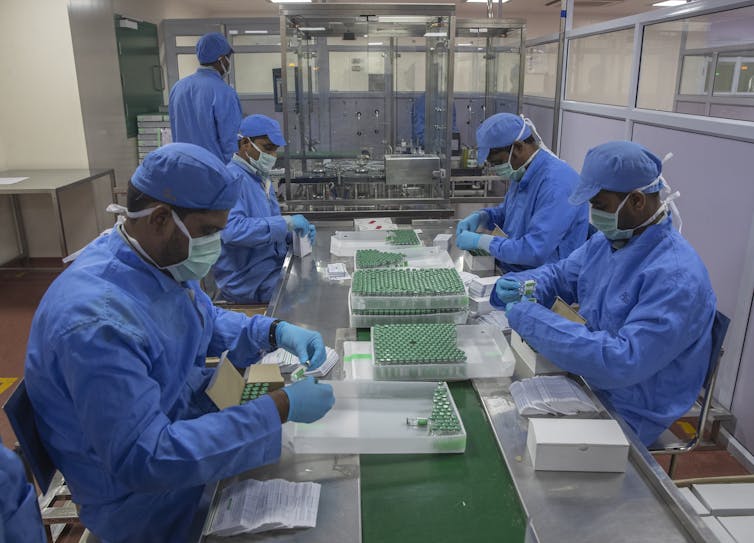
men wearing blue lab coats and face masks pack vials into boxes on a table
India has become a major exporter of advanced goods such as software and vaccines in recent years. AP Photo/Rafiq Maqbool

These reforms paid off: By integrating India’s economy to the rest of the world, the reforms created market opportunities for Indian companies, made them more competitive, and that, in turn, led to higher growth rates for the overall economy.

Another way to measure the different paths is in gross domestic product per person. In 1990, India and Pakistan had almost identical per-capita GDPs, a little under $370 per person. But by 2021, India’s had surged to $2,277, about 50% higher than Pakistan’s.

The reasons for their different choices have a lot to do with politics.

Pakistan has suffered from near-constant political instability. From 1988 to 1998 alone, it had seven different governments as it alternated between civilian and military governments following coups. This discouraged foreign investment and made it much harder to make reforms and follow through on them. Through all these changes, Pakistan’s military spending as a share of its GDP remained higher than India’s during the entire post-independence period.

India, on the other hand, has managed to maintain a steady democracy. Though it’s far from perfect, it has kept leaders more accountable to the people and led to more inclusive growth and less reliance on foreign institutions or governments. In one decade alone, India lifted over 270 million people out of poverty.

At a time when democracy is under threat in so many parts of the world, this history, in my view, reminds us of the value of democratic institutions.

https://theconversation.com/indias-economy-has-outpaced-pakistans-handily-since-partition-in-1947-politics-explains-why-187053

How floods in Pakistan compound people's economic woes


Devastating flooding in Pakistan in recent weeks has battered a country already struggling to revive its crisis-stricken economy.

Pakistan has witnessed catastrophic flooding over the past few weeks that affected over 33 million people — some 15% of the nation's population — and submerged a third of the country.  

The natural disaster has killed over 1,500 people and caused damage worth billions of dollars, compounding the woes of an economy already beset by a raft of problems, ranging from a heavy debt burden and ballooning current account deficit to a tumbling currency and skyrocketing inflation, particularly food prices.

The rains have damaged vast swathes of rich agricultural land and crops.

Parts of Pakistan were cut off from the rest of the country as flooding rendered roads and bridges inaccessible — crucially, this included areas in the nation's southern breadbasket.

Finance Minister Miftah Ismail said at the end of August that the price of onions, a common ingredient in Pakistani meals, had increased by more than fivefold.

The price of tomatoes — another essential ingredient in Pakistani cuisine — also soared following the destruction of most of the crop, official statistics show.

Khaqan Najeeb, a former adviser to the Finance Ministry, said crops like cotton, rice and tomatoes have been seriously damaged.

The damage to the agriculture sector is likely to widen Pakistan's trade deficit from the current 2.4% of GDP to more than 3.5%, as the country is forced to import more foodstuffs and other goods from abroad, he pointed out.

Rising costs and low growth

Pakistan will import more tomatoes, rice, wheat, cotton and other food items, said Qaiser Imam Shaikh, a leading businessman in the country. And rising freight costs mean that the prices of these items will continue to surge, making life very difficult for poor and middle-class Pakistanis, he told DW, adding that imported items cannot be sold at discounted rates, "So, of course, there will be more inflation in coming days because of the destruction of agriculture."

Shahida Wizarat, a Karachi-based economist, said that Pakistan finds itself in a tough spot.

"If we do not import industrial raw materials, then manufacturing would be hit and if we do, the import bill will rise exponentially. We are in a very difficult economic situation," she stressed.

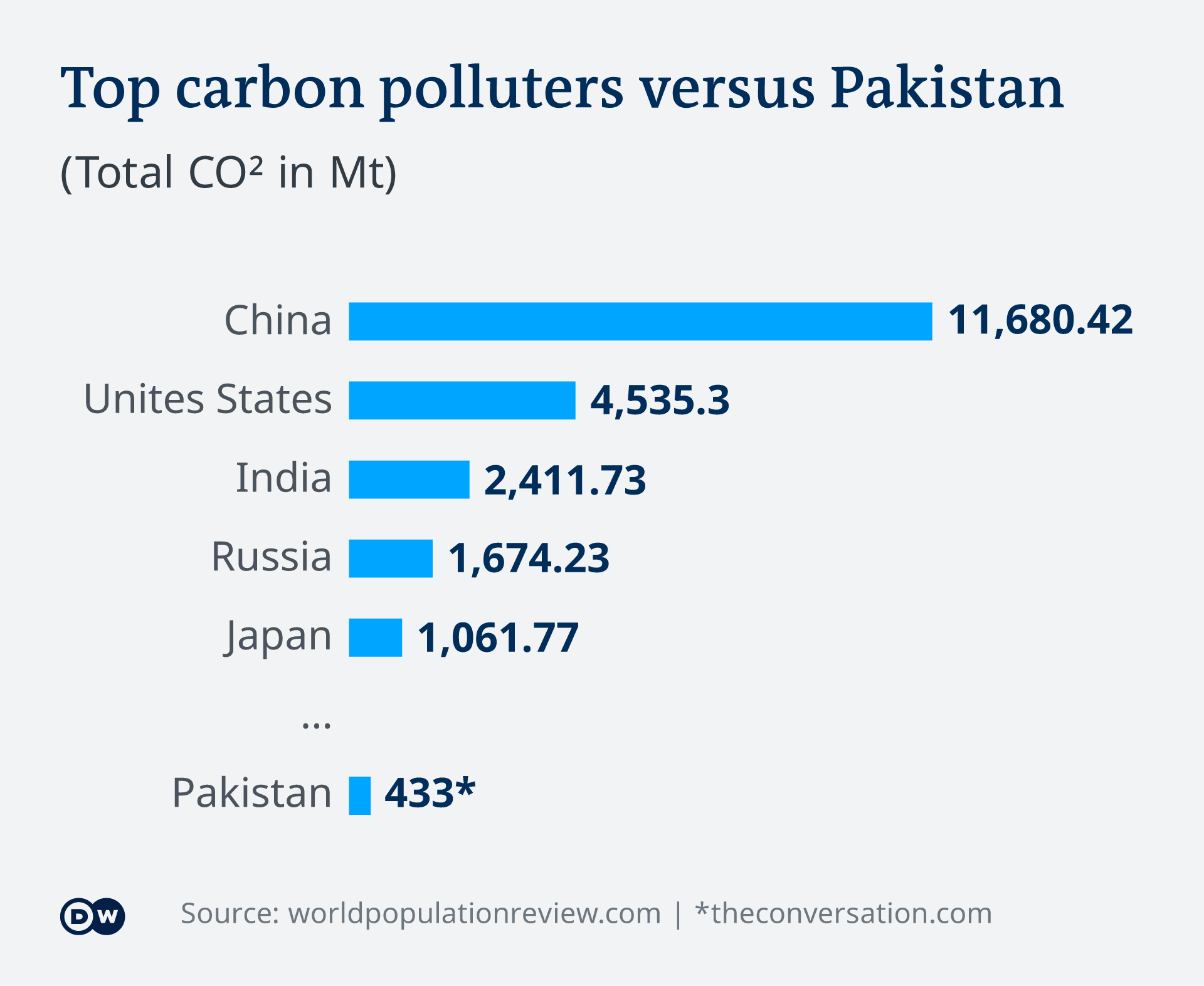
The expert called on advanced Western economies to waive off Pakistan's debts and help, "After all, it is their obsession with growth that has destroyed the environment, punishing countries like Pakistan, which contributes very little to carbon emissions."

Top carbon polluters versus Pakistan

In June, the Pakistani government set a 5% growth target for this year, while the International Monetary Fund forecast that the economy would expand by 3.5%. But after the disastrous floods, many expect zero growth this year. 

"Given the current economic and financial hardships, the zero percent growth prospect is not unrealistic," a renowned economist, who asked not to be named, told DW.

Finance Minister Ismail, however, told DW that the growth will be "around 2%."

"We forecast growth of 5% and expect growth of 2% now, hence a loss of 3%. But this is our model. The IMF predicted growth of 3.5% but hasn't shown yet, to the best of my knowledge, what the reduction will be. It is wrong to use our reduction number in the IMF model. We still think growth will be around 2%," he said.

Help only with strings attached

Pakistan's foreign exchange reserves currently stand at about $8.6 billion, only enough for about a month of imports. The year-end target was to increase the buffer by up to 2.2 months.

The country was able to bring an International Monetary Fund (IMF) program back on track after months of delay, thanks to tough policy decisions.

Salman Shah, a former finance minister, said Pakistan will likely have to increase its borrowing in the coming months to service its foreign debts and finance essential imports. 

The South Asian nation needs a total of $33.5 billion in the year through June 2023, Bloomberg reported in July. Its next big payment — $1 billion in international bonds — is due in December.

Shah said funds from bodies like the IMF to service the debt will come with strings attached, such as conditions to increase electricity prices, impose additional taxes or cut fuel subsidies.

Vow to take 'prudent decisions'

Despite the challenging financial circumstances, Finance Minister Ismail said Pakistan will "absolutely not" default on debt obligations.

"The path to stability was narrow, given the challenging environment, and it has become narrower still," he told Reuters on Sunday, adding: "But if we continue to take prudent decisions — and we will — then we're not going to default. Absolutely not."

He acknowledged that global markets were "jittery" about Pakistan, given the economy's massive losses after the floods, but noted that external financing sources were secured, including over $4 billion from the Asian Development Bank, Asian Infrastructure Investment Bank and World Bank.

"Yes, our credit default risk has gone up, our bond prices have fallen. But ... I think within 15 to 20 days, the market will normalize, and I think will understand that Pakistan is committed to being prudent."

https://www.dw.com/en/how-floods-in-pakistan-compound-peoples-economic-woes/a-63193128

The Interview: Bilawal Bhutto Zardari: 'The scale of climate catastrophe in Pakistan is truly apocalyptic'

By:Marc Perelman
Pakistan Foreign Minister Bilawal Bhutto Zardari told FRANCE 24 the floods that ravaged his country had created a catastrophe of apocalyptical proportions. In addition to more than 1,500 deaths, the disaster has caused dual health and food security crises. 

Zardari said Pakistan needs some $30 billion in aid and praised international efforts under way to offer help. Neighbouring India, however, has failed to offer assistance, said Zardari, who condemned the country's government as "racist" and "Islamophobic". 

 On Afghanistan, Bilawal Bhutto Zardari said that the Taliban had not fulfilled their promises to the international community and this had precluded recognition of their government. He expressed regret that they had not allowed girls to attend secondary school, despite their pledges to do so.
With regards to the protests ignited by the death of young Iranian woman Mahsa Amini after she was detained by the morality police in Iran, Zardari said that he trusted Iran's foreign minister who said he would conduct a thorough investigation into the circumstances of her death.
https://www.france24.com/en/tv-shows/the-interview/20220921-bilawal-bhutto-zardari-the-scale-of-climate-catastrophe-in-pakistan-is-truly-apocalyptic?ref=tw

Tuesday, September 20, 2022

Video Report - #swatvalley #taliban #pakistan سوات کې د ناامنۍ ضد اقداماتو لپاره د پولیسو واک پراخولو غوښتنه شوې

Video - Malala Yousafzai at the Transforming Education Summit | United Nations

Video Report - PPP Leaders addresses press conference in Karachi

‘Peaceful Afghanistan is Pakistan’s priority’: Foreign Minister Bilawal Bhutto

‘Peaceful Afghanistan is Pakistan’s priority. Foreign Minister Bilawal Bhutto-Zardari, in a meeting with US Special Representative on Afghanistan Thomas West, stressed the significance of continuing international engagement with the interim Afghan government for lasting peace and stability in Afghanistan and beyond.
West called on Bilawal — who is currently in New York to attend the 77th session of the United Nation’s General Assembly — on Monday, a statement issued by the Ministry of Foreign Affairs said.“A peaceful, stable, and prosperous Afghanistan is a priority for Pakistan,” Bilawal was quoted as saying while highlighting Pakistan’s facilitation efforts in building regional consensus on the way forward in Afghanistan, including the Extended Troika mechanism.
The FM indicated various steps taken by Pakistan to support bilateral engagements with Afghanistan, as well as extensive facilitation of international humanitarian assistance.
Referring to humanitarian prospects in Afghanistan, which the United Nations and international agencies warn will deteriorate further in impending winters, Bilawal emphasized that such a scenario could result in mass refugee exodus and provide fertile ground for exploitation by terrorists and extremists, with regional and international implications.The US special representative for Afghanistan appreciated Pakistan’s efforts for peace and stability in Afghanistan, as well as in the facilitation of evacuations.

The two sides acknowledged the need for continued cooperation on the shared objectives of sustained efforts and engagement of the international community to alleviate the suffering of the Afghan people and promote regional peace and stability.

‘Peaceful Afghanistan is Pakistan’s priority’: FM Bilawal

Pakistani-American Delegation, Including Former Minister, Lands in Israel


The Pakistani delegation, which also includes members of Muslim-American peace groups, is currently in Israel despite a lack of formal diplomatic ties between the two countries.
A delegation of Pakistani-Americans, including a former government minister, arrived in Israel on Tuesday, less than a year after a prominent Pakistani journalist was fired following his visit to Jerusalem and meeting with Israeli President Isaac Herzog.
The delegation consists of members of the American Muslim and Multifaith Women’s Empowerment Council (AMMWEC) and Sharaka, an NGO founded in the wake of the Abraham Accords to embed people-to-people normalization between Israel and Muslim-majority states.
Among those visiting is Dr. Nassim Ashraf, the ex-head of the Pakistan Cricket Board and a former Pakistani Minister of State for Human Development.
In a statement reported by the Pakistani news site propakistani.pk, Ashraf said that he was “delighted and honored” to take part in a delegation intended “to promote peace and interfaith dialogue.”
“Such people-to-people contacts,” he said, “are very important to develop understanding and harmony between Abrahamic Faiths to which we belong.” Anila Ali, the president of AMMWEC and a Sharaka board member, told the site that “we must continue our work to build peace on a people-to-people connection to promote the Abraham Accords in Muslim countries,” including between Israelis and Pakistanis.“The aim of the trip is to allow the participants to see and explore Israel for themselves, and to transmit what they learn and experience to audiences in Pakistan to help provide information for the important debate underway on whether Pakistan should join the Abraham Accords,” she said, adding that “due to the tragic flooding in Pakistan, much of the visit will focus on life-saving technologies developed in Israel relating to water and food security and to mitigating climate and environmental disasters.”
Israel and Pakistan have made overtures to each other in the past, most notably when the country’s foreign ministers met in Istanbul in 2005 following Israel’s withdrawal from the Gaza Strip. But there hasn’t been any major public push to bring the countries closer, even as Israel has tightened ties in recent years with India. Antisemitism and anti-Israel rhetoric is common in Pakistan and every Pakistani passport includes a warning in bold letters that it is valid for all countries except Israel. Just last year, during an interview with CNN, Pakistan’s former Foreign Minister Shah Mahmood Qureshi alleged that Israel had "deep pockets" and "they control the media.”
The trip comes only months after journalist Ahmed Quraishi was fired after participating as part of a previous AMMWEC/Sharaka delegation of mostly Pakistani expatriates living in America that travelled to Israel. Among those who assailed the visit was Pakistan’s ousted Prime Minister Imran Khan, a former cricket star turned Islamist politician who was voted out of office in April. Khan claimed the visit to Jerusalem meant to pave the way for Pakistan’s eventual recognition of Israel — something the delegation denied. The government has also said there are no plans to establish ties with Israel.
At the time, Anila Ali defended the visit, telling The Associated Press that they only sought to reconcile Muslims and Jews.
Ellie Cohanim, the head of the Mukhayriq Initiative, a U.S.-based non-government organization devoted to promoting Muslim-Jewish relations, told the AP that after criticism from Khan, “Quraishi began to receive threats to his life” — even though he was only doing the “job of any good journalist, (which is) to seek information on the ground, and to understand issues first-hand.” Writing in Haaretz following the trip, Hamza Azhar Salam, a Pakistani journalist based in London, reported that Quraishi told him that “all Israelis we met went the extra mile to show us that they have nothing against Muslims, that they respect Muslims, they respect Palestinian Muslims, they respect Muslims from other countries in the world, they would like to make the experience of local Palestinians and visitors from outside who want to visit [Jerusalem’s] Masjid al-Aqsa and the Dome of the Rock and other holy sites as smooth as possible."
According to i24 News, an unnamed senior Indonesian official is also currently visiting the country. This follows a prior delegation this January which made a rare visit to Israel recently to discuss coronavirus strategies.Israel and Indonesia do not have diplomatic relations, but for years there have been back-channel overtures to establish official ties. Indonesia has refused to normalize relations with Israel until the establishment of an independent Palestinian state, and has been a staunch supporter of the Palestinians.
The United States has been urging Indonesia and Israel to establish full diplomatic relations as part of the Abraham Accords.
https://www.haaretz.com/middle-east-news/2022-09-20/ty-article/.premium/pakistani-american-delegation-including-former-minister-to-visit-israel/00000183-5a58-d1c8-ade3-ffd91a640000

Sunday, September 18, 2022

Video Report - SCO Summit: Putin criticises the West for "economic selfishness"

Video Report - #energy #Russia #EU How Putin held Europe hostage over energy

Video Report - #trump #january6 Expert warns of "violent threat" to U.S. democracy

Video Report - #immigration Jeh Johnson says Texas and Florida governors treating migrants "like livestock"

Video Report - Nancy Pelosi visits Armenia as Azerbaijan truce holds

د زامنو په زېږون خوشالي او د نجونو پر پیدا کېدو خپګان ولې؟

د مشال راډیو د ځانګړي پاډکاسټ "نا ویلې خبرې" په لومړۍ برخه کې پر دې غږېدلي یو چې په پښتني ټولنه کې اکثر د لوڼو پرتله د زامنو زېږون ته ولې ارزښت ورکول کېږي او د نجلۍ پیدایښت ولې د ځینو خلکو د خپګان لامل کېږي؟ له دې پرته دا هم اورئ چې د پوهاوي او تعلیم باوجود خلک ولې تر اوسه زامن د خپلې کورنۍ راتلونکې لپاره مهم بولي او لوڼو ته حقونه نه ورکوي. په خپرونه کې د پېښور یوه اوسېدونکې شاه سلطانه، د ماشومانو د حقونو مبارز عمران ټکر، تاریخپوه نورالامین یوسفزی او د ښځو د ناروغیو متخصصه ډاکتره شهلا مندوخېل مېلمانه دي. خپرونه په لېنک کې واورئ.

Video Report - په سوات کې د امن دپاره او ترهګرۍ په ضد احتجاجي مظاهرې شوي

Pakistan floods: Medicine shortages threaten health crisis


Waterborne diseases are spreading in northwestern Pakistan as floodwaters recede. Doctors do not have enough medicine to treat displaced people living in crowded camps.

Gul Makai from Swat district in the northwestern Pakistani province of Khyber Pakhtunkhwa was forced from her home after floodwaters inundated her village.Although the waters have receded, the flooding has left behind unsanitary conditions in which dangerous pathogens can easily spread. Medicine and clean water are scarce in this remote area of Pakistan.Makai is staying in a flood shelter 3 miles (4.8 kilometers) from her home and tries to cool her crying infant son with a handheld fan.The 11-month-old fidgets on a plastic floor mat constantly scratching his skin, which has been infected with scabies. Two of her other children are also infected. The ailment is spread by microscopic mites that burrow into the skin."Look at the rashes and scabs on his body. He scrapes them with fingers and cries, while the humid heat adds to his misery in this tent," Makai told DW. The temperature hovers around 30 degrees Celsius (86 degrees Fahrenheit) with 60% humidity.

Flood destruction displaces communities
Much of Swat district is situated in a river valley surrounded by mountains and it was one of the worst hit areas in northern Pakistan by last month's record flooding, which washed away infrastructure and houses.Local authorities set up tent camps for displaced people on the grounds of a school. Makai said she received medicated cream for scabies after arriving at the camp, but was not given any further medical assistance.Cholera, diarrhea and dysentery are also spreading in the displacement camps due to lack of clean water.
Nauman Khan from the Pakistan Islamic Medical Association (PIMA), a medical NGO, told DW at a camp in Swat's capital, Saidu Sharif, that stagnant rainwater used for drinking and washing was spreading disease.
Cases of mosquito-borne dengue fever have also been reported. Khan said mosquito nets and repellent are needed.
He added that women are also unable to maintain menstrual hygiene, as pads and tampons are not available.
"I detected eight cases of yeast infection in just one day and found the repeated use of a piece of cloth [by menstruating women] caused it," he said. Women are also unable to access pain relievers.
A 23-year-old woman told DW anonymously that the tablets and herbal tea normally used to treat menstrual pain are not available.
"We have to drink warm water or walk around for relief, but those home remedies fail to save us from the embarrassment of men knowing about a matter very private for us," she said.
Medicine in short supply
Aid organizations say more medicine is urgently needed to stop the spread of waterborne diseases after the flooding. Pharmacies are out of painkillers, antibiotics, and medicines for skin and gynecological issues, diabetes and eye infections.
Asadullah Khan, an aid worker from the Pakistani social welfare charity Edhi Foundation, told DW that many of his acquaintances in Swat have contacted relatives in other parts of Pakistan hoping to acquire insulin and other medicine, only to find pharmacies are out of stock.Khan, who is based in the Swat valley's northern Kalam region, added a World Health Organization (WHO) team visited a local hospital and promised provision of essential medicines and other goods.Pharmaceutical companies have blamed the government for drug shortages, as a price cap has raised the cost of production and led to suspended manufacturing."When a finished product costs us [companies] more than the allowed price, how we will continue manufacturing it? It's the simple principle of doing business," Pakistan Pharmaceutical Manufacturers Association chairman Hamid Raza told DW.
He added the issue would be resolved if the government hiked prices in proportion to inflation.
Swat District health officer Mohammad Saleem Khan told DW that a health crisis could spread out of control if medical supplies are not provided soon.
"We [health department] are trying our best to ensure the availability of medicines but things are fast worsening. We need more medicine," he said.
https://www.dw.com/en/pakistan-floods-medicine-shortages-threaten-health-crisis/a-63131924

3.4 million children in Pakistan need ‘immediate, lifesaving support’ after floods: UNICEF

 By Sophia Saifi, Jake Kwon, Larry Register and Heather Chen


“Super floods” in Pakistan have left 3.4 million children in need of “immediate, lifesaving support,” according to UNICEF.

The floods – caused by record monsoon rains and dubbed by one minister as “the worst humanitarian disaster in a decade” – have impacted 16 million children in total, UNICEF’s Pakistan Representative Abdullah Fadil said following his visit this week to the country’s southern Sindh Province.That estimate came as the country’s National Disaster Management Authority updated the death toll from the floods since mid-June to 1,545 people, 552 of them children.
Meanwhile, officials in the country warn that toll is likely to rise as deaths are being under reported and diseases like dengue fever are on the rise.
Azra Pechuho, health minister for the southern Sindh Province – one of the hardest hit areas where many schools and other facilities remain shut, said there was now a “state of emergency” caused by the vast amount of standing water, which provides the perfect breeding conditions for Aedes mosquitoes to spread the dengue virus. UNICEF’s Fadil said the situation on the ground in Sindh was “beyond bleak” with many malnourished children battling diseases like diarrhea, malaria and dengue fever, as well as painful skin conditions.
“Girls and boys in Pakistan are paying the price for a climate disaster not of their making,” Fadil said.
“Young children are living out in the open with their families with no drinking water, no food and no livelihood – exposed to a wide range of new flood related risks and hazards,” Fadil said. Mothers, many exhausted, anemic and malnourished, were also unable to breastfeed their babies.
“Vital infrastructure … has been destroyed and damaged, including thousands of schools, water systems and health facilities,” he added.
https://www.cnn.com/2022/09/17/asia/pakistan-flood-death-roll-rise-dengue-fears-intl-hnk/index.html

وزیرِ خارجہ بلاول بھٹو زرداری آج امریکا پہنچیں گے

 پاکستان پیپلز پارٹی کے چیئرمین اور وزیرِ خارجہ بلاول بھٹو زرداری آج امریکا


کے دارالحکومت واشنگٹن ڈی سی پہنچیں گے۔

سفارتی ذرائع کے مطابق بلاول بھٹو زرداری نیویارک میں جنرل اسمبلی کے اجلاس میں شرکت کریں گے۔

بلاول بھٹو نیویارک میں امریکی ہم منصب سمیت مختلف ممالک کے وزرائے خارجہ سے ملاقاتیں بھی کریں گے۔

وہ بحیثیت چیئرمین پاکستان پیپلز پارٹی امریکا میں پارٹی پروگراموں میں بھی شرکت کریں گے۔

https://jang.com.pk/news/1137267

Friday, September 16, 2022

Music Video - Rob Base & DJ EZ Rock - It Takes Two

Video Report - President Biden Holds a Bilateral Meeting with South African President Cyril Ramaphosa

Video Report - #immigration #marthasvineyard White House to discuss immigration policy after dozens of migrants land in Martha's Vineyard

Video Report - Putin threatens to pull out of grain deal ahead of meeting Turkey's Erdogan

Video Report - #Germany #China #Russia - How Germany wants to turn away from China and Russia

Video Report - د پېښور پوهنتون زده کوونکي په پښتونخوا کې د ناامنۍ په پېښو خفه دي

Video Report - په پښتونخوا کې له سېلابونو وروسته د سړکونو خرابېدو له کبله اوړه ګران شوي دي

Video Report - چین د افغانستان د ټولو ګنګل شویو شتمنیو د ازادولو غوښتنه وکړه

Pakistan Collected $40 Million For Dam, Spent $63 Million On Its Ad: Report

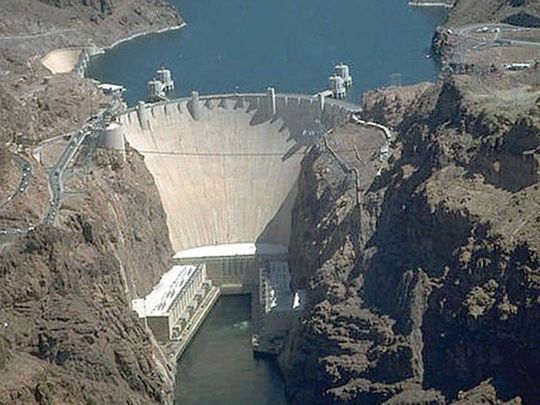
The Diamer-Bhasha Dam on the Indus River is set to be one of the biggest in Pakistan and intends to solve the flooding problem.
Pakistan recently experienced one of its worst floods, which submerged swathes of the country. Though many climate experts have blamed human-caused climate change for the deluge, fingers are being pointed towards the country's overwhelmed dams. According to a report in Vice News, the proposed Diamer-Bhasha Dam on the Indus River is caught in a scandal. The "mega dam" is supposed to solve many problems for the country, including flooding, a government report has highlighted major flaws in the entire plan. A report by Pakistan's Parliamentary Affairs Committee (PAC) said that $40 million was raised from the public for the construction of the dam, but $63 million was spent on advertising it, and it's nowhere close to completion.
The dam was originally meant to be completed in the 1980s, but factors like environmental impact and escalating cost kept delaying the project. Then, in 2018, former chief justice of Pakistan Saqib Nisar set up a fund for the construction of dam - the cost had escalated to $14 billion by then.
Mr Nisar set up the fund to take donation from people of Pakistan, claiming that they would provide the billions needed for the dam's construction, said the Vice News report.
The contributions started pouring in not just from public but country's cricket team and top musicians. The army and several government employees gave up a portion of their salaries to provide $1 billion, said the outlet.
Imran Khan, who was Pakistan's Prime Minister then, assumed joint leadership of the fund.
When Mr Nisar retired in 2019, there was a shortfall of $6.3 billion, said Vice News. But his fresh comment shocked the people of the country. The now-retired chief justice of Pakistan said the fund was never meant for actually building the dam, but to raise awareness.
The allegations of corruption soon surfaced and many influential Pakistanis started speaking against the "joint venture". A member of Pakistan National Assembly, Ahsan Iqbal, claimed that more amount had been spent on advertising for the dam fund than was raised for it.
The PAC last month summoned Mr Nisar to provide explanation regarding the dam fund that was established during his time. The Diamer-Bhasha Dam, when constructed, will have a height of 272 metres. According to officials, it will have a power generation capacity of 4,500 megawatts.
https://www.ndtv.com/world-news/pakistan-collected-40-million-for-dam-spent-63-million-on-its-ad-report-3349676

Bilawal Bhutto hopes Pakistan will get off FATF grey list, says “we want to tackle terrorism”

Pakistan Foreign Minister Bilawal Bhutto Zardari has expressed hope of his country getting off the Financial Action Task Force (FATF) grey list.

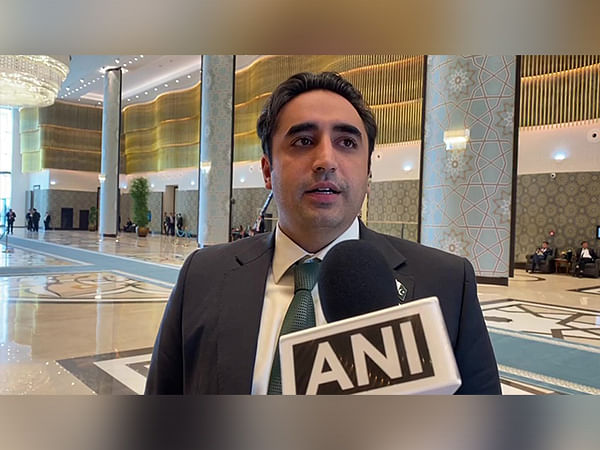
Speaking to ANI, Bilawal Bhutto who is in Samarkand to connection with the Shanghai Cooperation Organisation (SCO) summit, said that Pakistan wants to fight terrorism and extremism and this is a priority not due to FATF listing or the international community but for the people of his country.
“We hope that Pakistan will get off the FATF list. We want to tackle terrorism. It is our priority not because of FATF but for the people of Pakistan and also our own resolve,” Bilawal Bhutto Zardari told ANI.
Pakistan has been on (Financial Action Task Force (FATF) grey list since 2018. Pakistan’s record on the flow of funds into terrorist activities has been under sustained scrutiny by FATF. Media reports said that Pakistan had sent a letter to Taliban-ruled Afghanistan days ahead of an inspection by the monitors from FATF seeking the arrest of Jaish-e-Mohammed (JeM) chief Masood Azhar Alvi.The FATF-Asia Pacific Group delegation visited Pakistan from August 29 to September 2 to verify the country’s compliance with a 34-point action plan committed with FATF at the highest level.
Uzbekistan is the current chair of SCO 2022 whereas India will be the next chair of the SCO.
This is the first in-person SCO Summit after the Covid pandemic hit the world. The last in-person SCO Heads of State Summit was held in Bishkek in June 2019.
The SCO currently comprises eight Member States (China, India, Kazakhstan, Kyrgyzstan, Russia, Pakistan, Tajikistan and Uzbekistan), four Observer States interested in acceding to full membership (Afghanistan, Belarus, Iran, and Mongolia) and six “Dialogue Partners” (Armenia, Azerbaijan, Cambodia, Nepal, Sri Lanka and Turkey).
The Shanghai Five, formed in 1996, became the Shanghai Cooperation Organisation (SCO) in 2001 with the inclusion of Uzbekistan. With India and Pakistan entering the grouping in 2017 and the decision to admit Tehran as a full member in 2021, SCO became one of the largest multilateral organisations, accounting for nearly 30 per cent of the global GDP and 40 per cent of the world’s population.
https://theprint.in/world/bilawal-bhutto-hopes-pakistan-will-get-off-fatf-grey-list-says-we-want-to-tackle-terrorism/1131351/

Thursday, September 15, 2022

Video Report - China, India have increased imports of Russian energy

Video Report - China willing to make efforts with Russia to assume role of "great powers": Xi

Video Report - Xi, Putin meet at key Shanghai Cooperation Organisation summit in Uzbekistan

Video Report - #China #Russia #SCO2022Samarkand Can China and Russia establish a new global order?

Video Report - Why Indonesia is spending billions to build its new capital Nusantara

Music Video - MUNDAYA DUPATTA CHAD MERA

Music Video - Salam e Mohabbat bada khoobsurat Zeba Mohammad Ali - Noor Jahan

Pashto Music - Nan Pah De Hujra Ke Khushali

Pashto Music - Janana sta yama

Pashto music - Na Darzi Pa Las Zulfay Zama | Gulnar Begum

Video Report - A Third of Pakistan Is Underwater. Calls Grow for Climate Reparations and Debt Cancellation

Video Report - #Pakistan #PakistanFloods #PakistanFloods2022 Pakistan reopens a main highway to speed aid to flood victims

Video Report - #FloodsInPakistan #FloodsInPakistan2022 - CM Sindh Syed Murad Ali Shah’s media talk at relief camp TMK

The Recent Floods Have Put a New Focus on the Problem of Period Poverty in Pakistan

BY SANYA MANSOOR
Many of the more than 8 million women of reproductive age affected by Pakistan’s unprecedented floods have been turning to desperate measures to manage their periods. One woman in the hard-hit province of Balochistan, who called volunteers in distress, reported using tree leaves. “It was heartbreaking,” says Bushra Mahnoor, one of two college students who in July founded Mahwari Justice, a grassroots movement to distribute menstrual products to women in need.
Floods have inundated one-third of Pakistan and displaced more than 33 million people. The waters have also killed more than 1,400 individuals and destroyed hundreds of thousands of houses, as well as bridges and roads. More than 660,000 people are still living in relief camps and makeshift homes.
On Monday, Prime Minister Shahbaz Sharif said the country was grappling with food shortages. Relief organizations are rushing aid to affected areas—but supplies of menstrual products are often overlooked. That’s partly because of the stigma around discussing periods in Pakistan, according to Mahnoor.That’s why Mahwari Justice chose such an unapologetic name for itself: Mahwari simply means “periods” in Urdu, Pakistan’s national language. As the flood waters intensified, the group redoubled its efforts to get menstrual products to Pakistani women, knowing that the deluge could lead to a higher incidence of reproductive and urinary tract infections by making safe menstrual practices even harder.
So far, Mahwari Justice has delivered 20,000 menstrual kits to those in need and Mahnoor and her co-founder Anum Khalid have been invited to speak about their efforts on the BBC. Along with similar organizations, they have also helped generate a general discussion about the most effective way to help women in flood-stricken areas.
“This is something that gets neglected really easily because for a lot of people, and especially for countries like Pakistan—where laws are made by men, when relief work is led by men—there’s no discussion around what a woman needs,” says Sana Lokhandwala, co-founder of HER Pakistan. The group has so far handed out more than 7,000 menstrual kits and partners with volunteers, community mobilizers, activists, and other organizations to distribute additional essentials such as food, shelter, and clothing.
The needs of Pakistan’s rural women
Even before the floods, misconceptions about periods were rife in Pakistan.
Dr. Sidra Nausheen, an assistant professor and vice chair of research in obstetrics and gynecology at the Aga Khan University Hospital in Pakistan’s biggest city Karachi, has been working for many years in rural communities to raise awareness about proper menstrual management. She has encountered girls and women who would not take a bath for a week, or avoid drinking hot or cold beverages, for fear it would disrupt their cycle. Some women would be confined to a room until their periods were over. Many girls were not attending school during their periods because of the lack of availability of menstrual products.
“Menstrual hygiene is something that in Pakistan especially nobody talks about,” Nausheen tells TIME. In such an atmosphere, inaccurate information can thrive. “Lots of women don’t know what’s happening to their bodies.” When Mahnoor and Khalid first started Mahwari justice, they studied other disaster relief efforts to learn about the most effective ways of supplying menstrual products. They also spoke directly with women in rural areas to find out what items would be most helpful.
Then they came up with three kinds of kits. One contains a pack of sanitary napkins and underwear, the second small towels and underwear, while the third consists of cotton pads. Diagrams accompany the kits, showing the right way to use the products. Different circumstances determine which items are most effective. Lokhandwala, of HER Pakistan, explains that if flood waters haven’t receded, cloth towels may present problems as there is no clean water to wash and dry them. “Cloth pads might work in one community if they are still living in homes and have washing supplies, but might not work in relief camps,” she says.
Doctors, relief workers, and public health advocates have long called for Pakistan to remove its luxury tax on menstrual products. “Women don’t feel luxurious during these days,” Khalid says. “Menstrual kits [and] sanitary napkins should be free but the taxes on them are so high people cannot afford it,” says Dr. Alia Haider, a doctor currently working in relief camps. “It’s the responsibility of the state to give us a healthy life—health should be free.” But until menstrual products become affordable, many Pakistani women will have no choice but to rely on private organizations and volunteers for help in managing periods.
From 2019 to 2021, Nausheen and her colleagues from Aga Khan University Hospital conducted fieldwork on menstrual hygiene among women aged 14-49 in Dadu district, Sindh province—an area hit hard by the recent floods. About 40% of the 25,000 women surveyed in Dadu were not using any pads or napkins during their periods but instead would repeatedly change out of and wash their stained clothes. “Many weren’t aware of reusable pads or the availability of pads. They thought it was very expensive and ‘We can’t afford it,’” Nausheen says
Nausheen and her team taught the women how to stitch pads from a cheap, absorbent cloth available in the local market. Now, some 90% of the women who took part in the survey are using such pads. Many are also making and selling them—even during the catastrophic floods.
Says Khalid of Mahwari Justice: “Periods never stop during any calamity.”
https://time.com/6213181/period-poverty-pakistan-menstruation-floods/

Experts slam ‘pittance’ in aid to Pakistan as they find climate crisis played a role in floods

.
By Angela Dewan
An analysis of Pakistan’s devastating floods has found “fingerprints” of the human-made climate crisis on the disaster, which killed more than 1,400 people and destroyed so much land and infrastructure it has plunged the South Asian nation into crisis.
The analysis, published Thursday by the World Weather Attribution initiative, was unable to quantify exactly how much climate change contributed to the floods — which were caused by several months of heavy rainfall in the region — but some of its models found that the crisis may have increased the intensity of rainfall by up to 50%, when looking specifically at a five-day downpour that hit the provinces of Sindh and Balochistan hard.
The analysis also found that the floods were likely a 1-in-100-year event, meaning that there is a 1% chance of similarly heavy rainfall each year.
If the world warms by 2 degrees Celsius above pre-industrial temperatures — as it is on course to — short rain bursts like those seen in the five-day period will likely become even more intense. The Earth is already around 1.2 degrees warmer than it was before industrialization.
The scale of the floods and the WWA analysis highlight the enormous financial need to address impacts of the climate crisis. “The kind of assistance that’s coming in right now is a pittance,” Ayesha Siddiqi, a geographer at the University of Cambridge, told journalists at a press conference. “A number of Western economies have argued that they’re suffering their own crises, because of the war in Ukraine and various other issues.” She described the UK’s original assistance of £1.5 million ($1.7 million) as “laughable.” The UK has, however, increased its pledge to £15 million ($17 million) more recently. The geographical area that is now Pakistan was part of the former British colony of India until 1947, when the British partitioned the land into two separate dominions.
Fully developed nations bear a far larger historical contribution to climate change than the developing world.
Siddiqi said that the funds coming into Pakistan paled in comparison with the assistance sent after deadly floods that hit the country in 2010.
“The big global news [in 2010] was all about ‘We must help Pakistan or the Islamists will win,’” she said, explaining that there was a fear in the West at the time that Islamist groups would take advantage of the floods’ aftermath to recruit more members. “And this time around, of course, we don’t have the same geopolitical imperative to help Pakistan, and so the aid has really been a pittance.” Pakistan is responsible for around 0.6% of the world’s greenhouse gas emissions, even though it makes up nearly 2.7% of the global population, according to the European Union’s global emissions database. China is the world’s biggest emitter, at 32.5%, and while the US is second, accounting for 12.6%, it is historically the biggest emitter globally.
More than 33 million people in Pakistan have been impacted by the floods, which is more than the population of Australia or the state of Texas. The floods destroyed 1.7 million homes, swept away dozens of bridges and turned verdant farmland into fields of dust. The UN estimates the recovery could cost around $30 billion, which around the same value as the country’s annual exports. What’s to come There were limitations to how much scientists could determine about the role of the climate crisis in the floods because the impacted area has such huge natural variability in rain patterns during monsoon seasons. It’s also a year of La Niña, which typically brings heavier and longer rainfall to Pakistan. The role of climate change in heat waves — which also hit Pakistan and other parts of the Northern Hemisphere this year — is much larger and often clearer to determine in South Asia, the scientists said. A WWA study published in May found that pre-monsoonal heat waves in Pakistan and India were made 30 times more likely by climate change. “Every year the chance of a record-breaking heat wave is higher than the year before,” said Friederike Otto, co-founder of WWA and a climate scientist with the Grantham Institute at Imperial College London. The next heat wave in Pakistan will probably have “quite devastating consequences,” she said. “Because even if everything is done now to invest in reducing vulnerability, that takes time.” She said that while scientists couldn’t determine exactly how much climate change contributed to the floods, it was probably closer to “doubling” their likelihood, as opposed to the 30-fold factor they found with the region’s heat wave.
The issue of who should pay for the impacts of the climate crisis, known as “loss and damage,” has long been a sticking point between developing and some developed nations, and is expected to be central to the upcoming COP27 international climate talks in Egypt.
“I think it’s absolutely justified to say, ‘We need, finally, some real commitment to addressing loss and damage from climate change,” Otto said.
“A lot of what leads to disaster is related to existing vulnerabilities and not to human-caused climate change. But of course, the Global North plays a very large role in that as well, because a lot of these vulnerabilities are from colonialism and so on. So there is a … very huge responsibility for the Global North to finally do something real and not just talk.”
https://www.cnn.com/2022/09/15/asia/pakistan-climate-floods-attribution-intl/index.html