Tuesday, August 2, 2022

#Pakistan - Violence against women

Nadeem Shah
One suspect arrested, another on the run after a v-logger is assaulted in DG Khan.

D

era Ghazi Khan police have arrested a man accused of gang rape, while an alleged accomplice is on the run after an American v-logger reported them.

Arabela Urpi says she was in the area to visit the Fort Munro hill station.

According to the complaint filed with the Fort Munro Border Military Police, Muhammad Muzammil Sipra and Azan Khosa raped Urpi and made a video recording of the assault to later blackmail her. “Muzmal Sipra and Azan Khosa sexually assaulted me in a hotel room on the July 17-18 night,” Urpi stated in her complaint.

The FIR has been registered under Pakistan Penal Code Sections 376/ 292-b. Section 376 describes the punishment for the crime. (1) Whoever commits rape shall be punished with death or imprisonment for life without parole till death and shall also be liable to fine.

The Border Military Police have arrested the hotel owner.

Arablea Urpi is a v-logger who uploads videos on TikTok about her travels. She says she had contacted Sipra through a tourist application and had planned on visiting Dera Ghazi Khan to explore its Baloch traditions and culture.

“Hospitality and loyalty are among the chief aspects of our culture. A guest is welcomed and honoured. If we are unable to receive a guest in a dignified way, it is very unfortunate and condemnable,” says Irfan Khan Baloch, the Baloch Ittehad Council chairman.

In his preliminary statement to the police, Sipra has claimed that his relationship with the victim was consensual.

The BMP commandant was directed to contact the survivor, who at the time was in Multan and preparing to leave for Lahore. Upon telephonic contact, she confirmed the report. Later, the BMP commandant and the DG Khan police superintendent in charge of investigation travelled to Lahore to record her statement.

“Arabela Urpi has been in contact with me for the last seven months. She has visited my home thrice. She stayed with me in Karachi for two days. She first contacted me through the tourist application in January, last year. Later, she visited me in Karachi and stayed at my house for two days. She left Karachi after a couple of days for her country. She again visited my house in Rajanpur in June. She stayed with me for one day in Rajanpur. Both of us visited Uch Sharif, Rahim Yar Khan and Sadiqabad and returned to Rajanpur. Arabela stayed in Rajanpur for two weeks. She also stayed at my house,” the suspect told police. He denied knowing Khosa. “We visited Jampur on July 15 and visited a Jampur bikers’ club called Maulvis on Bikes. The club provides services to foreigners and arranges tours to Dera Ghazi Khan and other areas. The club invited us for a tour of Fort Munro. When we reached there, Arabela told me that she had been in contact with a local TikToker, Azan Khosa, and wanted to meet him,” the suspect said.

The Dera Ghazi Khan BMP commandant stated that the Dera Ghazi Khan DPO had informed the deputy commissioner that he had received a message from the Rahim Yar Khan DPO that a rape incident involving a foreign national at Fort Munro on July 17-18 had been reported.

The BMP commandant was then directed to contact the victim, who at the time was in Multan and preparing to leave for Lahore. Upon telephonic contact, she informed the officials that she had travelled to Pakistan three weeks ago and was residing with her fiancé, a Pakistani national in Lahore.

She told the authorities that she had travelled from Lahore to Rajanpur by bus to stay at Sipra’s residence and had stayed with him from 13th to 15th of July. They had then travelled to Fort Munro and stayed at Anmol Hotel from July 16th to 18th.

The BMP commandant and the DG Khan police superintendent in charge of investigation had then travelled to Lahore to recording her statement.

https://www.thenews.com.pk/tns/detail/977963-violence-against-women 

#Pakistan - Pakistan’s Peace Gamble With the Tehreek-e-Taliban Pakistan

By Salman Rafi Sheikh
With the TTP’s history of failed agreements and its demand to establish exclusive control over the former FATA, why is Pakistan so keen on talks?
With Pakistan engaged in Afghan Taliban-mediated talks with the outlawed Tehreek-e-Taliban Pakistan (TTP) to establish “permanent” peace, a mini Islamic Emirate could emerge in the erstwhile Federally Administered Tribal Areas (FATA) of Pakistan bordering Afghanistan.
Inspired by the victory of the Afghan Taliban against the U.S./NATO and Afghan security forces in August 2021, the TTP’s war on Pakistan reached new heights in 2021, as it killed hundreds of troops and people through dozens of attacks across Pakistan. The renewed war led Pakistan to contemplate a “permanent” ceasefire with the proscribed group, and Islamabad even released top TTP commanders in May 2022 to facilitate the process.In June, the Afghan Taliban announced an “indefinite” ceasefire between the TTP and Pakistan, adding that this could bring long-term peace. But no agreement has so far been reached due to a deadlock over the TTP’s demand to de-merge FATA from Khyber Pakhtunkhwa province and establish its own exclusive control over the region. An additional source of trouble is the TTP’s total refusal to renounce violence as a means of achieving its objectives.
To break the deadlock, on July 26 Pakistan sent a delegation of eight leading clerics to Kabul to hold talks with the TTP’s central leader, Noor Wali Mehsud. In June, in an interview given on YouTube, Mehsud categorically refused to back down from the TTP’s demand to have complete control of FATA, a tribal territory that was merged with Khyber Pakhtunkhwa in 2018 via the 25th amendment to Pakistan’s Constitution. The recent delegation, too, failed to convince Mehsud to change his stance.
There are good reasons for the TTP leader to refuse to back down. His position is strengthened, first and foremost, by the fact that these talks have been initiated by Pakistan out of its fear of another period of protracted war.For years, Pakistan’s security establishment claimed to have wiped out terrorism, but the resurgence of the TTP post-August 2021 showed that the group had only relocated to Afghanistan in the wake of Pakistan’s various military operations in FATA. Following the Afghan Taliban’s takeover of Kabul, hundreds of TTP fighters imprisoned in Afghanistan by the Ghani regime were freed. That allowed Mehsud to regroup and reorganize the TTP, allowing him to renew its war on Pakistan.
The TTP is, therefore, talking from a position of strength, a fact recently highlighted by the United Nations Security Council’s ISIL and al-Qaeda sanctions monitoring committee’s 30th report on the presence and capability of various terror groups based in Afghanistan. As the report shows, the TTP currently has the “largest component” of 3,000 to 4,000 foreign fighters in Afghanistan.
As the UNSC report shows, Mehsud’s success in reuniting various TTP factions has made the group “more cohesive, presenting a greater threat in the region.” As the report mentions further, the TTP is working in alliance with other transnational jihadi networks, such as the East Turkestan Islamic Movement (ETIM), based in Afghanistan. The group is also tied to al-Qaida, as the February 2021 report of the UNSC showed that the anti-Pakistan group’s merger was facilitated by al-Qaida.
The TTP’s links with transnational jihadi networks plus its demands to retain control of its weapons and de-merge FATA strongly suggests that the group intends to use the peace process to gain control of its old stronghold not only as a sanctuary for its allies but also as a launch base for its new war on Pakistan.
Many in Pakistan believe that the TTP’s approach to the negotiations – offering peace in exchange for accepting the said demands – are only a prelude to another war. In the past, the group repeatedly failed to honor its agreements. In May 2004, Pakistan signed an agreement with the then-leader of the Pakistani Taliban, Nek Mohammad of South Waziristan. The agreement called for a ceasefire, with the Pakistani state also agreeing to release Taliban fighters. The Taliban was allowed to retain its weapons. This agreement lasted only 50 days. In 2006, another agreement was signed, which the then-governor of North Western Frontier Province (now Khyber Pakhtunkhwa), hailed as “unprecedented in tribal history.” This, too, failed to bring peace. Another agreement was signed in 2008, which also failed to end terrorism. Therefore, with a history of failed agreements and the TTP’s demand to establish its exclusive control over the half a million people of FATA (according to the 2017 census), the question that needs to be asked is: Why is Pakistan pushing for talks at this particular juncture?
There are a number of domestic, regional and international reasons for this.
First of all, Pakistan’s present economic condition does not warrant another war. Pakistan’s rupee is trading at a historic low vis-à-vis the U.S. dollar. Pakistan’s foreign exchange reserves fell below $9 billion in June. With experts predicting a doomsday scenario, if not default, there is little room for starting a war that could consume billions.While Pakistan was able to undertake sizable military operations against terrorist groups in the past, a crucial source of help was the coalition support fund provided by the United States. The U.S. exit from Afghanistan and the end of the “war on terror” mean that external help is unlikely to become available. China, Pakistan’s so-called “all-weather” friend, too, is unlikely to offer any help. On the contrary, the fact that the TTP has attacked China-Pakistan Economic Corridor (CPEC) projects and Chinese personnel working in Pakistan many times has led China – as one Pakistani diplomatic official said on the condition of anonymity – to “suggest” that Pakistan “make peace” with the Taliban to allow for a smooth implementation of CPEC.
As the official further said, the Chinese want Pakistan to follow their lead. In March, the Chinese foreign minister told his Afghan counterpart that Beijing respects their traditions and way of living, indicating that Beijing does not intend to interfere as long as the Afghan Taliban can ensure that their land is not used against China. “China wants us to do something like this” to ensure its projects are not attacked, revealed the official.
If Pakistan fails to ensure the security of Chinese projects and personnel, it could lead, Pakistan fears, to an exit of Chinese capital from Pakistan, which will put unbearable pressure on the country.
While Pakistan has many reasons to engage with the TTP and the announcement of an “indefinite” ceasefire might be an encouraging sign, accepting the group’s demands regarding the tribal region is “tantamount to creating a state within the state,” said the official.
What is worse is that Pakistan lacks any “significant chips to bargain with.” The Afghan Taliban are willing to mediate, but their influence on the TTP is limited. As Noor Wali Mehsud indicated in an earlier interview with CNN, the group could ally with the Islamic State Khorasan Province (ISKP) if pushed too much to give up core demands. With the Afghan Taliban itself fighting the ISKP, it is unlikely to pressure the TTP either.
Pakistan, therefore, faces hard choices only. While talks could still succeed and “peace” could come to FATA, it will be an extremely risky venture taken in unchartered territory. In all likelihood, this form of peace would eventually lead to another war.
https://thediplomat.com/2022/08/pakistans-peace-gamble-with-the-tehreek-e-taliban-pakistan/

#Pakistan - Ex-Pak PM Imran Khan in the dock after election commission rules his party received prohibited funding from 34 foreign nationals

In a setback to ousted prime minister Imran Khan, Pakistan’s election commission on Tuesday issued a show cause notice to his Pakistan Tehreek-e-Insaf party for receiving prohibited funding from 34 foreign nationals and 351 foreign-based companies. A three-member bench of the Election Commission of Pakistan (ECP), comprising Chief Election Commissioner Sikander Sultan Raja, Nisar Ahmed Durrani and Shah Muhammad Jatoi announced the unanimous verdict, in a case that was filed by Pakistan Tehreek-e-Insaf’s (PTI) founding member Akbar S. Babar and had been pending since November 2014.The electoral watchdog ruled that PTI received funds from 34 foreign nationals and business tycoon Arif Naqvi.
The ECP also said PTI received donations from Romita Shetty, a US-based business woman of Indian-origin, which was against the rules, according to the Dawn newspaper.
Interestingly, the ECP’s verdict comes after The Financial Times newspaper recently published a story titled ‘The strange case of the cricket match that helped fund Khan’s political rise’.
The report states that fees were paid to Wootton Cricket Limited, which, despite the name, was in fact a Cayman Islands-incorporated company owned by Naqvi, the founder of Dubai-based Abraaj Group.
In the written verdict, the ECP noted that PTI “knowingly and wilfully” received USD 2,121,500 funding from Wootton Cricket Limited, according to the Dawn newspaper. “PTI Pakistan, through fundraising campaigns by PTI USA LLC-6160 and PTI USA LLC-5975, was a recipient of donations from 34 foreign nationals and 351 foreign-based companies.
Collection of donations and contributions from foreign nationals and companies are hit by prohibition and in violation of Pakistani laws,” the ECP said. It went on to add that the party also received donations through PTI Canada Corporation and PTI UK Public Limited Company. The ECP declared the party had kept 13 accounts secret, which it said was another violation of the Pakistan Constitution.
It also issued the show cause notice to Khan’s party to explain why these funds should not be confiscated.
“This Commission is constrained to hold that Mr Imran Khan failed to discharge his obligations as mandated under the Pakistani Statutes. The Chairman PTI has or successive five years (2008-2009 to 2012-2013) under review and examination has submitted Form-1 and signed a Certificate which is not consistent with [the] accounting information before us which has been gathered and complied on the basis of information obtained from Banks through [the] State Bank of Pakistan,” the judgement stated.
Babar, the petitioner in the case, said it was a step towards uprooting PTI’s “fascism.” There was no immediate response from PTI chief Khan on ECP’s verdict.
https://theprint.in/world/ex-pak-pm-imran-khan-in-the-dock-after-election-commission-rules-his-party-received-prohibited-funding-from-34-foreign-nationals/1065728/

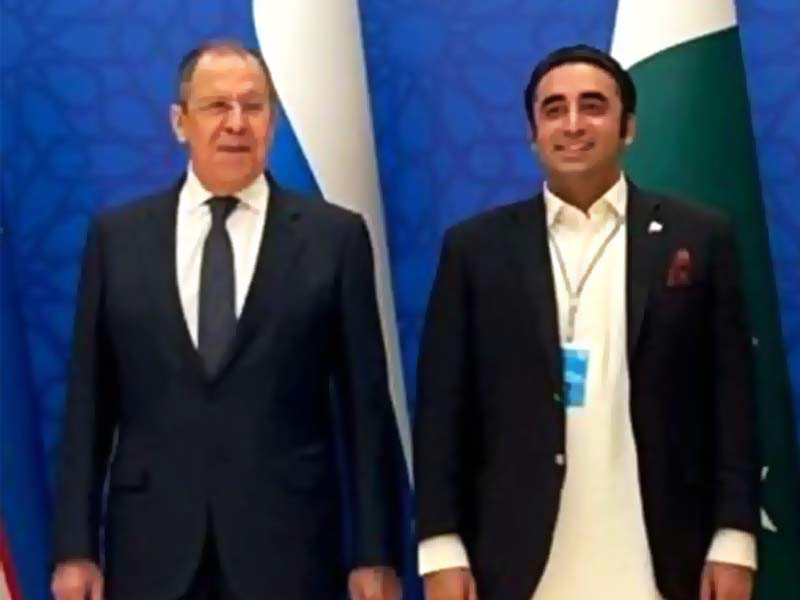
#Pakistan - Russian FM invites Bilawal for Moscow visit

Russian Foreign Minister Sergei Lavrov has invited his Pakistani counterpart Bilawal Bhutto Zardari to visit Moscow at a time when Islamabad is trying to maintain a fine balance in its ties between the west and Russia.
The invitation was extended by Lavrov during his brief informal interaction with Bilawal during the meeting of Council of Foreign Ministers of Shanghai Cooperation Organisation (SCO) in Tashkent on Friday, a diplomatic source told The Express Tribune on Saturday.
There was a bilateral meeting scheduled between the two foreign ministers but the late arrival of Lavrov to Tashkent led to the cancellation of the meeting, said the source dismissing reports that there was any tension between Pakistan and Russia or Lavrov refused to meet Bilawal.
Bilawal met foreign ministers of all member states of SCO at the sidelines except Russia and India.
A meeting with Indian Foreign Minister S Jaishanker was not on the cards but no bilateral meeting with Russian Foreign Minister Sergei Lavrov had raised eyebrows as meetings between Pakistan and Russian diplomats at the sidelines of such regional forums were routine. But the foreign office sources played down the development.
They referred to the engagement of Indian External Affairs Minister S Jaishanker who even because of scheduling issues could not hold a bilateral meeting with his Russian counterpart though he met other leaders at the margins of the conference. “Therefore, we should not read too much into it,” stressed a senior foreign office official while requesting anonymity.
The Pakistan Tehreek-e-Insaf (PTI) has criticised the coalition government for toeing the United States line, saying that was the reason there was no meeting between Bilawal and Lavrov. PTI leader Fawad Chaudry claimed that Lavrov refused to meet Bilawal. Sources, however, dismissed such claims.
They insisted that Pakistan would continue to seek a cooperative relationship with Russia and Bilawal would visit Moscow at an appropriate time.
Pakistan’s relationship with Russia was at the heart of controversy when former Prime Minister Imran khan was removed from power through a vote of no-confidence earlier this year. The ousted prime minister has maintained that he was removed from power through a US conspiracy since he wanted to pursue an independent foreign policy, particularly efforts to deepen ties with Russia.
The basis of his claims was a classified diplomatic cable that details a meeting between the Pakistani Ambassador in Washington and a senior Biden Administration official in March. Pakistan’s then Ambassador Asad Majid wrote back to the foreign office conveying the Biden administration’s serious reservations over Imran Khan’s visit to Moscow. As per the diplomatic cable, US Under Secretary of State and South Asia Donald Lu informed the Pakistani envoy that the Biden administration was not happy with Imran’s decision to visit Moscow at a time when President Viladmir Putin was preparing for the invasion of Ukraine. He then went on to say that Pakistan would have to face the dire consequences if a vote of no-confidence against Imran did not succeed. The country’s top decision making body on national security met twice—once when Imran was still prime minister and second time when he was ousted from power—concluded that there was no evidence to suggest that the US was behind the vote of no-confidence against the PTI government.
But Imran is convinced that there was interference and has kept demanding a judicial probe into the controversy.
Russia officials and the state media have endorsed Imran’s allegations that he was punished for pursuing an independent foreign policy.Against this backdrop, all eyes were on the SCO meeting that whether Foreign Minister Bilawal would meet his Russian counterpart.
https://tribune.com.pk/story/2368683/russian-fm-invites-bilawal-for-moscow-visit

Sunday, July 31, 2022

Video Report - Dutch cyclist Annemiek van Vleuten wins Women’s Tour de France 2022

Video Report - US working families hit worst by rent rise

Video Report - Democrats Find A Deal On Energy And Budget, But Sinema Hasn't Signed On Yet

Video Report - Political panel on the midterms, Congress, the economy and more

Video Report - SC candidate says America is ruled by 'geriatric oligarchy'

Video - Lokan Do Do Yar Banaye - Afshan Zaibi

Video Report - Judges’ appointment & timid Attorney General, Why ECP can’t punish IK in Foreign Funding?

Video Report - Why #PPP, #PMLN Lag Behind PTI Social Media Team? - Party Reps Speak

Afghans in Pakistan

PAKISTAN’S western border has been famously porous through much of the country’s history. But flows of migrants intensified from the 1970s onwards, as Pakistan formally played host to Afghans fleeing turmoil, conflict and dictatorial regimes.
At the height of the Soviet occupation, in 1986-87, there were an estimated three million Afghans resident in Pakistan as per UNHCR (the UN refugee agency) and government data. There were no serious efforts to repatriate Afghans till 2002, when the government of Pakistan began to work with UNHCR to encourage Afghans to return to what was then perceived as a stable environment.
The repatriation effort gathered steam after Pakistan started closing down refugee camps in 2005, and the distribution of rations, etc, stopped. However, the reverse flows began to peter out after the Taliban resurgence of 2007-08. In 2021, according to Nadra, there were 2.8m Afghans in Pakistan; 1.6m of whom hold Proof of Registration (POR) cards identifying them as having been registered with the UNHCR. The rest hold ACCs or Afghan Citizen Cards, a form of documentation launched in 2017 to cover Afghan migrants who were essentially undocumented.
Notwithstanding the relatively recent (POR card issuance did not begin till 2006) efforts to document the number of Afghans in Pakistan, there is little doubt that the numbers do not tell the full story. A census of Afghan refugees was not held till 2005, 26 years after the larger flows began. From 1979 to 2005, numbers were estimated based on discussions with tribal elders and household heads, who were asked to state how many family members or dependents they had with them. These numbers were supposed to determine the volume of rations given out, and were almost certainly exaggerated.
In spite of the integration of Afghans into Pakistan’s economy, the official policy is to treat them as temporary residents.
In subsequent years, as families settled in and grew; and more marriages and births took place, this initial (likely) exaggeration was almost certainly offset, however. The census of 2005 did not reach many Afghans who were scared of talking to the authorities and preferred to lie low. Meanwhile, inflows and outflows continued over the years (the border fencing project did not begin till 2016), many Afghans acquired Pakistani citizenship papers, many children were born who have never known any country other than Pakistan.
With more than 40 years having passed since the Soviet invasion, the concept of who is Afghan has become fuzzy to say the least. This is a natural consequence of a policy where Pakistani authorities were initially a) reluctant to count exact numbers coming in from Afghanistan; and b) reluctant to confine them to camps. In fact, the latter was impossible given the tribal, familial, linguistic and religious links with the local population, particularly in the border regions. There are other factors also which preclude the classification of the Afghan community in Pakistan as refugees in the strict sense of the term. Refugees are formally defined (as per international law) as people who cannot go back to their homeland for fear of persecution or death. However, Afghans had been moving back and forth across the border with few restrictions from the late 1970s till 2016-17. Many of those who came to Pakistan as refugees, and have been resident here for years, have also made frequent trips back to visit relatives, get married, check up on land and property, etc. Until recently, it was not a problem to cross the border using the POR card, or the Afghan tazkira, or indeed nothing at all. In spite of the obvious integration of Afghans into Pakistan’s economy, notably their presence in transport and logistics; construction, retail and wholesale trade, and the food business to name just a few, Pakistan’s official policy is to treat them as temporary residents. Afghans are not allowed to own property or businesses. Until recently, they were not allowed to open bank accounts (this only changed in 2020) or have cellphone SIMs registered in their names. They were not allowed to hold driver’s licences — a fact that leaves one incredulous given that they were clearly running a significant portion of the cross-country freight business. In fact, Afghans have done everything that they have officially been barred from, by circumventing official protocols and using informal economic networks to their advantage. This was inevitable given the extended stays in this country, and the societal/linguistic links.
Pakistan is not a signatory to the Refugee Convention of 1951, or the accompanying Protocol of 1967. The government of Pakistan says that it has actually given the Afghans many facilities above and beyond what the convention stipulates. This can be debated. But what is true is that Pakistan, in spite of hosting a large migrant/refugee population for over 40 years, has not developed a comprehensive policy on what to do with migrants.
Pakistan adheres to international law in that it does not practise forcible repatriation, at least officially. But there are still too many unanswered questions. Why is there no path to citizenship, and what purpose does it serve to not have one? Why were people allowed to freely move around in the country and settle here, yet not allowed to legally work or run businesses or own property? How can one facilitate students to take examinations when their parents do not have the requisite citizenship or refugee status documentation?
It is important to start working on these issues. It does not serve the larger interests of the state or society to host a large population that is overlooked by social services or social protection systems, is not documented and is perpetually vulnerable to the whims of law enforcement and security agencies. The recent protests by Afghan migrants in Islamabad must be taken notice of, and a clear policy enacted.
https://www.dawn.com/news/1702123/afghans-in-pakistan

#Pakistan - Indian and Pakistani FMs avoid ‘bilateral tiffs’ at SCO

Pakistani and Ind­ian foreign ministers on Friday toge­ther attended the Shanghai Coopera­tion Org­anisation’s (SCO) Council of For­eign Ministers’ meeting and events on its margins, but avoided handshakes.The SCO meeting was the first multilateral event where Bilawal Bhutto-Zardari and S. Jaishankar came together since the former became the foreign minister after the change of government in Pakistan in April.Even in informal settings, for instance when the foreign ministers of SCO member countries waited for a joint call on Uzbekistan’s President Shavkat Mirziyoyev, the two foreign ministers sat away from each other.
Relations between the two neighbouring nuclear-armed rivals have been bitter for long. Islamabad had lowered diplomatic ties with New Delhi after the BJP government revo­ked the autonomous status of Indian-held Jammu and Kashmir in 2019.
Despite being in same room, Bilawal, Jaishankar steer clear of handshakes.
Subsequent events in Kashmir and Hindu supremacists’ actions against Muslims in India have so far prevented re-engagement. Islamabad’s position has been that it wants normalisation, but it is for India to provide a conducive environment for that to happen.
Foreign Minister Bhutto-Zardari, while speaking at a government-run think tank in Islamabad last month, emphasised the need to engage India. He had argued at the time that despite a “long history of war and conflict” and Indian government’s actions in Occupied Kashmir and its anti-Muslim agenda, it was not in Pakistan’s interest to remain disengaged.But soon afterwards, the Foreign Office clarified that there was no change in Pakistan’s policy on India, on which there is national consensus.However, Mr Bhutto-Zardari and Mr Jaishankar, in line with SCO rules and charter, neither mentioned bilateral disputes, nor accused each other.
There is a clause in SCO charter barring member states from bringing their bilateral acrimony to the organisation’s meetings.
The Pakistani FM, in his speech at the Council of Foreign Ministers meeting, highlighted Pakistan’s perspective on important regional and international issues of concern to SCO member states. He emphasised that “shared prosperity” was essential for peace, stability and development in the SCO region and globally.
The foreign minister also shared Pakistan’s vision for the future direction and growth of SCO which could be achieved through joint efforts to enhance greater connectivity; road/rail links within the SCO region; building network of businessmen and entrepreneurs of SCO; harnessing the potential of technology and digitalization; and removing barriers to intra-SCO trade.
About strengthening connectivity in the SCO region, Mr Bhutto-Zardari proposed the construction of railways and roads, and the opening of trade routes. He said Pakistan backs the proposed “strategy for the development of interconnectedness and the creation of efficient transport corridors.”Pakistan is working with Afghanistan and Uzbekistan on a planned railway project. This project, if it is realised, could provide an important access for Central Asian countries to the seaports of Pakistan, and will become an important component of the transport system of the SCO region.The foreign minister also spoke about the humanitarian crisis in Afghanistan and reminded the member states about their responsibility to help the war ravaged country.Indian Foreign Minister Jaishankar, meanwhile, touched upon the challenges facing the region and expansion of the organization.
According to the FO, the SCO Foreign Ministers deliberated upon important topical issues facing the organization after 20 years of its establishment, including expansion in its membership; improvement in the mechanisms of the SCO Secretariat; and SCO’s stance on global economic and political developments and the challenges for SCO countries.
The foreign ministers signed sixteen decisions endorsing proposals on diverse areas of socio-economic cooperation and adopted a Joint Statement on Strengthening the Biological Weapons Convention. FM Bhutto-Zardari, on the sidelines of the conferences, also met with his counterparts from China, Kazakhstan, Kyrgyzstan, Tajikistan and Uzbekistan.
“In these bilateral meetings, the Foreign Minister exchanged views on issues of common interest as well as matters relating to bilateral cooperation and further strengthening of political, economic and trade relations with these countries,” the FO said.
https://www.dawn.com/news/1702279

Tuesday, July 26, 2022

Music Video - Naheed Akhtar - Teri Ulfat Mein Sanam - 4K Ultra HD -

Video Report - Exclusive: Farhatullah Babar proposes to PDM to limit powers of Supreme Court

#Pakistan - #Christian woman raped by employer then gang tells her and family they must go back to work

A Christian woman was raped by her Muslim employer, who sent for her to go to his private quarters at the end of her work shift.
After the ordeal the woman’s family still reeling from news of the sexual assault, were met by an armed gang at their home the following morning demanding they all go back to work.Rimsha Riaz (18 yrs) was employed in a glass crushing company alongside members of her family all of whom were hard-working loyal employees for Haji Ali Akbar, a successful Muslim businessman.
Members of the family turned up for work as usual on 6th July 2022 and after a tiresome shift they were all ready to go home. As they were all packing up and getting ready to leave a messenger was sent from the offices of Mr Akbar calling for the attendance of Rimsha Riaz for some extra work that was required.
The time was around 7.30pm so her mother Mumtaz Bibi (how old), brother Arslan (17 yrs) and oldest brother Adnan (25 yrs) returned home.
About an hour later Rimsha arrived home and was visibly distressed. Her mother asked her about the work Rimsha had done for Mr Akbar, at which pint she broke out into tears and informed her family that she had been raped at gunpoint.Rimsha spoke with BACA about the attack, she said:
“In his office, Mr Akbar pulled out his pistol threatened to kill me if I did not do what he wanted.
“He then started raping me.
“I cried out as loud as I could but no-one came to help.
“After he finished with me, Mr Akbar put the pistol to my ear and threatened to kill my brothers and other family members, if I dared to tell anyone.”
When Mr Akbar had completed his rape and threat he sat down and let Rimsha go. Rimsha took the opportunity to redress herself and ran all the way home.Her mother instructed the family not to go back to work ever again but did not go to police, because Christian families are generally frightened of them, and expect little justice. After two days however, on 8th July, Mr Akbar arrived at their home in the evening with a four armed men and rapped loudly on their door with the butt of his pistol. Mr Akbar shouted out to the family that they should open the door or face dire consequences. Rimsha’s brother Arslan opened the door frightened of what might happen to the family and was shocked to see all the armed men.

Arslan told us that Mr Akbar was drunk when he arrived and abused him and other family members verbally.  He demanded that they all return back to work and threatened to kill them if they failed to arrive the next day.

Arslan told him that they had left the work and would not be returning to the factory anymore. At this Muhammad Akbar furiously shouted:

“How dare you leave my factory without my permission?

You filthy Chooras (dirty Christians).

“I will kill you if you remain absent tomorrow and make sure you bring the girl.”

The whole family was left terrified and when he left the family began discussing what they should do. While they were planning what to do, Rimsha who was very distressed fainted and collapsed on the floor.  Her brother Arslan took her to District Headquarters Hospital, Gujranwala where she received treatment and a diagnosis confirmed she had been raped.

Back in the family home, Mumtaz Bibi called a close relative to ask what she should do.  He advised her to go to her local police station and report the rape and the threats.

That evening Mumtaz Bibi travelleed to Jandiala Baghwala Police Station with her relative and filed an application against Mr Akbar for raping her daughter.

The next morning arrested the culprit from his factory and registered a First Information Report – FIR No.994/22, on charges of rape undersection  376 of the Pakistan Penal Code.

376. Punishment for rape
(1) Whoever commits rape shall be punished with death or imprisonment of either description for
a term which shall not be less than ten rears or more, than twenty-five years and shall also be
liable to fine.
(2) When rape is committed by two or more persons in furtherance of common intention of all,
each of such persons shall be punished with death or imprisonment for life.”.

Despite the fact that police have arrested the culprit the family is still is in trauma and fear. Mumtaz Bibi has left her rented house in Gujanranwala and moved to a distant place at the home of her sister.

Unfortunately for Rimsha who was engaged to be married, her fiancé has now  broken the engagement on discovering the rape incident. Rimsha is visibly traumatized and depressed.

Juliet Chowdhry, Trustee for British Asian Christian Association, said:

“Rimsha is a Christian women in a country where here status makes her vulnerable.

“The fact that the rapist employer felt he could force Rimsha and her family to return to work after such an ordeal, is an illustration of the weak standing of Christians.

“In 2014, a damning report by an Islamic NGO ‘Movement of Solidarity and Peace’ reported that 700 Christian women every year are abducted, raped and forced into Islamic marriage (click here).

“This statistic does not take into count crimes of just rape – which if included would paint an even more devastating picture.

“Pakistani authorities must build in better protection for Christian women within their existing structures, or this social malaise will continue to grow.”


https://www.britishasianchristians.org/baca-news/christian-woman-raped/?fbclid=IwAR0K3BQPUPSla0Cz0GTojoWPCAcpDCIUgF2-NPo5Ooha2brg4Ps9yyrytQk_aem_AVnjIpVDaQpVcp813JO_JodkCyUFoTHAalpuuSyr2fthICtRhVh-5ROFjnytpyi6DtKrVD-WLPfRNjZ8VBxAP8Q_k4cov3GnUUtHmQ2zCczeC-oMxdShY2Iz8xOr3hWNIjHPGruwfzfRX8N1NRbzmrNs

#Pakistan - Risk of a perfect storm

By Maleeha Lodhi
POST-PUNJAB by-election developments have injected more volatility into an already fraught and vexed political situation. This has raised growing concerns about the fate of a precarious economy in the face of more political turmoil that seems to lie ahead.PTI’s stunning electoral victory was obviously consequential for the survival of the PML-N-led Punjab government. But political fortunes reversed in just a few days. In the dramatic events and wheeling and dealing that followed, the run-off election for the provincial chief minister took place on a day of surprises.
Although PTI and its ally PML-Q enjoyed a majority in the House an unexpected turn of events saw PML-Q president Chaudhry Shujaat declare he would not support his cousin, Pervaiz Elahi as Imran Khan’s candidate. He instructed party legislators to vote instead for Hamza Shehbaz and conveyed this decision to the deputy Speaker, who then rejected their votes cast for Elahi. This ensured a narrow win for Hamza. But instead of ending the Punjab crisis this outcome is likely to aggravate it. With Khan calling foul, the deputy Speaker’s ruling has been challenged in the Supreme Court while PTI has called for public protests against its ‘stolen mandate’. The Supreme Court may well rule against the deputy Speaker’s action.
Meanwhile, the coalition government at the centre has made it apparent it will continue in office until parliament completes its term in August 2023. But the question is how tenable this is, especially with the situation in Punjab mired in confusion.
× More importantly, can the fragile economy withstand what promises to be a period of more political turbulence and confrontation between the coalition government and PTI?
Imran Khan will continue to mount pressure on the government to hold immediate general elections. Towards this end, he is continuing to castigate the establishment on the unsubstantiated ground of siding with his political opponents. He also accuses the Election Commission of Pakistan of bias and has repeatedly demanded the chief election commissioner (CEC) — who holds a constitutional post — should resign. This despite his party’s decisive win in the by-elections in which it polled 47 per cent of the popular vote against 40pc for PML-N. Khan cast his party’s electoral success as the ‘defeat’ of both the establishment and ECP that he accused, without evidence, of trying to foil his victory.
Prevailing in the power game will be in vain if the economy tanks.
Even if Khan is able to get his way in forcing early elections, uncertainty will not end. He clearly wants a CEC of his choice. This is unlikely to happen. So how will he deal with this eventuality if and when elections are called? This raises a related question. Will he agree with his principal political rival on who should head a neutral caretaker government, constitutionally mandated under Article 224 to oversee elections? Uncertainties don’t end here. In the absence of consensus between the government and opposition on an interim arrangement, the matter goes for decision to a parliamentary committee. If that fails to reach agreement, the ECP has to make that call, under the constitutionally prescribed procedure (Article 224-A) For now, it is the economy that is being adversely affected by political turbulence. The economy is far from being out of the critical ward. True that a staff-level agreement has been reached with the IMF, expected to go for approval to its executive board in August. This did calm market sentiment, but only temporarily. Both volatility in global commodity and financial markets and political unpredictability at home is eroding confidence. The rapidly declining value of the rupee against the dollar is the most worrying sign of that. The rupee has depreciated by 20pc in the past few months, adding to spiralling inflation. The State Bank has pointed out that some of this depreciation is part of a global phenomenon due to the growing strength of the dollar. But other factors have also contributed over the months. Finance Minister Miftah Ismail attributed last week’s rupee plunge to a historic low to market panic due to “political turmoil”. While he hopes this will soon recede, continuing political confrontation suggests otherwise.
In fact, the market will remain nervous until Pakistan gets significant cash injections from the IMF and others. Reports indicate that the Fund will release the first tranche of $1.1 billion once Saudi Arabia provides SDR (special drawing rights) of around $2.6bn because Pakistan’s financing needs far exceed what IMF can disburse. The finance minister acknowledged in his press conference last week that a “friendly country” would transfer SDRs through the IMF.
Meanwhile, the recent downgrade of Pakistan’s credit rating outlook by Fitch Ratings has added to market jitters.
The country’s foreign exchange reserves are around $9.7bn, which cover less than six weeks of imports. As the reserve cushion has begun to erode so has confidence. Moreover, heavy external obligations lie ahead — over $30bn estimated for this fiscal year, $21bn to repay debt and $10-12bn to fund the current account deficit. This heightens the risk of a perfect storm. If reserves continue to dwindle, external capital injections prove inadequate or envisaged inflows don’t materialise, panic can take hold in markets even ahead of a cash flow crisis. Confidence can quickly evaporate over the perceived inability of the country to meet its financing requirements. In a scenario where panic sets in and speculative pressures mount, people start converting rupees into dollars as a hedge against risk. This pressure can prompt the central bank to quickly run down reserves. And if the State Bank does not use its reserves, the rupee’s value plunges even more. This in turn can fuel another round of already high inflation, produce a sharp rise in import costs for fuel and of course aggravate the problem of a runaway fiscal deficit.
The tenuous state of the economy urges an end to political turmoil and calls for responsible economic management in the months ahead. The fate of the economy is more consequential for the country than who wins the ongoing political battle. Prevailing in the power game will, in any case, be in vain if the battle for Pakistan’s economic stability is lost.
https://www.dawn.com/news/1701462/risk-of-a-perfect-storm

PAKISTAN: Three persons can’t decide country’s fate

Foreign Minister Bilawal Bhutto-Zardari Monday said the only demand of the country’s democratic parties was the constitution of a full court bench to hear the case related to the Punjab chief minister’s election. “It cannot happen that only three people decide this country’s fate. That only they decide whether this country is run through a democratic system, an elected system or a selected system,” he said while addressing a press conference in Islamabad. Bilawal said that all the parties in the coalition government wanted a democratic system. He said “some powers” were unable to digest that Pakistan was moving towards democracy and the people were making their own decisions. He said that the PTI chief had trampled on the province’s rights during his time in government which had proven to be disastrous for the country and the economy. Bilawal said that as a result of the government’s democratic struggles, the country’s institutions were compelled to change their “controversial, unconstitutional and undemocratic role”.
“And it has been three months and some powers, people, political parties and conspirators are unable to tolerate […] a campaign is being run in the country to keep Imran Khan at the forefront,” says a news report. He alleged that this campaign was a conspiracy against the country’s economic progress and democratic journey. “We did not let any conspiracy succeed in the past and we will not let it happen now. We want institutions to remain uncontroversial.” The foreign minister said that everyone will accept the verdict when all the judges listen to the case.
“If only three judges give a decision, then we will not be able to control the political situation that will develop in this country.” He said that the Constitution could not be altered due to the pressure asserted by the PTI chief. “We all want full court bench. Whatever you decide then will be according to the law and Constitution and we will trust it.”
https://dailytimes.com.pk/972273/three-persons-cant-decide-countrys-fate/

Sunday, July 24, 2022

Music Video - Madonna - La Isla Bonita

Video - #TrevorNoah #DailyShow #Comedy Biden Catches COVID & Boris Johnson Gives a “Terminator” Farewell Speech | The Daily Show

Video Report - U.S. Commerce Secretary Gina Raimondo on “Face the Nation with Margaret Brennan” | Full interview

Video Report - State of emergency, evacuations after ‘explosive’ California fire

Video Report - Data shows big shift in Democratic voters. Expert explains what's happening

Pakistan Headed The Sri Lanka Way Of Economic And Political Meltdown – Analysis

By Dr. Subhash Kapila
Sri Lanka’s complete economic and political meltdown attributable to Sri Lanka’s bartering its fiscal and autonomy to China’s ‘Debt Traps’ under the seemingly redoubtable President-Prime Minister Duo Rajapaksha Brothers, should be an eye-opener for Pakistan as with Pakistani economic meltdown underway what awaits Pakistan is a political meltdown.

Noticeably, Pakistan too like Sri Lanka’s leadership has courted and flirted with China economically and strategically. This became more marked in since 2018 when Pakistani masses mesmerised by Imran Khan selling dreams of a ‘Naya (New) Pakistan’ emerged as Pakistan’s Prime Minister.

It is doubtful that a return to power of Imran Khan as Prime Minister could forestall Pakistan’s economic and political meltdown. On the contrary Imran Khan’s credentials and demonstrated performance indicate otherwise.

Pakistan’s economic spiral downslide resulted in a big way from then PM Imran Khan with boundless political arrogance fostered by his China-tilt connect with Beijing made him brash to jettison United States and Saudi Arabia as Pakistan’s main donors underwriting Pakistan’s financial solvency.

Pakistan’s comparative situation with Sri Lankan terms of economic and political meltdown has not gone unnoticed within Pakistan and some media Columnists have reflected these concerns.

Further, reflected by this Columnist the disturbing similarities with Sri Lanka as import dependence on essential commodities, limited foreign exchange and piled up external debt.

Pakistan’s economic and political meltdown is a legacy issue of over three years of rule of former Prime Minister Imran Khan. Pakistan was mercifully saved by the Constitutional Coup underwritten by Pakistan Army bringing PM Shahbaz Sharif to replace him. 

However, Pakistan seems to be in a self-destruct mode going by the recent by-poll election results in Pakistan’s majority province of Punjab. Former PM Imran Khan’s PTI party swept the polls leading to widespread speculation in Pakistan media that this could possibly herald the political resurrection of Imran Khan and his possible return as Pakistan’s Prime Minister. 

However, Imran Khan’s big win in Punjab was from seats in which earlier PTI legislators had stood disqualified. The PTI therefore can be said to have retained its earlier poetically strong con constituencies. PTI has nothing to show that it has enlarged its political base.

In South Asian politics, by-poll results are not an accurate barometer of political mood swings and more so in Pakistan where there are too many imponderables at play, bot external and internal.

Pakistan’s foreign policy under Imran Khan as Prime Minister was horribly messed-up both by Imran Khan’s own predilections for China and those of his impulsive and brash Foreign Minister Qureshi. Both of them, more than earlier regimes swung Pakistan firmly into China’s orbit and flirting with notions of Pakistan-Turkey-Malaysia Islamic Bloc to offset the more conservative hold of the Arab Monarchs Bloc on the Islamic World.

In both cases, Pakistan was geopolitically positioning itself with countries which patently were in adversarial mode with United States which controlled global financial institutions.

The economic spinoff of the above impulsive moves was that Pakistan so- positioning led to an economic squeeze of financial sustenance of Pakistan by major donors like United States and Saudi Arabia which were the very sources of financial largesse which had sustained Pakistan financially. 

Pakistan under Imran Khan Regime was not trusted by the United States and Saudi Arabia changed course only after PM Imran Khan went with a begging bowl to Jeddah and forsook moves to form Pakistan-Turkey-Malaysia Bloc as rival to Saudi-led Arab Monarchies Bloc.

The United States also made initial political outreach moves to Pakistan with exit of PM Imran Khan. The Pakistan Army Chief despite the Army’s predominant Chines military inventories publicly articulated that Pakistan sought good relations with the United States, signalling that it had not approved Imran Khan’s marked China-tilt.

Pakistan’s internal political dynamics, if going by recent by-poll results suggesting Pakistan’s political mood for return of Imran Khan as Prime Minister could then put United States political outreaches to Pakistan in jeopardy, and which in its wake ensures lending by global financial institutions slip into reverse gears.

Pakistan’s economy would take at least a decade to recover under present political conditions continuing to prevail. However, should political mood-swings veer towards Former PTI PM Imran Khan then Pakistan’s economic meltdown would get accelerated?

Former PM Imran Khan with all his political demagoguery is less likely to continue in power, even if he returns, as political meltdown is a natural corollary of Pakistan’s economic meltdown.

China has already exhibited that it can bail out Pakistan financially only up to a point where any Pakistani regime can ensure the security of Chinese economic and strategic interests in Pakistan. But how can a future Imran Khan Regime forestall Pakistan’s economic meltdown if China does not go in for massive re-scheduling of Chinese loans to Pakistan. Can China do it with its own declining economic growth?

While dwelling on the subject, the attitudes of Pakistan Army cannot be side-lined. The Pakistani Army is a strong determinator of Pakistan’s foreign policies and Pakistan’s political dynamics. Too much significance is being attached today to speculation that Pakistan Army is a ‘Divided House’ with some of the Generals supporting Imran Khan.

In the overall analysis, it can be safely asserted that when it would come to an eventual showdown on Pakistan Army losing its grip on Pakistan’s governance, then Pakistan Army hierarchy would close its ranks to safeguard its corporate interests.  Can it be forgotten by Pakistan Army hierarchy that Imran Khan as Prime Minister was dividing the Pakistan Army’s Collegium of Generals while in power?

Concluding, it can be asserted that if Pakistan is to avoid going the Sri Lanka path of economic and political meltdown, then Pakistan’s political dynamics seeking return of former PM Imran Khan to power would only hasten the meltdown of Pakistan.

https://www.eurasiareview.com/24072022-pakistan-headed-the-sri-lanka-way-of-economic-and-political-meltdown-analysis/

One such informed Columnist, Mohsin Saleem Ullah on July 21 in Express Tribune has assessed and compared the economic situation in Pakistan as akin to Sri Lankan major crisis. It is brought out that Pakistan today is similarly plagued with severe external debt, high inflation, surge in unemployment and scarcity of food grains and medicines 

Water management for Balochistan

Dawood Khan
It is time policies are made and implemented swiftly to respond to the water needs of the province.

B

alochistan’s water crisis has reached a level where rain is needed everywhere, all the time. Sadly, the annual rainfall is meager. On the other hand, there is little preparedness for it. Every time it rains, flooding damage affects lives and livelihoods, particularly in the agriculture. All this was on display last week when it rained in most parts of Balochistan.

In Pishin district, the rain storm caused a number of families to migrate to higher points under an open sky. Water entered the living quarters in many areas. People in the Malakyar village had to flee their homes during the night. Many families migrated to urban regions and started living with their relatives in the host cities.

A few weeks ago, videos of some female students at Loralai Medical College went viral on social media. They were carrying pots of water. They travelled great distances from their hostels and fetched water for themselves. The students have been deprived of safe drinking water. For a long time, the people of Gwadar have not had sufficient water. On several occasions they have been forced to hold street protests.

Quetta, the capital of Balochistan, is over-populated. Families that hail from quite far-flung regions (both Pashtuns and Baloch) also reside in the capital. It is mostly because unlike their ancestral villages their children have access to basic healthcare and schools. The large population needs water. However, the water supply is not sufficient. Water tankers charge around Rs 10,000 per fill. Over the years, an entire water economy has evolved in the city.

In Killa Saifullah, the agriculture has been affected the most by heavy rains. Many shepherds lost their livestock on the eve of Eid-ul-Azha. Some said they had to watch helpless their animals drowned. The already marginalised segment of the society was badly hit economically. Similar stories poured in from other parts of the province. It cannot be claimed, however, that all parts of the province received adequate media coverage.

Potable water scarcity is a serious issue. It causes poverty, illiteracy, stunted growth and security issues. The population of Balochistan is less than the city of Lahore but it is scattered over 48 percent of the land area of the country. 

Many people in Balochistan do not have clean water to drink. The water table has gone down nearly a thousand feet in recent years. Installation of solar-powered tubewells, promoted by some politicians, brings only temporary relief.

When it rains, the worries of many citizens are multiplied. Rural regions are affected the most because of the poor design and construction of buildings.

Potable water scarcity is a very serious issue. It causes poverty, illiteracy, stunted growth and security issues. The population of Balochistan, less than that of the city of Lahore, is scattered over 48 percent of land area of the country.

Government policies to solve these issues have not proved compatible with the ground realities. Balochistan does not have enough dams and reservoirs to store rain water. Most of the rainwater is wasted. It flows out quickly and joins the sea, becoming unfit for drinking and other uses.

There is an opportunity for the federal and provincial governments to bring the issue to the table with the Chinese under the CPEC umbrella. The issue must be given priority. The authorities should declare a water emergency. Use of clean water for washing cars etc should be banned.

Balochistan is blessed with minerals and natural resources. It should resolve its water issue by requiring mining companies to provide water for the host communities.

The provincial government should also develop a water trade system with other provinces. In return for the water received Balochistan can provide grapes, apples, melons and watermelons to the rest of the country.

Balochistan is adjacent to Afghanistan which has sufficient water. The government should analyse this option wisely and enter a suitable arrangement with the Afghan government.

The karez system in Balochistan has become extinct. Restoring this system is not viable. A better alternative is small dams to store rainwater.

In the near future, construction and operation of such dams will likely be the best indicator of the health of the economy. It will also be a good yardstick for the sincerity of politicians.

https://www.thenews.com.pk/tns/detail/976186-water-management-for-balochistan 

Pakistan: 100 killed, 57 injured in rain-related incidents in Balochistan province

Heavy downpours have killed 100 people in Pakistan, leaving 57 injured and displacing many across southwest Balochistan province.
The Provincial Disaster Management Authority (PDMA) said that women, children and men were among 100 people killed in recent heavy rainfall in the province, ARY News reported.
“Overall 6,063 houses were demolished while 550-kilometre road track along four major highways in the province also got damaged during the rainfall,” PDMA said. The disaster management authority mentioned that over 712 animals have been killed during the heavy downpour. Section 144 was imposed by the government for a period of one month after the forecasts predicted more downpours in the province.
Section 144 prevents people from going to picnics at rivers, dams and other water bodies. Under the section, there is a ban on swimming in rivers and water streams.
NDMA has provided relief goods to the province, local media reported. The relief goods include family tents and de-watering pumps to assist the disaster management authority. The PDMA situation report said that more than 2,500 houses have been completely damaged, whereas 1,417 houses have been partly damaged in the recent rains.
Rescue and relief activities are in full swing in the province, according to the PDMA, adding that camps, ration bags, blankets, and other everyday life necessary stuff have been dispatched to the flood-hit areas.
Earlier, the Pakistan Meteorological Department forecasted more heavy rains in various districts of the province from Friday to Tuesday, advising all concerned authorities to remain alert and take necessary precautionary measures during the forecast period. Due to heavy rainfalls across Pakistan, several incidents of people getting electrocuted have come to light.
Rainwater has accumulated on the main roads and streets and has caused a disruption in the flow of traffic, and the accumulated water has caused several vehicles and motorcycles to break down on the streets. The downpour across the has caused several houses and villages to be submerged, standing crops and infrastructure was damaged and many remote areas were cut off from the rest of the population due to destroyed roads.
https://theprint.in/world/pak-100-killed-57-injured-in-rain-related-incidents-in-balochistan-province/1053195/

Christians in Pakistan are victims of rape, forced marriages, and violent mobs using blasphemy laws against them

A witness to the plight of Christians and other religious minorities talks to Aleteia, as the European Union considers suspending Pakistan's preferential trading status.Each year, human rights observers report that as many as 1,000 mostly Christian and Hindu girls and young women in Pakistan are raped and subjected to forced conversions and marriages to Muslim men.
These crimes have helped earn Pakistan its ignominious designation as a “Country of Particular Concern” on the U.S. Department of State’s Religious Freedom Report. Representing only 2% of the population of Pakistan, Christians are often victims of the country’s harsh blasphemy laws and mob violence.That number however, represents only about half of the actual number of victims, says Shaheed Mobeen, a Pakistani professor of philosophy at the Pontifical Urban University in Rome and an advocate for religious freedom in Pakistan. Mobeen is a witness testifying at the International Religious Freedom Summit, held in Washington, DC, this week. A guest of the Catholic charity Aid to the Church in Need, he is here to talk about the persecution of religious minorities in Muslim-majority Pakistan.
Aid to the Church in Need, in its support of persecuted Christians around the world, helps fund the legal defense of Christians accused of blasphemy, and aids in the rescue of Christian girls abducted and forcibly converted.
“The government of Pakistan doesn’t accept [the number of victims as] 1,000 a year, but in the last two years, what I have seen, and what volunteers, nuns and lawyers have found, is that there are about 2,000 forced conversions and marriages a year,” Mobeen told Aleteia. In addition to Christians, Hindu, Sikh, and Shia Muslim families are being victimized and forced into marriages with Muslim men.
Abducted by Muslim “uncles”
The perpetrators of these crimes against girls and young women, he said, are usually family friends.“What happens is a Muslim man who appears to be a friend of the Christian family visits the family, they eat together, and they drink together. This man starts bringing some gifts for the children of the house. The parents think that he is just like part of the family, whereas he is already planning his own future 3rd, 4th, or 5th wife,” Mobeen explained.
“And he chooses the most beautiful minor girl between the ages of 10 and 14. Fascinated by the candies, all the nice dresses, all the make-up things, these almost-teenagers think at the beginning that its an uncle who is giving so many gifts.
“Then he sexually violates the girl, converts her to Islam, and marries the same girl. After two days when the parents are looking for her everywhere, they receive a letter: ‘Your daughter has accepted Islam, congratulations, she will be saved,’” Mobeen said. While the minimum legal age for marriage in Pakistan ranges from 14 to 18 depending on the province, that restriction is ignored by the men who abduct these girls, and sometimes by the courts tasked with upholding the law. In Sindh Province, for example, in the southeastern region of Pakistan, girls must be 18 to marry without the permission of their parents. When the parents of 14-year-old Huma Younus, a Catholic girl, went to court after their daughter was abducted, forcibly converted to Islam, and married off to a Muslim man, they discovered that the judicial system was not based on the laws on the books. In his ruling, the judge declared that, despite the evidence that a 14-year-old girl had been illegally married without her parents’ permission, no crime had been committed. He said that the marriage was legal.
His reasoning: in accordance with Sharia law, since their daughter had already had her first menstrual period, she was of marriageable age.
The decision set off a firestorm of protests on social media, and was the subject of remarks on up on the floor of the UK Parliament, Mobeen said.He told Aleteia that despite the many witnesses present, the court later denied that the judge ruled as he did. “It became an issue, and three days later the same court issued a press release saying ‘all that is being said in social media is not true.’ But we are witnesses to confirm that that was said,” Mobeen said.
Blasphemy laws and the threat of international sanctions
According to reports from human rights observers, Christians, Hindus and other religious minorities continue to be victimized by mobs of Muslims who attack them because of alleged acts of blasphemy.
Under the Pakistani penal code, accusations of blasphemy can subject one to life imprisonment and the death penalty, although nobody has ever been executed, at least through the judicial system. For non-Muslims accused of blasphemy, according to Aid to the Church in Need’s Religious Freedom Report, “accusations often result in lynching, mob attacks on entire neighborhoods, and extrajudicial killings.” Those who survive are brought to jail, where they remain, having been denied bail because they are believed to be safer in jail. In some cases, those who are incarcerated die under suspicious circumstances, Mobeed said.
The world turned its eyes to Pakistan when human rights activists, including Aid to the Church in Need, brought attention to the case of Asia Bibi, the Pakistani woman sentenced to death after being convicted of blasphemy charges. Her 2018 acquittal due to “insufficient evidence” was followed by a decrease in charges of blasphemy. The Center for Social Justice (CSJ) reported authorities charged and imprisoned 84 individuals in 2021 for blasphemy, a decrease from the 199 brought in on blasphemy charges in 2020.“After the release of Asia Bibi, Pakistan realized the world is looking at us and there are going to be economic sanctions on us if we don’t respect and give space for religious freedom and human rights,” Mobeen said.
In the United States, while Pakistan remains on the list of “countries of particular concern,” the U.S. State Department has issued a waiver so sanctions won’t be brought against Pakistan, due to “the national interests of the United States.”
Meanwhile, Pakistan is now in danger of losing its GSP+ status with the European Union because of its persecution of religious minorities. The country benefits from a preferential status that allows it to enjoy zero duties on 66% of its exports. In April several Members of the European Parliament called for a debate on human rights abuses in Pakistan, with a focus on discrimination against religious minorities. In its resolution the group demanded that Pakistan protect religious freedom or risk losing aid from the European countries. “Pakistan is trying to do its best to show to the international community that there is religious freedom in Pakistan, that they are respecting human rights in Pakistan, but in the case of religious minorities, religious freedom is not even discussed. We have a department of religious affairs called Interfaith Harmony and they are not doing anything in that direction and they don’t even know what interfaith dialogue means,” he said.
And despite a decrease in the number of people jailed for blasphemy, Mobeen said that there are “many Asia Bibis in Pakistan in prison.”
“They need to be saved, the many boys and girls, school teachers who are in jail, accused of blasphemy, while there is no proof of having committed blasphemy. They are going to stay for years and years in jail,” he said.
Criminals hiding behind Sharia law
According to Mobeen, the rapes, forced conversions and marriages, and mob violence have little to do with religion.
“Religion does not have anything to do with that kind of lustful attitude of these men,” accused of abducting young girls and forcing them to marry them, he said.
“Those vicious and lustful men use religious law to protect themselves and safeguard themselves, just like with the blasphemy laws.” Mobeen believes that charges of blasphemy are often made by Muslims who are jealous of how Christians and Hindus are faring economically. “Islam does not invite you to rape a girl, Islam does not teach you to accuse someone falsely of blasphemy, but with this situation, it is legally possible for a Muslim criminal to hide himself behind these Islamic laws,” he explained.
Hope rests on international pressure
“Christians are finding it difficult to survive in everyday life,” Mobeen stressed.
His hope is that the United States and other nations will press for Pakistan to provide protection for religious minorities.
“If they say they are protecting religious minorities, it is not true. If it appears they are doing something, it’s not enough, we need to be protected better,” Mobeen said.In addition, he believes the Pakistani government should be encouraged to provide economic assistance to minority small businessmen and educational scholarships to religious minorities.Because many Christian parents refuse to let their daughters attend state schools for fear they will be abducted, the literacy rate for girls is only about 9%, Mobbed estimates. Home-schooling is not an option as many of the parents are themselves illiterate. And Christian schools are unaffordable for many. University scholarships, he says, are denied non-Muslims, blocking off the main path to economic well-being.
But no amount of economic or educational assistance will help without the physical protection of religious minorities, Mobbed said.
“We are citizens of Pakistan. We aren’t aliens. We need protections as any other citizens of Pakistan do,” he said.
https://aleteia.org/2022/07/01/christians-in-pakistan-are-victims-of-rape-forced-marriages-and-violent-mobs-using-blasphemy-laws-against-them/