Saturday, July 23, 2022

Is Pakistan the Next Sri Lanka?

By Muhammad Akbar Notezai

Pakistan’s own economic crisis has sparked worrying comparisons to the disaster unfolding in nearby Sri Lanka.
Hambantota in southern Sri Lanka housed ousted President Gotabaya Rajapaksa following the recent crisis, until he was forced to flee the country entirely. That continues a trend of the city, and especially its strategic deep-sea port, being in the news for all the wrong reasons. In 2017, when Sri Lanka found itself struggling to make debt repayments on time, it sold a 99-year lease of the port to the Chinese company that had constructed it for some quick cash. Many analysts and writers penned articles pointing to Hambantota as Exhibit A in the theory that China deliberately plunges developing countries into a “dept trap” by offering loans to finance extravagant infrastructure projects. Similarly, many analysts and writers who warned the same fate might befall Pakistan, where Chinese authorities have been heavily involved in investment projects, particularly under the China-Pakistan Economic Corridor (CPEC) since 2015. Like Sri Lanka’s Hambantota, the Chinese have been heavily investing in Gwadar, the deep-sea port in Pakistan’s southwestern Balochistan province that serves as the epicenter of CPEC in Pakistan. Hence, the news about Hambantota port rang alarm bells in the corridors of power in Pakistan. Some feared that if Chinese influence further increased in Gwadar, it might follow the example of the Sri Lankan port, for all the wrong reasons.
Today, the current political and economic situation has worsened tremendously in Sri Lanka, culminating in the country defaulting on its debt payments. Amid shortages of basic necessities, Sri Lankans have erupted in mass protests. And the crisis is unlikely to be resolved soon, even though the protesters have forced Rajapaksa to quit. He was replaced by Prime Minister Ranil Wickremesinghe, who is also unpopular with the masses and seen as a symbol of the political status quo.
Once again, Pakistan (among other developing countries) has come under discussion in light of the worsening situation in Sri Lanka, with questions as to whether the country may fall down the same dark path.
Undoubtedly, Pakistan, too, has a shambling economy, now going from bad to worse in the wake of political uncertainty. There is gross unemployment, while the inflation rate has skyrocketed. Among other things, The News, an English national daily in Pakistan, reported recently that the value of the Pakistani rupee versus the U.S. dollar has worsened more than 4,100 percent, from just 4.76 rupees per U.S. dollar 50 years ago, in May 1972, to a whopping 200 rupees per dollar on May 18, 2022. The depreciation of the Pakistani rupee against the U.S. dollar continues its downward slide, and it stands at 225 per dollar at the time of writing, further compounding the country’s economic miseries amid dwindling foreign exchange reserves.
Like Sri Lanka, Pakistan has welcomed Chinese investments to support its ailing economy. This is why some analysts argue that heavy Chinese investments in Pakistan pushed the country to the brink of economic collapse. But that narrative is an exaggeration: Most of Pakistan’s problems, especially its economic problems, are the creation of its own mismanagement, lack of planning, political uncertainty, and, above all, the deteriorating relations with neighboring countries that have had traditionally good relations with Pakistan. A case in point is the recent government of former Prime Minister Imran Khan, which came to power in 2018, allegedly with the backing of powerful security establishment. During his tenure, which came to an abrupt end in April 2022 through a no-confidence motion in the parliament, Pakistan’s relations with both Saudi Arabia and Turkey deteriorated. Traditionally close friends of Pakistan, these two countries have previously supported Pakistan in times of need. Meanwhile, China, an all-weather friend of Pakistan, remained dissatisfied with progress on CPEC projects, which slowed down under Khan’s rule. Thus as Pakistan’s economic crisis began to sink in, Islamabad’s friends were less disposed than usual to provide a bail out.
Perhaps most notably, Pakistan’s ties with the United States plummeted. Washington remained furious over Pakistan’s role in supporting the Taliban in Afghanistan, to the extent that U.S. President Joe Biden did not call Khan after becoming president. The downward slide did not stop there. Khan went one step further and visited Russia in February 2022, a move bound to anger the U.S. — it happened to be the very day Moscow began its invasion of Ukraine.
When he was ousted by a no-confidence vote in parliament, Khan further blamed the U.S. for his downfall. In the media and public gatherings, he claimed he was the target of a U.S. conspiracy to remove him from office. Khan’s strategy was to whip up anti-U.S. sentiments in Pakistan in order to gain votes and to woo his political opponents – and it worked. In the recent by-elections in Punjab, the most populous province in the country, his party clinched a majority of seats, thanks to his fiery speeches and the upsurge of inflation that began during his own rule.
Above all, Pakistan’s powerful security establishment has extended its role and influence in all sectors, including politics. It is common knowledge in Pakistan that governments come and go with the military’s approval. But the heavy hand of the security establishment has created a stalemate in the country, preventing it from proceeding on the path of development. Most of Pakistan’s problems, including its economic and political uncertainty, emanate from this issue. For example, Pakistan’s security-centered approach to nearby terrorist groups pushed the country onto the grey list of the Financial Action Task Force (FATF), with economic consequences. Successive governments have struggled to remove Islamabad from the grey list (and stay off it).
On the other hand, the new government in Islamabad, led by Prime Minister Shehbaz Sharif, is faced with myriad problems, starting with an economic crisis. In the wake of prevailing economic issues in Pakistan, the Sharif government is negotiating with the International Monetary Fund (IMF), to receive $2 billion in relief funds. Yet, if the prevailing political uncertainty further increases, it will be quite hard to get this package from the IMF. For the purpose of attaining a loan package, Pakistan has reportedly taken several steps to reduce its expenditures, increase energy prices, and improve tax collection, as demanded by the IMF. But these moves are unpopular with the public and could lead to yet another change in government this fall, when elections are due. Moreover, Pakistan has a long history of running to the IMF when economic challenges become dire. Its repeated requests are proof that this is not a long-term solution to Pakistan’s economic woes. As the economic crisis continues to unfold, the parallels to Sri Lanka are becoming alarming. Like Sri Lanka, Pakistan faces a growing shortage of foreign exchange reserves, limiting its ability to import basic necessities like food and fuel. And like Sri Lanka, too, that economic turmoil is mapped onto fertile grounds for political contestation. Should the economic situation bottom out, Pakistan could also spiral into mass protests and a leadership vacuum.
Noted Pakistani columnist Zahid Hussain is one of the voices warning that Pakistan must take action now to avoid Sri Lanka’s fate. “What led to Sri Lanka’s economic collapse is obvious. Crippled by the shortage of foreign exchange, the country has not been able to pay for imports of even essential commodities such as fuel. In fact, the crisis had been building up for many years as the country piled up foreign debts to the tune of $51bn,” he wrote for Dawn, a Pakistani daily.
“…There are many developing countries, including Pakistan, which confront a similar predicament. We may not be in Sri Lanka’s shoes yet, but are not very far off as there are some comparable symptoms.”
Unfortunately, grounded realties tell us that Pakistan is, gradually and slowly, slipping into dire economic and political uncertainty. If the policymakers of Pakistan continue to ignore the warning signs, as they have always done in the past, things may lead to a similar crisis as that unfolding in Sri Lanka. It is high time Pakistan swallowed the bitter pill of hard economic reforms before it is too late.

Friday, July 22, 2022

Video Report - Russia-Ukraine war: Warring sides sign grain export deal

Video Report - #fauci #covid19 Dr. Fauci on Biden's COVID-19 diagnosis, variants and monkeypox

Video Report - President Joe Biden keeps working in White House as he fights COVID-19

Video Report - #Colbert #Comedy #Monologue Stephen's LIVE Monologue After The Jan. 6th Committee Hearing | Run, Hawley,

Video Report - #DailyShow #Comedy #TrevorNoah House Votes to Codify Same-Sex Marriage & Sesame Place Under Fire for Racism | The Daily Show

Urdu Music Video - Runa Laila

Urdu Music - Naheed Akhtar - Teri Ulfat Mein Sanam -

Lack of technology prevents Pakistan from producing own Covid vaccine

Despite rising cases of Covid in Pakistan, the South Asian country may not be able to produce its own Covid vaccines due to a lack of technical capacity and unavailability of biotechnology plant to manufacture the latest type of vaccines.
The waiver by World Trade Organization has paved the way for Pakistan to produce jabs using mRNA technology, however, Pakistan does not have a biotechnology plant to manufacture the latest type of vaccines, University of Health Sciences (UHS) Vice Chancellor Dr Javed Akram said, Dawn reported.
Dr Akram, who is also a member of the Scientific Task Force on Covid-19, further said that currently Pfizer and Moderna jabs were the only mRNA vaccines used in Pakistan as he expressed concerns about Pakistan’s ability to take advantage of the waiver, saying that Islamabad does not have a single biotech plant used to produce such vaccines.
“I had contacted Pakistan Pharmaceutical Manufacturers Association (PPMA) and they made a consortium to build a biotechnology plant. Even funds were raised by the association, but the government could not give [us] assurance for favourable policies, including tax holiday,” he said, adding that then CJP Nisar had summoned him to brief the court on the issue, reported Dawn.
The issue is still pending in court, he added.
Dr Akram also suggested that Pakistan should capitalise on the opportunity by involving the private sector as it was not the job of the government to establish a biotechnology plant investing billions of rupees.”Health Services Academy Vice Chancellor Dr Shahzad Ali Khan, while talking to Dawn, said: “It is the most advanced technology in which artificially genetic material is produced and injected into the human body to reduce chances of infection.He added, “The mRNA vaccines are beneficial for a large number of diseases and I am hopeful that in future HIV (human immunodeficiency virus) will also be controlled through these jabs.”
Notably, fifteen companies from 15 countries are currently learning how to make mRNA vaccines against Covid-19 at Afrigen Biologics, a South African firm. These countries include Pakistan, India, Bangladesh, Vietnam, Indonesia, Argentina, Brazil, Senegal, Nigeria, Tunisia, South Africa, Serbia, Egypt, Kenya, and Ukraine.
https://theprint.in/world/lack-of-technology-prevents-pakistan-from-producing-own-covid-vaccine/1051430/

Video Report - Geo News Headlines 02 AM Chaudhry Shujaat's last-minute move | Hamza Shahbaz | Zardari 23 July 2022

Video Report - MJtv - وزیر اعلی پنجاب انتخاب ہو گیا نتیجہ آ گیا

Thursday, July 21, 2022

Video Report - President Biden reassures American people after COVID-19 diagnosis

Video Report - Harris Says Biden Is In 'Good Spirits' As He Recovers From Covid

Video Report - CNN doctors discuss potential timeline of President Biden contracting Covid-19

Video Report - 07/21/22: Press Briefing by Press Secretary Karine Jean-Pierre and Dr. Ashish Jha

Video Report - President Biden Tests Positive for COVID-19

Video Report - #PPP Leaders addressing a press conference at Sindh House Islamabad

Video Report - #mjtv #matiullahjan #supremecourt میرے “مبینہ اغوا” اور تشدد کے دو سال اور سپریم کورٹ کی دو سال سے بند آنکھیں

Crisis and instability threaten Pakistan’s economy yet again

APARNA PANDE
Pakistan’s backing of anti-Indian, anti-Western extremism has cost it dearly as its new prime minister confronts economic misery, rising discontent and challenges from his predecessor.

Pakistan has so far managed to stave off riots and repay creditors, avoiding an economic meltdown like that seen in Sri Lanka. Still, Prime Minister Shahbaz Sharif’s coalition government, which took over in April 2022, is grappling with multiple political and economic crises. Pakistan’s rupee is one of the world’s worst-performing currencies, the country’s foreign exchange reserves are abysmally low, and it has been unable to attract much-needed foreign investment.

Domestic political instability and increased vulnerability to terrorism following the Taliban takeover in neighboring Afghanistan add to the country’s problems. Four years of erratic rule by former cricketer Imran Khan has deeply polarized Pakistani society. Ex-Prime Minister Khan’s claims that his ouster through a parliamentary vote of no confidence was orchestrated by the United States, with help from the army leadership, have had an unsettling effect.

Pakistan’s political class is fragmented. Its society has been radicalized further. The economy is weaker than it was four years ago, and the country is more isolated internationally.  The all-powerful military establishment has been bruised by coming under criticism, first for helping Mr. Khan into office, and now for helping push him out.

Mr. Khan came to power in 2018 through the open backing of the security establishment, but his government was hobbled by poor coalition management and ineffective governance. As Pakistan’s economic crisis grew, and tensions between Prime Minister Khan and the military establishment deepened, a coalition of opposition parties used the opportunity to push a no-confidence motion against him.

Instead of facing the no-confidence motion in parliament and accepting defeat gracefully, Mr. Khan sought to hold on to power through extra-constitutional means. In the end, the Supreme Court of Pakistan intervened, supported behind closed doors by the army top brass, to ensure that the no-confidence vote took place, and a new government was sworn in.

If Pakistan’s economic crisis continues, the public may forget that it was Prime Minister Khan who is responsible for the mess

Mr. Sharif, the current prime minister, is a former chief minister of Punjab state, and the younger brother of Nawaz Sharif, a three-time prime minister. Shahbaz Sharif is a good administrator but lacks the national-level political experience critical to managing a disparate coalition. Mr. Khan, in the meantime, is applying pressure on the government and the military establishment both through social media and street protests.

Pakistan badly needs to get back on track with an International Monetary Fund (IMF) lending program, both to get through its immediate balance of payments difficulties as well as for longer-term economic stability. The political environment makes tough economic decisions, like ending subsidies and raising taxes, difficult to implement.

Economic and political challenges

Pakistan’s current crisis is the culmination of decades of fraught policies. The desire to combat a perceived existential threat from India, the country from which Pakistan was carved out in 1947, resulted in decades of unsustainable military expenditure that depended on foreign, historically American, support.

That external backing ended in part because of changing geopolitics. Rival India, not Pakistan, is now America’s ally of choice. Pakistan’s policy in Afghanistan and its support for jihadi terrorist groups targeting India have also led to a loss of Western support. Unable, or unwilling, to raise revenue from taxes and economic expansion, Pakistan has repeatedly turned to either multilateral institutions or friendly countries – in the Arab Middle East and China – for budgetary support.

The new prime minister and his foreign minister, Bilawal Bhutto Zardari, have indicated their desire to reframe U.S.-Pakistan relations. However, to truly repair relations with Washington, Pakistan would have to completely revise its foreign and security policy, especially vis-a-vis India and China, which might not be possible in the short term.

Pakistan’s economy remains dependent on the export of cotton textiles, with little investment in diversification. The literacy rate stands at 52 percent, the lowest in South Asia, resulting in an unskilled labor force that migrates primarily to the Gulf and sends remittances back. Pakistan’s ratio of taxes to gross domestic product (GDP) is one of the lowest in the world and key segments of the economy, such as agriculture and some military-run corporations, are exempt from income tax. Instead of raising revenue through taxes, governments have preferred to keep giving subsidies to avoid political and social unrest.

A direct military coup is the least likely scenario but cannot be ruled out.

Mr. Khan’s poor management and the impact of the Covid-19 pandemic left Pakistan’s economy badly battered. He changed finance ministers four times in three and a half years and changed his mind on trade and investment policies frequently. In addition to a $6 billion loan from the IMF, over the last four years, Pakistan has borrowed $10 billion altogether from Saudi Arabia, the United Arab Emirates, Qatar and China.

To forestall balance of payments difficulties, Pakistan borrowed in 2019 from the IMF – its 22nd loan from the institution since 1958. Pakistan has a pattern of drawing the first one or two tranches from the IMF and then abandoning the program to avoid fulfilling stringent conditions for economic restructuring. Mr. Khan’s government also initially agreed to the IMF’s demands to lower fuel subsidies in February 2022 but reinstated them once its ouster became imminent.

Though it was a difficult decision politically, Mr. Sharif’s government has rolled back the fuel subsidies and the IMF is expected to release the next tranche of its loan soon. But there is still no quick fix for Pakistan’s economic predicament. Rising utility costs and food prices, and a potential hike in interest rates, will slow industrial activity. That would hurt employment and add to the likelihood of street protests that are already being incited by Mr. Khan and his followers.

This vicious cycle will be difficult to break, even more so at a time when the global economy is recovering from the dual blows of Covid-19 and Russia’s war on Ukraine. Further, Pakistan has refused to open trade with its largest neighbor, India, because it is anathema to Pakistan’s ubiquitous security establishment.

For decades, Pakistan’s military establishment has intervened, directly and indirectly, in Pakistani politics to choose winners and losers. They once chose Mr. Khan but have now discarded him. The former prime minister is using the army’s own playbook against them: blaming everything on a foreign conspiracy, using anti-Americanism and pan-Islamism to rally support on the streets, and labeling anyone who disagrees with him – including military leaders – as anti-national.

The army is finding it difficult to fight an ideology it crafted and the monsters that it created. There are enough people within the lower and middle ranks of the military, in the media, and within the middle class in Pakistani society who believe Mr. Khan’s narrative, as it echoes what is taught in the educational curriculum.

Scenarios

The three key actors right now are the coalition government, the military-intelligence establishment and ex-Prime Minister Khan. The current army chief, General Qamar Javed Bajwa, is reluctant to intervene in politics directly and is still bruised from supporting Mr. Khan for the last four years. Prime Minister Sharif is a good administrator, but his experience in provincial politics might not transfer effectively to national politics. The quicker he solves some of Pakistan’s economic challenges, the better it is for him, irrespective of when the next elections are held.

If Pakistan’s economic crisis continues, the public may forget that it was Prime Minister Khan who is responsible for the mess. Mr. Khan will try to generate chaos, believing that the more he pushes Pakistan to the brink, the more the army is likely to help bring him back to power as the savior.

A wild card in all these scenarios is the role of the Supreme Court of Pakistan, which could upend the situation by disallowing certain politicians from participating in elections or striking down policies. Historically the court has sided with the military-intelligence establishment. Recent years, however, have witnessed judicial activism that has underlying Islamist and populist elements.

The timing of the next elections is important. The next army chief is scheduled to be appointed by the prime minister in November. All major actors – the political parties, the army, and the judiciary – would like their favored person to be prime minister when that decision is made.

The most likely scenario is that things continue as they are right now with the coalition government managing to stay afloat with tacit backing from the military. Neither the coalition government nor the army have any incentive in rocking this rickety boat and both need the next tranche of the IMF loan to come through quickly. Mr. Khan’s momentum is dissipating and, as of now, he has backed off when threatened with imprisonment.

In this scenario, Prime Minister Sharif would extend the current army chief’s tenure by a year and hold general elections, in which his coalition would then win the army’s support. Alternatively, Mr. Sharif could appoint a new army chief as advised by the incumbent.

If the IMF delays the next tranche of its loan and even friendly Gulf states – like the United Arab Emirates and Saudi Arabia – are slow to offer support, there could be a real threat of Pakistan’s default on debts. In that second, less likely, scenario, the army might install an interim caretaker government to stabilize the economy. Such a caretaker government would comprise technocrats and retired politicians and judges and would have a limited mandate.

A direct military coup is the least likely scenario but cannot be ruled out. If the politicians continue to squabble, and an interim government fails to restore economic health, General Bajwa or his successor could take over, promising to clean up the political and economic mess. Deep divisions within the army make such a scenario possible but not very likely. If Mr. Khan and his reverential following threaten violence and the current prime minister asks the army to put down the violence, the possibility of direct army intervention would increase.

https://www.gisreportsonline.com/r/pakistan-crisis-economy/

#Pakistan #ppp - Bakhtawar Bhutto slams Imran Khan for allegations against Asif Ali Zardari

Bakhtawar Bhutto-Zardari, the daughter of PPP Co-chairperson Asif Ali Zardari, hit back at PTI Chairperson Imran Khan for levelling allegations against the former president.
The former prime minister had alleged that Zardari was the “main architect” behind the alleged horse-trading in Lahore, adding that the former president has secured an “NRO for his corruption and purchases people with looted wealth”.
He had demanded that the PPP leader should be jailed.

Following the allegations, Bakhtawar, while taking to her Twitter account, warned Khan and stated: "Why don’t you take your obsession with proof to the court, otherwise you will be hearing from our lawyers for defamation and lies."

"Still not over the absolutely no phone call? Why don’t you take your obsession with proof to the court," she wrote, adding that she pities the PTI Chairman as he has never read the Constitution as nothing will save him from committing treason.

https://www.geo.tv/latest/428979-bakhtawar-bhutto-slams-imran-khan-for-allegations-against-asif-ali-zardari

Pakistan’s Council of Islamic Ideology - Ignorance from the 7th century is still in effect. - Theocracy in the 21st Century

By Khaled Ahmed
Pakistan’s Council of Islamic Ideology has a long history of seeking to impose more religion in all aspects of life.
Pakistan began describing itself as an ideological state after the word had been made respectable by the Soviet Union through its planned economy and rapid growth. Ideology means the state has an idea which it thinks is right, and will punish anyone who doesn’t believe in it. Section 123-A of the Pakistan Penal Code specifically criminalizes anyone who opposes the ideology of Pakistan, which the state has designated its religion, Islam.Pakistan’s ideology, like most other ideologies, was utopian; it made Pakistanis different from Indians. It also set Pakistan apart from states like Iran or the Soviet Union, with theocratic characteristics vulnerable to “theocratic” Taliban and parts of the population that live under their influence. At least one leader, Imran Khan, employs political rhetoric that links him to Pakistan’s “theocratic” dream.
Theocracy, or the rule of God, was a great experiment tried during the Middle Ages in the Christian West. As history shows, that experiment in governance failed. Although some theocracies continued to exist for hundreds of years, the idea never really worked for the simple reason that the will of God must always be interpreted by mortal, fallible human beings. Theocracy, in the last analysis, is no better than the men who govern in God’s name. As a matter of practice, such men are no better than other governors, and often they are worse. Unlike Christianity, Islam has never quite given up the theocratic ideal. Almost all Christian nations today erect strong constitutional hedges between religion and the state. God may continue to be understood as guiding the nation’s destiny, but his servants are not permitted to interfere in the affairs of the state. Some Islamic nations, although not all, have refused to erect such barriers to direct action by the servants of God and the interpreters of His will.
Theocracy in Iran
Iran, under the ayatollahs, is the leading example of theocracy. The shah of Iran, Mohammad Reza Pahlavi (1919-1980), was overthrown in 1979 in a revolution led from exile by Ayatollah Ruhollah Khomeini (1900-1989). Khomeini returned to Iran in February 1979 and immediately took over control of the new government, which he appointed and continued to dominate until his death. He was succeeded by another ayatollah, but it appears likely that no Iranian successor will have as much power as Khomeini did.
An absolute despot who convinces his subjects that his word is the word of God may enjoy more power than any other kind of ruler. Numerous examples of people ruling with absolute power and authority over religious communities have been noted during the 20th century. Jim Jones (1931-1978) ordered more than 900 of his followers to commit suicide at Jonestown, Guyana, on Nov. 18, 1978. Most of them did so, passively and without protest. Jones himself died of a gunshot wound, perhaps not self-inflicted. Other communities have undergone similar experience.As a nation, Iran underwent a comparable suicidal experience in its war with Iraq (1980-1988). The number of casualties, many of them teenage boys, has been estimated at well over a million. These children gave their lives for God, the ayatollah said, and the people believed it to be true.
Democracy as enemy of Islam
Democracy is anathema to theocracy. It is not surprising, therefore, that the United States, the leading exemplar of democracy in the world, was considered an evil nation by Khomeini and the Iranian imams. A religious tyrant cannot afford to allow his followers to be tempted by democracy; he must claim that democracy is the invention of anti-God, or Satan. For Khomeini, the United States became the Great Satan. As long as his followers believe this to be so, there can be no dialogue between democracy and theocracy. And when dialogue begins, theocracy is inevitably dissolved. Theocracy cannot survive freedom, which, like democracy, is anathema to it.
The Ayatollah Khomeini was able to impose an absolute tyranny over his followers. Anyone who sought to interject the slightest amount of freedom into the operations of the state was killed in the name of God. Historically, it has usually proved impossible for a succession of theocrats to impose and enjoy such absolute power. In the present state of world, with the vast majority of living human beings either already possessing or manifestly desiring and demanding democratic freedoms, theocracy has very little chance of surviving for long except in the circumstances that occurred in Iran in 1979. At the present time, therefore, theocracy would seem not to be a serious long-term threat to democracy.
It should not be forgotten, however, that a theocracy lasted in ancient Egypt for 3,000 years. And theocratic overtones are often heard in the claims of despots of other persuasions. Communism, as an example, banned God not only from the government but also from society with men and women not being allowed to be religious or to worship God privately, to say nothing of permitting God’s servants and interpreters to play a role in the state. This might have created a kind of vacuum in the lives of many persons that could only be filled by the state itself and the overwhelming idea of the Revolution. The Revolution was, or became in some people’s minds, a kind of deity. Thus several Communist states, notably the Soviet Union, began to take on a theocratic hue even though they were explicitly nonreligious and indeed antireligious.
The example of Pakistan
In Pakistan’s capital Islamabad, the Council of Islamic Ideology (CII), an advisory body of clerics and scholars tasked with assisting the government in bringing laws in line with the holy Quran and the example of the Holy Prophet (Peace Be Upon Him), declared in 2004 that a man might not ask for permission from his first wife before marrying a second one. The “decision” at the CII grated on many nerves because the law in force at present is that marrying the second time without asking the first wife will entail one year in jail and Rs. 5,000 as fine. The law of “permission” raised belly-laughs anyway because if the first wife refuses permission she can be divorced by the husband by pronouncing “talaq” (divorce) three times, no questions asked. But the primitive anachronism of the Council’s “advice” provoked the Human Right Rights Commission of Pakistan (HRCP) into condemning it as another sign of tightening up the faith in anticipation of the Rule of Taliban. There is a common fallacy that Islam as enforced in Pakistan is misinterpreted and somehow there exists a true religion of Islam which should be revived. The truth of the matter is that under the prevailing principles of interpretation, what Pakistan has is the correct interpretation of Islam. The “rational” Islam of Sir Syed Ahmad was rejected in his lifetime by all schools of thought among Muslims, Deobandi and Barelvi alike. In Egypt the reformist spirit of Muhammad Abduh was challenged and set aside by the Islamists of the 21st century, including the ulema of Al-Azhar. There is an emphasis on fiqh under the principles of ijtehad (reinterpretation). Not many people know that Islamic law is based on fiqh and that ijtehad is allowed only on matters not decided by fiqh. Allama Iqbal once tried to write on ijtehad and corresponded with Maulana Salman Nadvi, asking him tough questions on points where fiqh actually supersedes the Quran, to which the maulana made no reply.
Women under the religious state
The verdict on riba by the Supreme Court Shariat Appellate Bench in 1999 shocked many, but it was according to the standard application of theocratic jurisprudence called fiqh. Right after that, the Federal Shariat Court also abolished the old Family Law Ordinance and allowed men to practice polygamy without the permission of their first wives. In an effort to make the verdict rational, the Court said it was good for Pakistan because there were more women here than men! After that the wife of Dr. Israr Ahmad, a famous Lahore cleric, said that she would not mind her husband taking another wife.
Lashkar-e-Taiba chief Hafiz Saeed never stopped saying that democracy was against Islam and that those who believed that Islam allowed Parliament were ullu (owls). Only the Army liked what he kept on saying, but he was right. The CII and the Ministry of Religious Affairs should not be blamed for issuing outrageous Islamic proposals (one advice being that all banknotes be withdrawn and the photo on them of the Quaid-e-Azam be erased) because they are following the rules of interpretation in Islam.
Extremism as misinterpretation
Most people think that extremism comes out of a misinterpretation of Islam. This is wrong. Extremism and violence occur when people do not accept what the Islamists regard as the irreducible crux of Islam in the shape of shariah. (What is shariah may differ from country to country). The mood among the clergy and the Islamists has been aggressive since the turn of the 20th century and violence is normally resorted to when a literalist version of fiqh-dominated Islam is not enforced. That is where extremism starts. As for the practicability of literalist Islam, many laws in force have either produced malpractice or have simply lain dormant, as in many cases of diyat (blood money) and qatt-e-yadd (cutting of hands).
In such cases the stand of the Islamists is that only they will enforce them correctly when they come to power through aggressively isolationist policies in the manner of the late Mullah Umar of Afghanistan. According to an old edition of daily Urdu newspaper Jang, the CII would hold a session to recommend that anyone blaspheming against Allah should be punished. It would also recommend that no woman be allowed to marry without the permission of her wali (male guardian). It was expected to ban kite-flying, organ transplant and smoking.
Pious destruction of Buddha statues
According to daily Khabrain, the ministry for religious affairs in Islamabad gave its verdict on the destruction of ancient statues in Afghanistan in 2001 by saying that the Taliban were right in doing so; the Foreign Office had earlier asked the ministry about the status of this destruction in sharia. Thus Pakistan now had to support the destruction of the ancient Buddha statues in Afghanistan, although it was not made clear what should be done to such statues in Pakistan. According to Khabrain, the CII had also become seized with the question of Christian jallad (hangman) executing Muslim convicts in Pakistan. Among issues taken to the CII by the religion ministry was the issue of girls marrying of their own choice.
According to daily Din, the religion ministry had given the task of preparing a draft ordinance for the enforcement of namaz in Pakistan. Its directive was that all businesses should be closed down five times a day during namaz and during Friday namaz, and no one should be allowed to break this law. The entire country would also have the same namaz and azan (call) timings.
No songs on television, please!
Not long ago, according to daily Jang, the federal ministry for religious affairs sent a recommendation to the ministry of information that all songs and dances shown on PTV should be banned. The ministry’s letter said the PTV was involved in emulating Indian TV channels and was showing women shaking their bodies. According to daily Khabrain, the CII also announced that girls getting married of their own choice should be punished under law. A verdict undoing such a marriage at the Lahore High Court was, however, set aside by the Supreme Court. The other enlightened opinion of the CII was that co-education should be banned, that all lotteries like prize bonds should be banned and the paper used for printing the Quran should not be recycled.
According to daily Din, incumbent chairman of the CII S.M. Zaman has criticized the Supreme Court for postponing the removal of bank interest for another year. He said it was not an economic issue but an issue related to the Quran and the Prophet (PBUH). According to daily Nawa-e-Waqt, the CII also rejected then-religion minister Mahmood Ghazi’s plan to use zakat to allow the poor to invest in businesses by saying that zakat could not be used for investment of any kind. The body has also ruled that insurance of all kinds was against Islam and should be abolished forthwith, with instalments paid into a policy given under mudaraba (leasing) to make it Islamic; Mudaraba businesses did not do well in Pakistan.
In another report from Jang, the CII came to the conclusion that soft drinks sold as non-alcoholic beer were not jaez (allowed) in Islam, adding that any drink that is not sharab (alcohol) could not be called sharab or that the name beer should not be put on it. It also said preparation and trade of non-alcoholic beer inside or outside Pakistan was haram (prohibited). Another newspaper reported that despite the passage of 23 years since the CII made its first proposal about it, the government had not changed the flag; the recommendation had called for the kalima tayyaba (short prayer in Arabic) to be inscribed on the national flag along with Allah-u-Akbar.
Get women to stay at home
Quoted in another newspaper, the CII said that women should be disallowed from appearing in ads and only men should be used to promote products through photographs. It said that women were allowed to work as air-hostesses but only if they wore burqa or hijab, adding that no darzi (tailor) should be allowed to sew clothes for women and only women darzi should be used for women. According to the daily, the CII also recommended that ACRs of all state employees should contain sections indicating religious observance and those not saying namaz should not be promoted.
At one point, per Jang, the CII also declared that it was wrong to label jihad as solely a defensive war. The truth, according to the CII, was that jihad could be offensive as well. According to Nawa-e-Waqt, the CII stated that Western propaganda against jihad had pushed it into the background, but everyone should be grateful to Afghanistan for having revived it. It said the greatest act of piety was participation in jihad; and one cause of the decline of the Muslims was their abandonment of it.
The final verdict
Daily Jang magazine once quoted Lashkar-e-Taiba chief Hafiz Saeed—today in confinement under a FATF “grey-list” fiat—as saying that when an Islamic government is imposed on Pakistan, currency would be abolished and gold and silver coins would be the sole legal tender. He said the Constitution, too, would be abolished as there was no need of a Constitution in the presence of the Quran. Similarly, Khabrain reported, the CII declared that sending anyone to prison was against Sharia and recommended that prison sentences be abolished. Early Islam had no jails, no police, and no banks, it said, and thieves used to have their hands cut.
https://www.newsweekpakistan.com/theocracy-in-the-21st-century/

Sunday, July 17, 2022

Pashto Music Video - Rook Dey Rana Zara Janana | Moreeda Dey Yam Peera Peera

Video Report - د پوهنتون د پخوانۍ استادې نرګس مومند حسنزۍ مرکه

Video Report - افغانستان کې د چنګاښ د ۲۶مې کودتا؛ شاهي نظام څه ډول وپرځېد

Video Report - World Economic Forum report on gender gap exposes how poor Pakistan's women have been treated by the state and society.

Video Report - Any difference btw politics of #imrankhan & journalism of #hamidmir -عمران خان اورحامد میر ایک جیسے؟

International Relations – What’s in it for the Common Man?

By Sadaf Rasheed
Bilawal Bhutto Zardari has made headlines in the international press after becoming Pakistan’s youngest Foreign Minister. His frequent visits to multiple countries during this short period of time have won him applause from the experts but the opposition and its mouthpieces in media has criticized him for what they call “too many foreign trips”. Can there be too many foreign trips by a country’s Foreign Minister whose job is to build, rebuild and enhance relations with other countries?
If someone analyzes the history of PPP governments, it becomes evident that Mr Zardari is not doing something new. PPP governments in the past initiated a robust and enhanced process of global engagement based on the principles of equality, respect and mutuality of interest and benefit.
Shaheed Mohtarma BB, during her visit to Cairo in 1994 said,“I dream of a Pakistan, of an Asia, of a world, where we can commit our social resources to the development of human life, and not to its destruction.”
PPP’s 2018 Manifesto states,“Pakistan must step forward and rationally create the framework for a proactive foreign policy that is designed to maximise our benefits while maintaining the best possible relations with all other countries.”
“We envision a Pakistan that is regionally, geographically and globally connected.”
Mr Bilawal Bhutto Zardari is continuing the PPP’s policy of maintaining good relations with other countries around the globe.
Now a question arises here why a political party that takes pride in being pro-poor takes so much interest in international relations. Chairman PPP Mr Bilawal Bhutto Zardari answered this question while speaking at an event to announce the party’s manifesto for the 2018 general elections. He said,“Foreign policy should be rooted in economic diplomacy” Like people, countries cannot prosper while working in silos. International co-operation is essential for the prosperity of a country, region and entire world. The economic and social development of a nation is directly proportional to the degree of its foreign relations. International trade, export & import strengthen the economy which in turn helps in poverty alleviation. Apart from economic implications, the effect of having good international relations can be seen in the social sector. When any country falls into natural calamities like floods, earthquakes, and diseases, other countries play their role to help lessen the effect of devastation. The control of polio and COVID-19 virus shows that through global cooperation countries can overcome any problem. Training of human resources, introduction of the latest technologies in agriculture, industries, and medical science, all require having strong relations with other nations.
So what has PPP achieved for a common man through its foreign policy? Be it the period of Shaheed Zulfikar Ali Bhutto, Shaheed Benazir Bhutto or Mr Asif Ali Zardari, PPP governments have actively pursued foreign relations with other countries which resulted in strengthening of the economy, creation of jobs, development of infrastructure, educational and health institutions, thereby uplifting Pakistan’s common man.
Zulfikar Ali Bhutto initiated foreign relations with the then Soviet Union when he was the Foreign Minister of Pakistan. It was the fruits of his efforts that in 1961, the Soviet Union gave a loan of 27 million Rubles to Pakistan for oil and gas exploration, which later enabled the establishment of an oil and gas development organization in Pakistan. So, the contribution of OGDCL to the development of Pakistan can be attributed to ZAB’s foreign policy.

Zulfikar Ali Bhutto took reins of a country in anarchic conditions, this undeveloped and war-shattered Pakistan was facing an international economic crisis. As soon as ZAB took the oath, he started visiting different countries to strengthen Pakistan’s ties with the international world. His foreign policy paid dividends and the world came to rescue Pakistan from difficult conditions by investing in different sectors. The economic cooperation from China, the Soviet Union, Iran, Saudi Arabia, U.A.E. and Libya are worth mentioning which resulted in the establishment of fertilizer plants, an oil refinery, Port Qasim, the Heavy Mechanical Complex, the Heavy Foundry and Forge near Taxila, self-sufficiency in wheat production, roads infrastructure, hospitals, educational institutes, nuclear reprocessing plant and the steel mill. All these projects led to the creation of hundreds of thousands of job opportunities and the reduction of poverty in Pakistan.
Moreover, the government of Zulfikar Ali Bhutto persuaded the Gulf countries to encourage both skilled and unskilled men from Pakistan to work there. In 1979, it was estimated that the Pakistani workforce in the Middle East lay somewhere around one million. Remittances sent by the migrants not only helped in building the country’s foreign exchange reserves and in providing a balance of payment support, which thus contributed to greater economic development but also provided necessary income support to their families. Similarly, when Shaheed BB came to power, she visited Iran, Turkey, China, US, UK, Switzerland, Korea, France, and Germany, among other countries, to convince business leaders of the viability of investing in Pakistan and to stress the potential for lucrative returns that such investment offers. SMBB succeeded in bringing Pakistan into the modern era. She brought fiber optic technology, cellular phones, and Internet technology to Pakistan. By early 1994, Telecom Australia started working on a $40 million contract to lay fiber optic cable from Karachi to Islamabad. During the same time, other foreign telecommunications companies, including Alcatel, Siemens, Ericsson, and Cable and Wireless had also begun installing digital communications networks in the Sindh, Punjab, and KP provinces. By mid-1994, 5430 telex lines had been installed, and a cellular mobile telephone system had been introduced.
Today, Pakistan has an IT industry with more than 12000 IT Companies and exports crossing the $2 billion figure. It contributes around 7 per cent of Pakistan’s GDP and employs hundreds of thousands of professionals. The growth of the IT industry is only possible because the PPP government was able to sell the idea of investing in Pakistan to foreign investors.
In addition to technology, the PPP government led by SMBB succeeded in attracting investment worth billions of dollars into Pakistan’s energy and power generation sector. In 1996, Benazir Bhutto laid the foundation stone of the Thar Coal power project. It has now become a success story of public-private partnership. Considering the load shedding, people are facing nowadays, there is no need of explaining the importance of power generation to common people, leave alone industries. Apart from power generation from this project, coal mining is playing a significant role in economic growth and poverty alleviation by providing thousands of jobs to the locals. In the infrastructure sector, Benazir Bhutto’s government signed a memorandum of understanding with the South Korean conglomerate Daewoo in which the latter pledged to implement $2 billion worth of projects, including the construction of a $730 million, 315km motorway between Lahore and Islamabad, Pakistan’s first motorway. After taking oath as President of Pakistan, Mr Asif Ali Zardari conducted his first-ever diplomatic visit as president of the country to China to follow up on the strong relations developed with the friendly country by Zulfikar Ali Bhutto and Benazir Bhutto. He followed it up with many more visits to present his idea of multi-billion dollars China Pakistan Economic Corridor. This project is termed a “Game changer” for Pakistan. It is estimated that this project will create 800,000 direct jobs in the next 10 to 15 years. This project is expected to add more than $60 million to Pakistan’s economy and thousands of megawatts of energy to the national grid. The impact of CPEC is expected to be so huge that research papers have been written on the topic.
President Zardari also visited European countries and introduced his idea of “Trade, not aid”. He lobbied at the highest level with countries of the EU. His continuous efforts in this regards resulted in GSP Plus status given to Pakistan in 2014. Not only did the Pakistan economy gain in terms of export revenue, but the efficiency gained was also immense as the relevant industries gained economies of scale and started becoming globally competitive. The labour employed in the relevant sectors was also employed gainfully as exports rise. Also worth mentioning is that the total EU development assistance for Pakistan for 2009-2013 amounts to over € 2.4 billion, funding activities focused on rural development/natural resources management and on education/human resources management.
Pakistan faced one of the most devastating floods in 2010. Flooding across Pakistan resulted in almost 2000 fatalities and an estimated $40 plus billion dollars worth of damage. International friends came to help the people of Pakistan in those difficult times. In the aftermath of the floods, the Russian Federation decreased the custom duty up to 35% on Pakistani goods as a goodwill gesture. The European Commission helped with €150 million in humanitarian assistance. The U.S. donated $55 million. All of this assistance was provided for the relief of the common man of Pakistan.
Following the footsteps of his leaders, Chairman PPP, Bilawal Bhutto Zardari has already visited US, Switzerland, China, Saudi Arabia, Turkey and Iran in a short span of time after taking oath as the Foreign Minister of Pakistan to rebuild ties with the international community. While in his early days, he has already resolved the issues of Pakistani students enrolled in Chinese Medical universities whose future was at stake. It is hoped that like his predecessor, Chairman PPP Bilawal Bhutto Zardari will be able to strengthen and broaden Pakistan’s relations with the world and translate these relations into the socio-economic development of common people of Pakistan.
https://en.humsub.com.pk/4261/international-relations-whats-in-it-for-the-common-man-2/

Tribal council in Pakistan bars women from visiting tourist spots

SAJJAD HUSSAIN
A tribal council in Pakistan has barred women from visiting public places for tourism and entertainment, terming it “unethical” and against the Islamic principles.The all-male jirga (tribal council) of local elders of ultra-conservative Salarzai tehsil in Bajaur tribal district on Saturday announced that if the government did not implement the decision by Sunday, the jirga members would take it upon themselves to impose it, the Dawn News reported.
The jirga was organised by the local chapter of the Jamiat Ulema-i-Islam-Fazl, which is also one of the main members of the ruling coalition.
The move comes just days after the World Economic Forum, in its Global Gender Gap Report, ranked Pakistan as the second worst country in terms of gender parity in the world as well as the region.Besides scores of elders from various tribes and areas of the Salarzai tehsil, a number of JUI-F leaders and religious figures of the region also attended the gathering, held after the JUI-F district leadership raised concerns during their presser on Thursday over what they called “unethical” activities in the name of entertainment. Addressing the gathering on Saturday, JUI-F district chief Maulana Abdur Rasheed, who also belonged to the Salarzai region, and other speakers pointed out that the jirga was meant to discuss several issues of the region that emerged during Eid, and resolve them peacefully and amicably.
The participants were told that it was noted that besides men, scores of local women either with their husbands and other relatives or separately had visited different tourist and picnic spots during the Eid holidays in the region to attend musical concerts and boat rides, which they claimed were against the local customs and traditions “based on Islamic principles”.
The speakers further said women visiting the said places for tourism and entertainment was “totally unethical and unacceptable” as, they claimed, there was no room for such activities both in Islam and local traditions. The participants in the meeting expressed concerns over women’s movement, and sought strict restrictions in this regard. The ban on women from visiting picnic sites was later announced by JUI-F’s Maulana Rasheed, calling it a “joint declaration” of the jirga.
He said all the participants approved a complete ban on women’s visits to tourist spots — with or without husbands.
“We want to promote tourism in our areas as it is vital for socioeconomic development of the region. We are only against women visiting such areas as it was in contrast to our customs and traditions. Hence, the jirga banned it,” he announced, adding such activities could not be allowed in the name of tourism.
He further stressed that if the government/district administration failed to take any action in this regard until Sunday, the jirga would enforce the ban itself.
There was no word from the district administration, nor was there any indication if the JUI-F-backed jirga decision had been endorsed by other political parties, or if it was indeed “representative” of the tribal council.
The party has influence in the tribal district, but social activists said the announcement lacked any legal and constitutional backing. PTI SH PMS PMS
https://theprint.in/world/tribal-council-in-pakistan-bars-women-from-visiting-tourist-spots/1043003/

The big default? Pakistan among a dozen countries in ‘danger zone’


Traditional debt crisis signs of crashing currencies, 1,000 basis points bond spreads and burned foreign exchange reserves point to a record number of developing nations now in trouble.
Lebanon, Sri Lanka, Russia, Suriname and Zambia are already in default, Belarus is on the brink and at least another dozen are in the danger zone as rising borrowing costs, inflation and debt all stoke fears of economic collapse. Totting up the cost is eye-watering. Using 1,000 basis points bond spreads as a pain threshold, analysts calculate $400 billion of debt is in play. Argentina has by far the most at over $150bn, while the next in line are Ecuador and Egypt with $40bn-$45bn.
Crisis veterans hope many can still dodge default, especially if global markets calm and the IMF rows in with support, but these are the countries at risk.

ARGENTINA: The sovereign default world record holder looks likely to add to its tally. The peso now trades at a near 50 per cent discount in the black market, reserves are critically low and bonds trade at just 20 cents in the dollar — less than half of what they were after the country’s 2020 debt restructuring.

The government doesn’t have any substantial debt to service until 2024, but it ramps up after that and concerns have crept in that powerful vice president Cristina Fernandez de Kirchner may push to renege on the International Monetary Fund.

UKRAINE: Russia’s invasion means Ukraine will almost certainly have to restructure its $20bn plus of debt, heavyweight investors such as Morgan Stanley and Amundi warn.

The crunch comes in September when $1.2bn of bond payments are due. Aid money and reserves mean Kyiv could potentially pay. But with state-run Naftogaz this week asking for a two-year debt freeze, investors suspect the government will follow suit.

TUNISIA: Africa has a cluster of countries going to the IMF but Tunisia looks one of the most at risk. A near 10pc budget deficit, one of the highest public sector wage bills in the world and there are concerns that securing, or at least sticking to, an IMF programme may be tough due to President Kais Saied’s push to strengthen his grip on power and the country’s powerful, incalcitrant labour union.

Tunisian bond spreads — the premium investors demand to buy the debt rather than US bonds — have risen to over 2,800 basis points and along with Ukraine and El Salvador, Tunisia is on Morgan Stanley’s top three list of likely defaulters.

GHANA: Furious borrowing has seen Ghana’s debt-to-GDP ratio soar to almost 85pc. Its currency, the cedi, has lost nearly a quarter of its value this year and it was already spending over half of tax revenues on debt interest payments. Inflation is also getting close to 30pc.

EGYPT: The country has a near 95pc debt-to-GDP ratio and has seen one of the biggest exoduses of international cash this year — some $11bn according to JPMorgan. Fund firm FIM Partners estimates Egypt has $100bn of hard currency debt to pay over the next five years, including a meaty $3.3 billion bond in 2024.

Cairo devalued the pound 15pc and asked the IMF for help in March but bond spreads are now over 1,200 basis points and credit default swaps (CDS) — an investor tool to hedge risk — price in a 55pc chance it fails on a payment.

Francesc Balcells, CIO of EM debt at FIM Partners, estimates though that roughly half the $100bn Egypt needs to pay by 2027 is to the IMF or bilateral, mainly in the Gulf.

KENYA: Kenya spends roughly 30pc of revenues on interest payments. Its bonds have lost almost half their value and it currently has no access to capital markets — a problem with a $2bn dollar bond coming due in 2024.

On Kenya, Egypt, Tunisia and Ghana, Moody’s David Rogovic said: “These countries are the most vulnerable just because of the amount of debt coming due relative to reserves, and the fiscal challenges in terms of stabilising debt burdens.”

ETHIOPIA: Addis Ababa plans to be one of the first countries to get debt relief under the G20 Common Framework programme. Progress has been held up by the country’s ongoing civil war though in the meantime it continues to service its sole $1bn international bond.

EL SALVADOR: Making bitcoin legal tender all but closed the door to IMF hopes. Trust has fallen to the point where an $800 million bond maturing in six months trades at a 30pc discount and longer-term ones at a 70pc discount.

PAKISTAN: Pakistan struck a crucial IMF deal this week. The breakthrough could not be more timely, with high energy import prices pushing the country to the brink of a balance of payments crisis.

Foreign currency reserves have fallen to as low as $9.8bn, hardly enough for five weeks of imports. The Pakistani rupee has weakened to record lows. The new government needs to cut spending rapidly now as it spends 40pc of its revenues on interest payments.

BELARUS: Western sanctions wrestled Russia into default last month and Belarus now facing the same tough treatment having stood with Moscow in the Ukraine campaign.

ECUADOR: The Latin American country only defaulted two years ago but it has been rocked back into crisis by violent protests and an attempt to oust President Guillermo Lasso.

It has lots of debt and with the government subsidising fuel and food JPMorgan has ratcheted up its public sector fiscal deficit forecast to 2.4pc of GDP this year and 2.1pc next year. Bond spreads have topped 1,500 bps.

NIGERIA: Bond spreads are just over 1,000 bps, but Nigeria’s next $500m bond payment in a year’s time should easily be covered by reserves which have been steadily improving since June. It does though spend almost 30pc of government revenues paying interest on its debt.

https://www.dawn.com/news/1699817/the-big-default-pakistan-among-a-dozen-countries-in-danger-zone

#Pakistan - The poison in our politics

Politics has never been a particularly pleasant business in these parts, especially in Punjab since it is the most important province in the federation, but the atmosphere ahead of today’s by-polls easily beats all previous levels of toxicity; which is a crying shame. It’s not just that campaign speeches are full of venom and vitriol for opponents, instead of what they would like to do for the people, it’s also that party leaders prefer and reward the kind of lieutenants that stand out for the crassness of their attitudes. So the whole thing has descended to one big fight in which the one that throws more mud at the other wins the battle of wits.
The latest twist has been the release of the Supreme Court’s detailed judgement on the actions of former deputy speaker of the national assembly, Qasim Suri, when the no-confidence motion against Imran Khan was tabled. Though parliamentary business in Islamabad is far removed from the battle for Punjab, it’s added yet more poison on the road to the July 17 by-poll. Now PML-N heavyweights are smiling ear-to-ear and dangling Article-6 in front of the PTI leadership, while the latter has rolled up its sleeves even more as it ratchets up its rhetoric against state institutions; clearly taking the position that anybody that does not agree with the party, even if it is the superior judiciary, is no friend of the country.
In this rush the people of the province have perhaps failed to notice that there’s nothing that either party has said about how it would run the cash-starved province to their benefit, whose policies would benefit households and businesses more, and all that. They have, in fact, only been witness to a very ugly feud between the political elite of this place. And even when they throng to political rallies, most of them expect nothing more than the circus they are treated to.
Today’s by-poll shows perfectly just how and why this country’s politics has become devoid of material and full of poison.
https://dailytimes.com.pk/967451/the-poison-in-our-politics/

Message of sympathy to Foreign Minister Bilawal Bhutto Zardari on the ongoing floods in Pakistan

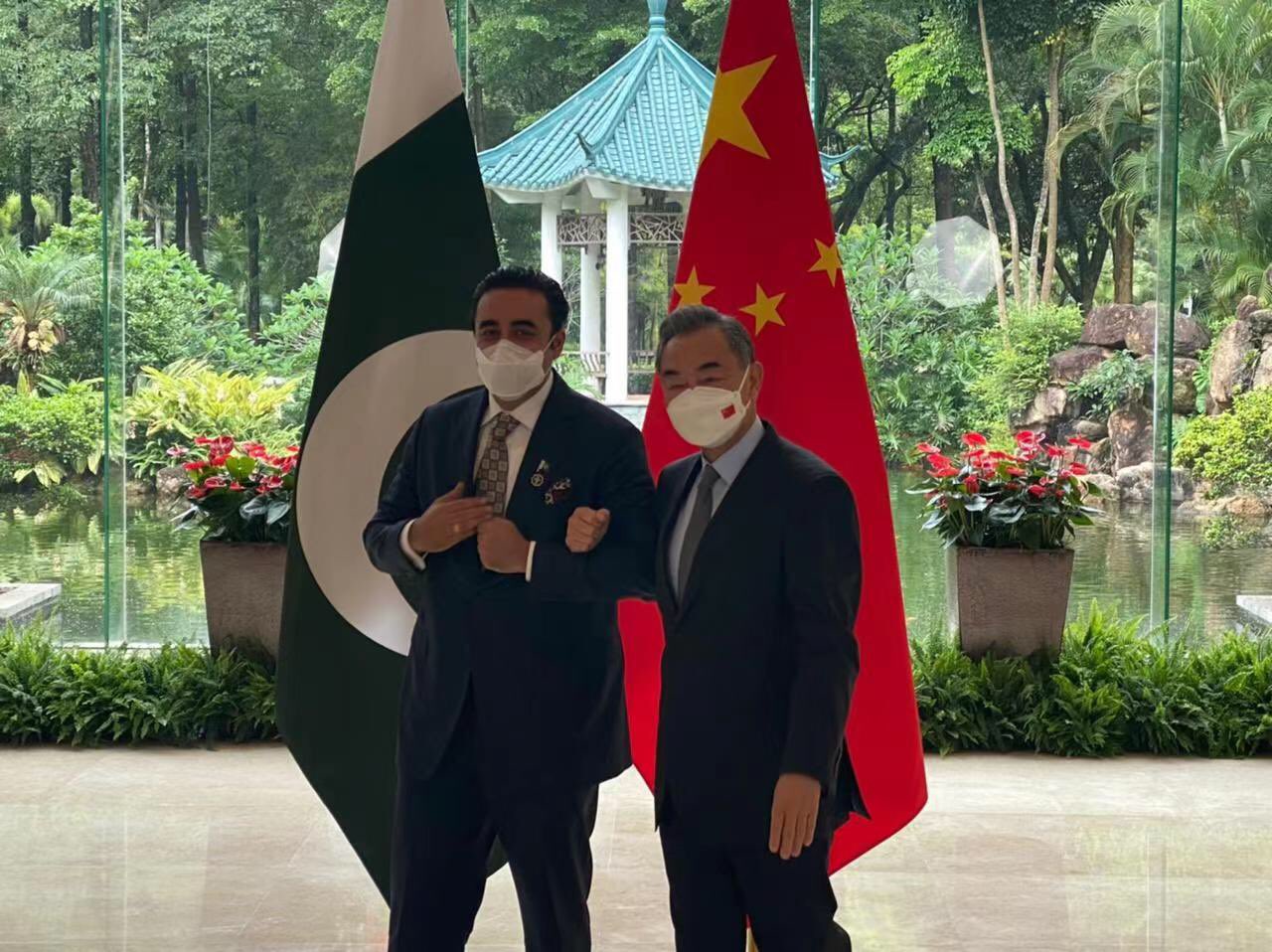
China’s State Councilor and Foreign Minister Wang Yi sent a message of sympathy to Foreign Minister Bilawal Bhutto Zardari on the ongoing floods in Pakistan.
In his message, Wang Yi expressed deep grief and sorrow over the loss of life and property in several areas of Pakistan due to floods, CRI reported. He expressed deep sympathy with the families of those who died in the flood, the injured and the affected people in the disaster areas. Wang Yi said that the Chinese government and people are always with the Pakistani government and the fraternal Pakistani people.
We are sure that under the leadership of the Pakistani government, the people of Pakistan will definitely overcome the calamities and restore normal life soon, he added.
https://dailytimes.com.pk/967513/chinese-fm-expresses-grief-over-flood-damages-in-pakistan/