Tuesday, June 21, 2022

#Pakistan #PPP - #HappyBirthdaySMBB #SalaamBenazir ❤ - Bilawal addresses Benazir’s 69th birth anniversary in Larkana

Pakistan Peoples Party (PPP) Chairman Bilawal Bhutto-Zardari on Tuesday told a public gathering in Larkana that Benazir Bhutto bravely fought military dictators and her activists have kept her message alive in today's Pakistan.
He made these remarks while addressing the gathering organised on the occasion of the 69th birth anniversary of the slain PPP chairperson and former prime minister.

"It was because of the struggle of PPP jiyalas that Imran Khan was ousted from power via a no-trust move," he told the participants gathered at the venue.

Imran Khan's narrative against corruption is a lie, he added.

The PPP chief further said his party ousted the “selected” after waging a struggle along with two other political parties.

Bilawal said that "power-hungry and criminal Imran Khan Niazi”, who was responsible for the current inflation and several other prevailing economic issues, is roaming free and is accusing others of causing the issues.

“Imran was causing this damage to the people just to stay in power and the burden of it is now being born by the commoners.”

Bilawal asserted that the former premier must be told to respond to his performance, including the cases of corruption emerging now.

Referring to the Tosha Khana case, he said the PTI chief and the former first lady will have to provide answers about their corruption.

He said that Imran Khan has sold a watch gifted to him by a foreign country and also brought a bad name to the country.

“People now know that the slogan of change wasn’t for change, but for the destruction of the country."

Imran Khan, he added, begged other countries for funds and is now resorting to mudslinging against his political rivals.

Likewise, he added, the government will eventually succeed in retaining the GSP+ status for the country and bring more glad tidings for exports.

“These are the things that we achieved by focusing on our work, instead of resorting to mudslinging, he said,” while taking a veiled jibe at the PTI chief.

He ensured that the government is working day and night to ensure that the country was put back on the path of stability and progress.

“It was because of the struggle by Prime Minister Shehbaz Sharif that Pakistan was saved from going bankrupt.”

The PPP leader, who is also the foreign minister, maintained that he had been visiting several countries. “Our policy is not to beg but to trade with other countries.”

“We put immense effort into taking Pakistan out of the Financial Action Taskforce (FATF) grey list and it is hoped that by October, when an on-site visit is due, we will achieve this objective.”

He went on to say that Pakistan was facing two "FIRs" against it in FATF; one related to money laundering while the other related to terror financing.

Earlier, while addressing the gathering, Sindh Chief Minister Murad Ali Shah that the coming generations will keep the slogans of the party high and achieve them.

He added that the party activists will never forget Benazir Bhutto's message and will keep it alive with zeal and zest.

Earlier today, Prime Minister Shehbaz Sharif paid tributes to the PPP chairperson and said democracy is "poorer" without her; the void "left by her martyrdom will never be filled".

He recalled the former prime minister fearlessly and staunchly advocated the causes she believed in.

https://tribune.com.pk/story/2362671/live-bilawal-addresses-benazirs-69th-birth-anniversary-in-larkana


Monday, June 20, 2022

Video Report - #MJtv ہی ٹی ایم کے راہنما منظور پشتین کا لالہ عثمان کاکڑ کی یاد میں لاہور میں تقریب سے خطاب

Video Report - IMF Deal In 2 Days | Hamid Mir Exposed Imran? | 'Mehngai Rally' Flop? | Usman Buzdar Booked

Video Report - Gambat Institute of Medical Sciences | Free of cost Treatment for all

#Pakistan #PPP - #HappyBirthdaySMBB #SalaamBenazir ❤ The story of a journey in friendship

By  Yasmin Niazi Islam

From the very first instant, we got on like a house on fire. We were bound by this mutual feeling of having been together all our lives. I became BB’s companion, escort, ADC all rolled into one. She was 22 then.

I

was seventeen when I first met Benazir. My father, Dr Zafar Khan Niazi was Mr Bhutto’s dentist but beyond that, both my parents were avid Bhutto supporters. My mother rarely missed a ZAB rally or public meeting. Sometimes my siblings and I were also dragged to the jalsas after school.

After Zia’s military coup, Mr Bhutto was in confinement and Begum Nusrat Bhutto arrived in Islamabad in pursuance of her petition in the Supreme Court, sometime in August 1977. Being the ardent supporter she was, my mother went to the airport to receive Begum Bhutto.

There was a huge crowd to receive the former PM’s wife and they all drove back in a cavalcade to Ghulam Mustafa Jatoi’s residence, where Begum Bhutto was to stay. Jatoi had, of course, been the chief minister of Sindh and was a very senior PPP leader. When they arrived at the venue, the gate was locked shut and there was no sign of anyone expecting a VIP guest. After some wait, a servant came out and said that the “sahib” was not in and had left no instructions to receive a guest. The elected prime minister’s wife had come out of the car and stood virtually on the street in a state of shock and utter disbelief. There was nowhere for her to go.

At this moment, my mother stepped out of the crowd and approached Begum Bhutto and invited her to be her guest. Begum Bhutto hesitated and asked her to first seek my father’s permission. My mother insisted that my father would be offended and insisted on taking her home. Our house in Islamabad’s F-6/2 was still under construction, and we lived out of two or three rooms that were complete. My mother vacated their bedroom and settled Begum Bhutto in.

A few days later, Benazir came to Islamabad to join her mother and was driven straight to our home. That is when I first met her, and the seeds of an extraordinary friendship were planted. I became BB’s companion, escort, ADC all rolled in to one. She was 22 then.

From the very first instant, we got on like a house on fire and were bound by this mutual feeling of having been together all our lives. Whenever BB visited Islamabad, she would always stay with us – not as a guest but as member of the household.

When BB went to Karachi, she would plead with my mother to allow me to accompany her. The first couple of times, my mother easily gave in but thereafter BB sensed my mother’s hesitation. We came from a very conservative family who were not comfortable with the idea of a young girl being away from home. Being BB, she came out with a novel solution. “Let me adopt Yasmin”, she offered. My parents laughed it off but realised that she was deadly serious. Then on, they had no choice but to permit me to accompany her on her visits to Karachi and Larkana. BB was a friend but now assumed the role of my guardian as well. I had never visited Karachi before and found the big city a little daunting. I met BB’s school friends, Samya, Salma and the Punthaky sisters – Firoza and Paree. They would try to drag me out of the confines of 70 Clifton to show me a bit of Karachi but always met with resistance from the guardian. BB, of course, had no time for girly outings as she was glued to her desk and typewriter, assisting in her father’s appeal.

After the Lahore High Court judgment, Mr Bhutto was shifted to a death cell in Rawalpindi jail. Begum Bhutto and BB took up residence in Islamabad but our home virtually remained the unofficial PPP headquarters. Mr Bhutto’s food was prepared by me personally and I drove each day to the jail to deliver it. The jail authorities would not accept anything brought in after 12 noon, so we were always in a panic and a rush to beat the deadline. BB was only allowed one weekly visit to her father and counted the hours for her appointed date. Mr Bhutto loved roses and she would always carry tube roses with her.

Zia’s government had started a vicious campaign of lies and propaganda against ZAB. He sat in his tiny cell with paper resting on his knees while writing copious notes in answer to the charges. There came a stage when his fingers started to bleed from holding the pen. BB would smuggle these notes out of the jail in a hidden compartment of her handbag and together we (later joined by Victoria Schofield) assisted her as she deciphered the writing and typed it out laboriously with her own fingers on a typewriter. She would spend entire nights doing this. And then there were messages from her father for the outside world which had to be delivered.

BB and her mother were placed under house arrest and we would stay in touch through notes carried by her servant. One day, I was informed by one of our staff that a person had come to see me and if I would go down to meet “him”. I went out and nearly fainted at the sight of the young man, who signalled me to remain quiet. Heavily clad in a bomber-jacket, scarf and hat, the young man was none other than Benazir Bhutto. She had escaped her house arrest, sitting on the back of a motor-bike driven by her servant. She stayed with us for a few days; her eventual return home was conducted in the same clandestine manner.

Sometime later, Begum Bhutto was temporarily released from house arrest while BB remained in confinement. One day, Begum Bhutto came to our house and said that BB was insisting that she should smuggle me in to spend a few days with her. My parents were of course aghast but who were they to withstand and resist the BB storm. So, I was snuck under the back seat with a blanket over me and Begum Bhutto’s feet resting above. The joy on BB’s face as she saw me can only be sketched on drawings and paintings. These were some of the relief moments (albeit tension-ridden) through those dark and depressing days.

Mr Bhutto suffered from gum affliction and by special permission; my father was allowed to visit him in his death cell. My father was so mortified by the conditions in which Mr Bhutto was kept that he gathered us one day and said that he could not remain silent while Mr Bhutto suffered such barbaric treatment and that he would write and communicate with all the ambassadors in Islamabad and parliamentarians abroad. He warned us that his actions could attract a very harsh and draconian reaction from the military regime. He then asked if we were prepared to suffer the consequences. To the person, each one of us alleged their complete confidence in the path my father had chosen and pledged to stand by him and our leader, ZAB. The consequence did not take too long to materialise. The military regime arrested my father and sent him off to Jhelum jail. We were allowed weekly visits for which we drove to Jhelum but our visits did not always materialise in meetings. My father braved the sizzling heat of Jhelum in the company of hardened criminals. The regime tried every trick to break him and force him to forfeit his allegiance to ZAB. My father steadfastly refused and we stood by him.

Benazir’s weekly visits to her father served as tutorial sessions in politics. He guided her on the intricacies of national and international politics. On one visit, just before her tour of the NWFP (now KP), ZAB instructed BB on how to appear and speak before the Pakhtuns.

On that visit, I accompanied BB, and also had Victoria Schofield as our companion. We were driven by Gen Naseerullah Babar. All along the route, BB was greeted and cheered by large crowds. Wearing a chaddar and a Mao cap, she addressed them as coached by her father. The tour was a rousing success. On her next visit to jail, she told me that her father stood up and saluted her – so pleased was he with how she had conducted herself.

On her 21st birthday, she sought permission from the authorities to visit her father (not her usual visiting day). She felt confident about gaining permission. She waited impatiently for the moment to arrive. Her father did likewise. She asked me to prepare his favourite chicken sandwiches. When the day arrived, the authorities callously blocked her from visiting. She was distraught and heart-broken, as was her father in his death cell. It was then that he, with tear-soaked eyes penned down an epic letter, which was long enough to be printed as a book, under the title “My dearest daughter”. 21st June. “The longest day and the longest wait”, he wrote.

All during those trying and traumatic times, thousands of PPP supporters were jailed and so many backs of the young and old alike torn open with lashes and decorated with crimson lines. So many collapsed shouting “Jiye Bhutto”, as they were lashed till they fainted.

The terror of that martial law was debilitating – there is no parallel in Pakistan’s history. The chaddar and char-deewari were violated with impunity. The steel was being driven relentlessly into the nation’s soul. I lived through those times and the experience still haunts me.

In February 1979, the Supreme Court, in a split verdict rejected Mr Bhutto’s appeal. The maxim “justice is blind” stood blinded to truth and chose instead to bow before the dictator. The countdown to death began. Whatever meagre provisions were allowed to Mr Bhutto in his death cell, were hastily withdrawn. On April 3, my mother and I, as per our usual practice drove to the jail with Mr Bhutto’s home-cooked food. We arrived at the gates to witness a lot of activity and extra security deployed. The jail staff refused to take the food. The writing was on the wall. The dreadful denouement to the sordid drama tolled its bells as my mother and I stood clutching Bhutto’s food, broken. Everything around us was surreal as in a Shakespearian script. An elderly, helpless woman in ragged clothes was screaming in pain and seeing a sympathetic face, approached me. She handed me a soiled envelope and said, “This is for Bhutto – it has all the money I have saved for my hajj but now I want you to sacrifice a goat so his life may be saved”. The envelope had a stack of time-worn notes. Before I could gather myself and return her money, she vanished, just as happens in supernatural dramas.

Just then, the gates were flung open, and a car drove out. I could see Begum Bhutto and BB and for a fleeting moment, our eyes met. Long enough for BB to convey that they were going to kill her father. We felt the ground underneath us open as time stood suspended.

Next day, April 4, it was announced. My mother, my sisters and I drove out to join a crowd which was beginning to gather to protest. Law enforcing agencies came out in numbers to teargas and baton charge us. They struck us with their batons and arrested all of us. After enduring many hair-raising hours, we were finally lodged at the Attock Fort, prisoners of conscience – all of us.

Mr Bhutto’s body was flown out in the dark of the night and hurriedly laid to rest in his ancestral village Garhi Khuda Bux. Only his first wife was allowed to see his face briefly. Begum Bhutto and BB remained prisoners in Sihala.

Ultimately all of us were released and BB flew straight to Larkana. Along with some of her friends, I was with her and spent a year in Larkana while she grieved and received condolences, for which crowds upon crowds of people visited each day. BB spent the nights weeping uncontrollably while clutching on to her father’s clothes. I sat up with her, holding her in my embrace.

Later events led to the arrest of both BB and Begum Bhutto. BB was taken to Sukkur jail and kept under inhuman conditions. She had to endure the crippling heat of Sukkur without being allowed a fan, ice or cold water. She fell ill while in jail, but the authorities remained intransigent and refused to provide her any relief. It was during this time that she suffered an infection to one of her ears, for which she needed surgery. After a long wait, she was allowed to fly out to London.

In the meantime, FIRs were registered against my father and me and the countdown for our arrest began. My father escaped to Afghanistan and I went into hiding. My father joined Murtaza and Shahnawaz Bhutto in Afghanistan. While there, he suffered a heart attack and had to be flown to London for surgery.

My family pondered on who among us could fly to London to be with my father while at the same time assure my safety and possible exit. I had no passport and had my name on an FIR with the entire government machinery looking for me. What happened then can only be believed if you trust in God and believe in His miracles. My mother suddenly had this idea that perhaps I could get a British passport as I was born in London. The British Embassy in Islamabad was approached, and they were extremely humane and sympathetic and issued me a passport overnight. The next problem was how to get me out in the prevailing circumstances. We had a relative in the Islamabad airport immigration but it was heavily manned by the military. He had to take a huge risk, as did I. Tremors and fear accompanied me as I went to the airport in disguise, accompanied by my sister and brother-in-law. Just as my turn came up in the immigration queue, the lights miraculously went out. In the commotion and darkness, I was ushered through.

I was able to be with my father through his surgery and recovery and we were joined by BB in 1983 when she was finally allowed out under massive international outcry and clamour.

I stayed with her at her bedside through her surgery and her stay in the hospital. BB stayed initially with her aunt Behjat but had no residence in London. We offered that she stay with us in our flat in Barbican. She moved in with us and later, we were able to rent out a flat for her in the same block. But it was our flat – 111 Barbican that became the PPP London headquarters. Once again, I was back on duty. I left college to become her secretary, aide and confidant and her travel companion when she toured the US and the UK. It was there that in a meeting of the PPP Central Committee, the famous “uncles” were overthrown.

Time rolled on and BB found time to launch her project which was constantly on her mind. She wanted me married but also at the same time not lose me to an unknown family. Only someone like her could have found the solution to the predicament. “Yasmin”, she said to me one day as we sat up late into night chatting in the Barbican flat, “I would like you to marry my cousin TI (as she referred to Tariq). That way we will not be separated as I will gain you as a relative”.

And so, it happened.

She approached my parents with all the protocol and propriety the occasion warranted and of course won their approval and consent. We were married soon enough but Tariq could not figure out whether I was married to him or to BB, as she did not ease up too much on her demands on my time. We eventually worked out an acceptable medium.

In 1987, BB was engaged to Asif in London and the marriage was set for December in Karachi. I travelled to Karachi, two kids in tow not knowing what might happen. Zia was still in power albeit we were under the “democratic” Junejo government.

BB, as was her wont, played the symphony director at her own wedding, which was held in the Clifton garden. She however, wanted a wedding ceremony to share with her “awam”. So, she decided on Lyari’s Kakri Ground where her father had made some of his famous speeches and won a seat for the PPP. I accompanied her in her car as we drove through the throngs to arrive at the brightly decorated and festive Kakri Ground. The crowd went into utter rapture as she appeared waving to them on the stage. It was the homecoming of a famous daughter. She did not have her beloved father to give her hand away in marriage. So, she settled on the next best thing, the people of Lyari.

What a daughter she was! She sacrificed her youth in her father’s service, never fearing, never wavering. And what a friend – loyal to the core, always loving, always caring.

One thing that gave her extreme joy was her birthdays which she always celebrated together with friends and family with great gusto. All her troubles and trials were forgotten to savour that one day. And now as June 21 is upon us, I miss her deeply. So many of her birthdays we shared together. She is with her Maker today enjoying a great feast of celebration as her father, mother and brothers look on. We in our temporary abode can only send our prayers and love and say “Thank You Benazir. Your name means ‘one without equal’ – surely you are that. Rest in peace my friend – our journey for the time has ended but we are bound together in soul and spirit and for all times to come.

https://www.thenews.com.pk/tns/detail/966964-the-story-of-a-journey-in-friendship

#Pakistan #PPP - #HappyBirthdaySMBB #SalaamBenazir ❤ Benazir Bhutto: Leadership And Legacy

 Saria Benazir Jadoon

@SariaBenazir


June 21 is the longest day of the year. It is also the birthday of Pakistan’s slain Prime Minister, Benazir Bhutto—the first woman to head the government of a Muslim majority country after her long and arduous struggle against a brutal military dictatorship. She was elected to this office twice. A fierce and fearless champion of democracy, human rights, international peace and progressive values, Benazir was truly ahead of her time.

Her courage was as extraordinary as her accomplishments and while she may have been physically eliminated by Islamist terrorists fifteen years ago, she remains a beacon of light on the horizon of global politics. A world in the throes of war, authoritarianism and inter-civilisational strife can draw important lessons from the life and legacy of Benazir Bhutto.

An unwavering commitment to the ideals we cherish is a first. Indeed, there will always be obstacles to surmount and quite often, it entails personal sacrifices that one must be prepared to make. Fate took a cruel course when Benazir returned home after graduating from Oxford.

Her father—Pakistan’s first democratically elected Prime Minister, Zulfikar Ali Bhutto was deposed and sent to the gallows for a murder he did not commit. For years, her life alternated between house arrest and solitary confinement in sordid conditions but nothing dampened her resolve to restore civilian rule in her country and she did. However, both of her governments were dismissed before time at the behest of obscurantist forces that could not see Pakistan forge ahead under the dynamic leadership of a modern young woman.

Benazir Bhutto’s detractors levelled all sorts of baseless allegations to undermine her popularity, attack her family and banish her from the political scene but she was not deterred. Despite threats of death, she returned to her homeland after eight years of exile to save it from falling into the hands of militants who had captured major city centres in the country’s north-west.

In the process, she lost the battle for her life but the ensuing government of her party, the PPP, won the war against terrorism, preventing Pakistan from becoming the epicentre of global jihad. Her son, Bilawal Bhutto-Zardari—only nineteen when his mother was assassinated—continues this fight.

Freedom is fragile and needs friends. For the same reason, Benazir Bhutto proposed an association of democratic states that would back one another and promote this universal good. Democracy leads to economic prosperity and helps create and conserve constituencies of peace.

Like any other form of government, it has its flaws that must be identified and fixed from within for it to persevere and build more equitable societies. With liberal values in retreat everywhere, the exigency of such a union cannot be overstated. Furthermore, advocacy of human rights must be a matter of principle, not convenience.

Democratic nations that are also great powers must censure violation of these rights without any distinction and lend practical support for their protection. Double standards not only erode their own credibility but also the sanctity of those values. In a similar vein, women must stand up for other women.

Benazir Bhutto did not repair the iron ceiling after breaking it. Instead, she made way for other women to rise to important positions by setting an example and providing them opportunities. The governments she led took important initiatives to increase their access to education, healthcare, justice, employment and legislation. Economic emancipation was integral to her agenda; therefore, the Women Bank was established to provide loans to thousands of women to start their own business.

Similarly, Pakistan’s largest social safety net envisioned by her and instituted by her successors—the Benazir Income Support Programme—seeks to assist and empower poor women by making direct cash transfers to them. The situation just next door where the Taliban have placed restrictions on girls’ education, work and movement is starkly different.

Following the withdrawal of the USSR from Afghanistan, Benazir Bhutto warned against the United States’ abandonment of the region. Thirty-four years later, the humanitarian crisis in the country has worsened in the wake of Washington’s hasty exit.

With 9 billion dollars in assets frozen overseas, tens of millions are facing acute hunger, poverty and deprivation of essential public services. Impoverishment enables oppression and creates a breeding ground for violent extremism. If the Afghan state collapses, the consequences for international peace and security will be very dire.

The world must therefore do whatever it can to alleviate the plight of its citizens and end the recurring cycle of conflict and war that has plagued Afghanistan for far too long. This goes for other flashpoints too, especially in the Middle East and South Asia where a protracted rivalry between two nuclear powers over Kashmir imperils the future of almost one quarter of the world’s population.

Benazir Bhutto believed that a European Union sort of mechanism to foster trade, cooperation and people-to-people relations would help put a stop to hostility between India and Pakistan. In her book published posthumously, ‘Reconciliation: Islam, Democracy and the West’, she stressed the need for a constructive dialogue within and among disparate societies, faiths and civilisations to introspect, find common ground and generate goodwill.

The tumultuous times we are passing through have made such an exchange indispensable.

Speaking at Harvard on May 26, New Zealand’s Prime Minister Jacinda Ardern reminded the audience that the path Benazir carved as a woman decades ago is as relevant today as it was then; so too is her message.

By giving birth while she was the Prime Minister of Pakistan in 1990, Bhutto demonstrated that women could ‘have it all’. The Daughter of the East undoubtedly occupies an unparalleled place in the pantheon of world’s great leaders. The woman who inspired Malala Yousafzai and enthralled Hillary Clinton could be no ordinary extraordinary woman.

She was in a league of her own but may her league multiply in size and strength. The global community must recognise her in a manner that befits her glorious achievements and supreme sacrifice. Observance of an international day in her remembrance by the United Nations would be the right thing to do.

https://nation.com.pk/2022/06/21/benazir-bhutto-leadership-and-legacy/

Saturday, June 18, 2022

Alia Ansari - Wa Halika | عالیه انصاری - وه هلکه - Pashto Music

Pashto News - د اشنا تلویزیون د شنبې خپرونه د ۲۰۲۲ د جون ۱۸ - غبرګولي ۲۸

Video - FM Bilawal Bhutto Zardari attended 49th Foundation Day Ceremony of Institute of Strategic Studies

Rights group demands economic stability, political rights in Pakistan

The Human Rights Commission of Pakistan (HRCP) expressed its concern at the alarming polarization in political discourse, which it said was detrimental to the cause of democracy in the country.
The HRCP made these observations after the conclusion of the biannual meeting of its governing council.
“It is equally concerned about the ensuing economic instability, the runaway inflation and the threat of food insecurity that are disproportionately impacting the working and middle classes. Punjab, the country’s biggest province, stays in a political limbo. HRCP calls for a non-partisan consensus on crucial issues facing the country,” the HRCP said.
The Council highlighted multiple grave human rights issues being faced by the populace, including the impact of climate change evident in the recent glacial flooding in Gilgit-Baltistan, the ongoing heatwave in Punjab, and the acute water shortages in Sindh and Balochistan.
“It noted the worsening instances of police brutality against peaceful protestors across Pakistan with arrests of activists and political workers on anti-state charges becoming a common feature. Freedom of the press is under continuous stress and journalists have been persistently targeted,” the HRCP said.
The group highlighted how there is no letup in cases of enforced disappearances, particularly in Balochistan, Sindh and KP.
“What is worse is the uptick in enforced disappearances of Baloch and Pashtun students. It reiterates its demand to enact the law that criminalises enforced disappearances and the state must ratify the International Convention for the Protection of All Persons from Enforced Disappearance,” the group said.
According to the report, violence against women and transgender persons showed no signs of abating.
Religious and sectarian minorities remain vulnerable, with incidents such as the mob lynchings in Sialkot and Mian Channu, the attack against Shia worshippers in Peshawar, and desecration of Ahmadiyya graves, becoming more frequent, it added.
The HRCP called on the state to curb the rising tide of religious extremism, and grant the National Commission for Minorities a statutory position in light of the Tassaduq Jillani Supreme Court judgement 2014 so it may fulfil its duties.
https://theprint.in/world/rights-group-demands-economic-stability-political-rights-in-pakistan/1002408/

Pakistan to stay on terror financing watchdog's 'gray list'

An international watchdog said Friday it will keep Pakistan on a so-called “gray list” of countries that do not take full measures to combat money laundering and terror financing but raised hopes that its removal would follow an upcoming visit to Islamabad to determine its progress.The announcement by Marcus Pleyer, the president of the Financial Action Task Force, was a blow to Pakistan's newly elected government, which believes that it has mostly complied with the organization's tasks.
Expectations were high in Pakistan that FATF would announce its removal from the list at Friday's meeting in Berlin.
Instead, Pleyer said an onsite inspection by FATF in Pakistan would take place before October, and that a formal announcement on Pakistan's removal would follow. He said FATF is praising Islamabad for implementing the organization's action plans — a clear indication that Pakistan is moving closer to getting off the “gray list." “Pakistan’s continued political commitment to combating both terrorist financing and money laundering has led to significant progress," FATF said in a statement. The country's efforts were sustained, it said and added that Pakistan’s “necessary political commitment remains in place to sustain implementation and improvement in the future."
Pakistan's foreign ministry said FATF reviewed Pakistan’s progress in countering terror financing during a four-day meeting this week and “acknowledged the completion of Pakistan’s" action plans. It said a visit to Pakistan was authorized as a final step toward exiting from the FATF’s “gray list."
Also Friday, FATF removed Malta from its “gray list" but added Gibraltar. Pleyer urged Gibraltar to take steps in the right direction, including focusing on the gatekeepers to the financial system. The Paris-based group added Pakistan to the list in 2018. The “gray list” is composed of countries with a high risk of money laundering and terrorism financing but which have formally committed to working with the task force to make changes.
At the time, the south Asian country avoided being put on the organization's “black list” of countries that do not take adequate measures to halt money laundering and terror financing but also have not committed to working with the FATF. The designation severely restricts a country’s international borrowing capabilities.
Still, being on the Paris-based international watchdog's “gray list” can scare away investors and creditors, hurting exports, output and consumption. It also can make global banks wary of doing business with a country. Pakistan has said it continues to detain suspects involved in terror financing to comply with tasks set by the watchdog. A Pakistani-based independent think tank, Tabadlab, has estimated that it has cost the country’s economy $38 billion since it was put on the gray list in 2018.
The FATF is made up of 37 member countries, including the United States, and two regional groups, the Gulf Cooperation Council and the European Commission. Currently, only Iran and North Korea are blacklisted.
https://news.yahoo.com/pakistan-stay-terror-financing-watchdogs-154550336.html

Tuesday, June 14, 2022

Ahmad Zahir - Khuda Bowad Yaret

Persian Music Video - Googoosh - Man Amadeam گوگوش - من آمدم

Video Report - Joint Press Stakeout by Foreign Ministers of #Pakistan and #Iran

#Pakistan #PPP - Foreign Minister Bilawal Bhutto calls on President Raisi during #Iran trip

Foreign Minister Bilawal Bhutto Zardari on Tuesday called on Iranian President Ayatollah Ebrahim Raisi during his visit to the neighboring country, according to the Foreign Office (FO).
The FO said that Bilawal conveyed Prime Minister Shehbaz Sharif's greetings to President Raisi and also extended an invitation to visit Pakistan.
"The foreign minister reaffirmed Pakistan’s keen desire to strengthen bilateral relations, which are rooted deep in shared history and commonalities of faith, culture and heritage.
"He highlighted the importance of regular exchanges to advance economic and energy cooperation, regional connectivity, operationalisation of barter trade and border sustenance marketplaces, and facilitation of Zaireen visiting Iran for pilgrimage," the FO said in a statement.
It added that Bilawal also took up the issue of the release and transfer of Pakistani prisoners detained in Iranian prisons.
The Iranian president welcomed FM Bilawal and underscored that the two countries were "bound by close historic linkages and strong fraternal ties".Raisi noted that Iran attached great importance to its economic and trade relations with Pakistan, which had considerable potential for further growth.
Cooperation in the energy sector
Earlier in the day, Bilawal said Pakistan was committed to strengthening its cooperation with Iran in the energy sector through the import of additional electricity.Addressing a press conference in Tehran with his Iranian counterpart, Hossein Amir-Abdollahian, Bilawal elaborated on their discussion. He said their dialogue took stock of the "entire gauntlet" of bilateral relations and identified ways to enhance them further in order to match their true potential in areas such as trade, investment, connectivity, border management, cultural and education cooperation.

On trade, the foreign minister said he was "glad" that Pakistan and Iran had come closer to resolving one of the major obstacles in the expansion of bilateral trade through the operationalisation of barter trade mechanism, formalisation of cross-border exchanges through the opening of new border crossings and promotion of trade through border market places.

He said such steps were "measures of our shared commitment to the provision of opportunities for enhanced economic and commercial activities that'll benefit the people of Iran and Pakistan", adding that they would help in improving the livelihood and welfare of people at the border areas.

FM Bilawal said he discussed with Amir-Abdollahian the possibility of exchanging prisoners under the existing legal framework so they could complete their sentences in their own countries.

The foreign minister also appreciated Iran's hospitality and facilitation of Pakistani pilgrims, adding that there were talks on the provision of further services for the pilgrims which formed a "bond of friendship" between the two countries.

On the international front, Bilawal said they discussed the latest developments in Afghanistan and agreed that "Afghans must be supported at this critical juncture, including through access to frozen financial assets."

He said the world expected a move towards "inclusivity and effective counter-terrorism action" from the Afghan authorities.

Bilawal said he had also briefed FM Abdollahian on the human rights situation in Indian-occupied Kashmir and thanked the Iranian leadership for its steadfast support on the Kashmir dispute.

He said they also discussed the rising tide of Islamophobia and the recent derogatory remarks by Indian officials that had "deeply offended" the global Muslim community.

"It's time for the international community to show a common resolve against xenophobia, islamophobia, intolerance and incitement to violence on basis of religion or belief," FM Bilawal said.

He said Pakistan and Iran had long historic ties and he wanted to take the existing bilateral relationship to new heights.

"On behalf of the Government of Pakistan, I convey a message of goodwill and cordiality to Iranian brothers and sisters," Bilawal said, adding that building close relations with Iran was a high priority for himself and Prime Minister Shehbaz Sharif.

FM Bilawal also expressed support for Iran in the ongoing nuclear deal talks, adding that he looked forward to the day when a conclusion could be reached that was the "right of the people of Iran".

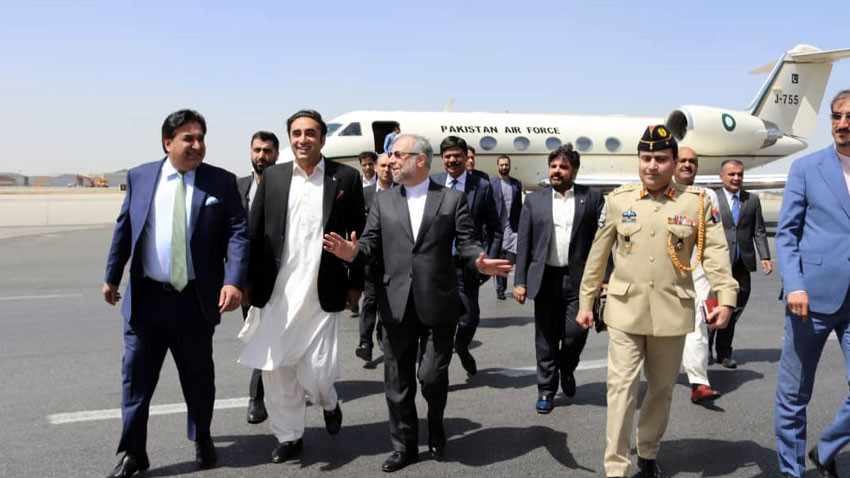
Earlier, FM Bilawal reached Iran on a two-day visit to hold talks with Iranian dignitaries on a range of issues, including bilateral ties, trade, regional security and Islamophobia.

This is Bilawal's first official visit to Iran. He is visiting the country at the invitation of Iranian FM Amir-Abdollahian, who welcomed him upon his arrival in the neighbouring country.

State-run APP shared a video of Bilawal sitting with Abdollahian and other dignitaries soon after his arrival.

Delegation-level tallks

The FO statement said Bilawal was to share views with his Iranian counterpart on all areas of mutual interest.

It added that in delegation-level talks during the visit, "the two sides will review all facets of bilateral relations, including trade and economic ties, electricity supply from Iran, border sustenance markets, road and rail connectivity, and facilitation of Zaireen".

"They will also review regional security situation with particular focus on developments in Afghanistan and South Asia, as well as combating Islamophobia," the statement added.

According to the FO, Bilawal's visit to Iran is part of regular high-level exchanges between the two countries. "The last meeting between the two foreign ministers was held on the sidelines of the World Economic Forum at Davos on 26 May 2022."

In concluding remarks, the FO statement highlighted that "Pakistan and Iran enjoy close cooperative ties, based on shared geography, cultural affinities, and historic people-to-people linkages. These fraternal relations have been further strengthened through frequent high-level exchanges. The two countries are celebrating the 75th anniversary of the establishment of diplomatic relations in 2022".

Bilawal looks to enhance economic cooperation

Bilawal had shared similar views with the official Iranian news outlet IRNA a day before leaving for Iran, during an informal talk with journalists.

“Iran is our neighbour and in Islam, neighbours have rights. We believe that relations between [the] people of Pakistan and Iran, including cultural and spiritual, are historic,” he had said.

The foreign minister had added that economic cooperation and coordination between the two countries had much potential to be explored and exploited.

On the Pak-Iran Gas Pipeline project, Bilawal said: "Its foundation was laid by former president Asif Ali Zardari and we would want international obligations, their framework and the deal to progress so that we can unlock the potential in our relations further."

Pakistan wants to construct a 1,100-kilometre gas pipeline, known as the Pakistan Stream Gas Pipeline Project, from Port Qasim in Karachi, in Sindh, to Kasur in Punjab. The $2.5 billion project is tentatively slated to begin next year, though an initial agreement was first signed in 2015 and a second in 2021.

Bilawal also expressed these views during an interview with Iran's Islamic Republic News Agency (IRNA) hours before leaving for the two-day trip.

He said that "facilitating trade and exploiting the true potentials of Iran and Pakistan is important for us" and that he looked forward to improving and enhancing the relationship between the two countries.

The foreign minister elaborated that Pakistan wanted to enhance its economic activity with all countries and "we are focusing on economic diplomacy as you have mentioned there has been a lot of cooperation in the past with Iran and we look forward to enhancing this cooperation".

“We want to enhance progress on border markets and go a long way to facilitate commercial activity on both ends and I am looking forward to having meaningful conversations with my counterparts to unlock the true potential of the economic relationship,” he added.

Moreover, IRNA quoted him as saying, that there was a lot more potential for both sides to enhance tourism.

"And I am really hoping that we will be able to discuss these issues, enhance the modes and means of transport between the two countries, and encourage not only, obviously religious and spiritual tourism between the two countries. but also economic tourism and people-to-people activities."

On Afghanistan, he said: “I think the situation in Afghanistan is on everyone’s mind, particularly those of us who are in the region or in the neighbourhood who are directly impacted by the developments in Afghanistan, and I am sure I would have deep meaningful conversations on this topic as well.”

Pakistan's Foreign Minister Bilawal arrives in Tehran to meet Iranian leadership

 Foreign Minister Bilawal Bhutto Zardari on Tuesday reached Tehran on his maiden two-day official visit to the country's Persian Gulf neighbour. 


During his visit, the foreign minister will hold talks with the Iranian leadership on the spectrum of bilateral relations.

He will also hold delegation-level talks with his Iranian counterpart and the two sides will review all facets of bilateral relations, including trade and economic ties, electricity supply from Iran, border sustenance markets, road and rail connectivity and facilitation of Zaireen.Iran is currently supplying electricity to Gwadar and Pakistan is keen to further enhance that cooperation. The country is currently in the grip of energy shortages, causing long power outages.

But there has been no mention of the Iran-Pakistan gas pipeline project that was signed during the Pakistan People Party’s (PPP) term between 2008 and 2013. Iran has completed work on its side of the border but Pakistan could not undertake the project, fearing the US economic sanctions
Pakistan and Iran are celebrating seventy-five years of establishment of diplomatic ties this year.Bilawal is undertaking the visit at the invitation of Iranian Foreign Minister Dr Amir Abdollahian.

https://tribune.com.pk/story/2361525/fm-bilawal-arrives-in-tehran-to-meet-iranian-leadership