Saturday, February 26, 2022

Russia to Riyadh — Imran Khan now has a history of being in the wrong place at the wrong time


NAILA INAYAT
If you want to blame anyone for all this, blame US President Joe Biden. Had he called Khan like Putin did, it would’ve been a different story altogether.

All was going well before it wasn’t. There was excitement and elation before there weren’t. That’s the thing about fantasy and reality. In your own la la land, you can be a mediator of superpowers or imagine yourself stopping a war or even drawing your own borders from Germany to Japan. But in reality, you might be welcomed by your host with a hostile invasion of his neighbor. What are the odds?
Some were still in the process of celebrating the mammoth moment when Pakistan Prime Minister Imran Khan set foot in Russia, that too in a black shalwar kameez. At that moment, nothing mattered beyond the handsomeness and breaking and setting of records— “first in two decades”, “game-changer”, “never before”. Never again. Everything became historic indeed when Russia began its war on Ukraine simultaneously on the same day.
Exciting times
On his arrival at the Moscow airport, PM Imran Khan was delighted at his timing. “So much excitement,” he said. That “excitement” increased manifold when the PM and his entourage were found in a war capital. When Russia’s invasion of Ukraine started, many wondered if Khan would cut his visit short. Then came a one-on-one meeting with President Vladimir Putin, and this time a rather sombre-looking PM Khan posed for the cameras on a day when the entire world was condemning Russian for its actions. Exciting times to share the space with Putin?So much for Pakistan going bloc-free. The criticism is not that Pakistan shouldn’t pursue its relationship with Russia but given the escalating Ukrainian situation for months, Imran Khan was sleepwalking into a diplomatic embarrassment. The sarkari spin-masters argue: the prime minister was unaware that Putin would invade Ukraine on his arrival.
Sure, let’s add this to a long list of things the ever-so-aware PM, who knows more about everything under the sky, didn’t know. If Ukraine was part of India, then probably he’d know. By the way, what are intelligence agencies for?
The prime minister and his team went with a lot of fanfare but returned rather quietly. Unlike the historic 2019 return from the United States when Khan felt he had won the 1992 World Cup all over again.
Wrong time, wrong place
Constantly, for one year now, we have been preached how Naya Pakistan doesn’t believe in blocs and camps anymore. No more fighting others’ wars, no more being used as a hired gun, and no more being asked to do more. But no one was buying this new-found national conscience. When the dollars dried from one side, it was time to pick another. This is, however, not the first time that PM Khan found himself in the wrong place at the wrong time. Back in 2018, after the assassination of Saudi journalist Jamal Khashoggi, Khan travelled to be part of the Saudi investment conference in Riyadh at a time when major world leaders and organisations had boycotted the event. His viewpoint was that Pakistan cannot afford to snub Saudi Arabia over the murder of Khashoggi, talking about the dire need for loans at the time.
In case of Russia, given the unfolding of events and economic sanctions, Pakistan scored no bilateral deal, let alone the much-talked-about gas pipeline project with Khan’s visit. The gas project is much like Khan’s gas dreams at home, where he hoped against hope that gas might be found while drilling off Pakistan’s shores and our 50 years of gas problems will be solved. But, of course, no reserves were discovered off Karachi coast.
From Ukraine, Pakistan covered 60 per cent of its wheat imports last year, but there is fear of food inflation in the aftermath of the conflict. Brace yourself for the next 100 days of speeches— you’ll probably be told that Russia and Ukraine are responsible for food inflation.
Cheerleaders on steroids
Prime Minister Imran Khan’s Russia visit has led to a ‘with us or against us’ debate between supporters and critics. Emotions are running high on what is the best way to deal with Russia at this time. The cons of the visit have been highlighted — Putin used Khan and made most of this opportunity to embarrass Pakistan; “In foreign affairs, hum [Pakistan] mamoo ban gaye” (We were made a fool); “Russia settled decades-old score with Pakistan by invading Ukraine on the day it invited Imran Khan. Putin showed a finger to Khan.” Then there have been those who left no stone unturned to praise Putin, going as far as invoking Quranic interpretations to describe the future acts of the Russian president. Then in excitement of another level, it was declared “Ukraine mein dhamaka, Putin attacks Russia.” Wait, what? On steroids have been the YouTubers who declared that Putin meeting Khan with a small table between them was a signal to the world that Putin loves Khan and did not sit the Pakistan PM across a big table like Western visitors. No one told the sarkari cheerleaders that the four-metre table between others and Putin were placed when the Russian Covid test was refused by visiting leaders due to fears of DNA theft. But let’s hail small-table diplomacy for now.
If you want to blame anyone for all of this, blame US President Joe Biden. Had he called Khan like Putin did thrice in as many months, it would have been a different story altogether. But lovers will tell haters that Biden is jealous and the purpose of the visit has been served. That’s the thing about living in fantasies.
https://theprint.in/opinion/letter-from-pakistan/russia-to-riyadh-imran-khan-now-has-a-history-of-being-in-the-wrong-place-at-the-wrong-time/847515/

Ukraine crisis: Why Imran Khan's Russia trip will further isolate Pakistan

Pakistani Premier Imran Khan chose to meet with President Putin in Moscow, just as Russian forces were invading Ukraine. DW analyzes why the visit is likely to strain Islamabad's ties with Washington and Brussels.
"What a time I have come, so much excitement," Pakistani Prime Minister Imran Khan was heard saying at the airport as he arrived in Moscow on Wednesday ahead of a meeting with Russian President Vladimir Putin.
Khan's statement would prove to be ill-timed, as hours after his arrival, Russia carried out a full-scale invasion of Ukraine.
The West has condemned President Putin with one voice and imposed strict sanctions on Moscow. Russian forces are bombing Ukrainian cities and are closing in on the capital Kyiv. There is definitely more anger than "excitement" about the situation in the West.However, with Khan's visit, Pakistan's leadership seems to be demonstrating its naivete vis-a-vis the gravity of global politics in the aftermath of Russia's unilateral invasion of Ukraine.
Pakistani officials have insisted that Khan's Moscow trip had nothing to do with the ongoing Russia-Ukraine conflict.
The visit was scheduled much earlier, and Khan and Putin said they discussed bilateral and South Asian affairs during their Thursday meeting.
But experts point out that the timing of Khan's Russia trip was a "diplomatic disaster." Although Khan is not a huge player in global politics, his meeting with Putin during the Ukraine invasion has carried some immense symbolic value — mostly in favor of Russia.
Pakistan moving toward US rivals
Regardless of what Khan's ministers have said about Pakistan's "neutrality," geopolitical analysts are watching as the world becomes more clearly divided between the Western and China-Russia camps. Islamabad's close ties with Beijing are no secret, but Pakistani authorities maintain that they want good relations with both China and the US.
However, the time for "neutrality" from South Asian countries like Pakistan and India is almost over after Russia's Ukraine attack, according to security observers."The trip, while overshadowed by the Ukraine crisis, represented a key milestone for a relationship that has quietly grown in recent years," said Micheal Kugelman, a South Asia expert at the Washington-based Woodrow Wilson Center for Scholars, to DW."It also amplifies the direction that Pakistan’s foreign policy is taking; one that is increasingly aligning with US rivals and hence suggests the limits of expanding US-Pakistan relations in the years ahead," he added.
US State Department spokesman Ned Price was quite clear on this issue.
"We believe it's a responsibility of every responsible country around the world to voice concern, to voice objection, to what Putin appears to have in mind for Ukraine," Price said on Wednesday, responding to a question about Khan's meeting with Putin.
Pakistan receives substantial military aid from Washington, and its economy is heavily dependent on the International Monetary Fund's loans.
Whether or not Khan has calculated potential repercussions of his Moscow visit, it could have serious consequences for his country's economy.
A 'wrong signal' to the West
Khalid Hameed Farooqi, a Brussels-based Pakistani journalist and an expert on South Asian diplomatic affairs, told DW that Khan's Russia visit will "isolate Pakistan more among the international community.""Regardless of what he says, by going to Moscow, Khan has conveyed a message to Europe and the US that he has decided to side with Russia in the Ukraine conflict," Farooqi said.
"He could have easily rescheduled his trip, but possibly, he wanted to put pressure on Washington," he said, adding that even India, which has historically been close to Russia, has so far abstained from taking sides in the conflict.
"EU diplomatic circles have not taken Khan's Russia trip well," according to Farooqi.
Maleeha Lodhi, Pakistan's former ambassador to the US, however, believes Khan did the "right thing to press ahead" with his trip. "The prime minister's visit was scheduled much before the [start of] the Ukraine crisis. The visit was bilateral in nature and not intended to send any signal to the West. The visit helped consolidate the positive trajectory in relations between Pakistan and Russia and explored more areas of cooperation," she told DW.
A 'business trip'
A Russian government statement described Khan's tour as a "working visit."
"The leaders of the two countries discussed the main aspects of bilateral cooperation and exchanged views on current regional topics, including developments in South Asia," said the statement.Pakistani is facing an acute energy crisis, and one of the reasons behind Khan's Moscow trip was to finalize a gas pipeline deal with Putin.Trade between Pakistan and Russia, however, is relatively small, with Pakistan exporting $277 million (€247 million) of products in 2019, and Russia exporting $178 million to Pakistan."The visit was not substantial in terms of business agreements; instead certain MOUs were signed which were possible without the visit," Talat Masood, a retired army general and security expert, told DW.
Analyst Farooqi said that after the West has imposed heavy sanctions on Russia, Pakistan is no position to do business with Moscow.
Pakistani military wants 'distance' from Russia
It is important to note that while Khan was preparing to visit Moscow, Pakistan's powerful military chief, General Qamar Javed Bajwa, was meeting with EU officials in Brussels.
Although, his visit was "low-key," analyst Farooqi believes it was significant.
"Pakistan's military leadership wants to keep distance from Russia, unlike Imran Khan," said Farooqi.
"It doesn't want to provoke the West, as Pakistan's security infrastructure relies on the West's support. The generals are pro-West," he said.
Farooqi says that Khan wants to be recognized as being in charge of Pakistan, but in reality, the military generals call the shots in the Muslim-majority country.
Security analyst Masood believes Khan catered to his "anti-West" local constituency by visiting Russia.
"Pakistan is walking a tightrope, although the visit could help Khan domestically," he said.
But Khan's popularity is plummeting in Pakistan, with masses reeling under high inflation and rising unemployment. Meanwhile, opposition parties are hoping to oust him through a no-confidence vote in parliament.
https://www.dw.com/en/ukraine-crisis-why-imran-khans-russia-trip-will-further-isolate-pakistan/a-60916130

کل بھی بھٹو زندہ تھا،آج بھی بھٹو زندہ ھے

Friday, February 25, 2022

Music Video - Guns N' Roses - Paradise City

Video - #China #Russia #Ukraine China refuses to call Russian attack on Ukraine an ‘invasion’

Video Report From Moscow - Lying Zelensky & Ignorant Western Media | Russian FM’s press conference

Video - Why has #Putin attacked #Ukraine?

Video - Jen Psaki on sanctions against Putin, Supreme Court pick, CDC mask guidance and more

Obama calls on Americans to support sanctions against Russia despite 'economic consequences'

SUMMER MEZA

  Former President Barack Obama was one of many prominent U.S. politicians to comment on Russia's invasion of Ukraine on Thursday, saying it "threatens the foundation of the international order" and offering his perspective on what Americans should do moving forward.


The former president first condemned Moscow's "brutal" attack, despairing at the death and destruction that would leave "untold numbers" of displaced Ukrainians. 

He then called on Americans to denounce Russia's actions and put aside political differences to "support President Biden's efforts ... to impose hard hitting sanctions on Russia."

"There may be some economic consequences to such sanctions, given Russia's significant role in global energy markets," Obama continued. "But that's a price we should be willing to pay to take a stand on the side of freedom."

See his full statement below.

https://theweek.com/barack-obama/1010600/obama-calls-on-americans-to-support-sanctions-against-russia-despite-economic

Video Report - #SupremeCourt #SCOTUS Biden introduces Supreme Court nominee Ketanji Brown Jackson | Special Report

Music Video - Sanu Nehar Walay Pul Tay Bula Kay.... Noor jahan

Pakistan's tough stance on 'fake news' threatens basic freedoms

WALEED TARIQ
Draconian measure meant to tackle rampant disinformation on social media.
Pakistan moved over the weekend to tighten up a controversial cybercrime law in order ostensibly to tackle fake news on social media, but media organizations and rights activists said it could target opposition critics and stifle freedom of speech.
The Pakistan Electronic Crimes Act 2016 (PECA) was amended using a presidential ordinance. The law already criminalized certain kinds of speech including "offenses against the dignity of a natural person." With the amendment, someone accused of defaming a person or institution -- such as the army or the judiciary -- could be denied bail and be jailed for up to five years instead of three. The accused must be tried within six months, and the offense has also been made cognizable, enabling police to make an arrest without a warrant.
Addressing a press conference in Karachi on Sunday, Law Minister Farogh Naseem said the amendment is meant to deal with "fake news." Naseem said the amendment was made following consultations with Prime Minister Imran Khan, Information Minister Fawad Chaudhry and Attorney General Khalid Jawed Khan.
"It is your constitutional right to criticize but please do not indulge in spreading fake news," said Naseem. He said fake news is spread by those who have a personal agenda or are funded by external agents in foreign countries. The minister brushed off criticism that the ordinance is a mechanism to bypass parliament. "An ordinance is not unconstitutional or undemocratic," he said. "By approving an ordinance one also gets to know the pitfalls in the law, which can be corrected through amendments when it is laid in the parliament."
Disinformation is rampant on Pakistani social media where hordes of trolls -- some of whom are alleged to have ruling party support -- run smear campaigns against opponents, critical journalists -- especially female ones -- and minorities. Rizwan Saeed, a doctoral researcher at Ohio University who recently contributed the chapter on Pakistan in the Routledge Handbook of Autocratization in South Asia, told Nikkei Asia that allowing any individual to file a report of defamation of an institution and then becoming a party in the case is "problematic."
"How can an individual assess what damage has been done to the targeted institution?" Saeed asked. He said that adding denial of bail and arrest without a warrant are "coercive measures to threaten citizens, and one more step towards digital autocratization."
Saeed said the absence of an exact definition of fake news will also leave citizens vulnerable to the interpretations and mercies of law enforcement personnel.
"The state can use this lack of clarity to silence dissenting voices and suppress individuals' digital liberties," he said. He cited the recent example of a provincial minister in Punjab asking the Federal Investigation Agency to take action against those who spread "fake news" about Lahore's deplorable air quality, which has risen to hazardous levels.
The Human Rights Commission of Pakistan called the legislation "undemocratic," and expressed concern that it will be used to clamp down on critics of the government and state institutions. The independent non-profit organization said in statement that the government should be accountable to citizens, and called for the ordinance to be "rolled back immediately."
Journalists and media related organizations have severely criticized the ordinance. "Imran Khan wants to enforce the Chinese model in Pakistan," Hamid Mir, a senior journalist, told Nikkei. He said the law infringes on the spirit of the constitution and many past court verdicts, and needs to be quashed.
Khan, who came to power in 2018, has been included on Reporters Without Borders' 2021 list of "press freedom predators."
A joint action committee that includes the All Pakistan Newspapers Society and the Council of Pakistan Newspaper Editors issued a similar statement and rejected the "draconian amendments." The committee pledged to take "any and all" legal action to challenge state efforts to curb media independence. On Monday, it walked out of a meeting with the information ministry, and announced that all discussions were being suspended until the amendments are reversed.
Last year, the government moved to form the Pakistan Media Development Authority -- a centralized body to oversee print, electronic and digital media. The idea was firmly rejected by all stakeholders.
Freedom Network, a Pakistani media and development sector watchdog, said the decree is meant to inhibit public scrutiny of elected representatives and state institutions. In a statement, it called on the government to withdraw the amendment and "let citizens express themselves without fears of being penalized." In its annual 2021 report, the organization said at least two dozen journalists have been issued PECA notices in the last three years, and half of them were formally charged. Members of the opposition also voiced concern. They included Shehbaz Sharif, president of the conservative Pakistan Muslim League (Nawaz), which passed the law six years ago. He tweeted that the ordinance "shows the real fascist face of the ruling clique." Yousuf Raza Gilani, leader of opposition in the upper house of parliament, said they will challenge the amendments in court. In recent weeks the government has come under increasing criticism over rising commodity and fuel prices, natural gas shortages and deteriorating law and order.
Activists had already warned of a further clampdown after last week's arrest of Mohsin Baig, a critical former media adviser to the prime minister, under cybercrime laws on the request of a federal minister. Baig was accused of defaming Murad Saeed -- a politician belonging to the Khan's Pakistan Tehreek-e-Insaf party -- on a TV talk show. He has also been charged under anti-terrorism laws for resisting arrest by plainclothes officers.
Saeed said rooting out misinformation is only possible with "concerted and collective efforts" of social media companies, governments, news agencies and media outlets.
https://asia.nikkei.com/Politics/Pakistan-s-tough-stance-on-fake-news-threatens-basic-freedoms

Fresh clashes on Pakistan-Afghanistan border kill two, wound several

By Gul Yousafzai
Clashes between Afghan and Pakistani security forces have killed two people and wounded several in a border region of the two neighbours, officials said, the latest in a series of such skirmishes.
The forces started exchanging fire in a dispute over the setting up of a military check post in a southwestern border area that divides Chaman and Spin Boldak districts, three security officials told Reuters.
Both sides blamed each other for starting the clashes that later spread to several nearby villages.
"It is regrettable that the Pakistani security officials first opened the fire," Afghan Taliban government spokesman Zabihullah Mujahid said in a tweet.Two civilians were killed and 22 wounded on Afghan side, a local Taliban spokesman Mohammad Asif Hakimi said. Five Taliban soldiers were also wounded, he said."Afghans made the first move and opened unprovoked fire on Pakistani troops when they asked Afghan soldiers to stop work on a post located on Pakistani side," a Pakistani security official said.
Pakistani officials said several wounded included four security officials.
It is difficult to independently verify claims in the border region, which is off limits to journalists.
Pakistan's army, which didn't respond to a request for comment, has stepped up security operations along the Afghan border in recent weeks after a spate of militant attacks. read more
Islamist and separatist factions have killed at least 14 Pakistani soldiers in attacks over the past month, three of them carried out by fighters entering from Afghanistan.
The Taliban have denied Afghan territory was used to stage the attacks.
Despite such assurances, disputes linked to the border have been a bone of contention between the neighbours for decades. The Taliban have attempted to block Pakistan's plans to finish fencing the 2,600 km (1,615 mile) border that was drawn by British colonial rulers with no consideration for the Pashtun tribes it divided.
It has never been recognised by any Afghan government.
https://www.reuters.com/world/fresh-clashes-pakistan-afghanistan-border-kill-two-wound-several-2022-02-25/

"Nuclear Nation, Begging For Decades": Anger In Pakistan Over Loans


Public confidence in the government is at a new low due to financial mismanagement and over-dependence on foreign funds to run the country, 'Islam Khabar' claimed.

Amid the release of a fresh tranche of loans from the International Monetary Fund (IMF), the Pakistani government is facing backlash from civil society, over the unending series of loans, a report said on Thursday.

Public confidence in the government is at a new low due to financial mismanagement and over-dependence on foreign funds to run the country, 'Islam Khabar' claimed.

Angry reactions followed a tweet by Pakistan's Finance Minister Shaukat Tarin announcing the approval of the 6th tranche of IMF loans.

"I am pleased to announce that IMF Board has approved 6th tranche of their programme for Pakistan," Tarin tweeted.

"It is not only surprising but also regrettable that the Finance Minister, by enslaving the nation, expressed happiness over the receipt of a new installment from the IMF," the report noted.

A media editorial in Pakistan underlined that Pakistan is "probably the only nuclear country whose daily affairs require loans, begging for aid and this has continued for decades."

The backlash followed IMF's release of USD 1 billion to Pakistan, subject to fulfilling certain conditions. Fuel prices and power tariffs in Pakistan are at historic highs as a result.

The fresh funds constitute an installment of a USD 6 billion bailout package. IMF's Executive Board had cleared the bailout package for Pakistan on July 3, 2019.

"Pakistan remains vulnerable to possible flare-ups of the pandemic, tighter international financial conditions, a rise in geopolitical tensions, as well as delayed implementation of structural reforms," the IMF noted in a staff report prepared for the executive board.

https://www.ndtv.com/world-news/anger-in-pakistan-over-loans-nuclear-nation-begging-for-decades-2788488

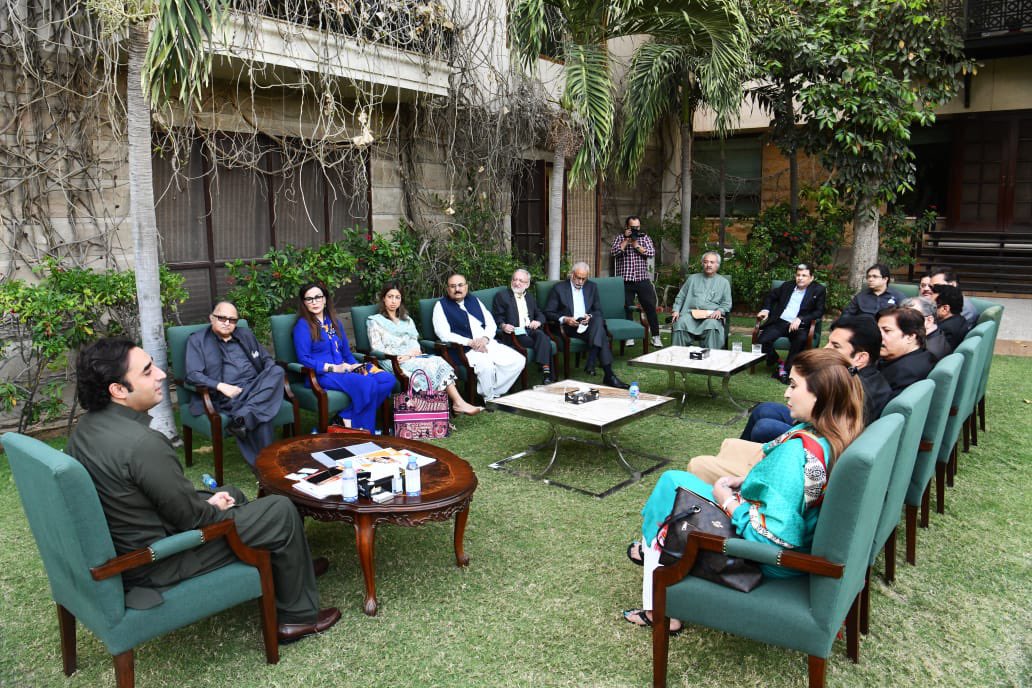
پاکستان پیپلز پارٹی کے چیئرمین بلاول بھٹو زرداری سے ملکی میڈیا کی جوائنٹ ایکشن کمیٹی کے عہدیداروں کی ملاقات

کراچی (25 فروری 2022) پاکستان پیپلز پارٹی کے چیئرمین بلاول بھٹو زرداری سے ملکی میڈیا کی جوائنٹ ایکشن کمیٹی کے عہدیداروں نے ملاقات کی اور انہیں پی ٹی آئی حکومت کی جانب سے سوشل و الیکٹرانک سمیت تمام میڈیا کو دبانے کے لیے پریوینشن آف الیکٹرک کرائمز ایکٹ (پیکا) جیسے کالے قانون اور اس جیسے دیگر قوانین جو شہریوں کی اظہار رائے کی آزادی کے بنیادی حق پر قدغنیں لگاتے


ہیں کے متعلق اپنے تحفظات سے آگاہ کیا ہے۔ 

پی پی پی چیئرمین نے وفد کو یقین دہانی کرائی کہ ان کی جماعت اپنے منشور کے مطابق آزادی صحافت کی ہر شکل اور مواد کی حمایت پر قائم رہے گی۔

 انہوں نے اپنی پارٹی کی ٹیم کو ہدایت کی کہ وہ عدالتوں کے ساتھ ساتھ سیاسی، پارلیمانی اور سماجی سطح پر ہر فورم پر مذکورہ قوانین کو چیلنج کرے۔ 

چیئرمین بلاول بھٹو زرداری نے جوائنٹ ایکشن کمیٹی کو اپنی غیر متزلزل حمایت کے ساتھ ساتھ اپنی پارٹی کی جانب سے بھی پاکستانی عوام کے ناقابل تنسیخ بنیادی، آئینی اور جمہوری حقوق کے لیے کی جانے والی مشترکہ لڑائی میں مکمل یکجہتی کا یقین دلایا۔ 

وفد میں سی پی این ای، اے پی این ایس، اے ای ایم ای این ڈی، اور پی بی اے کے سینئر نمائندے شامل تھے۔ اجلاس میں سرمد علی، ناز افرین سہگل، ڈاکٹر جبار خٹک، طاہر اے خان، شکیل مسعود، شہاب زبیری، اطہر قاضی، زاہد مظہر، اعجاز الحق، عامر محمود، حافظ طارق اور شہاب محمود نے شرکت کی۔ اس موقعے پر پاکستان پیپلز پارٹی کے رہنما شیری رحمان، شازیہ مری اور فیصل کریم کنڈی بھی موجود تھے۔

https://www.ppp.org.pk/pr/26343/


Thursday, February 24, 2022

Video Report - #Sanctions at what cost? West dials up response to #Putin's move on #Ukraine

Chinese Media Video Report - Russia-Ukraine crisis: Did US ever think about consequences of pushing a big country to the wall?

Video Report - US not in a position to lecture! China slashes US over state sovereignty remarks on Ukraine issue

Video Report - Russia attacks Ukraine: What we know so far

#Russia #Ukraine #Putin Russia's invasion of Ukraine: War has returned to Europe

Video Report - Russia invades Ukraine: How strong is the West’s resolve?

Video Report - Russia Ukraine conflict: Putin launches full-scale invasion

Video Report - ‘Putin chose this war,’ Biden says about Ukraine attack

Music Video - Tahira syed sings Ahmad Faraz - Yeh Aalam Shauq ka dekha na jaaye

Social Justice Survey Reveals Pakistan Corruption

 The Center for Social Justice (CSJ) recently carried out a survey on the social, political, and religious situation of non-Muslim groups in Pakistani society. The report was sent to Agenzia Fides and highlights four areas of concern that Christians face in Pakistan. “The fundamental rights of religious minorities in Pakistan are of great concern, as can be seen in the field of blasphemy, in religious conversions, in the implementation of labor regulations, in the educational sector”

The first area of concern deals with the “Blasphemy Law”, which is utilized to abuse Christians who take part in what the government considers blasphemy. Dozens of cases are filed against Christians with at least three people extrajudicially killed for allegedly violating this law. While the numbers may seem low, the report indicates that this number may be much higher as, “this data is not exhaustive due to the limited means and the frequency of the incidents, so the number of victims can be considerably higher.”

The second area of concern deals with the issue of forced conversion, while the third addresses the asymmetry of the most recent census results. At least 38 Christian women have been forcibly converted, and the lack of repercussions further encourages this heinous act. The census reports that the Christian population has decreased from 3.73% to 3.52%, despite the population surge. This asymmetry between population growth and Christian decline further marginalizes the Christian community and makes their plight more insignificant in the eyes of the government.

The fourth area of concern addresses the education system. The recent “Single National Curriculum” introduced by the government last year heavily focuses on Islamic teachings. “The general educational approach has brought public education closer to the religious education of madrasas, the teaching content is heavily loaded with lessons on the Islamic religion, which does not contribute to the objective of religious tolerance and social cohesion” according to the report.

The four areas of concern highlighted in this report reveal inaction by the government of Pakistan when it comes to justice for religious minorities and deliberate action to influence the youth into Islamic teachings while further repressing freedom of religion.


https://www.persecution.org/2022/02/24/social-justice-survey-reveals-pakistan-corruption/

PAKISTAN - Blasphemy, forced conversions, education system: the weak points for the rights of religious minorities

 "The fundamental rights of religious minorities in Pakistan are of great concern, as can be seen in the field of blasphemy, in religious conversions, in the implementation of labor regulations, in the educational sector": this is affirmed by a report by the Center for Social Justice (CSJ), which carries out a survey on the social, political and religious situation of non-Muslim groups in Pakistani society. Highlighting the key points of the state of rights in 2021, the CSJ, led by the Catholic layman Peter Jacob, in the report sent to Fides, focuses on four important issues for the effective realization of freedom of religion in Pakistan: abuse of blasphemy laws; the increase in forced conversions: the census of religious minorities; problems in the reform of the education system. On the first point, the abuse of the blasphemy law, notes the text, remained persistent in 2021. At least 84 people have been charged under the articles of the Pakistani penal code which constitute the "blasphemy law". Three people were extrajudicially killed, including the lynching of Sri Lankan national Priyanka Kumara in Sialkot. These figures, it is noted, are based on reported cases in the media, verified by the Center for Social Justice. "However, these data are not exhaustive due to the limited means, the frequency of the incidents, so that the number of victims can be considerably higher", reports the Center. In 2021, the highest number of cases was recorded in Sheikhupura (13), followed by Lahore (11) and Kasur (10), all districts in northern Punjab. The 80% incidence in 2021 is held by the Punjab Province. The largest number of victims of blasphemy (45) are of Muslim faith, followed by Ahmadis (25), while seven cases are recorded against Hindus and seven against the Christian community. "However, it should be remembered that Christian and Hindu minorities together represent 3.5% of the population. And the presence of abuse, threats and violence leaves serious repercussions in the life of these communities", notes the CSJ.

The organization calls on the government to approve a legislative measure that provides specific protections against the abuse of blasphemy laws and to prosecute those who make false accusations of blasphemy and/or extrajudicial executions.
The second point examined concerns the incidence of cases of forced conversions. Although the government has set up an ad hoc "parliamentary Commission", in 2021 the number of incidents increased to at least 78 reported cases (39 cases involving Hindu girls, 38 Christian girls or women and one Sikh). The highest number of cases (40) is reported in Sindh province, followed by 36 in Punjab, while one case from each province was reported in Khyber Pakhtunkhwa and Baluchistan.
According to CSJ, the surge is due to impunity which increases the likelihood of crimes against the weakest and most vulnerable. "Faced with the government's inaction, the perpetrators of these acts use the pretext of religious conversions to cover up crimes such as the abduction of girls from religious minorities", notes the CSJ.
The third point of the Report sent to Fides notes that the last national population census carried out in 2017 in Pakistan became controversial before the announcement of the final results in 2021. According to the results of the census, the population of religious minorities increased from 3 .73% in 1998 to 3.52% in 2017 (a decrease of 0.21% in 19 years). Faced with general population growth, the evolution of religious minorities is surprisingly asymmetrical. The Christian population would have decreased by 0.32%. The CSJ urges the government to postpone the conduct and formalization of the popular census until April 2023 to allow adequate preparation, with an adequate prior awareness campaign on the necessary registration. "It is necessary to remove the 'culture of secrecy' in data processing in order to build trust among all sections of the population", the report said.
The fourth and last point, which is very important, concerns the education system. The government introduced a "Single National Curriculum" for grades 1 to 5 in 2021. "The general educational approach has brought public education closer to the religious education of madrasas", it notes, while "the teaching content is heavily loaded with lessons on the Islamic religion, which does not contribute to the objective of religious tolerance and social cohesion", denounces the CSJ. Public school textbooks allegedly violate article 22 of the Pakistani Constitution, which guarantees that: "No person who attends an educational institution is required to receive religious instruction, or take part in any religious ceremony, or attend religious worship, if such instruction, ceremony or worship relates to a religion other than his own". "Students from religious minorities are deprived of the study of their own religion", and the observations made on this subject remain pending before the Supreme Court of Pakistan, recalls the report, which calls on the authorities to respect article 22 of the Constitution of Pakistan. The CSJ also notes that the "Punjab Curriculum and Textbook Board Act", amended in 2020, confuses the objectives of "public education" with those of "religious education". Moreover, the Punjab Department of School Education has announced the recruitment of 70,000 Islamic teachers, while there is a huge shortage of math, science and social science teachers. (PA) (Agenzia Fides, 23/2/2022)

http://www.fides.org/en/news/71696-ASIA_PAKISTAN_Blasphemy_forced_conversions_education_system_the_weak_points_for_the_rights_of_religious_minorities

#Pakistan: New cybercrime law threatens to to stifle social media dissent

Pakistan's new social media-related cybercrime ordinance has drawn ire from civil society activists who say the "draconian" legislation is likely to be used against government critics.
Pakistani Prime Minister Imran Khan's government recently passed a cybercrime ordinance that prescribes a punishment up to five years in jail for posting "fake news" about government officials, the military and judiciary on social media.
Human rights groups have said the Prevention of Electronic Crimes (Amendment) Ordinance 2022 is merely a tool to curb freedom of expression in the South Asian country.Khan's Cabinet adopted the ordinance swiftly after President Arif Alvi signed it over the weekend. The legislation, however, needs to be passed by the country's parliament within 90 days.Khan's government has come under heavy criticism locally and internationally for curbing free speech in Pakistan.A 2021 Reporters Without Borders report lists Khan as one of the "press freedom predators" in the world.
A move against 'fake news'?
Opposition parties have criticized the ordinance, saying the people arrested under the law will not have the right to file a bail application during the trial. "This ordinance is a violation of fundamental rights. It curbs media freedom," Shahid Khaqan Abbasi, a former prime minister and member of the Pakistan Muslim League (Nawaz group) party, told DW. But Law and Justice Minister Farogh Naseem defends the legislation as an effective way to stop "fake news" and "hate speech" on electronic and social media. "The government believes in the freedom of expression, but it also wants to end the spread of fake news," Naseem told reporters. The Human Rights Commission of Pakistan (HRCP), an independent rights organization, termed the legislation "undemocratic" and expressed concern that the law will be used to target critics of the government and state institutions.
"The government should be accountable to the citizens, and the ordinance should be rolled back immediately," it said in a statement.
https://www.dw.com/en/pakistan-new-cybercrime-law-threatens-to-to-stifle-social-media-dissent/a-60899561

Pakistan’s foreign policy must maintain a delicate balance with war clouds hovering over Europe - Improving ties with Moscow

Zahid Hussain
@hidhussain
 PRIME MINISTER Imran Khan is visiting Moscow on the latter’s invitation amidst rising tensions in a region on the brink of a full-scale military conflict that can have massive global implications. Russian President Vladimir Putin’s decision to recognize the independence of two breakaway Ukrainian territories and to send Russian troops there has turned the situation even more volatile and has increased the threat of a wider conflagration.
 The latest development there presents a serious diplomatic predicament for the prime minister as Pakistan would not like to be perceived as siding with anyone party during a possible conflict.
A Russian invasion of Ukraine could create a very challenging situation for our foreign policy officials. It would require a delicate balancing act on Pakistan’s part, given its support for Ukraine’s sovereignty and territorial integrity. The darkening war clouds in the region will cast a long shadow over the prime minister’s two-day stay in Moscow. Heightening tensions between Russia and the US in the Ukraine stand-off has further complicated the situation.
It will be the first trip to Moscow of a Pakistani leader in more than two decades and, as such, it highlights the warming of relations between the two nations in times of fast-changing geopolitics. The timing of the visit is of great importance in view of the emerging political realignment in the region.
Relations between Moscow and Islamabad have improved over the last few years and there has been increasing bilateral interaction at the senior official level. Russian Foreign Minister Sergey Lavrov visited Islamabad last April after nearly nine years.
With war clouds hovering over Europe, Pakistan’s foreign policy must maintain a delicate balance.
Besides growth in trade and economic relations, there has been a significant increase in security cooperation between the two countries. For instance, they have regularly conducted joint military exercises since 2016 and in 2018, when army chief Gen Bajwa visited Russia, they formed a joint military commission. To a large extent, these warmer ties have also been the result of Pakistan’s strained relations with the US that compelled the former country to expand its foreign policy options. This factor has led to both, deeper strategic relations with China and improvement in ties with Russia. Also, the growing US policy of confrontation with Beijing and Moscow has shaped regional realignments.
Pakistan may emphasize a position of neutrality but global developments of late, which have also included the Afghan situation after the departure of US troops, have brought it closer to the Beijing-Moscow axis.
Islamabad and Moscow have similar views on Afghanistan among other regional issues. Under the auspices of the Shanghai Cooperation Organisation, both capitals have pledged to tackle together the growing threats that emanate from the militant Islamic State in the region. It is likely that the discussions between the two leaders will focus on economic cooperation and developments in the region after the American withdrawal from Afghanistan. But the latest move by President Putin could shift the focus entirely. Moscow has not only recognized the so-called Donetsk and Luhansk People’s Republics, which were created by separatist movements in eastern Ukraine in 2014 but has also challenged the legitimacy of Ukraine itself as a sovereign nation. The tension between the two nations had been building up over Ukraine’s inclination to join the Nato alliance. Russia sees the Western plan to expand the defense treaty to eastern Europe and particularly to the former Soviet states as a deliberate move to encircle it. Moscow’s security concerns over Nato’s eastward expansion appeared to be valid.
For Moscow, it has also been a violation of an earlier understanding that the US and its Western allies would not intervene in Russia’s area of influence. The tension worsened after Russia’s invasion of Crimea and the latter’s annexation by it in 2014. But a UN resolution has rejected the annexation and considers the area to be a part of Ukraine. It also led to the imposition of some financial sanctions against Russia by the US.
The Ukrainian crisis took a more serious turn after Russia deployed thousands of troops along the Ukrainian border as fighting between the Ukrainian forces and the separatists intensified. Moscow had until now refuted the American claim that a Russian invasion of Ukraine was imminent. But President Putin’s speech on Monday has brought matters to a head, increasing the possibility of conflict. It also seems to have bridged the gap between the US and some of its Western allies who had been sceptical of President Biden’s aggressive approach towards Russia and had sought a diplomatic solution to the crisis. But the latest action has not drawn any support from the international community. America has imposed fresh sanctions on Russia with the latter’s recognition of the breakaway regions.
Such an aggressive stance by President Putin may also put Russia’s allies, particularly China in a diplomatic quandary. The two have cemented their alliance in the face of the Biden administration’s confrontationist policies towards them. President Putin and Chinese President Xi after their meeting in Beijing recently had issued a joint statement that their partnership had “no limits”. In that statement, China openly joined Russia in opposing a further expansion of Nato.
On the other hand, Beijing has also been supporting Ukraine’s sovereignty. Speaking at a security conference, Chinese Foreign Minister Wang Yi while supporting Russia in saying that Nato’s enlargement was destabilizing the continent also stressed that Ukraine’s sovereignty should be “respected and safeguarded”. The statement is certainly at variance with President Putin’s questioning of Ukraine’s right to exist as a state. Any military action against Ukraine may strain the alliance. Moreover, China is Ukraine’s biggest trading partner. Pakistan too has close relations with Ukraine with whom it has forged strong security cooperation.
Pakistan has its own place in changing geopolitical dynamics but caution is needed if the country is to safeguard its interests. Improving relations with Moscow is to be welcomed but it is also crucial that it maintains a balance in foreign ties so that it doesn’t end up favoring one side over the other.
https://www.dawn.com/news/1676596/improving-ties-with-moscow?preview

Wednesday, February 23, 2022

Music Video - Madonna - 2012 Super Bowl Halftime Show

Video - Putin: Why Good Must Always Be Frail & Helpless? Good Means Being Able To Defend Oneself

Video Report - Vice President Harris Meets with the National Black Caucus of State Legislators

Video Report - France announces Mali withdrawal after nine-year jihadist fight

Video Report - Ukraine conflict overshadows Russia's Defender of Fatherland Day

Video Report - سائبر قوانین میں ترمیم کے پیچھے اٹارنی جنرل بیرسٹر خالد جاوید کے سائے کا انکشاف

#Pakistan - Killing free speech


THE PTI government has triggered another controversy by promulgating a presidential ordinance that is a clear threat to the freedom of expression. On Sunday, Law Minister Farogh Nasim had announced in a press conference that the ordinance amended the Prevention of Electronic Crimes Act that had originally been legislated by the PML-N government in 2016.
At that time too, media and civil society organizations had protested the contents of the law and warned that it would be used to curtail the space for free speech. The PTI government has now gone many steps ahead in making this draconian law even more restrictive; its scope has been broadened to include state institutions, like the military and judiciary, as aggrieved parties. The latest amendments give the authorities the powers to arrest anyone accused of promoting or broadcasting fake news. The courts will have six months to decide whether or not the complaint is genuine but during this period the accused is liable to remain in incarceration unless given bail. This means that anyone can be arrested by the authorities on vague charges. This can lead to wild accusations resulting in random detentions.
Frustration at the government’s refusal to budge on the matter was visible yesterday when the country’s top media bodies walked out of a meeting with the information ministry. Such laws have no place in a democratic society. However, with each passing day, it is becoming increasingly clear that the PTI government is making a mockery of democratic norms. The inexplicable postponement of the session of the National Assembly by the government now makes sense — it was done so that this draconian ordinance could be promulgated, bypassing parliament. It is ironic that the government is resorting to such high-handed tactics to silence its critics when the world is moving towards decriminalising defamation as an issue. The mal-intent of the government is thinly disguised.
The raid on the house of media personality Mohsin Baig and the manner of his arrest indicates that the government intends to use Peca to hound people in this manner. Armed with these latest amendments, it can run amok and unleash a wave of repression against those who do not validate its point of view. This casts a dark shadow on the state of constitutional democracy in Pakistan and makes the citizens vulnerable to greater persecution.
The amendment is a crude attempt by the PTI government to browbeat its opponents and it must not be allowed get away with it. The opposition, media, civil society and all segments of the citizenry must exercise their democratic rights to oppose this ordinance and ensure that it is rolled back. The judiciary too must play its role to ensure that the government is not allowed to trample on the constitutional rights of citizens for its narrow vested interests. Peca is a bad law. It should not be made worse.

#Pakistan - #PPP - Rehman Malik dies due to Covid-related complications

Rehman Malik, a special intelligence agent-turned politician, tested COVID-19 positive in January, and had complained of breathing problems. Earlier this month, he was put on a ventilator.
Pakistan Peoples Party (PPP) stalwart Rehman Malik, who was the Interior Minister when 10 LeT terrorists launched a brazen attack on Mumbai in 2008, died at a hospital here on Wednesday due to coronavirus-related complications. He was 70. Malik, a special intelligence agent-turned politician, tested Covid-19 positive in January, and had complained of breathing problems. Earlier this month, he was put on a ventilator. “Deeply devastated to say that former interior minister [and] PPP’s senior leader, Abdul Rehman Malik, passed away,” Malik’s spokesperson Riaz Ali Turi tweeted on Wednesday.
“Devastated with the news of @SenRehmanMalik passing after severe covid. He was there for us during exile and remained steadfast with the party no matter the hardships. His loss will be felt deeply by us all,” former prime minister Benazir Bhutto’s daughter Bakhtawar Bhutto-Zardari said in a tweet, which was re-tweeted by PPP Chairperson Bilawal Bhutto-Zardari.
Before his entry into national politics, Malik was with Pakistan’s Federal Investigation Agency as a special agent, and was elevated to the post of the Additional Director General in 1993.During his stint as a director, he coordinated numerous successful counter-terrorist operations, including the arrest and extradition of Yousaf Ramzi to the US in 1995. Ramzi was one of the main perpetrators of the 1993 World Trade Center bombing and the bombing of the Philippine Airlines Flight 434.Malik was considered a close associate of former prime minister Benazir Bhutto and her husband Asif Ali Zardari. He served as the chief of security of Bhutto from 2004 to 2007.During the military regime of Pervez Musharraf, Malik persuaded Bhutto and exiled prime minister Nawaz Sharif to join hands against the General. The famous Pact of Democracy agreement between PPP and PML-N was signed by Bhutto and Sharif at Malik’s house in London. He also facilitated reconciliation between the PPP and then-military president Musharraf, and the National Reconciliation Ordinance was issued.
When the PPP government was formed after the 2008 general elections, Malik was appointed Advisor to the Prime Minister on Internal Affairs. He was later given the portfolio of Interior Minister by the then Prime Minister Yousaf Raza Gilani.During the PPP government, he was awarded Sitara-e-Shujat – one of the highest civilian awards in Pakistan. He also received the Nishan-e-Imtiaz.
https://indianexpress.com/article/pakistan/rehman-malik-dead-former-pak-minister-covid-complications-7787591/

#Pakistan #PPP - Youth ready to confront the selected: Bilawal

Pakistan People’s Party (PPP) Chairman Bilawal Bhutto Zardari said that new generation was ready to confront the selected.
Addressing the convention organised by the People’s Students’ Federation (PSF) here at the Arts Council on Wednesday, the PPP chairman said that it was high time that youth should assume the leadership role in the country.Bilawal said that it was the prime time for the young people to lead the country from the front against the decayed and frustrated elements having no sanity and sense of responsibility. He said the PSF office-bearers and workers had, through years of unshaken and nerve-writhing struggle, had secured the right to form the student union that had been snatched in the past by dictator Ziaul Haq.
He said that late Benazir Bhutto in her first term had restored the student unions along with the labour unions, but under a conspiracy the government of Bhutto was toppled and the government that followed again imposed ban on student unions. He said that PPP was not the party of landlords and ‘peers.’
He said that Pakistanis got this country not as a result of any war or violence but as a result of a peaceful democratic struggle under the leadership of Quaid-i Azam Muhammad Ali Jinnah. Quaid-e-Awam Shaheed Zulfikar Ali Bhutto gave the precious gift to the nation in form of democracy. The PPP chairman was of the view that the biggest atrocity against the youth of this country was that an attempt was made to suppress their voice. He lamented that the young people were not allowed to talk about their own problems. “Some frustrated elements are predominantly obsessed with a negative idea that country's youth should not be involved in mainstream politics. “We wonder why there is so much violence and barbarism in our society. The politics of religion and ethnicity get space because student unions were banned,” he said.
By banning student politics for their own benefit, some elements not only harmed the youth of country's academic institutions such as colleges and universities but also inflicted irreparable loss to the society, he commented.
He said that the ever-escalating fee graph of educational institutions was visible to everyone. The way the state was being run, and graduates were being deprived of job opportunities, the students would now speak and draw attention to such issues. The PPP chairman said that cases of harassment were being reported from educational institutions, but it was a great injustice that those cases would be investigated by those who belonged to the same institution as they won't do justice at all.
"Student unions are our first step, and when the students are organised, they will fight for the solution of their problems, but if there is a PPP government, you will run the government yourself," he said.
https://www.thenews.com.pk/print/934337-youth-ready-to-confront-the-selected-bilawal

وزیراعظم کے خلاف تحریک عدم اعتماد کے لیے 3 جماعتوں نے کمیٹی تشکیل دے دی

وزیراعظم کے خلاف تحریک عدم اعتماد کے معاملے پر اپوزیشن کی تین بڑی سیاسی جماعتوں نے9 رکنی کمیٹی تشکیل دے دی، کمیٹی وزیراعظم کے خلاف تحریک عدم اعتماد لانے کا حتمی لائحہ عمل طےکرے گی۔

ذرائع کا کہنا ہے کہ کمیٹی میں ن لیگ، پی پی پی اور جے یو آئی ف کے تین تین رہنما شامل ہوں گے، مسلم لیگ ن کی نمائندگی خواجہ سعد رفیق، سردار ایاز صادق اور رانا ثناء اللّٰہ کریں گے۔

ذرائع کا کہنا ہے کہ پیپلز پارٹی کی نمائندگی یوسف رضا گیلانی، راجہ پرویز اشرف اور سید نوید قمر کریں گے۔

ذرائع کا کہنا ہے کہ جے یو آئی ف کی نمائندگی مولانا اسعد محمود، اکرم درانی اور سینیٹر کامران مرتضیٰ کریں گے، اپوزیشن کی 9 رکنی کمیٹی کا اجلاس جلد از جلد منعقد ہوگا۔

کمیٹی کے اجلاس میں عدم اعتماد لانے سے متعلق حتمی اقدامات طے ہوں گے، حکومتی اتحادیوں اور ارکان سے رابطوں کا طریقہ کار اور حکمت عملی بھی طے ہوگی۔

ذرائع کا کہنا ہے کہ کمیٹی حکومت سازی سمیت دیگر امور کو بھی حتمی شکل دے کر منظوری کے لیے پیش کرے گی۔

https://jang.com.pk/news/1054107


Tuesday, February 22, 2022

Video Report - #UKRAINE - Is Putin's latest move a prelude to a wider conflict? | Inside Story

Video Report - 'The language of war': Borger reacts to Biden's speech about Ukraine

Video Report - #Trump Called Putin’s Ukraine Strategy ‘Savvy’ and ‘Genius’

Video Report - President Biden Provides an Update on Russia and Ukraine - Feb 22, 2022

Video Report - #Ukraine #NATO #Russia Ukraine crisis: which sanctions are the EU and the US now imposing on Russia? Feb 22, 2022

Pashto Music Video - Sehrish Khan | Sada Janan

Video - Imran Khan's Russia Visit Despite Serious Reservations From Powerful Quarters

To Preserve Its Own Stability, Pakistan Must Stabilize Afghanistan First


 By Salman Masood and Zia ur-Rehman

Analysts say that the Taliban takeover has sparked a spike in terror attacks that have put the Pakistani government in a difficult position as it tries to support Afghanistan’s new government.
The euphoria felt by many in Pakistan over a Taliban victory in Kabul six months ago is subsiding. The government had hoped that a friendly — some would say proxy — regime in Kabul would ease its concerns about the Pakistani Taliban.
But instead, there has been a spike in terror attacks in recent months, which Pakistani officials say were planned by militants hiding inside Afghan territories.Still, senior Pakistani civil and security officials remain sanguine about the future, or, at the very least, stress that a stable Afghanistan is essential for a stable Pakistan. It’s a position that puts Pakistan in a tight corner: The country must continue to help the new Taliban government, while also contending with the growing security and economic risks to Pakistan that have come with the new regime.
“Is there a chance that if the Taliban government is squeezed, there could be a change for the better? No.” Prime Minister Imran Khan of Pakistan said in an interview with CNN earlier this month. He stressed that the world will also eventually have to deal with the Taliban for the lack of a second or better alternate.
“So the only alternative we have right now is to work with them and incentivize them for what the world wants: inclusive government, human rights and women’s rights in particular,” he added.
So far, however, the government’s efforts for the diplomatic recognition of the Afghan Taliban and calls for more global financial assistance have yielded few results. Pakistan itself not diplomatically recognizing the Afghan Taliban shows the dilemma the country faces.
Pakistan witnessed a 42 percent increase in terrorist attacks in 2021 compared to the previous year, according to the Islamabad-based Pak Institute of Peace Studies, with a significant surge after Kabul fell. The report noted that the fall of Kabul had started adversely influencing the country’s militant landscape and security, saying the change in Afghanistan is “not helping in any way Pakistan’s efforts to deal with the militant groups threatening its security.”
The institute documented that the Pakistani Taliban, or Tehrik-i-Taliban Pakistan, a banned militant group responsible for some of the country’s worst terrorist attacks, alone was responsible for 87 attacks that killed 158 people, an increase of 84 percent relative to 2020.
Until late 2020, the Pakistani Taliban seemed considerably weakened, its top leadership killed or pushed into Afghanistan after a Pakistani military offensive in 2014. But alongside the Taliban’s takeover of Afghanistan, the insurgency has made a comeback, and is using its resurgence to instill fear in Pakistani traders, government officials and law enforcement.
Using telephone numbers starting with the Afghanistan international dialing code, the Pakistani Taliban have been calling and threatening affluent Pakistani traders to pay extortion money.
“Traders have been forced to pay huge amounts of extortion money because of fear,” Muhammad Azam, a Karachi-based trader, who says he paid around $2,850 last month to the terror outfit.“If a trader refuses to pay it, the militants detonate small bombs near their homes to frighten them into succumbing to their demands. If they continue to refuse payment, militants harm them or their family members,” Mr. Azam said.Such threats have also extended to senior government officials, many of whom say they pay because they fear being attacked at political rallies or during other public events — as has been the fate of senior political leaders in the past.
One senior federal government minister, hailing from Khyber Pakhtunkhwa Province, said he recently paid a few million rupees to the Pakistani Taliban to avoid being attacked. Another official, who spoke to The Times on the condition of anonymity because of security fears, said when he refused to pay, a militant threatened him in person.
Police officers, particularly those protecting polio vaccinator teams, have been a key target of such attacks. In 2021, militants, mainly belonging to Pakistani Taliban, killed 48 policemen and injured 44 others in Khyber Pakhtunkhwa Province alone, according to police statistics. Much of the violence occurred in the last few months of the year.
Despite repeated attempts, Pakistan has been unable to get firm guarantees from the Afghan Taliban that they would take action against the Pakistani Taliban operating in Afghanistan. The worsening security situation was one of the top agenda items in talks between Taliban authorities and Moeed Yusuf, the Pakistani national security adviser, when he visited Kabul last month.
The Afghan Taliban are “committed to taking necessary steps to ensure that Afghan soil is not used for attacks against Pakistan,” Mr. Yusuf said in an interview with The New York Times, adding that Pakistan “will continue to extend humanitarian assistance to Afghanistan, and engage with the Taliban on matters of mutual interest and concern within the internationally permissible framework.” Analysts also note that Pakistan’s economy has been hurt by the situation across the border, as millions of American dollars are reportedly smuggled over the border per day. To mitigate this, the State Bank of Pakistan in October limited the amount of U.S. dollars travelers are allowed to take to Afghanistan.
One of the upsides for Pakistan of the collapse of the former Afghan government has been the damage it did to India’s second front against Pakistan, according to said Asif Durrani, a former Pakistani ambassador to Afghanistan and Iran.Pakistani officials had long accused India of supporting terrorism in Pakistan through Indian consulates inside Afghanistan, with the support of the former Afghan government’s intelligence agency. After the Taliban takeover, Pakistani officials say that the Indian footprint has been diminished, though they still blame India for funding the Tehrik-i-Taliban Pakistan and Baluch separatists groups. This has been particularly acute in southwestern Baluchistan, a natural gas and mineral-rich province and the site of major Chinese projects. On Jan. 27, the Pakistani military said 10 of its soldiers were killed in a firefight in the Kech district of Baluchistan Province. Less than a week later, more than a dozen suicide attackers, heavily armed with rocket launchers and sophisticated weapons, attacked two Pakistani paramilitary camps in the remote districts of Panjgur and Naushki along Pakistan’s southern border with Iran and western border with Afghanistan.
“The Baluch insurgents are also drawing strength from the Taliban’s example of defeating the United States, and the T.T.P. has been helping them with training and tactics for some time,” said Asfandyar Mir, a senior expert at the United States Institute of Peace, referring to the Pakistani Taliban. “With Afghanistan more permissive to the T.T.P., Afghanistan-based Baluch insurgents — despite losing the patronage of the former Afghan government — still have help in Afghanistan.” Senior security officials in Islamabad also say they are mindful of the capacity issues of the Afghan Taliban, who don’t have total control over all of their members. Some low-level Afghan Talibs, they say, maintain their links with the Pakistani Taliban, a fact recognized by the senior Afghan Taliban leadership who acknowledge their shortcomings and resolve to allay Pakistan’s concerns.
Some analysts, however, warn that Pakistan is overreaching in its optimism and hopes placed with the Afghan Taliban.
“The ideological convergence between the Afghan Taliban and the T.T.P. terrorist network is inescapable,” said Mosharraf Zaidi, an Islamabad-based policy and security analyst. “Combined with the allure to explicitly support Pashtun nationalism, this ideological convergence between Kabul and the T.T.P. terrorist network means that the Taliban are not aligned with Islamabad on two key security issues.”
Pakistan, Mr. Mosharraf said, now has largely the same Afghanistan on its border that it did before August 2021, when Kabul fell, but with one profound difference. “It no longer has a capable counterterrorism partner, à la the U.S. government, to work with.”
Other commentators second this assessment.
Ironically, Pakistan, which supported the Taliban against the United States and has been batting for the movement’s international recognition since August 2021, is the first country to charge that, under the new Taliban government, Afghan territory is being used for international terrorism, Mr. Mir said. Pakistan made the accusation after T.T.P. militants firing from inside Afghanistan killed five Pakistani soldiers at a border post in northwestern Kurram district on Feb. 6.
Mr. Mir added: “The hollowness of the Afghan Taliban’s counterterrorism guarantees has become apparent in their treatment of the Pakistani Taliban.”
https://www.nytimes.com/2022/02/22/world/asia/pakistan-afghanistan-taliban.html#commentsContainer

Pakistan Faces ‘Peace of Wolves’ as Regional Tensions Rise

By Lynne O’Donnell
After 20 years of supporting the Taliban in Afghanistan, Pakistan finds the tables are turning as militancy comes home.
Complex, simultaneous attacks on two regional Pakistan Army headquarters in remote Balochistan have focused attention on the capacity and audacity of homegrown militant groups emboldened and even enabled by the victory of the Taliban in neighboring Afghanistan.
The assault on the paramilitary headquarters in Panjgur lasted three days, and the one in Nushki a day, and coincided with Pakistani Prime Minister Imran Khan’s visit to Beijing for the Olympics opening ceremony and talks with Chinese President Xi Jinping. A senior Pakistani official, speaking anonymously, said 22 attackers and 13 soldiers were killed in the Feb. 2-5 attacks, which were claimed by Baloch separatists. Sources in Pakistan—including officials and diplomats who spoke on condition of anonymity—were alarmed by the sophistication and capability on display in the attacks. The Baloch Liberation Army had also claimed an attack a few weeks earlier.
The resurgence of domestic terrorism in Pakistan is a bitter, but not unexpected, harvest for Islamabad, which spent the last two decades supporting the Taliban in Afghanistan, only to see the latter’s eventual success boomerang and undermine Pakistan’s own security. Pakistan now accuses the Taliban in Afghanistan of harboring militant groups that seek the overthrow of the Pakistani state. Militant attacks have increased alarmingly since May 2021, coinciding with the Afghan Taliban’s ultimately victorious offensive, according to the Pakistan Institute for Conflict and Security Studies (PICSS). It noted the deadliest month for attacks in Pakistan was August, when the Afghan Taliban retook power in Kabul.
PICSS counted 294 attacks in Pakistan last year—a 56 percent rise over 2020—resulting in 395 deaths and more than 600 wounded. It said 104 of those attacks happened in Balochistan, with 103 in the restive tribal districts of Khyber Pakhtunkhwa. Both share borders with Afghanistan; Balochistan also borders Iran.
The Tehrik-i-Taliban Pakistan (TTP), which has long had ties to the Afghan Taliban, was driven into Afghanistan’s eastern provinces from the North and South Waziristan tribal areas in Pakistan Army operations in 2014 and 2015. The United States Institute of Peace last year described the TTP as a “greatly diminished force but not a toothless one” and added that its “relationships with other militant groups—particularly the Afghan Taliban, al-Qaeda, and ISK [the Afghanistan chapter of the Islamic State]—have been critical in providing the group with material benefits, as well as legitimizing its ideology.”
And the fall of Afghanistan—once meant to provide Pakistan with “strategic depth”—has directly impacted Islamabad’s own security. The departure of U.S. and international forces and the collapse of the Afghan republic meant drone strikes and ground operations against the TTP in Afghanistan ceased in the middle of last year. The United Nations Security Council puts the number of TTP militants in Afghanistan at 3,000-5,000.
But Pakistan’s woes aren’t just due to the fall of the Afghan republic. Domestic militant threats are expected to intensify amid a toxic cocktail of economic deprivation, social marginalization, heavy-handed security, ethnic nationalism, and tribalism. Across the country, attacks are on the rise. Baloch and Pashtun nationalists are chafing against forced disappearances, extrajudicial killings, and tight media controls. There’s also the perception that big Chinese investments, especially in Balochistan, under the guise of the China-Pakistan Economic Corridor aren’t trickling down. The senior Pakistani official attributed the early February attacks in Balochistan to ire over China’s economic and financial stranglehold on Islamabad. “The aim was to downgrade the relationship with China,” the official said.
“In any other country, including my own, these attacks would be called civil war,” said a Western diplomat, who spoke on condition of anonymity. “Things are getting worse, but will it explode? No, and for no other reason than that the military is there.” The Pakistan Army is entrenching its control over the civilian administration, courts, media, and civil society, justifying its actions with traditional anti-India rhetoric as well as the uptick in homegrown terrorism.
https://foreignpolicy.com/2022/02/22/pakistan-taliban-terrorism-militant-groups/

تحریک عدم اعتماد پر غور، شہباز شریف، آصف زرداری ملاقات کا مشترکہ اعلامیہ سامنے آگیا


اپوزیشن کی دو بڑی جماعتوں مسلم لیگ (ن) شہباز شریف اور پیپلز پارٹی کے آصف علی زرداری کی ملاقات کا مشترکہ اعلامیہ سامنے آگیا۔

بلاول ہاؤس لاہور میں ہونے والی اپوزیشن کی اہم سیاسی بیٹھک میں بلاول بھٹو زرداری، جے یو آئی (ف) کے اسعد محمود بھی موجود تھے۔

ملاقات کے اختتام پر طے پایا کہ آصف علی زرداری، شہباز شریف، مولانا فضل الرحمان اور بلاول بھٹو کل ایک بار پھر سیاسی بیٹھک لگائیں گے۔

مشترکہ اعلامیے کے مطابق اپوزیشن قیادت کی اگلی ملاقات میں اپوزیشن کی تینوں بڑی جماعتوں کی قیادت کل دوپہر شہباز شریف کی رہائش گاہ پر مل بیٹھے گی۔

اعلامیے کے مطابق آصف زرداری اور شہباز شریف کی ملاقات میں رہنماؤں نے حکومت کے خلاف تحریک عدم اعتماد کے حوالے سے اہم گفتگو کی۔

مشترکہ اعلامیے کے مطابق قائدین میں تحریک عدم اعتماد سے متعلق فیصلہ کن اقدام پر اہم مشاورت ہوئی۔

اعلامیے کے مطابق قائدین نے اتفاق کیا کہ مہنگائی کی آگ عوام کے گھر جلارہی ہے، حکومت کو گھر بھجوا کر عوام کو اس ظلم سے بچایا جاسکتا ہے۔

مشترکہ اعلامیے کے مطابق قائدین نے اتفاق کیا کہ عوام کی خواہشات پوری کرنے کے لیے تندہی سے کام کریں گے اور جلد رزلٹ دیں گے۔

اعلامیے کے مطابق اپوزیشن قیادت کی اس ملاقات میں فسطائیت اور آمریت کو پیکا ترمیمی قانون کا نام دیا گیا۔

مشترکہ اعلامیے کے مطابق قائدین نے اتفاق کیا کہ میڈیا اور اظہار رائے کی آزادیاں چھیننے والے حکمران سے اقتدار چھین لیں گے۔

اعلامیے کے مطابق ملاقات میں اپوزیشن قیادت نے ملک میں بڑھتی بے امنی اور لاقانونیت پر تشویش کا اظہار کیا۔

مشترکہ اعلامیے کے مطابق حکومت عوام کی جان ومال اوربنیادی ضروریات پوری کرنےمیں ناکام ہوچکی ہے۔

https://jang.com.pk/news/1053698