Thursday, February 17, 2022
Pakistan struggles to quell violence on its Afghan border
The Lahore High Court is a part of the history of Pakistan where Shaheed Zulfikar Ali Bhutto was denied a free trial – Chairman PPP Bilawal Bhutto Zardari

https://www.ppp.org.pk/pr/26300/
Wednesday, February 16, 2022
Pakistani Journalist Arrested, Booked Under Terrorist Act Over Remarks Against Imran Khan

Addressing students convention in Karachi, PPP Chairman Bilawal Bhutto Zardari calls for restoration of student unions in every province like Sindh

He was speaking at a mammoth students convention under the aeges of Sindh People’s Student Federation (SPSF) at Karachi Arts Council Auditorium.
He said the SPSF office-bearers and workers had through years of unshaken nerve-writhing struggle taken the right to form a union of which they had been deprived by was dictator Ziaul Haque.
Bilawal Bhutto Zardari said that Shaheed Mohtarma Benazir Bhutto in her first term had restored the student unions along with the labour unions, but under a conspiracy the government of Shaheed Mohtarma Benazir Bhutto was toppled and the government that followed imposed ban on student unions.
The PPP chairman said that any 18-year-old could participate in the election of the Prime Minister, meaning he could choose the Prime Minister of the country, be prepared to fight in war situations, by taking up arms against India but when it comes to choosing his own representative, he has no choice left for a change.
He said that Pakistanis got this country not as a result of any war or violence but as a result of a peaceful democratic struggle under the leadership of Quaid-e Azam Muhammad Ali Jinnah. Quaid-e-Awam Shaheed Zulfikar Ali Bhutto gave the precious gift to the nation in form of democracy and gave every citizen the right to vote.
He was of the view that the biggest atrocity against the youth of this country was that an attempt was made to suppress their voice.
He lamented that the young people aren’t allowed to talk about their own problems. Some frustrated elements are predominantly obsessed with a negative idea that country’s youth shouldn’t get involved in mainstream politics.
They are the advocates of zero politics in universities as if doing politics is either a bad taboo or a crime.
“Doing politics is the right of the youth and doing politics is their most powerful weapon.”
He said that the youth with right to vote and do politics is more powerful than tanks and armored vehicles because he can change the entire scenario which tank can’t.
The PPP Chairman Bilawal Bhutto Zardari said that we wonder why there is so much violence and barbarism in our society. The politics of religion and ethnicity get space because student unions were banned.
By banning student politics for their own benefit, some elements not only harmed the youth of country’s academic institutions such as colleges and versities but also inflicted irreparable loss to the society.
He said that the ever escalating fee graph of educational institutions is naked to all eyes. The way the state is being run, and graduates are being deprived of jobs opportunities instead of creating job opportunities, the students will now speak and draw attention to such issues.
The PPP chairman said that cases of harassment are being reported from educational institutions, but it was a great injustice that those cases would be investigated by those who belonged to the same institution and they won’t do justice at all.
He said that the fees graph is forced to be higher without taking the students on board. They also face similar injustice with regard to imposition of same curriculum is imposed across the country.
“Student unions are our first step, and when the students are organised, they will fight for the solution of their problems, but if there is a PPP government, you will run the government yourself,” he added.
Bilawal Bhutto Zardari said that since he took over the organisational responsibility, the PPP’s priority is the public health system. Despite limited resources, it has created world-class institutions in the field of health.
He asserted his dream to establish more institutions like NICVD and Gombat in the field of health. We will also equally work in the field of education.
He pointed out that most of the universities in the country were established during the PPP government. We will work harder and strive for 100 percent free of cost education in future government educational institutions. Though, not possible to achieve this target overnight but since we are dynamic young people so we will try hard for it. Our goal is to establish at least one university or campus in each district over the next five years.
Highlighting his party’s future plans, he said his government would set up youth centers in every district, providing space for cultural and sports activities as well as career counseling. Students work hard to get a degree, but then they need career counseling.
He said that history has shown that PPP always provided employment. The actions of Quaid-e Awam Shaheed Zulfikar Ali Bhutto are part of
history, while for Shaheed Mohtarma Benazir Bhutto, she
was famed that she would come and bring employment.
He said that the role of students in the struggle against Yahya Khan or dictator Zia has been historic and exemplary. The purpose of depriving the students of their rights was simply that some elements want to see a non-political society in the country. So that it will be easy to control this society. Today, due to the selected government, which has led to skyrocketing inflation, unprecedented unemployment rate, increase in fees of educational institutions is talk of the town while country’s foreign policy has been compromised and this has opened a venue for the youth for struggle against it. Part of the unfinished mission of Quaid-e Awam Shaheed Zulfikar Ali Bhutto and Shaheed Mohtarma Benazir Bhutto has been completed in the form of revival of Students Union.
He said that it was being propagated all over the country that the PPP needed feuds and elites, while they did not know that the
PPP was in fact a party of the SPSF. The fact is that the feuds need PPP, instead.
He said that February 27 march of the party will carry the demands for restoration of students union all over Pakistan.
https://www.ppp.org.pk/pr/26297/
Tuesday, February 15, 2022
#Pakistan - Editorial: With yet another lynching, the state must realise futility of quick fixes to combat extremism -

https://www.dawn.com/news/1675164/what-have-we-become
The life of slavery of Pakistani women who are forced to 'marry' the Quran
Marrying a woman to the Quran is an abusive practice in Pakistan's southern province, Sindh. Many feudal lords wed their daughters or sisters to the Quran to renounce their inheritance rights. One 'Bride of Quran' shares her story.Some can’t take it and go mad. Others become apathetic and slowly fade away. Most live a nightmarish life, trapped in the hellish web of an inhumane tradition. These girls are waitresses, child minders and slaves born to serve the family. They are the “wives of the Quran”, Pakistani girls whose lives have been mortgaged by their families: instead of marrying men, they are forced to “marry” the Holy book of Islam, the Quran. They learn its contents off by heart and have to hang the text around their wastes with a cord. They live segregated lives and no boy that is older than 14 is allowed to approach them. A life sentence they have no say in. The tradition, known as the “Haq Bakshish”, literally means “renouncing the right to marry”. It is an ancient and cursed tradition that is still widely practiced in the Sindh province and in some parts of the Punjab in Southern Pakistan. Arabic international newspaper Asharq Al Awsat says that in 2007 there were an estimated ten thousand Quran brides in Sindh. The roots of this tradition are economic more than religious. This is explained further in a 2011 US Department of State report on human rights in the world. It said that this practice is prevalent among the families of big landowners. When a suitable husband cannot be found for a daughter or a sister among the members of extended family (cousins and uncles, Ed.), then it is preferable to keep the girl cooped inside the family home than divide the land, giving a portion of it to the girl as a dowry and letting her marry an outsider. This keeps her portion of the land within the family and under the protection of her father or brother. Under Pakistani law the Haq Bakshish tradition is punishable by a seven-year prison sentence, but no one dares report such cases. This is partly due to the fact that the families involved belong to the Sayyid caste, which claims its members are direct descendants of the prophet Mohammed. These pure-blooded Muslims are often leaders of institutions. This is why Quran brides are hidden away, making it impossible to get official numbers.Very rarely some cases do come to light. For example, in 2011 a 28-year old couple, Fahad Amin and Shahnila Naz, married against the parents’ will and held a press conference in Lahore speaking out against the death threats they received for violating the Haq Bakshish code.“Half the women in my family,” the girl told the Daily Times, are married to the Quran. They are treated worse than servants and are forced to look after children and animals. One evening all of my family came to my room, sat on my bed, opened the Quran and said: ‘Here is your husband.’ I managed to escape; I got to Fahad and we got married in a court. But they are threatening me, I’m scared….” It is not known what happened to the rebel couple in the end.
https://www.ucanews.com/news/the-lives-of-pakistans-brides-of-the-quran/68919#
Pakistan’s all-powerful military to determine Imran Khan’s fate


Monday, February 14, 2022
Fearing persecution in Pakistan, Hazara youths undertake perilous journeys to Australia, Europe


https://theprint.in/world/fearing-persecution-in-pakistan-hazara-youths-undertake-perilous-journeys-to-australia-europe/831921/
#Pakistan #PPP - Any tinkering with the present Constitutional frame will have disastrous effects on the Federation – Senator Mian Raza Rabbani
PRESS RELEASE
Senator Mian Raza Rabbani, Former Chairman Senate, has issued the following press release;
The proverb, “a bad workman always blames his tools” or in Urdu “naach na jaane angan tedha” is the call of the Government as it has failed to implement it’s election theme of Change or Tabdeeli.
The attack on the 18th Amendment and Parliament as a stubble, reflects a autocratic, centrist mind set. It also exposes the hands behind the debate on a Presidential form of government, like the Ayub era for which admiration has been shown by the PTI.
It is incorrect to say that Parliament or the Senate has stood in the way of legislation. The Government has bulldozed Bills by overriding rules, brining supplementary Orders of Day and horse trading. Following a foreign agenda of colonisation of Pakistan, all Bills of subjugation to the IMF were passed but legislation for the people cannot be, the reason being the lack of political will of the Government.
How has the 18th Amendment and Parliament stood in the way of the Government to deal with and bring before law the various Mafias, cartels and hoarders? The Government has failed because it supports cronyism.
How has the 18th Amendment or Parliament prevented the Government from controlling the record price hike, corruption, depreciation of the Rupee, delayed decisions on the import of gas etc.
As the day of Judgment draws near the Government is trying to find whipping boys to place their failures on at times it is the bureaucracy which is not taking decisions.
At times it is the Judiciary which is creating obstacles in the way of the Government, and now;
The 18th Amendment and Parliament. No institution functioning under the Constitution or the Constitution itself has been spared to cover for the collective failure of the political Government.
The 18th Amendment and Parliament is the life line that holds the Federation. Any attempt to roll back the 18th Amendment will give rise to extreme movements of nationalism and even federalists, can raise the slogan, let the provinces collect all the taxes and the Federation place its expenditures before the provinces, which verify and meet them.
Any tinkering with the present Constitutional frame will have disastrous effects on the Federation.
(SENATOR MIAN RAZA RABBANI)
https://www.ppp.org.pk/pr/26262/
Sunday, February 13, 2022
Did PTI fail? Khan must now step down of the container and deliver...

By Usman TorwaliFrom the very beginning, Imran Khan seemed to have a visionary outlook towards the development of the nation and country. The sincerity and determination reflected in his speeches and the novel slogan of change in Pakistani politics, attracted the masses, entrusting him with a government to change things. Soon the practicability of the Khan’s motto entangled by different elements proved less progressive and more retrogressive, as more and more support suffering was inflicted on the masses. Did it result from the incompetency of leadership or structural barriers posed hindrances to the implementation of programs? Whatever might be the case Khan’s government is stumbling is likely to be dropped out of the arena in the next general elections. Why is it so? Maybe Khan’s attitude towards government or rather politics. It perhaps is now revealed upon Mr. Imran Khan that running a government is far more difficult an activity than standing on a container and criticizing the then government. Mobilizing people and staging protests against the then government was fruitful if to suppose so, but continuously degrading the moral by repeatedly passing immoral phrases against the political rivals has done irreversible harm to Pakistani politics. The fierce claims of ridding off corruption, nepotism, and favoritism from the personnel and institutions in the country have also proved mere a political point-scoring tool for the triumph in the general elections – as no solid goals have been achieved so far. Citizens and especially workers of the PTI are also left with no choice except to keep their lips closed when and if there is any opposition to the ruling party. Being the valiant soldiers of PTI, how would have they swallowed criticism over their party and leaders! Three years have passed but the citizens have not witnessed changes anywhere in the country. The economy is shambling, the foreign policy is shattered, the national security is compromised, poverty and unemployment soaring up above unbelievable levels. The leisure, wealth, and prestige of the corrupt and criminal elites are the same. The taxation system is one that prevailed before the government. The bureaucracy, Police, and NAB-like institutions are unreformed, not unpoliticized, and not even budged in their operative fields. The autonomy of Media, Journalists and other civil society members has been put in the pocket of PEMRA. Still and all, the hard county moves on under the leader on the container. Will he step down in the last and perhaps in the defeating stage? Perhaps No. Well, time and bosses decide fate. But still, Khan should have a bit of leverage of the masses’ support, which is rapidly vanishing. The continuous deterioration of citizens’ security also leaves one flabbergasted. How a rational being can shut his eyes to the onslaught of humankind. Be that poverty, extremism, terrorism, or other security-related matters. The citizens are done of all these. As apart from the rising cases of violence, prevalent in the religious circles, against the minorities there are rampant abuses against women and girls that have been consecutively increased in the past three years in the PTI government. According to the World Report 2022 “Violence against women and girls—including rape, murder, acid attacks, domestic violence, and forced marriage—is endemic throughout Pakistan. Human rights defenders estimate that roughly 1,000 women are killed in so-called honor killings every year.” Another report issued by the World Economic Forum says, “Pakistan ranks 153 out of 156 nations on the Global Gender Gap 2021 index.” The unpopular single national curriculum education policy is also a slap on the face of national integration. Introducing SNC to such a diverse and heterogeneous population is not going to work in the long term: but despite the strong opposition from different circles the incumbent government imposed it. Another hallmark of the PTI’s achievements is undemocratization and centralization. Again and over again presidential ordinances have been promulgated while parliament is sidelined. To the common masses, this might not make any sense but there is little democracy since the ordinances have by far outnumbered laws passed by the national assembly. This attitude is again demonstrated in repeatedly resorting to the debate of presidential setup, which the current government holds fit for the country. Along with all these self-destructive policies of the PTI, there is a naïve and apathetic attitude towards the provincial governments in the top leadership. Mr. Buzdar and Mehmood Khan have long been proved the most incompetent boys but still are cherished by the PM. In the past three years, one big thing that has been seen and experienced everywhere is the reluctance of Imran Khan. Be that is related to the provincial top boys, implementing a national policy, rising inflation, the EVMs, or in meeting with the opposition leader. There is reluctance on the part of Imran Khan. Even the constitutional methods have been ignored.
https://en.humsub.com.pk/3604/did-pti-fail/Khan must now step down of the container and deliver what he had promised before the elections. The ongoing presidential system debate has no realism as the PTI cannot afford the amendment procedure. Abreast with that, there is also a legal limitation to the presidential setup. It is a futile debate just to divert and distract citizens from the problems at hand. Moreover, there is very little time left for anything worthwhile to be done for keeping the party image and unity intact. The PTI is stranded in the waters. It seems from different sources that the party has lost its connections with the establishment as well. So, it can be concluded that PTI is struggling to win an already lost game.
#Pakistan - PTI and the bitter IMF pill

By Abdul Rauf Shakoori & Huzaima Bukhari
The government must introduce economic reforms and focus on privatisation and exploration of new avenues for taxation.
In 2019, the government led by Pakistan Tehreek-i-Insaf (PTI), reached the brink of a severe fiscal crisis through its indecisiveness and lack of control. Despite tall claims to the contrary, Prime Minister Imran Khan travelled to the United Arab Emirates to meet the International Monetary Fund’s chief and assured her of his government’s commitment to undertake structural and governance reforms.
Responding to the rescue call, the IMF approved a programme for Pakistan in July 2019, through which the crisis was averted and the government managed to partially stabilise the economy.
Accordingly, IMF’s Executive Board approved a $6 billion Extended Finance Facility (EFF) for Pakistan. Since then, the IMF-Pakistan relationship has moved through several phases. At times, the disbursement was delayed due to non-performance of commitments by Pakistan. These delays reflected badly on the national economy.
The conditions of the IMF’s programme and a letter of intent signed by Dr Abdul Hafeez Shaikh, the advisor to the prime minister of Pakistan, and Reza Baqir, the governor of the State Bank of Pakistan (SBP), required Pakistan to undertake numerous strategic, technical and transactional changes. However, on some review intervals, Pakistan failed to initiate the reforms as agreed.
The IMF has always emphasised maintaining a prudent monetary policy that should be reflective of real interest rates, rebuilding external buffers through natural means like bolstering exports and at the same time allowing exchange rate flexibility. This is because previously the exchange rate was allegedly managed through significant forex interventions, which contributed to imbalances on the external front.
In parallel, interest rates were kept low to support the local economy. However, this triggered consumption and import-driven growth, which added fuel to the fire of external imbalance and government’s reliance on local and international borrowing channels.
Currently, Pakistan is facing a challenge on account of debts. In the fiscal year (FY) 21, they rose to 100.3 percent of the gross domestic product (GDP). Pakistan’s gross external financing needs in FY 23 and FY 24 are estimated to be around $77 billion. Given the deteriorating current account balance, the situation is getting more complicated.
Pakistan therefore needs to work on increasing its exports, to explore new markets and must focus on technological advancements. Currently, the goods offered by Pakistan remain at the southern end of the global value chain.
Although Pakistan has signed free trade agreements (FTA) with China, Sri Lanka and Malaysia, and has preferential trade agreements with Iran, Indonesia, and Mauritius, except for China, not one of these countries falls in the category of main importers of Pakistan’s products.
According to the IMF report, in FY 2021 trade with the United States, United Kingdom, Afghanistan and Germany comprised about 37 percent of the exports. Exports to the three FTA markets were only around 10 percent. Entering FTAs with major export market destinations can boost Pakistan’s exports and reduce the external imbalance.
It is pertinent to mention here that, after a recent IMF staff review, the government has agreed to assess its export refinancing scheme by the end of this month. This might pose new challenges for export-oriented industries. The IMF has also raised concerns over refinancing schemes offered by the SBP to address long-standing large credit gaps and market failures and has warned that this expansion, if not temporary, would undermine its efforts to credibly implement monetary policy to achieve its primary objective and improve monetary policy transmission channels.
The conditions in the International Monetary Fund’s programme and a letter of intent signed by advisor to the prime minister of Pakistan and governor of the State Bank of Pakistan required that Pakistan undertake numerous strategic, technical and transactional changes.
To bring efficiency to its domestic financial operations, Pakistan needs to ensure that the energy sector is working in a financially viable way. Addressing the circular debt issue and strengthening the applicable regulatory framework is therefore of paramount importance. High transmission losses and low recoveries hamper payments to power companies. This is a major cause for accumulation of circular debt that is alarming not only for the power sector but also for the whole economy.
As of June 2021, the circular debt had reached a historic high level of Rs 2.3 trillion. The inefficiencies in power generation, transmission and distribution, and non-payment of subsidies in a timely manner are the main causes of increase in circular debt. In parallel, a new phenomenon of gas sector circular debt has emerged.
The IMF estimates provided in its Country Report No. 22/27 dated February 2022, warn that circular debt in the gas sector peaked at Rs 654 billion at the end of June 2021 (Rs 554 billion in system gas arrears and about Rs 100 billion in regassified liquefied natural gas arrears).
The constant bleeding of scarce resources in the hands of inefficient and loss-making state-owned enterprises (SOEs) is also a great concern. The SOEs have a significant market presence, particularly in key service sectors like power generation and distribution, energy, aviation and railways.
The recent State-Owned Enterprises Triage report provides a snapshot of the federal SOE landscape. It states that as of FY 2019, there are 213 SOEs, out of which only 85 have commercial operations (18 financial and 67 non-financial). The overall revenues of these SOEs in 2018-19 were recorded as Rs 4 trillion, that is roughly 10 percent of the nominal GDP. These SOEs employed more than 450,000 people which constitutes around 0.8 percent of the total workforce. The financial performance of several SOEs has remained worrisome, and in 2018-19, commercial SOEs collectively recorded net losses of Rs 143 billion.
The government must go for restructuring state-owned entities to reduce the state’s burden of funding these loss-making ventures. Their privatisation is the only viable option for modernising and revamping these institutions. This can generate employment and more tax revenues for the government. Otherwise, the state would be left at the mercy of global lenders who propose and impose policies with no consideration for challenges faced by the common man.
The recent resumption of the EFF indicates that the government has undertaken aggressive revenue measures by introducing amendments in indirect tax legislation by moving most goods from zero-rating (5th Schedule items) or reduced rates (8th Schedule items) to the standard sales tax rates by eliminating many exemptions listed under the Sixth Schedule to the Sales Tax Act, 1990.
The finance minister, Shaukat Tareen, has also expressed the government’s intention of increasing petroleum levy (PL) which is expected to help bridge the revenue deficit. According to the recently published IMF staff report, in early November, the authorities started gradually increasing the levy on gasoline and diesel oil by Rs 4 per litre, with a further Rs 4 per litre increase in December. The government will continue to increase the levy by Rs 4 per litre per month until it reaches Rs 30 per litre.
The global lender has also emphasised sales tax harmonisation. Currently, services are subject to provincial taxation and goods fall under the purview of federal sales tax. This dichotomy has created several compliance issues for taxpayers and administrative problems for taxation authorities. Further, in terms of direct taxation, the IMF staff reports indicate that Pakistani authorities are in the process of drafting Personal Income Tax legislation for next financial year, i.e., FY 22-23, which aims at reducing the number of rates, income tax brackets, tax credits and allowances.
After swallowing these bitter pills and consenting to “aggressive reform measures” Pakistan has now completed the sixth EFF review and the earlier withheld $1 billion tranche has been released. Pakistan has now obtained the $3 billion from the IMF under the current programme with $3 billion to be issued subject to successful completion of the remaining reviews.
These commitments are expected to attract a wave of taxes and duties, which can make the common man’s life more challenging. The government must achieve the equilibrium in a way that its revenue objectives are met without being regressive to the common man. This can be done by introducing economic reforms focusing on privatisation and exploration of new avenues for taxation.
https://www.thenews.com.pk/tns/detail/932991-pti-and-the-bitter-imf-pill
Taliban’s Kabul takeover security nightmare to Islamabad as terror groups ramp up attack in Pakistan

https://theprint.in/world/talibans-kabul-takeover-security-nightmare-to-islamabad-as-terror-groups-ramp-up-attack-in-pak/830448/
As Minorities Suffer In Pakistan, Imran Khan Attempts Damage Control After Punjab Lynching
According to local media reports, the incident took place at Mian Channu’s Tulamba Madrasa at Khanewal. It happened in front of a police station, where the victim was taken after people accused him of trying to tear off the pages of the Holy Quran inside the mosque. In order to protect themselves from the angry mob, the local police allegedly allowed the accused to leave the police station where the mob was present.‘Sialkot like incident’ The victim was dragged by the crowd when he came out of the police station, while the cops allegedly played the role of a silent spectator. He was lynched and was tied to a pole and left to die. Local Pakistani media outlets said that Saturday’s incident was a “Sialkot like incident” when an angry mob killed a Sri Lankan man for alleged blasphemy. Back in December 2021, Sri Lankan man Priyantha Diyawadana was tortured, killed and then set on fire after being accused of blasphemy over some posters that he had allegedly taken down. The widely reported incident involved a Sri Lankan national who worked as general manager of a factory of the industrial engineering company Rajco Industries in Sialkot, Punjab. The horrific images and videos also emerged on social media that showed Diyawadana being thrown on the floor where hundreds of people had started tearing his clothes and violently beating him.
https://www.republicworld.com/world-news/pakistan-news/as-minorities-suffer-in-pakistan-imran-khan-attempts-damage-control-after-punjab-lynching-articleshow.html
Man accused of blasphemy stoned to death by mob in Pakistan
By ASIM TANVEERAn enraged mob stoned to death a middle-aged man for allegedly desecrating the Quran in a remote village in eastern Pakistan, police said Sunday. The custodian of a local mosque said he saw the man burning the Muslim holy book inside the mosque Saturday evening and told others before informing police, according to police spokesman Chaudhry Imran. The violence took place in a village in the district of Khanewal in Punjab province.Imran said police rushed to the scene, where a man was found surrounded by an angry crowd. Officer Mohammad Iqbal and two subordinates tried to take custody of the man but the group began throwing stones at them, seriously injuring Iqbal and slightly injuring the other two officers. Munawar Gujjar, chief of Tulamba police station, said he rushed reinforcements to the mosque but they did not arrive before the mob had stoned to death the man and hung his body from a tree. Gujjar said the victim was identified as Mushtaq Ahmed, 41, of a nearby village. “The ill-fated man has been mentally unstable for the last 15 years and according to his family often went missing from home for days begging and eating whatever he could find,” he said. He said the body was handed over to the family. Mian Mohammad Ramzan, the mosque custodian, said he saw smoke inside the mosque, which is adjacent to his home, and rushed over to investigate. He found one Quran burned and saw a man attempting to burn another. He said people were starting to arrive for evening prayers as he was shouting for the man to stop. Witnesses said a police team that reached the village before the stoning began took custody of a man but the mob snatched him away from them and beat the police as they tried to rescue him. Later, more officers and constables reached the scene and took custody of the body, they said. Gujjar, the area police chief, said investigators were scanning available videos to try to identify the assailants. He said police had so far detained about 80 men living in the mosque's surroundings but that about 300 suspects took part. Prime Minister Imran Khan expressed his anguish over the incident and said he was seeking a report from Punjab's chief minister on the police handling of the case. He said they “failed in their duty.” “We have zero tolerance for anyone taking the law into their own hands and mob lynching will be dealt with with the full severity of the law,” he said in a tweet hours after the incident. Khan also asked the Punjab police chief for a report on the actions taken against perpetrators of the lynching. The killing comes months after the lynching of a Sri Lankan manager of a sporting goods factory in Sialkot in Punjab province on Dec. 3 who was accused by workers of blasphemy. Mob attacks on people accused of blasphemy are common in this conservative Islamic nation. International and national rights groups say blasphemy accusations have often been used to intimidate religious minorities and settle personal scores. Blasphemy is punishable by death in Pakistan. https://abcnews.go.com/International/wireStory/man-accused-blasphemy-stoned-death-mob-pakistan-82858123
Saturday, February 12, 2022
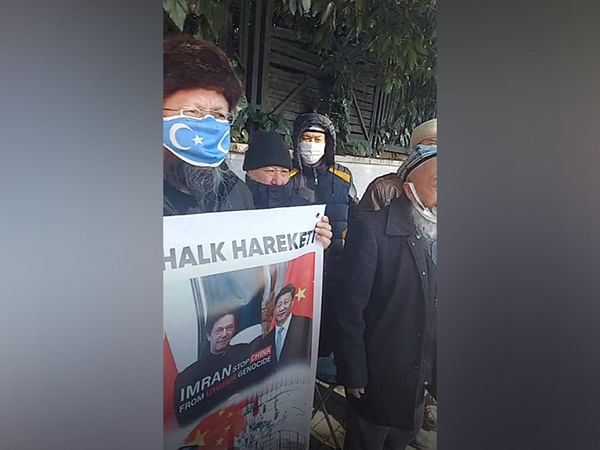
Uyghur Muslims protest in Turkey against Pakistan PM Imran Khan’s clean chit to China

After much argument, only 25 protesters were allowed at the site with the assurance they would not disrupt the traffic. However, starting with 25, the number of protesters increased to 70. After half an hour the Turkish police forcibly boarded the protesters and sent them back. During the protest clash between the security officials and protestors occurred many times. A minor skirmish occurred when the consulate senior officer stopped a few Uyghurs from raising anti-Imran Khan slogans.Imran Khan, who has long projected himself as a champion of Islamic causes, continues to support China on its policy regarding Xinjiang, despite the global bid to hold Beijing accountable for suppressing Uyghur Muslims in the region. Italian political advisor and geopolitical expert Sergio Restelli said the growing dependence on China for economic aid and diplomatic support is the major reason that Pakistani leadership is left with no option but to publicly commit to China’s policies even though they are responsible for the genocide of Uyghur Muslims. (ANI)
However, only 10 protestors were allowed to stand in front of the Pakistan consulate main gate at a time. A memorandum was submitted to security officials who refused to receive it. The envelope containing the memorandum was pasted on the main gate of the consulate. Senior officers of the Pakistan embassy came out to reason with the protesters. Interestingly they tried to convince the protesters to go and protest in front of the Chinese embassy.
https://theprint.in/world/uyghur-muslims-protest-in-turkey-against-pakistan-pm-imran-khans-clean-chit-to-china/829130/
Pakistan witnesses four heinous crimes against women in one week

#PPP #Pakistan - ‘The Sindh Students Unions Bill, 2019’ revives student unions after a 38 year long eclipse -Mian Raza Rabbani, Former Chairman Senate
PRESS RELEASE
Mian Raza Rabbani, Former Chairman Senate, has issued the following press statement;

The Pakistan People’s Party has kept its pledge with the nation, and youth in particular, as the Sindh Assembly has passed ‘The Sindh Students Unions Bill, 2019’. 
The Bill revives student unions after 38 years’ eclipse. Student union had been banned in public sector universities and colleges of the country in 1984 during regime of the dictator Gen. Ziaul Haque. This was a deliberate step taken by the state in order to crush the student unions as well as labour unions which were on the forefront of the struggle against Gen. Ayub Khan.
The Bill provides for promoting the general interest of students in academic, disciplinary, extracurricular or other matters relating to the affairs of the students in the educational institutions. It further provides that a student or students shall be the member of the Syndicate, Senate or Board of the educational institution.
Student unions have been a nursery for producing political workers with ideological commitment, believing in transparency. A cursory glance at the present political leadership will unravel that those who have grown from student politics are committed to their ideology, party, believe and are upright and honest not compromising on principles.
Student unions will also help in promoting academic freedom in educational institutions.