Friday, December 3, 2021

Britain Has Created Millions of Refugees and It Must Face Its Responsibilities

Nicholas Pritchard
On 24 November, Mohammed Shekha clung to the side of a flimsy boat in the waters between France and the United Kingdom while around him at least 27 people drowned. The 21-year-old had left his home in Iraqi-Kurdistan a month before, travelled through Belarus, and attempted the 20-mile journey across the Channel in the freezing conditions of the northern European winter. According to Muhammad, who spoke to Rudaw, 15 of those who died on the journey were Kurds. Mohammed and a man from Somalia are the only survivors.
Almost 26,000 people are thought to have crossed the Channel in small boats in 2021, an increase of nearly 8,700% in three years. Politicians in the UK have pinned the blame firmly on those who profit from the dangerous journeys.
The Home Secretary Priti Patel responded to the deaths by saying the UK will “stop the vile people-smuggling gangs”, insisting the journeys across the Channel are “absolutely unnecessary.” The migration crisis, as far as the British government is concerned, is that people are trying to enter the UK, rather than people being forced to leave their homes.
However, British foreign policies over the past twenty years have increased the number of refugees around the world. Furthermore, the UK has one of the least generous refugee policies of any wealthy nation and there are plans to make it even harsher, threatening to push tens of thousands of people deeper into misery, poison public debate in the UK with more xenophobic rhetoric, and disalow the British public a chance to acknowledge the effects recent wars have had on their society.
Instead, Britain needs to acknowledge that post-9/11 wars led to the displacement of millions of people and provide routes for safe access for the very small numbers, when compared with countries in the Middle East and the European Union example, who wish to settle in the UK.

Asylum Requests in the UK

Contrary to popular belief, the number of asylum requests in the UK is tiny. There were 37,562 claims for asylum made over the last 12 months.

This is low compared with other EU nations and extremely low compared with less wealthy states in the Middle East, Africa, and Asia. For example, Germany received 122,015 and France 93,475 applications. Per head of the population, the UK has the 17th highest intake of refugees compared with EU states. 

UK and US Wars and ISIS

Britain’s wars following 9/11, undertaken hand-in-hand with the US, have resulted in the displacement of between 37m and 59m people. By 2007, the Iraq War had left 4.7m people displaced within their own country or as refugees or asylum seekers elsewhere.

The rise of Islamic State and the bloody years in the second decade of the century caused the displacement of at least a further 2m people. Last year, 9.2m people were internally displaced or refugees abroad as a result of the invasion. Tellingly, there has been no thorough study on the number of refugees created from the conflict. 

The UK has never had a proper scheme for the resettlement of Iraqis. Even now, Iraqis are far less likely than other nationalities to be granted asylum.

Following the civil war period in Iraq, Britain only accepted 69, 355, and 432 Iraqi refugees each year from 2007 to 2009 through a scheme designed to resettle Iraqis who had worked with British forces. In the same period, Sweden, France, and Germany accepted many more.

The UK has not improved in its obligations to Iraqis fleeing violence. In the year preceding June 2021, for example, only 30% of requests from Iraqi asylum seekers were granted on the first decision.

Some of these decisions are eventually overturned and for those who are waiting for a decision, often for years, it’s a grueling period; unable to work and given only £5.64 a day for food, sanitation, and clothing. 

Displacement After Invasion of Iraq

Jason Hart, Senior Lecturer at the University of Bath, points out that the invasion of Iraq led to wider forced displacement in the Middle East. “It’s fair to link the destabilization in Iraq experienced since the invasion of 2003 to destabilization across the region", he told Al Bawaba. “This has not been properly discussed in the mainstream British media.

“When I was working in Jordan in 2014, looking at the response to the Iraqi displacement, the UK did not want to talk about it or acknowledge its role in creating the conditions for that displacement. It was surprising to me that the US were willing to do that, which just showed the UK in an even worse light.” 

Every day more people attempt the same deadly journey across the Channel as Mohammed Shekha and those who died in horrific circumstances last week. The British government treats them as subhuman; housing them in inadequate accommodation and forcing them to sleep on concrete floors with only one toilet for up to 250 people.

The UK’s recent wars created millions of refugees. It needs to stand up to its responsibilities to those who want to flee the violence.

 https://www.albawaba.com/news/britain-has-created-millions-refugees-and-it-must-face-its-responsibilities-1457254

United Nations Should Create New Yemen War-Crimes Investigation

Louis Charbonneau
Saudi Arabia and UAE Fight for Impunity in Yemen Conflict.
Last month, the Netherlands’ ambassador to the United Nations in Geneva said the United Nations Human Rights Council (UNHRC) had “failed the people of Yemen” by rejecting the renewal of an investigation into alleged human rights abuses and war crimes there. UN member countries have a chance to reverse that failure and create something better as the conflict in Yemen continues to rage.
Last week, the Netherlands delivered a joint statement on behalf of 37 countries to the UN General Assembly voicing deep regret at the UNHRC’s failure to renew the mandate of the Group of Eminent Experts (GoEE), which since 2017 has been investigating alleged violations of international humanitarian and human rights law in Yemen.
The statement urged UN member countries to “use all opportunities within the UN-system to assess facts on the ground in an impartial manner, and work towards accountability.”
In response, some two dozen mostly Arab governments endorsed a Saudi-drafted statement welcoming the demise of the GoEE.
The UNHRC could seek to create a new Yemen accountability mechanism at its next session in March. But why wait? The General Assembly could establish a standing independent and impartial investigative body that would not only report on alleged violations to UN member countries but also gather and preserve evidence and prepare cases for possible future prosecutions.In 2016, the General Assembly created the International, Impartial and Independent Mechanism (IIIM) for Syria in response to Russia and China using their Security Council vetoes to thwart accountability for war crimes and abuses. The IIIM’s job is to “assist in the investigation and prosecution of persons responsible for the most serious crimes.” In 2018, the UNHRC created a similar mechanism for Myanmar in the wake of the 2017 ethnic cleansing and possible genocide of Rohingya Muslims.
Since 2015, the conflict between the Saudi and UAE-led coalition and the Houthi armed group has resulted in abuses and laws of war violations that have killed and injured thousands of civilians, and sparked the world’s worst humanitarian crisis .
Some delegations fear failure. Creating the IIIM wasn’t easy but the efforts were successful. The Saudis and Emiratis will fight hard to prevent such a mechanism from seeing the light of day. But their joint statement backed by some two dozen states hardly represents an insurmountable obstacle at the General Assembly. And even if a push for a new mechanism fails, the people of Yemen will be no worse off than they are today.
We owe it to the people of Yemen to try.
https://www.hrw.org/news/2021/11/03/un-should-create-new-yemen-war-crimes-investigation

France Should Stop Selling Arms to the United Arab Emirates, Saudi Arabia

Elvire Fondacci @elvirefondacci
Macron Should Address Rights Abuses in Gulf Region.
This week, French President Emmanuel Macron will visit the United Arab Emirates (UAE), Saudi Arabia and Qatar, with a large delegation of French ministers and major business executives. In the UAE, he will apparently be finalizing a weapons deal, when in all three countries he should be speaking out against human rights abuses.
According to media reports, Emmanuel Macron's visit to the UAE on December 3, in addition to celebrating the country’s 50th anniversary, would have as its main purpose finalizing the sale of dozens of Rafales fighter jets produced by the French company Dassault Aviation. France is promoting these sales even though the UAE has played a prominent role in the Saudi and UAE-led coalition's atrocity-ridden military operations in Yemen. The UAE also took part in the latest conflict in Libya, which ended in June 2020, where UAE forces killed civilians in unlawful air and drone strikes, while also supplying abusive local forces with weapons and ammunition. Yet, the UAE ranks as France's 5th largest arms customer between 2011 and 2020.
Macron's will next go to Saudi Arabia, the largest buyer of French weapons in 2020. France has stubbornly continued arms exports to Saudi Arabia in defiance of UN experts who have called on France and others to halt exports to the coalition as they could be used to commit unlawful attacks or even war crimes.
France's support for the UAE and Saudi Arabia is even more objectionable as their leaders have failed to improve their countries’ disastrous human rights records domestically, although their public relations efforts to present themselves as progressive and tolerant internationally is in full swing. While there is little hope that Macron will condition France's support on concrete progress in this area, he should at the very least publicly call for the UAE to release Ahmed Mansoor and other dissidents. Likewise, in Saudi Arabia, he should address the atrocious 2018 murder of Jamal Khashoggi. Remaining silent on these matters would be tantamount to turning a blind eye to serious human rights violations.
In Qatar, Macron should address human rights violations against migrant workers in the run-up to the 2022 FIFA World Cup, to be held there.
France's arms sales to and protection of dubious military partnerships in the name of counterterrorism and at the cost of human rights will remain a stain on Macron's diplomatic record.
https://www.hrw.org/news/2021/12/02/france-should-stop-selling-arms-united-arab-emirates-saudi-arabia#

UN urged to restart Yemen war crimes probe after Saudis halted earlier efforts

More than 60 rights and humanitarian groups say investigators should 'publicly report on the most serious violations' in Yemen
Dozens of rights and humanitarian groups on Thursday called on the United Nations to create a new independent panel to collect evidence of possible war crimes committed by all parties in Yemen's bitter conflict, after Saudi Arabia reportedly lobbied to shut down the previous investigation.
The organisations said a new independent body should "investigate and publicly report on the most serious violations and abuses of international law committed in Yemen", while also preserving this evidence for possible criminal prosecution in the future.
"The undersigned organisations call upon the UN General Assembly to move quickly and establish a new international accountability mechanism for Yemen," the groups said in a statement.
In October, the UN Human Rights Council (HRC) voted against extending the mandate for an independent war crimes investigation in Yemen by the Group of Eminent Experts (GEE).Earlier this week, a report by The Guardian found Riyadh used “incentives and threats” to force members of the Council to vote against extending the mandate.One such incentive was warning Indonesia - the most populous Muslim country in the world - that it would make it difficult for Indonesians to travel to the holy city of Mecca if Indonesian officials didn't vote against the 7 October resolution.
"The international community cannot stand by and allow that vote to be the last word on accountability efforts for abuses and war crimes in Yemen," the statement said.
"The people of Yemen need justice. And justice begins with investigations and accountability. The time to act is now."
The 64 organisations that signed on to the statement include the human rights clinics at Yale University and Columbia University, Amnesty International, Human Rights Watch (HRW), and the Project on Middle East Democracy (POMED).
'Widespread and systematic abuses'
Saudi Arabia and its allies, primarily the United Arab Emirates, militarily intervened in Yemen in March 2015, after Houthi rebels seized control of the capital, Sanaa, and began closing in on Aden, prompting Abd Rabbuh Mansour Hadi, president of the internationally recognised government, to flee to Riyadh.
Fighting has displaced millions of people within the country, while shortages of fuel have severely impacted the economy and services.
The death toll of the war, now in its seventh year, will reach an estimated 377,000 by the end of 2021, according to a recent report from the UN's Development Programme.
The report's authors say 60 percent of deaths were caused by indirect effects of the conflict, such as hunger and disease and a lack of healthcare facilities.Meanwhile, some 150,000 deaths were caused by fighting between the Houthi rebels and Saudi coalition-backed government forces."All parties to the conflict in Yemen have perpetrated widespread and systematic abuses, including the killing and injuring of tens of thousands of civilians," the groups' statement said.
The fighting has also seen some 80 percent of the population, or 24 million people, relying on aid and assistance, including 14.3 million who are in acute need. 
https://www.middleeasteye.net/news/yemen-war-crimes-un-urged-new-probe-after-saudi-blocked-investigation

Video Report - The Saudi Arabian tyrant silencing his critics with savagery

Video Report - #Iran: Can the 2015 nuclear deal be revived?

Video Report - CDC chief: Omicron may become dominant variant in US

Video Report - Fauci, health officials address new Omicron COVID variant cases in U.S.

Video Report - Testosterone — new discoveries about the male hormone | DW Documentary

Video Report - #NayaDaur #MissingPersons #Pakistan Shireen Mazari being grilled by Matiullah Jan over enforced disappearances and the proposed bill

Video Report - #NayaDaur #NajamSethi #Pakistan If this country is not made a normal state, Sialkot like incidents will continue to happen

Pakistan’s Surging Religious Extremism


By Umair Jamal

Its political class has neither the will nor the intent to tackle religious extremism as all have benefited from it.

 Pakistan’s Information Minister Fawad Chaudhry said last month that the Pakistani state and government are not ready to tackle the rising extremism in the country.

“Many people think that the remedial steps taken by us [the government] are inadequate while the truth is that neither the government nor the state is completely ready to fight extremism,” Fawad said, while addressing a seminar organized by the Pakistan Institute of Peace Studies in Islamabad.

Fawad’s admission that growing extremism in the country poses a serious challenge to Pakistan’s stability comes after a series of recent setbacks that forced the state into making deals with right-wing Islamist groups of different sects.

Last month, the Tehreek-e-Labbaik Pakistan (TLP), a Barelvi religious group, forced the government into allowing it to operate as a political party even as the TLP’s workers had killed several law enforcement officials in clashes. In recent years, the group has openly challenged Pakistan’s foreign policy decisions and shown intent to take on the state without any hesitation.

Simultaneously, Pakistan has been negotiating a deal with the Tehrik-i-Taliban Pakistan (TTP), an organization of the Deobandi sect that has killed thousands of Pakistanis over the last decade. Pakistan’s decision to negotiate with the TTP comes years after the Pakistan military carried out a massive military operation against the group in the country’s tribal areas. The group has not only rebounded from that crippling military offensive but has also managed to unite numerous factions under its leadership.

Some groups in Pakistan carry agendas with an intent to spread their operations globally; others keep Afghanistan as a focus; some are India-oriented while many consider the domestic landscape their target and are sectarian. As a result, some of these groups wouldn’t shy away from inciting violence against the state if their political interests are not fulfilled by the ruling elite.

Some of these groups thrive as they receive support from state institutions. For instance, one of the reasons that the TLP has become a significant challenge for the Pakistani state is that the state itself adheres to the narratives that are propagated by the radical group. Unfortunately, what we see now is a race between different radical groups and the government to prove who is the bigger and better Muslim and win over the public’s support.

A few days ago, Pakistan’s Prime Minister Imran Khan asked universities to research the harmful effects of Western culture on Pakistan’s family system. There is not a single speech of the prime minister where he doesn’t link Pakistan’s economic troubles with citizens being lesser Muslims.

The issue is further complicated by political parties. They not only make electoral alliances with radical groups but also preach the same sectarian hate when in need of public support against their political foes.

Since the TLP’s restoration as a political party, leaders from all major parties have visited the group’s headquarters. Reportedly, the ruling party could even be considering making an alliance with the TLP in the upcoming local body elections.

On the other hand, when opposition parties need to weaken a government, their go-to weapon is bringing in religion to accuse the ruling party of either working for the United States or Israel. They accuse the government of attempting to make Pakistan a liberal country.

Unable to draw people to join its protest marches with its raising of political and economic issues, the Pakistan Democratic Movement, an opposition alliance, is now calling on the public to join a jihad against the Imran Khan government, as religious rhetoric resonate with the masses. Its main reason for appointing Maulana Fazlur Rehman, the head of the Jamiat Ulema-i-Islam-Fazl (JUI-F), as the president of the alliance is due to his ability to mobilize and bring onto the streets thousands of students from his massive madrassa network across Pakistan.

These moves by parties in government and the opposition show that there is little will and intent in Pakistan’s political class to tackle the issue of religious extremism as everyone has benefited from radicalism one way or the other.

The country has become so radicalized that any attempt by the state or the government to push back against the rising extremism could very well backfire. Thus, for some, it’s too much risk and for others, it doesn’t even constitute a problem.

The last major opportunity to challenge rising extremism was when the country formed the National Action Plan (NAP) against extremism in 2014. However, that plan has not moved beyond reports and briefings.


For those in power, staying in power at any cost is what matters, but Pakistan is suffering.
 https://thediplomat.com/2021/12/pakistans-surging-religious-extremism/

Pakistani hardline Islamist party supporters lynch Sri Lankan citizen over ‘blasphemy’

Several videos were circulated on social media showing hundreds of men gathered at the site surrounding the body of the Sri Lankan national. They were chanting slogans of the TLP.
In a grisly incident, a top Sri Lankan executive of a garment factory was lynched and his body burnt by angry supporters of a hardline Islamist party which attacked the facility in Pakistan’s Punjab province over blasphemy allegations on Friday, police said.Priyantha Kumara, who was in his 40s, was working as the general manager of the garment factory in Sialkot district, some 100 kms from here, a Punjab police official told PTI.
“Mr Kumara allegedly tore a poster of the hardline Tehreek-e-Labbaik Pakistan (TLP) in which Quranic verses were inscribed and threw it in the dustbin. The poster of the Islamist party was pasted on the wall adjoining the office of Kumara. A couple of factory workers saw him removing the poster and spread the word in the factory,” the official said. Hundreds of men, enraged over the “blasphemy” incident, started gathering outside the factory from adjoining areas. Most of them were activists and supporters of the TLP.
“The mob dragged the suspect (the Sri Lankan national) from the factory and severely tortured him. After he succumbed to his wounds, the mob burnt his body before police reached there,” the official said.
Several videos were circulated on social media showing hundreds of men gathered at the site surrounding the body of the Sri Lankan national. They were chanting slogans of the TLP.The Imran Khan government had recently lifted a ban on the TLP after signing a secret agreement with it after which its chief Saad Rizvi and over 1,500 activists accused of terrorism were released from jail. The TLP in return had ended its week-long sit-in in Punjab after withdrawing its demand of expelling the French ambassador on the issue of blasphemous cartoons in France.Sialkot District Police Officer Umar Saeed Malik told reporters that a heavy contingent of police has been deployed in the area to control the situation after the lynching of the Sri Lankan national.
The situation in the area is tense while all factories are shut, the police added. Meanwhile, Punjab government spokesperson Hassan Khawar said that “approximately 50 people have been arrested,” Geo News reported.
“CCTV footage is being obtained so that those who were responsible can be identified. The IG has directed law enforcement personnel to produce results in 48 hours after which the probe will be extended,” the spokesperson said.
“PAKISTAN: Amnesty International is deeply alarmed by the disturbing lynching and killing of a Sri Lankan factory manager in Sialkot, allegedly due to a blasphemy accusation. Authorities must immediately conduct an independent, impartial and prompt investigation and hold the perpetrators accountable. “Today’s event underscores the urgency with which an environment that enables abuse and puts lives at risk must be rectified,” it said in a series of tweets.
Pakistan has extremely strict laws against defaming Islam, including the death penalty, and rights campaigners say they are often used to settle personal disputes in the Muslim-majority country. A US government advisory panel report says Pakistan used blasphemy laws more than any other country in the world. Mere allegations of blasphemy have triggered violence against minorities like Christians.
Several persons accused of committing blasphemy have been lynched in recent years.
https://indianexpress.com/article/world/mob-lynching-blasphemy-sri-lankan-killed-7654648/

Sri Lankan manager killed by mob of workers at Pakistan factory

By Mubasher Bukhari
A mob of factory employees in eastern Pakistan tortured and burned a Sri Lankan manager on Friday over apparent blasphemy in a "horrific" attack.
A police official in the eastern town of Sialkot, who spoke on condition of anonymity because of the sensitivity of the case, said investigators believed the attackers had accused the manager of blasphemy for tearing down a poster with Islamic holy verses.
"The factory workers tortured the manager," said provincial government spokesman Hassan Khawar. "A total of 50 people so far have been identified and arrested."
Television footage showed crowds of hundreds of people in the streets of Sialkot, in the heart of Pakistan's most heavily industrialised region where much of the country's export industry is based. Mob killings over accusations of blasphemy - a crime that can carry the death sentence - have been frequent in Muslim-majority Pakistan.
Friday's killing came only weeks after days of violent protests by the radical Tehrik-e-Labaik Pakistan movement, a Sunni Muslim group founded in 2015 to address actions it considers blasphemous to Islam.
https://www.reuters.com/world/asia-pacific/sri-lankan-manager-killed-by-mob-workers-pakistan-garment-factory-2021-12-03/

Thursday, December 2, 2021

Video Report - Biden outlines plan for fighting Omicron COVID-19 variant this winter

Video Report - CNN Town Hall: Dr. Fauci answers questions on #Omicron variant

Video Report - #Omicron #Covid19 #Variant Omicron: Scientists race to work out how dangerous the variant is

Video Report - #omicron : Will rich countries now stop hoarding vaccines?

Video Report - The reason we're becoming more extreme

Video Report - #MJtv LIVE: اسلام آباد میں کے تمام سرکاری اساتذہ بھی حکومت کیخلاف سڑکوں پر

#MJtv LIVE: علی وزیر کیس منسوخ ہو کر چند گھنٹوں میں پھر کیوں لگا ، بینچوں کی تاڑ پھوڑ

#Pakistan - Silencing opposition - Pakistan must cut away from its royal, colonial and dictatorial legacy.


DESPITE a democratic Constitution, there seems to have been a move towards authoritarian rule in Pakistan with a concerted effort to silence and delegitimise any voices of opposition, political or otherwise. These efforts have been augmented through regulatory directives, undemocratic ordinances, extra-legal measures, and aggressive public messaging. The only capitulation by the state seems to be in the case of opposing parties that direct violence towards it under the pretence of religion.
Whether it is media, social media, human rights movements, political leaders, or even judges, there have been concerted efforts to silence them and get them to toe the line of the state.
Through attempts to put restrictions on the media, first through covert pressure on media houses to fire columnists and TV anchors who do not toe the state line, and then by proposing draconian ordinances such as the Pakistan Media Development Authority (PMDA), press freedom guaranteed by Article 19 of the Constitution is routinely violated. This was also seen when channels and newspapers with critical opinions were relegated to the end of the channels list by cable operators and banned from circulation in cantonment areas respectively. The government also stopped its advertisements for media groups that were critical, violating the right to information of citizens as guaranteed by Article 19-A as they were deprived of public messaging.
The state response to human rights movements has been even worse. The peaceful Pashtun Tahaffuz Movement (PTM) has ruffled feathers due to young and unarmed Pakhtuns demanding basic rights and protections guaranteed by the Constitution in a region ravaged by the war on terror brought to their lands by a reckless dictator. Instead of embracing the young of the former tribal areas, even their popular elected representatives have been imprisoned by the state with complete disregard for the democratic mandate they hold.
It is time that Pakistan cut away from its royal, colonial and dictatorial legacy.
Ali Wazir still remains incarcerated despite being granted bail by the Supreme Court on Tuesday, with other cases pending against him, while members of the movement and others have contrasted the treatment meted out to them with the olive branch consistently extended by the state to the violent TTP that killed thousands, and the violent TLP that on many occasions has held entire cities hostage. Such capitulation should only be extended to peaceful groups and certainly not to those who commit grave crimes including mass murder.
Similarly, the state has cracked down on NGOs by introducing stringent registration requirements that make functioning almost impossible under the excuse of foreign funding, overlooking the fact that the most foreign-funded entity in the country is the state itself. This was seen again last month with the government officials’ outburst at the Asma Jahangir Conference in Lahore where thrice-elected prime minister Nawaz Sharif was invited to address the closing ceremony in line with the tradition of the annual conference.
Even if he is considered a ‘convict and absconder’, despite the partiality with which the National Accountability Bureau targets opposition politicians, there is nothing in Pakistani law that prohibits convicted political leaders from addressing gatherings. However, the high-handedness and paranoia of the state was apparent in the suspension of internet services by the Pakistan Telecommu­nication Authority in the vicinity of the conference in the centre of Lahore, something that ought to be seen as illegal, disproportionate and excessive.
This is not about Nawaz Sharif. This is about selective attacks against civilian politicians whose ability to compete in a democratic system is constantly undermined through all sorts of innovative tactics, ranging from blasphemy insinuations weaponised through extremist groups to the all-time favourite accountability laws that only seem to apply to opposition politicians to the use of treason clauses of the law that are used to accuse everyone that the state is displeased with, with the exception of those whom they should actually apply to for abrogating the Constitution. But these attacks haven’t even spared the apex court for raising questions regarding interference in politics by those who are meant to guard our borders.The onslaught on social media freedoms has been building since 2015 with Peca being passed the next year, and the latest social media rules, despite constant questions over their constitutionality including by the Islamabad High court, being incorporated. TikTok has been banned four times, most likely out of fear of the digital inclusion it enables for people at the margins and how it lends them the ability to have a voice with the viral factor. And Peca continues to be abused to silence journalists, activists, young citizens and political opponents for daring to exercise their guaranteed freedom of speech on the internet.It is time that Pakistan cut away from its royal, colonial and dictatorial legacy to become the completely democratic state that its Constitution envisages. This is not possible without the pressure of its citizens that have always been eager to resist attempts to put them under control, and political parties that must learn to mobilise without considering backroom deals to save their slice of the power pie that history shows always gets eaten by another eager entity.
Enforced disappearances, bogus cases, dictatorial tactics and online attacks to skew narratives have to be controlled. It is crucial that the independence of the judiciary is upheld, which may not be possible if the press is not free. Constitutional protections exist for a reason, and the roots are in our history of resistance against anyone who tries to impose their will on us.
Presidential systems or one-party systems do not belong in our vibrant democracy with a diverse populace, which is why the autonomy that the 18th Amendment gives to provinces was welcomed across the board. Let us work together to reap its benefits rather than try to upstage one another.
The censorship of opposing voices cannot continue, and the future belongs to an inclusive democratic system. If the government insists on burying its head in the sand, it must realise that the grains of sand around its head belong to the people who lend them legitimacy, and the people are not fools.
https://www.dawn.com/news/1661474/silencing-opposition

#Pakistan - The wages of the #IMF

Durdana Najam
IMF, World Bank have been of no use other than exacerbating Pakistan’s economic woes, says American economist.
Despite having some of the best internationally recognised minds to manage Pakistan’s financial affairs, why is there no exit from the economic woes? Is there a probability that these able minds have been working as the so-called economic hitmen to keep Pakistan financially bankrupt? This is not an illusion of a conspiratorial mind as the readers might be tempted to think. There are reasons for the doubt. For instance, take the case of the IMF’s six billion dollar package. We have not even received half of the total package as the debt is released in bits and pieces. With every new tranche, a list of dos and don’ts is handed down for compliance. Being negotiated currently is a tranche worth $1 billion. So far, the walk on the tightrope has been made possible with the massive devaluation of the rupee, high electricity and gas tariffs, elimination of Rs350 billion worth of subsidies, the reincarnation of petroleum levy by Rs33, cut in the development budget to the tune of Rs300 billion and imposition of new taxes. Soon a mini-budget will be floated to give a legal cover to these demands. According to experts, this will be one of the biggest mini-budgets in the history of Pakistan. How will this affect a common man? That is not on the agenda of the government economic wizards. What is on their hit list is compliance with the IMF demand.
Now let us talk about the illusion part.
As compared to the $1billion IMF tranche, which is so far behaving like a sinking boat that may tumble the country with it if not rescued, Pakistan has earned $6 billion from textile export in the first four mounts of the current fiscal year. Juxtapose the part receipts of the IMF package with $6 billion from only four months of textile export, and you will find yourself questioning the justification for the anxiety to keep the IMF boat afloat. With an industrial output sufficient to overcome the so-called current account deficit, why have we tied ourselves to the IMF programme, which for all its purposes is only tightening the noose around common men’s neck? The question is: what justifies our eagerness to meet the IMF unjust demands for a $1 billion tranche, especially when our economy has the potential to wade us out of solvency — if there is any?
Recently, Dr Arthur Betz Laffer, an American economist, was in Pakistan to attend Pakistan Prosperity Forum — 2021 arranged by the Prime Institute in Islamabad. During his address, he advised Pakistan’s economic heads to refrain from taking dictation from the IMF and the World Bank. Adding further to his anguish against the lending institutions, he said that the IMF and the World Bank have been of no use other than deliberately exacerbating Pakistan’s economic woes. He reminded us that we were not their slaves and that we should act independently.
This advice of acting ‘independently’ brings to mind the ardent opposer of the IMF and the World Bank, Mr Yanis Varoufakis, a Greek-Australian economist and politician. He served as Greek Minister of Finance from January to July 2015. During his stint as finance minister, he refused to bend to the demands of the lending institutions and instead said that “…we are insolvent, and we have to embrace our insolvency.”
Varoufakis equated these creditors with terrorists. Like terrorists, they instil fear and trepidation so that their targets bend and give in. The weapons used in this warfare are the economic experts drawn usually from the targeted countries. They deliberately make flawed policies. Each policy digs a hole in the exchequer. Eventually, a time comes when this leaking bucket becomes a burden to the community of greedy and expedient politicians, military personals and businessmen, who had been raised over the period to make this leaking bucket a reality. Later, each hole is patched from the creditor’s debt in return for more taxes, exorbitant utility bills, and inflationary pressures. Varoufakis met Barack Obama at the Greek Independence Day celebration in the East Room of the White House and was asked to “swallow bitter stuff” like he did to survive the 2008 economic crisis. Varoufakis replied, “You inherited a mess when you came to office, but at least you had your central bank behind you. We inherited a mess and we have a central bank” — the European Central Bank — “trying to choke us”. The creditors wanted Greece “to privatize state assets, such as Athens’s port; reform institutions and practices perceived to be inefficient, including its health-care and welfare systems, in ways likely to result in mass dismissals; and adjust its budget through further tax increases and spending cuts, to the point where Greece’s income significantly exceeded its spending on everything but its repayments”.
From Laffer to economic experts like Dr Ikramulhaq, government is advised to downgrade income and sales tax to widen the tax net. However, the government has no appetite to hear sane voices. Instead, it is fuelling the 134 non-functioning state-owned organisations with an annual injection of $4 million. How does Pakistan’s economic wizard justify this loss is anybody’s guess.
https://tribune.com.pk/story/2331970/the-wages-of-the-imf

#Pakistan - Chairman #PPP Bilawal Bhutto Zardari’s message on International Day of Persons with Special Abilities

Pakistan Peoples Party Chairman Bilawal Bhutto Zardari has said that the time has come for the state to stop resorting to excuses and depriving those with special abilities of their rights. Everyone must now come to the same page on the issue of rights, health, education, and employment of more than 3 million special people.
According to a statement issued by Media Cell Bilawal House, the Chairman PPP in his message on the International Day of Persons with Disabilities further said that people with special abilities do not need our attention and help, but the aid we provide them is a test of our responsibility and humanity. Creating a balanced and equitable society without full implementation of the rights of persons with special abilities is a dream that needs to be accomplished.
Chairman Bilawal Bhutto Zardari said that during the tenure of the selected Prime Minister, special people have been severely affected by historical inflation, unemployment and poverty. The government has left them helpless like other downtrodden sections of the society. Chairman Bilawal Bhutto Zardari also said that the PPP has always been responsible and committed in including the talents of specially qualified persons in the national development. The introduction of 5% quota for employment in government departments and the interest-free loan scheme of Rs. 1 – 2 lakh with the Benazir Income Support Programme are a few groundbreaking initiatives taken by PPP. Bilawal Bhutto Zardari said that the Sindh government of Pakistan Peoples Party has shown remarkable performance in all the standards of implementation of UN conventions on persons with special qualifications. The Sindh Assembly passed the Sindh Differently Abled Persons Act-2014 in 2017, under which persons with disabilities were declared as persons with special abilities. The issuance of driving licenses for the deaf and the establishment of a Center for Autism Rehabilitation and Training in Karachi are the hallmarks of the peoples government of Sindh. The Department of Special Education in Sindh is also in the process of setting up special children’s schools along modern lines.
The PPP chairman said that Pakistan Peoples Party is the only political party in the country whose manifesto includes a revolutionary strategy for the protection of the rights and development of persons with special abilities. He said that the Pakistan Peoples Party government to be formed after the forthcoming elections, would take effective measures to ensure full implementation of the rights of persons with special abilities. The Pakistan People’s Party (PPP) has promised to abide by the UN Convention on the Rights of Persons with Disabilities, which was ratified by the government led by former President Asif Ali Zardari in 2011.
https://www.ppp.org.pk/pr/25863/

Wednesday, December 1, 2021

Video Report - CDC weighs tightening COVID test requirement for international travelers

Video Report - #Covid's new variant: How to effectively stop the spread of #Omicron?

Video Report - Protesters gather outside Supreme Court as abortion rights are challenged

Video Report - #Covid Doctor treating Omicron patients in South Africa describes what she is seeing

Video Report - Dr. Anthony Fauci and White House press secretary Jen Psaki hold a news briefing

Pashto Music Video - Nashenas _ زه خو شرابي يم، زه خو شرابي يم شیخه څه راسره جنګ کړې برخې ازلي دي، کاشکې ما د ځان په رنګ کړې زه خو شرابي يم شيخه ته راسره جنګ کړې برخې ازلي دي، کاشکې ما د ځان په رنګ کړې

#Pakistan - #Balochistan’s Students Protest Enforced Disappearances

By Somaiyah Hafeez

          @sommulbaloch

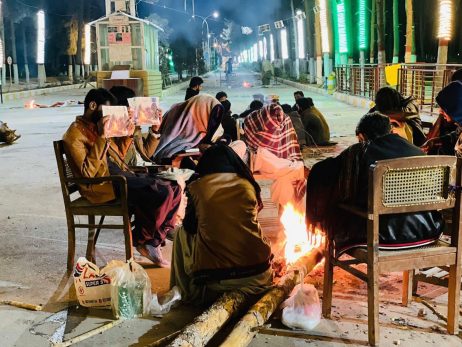
For over three weeks, Baloch students in Quetta have been demonstrating against the suspected abduction of two of their own.
Students at the University of Balochistan in the Pakistani city of Quetta have been staging a sit-in, resulting in all academic activities being halted, for almost three weeks. Protests started on November 7 after the enforced disappearance of two students of the university, who were allegedly abducted from the campus.
Faseeh Baloch and Sohail Baloch went missing on November 1. Since then, their fellow students have been protesting, day and night in the biting cold outside the university. The demonstrators say they won’t stop unless the missing students are released. Negotiations between the students and the university administration took place on November 9 but failed to reach a solution. Afterwards, students from the Baloch Student Organization (BSO) locked the gates of the university and announced that all academic activities, including the semester examinations, would be halted until the missing students were recovered.
Later, on November 11, a committee formed by the government met with the students with similarly inconclusive results.
“We have had two meetings with the representatives of the government,” Zubair Baloch, chairman of BSO Pajjar, a faction of the BSO, told The Diplomat. “In the first sitting, they assured us that the missing students would be recovered by 16 November. We paused our demonstration on 13 November, but in the second meeting, they had no information whatsoever about the whereabouts of the missing students.
“Hence we have now resumed our protests, which will only end after the missing students are recovered.”
The issue of the disappearances of the students was also raised in the Balochistan Assembly.
This isn’t the first time that Baloch students have been abducted; however, the enforced disappearances of Faseeh and Sohail came as a shock as the students went missing from within the university campus, which has a heavy deployment of security forces, including housing a base of the Frontier Corps, a paramilitary force.
Balochistan, Pakistan’s geographically largest but poorest province, has been wracked by an insurgent movement for the last two decades. Paramilitary forces are a common sight throughout Balochistan; even educational institutions are not free from the militarization.Enforced disappearances are widely believed to be a part of the state’s counterinsurgency operations. Victims of enforced disappearances range from insurgents and family members of insurgents to political workers and even students. Anyone who is merely suspected of sympathizing with insurgents is at risk of being whisked away.In a recent report titled “Living Ghosts,” the human rights group Amnesty International documented the practice of enforced disappearances in Pakistan and urged Pakistani authorities to end its use as a tool of state policy. The report consists of interviews with 10 family members of victims of enforced disappearances who are still missing to date. The report discusses at length the difficulties faced by the family members in using the legal system to locate their loved ones, the intimidation and threats they faced for their activism against the practice, and the impact of the issue on their mental well-being.
As the insurgency has gained momentum over the past few years, there has been an increase in cases of enforced disappearances. Pakistan’s military, however, denies any involvement. In 2019, the director general of Inter-Services Public Relations, the publicity arm of the Pakistani military, tweeted, “Our hearts beat with families of every missing person. We share their pain and we are with them in the process of tracing them.”
On November 26, the office of the registrar of University of Balochistan released a notification announcing the closure of the university until the recovery of the two missing students. “All academic and administrative functions will remain suspended,” the notification said, adding that students must vacate all hostels within three days.
Baloch Student Activism
The missing students are members of the BSO, a student organization that was founded to campaign for the rights of Baloch students in 1967. The BSO has been responsible for birthing many prominent Baloch politicians. Student leaders of the BSO have later gone on to participate in the politics of the country, many being elected to the National Assembly or becoming the chief minister of the province. Dr. Abdul Malik Baloch, the chief minister of Balochistan from June 2013 to December 2015, is a prominent example.
Senator Muhammad Akram Dashti, who served as the speaker of the Balochistan Assembly, was also actively involved in student politics. He has raised the issue of the abduction of Baloch students in the Pakistani Senate.
He told The Diplomat, “The abduction of Baloch youth, this counterinsurgency tactic, will yield dire negative consequences. Student politics has played a vital role in the politics of Balochistan and has always remained a secular, progressive, and nationalist practice. Balochistan is already a neglected province, this crackdown against the student activists will only further embolden the feelings of alienation and neglect.”
“The security establishment hasn’t till date understood how to deal with the issues of Balochistan and how to address the grievances of the province,” Dashti added. “The security establishment often claims that no one is missing or the Baloch students abducted have links with the insurgency movement, but even if that’s the case, enforced disappearances isn’t the answer. If the state has any allegations against any of the students or anyone, they should take the legal procedure against them and present them in front of the courts”
Students of Balochistan have been on the forefront of protests in major events in the past few years, on many occasions leading to fruitful results. In 2019, widespread protests by students against a sexual harassment scandal at the University of Balochistan resulted in the resignation of the university’s vice chancellor. The killing of a Baloch student, Hayat Baloch, by FC personnel; the murder of Malik Naz Baloch at the hands of a member of a “death squad”; and the issues with online classes during the pandemic in Balochistan, which lacks internet facilities – these are few examples that led students to mobilize and stage protests for their rights.
“If anyone is doing politics that has some impact in Balochistan, then that’s the Baloch students, but they face a lot of issues: There’s [the] academic burden, [and a] lack of facilities,” said Dr. Sabiha Baloch, chairperson of the Baloch Student Action Committee (BSAC). Students undertake political activism to defend their rights, but in doing so, they face a great deal of pressure. “All the students protesting in UoB are threatened, calls are made to their parents with threats,” she said.
Baloch Women and Student Politics
Balochistan is a highly conservative, tribal, and patriarchal region, where women have restricted rights. However with the recent rise in enforced disappearances of Baloch men, it is the Baloch women who are filling the void created in the province’s political scene, including leading protests against enforced disappearances. Today, Baloch women have a far greater presence in the politics of the province, and much of it comes in the form of activism by Baloch women students.
Last month, two young children were allegedly killed in a mortar attack by the Pakistan security forces, which led to protests by the family in Turbat and later on in Quetta, where they staged their protest with the dead bodies. Women were once again at the forefront of these protests: they shouldered the dead bodies of the children when they were finally laid down to rest. In a region where women are confined to their homes, such an act is nothing less than a rebellion. When Karima Baloch, the first women chairperson of the BSO, mysteriously died last year in Canada, Baloch women walked dozens of kilometers to take part in her last rites.
Sabiha Baloch is the first female chairperson of the BSAC; however she has had to endure a lot of pressure ever since taking the responsibility.
“I belong to a tribal region, and I had to keep my activism a secret for a very long time,” she said. “To date my family is pressurized with constant taunts hurled at my father in our tribe. Everyone says to him ‘your daughter is doing politics.’ They see my activism as a crime because I am a woman.”
Baloch women student activists thus bear the brunt of a dual oppression.
Collective Punishment
Student activists, especially women, fear not only for their own safety but also for the safety of their loved ones.
Sabiha’s 19-year-old brother, Shahmir Baloch, a student of Balochistan University of Engineering and Technology Khuzdhar, was abducted from the university premises along with some other students who were later released. “The day my brother was abducted, I had talked to him on call in the morning. He told me he had received a call threatening him that they’ll abduct me and telling him that ‘your sister is a terrorist,’” she recounted. “I asked him not to worry about me. We consoled each other but I had no idea they would abduct my brother – he has never been involved in student politics.”
After the abduction of her brother, Sabiha was under a lot of pressure from her family to resign from her position. She said she decided to halt her activism and even offer her resignation if that would mean the safe release of her brother.
Despite her efforts, the release of her brother was delayed time and again. Three months later, her cousin, Murtaza Baloch, was abducted too. Murtaza was released last week, but Shahmir is still missing.
“When a female student leaves her home, she rebels against the norms of the tribal and patriarchal society,” said Sadia Baloch, a student activist from Balochistan (no relation to Sabiha). “She faces hostile behavior from administration and after all this, when she emerges as a student activist figure, there is oppression from the state and a collective punishment is given.”
“Sabiha Baloch’s brother and cousin were abducted solely because she is a student activist. This is to send across a silent message to anyone resisting,” said Sadia.
“If silencing myself would bring back my brother I am ready for that, but I know it wouldn’t because this is just a tactic – a collective punishment and a strategy to silence us from speaking for our rights,” Sabiha said. “They are abducting students from areas where they want to develop pressure. Zehri, Khuzdhar, Kharan, Nushki, Panjgur – every day you will receive news of enforced disappearances from these areas.
“The cases that are reported on social media are just the tip of the iceberg, the majority of the cases are not even reported.”
Back to the Past – or a New Future?
Many Baloch student activists express concern on the mass abduction of students, fearing that security forces are looking to undo the progress the movement has made over the last few years.
“Once again an atmosphere of fear is being built in Balochistan, much like 2009 times when one would think twice before calling themselves a Baloch out of fear of abduction,” Sabiha said. “From 2018-2021, the progress that was made via the movement to break free from the shackles of fear, whereby we had the hope that our protests would bear fruit in case someone is abducted or for any other issue – those chains of fear are once again being tied.”
Still, the official announcement of the closure of the university until the missing students are recovered is a silent acknowledgment from the administration of the resilience of the Baloch students, who remain unshakable, unmovable, and undefeatable. Balochistan has seen a recent wave of protests from Gwadar to Quetta for the rights of the people and against enforced disappearances. Yet the protests and rallies in Balochistan don’t get any coverage in the mainstream media and Pakistani politicians avoid the issues troubling the country’s largest province.In his latest article, “History and Truth,” author Aasim Sajjad Akthar writes, “it may have been said many times but it must be said again: Balochistan continues to be treated little better than a colony in contemporary Pakistan.”
In the words of Senator Dashti, “The state must not repeat the mistakes of the past. Instead of a crackdown against student activists, the state must engage with the youth of Balochistan and address their grievances. Balochistan should not be treated as a colony. That’s the only solution to the mistakes of the past – by safeguarding the rights of the future.”
https://thediplomat.com/2021/12/balochistans-students-protest-enforced-disappearances/

Video Report - #NayaDaur #AsmaShirazi Long Before Nawaz Sharif And Audio Leaks, History Gave Its Verdict In Bhutto's Favour: Asma Shirazi

ذوالفقار علی بھٹو ایک سازش کا شکار ہوئے اور جن ججوں نے سزا سنائی وہ بعد میں ان کے حق میں شہادتیں لے کر سامنے آئے۔ عاصمہ شیرازی لکھتی ہیں کہ آج ہماری عدالتوں سے انصاف لینے کے لیے آڈیو اور ویڈیو لیکس کا سہارا لیا جا سکتا ہے لیکن تاریخ کا فیصلہ طویل ترین رہتا ہے۔

#Pakistan: Can Nawaz Sharif Stare Down the Hybrid Regime?

By Mohammad Taqi
@mazdaki 

While the political sands are shifting, the ultimate face-off remains between Nawaz Sharif and the army – with Imran Khan and other minor players being a sideshow.
The drama which started almost two months ago with Prime Minister Imran Khan’s obstinate insistence on retaining his favourite, General Faiz Hameed Chaudhry, as director general of Inter-Services Intelligence (DG ISI) ended this past week with the military brass led by army chief Qamar Javed Bajwa ultimately prevailing.General Faiz has been posted as Commander of the XI Corps at Peshawar and the new DG ISI, Lt. General Nadeem Ahmed Anjum, has replaced him. Though the junta showed tremendous patience with its puppet PM – swallowing his tantrums and even allowing him even to interview a slate of candidates – it eventually ensured that he signed off on the candidate the army had chosen.
This is the first major, and very public, rupture between Imran Khan and General Bajwa. Both the Pakistan Tehreek-e-Insaf (PTI) government and the army have been known to publicly declare that they are “on the same page”. However, that page seems to be in tatters now. And the end result is political uncertainty, if not full-blown chaos, with the two constituents of Pakistan’s hybrid regime, as well as the opposition to it, all fending for themselves.
The army imposed Imran Khan on Pakistan in 2018 by literally stealing the elections. Before engineering Imran Khan’s electoral victory, the army got the Supreme Court of Pakistan (SCP) to oust and disqualify the three-time former prime minister Nawaz Sharif from office on the flimsy charge of failing to disclose potential wages from a ceremonial position he had once held in his son’s UAE-based company.
The army had been infuriated with Sharif and his Pakistan Muslim League-Nawaz (PMLN) for trying to assert a modicum of civilian supremacy and pursuing a high treason case against former dictator General Pervez Musharraf. But unable to mount an overt coup d’état due to domestic and international constraints, the brass had opted to rule indirectly in this South Asian variety of a Potemkin Democracy. The idea simply was to maintain a veneer of democracy while the army really called the shots. In the process, the army also canned Nawaz Sharif’s agenda for regional peace and trade with the neighbouring countries, especially India. An economy on upward trajectory between 2013-18, with GDP growth as high as 5.8 and the CPI inflation not exceeding 5.4%, came to a grinding halt under the new management. The junta and Imran Khan both seemed to have convinced each other that the latter had assembled a financial dream team, which would steer the country to an economic Valhalla that the army gods would get to rule over in perpetuity without ever having to deal with irksome democratic mortals.
Fast forward to the end of 2021 and Pakistan’s economy is on the brink of disaster, with inflation skyrocketing into double digits. In a play on the literal meaning of Pakistan – the land of the pure – the Economist has called the country the land of the poor, with its per capita GDP not even at two-thirds of India’s and life expectancy slightly better than Afghanistan’s. While GDP showed a slow uptick, rising imports, surging global commodity prices and the ever-weaking rupee have pushed the hybrid regime to desperately seek a lifeline from the International Monetary Fund (IMF). In the interim, food and fuel prices have virtually broken the back of the middle and lower-middle classes, and crushed the poor.
But what got the army eventually worried was not the hideous reality of its warped hybrid project, but that its image as the manipulator that could no longer be hidden. The common man is pointing the finger of blame for his economic misery not just at Imran Khan but at those who have installed him. A slogan now heard at protests in the Punjab province, which is home to most of the brass and troops, goes:
“Bhukkay reh gaye main te tu, Lut ke lay gaya GHQ” (Who is hungry? Me and You, Who has plundered? GHQ)
The junta seems willing to sacrifice its protégé so long as the alternative does not try to name, shame, and hold it to account for the disaster. It appears amenable to even letting the judiciary take the heat for its role in bringing down Nawaz Sharif, so long as the generals do not get blamed for leaning on the judges to do their hatchet job.
In essence, the army wants to scale back the intensely in-your-face control of politics that General Bajwa has unabashedly conducted, to one that is more restrained publicly but complete, nonetheless. It effectively wants a face-saving leeway with mere cosmetic changes, without letting the lopsided power equation change vis-à-vis the civilians. To that end, the army might prefer an in-house change where a so-called national government is cobbled together with the help of opposition members from the Pakistan Peoples Party (PPP), a PTI block and allied parties pried away from Imran Khan, with the tacit approval – if not support – of the PMLN. This type of dispensation would supposedly run for the rest of the National Assembly’s term through 2023. The proposition may be acceptable or even desirable for the PPP, which potentially eyes the PM slot for its young chairman, Bilawal Bhutto Zardari that otherwise is a pipe-dream given the party’s dismal standing outside the leadership’s home province of Sindh. The PPP would also get to retain its provincial government in Sindh.
Imran Khan as the incumbent would obviously flail and swing against such machinations. In fact, his clinging to General Faiz was an act of self-preservation where he sensed that the army, which as an outfit brought him in, is collectively willing to send him to the chopping block. In the ex-DG ISI, Khan saw an ambitious ally who seemed willing to help him tide over the current crisis, secure a second prime ministerial term and, in a quid pro quo, himself become the COAS next November. But just like in Vegas, in the Pakistan army too the house always wins. The army does not tolerate solo flights from within its ranks. Its decision-making is collective and individual ambition is only acceptable if it matches the institutional needs.
The Khan-Faiz gamble thus backfired, as it does not converge with the army’s current need to repair its incredibly tarnished image. Should the army show him the door, Imran Khan, for his part would not be able put up any significant resistance for multiple reasons. Every bit of Imran Khan’s post-2011 ascent has been meticulously engineered by the army, complete with building his media image, organising his rallies and protests, shepherding the pro-army politicians into his PTI, as well as ruthlessly undermining his political opponents.
Bereft of all that support, it seems highly improbable that Imran Khan would be able to challenge his army masters. The reason that the army has not drummed Imran Khan out after this spat is that there really aren’t any takers for the job, without a change in terms and conditions. In fact, the brass even helped Khan’s government ram dozens of bills, including the approval of controversial Electronic Voting Machines (EVMs) and voting rights for overseas Pakistanis, through a recent joint session of the parliament. While Khan may see this as success in retaining the army’s patronage, the EVMs – with an inherent potential for electronic rigging – seem to be the proverbial sword of Damocles that the army is hanging over the opposition’s head, especially Nawaz Sharif’s, for he remains defiant and unyielding.
While the political sands are shifting, the ultimate face-off remains between Nawaz Sharif and the army – with Imran Khan and other minor players being a sideshow. Sharif was wronged and doesn’t flinch from saying that it is the army which has wronged him. He, his daughter, Maryam Nawaz Sharif, and a sizeable number of the PMLN stalwarts want this rectified. They want their sham judicial disqualifications rescinded and fabricated cases quashed. The father-daughter duo wants not just a level playing field, leading up to free and fair elections, but a guarantee that the army won’t resort to its usual shenanigans and start undermining yet another democratic setup within six months. However, the army seems willing to allow the PMLN back into the game only if – and that’s a huge if – it doesn’t insist on revising and resetting the rules.
Nawaz Sharif’s younger brother and the PMLN’s president Shehbaz Sharif, who has been a consistent proponent of a near-unconditional rapprochement with the army, would be acceptable to the latter. The younger Sharif, however, can’t and won’t go against his brother, not just because of the familial hierarchy but simply because the vote bank belongs to Nawaz Sharif, and then his daughter. The army remains wary of Nawaz given both his past record of trying to assert civilian control over the military and attempts to bring General Musharraf to book for subverting the constitution, as well as the more recent tactic of publicly indicting Generals Bajwa and Faiz for engineering his fall and ouster. For his part, Nawaz Sharif, even when he does not name names, makes it a point to draw attention to the army’s decades-long violations of the constitution. For example, speaking remotely to the recently-held Asma Jahangir Conference, Sharif described those who “scale the walls of the constitution” as traitors, in a thinly-veiled reference to the putschist generals, once again implying high treason charges.
The army, under General Bajwa, therefore, appears to be looking for alternatives to Imran Khan that would also keep Nawaz Sharif at bay for now. It seems to be dragging its feet even on the PMLN’s tacit demand that if an in-house change is to be brought about, it should be for the sole purpose of ousting Imran Khan’s disastrous dispensation and holding fresh elections. The PMLN remains part of an opposition alliance called the Pakistan Democratic Movement (PDM), which, after showing tremendous initial promise at its inception a year ago, has been marred by divisions and inaction. The PDM has been promising a multi-pronged strategy to oust Imran Khan and force his army backers to lay off meddling into politics. To that end, it had pledged a pincer strategy of protests in the streets and inside parliament, culminating in the opposition’s resignations from the assemblies. None of that materialised. The junta successfully coaxed components of the PDM, like the PPP, to avert any coherent agitation and action. But that was before the tiff between the army and Imran Khan.
Another factor that has come into play lately are accusations by members of judiciary and an alleged on-tape admission by a former Chief Justice of Pakistan, Saqib Nisar, that the army had coerced the judges into convicting and disqualifying Nawaz Sharif and his daughter on framed charges. While the PMLN has been able to build a fairly strong anti-hybrid regime narrative, it has not been able to get the PDM to put forth a tangible plan for the endgame or come up with one on its own.
To successfully prosecute political change, a sound strategy and robust struggle must match a strong narrative. In the PMLN’s case, the narrative has been enunciated fairly clearly by both Nawaz and Maryam Sharif, but there seems to be vacillation about choosing the means to that end.
I had a chance to meet Nawaz Sharif in London earlier this month. It was eminently clear that in the final lap of his long political marathon, he wants to leave a legacy not just for his party but also a mark on the country’s history. It was refreshing to hear a right-of-centre politician speak clearly about civilian supremacy guaranteed by the constitution, the rights of the federating units, civil liberties, and regional peace. He seemed clear that he would not accept a government without the authority to run it.
The former PM is clearly not interested in political scraps. He does not want to merely replace Imran Khan without a substantive change in the army’s behaviour. He realises that there is a historical opportunity to correct the course of Pakistan’s polity, that no other politician – except perhaps Zulfikar Ali Bhutto in the post-1971 scenario – has had. On the strategic front, he seemed inclined to lead a broader front to change, without compromising on the civilian supremacy or his party’s preeminence. On tactics, he appeared patient but not incognisant that time is of the essence and that the window of opportunity can close before one knows it. The constellation of an unpopular and incompetent government and its army benefactors getting squarely blamed for its failings – especially the sagging economy – and public unrest and protest are the essential ingredients for a popular political movement. Pakistan’s current political milieu has them all.
In addition, the only way to push back against the army’s behind-the-scenes political machinations is a strong people’s campaign to counter those. Can Nawaz Sharif pull the rabbit of civilian supremacy out of the current political chaos and stare down the hybrid regime? One wouldn’t know unless he gives it his best shot. But this much is certain: there is no time to vacillate and dither. As Goethe once said, “Each indecision brings its own delays and days are lost lamenting over lost days. Whatever you can do or think you can do, begin it. For boldness has magic, power, and genius in it.”
https://thewire.in/south-asia/pakistan-can-nawaz-sharif-stare-down-the-hybrid-regime

Opinion: #Pakistan’s judges need to stop getting involved in politics

By Hamid Mir
@HamidMirPAK
An independent judiciary is one of the crucial pillars of any genuine liberal democracy. Here in Pakistan, a new scandal has ignited a firestorm of controversy precisely because it is reminding us that our judicial branch can make no claim to independence. Our country’s senior judges have intervened in politics again and again throughout history.
The Supreme Court of Pakistan has disqualified sitting prime ministers many times. The judges even decreed the hanging of one prime minister during the reign of a military dictator. There was no public outcry against the judiciary’s dubious actions back then. But society is changing. On Nov. 21, an investigative journalism website released an alleged audio recording on which former chief justice Saqib Nisar can be heard plotting against then-Prime Minister Nawaz Sharif three years ago. On the tape, Nisar can be heard urging his unknown interlocutor to “penalize” Sharif and his daughter, Maryam Nawaz. (Both were under investigation for corruption in 2018, when the recording was apparently made.)
“The institutions have asked to do so, whether it is fair or not, it has to be done,” says Nisar at one point. (The journalist Ahmad Noorani, who broke the story, has explained that the term “institutions” refers to the military establishment.) Nisar also notes that they want Imran in power — apparently referring to Imran Khan, the current prime minister — and implies that the judiciary must do what it can to facilitate his rise to power.
Nisar immediately claimed that the recording was fabricated. Members of the current government have started defending Nisar, apparently on the instructions of Khan. Nisar’s defenders claim that the audio is part of a campaign launched by Sharif. (Who, it should be noted, used judges against his own opponents in the past.) Some officials say that the audio of the former chief justice is a fake, cobbled together from his old speeches. Noorani says that the tape’s authenticity has been confirmed by an American company that examined it.
It’s important to note that Noorani is not living in Pakistan. He is currently living in the United States, where he runs his own website. He was forced to flee his homeland after his journalistic investigations into the corruption of those in power proved too risky. He was attacked in Islamabad, Pakistan in 2017, and the police failed to arrest any of the culprits. He feared for his life due to continuous propaganda against him on some TV channels. Soon after that, he lost his job. No Pakistani newspaper or TV channel was willing to take the risk of hiring him.
Just a few days ago, a prominent lawyer, Ali Ahmad Kurd, harshly criticized the judiciary for its past political interference at a conference in Lahore that brought together Indian and Pakistani journalists and activists. Also in attendance at the conference was Chief Justice Gulzar Ahmad, who reacted angrily to Kurd’s remarks: No one should dare to dictate to the judiciary. This is the first time that a prominent lawyer has criticized the judiciary so directly for violating the principle of noninterference in political matters.
The Nisar audio leaked a day later. It’s worth noting that Nisar himself has figured in past accusations about political interference by the judiciary. Three years ago, a human rights group, the Women’s Action Forum, filed a reference against the then-chief justice. The complaint, submitted to the Supreme Judicial Council, listed 25 blatant violations that had allegedly been committed by Nisar during his tenure. Yet the complaint was dismissed within weeks of his retirement. Now, two years after his retirement, Nisar is facing a very specific allegation of a different kind. This allegation is not ultimately about a person. It’s about institutions.
We urgently need to know the truth about the allegations against Nisar. Larger issues are at stake. Pakistanis want to know why no prime minister in Pakistan has ever completed his or her five-year term. Yet no action has ever been taken against any of the chief justices involved in the corresponding political maneuvers. (Nor, needless to say, against any of the army chiefs who were involved in the same intrigues.)
People are not prepared to trust simple denials from institutions. The next audio or video scandal could very well rock Pakistan’s institutions to their core. The country urgently needs an impartial probe of this latest scandal to find out the truth.
https://www.washingtonpost.com/opinions/2021/11/24/pakistans-judges-need-stop-getting-involved-politics/

Tuesday, November 30, 2021

Video - #DailyShow #TrevorNoah #RoyWoodJr The Omicron Variant: What It Is & Why the African Travel Ban Is BS | The Daily Show

Video - 'Makes no sense': Lemon reacts to Trump White House doctor's tweet

Video - Biden delivers remarks on infrastructure in Minnesota

Video - #Fauci #DrFauci #COVIDResponseTeam : Dr. Fauci and the White House COVID-19 Response Team hold press briefing on coronavirus

What ‘My Body, My Choice’ Means to the Right

OPINION: MICHELLE GOLDBERG
Here’s a bit of evidence that we live in a simulation controlled by someone with a perverse sense of humor: At the very moment that Roe v. Wade could be overturned, the American right has become obsessed with bodily autonomy and has adopted the slogan “My body, my choice” about Covid vaccines and mask mandates.
Feminists have always known that if men — or at any rate cis men — could get pregnant, abortion would be a nonissue. The furious conservative reaction to Covid mitigation measures demonstrates this more than any hypothetical ever could. Many on the right, we can now see, believe it’s tyranny to be told to put something they don’t want on or in their bodies in order to save lives.
There is, to be fair, at least one prominent illiberal conservative, Harvard’s Adrian Vermeule, who has defended vaccine mandates, writing, “Even our physical liberties are rightly ordered to the common good of the community when necessary.” More typical on the right, however, is a paranoid sense that the vaccines are tied up with occult forces of social control.
In “Why I Didn’t Get the Covid Vaccine,” an essay in the Catholic anti-abortion journal First Things, the theologian Peter Leithart quotes a book called “The Great Covid Panic”: “A very effective way to dominate people is to convince them they are sinful unless they obey.” He invokes totalitarian “biopolitical regimes” that seek to exercise power over the body: “Once upon a time, the ruler bore a sword; now, a syringe,” he writes.
Of course, many American women will soon be faced with an infinitely more invasive form of biopolitical control, courtesy of First Things’ allies. On Wednesday, the Supreme Court will hear oral arguments in Dobbs v. Jackson Women’s Health Organization, a case dealing with Mississippi’s ban on abortions after 15 weeks. It’s possible that the justices could gut Roe without overturning it outright, but after they let Texas’ abortion bounty law stand, at least for the time being, I’m expecting the worst. If Roe is tossed out, most abortions will instantly become illegal in at least 12 states, and they will be severely restricted in others.
We are seeing a preview of what this world will look like in Texas, whose six-week abortion ban remains in effect. There are no exceptions for rape and incest. Women with wanted pregnancies that go tragically wrong have to either cross state lines for treatment or wait until their lives are in immediate danger. “Many doctors say they are unable to discuss the procedure as an option until the patient’s condition deteriorates and her life is at risk,” The New York Times reports. It’s striking, the gap between the bodily impositions people on the right will accept in their own lives and those they would impose on others. When it comes to themselves, many conservatives find any encroachment on their physical sovereignty intolerable, and arguments about the common good irrelevant. Yet their movement is dragging us into a future where many women will be stripped of self-determination the moment they get pregnant. Choices, it seems, aren’t for everybody.
As the feminist Ellen Willis once put it, the central question in the abortion debate is not whether a fetus is a person, but whether a woman is. People, in our society, generally do not have their bodies appropriated by the state. It’s unimaginable that they would be forced to, say, donate blood. As we’ve seen, even mask and vaccine requirements elicit mass umbrage. Americans tend to believe that their bodies are inviolate.
“You can’t make a case against abortion by applying a general principle about everybody’s human rights; you have to show exactly the opposite — that the relationship between fetus and pregnant woman is an exception, one that justifies depriving women of their right to bodily integrity,” Willis wrote in 1985. To ban abortion is to say that pregnant women are not entitled to the authority over their physical selves that other adults expect and demand.
Mississippi’s attorney general, Lynn Fitch, who will defend her state’s ban before the Supreme Court on Wednesday, has also filed three lawsuits against President Biden’s vaccine mandates. On Nov. 12, a federal appeals court stayed one of them, the mandate dealing with companies that have over 100 employees. Judge Kurt D. Engelhardt, a Trump appointee, wrote that the public interest is “served by maintaining our constitutional structure and maintaining the liberty of individuals to make intensely personal decisions according to their own convictions — even, or perhaps particularly, when those decisions frustrate government officials.”
Engelhardt, a former member of Louisiana Lawyers for Life, obviously doesn’t believe that all individuals should have the liberty to make “intensely personal decisions according to their own convictions.” But that doesn’t mean he’s a hypocrite. He simply appears to believe, as much of the modern right does, that there are some people who should be subject to total physical coercion, and some who should be subject to none at all.
https://www.nytimes.com/2021/11/29/opinion/abortion-vaccine-mandate.html

Video Report - #Manzoor #Pashteen media talk at Supreme Court

Video - په چين کې د پاکستاني بنديانو د خوشې کولو لپاره مظاهره