Monday, October 18, 2021

Zalmay Khalilzad, Biden’s Envoy for Afghanistan, Steps Down

By Michael Crowley
An Afghan American and a rare Trump appointee who survived into the Biden administration, Mr. Khalilzad played a central role in the U.S. exit from the country.

Zalmay Khalilzad, President Biden’s envoy for Afghanistan and a rare Trump appointee to remain in the new administration, is departing from the government, the State Department said on Monday. Mr. Khalilzad, 70, who was born in Afghanistan and grew up in the capital, Kabul, was a veteran of past Republican administrations who helped President George W. Bush plan the overthrow of the Taliban in 2002, and then negotiated with Taliban leaders the terms of America’s humbling and ultimately tumultuous exit from the country nearly 20 years later. After President Donald J. Trump appointed him in September 2018 to pursue peace negotiations with the Taliban, Mr. Khalilzad spent much of the following 18 months in Doha, Qatar, meeting with Taliban representatives to craft an agreement, signed in February 2020, under which the Trump administration committed to the full withdrawal of American troops that Mr. Biden completed in August.
To his critics, Mr. Khalilzad enabled a peace process that was little more than a fig leaf for Mr. Trump’s determination to exit Afghanistan swiftly, with little regard for the fate of its government or people. In recent interviews, Mr. Khalilzad has argued that he did not set overall U.S. policy and extracted as many concessions as he could from Taliban leaders.
In an Oct. 18 resignation letter to Secretary of State Antony J. Blinken, in which he said he would step down on Tuesday, Mr. Khalilzad said that he was asked to join the Trump administration “after the decision had been made to substantially reduce or end the military and economic burden of the Afghan engagement on the U.S. and to free those resources for vital priorities, including domestic needs and the challenge of dealing with issues related to China.” Mr. Khalilzad, who long supported the vision of a more modernized, pluralistic and democratic Afghanistan, lamented in his letter that “the political arrangement between the Afghan government and the Taliban did not go forward as envisaged.” “The reasons for this are too complex and I will share my thoughts in the coming days and weeks, after leaving government service,” he wrote. As the Taliban stormed through the country in August, capturing city after city, Mr. Khalilzad continued to negotiate with its leaders, urging them to negotiate a peaceful political transition and political power-sharing agreement with the Afghan government. He was unable to do so before President Ashraf Ghani fled the country on Aug. 15, saying he feared for his life. After the Taliban captured Kabul, Mr. Khalilzad helped facilitate safe passage for American civilians and at-risk Afghans. In all, 120,000 people were evacuated from the country.
A naturalized American citizen, Mr. Khalilzad had a lifelong personal investment in the country he first left for the United States as a high school exchange student. He served as envoy for Afghanistan during the Bush administration and then U.S. ambassador, and even once considered seeking the Afghan presidency.
During the 2016 presidential campaign, Mr. Khalilzad introduced Mr. Trump before a foreign policy speech hosted by the Center for the National Interest, with which Mr. Khalilzad was affiliated, and was rewarded with the Afghanistan envoy post under Secretary of State Mike Pompeo.
Many Democrats assumed that Mr. Khalilzad would leave government at the end of the Trump administration, but Mr. Blinken asked him to remain in his job, with the official title of special envoy for Afghanistan reconciliation.
Mr. Blinken valued Mr. Khalilzad’s deep familiarity with Taliban leaders as the Biden administration continued to negotiate the terms of America’s military exit. Mr. Khalilzad also benefited from his relationship with Mr. Biden, whom he hosted during visits to Afghanistan when he was ambassador and Mr. Biden a senator. In a statement on Monday, Mr. Blinken thanked Mr. Khalilzad for his “decades of service to the American people.” Mr. Blinken said that Mr. Khalilzad’s deputy, Tom West, would become the State Department’s special representative for Afghanistan. Mr. Khalilzad has already begun to ruminate in public on how the U.S. project in Afghanistan failed so badly. In an interview with Foreign Policy magazine published last month, he said the notion that he made the decision to withdraw all American troops from the country “boggles the mind,” and joked that he was flattered at the idea that he was the mastermind of the U.S. exit. He said important questions he would ponder included whether America’s “ambitions were too large compared to the strategy and resources” and whether Washington “should have pushed harder for a political settlement earlier.”
And he ultimately pointed a finger at the Afghan government for failing to come to terms with a growing reality over the past several years.
“I think that the grand miscalculation of the Afghan leadership was this: that we were not going to leave,” he said.
https://www.nytimes.com/2021/10/18/us/politics/zalmay-khalilzad-afghanistan.html

Afghan Taliban's victory boosts Pakistan's radicals

KATHY GANNON
In Pakistan’s rugged tribal regions along the border with Afghanistan, a quiet and persistent warning is circulating: The Taliban are returning.
Pakistan’s own Taliban movement, which had in years past waged a violent campaign against the Islamabad government, has been emboldened by the return to power of the Taliban in Afghanistan. They seem to be preparing to retake control of the tribal regions that they lost nearly seven years ago in a major operation by Pakistan’s military. Pakistani Taliban are already increasing their influence. Local contractors report Taliban-imposed surcharges on every contract and the killing of those who defy them. In early September, for example, a contractor named Noor Islam Dawar built a small canal not far from the town of Mir Ali near the Afghan border. It wasn’t worth more than $5,000. Still, the Taliban came calling, demanding their share of $1,100. Dawar had nothing to give and pleaded for their understanding, according to relatives and local activists. A week later he was dead, shot by unknown gunmen. His family blames the Taliban. Pakistan’s Taliban, known as the Tehrik-e-Taliban or TTP, is a separate organization from Afghanistan’s Taliban, though they share much of the same hardline ideology and are allied. The TTP arose in the early 2000s and launched a campaign of bombings and other attacks, vowing to bring down the Pakistani government and seizing control in many tribal areas. The military crackdown of the 2010s managed to repress it.
But the TTP was reorganizing in safe havens in Afghanistan even before the Afghan Taliban took over Kabul on Aug. 15. “The Afghan Taliban’s stunning success in defeating the American superpower has emboldened the Pakistani Taliban...They now seem to believe they too can wage a successful jihad against the Pakistani ‘infidel’ state and have returned to insurgency mode,” said Brian Glyn Williams, Islamic history professor at the University of Massachusetts, who has written extensively on jihad movements.
The TTP has ramped up attacks in recent months. More than 300 Pakistanis have been killed in terrorist attacks since January, including 144 military personnel, according to the Islamabad-based Pakistan Institute for Conflict and Security Studies. The events in Afghanistan have also energized the scores of radical religious parties in Pakistan, said Amir Rana, executive director of the Islamabad-based Pakistan Institute for Peace Studies. These parties openly revile minority Shiite Muslims as heretics and on occasion bring thousands on to the street to defend their hardline interpretation of Islam. One party, the Tehreek-e-Labbaik Pakistan, has a single agenda: to protect a controversial blasphemy law. The law has been used against minorities and opponents and can incite mobs to kill simply over an accusation of insulting Islam. Already buffeted by a growing religiosity, Pakistani society is at risk of transforming into one similar to Taliban-run Afghanistan, Rana warned. A Gallup Pakistan poll released last week found 55% of Pakistanis would support an “Islamic government” like the one advocated by Afghanistan’s Taliban. Gallup surveyed 2,170 Pakistanis soon after the Taliban takeover in Kabul.
Pakistan has shied away from offering unilateral recognition to the all-Taliban government in Afghanistan, but has been pushing for the world to engage with the new rulers. It has urged the United States to release funds to the Afghan government, while urging the Taliban to open their ranks to minorities and non-Taliban. Pakistan’s relationship with the Afghan Taliban is a constant source of angst in America, where Republican senators have introduced a law that would sanction Islamabad for allegedly working against the U.S. to bring the Taliban to power. The charge has angered Pakistan, whose leaders say it was asked and delivered the Taliban to the negotiation table with the U.S., which eventually led to an agreement paving the way for America’s final withdrawal.
Pakistan’s ties to many of the Afghan Taliban go back to the 1980s when Pakistan was the staging arena for a U.S.-backed fight against Soviet forces in Afghanistan. In particular, the Haqqani group, possibly Afghanistan’s most powerful Taliban faction, has a long relationship with Pakistan’s intelligence agency, ISI. Pakistan has turned to Sirajuddin Haqqani, the interior minister in Afghanistan's new Taliban government, for help in starting talks with the Pakistani Taliban, said Asfandyar Mir, a senior expert at the U.S. Institute of Peace. Some TTP figures in North Waziristan -- a rugged area the group once controlled -- are ready to negotiate. But the most violent factions, led by Noor Wali Mehsud, are not interested in talks. Mehsud’s Taliban want control of South Waziristan, said Mir. It’s not clear whether Haqqani will be able to get Mehsud to the table or whether Afghanistan’s new rulers are ready to break their close ties with Pakistan’s Taliban. In the attempts to put together negotiations with Islamabad, the TTP is demanding control over parts of the tribal regions and rule by its strict interpretation of Islamic Shariah law in those areas, as well as the right to keep their weapons, according to two Pakistani figures familiar with the demands. They spoke to The Associated Press on condition of anonymity because they are not authorized to speak to the media and because they fear retaliation.
Bill Roggio of the Foundation for Defense of Democracies, a U.S.-based think tank, said Pakistan is opening talks with the Taliban to stop the increasing attacks on its military, but he warned that “the government is opening Pandora’s box.” “The TTP will not be satisfied with ruling a small portion of Pakistan, it will inevitably want more than what it is given,” Roggio said. “Like the Afghan Taliban wanted to rule Afghanistan, the TTP wants to rule Pakistan.”
https://news.yahoo.com/afghan-talibans-victory-boosts-pakistans-060652186.html?guccounter=1&guce_referrer=aHR0cHM6Ly93d3cuZ29vZ2xlLmNvbS8&guce_referrer_sig=AQAAABrZpe2PtaVJiZ73OXeGwC_UCZf-VcGTkwIxFwkuY9N7Pivt-LrM1oEarSWCsHeN3BFEm4CGaH_qWhis9DNXK0Gpih6BiJTgU6VCkGAoTn_6v8sXUHX4rwh24AusQNVtQmrNw5ysgOKpj9YRHtpKXNcIrEk7NudYyQ2tQ02oCu7K

Sunday, October 17, 2021

Video - #DailyShow #TrevorNoah #TheGreatResignation Why Is Everyone Quitting Their Jobs? - Getting Back To Normal-Ish | The Daily Show

Video Report - Historian on the potential threat former President Donald Trump's "Big Lie" presents

Video Report - Jon Stewart: Trump isn't some incredible supervillain

Fauci: Johnson & Johnson Vaccine Probably Should Have Been 2 Shots


By Nina Golgowski
A federal health panel has recommended that J&J recipients receive a booster shot.
Johnson & Johnson’s single-shot coronavirus vaccine “very likely” should have been two doses, Dr. Anthony Fauci said on Sunday after a federal health advisory panel recommended that J&J vaccine recipients get a booster shot at least two months after receiving their first.The White House chief medical adviser, speaking on ABC News’ “This Week,” said that recipients of the J&J vaccine should not be concerned after a Food and Drug Administration (FDA) advisory committee on Friday recommended that they get booster shots.
“I think that they should feel good about it because what the advisers to the FDA felt is that, given the data that they saw, very likely this should have been a two dose vaccine to begin with,” he said.

“So I think that’s a very good thing. And I think it’s very favorable for those who have received the J&J vaccine,” he said. “I don’t see that as a problem at all.”


The advisory committee’s recommendation was not an automatic green light for the boosters, but the FDA and Centers for Disease Control and Prevention are expected to approve the recommendation as early as this week.
Fauci added that those needing a booster will likely have the option to receive one from Moderna or Pfizer instead of J&J.
On Wednesday, the National Institutes of Health released a study that found that those who received the J&J vaccine and then a Moderna or Pfizer booster had more coronavirus antibodies than someone who received two doses of the J&J vaccine.
When asked about that study, which has not yet been peer reviewed, Fauci said that the FDA and the CDC will give booster flexibility based on the recipient’s health situation, such as whether the individual is susceptible to known adverse reactions linked to mRNA vaccines, such as myocarditis (aka heart inflammation). Pfizer and Moderna’s COVID-19 vaccines are both mRNA vaccines, while the J&J vaccine is a viral vector vaccine.“For example, a woman of child-bearing age who would have almost no issues at all with a possible adverse event of myocarditis ... that person might want to opt for that approach,” he said of receiving one of the mRNA vaccines after the initial J&J shot.
“If you’re a young man who does have that very, very rare risk of getting myocarditis, you might want to take the J&J route,” Fauci continued.
https://www.huffpost.com/entry/fauci-johnson-johnson-vaccine-booster_n_616c3b85e4b06573572f265a

OPINION: A Defining Test for Mr. Biden

When the federal government started sending monthly checks to families with children earlier this year, Democrats predicted that the program would be a big hit. They were counting on public support to extend the payments beyond this year, and to pass a broader expansion of federal aid for families.
So much for that.
Enthusiasm has fallen short of the party’s expectations, and Democrats are facing a gut-check moment. The Biden administration is struggling to win the unified support of Senate Democrats for an expansion of social welfare programs, and public opinion polls suggest that the misgivings of centrist Democrats, notably those of Senator Joe Manchin of West Virginia, are shared by many Americans.One sign of the change in political weather: A Gallup poll last year found that 54 percent of Americans thought government “should do more to solve the nation’s problems,” the highest level in the nearly three-decade history of the annual poll. This year’s results, released this week, showed that only 43 percent now support that statement.
Some Americans see evidence that Democrats are trying to do too much. Others think that Democrats are losing a war of ideas that is undermining public support for necessary change. The most optimistic predict that voters will come around. The rocky launch of the child benefit suggests there is some truth in all three explanations.
This board continues to support the Biden administration’s spending plans. In addition to the monthly benefit payments, the administration and its congressional allies are proposing to mandate family leave, to provide child care subsidies and funding for prekindergarten and to expand access to affordable housing and health care.
These are all worthy goals, even if they cannot all be funded in this legislation.
Families need help. The government has an obligation to provide it. There is no evidence that the United States is approaching the limits of its resources. Interest rates remain near historical lows, indicating that the bond market is ready to fund the administration’s ambitions and is also holding down the cost of interest payments.
But there is one way in which the government appears overstretched: execution.
Recent expansions of social programs, like the Affordable Care Act’s health insurance marketplaces and the distribution of economic aid during the pandemic, have been plagued by failures to get help to the right people, failures to prevent the wrong people from taking advantage and a fair amount of general chaos.A study of the new child benefit, for example, found that it is strikingly successful in reducing food insecurity. But the study also found that fewer than 60 percent of families with incomes below $25,000 reported getting the payments. Because the government is struggling to distribute the payments, the researchers concluded that the program is delivering about half of its potential benefit.Americans have a right to expect that the government will not waste money and that it will deliver on its promises. Spending to improve the administration of benefits programs may not be popular in itself, but it is necessary — and it could help to improve public support.
Those seeking to expand the government’s role in American life also need to engage the ideological arguments of their opponents. Many Americans regard government benefits as a kind of charity that ought to be reserved for those whom they consider both needy and deserving — generally speaking, the working poor. This is what Mr. Manchin meant when he said recently: “I don’t believe that we should turn our society into an entitlement society. I think we should still be a compassionate, rewarding society.”
Some proponents of President Biden’s plans are inclined to grant Mr. Manchin’s point and then argue for programs like the child benefit on the grounds that it is a worthy kind of charity.
The better argument is that Mr. Manchin is wrong. Paying taxes is not a form of noblesse oblige, and the social safety net is not a philanthropic project. This nation’s prosperity is a collective achievement, and Americans are entitled to share in that prosperity. Americans also need government support to contribute to that prosperity. A basic goal of providing more help to parents with dependent children is to allow those parents to engage in paid work and to allow their children to become flourishing members of society.
It is hard to persuade an aging nation to pay for child care. Only about a third of American households include dependent children. While older Americans may have raised children, they may also recall a time when raising children was considerably less costly.Mr. Biden’s legacy may well rest on his ability to confront that challenge and to persuade Americans that his spending plans serve the nation’s common and collective interests.
Democrats have exactly 50 Senate votes, so the scope of those plans is constrained, unavoidably, by the views of the least enthusiastic member of the caucus. But it ought not to be dictated by the results of the latest public policy poll. Democrats must consider public opinion, of course, but they were ultimately elected to enact laws they regard as necessary. They must act in the public interest, not in the interest of public opinion.
If those policy choices are executed effectively, they may well become popular, too.
https://www.nytimes.com/2021/10/16/opinion/child-tax-credit-biden-welfare.html

#PPP - کل بھی بھٹو زندہ تھا،آج بھی بھٹو زندہ ھے - #SalamShuhadeKarsaz #KarachiJalsa

Video - #SalamShuhadeKarsaz #KarachiJalsa - Tribute to martyrs of Karsaz who sacrificed their lives for the revival of democracy in Pakistan

عمران خان نے جہاں ہاتھ ڈالا وہاں تبدیلی نہیں تباہی آئی، بلاول بھٹو

پاکستان پیپلز پارٹی (پی پی پی) کے چیئرمین بلاول بھٹو زرداری نے کہا ہے کہ


وزیراعظم عمران خان نے جہاں ہاتھ ڈالا وہاں تبدیلی نہیں تباہی آئی ہے۔

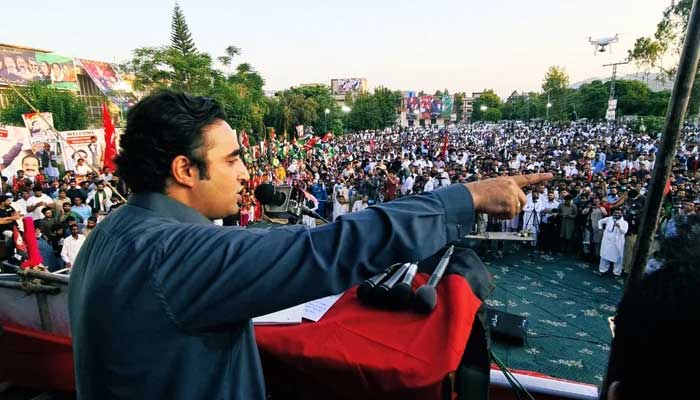
باغ جناح کراچی میں سانحہ کارساز کے شہدا کی یاد میں منعقدہ جلسے سے خطاب میں بلاول بھٹو زرداری نے کہا کہ اگر کل آمریت تھی تو آج یہ کٹھ پتلی نظام میں آمریت ہی ہے۔

انہوں نے کہا کہ سابق وزیراعظم شہید محترمہ بینظیر بھٹو دہشت گردی سے اور نہ آمر پرویز مشرف سے ڈری اور نہ ہی پی پی کا کوئی جیالا ڈرا ہے۔

پی پی چیئرمین نے مزید کہا کہ شہید بینظیر بھٹو ملک کو آمریت سے نجات دلانے کے واپس آئی تھیں۔

اُن کا کہنا تھاکہ 18 اکتوبر کو دنیا کو پتہ چلا کہ جیالے بم دھماکے سے بھی نہیں ڈرتے بلکہ جب دھماکے ہوتے ہیں تو ہمارے کارکن اپنی قیادت کی طرف بھاگتے ہیں، وہ دھماکے سے نہیں بھاگتے۔

بلاول بھٹو زرداری نے کہاکہعمران خان کہتے تھے کہ جب مہنگائی بڑھتی ہے تو اس کا یہ مطلب ہے کہ وزیراعظم چور ہے۔

انہوں نے کہا کہ جتنی مہنگائی اس وقت اتنی پاکستان کی تاریخ میں کبھی نہیں رہی تو عمران خان کے بقول جتنا چور اس وقت ہمارا کٹھ پتلی وزیراعظم ہے اتنا بڑا پاکستان کی تاریخ میں کوئی وزیراعظم چور نہیں رہا۔

پی پی چیئرمین نے کہا کہ اس وقت بجلی، گیس، پٹرول بے انتہا مہنگا ہے، یہ خان صاحب کا نیا پاکستان ہے، یہ تبدیلی نہیں تباہی ہے، انہوں نے ہماری معیشت کی تباہی کا بندوبست کیا ہے۔

جلسے کے آغاز سے قبل پی پی چیئرمین بلاول بھٹو اپنی چھوٹی ہمشیرہ آصفہ بھٹو زرداری کے ساتھ اسٹیج پر پہنچے تھے۔

جلسہ گاہ میں گہما گہمی عروج پر رہی، بڑی تعداد میں موجود کارکنان انتہائی پرجوش تھے اور پارٹی ترانوں پر رقص اور دھمال کر رہے تھے۔

وزیراعلیٰ سندھ سید مراد علی شاہ نے آج شام پریس کانفرنس کی تھی، جس میں کہا تھا کہ ان حکمرانوں کو نہ پتا تھا کہ حکومت میں آکر کیا کرنا ہے اور نہ ہی انہوں نے کچھ سیکھا ہے۔

https://jang.com.pk/news/999467 

Video - #SalamShuhadeKarsaz #KarachiJalsa - Chairman PPP Bilawal Bhutto Zardari addresses the public gathering at Bagh-e-Jinnah

Video - Karachi: #SalamShuhadaeKarsaz - PPP‘s public gathering at Bagh-e-Jinnah to pay tribute to Karsaz Martyrs

Friday, October 15, 2021

کندهار کې د شيعه ګانو يوه جومات کې چاودنې لسګونه کسان وژلي او ګڼ نور ژوبل کړي - بي بي سي نړۍ دا وخت

Video Report - #NayaDaur #SaleemSafi #ImranKhan Imran Khan Shouldn't Compare His Govt With Hazrat Umar's (RA): Saleem Safi

Video Report - #MJtv : ملک نازک موڑ پر، حساس ادارہ بیچ چوراہے میں، سویلین بالا دستی والے یو ٹیوبرز کا یو ٹرن

How Corruption Played a Role in the Demise of the Afghan Government


By 

As Afghanistan heads toward an uncertain future, many wonder what went wrong in the two decades leading up to the present crisis.
October marks the 20th anniversary of Operation Enduring Freedom and the start of the U.S. state-building project in Afghanistan. The main focus of this effort — the Afghan government — did not make it to the anniversary.
The overnight collapse of the Afghan government on August 15 caught many by surprise. Certainly, no one anticipated the chaotic situation that unfolded at Kabul International Airport in the last days of the U.S. evacuation. Even so, the writing was on the wall; cracks had appeared long ago. Years of excessive corruption at all levels of the Afghan government, enabled partly by the international community, crippled the Afghan government. This created a legitimacy crisis that contributed to the rapid downfall of the government in Kabul.
Corruption in the Shadows In June 2020, John Sopko, head of the leading U.S. government oversight agency for Afghanistan reconstruction (SIGAR), warned that corruption was “the
most insidious threat” facing the Afghan government at the moment. He argued that the gap between the public and the government had widened due to corruption, resulting in a situation where Afghans had to bribe officials to be able to access the most basic public services. As quoted by the Economist, Ahmad Shah Katawazai, a former Afghan diplomat, said that in Afghanistan, “from your birth certificate to your dead certificate and whatever comes in between, somehow you have to bribe.” Graeme Smith, a journalist and author of “The Dogs Are Eating Them Now: Our War in Afghanistan,” on the eve of a recent screening of his documentary “The Ghosts of Afghanistan” in Berlin told me that corruption in the last 20 years was treated as a side issue, despite it playing a central role in the collapse of the Afghan government.
As noted by U.N. Special Rapporteur Diego Gracia-Sayán, corruption has “direct damaging consequences” on governance, weakening the capacity of the judicial system while, on the other hand, decreasing citizens’ trust in judicial institutions. It would appear, therefore, that there exists a correlation between delaying the provision of justice and the subsequent growth of corruption. In Afghanistan, the weak judiciary has often bent before the will of the powerful, who can take advantage of their political connections. Others, less fortunate and unable to use such advantages, pay bribes and suffer from frustration due to lengthy processes. As a result, people (as much as 80 percent by one estimate) made use of an informal justice system or turned to the Taliban for assistance. These actions had a compounding effect on weakening the Afghan government’s legitimacy, something which it was in strong need of.
Anti-corruption Efforts
Following the controversial 2014 presidential election, which resulted in the creation of the National Unity Government (NUG) led by President Ashraf Ghani, hopes were high. Many believed that the former World Bank technocrat was the right man for the job of tackling corruption. Ghani’s initials steps, including establishing the Anti-Corruption Justice Center (ACJC) to address major corruption crimes, were promising. Reforms in other sectors such as public procurement resulted in some degree of success. In 2020, the World Bank noted that the procurement reforms saved the Afghan government an estimated $868 million – a considerable amount, given that the entire Afghan government budget was $5.5 billion that year.
Working with civil society, the Afghan government took steps to introduce anti-corruption measures. For instance, Afghanistan’s Access to Information Law, approved in 2018, ranks first in the world. In addition, Afghanistan’s remarkably free media allowed investigative journalists to exert greater scrutiny on government abuse of public funds.
That being said, the government’s fight against corruption can hardly be seen as a success story. While the government initiated well-intentioned reform programs to fight corruption, it did the opposite in other areas. The government’s shortcoming on adequate funding for more than a dozen anti-corruption agencies (ACAs), and limited political support to relevant actors, weakened anti-corruption efforts writ large. Furthermore, skilled staff were lacking, with overlapping mandates hindering their work. Surprising few, some of the ACAs ended up blackmailing rather than helping the government fight corruption. Furthermore, political interference from Arg, the Afghan presidential palace, and MPs did little to help the matter. Both former presidents Ashraf Ghani and his predecessor Hamid Karzai used the ACAs as “attack dogs” against political opponents. In a final attempt to draft an anti-corruption law and bring the many ACAs under one roof, the government disregarded inputs provided by civil society members. International Community
Equally complicit was the international community, due in large part to its mismanagement of assistance. A complete analysis of how financial assistance coming into Afghanistan was handled by donors raises important questions. Too much money, with little or no oversight, was flooded into Afghanistan, which had no institutional mechanism to properly handle such resources. One estimate by SIGAR puts the total amount donated by the United States alone to be valued at $145 billion in development assistance over the past 20 years. As noted by the U.S. watchdog, there were notable allegations of “waste, fraud and abuse” against the U.S. reconstruction efforts in Afghanistan. A CNN summary of SIGAR’s reports highlighted 10 examples, including a cargo fleet with an initial value of half a billion dollars selling for scraps at a paltry $40,000, a fancy $85 million hotel which never opened, and a health care facility which had coordinates placing it in the Mediterranean Sea. These are only a few examples of such rampant waste of resources.
Some, including Chairman of the Joint Chiefs of Staff General Mark Milley, argue that the May 2020 troop withdrawal under the Doha agreement with the Taliban provided the basis for the collapse of the government. There is certainly some truth to that. The Taliban saw no incentive to truly engage in further talks or to agree to a power-sharing deal with Kabul while the Americans were already on their way out. The decisive blow came earlier, however, when the U.S. decided not to include the Afghan government in the peace negotiations in the first place. Years of excessive corruption in the Afghan government had weakened its position at the negotiation table. The U.S. prioritizing security over state-building and development resulted in achieving neither.
Challenges Before the Taliban
There is no understanding of what a Taliban anti-corruption policy may eventually look like – at least not at the moment. Although the Taliban are known for having little tolerance for corruption, they are still vulnerable. Fighting corruption and governing, in general, is more challenging than achieving success on the battleground. Endemic corruption has infiltrated every level of Afghan society. Afghanistan ranks 165th out of 180 countries and territories on Transparency International’s 2020 Corruption Perception Index (CPI). As the Taliban pushes for international recognition, it should ensure that good anti-corruption laws, such as the access to information law from the past government, should be in place. Furthermore, the increasingly shrinking space available for media and civil society to participate is worrisome and will not help in the fight against corruption.
Any future Afghan government that ignores prioritizing anti-corruption will find itself in hot water sooner or later. Creating an environment that includes a vibrant civil society and free media is essential for tackling corruption in developing economies such as Afghanistan.
https://thediplomat.com/2021/10/how-corruption-played-a-role-in-the-demise-of-the-afghan-government/

Violence surges in Pakistan's tribal belt as Taliban, IS-K go on attack

By Abid Hussain
Seventeen-year-old Israr was fast asleep when his phone rang.
It was 2am and the teenager was exhausted. He'd been working all day as a guard. On the other end of the line was his brother, who told Israr that men had barged into their family house, dragged their father outside, and shot him dead.
"He asked me to rush back home," recalled Israr, whose name has been changed for his safety.
I met Israr in Orakzai, one of seven districts in Pakistan's tribal belt. Like the provinces just over the border in Afghanistan, Orakzai is home to a predominantly Pashtun population.Three days after Israr's father was killed, a branch of the extremist organisation Islamic State known as Islamic State Khorasan Province (IS-K), claimed responsibility for the murder.
IS-K accused Israr's father of being a Pakistani military informant, a claim rejected by Israr.
"My father just had a shop in Orakzai. He would help his tribe, especially those people who were returning to the area after being displaced due to war," Israr said.
"He had no enemies. He was one of the elders of the area."
In Afghanistan, the Taliban and IS-K are fighting a bloody war for pre-eminence.
Rising violence
The attack on Israr's father wasn't a one-off. On the same day, another man was shot dead in Orakzai, also for allegedly being an "informant" for the Pakistani military. IS-K also claimed responsibility for that attack.Orakzai is one of seven tribal areas including Bajaur, Mohmand, Khyber, Kurram, North Waziristan and South Waziristan which were previously governed under British colonial-era law.It was only in May 2018 that they were merged with the province of Khyber Pakhtunkhwa and turned into districts, bringing them into the Pakistani civilian fold.There has been a surge in violence this year, according to data compiled by the Pakistan Institute for Peace Studies (PIPS), an Islamabad-based research organisation.Tehrik-i-Taliban Pakistan (TTP), the "ideological twin" of the Afghan Taliban, is mainly responsible. TTP wants to follow in the footsteps of its Afghan counterparts and establish their interpretation of Sharia - a hard-line form of Islamic governance - in Pakistan.
According to PIPS data, the TTP carried out 95 attacks last year, killing 140 people, and 44 attacks in the first six months of this year.
As the Afghan Taliban made rapid progress in Afghanistan and started gaining control of various provinces from July onwards, the TTP increased their activity. From July until September, the group carried out another 44 attacks, claiming 73 lives. Those killed were mostly members of Pakistan's law enforcement agencies.
Threats and intimidation
And beyond the overt violence, the region has been simmering for months with threats and tension.
Some residents say they have received calls from Afghan and Pakistani numbers demanding extortion money. Ahmed - not his real name - is a social worker and businessman from Bajaur district. He told the BBC that he kept receiving calls from different numbers in July and August.
The men would introduce themselves as being from the Taliban and demand money.
"They were asking for extortion money," Ahmed said. "And despite my refusal, they kept sending me voice notes and messages on WhatsApp, threatening that if I didn't pay up they would harm me and my family."
Ahmed said he contacted the district administration and presented evidence to both civilian and military authorities.
"I repeatedly informed them about it but I was told by the administration that I am not the only person receiving these calls, and many others have received the same threats here in Bajaur.
"They told me that it's impossible to provide security to everyone, and that I must take precautions myself and install security cameras at my house."
Who are the TTP? The TTP was founded by Baitullah Mehsud in South Waziristan at the end of 2007. The militant movement was formed in response to a Pakistani military operation clearing the Lal Masjid mosque in Islamabad where a radical preacher held sway. He was once considered close to Pakistan's intelligence agency, the ISI.
According to Dr Amira Jadoon, an assistant professor at the US Military Academy at West Point, the links between the Afghan and Pakistani Taliban date back to 9/11 and the fall of the first Taliban government in Afghanistan in 2001.Analysts say that after the US-led invasion of Afghanistan the Pakistani Taliban's leaders fought alongside the Afghan Taliban, providing food, shelter, and financial aid to the Afghan Taliban in Pakistan's tribal areas, and also pledging allegiance to them.But after its formation, the TTP went on a rampage against the Pakistani state, targeting both civilians and security forces. The Pakistani Army retaliated and pushed the TTP leadership to Afghanistan, where it has been based since 2015, conducting a "low-intensity" warfare against Pakistan.
As the Afghan Taliban started their march on Kabul this past July, the TTP became more visible.
Pakistani Taliban chief Noor Wali Mehsud told CNN that the Afghan Taliban's victory would be a "victory for the entire Muslim people". He also had a warning for Pakistan.
"Our fight is only in Pakistan where we are at war with Pakistani security forces," he said.
"We are hoping to take control of Pakistan's border tribal region and make them independent."
Singapore-based terrorism scholar Abdul Basit believes the victory of the Afghan Taliban has "definitely emboldened" the TTP.
"They feel that if America has lost out in Afghanistan, what can Pakistan do," he said. "Plus, they have been stoking ethnic tensions and playing up local grievances ... Essentially, the TTP is trying to exploit Pashtun victimhood." But according to Pakistan's former national security adviser and retired three-star General, Nasir Janjua, the TTP are a "receding phenomenon". "The TTP has lost its appeal among the masses. Their narrative to fight Pakistan because it sided with the US has outlived its shelf life since the Americans are no more in Afghanistan," he said.
"Their increased violence is their struggle for survival."
The public relations wing of the Pakistani military, the ISPR, played down the increasing number of attacks by the TTP and affiliated militants in the tribal region."Terrorist groups have been largely defeated. However, isolated incidents do happen," a spokesperson told the BBC.
Good Taliban, Bad Taliban
It is commonly accepted that the Pakistani state has a historically strong relationship with the Afghan Taliban and is encouraging the world to accept their new regime in Afghanistan.But it has also fought a bloody battle against the Pakistani Taliban over the past decade, resulting in thousands of civilian and security forces deaths across the country.It is often referred to as Pakistan's "good and bad Taliban" strategy, where the Afghan Taliban are seen in a good light but the Pakistani Taliban in a bad light.
The military launched multiple operations to eliminate the militants from the tribal areas with hundreds of thousands of people forcibly displaced.
But the Pakistani government has also sought to negotiate a peace deal with various factions within the Pakistan Taliban down through the years.
However, the presence of IS-K in the tribal region causes yet another headache for the Pakistani authorities.
In Afghanistan, IS-K also has major differences with the Taliban, accusing them of abandoning Jihad for a negotiated settlement signed last year in Doha. IS-K considers the Taliban "apostates" and legitimate targets. IS now represents a major security challenge for the incoming Afghan Taliban government, something the Taliban leadership shares in common with Western intelligence agencies.
"IS-K has sectarian differences with the TTP (Pakistani Taliban) and consider them to be misguided Muslims, who are agents of Pakistan, Iran and other regional forces," said Abdul Sayed, a Sweden-based independent researcher on jihadism. But experts believe that the low-level cadre of TTP and IS-K in Pakistan consist of the same members who are fluid in their allegiance and often work for both organisations.
According to Dr Jadoon, IS-K has a bigger objective in mind than the TTP.
"IS-K seeks territorial control in pursuit of a caliphate and sees itself as the only legitimate leader of the global ummah (Muslim people)," she said.
Forced to flee
With so many militant groups in operation, life is hard for people who must live in their midst.
A former militia leader who fought the TTP alongside the Pakistani military a few years ago told me his entire family had to relocate from his village in Mohmand, a tribal district bordering Afghanistan. "My father was martyred, my cousin was martyred, our family homes destroyed," said the former militant, Shehzad - not his real name. "Some of our men lost their hands, some lost their legs, and some don't have either. None of us wanted to leave our village but what else can you do when there's no place to live," he said. Ahmed, the businessman from Bajaur, also painted a gloomy picture. "It often compels me to think about leaving my home and taking the family away. But then, where can I possibly go. How can I just walk away from my home," he said.
Israr, the young man from Orakzai, was more forthright.
"We had no choice but to leave our home when the war started 14, 15 years ago. My parents returned two years ago but now my mother has become a widow," he said.
"The government assured us that the peace has returned in the area and we should go back, but where is the peace?"
https://www.bbc.com/news/world-asia-58891613

Wednesday, October 13, 2021

Comedy: #drybar #comedy #standup Dysfunction Junction. Tom Mabe

Video Report - French forces prepare to close bases in Mali

Video Report - President Biden Delivers Remarks on Efforts to Address Global Transportation Supply Chain Bottleneck

Video Report - Vice President Harris Meets with Mia Amor Mottley, Prime Minister of Barbados

Video Report - Secretary Blinken's meeting with UAE Foreign Minister Sheikh Abdullah Bin Zayed Al Nahyan

خوبونه گوره د خراسان بدل به نشی افغانستان

Video Report - د افغان میرمنو اندیښنو په اړه له فوزیه کوفي سره مرکه

Video Report - د آشنا تلویزیون د چهار شنبې خپرونه د ۲۰۲۱ د اکتوبر ۱۳ - تلې ۲۱

#Pakistan #PPP leaders demand an apology from PM Imran Khan for calling the Pakhtun nation terrorists

Pakistan Peoples Party central leaders have demanded that the Prime Minister should apologize for calling the Pakhtun nation terrorist. The government has destroyed all institutions. Now, an institution like the army should not be made controversial.These views were expressed by PPP Central Secretary Information Faisal Karim Kundi, former member National Assembly Akhwanzada Chitan, Senator Rubina Khalid, Syed Sibtul Hassan Bukhari in a joint press conference. They were accompanied by PPP Media Coordinator Nazir Dhoki and Raja Noor Elahi.
Faisal Karim Kundi said that the nation was saddened by the demise of Dr Qadeer Khan. Pakistan lost a great personality with the demise of Dr Abdul Qadeer Khan. The government did not fulfil the will of Dr. Qadeer for burial in Faisal Mosque. The government did not honour Dr. Qadeer Khan.
He said that the appointment of DG ISI has been made controversial by the selected Prime Minister. The government has given an opportunity to the media of the enemy country to criticize our forces. “I want to tell Imran Khan that the former tribal areas had guarded the borders for 60 years” Kundi said. The party condemns Imran Khan’s declaration of the Pashtun nation as terrorists. Imran Khan should apologize to the nation for declaring Pashtuns as terrorists. Faisal Karim Kundi said that the details of the gifts in the treasury should be brought before the nation. Opposition parties should unite and get rid of this selected and puppet government by bringing a no-confidence motion in Punjab and the Centre. He said that inflation has made life miserable for the people against which PPP is protesting all over the country. The government is playing with the future of young doctors. He also condemned the police brutality at the press conference of eunuchs.
Akhunzada Chitan said that the Taliban’s statement was about Islam, jihad and caliphate. The Taliban never spoke of Pakhtuns or nationalism. The Taliban was based in Kandahar where they fought Pakhtun leaders. Asfandyar Wali, Mahmood Achakzai, Manzoor Pushtin, Aftab Sherpao have never supported the Taliban. He said that before the jihadi culture was introduced, there was no such thing as crime in the entire tribal districts.
https://www.ppp.org.pk/pr/25620/

#Pakistan #PPP - Newborn baby in NICU but getting stronger, says Bakhtawar Bhutto-Zardari

 Bakhtawar Bhutto-Zardari Wednesday provided her fans and followers on social media with a health update, saying that her little baby boy is currently in a Neonatal intensive care unit (NICU) but getting stronger.

Taking to Twitter, PPP Chairman Bilawal Bhutto-Zardari's sister revealed that her son was due on November 10 but "surprised us all on Oct 10th".

"Thank you for all the love & celebrations welcoming our little baby boy to the world," she tweeted.

"He was due Nov 8th but decided his own birthday and surprised us all on Oct 10th - currently in the NICU but getting stronger every day, do keep him in your prayers," she tweeted. 

Bakhtawar had announced the birth of her son on October 10. 

"We are happy to announce the birth of our baby boy," she had written.

Her brother, PPP chairman Bilawal Bhutto-Zardari, had also reacted to the news and expressed his happiness over becoming an uncle.

Bilawal and Bakhtawar's youngest sibling Aseefa Bhutto-Zardari had also taken to Twitter to write: "Officially a khala!!! Alhamdullilah!"

https://www.geo.tv/latest/375544-in-nicu-but-getting-stronger-says-bakhtawar-bhutto-zardari

Tuesday, October 12, 2021

Video Report - Talk with the Taliban? West meets with new Afghan rulers as food crisis looms

Video Report - #Poland #Belarus #migration Belarus-EU standoff triggers fresh migration crisis

Video Report - UN court gives Somalia most of sea zone claimed by Kenya

Video Report - How Congress avoided a government shutdown and a default crisis

Video Report - White House press secretary Psaki holds news conference (FULL - 10/12)

Music Video - Main nashe mein hoon Jagjit Singh

Music Video - Ghazal - Sabko Maloom Hai Main Sharabi Nahin By Pankaj Udhas

Video Report - #MJtv LIVE: بارہ اکتوبر سے بارہ اکتوبر تک، جنرل مشرف سے جنرل باجوہ تل ک

#Pakistan - Child beggars

Kishwar Enam
A FEW years ago, as I parked my car in a public parking lot, two child beggars came running to get their pack of cookies which I used to keep for them. Returning to the car a few hours later, I saw the vehicle’s lights blinking, the windows broken, and the audio system stolen. One of the little girls I had befriended was eyeing me from a distance. I waved for her to come over and asked if she knew who was responsible. She said no but her expression gave her away. She was the little messenger who knew how much time I spent away from the car. Later, I found out that the two belonged to a group of professional beggars, who, when arrested, were not only instantly freed, but escorted in a big, shiny four-wheeler.
Child beggars at busy traffic signals are a common sight in most big cities in Pakistan. They are often a heartrending sight and we impulsively succumb to their plea for money. In reality, the money we give is not so much for the child as it is for the pleasure of seeing the young beggar smile, or self-pride at our charitable act, or, to fulfil our sense of religious duty or to combat our own feeling of helplessness at the child’s situation.
It is no secret that beggary in Pakistan is a racket operated by professionals who control territory. Beggars pay rent to reserve a particular area for themselves and the busier the site, the steeper the rent. Child beggary involves a complicated process. Most of the time, adults accompanying the children are not parents but their handlers. From the handler who takes advantage of parents’ poverty and the trafficker who abducts children to the peddler who needs to sell drugs and others who stand to financially benefit, the one who is exploited is always the child. Often the limbs of these children are amputated or they are disfigured to attract sympathy. They are also physically and sexually abused and kept in miserable conditions. Emotional neglect and non-provision of basic necessities including healthcare, food, clothing, education and shelter impact their psychosocial development.
Studies in Pakistan have shown an association between begging and developing an inferiority complex, lack of self-confidence, loss of self-respect, and poor social skills. These children remain in a cycle of poverty. Their future is bleak. They develop mental health problems, become drug addicts and keep poor health. In short, the money we give them only pulls them deeper into the abyss.
There’s no visible change in the number of young beggars.
The anti-vagrancy law of 1958 prohibits a child from receiving alms at public places or exhibiting wounds, injuries, deformities or disease. The Sindh cabinet in 2018 imposed a ban on beggary. Shortly after, the chief minister directed the social welfare department to pick up child beggars and rehabilitate them. The Sindh Child Protection Act includes child beggars in the list of children who need special protection measures. Additionally, amendments made in 2021 added street children to the act. It also allows for child protection officers to take a child requiring special protection measures immediately under their custody and present them to the magistrate within 24 hours. Despite the several anti-beggary drives by the government and advertisement efforts of the 1121 helpline, there is no change in the number of child beggars seen in Karachi. The drowsy and sleeping infants in the laps of their so-called mothers have been tested on several occasions and were found to be drugged. The result of the Sindh Police’s project to test the DNA of children and adult beggars on suspicion of abduction is still awaited.
When police pick up child beggars, they are dropped at an Edhi Centre. However, it only takes a few hours before the parents or handlers pick them up after paying a minimal fine. Last year, a huge shelter was inaugurated by the Sindh Child Protection Authority with sufficient capacity to accommodate and rehabilitate the beggars and street children. Unfortunately, the police and the authority are still confused about their roles. While the laws are self-explanatory, it requires determination to get the new system up and running; and we are definitely lacking in that.
The answer is not straightforward in a low-/middle-income country, where the poverty ratio is estimated to be 39 per cent by the World Bank and where over two million people have fallen below the poverty line over the last few years. We must delineate clearly between begging due to poverty and begging on account of the mafia. The law is clear: the mafia and handlers should be identified and punished. It is the government’s responsibility to provide support to the parents of child beggars. If parents do not stop exploiting their children after being warned, they should be punished too. These children have the right to receive an education and to live their life.
Next time before giving money to a child beggar, please consider whether you are really helping them or pushing them deeper into misery.

#PashtunsAreNotTerrorist - Pakistani Pashtuns have a message for Imran Khan—‘we are not Taliban’


ANGANA CHAKRABARTI
Last month, Imran Khan said at the UN that all Pashtuns living in Pakistan ‘had affinity and sympathy with the Afghan Taliban’. From Malala Yousafzai’s father Ziauddin Yousafzai to columnist Mohsin Dawar, Pakistani Pashtuns are saying — ‘I am Pashtun but I am not Taliban’. And these messages are for Prime Minister Imran Khan.
PM Khan has become the centre of controversy over his 24 September statement at the United Nations General Assembly where he said that all the Pashtuns living in Pakistan “had affinity and sympathy with the Afghan Taliban”.
“Then all along the tribal belt bordering Afghanistan – Pakistan’s semi-autonomous tribal belt – where no Pakistan army had been there since our independence, people had strong sympathies with the Afghan Taliban, not because of their religious ideology but because of Pashtun nationalism, which is very strong. Then there are three million Afghan refugees still in Pakistan- all Pashtoons, living in the camps…They all had affinity and sympathy with the Afghan Taliban,” Khan had said.
On Monday, MP Mohsin Dawar submitted a resolution in Pakistan’s National Assembly in which he condemned Khan’s remarks at the UN and demanded an apology. In the resolution, Dawar wrote, “The PM’s unfounded and false assertions are an insult to Pashtuns who had suffered the most at the hands of Taliban. Thousand of Pashtuns and Pashtun leaders and political activists have lost their lives to acts of terror perpetrated by the Taliban”
In September, Khan had also drawn controversy over an interview in which he said that the terrorist organisation Haqqani network is a Pashtun tribe living in Afghanistan.
Twitter responds
On Monday, several Twitter users took to social media to denounce Khan’s statement.
Ziauddin Yousafzai, who is the father of Pakistani activist and Nobel Peace Prize laureate Malala Yousafzai, wrote, “Let me insist and remind the world: I love peace, democracy, and education. I believe in women’s freedom and equality. I love art and music. I am Pashtun & I love Pakistan.”
Columnist Mohammed Taqi, hit back at Khan by calling the Taliban an “anti-Pashtun project of the Pakistan army”. “Neither is every Pashtun a Talib nor every Talib a Pashtun. Taliban is an Islamist terrorist anti-Pashtun project of the Pakistan army designed and deployed to counter Pashtun nationalism #PashtunsAreNotTerrorist,” he said.Criticising the PM for defaming Pakistani Pashtuns, a Twitter user like Shagufta Noorzai tweeted saying, “He (Imran Khan) said that the Pashtun nation attacked the state, so what could be more unfortunate for us now that the Prime Minister of my own country presented me to the world as a terrorist doing.”Another Twitter user, Nadeem Askar, said, “Shocked at how the puppet PM of Pakistan connecting Taliban with Pashtun. Taliban is a project of Pakistan’s Generals for using against Pashtun nationalism. Stop Pashtun profiling.”
Who are the Pashtuns
Also known as Pushtans, Paktuns or Pathans, the Pashtuns are the largest ethnic group in Afghanistan. A large number of Pashtuns, who are mostly Sunni Muslims, live in the Khyber Pakhtunkhwa in Pakistan province that shares a border with Afghanistan.Criticising the PM for defaming Pakistani Pashtuns, a Twitter user like Shagufta Noorzai tweeted saying, “He (Imran Khan) said that the Pashtun nation attacked the state, so what could be more unfortunate for us now that the Prime Minister of my own country presented me to the world as a terrorist doing.”
Another Twitter user, Nadeem Askar, said, “Shocked at how the puppet PM of Pakistan connecting Taliban with Pashtun. Taliban is a project of Pakistan’s Generals for using against Pashtun nationalism. Stop Pashtun profiling.”
Who are the Pashtuns
Also known as Pushtans, Paktuns or Pathans, the Pashtuns are the largest ethnic group in Afghanistan. A large number of Pashtuns, who are mostly Sunni Muslims, live in the Khyber Pakhtunkhwa in Pakistan province that shares a border with Afghanistan.
A significant number of Pashtuns have also settled in Balochistan, where they comprise up to 20 per cent of the population and a small number live in the highlands of Pakistan’s semi-autonomous Federally Administered Tribal Areas (FATA).Several within the Pashto community in Pakistan have often criticised the current dispensation in the country for alleged human rights violations. The Pashtun Tahafuz Movement (PTM), a civil rights group, was founded in 2014 and has since been taking up the cause of the Pashtuns.
A significant number of Pashtuns have also settled in Balochistan, where they comprise up to 20 per cent of the population and a small number live in the highlands of Pakistan’s semi-autonomous Federally Administered Tribal Areas (FATA). Several within the Pashto community in Pakistan have often criticised the current dispensation in the country for alleged human rights violations. The Pashtun Tahafuz Movement (PTM), a civil rights group, was founded in 2014 and has since been taking up the cause of the Pashtuns.

Differences over ISI chief's appointment a test for Gen Bajwa

By Namrata Biji Ahuja
‘Your armed forces shall never let you down,’ said Gen Musharraf after the coup
On October 12, 1999, it took just 17 hours for Pakistan chief of army staff Pervez Musharraf to overthrow the Nawaz Sharif government in a bloodless coup. Sharif had kept intelligence chief General Ziauddin by his side, appointing his new head of the military, but was soon defeated, put under house arrest before being forced into exile. On this day, the military rule set in for the third time in Pakistan.
“ Your armed forces have never, and shall never, let you down,” Musharraf told Pakistanis in a late-night address that night.
As Pakistan commemorates the 22nd anniversary of the military coup on Tuesday, Pakistan prime minister Imran Khan was huddled with the incumbent chief of the Army Staff General Qamar Javed Bajwa to iron out the differences over the appointment of incoming ISI chief Lt General Nadeem Ahmed Anjum.
Imran Khan's dependency on his predecessor Lt General Faiz Hameed is well known in Pakistani security circles.
Imran Khan is fighting polarisation within the political arena where opposition like Pakistan People's Party (PPP) are sniping at his heels. Like some of his predecessors, he had been looking at Lt General Hameed to bail him out. But when Gen Bajwa met the prime minister last week and told him that Lt Gen Hameed has to be posted out as Commander of Peshawar-based Corps XI, Khan wasn't happy.
Lt Gen Hameed was removed as ISI chief and sent as Commander of Peshawar-based Corps XI on the instructions of Gen Bajwa. The only time a prime minister in Pakistan appointed an ISI chief of their choice was when Benazir Bhutto brought in Lt Gen (retd) Shamsur Rahman Kallu, using her powers to appoint the ISI chief to replace the hawkish Lt Gen Hamid Gul in 1989. But history bears testimony to Bhutto's fate when she was shown the door a year later and it was a helpless Lt Gen Kallu whose own units defied him and were used by the military to topple her government.
Once again, a controversy over the change of command at ISI has hit home and security experts view it as an indicator of the growing rift between the civilian government of Imran Khan and the chief of the Army Staff General Qamar Javed Bajwa. Gen Bajwa has made it clear that the institutional interest of the Pakistan army has to be protected at all costs. The difference over the ISI chief's appointment is a test case for the Army General. Top officials said if the Pakistan army backs out now, it will be a huge setback to Gen Bajwa, the chances of which are extremely unlikely unless Pakistan is plunging into the making of another military coup which it can ill afford. Traditionally, civilian governments in Pakistan have had little say when it comes to the affairs of the army. One of the reasons being cited for Lt Gen Hameed's posting is that all the three generals before him had been posted as corps commanders and the requisite experience would help Lt Gen Hameed to be in contention for the next army chief when Gen Bajwa retires in November 2022. ''But more than that it is Bajwa's decision to send him out that has to prevail over Khan's political needs or convenience,'' said a top security official.
Security sources said Lt Gen Hameed's visit to Kabul and the international attention on the ISI chief at a time when the world was watching the Taliban -Haqqani takeover of Afghanistan, had not also gone down well with Gen Bajwa even though it has scored political brownie points for Imran Khan government for its strategic victory in its neighbourhood. For Imran Khan, the simpler way out is to avoid a deadlock and issue a clarification about the delay in issuing a formal order on the appointment of the new ISI chief. His predecessors have done it in the past when they have defied the army's will or diktat.
In 2008, when Prime Minister Yousuf Raza Gilani was en route to Washington, ISI chief Lt Gen Nadeem Taj was waiting anxiously for his plane to land midway in London to convey a message. The message was that Gen Ashfaq Kiyani, then chief of army staff, was miffed after Gilani had issued an order that the ISI, which focusses on external intelligence, will be brought under the Interior Ministry. The army had not been consulted. Within minutes of Gilani's plane landing in London, the Pakistan government issued a ''clarification'' that the earlier notification was a ''misunderstanding''.
This time, Imran Khan and Gen Bajwa are holding talks and whatever decision is taken, the will of the Pakistan army is expected to prevail.
https://www.theweek.in/news/world/2021/10/12/pak-commemorates-22nd-anniversary-of-military-coup-that-led-to-musharraf-leaving-the-country.html

Monday, October 11, 2021

Video - د آشنا تلویزیون د دوشنبې خپرونه د ۲۰۲۱ د اکتوبر ۱۱ - تلې ۱۹

Biden administration delivers brusque message to Pakistan

Shah Meer Baloch & Julian Borger
With relations frosty over Taliban victory and Pakistani repression, deputy secretary of state visits for ‘specific and narrow purpose’
A senior US official visiting Islamabad has made clear to Pakistan that the Biden administration has downgraded the bilateral relationship.
On the eve of her arrival, the deputy secretary of state, Wendy Sherman, used a public event in Mumbai to lay out in blunt terms the new parameters of US-Pakistan relations, stressing there would be no equivalence with Washington’s deepening ties to India.
The Islamabad trip was for “a very specific and narrow purpose”, Sherman said, to talk about Afghanistan and the Taliban.
“We don’t see ourselves building a broad relationship with Pakistan, and we have no interest in returning to the days of hyphenated India-Pakistan,” she added. “That’s not where we are. That’s not where we’re going to be.”
Sherman’s reception in Pakistan the next day was stilted. A planned meeting with the prime minister, Imran Khan, never materialised. Senior Pakistan government officials told the Guardian that there was diplomatic tension between the two countries that needed to be resolved and that Khan was angry that he had still not received a phone call from Joe Biden.
However, Fawad Chaudhry, the information minister, said that the talks with Sherman had gone well. “I think she spoke very warmly in Pakistan and she has understood Pakistan’s point of view,” Chaudhry said.Biden sets great store by his personal relations with world leaders, and in his speech marking the completion of the military withdrawal from Afghanistan on 31 August the president said the new emphasis would be on regional diplomacy. In that context, the decision not to call is intended to be an unambiguous signal of Washington’s displeasure with Khan’s attitude to Afghanistan.
Khan described the Taliban takeover as “breaking the chains of slavery”. The US wants Pakistan to maintain international solidarity in withholding recognition of the Taliban while pressing for women’s rights and other democratic principles.
The cold approach has come as a shock to Islamabad, which had been accustomed to Trump’s informal and personal relationship with Khan. In a recent leaked memo, the foreign minister, Shah Mahmood Qureshi, urged the Pakistani embassy in Washington to get a call arranged between Biden and Khan.
“In spite of the existing situation in Afghanistan, and the key role played by Pakistan, it is unfortunate that the White House remains indifferent to the Pakistani leadership,” the letter said, blaming “the immature understanding of the White House staff”.
“You are thus expected to take adequate measures, ensuring that enough diplomatic steps are taken to guarantee the strategic relevance of Pakistan in all diplomatic forums.”
The foreign minister insisted the letter was a fake but official sources said it was authentic.
Asked about the absence of a presidential phone call to Khan, the White House said it had nothing to add to non-committal remarks by the press secretary, Jen Psaki, in late September when she said she didn’t “have anything to predict at this point in time”.
Pakistan has been long accused of playing a double game in the fight against terrorism, on one hand being a supposed ally in the US “war on terror” while also supporting and sponsoring the Taliban, and allowing them to live and regroup on Pakistan soil.
Cyril Almeida, a columnist and analyst, said: “Since 9/11, the US has seen Pakistan through an Afghan prism. Now that Pakistan is perceived to have won another proxy war against a superpower in Afghanistan, the superpower appears to be in no mood to forgive or forget.”
The issue is urgent for Pakistan, which is anxious to get flows of humanitarian aid going across the border and forestall a complete collapse in Afghanistan which would lead to a huge, destabilising influx of refugees.“Pakistan is desperate to move on from the past and let bygones be bygones and wants to broaden out its relationship and focus on geo-economics, but from Washington’s standpoint, Afghanistan is going to continue to dominate its interests in the region for the foreseeable future,” Elizabeth Threlkeld, the director of the South Asia programme at the Stimson Center, said.Since the Taliban came into power in mid-August, Pakistan has been publicly talking about the future recognition of the Taliban government, which has close ties to Pakistan’s powerful military intelligence services, the ISI.Last week, in an interview with the Turkish-state affiliated TRT World, Khan said the United States will “sooner or later” have to recognise the Taliban government in Afghanistan.
There is a fear among western countries and diplomats that Pakistan may recognise the Taliban new government and undermine international efforts to pressure the Taliban into making assurances about human rights, security and the freedoms of women. A report published in Pakistan’s Dawn newspaper, quoting the US sources, reported that the United States does not want Pakistan to recognise the Taliban regime before the rest of the international community.
Almeida said it has not helped that, since the collapse of the Afghan government and the takeover by the Taliban, Pakistan has been seen to be earnestly pleading the group’s case to the world as well as making it very public that it is playing a role in helping establish the new Taliban cabinet.
Zahid Hussain, the author of No-Win War: the Paradox of US-Pakistan Relations in Afghanistan’s Shadow, said that relations were at their lowest ebb. “There is lack of hope that the relations will get better, as the things are not moving towards rapprochement between both countries. Today, we don’t see the strategic relations between the US-Pakistan – it is only a transactional relation now,” he said.
In contrast to the Trump administration, the Biden administration has been more focused on promoting democracy and human rights globally and many believe that Biden will eventually press the Pakistan premier on the human rights abuses and censorship of the media that have become rampant in Pakistan.A US state department report published in 2021 had a detailed and damning chapter on the human rights violations in Pakistan. The chapter portrayed a bleak situation in Pakistan in terms of issues such as human rights abuses, suppression of freedom of speech, marginalisation of women and minorities in Pakistan.However, senator Mustafa Nawaz Khokhar, a former committee head of human rights in the senate of Pakistan, said that while the US had been “silent for a long time when it involves democracy and human rights violation”, the Biden administration could play a crucial role in holding Khan’s administration to account.
“It can be damaging for Pakistan,” said Khokhar. “The current Khan regime is known for the suppression of free speech and democratic norms. We think Biden will go hard on Pakistan.”
Almeida said it has not helped that, since the collapse of the Afghan government and the takeover by the Taliban, Pakistan has been seen to be earnestly pleading the group’s case to the world as well as making it very public that it is playing a role in helping establish the new Taliban cabinet.
Zahid Hussain, the author of No-Win War: the Paradox of US-Pakistan Relations in Afghanistan’s Shadow, said that relations were at their lowest ebb. “There is lack of hope that the relations will get better, as the things are not moving towards rapprochement between both countries. Today, we don’t see the strategic relations between the US-Pakistan – it is only a transactional relation now,” he said.
In contrast to the Trump administration, the Biden administration has been more focused on promoting democracy and human rights globally and many believe that Biden will eventually press the Pakistan premier on the human rights abuses and censorship of the media that have become rampant in Pakistan.
A US state department report published in 2021 had a detailed and damning chapter on the human rights violations in Pakistan. The chapter portrayed a bleak situation in Pakistan in terms of issues such as human rights abuses, suppression of freedom of speech, marginalisation of women and minorities in Pakistan.
However, senator Mustafa Nawaz Khokhar, a former committee head of human rights in the senate of Pakistan, said that while the US had been “silent for a long time when it involves democracy and human rights violation”, the Biden administration could play a crucial role in holding Khan’s administration to account.
“It can be damaging for Pakistan,” said Khokhar. “The current Khan regime is known for the suppression of free speech and democratic norms. We think Biden will go hard on Pakistan.”
https://www.theguardian.com/world/2021/oct/10/biden-administration-delivers-brusque-message-to-pakistan

Chairman PPP is fighting against the exploitative forces of Imran Khan that are abusing the rights of poor people of Pakistan

 Central Information Secretary Pakistan Peoples Party Parliamrntarinans and member of the National Assembly Shazia Atta Marri has said that Chairman PPP is fighting against the exploitative forces and poor masses have been suffering for eight years due to anti-people policies of Imran Khan’s government. This she expressed in a statement issued hereon today. 

Shazia Marri while slamming the government said that the ruling government has been deprived the people of their jobs and employment opportunities have also been closed for the youth for eight years in the country while PPP leadership provided jobs to the youth. PPP is the only party that creates opportunities of jobs for the people and this PTI’s incompetent government has also impoverished the middle class due to bad economic policies. 

The educated youth of the country being deprived of their skills by showing them the way to the anchorage. She said that people should support Bilawal Bhutto Zardari in the upcoming general elections, he will provide jobs to the youth and will never disappoint the people.


https://www.ppp.org.pk/pr/25608/

“OFFICIALLY A KHALA!” SAYS ASEEFA AS BAKHTAWAR BHUTTO, MAHMOOD CHOUDHRY WELCOME BABY BOY

 Bakhtawar Bhutto Zardari and Mahmood Choudhry on Monday welcomed a baby boy as the former’s sister and PPP leader Aseefa Bhutto Zardari made the announcement, ARY NEWS reported.

In a message from her Twitter handle, Aseefa Bhutto Zardari said that she had officially become a maternal aunt.


“Officially a Khala!!! Alhamdullilah!,” she said while sharing a Twitter post from Bakhtawar in which the latter mentioned her husband, Mahmood Choudhry while announcing the birth of a baby boy.

Bilawal Bhutto also announced the news from his Twitter handle saying that he has officially become a maternal uncle.


Late Benazir Bhutto and former president Asif Ali Zardari’s eldest daughter Bakhtawar Bhutto Zardari tied the knot with her fiancé Mahmood Choudhary in January this year.

The nikkah ceremony of Bakhtawar was held at Bilawal House, Karachi. The ceremony was attended by families of Bakhtawar Bhutto and Mahmood Choudhary alongside prominent figures including politicians and businessperson.

The guest count was kept limited to only 300 people due to the ongoing coronavirus pandemic.

https://arynews.tv/bakhtawar-bhutto-mahmood-choudhry-aseefa-baby-boy/