Sunday, July 11, 2021

#Pakistan - Muzzling dissent?


Mubasher Bukhari

          @BukhariMubasher 

A provincial assembly has passed a bill providing for summary trials of journalists, bureaucrats.

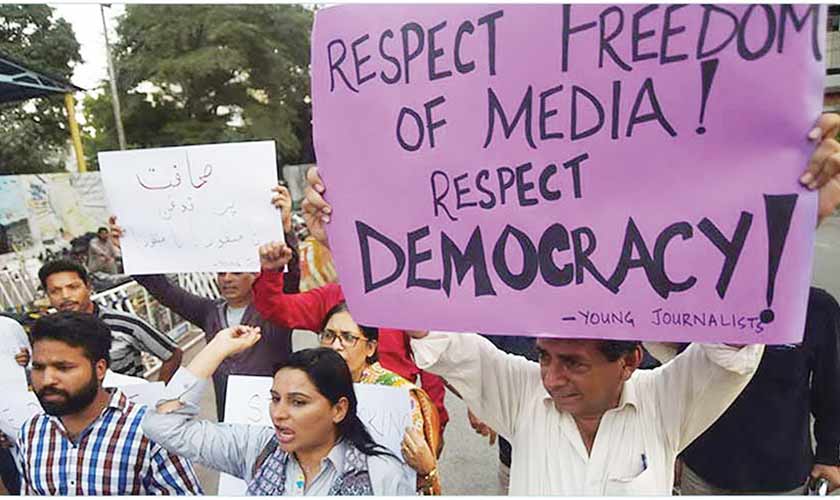
The provincial assembly recently passed the Punjab Privileges (Amendment) Act 2021, sending a wave of concern among journalists, bureaucrats and the civil society. Media activists, press clubs and unions of journalists have since been protesting against this law, calling it a conspiracy against the freedom of expression.The passage of the law and the later conciliatory statements by the speaker indicate that the legislation was prepared and passed in haste and without any serious deliberation.Makhdoom Usman Mehmood of the Pakistan Peoples Party moved the bill as a private member. It also carried the names of some Pakistan Tehreek-i-Insaf and Pakistan Muslim League-Nawaz members as sponsors. The bill was passed unanimously despite not being featured on the order of the day.
Press clubs and unions of journalists, including the Pakistan Federal Union of Journalists, the All Pakistan Newspapers Society (APNS) and other bodies have strongly criticised the bill.
Pakistan Press Foundation secretary Owais Aslam Ali says, “The law is an attempt to make the media a puppet. Already, the media in Pakistan is under pressure. There are so many state institutions being used to control the media. In such a situation, this bill was not needed. Now, any journalist who reports news about any member of the Punjab Assembly can be arrested and punished by the speaker or a committee.” “It is shocking that a PPP member tabled the bill after the PPP introduced the Protection of Journalists Bill 2021 in the Sindh Assembly to protect newspersons and their sources.”
Clause 1 of the schedule, given at the end of the bill states: “Using criminal force to, or obstructing, assaulting, threatening or insulting any Member or an Officer of the Assembly in the discharge of their official duty may lead to six months’ imprisonment or a Rs 10,000 fine or both.”
Talking to The News on Sunday, Malik Muhammad Ahmad Khan, an MPA and PML-N Punjab vice-president said PA officials were included after some media people exchanged harsh words with some of them. “The clause has been amended and assembly officials have been omitted from it,” he said.
Clause 2 of the schedule reads: “Contravention of the provisions of the Rules of Procedure of Provincial Assembly of the Punjab, 1997, will incur a Rs 10,000 fine.”
Clause 3 of the schedule says, “Breach of any of the privileges as provided in Section 16, or Section 17 or Section 18, as the case may be. It may lead to imprisonment of either description for three months, or a fine of ten thousand rupees, or both.” This clause indirectly targets the media and the bureaucracy. Coming to the media related clauses, the schedule in its Clause 6 reads: “Willfully publishing a false or perverted report of a debate or proceedings of the Assembly or a Committee or willfully misrepresenting a speech made by a Member before the Assembly or a Committee may lead to imprisonment for three months or a Rs 10,000 fine or both.” As a result, writing and publishing a commentary about PA’s proceedings will be a challenge.
Clause 7 says, “Willfully publishing a report of a debate or proceedings of the Assembly or a Committee the publication of which has been prohibited or expunged by the Presiding Officer may amount to three months’ imprisonment or a fine of Rs 10,000 or both.” The restriction is apparently pointless as PA proceedings frequently go on air live. The speaker then expunges parts of it after they have been broadcast/telecast. The relevant news persons are sensitive to the rules in any case so that newspapers never publish the expunged remarks. Following protests by journalists’ bodies, Speaker Chaudhry Parvez Elahi issued a notification omitting entries 6, 7 and 10 of the Act. The notification says the speaker exercised powers conferred upon him under Section 21 of the PunabPrivileges Act 1972. However, constitutional experts say the speaker cannot abrogate any entry or clause without the approval of the House. Entry 8 says, “Casting or publishing any reflection upon the character or conduct of the Presiding Officer or any imputation of partiality against him in the discharge of his duties may lead to imprisonment of either description for three months, or a fine of twenty thousand rupees, or both.” This is ridiculous as almost every presiding officer faces the accusation of being partial. Apparently, this entry is meant to be used against opposition members.
Entry 9 of the schedule says, “Making or publishing a maliciously false, scandalous, defamatory or derogatory statement concerning any Member in respect of his conduct as a Member or an Officer of the Assembly will lead to imprisonment of either description for three months, or a fine of ten thousand rupees, or both.” Given that the law of libel empowers every citizen to file a defamation case against anybody, this entry was totally unnecessary.
To stopping the media from educating the people about what’s cooking in the PA in terms of legislation or budgetary documents, there is Entry 10 of the schedule. It reads: “Printing of a copy of any Act or Ordinance or of any report, paper, minutes or notes of proceedings of the Assembly or a Committee, which purports to have been printed by or under the authority of the Assembly or any Committee but which in fact has not been so printed or the tendering in evidence of any such copy as aforesaid will lead to imprisonment of either description for three months, or a fine of ten thousand rupees, or both.” This entry puts paid to all investigative journalism.
The law seems to have been made to further empower the speaker. Entry 12 reads: “Willful failure or refusal to obey any order of the Judicial Committee under this Act, or any order of the Presiding Officer or any Member or Officer of the Assembly which is duly made under this Act will lead to imprisonment of either description for three months, or a fine of ten thousand rupees, or both.” The law empowers the Sergeant-at-Arms to arrest any person to prevent them from acting in any manner in breach of privileges within the precincts of the assembly. The arrests can be made without any warrant, at any place within the “precincts of the Assembly”, that has been defined as the assembly’s courtyard, hall, lobbies, press galleries, rooms etc.
The law also allows for the use of “reasonable force as may be necessary” when making the arrests. Now, the speaker “can in writing direct the arrest and detention in custody” of a journalist, bureaucrat and/ or any lawmaker.
The law further empowers the speaker to form a Judicial Committee of the assembly to try offences and award punishments and the sentence passed by the committee that will enjoy magisterial powers.
Following protests by journalists, Speaker Chaudhry Parvez Elahi issued a notification on July 4. The notice says, “The Entries 6, 7 and 10 shall be omitted and the schedule will be renumbered.” The notification states that the speaker exercised powers conferred upon him under Section 21 of the Punjab Privileges Act 1972. Constitutional experts say that the speaker cannot abrogate any entry or clause from a law without approval of the House. In a media statement, Elahi said he held journalists in great esteem. He said the clauses that had sparked controversy, had been removed from the bill. However, journalists are not happy. Most of them see the action as an eyewash.
MPA Khan said, “We wanted better working in standing committees. We wanted a law in this regard. The bill was tabled and passed unanimously. The PML-N raised questions on the media-related clauses before anybody including the media did.” “Now the objectionable clauses, including those about privilege of the assembly officials have been removed. If somebody publishes a concocted story against any of the legislators what can be done against them?.”
Abid Saqi, a senior lawyer and human rights activists, says, “The bill clashes with Article 8 of the Constitution of Pakistan. Article 8 of the constitution of Pakistan reads: ‘Laws inconsistent with or in derogation of fundamental rights to be void. (1) Any law, or any custom or usage having the force of law, in so far as it is inconsistent with the rights conferred by this Chapter, shall, to the extent of such inconsistency, be void.’”
Saqi says the law should be abrogated by those who passed it. Else, a court will nullify it if somebody files a petition.
https://www.thenews.com.pk/tns/detail/861836-muzzling-dissent
Pakistan's Islamic body that said man can ‘lightly beat’ wife halts legislation on Domestic Violence Bill

In Pakistan, a bill aimed at protecting women, children, the elderly, and other vulnerable populations from domestic abuse has uncovered flaws and divided sentiments.
The Council of Islamic Ideology (CII) paused legislation on the Domestic Violence Bill in 2020 on Friday, stating that the Islamic constitutional authority must evaluate the bill and report back to the Pakistan government.
They expressed concerns about several aspects of the law. According to The News International, the CII's judgement was finally given to the Human Rights Ministry in the third week of June, after the bill sparked controversy following its passing in the Senate.
After the bill was brought before the National Assembly in November 2020, the CII considered it (NA).
Following its passage in the Senate, the bill sparked outrage among lawmakers, political leaders, religious scholars, and opinion-makers, including Jamaat-i-Islami (JI) Amir Sirajul Haq, Senator Mushtaq Ahmad, and Jamiat Ulema-e Islam of Fazal-ur-Rehman (JUI-F) Senator Atta-ur-Rehman.
Following public pressure, Prime Minister Imran Khan's Parliamentary Affairs Advisor, Babar Awan, publicly met Speaker of the National Assembly Asad Qaiser and requested that the bill be referred to the CII.
Babar Awan wrote a letter on behalf of Prime Minister Imran Khan, who was also informed of the bill's' 'un-Islamic aspects. '
In the letter, Awan draws attention to various contents and definitions in the bill. According to a report in Dawn, the letter notes: "Most importantly, it is being highlighted that the bill contravenes the Islamic [injunctions] and way of life as enshrined in the responsibility of the state in Article 31 of the Constitution of the Islamic Republic of Pakistan".
What is the proposed Pakistan's Domestic Violence Bill?
The bill demands harsh penalties for all sorts of domestic violence.
Any act of domestic abuse is punishable by a maximum of three years in prison and a minimum of six months in prison, according to the law.
Furthermore, the offender may face fines ranging from Rs20,000 to Rs1,000,000.
‘Lightly beating’ wife permissible
In 2016, the Council of Islamic Ideology (CII) advocated allowing a husband to ‘lightly' beat his wife if he feels it is necessary, as well as requiring women to breastfeed their children for two years.
In the same year, the constitutional council ruled that the Punjab Assembly and the Khyber Pakhtunkhwa (KP) government's women's protection bills, which criminalised all types of violence against women, were "un-Islamic."
https://www.wionews.com/south-asia/pakistans-islamic-body-that-said-man-can-lightly-beat-wife-halts-legislation-on-domestic-violence-bill-397103

Pakistan braces for fourth Covid wave as fresh infections witness three-fold rise

According to the country’s ministry of national health services, 1,980 people tested positive for Covid-19 in the last 24 hours, as against 663 on June 21.
Pakistan is bracing for what has been described as the country’s fourth wave of the coronavirus pandemic, with the number of fresh daily Covid-19 cases registering a three-fold rise over the corresponding figures from just three weeks ago.
The country’s ministry of national health services on Sunday put the number of those who tested positive for Covid-19 in the last 24 hours at 1,980, while the number of those who succumbed to the viral disease in the same duration was recorded at 27. In contrast, three weeks ago, on June 21, the new daily caseload stood at just 663. In another concerning development, the positivity rate crossed 4 per cent for the first time since May 31 when it was at 4.05 per cent.
According to the health ministry, Pakistan’s confirmed tally of Covid-19 infections has reached 9,73,824 of which 22,582 cases have resulted in deaths. The official data also shows that 9,13,203 people have recovered from the infection, while more than 2,100 people are still in a critical condition.
Health experts have attributed this sudden uptick in cases to the reopening of the business and tourism sectors and have urged the government to announce a lockdown so that the festival of Eid al-Adha can be observed in accordance with pandemic-related restrictions. The government has also come under fire for holding board examinations of secondary and higher secondary students, despite warnings from Opposition parties, and protests by students. Going ahead with the examinations, health experts have warned, could lead to a further spike in fresh daily infections.
However, according to reports, the Pakistan government is banking on its vaccination drive to prevent any further surge in Covid-19 cases. The government says it has administered more than 19 million doses of anti-Covid vaccines and has been urging people to get themselves inoculated at the earliest.
https://www.hindustantimes.com/world-news/pakistan-braces-for-fourth-covid-wave-as-fresh-infections-witness-three-fold-rise-101626002461560.html

قوم کو امن، چین اور خوشحالی کے ساتھ مساوی مواقع والے معاشرے میں تبدیل کرنے کے لیئے وسائل اور آبادی میں توازن انتہائی اہم ہے، چیئرمین پاکستان پیپلز پارٹی بلاول بھٹو زرداری


 پاکستان پیپلز پارٹی کے چیئرمین بلاول بھٹو زرداری نے کہا ہے کہ قوم کو امن، چین اور خوشحالی کے ساتھ مساوی مواقع والے معاشرے میں تبدیل کرنے کے لیئے وسائل اور آبادی میں توازن انتھائی اہم ہے۔ میڈیا سیل بلاول ہاؤس کی جانب سے جاری کردہ بیان کے مطابق پی پی پی چیئرمین نے آبادی کا عالمی دن منانے پر پاکستان کی عوام کو مبارکباد دی ہے۔ رواں سال کی تھیم: Rights and Choices are the Answer: Whether baby boom or bust, the solution to shifting fertility rates lies in prioritising all people’s reproductive health and rights. آبادی سے منسلک معاملات کا ذکر کرتے ہوئے پی پی پی چیئرمین نے کہا کہ ایک جانب وہ ممالک ہیں جہاں فرٹیلٹی ریٹ کم ہے۔ ان ممالک میں برزگ شہریوں کی آبادی بہت ہے۔

 دوسری جانب بہت سارے ترقی پذیر ممالک ہیں، جہاں فرٹیلٹی ریٹ زیادہ ہونے کے باعث انہیں ایک چیلنج جیسی صورتحال کا سامنا ہے۔ اس کا مطلب یہ ہے کہ وہاں دوسروں پر انحصار کرنے والی آبادی یعنی نوعمر اور نوجوان افراد کی تعداد بہت زیادہ ہے۔ یہ صورتحال ملک میں بیروزگاری، تعلیم اور صحت کی سہولیات کے فقدان جیسے مسائل کو جنم دیتی ہے۔ پی پی پی چیئرمین نے نشاندہی کرتے ہوئے کہ کہ پاکستان کا شمار ان ممالک میں ہوتا ہے، جہاں فرٹلٹی ریٹ بہت زیادہ ہے اور مانع حمل طریقوں کا استعمال بہت کم ہے، جس کا نتیجہ آبادی میں اضافے کی شکل میں نکلتا ہے۔ 

انہوں نے کہا کہ 2017ع کی آدمشماری کے نتائج (گو کہ متنازعہ ہیں) سے واضح ہوا ہے کہ پاکستان کی آبادی 208 ملین سے زیادہ افراد پر مشتمل ہے، جو سالانہ 2.4 فیصد سے بڑھ رہی ہے۔ اس ضمن میں ایک اہم عنصر یہ بھی ہے کہ 100 شادی شدہ خواتین میں سے صرف 34 فیصد خواتین مانع حمل تدابیر اختیار کر رہی ہے۔ انہوں نے مزید کہا کہ 18 فیصد مزید خواتین مانع حمل تدابیر اختیار کرنا چاہتی ہیں، لیکن انہیں ایسی سروسز تک رسائی حاصل نہیں ہے۔ پی پی پی چیئرمین نے کہا کہ گو کہ، پاکستان پیپلز پارٹی اور صوبہ سندھ میں اس کی حکومت کو آدمشماری کے نتائج پر شدید تحفظات ہیں، لیکن جہاں تک آبادی میں توازن لانے کا معاملہ ہے تو ملکی سطح پر ہم فرٹیلٹی اور خاندانی منصوبہ بندی کے سلسلے میں اٹھائے جانے والے اقدام پر تعاون کر رہے ہیں۔ بلاول بھٹو زرداری ن ے کہا کہ پاکستان پیپلز پارٹی ایسے اقدامات سے کمٹڈ ہے، جیسا کہ مشترکہ مفادات کونسل (سی سی آئی) کی سفارشات کے تحت وفاقی و صوبائی سطح پر ٹاسک فورسز کا قیام؛ خاندانی منصوبہ بندی اور تولیدی صحت کی خدمات تک آبادی کی رسائی کو یقینی بنانا؛ مالی معاونت؛ نئی قانون سازی کرنا؛ ایڈووکیسی اور کمیونیکیشن کے سلسلے میں اقدام اٹھانا، نصاب اور تربیت پر مبنی تعلیم دینا؛ محفوظ مانع حمل اشیاء کو یقینی بنانا؛ اور رائے عامہ ہموار کرنے والوں اور علماء کرام کی حمایت کرنا شامل ہے۔ 

پی پی پی چیئرمین نے کہا کہ یہ دیکھ کر افسوس ہوتا ہے کہ سپریم کورٹ کے ازخود نوٹس کے تحت حکم کے باوجود، جس کی توثیق بعد ازاں سی سی آئی بھی کرچکا ہے، سلیکٹڈ وزیراعظم پاپولیشن کے متعلق ٹاسک فورس کی صدارت سے گریزاں ہے۔ ٹاسک فورس کی ہونے والے چاروں اجلاسوں کی صدارت صدر مملکت نے کی۔ یوں، وسائل اور عملدرآمد کے متعلق سی سی آئی کی سفارشات پر من و عن عملدرآمد ممکن نہیں ہوسکا ہے۔پاپولیشن فنڈ کے لیئے وفاقی حکومت کی جانب سے 10 ارب روپئے مختص کییئے جانے تھے، جس میں سے تاحال صرف ایک ارب روپے رکھے جا سکے ہیں۔ چیئرمین بلاول بھٹو زرداری نے کہا کہ پاکستان پیپلز پارٹی اور اس کی سندھ میں حکومت آبادی میں توازن اور زچہ و بچہ کی صحت کے سلسلے میں صفِ اول سے قائدانہ کردار ادا کر رہی ہیں۔ وزیر اعلی سندھ آبادی کے متعلق ایک ملٹی سیکٹورل ٹاسک فورس کی سربراہی کرتے ہیں۔ 

انہوں نے کہا کہ سندھ ملک کا وہ پہلا صوبہ تھا، جس نے 2015ع میں فیملی پلاننگ کے سلسلے میں اپنا کوسٹڈ امپلیمنشن پلان (سی آئی پی) تیار کیا، جو 2012ع میں لندن سمٹ کے اعلامیئے گلوبل ایف پی 2020 انیشیٹو کے تحت تھا۔ سی آئی پی پر عملدرآمد جارہی ہے اور اب اسے سسٹینایبل ڈولپمنٹ گولز (ایس ڈی جی) اور ایف پی 2030 گلوبل ایجنڈا کا حصہ بنا دیا گیا ہے۔ انہوں نے وزیراعظم شہید محترمہ بینظیر بھٹو کی جانب سے متعارف کردہ لیڈی ہیلتھ ورکرز پروگرام کا حوالہ دے کت قوم کو پاکستان پیپلز پارٹی کے آبادی کو کنٹرول کرنے کے متعلق موقف اور ضرورتمند خواتین کی مدد کرنے کو یاد دلاتے ہوئے کہا کہ اب اس افرادی قوت کا فوکس ایک بار پھر خاندانی منصوبہ بندی پر مرکوز کیا گیا ہے، جبکہ سابق صدر آصف علی زرداری کی زیرِ قیادت تاریخی 18 ویں آئینی ترمیم کے بعد اب صحت اور بھبودِ آبادی کے محکمے باضابطہ مربوط و فعال ہیں۔ پی پی پی چیئرمین نے کہا کہ اس کے بعد صوبہ سندھ نے اپنے محکمہ بھبود آبادی کی بجٹ میں 8 گنا سے بھی زیادہ اضافہ کیا ہے۔ دیہی اور دور دراز علاقوں میں خواتین کی فیملی پلاننگ اور تولیدی صحت کی خدمات تک رسائی ہوئی ہے اور اس تعداد میں 10 لاکھ سے زائد صارفین کا اضافہ ہوا ہے، یوں مانع حمل تدابیر اختیار کرنے والی خواتین کی سالانہ تعداد بھی دوگنی ہوئی ہے۔

 پاکستان ڈیموگرافک اینڈ ہیلتھ سروے کے مطابق گذشتہ پانچ سالوں کے دوران سندھ میں ایف پی میں 4 فیصد اضافہ ہوا ہے۔ پی پی پی چیئرمین نے حکومتِ سندھ کی جانب سے منظور کردہ ترقی پسند قوانین جیسا کہ ریپروڈکٹو ہیلتھ رائٹس ایکٹ 2019، چائلڈ میرج ریسٹرینٹ ایکٹ 2013 اور انسدادِ گھریلو تشدد کو سراہتے ہوئے کہا کہ ازدواجی مشاورت کے بل پر بھی کام کیا جا رہا ہے۔ چیئرمین پیپلز پارٹی بلاول بھٹو زرداری نے قوم کو یقین دہانی کراتے ہوئے کہا کہ پاکستان پیپلز پارٹی خواتین کو بااختیار بنانے، صنفی مساوات، اور انفارمڈ چوائسز کے حقوق اور نوعمر و نوجوانوں کے حقوق سے کمٹڈ ہے اور جب وہ منتخب ہوکر حکومت میں آئے گی تو ایسی اصلاحات کو پورے ملک میں متعارف کروائے گی۔

https://www.ppp.org.pk/pr/25253/

Saturday, July 10, 2021

Music - #SnohAalegra #TEMPORARYHIGHSINTHEVIOLETSKIES Snoh Aalegra - NEON PEACH feat. Tyler, The Creator (Visualizer)

Video Report - Increased social pressure leads to rise in eating disorders in China

Video - #Haitian #assassination #President 'The manhunt continues' after assassination of Haitian President, says Haitian ambassador to the US

OPINION: - The Ascension of Bernie Sanders

BY MAUREEN DOWD
I want to talk to Bernie about Balenciaga. And Britney. And Dua Lipa, Sha’Carri Richardson and Joe Manchin’s houseboat. And whether he prefers red or white horseradish on his gefilte fish. And the state of capitalism, and the absurd price of a Birkin bag.
We settle into a retro yellow booth at Henry’s Diner and I pull out a thick sheaf of questions. Eyeing it suspiciously, he asks with that booming Brooklyn accent, “You givin’ a speech?”
He reaches into his shirt pocket and pulls out his own piece of paper, a list of items written in his loopy scrawl. These are the only things he’s here to talk about.
At 79, Bernie Sanders is a man on a mission, laser-focused on a list that represents trillions of dollars in government spending that he deems essential. When I stray into other subjects, the senator jabs his finger at his piece of paper or waves it in my face, like Van Helsing warding off Dracula with a cross.
“Maureen, let me just tell you what we’re trying to do here,” he says. “We’re working on what I think is the most consequential piece of legislation for working families since the 1930s.”Sanders, long a wilderness prophet in Washington, a man who wrote a memoir bragging about being an outsider, admits that it is strange to be a key member of The Establishment. As the chairman of the Senate Budget Committee, the democratic socialist is now pulling the levers in the control room.He has changed the whole debate in the nation’s capital. He is the guy trying to yank his party back to its working-class roots and steer President Biden in a bolder, more progressive direction.Mirabile dictu: A president and senator who are both pushing 80, men who were underestimated and dismissed for years in Democratic circles, are now teaming up to transform the country. It’s the Bernie and Joe show.
Sanders passionately believes that the only way to undo the damage done by Donald Trump and Trumpism is by showing that government can deliver, that good policy can overcome dangerous conspiracy theories and lies.
“I would have loved to run against him, to tell you the truth,” he says of Trump. “He’s a fraud and he’s a phony. That’s what he is, and he has to be exposed for that.”
Even with Trump out of office, Sanders feels we are still on the precipice. Democrats need to speak to the struggles of the white working class, he says, something that “sometimes part of the Democratic elite does not fully appreciate.” He adds: “We’ve got to take it to them. I intend, as soon as I have three minutes, to start going into Trumpworld and start talking to people.”
“It’s absolutely imperative if democracy is to survive that we do everything that we can to say, ‘Yes, we hear your pain and we are going to respond to your needs.’ That’s really what this is about. If we don’t do that, I fear very much that conspiracy theories and big lies and the drift toward authoritarianism is going to continue. You got all these folks out there who are saying, ‘Does anybody pay attention to me?’”
Sanders is a purist who doesn’t like to acknowledge how intertwined the personal and political can be. Yet he and Biden have a bond that could have a profound effect on the lives of Americans.
While the two men disagree on a lot of things, the former Senate colleagues and 2020 rivals share a mutual respect. Sanders has easy access to the White House. It is a big difference from the way he was treated in 2016 by Clinton, Inc. Not only did Hillary’s henchmen run a nasty campaign and try to rig the primaries; Hillary herself would later say about him in a 2020 documentary: “Nobody likes him. Nobody wants to work with him.”
Sanders says he gives the president a lot of credit for looking at the budget not just as numbers on a spreadsheet but as a chance to reshape the American identity.
“Who denies the realities of what he is taking on?” Sanders says, digging into some eggs over easy and white toast. “Does anyone deny that our child care system, for example, is a disaster? Does anyone deny that pre-K, similarly, is totally inadequate? Does anyone deny that there’s something absurd that our young people can’t afford to go to college or are leaving school deeply in debt? Does anybody deny that our physical infrastructure is collapsing? Does anybody except anti-science people deny that climate change is real? Does anyone deny that we have a major health care crisis? Does anyone deny that we pay the highest prices in the world for prescription drugs? Does anyone deny we have a housing crisis? Does anyone deny that half the people live paycheck to paycheck?”
Sanders, who has talked about spending up to $6 trillion on the reconciliation package, says he will not support a two- or three-trillion-dollar bill. “That’s much too low.”
What about grumbling coming from members of the progressive wing that they want Sanders to stay a hell-raiser, not be a bridge-builder who gives Biden and the center-left cover?“You know politics,” he answers with a shrug. “You can’t please all of the people all of the time.” He adds that he sees this moment as a chance to “address concerns progressives have had for decades.”
Sanders was a lonely voice on democratic socialism for decades; now he has a squad to keep him company.
He lights up talking about “Alexandria, Rashida, Ilhan, Pramila, Ayanna from Massachusetts,” noting that “they really came from very much the same place that I was coming from, and they all came from different parts of the world.” Still, Sanders is not in lock step with the most progressive members of his party on everything. He says, for example, that he prefers “fundamental reform” to defunding the police.
“A cop’s life is a difficult life,” he says, sounding like the mayor he once was. “Schedules are terrible. Salaries, in many cases, are inadequate. It’s a dangerous job. It’s a job with a lot of pressure. We need to significantly improve training for the police. In certain communities, what is going on is absolutely unacceptable. It must be changed, period. We cannot have racism in policing. If you go to Black communities or Latino communities, they want this protection.”
When I ask Sanders if he thinks A.O.C. could be president someday, out comes the list.
“That’s not what I want to get into,” he barks. “I want to get into what this legislation is about.”
“You don’t want to discuss ‘Free Britney’?” I ask.
“No.”
But I get him on the American sprinter Sha’Carri Richardson being suspended from the U.S. Olympics team because of marijuana use.
“I think it speaks to the problems of the so-called war on drugs,” he says. “So I have a problem with that.”
Sitting across from Sanders in this little diner in this little town, it’s wild to contemplate that the 79-year-old has become an icon of popular culture, beloved by people under 30, featured in this month’s Vanity Fair cover story as a friend of pop star Dua Lipa, and that he was an inspiration for a Balenciaga show in Paris in 2017.
He rolls his eyes at fashion. “I’m not chic,” he says. “I’m the least chic person in the world. Trust me.” He’s also unimpressed by billionaires and their toys.
“You have the richest guys in the world who are not particularly worried about earth anymore,” he says. “They’re off in outer space.” People are sleeping on the streets, but “Mr. Bezos is worth $200 billion and now he wants to get a spaceship. That’s very nice. That’s what this legislation is about, Maureen. I want to talk about this legislation.”
But wait, what does he think of Marjorie Taylor Greene’s lurking around A.O.C.’s office and calling her “a little communist”?
“You’re getting off the subject here,” Sanders chides, before relenting: “Look, she is the future of a segment of the Republican Party which is delusional, which tends toward violence.” He adds: “It’s not just Jan. 6. It’s taking place at state capitols. There’s people walking around with guns.”
If he were not a senator, he says, he might want to do something in media, helping journalists relate to the working class and correctly define political terms like “liberal”: “Liberals want to do nice things. And progressives understand that you have to take on powerful special interests to make it happen.” Before the senator leaves to work the phones, he returns to his list with one last directive: “Tell people what we are trying to accomplish.”
https://www.nytimes.com/2021/07/10/opinion/bernie-sanders-interview-maureen-dowd.html

Joe Biden, 20th Century Trustbuster


 Antitrust lesson 101: Big government often makes big business bigger.

President Biden has modeled his spending agenda on the Great Society and New Deal. Now he wants to take antitrust policy back to the early 20th century. Or at least that’s how it looks from his executive order on Friday to regulate competition and impose more government control over the private economy.
“In the early 1900s, Teddy Roosevelt’s Administration broke up the trusts controlling the economy—Standard Oil, J.P. Morgan’s railroads, and others—giving the little guy a fighting chance,” his summary states. Mr. Biden now wants to use regulation to break up Big Tech, finance, agriculture and healthcare companies, among others.
At least two parts of his order are encouraging. He directs Health and Human Services to let hearing aids be sold over the counter, which would offset federal rules that make the devices more expensive than necessary. He also encourages the Federal Trade Commission to ban unnecessary occupational licensing, which is long overdue. These are the government barriers to entry that stymie entrepreneurs, often minorities, in services like hair-braiding or plumbing.
These are deregulatory actions, but the rest of his order is about enhancing government power. Courts for more than a century have applied antitrust law based on the “rule of reason.” Scholars and judges across the political spectrum, including Phillip Areeda and Supreme Court Justice Stephen Breyer, have shifted antitrust focus from market concentration to economic analysis and consumer welfare.The new Brandeisians in the Biden Administration led by the National Economic Council’s Tim Wu (godfather of net neutrality) and FTC chair Lina Khan want to replace the rule of reason with the rule of politics. Mr. Biden’s order includes 72 directives that mostly aim to shackle businesses.Consider railroads. Government regulation of railroad rates was among the great failures of the 20th century. It reduced private investment and service and drove many carriers into bankruptcy. Congress abandoned it in 1980, but Mr. Biden wants to revive it. His order summary says there are only seven Class I freight railroads compared to 33 four decades ago. Yet freight prices have dropped 44% since 1981. Mr. Biden wants to force railroads to hand over freight traffic to competitors, which would reduce private investment and shipping efficiencies.
He also instructs the Federal Communications Commission to restore the Obama -era “net neutrality” rules that regulated broadband providers like railroads. Investment fell after the FCC imposed net neutrality, then surged after the Trump FCC liberated carriers. Broadband last year cost 20.2% less and was 15.7% faster than in 2015.
One reason is fierce competition. Democrats opposed the T-Mobile-Sprint merger in 2018, but it has boosted wireless competition and investment. The tie-up shows how business consolidation can improve consumer welfare. Economies of scale can reduce prices. Size also gives businesses more leverage to negotiate lower prices with suppliers.Prescription drug prices have fallen 2% since 2018 as the Food and Drug Administration has approved more generics and second-line therapies. Competition is working. But Mr. Biden nonetheless orders Health and Human Services to “issue a comprehensive plan within 45 days to combat high prescription drug prices and price gouging.” Translation: Government price controls, which will reduce innovation and investment in new treatments.
It’s no coincidence that consolidation has been greatest in the two industries that have experienced the biggest increase in regulation over the last decade—finance since Dodd-Frank and healthcare since ObamaCare.
Bigger businesses can more easily absorb regulatory costs. After ObamaCare limited insurer profits, Aetna and Cigna merged with more remunerative pharmaceutical benefit managers. Medicaid expansion and low government reimbursement rates have driven hospitals to consolidate to augment their pricing leverage with insurers.
ObamaCare’s “accountable care organizations” gave hospitals an incentive to acquire physician practices. According to the Kaiser Family Foundation, primary-care-practice market concentration in metropolitan areas increased 29% between 2010 and 2016. A bigger government makes big business bigger.
Mr. Biden especially has Big Tech in his bull’s eye. His order decrees “greater scrutiny of mergers, especially by dominant internet platforms.” But many tech acquisitions increase competition and benefit consumers. Amazon’s purchase of PillPack drove retail pharmacies to offer free prescription drug shipments. Specific Big Tech behavior, such as Google’s digital ad practices, may deserve antitrust scrutiny. But breaking up companies merely because of their size will take years to litigate with uncertain consequences and could help foreign companies more than consumers.
That was the hard-earned antitrust lesson of the 20th century, and it appears Mr. Biden wants to doom us to repeat it.
https://www.wsj.com/articles/joe-biden-20th-century-trustbuster-11625869633?mod=trending_now_opn_sf_pos2

Video - Pashto song dedicated DIEHARD PASHTUN - DR.NAJIB

Video Report - International Media Reacts to Afghan Situation: CrossTalk | Saigon in Afghanistan

World Media Reports: #Afghanistan #Taliban Afghanistan🇦🇫 on The Brink: Taliban Advances as a Defeated US Withdraws (Ex-Afghan Amb. To China)

Pakistan: Why RSF deems PM Khan a 'press freedom predator'

Daniel Bastard, Asia-Pacific director at Reporters Without Borders (RSF), told DW that Pakistani authorities are trying to censor and intimidate journalists who dare to not toe the government's line.

Pakistan, After Rooting for Afghanistan’s Taliban, Faces a Blowback

 By Saeed Shah

Islamabad wants a negotiated agreement, fears that outright Taliban takeover would galvanize Pakistani jihadists.

For two decades, a large part of the Pakistani security establishment rooted for the Taliban in the Afghan war. Now that the Taliban are taking over vast tracts of the country and seem to be on the cusp of seizing power, panic is spreading through Pakistan’s halls of power.
Ever since the 2001 U.S. invasion ousted the Pakistani-backed Taliban regime in Kabul, Pakistan’s powerful military has unofficially provided carefully calibrated support to the group, allowing Afghan insurgents to operate from its territory. Pakistan wanted to bolster the Taliban as a counter to the influence of its enemy—India—in Afghanistan and to have a potent proxy there after a U.S. departure.
Formally an American ally since 2001, Pakistan’s government denies backing the Taliban, but says it has some limited influence over the group.
With the Taliban sweeping through a third of Afghanistan’s districts following the U.S. military withdrawal and surrounding the country’s major cities, Pakistani authorities have to grapple with the unintended consequences of their policies. A total takeover by the Taliban or a new civil war in Afghanistan would backfire against Islamabad’s national interests, senior Pakistani officials say.
“We are so closely intertwined with Afghanistan, ethnically, religiously, tribally, that whenever there is civil war, Pakistan gets sucked in automatically,” said Pakistan’s former defense minister, retired Lt. Gen. Naeem Lodhi. “Civil war [in Afghanistan] is the last thing that Pakistan would like to happen.”
The fear in Pakistan is of a flood of refugees across the porous border that would add to the 1.4 million registered Afghan refugees already living in the country. Worse, a triumphant Afghan Taliban would galvanize Pakistan’s own Islamist militants whose power has waned as a result of successive military operations in the country’s tribal border areas.
“Our jihadis will be emboldened. They will say that ‘if America can be beaten, what is the Pakistan army to stand in our way?’” said a senior Pakistani official. “War does not suit us at all. We’ve seen it for 40 years.”
Islamabad says it no longer wants to be the main backer of a pariah regime, as it was when the Taliban controlled Kabul from 1996 to 2001. Instead, Pakistan is aiming for a negotiated peace settlement that would see the Taliban handed a major share of political power in Kabul, along with international legitimacy and funding. Peace talks between the Taliban and the Afghan government and politicians in Doha, Qatar, have largely stalled, with Afghan officials saying the insurgency seeks to use negotiations to legitimize its military conquests.
“Pakistan is a bit stuck,” said Laurel Miller, a former acting U.S. special representative for Afghanistan and Pakistan who now heads the Asia program at the International Crisis Group.
https://www.wsj.com/articles/pakistan-after-rooting-for-afghanistans-taliban-faces-a-blowback-11625822762?mod=searchresults_pos2&page=1

Music Video - کل بھی بھٹو زندہ تھا،آج بھی بھٹو زندہ ھے

@BBhuttoZardari - کسی بھی پاکستان پیپلز پارٹی کے کارکن کو مریم شریف صاحبہ کیلئے غلط زبان استمعال کرنے کی اجازت نہیں ہو گی -

Video - #PPP - Vote for Teer

Women’s access to family planning and reproductive health services in Sindh have increased in rural and remote areas by an addition of more than 1 million users – Chairman PPP Bilawal Bhutto Zardari

Chairman Pakistan Peoples Party Bilawal Bhutto Zardari has said that balancing resources and the population is crucial in developing a nation. Population control transforms a country into a vibrant equal-opportunity society with peace, tranquility, and prosperity.
In a statement issued from the Media Cell Bilawal House, on the occasion of World Population Day scheduled to be celebrated worldwide on Sunday, July 11, PPP Chairman felicitated the people of Pakistan on commemorating the World Population Day. The theme of the event this year is, “Rights and Choices are the Answer: Whether baby boom or bust, the solution to shifting fertility rates lies in prioritizing all people’s reproductive health and rights.”
Discussing issues relevant to changes in population, Chairman PPP stated, “On one hand, there are countries that witness low fertility rates. In these countries, the older population is more,” he explained. “On the other hand, a large number of developing countries are facing the challenge of high fertility. This means there is a high number of dependent population; adolescents and young people. The result; issues of unemployment, education, and an absence of health services,” he added.
Chairman PPP pointed out that Pakistan is one of the countries with a high level of fertility and low use of contraceptives. This results in population growth. “The Census result of 2017 (though disputed) has shown that Pakistan’s population has grown at a higher level of 2.4% per anum with more than 208 million people,” lamented Chairman Bilawal Bhutto Zardari. “One of the major factors is that out of 100 married women of reproductive age, only 34 are using contraception.”
He also said that 18 more women in this category intend to use contraceptives but do not have access to them. “Pakistan People’s Party and its government in the Sindh province have reservations on the Census results,” Chairman PPP declared. “However, as far as balancing the population growth is concerned, we have been providing support on fertility and family planning issues on a country level,” he stated. Chairman Bilawal Bhutto Zardari further said that PPP was committed to initiatives like Recommendations of the Council of Common Interest (CCI) i.e., establishing federal and provincial taskforces; ensuring universal access to family planning and reproductive health services; committing finances; introducing legislation; initiating advocacy and communication; inculcating life skill-based education through curriculum and training; ensuring contraceptive commodities security; and support of opinion makers and ulema.
“It’s disappointing that the selected Prime Minister has been avoiding chairing the Federal Taskforce on Population, despite the Supreme Court decision on suo moto,” he stated, condemning PM Imran Khan’s lack of interest in controlling the population of Pakistan. “The President of Pakistan chaired all four meetings of the Taskforce,” he continued. “Thus, the Council of Common Interest (CCI) recommendations in terms of resources and implementation have not materialized. Out of the allocation of Rs. 10 Billion of the population fund by the Federal Government, only Rs. 1 Billion could be allocated.”Chairman Bilawal Bhutto Zardari also said that PPP and its government in Sindh are leading from the front on initiatives regarding population growth and maternal and child health. The Chief Minister Sindh, too, chairs a multi-sectoral Sindh Taskforce on population. He added that Sindh was the first province to formulate its flagship Costed Implementation Plan (CIP) on Family Planning in 2015 due to the global FP2020 initiative announced at the London Summit, 2012. The CIP is being implemented and transformed into FP2030 as part of the Sustainable Development Goals (SDGs) and FP2030 global agenda.
He further reminded the nation of PPP’s stance to control the population and help women in need by mentioning the Lady Health Worker’s program introduced by Prime Minister Shaheed Mohtarma Benazir Bhutto. This workforce has been refocused on family planning, whereas the health and population departments are functionally integrated after the landmark 18th Constitutional Amendment led by President Asif Ali Zardari.
“Sindh has since then, enhanced its allocations more than 8 folds by its Population Welfare Department,” stated Chairman PPP. “Women’s access to family planning and reproductive health services have been increased in rural and remote areas by more than 1 million users thus, doubling the rate of annual women who use contraceptives. Pakistan Demographic and Health Survey shows a four percent increase in FP in Sindh during five years.” Appreciating the Progressive laws such as Reproductive Health Rights Act, 2019, Child Marriage Restraint Act 2013, and the Prohibition of Domestic Violence passed by the Sindh Government, Chairman PPP highlighted that a Marital Counseling Bill is underway.
“PPP is committed to the empowerment of women, gender equality, their right to have access to informed choices; and the rights of adolescents and youth,” concluded Chairman Bilawal Bhutto Zardari, assuring the nation that PPP will introduce such reforms in Pakistan when elected. https://www.ppp.org.pk/pr/25247/

Chairman PPP Bilawal Bhutto Zardari’s message on the occasion of World Population Day

Chairman Pakistan Peoples Party Bilawal Bhutto Zardari has said that balancing resources and the population is crucial in developing a nation. Population control transforms a country into a vibrant equal-opportunity society with peace, tranquility, and prosperity.
In a statement issued from the Media Cell Bilawal House, on the occasion of World Population Day scheduled to be celebrated worldwide on Sunday, July 11, PPP Chairman felicitated the people of Pakistan on commemorating the World Population Day. The theme of the event this year is, “Rights and Choices are the Answer: Whether baby boom or bust, the solution to shifting fertility rates lies in prioritizing all people’s reproductive health and rights.”
Discussing issues relevant to changes in population, Chairman PPP stated, “On one hand, there are countries that witness low fertility rates. In these countries, the older population is more,” he explained. “On the other hand, a large number of developing countries are facing the challenge of high fertility. This means there is a high number of dependent population; adolescents and young people. The result; issues of unemployment, education, and an absence of health services,” he added.
Chairman PPP pointed out that Pakistan is one of the countries with a high level of fertility and low use of contraceptives. This results in population growth. “The Census result of 2017 (though disputed) has shown that Pakistan’s population has grown at a higher level of 2.4% per anum with more than 208 million people,” lamented Chairman Bilawal Bhutto Zardari. “One of the major factors is that out of 100 married women of reproductive age, only 34 are using contraception.”He also said that 18 more women in this category intend to use contraceptives but do not have access to them. “Pakistan People’s Party and its government in the Sindh province have reservations on the Census results,” Chairman PPP declared. “However, as far as balancing the population growth is concerned, we have been providing support on fertility and family planning issues on a country level,” he stated.
Chairman Bilawal Bhutto Zardari further said that PPP was committed to initiatives like Recommendations of the Council of Common Interest (CCI) i.e., establishing federal and provincial taskforces; ensuring universal access to family planning and reproductive health services; committing finances; introducing legislation; initiating advocacy and communication; inculcating life skill-based education through curriculum and training; ensuring contraceptive commodities security; and support of opinion makers and ulema.
“It’s disappointing that the selected Prime Minister has been avoiding chairing the Federal Taskforce on Population, despite the Supreme Court decision on suo moto,” he stated, condemning PM Imran Khan’s lack of interest in controlling the population of Pakistan. “The President of Pakistan chaired all four meetings of the Taskforce,” he continued. “Thus, the Council of Common Interest (CCI) recommendations in terms of resources and implementation have not materialized. Out of the allocation of Rs. 10 Billion of the population fund by the Federal Government, only Rs. 1 Billion could be allocated.”
Chairman Bilawal Bhutto Zardari also said that PPP and its government in Sindh are leading from the front on initiatives regarding population growth and maternal and child health. The Chief Minister Sindh, too, chairs a multi-sectoral Sindh Taskforce on population. He added that Sindh was the first province to formulate its flagship Costed Implementation Plan (CIP) on Family Planning in 2015 due to the global FP2020 initiative announced at the London Summit, 2012. The CIP is being implemented and transformed into FP2030 as part of the Sustainable Development Goals (SDGs) and FP2030 global agenda. He further reminded the nation of PPP’s stance to control the population and help women in need by mentioning the Lady Health Worker’s program introduced by Prime Minister Shaheed Mohtarma Benazir Bhutto. This workforce has been refocused on family planning, whereas the health and population departments are functionally integrated after the landmark 18th Constitutional Amendment led by President Asif Ali Zardari.
“Sindh has since then, enhanced its allocations more than 8 folds by its Population Welfare Department,” stated Chairman PPP. “Women’s access to family planning and reproductive health services have been increased in rural and remote areas by more than 1 million users thus, doubling the rate of annual women who use contraceptives. Pakistan Demographic and Health Survey shows a four percent increase in FP in Sindh during five years.”
Appreciating the Progressive laws such as Reproductive Health Rights Act, 2019, Child Marriage Restraint Act 2013, and the Prohibition of Domestic Violence passed by the Sindh Government, Chairman PPP highlighted that a Marital Counseling Bill is underway.
“PPP is committed to the empowerment of women, gender equality, their right to have access to informed choices; and the rights of adolescents and youth,” concluded Chairman Bilawal Bhutto Zardari, assuring the nation that PPP will introduce such reforms in Pakistan when elected.
https://www.ppp.org.pk/pr/25249/

Friday, July 9, 2021

Music Video - #Madonna #Hollywood - Madonna - Hollywood

Video Report - 'Mr. Pence lost it': New book details VP's fight with Trump

Video Report - Biden presses Putin to crack down on cyberattacks

Opinion: Mitch McConnell, naked and afraid

 
By Dana Milbank
On rare occasions, Mitch McConnell can summon the ability to mimic human emotions.
Ten days ago, for example, the Senate Republican leader was asked, at a Chamber of Commerce event, to imagine: “You’re stranded on a desert island and you can only have one companion. Your choices are Joe Biden, Barack Obama, Bill Clinton or Jimmy Carter. Who do you choose?

McConnell had little hesitation. “Biden and I did four bipartisan deals during the Obama administration. I consider him a personal friend,” he said. “I was the only Republican who went to his son Beau’s funeral. So that would be an easy choice. I think Biden is a first-rate person.”
McConnell’s desert-island answer gave me the unfortunate mental image of the two septuagenarians competing together on Discovery’s reality TV show “Naked and Afraid,” in which an unclothed pair are dropped in the wilderness for 21 days with only one survival item apiece. For reasons of good taste, I picture our contestants clothed: marooned Biden wearing Ray-Bans and shirtsleeves and marooned McConnell in pinstriped suit. Biden’s survival item is a cup for boiling water. McConnell’s survival item is a filibuster. Instead of squabbling over campsite placement, they’re bickering about covid relief.
That’s just what our two castaways did this week. At an event in his home state, McConnell complained about Biden’s “wildly out of proportion” $2 trillion American Rescue Plan — while in the same breath mentioning what a boon it will be for Kentucky: “Not a single member of my party voted for it,” he said. “I didn’t vote for it. But you’re going to get a lot more money. Cities and counties in Kentucky are getting close to seven or 800 million dollars. If you add up the total amount that’ll come into our state, $4 billion, that’s twice what we sent in last year.”
I hate this windfall that will be so awesome for my constituents!
McConnell’s struggle for coherence prompted Biden to needle his desert-island pal. “Mitch McConnell loves our programs,” he teased. “He’s bragging about it in Kentucky.”
The confusion isn’t limited to covid relief. McConnell takes every opportunity to undermine this “first-rate person” and “personal friend” — both politically and personally. McConnell waited more than five weeks before acknowledging Biden’s victory, allowing Donald Trump and his allies to delegitimize Biden — and the election — in the eyes of tens of millions of Trump supporters. McConnell didn’t speak up because he wanted Republicans to win Senate runoffs in Georgia. “Look, we need the president in Georgia and so we cannot be frontally attacking him right now,” McConnell told the attorney general, according to Jonathan Karl of ABC News.
McConnell withheld support for the new Senate’s organizing resolution for weeks, delaying consideration of his friend Biden’s nominees.
Asked about Trump’s election lies, McConnell instead attacked his friend. “One hundred percent of my focus is on stopping this new administration,” he said, also tagging friend Biden with the “socialist” moniker.
McConnell vowed to fight the covid relief legislation “in every way that we can.” He filibustered bipartisan legislation to create a commission to examine the Jan. 6 insurrection. He filibustered equal-pay legislation requiring employers to show that they don’t discriminate against women. He filibustered voting rights legislation and upended bipartisan talks on legislation to address police brutality.
He has so far failed to endorse bipartisan infrastructure legislation, while saying he would wage a “hell of a fight” if Democrats go it alone.
And he stands by as his staff portrays Biden as senile. McConnell aides “have taken to describing the White House chief of staff as ‘Prime Minister Klain,’” the Hill reported, attempting “to undercut public perception of Biden as a leader who is totally with it.”
With friends like these …
McConnell is not a man you’d want in your foxhole — or on your desert island. But his treachery would make for good television. I propose a “Naked and Afraid” spinoff: "In the Swamp.”
Episode One: Biden erects a tent. McConnell knocks it down. Biden builds a hut. McConnell burns it down. Biden digs a shelter in the ground. McConnell fills it with scorpions and snakes.
Episode Two: The survivalists go fishing. Biden spears a fish. Biden goes foraging for kindling to cook the fish but returns to discover that McConnell has eaten the whole fish raw. McConnell blames Biden for his upset stomach. Episode Three: McConnell introduces Biden to an orangutan he has befriended with blaze-orange fur. The orangutan destroys their camp, eats all their food, contaminates their water supply, then attacks the Discovery camera crew. But McConnell tells Biden he cannot stop the orangutan because there is a Senate runoff in Georgia.
Episode Four: Biden “taps out” and calls for a helicopter evacuation. McConnell, chased by the orangutan, clambers aboard, too. The men have survived only three days together. Each ends with a PSR (Primitive Survival Rating) score of zero.
https://www.washingtonpost.com/opinions/2021/07/09/mcconnell-biden-desert-island/

OPINION: THE EDITORIAL BOARD - We’ve Come So Far With Vaccines, America. Now Keep Going.


For all the missteps during its early days, the American coronavirus vaccination campaign is poised to go down as a triumph of science and public health. Seven months after the first shots were authorized for emergency use, 66 percent of adults — more than 100 million people — have received at least one dose. That’s not the 70 percent President Biden was aiming to reach by July 4, but it’s close, and it’s an impressive figure.
This progress has enabled the nation to edge its way back to something resembling normal. Daily case counts and death tolls are falling steadily in most places. Restaurants and theaters and barbershops are open. Mask mandates are being lifted. So far, most of the vaccines seem to work well against the dangerous Delta variant and all of its known cousins. What’s more, the latest research suggests that for most people, vaccine boosters will not be needed anytime soon.
It’s worth pausing to acknowledge this triumph. Last summer, the nation was praying for vaccines that would be at least 50 percent effective, and no one was sure whether or when they might arrive. This summer, millions of Americans have been inoculated with vaccines that are more effective than many dared to hope for.
But it’s too soon to declare total victory. The world is still locked in a desperate race between the coronavirus’s ability to evolve and society’s ability to vaccinate, and America’s lead in that race is precarious. The virus is evolving quickly and efficiently. Given enough time and enough susceptible hosts, it could still mutate its way around the human immune response and beyond the ability of existing vaccines to help. If that happens, the United States, and any other nations that have made such progress, will be forced backward.
The only way to prevent such a grim outcome is to vaccinate as many people as possible, as quickly as possible — not just in the United States but everywhere.
There are still many barriers to accomplishing this goal. Vaccine hesitancy is rampant and in some cases baffling: Health care workers witnessed the ravages of Covid-19 firsthand, but some of them are still resisting vaccination and even suing to block vaccine mandates. Some teenagers who want the shots have found that the biggest obstacles are their parents who worry about side effects that have yet to emerge. Many young adults are skipping vaccination because they don’t see the urgency. Vaccine hesitancy is not the only problem. In most states, Black and Hispanic people have received fewer vaccinations relative to their share of cases and their share of the total population, according to surveys by the Kaiser Family Foundation. The reasons for this disparity are innumerable, but systemic racism and income inequality play huge roles. Many marginalized groups are leery of a government that has failed them time and again. Some people have been stymied by a lack of paid leave or by transportation issues or by simple misunderstandings; for instance, not all people have been made aware that they are not supposed to be charged for shots. In Latino communities, the fear of immigration enforcement at vaccination sites looms large.
In other countries, the trouble is both more straightforward and much more dire: There are simply not enough shots to go around. Part of the problem has to do with hoarding, as wealthy nations have gobbled up much of the vaccine supply. But also, vaccine makers are producing only a tiny fraction of what’s needed to begin with. The result is a profound global vaccination gap. While the United States has vaccines for anyone who wants them, most other countries are still struggling to inoculate even their most vulnerable residents, including frontline health care workers and older people. In Indonesia, where the Delta variant is surging, fewer than 5 percent of residents have received any vaccine.
As the second pandemic summer progresses, it will be crucial to tease these strands apart and address the roots of each one.
Much of the growing mistrust of vaccines can be traced to an anti-vaccination movement that is well funded, politically connected and media savvy. Its efforts have succeeded to such an alarming degree that vaccine hesitancy ranked as one of the world’s leading global health threats well before the Covid pandemic emerged. But it’s important to remember that this contingent makes up a small portion of unvaccinated people. A large majority of Americans are not opposed to vaccines, only hesitant. That means they can still be won over.
The Biden administration has started a multimillion-dollar campaign to dispel vaccine misinformation and educate Americans about the benefits of getting the shots. Among other things, it has partnered with WhatsApp to reach Spanish-speaking communities and with NASCAR and the Christian Broadcasting Network to get the message out to other groups. Those are smart and crucial moves. It will be equally important for officials to act locally, because the best vaccine ambassadors are likely to differ from one community to the next. Younger people might be swayed by celebrity influencers. Older people might trust their religious leaders above all others. Parents might want to hear only from doctors, doulas or other parents.
Those who study vaccine hesitancy and science communication say that the most important thing such ambassadors can do is listen. Showering doubters with facts doesn’t work. But hearing them out, validating their underlying concerns and addressing those concerns whenever possible can make a huge difference.
No matter how successful these efforts are, they will be wasted in the long run if the rest of the world is not also vaccinated. In the past two months the Biden administration has donated or promised to donate tens of millions of vaccine doses to countries that need them. Mr. Biden has also supported a global patent waiver that would make it easier for countries and companies to make vaccines themselves. Those are welcome and urgently needed steps. But much more is still needed. To beat this coronavirus, and to prepare for the next pandemic, the United States and other wealthy nations will have to help the world increase its capacity for making and distributing vaccines. That will require a concerted effort and clear leadership.
In the meantime, every unvaccinated person is an opportunity for the virus to spread, multiply and mutate — and every mutation is a chance for it to penetrate all our best defenses. If you have access to any of the coronavirus vaccines and your immune system is not compromised, the single most important thing you can do for yourself, your loved ones and your country is to get vaccinated right away.
https://www.nytimes.com/2021/07/03/opinion/covid-vaccine-us-hesitancy.html

Video - Chairman PPP Bilawal Bhutto Zardari addresses the massive public gathering of PPP in Mirpur.

پی ٹی آئی اور ن لیگ کی طرح یو ٹرن لینے والے نہیں، بلاول بھٹو

 پیپلز پارٹی کے چیئرمین بلاول بھٹو زرداری نے تحریک انصاف اور ن لیگ کو


یوٹرن لینے والی جماعتیں قرار دے دیا۔

آزاد کشمیر میں جلسے سے خطاب میں بلاول بھٹو زرداری نے الیکشن میں مدمقابل حریف جماعتوں پر تنقید کی اور کہا کہ ہم پی ٹی آئی اور ن لیگ کی طرح یو ٹرن لینے والے نہیں ہیں۔

انہوں نے کہاکہ سلیکٹڈ وزیر اعظم لوگوں سے روٹی کپڑا اور مکان چھین رہا ہے، آپ کو کشمیر کو تباہی سے بچانا ہے

پی پی چیئرمین نے مزید کہاکہ کشمیر کے مستقبل کا فیصلہ کشمیری عوام کریں گے، یہی پیپلز پارٹی کا فلسفہ رہا ہے۔

اُن کا کہنا تھا کہ ہم نے پرویز مشرف کو بھگایا اور نواز شریف کا مقابلہ کیا، جیالے اس کٹھ پتلی حکومت کو بھگائیں گے اور کشمیر کا سودا نہیں ہونے دیں گے۔

بلاول بھٹو زرداری نے یہ بھی کہا کہ عوام کےساتھ مل کر نالائق اور نااہل سلیکٹڈ حکومت کا مقابلہ کریں گے، نااہل حکومت کو بھی ایسے بھگائیں گے جیسے سب کو بھگایا ہے۔

انہوں نے کہا کہ کلبھوشن جادھو کو این آر او دینےکےلیے رات کی تاریکی میں آرڈیننس جاری کیا گیا، کیا آپ اس کٹھ پتلی حکومت کو اجازت دیں گے۔

پی پی چیئرمین نے واضح طور پر کہا کہ عمران خان نے کلبھوشن جادھو کو این آر او دینا ہے تو خود ہی دیں، اس معاملے میں پیپلز پارٹی ملوث نہیں ہوگی۔

اُن کا کہنا تھاکہ جو رات میں ایک اور دن میں دوسری بات کرے، ایسا وزیر اعظم ہمیں قبول نہیں، ایسے شخص کو حق نہیں ہونا چاہیےکہ وہ وزیراعظم کی کرسی پر بیٹھے۔

https://jang.com.pk/news/954202

Another Discriminatory Job Advertisement Published in #Pakistan

 According to local reports, another discriminatory job advertisement has been documented in Pakistan stating that only Muslims are allowed to hold positions of leadership.

On July 1, the Punjab Public Service Commission published an advertisement regarding 12 vacant positions in different departments. Specifically, the advertisement stated, “According to clause (5) of the Punjab Waqf Properties Ordinance 1979, no person be appointed an officer unless he is a Muslim.

The discriminatory advertisement singles out Muslims as the only religious identity able to be appointed to positions of leadership at the Punjab Public Service Commission. In effect, this advertisement relegates religious minorities, including Christians, to non-leadership positions and feeds into a biased narrative that say Christians cannot hold positions of leadership over Muslims.

In April and June, International Christian Concern (ICC) documented two other instances in which discriminatory job advertisements were published. In both cases, the advertisements specifically called for the hiring of religious minorities to vacant sanitation positions.

Widespread discrimination often relegates Pakistani Christians to the lowest rungs of society. Discriminatory hiring practices, that see Christians overrepresented in the lowest positions of the workforce, only reinforces the low social status of Pakistani Christians.

In Pakistan, Christians make up between 80% to 90% of the sanitation workforce, including the country’s street sweepers, janitors, and sewer workers. This percentage is an extreme overrepresentation as Pakistani Christians make up less than 2% of the country’s overall population.

https://www.persecution.org/2021/07/07/another-discriminatory-job-advertisement-published-pakistan/

Religious Affairs Minister Makes False Claims of Religious Harmony in Pakistan

Pakistan’s Minister for Religious Affairs, Dr. Noor-ul-Hug Qadri, claimed during a Paigham-e-Pakistan ceremony that all Pakistani religious minorities enjoy complete religious freedom as guaranteed by the constitution of Pakistan. The statement comes at a time when international attention has increasingly focused on the plight of Pakistan’s religious minority community. Horrific stories of the forced conversions and marriages of religious minority girls are all too common, but even more systematically the country’s notorious blasphemy law is used to suppress freedom of religion across society.
The international community has brought continued attention to the blasphemy law, citing numerous cases where the law was misused by the Muslim religious majority community to suppress or silence Christians and religious minorities. Members of the Muslim majority community will use the threat of blasphemy accusations as leverage over religious minorities in interpersonal conflict and business dealings.

The United States Commissions on International Religious Freedom recommended that Pakistan be designated as a Country of Particular Concern (CPC) in their latest report. The Biden Administration should accept this recommendation and continue with the CPC designation for Pakistan, but also implement economic consequences in the form of Global Magnitsky sanctions to encourage behavior change in Pakistan.
The United States must lead on religious freedom and hold Pakistan accountable for their atrocious human rights record.
https://www.persecution.org/2021/07/08/religious-affairs-minister-makes-false-claims-religious-harmony-pakistan/

#Pakistan - Imran Khan is waiting for a call from Joe Biden. The phone still hasn’t rung

NAILA INAYAT
Earlier it was Indian PM Narendra Modi who wasn't taking Imran Khan's calls. Now it is US President Joe Biden who is refusing to call. 

Around mid-year, one starts assessing how the year could have looked up had things gone a certain way or if a powerful friend had kept some of the promises they made at the start of the year. Now, what if that powerful friend lives in the White House? Getting an invite is door ki baat, even a telephone call means a lot. But things don’t always go as you plan.
US President Joe Biden must be among those having mid-year regrets. How he could have done things differently, arranged a couple of playdates, or at least made one “important” long-distance phone call to Pakistan. To whom? You already know. It is Prime Minister Imran Khan.
It so happened that ever since taking control of the Oval Office, Biden hasn’t telephoned the PM. What? Who does that? While Biden could say he had better things to do, most Pakistanis are clear that nothing can be better until PM Imran Khan’s phone has rung. Let the record show that Pakistan isn’t waiting for a Biden phone call because, after all, what’s in a call in the age of Snapchat et al. Let the record also show that Joe Biden now faces the wrath of those he never cared to find out about. Tough luck, Biden. You are on your own now.
A matter of ‘shame’
Imran Khan may have been gracious enough to say that Biden can call him whenever he has time, clearly, Biden doesn’t have time and has other priorities. But others in Pakistan aren’t as forgiving. It turns out that not getting a call from the White House has become a cause to shame the prime minister with taunts and whatnot. Opposition’s Bilawal Bhutto Zardari asked Foreign Minister Shah Mahmood to focus on arranging PM’s phone call with President Biden given its strategic importance in Pakistan’s politics: “It is a matter of shame that our premier doesn’t even get a phone call.”
Now, when you attach shame to national ghairat (honour), then be ready to get a befitting.
In parallel Pakistan
Taking the action-packed fight to Biden’s house were the regime YouTubers, upping the ante just a bit too much. They were now convinced that Biden had taken “direct panga” with the wrong man, that the US had angered Army chief General Qamar Javed Bajwa and that the days of America were numbered. How, they didn’t say. But the best was still to come: “Biden becomes furious, he will now only give eent ka jawaab patthar se (answer brick with a stone),” drawing reference from the US’ inclusion of Pakistan and Turkey in the Child Soldier Recruiter List this week. However, Imran Khan’s trumpet blared across the US, we are yet to find out but why. According to these Pakistani prodigies, all this is the net result of Pakistan saying ‘no’ to giving air bases to the US. And yet, in the parallel universe of Pakistan YouTube, the American president was defeated this week and is scared of who else but the Dabanng Khan. They are a perfect match to the warriors on Facebook, where every day is Israel’s last day, all thanks to the universe that works in mysterious ways. Lost in populist public discourse between saying “no” and not caring about “doing more”, the journey continues. But spare a thought for Imran Khan. Earlier it was Indian PM Narendra Modi who wasn’t taking his calls; now it is US President Joe Biden who refuses to call him. It’s becoming a pattern for a world leader who claims that his foreign policy has been nothing but exemplary. It is ‘absolutely not’ you, Imran; it is them. Them who don’t make the call, take the call, or care about the call. Perhaps, the friendship that Imran Khan started in 2019 with a feeling like “winning the world cup” after meeting Donald Trump appears to be ending with Biden not listening. Or are you listening, Biden?
PS: Till the filing of this article, Joe Biden still hadn’t called Imran Khan and the parallel universe in Pakistan continued to be on fire. https://theprint.in/opinion/letter-from-pakistan/imran-khan-is-waiting-for-a-call-from-joe-biden-the-phone-still-hasnt-rung/692704/

Thursday, July 8, 2021

Music Video - Party Dance Club Mix 2019 -

Music Video - #OfficialMusicVideo #Madonna #AmericanLife Madonna - American Life

Video Report - What's next for Haiti after the President's assassination? | Inside Story

Video - President Biden delivers remarks about troop drawdowns in Afghanistan —

Video Report - Return of the Taliban: What next for Afghanistan?

Video - Chairman PPP Bilawal Bhutto Zardari addresses the massive public gathering of PPP in Haveli.

Why both the Russians and Americans got nowhere in Afghanistan

LEONID BERSHIDSKY

Both Russia and the US stepped into Afghanistan with too little forethought and too much arrogance and confidence — and knew from the start that they couldn’t stay.
The story of two superpower invasions of Afghanistan is all about the similarities that end up erasing the undeniable differences.
As the Soviet Union prepared to leave Afghanistan in 1988, it stepped up economic and military aid to the government of Mohammad Najibullah, even though it knew the requests for more weaponry were often larcenous, based on wildly inflated numbers of Afghan servicemen. Mikhail Gorbachev and his Politburo felt guilty about the withdrawal and wanted to compensate their “Afghan friends,” as official documents of the era referred to Najibullah and his people, for leaving them alone to face the fury of the U.S.-trained, -armed and -funded opposition.
Gorbachev was also conscious of a certain dignity issue. “He said several times that we cannot just pull up our pants and make a run for it, like Americans in Vietnam,” his foreign policy adviser Anatoly Chernyaev recalled in 2009.
The Soviets took more than three years to leave after the decision was made. As they handed over garrisons and military equipment, the proceedings were elaborate, with the new local owners receiving spruced-up barracks and freshly tested weapons, all signed off on receipts. General Boris Gromov, who presided over the withdrawal, recalled in his 2019 memoir, “The Limited Contingent,” how the Jalalabad garrison left its barracks:
The beds were neatly tucked in. Even the bedside floor mats were in the regulation spots, and there were slippers under the lockers. The barracks had all the necessary equipment. Water supply worked without a hitch.
As the U.S. pulls out in 2021, it aims to finish the withdrawal mere months after President Joe Biden made the decision to leave. It appears somewhat more concerned than the Soviets about having its weaponry fall into the hands of Afghanistan’s possible new masters, so it’s destroying some equipment. Some of what U.S. troops do leave is, deliberately or not, unusable — for instance, cars and trucks abandoned without keys. Nor does the U.S. appear to believe in elaborate goodbyes, at least if one judges by its unannounced nighttime departure from the Bagram Air Base; the Americans shut off the power (which cut off the water supply) and were gone.
And yet the more things seem different, the more they stay the same. The spotless Soviet garrison town in Jalalabad was looted hours after the Russians left, and “all the more or less valuable property — televisions, audio equipment, air conditioners, furniture, even army beds — was sold through the city’s market stalls,” Gromov wrote. The same happened to Bagram minutes after the Americans went — looters went in and grabbed anything they could find of value.
The Soviet Union went into Afghanistan to prop up a Communist-led coup as part of an expansionist Cold War strategy. The U.S. did so in an attempt to purge al-Qaeda in the wake of 9/11 — arguably a more honorable justification. The Soviets lost some 15,000 personnel in less than 10 years, the Americans (the Pentagon and private military companies together) fewer than half of that number over twice the time. The USSR achieved nothing by getting into its Afghan war — pouring resources into the conflict’s bottomless pit only quickened the end of the Communist superpower; the Americans, who spent a mind-boggling $2.26 trillion on the war, can live with that, and they did at least manage to break al-Qaeda’s back and kill Osama bin Laden, albeit not in Afghanistan itself.
The Pakistan factor But again, it’s hard to focus on these differences when the similarities are even more powerful. In early 1989, according to Gromov, the “opposition” — a catch-all term for various Islamist groups and self-serving warlords — controlled “207 out of 290 districts.” The number of districts is rather fluid in Afghanistan, and it’s being reported that the Taliban now controls about a third of the country’s “421 districts and district centers”; that number keeps growing. So both superpowers knowingly left behind beleaguered governments and a feeling of gloom and doom on the territories these governments still controlled. When the Taliban emerged as a righteous force pledging to end warlords’ internecine fighting and seized control of Kabul in 1996, they hanged Najibullah, by then long out of power; Afghan leaders who cooperated with the U.S. could well face the same fate if they fail to flee.
And in both cases, Pakistan played a critical role in thwarting the superpowers’ ambitions of holding back Islamist radicalism. As the former high-ranking Central Intelligence Agency officer Bruce Riedel wrote bluntly for the Brookings Institution earlier this year.The war against the Taliban is impossible to win as long as Pakistan provides sanctuary and safety, training, equipment, and funds for the Taliban. We cannot defeat Pakistan, which is a nuclear-armed state and has the fifth largest population in the world.In 1989, Pakistan was the party that flouted the agreements on Afghan national reconciliation, which served as the basis for the Soviet withdrawal. The Afghan rebels, including fighters who would end up with the Taliban, maintained bases in Pakistan and recruited Afghans in local refugee camps. Weapons and cash also flowed from the neighboring country into the fighting areas, facilitated by the U.S. and its Western allies; like the U.S. today, the Soviet Union was unprepared to take on Pakistan militarily.
In other words, no matter what your values, no matter how much time you spend or how many soldiers you lose, no matter whether you’re on the winning or the losing side in geopolitical battles, what you’ll leave behind in Afghanistan is scenes of looting, a weak regime too dependent on your support and unlikely to hold out much longer, tough local fighters who feel vindicated for years of hardship, and gloating Pakistani generals across the border. Another constant: Afghanistan’s flourishing opiate industry, which neither the Soviets nor the Americans could undermine.
These enduring circumstances have less to do with the stubborn magic of the place than with the simple fact that, as much as the Soviets of the 1980s and the Americans of this century’s first two decades differ from one another, both stepped into Afghanistan with too little forethought and too much arrogance and confidence — and knew from the start that they couldn’t stay. Both were certain of their superior military might and their superior values. Both found evidence that some locals liked what they brought — each their own brand of secular progressivism — and took that to mean those values could take root. But neither could stick around forever; colonization just isn’t done anymore, and Gorbachev was no more prepared to entertain it than Joe Biden. Afghanistan hasn’t been worth holding on to for either of them, given its hefty human and financial cost.
To the Taliban, though, just as to the assorted Afghan rebels before them, their entire purpose and meaning were in staying there forever. The local fighters felt in 1989, and still feel in 2021, that they stand for the country and its way of life. The Taliban can be particularly convincing about it. If you’re not going anywhere no matter what happens, what price you’re forced to pay over how long, you can outlast superpowers. Attachment to a place and a way of life is a powerful constant that, as Afghanistan’s example shows, creates other constants.- Bloomberg
https://theprint.in/opinion/why-both-the-russians-and-americans-got-nowhere-in-afghanistan/692259/