Wednesday, February 24, 2021

How Biden Will End the Trump Sugar High for Israel and Saudi Arabia

By AARON DAVID MILLER and RICHARD SOKOLSKY
After years of getting everything they wanted, the Middle East’s biggest egos will have to learn to do with less as the new president focuses on crises at home.
Elections have consequences. And nowhere are the consequences of Joe Biden’s election more worrisome than in Jerusalem and Riyadh. In the past week, the president has signaled to Israeli Prime Minister Benjamin Netanyahu and Saudi Crown Prince Mohammed bin Salman—the region’s two biggest egos—that the sugar high of the Trump years is over.
Biden isn’t interested in fundamentally altering these relationships. But he is looking to rebalance the Israeli and Saudi accounts, restore Israeli and Saudi respect for U.S. interests absent during the Trump years, and signal to Bibi and MBS—who are now wondering where they stand among Biden’s priorities—that they are no longer the center of America’s world and should think very carefully before they take actions to undermine U.S. interests. Biden isn’t looking for a fight. And whether he takes tougher actions against Israel and Saudi Arabia will depend on whether they willfully ignore or undermine U.S. interests in creating greater security and stability in the region. It’s still stunning to reflect on the fact that Trump’s initial stops on his first foreign trip as president in May 2017 were to Saudi Arabia and Israel. From that point on, Trump’s presidency was a gift that just kept on giving. Never in the history of U.S. relations with either country has so much been given with so little asked for in return—and with so much bad behavior swept under the rug.
Without making Israel earn U.S. favors with any concessions of its own, the Trump administration orchestrated a campaign of maximum pressure on Iran; declared Jerusalem Israel’s capital and opened an embassy there; turned a blind eye to Israel’s settlement expansion; recognized Israeli sovereignty over the Golan Heights; promulgated a peace plan that all but conceded 30 percent of the West Bank to Israel before negotiations with Palestinians had even begun; downgraded U.S. diplomatic relations with the Palestinian Authority; drastically curtailed U.S. assistance to the Palestinian people; and perhaps most significantly, made a major effort to facilitate normalization between Israel, the Gulf states and other Arab countries.
The Saudis also got in on the action. The Trump administration gave a blank check to Riyadh to pursue its disastrous military campaign in Yemen and aided and abetted it with U.S. military assistance for Saudi operations; acquiesced in MBS’s repression at home and covered up his role in the murder of journalist Jamal Khashoggi; and lavished arms sales on the Saudis over Congress’ objections.
If Trump made Israel and Saudi Arabia top foreign policy priorities, Biden seems intent on downgrading their importance. Much has been made of the nearly one month delay in Biden calling Netanyahu; Trump’s third call was to Netanyahu, and former President Obama reached out to then-Prime Minister Ehud Olmert on day one. One delayed call does not a relationship make or break. But Biden was sending a message nonetheless: I’m busy with domestic recovery and the Middle East is not a top priority, he was saying. I’m pro-Israeli, but not necessarily a pro-Netanyahu president.
Biden has also set out to put some distance between the U.S. and Saudi Arabia. Candidate Biden issued some very strong words about the Kingdom on the campaign trail, describing it as a pariah nation on human rights and promising to end U.S. support for its catastrophic campaign in Yemen. Days after Biden’s inauguration, the administration declared an end to American support for Saudi operations in Yemen and pledged to review current arms sales to Riyadh. And in an unmistakable sign of displeasure with the reckless and ruthless Crown Prince, White House press spokesperson Jen Psaki spoke of “recalibrating” U.S. relations with Saudi Arabia and indicated Biden will be speaking with his counterpart King Salman not MBS.
Biden is sending an unmistakable message: We can still be friends but it has to be with more benefits for the United States. Given my focus on domestic and other foreign policy priorities, I may not have a great deal of time to focus on your problems; don’t make it harder for the United States in the region or things between us will get complicated.
Biden’s early warning signals to Israel and Saudi Arabia don’t necessarily mean he is seriously prepared to make significant changes in either of these relationships. If the president, provoked by troublesome behavior by Jerusalem and Riyadh, decided to fundamentally alter rather than adjust these relationships, he would need to be far more assertive and bold. With Israel, the reset would likely focus on injecting real accountability for actions Israel takes on the ground toward Palestinians and some conditionality with respect to U.S. assistance should Israel ignore American expectations.
Biden would call for a comprehensive settlement of the Israeli-Palestinian conflict, opposing all construction beyond the 1967 lines, including east Jerusalem, as inconsistent with international law. The U.S. would not expend effort defending Israel in the U.N. and other international organizations from actions resulting from its settlement activities. And Washington would enforce its longstanding determination that no U.S. government funds could be used to support settlement activity and establish a monitoring mechanism to ensure compliance with this requirement. Biden would also make clear that any Israeli initiative designed to annex territory would result in severe consequences, including a potential cut-off of assistance or recognition of Palestinian statehood.
Biden also has plenty of options to make life unpleasant for Saudi Arabia if it attempts to sabotage a new nuclear agreement with Iran. These include slapping sanctions on MBS and his hatchet men for their complicity in the killing of Khashoggi; permanently cutting contacts with MBS; making it clear that the United States will not stand in the way of others bringing the Saudis to the International Criminal Court for committing war crimes in Yemen; mounting a major campaign of public criticism of Saudi human rights abuses; halting all new arms sales to the Kingdom; withdrawing the U.S. ambassador to Saudi Arabia and treating the Saudis as diplomatic pariahs; upping public pressure on the Saudi government to cut way back on its carbon emissions; and twisting Saudi arms to open a dialogue with Tehran on regional security issues. It’s highly unlikely that Biden would move in these directions with either Israel or Saudi Arabia unless their behavior leaves him no alternative. The president’s overriding priority is domestic recovery; he would prefer to avoid problems that might undermine progress toward that goal. Indeed, his presidency will succeed or fail based primarily on what occurs at home, not abroad, and he has much bigger foreign policy challenges in dealing with China and Russia.
Israel is the tougher problem and whether he can get what he wants from the wily and ever-suspicious Netanyahu isn’t clear. Biden isn’t Obama; he’s more like Clinton, whose support for Israel was baked into his political DNA. Biden will be much harder for Netanyahu to attack. He will expect Bibi to refrain from an active campaign to undermine his diplomatic efforts with Iran, as Netanyahu did in 2015 by end running the Obama White House and making his case directly to Congress and mobilizing the Gulf Arab states against Iran. But Netanyahu is much weaker at home and in Washington than he was in 2015 and Biden is boxing him in on Iran, not with threats necessarily but, paradoxically, with kindness.
By coordinating and consulting with Jerusalem, he is not giving the Israeli prime minister an easy justification to openly oppose the American approach on Iran; for example, he informed Netanyahu in advance of last week’s announcement by the U.S. and Europeans about starting negotiations with Tehran, and at every turn mentions the importance of a longer and stronger agreement to address the deficiencies in the Joint Comprehensive Plan of Action. That would include addressing extended sunset provisions in the JCPOA, as well as Israel’s concerns about Iran’s ballistic missile programs and its efforts to expand its influence in the region. If Israel cries foul, undertakes some political effort to sabotage the negotiations, or launches an unwarranted military move against Iranian assets that triggers an escalation, it will be Netanyahu who’s isolated by actions that will be seen as a blatant effort to kill the U.S. negotiating initiative.
On the Israeli-Palestinian issue, Biden’s expectations for Netanyahu are pretty low. Unlike Obama, who pressed Netanyahu on both Iran and progress toward a two-state solution with Palestinians, Biden will not make waves, knowing full well that prospects for significant progress are slim. In a nod to Netanyahu, he has praised the Abraham Accords negotiated by the Trump administration and appears willing to support the benefits the Trump administration has offered the UAE (F-35s) and Morocco (U.S. recognition of its sovereignty over Western Sahara) for concluding the agreement.
Netanyahu won’t be happy with the administration’s intention to upgrade relations with the Palestinians but won’t fight it. If there is conflict, it will be over Biden’s focus on changing the situation on the ground and restoring cooperation and some measure of trust between Israelis and Palestinians. Biden will expect Netanyahu to refrain from moving ahead with major infrastructure and high profile settlement projects, on the West Bank or Jerusalem, let alone the annexation of territory. Should Netanyahu win the upcoming elections on March 23 and form a narrow right-wing government, however, the stage could be set for a major confrontation with the administration on these issues.
Unless the Saudis attempt to scuttle a new nuclear agreement with Iran—or pursue other regional policies that are destabilizing and detrimental to U.S. interests—Biden’s actions will follow the path he’s already outlined. The dialogue with Saudi Arabia will be structured and disciplined, not left to presidential relatives who were given a blank check to kowtow to MBS’s reckless activities. Biden will continue to press Riyadh on human rights. And the anticipated release of the Intelligence Community’s report on MBS’s role in the murder of Saudi journalist Jamal Khashoggi will provide a focal point for the administration to press for the release of Saudi dissidents. Biden will also press Saudi Arabia to do its part in ending or at least tamping down the violence in Yemen.
The administration has rightly undertaken a review of at least two arms sales to the Kingdom. Whether it will go farther or not is unclear. But it should. For years, administrations have supplied Saudi Arabia with weapons that it wants rather than weapons it needs to address the real military threats the Kingdom faces. Helping the Saudis to improve their defenses against Iranian missile attacks on critical infrastructure and cyber and terrorist attacks is perfectly appropriate and legitimate. The same cannot be said, however, for providing weapons systems that would improve Saudi capabilities to project force beyond its borders and especially against Iran. The Kingdom does not face a credible threat of a large-scale conventional attack by Iran or any other countries in the region. The world has seen the havoc the Saudis have wreaked in Yemen with advance combat aircraft and munitions, and the Saudi military was missing in action in the battles against ISIS in Iraq and Yemen. Joe Biden is no revolutionary—at home or abroad. As a cautious moderate Democrat, he’s more interested in remodeling the house than in tearing it down. And that applies to Saudi Arabia and Israel, too. Saudi Arabia isn’t a U.S. ally; but it is an important partner—at least until the rest of the world weans itself off Arab hydrocarbons and America benefits from U.S.-Saudi cooperation on counter-terrorism. And Israel, the region’s only democracy—however imperfect—is the one state in the region that shares any real coincidence of both interests and values with the U.S., and is a subject fraught with domestic political risks for any U.S. president.
After four years of one-way street relationships, Biden is right to want to inject real reciprocity and a measure of conditionality into the U.S. relationships with Israel and Saudi Arabia. He may well succeed if he simply recognizes that these two countries need America a hell of a lot more than we need them—and if he is prepared to use U.S. leverage to advance our national interests if they force his hand.
https://www.politico.com/news/magazine/2021/02/22/how-biden-will-end-the-trump-sugar-high-for-israel-and-saudi-arabia-470911

Jamal Khashoggi: Biden faces calls to 'strike a blow' for Saudi human rights


Stephanie Kirchgaessner

President Biden to call King Salman as his administration prepare to release intelligence report expected to implicate crown prince.

Joe Biden is expected to call Saudi Arabia’s King Salman, as his administration prepares to release a declassified intelligence report that many experts expect will name the royal’s son and heir as complicit in the grisly murder of Jamal Khashoggi.
The White House confirmed on Wednesday that Biden’s call to the 85-year-old ruler would take place “soon” and that the declassified report on Khashoggi’s murder was being readied for release. Biden is insisting that he speak only to the king. The announcement comes as the White House is facing calls by human rights activists and Saudi dissidents to “strike a blow” against Saudi human rights violations with new sanctions that they say could help rein in Crown Prince Mohammed bin Salman’s crackdown on dissidents and turn the page on the Trump administration’s “embrace of despots”.
Media reports have in the past said that US intelligence agencies had a medium- to high-degree of confidence that the crown prince and de facto ruler was responsible for ordering Khashoggi’s killing in the Saudi consulate.
“The release of the report is a long-awaited step that must be accompanied by accountability to ensure that this barbaric crime doesn’t happen again,” said Khalid Aljabri, a Saudi who is living in exile in Canada and is the son of Saad Aljabri, a former senior official and aide to Mohammed bin Nayef, the former crown prince who is now in jail. “Toothless sanctions by the Trump administration didn’t deter MBS [as the crown prince is often known] from going after others. The Biden administration must take more effective steps by sanctioning senior officials and political figures, institutions and entities that contributed to the murder,” he said.
Jake Sullivan, the White House’s national security adviser, said last week in an interview on CNN that the administration was preparing to accompany the release of the classified report in the 2018 murder with a “further answer” by the administration that will hold individuals accountable for the crime. It is far from clear what kinds of actions Sullivan had in mind.
Before last year’s presidential election, Biden said Saudi Arabia deserved to be treated as a “pariah” for its murder of Khashoggi – a critical voice against the Saudi government – and for Prince Mohammed’s targeting of critics. But some analysts now predict that the administration will have to take more measured steps.
“I don’t think they can sanction MBS personally, but you could see steps against state-owned enterprises and perhaps limits on the PIF [Saudi sovereign wealth fund] investments in the US. They could also issue a statement that we will not deal with MBS as head of state, which has already been said,” said Kirsten Fontenrose, director of the Scowcroft Middle East Security Initiative at the Atlantic Council. In an opinion piece on CNN this week, Abdullah Alaoudh, the DC-based professor and son of a prominent Saudi cleric and political prisoner who is facing the death penalty in Saudi Arabia, and Michael Eisner, a former state department lawyer, called on the administration to implement “targeted sanctions” that would pressure the Saudi government to lift travel bans on dissidents and their families. “Such a measure would signal to the Saudis and the world that the US stands firmly on the side of civil society and has turned the page on the Trump administration’s policy of embracing despots,” they said.
The pair also said the Biden administration could take a “small but significant step” by instituting a bar on entry into the US of Saudi leaders, targeting the Saudi royal court and interior ministry.
“The Biden administration should move to apply the exact same Magnitsky Act sanctions – including a travel ban and freeze of his assets – that the US applied to his 17 accomplices for the murder of Khashoggi,” said Sarah Leah Whitson, executive director of Democracy for the Arab World (Dawn). While most experts say it is unlikely, a move to sanction Prince Mohammed directly could have profound implications for his future as heir to the throne. Some analysts point out that even if Biden sought to challenge the prince, it is not clear who might step in Prince Mohammed’s shoes following a campaign in Saudi Arabia to silence or imprison his most likely political rivals.
Agnès Callamard, the outgoing special rapporteur on extrajudicial killing for the United Nations, who investigated the Khashoggi murder, said that targeted sanctions against Prince Mohammed’s personal assets and bank account ought to be ordered as a “minimum” if intelligence showed the crown prince ordered or incited the crime. She added that Biden ought also to exert pressure on the Saudis to identify the location of Khashoggi’s remains, allow for Khashoggi’s children to leave Saudi if they wish, and, if evidence suggests he ordered the killing, freeze Prince Mohammed’s diplomatic engagements with the US. “Banishing the persons responsible for ordering the killing of Jamal Khashoggi from the international stage is an important step towards delivering justice to Jamal Khashoggi,” Callamard said.
https://www.theguardian.com/world/2021/feb/24/jamal-khashoggi-murder-us-report-saudi-arabia-mbs-king-salman-complicit

How Biden can strike a blow against Saudi Arabia's human rights violations

By Michael Eisner and Abdullah Alaoudh
Saudi women's rights activist Loujain al-Hathloul was released from prison earlier this month after serving 1001 days in prison for "crimes" that included contacting human rights groups and trying to change Saudi Arabia's restrictive male guardianship laws. Loujain is by no means free, though. She is banned from traveling for five years and remains on a three-year probation, living under the constant threat of being jailed again.
Travel bans are not new in Saudi Arabia. But past rulers used them more sparingly. Since Crown Prince Mohammed bin Salman (MBS) took power, they have increasingly become a key instrument in his struggle to extinguish any semblance of dissent. MBS has not only gone after activists and dissidents, but also has prevented their families from leaving the country in order to bully and coerce them into keeping silent.
Nineteen members of the family of Saudi Muslim scholar and political prisoner Salman Al-Awda have been banned from travel outside Saudi Arabia, including six great-grandchildren, the youngest just a 1-year-old. MBS has also targeted royals, the rich and the powerful in an effort to intimidate, shake down and thwart any challenge to his power. The campaign against the Saudi power elite was launched in November 2017, when MBS' security forces detained hundreds of the Kingdom's richest royals and businessmen at the swanky and now infamous Ritz Carlton Hotel. After enduring weeks of confinement that allegedly included torture and forking over assets under duress, the Ritz detainees were released -- save for one who died in custody. (A Saudi official told the New York Times that the allegations of abuse and torture are "absolutely untrue.")
The shakedown and intimidation continue, though, under the guise of the travel ban, a non-violent but still effective tool of oppression. Since the Ritz we estimate, based on our sources in Saudi Arabia, that hundreds of the rich and royal have been added to the banned list, along with their families. These bans violate Saudi domestic law, its own regional treaty obligations and international law. Saudi domestic law requires all bans to have "a specific period of time," and the Arab Charter on Human Rights, to which Saudi Arabia is a party, forbids governments from "arbitrarily or illegally" depriving citizens of their right to leave the country. Moreover, customary international law, which binds all countries, requires any government issuing a travel ban to provide "precise criteria" for the ban and to afford the affected individual the opportunity to appeal it.
The Saudi government's travel bans flout all of these domestic and international legal requirements, depriving citizens of the right to leave the country. Many of those placed on the banned list often only find out about it when they go to the airport or try to cross a border post, making it unclear exactly how many people have been affected. The ban also constitutes an integral part of the government's apparatus of oppression, a first step along a continuum, which, depending on the whims of its unelected leaders, might well progress to detention or disappearance. Sarah and Omar Aljabri, ages 21 and 22, the children of former intelligence official Saad Aljabri who fled the country to Canada, have made their way along that continuum, from travel ban to secret trial to detention in an undisclosed location. They are children being used as pawns to escalate pressure on their father, who last August filed a lawsuit in a Washington, DC district court alleging that MBS dispatched an assassination squad from Saudi Arabia to Canada to try to kill him just days after journalist Jamal Khashoggi was killed by members of the same group. (MBS has denied personal responsibility for Khashoggi's killing and dismemberment in Turkey in 2018, but said he took "full responsibility" for the journalist's murder because it was carried out by Saudi officials.) Others have been detained or disappeared altogether after being issued with a travel ban: Ahmed and Abdulmajeed Abdulaziz, two brothers of prominent Saudi activist Omar Abdulaziz, the rich and royals Faisal Bin Abdullah, Basma bint Saud and Mohammed bin Nayef, to name just a few that have been documented by Human Rights Watch. All of the travel-banned Saudis, along with exiled dissidents, live in a twilight of uncertainty and fear.
The United States has an important stake in this clash between dissident and authoritarian forces in Saudi Arabia -- a struggle that is also playing out on a larger scale across the Middle East and North Africa.
At a minimum, the Biden administration -- which says it wants to "recalibrate" its relationship with Saudi Arabia -- has an obligation to temper the worst excesses of a leader who has a penchant for sadistic abuses and wanton wars that have harmed and destabilized the region. MBS, is, after all, America's liability as long as the US government provides him with billions in military weapons and political cover. Moreover, the US has a fundamental reason, both from a moral and self-interest standpoint, to provide support for the dissident and nascent democratic forces that are locked in an existential struggle with the forces of authoritarianism across the region, from Egypt to Iran, Saudi Arabia and Yemen, UAE and Bahrain, Syria, Iraq and Turkey. Indeed, that struggle is taking place worldwide, and, as President Biden has declared, we are a party to it. To bolster the forces of democratic reform, the Biden administration should strike a blow against Saudi human rights violations not only in Yemen, but also in Saudi Arabia. The Biden administration has already put a temporary freeze on arms sales to Saudi Arabia; it should use this pause to implement targeted sanctions that would raise the costs of the travel ban to the Saudi government. Such a measure would signal to the Saudis and the world that the US stands firmly on the side of civil society and has turned the page on the Trump administration's policy of embracing despots. The new administration could take a small but significant step by instituting a bar on entry into the US of Saudi leaders, a visa ban for those most responsible for the travel ban, starting with staff members at the Saudi Royal Court and the Interior Ministry.
Such a tailored sanction would raise the cost of the travel ban for the Saudis and might just convince MBS to back off and allow Saudis who want to leave to do so. A forceful US response to the Saudi ban would also help fortify the community of dissident Arab exiles who could well play a critical role in the future of the region, and it would position the US in the larger struggle exactly where we belong -- on the side of dissidents, civil society and the rule of law.
https://edition.cnn.com/2021/02/23/opinions/saudi-arabia-biden-human-rights-eisner-alaoudh/index.html

Video Report - Chairman PPP Bilawal Bhutto Zardari addresses press conference in Lahore

Pashto Music Video - Gul Panra - Ufff Allah

Pashto Music Video - Aish Kawa - Gul Panra

Pashto Music Video - Ghezaal Enayat - Rata Ma Kaway Zari

Pashto Music Video - JAAM | Junaid Kamran Siddique

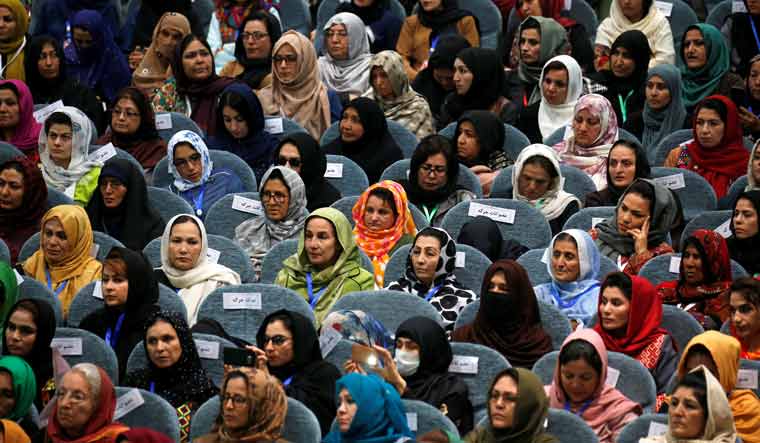
What Has the US Learned About Supporting Afghanistan’s Women?


By Catherine Putz
From 2002 to 2020, the U.S. government disbursed at least $787 million for programs to support Afghan women and girls. What progress did those funds buy and how easily could it all be lost?
Speaking at a Brookings Institution event last week to unveil his office’s latest lessons learned report, Special Inspector General for Afghanistan Reconstruction (SIGAR) John F. Sopko put the report’s release in context: “We release it as the new administration faces a critical issue – how the United States can continue to support Afghan women and girls at a time of great uncertainty about their nation’s future.”
The 165-page report (plus annexes) is a comprehensive tour through nearly two decades of reconstruction work focused on women and girls in Afghanistan. The report found some success, but plenty of failure, too; much of it rooted in a lack of understanding (and subsequent lack of considerations of) local cultural contexts in the design and implementation of programs.
Since 2001, SIGAR notes significant progress in a variety of fields, from health and education metrics to political and economic participation. But the gains have been “tempered,” the report noted, by sociocultural norms and insecurity. In an ironic twist, while high-level political focus on gender issues in Afghanistan meant greater congressional and executive branch support, and significant funding, the “political focus may also have reduced the scrutiny accorded to the design of some gender programs.”
And program design matters.
Promoting women’s rights in Afghanistan has been a goal of U.S. reconstruction efforts since 2002, but SIGAR found that some programs achieved better success than others. “Some programs were designed based on assumptions that proved to be ill suited to the Afghan context,” Sopko said in his remarks.
T
he “Afghan context” is a society as complex as societies the world over, burdened by history and a patriarchal culture. As Sopko highlighted in his remarks, the experiences of Afghan women are too often simplified in international eyes: either mini-skirt clad students of 1970s Kabul or women in dusty villages hidden under burqas in the 1990s. “As we note in the report, such one-dimensional narratives can undermine even the most well-intentioned efforts to ensure women and girls are afforded basic human rights,” Sopko said.As in other societies, there exist in Afghanistan restrictive social and cultural norms relating to the behavior of women and girls. In Afghanistan, the report notes, these “predate and transcend the Taliban.” This is an important point to underscore: If the Taliban were to vanish entirely tomorrow, the difficulties faced by women in Afghanistan would remain. That said, if the Taliban were to return fully to power in Afghanistan, the gains made by Afghan women could too easily vanish.
Another of the report’s key findings notes that historically, “Afghan leaders’ efforts to advance women’s rights have spurred backlash, especially in rural areas, and have been most successful when based on a broad social consensus.” Walking the tightrope of progress without engendering a backlash might be an impossible task, but it’s a worthy endeavor.
In offering lessons, SIGAR highlights the value of U.S. and international pressure in advancing women’s rights but also the necessity of U.S. officials developing and employing a deeper understanding of Afghanistan’s cultural contexts. The lessons also note that educating Afghan men and boys about gender equality is critical. This is as true in the mission to advance women’s rights in Afghanistan as it is in the West.
In laying out the report’s findings, a final point was worth highlighting: “The effort to promote women’s rights may be hampered by a growing narrative in Afghanistan that the country can either have women’s rights at the cost of peace, or peace at the cost of women’s rights.”
This is a dangerous narrative that feeds into a broader zero-sum view of rights in which women’s gains come at the expense of men.
“I do not believe gender equality is a zero-sum game,” Sopko said in his remarks.
In the Afghan context, the emerging narrative that defending “women’s rights” might derail the peace process is a troubling and false set-up. Such as narrative presupposes that sacrificing women’s rights could even buy peace, as if such a thing could be sacrificed like a lamb on the altar. After more than a month hiatus, negotiators from the Taliban and the Afghan government met again on February 22. The two sides are still working on an agenda for talks, with the Afghan government prioritizing a ceasefire and the Taliban dancing around ideas of political arrangements but mostly waiting for the Biden administration to finish its review of the Trump-era Doha agreement.
Women’s rights are certainly a facet in the negotiations but they are not the only point of tension between the two sides. SIGAR stresses in its conclusion the importance of the U.S. advocating a greater role for women in the negotiations. Amid the extant political uncertainty, the Afghan government’s continued dependence on the U.S. gives Washington a degree of leverage it can, and should, use to “remind Afghan powerbrokers that the world is watching, and lend support to Afghan leaders and advocates who share U.S. goals.”
https://thediplomat.com/2021/02/what-has-the-us-learned-about-supporting-afghanistans-women/

Is Pakistan headed for a hunger pandemic?

Mehreen Naushad

Even before the coronavirus pandemic, food security had posed a huge threat to the national security of Pakistan due to socio-economic conditions, natural disasters, terrorism and sectarian violence, among others factors.
But the threat has become even more pronounced since the pandemic. It now has the potential to further aggravate poverty in the country.
The primary challenge facing the government at the moment is to curb the spread of COVID-19 and minimise its socio-economic impacts.
Full and smart-lockdowns have led to a reduction in incomes and a disruption in food supply and production. Consequently, households across the country are being forced to cut down on the quality and quantity of their food consumption.
According to a study titled, “Rapid Assessment: Possible Impact of COVID-19 on Livelihoods, Food Security, Nutrition and Agricultural Supply Chain in Pakistan”, by the Food and Agriculture Organization of the United Nations in collaboration with World Food Programme in August 2020, an estimated 125 million people in Pakistan are expected to be thrown below the poverty line due to the global economic shock and the lockdowns.
The report states: “The restrictions on movement of goods and people and lockdown are likely to cause adverse impacts on livelihood and food and nutrition security of people if not accompanied by well thought policy measures.”
It adds that around 40 to 62 million people (20-30% of Pakistan’s population) are experiencing some form of food insecurity.
However, these are conservative figures. Keeping in mind the scale of the COVID-19 emergency, it is reasonable to conclude there will be a substantial increase in the number of food insecure people in Pakistan in the coming months or years.
In this case, the vulnerable and marginalised groups such as women, children, daily-wage laborers, small- and medium-scale businesses, agriculture and other informal sectors will be disproportionately impacted, not only economically but also in terms of human cost i.e., mental trauma.
These groups rely heavily on agriculture, livestock rearing or non-agricultural jobs and they already struggle to meet their food and nutrition security needs due to limited access to food production inputs and restricted purchasing powers.
COVID-19 is expected to force these people to adopt negative coping mechanisms such as limiting the quality and quantity of their dietary intake, or compel them to sell their assets and seed stock at low prices, or borrow from the banks at exorbitant interest rates.
But does the government have the financial resources to support the vulnerable groups? Especially when it is already catering to those residing in the locust- and drought-affected regions in Balochistan and Sindh.
It isn’t easy to procure and distribute resources in time to hard-to-reach areas.
Last year, Prime Minister Imran Khan rolled out three initiatives under the umbrella of the poverty alleviation Ehsaas Program - Ehsaas Rashan, Ehsaas Nashonuma, and the Ehsaas Langar Program - which aimed to provide food packs or cash equivalent to vulnerable deserving beneficiaries and to serve meals to the vulnerable segments of the society.
However, these are short term initiatives to address the most pressing and immediate threat. It is unclear how these programs will sustain themselves in the long term. It is also vital that a well thought out policy is enacted on the national level to ensure food security in Pakistan during the pandemic.
Pakistan’s National Action Plan for Preparedness and Response to Coronavirus Disease highlights food security as a priority area. It further calls for the Ministry of Food Security and Research to present a National Food Security Plan to the federal government at the earliest, and tasks provincial governments to prepare their respective provincial food security plans to ensure the availability of sufficient stockpiles of basic food provisions at the territorial level.
However, till date other than the government of Khyber Pakhtunkhwa, no other provincial government nor the federal government has drafted a National Food Security Plan.
Separately, the government can also collaborate with UN partners and other humanitarian organisations to reinforce contingency food stocks and position them at strategic locations, to quickly dispatch and distribute food.
It is imperative that the government take timely measures to ensure that the health crisis of the coronavirus pandemic does not become a food crisis.
https://www.geo.tv/latest/336301-is-pakistan-headed-for-a-hunger-pandemic

Iran is committing economic terrorism in Balochistan: Hyrbyair Marri


 Baloch leader and head of the Free Balochistan Movement, Hyrbyair Marri, in reaction to the recent killing of Baloch fuel traders by IRGC said that Iran was committing economic terrorism against Baloch people.

He said that Iran’s foreign minister Javad Zarif & Iranian Mullahs claim that American sanctions are economic terrorism. ‘In reality, the Iranian state was committing economic terrorism against the Baloch nation.’

On 22 February, IRGC murdered more than 10 Baloch traders on the arbitrary border which divides Balochistan

Several dozen people were as well injured; their pickup trucks were set ablaze by the IRGC forces.

 Iran has not only occupied Balochistan and looting its natural resources, but it has also severely restricted the Baloch people’s movement within our homeland.

'Win for democracy': Bilawal says PDM's actions have forced govt to heed people's problems


PPP chairperson Bilawal Bhutto-Zardari claimed on Wednesday that the actions of the opposition's 10-party Pakistan Democratic Movement (PDM) had forced the incumbent government into activity to reach out and attempt to address the people's problems, terming it as a "win for democracy".
Bilawal was addressing a press conference in Lahore with PPP leaders Yousuf Raza Gilani and Qamar Zaman Kaira. He reiterated that the PDM had come to a consensus to not only take part in by-polls but also give a "tough time to the government" in every field, whether it was the by-elections or the upcoming Senate Polls. "This is the task of the opposition to familiarise the government with the people's voice and problems and to fight for them at every instance."
"This by itself is a win for democracy that they [the government] are [now] reaching out to everyone and they are trying to make the effort to solve the people's problems. Now they are ready to listen to the people's pain, grief and problems."
He said the opposition's continued criticism of the neglect of the National Assembly, calls for the supremacy of the parliament and decision-making through the parliament had made the government realise that it could not ignore its MNAs and allies. Bilawal added that the PDM had "exposed the government's situation" to Pakistan and the world in a short time due to its political decisions.
"By-elections happened in every corner of the country and the government was badly defeated," said Bilawal, alleging that the government had been exposed in its use of violence and methods to rig the NA-75 (Daska) by-poll. "The message has been sent to the whole of Pakistan that people are not with the government and the PTI but with the PDM."
He said he was hopeful that a new chapter would start in Pakistan where democracy would flourish after the win of Gilani in the Senate election. "I once again am thankful to the PDM leadership that they chose Yousuf Raza Gilani as their joint candidate from Islamabad."He praised Gilani as someone who answered the questions of both opposition and government members during his tenure as prime minister and as someone who "sat in parliament, respected everyone and talked to everyone"."This is a test for our members of assembly that will you vote based on the people's expectations or will you vote out of [Prime Minister] Imran Khan's fear," asked Bilawal of Pakistan's parliamentarians.
Yousuf Raza Gilani has been fielded as a joint candidate of the PDM for the upcoming Senate elections from Islamabad. The PPP leader expressed his confidence on Monday, while speaking to the media on a visit to JUI-F chief Maulana Fazlur Rehman's residence in Islamabad, that he would emerge victorious in the Senate polls, saying that response to his nomination had been "positive". He also thanked the PDM leadership for choosing him and said that his nomination had "given respect to members of parliament" as the government was now ready to talk to MNAs and MPAs as well.
The ruling PTI has challenged Gilani's nomination in the Election Commission of Pakistan, alleging that the former prime minister concealed facts in his nomination papers. PTI's Senate candidate from Islamabad Fareed Rehman said that Gilani had failed to mention his conviction in a contempt of court case back in 2012.
'Prayer is that institutions are neutral'
"Since three generations, the PPP's struggle has been that we want our institutions to remain impartial [...] Pakistan's progress and development are dependent on this that every institution performs its role within its limits."
Bilawal claimed that the PPP had never asked for undemocratic support from any institution and was "happy" when every institution worked within its constitutional limits. "Our prayer is that institutions are neutral," he said, adding if everyone felt that institutions were being neutral in the Senate Polls, then it should be "welcomed".
He reiterated that the PPP wanted action on clauses within the Charter for Democracy which called for electoral reforms and open balloting in Senate elections but not without the parliament which "is the only avenue for lawmaking". Bilawal said he hoped lawmaking would commence on broader electoral reforms after the Senate Polls but they wouldn't be allowed to pass through "back doors".
Bilawal said the PDM would convene later after the Senate elections to strategise on any no-confidence motion and its strategy for the long march. "At the moment, we are just fighting the Senate elections and our hope is that we will bring good results in front of the people in the Senate elections."
https://www.dawn.com/news/1609167/win-for-democracy-bilawal-says-pdms-actions-have-forced-govt-to-heed-peoples-problems

Pakistan: Christian couple on death row for ‘blasphemous texts’ must be released

 The Pakistani authorities must immediately and unconditionally release a husband and wife facing death sentences after being convicted of sending ‘blasphemous’ text messages, said Amnesty International, ahead of an appeal hearing in the case at the Lahore High Court today.  

Shagufta Kausar and Shafqat Emmanuel, who are Christians, have been in prison since 2013 and were convicted and sentenced to death in April 2014 by a Trial Court in Toba Tek Singh. The couple face execution for sending ‘blasphemous’ texts to a mosque cleric insulting the Prophet Mohammad, from a phone containing a sim registered in Shagufta's name. Both deny the allegations and believe that the sim was obtained by someone using a copy of her National Identity Card. 

The mandatory death sentences for Shagufta Kausar and Shafqat Emmanuel are emblematic of the dangers faced by the country’s religious minorities as long as the blasphemy laws remain in place. 
Samira Hamidi, Amnesty International's Deputy Regional Director for South Asia

“The mandatory death sentences for Shagufta Kausar and Shafqat Emmanuel are emblematic of the dangers faced by the country’s religious minorities as long as the blasphemy laws remain in place. They have been in prison for the better part of eight years waiting for their appeal hearing, when they should not be in jail in the first place. We call for their immediate and unconditional release,” said Samira Hamidi, Amnesty International’s Deputy Regional Director for South Asia. 

“The Government of Pakistan must urgently repeal its blasphemy laws that have been flagrantly abused and caused an immeasurable amount of harm.” 

Pakistan’s blasphemy laws are incompatible with international human rights laws, overly broad, vague and coercive. They have been used to target religious minorities, pursue personal vendettas, and carry out vigilante violence. Judges, fearing reprisals if they do not deliver the harshest sentences, often fear for their lives when adjudicating blasphemy cases.  

The couple’s appeal was due to be heard in April 2020 but was postponed due to the Covid-19 pandemic. At their last hearing, on 15 February 2021, the judges left the court as they were due to hear the appeal. 

Background 

There has been an alarming uptick in “blasphemy” accusations in Pakistan over the last year, with accusations brought against artists, human rights defenders and journalists.  

Amnesty International is calling for the full repeal of Pakistan’s blasphemy laws. Of further concern is the automatic and mandatory imposition of the death penalty, prohibited under international human rights law and standards. The mandatory death penalty does not allow judges the possibility of taking into account the personal circumstances of the defendant or the circumstances of the particular offence; and the use of this punishment for crimes that do not meet the "most serious crimes" threshold, meaning intentional killing.   

https://www.amnesty.org/en/latest/news/2021/02/pakistan-christian-couple-death-row/

Tuesday, February 23, 2021

Music Video - Billie Eilish - Therefore I Am

Video Report - France's 'Islamo-leftism' row: Uproar over minister's probe into academic research

Video Report - Press Preview - A first look inside Wednesday's newspapers

Video - #Biden #Trudeau #COVID19 President Biden, Canadian Prime Minister Justin Trudeau speak after first meeting

Video Report - #Colbert #Impeachment #Monologue Ted Cruz's Favorite President Could Face Jail Time For Tax Fraud

Video Report - ‘The Worst Of The Worst’: Capitol Police Captain Recounts Experience On January 6

Video Report - Ex-Capitol police chief contradicts GOP senator at riot hearing

Video Report - What we learned from the Capitol riot hearings

Video Report - #TigerWoods -Tiger Woods hospitalized after serious car crash

Opinion: THE STONE - Humans Are Animals. Let’s Get Over It.


 By Crispin Sartwell


It’s astonishing how relentlessly Western philosophy has strained to prove we are not squirrels.
If one were to read through the prefaces and first paragraphs of the canonical works of Western philosophy, one might assume the discipline’s primary question to be this: What makes us humans so much better than all the other animals? Really, it’s astonishing how relentless this theme is in the whole history of philosophy. The separation of people from, and the superiority of people to, members of other species is a good candidate for the originating idea of Western thought. And a good candidate for the worst.
The Great Philosopher will, before addressing himself to the deep ethical and metaphysical questions, pause for the conventional, ground-clearing declaration: “I am definitely not a squirrel.” This is evidently something that needs continual emphasizing.
Rationality and self-control, as philosophers underline again and again, give humans a value that squirrels lack (let’s just stick with this species for the time being), a moral status unique to us. We are conscious, and squirrels, allegedly, are not; we are rational, and squirrels are not; we are free, and squirrels are not.
We can congratulate ourselves on the threat averted. But if we truly believed we were so much better than squirrels, why have we spent thousands of years driving home the point?
It’s almost as though the existence of animals, and their various similarities to humans, constituted insults. Like a squirrel, I have eyes and ears, scurry about on the ground and occasionally climb a tree. (One of us does this better than the other does.) Our shared qualities — the fact that we are both hairy or that we have eyes or we poop, for example — are disconcerting if I am an immortal being created in the image of God and the squirrel just a physical organism, a bundle of instincts.
One difficult thing to face about our animality is that it entails our deaths; being an animal is associated throughout philosophy with dying purposelessly, and so with living meaninglessly. It is rationality that gives us dignity, that makes a claim to moral respect that no mere animal can deserve. “The moral law reveals to me a life independent of animality,” writes Immanuel Kant in “Critique of Practical Reason.” In this assertion, at least, the Western intellectual tradition has been remarkably consistent.
The connection of such ideas to the way we treat animals — for example, in our food chain — is too obvious to need repeating. And the devaluation of animals and disconnection of us from them reflect a deeper devaluation of the material universe in general. In this scheme of things, we owe nature nothing; it is to yield us everything. This is the ideology of species annihilation and environmental destruction, and also of technological development.
Further trouble is caused when the distinctions between humans and animals are then used to draw distinctions among human beings. Some humans, according to this line of thinking, are self-conscious, rational and free, and some are driven by beastly desires. Some of us transcend our environment: Reason alone moves us to action. But some of us are pushed around by physical circumstances, by our bodies. Some of us, in short, are animals — and some of us are better than that. This, it turns out, is a useful justification for colonialism, slavery and racism.
Every human hierarchy, insofar as it can be justified philosophically, is treated by Aristotle by analogy to the relation of people to animals. One might be forgiven for thinking that Aristotle’s real goal is not to establish the superiority of humans to animals, but the superiority of some people to others. “The savage people in many places of America,” writes Thomas Hobbes in “Leviathan,” responding to the charge that human beings have never lived in a state of nature, “have no government at all, and live in this brutish manner.” Like Plato, Hobbes associates anarchy with animality and civilization with the state, which gives to our merely animal motion moral content for the first time and orders us into a definite hierarchy. But this line of thought also happens to justify colonizing or even extirpating the “savage,” the beast in human form.
Our supposed fundamental distinction from “beasts, “brutes” and “savages” is used to divide us from nature, from one another and, finally, from ourselves. In Plato’s “Republic,” Socrates divides the human soul into two parts. The soul of the thirsty person, he says, “wishes for nothing else than to drink.” But we can restrain ourselves. “That which inhibits such actions,” he concludes, “arises from the calculations of reason.” When we restrain or control ourselves, Plato argues, a rational being restrains an animal. In this view, each of us is both a beast and a person — and the point of human life is to constrain our desires with rationality and purify ourselves of animality. These sorts of systematic self-divisions come to be refigured in Cartesian dualism, which separates the mind from the body, or in Sigmund Freud’s distinction between id and ego, or in the neurological contrast between the functions of the amygdala and the prefrontal cortex.
I’d like to publicly identify this dualistic view as a disaster, but I don’t know how to refute it, exactly, except to say that I don’t feel myself to be a logic program running on an animal body; I’d like to consider myself a lot more integrated than that. And I’d like to repudiate every political and environmental conclusion ever drawn by our supposed transcendence of the order of nature. I don’t see how we could cease to be mammals and remain ourselves. There is no doubt that human beings are distinct from other animals, though not necessarily more distinct than other animals are from one another. But maybe we’ve been too focused on the differences for too long. Maybe we should emphasize what all us animals have in common.
Our resemblance to squirrels doesn’t have to be interpreted as a threat to our self-image. Instead, it could be seen as a hopeful sign that we will someday be better at tree leaping.
https://www.nytimes.com/2021/02/23/opinion/humans-animals-philosophy.html

Urdu Music Video - Naheed Akhtar - Teri Ulfat Mein Sanam

Video Report - #Pakistan - #WomenRights - North Waziristan Incident: Why Govt Fails To Protect Aid Workers?

Christian leaders slam Minister Shah: Pakistan does not protect its minorities

By Shafique Khokhar
Pakistan's Anti-Narcotics Minister Ijaz Shah spoke recently at the centennial of the Saka Nankana or Nankana massacre. His controversial speech sparked outrage.
At the ceremony held last Sunday in Nankana Sahib, Lahore (Punjab), the politician said that all minorities in the country are respected and protected, while in India they are the subject of “atrocities”.This elicited an immediate response from some prominent individuals, including some Christians, who cited many examples of violations, evidence that minorities are protected only “on paper”. The minister spoke at an event marking the centenary of the Nankana massacre, an anniversary that brought many Sikh pilgrims from across Pakistan and also abroad.The anniversary commemorates the killing of more than 260 Sikhs, some as young as seven, at the hands of the last Udasi Custodian, Mahant Narayan Das, and his mercenaries when the area was still part of British India.
The three-day observance coincided with the birthday of Guru Nanak, founder of Sikhism, which was celebrated in the presence of politicians, religious leaders, minority representatives, activists and worshippers gathered in Nankana Sahib.
Addressing those present, the Anti-Narcotics Minister said that “good treatment of minorities is one of the obligations of the Islamic religion” and “the white colour in our national flag represents minorities”. Guru Nanak, he added, “taught the lesson of peace and love to people”.
Mr Shah also noted that the Baba Guru Nanak University was under construction, and that it would bring an educational revolution in the area, paid entirely by the Pakistani government.
The minister's celebratory words raised concern, even outrage, in many representatives of religious minorities who say that it is false to say that “religious minorities enjoy full respect in Pakistan”. For Rev Javed Bashir, a pastor with the Voice of Christ Pentecostal Church in Karachi, Ijaz Shah's words are contrary to reality “because not only Christians, but all minorities face a difficult situation” that is getting worse “day to day”.”
“Let us pray for the leaders and authorities of our country, that they may bring true peace and prosperity to our nation,” the Christian leader said. “We are concerned about the future of our young people” and it remains essential to “educate children”.
Citing a recent report by International Christian Concern, Rev Bashir noted that non-Muslims are at critical moment, subjected to many abuses and acts of violence.
The report, he points out, documents at least 38 episodes of persecution that include “discrimination, sexual assaults, kidnappings, forced conversions, forced marriages, spurious accusations of blasphemy, and even murder.”
http://www.asianews.it/news-en/Christian-leaders-slam-Minister-Shah:-Pakistan-does-not-protect-its-minorities-52422.html

On Pakistan’s Minority Persecution ‘Concerns’ – OpEd

By Nilesh Kunwar
Last Thursday, while speaking at a virtual meeting of United Nations Economic and Social Council on “Reimagining Equality: Eliminating Racism, Xenophobia and Discrimination for all,” Pakistan’s Foreign Minister [FM] Shah Mahmood Qureshi was at his eloquent best, pitching strongly for the “forging a global alliance against the rise and spread of Islamophobic as well as other violent nationalist and racist groups.” He lamented that hateful political rhetoric and inciting violence against vulnerable ethnic and religious groups being practiced in ‘Pakistan’s neighbourhood’ had “resulted in discriminatory citizenship laws, attacks on places of worship and repeated state-sponsored pogroms against minorities.”
Even though Qureshi didn’t specify who was responsible for what he in his wisdom perceives to be a replay of the Holocaust, there are no prizes for guessing at whom this barb had been directed as this completely unsubstantiated and patently motivated refrain has become Islamabad’s staple fare. What’s most intriguing is that despite having failed to garner any meaningful support for its puerile and ineffectual Kashmir narrative, Islamabad still continues to reiterate it on every conceivable occasion. So, it’s not at all surprising that the exasperated international community has even abandoned the diplomatic nicety of at least acknowledging Pakistan’s concerns, even if they don’t necessarily agree with them.
Domestic compulsions driving Islamabad’s anti-India tirade are understandable. That’s why its insistence to continue harping on a narrative that’s been univocally rejected by both UN and the international community is indeed intriguing-unless of course, the persistent reprise is inspired by Hitler’s propaganda chief Joseph Goebbels’s dictum that “If you tell a lie big enough and keep repeating it, people will eventually come to believe it.” However, it seems that Islamabad isn’t aware of, or doesn’t believe in the adage that ‘whenever one points a finger at others, three fingers are pointing back at the accuser’.
Since Prime Minister Imran Khan had in 2018 announced with great flourish that “We will show the Modi government how to treat minorities,” Qureshi being anguished by “state-sponsored pogroms against minorities” in Pakistan’s neighbourhood is comprehensible. However, it appears that foreign affairs are keeping him so busy that he’s completely ignorant about pitiable conditions of minorities in his own country on which several international organisations have voiced serious concern. However, since both Khan and Qureshi would outrightly “reject” any such report prepared by an external agency no matter how impartial and credible it may be, let’s restrict ourselves to what the Human Rights Commission of Pakistan [HRCP] itself has revealed.
In its annual report [‘State of Human Rights in 2019’], HRCP has listed two damning observations. One, it notes that “Religious minorities remained unable to enjoy the freedom of religion or belief guaranteed to them under the constitution[Emphasis added]. For the Ahmadiyya community in Punjab, this included the desecration of several sites of worship.” Two, that “Both the Hindu and Christian communities in Sindh and Punjab continued to report cases of forced conversion. In Punjab, girls as young as 14 were forcibly converted and coerced into marriage. In Sindh, the case of two Hindu girls whose families claimed they had been kidnapped for marriage and converted forcibly, drew widespread attention when the Islamabad High Court ruled that the girls were not minors at the time of marriage and allowed them to return to their spouses.” [Emphasis added].
Enforced disappearance is another grave issue that ethnic minorities in Pakistan have to grapple with. The 2019 HRCP report makes the shocking revelation that “Pakistan has yet to criminalise enforced disappearances even after a commitment to this effect made by the incumbent government on several occasions” goes on to state that “The Commission of Inquiry on Enforced Disappearances falls short of being an effective agency to provide relief to the citizens, apportion responsibility and bring perpetrators to justice.” It also mentions that “Since the inception of the Commission of Inquiry on Enforced Disappearances, KP [Khyber Pakhtunkhwa has topped the list in the numbers of missing persons. At end December 2019, the total number of cases registered in KP stood at 2,472.” [KP is home to Pakistan’s Pashtun minority].
Islamabad will most certainly deny any institutionalised persecution of the Pashtun minority. However, if this is true, then how does it explain Director General [DG] of Pakistan army’s media wing Inter Services Public Relations [ISPR] warning Pashtun Tahaffuz Movement [PTM], a social movement for Pashtun human rights based in KP and Balochistan, by saying that “their time is up”? Is the fact that within a month of the DGISPR issuing this not-so-cryptic threat,13 PTM supporters were killed and over 25 others injured near Kharqamar check post in North Waziristan when the army opened fire on peaceful demonstrators, just a mere coincidence?
If Rawalpindi’s contention that soldiers at Kharqamar check post resorted to firing as a last resort after they were attacked by violent PTM demonstrators and had exercised full restraint is really true, three questions still arise. One, if the Pakistan army had really exercised outmost restraint, then how come it ended up inflicting such heavy casualties? Two, if soldiers had acted purely in self-defence, then why was HRCP’s fact finding team stopped by the army from proceeding to the check post for an on-site-investigation? Lastly, as per Rawalpindi, one soldier was killed while five were seriously injured when PTM protesters attacked the Kharqamar check post. So, if PTM workers had indeed been instigated to attack the check post and had both killed and injured soldiers, then why did the government withdraw the cases against National Assembly members Ali Wazir and Mohsin Dawar who had been arrested by security forces for having incited protesters?
The people of Balochistan too have been bearing the brunt of a brutally violent campaign being carried out by Pakistan army in the garb of anti-terrorist operations and today, this region has become inextricably associated with enforced disappearances. In its ‘Public Statement’ of 12 November 2020, Amnesty International [AI] notes that “Enforced disappearances targeting students, activists, journalists and human rights defenders continue relentlessly in Pakistan’s southwestern province of Balochistan.” In its recommendation, AI has called upon Pakistani authorities to “Ensure that all measures are taken to immediately end the practice of enforced disappearance.” Though AI’s explicit statement and recommendation addressed to “Pakistani authorities” gives a clear indication of institutional complicity in the repulsive practice of disappearing people, the Government of Pakistan will obviously reject the same.
However, even if AI’s observation as well as recommendation is disregarded and Islamabad is given benefit of doubt, this issue doesn’t disappear. Readers may recall that during a media interaction session in 2019, when senior journalist Hamid Mir of Geo TV expressed concern about enforced disappearances in Balochistan and elsewhere, DGISPR replied, “You have a deep attachment with missing persons [but] so have we. We don’t wish that anyone should be missing. But when its war, you have to do a lot of things- as they say, all is fair in love and war; war is very ruthless.” [Emphasis added]. Now with Pakistan army’s media chief himself admitting that Rawalpindi considers military actions against its own citizens who are resisting exploitation of the region’s natural resources and excesses against their people as ‘war’ and follows the “all is fair in love and war” approach to justify enforced disappearances, is any further proof of institutionalised persecution of ethnic minorities in Pakistan necessary?
So, rather than levelling unproven accusations in an attempt to malign opponents, it would certainly do Islamabad a lot of good if it focuses more on setting its own house in order, because at the end of the day, the international community neither has time nor the inclination to suffer hypocrites peddling lies.
https://www.eurasiareview.com/22022021-on-pakistans-minority-persecution-concerns-oped/

France summons Pakistan envoy over criticism of ‘separatism’ bill

Spat comes after Pakistani President Arif Alvi called on Paris to abandon controversial bill, claiming the law would discriminate against Muslims.
The French foreign ministry has summoned Pakistan’s envoy to protest against claims by President Arif Alvi that a French bill cracking down on what it terms “Islamist extremism” stigmatises Muslims.
Addressing a conference on religion on Saturday, Alvi said: “When you see that laws are being changed in favour of a majority to isolate a minority, that is a dangerous precedent.”
Specifically referring to the legislation drafted after the beheading of a French teacher over cartoons of the Prophet Muhammad, Alvi said: “When you insult the prophet, you insult all Muslims.
“I urge the political leadership of France not to entrench these attitudes into laws … You have to bring people together – not to stamp a religion in a certain manner and create disharmony among the people or create bias.” Pakistan was one of several Muslim countries that saw angry anti-French protests in October over President Emmanuel Macron’s defence of the right to show cartoons depicting the Prophet Muhammad.
Pakistan, a country with the second-largest number of Muslims in the world after Indonesia, does not have an ambassador in France.
The French foreign ministry said late Monday it had called in Pakistan’s charge d’affaires to mark “our surprise and our disapproval (over Alvi’s remarks), given that the bill contains no discriminatory element”.
“It is guided by the basic principles of freedom of religion and conscience, makes no distinction between the different religions and applies therefore equally to all faiths,” the ministry said.
“Pakistan must understand this and adopt a constructive attitude for our bilateral relations,” it added.
The bill adopted by the lower house of the French parliament last week is dubbed the “anti-separatism” bill in reference to Macron’s claim that “Islamists” are closing themselves off from French society by refusing to embrace secularism, gender equality and other French values.
The legislation significantly expands the state’s powers to close religious organisations and places of worship if they are found to air “theories or ideas” that “provoke hate or violence towards a person or people”.It also creates a new crime of “separatism” – described as threatening a public servant to gain “a total or partial exemption or different application of the rules” – that is punishable by up to five years in prison.Pakistan’s government has been particularly virulent in its condemnation of Macron’s clampdown, which followed a wave of attacks in recent years on French soil.
Prime Minister Imran Khan in October accused Macron on Sunday of “attacking Islam” and choosing to “encourage Islamophobia” for defending the right to publish cartoons of the Prophet Muhammad.
https://www.aljazeera.com/news/2021/2/23/france-summons-pakistan-envoy-over-criticism-of-separatism-bill

Monday, February 22, 2021

Video - #Colbert #Impeachment #Monologue Cowardly GOP Senators Look Away As Devastating Footage Shows Exactly Who Incited The Capitol Riot

Video - #USCoronavirus #coronavirus Political divide contributed to 500K deaths, says Fauci

Video - 'Resist becoming numb to the sorrow' - President Biden pays tribute to 500K dead

Video - White House Moment of Silence for 500,000 U.S. COVID-19 Deaths

Video Report - Psaki Says Biden Is 'Eager' to Visit Texas as Early as This Week

Video Report - #Ahmadis Why Can't Ahmadis Be Included In Minorities Commission

Video Report - #Pakistan - 20 MPs Absent From Imran Meeting

Pakistan army preparing to escalate its offensives in Balochistan

 The Pakistani army is preparing for fresh offensives in different areas of Balochistan including Kohistan Marri’s Kahaan region, Bolan, Harnai and surrounding areas.

According to the details, a large number of the Pakistani army have been seen moving toward the Kahaan area from the military cantonment in Kohlu.

Locals fear the extraordinary movements and sudden increase of troops in the number suggests that the Pakistani army plans to intensify its offensives in Kohistan Marri’s Kahaan region where Baloch freedom fighters have been frequently attacking them.  

Similar bloody aggressions were carried out last week in Kharan, Bolan, Harnai and many other areas of Balochistan in which many innocent Baloch were killed and injured.

Several people including women and children were abducted during the latest offensives.  

On Sunday, the federal interior minister Sheik Rashid met the Inspector General Frontier Corps North, Major General Muhammad Yousuf Majoka in Quetta and appreciated the role of “FC Balochistan in maintaining law and order.”

Pakistani media sources quoted Rashid as saying, “implementation of all points of the National Action Plan (NAP) will be ensured.”

He also said steps would be taken to ensure internal security and ‘enemies of the country would not be allowed to succeed in their nefarious designs.’

He also warned, “Terrorists who want to destabilise Balochistan would not have a place to hide.”

The federal minister who is known for his hatred for the Baloch people is on a four-day-tour to Balochistan.

The latest military development and increase in deployments of troops is being seen as the result of Rashid’s go-ahead to escalate military offensives in Balochistan.

https://balochwarna.com/2021/02/22/pakistan-army-preparing-to-escalate-its-offensives-in-balochistan/

Concerns over Pakistani PM's visit to Sri Lanka

Human rights defenders are suspicious of the motives behind Imran Khan's two-day visit.
A regional network of human rights defenders has called on the governments of Pakistan and Sri Lanka to respect the rights of all minorities guaranteed in their constitutions and to address their concerns while providing equal treatment to all.
South Asians for Human Rights (SAHR) issued its statement ahead of Pakistani Prime Minister Imran Khan’s visit to Sri Lanka.
Expressing concern over the timing and purpose of Khan’s Feb. 22-23 visit, SAHR said: “We further urge the governments of Sri Lanka and Pakistan to use this occasion to celebrate true South Asian camaraderie while working together to address human rights concerns of all citizens in the region."
The visit coincides with the virtual launch of the 46th session of the UN Human Rights Council (UNHRC), where it is reported that a new resolution on Sri Lanka will be discussed. “This is also at a time when the government of Sri Lanka has been criticized for forcibly cremating the corpses of Covid-infected Muslim persons against WHO [World Health Organization] guidelines,” the group said. “SAHR believes that the prime minister’s visit is to garner support from the Organisation of Islamic Cooperation to vote against a resolution on Sri Lanka that is due to come up on February 23.”
Khan is expected to address the rights concerns of Muslims and will hold talks with key government officials and party leaders.
Sri Lanka is to allow burial of Muslim coronavirus victims after a global outcry over its mandatory cremation policy. “While commending PM Khan's willingness to address the issues faced by the Sri Lankan Muslim minority during his visit, we are also apprehensive of the impact these talks will have on the Tamil minority in the country,” the group said.
In February 2020, Sri Lanka’s government informed the UNHRC of its decision to withdraw its co-sponsorship of resolutions calling for a process of transitional justice promoting reconciliation, accountability and human rights, saying it wanted to pursue a domestically designed and executed policy.
Support from Pakistan and other countries would permit the Sri Lankan government to deliberately bypass the proper process of transitional justice for victims who are mainly among the Tamil and Muslim minorities in the country. SAHR said numerous restrictions on people’s freedom of expression and right to peaceful protest are common across the region. The increase in nationalism and religious extremism leading to marginalization of minorities, shrinking civic space, journalists being targeted by state and non-state authorities, and activists and opposition members being vilified and detained without due process and persecuted through the misuse of laws and undue influence of executive powers are rampant in South Asia, the group said.
Indian climate activist Disha Ravi’s arrest is the latest example of the rapid degradation of human rights, it added. “Moreover, there have been numerous instances of people’s rights and respect for democratic values been blatantly violated by governments using the pandemic containment as a facade,” SAHR said.
“In Pakistan and Sri Lanka, the intensification of militarization, especially the military leading Covid-19 containment measures as well as the civil administration, business and other aspects of civilian life, have further reduced freedoms and civil liberties. “The agony and suffering faced by minorities in Pakistan and the use of the draconian blasphemy laws have sometimes pushed them to become refugees in neighboring countries. The ruthless measures taken to curb the students’ movement and Pashtun movement without attempting to find sustainable solutions to their problems raises concerns of PM Khan's legitimacy to address issues of the Muslim minority in Sri Lanka.
“We believe that such bilateral occasions should not be used to address issues of one minority community while overlooking the concerns of another.”
https://www.ucanews.com/news/concerns-over-pakistani-pms-visit-to-sri-lanka/91491#

4 Aid Workers Are Shot Dead in #Pakistan


By Zia ur-Rehman
The attack could portend a resurgence of militant violence in the former tribal areas of Waziristan, once a hub of the Pakistani Taliban.
Gunmen killed four aid workers in an ambush in the northwestern Pakistani district of North Waziristan on Monday, police officials said, an attack that could signal a revival of insurgency in the region bordering Afghanistan that was once a stronghold of the Pakistani Taliban.A vehicle carrying the aid workers, who were all Pakistanis and who were affiliated with a program for developing household skills for women, was fired upon by unidentified attackers in the town of Mir Ali, the police said.The four aid workers, all women, were killed and the male driver was wounded. A fifth aid worker, also a woman, survived the attack by taking refuge in a nearby house, the police statement said. The attackers fled into the nearby mountains.
The Human Rights Commission of Pakistan condemned the attack and demanded that the government bring the attackers to justice.
“It is the responsibility of the authorities to protect the lives and property of citizens at all costs,” the commission said in a statement.
There was no immediate claim of responsibility for the ambush. But the shooting fits a pattern of attacks against aid workers and anti-polio medics across the country that officials have attributed to the Pakistani Taliban.
Waziristan was the hub of the insurgent group for years, until a strong push by the Pakistani military around 2014 cleared most of the militants, bringing a semblance of security to the region. Analysts and residents now fear that various factions of the Pakistani Taliban who had sought shelter from military operations in the bordering provinces of Afghanistan have regrouped.
Frequent reports of targeted assassinations of tribal elders, roadside bomb attacks, and clashes with security forces have raised fears that the region, which had a tribal status before fully integrating into the rest of Pakistan through legislation in 2018, will relapse into militant control.
Mohsin Dawar, a member of Parliament elected from North Waziristan and a leader of an ethnic Pashtun movement that seeks equal rights, wrote on Twitter, “The wave of indiscriminate killings continues unabated in our region with no end in sight.”
“Where is the State?” he asked.
In a separate attack, five members of the military were killed and another wounded when militants attacked a security checkpoint in South Waziristan late Thursday night, according to the Pakistani military.
The Pakistani Taliban, in a statement, claimed responsibility for that attack, saying that the military unit had been conducting an active operation against the group in the region.The military also said that two militants and a member of the army were killed during a search operation carried out on Friday night.Muhammad Amir Rana, director of Pak Institute of Peace Studies, an Islamabad-based research organization, said that the rise in assaults in the former tribal districts was a cause of concern for national security. But, he added, the militants might not be able to regain their old strength because the security forces continue to hunt them actively.
“Reunification of the Pakistani Taliban has been posing a threat in former tribal districts, but now they are not in a position to gain the strength it had before 2014,” Mr. Rana said.
The killing of the four aid workers has also renewed security fears among charity and aid groups working in Pakistan, particularly in the former tribal districts.
An aid worker in the tribal areas, who spoke on condition of anonymity because of a fear of reprisals, said that both the government and the militants viewed him and others who work for aid groups with suspicion since the raid on Osama bin Laden in the Pakistani town of Abbottabad in 2011. The United States intelligence service had reportedly staged a fake vaccination campaign in the area to gather DNA samples to confirm Bin Laden’s presence.
The aid worker said that the recent attack would again force aid organizations to rethink their security measures and decide whether they could continue to work in the former tribal areas.
https://www.nytimes.com/2021/02/22/world/asia/pakistan-aid-workers-killed.html

Sunday, February 21, 2021

Video Report - Dr. Fauci explains why we might be wearing masks in 2022

Video Report - Fareed Zakaria GPS - February 21, 2021

Video - #LLF2021 #LahoreLiteraryFestival2021 Fareed Zakaria and Maleeha Lodhi | Book Launch | Ten Lessons for a Post Pandemic World | LLF2021

Biden Aiming For Bigger Vaccine Numbers Beyond 100 Million In 100 Day Goal

By Zeke Miller
It sounded so ambitious at first blush: 100 million vaccination shots in 100 days.
Now, one month into his presidency, Joe Biden is on a glide path to attain that goal and pitching well beyond it to the far more ambitious and daunting mission of vaccinating all eligible adults against the coronavirus by the end of the summer.
Limited supply of the two approved COVID-19 vaccines has hampered the pace of vaccinations — and that was before extreme winter weather delayed the delivery of about 6 million doses this past week. But the United States is on the verge of a supply breakthrough as manufacturing ramps up and with the expectation of a third vaccine becoming available in the coming weeks.
That means the act of delivering injections will soon be the dominant constraint, and it’s prompting the Biden administration to push to dramatically expand the universe of those who will deliver injections and where Americans will meet them to get their shots.
“It’s one thing to have the vaccine, and it’s very different to get it in someone’s arms,” Biden said Friday as he toured Pfizer’s manufacturing plant in Portage, Michigan. The company is set to double its pace of vaccine deliveries in the coming weeks.
Since their approval in December, more than 75 million doses of the two-shot-regimen Moderna and Pfizer vaccines have been distributed, of which 63 million have been injected, reaching 13% of Americans. Nearly 45 million of those doses have been administered since Biden’s inauguration on Jan. 20.
The pace of deliveries of those vaccines is about to take off. About 145 million doses are set for delivery in the next 5 1/2 weeks, with an additional 200 million expected by the end of May and a further 200 million by the end of July.
That’s before the anticipated approval by the Food and Drug Administration for emergency use of a third vaccine, from Johnson & Johnson. The single-dose J&J vaccine is expected to help speed the path to immunity and requires half the vaccination resources of the two-shot regimens. But there is no massive stockpile of J&J doses ready to roll out on Day One. “We’re going to be starting with only a few million in inventory,” White House COVID-19 coordinator Jeff Zients said this past week. Still, when combined with the anticipated increases in the other vaccines, the J&J doses could prove the pivotal advance in delivering enough shots for nearly all American adults by the end of June, at least a month earlier than currently anticipated.
The daily inoculation average climbed to 1.7 million shots per day last week, but as many as double that number of doses are soon expected to be available on average each day. The focus of Biden’s team is now quickly shifting to ensuring those doses can get used, though the administration has resisted the calls of some health experts to publicly set a “moonshot” target for how many daily doses it hopes to deliver.
Biden first set his target of 100 million doses in 100 days on Dec. 8, days before the first vaccines received emergency use authorization. By Inauguration Day, it was clear the U.S. was on course to attain that goal.
Dr. Leana Wen, an emergency physician and public health professor at George Washington University, said she would like to see the administration commit to a more ambitious 3 million shot-per-day target.
“I want to see them put that stake in the ground and ask everyone to help them achieve that goal,” she said.
The current pace of vaccination dipped markedly in recent days as winter weather shuttered administration sites in Texas and across the South, and icy conditions stranded supplies at shipping hubs in Louisville, Kentucky and Memphis, Tennessee. One-third of the delayed doses have already been delivered, Dr. Anthony Fauci, the nation’s top infectious disease specialist, announced Sunday. The White House anticipates that remaining delayed doses will be injected by March 1 and that the daily pace of vaccinations will continue to climb.
Much of the increase, according to data from the Centers for Disease Control and Prevention, comes from people receiving their second dose of the Moderna or Pfizer vaccine. The pace of first-dose vaccinations, meanwhile, has been largely steady over the past several weeks, hovering around an average of 900,000 shots per day.
Increasing both the rate of first-dose administrations and the rate of overall vaccinations will be key to achieving herd immunity — estimated to require vaccination of about 80% of the population — in hopes of ending the pandemic and curtailing the emergence of potentially even more dangerous “mutant” strains of the coronavirus.
That means keeping demand high. The administration has expressed concerns about public surveys showing that tens of millions of Americans are reluctant to get the vaccine and it is stepping up public outreach to overcome that hesitancy as the U.S. death toll nears 500,000 — “a terribly historic milestone in the history of this country,” as Fauci put it, and “we’re still not out of it.” Dr. Cyrus Shahpar, the White House COVID-19 data director, said in an interview that the administration is “focused on going out to communities and making sure people know these vaccines are safe and how they can get them, with a goal of vaccinating nearly all Americans,.”
The administration has also turned its focus toward identifying new delivery paths for the vaccines beyond those already used by states, including federally run mass vaccination sites, smaller community health centers and retail pharmacies. The White House’s goal is to stand up the sites now so that they will be ready to handle the influx of vaccine in the coming weeks.
“They can push a lot more volume through those channels, through those big box stores, through the community health centers,” Scott Gottlieb, a former Trump administration FDA commissioner, told MSNBC on Friday. He praised the Biden administration for setting up those sites in advance.
The Pentagon, at the request of the Federal Emergency Management Agency, has started deploying thousands of active-duty troops to open mass vaccination centers across the country, with plans in place for as many as 100 sites capable of delivering 450,000 doses per day. The first of those facilities opened this past week in California, with locations in Texas and New York due to open in the coming days.
“We always knew along the way we would have to provide predominantly federally supported sites,” FEMA’s acting administrator, Robert Fenton, said this past week, describing the initial locations as a “pilot” for the larger deployment. “These will continue to grow as supply comes onboard.” The administration also rolled out the federal pharmacy program that had initially been announced by the Trump White House. It has delivered doses directly to chains such as CVS and Walgreens, leveraging existing distribution chains for injections like the flu vaccine.
Governors, along with the CDC, identified specific retail chains to begin administering the vaccines in their states, with an eye on reaching underserved communities and also testing the pharmacies’ capacity to scale up injections. In its first four days of operation, with about 15% of pharmacies nationwide participating, the pharmacy program administered more than 700,000 of the initial 1 million doses per week allotted by the federal government. That led the White House to quickly double it to 2 million doses this coming week.
Further increases are likely, as the White House monitors the pharmacies’ capacity to deliver injections. The National Association of Chain Drug Stores estimates its members alone have the capability to deliver more than 3 million doses per day. The additional federal channels for delivering inoculations have drawn some grumbling from governors who want even more vaccines to flow through their state allocations. That figure has risen from fewer than 9 million doses per week to 13.5 million in Biden’s first weeks in office.
“Everyone wants more vaccines,” said Gov. Gretchen Whitmer, D-Mich., “I do know that the continuous increase is great news for all of us.”
“The more ways we can bring the opportunities online the better,” she added.
https://www.huffpost.com/entry/joe-biden-increases-vaccine-goal_n_6032f06bc5b66dfc101f9372