
Tuesday, February 9, 2021
Jailed Saudi activist Loujain al-Hathloul set to be released, sister says
By Ali Harb
 Hathloul has been in prison for more than 1,000 days, where her family says she endured torture.
After more than 1,000 days in detention where she endured torture and hunger strikes, Saudi women's rights activist Loujain al-Hathloul is expected to be released on Thursday, her sister revealed in a tweet on Monday.
A Saudi court sentenced Hathloul to close to six years in prison late in 2020 on charges of contacting foreign organisations stemming from her human rights work. With time served and the court suspending part of the jail sentence, she was set for release in March.
"Today I was looking at the weekly work and looking at the agenda. Out of excitement, I cancelled all of my meetings on Thursday, 11 February and took the day off," Alia wrote.
"According to the judge's order, Loujain will be released this Thursday."
Her early release would come weeks into the administration of US President Joe Biden, who has vowed to "reassess" relations with Riyadh and prioritise human rights in its dealings with the kingdom. In a phone call with Saudi Foreign Minister Faisal bin Farhan last week, US Secretary of State Tony Blinken stressed "several key priorities of the new administration including elevating human rights issues and ending the war in Yemen", according to a statement by the State Department.
1,000 days
Hathloul, a women's rights defender, had been engaged in public campaigns to allow women to drive.
Under the leadership of Crown Prince Mohammed bin Salman, the kingdom lifted the driving ban on women but arrested Hathloul and others who lobbied for that right.
Hathloul was first kidnapped in 2018 in the United Arab Emirates, where she lived, and flown into Saudi Arabia against her will, where she faced a trial based on a loosely worded terror law often used to prosecute activists.
She quickly became an international icon symbolising the crackdown on individual and political freedoms in Saudi Arabia.
In 2019, Hathloul and fellow detained feminist activists Nouf Abdulaziz and Eman al-Nafjan received the PEN/Barbey Freedom to Write Award that is given to prominent advocates of freedom of expression.
According to rights groups and family members, Hathloul faced sexual harassment and was tortured with the direct involvement of Saud al-Qahtani, a top aide to bin Salman.
Monday marked 1,000 days for Hathloul in jail. Human rights groups and women's rights activists had paid tribute for the jailed activist throughout the day.
"Today marks the 1,000th day that Saudi writer-activist Loujain Al-Hathloul has spent in prison for her work speaking up for women's rights," Pen America said in a tweet.
"She now serves a nearly six-year prison sentence. We must continue calls to #FreeLoujain unconditionally and defend the #FreedomToWrite."
Biden's approach
The Biden administration, which had not taken office, had decried the sentence against Hathloul in December.
"Saudi Arabia's sentencing of Loujain al-Hathloul for simply exercising her universal rights is unjust and troubling," National Security Adviser Jake Sullivan said at the time.
"As we have said, the Biden-Harris administration will stand up against human rights violations wherever they occur."
Saudi officials, however, have argued that the cases of Hathloul and other activists are a judicial, not a political issue.
"They are not detained because of any human rights activity or activities related to women's emancipation. They are charged with serious crimes under our laws and everyone is equal under the law in the Kingdom of Saudi Arabia," bin Farhan, the foreign minister, said, when asked about Hathloul and other women rights defenders last October.
Seth Binder, advocacy officer at the Project on Middle East Democracy (POMED), told MEE that the Biden administration's approach to human rights in the kingdom is a "dramatic change" from its predecessor.
Binder said that Hathloul's expected release is a "nice, positive" development. "But unless her release is unconditional, and she's not put on a travel ban or any other step that restricts her freedoms, then it's only a partial victory and not done."
Sarah Leah Whitson, the executive director of Democracy for the Arab World Now (DAWN), said news of Hathloul's expected release shows that the administration of former President Donald Trump, including ex-Secretary of State Mike Pompeo and top adviser Jared Kushner, did not push adequately to free the activist.
Whitson also warned that freeing Hathloul cannot be seen as a sign of reform in the kingdom, while many other dissidents remain detained.
"Great news and clear evidence that tireless activity works. Many #Saudi political activists remain in jail, and we will not rest until every last one is released," she wrote on Twitter.
https://www.middleeasteye.net/news/loujain-al-hathloul-saudi-activist-be-freed-sister-says
The decline in the US birth rate is not about moral failure, it's about economics

Last month, the Brookings Institution updated a June survey on American fertility, concluding that 2021 would see a sharp drop in US births. The pandemic and its attendant economic recession would result in 300,000 to 500,000 fewer births in 2021, Brookings estimated, threatening what the thinktank called a “baby bust”. Brookings also cited a study by the left-leaning Guttmacher Institute, a group that tracks data related to reproductive rights and health. That study – based on an internet survey of roughly 2,000 straight women of childbearing age – found that a staggering 34% of respondents had chosen to wait to get pregnant, or to have fewer children, as a result of the pandemic. As corroborating evidence, the authors of the Brookings report also cited data from the University of Indiana and the Kinsey Institute that indicate that Americans, and particularly those with school age children, are having less sex since the advent of coronavirus restrictions.
Declining birth rates in the United States are a longstanding trend, consistent with similar phenomena in nations where women have gained greater economic independence and greater control over their own bodies. And the sharp downturn in fertility in the wake of the coronavirus pandemic is not unique to the United States, as the trend has also been seen in among women in European countries that were hit hard by the virus. The acute downturn in American fertility is likely temporary: sharp declines in births, followed by rapid increases, have been typical in the midst of historic events that caused mass disruptions to family life, such as the second world war. It’s likely that if life ever goes back to something like what it was before the pandemic, birth rates will go back to their previous levels, too.
But the longer-term trend of smaller American families and more adult women living childless lives is likely to continue. And it is this observation, perennially made by thinktanks and statisticians, which perennially sets off a minor moral panic among economists, pundits and observers of American political life. How will social services be paid for if America does not keep producing new generations of taxpayers? What will the social life and moral character of the nation look like if the childrearing nuclear family collapses as the primary social unit? What will America become, these thinkers ask, if women don’t start having babies again?
The reality of why American families are smaller is not about a failing national character or a decline in women’s femininity
Pro-natalism arguments such as these are never entirely devoid of sentimentality about family life, and they tend to make assumptions about women’s roles and responsibilities that are grounded in regressive, sexist and simple-minded ideas. When the trend of women having fewer babies is spoken about on the national scale, the old assertion that it is women’s role to bear children can advance from an item of moralizing paternalism to one of civic duty. In the minds of male pundits, fears of low birth rates can transform a woman’s fertility from a personal choice into an obligation of citizenship, something she has to do for her country, and theirs. Whose country, and whose babies, is always the unaddressed question in these conversations, and it is notable that those who think that America’s declining birth rates will cause problems as a result of a shrinking population do not usually offer increased immigration as a possible remedy. This focus on women’s choices makes the conversation around birth rates regressive and sexist, infused with a nationalism that exudes völkisch creepiness.
But the reality of why American families are smaller is not about a failing national character or a decline in women’s femininity. It’s about money. Because while many more women are choosing to have no children or fewer children, others are having fewer children than they would like. And for these women, their own smaller families are the result not of their own personal selfishness or moral degradation, but of economic constraints. For all of the pro-natalist handwringing over America’s shrinking tax base, the United States has spent shockingly little of its annual tax revenues on creating accessible and effective support for mothers. For years, the US has made domestic policy that has punished women for becoming mothers, and by extension, de-incentivized those who want to have as many children as they would like. This is one reason why the birth rate has declined so much: women are not given enough material support by the state to be able to raise children while still leading prosperous, economically productive lives.
Women, after all, are paid notably less than men, a trend that is especially dramatic when women of color are compared with their white male peers, and the gaps in compensation often begin early in women’s careers, even before they have begun raising families. Those pay gaps become larger as careers progress, making it harder for women to begin their families and harder for them to provide for the families that policymakers want them to grow.
Women are not given enough material support by the state to be able to raise children while still leading prosperous, economically productive lives
But once a worker becomes pregnant, there is little protection to enable her to have both her baby and her job. Pregnancy discrimination is rampant and laws against it are enforced laxly when they are enforced at all, meaning that many women, when they become pregnant, are demoted or fired by employers who assume that she will be less productive after she becomes a mother.
Even if she manages to keep her job through her pregnancy, there is no guarantee she will be able to keep it once she gives birth. The United States is unique among its peer nations in having no mandatory paid maternity leave, meaning that when a woman leaves work to have her child, she often has to choose between staying with her baby in the vulnerable and tender early months, or rushing back to work while she heals.
That is all assuming that the pregnancy and birth go well. Because due to public neglect of women’s health, the United States has some of the highest maternal mortality rates in the developed world, and those rates are dramatically, devastatingly higher for Black women.
There is no universal childcare in the United States, and the cost of childcare can be staggeringly high, meaning that mothers frequently have to choose between keeping their jobs, sending their children to substandard facilities, or allowing an acceptable childcare provider to eat a substantial chunk of her paycheck.
Male partners help, but not enough: women still do a disproportionate amount of the unpaid domestic labor of childcare, eldercare and housework. If a mother is owed child support by her children’s father, there’s a good chance that she’s not receiving it: less than half of custodial parents who are owed child support receive the full amount.
And now, all of these circumstances have been exacerbated by the pandemic, one in which most of the job losses have been borne by women, and where the childcare once provided by public schools has now been converted into yet another obligation for mothers – that of supervising online learning. As the writer Lyz Lenz put it in a piece responding to the Brookings report, “Now, with no schools, no daycare, no social support, and probably no job … now women are supposed to just suddenly feel in the mood to have babies because America’s tax base is eroding? Go to hell.”
The truth is that American policy has not treated childrearing and childcare as essential infrastructure, the kind of thing that workers need to have access to in able to keep the economy going. Instead, America has treated the raising and maintaining of children – and the care and support of pregnant women – as private issues, sentimentalized as labors of love. And of course, mothers do love their children, and many of them find that love rewarding and personally sustaining. But love does not pay the bills. The state has abdicated its responsibility to help women raise families, meaning that this burden has been borne by women alone. In light of these profound obstacles to child-rearing in the US, the question that comes to mind is not why so many American women are not having children. The question is why so many of them still are.
https://www.theguardian.com/commentisfree/2021/feb/09/us-birth-rate-decline-one-economics-coronavirus
Time for Pakistan's Christian TV channels to raise their voices
Kamran ChaudhryKamran Chaudhry
While the Church is embracing the digital age like never before, it needs to address national issues to escape its bubbleThe year 2020 will go down in history as the year of coronavirus, but for the Catholic Church in Pakistan, it marked a revival of the media ministry. When the Covid-19 pandemic forced the closure of churches last March, many priests were forced to train in social media and take their parishes online by celebrating Masses on Facebook Live and initiating WhatsApp groups.Archbishop Sebastian Shaw of Lahore dedicated the conference hall of the bishop’s house for a studio-cum-chapel, while Radio Veritas Asia (RVA) Urdu Service revamped its format to launch a news program — the first of its kind in Pakistan.I revived the YouTube channel of Caritas Pakistan. Islamabad-Rawalpindi Diocese became a YouTuber last November with the launch of Ave Maria Catholic TV under the theme of “A journey of peace and hope.”The efforts to spread spiritual awakening through electronic media are continuing. During an RVA board meeting on Feb. 8, Archbishop Joseph Arshad, chairman of the National Commission for Social Communications, approved sample TikTok videos based on hymns, Bible verses and quotes of the saints for evaluation. For the first time, a session on media has been added in the ongoing formation of 75 young priests (five years into their priesthood) in Lahore Archdiocese. “This is the biggest number we ever had in the history of the local Church,” Archbishop Arshad told me. “Diocesan directors of the Commission for Social Communications will be instructed to activate existing channels. The Church cannot afford to lose the media competition.” About 16 Christian TV channels are operating in Pakistan. All share the common goal of evangelization, broadcasting prayers and church activities as well as dispelling misconceptions regarding Christianity. Their presenters use Urdu, the national language. Few of them report minority rights. Many are being managed by resourceful ministries. Their founder pastors can be commonly seen in colorful coats on the stage at healing crusades with wives wearing heavy makeup. “It is a fact that most issues related to minorities are highlighted by the foreign media, and they reach Pakistan mostly through social media and are discussed in mainstream media,” said Peter Jacob, executive director of the Centre for Social Justice. To check the facts about minorities’ complaints regarding Urdu media, UK-based Minority Concern Pakistan (MCP) followed two national Urdu newspapers’ front pages in June 2020. The survey revealed that not even a single news story regarding minority issues or their activities appeared on those pages.
Smaller news items about non-Muslims were found in the middle pages. Although minority coverage is better in English newspapers, Urdu media is the main opinion maker. Christian TV channels in Pakistan are struggling, but they face challenges of mostly untrained communicators and sub-quality content. As a result, the community doesn’t rely on them,” MCP founder Aftab Mughal told a recent talk show. Fear of blasphemy allegations and lack of interaction with Christian professionals in mainstream media further constrain their freedom of expression, according to other speakers.The solutions Mughal, a former executive secretary of the Justice and Peace Commission of the Major Superiors Leadership Conference of Pakistan, suggested Christian TV channels in Pakistan raise their voices about national issues and contribute to national movements to escape their ghettoized situation.The Pakistan Church addresses the misuse of blasphemy laws and persecution only through the National Commission for Justice and Peace (NCJP), its human rights body.Other commissions have adopted a non-controversial approach. The National Commission for Interreligious Dialogue and Ecumenism condemns misuse of blasphemy laws, but only if it occurs in other countries. The media ministry highlights good news, while Caritas Pakistan deals with development, and so on.All these commissions can establish a platform with the cooperation of mainstream media organizations to hold seminars, discussions and debates on interfaith harmony. The new year offers them another chance to mend their broken ties with liberal civil society, human rights defenders and free thinkers, creating more space for church groups. Punjab’s recently launched draft policy on interfaith harmony, the first of its kind in Pakistan, recommends the Punjab government use the Punjab Information Department and Directorate General of Press Information to motivate the media to be part of the "Harmonious, Tolerance and Safe Punjab for Everyone" campaign. The survival of Christian media in Pakistan depends on the country’s complete transformation to a democratic state. More provinces should develop and ensure implementation of policies on interfaith harmony. Protection of minorities and journalists can help soften the image of our country. Right now, it is a dangerous place for them. https://www.ucanews.com/news/time-for-pakistans-christian-tv-channels-to-raise-their-voices/91331
Why Most Pakistanis Can't See The Film Pakistan Is Submitting For An Oscar Nod
By ZUHA SIDDIQUI
 With Oscar nominations just a day away, Pakistan is hoping its picture gets one of the slots for best foreign film. But it's a film that most Pakistanis aren't able to see.
The 2-hour, 15-minute long movie is called Zindagi Tamasha, or "Circus of Life." Set in the hazy old quarter of the Pakistani city of Lahore, prostitutes, devout families, drug dealers and men hustling a living live side-by-side. It is the fictional story of a devout, middle-aged real estate agent and performer, Rahat Khwaja, whose life capsizes after a guest at a wedding films him sensually swaying to an old Pakistani song, "Zindagi Tamasha" (the film is named after the song) as he sings it for the audience.
The video goes viral and Khwaja, who is respected in his crowded quarter for his singing of devotional Islamic poems, is suddenly viewed by his community as vulgar.
Religious events where he once starred as an esteemed singer are now off limits – he is literally pushed out of one event by other performers who are enraged by his wedding performance. He finds his face plastered across tawdry memes on the internet. Children who once loved him for the sweets he handed out in their crowded alley call him a pig and a pimp. A cleric threatens to accuse him of blasphemy – which can be a deadly accusation in Pakistan. Worse, his beloved daughter turns against him.The film was banned in Pakistan after an extremist religious group watched the trailer and became enraged at its portrayal of the cleric in the movie. Not only does he loosely hurl accusations of blasphemy against the protagonist, the cleric is painted as a sneering, arrogant man who turns a blind eye to child sex abuse in his seminary, even as he leads the charge to shame the protagonist. And the group rallied against the director. "Who are you to talk against scholars?" demanded Khadim Hussain Rizvi, the then-leader of Tehreek-e-Labbaik Pakistan at a rally last February against the movie, which gathered thousands of angry, chanting protesters. "The prophet did not delegate the faith to you!" he said, referring to the film's director, Sarmad Khoosat. So just like the protagonist of Zindagi Tamasha, Khoosat faced a whirlwind of hatred. "I would be added to these WhatsApp groups where mysterious people would just send me messages with gross, horrifying images of beheaded people," he tells NPR. "On social media, Twitter was on fire with 'ban Zindagi Tamasha' and 'kill this bastard.' " He says other users accused of him of blasphemy, which can trigger vigilante attacks and even lynchings in Pakistan. Following the outcry by Tehreek-e-Labbaik Pakistan, the Pakistani government postponed Zindagi Tamasha's release. They also asked the country's Islamic advisory body to conduct a "critical review" — effectively shelving the film. The shelving of the film reflects a decades-long trend of Pakistani authorities appeasing the religious right, says Raza Rumi, the director of the Park Center for Independent Media at Ithaca College, and the editor of a liberal outlet called Naya Daur."This is a trend that has been there for a long time, and it's been growing over the decades, with more and more pressure from the religious lobbies," Rumi says. "Every government attempts to appease them, because it's a risk to anger the mullahs." "The mullahs have street power in Pakistan," he adds. But critics argue that the current ruling coalition of the prime minister Imran Khan appears even more obsequious than previous governments. That's because of a perception among some Pakistanis that it is indebted to the country's powerful military establishment for being propelled to power."This government has the unique distinction that it is probably the weakest civilian government in a long time," says Murtaza Solangi, a colleague of Rumi at Naya Daur. "It's easier to blackmail them and put them under pressure."In response to a request from NPR for an interview about the shelving of Zindagi Tamasha, and the banning of other media products, the information minister Shibli Faraz denied the government was in the business of censorship. In a statement, he wrote: "The government neither believes nor practices any kind of censorship or press advice. What it does believe in is encouragement of self-regulation by all forms of media. Further, it strongly believes in the preservation of our cultural and moral values." Faraz declined to answer specific questions. In any case, the government is sensitive to the criticisms of turbaned preachers, conservative viewers – and even an influential newspaper editor, Ansar Abbasi. He successfully demanded a jaunty biscuit advertisement be banned for showing an actress performing folk dances. "Wasn't Pakistan built in the name of Islam?" demanded Abbasi, as he complained in October about a Gala Biscuit advertisement to his 1.7 million Twitter followers. "Will biscuits be sold through mujra dancing now?" he demanded, a pejorative that refers to sexualized dancing.Within hours, Abbasi's tweet was shared thousands of times, and the ad was taken down for review by Pakistan's Electronic Media Regulatory Authority. "We received tons of complaints," Muhammad Tahir, a regulatory authority official, tells NPR. "A certain segment of our society definitely thinks dances are vulgar."Zindagi Tamasha and the biscuit ad are among the flurry of items that were banned or prevented from circulation over the past year. They include books, social media apps, television shows and even video games.As the triggers of offense appear to broaden, content makers have been left uncertain of how to work. The Gala Biscuit advertisement was a case in point: the director Asad ul Haq said it was meant to be family-friendly, celebrating local folk traditions. The actress who danced in the ad, "was fully layered up, there was no skin showing." The fear is that the country is creeping back to a repeat of its darkest days, under dictator General Muhammad Zia-ul-Haq, who tried to reshape Pakistan in his stern image after he seized power in the late 70s. He stopped movies from being screened and effectively choked the local film industry. Actors stopped finding work. Movie houses shut down. Musicians who provided their scores packed away their instruments. The military dictator Zia-ul-Haq died in 1988 in a plane crash, and it has taken years for the industry to recover. It was only in 2013 that Pakistan submitted a film for Oscar consideration: Zinda Bhaag, which followed the path of three young men who try smuggle themselves to Europe to start a new life. The committee responsible for picking the entry has submitted a film for consideration every year since. One committee member, Hamza Bangash, told NPR that Zindagi Tamasha was selected in November because it "really kind of upends a lot of hypocrisy within our society," he says. "It does so with humor and it's so gentle." But Bangash says he doesn't expect the nomination to change anything — in fact he calls Zindagi Tamasha "a cautionary tale, because it tells you you can pour your heart and soul into a film," he says, "and you might face death threats at the end of that." https://www.npr.org/sections/goatsandsoda/2021/02/08/965328189/why-most-pakistanis-cant-see-the-film-pakistan-is-submitting-for-an-oscar-nod
Imran Khan attempting to make Senate elections controversial like the 2018 general elections and conceal his farcical majority: Chairman PPP Bilawal Bhutto Zardari

Addressing a press conference at Media Cell Bilawal House, the PPP chairman said that we are ready to contest the Senate elections against the government even through open ballot, and angry members of the ruling party will vote against the regime despite the open ballot. “However, every citizen has the constitutional right to the secret ballot so that he can exercise his right to vote with complete privacy and without any pressure. This fundamental right is exercised in every election, but now the same right of the Assembly members is being attacked,” he added.
Bilawal Bhutto Zardari said that the reference regarding the Senate election is under hearing in the court, but the PPP will also challenge the Presidential Ordinance through the Sindh government, while Senator Mian Raza Rabbani and the provincial government will take a stand on the reference.
He said that there could be some rotten eggs who have sold their votes, but the majority of the members of the Assembly vote on the basis of their conscience. “If the PTI government wanted electoral reforms it had ample time during last three years to consult other parties for Constitutional amendments but now by using unconstitutional means it has exposed its bad intentions,” he added.
PPP Chairman further said that the selected government had hoped that they would also be given open concessions in the Senate elections like in the last general elections, but when Imran Khan saw that the PDM was ready to contest and his members were also angry, he first filed a judicial reference and then tried to impose a constitutional amendment bill through the committee without any discussion.
Bilawal Bhutto Zardari said that if the conspiracy regarding the Senate elections was successful, it would be a major attack on democracy, Parliament and the electoral system. “if the Constitution of Pakistan is violated to satisfy the ego of a party and an individual, then it would make all the institutions controversial as the democratic parties want to stay with the system and struggle,” he stated.
PPP Chairman said that everyone knows that Imran Khan and PTI has no organic majority but these puppets have been imposed on us by undermining democracy and this key mistake is now dragging the economy of the country to destruction. “Imran Khan wants to conceal his farcical majority by trampling the Constitution and electoral laws, which won’t be allowed by the people of Pakistan,” he added.
He said that the PDM public meeting in Hyderabad would let the people of the country know what the people of Sindh wanted as they have already fought and given sacrifices during the popular movements of MRD and ARD.
Provincial Ministers Nasir Hussain Shah and Saeed Ghani, MNA Shazia Ata Marri and Jamil Soomro were also present on the occasion.
https://www.ppp.org.pk/pr/24362/
Monday, February 8, 2021
Malala Yousafzai calls for more support for girls in education in literature festival speech
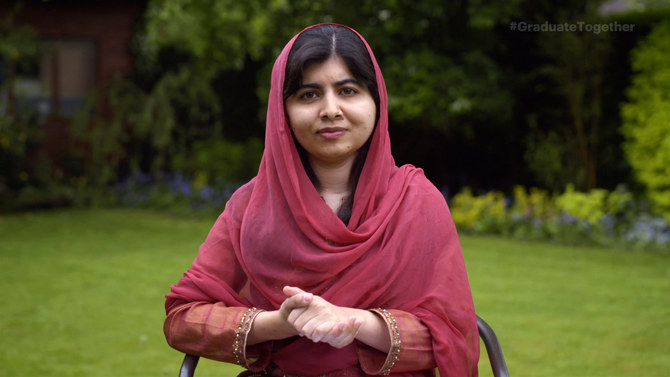
Fortunately, she survived and did not falter in her mission to promote access to education. Yousafzai has since traveled the world to give inspirational speeches, written a best-selling book and become the youngest person to win a Nobel Peace Prize at just 17.
She has continued to use her influence to enact change via the non-profit Malala Fund, that advocates for girls’ education through helping build schools in rural areas, offering programs to advance secondary education and providing school supplies for those who need them most.
The activist, 23, took the opportunity to speak at the 2021 Emirates Airline Festival of Literature over the weekend to discuss why we should prioritize the right to education and to highlight the current issues making it difficult for females around the world to attend school.
Speaking virtually, the Oxford University graduate said: “Every girl should have the right to complete 12 years of education.”
She also touched on the effects that the ongoing coronavirus disease (COVID-19) pandemic has had on schooling.
“Millions of girls are being taken out of schools, which is a serious cause of concern,” Yousafzai said.
https://www.arabnews.com/node/1805766/lifestyle
A grim year for Pakistan's persecuted religious minorities
Kamran ChaudhryHuman Rights Watch accuses government of failing to provide adequate protection or hold perpetrators to account. Rights activists in Pakistan have endorsed the findings of a leading advocacy group that reported a grim situation for religious minorities last year.Attacks by Islamist militants targeting law enforcement officials and religious minorities killed dozens of people in 2020, according to the recently released World Report 2021 of Human Rights Watch (HRW). “Women, religious minorities and transgender people continued to face violence, discrimination and persecution, with authorities often failing to provide adequate protection or hold perpetrators to account,” the report states. “The Pakistani government did not amend or repeal blasphemy law provisions that have provided a pretext for violence against religious minorities and have left them vulnerable to arbitrary arrest and prosecution. The death penalty is mandatory for blasphemy, and 40 people remained on death row as of late 2020. “Child marriage remains a serious problem in Pakistan, with 21 percent of girls marrying before age 18 and 3 percent marrying before 15. Women from religious minority communities remain particularly vulnerable to forced marriage. The government has done little to stop such forced marriages.” Saroop Ijaz, senior counsel for HRW’s Asia Division, accused Pakistan’s government of a direct violation of human rights. “We saw a continuation of the negative trends of attacks on minorities and civil society as well as shackles on freedom of expression since 2018. The challenges became acute last year. There was an increase in attacks on non-Muslims and a failure to stem them,” he said in a recent talk show. According to I.A. Rehman, spokesperson for the Human Rights Commission of Pakistan, 15,000 Pakistani journalists became jobless last year. “This is extraordinary. This government is bent upon violence. It is sadistic. For the first time in history, castration was in Pakistan’s Penal Code. This is inhuman,” he said. President Arif Alvi last month approved the Anti-Rape Ordinance 2020 that sanctions chemical castration for convicted rapists. Speaking to UCA News, Cecil Chaudhry, executive director of the National Commission of Justice and Peace, agreed that 2020 saw a rise in incidents of forced conversions and marriages, hate speech against religious and sectarian minorities, and killings in the name of religion.According to Washington-based International Christian Concern, 24 Christians are imprisoned in Pakistan on blasphemy charges and face 21 different cases at various stages. On Dec. 30, hundreds of villagers led by local clerics stormed Krishna Dwara temple in Karak district of Khyber Pakhtunkhwa province and set it on fire. The mob also attacked an under-construction house allegedly occupied by a Hindu man. According to reports, clerics made provocative speeches against the alleged expansion of the Hindu temple, leading to the attack. This year got off to a bad start when 11 Shia Hazara miners were killed in a brutal attack claimed by Islamic State gunmen in Balochistan province on Jan. 3. The miners from the persecuted Muslim minority were kidnapped near a coal mine in Mach close to Pakistan's border with Afghanistan.
https://www.ucanews.com/news/a-grim-year-for-pakistans-persecuted-religious-minorities/91029#
Has corruption increased in Pakistan?
Rustam Shah Mohmand
Govt must realise that in face of such a terrible picture chances for foreign investment would remain hopelessly low.
In its report on the state of corruption in Pakistan, Transparency International (TI) has ranked Pakistan at 124 out of 180 countries. In other words, the country has lost four more points or corruption has significantly increased in the last two years during Imran Khan’s tenure.
The country has also scored less than last year in two categories: Rule of Law Index and Varieties of Democracy due to which Pakistan’s score in CPI 2020 has reduced by one.
The report of the highly respected organisation is a damning indictment of a government that has made elimination of corruption the centrepiece of its policy. Never before in Pakistan’s history has a government so vociferously made elimination of corruption its top priority.
As soon as the report was published, the ministers rushed to rebuke the contents of the report alleging that the statistics on the basis of which the report was prepared related to the periods of previous governments — wholly ridiculous assertions that no one would accept.
Despite tall claims of rooting out the menace of corruption, why has there been an upward spike in graft in the last two years?
TI has however acknowledged that the National Accountability Bureau has, according to its claims, recovered Rs363 billion since 2018 from those found to have been involved in corruption. Additionally, the Public Accounts Committee also claims to have recovered Rs300 billion. But TI has noted that despite these successes, corruption registered a spike. What could be the reasons for this?
The reasons are not difficult to ascertain. Firstly, there has been an overdue emphasis on rhetoric with very little attention to a whole complex picture of eradication of corruption. The task would involve identifying the reasons, examining systems closely, introducing reforms where needed, institutionalising the system of accountability, removing existing deficiencies in the systems, dealing with inequalities, etc. These are fundamental issues that require to be incorporated into the governance system in order to make them transparent. The government regrettably has not been able to pay attention to the whole issue in its true perspective. Speeches — no holds barred — do not provide remedies or solutions. The evil of corruption is rooted in the psyche of many and cannot be dealt with by making statements alone.
The other reason is that the government at the top is obsessed with punishing its political rivals — mainly those in the PML-N and to an extent, in the PPP. This being the priority, all other echelons of bureaucracy feel comfortable because they are not on the government’s radar. This is the time to engage quietly in receiving graft as the government is awfully preoccupied with just a few politicians. Eradication of corruption cannot be pursued in a climate of political vendetta. An expediency-driven approach that is premised on punishing political opponents cannot help in creating the right ambience for dealing with malpractices.
Dealing with corruption would require an even-handed approach. Sparing some and targeting others would create suspicions and destroy the notion of fair accountability. Chasing those who pose a political challenge would taint the whole process, and shatter people’s confidence in the ability of the government to cleanse the system. That is what is happening in Pakistan. The report has brought to light the not so visible factors that have contributed to an increase in the extent and level of corruption in the country.
The report that places Pakistan lower than other countries in the region, like Afghanistan, should not be dismissed on bogus grounds. It should awaken the leadership to take stock of the grim reality of the ever-rising menace of corruption and motivate the government to chalk out a comprehensive short- and long-term plan to combat the evil. The government must realise that in the face of such a terrible picture the chances for foreign investment would remain hopelessly low. What to speak of foreign investment, even Pakistani investors would be tempted to seek other avenues for their capital to be invested.
https://tribune.com.pk/story/2282390/has-corruption-increased-in-pakistan
Awaiting justice: Daniel Pearl’s gruesome murder still haunts US-Pakistan ties
Waqar GillaniThe Supreme Court of Pakistan’s order to release Ahmad Omar Saeed Sheikh, the main accused in the Daniel Pearl abduction and murder case, threatens to mar the ties between Pakistan and the new US administration. On January 28, the apex court dismissed appeals filed against Sindh High Court’s earlier decision to overturn Sheikh’s murder conviction. On April 2 last year, the SHC had overturned Sheikh’s conviction in Pearl’s murder case. However, the court had upheld his conviction on the lesser charge of abetting the kidnapping, for which he was sentenced to seven years in prison. The Sindh government and Pearl’s parents, Ruth and Judea Pearl, had then filed an appeal in the SC against the acquittal. Pearl’s wife, parents and the US government have strongly reacted to the judgment. US authorities have expressed deep concern and outrage, demanding that Pakistan ensure justice in the case and sought Sheikh’s custody for a fresh trial in the US if one is not possible in Pakistan. A day after the SC verdict, US Secretary of State Antony J Blinken telephoned Foreign Minister Shah Mahmood Qureshi. “Secretary Blinken and Foreign Minister Qureshi discussed how to ensure accountability for the prime accused, Ahmed Omar Saeed Sheikh, and others responsible for the kidnapping and murder of American journalist Daniel Pearl,” a State Department statement later stated. The secretary reiterated US concern about the Supreme Court ruling and potential release of these prisoners. Following Sheikh’s acquittal order, a separate bench of the SC hearing the matter of his continuous detention, ordered authorities to free him from the jail and keep him at a rest house giving a residential environment and allowing his family to stay with him till the disposal of the case pertaining to his post-acquittal detention by the state. “This is not dark ages; we cannot allow such malafide detentions without proper evidence.” Pearl had been working on a story on militancy in January 2002 when, according to the prosecution, Sheikh trapped and abducted him. A video circulated later showed his gruesome beheading. His remains were later found on the outskirts of Karachi in May 2002. An anti-terrorism court, deciding the case within three months, awarded death sentence to Sheikh and life imprisonment to three others. Appeals against the judgment were moved before Sindh High Court. After a period of 17 years, the Sindh High Court, in April 2020, decided the appeal. It acquitted three of the convicts and approved the sentence of Omar Sheikh only in the matter of abduction (a sentence of up to eight years that he had already completed). The SHC exonerated all of them of murder charges for lack of proof. The Sindh government then appealed against the SHC judgment and asked for an enhancement in the punishment of Sheikh and against acquittal of the other three. Sheikh sought a clean acquittal as there was no proof against him. He argued that the evidence presented against them before the trial court was “flawed, fabricated, and contradictory.” The SC, after an unusually long hearing, not only maintained the acquittal of three accused but also exonerated Omar Sheikh of abduction charges. Two judges of the three-member SC bench, acquitted Sheikh of abduction charges “by extending the benefit of doubt to him.” The SC ordered that he and the other three - Fahad Nasim Ahmed, Syed Salman Saqib and Shaikh Muhammad Adil – be released from the jail ‘forthwith.” The third judge of the bench also acquitted Sheikh of the murder charge but enhanced his sentence for abduction to life imprisonment (practically a period of 12 years that he has also completed in jail). The Sindh government has now filed a review petition against the SC judgment. On April 2, 2020, the Sindh High Court overturned Sheikh’s conviction in the Pearl murder case. However, the court upheld his conviction on the lesser charge of abetting the kidnapping, for which he was sentenced to seven years in prison. The Sindh government and Pearl’s parents then filed an appeal in the SC. The judgment points out that the evidence relied on for the conviction and sentencing was circumstantial, flawed and contradictory. Some of the key persons involved in this case including Fazle Karim, Atta-ur-Rehman alias Naeem Bukhari (a leader of the sectarian outfit Lashkar-i-Jhangvi who later joined the ranks of the Taliban) and Saud Memon, were never made part of the case. Some legal experts say that this would have called for fresh investigations amid a strong pressure from the US to ensure justice. Fazle Karim, according to some media reports, was identifiable in the video of Pearl’s killing. The murder weapon was recovered from a compound “owned by Memon”. In 2019, in a letter written from jail to the SHC, Sheikh had urged the court to investigate Naeem Bukhari, who, according to him, was the key person in abduction and killing of Pearl. Sheikh had claimed that he was made a “scapegoat” and had only a minor role in the plot. Bukhari was in state custody at that time. According to Sheikh’s counsel, the letter was never officially acknowledged and never delivered to the SHC. Another flaw in the process was that the accused was taken into custody on February 4, 2002, but his formal arrest was shown a week later. Sheikh, a British-born dual national, has had a checkered past. While studying in London School of Economics in 1992, he quit in the middle of his degree and went to Bosnia to help Muslims. He never went back and allegedly developed links with the militant group Harkatul Mujahideen (HuM). He went to India in 1994 where he was arrested for his alleged involvement in the abduction of a group of foreign tourists. Six years later, he was released in exchange for the passengers of a hijacked Indian airliner. His family acknowledges his sympathy for his coreligionists in Bosnia. However, they have denied his links to militant groups, and insist that they would go to any lengths to prove him innocent and secure his release. Such acquittals in terrorism cases are not unprecedented. In the past, courts have acquitted many people accused of suicide attacks and bomb blasts on account of poor prosecution and lack of evidence. This case is different in that the victim in this case is an American citizen. Pearl’s abduction has been described as one of the earliest violent responses of the Al Qaeda-linked Pakistani militant groups to the American invasion of Afghanistan. Sheikh’s release may cause serious and deep concerns for Washington and severe challenges for Islamabad as the authorities are running out of options to keep Sheikh behind bars. “It is a very difficult case for the state/government to prove. The accused get relief over lack of evidence, faulty investigation and poor prosecution all the time. The courts are independent and if they acquit Sheikh, we will have no other but choice to accept their final order,” a senior federal government official told The News on Sunday. In legal terms, he says, the prosecution case was a very weak one. Pakistan may detain Sheikh on other charges but not for a long time. The scope of the review petition is very narrow. Pakistan may also bring some reforms in its criminal justice system in future to ensure that people involved in heinous crime do not escape justice but those would not have retrospective effect. The real question for the government now appears to be: how to satisfy the US government in this case if Islamabad loses the review in the top court. A key Al Qaeda member, Khalid Sheikh Muhammad, who was handed over to the United States, earlier, also confessed to his role in killing Pearl. Even after the passage of two decades, the case continues to resonate in the US-Pakistan diplomatic relations.
https://www.thenews.com.pk/tns/detail/785516-awaiting-justice
Pakistan: Why is the military taking over civilian posts? Is Khan returning the favor?


Experts say that under Prime Minister Imran Khan's government, the Pakistani military is increasingly encroaching on the civilian sphere, with many generals now heading administrative and executive institutions.
Corruption and incompetence: reality and perception Prime Minister Khan justifies the military appointments, saying they are being done on merit. There is a widespread perception in the country that politicians and civilian bureaucracy are incompetent and corrupt, whereas the military is efficient and well-organized. Many politicians and civilian bureaucrats are currently facing corruption charges, which are being probed by the country's National Accountability Bureau. "Army officers manage state-run institutions in an efficient way. The Water and Power Development Authority is headed by a military official and has accomplished many important tasks, including construction of dams and several energy projects," Amjad Shoaib, a retired military general and defense analyst, told DW. Shoaib rejected the criticism of military appointments as an "anti-army propaganda." "Nawaz Sharif's party is behind this nefarious propaganda, which is aimed at defaming the army. It is a dangerous trend to blame the military for the country's problems. It must stop," he added.Politicians, on the other hand, say the incompetence perception is part of the military propaganda. They also say that the military considers itself above the law and is not answerable to anyone."When we summon civilian bureaucrats, they show up and pay heed to our recommendations. When we call upon the military officials, who are heading civilian departments, they don't care to respond," Usman Kakar, an opposition lawmaker, told DW.Kakar also says that military-run institutions see more malpractices than the civilian ones. "The department responsible for dealing with the coronavirus pandemic told us that it spent rupees 2.5 million (€13,000, $16,000) on a single COVID patient. When we called the military officials working in that department to come to our parliamentary committee and explain why such a huge amount was spent, they didn't care to respond," Kakar alleged.
https://www.dw.com/en/pakistan-why-is-the-military-taking-over-civilian-posts/a-56473442
Sunday, February 7, 2021
Saturday, February 6, 2021
US, Amnesty call for release of Ismail, father of activist Gulalai who fled Pakistan in 2019

By UNNATI SHARMA
Gulalai Ismail, who is in exile in US, alleges evidence is being fabricated against her father Mohammed, a retired Urdu professor facing terror financing charges in Pakistan.
The US government and international agencies have called for the release of Mohammad Ismail, the father of a prominent Pakistani human rights activist who is in exile, after he was remanded to police custody in a sedition and terror financing case in Pakistan.
On Thursday, the US State Department and the human rights NGO Amnesty International sought the release of professor Ismail after his daughter Gulalai Ismail, who fled to the US from Pakistan in 2019, expressed fears over his life and highlighted the targeted harassment of her family.
In a tweet, the activist alleged her village home in Swabi Marghuz was raided and fabricated papers/receipts were implanted in the files of her home.
While the State Department said it is monitoring allegations of harassment against the Ismail family, and urged Pakistan to uphold due process and the rule of law, Amnesty called for all charges against Ismail to be dropped unconditionally.The move came a day after an anti-terrorism court in Peshawar rejected the bail plea of Ismail and sent him to custody for three more days. He had been arrested by the Counter-Terrorism Department (CTD) on 2 February. Who are professor Ismail and his daughter Gulalai? Mohammad Ismail (66) is a retired professor of Urdu, who is also a social activist and a member of Pakistan NGOs Forum. Ismail’s daughter Gulalai (35) is a noted social activist who has been a vocal advocate for human rights since she was 16. As a teenager, she founded an NGO called Aware Girls to educate young girls about their rights in the province of Khyber Pakhtunkhwa in north-west Pakistan.
She became a state target after she prepared a report on women who had allegedly been victims of sexual abuse during a Pakistan Army crackdown near the border with Afghanistan.
She had six cases registered against her in Pakistan’s courts for “anti-state activities”, and was banned from leaving the country. However, she fled to the US in 2019 after months of hiding.
Following Gulalai’s escape, her parents have been on a state list for alleged terror financing activities.
In July 2019, her parents, professor Ismail and mother Uzlifat Ismail, were booked in a case under the anti-terrorism laws of Pakistan, accused of taking money from India for distribution among terrorist organisations in Pakistan. However, a year later, the case was dismissed by a Peshawar anti-terrorism court judge over lack of evidence.
But weeks later, additional charges were filed against Gulalai’s parents for facilitating an attack on a Peshawar church in 2013 and a 2015 attack on a Shia mosque in Peshawar, which they denied.
On 24 October 2019, the professor was also abducted by a group of unidentified men as he was leaving the Peshawar High Court after a hearing. The men were later identified as members of the Federal Investigation Agency’s Cyber Crime Wing in Peshawar.
What human rights organisations say
The Human Rights Commission of Pakistan, an independent monitoring group, in a statement said the case against professor Ismail and the “interminable cycle of ludicrous charges, arrests and court dates are nothing more than heavy-handed tactics targeting his daughter — a respected rights activist”.
London-based international NGO Peace Direct also urged the Pakistani authorities to protect Gulalai’s family members still in Pakistan from any forms of harassment and intimidation.
Ismail had tested positive for Covid-19, which his family says has weakened his health significantly, exacerbating the risk to his well being if he is sent to jail.
Friday, February 5, 2021
Chairman Bilawal Bhutto Zardari strongly condemns the blasts on Kashmir Solidarity Day rally in Quetta
Chairman Pakistan Peoples Party Bilawal Bhutto Zardari has strongly condemned blasts in Kashmir Solidarity Day rallies in Quetta and Sibbi and termed the tormentors as stooges of Butcher of Gujarat Narendra Modi.
In a statement, the PPP Chairman demanded that the authorities take every action to find the terrorists involved in blood-shed of innocent people and bring them to justice.Bilawal Bhutto Zardari expressed sympathies with the families of victims who were martyred and injured in the terror blasts in two cities. “I understand the pain of losing dear ones in terrorist attacks,” he said and prayed for early recovery of the wounded.
https://www.ppp.org.pk/pr/24354/
Thursday, February 4, 2021
Subscribe to:
Posts (Atom)