Saturday, October 31, 2020

Pakistan still obsessing over Abhinandan. How about an update on Israeli pilot Army ‘caught’


In Pakistan, PML-N leader's remarks on minister Shah Mehmood Qureshi are a more serious threat to national security than minister Fawad Chaudhry claiming a terror attack.

The year of the rat continues to be obsessed with the year that was, 2019. That was when the enemy pilot Abhinandan came, had chai and left. He left, but like any jilted ex, the conversations continue about why he left us. He didn’t say, “It’s me, not you”. But for Pakistanis, it still remains an unfinished agenda even in 2020, the year that is actually all about being Modi’s yaar and Pakistan’s ghaddar.

This is Pakistan in a nutshell.

On Wednesday, Pakistan Muslim League-Nawaz (PML-N) leader Ayaz Sadiq shared on the floor of the National Assembly how the Pakistan Tehreek-e-Insaf (PTI) government was panicking to release Abhinandan Varthaman because it feared an attack from the Indian military. The conversation referred to a parliamentary briefing held after the capture of the Indian pilot in February 2019, an exchange that Prime Minister Imran Khan was not a part of even as Army chief General Qamar Javed Bajwa was present. Sadiq explained that Foreign Minister Shah Mehmood Qureshi was jittery with a sweaty forehead when he told those present at the briefing, “Khuda ka wasta hai ab isko jane dein (for god’s sake let him go),” referring to Abhinandan. According to Sadiq, India was going to attack Pakistan at 9pm.

Hum bhi hain josh mein

It was as if Qureshi would turn into a pumpkin if Abhinandan wasn’t released before 9pm. Tea was still fantastic, 9pm or 9am. There is still no news on the fictitious Israeli pilot that Pakistan caught. Probably he is still having tea somewhere here.

Shocking revelation? Not really. The mention of an Indian attack was already made by PM Imran Khan during his address to the Assembly on February 28. He had said that there were fears India might launch a missile attack on Pakistan, but the situation was later defused.

What came as a real shocker was Science and Technology Minister Fawad Chaudhry’s response to Ayaz Sadiq. In josh-e-khitabat, the minister went on to claim Pulwama terror attack, which killed 40 Indian soldiers, as a huge victory of Pakistan under the leadership of Imran Khan. “Humne Hindustan ko ghus ke maara hai (we hit India in their home). Our success in Pulwama was the success of the nation,” Chaudhry said, berating the PML-N leader.

Chaudhry just fell short of breath, otherwise the flow in which he was, he might as well have taken credit for crashing planes into the World Trade Centre on 9/11. It was only after he had made all the confessions that he thought he should modify his boast a bit, which is what he did: “Pulwama ke baad humne ghus ke maara” — the modification being ‘after Pulwama’.

Priorities you & I won’t understand

The minister’s ramblings were astounding and could have serious repercussions for Pakistan. But what woke the military spokesman up from deep slumber was Ayaz Sadiq and not Fawad Chaudhry. Even repeated allegations of political engineering against Qamar Bajwa by former prime minister Nawaz Sharif didn’t sprung DG-ISPR into action. But here he was. Now a pro at rejecting stuff from political leaders, Babar Iftikhar held a presser to reject the statement that Abhinandan was released owing to perceived threat of an Indian attack.

Only in Pakistan are the remarks on an opposition leader a more serious threat to national security than a sitting minister’s 60 seconds of claiming and celebrating a terrorist attack. This is the reason why PTI ministers are taken as seriously as they are around the world. And the same set of ministers now want a criminal charge against Ayaz Sadiq. Him revealing that Qureshi’s legs were shaking and he was sweating is tantamount to outing State secrets?

A campaign to brand Sadiq a ‘traitor’ is now on, with posters coming up on the streets of Lahore. Sadiq is shown wearing an Abhinandan-like moustache with both Modi and the Indian pilot in the background. ‘Mir Jaffar, Mir Sadiq…Ayaz Sadiq’ is the tagline.

The excuse for the extreme reaction is to point towards “how Indian media is having a field day with Ayaz Sadiq’s statement”. But the same people choose to look the other way when Indian media is amplifying Fawad Chaudhry’s remarks and bringing more attention. If coverage in Indian media is the parameter of bringing bad name to the country, then where does PM Imran Khan stand over his several interviews and conclaves that he attended in India, where he said the most controversial things? Where does he stand over the Indian media’s rather extensive coverage of PTI’s dharnas when he was in the opposition?

Imran Khan’s simple rule

The entire episode reflects the simmering tension between the PTI and the opposition parties ever since the anti-government protests began. It is clear that when confronted with the ghaddari (traitor) allegations, the leaders of PML-N and even other parties reply in the same coin. If the previous PML-N government will be blamed for Kulbhushan Jadhav’s case in the International Court of Justice (ICJ), its leaders will hit back with PTI going out of the way and making concessions for Jadhav now.

The world may have moved onto dealing with more pressing concerns brought about by the Covid-19 pandemic, or bothering about who will be the next president of the United States. But what matters the most to the government of Imran Khan is the continuous labelling of his political opponents as pawns of India. In Khan dreamland, whether he’s in opposition or in power, his opponents remain traitors. He vehemently believed that whenever Nawaz Sharif was in trouble, tension along Pakistan’s borders and terror attacks increased. Now as prime minister, he still gives out certificates of working with ‘Israeli and Indian lobby’ to the opposition. For Imran Khan, it works like: heads I win, tails you lose.

https://theprint.in/opinion/letter-from-pakistan/pakistan-still-obsessing-over-abhinandan-how-about-an-update-on-israeli-pilot-army-caught/534554/


In light of Pakistan's criticism of France, leader Marine Le Pen calls for ban on Pakistan immigration

Namrata Agarwal
French leader Marine Le Pen urged to impose a ban on Pakistani immigration amidst critical comments by Pakistan leaders on France. Calling it as a threat to the country, the leader of the National Rally Party called for a ban on Pakistani immigration .


 Taking to Twitter she wrote (in French which roughly translates to): "In view of the new ultra-violent demonstrations today in #Bangladesh (demonstrators who called to behead our ambassador), and #Pakistan , I call for an immediate moratorium on immigration from these countries, in the name of national security. MLP." Recently, France witnessed gruesome murders after President Emmanuel Macron defended the right to caricature the Prophet Mohammed.

 It has witnessed two knife attacks, one in Nice in which three people were killed at a church, and another in Avignon, in which the attacker was killed by the police. While, a guard at the French consulate at the Saudi city of Jeddah was attacked.
https://zeenews.india.com/india/in-light-of-pakistans-criticism-of-france-leader-marine-le-pen-calls-for-ban-on-pakistan-immigration-2321336.html

Turkey and Pakistan's campaign to boycott French products backfire as Saudi Arabia steps in

Manish Shukla
French President Emmanuel Macron's stand against Islamist terrorism has led to a new geopolitical tussle among countries like Turkey, Pakistan and Saudi Arabia.
The temperament displayed by French President Emmanuel Macron to fight the radical Islamist terrorism after the brutal murder of teacher Samuel Paty and the outrage by the French citizens over the incident has led to a new geopolitical tussle.
In response, Turkish President Recep Tayyip Erdogan attacked Macron and said, “The person in charge of France has lost his way. He goes on about Erdogan all day. Look at yourself first and where you are going…he is a case and he really must be checked up.”
Turkey also launched an aggressive campaign to boycott French goods from its markets.
In a show of support to Turkey's campaign, Pakistani Prime Minister Imran Khan tweeted that Macron chose “to encourage Islamophobia by attacking Islam rather than the terrorists” adding that Macron chose “to deliberately provoke Muslims, including own citizens.” Recently, boycott France products was a top trend in Pakistan. It joined Turkey in attacking France and Pakistanis have been aggressively trending several hashtags over social media platforms, urging people to boycott French products, abusing the French President, and threatening French citizens.
Besides Pakistani citizens staying all over the world launched a global campaign to boycott French products. Many prominent Pakistani Twitter handles, with a blue- tick, spat venom on the French President and urged Muslims worldwide to boycott products of the country.Editor of a prominent Pakistani daily ‘The News’, Ansar Abbasi urged the Islamic fraternity of the world to protest against France against the ‘shameful’ attack on Muslims by using the hashtag #MacronGoneMad.Responding to the boycott campaign, Macron tweeted, “We will not give in, ever. We respect all differences in a spirit of peace. We do not accept hate speech and defend reasonable debate. We will always be on the side of human dignity and universal values.”
It is believed that by launching the strongest attack on the French government, Erdogan would be able to project himself as the ‘Messiah’ of Muslim Ummah and leader of the ‘Caliphate’. Observers see this as Erdogan’s efforts to encash the opportunity to challenge Saudi Arabia's leadership of Islamic world.
Unlike Turkey and Pakistan, the supreme body of Muslim countries, the Organisation for Islamic Cooperation (OIC) condemned the act of gruesome killing of the French teacher, besides expressing its concerns on ‘ongoing practice of running satirical caricatures depicting the Prophet Muhammad'.Taking a divergent route from the balanced approach of the OIC, Turkey-led Islamic block unilaterally attacked the French government and sympathised with the attacker.Turkey and Pakistan's aggression was not taken in good taste by Saudi Arabia, which has been a constant target of Turkish President Erdogan in his efforts to displace Saudi as the leader of Islamic world.Citizens of Saudi Arabia have, in fact, launched a massive campaign to boycott Turkish goods. Saudi shops and supermarkets have boycotted Turkish goods and replaced Turkish items with the Greek ones. Expressing solidarity with Greece on Turkish aggression as well as denoting the availability of Greek products in their stores, Saudi traders hung Greek flags outside their establishments.
The Saudi citizens have taken up a comprehensive campaign against Turkey on the basis of three principles – No investment, no imports and no tourism. It is striking to note that the campaign has not been launched by the Saudi Government, rather it is driven by the common public sentiments of the Saudi citizens.
Besides boycotting local products made in Turkey, Saudi citizens are also boycotting the products of international brands produced in Turkey. Such a boycott might turn Turkey into a hostile investment destination and thereby compelling companies to pull out their investments from the country.
Saudi Arabia has been one of the biggest markets for import of Turkish products. Besides, Turkey also uses the country as a transit point to trade its goods elsewhere in the region. Hence, the boycott by Saudi citizens, if continued for long, might prove costly for Turkey.
Current developments suggest that efforts of Turkey and Pakistan might have begun to backfire. The strong resolve of the French President and the retaliation by Saudi citizens might impact the economies of both the countries, which are already not in a very good state. Besides economic and diplomatic losses for Turkey, the tussle on boycott campaign is also going to inflict huge strategic and diplomatic losses for Pakistan.
Pakistan's desperate jump at Erdogan’s anti-French rhetoric and unwarranted threats from the Pakistani leadership and elites might have added to the displeasure of Saudi Arabia, which has been disgruntled on Pakistan's support of unilaterally projecting Erdogan as the tallest leader of the Ummah. Besides, Pakistan might have found a new antagonist in another world superpower — France!
Nevertheless, the tussle between pro-France and pro-Turkey countries is certainly going to be intensified in the next few days, throwing reflections on the emerging geopolitical dynamics of the world.
https://zeenews.india.com/world/turkey-and-pakistans-campaign-to-boycott-french-products-backfires-as-saudi-arabia-steps-in-2321103.html

Friday, October 30, 2020

Persian Music Video - Ahmad Zahir - "Khuda Bowad Yaret"

Video Report - #NayaDaur Arzoo Raja Case, And State Of Pakistani Minorities

Video - #Pakistan - #ArzooRaja| Women's charter demands| How To End The Culture of Intolerance

Chairman PPP congratulates the successful candidates of the Supreme Court Bar Association (SCBA) elections


Chairman Pakistan Peoples Party (PPP) Bilawal Bhutto Zardari has congratulated the successful candidates according to the unofficial results of the Supreme Court Bar Association (SCBA) elections.

Abdul Latif Afridi of Independent Group of lawyers, also known as the late Asma Jahangir group, and Ahmad Shahzad Farooq were respectively elected as President SCBA and General Secretary along with other office-bearers. Peoples Lawyers Forum had supported the Independent Group.

Bilawal Bhutto Zardari hoped that the new SCBA body will struggle for supremacy of the Constitution and law to strengthen democracy and Parliament. He further said that the lawyer fraternity has always been with the democratic forces of the country, and this alliance shall always be in place.


https://www.ppp.org.pk/pr/24001/

Christian girl, 13, is kidnapped by 44-year-old man in Pakistan and forced to convert to Islam and marry him

Arzoo Raja was abducted from her home in Karachi on October 13, activists say.Two days later her 44-year-old 'husband' produced a marriage certificate .Protests have broken out after a Pakistani court upheld the marriage's validity.
A 13-year-old Christian girl was kidnapped in Pakistan and forced to marry a 44-year-old man who made her convert to Islam, campaigners say.
Arzoo Raja was abducted from her home in Karachi on October 13, and two days later her 'husband' produced a marriage certificate saying she was 18 and had converted to Islam.
The case has led to protests in Karachi and Lahore but a Pakistani court has upheld the marriage after her husband claimed she had converted of her own free will.
Arzoo tried to run to her mother during the court hearing but her husband held her in a tight grip to stop her from leaving, it is alleged.
Arzoo's father Raja said that his daughter had been abducted from the family home in Karachi's Railway Colony after her parents went to work.
When police contacted the family two days later they said that the 'husband' had already obtained a marriage certificate, according to a Christian group called the Centre for Legal Aid, Assistance and Settlement (CLAAS).
'Very often young girls are threatened into giving statements to the court saying they have married and converted to Islam of their own free will,' said CLAAS UK director Nasir Saeed.
'It is a very sensitive matter for Pakistani Christians but sadly it is all falling on the deaf ears of the politicians and the authorities.
'It is sad as the Pakistani police and courts have failed to respect their own laws, as well international standards, which are continuing to be ignored especially in forced conversion and forced marriage cases even in the higher courts.'
Arzoo allegedly had her name changed to Arzoo Fatima and a judge claimed that she had converted to Islam of her own free will.
At a court hearing, the husband allegedly 'held on tightly to her arm' to stop her reaching her mother, who was not allowed to meet her daughter.
The certificate said she was 18, but the family has a birth certificate showing she is 13, according to a Catholic organisation called Aid to the Church in Need.
The charity says that Arzoo's parents have lost their jobs and been threatened by kidnappers since their daughter disappeared.
According to figures from the campaign group Girls Not Brides, around 21 per cent of girls in Pakistan are married before the age of 18. The group says that traditionalist customs and religious views mean some families believe they should 'marry off their daughters once they reach puberty'.
Low levels of education are also described as 'both a cause and a consequence' of child marriage,' it says.
In 2017, Pakistan's government tried to crack down on child marriage by imposing prison sentences up to 10 years for offenders.
https://www.dailymail.co.uk/news/article-8896671/Christian-girl-13-kidnapped-44-year-old-man-Pakistan.html

Thursday, October 29, 2020

Music Video - INNA - Yalla

How Mohammed bin Salman is quietly enabling an Israeli axis in the Arab world

Madawi al-Rasheed
Using Saudi influence and the promise of financial rewards, MBS can continue to bring more Arab countries into the normalisation fold.

The claims made by Israeli-American billionaire Haim Saban that Saudi Crown Prince Mohammed bin Salman's reluctance to rush into normalisation with Israel was due to his fear that Iran, Qatar or "his own people" would kill him, must be taken with a pinch of salt.

In truth, MBS fears murder in the palace more than murder by the people, or for that matter by Iran or Qatar. His nightmare scenario is to rule as a king who has shattered royal consensus and humiliated a bunch of royal rivals.  

MBS is not Egypt's Anwar Sadat, assassinated in 1981 after signing the first historic peace treaty with Israel

The Saudi crown prince will not rush into going public over his relations with Israel if he can keep them under the table. Why should he sign a controversial agreement with Israel when the costs could be far higher than maintaining a secret alliance?

The fear of being killed by Iran, Qatar or his own people is unfounded, as none of those three are constituencies contemplating or capable of carrying out an assassination.  

MBS is not Egypt's Anwar Sadat, assassinated in 1981 after he'd signed the first historic peace treaty with Israel, the Camp David Agreement, in 1979, shocking many Arabs, including Saudis. The late Saudi King Fahd, who staged a momentary boycott of Egypt to please an angry Saudi constituency and the wider Arab world, soon reversed his policy and worked hard to bring Egypt back into the Arab fold. 

Today the situation is different. The Saudi regime in general - and MBS in particular - can be more useful to the cause of normalisation with Israel without having a relationship in the open that would see the Israeli flag raised in Riyadh. MBS can work as a conduit, a facilitator, a behind-the-scenes agent, who would use Saudi influence and the promise of financial rewards to bring more Arab countries into the fold of an Israeli axis in the region.

The Saudi umbrella 

So far, the UAE, Bahrain and Sudan are well placed to pursue normalisation under a Saudi umbrella, without MBS making a move which might be seen as an explicit endorsement of US President Donald Trump and his campaign for re-election, with polls currently showing Democratic candidate Joe Biden as favourite for the White House.

 Further, MBS will hesitate to join the new axis if he and his father, King Salman, can continue to make noises about respecting defunct Arab peace initiatives, such as the one announced by King Fahd in the 1980s. 

Moreover, while awaiting the right moment to go public about normalisation, the crown prince can bring more Arab countries into the normalisation fold, thus winning more favour in Washington while appearing to support Palestinian rights.

At the same time, MBS can continue to deploy his media resources to erode Arab public support for the Palestinians, until the critical point is reached when Saudi normalisation becomes a fait accompli that would not cost him his life or undermine the legitimacy of the Saudi regime. 

  Palestinians burn pictures depicting US President, Abu Dhabi Crown Prince and Saudi Arabia's Crown Prince during a protest against the UAE deal with Israel in Ramallah on 15 August (Reuters)
Palestinians burn pictures of the US president, Abu Dhabi's crown prince and MBS during a protest against the UAE deal with Israel in Ramallah on 15 August 2020 (Reuters)

Trump and Israel will have to wait to see whether MBS’s campaign to erode Palestinian rights bears fruit. Trump may be out of office soon, but MBS looks like he will outlast him. If MBS does have legitimate fears for his life, then the danger is truly not from the three constituencies that he announced to Haim Saban.

Palace coup

The true threat to MBS comes from within his own family, rather than from his "own people" (by which he must mean the Saudi people, who have never assassinated a Saudi royal). Historically, any assassinations in the kingdom have been carried out by members of the House of Saud. 

MBS can continue deploying his media resources to erode Arab public support for the Palestinians

Since the 19th century, slain Saudi princes and kings have been killed by a brother, uncle or nephew. The last murder in the palace, in 1975, was that of King Faisal, shot dead by his young nephew, also called Faisal. Neither the Palestinian cause nor any other cause were behind such murders.

They were simply family homicides, motivated by revenge, treachery and power struggles within the royal household. It is this that MBS truly fears, rather than what Saban claimed the crown prince had told him. 

And MBS has many reasons to fear an assassination from his own relatives rather than being murdered over his abandoning of the Palestinian cause or the normalising of relations with Israel. Since MBS came to power in 2017, he has pursued a policy of detention of potential rival princes.

So far he has not executed his royal critics (although the execution of peaceful protesters is on the rise), but perhaps it won’t be long before MBS considers eliminating his rivals altogether. He has shattered royal consensus and pursued policies that undermine the regime as a whole rather than simply his own chances of becoming king.

A prince who believes that MBS is a danger for the whole family is yet to emerge. When and if that happens, then the stakes would rise considerably. 

Media brainwashing

Of course, many in Saudi Arabia continue to oppose normalisation with Israel. But those are gradually being indoctrinated into accepting such normalisation with the help of the Saudi media. Frankly, most Saudis have more urgent matters to worry about.

MBS has many reasons to fear an assassination from his own relatives rather than being murdered over his abandoning of the Palestinian cause

From their declining living standards to fears of power struggles within the royal household, Saudis are beginning to feel the insecurity of their own lives under a regime that has plundered their wealth and repressed them, depriving them of a decent life in one of the richest countries in the world.

MBS has yet to reconcile with his own family and secure the throne amid the current widespread insecurity in the kingdom.

MBS’s "own people" are neither assassins nor treacherous. They simply need a decent life and a say over how their country is run.

The crown prince will never listen to their needs, but his own relatives may become impatient when he finally becomes king. 

https://www.middleeasteye.net/opinion/saudi-arabia-mohammed-bin-salman-quietly-enabling-israel-axis-arab-world

France brought Jihad on itself, now has some tough decisions to make – former anti-terrorism


A spate of stabbing attacks are the result of France’s failed experiment with multiculturalism, former UK counterterrorism chief Chris Philipps told RT. When the liberal West and Islamic East clash, he said, violence follows.

“I do believe that France and the West brought a lot of this on themselves,” Philipps told RT on Thursday. “They’ve invited people to come to their country and allowed people to come to their country who’ve no thought process of eventually assimilating.”

“French culture, you either accept it or you don’t, and these people clearly haven’t,” he continued.

Earlier, a knife-wielding attacker killed three people in a church in Nice, police in Avignon shot another knifeman dead, and another alleged terrorist attack was foiled near a church in Sartrouville, near Paris. Additionally, police in Saudi Arabia arrested a man for stabbing a guard outside the French consulate in Jeddah.

French President Emmanuel Macron called the Nice attacker an “Islamist terrorist,” and deployed troops to guard churches and schools. Just days earlier, Macron had vowed to clamp down on “the evil that is radical Islam,” after a teenage Muslim beheaded a teacher for showing his class a caricature of the Prophet Mohammed.

Macron’s army deployment may reassure the public in the short term, but Philipps said that it’s “pretty much impossible” to screen out potential future attackers, and harder again to deport or detain them, as in his experience in the UK, many suspects were British citizens.

“We’ve got 20 or 30 thousand people of concern in the UK. France probably has far more than that,” he explained. "If you go to Nice there’s a massive North African contingent there.” 

French media outlets have reported that the Nice attacker – who was shot and arrested by police – was a 21-year-old Tunisian migrant. Four years earlier, a Tunisian was behind the wheel of a 19-ton truck that plowed through crowds of people on the city’s iconic waterfront, killing 84 and injuring more than 400. France’s population is nearly nine percent Muslim, the highest percentage in any Western country. Of these 5.7 million Muslims, the percentage who harbor extreme views is unknown, but in 2016, three quarters of all suspected radicals on a government watch list were radical Islamists.

Philipps said that in his experience, he was surprised how many moderate Muslims see cartoons of the Prophet Mohammed as “extremely offensive” and understand “the idea of taking revenge.”

The core of the problem, he said, is the incompatibility of Islam with the liberal West. “When the cultures clash so much, and it leads to this kind of violence,” he said, governments need to “make some decisions” regarding the future of multiculturalism and open society.

While Philipps spoke in apocalyptic terms about the future of multicultural France, Muslim author and lawyer Asif Arif is more optimistic. The fight against terrorism, he told RT France, is “a long and hard war,” that “will not be fought with common arms.” 

Rather than deploy troops and close Islamic organizations, as Macron has done in recent days, Arif said that the French government should increase funding to counterterroism investigators and deploy intelligence agents to mosques and Muslim organizations to gather information and identify potential threats.

“We need these Muslim organizations to fight terrorism,” Arif concluded. “Stigmatization will never help.”

https://www.rt.com/news/504921-france-attacks-failed-integration/

China sets ‘pragmatic’ targets through 2035

By Wang Cong, Cao Siqi and Chen Qingqing 

 Nation aims for ‘big leaps’ in economy, technology.

With decisive progress in the past five years and a strategic victory against the COVID-19, top leadership of the Communist Part of China (CPC) on Thursday unveiled a steady and bright picture for the country's future, as it sets sweeping social and economic development goals for the next five to 15 years that aim to build the world's most populous nation into a modern socialist power in the economic, technological and other fields by 2035. 

In a wide-ranging communiqué released after the fifth plenary session of the 19th Central Committee of the CPC ended in Beijing, top officials conclude that China remains in a major strategic development period, citing "decisive achievements" in the past five years and "major strategic results" of the COVID-19 epidemic, and offered sweeping solutions in a wide range of areas, from economy, to security, and to governance.

While the communiqué projected confidence in China's development paths and prospects, certain targets, particularly in economic areas, reflected a cautious and pragmatic sentiment among top officials, given mounting domestic and external pressure on growth, while other goals such as greenhouse gas reductions underscored the country's determination to pursue high-quality growth and tackle global issues, experts said.

 
00:00:00 / 01:55

 
Sweeping targets
   

"Having deeply analyzed the profound and complex changes our country faces in its development, the plenary session believes that China's development remains in an important strategic period," the communiqué said, calling for strategic patience in overcoming challenges and striving for progress.

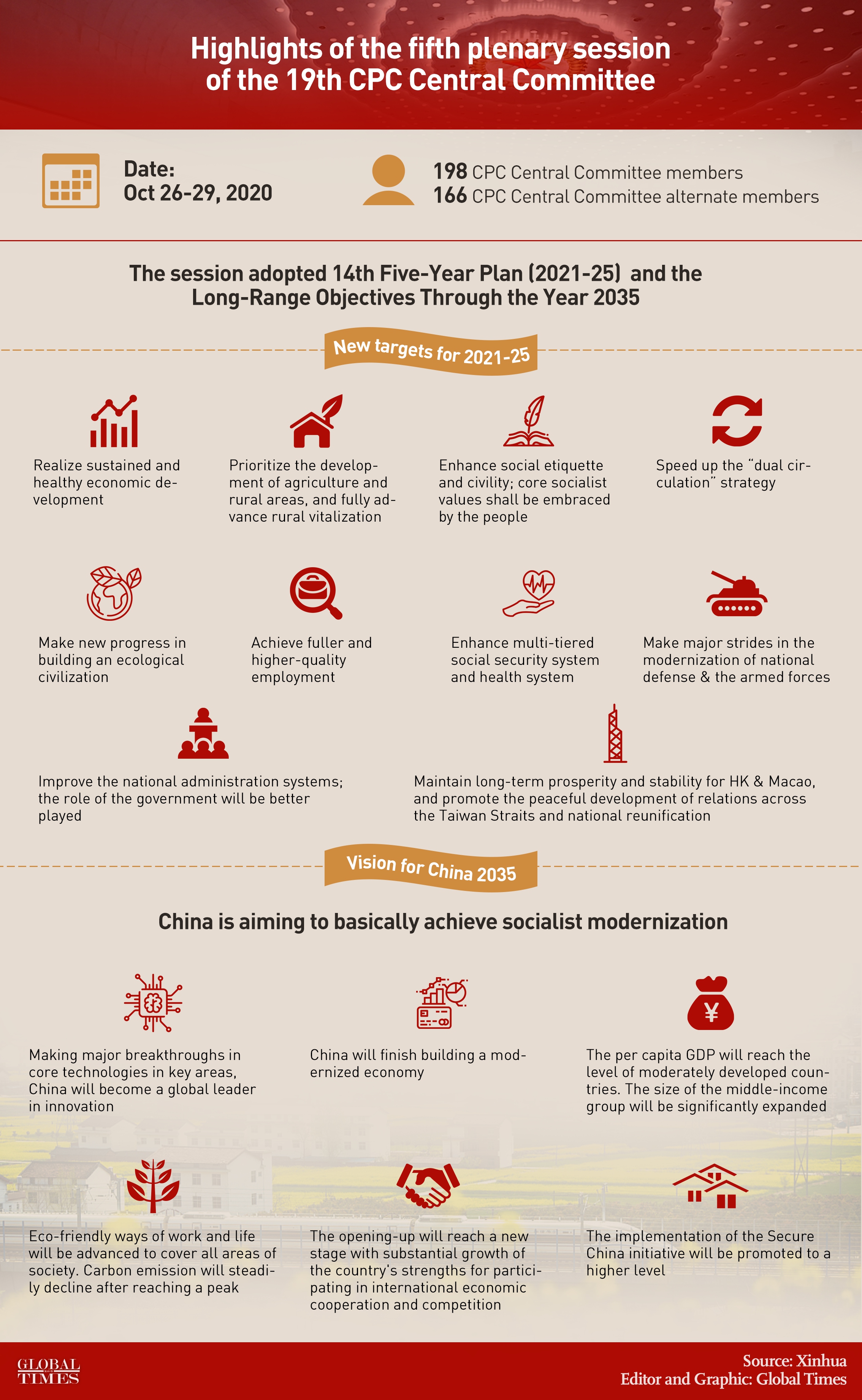
Among the key takeaways from the communiqué are sweeping targets sets for the 14th Five-Year Plan (2021-25) and long-range goals through the year 2035. Coming at a critical inflection point for China, the four-day meeting and the targets for the coming five to 15 years are essential steps in China's long-term goal for national rejuvenation. The 14th Five-Year Plan would also mark the start of the pursuit of the second centenary goal to build a modern socialist country. 

"Previously, we usually set five-year plans, but this time we mentioned the 'long-range goals for 2035' for the first time. The time span extended from five years to 15 years. That shows we have become more strategic," Yang Xuedong, a professor of political science at Tsinghua University, told the Global Times on Thursday.

Under the goals in the communiqué, China will achieve modern socialism by 2035. What that entails includes achieving "big leaps" in economic strength, technological prowess as well as overall national strength, the document said. Total economic output and urban and rural income will reach a "new level," and major breakthroughs would be made in core technologies.

"I think those targets are very pragmatic as they reflect our advantages and long-term development goals, as well as the many challenges we have to face," Tian Yun, vice director of the Beijing Economic Operation Association, told the Global Times on Thursday.

Though the document refrained from offering specific empirical targets, Tian said that those goals could mean that China would double its current GDP of around 100 trillion yuan in 2035, and double current per capita GDP of $10,000. "That would require a real GDP growth of around 3.5 percent annually; it is a big target but can be done if China's full potential is realized," he said.

In keeping with a decades-long tradition, the communiqué also included goals for the 14th Five-Year Plan. During the coming five-year period, China will aim for "new achievements" and "sustained and sound growth" based on improvements in quality. The domestic market will be further boosted and economic structure would be improved, it said.

In a breakaway from previous five-year plans, the 14th Five-Year Plan did not include an annual growth target. In the 13th Five-Year Plan, an annual growth target of around 6.5 percent, which, experts say, could be missed due to the COVID-19 epidemic.

That decision reflected the considerable risks and challenges the country is confronted with, including the COVID-19 pandemic, experts noted. 

The new five-year plan came at a critical juncture for the Chinese economy. Though China has effectively reined in the epidemic and embarked on a steady economic recovery path with a 4.9 percent growth in the third quarter in the year, the deadly virus continues to ravage across the world, which is already mired in rising trade and geopolitical tensions.

While the 6,200-word communiqué focused mostly on economic issues, it also touched on a long list of issues, including governance system, security, social fairness, education, healthcare, and environmental protection - all part of China's long-term strategy to build a modern socialist society. 

In security, the communiqué called for modernizing its military. On environmental protection, the communiqué said that China will continue to reduce carbon dioxide emissions after reaching a peak by 2035, which experts called a "bold" pledge that reflects China's determination to tackle climate and environment issues.  

Highlights of the fifth plenary session of the 19th CPC Central Committee Infographic: GT


Paths to success

The communiqué also outlined strategies and paths that China would take to overcome those challenges, and reach its goals in the medium-to-long term.

Among the major steps listed in the document is a strategy that has already gained widespread attention - the "dual circulation" model. In line with previous speeches from top officials, the communiqué called for forming a "powerful" domestic market and establishing a new growth model, where the internal circulation would play a main role in driving growth, though the external circulation would also be boosted. "Consumption would be boosted and room for investments would be expanded fully," the document said.

Though China is at a transitory period where both opportunities and challenges are abundant, "fully grasping the 'dual circulation' would turn this into a period of opportunities," Wang Huiyao, an adviser to China's State Council and president of the think tank Center for China and Globalization, told the Global Times on Thursday.

With China's exports, which have already been declining in recent years, facing a tough situation due to the raging pandemic and tensions, Chinese policymakers are counting on the massive domestic market to ensure economic growth and security. China, which already has a middle-income population of over 400 million, is set to overtake the US as the world's biggest consumer market in the coming years.

Aside from the "dual circulation" strategy, the communiqué also highlighted the country's focus on technological innovation to drive sustainable growth, calling it an "innovation-driven" development strategy, and aiming to become a global leader in innovation. The Chinese character for innovation appeared nearly 20 times in the document, and for technology, 13 times.

"One of the most important points in the communiqué is mentioning innovation as a core national strategy… Facing the complex global situation, China needs to improve these areas," Wang said.

However, as the communiqué has made clear, focusing on the internal circulation does not mean China will turn inward and stop its long-standing opening-up policies. China will firmly adhere to its opening-up paths, and will continuously expand opening-up at a higher level, the document said.

"When we talk about the 14th Five-Year Plan, we shouldn't stress its effect on domestic development. It also has a significant meaning globally. China's economy is the engine for the global economy. China achieving a strategic victory against the epidemic and sustained economic growth is also a dose of confidence for the world," Yang said.  

https://www.globaltimes.cn/content/1205131.shtml

Music Video - Boney M - Rasputin

Music Video - Billy Joel - We Didn't Start the Fire

Video Report - #Australia #CriminalResponsibility #RaiseTheAge Australia: Children as young as 10 are still being incarcerated

Video - France on two fronts: New wave of terror attacks ahead of return to lockdown

Video - Hear new audio from Kushner on Trump's Covid-19 response

Four Wasted Years Thinking About Donald Trump

By  Michelle Goldberg

@michelleinbklyn 

It’s very hard to catalog all the things we’ve lost under the presidency of Donald Trump.
As I write this, over 225,000 Americans have lost their lives to Covid-19. Many of our children have lost months of school. Soon a huge part of the country will lose Thanksgiving.
Because of the Trump administration’s barbaric family separation policy, 545 children may be lost to their parents forever. America has lost its status as a leading democracy. We lost Ruth Bader Ginsburg, so we’re probably going to lose Roe v. Wade. More people have lost their jobs under Trump than under any president since at least World War II.
Compared with all this, mourning the cultural casualties of the Trump years might be frivolous.
But when I think back, from my obviously privileged position, on the texture of daily life during the past four years, all the attention sucked up by this black hole of a president has been its own sort of loss. Every moment spent thinking about Trump is a moment that could have been spent contemplating, creating or appreciating something else. Trump is a narcissistic philistine, and he bent American culture toward him.
Early on, some thought the catastrophe of Trump’s election could be a catalyst for aesthetic glory. “In times of artistic alienation, distress is often repaid to us in the form of great work, much of it galvanizing or clarifying or (believe it or not) empowering,” wrote New York magazine’s Jerry Saltz.
I’ve no doubt that great work was created over the past four years, but I missed much of it, because I was too busy staring in incredulous horror at my phone. That would be the luxury problem of someone who follows politics for a living, except I wasn’t alone. The easiest place to quantify the cultural impoverishment of the Trump era is in book publishing. There have been so many books about Trump and the fallout from Trumpism that the Pulitzer Prize-winning Washington Post book critic Carlos Lozada has written a book about all the Trump books. “More political books have sold across all formats during this presidential term than at any point in NPD BookScan history,” said a recent report from the leading data company for U.S. book sales.
THE ARGUMENTListen to our podcast every Friday morning, with Ross Douthat and Michelle Goldberg.
I’ve read many of these books and greatly appreciated some of them. But these books, and their blockbuster popularity, made it harder for other work to break through. “Fiction lost out to nonfiction since 2015,” said NPD’s Kristen McLean. The decline in fiction sales began before this presidency, but during the past four years it accelerated. “Trump taking up space in our brain and crowding out our ability to think about anything else is definitely, I think, part of the phenomenon,” she said.It’s a phenomenon experienced even by some who’ve made literature their lives. The novelist Meg Wolitzer was a co-editor of “The Best American Short Stories 2017.” She described sitting in her apartment after her husband had gone to bed on election night in 2016, story submissions scattered around her. “I saw these stories and I thought, ‘How am I going to return to reading these tomorrow with the great attention and hope that I need to give them?’” she recalled to me. “Is that lost?”
It wasn’t, but she still feels the manic churn of current events fraying her concentration. “Right now it’s all about, ‘How will this end?’” Wolitzer said. “And that is so different from how we read fiction, because it’s about the desire to stay in this world, to be suspended in this world.”
Before Trump, I’d never had the feeling of wanting to fast-forward through the era I was living in, of longing to be in the future, looking back at how it all turned out. The conceit that there’s a gonzo writers room scripting current events is partly about astonishment at how crazy everything seems, but it’s also about a fantasy of narrative coherence — that one day all of this will make sense. When you are living through a baffling, all-encompassing drama, it becomes harder to lose yourself in other, unrelated stories.
I’d have thought that dramatic television would flourish in a time when reality has become so toxic, but instead it feels like Peak TV has, well, peaked. As Vanity’s Fair’s TV critic Sonia Saraiya wrote, “The daily clown show cuts into television’s bandwidth, both figuratively and literally, occupying space in the national conversation, and therefore our brains, that might be instead filled with, among many other things, the heir to ‘The Sopranos.’”
The great shows that have come out over the past four years have largely been riffs on our national calamity, not counterpoints to it. “The Handmaid’s Tale” was a nightmare about sadistic patriarchy. “Succession” is the story of an overbearing right-wing media mogul and his weak-willed children. “Watchmen” was almost a photonegative of Trumpism, in which white nationalism was a guerrilla insurgency rather than a ruling ideology. Like the hit movie “Get Out,” which premiered just days after Trump’s inauguration, it turned on secret racist malice. The 2016 election turned on the same thing.
Of course, it can be thrilling when art and entertainment are politically relevant. But when politics are so alarming that the rest of the world seems to recede, it creates cultural claustrophobia. Since Election Day 2016, writers, artists and critics have wondered what many forms of cultural production — novels, fine art, theater, fashion — mean “in the age of Trump.” It’s a cliché — one I know I’ve used — about the reorientation of almost everything around the monstrous fact of the Trump presidency.
Both the right and the left have rejoinders for those of us who find this cultural climate suffocating. Conservatives love to jeer Democrats for being obsessed with Trump, for letting him live, as many put it, rent-free in our heads. It’s a cruel accusation, like setting someone’s house on fire and then laughing at them for staring at the flames. The outrage Trump sparks leaves less room for many other things — joy, creativity, reflection — but every bit of it is warranted. The problem is the president, not how his victims respond to him.
Some leftists, by contrast, suspect that parts of the Resistance will disengage from politics if and when the object of their loathing is removed from the White House. (Shorthand for this fear is “back to brunch.”) It’s not an unreasonable worry. One reason for the unprecedented progressive mobilization of the past four years is that people used to feeling safe in America — particularly middle-aged, middle-class white women — suddenly didn’t. If Trump is defeated, it might be a challenge for organizers to keep these people mobilized. After four years of “This is not normal!” what happens if a version of political normality returns?
But a perpetual state of emergency isn’t healthy or sustainable. Living in Trump’s panic-inducing eternal present is bad for art, but it’s also bad for imagination more broadly, including the imagination needed to conceive a future in which Trumpism is unthinkable. If people no longer had to throw themselves in front of the bulldozer of this presidency, there would be more energy for progress and for pleasure. Trump has blocked out the sun. Only when he’s gone will we see how much we’ve been missing.
https://www.nytimes.com/2020/10/29/opinion/trump-arts-culture.html?action=click&module=Opinion&pgtype=Homepage

Video - Chairman PPP Bilawal Bhutto Zardari addresses a corner meeting in Dambodas, Skardu

Chairman PPP Bilawal Bhutto Zardari says opposition will bid farewell to PTI government in January 2021


Chairman Pakistan Peoples Party, Bilwal Bhutto Zardari has said that in January 2021, the PTI government of Imran Khan will be sent packing and a people’s government will take over from this selected and puppet government.

He said this while addressing a mammoth public gathering at the main Bazar Skardu in connection to PPP election campaign for election 2020 to be held on 15th November. Former governor GB Qamar Zaman Kaira, former Chief Minister GB Mehdi Shah, president PPP GB Amjad Hussain Advocate and Sadia Danish were also present in this public gathering.

Bilawal Bhutto Zardari started his speech with the poem of Shaheed Mohsin Naqvi “Ya Allal Ya Rasool, Benazir Be Qasoor”. He said that it was unfortunate that the tyrants snatched Shaheed Zulfikar Ali Bhutto, Shaheed Shahnawaz Bhutto, Shaheed Mir Murtaza Bhutto and Shaheed Benazir Bhutto from the people. He said that he has gone to smallest town and village in GB and saw Bhutto alive at all those places. He remembered all those who established PPP in Gb and said that the struggle started by them is continued. Chairman PPP said that only PPP fights for the rights of oppressed people. the rights to the people of GB were given by Shaheed Zulfikar Ali Bhutto, Shaheed Mohtarma Benazir Bhutto and President Asif Ali Zardari. He said that nothing was done for the rights of the people of GB till 1974 when Shaheed Zulfikar Ali Bhutto ended FCR in GB. Shaheed Mohtarma Benazir Bhutto introduced democracy in GB in 1994 then in 2009 President Zardari gave GB its first assembly, first governor and first chief minister.

Chairman Bilawal Bhutto Zardari said that the the campaign for the right to rule and right to property belongs to the PPP. He said that he went to every district of GB and ran this campaign from Gilgit to Astore and from Ghanche to shigar and Skardu for this campaign. He said that PPP is the only party which included the demands of the people of Gb in its manifesto for elections in Pakistan in 2018. He said that PPP is the only party which said that the people of GN should have their own province, representation in the senate and national assembly of Pakistan and demanded increase in the funds for GB. He said that he is not a selected ot a player who will not fulfil the promises and said that he will remain in GB till your own government is formed in GB. He said that the campaign for the right to rule and right to property depends on this election on 15 November. He said that he needs 2/3 majority so that these rights are materialized.

He said that the PPP gave constitutional and democratic rights to the people of Pakistan. The PPP is the only party which can give the country the economic stability. PPP has always worked for the downtrodden and marginalized people of Pakistan. We have to save the people of GB from hunger, poverty and unemployment. He said that Shaheed Zulfikar Ali Bhutto had started Karakorum highway for the economic benefit of the people. he gave subsidy on food items, clothes and transport to the people of GB. He established institutions like the Steel Mills to provide employment to the youth of this country. He provided free passports to the people so that they can go abroad and work there to support their families. President Zardari followed the same philosophy and brought CPEC to Pakistan so that the people of GB, FATA and Balochistan can benefit from this mega project. It is unfortunate that these people could not get benefit but the PPP will make sure that it happens. He said that the Baba-e-Rozgar gave 25 thousand jobs to the youth of GB. He said that we started BISP to support poor women of Pakistan. The PPP increased salaries and pensions of government employees and army personnel and pension of our pensioners. He said that in contrast, the country is sinking in the tsunami of price-hike, unemployment and poverty during this tyrant rule of PTI. The government has increased the price of medicines up to 400 percent.

Bilawal Bhutto Zardari said that we will defeat the selected and their associates in every district of GB. Today every section of society is protesting against this government in all over Pakistan. The PTI government has closed utility stores in GB. He said that GB has not become a separate province yet but the PTI government has imposed taxes on the people. PTI is a puppet party and unfortunately some other parties have agreed to become puppet of the puppet. How the people who follow Hazrat Imam Hussain AS are taking the side of an oppressor and tyrant. He said that we will defeat them all by the votes on 15th November and the right to rule and right of property for the people of GB will be ensured. He vowed to establish a network of free hospitals for heart, liver and kidney in every district of GB like Sindh. We will have to form a government in GB so that the problems are solved.

Chairman PPP said that people are in trouble in Pakistan today because their votes were stolen but we will not let anyone to steal people’s vote. The PPP will not allow any such stealing of votes in GB. He said that people will form a PPP government in GB and then we will also form a people’s government in Pakistan. The democratic forces are saying goodbye to Imran in the month of January in Pakistan. At the end of his speech, Bilawal Bhutto Zardari asked his candidates to take oath to serve people and provide jobs to the people of GB. Similarly he asked people to promise that they will vote for PPP candidates.

Chairman PPP Bilawal Bhutto Zardari has so far addressed 12 corner meetings in Baltistan division in connection with the party’s election campaign 2020. This was the first jalsa of PPP in Skardu division during election campaign.

https://www.ppp.org.pk/pr/statement/23996/