Thursday, September 10, 2020

Asim Bajwa’s dirty money is RAW saazish in Imran Khan’s #Pakistan


Before coming to power, Imran Khan used to ask Nawaz Sharif to produce receipts of his investment. Rules have changed now that he is PM.

Pakistan’s default option for any crisis is to blame India. As a country that relies on conspiracy theories to snuggle out of difficult situations, it was on expected lines that a great Indian saazish was discovered when allegations against Lt Gen (retd) Asim Saleem Bajwa surfaced that his family empire had grown in sync with his rise in the Pakistani military. But how does Pakistan do it? It’s simple: brush every logical critique with the paint of ghaddari – perfidy – and add a bit of India and R&AW into it.
Bajwa toh bahana hai, asal nishana CPEC hai.
Although, the paranoia that the world is conspiring against the China-Pakistan Economic Corridor (CPEC) is not new and continues to rear its head because it works like magic. One time, a man in Chitral was booked under blasphemy law for declaring himself a messiah. An official said that it was perhaps some sort of a conspiracy to “sabotage CPEC”. Terrorism that set its roots some 14 years before CPEC’s arrival also became part of the larger “conspiracy” to demolish CPEC.
In former prime minister Nawaz Sharif’s case, we learnt that in Pakistan, you are guilty until proven innocent. Before coming to power, Imran Khan used to ask Sharif to produce receipts for the investments in London. He’d ask him and his family to give talashi (body search) for their ‘stolen wealth’. All that Pakistan’s mainstream media did then was ask for money trails, evidence, property transfers and whatnot.
But all that has withered away. Rules have changed now that Imran Khan is in power.

The story behind it

On 27 August, Fact Focus published an extraordinary account of the businesses of Bajwa family in four countries, which included pizza franchises, companies, real estate and commercial properties. Despite the story being backed by hundreds of documents, Bajwa, the chairman of China-Pakistan Economic Corridor (CPEC) and Special Assistant to the Prime Minister on information, found it easy to call it “malicious propaganda”.
The floodgates of conspiracy opened and in came the readymade Indian saazish (conspiracy) to malign Pakistan: ‘How a retired Indian army officer (Major Gaurav Arya) trapped a Pakistani journalist (Ahmad Noorani) into a web of lies’. ‘How’ remains the operative part here. But ‘patriotic’ canines in the controlled media had no interest in asking how — their job was to shoot the messenger.

The chronology

Gaurav Arya, in one of his YouTube shows, claimed that Bajwa owns pizza franchises and other real estate businesses outside Pakistan on 25 July. Now, since the story came out on 27 August — after Arya’s show — it was proof enough of collusion. It doesn’t matter that chatter around what is now called “Bajwa Leaks” began on social media days after PM Imran Khan’s advisors made their assets public on 19 July. Moreover, Bajwa, in his declaration, had said that his wife did not hold any “business capital outside Pakistan”, which was the main premise of the investigation report.
But who cares about the chronology as long as the messenger can be successfully smeared. If there was even a slight possibility of establishing links between Papa John’s franchises and India’s R&AW, then the Pakistani spin masters would have done that too.
ARY News ran a sustained campaign against the journalist, flashing Noorani’s photographs, calling him an Indian agent orchestrating anti-Pakistan propaganda. The campaign worked. Noorani started receiving death threats. His former employer Jang Group, whose owner is currently languishing in jail, published an article asking the Imran Khan government to strip him of his Pakistani citizenship because he was “maligning Pakistan” on the behest of some foreign powers.

Bajwa’s free pass

The irony of ironies is that Bajwa, faced with the severity of the allegations, decided to leave the post of PM’s advisor, which was later turned down. But none of those going after Noorani deem fit to ponder for a second why Bajwa was offering to resign if the charges against him were an Indian saazish. But no, they wouldn’t do that, because the instructions to the freest media in the world were to ‘celebrate’ the resignation as a great precedence, which no leader had set before.
Bajwa’s one-day TV outing with the news anchors showed that he was shaken-if-not-stirred. In one show, he dropped the call after a question; in another, he was edgy over being asked to produce the money trail. “Kaun si (which) money trail,” he snapped back. Later, he began his own Kaun Banega Crorepati with the news anchor, asking him if he has money trail of his house. Interestingly, the same government is currently prosecuting a sitting judge of the Supreme Court, Justice Qazi Faiz Isa, for allegedly concealing his and his family’s assets.
But PM Imran Khan says he is satisfied with Bajwa’s paperless defence and wants him to stay on. It’s a bit odd for a PM who rode to office on the high horse of bringing accountability. That he is okay with Bajwa being the chowkidar of the $64 billion cookie jar is a change no one voted for.

#Pakistan - Asif Ali Zardari is the founder of #CPEC-Chinese Ambassador


The Chinese Ambassador to Pakistan, H. E.Yao Jing called on the former president Asif Ali Zardari at Zardari House Islamabad on Thursday. Ms. Aseefa Bhutto Zardari, Senator Sherry Rehman and Deputy Chairman Senate Saleem Mandviwalla were also present during the meeting.
The Chinese Ambassador enquired about the health of the former president and invited him to China for his treatment. During the meeting, the Ambassador declared Asif Ali Zardari as the founder of CPEC and said that the relations between the PPP and China ago back a long way. He also said that China totally supports Pakistani stance on Kashmir.
President Zardari said that China is a trusted friend of Pakistan and Pakistani people take pride in this friendship. He said that both China and Pakistan suffered great human and financial losses due to Covid-19. Both the leaders discussed international and regional issues, as well as matters of mutual interest. 

https://www.ppp.org.pk/pr/23729/

Two-Pakistans theory negates Quaid-e-Azam’s ideology: Chairman PPP Bilawal Bhutto Zardari

Chairman Pakistan Peoples Party Bilawal Bhutto Zardari has cautioned against deviation from the vision of Quaid-e-Azam Mohammad Ali Jinnah, adding that those dragging his Pakistan towards a Two-Pakistans theory were committing a big injustice. Paying glowing tribute to Quaid-e-Azam Mohammad Ali Jinnah on his death anniversary, the PPP Chairman said that ideology of Pakistan was the key foundation of the country and the entire nation should ensure that no one is allowed to drift from this ideology. He said that Quaid-e-Azam created a country through a political and democratic struggle for majority Muslims where all would be equal before the law, unlike the pre-partition imperial regimes where one nation – many laws were practiced. “One Country – Two Laws” is a dangerous trend, which is once again being promoted for individual and political vested interests, he added.
PPP Chairman pointed out that former Prime Ministers Shaheed Zulfikar Ali Bhutto and Shaheed Mohtarma Benazir Bhutto fought for the ideology of Pakistan and its strengthening through giving its first-ever unanimous Constitution, strong foundations for defence, macro-economic basic strucuture, social sector reforms and empowerment of the people.
Bilawal Bhutto Zardari pledged that his Party would continue to be the torch-bearer of the vision and ideology of the Founder of the Nation Quaid-e-Azam Mohammad Ali Jinnah adding that PPP shall remain in the forefront of resistance whenever attempts are made to trample upon it.

Wednesday, September 9, 2020

Video Report - Punjab IG Human Trafficking Scandal | Sajid Gondal | Rauf Klasra Plot | Pakistan News Headlines

Video Report - #IGPunjab #NajamSethi #SajidGondal - Sajid Gondal case | Police Demoralised | 09 September 2020 | Najam Sethi

Nawaz Sharif or Asim Bajwa, corruption scandals in #Pakistan turn into never-ending soaps


By ARIFA NOOR
In Pakistan, no one seems interested in demanding stronger, more independent institutions which would do due diligence away from the public glare.
Assets have become a four-letter word in Pakistani politics. Let talk begin of the ‘assets’ of anyone well known, especially in politics, and chances are it will not end well — or ever end.
From a prime minister (Nawaz Sharif) to a judge (Qazi Faez Isa) to a former military man (Asim Saleem Bajwa), they have all been accused of hiding their wealth and because it was not made public it is assumed that it was illegally gotten.

 But what is even more fascinating is the reaction to these allegations made public. Our ability to buy them or reject them is directly linked to our political affiliation and not to the ‘facts’ made public. And because it’s a matter of belief, the ‘faith’ is rarely shaken, regardless of what follows. Be it the case of the former prime minister or the current judge, or present cabinet members, political beliefs decide which side of the issue we will land on and stay, no matter what transpires later.
Is this because of the polarisation in our politics? Partly, this is so for our national political scene is rather Manichean these days and everything is either to be accepted for all its goodness or rejected entirely for being evil. Shades of grey are old-fashioned, even if the book so titled proved rather popular. In our part of the world, for those who follow politics closely, it’s black and it’s white, as Michael Jackson once crooned.
And, therefore, wealth is accepted or its accumulation deemed acceptable, or otherwise because of who the owner is. And not the size or origins of the wealth. Facts have never been less important.
But this, too, is only part of the story.
Another part of it is linked to the undocumented nature of the economy. Chances are that most of those who are well known and wealthy have riches they can’t explain because of the manner in which businesses and people in Pakistan operate; figures are fudged and income tax evaded. And this is helped along by the law which says any ‘remittance’ from abroad will not be questioned. It is one of our, many, open secrets that unaccounted money is sent abroad through illegal means and then sent back through banking channels. And once this is done, the money is legit, till a fuss is kicked up for reasons other than the law and taxes. Such transactions would be found in many a bank account of the rich and the famous.
And the second issue here is of the breakdown of our institutions. Be it the FBR or investigative agencies such as the FIA which should be looking into these matters and determining the facts, none of them is capable of doing this. The organisations are so compromised that their inquiries and decisions lead to no closure.
As a result, scandals or allegations turn into a never-ending soap. Take the case of Nawaz Sharif — from Hudaibiya to Panama to the JIT to the NAB courts, it’s a story spanning decades and yet nothing is settled or resolved. Neither the details and reality of the ‘wrongs’ nor if they were really committed — those who believe in his innocence or his guilt do so by ignoring the actions and the findings of the state institutions, which in turn will declare him innocent or guilty, depending on the times and the political environment.
Hence, a case will be closed by the courts and in retrospect the decision will seem shady. Investigations will go on for years without anyone ever hearing anything and then suddenly they will move at breakneck speed and evidence will pile up faster than it is consumed. It is all, always, part of a game and rarely ever due to an institution doing its job.
This perhaps is the most worrying aspect. For without stronger institutions, none of these problems will ever addressed. After all, Pakistan is not the only country where the powerful are able to influence the system; it happens elsewhere also. But at some stage, the allegations or the scandal is big enough for the institutions to ignore all pressure and just do their job. The Epstein or Weinstein convictions are a case in point. And this is essential if people are to still have some level of trust in the state.
But this is never our goal. Because for everyone involved, it’s easier to keep NAB or FIA or even the trial courts so compromised that either accountability can be avoided or used for political ends. And this is true of the politicians as well as the establishment. And unfortunately, if there is any unspoken consensus between the two at the moment, it is to not address the larger systemic problems; instead, it’s to continue manipulating the system for political ends.
And sadly, the rest of us have become part of the game. We, too, now want a general or a politician or a judge to be held accountable. For some the politician is more accountable because he is elected to office by the people; for others, a general should be because politicians have already offered themselves up for accountability and paid a ‘heavy price’ more than once; and others still, a judge providing answers will ensure the fairness of the system. But no one seems interested in demanding stronger, more independent institutions which would do due diligence away from the public glare and also ensure that a scandal or an allegation is put to bed, one way or the other. However, in our part of the world, this is such a boring approach. And it doesn’t allow us to beat our chest and announce our patriotic or liberal credentials. Grey, after all, is a four-letter word.

Another Christian Sentenced to Death in Pakistan on Weak Blasphemy Charges

A court in Lahore, Pakistan today has sentenced a Christian to death over charges that he allegedly sent “blasphemous” text messages to a Muslim colleague seven years ago, his lawyer said.
Asif Pervaiz, a 37-year-old father of four, has been in jail for seven years since he was charged with blasphemy in October 2013 after his former supervisor at a garment factory, Saeed Ahmed Khokhar, accused him of sending sacrilegious text messages from his cell phone, attorney Saiful Malook said.
Pervaiz was charged under sections 295-A, 295-B and 295-C of the blasphemy laws, he said, with the latter, insulting the prophet of Islam, Muhammad, carrying a mandatory death sentence. The court ruled that Pervaiz would first serve a three-year prison term for phone misuse, be fined 50,000 rupees (US$300) and be “hanged by his neck til his death.”
Pervaiz has maintained that his supervisor accused him only after he refused to convert to Islam. Malook said the prosecution’s case was so weak that he could not fathom why the judge had ruled against his client.
Malook, a Muslim who represented Aasiya Noreen (known as Asia Bibi), also sentenced to death before she won her freedom, said that the ruling by Additional Sessions Judge Mansoor Ahmed Qureshi dismayed him because there was no evidence to justify the charges.
Pervaiz has said he had lost his SIM card some days before the alleged incident, which Khokhar misused to send derogatory text messages to his own number, the attorney said.“In his statement to the court, Pervaiz had categorically said that the complainant used to pressure him to renounce his Christian faith and convert to Islam,” Malook said. “Pervaiz said that due to the complainant’s constant harassment, he was forced to leave his job at the factory, but the latter continued to hound him at his new workplace.”Report (FIR) was initially registered against “unknown person,” and Pervaiz’s name was added to it later using a different pen, which clearly points to mala fide, Malook said.“Even though there’s a clear ruling by the Supreme Court that such doubtful FIRs should be quashed, the sessions judge, while admitting that my client’s name was added later, ruled that he did not see any dishonesty on the part of the complainant because he had approached the police specifically against the accused,” Malook said.
The forensic report on the text messages that the prosecution presented also should not have been admissible because the officer who took the cell phone to the laboratory did not appear as witness as per the law, he added. The Supreme Court has ruled that it is binding on the prosecution to prove that evidence sent for forensic examination remains in safe custody from its recovery until sent to a forensic laboratory, but in this case the investigating officer failed to name the person to whom he handed the cell phone, he said.
Moreover, the duty officer did not appear in court to testify who had taken the evidence to the laboratory, Malook added. The report only stated the name of a sub-inspector, Muhammad Arshad, but even he didn’t appear in court to record his statement, the attorney said.
“Despite these glaring lapses, the judge still admitted the report,” Malook said.
A police telephone operator at the Crime Record Office of the Inspector General of Police had requested records of Pervaiz’s calls from the mobile phone company and appeared in court as a witness. But according to Section 164 of the Pakistan Penal Code, Malook submitted to the judge, the witness should have been the person who generated the cellular data from the automated system, not the person who requested it, and therefore this too could not be admitted as credible evidence.
“However, my argument was not considered,” Malook said. “Although I’m greatly disappointed by the ruling in this case, one cannot ignore the fact that it has become a norm of trial court judges hearing blasphemy cases to convict the accused no matter how weak the prosecution’s case is.”
Malook said he would appeal the conviction in the Lahore High Court this week.
He said Pervaiz was naturally distressed when the judge announced the sentence.
“It’s tragic that Pervaiz has already spent seven years in prison during the trial, and God knows how many more years he will have to remain incarcerated till the high court takes up his appeal,” he told Morning Star News. “The worst thing in blasphemy cases is that the accused are left to rot in jail for years till their innocence is finally proved.”
Christians Targeted
False accusations of blasphemy are widespread in Pakistan, often motivated by personal vendettas or religious hatred. The highly inflammatory accusations have the potential to spark mob lynchings, vigilante murders, and mass protests.Between 1987 and 2017, 1,534 individuals were accused of blasphemy. Of those accusations, 54 percent (829) were made against religious minorities. As Christians make up 1.6 percent of Pakistan’s population, the 15.5 percent of accusations (238) against Christians is highly disproportionate.
Including Pervaiz, 25 Christian are imprisoned on blasphemy charges in 22 cases in Pakistan.
The Supreme Court ruled in October 2018 that Noreen (Aasiya Bibi) had been falsely accused in her case, and that Pakistan law provided inadequate oversight for false accusations.
In the past month, many people with in Pakistan’s Shia Muslim minority also have been accused of blasphemy, especially in Punjab Province.
New Case
Police in Khyber Pakhtunkhwa Province recently registered a blasphemy case against a Christian for allegedly desecrating pages of the Koran.
Risalpur Police Station House Officer Nek Zaman Khan said that officers arrested David Masih on Aug. 30 after residents of the Family Park area in the city posted videos of Koranic pages desecrated in a sewage drain.
“The residents complained that pages of the Koran were being thrown in the sewage drain by unknown persons, which was hurting their religious sentiments,” Khan told Morning Star News. “We began investigating the case and took several people into custody. During interrogation, a Christian resident identified as David Masih confessed to the crime.”
Khan claimed Masih “practiced black magic” and was misusing the Koran for that purpose and was sent to jail after being charged.
Morning Star News has made repeated attempts to contact his family but has yet to reach them.
Pakistan ranked fifth on Christian support organization Open Doors 2020 World Watch list of the 50 countries where it is most difficult to be a Christian, and on Nov. 28, 2018, the United States added Pakistan to its blacklist of countries that violate religious freedom.
https://christiannews.net/2020/09/09/another-christian-sentenced-to-death-in-pakistan-on-weak-blasphemy-charges/

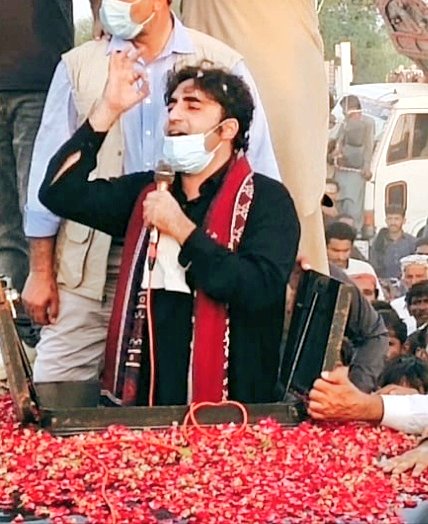
Imran Khan should visit Sindh’s flood-hit districts and personally see the havoc that the rains and the floods have wreaked, Chairman PPP

Pakistan People’s Party (PPP) Chairman Bilawal Bhutto Zardari has said that it is imperative that the Prime Minister (PM) Imran Khan visits Sindh’s flood-hit districts particularly Mirpurkhas division and should personally see the havoc that the rains and the floods have wreaked in there. He was talking to the flood victims of district Sanghar worst affected by the torrential rains and subsequent floods. He had arrived at Khipro and travelled through Loon Khaan, Pirumal, Kandyari and other areas. His tour of the flood-hit areas was ended at Berani town.
Bilawal Bhutto Zardari said that heavy rains and then floods had wreaked havoc in these districts and the crops and the livestock in Sanghar district have been ruined on which the Federal government should immediately announce to release ‘Pakistan Card’ to the people so that the affected populous could find some remedy to their wounds.
It is also unavoidable that the Supreme Court hand over the withheld money to the Sindh Government with which the later may initiate to improve the destroyed infrastructure. The people of Sindh are waiting to see this happen, he added.
Bilawal Bhutto Zardari assured the affected people that the Party and the Sindh Government shall continue to help them and would never leave the the people of Sanghar alone in hours of testing and on mercy of the nature.Chairman Bilawal Bhutto Zardari also on the occasion issued necessary directives to the Party leaders that they should help the affected people.At the end of his today’s visit at Berani, Party leaders and Jialas and area’s notables called on the PPP Chairman at the residences of member national assembly (MNA) Shazia Atta Marri and Senator Anny Marri.Members provincial assembly, Sindh, belonging to district Sanghar also called on the party Chairman at the house of Ali Hassan Hingoro in Khipro and briefed hoim about devastations that ruined the area.
PPP Chairman reached the town of Khipro in Sanghar and visited a camp set up for the internally displaced people by the rains. He met the victims there and inquired about their problems. When he saw a sick labourer Jumoon Kanbhar in the camp, he issued directives to the Sindh Chief Minister that he should forthwith make necessary arrangements for shifting of that sick to Karachi so that he could be treated there properly. CM Murad Ali Shah assured the PPP Chairman the poor sick person would be given best medical treatment in Karachi.
PPP Chairman was accompanied by the Sindh CM, Aajiz Dhamrah, Sohail Anwar Siyal, MNA Shazia Atta Marri, Senator Imam Ud Din Shauqeen, Sardar Muhammed Bux Mahar, Senator Anny Marri, Shahid Thaheem, Sarfraz Rajar, Jawaid Javed Nayab Leghari, Faraz Dero, Naveed Dero, Jam Madad Ali, Zulfiqar Shah, Ali Hassan Hingoro, Allauddin Junejo, Jahangir Junejo, Khadim Rind, Shakeel Marri and others.
https://www.ppp.org.pk/pr/23726/

Tuesday, September 8, 2020

Music Video - Alannah Myles - Black Velvet

Video Report - ""Growing Up Poor in America."" - How poor families are struggling to make ends meet during the pandemic

Video Report - California wildfire: Blazes have consumed record 2 million acres this year

Video Report - #Khashoggi - Will the truth about Jamal Khashoggi's murder ever be revealed?

Video Report - Retired general reacts to Trump's military comments

Pashto Music Video - Gulnar Begum - Na Darze Pa Laas Zulfi Zama

Pashto Music Video - Rasha dilbara zaliman me jarawe

Music Video - JO BACHA THA - NOOR JEHAN - UMRAO JAN ADA

Ghazal - La Pilade Saqia - Pankaj Udhas

Urdu Ghazal - "Tanhai" - Anup Jalota

Video Report - #NayaDaur #Pakistan Why Isn't Left Organised In Pakistan? | With Ammar Ali Jan

سیلاب سے متاثر میرپور خاص کے عوام کو اکیلا نہیں چھوڑ سکتے، بلاول بھٹو

پاکستان پیپلز پارٹی کے چیئرمین بلاول بھٹو زرداری نے کہا ہے کہ میرپور خاص کے عوام کو اکیلا نہیں چھوڑ سکتے، انہوں نے کہا کہ وزیراعلیٰ  کے ساتھ دورہ کیا ہے۔ وزیراعلیٰ نے وعدہ کیا ہے کہ تمام وسائل آپ پر خرچ کریں گے۔
بلاول بھٹو نے ان خیالات کا اظہار کوٹ میرس میں سیلاب متاثرین سے خطاب کے دوران کیا۔
انہوں نے کہا کہ دس سال پہلے بھی تاریخی بارش ہوئی تھی، اس وقت صدر زرداری کی حکومت تھی۔
بلاول بھٹو نے کہا کہ اس وقت وفاقی حکومت نے متاثرین کو امداد دی تھی، وزیراعلیٰ نے کل وزیراعظم کو آپ کی مشکلات بتائیں، وزیراعلیٰ نے بتایا کہ وزیراعظم صاحب سندھ بھی پاکستان کا حصہ ہے۔
وزیراعلیٰ نے ان سے کہا کہ وزیراعظم صاحب ہر متاثر کی مدد کریں۔ بارش متاثر کراچی کا ہو، میرپورخاص، سانگھڑ، یا سوات کا، مدد کریں۔ آپ ساتھ دیں گے تو دنیا کی کوئی طاقت آپ کا راستہ نہیں روک سکتی۔
انہوں نے کہا کہ آپ کو آپ کا حق چھیننا پڑے گا، آپ کو لڑنا ہوگا۔ میں لڑنے کو تیار ہوں، آپ لڑنے کو تیار ہو۔
https://jang.com.pk/news/818084

Baloch Students Action Committee rejects government’s assurances: hunger strike till death to continue

The spokesperson of the Baloch Students Action Committee (BSAC) said in a statement that they did not trust the promise of the government and that the hunger strike till death would continue.
The spokesperson said that such promises have been made by the government in the past and the strikes were called off after several rounds of talks between the two sides but the government has always violated the agreements by breaking its promises which forced the students to resume their strike.
The spokesperson said that the decision to go on a hunger strike was taken after APCA, BSAC and various organisations have exhausted all other efforts to resolve the issue, as a result of which four members of the organisation have gone on a hunger strike till death.
The spokesperson said that in a further discussion on Monday, Balochistan Chief Minister Jam Kamal had assured that the agenda would be laid in the cabinet meeting on September 9 and the bill would be passed.
A notification was issued by the governor on the same day saying that the status of BMC will be restored. However,  the main issue is the BMC amendment Act 2017, the BSAC said.
“Our previous experiences reflected that the government assurance was only to finish the students’ protest, that’s why the organization decided that the hunger strike by their colleagues will be continued.”
https://balochwarna.com/2020/09/08/bsac-rejects-governments-assurances-hunger-strike-till-death-to-continue/

Asim Bajwa Exposé Underlines the Corruption Linking the Pakistan Army and CPEC


A week after an investigative story into his alleged corruption was published on an alternative media website, Lieutenant General (retired) Asim Saleem Bajwa on Thursday decided to step down from his position as the special assistant to the prime minister on information and broadcast. However, Bajwa said he will continue in his more lucrative role as the chairman of the China Pakistan Economic Authority (CPEC) Authority.
This selective resignation by Bajwa, who issued a press release on Thursday categorically denying allegations of financial misappropriation as a senior military officer over the past two decades, not only weakens his own rebuttal, it adds more credence to calls for a change in leadership of the CPEC Authority. But even that half-baked decision to step down has been unraveled by Prime Minister Imran Khan’s “refusal” to accept the resignation.
With millions of dollars’ worth of financial misappropriation already uncovered in the economic corridor that is still under construction, it makes little sense for CPEC to be spearheaded by an individual accused of such large-scale corruption. But common sense usually takes a backseat whenever questions centering around the army are posed in Pakistan.
It is no coincidence that the mainstream media that headlined Bajwa’s rebuttals on Thursday never ran the story that was being refuted. And even while appearing on such a shackled media, Bajwa was found wanting when asked about the prospect of producing evidence to back his defense. He even briefly left an interview in a segment that has since been cut on the official channel.
Even so, such has been the military’s hegemony that a retired general offering explanations to refute corruption allegations — albeit without evidence to back his claims — is being peddled as “historic.” The failure to hold the army accountable explains how half of the Pakistan’s history has been spent under military rule and the other half under army-backed civilians. And while one of the many ways those civilians are kept under check is through exposés on their financial misappropriation, the military’s own business empire is now worth over $100 billion — almost double the size of the $62 billion CPEC, which is China’s biggest ever overseas investment.
The visions of the Chinese leadership and Pakistan Army align seamlessly. They both seek to appropriate Pakistan’s resources to grow their own neoliberal empires. CPEC itself links Xinjiang and Balochistan, the hubs of multipronged abuses carried out by China and Pakistan, respectively.
Both government also seek to maintain totalitarian controls so that no dissenting questions are posed to either of the two leaderships. And now with the economic corridor merging the duo’s autocratic ambitions, it is increasingly evident that, similar to Islam and the army, CPEC has swiftly become a holy cow that can’t be questioned in Pakistan.
After coming to power in August 2018, the Khan-led Pakistan Teheek-e-Insaf (PTI) government sought to revisit CPEC projects, with many deals underlining exorbitant costs for Pakistan. Two months later, during a visit to Beijing, Khan and his team were left embarrassed when Chinese officials showed slides of questions raised over CPEC by the incumbent government. The message was clear: Don’t ever dare to debate the pros and cons of CPEC again.


Unsatisfied with a civilian stooge government stalling the projects, Beijing decided to push for a thorough military takeover of CPEC.  In November 2019, the CPEC Authority was formed with Lt. Gen. (retd) Asim Bajwa its head. In July, a CPEC Authority Bill 2020 was proposed, practically handing over the corridor to the army.
Bajwa was made the prime minister’s adviser to further increase the military’s control over information, especially centering around CPEC. He had previously performed this role as the director general of the Inter-Services Public Relations (ISPR) — the military’s de facto control room for Pakistan media.
Since CPEC’s launch in 2015, the military has eyed its share in the economic bounties, which have historically made it richer at the expense of the masses. The first phase of development saw the military eliminating the inbound jihadist groups — which had hitherto remained untouched despite terrorizing the country for a decade and a half, and killing over 80,000 Pakistanis — because they now posed a threat to CPEC. After the previous government’s refusal to completely comply with the military’s continued takeover of issues centering around security and diplomacy, just as CPEC was taking center stage, the PTI’s election triumph was engineered.
Today, Pakistan’s elevation of CPEC to hallowed proportions is line with its complete abandonment of the United States’ side of the new cold war divide, with Washington having issued repeated calls for Islamabad to add transparency to what it dubbed a “debt trap.” Pakistan is now confident that China will fulfill all of its economic needs — to a point that it can now afford to snub Saudi Arabia.
This absolute submission to Beijing is coupled with any questions about China — including its Uyghur concentration camps — being deemed an “attack on CPEC.” Similarly, calls for Bajwa to step down are deemed synonymous with “conspiracies to destabilize CPEC.” Even Bajwa’s rebutting tweet — phrased with uncanny resemblance to the military-linked Twitter bots that target dissenting voices — appeared to deem the exposé another conspiracy.
Imran Khan, the entirety of whose political narrative has centered around an anti-corruption drive against the powerful, is happy to play the democratic front of this corrupt, totalitarian takeover epitomized by the CPEC. And while much of the financial gains are to be enjoyed by the two hegemons, any trickled down benefits for the masses — such as the improving security situation — will come at the price of further surrendering of their liberties, and gory misappropriation of what is rightfully theirs.

I am Asim Bajwa, I brought pizza, digital army to #Pakistan. But you call me Gen Papa Johnny


 Retired Lt Gen Asim Bajwa and his family have been under the scanner for their pizza empire, but no one can take away his ‘contribution’ to Pakistan’s digital propaganda.


They are now calling me General Papa Johnny. Do you know why? Because I, retired Lt Gen. Asim Saleem Bajwa, committed a sin by introducing this poor Pakistani nation to heavenly pepperoni pizzas. Blame me, best hang me, but you can’t deny my great service to the country. Yes, it is personal and it is about my pizza valour.
Retiring as lieutenant-general of the ‘Number 1’ military in the world, I saw many ups and downs but none like what I am facing now. I know that you’ve heard about my secret global economic escapades in the last few days — 99 companies, 133 pizza joints, some 13 commercial properties in the US including two shopping malls — don’t we all love malls. To all those complaining I say: Mehnat kar dost, hasad na kar (work hard my friend, don’t be jealous). Truth be told, it is no mean achievement to build an empire like mine in a poor country like Pakistan.

My cars and pizzas
Those who say that other countries have armies and the Pakistan army has a country are deeply conflicted. We are the only rich men stuck in a poor country. Why don’t you see our misery? You think it all came easy? I climbed my way up by kneading dough, that too yeast-free. Have a heart and imagine my struggle.
My bank balance, my properties, my corner plots, my pizza restaurants, even my swanky Toyota ZX 2016 are all in the greater national interest of Pakistan. If hypocrisy had a face it would be mine, but you still want me to give you my money trail. You call it corruption? Do remember the 101 of our national narrative: the only corrupt in this great nation are the politicians, those of civilian variety, not like me. Repeat it a hundred times, better yet, hang it by your bedside.
If you don’t know me then you don’t need to know more than you know already. Apologies, but trying to hold me accountable for my retirement benefits won’t change anything.
Thorough professional
This brings me to the other part of my life in which I act as a politician. Though my friends tell me that my bad luck began when I joined Prime Minister Imran Khan, because everything he touches turns to trash.
I am now special assistant to the prime minister on information. That is due to my previous excellent work as director-general (DG) of Inter-Services Public Relations (ISPR). Those who came after me couldn’t match my charm. While those before had no idea how to run ISPR.
At ISPR, Pakistan’s information revolution began with me, I was the real deal. The digital troll armies, the hashtags, the branding of then army chief Gen. Raheel Sharif — I was the game-changer then and I am here now. You’d all remember my famous hashtag #ThankYouRaheelSharif, it was in honour of my boss. When Raheel slept I trended ‘thanks’, when he walked I trended ‘thanks’, when he prayed I trended ‘thanks’. The face of my boss was on trucks, car bonnets, and banners in the streets. My biggest achievement? I was the first to bring any Pakistani army chief’s face on a baniyan — such is my power in making military men great. My stint as DG ended soon, otherwise, Sharif underwear was next on the cards.
Making Bajwas great again
I understand the pain of the people too.
I made hit songs such as Bada Dushman Bana Phirta Jo Bachon Se Ladta Hai, right after the Taliban killed 140 children in the Peshawar army school in December 2014. On the massacre’s first anniversary, I came up with Mujhe Dushman Ki Bachon Ko Parhana Hai. I gave special tuitions to the children of the dushman, and it was with that tuition fee that I built my multimillion empire. Just like that, I finished terrorism in Pakistan. No one seems to remember that.
When I left ISPR, I took with me my 3 million Twitter followers. I never handed over the official account to your favourite incoming DG Asif Ghafoor. Why should have I thrown away my hard work? Don’t judge me, it was all in the greater good of the nation.
My purpose is to serve. I did so as commander of the 111-Brigade, a brigade notorious for helping military coups — yet, I myself did no such thing. I was known as the dharna innovator in 2014, because many think I was helping Imran Khan put up a DJ show in Islamabad’s D Chowk.
These are the qualities that have left even senior Bajwa with no option but to trust me. People like to call me Chota Bajwa, but big or small, together we both can both make Bajwas great again!
As you know, I am a man of talents. I am also chairman of the China-Pakistan Economic Corridor (CPEC). I trust myself and there is no reason for the Chinese not to trust me. That is why I insist anyone who as much says a word about my corruption is liable of high treason. You question Bajwa, you question your existence. You question Bajwa over business with the United States and not China, you are an agent and conspirator of the dushman.
https://theprint.in/opinion/gen-papa-johnny-asim-bajwa-brought-pizza-digital-army-to-pakistan/491556/

Monday, September 7, 2020

#NajamSethiOfficial Sethi Sey Sawal | Najam Sethi Speaks on Asim Bajwa Revelations

Exposé On Former General's Vast Wealth Spurs Debate About Military Privilege In Pakistan

Pakistan’s powerful generals have for decades cited political corruption as a leading problem in the country that justified the toppling of governments through repeated coups and the military's manipulation of power.
But a recent report about the vast family business of a former army general who is a senior government adviser has prompted debate about alleged corruption among military elites and the apparent impunity they enjoy in contrast to civilian elites – both of which have taken turns ruling the country during its 73-year history.
Just days after independent journalist Ahmad Noorani published his August 27 article linking former Lieutenant General Asim Saleem Bajwa’s rise through the military to his family’s estimated $100 million fortune, Pakistani officials were scrambling to come up with a response amid public pressure.
Bajwa declared the report a “malicious propaganda story” and government supporters and former army officers have called it a conspiracy against their country as well as the Chinese investments Bajwa oversees. Late on September 3, Bajwa issued a detailed press release to counter Noorani’s report.
Noorani, a fellow at the Missouri School of Journalism, says the wealth of Bajwa’s family grew “unbelievably” after he joined the staff of military dictator Pervez Musharraf in 2002 and later headed the military’s public relations wing. He eventually led troops in the restive southwestern Balochistan Province until retiring in September 2019.
“The narrative about corruption is changing in Pakistan after my investigation came to light,” he told RFE/RL’s Gandhara website. “The corruption debate was limited only to graft allegations about politicians, but now people are discussing this issue in relation to the military and its powerful officers.”Noorani says he hopes his exposé will break the atmosphere of fear in Pakistan, where the military is frequently accused of blanket censorship and severe intimidation of activists and journalists.“My story proves that while [the military does] not allow anyone to investigate their dealings and most of their dealings are not part of the public domain, it is possible many similar stories are out there,” he said.
He argues that the financial dealings of officers should be made public.
“You can bar reporting on some [sensitive] national-security issues but allow the press and government accountability organizations to look into the financial dealings of top officers,” he said. “It will establish transparency.”
But Pakistan’s current accountability laws exclude the military and the judiciary.
Senior military figures have maintained they do not need external oversight because they have internal accountability mechanisms. They point to the many sackings and punishment of officers as evidence of the system’s effectiveness.
Author Ayesha Siddiqa, a research associate at London’s School of Oriental and African Studies, says Noorani’s investigation is the first of its kind to attempt to undo a decades-old narrative about corruption in public life in Pakistan.
“What this story has done is at least partly puncture the myth that military generals are honest and that they shouldn’t be accountable,” she told Gandhara. “There is a case to be made for their accountability.”Siddiqa’s 2007 book, Military Inc: Inside Pakistan’s Military Economy, argues that decades of political dominance have turned Pakistani generals into a privileged class with the lion’s share of power, wealth, and privileges.She says corruption and anti-corruption have dominated politics ever since military dictator General Ziaul Haq dissolved a civilian government over corruption allegations in 1988.In the 1990s, the two leading political parties -- the Pakistan Muslim League (PML-N) and Pakistan Peoples Party (PPP) -- accused each other of graft and targeted each other’s leaders over the issue. Corruption allegations figured prominently in General Pervez Musharraf’s military coup in 1999.
He later formed the National Accountability Bureau (NAB), an antigraft body focused on politicians and civil bureaucrats.
“In recent years, the main political rhetoric has been that there is no left-wing or right-wing ideology and the main struggle is over corruption and anti-corruption,” she noted.
“The [Pakistan Tehreek-e Isnaf] took benefit of this and made it to power,” she said, referring to Prime Minister Imran Khan’s PTI party, which campaigned against alleged corruption by the PPP and PML-N to eventually win parliamentary elections in July 2018 by incorporating many turncoat leaders from the two parties. Opposition leaders blamed the military for orchestrating the PTI’s win through rigging and manipulation.
As chairman of the China-Pakistan Economic Corridor Authority and Khan’s media adviser, Bajwa holds an important position within Khan’s administration.
But minutes after Noorani’s story was posted on his website, Factfocus.com, Bajwa rejected the report. “A malicious propaganda story published on an unknown site, against me and my family, (just uploaded on social media) is strongly rebutted,” he tweeted.
In a detailed response issued late on September 3, Bajwa called Noorani’s report “incorrect and false.” He denied his wife is a shareholder in the family business or that the family business is linked to his rise in the military ranks. “If one were to look at the actual figures, the inescapable conclusion would be that the news item has been spread with a view to malign my reputation,” he wrote in a four-page press release.
Amjad Shoaib, a former army general, declared the exposé a conspiracy against Pakistan hatched by Islamabad's archrival, India, and others.
“Has Noorani conducted any investigative story about many megacorruption cases in this country?” he asked.
As a leading investigative reporter, Noorani has distinguished himself by probing sensitive stories. He says his reporting led to years of harassment by the military, which culminated in a violent attack by unknown men in October 2017 that left him with head injuries.
In a statement on September 1, the global media watchdog Committee to Protect Journalists condemned threats against Noorani after he published his report.
Opposition politicians stung by the government’s accountability drive through NAB cases are gradually raising questions about Bajwa’s alleged fortune. "Allegations have been made against him [Bajwa] and he should answer them," PML-N Vice President Maryam Nawaz said.
Nawaz is seen as the heir apparent of former Prime Minister Nawaz Sharif.
In July 2017, the Supreme Court ousted him from office over undeclared assets. But Sharif insisted his removal was part of an effort to undermine democracy and civilian supremacy.
"If you have been appointed to a government post on taxpayers' money and allegations are made against you and evidence is presented, you should face them," she said. The PPP has also called for a probe of the alleged wealth of Bajwa’s family. On September 1, a Pakistani court gave Sharif a “chance to surrender” if he returned home within 10 days or else risk being declared a fugitive from justice. The court wants him to appear for a corruption hearing. Sharif has been in London since being allowed by the court in November to fly there for medical treatment.

https://gandhara.rferl.org/a/expos%C3%A9-on-former-general-s-vast-wealth-spurs-debate-about-military-privilege-in-pakistan/30819120.html

Civilians Accuse #Pakistani Military Of Mass Arrests, Beatings After Taliban Attack

Civilians in a remote area of western Pakistan have accused the country’s powerful army of mass arrests and torture after the Taliban claimed a bomb attack that killed and injured members of the army.
Residents of Shaktoi, a rural mountainous area of South Waziristan district, say security forces imposed a curfew, arrested local men, and conducted aggressive home searches after a roadside bomb killed three soldiers and injured four others last week.
Officials in the region, however, have rejected accusations of military abuses.
“We faced abuses and arrests after the attack,” Abdul Mutalib, an eyewitness, told Radio Mashaal. “They beat many people in their homes during a search operation and arrested many locals and some 100 laborers working on a road,” he added. “They broke the arms and legs of some of them during torture.”
Mutalib said some 40 soldiers conducted aggressive house searches in Anakhel, a village close to the site of the September 3 attack on the Pakistani Army. “They arrested men who were at home or just walking down the street. Some of them are still being detained at a local school used by the army,” he said.
Shaktoi is administratively part of South Waziristan but is approached from a road in neighboring North Waziristan. Most residents of the region are members of the Mehsud, a Pashtun tribe. Nearly half a million Mehsuds were displaced for a decade after a large-scale 2008 Pakistani military operation against the Tehreek-e Taliban Pakistan (TTP), the umbrella organization of the Pakistani Taliban.
Activists in Waziristan say the displacement and abuses by the Taliban and the military led to the emergence of the Pashtun Tahafuz Movement (PTM), a movement for the protection of Pashtuns, in February 2018. Since then, the supporters of the civil rights movement have protested military abuses and Taliban attacks in their homeland. Ending aggressive searches and collective punishments is a key PTM demand.
In a protest in Tank, a city adjoining South Waziristan to the east, and in the southern seaport city of Karachi, PTM members protested the alleged abuses in Shaktoi on September 7.
“We are demanding the immediate release of detained civilians,” Alamzeb Mahsud, a PTM leader, told Radio Mashaal at the protest in Tank. “We can no longer tolerate such treatment,” he said. The army is “still imposing collective punishment years after claiming to clear our homeland from terrorists.”
Hayat Preghal, another PTM activist, says civilians are helpless in the face of seemingly unending hostilities between the army and the Taliban. “We feel sandwiched between these two forces,” he told Radio Mashaal. “Ultimately, we will have no choice but to abandon Waziristan altogether to protest against the two and protect our people from their reprisals and infighting.”
But Shaukat Ali, the police chief in South Waziristan, says they have received no report of abuses even though search operations are common in the region in response to a recent uptick in Taliban attacks.
“I find it strange that people begin protests against abuses before lodging an official complaint,” he told Radio Mashaal. “If they complained about innocent civilians being detained, I could have asked the army and the police to release them.”
In a September 3 statement, the Pakistani military’s media wing said an officer and two soldiers had been killed while four others were injured by improvised explosives while they were providing protection to a road construction crew in Waziristan. “Security forces cordoned off the area,” the statement said. “Search operation being carried out for area clearance.”
The PTM plans to hold more protests against the alleged army abuses.

صحتمند و تعلیم یافتہ نسل کی پرورش ہی ایک پرامن، خوشحال اور مضبوط ملک کی ضمانت ہوتی ہے۔ چیئرمین پاکستان پیپلز پارٹی بلاول بھٹوزرداری

  پاکستان پیپلز پارٹی کے چیئرمین بلاول بھٹو زرداری نے کہا ہے کہ پاکستان ان
ممالک میں دوسرے نمبر پر ہے، جہاں سب سے زیادہ بچے اسکولوں سے باہر ہیں۔ پاکستان میں تقریباً 22.8 ملین بچے اسکولوں سے باہر ہیں۔ انہوں نے شرحِ خواندگی میں اضافے کے لئے اجتماعی کوششوں اور ذمہ داریوں پر زور دیا ہے۔

 یونیسیف کی جانب سے عالمی یوم خواندگی کے موقع پر جاری کردہ اپنے پیغام میں پی پی پی چیئرمین نے کہا کہ ہم آہنگی سے محروم معاشروں کے لیئے ناخواندگی ایک زرخیز میدان ہے، اور قوم کو اس بات کا نوٹس لینا چاہئے کہ اسکولوں سے باہر بچوں کی تعداد میں فی صد اضافہ ہورہا ہے۔ بلاول بھٹو زرداری نے کہا کہ تعلیم ہر بچے کا بنیادی حق ہے اور جو قومیں یہ حق دینے میں ناکام ہوتی ہیں، انہیں اس کا خمیازہ بھگتنا پڑتا ہے، کیونکہ صحتمند و تعلیم یافتہ نسل کی پرورش ہی ایک پرامن، خوشحال اور مضبوط ملک کی ضمانت ہوتی ہے۔ 

 انہوں نے کہا کہ پاکستان پیپلز پارٹی نے ہمیشہ خواندگی اور تعلیم کی بہتری کے لئے جدوجہد کی ہے، کیونکہ اس جماعت کو پاکستان میں سب سے زیادہ تعلیمی ادارے قائم کرنے کا اعزاز حاصل ہے، جبکہ آمرانہ حکومتوں کے دوران تعلیمی سرگرمیوں کو بہت زیادہ نقصان اٹھانا پڑا، جب سیاسی بے اصول افراد و کٹھ پتلیوں کی حمایت حاصل کرنے کے لیئے گھوسٹ اسکول کی عمارتوں کو بطور سیاسی رشوت متعارف کرایا گیا۔ بلاول بھٹو زرداری نے نشاندہی کی کہ پاکستان پیپلز پارٹی کی سندھ حکومت نے اپنے صوبائی بجٹ کا ایک چوتھائی سے زیادہ حصہ تعلیم کے لیئے مختص کر رکھا ہے اور اُن بچوں کو تعلیم کی جانب راغب کرنے کے لیئے مختلف پروگرام بنائے جا رہے ہیں، جو اسکولوں سے باہر ہیں۔ https://www.ppp.org.pk/pr/23709/

#Pakistan - Chairman #PPP Bilawal Bhutto Zardari’s Message on International #LiteracyDay

Chairman Pakistan Peoples Party Bilawal Bhutto Zardari has said that Pakistan is home to the world’s second-highest number of out-of-school children with an estimated 22.8 million children and stressed for collective efforts and responsibilities to improve the literacy rate in the country. 

In his message on the International Literacy Day is observed tomorrow under the aegis of Unicef, the PPP Chairman said that illiteracy is the fertile ground for disharmonious and intolerant societies and the nation should take notice that the number of out-of-school children was growing per cent-wise.
Bilawal Bhutto Zardari said that every child has the basic right to education and nations who fail to provide this right ultimately suffer because nurturing a healthy and educated generation was the only guarantee for a peaceful, prosperous and strong country. He said that PPP has always struggled for improvement in literacy and education as it has the distinction of establishing the largest number of educational institutions in Pakistan while academic activities suffered a lot during dictatorial regimes when ghost school buildings were introduced as a political bribe for free-wheeling political puppets in exchange for their support.
Bilawal Bhutto Zardari pointed out that PPP’s Sindh government has earmarked more than a quarter of its provincial budget on education and the province was planning programs to attract out-of-school children to attend schools.

 https://www.ppp.org.pk/pr/23707/

Sunday, September 6, 2020

Video Report - San Francisco | BLM activists march against Trump and police brutality

Video Report - #BlackLivesMatter What will halt Black Lives Matter protests in US?

Video Report - Kamala Harris visits Howard University, her alma mater, with CNN

Video Report - CNN Exclusive interview with Sen. Kamala Harris (part 1-2)

Opinion: The Strange Grief of Losing My Sense of TasteMany symptoms of Covid-19 were difficult, but losing my ability to taste hurt the most.


By Krista Diamond
After I tested positive for Covid-19, I ordered Panang curry. When the food arrived, I lifted the plastic lid, expecting the scent of makrut lime, lemongrass and ginger. But there was nothing. I plucked a forkful of tofu from the sauce. It was flavorless. My abilities to smell and taste had suddenly evaporated. And in the month since I’ve been sick, they have yet to return.
Earlier in the pandemic, my husband and I developed a ritual of ordering comfort food every Friday. We live in Las Vegas — a city that has been hit hard by the virus — and found meals from beloved local restaurants to be small but crucial gifts in a glittering landscape that was losing its luster. In March, my husband was laid off from a casino, and I lost a majority of my clients as a freelance writer. In June, the Strip reopened to unmasked tourists drunk on margaritas and the falsehood of a world without disease. By August, we were sick.
Unable to get out of bed days later, I sent out a tweet bemoaning Covid-19. Someone replied, “Whatever you do, don’t Google ‘When will I get my smell and taste back.’” I did exactly that and was met with article after article about anosmia — smell blindness — many of which suggested its impact could be long-term.
My existing symptoms worsened while new ones appeared: body aches, paralyzing nausea, 12-hour headaches, difficulty breathing and exhaustion that lingered like a hangover. But despite the physical pain of the illness, losing my ability to taste hurt the most. For months before I got the virus, I was locked inside my house. I saw friends and family through my computer screen. I watched the lights of downtown Las Vegas flicker off from my bedroom window. I felt the heartbeat of my career flatline.
Throughout this sea change, my only sense of joy was the taste of food. The red velvet cake I ate on my birthday in lieu of a canceled California vacation. The balsamic roasted brussels sprouts I cooked after I lost another client. The spicy bourbon fried chicken from the sun-drenched cafe where I used to read on leisurely Sundays.
Las Vegas is a city-centered around pleasure, and so much of that pleasure is taste — the bright citrus of champagne, the brine of fresh oysters, the impossible luxury of Kobe beef. And what is Las Vegas without pleasure? A desert.
The ability to taste was my connection to life before the coronavirus. And suddenly it was — and still is — gone.
My first week without taste and smell, I searched constantly for flashes of my lost senses. I sniffed candles, opened leftovers in my refrigerator, buried my face in my dog’s fur in search of that puppy smell. Even spoonfuls of hot sauce, pinches of salt, amounted to nothing. I worried — if I ate spoiled food, would I know? If there was a gas leak in my house, would it kill me?
In desperation, I turned to a Facebook group for people with Covid-19 experiencing smell and taste loss. It had more than 5,000 members.
“Today marks exactly 5 months since losing my taste/smell completely,” someone reported.
“There is hope,” another said, sharing that she had regained the ability to smell.
Some expressed sadness over seeing friends enjoying meals. Others floated conspiracies — had masks caused this? Many discussed smell training, a method requiring anosmia sufferers to sniff scents like eucalyptus, lemon and rose every day in hopes of turning the memory of them into reality.
Occasionally, someone would celebrate the return of taste and smell only to lose the sensations again or find that they had changed. Suddenly sugar was unbearably sweet, wine intolerably bitter. Phantom scents filled their nostrils — cleaning chemicals, gas.
I read the group’s Facebook posts for hours, commiserating with strangers around the world who shared this one strange loss. In a way, it felt frivolous. After all, many of us have already recovered and will avoid panicking emergency rooms. We will continue to live our lives — even if they are lives where chocolate tastes like chalk and whiskey taste like water.
But what is life without taste, without smell? If I never regain these abilities, will the question “What do you want for dinner” mean anything? Will a nice restaurant still have value? How will it feel when someone cooks for me, watches me take the first bite, and waits for my reaction? What is the point of perfume, of piney mountain air?
In a way, anosmia is the perfect metaphor for the world during Covid-19: devoid of pleasures we didn’t realize we might not always have.
But still, I try. I lift my husband’s shirt to my nose and breathe in. I cook meals — seared ahi tuna, pasta carbonara, strawberry pastries — and eat them, closing my eyes and trying to remember what they taste like.
Each day I hope for the familiar aromas and flavors to come back. I wait like the rest of us, for the things I love to return.
https://www.nytimes.com/2020/09/06/opinion/coronavirus-covid-symptoms-taste.html

جنرل ریٹائرڈ عاصم باجوہ کےاثاثوں سے متعلق احمد نورانی کی کہانی-اسکے پیچھے کیا کہانی؟ خصوصی انٹرویو

اسلام آباد سے اغوا ساجد گوندل کے بچے سڑکوں پر ۔ احتجاج - BringBackSajidGondal#

#KhabarSayAagay #NayaDaur #Politics Bhang Ke Rang | Pakistan's Politics, Culture, And Media