Sunday, August 16, 2020

How Pakistan’s Military Lost Kashmir

BY 
@azeemibrahim

For over seven decades, Kashmir has been the major flash point in the conflict between Pakistan and India. Since August 2019, the region has been in crisis after India’s prime minister, Narendra Modi, scrapped the special designation the region once held, which recognized its unusual status as a Muslim-majority area. New Delhi put the region under military lockdown, arrested Kashmiri local representatives, and blocked virtually all communication lines between the region and the outside world. There are reports of the abuse of civilians and shortages of food and medicines. Amid worldwide criticism, no voice has been louder than that of Pakistan, where Prime Minister Imran Khan has raised concerns of ethnic cleansing. Given the Hindu supremacist administration in New Delhi, these are not unjustified.

Yet Pakistan is not without blame in what is going on in Kashmir at the moment. And while Khan of Pakistan himself has acted in good faith, the military-intelligence state, the real power in Pakistan, has many questions to answer as to how it managed to be completely outmaneuvered on Kashmir—especially as it justifies its bloated budgets by emphasizing the need to keep Indian ambitions in Kashmir in check.

One of Pakistan’s greatest foreign-policy successes was its cooperation with the United States and the mujahideen in the Soviet-Afghan War (1979-1989). In this exercise, Pakistan proved itself indispensable to the United States’ Cold War grand strategy, but it also achieved its own strategic objectives to escape encirclement from Soviet-aligned Afghanistan and Soviet-aligned India.
Once that war was comprehensively won, Pakistan found itself with a great deal of spare military and intelligence capacity, as well as potentially useful relationships with militant groups and leaders that it could now redirect toward its traditional foe, India.
 Pakistan never stood a chance in a direct military conflict with India—and an all-out war between two nuclear powers was a terrifying possibility for everyone. But Pakistan thought that it could now leverage those same tactics that succeeded in Afghanistan against the militarily superior Soviet Union to put pressure on India. In the game-theoretical mindset of military and intelligence leaders, this seemed like a perfectly rational use of the available resources, especially since the key theater of conflict with India, Kashmir, shared remarkable similarities with Afghanistan: a remote, mountainous region, with a Muslim and friendly population, where it was easy to fight an insurgency against a larger foreign force, with relatively much lower use of resources.


But India was no Soviet Union. India was not entirely foreign to Kashmir linguistically and culturally, and the state was not being stretched to a breaking point economically and politically by maintaining its presence in the region. Nor did Pakistan’s adventures in Kashmir have the backing of the United States and the free world. In Afghanistan, Pakistan was a key lieutenant in a cover war sponsored by the world’s foremost superpower. In Kashmir, Pakistan was waging its own war, alone. And by sponsoring extreme militant groups such as Lashkar-e-Taiba and Jaish-e-Mohammed, Pakistan crowded out genuine Kashmiri movements of self-determination. It also did little to endear itself to local Muslim sentiments: Mainstream Kashmiri Islam is much more deeply steeped in Sufi mysticism and is ideologically opposed to the kind of reactionary fundamentalism that drives the majority of jihadi terrorist groups that Pakistan was sponsoring.

To be sure, India did itself no favors in how it governed its half of Kashmir.
 Ham-handed attempts at installing puppet governments in the state’s capital and constantly manipulating elections engendered genuine hostility toward New Delhi among Kashmiri locals. This policy eventually gave an opening to pro-Pakistan militants in 1989 to create a reign of terror that drove out almost all Hindus from the valley, forcing India to militarize the whole region.


But then the broader geopolitical realities also changed from underneath the Pakistani military establishment, when their old friend and ally from the Afghanistan campaign, Osama bin Laden, started waging a global campaign of terrorism against U.S. assets, culminating in the 9/11 attacks on U.S. soil in 2001. At this point, the Pakistani military establishment faced a choice: Would they retain their loyalty to the United States that had underwritten the independence of Pakistan throughout the Cold War, or would they retain the alliances with the Islamist militants that were key to their strategic depth against India?

Successive governments in Islamabad, and especially the autonomous military-intelligence complex, refused to make that choice. Nominally, they wished to retain their prized alliance with the United States, of course, but they were unwilling to forfeit the resources provided by the militants, which could be used against India—most notably in Kashmir. Instead of making that unavoidable choice, they tried to play both sides and sidelined any civilian administration that spoke of dialogue or rapprochement with India. This was the wrong strategy—and played directly into the hands of Indian hard-liners.

There is something remarkably stupid about the calculation those military leaders made that they could deceive the United States and keep both Washington and the Islamists on board. The United States had the foremost intelligence apparatus in the world. And it had the ability to act near-unilaterally even in Pakistan itself, as was demonstrated when the United States finally located Osama bin Laden in hiding near Pakistan’s military headquarters in Abbottabad and executed the operation to kill him without bothering to consult Islamabad.

With that raid, the charade was over. Pakistan had lost all credibility with the United States, as well as the close security ties it enjoyed throughout the Cold War. But the militants no longer had much reason left to believe that Pakistan could shelter them when push comes to shove. After playing both sides, Pakistan lost the trust of both and the ability to influence either. The United States continued its drone and ground campaigns against Islamists throughout Pakistan and Afghanistan as it saw fit. And the Islamists started conducting terrorist attacks all over the world according to their own calculations, without taking instruction from Pakistan’s Inter-Services Intelligence. Yes, they would on occasion help Pakistani geopolitical designs, but they were just as ready to carry out attacks within Pakistan, with little regard for the interests of the Pakistani state.

Pakistan thus lost a great deal of control over former proxies in the region. In Kashmir, this played directly into Modi’s hands. As Islamabad could no longer be relied upon to keep the Islamists in Kashmir on a tight leash, Modi had sufficient pretext to abandon all restraint in the territory of Kashmir while rejecting any dialogue with Pakistan’s civilian government as pointless.

Meanwhile, the Trump administration has moved to make peace with the Taliban in Kabul. If this comes to pass, that will once again release resources from Afghanistan for the regional Islamist networks. And the so-called liberation of Kashmir is almost certainly the next focus of those networks. Indian military chiefs would argue that Modi has been astute to move in on Kashmir before any such redeployment of resources could happen.

None of this is to defend the way in which New Delhi went about its crackdown in Kashmir. One year on, the humanitarian situation in Kashmir has only gotten worse. Nor should we lose track of the significance of Kashmir to the ongoing war New Delhi is waging against its Muslim citizens. A Hindu-supremacist Indian prime minister rolling out a military occupation into the only Muslim-majority state in India is cause for acute concern.

But looked at from the point of view of the history of India-Pakistan relations, Pakistan’s historical approach to Kashmir is just as responsible for enabling and facilitating this crisis as those Indians who vote for Modi in India’s general elections. Pakistan’s military-intelligence complex has only ever used Kashmir as pretext to increase its own power and to constantly attack India. And the suffering brought by that foolishness is falling on the civilians, especially Muslims, trapped on the Indian side of the border.
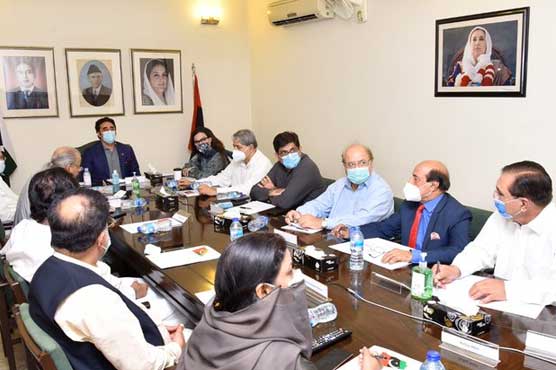
Bilawal Bhutto Zardari - Plan to divert Sindh and its capital Karachi’s revenue to Islamabad will not succeed because Karachi is an integrated part of Sindh and the city would remain its integrated part forever.

Pakistan People’s Party (PPP) said that the plan to divert Sindh and its capital Karachi’s revenue to Islamabad will not succeed because Karachi is an integrated part of Sindh and the city would remain its integrated part forever. Former President Asif Ali Zardari has been summoned by the National Accountability Bureau (NAB) without any reason. On the directive of Asif Ali Zardari, workers wouldn’t gather in front of NAB office on August 17. Former president Asif Ali Zardari has said that he has been facing NAB cases alone in the past and will continue to do so.
A meeting of the Central Executive Committee of the PPP was held at Bilawal House Karachi, Saturday, which was co-chaired by the party chairman Bilawal Bhutto Zardari and former president Asif Ali Zardari. Bilawal Bhutto Zardari attended the meeting in person along with other party leaders, while former President Asif Ali Zardari attended the meeting via video link. Syed Qaim Ali Shah, Sindh Chief Minister Syed Murad Ali Shah, Mian Raza Rabbani, Sardar Abdul Lateef Khosa, Sherry Rehman, Syed Naveed Qamar, Nafisa Shah, Humayun Khan, Shazia Marri, Nawab Yusuf Talpur, Saeed Ghani, Jamil Soomro, Sadiq Imrani, Waqar Mehdi, Syed Nasir Hussain Shah, Manzoor Hussain Wassan and Pir Mazharul Haq attended the meeting, while Nayyar Hussain Bukhari, Farhatullah Khan Babar, Faryal Talpur, Farooq H. Naik, Qamar Zaman Kaira, Ali Madad Jattak, Chaudhry Manzoor, Haider Zaman Qureshi, Faisal Karim Kundi, Azam Khan Afridi, Makhdoom Jameel-uz Zaman, Maula Bux Chandio, Nisar Ahmad Kharo, Chaudhry Latif Akbar, Advocate Amjad and others participated in the meeting through video link.
While addressing a post-meeting press conference, Mian Raza Rabbani said that the meeting was based on a 6-point agenda, including Gilgit-Baltistan elections, political situation and organisational issues in Punjab, recent legislation in the country, the developing situation in Karachi especially in light of a statement made by the Attorney General (AG), the NAB and Human Rights Watch reports and the situation in view of the Supreme Court remarks, as well as matters related to the August 17 NAB summons of former President Asif Ali Zardari and the overall situation of the party. The meeting discussed all the issues mentioned above.He said that Gilgit-Baltistan elections have been postponed for three months, while preparations for the elections and issues of giving tickets to candidates were discussed in the meeting. In the meeting, Syed Naveed Qamar gave a detailed briefing on the recent legislation regarding FATF.
Senator Raza Rabbani said that the government deliberately presented the bills related to FATF in the last hours of the stipulated deadline, so that they could not be reviewed in detail. The government once again tried to make the Parliament a rubber stamp through that move, but the opposition parties, especially the PPP, ensured for a limited time that the constitutional rights of ordinary citizens were not affected. The government included clauses in the bills that would deprive ordinary citizens of their rights, and they would live in fear of victimisation. He added that the opposition and especially the PPP has taken position on three laws. Among these are; the law on terrorism is such that if it is passed, every citizen will be affected by it, because the definition of terrorism described in it is very vague. This law is not just a black law, but a “king of black laws”. The second law is about amendments to the criminal procedure code (Cr.PC), examples of which can only be found in Hitler and Mussolini’s times. The government wants the investigating officer to have unlimited powers. The third bill is about anti-money laundering, as a result of which the entire nation would suffer. The bill violates a citizen’s confidence. Raza Rabbani said that PPP would resist these laws together with other opposition parties.
He said that the second issue was the role of NAB, which is naked to everyone. The role of NAB in the making Patriot party is not hidden. The PPP knows very well how the NAB is being used. Human Rights Watch report has fully exposed the NAB while the apex judiciary’s observations and decisions have exposed the NAB.He said that President Zardari did not need to be summoned by NAB at that time. He had appeared in the past, and will be again, if necessary. The PPP and its affiliates want party workers to appear before the NAB office. But President Asif Ali Zardari said that workers should not gather there, as he had faced NAB cases alone in past and would also face it in coming days. The party should protest on issues like sugar and flour crisis, inflation, bad governance and failures of the PTI government.Raza Rabbani said that during the meeting, the statement of the AG regarding Karachi in the Supreme Court was reviewed. This is nothing new. Ever since the PPP formed the provincial government, the PTI has sometimes talked of Governor Rule and sometimes of separating Karachi from Sindh. PTI does not recognise the federal concept in the constitution. Making Karachi a colony of the Federal government is tantamount to centralisation. PTI wants to take Pakistan back to 1962. In the 1962 constitution, the cabinet was not accountable to the Parliament. Even now, these people are not accountable to the Parliament because special assistants do not come to the Parliament and there are more than 18 people in the cabinet who have ministerial powers and they are not accountable to the Parliament. The solution and management of Karachi problem is the responsibility of Sindh government. The PPP will solve the problems of Karachi in an efficient manner. The conspiracy to separate Karachi from Sindh is not new. Islamabad wants to use Sindh capital’s revenue and people of Sindh will not accept it.
Raza Rabbani said that the party would increase its contacts with democratic forces and PPP chairman Bilawal Bhutto Zardari would meet democratic parties and civil society members. Speaking on the occasion, PPP leader Latif Khosa said that Shaheed Mohtarma Benazir Bhutto, Begum Nusrat Bhutto and Asif Ali Zardari were targeted by NAB rules and Musharraf also used it. Chaudhry Pervez Elahi and others were also affected by NAB. The NAB has summoned two former prime ministers Nawaz Sharif and Makhdoom Yousuf Raza Gilani as well as former president Asif Ali Zardari in the same case. All this is happening in the case of Tosha Khana in which the gifted car was bought in a transparent manner and money was given and no illegality occurred and the vehicle was taken in a transparent manner. He said that earlier other rulers have also made such payments and purchases. If there was any objection in such case, notice would have be given to them. He said that where there is unconstitutional work, it is the responsibility of the lawyers to protest. Peoples Lawyers Forum will appear on the 17th to defend the case.
He further said that there are references against the Punjab Chief Minister (CM) to which he has no answer. When the NAB calls, he says he does not know anything. Asif Ali Zardari is not a party in the case of taking loan on fake account and Park Lane case. NAB has no authority in this but media trial is being conducted. They should first arrest Punjab CM Usman Buzdar and should file a case against him. To a question, Raza Rabbani said that we will not compromise on the 18th amendment. We will try to protect basic human rights in the FATF laws. The party is united. At present the situation in the country is different from ten to fifteen years. Changes are being made keeping in view the situation but they are sticking to their principles but PTI regime wants to disperse opposition by creating differences between PPP, PML-N and other opposition parties.
https://www.ppp.org.pk/2020/08/15/plan-to-divert-sindh-and-its-capital-karachis-revenue-to-islamabad-will-not-succeed-because-karachi-is-an-integrated-part-of-sindh-and-the-city-would-remain-its-integrated-part-forever-2/

Saturday, August 15, 2020

Pashto Music Video - Ahmad Zahir - Oba Derta Rawrom -

VOA Pashto News - د بین الافغاني مذاکراتو د پیل نیټې کې ځنډ

#NayaDaurTV #PervezHoodbhoy - Towards A Progressive Pakistan | Pervez Hoodbhoy, Nadeem Paracha, Afiya Zia, Raza Rumi, Amber Shamsi

Even after 73 years, #Pakistan still struggling for independence: Pak journalist

Over the years the minority communities in Pakistan like Baloch, Pashtuns, Mohajirs, Kashmiris, Baltis, Christians and Hindus have been facing persecution at the hands of both the government and the army. Pakistan is still struggling for independence even after 73 years as people from Khyber Pakhtunkhwa, Balochistan, Sindh, Gilgit-Baltistan and other regions are yet to attain freedom, said journalist Marvi Sirmed.
"Marking 73 yrs of existence, Pak still struggling for independence. People in Khyber Pakhtunkhwa, Balochistan, Sindh, Gilgit-Baltistan, Pak admnstd Kashmir, nth military farms, Media, parliament, activists, 1000s of missing persons, #Julie...none is free. Happy birthday Pakistan!" She said on Pakistan's Independence Day.
While the country continues to share a troubled relationship with its minorities like Shias, Ahmadis, Hindus, Sikhs and Christians, Prime Minister Imran Khan during his address to the nation on Independence Day once again raised the Kashmir issue.
Meanwhile, hours before Pakistan's Prime Minister raised the issue of Kashmir, an elderly man from the Ahmadi minority community was shot dead by assailants in Peshawar.
Over the years the minority communities in Pakistan like Baloch, Pashtuns, Mohajirs, Kashmiris, Baltis, Christians and Hindus have been facing persecution at the hands of both the government and the army.
On Friday, the Voice for Sindhi Missing Persons and other human rights organisations organised a protest rally to express solidarity with the families of missing persons in Sindh and shouted slogans like "Yeh jo dehshat gardi hai, iske piche vardi hai (The people in uniform are behind these terrorist activities)".
The Pakistan Police used force to stop the protesters, including family members of the missing persons and human rights activists, outside the Karachi Press Club.
https://www.timesnownews.com/international/article/even-after-73-years-pakistan-still-struggling-for-independence-pak-journalist/637467

Pakistan’s Blasphemy Law A Weapon Of Revenge Used Against Minorities

Harshil Mehta
It isn’t that a politician has never tried to change blasphemy laws or bring reforms. But those who did, faced the wrath of the religious zealot section of the country.
 Radical Islamists of Pakistan found a new ‘hero’ recently. His name is Khalid Khan, who shot dead Tahir Naseem, an American citizen accused of blasphemy, in a Peshawar courtroom on July 29.
Even though Khalid Khan surrendered before the police, thousands rallied in support of him and his photos were shared widely on social media. Even before he was taken to the court, he was welcomed with hugs and kisses. 
Naseem was charged with blasphemy in 2018 after he declared himself Islam’s prophet.
The killing has ignited a debate on the dangerous blasphemy law and Pakistani society’s mindset in general. Pakistan’s blasphemy laws (PPC section 295 and subsections, section 298 and subsections) state that ‘derogatory’ remarks on the Prophet Muhammad, insulting any religion, disturbing a religious assembly and trespassing on burial grounds can cause lifetime imprisonment or sentence to death.
Till now, no blasphemy convict has been executed by Pakistan but allegations of blasphemy are enough to cause riots and killing of accused by vigilante groups. According to Al Jazeera, 77 people have been killed since 1990 over accusations of blasphemy. In Pakistan, as per data released by the National Commission for Justice and Peace, a total of 776 Muslims, 505 Ahmadis, 229 Christians and 30 Hindus have been accused under the various clauses of blasphemy law from 1987 to 2018. Ahmadis, Christians and Hindus constitute less than four per cent of the general population of Pakistan, but they account for around 50 per cent of blasphemy accused.
It isn’t that a politician has never tried to change these laws or bring reforms. But those who did, faced the wrath of the religious zealot section of the country. In 2011, Punjab Governor Salman Taseer was killed by his own guard after he defended a Christian woman, Asia Bibi, accused of blasphemy. She was acquitted in 2018. 
In another case, Pakistan’s only Christian cabinet member and first federal minister of minority affairs, Shahbaz Bhatti, was killed after he reportedly pressurised the federal government to change blasphemy laws. Pew Research Center, a prominent organisation for the survey, had found that 75 per cent of the Pakistani Muslims support the country’s blasphemy laws. The number is not small enough to ignore.
Rights groups and critics say Pakistan’s blasphemy laws are often used against religious minorities. Often the laws are used as a weapon of revenge. Therefore, there’s an urgent need to replace these laws.
It is important that murderers like Khalid Khan be given maximum punishment by the judiciary to set an example that the guilty will not be spared. If Pakistan wants to prove itself as a haven for religious freedom, then it must ban these regressive laws. 
It’s also imperative that global powers raise this issue on international platforms to create pressure on the internal politics of the country. Proposal to put sanctions or interrogation at international level may force them to think on this again. Progressive countries of the world should give refuge to the acquitted. 

#Pakistan’s persecution of #Ahmadi Muslims must end

By Siobhain McDonagh
Pakistan’s birth on Aug. 14, 1947 offered hope of a new country with new opportunities and new freedoms.
That was the vision of Muhammad Ali Jinnah, who as Pakistan’s founding father had rallied for a state where all would be free to believe in any faith or indeed in no faith at all. The country would harness the power of an equitable state and the talents of all its citizens to propel the country to the fore.
Seventy-three years on, Jinnah’s vision of secularism, equality and prosperity lies crumpled as Pakistan’s concern for civil freedoms has all but vanished. Ironically, its religious communities have suffered the most, and none more so than the Ahmadiyya Muslim Community.
Britain’s All-Party Parliamentary Group for the Ahmadiyya Muslim Community recently published a report on the persecution of Ahmadi Muslims in Pakistan, titled “Suffocation of the Faithful.”
“Such is the extent of persecution that it is no exaggeration to describe the life of an Ahmadi Muslim in Pakistan as one that faces persecution from the cradle to the grave,” the report states. “At every step of their lives, they remain ever at risk of arrest, attack or harassment. Ahmadis have been denied their fundamental right to vote, they cannot possess their religious texts, and even after death their graves are targeted and bodies exhumed.”
Among the range of human rights violations, the report found worrying evidence of Pakistani textbooks promoting extremism by inciting hatred against other religious communities.
School textbooks incite hatred against the Ahmadiyya Muslim Community by labeling Ahmadis as “Kafir” (disbelievers) and apostates, for which they prescribe the death penalty. Furthermore, textbook stickers are distributed in schools stating that any communication or friendship with Ahmadis is completely haram (forbidden) and calling for students to send names of Ahmadi students to Khatme Nabuwwat, an organization that has been at the forefront of violent anti-Ahmadi hostilities.
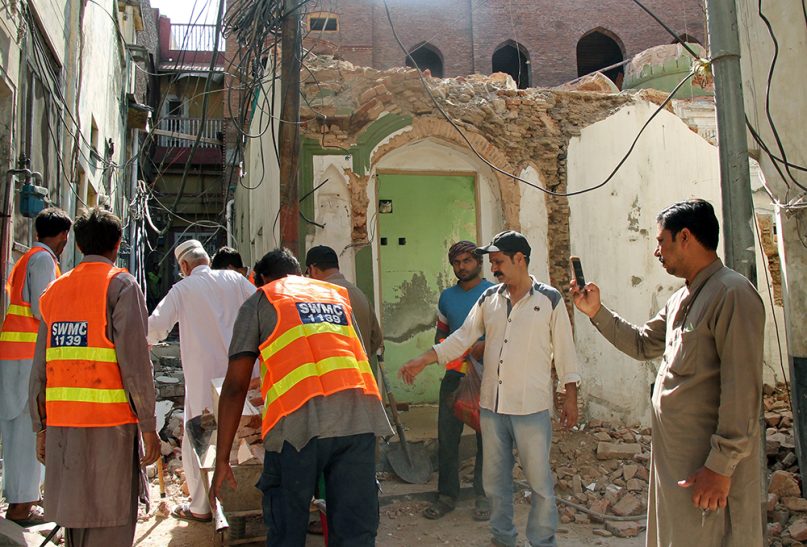
PAKISTANI VOLUNTEERS COLLECT DEBRIS FROM A DEMOLISHED AHMADI MOSQUE IN THE EASTERN CITY OF SIALKOT, PAKISTAN

Additionally, the report reveals how Ahmadi Muslim students of primary school age regularly face threats at school. Teachers, rather than maintaining discipline, turn a blind eye or worse, actively identify, denigrate and ridicule Ahmadi Muslim students in front of their class. Ahmadi Muslims face a constant risk of being denied access to education and those who secure a place are routinely targeted and stigmatized through physical and emotional abuse.
We heard during the inquiry that it was not uncommon for teachers to seclude students from minority backgrounds: They would be forced to eat, sit and play separately.
One must wonder what Pakistan can gain by excluding rather than harnessing talent.
During the launch of the report, Lord David Alton highlighted the fact that millions of pounds in British taxpayers’ money is given in aid to Pakistan.
While Britain rightly remains committed to helping the poorest in the world, the U.K. government must not do so blindly.
As the report notes, it must ensure that U.K. aid is not being used inadvertently to teach hatred, for example through textbooks, which evidently nurture intolerance and extremism.
Rather, checks and balances must be put in place to effectively counter hatred and promote diversity, respect and inclusion among schoolchildren, for it is the youth who will bring about the change needed in Pakistan to revert the country to the ideals of Jinnah.
As I wrote in the report: “It is time to say that enough is enough and that is why this report calls on the UK Government, and the wider international community to take immediate action to give Ahmadi Muslims, one of the most charitable and peaceful communities I know, their basic human rights.”

#Pakistan’s minorities continue to suffer discrimination

By Robin Gomes


Pakistan on August 11 observed the National Minorities Day to honour the services and sacrifices rendered by the country’s religious minorities for the country. However, minorities in the Muslim-majority country continue to face discrimination.
The National Minorities Day is observed on August 11 to honour Pakistan's religious minorities who have contributed to creating Pakistan and in nation-building. It commemorates the speech of Pakistan’s founding father Muhammad Ali Jinnah to the legislature on Aug. 11, 1947, days before Pakistan separated from India, in which he pledged to protect the rights of non-Muslims in the newly created country.
To assert this commitment, the government of Pakistan declared 11 August as National Minority Day in 2009.
Members of various religious minorities organized several events on Tuesday, including seminars and social gatherings. 
In a message for the occasion, Pakistani President Arif Alvi reaffirmed that all communities residing in the country will be treated and respected equally so that the country can further march on the path of progress and development.  

HRCP: the government has failed


Meanwhile, the Human Rights Commission of Pakistan (HRCP) has expressed concern over the state of religious minorities in the country and called for amending the Constitution to protect their rights and freedoms.
In a statement, the human rights watchdog noted that 73 years after Jinnah’s historic speech, Pakistan’s religious minorities "continue to be relegated to the status of second-class citizens, vulnerable to inherent discriminatory practices, forced conversions, and faith-based violence."
The HRCP expressed concern over the government’s Single National Curriculum, saying it “violates the constitutional guarantee that no member of a religious minority will be required to ‘receive religious instruction’ not relevant to their own religion”.
Over 96 per cent of Pakistan’s estimated population of 220 million is Muslim, in which the largest groups are ethnic Punjabis and Sunni Muslims.   Catholics and Protestants number around 2 million each, making up less than 1 per cent of the population respectively. Ahmadis, Christians, Hindus, Sikhs and Shias are said to be the most discriminated against.
In its annual report released in May, HRCP had pointed out that religious minorities continued to suffer in 2019, including discrimination, unabated honour killings, forced conversions of minority Hindu under-age girls and continued use of a blasphemy law that carries the death penalty to intimidate and settle scores, forced conversions and persecution under blasphemy laws and discrimination.

Minorities: lack of enforcement mechanisms

At a conference organized in Faisalabad on the eve of the National Minorities Day, leaders of religious and civil society groups expressed concern over the government’s position towards minorities.
Speaking at the conference on “Collective efforts for advancing diversities”, Catholic Bishop Indrias Rehmat of Faisalabad said “disparities of rights in policies and laws can never ensure equality of status and treatment”. 
The participants pointed out that the government has failed to take seriously the problems minorities face, noting that quotas for minorities are a futile attempt to ensure political, religious, social and economic equality if there is no proper enforcement mechanisms.
According to Rizwan Ullah Kokab, a professor at the Government College University, in a multi-cultural and multi-religious society, the authorities’ "ethnocentric" approach is not useful to the cause of national unity.
Hamid Yaseen of the Pakistan Federal Union of Journalists noted that “education policy must incorporate the concept of human rights, social justice, peaceful coexistence and non-discrimination”.
Father Kahid Rasheed Asi of Faisalabad said more “efforts are needed to reverse discrimination and convert the representation of minorities into participation”.
https://www.vaticannews.va/en/world/news/2020-08/pakistan-national-minorities-day.html

Joe Biden offers full-throated support to India against China, Pakistan

Joe Biden will support reforming the temporary visa system for high-skill — H-1Bs — to protect wages and workers and then their numbers.

Joe Biden, the presumptive Democratic nominee for president, will work with India in the Indo-Pacific to ensure no country, including China, “is able to threaten its neighbours with impunity” and will have “no tolerance” for cross-border terrorism in South Asia, if elected president, his campaign said in an expansive agenda released Friday for bilateral relations with India and the welfare of Indian Americans.
A Biden administration also will place a “high priority” on bolstering ties with India, continue to strengthen India’s defence capabilities and bring the United States back into the Paris climate to work with India again to combat climate change, according to the agenda.
On immigration, which has been a major part of India-US relations, Biden will “preserve family unification as a core principle of our immigration system”, increase the number of visas offered for permanent, work-based immigration — Green Cards, overturning the Trump administration’s switch to a merit-based system.
His administration will also exempt from any cap recent graduates of PhD programs in STEM fields, eliminate country limit on Green Cards, which has created a 100-year-long backlog for Indias. He will support reforming the temporary visa system for high-skill — H-1Bs — to protect wages and workers and then their numbers.
The agenda was a first expansive plan released by any presidential campaign yet for aims and goals for relations with India and Indian Americas. And, thus, marked the importance being accorded to India. It was released just hours before a major outreach by senior members of the Biden campaign to the community.On bilateral relations with India, the former vice-president will bring to the offie years of supporting India. As a senator, the agenda said, Biden had in 2006, said,“My dream is that in 2020, the two closest nations in the world will be India and the United States” In 2008, he led other Democrats to back the India -US civil nuclear deal. The Obama-Biden administration declared support for India’s claim to permanent membership of the UN Security Council and Declared India a major defence partner.
As president, the agenda said, “Biden believes there can be no tolerance for terrorism in South Asia – cross-border or otherwise”. The reference here was unmistakably to cross-border terrorism emanating from Pakistan, which had also been a sore point with the Obama administration.
On China, the Biden administration will ensure continuity. “A Biden Administration will also work with India to support a rules-based and stable Indo-Pacific region in which no country, including China, is able to threaten its neighbours with impunity.” There was no explicit mention of the border clashes but, once against, the sub-text was clear, aligning with growing bipartisan support for India in these clashes.“Biden will deliver on his long-standing belief that India and the United States are natural partners, and a Biden Administration will place a high priority on continuing to strengthen the US-India relationship,” the agenda said, adding, “No common global challenge can be solved without India and the United States working as responsible partners.”
It added: “Together, we will continue strengthening India’s defense and capabilities as a counter-terrorism partner, improving health systems and pandemic response, and deepening cooperation in areas such as higher education, space exploration, and humanitarian relief.”
For the estimated 4 million Indian Americans, the Biden vowed adequate representation in the his administration if elected and pointed, as evidence, picking Senator Kamala Harris as his running mate. “Our government will reflect the diversity of the United States, and Indian American voices will be included in shaping the policies that impact their communities,” said the agenda.
The Biden administration will address the rising incidents of hate crimes against “Indian Americans of all backgrounds -- Hindu, Sikh, Muslim, Jain, and others -- (who) have been subjected to bullying and xenophobic attacks”. He will see a legislation to increase the punishment for certain hate crimes that occur in houses of worship and other religious community sites, such as gurdwaras, mandirs, temples, and mosques.
“We cannot leave our faith-based organizations to rely on donations and internal fundraising efforts to guard against deadly attacks. Biden will work with Congress to attain an immediate and substantial increase in direct security grant funding to faith-based organizations,” said the agenda.
The Biden administration will also work with congress to reform the immigration system and find a way to citizenship for 11 million undocumented immigrants, including 500,000 from India.
https://www.hindustantimes.com/india-news/joe-biden-offers-full-throated-support-to-india-against-china-pakistan/story-QXXDd5Wxyp7KlhXq0A4mON.html

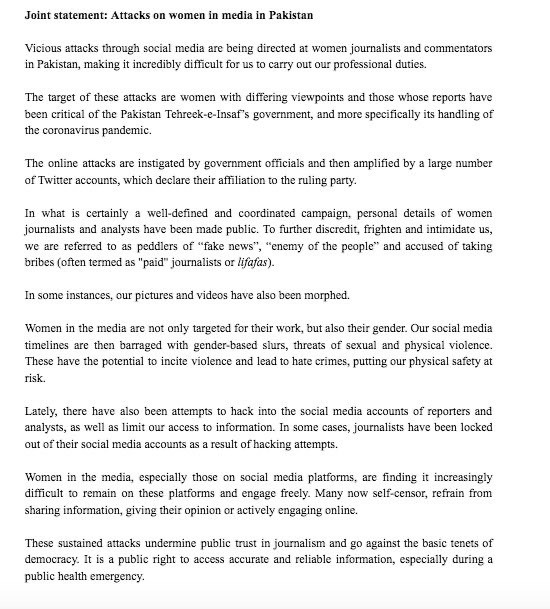
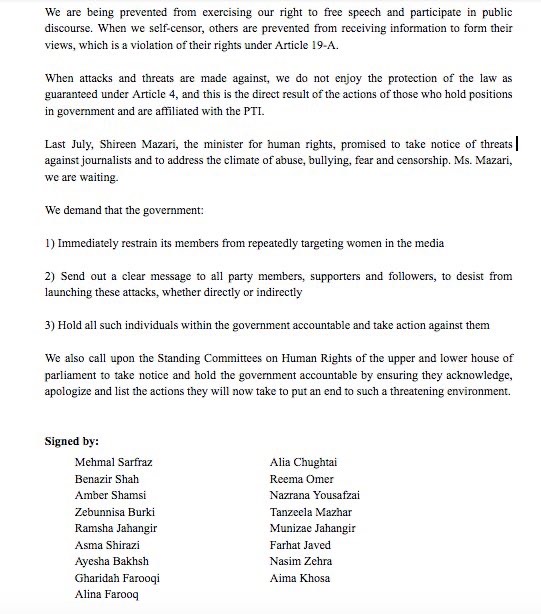
'جمہوریت پسند خواتین صحافیوں کو زیادہ نشانہ بنایا جا رہا ہے'

مونا خان نامہ نگار @mona_qau 

پاکستانی میڈیا میں کام کرنے والی خواتین صحافیوں نے کہا ہے کہ سوشل میڈیا پر ان کی کردار کشی کی جاتی ہے، ٹرول کیا جاتا ہے، ڈرایا دھمکایا جاتا ہے اور ان کے خلاف منظم مہم چلائی جاتی ہے، جس کی وجہ سے ان کا آزاد رائے کا اظہار مشکل ہو گیا ہے۔


پاکستانی میڈیا میں کام کرنے والی سرکردہ خواتین صحافیوں نے کہا ہے کہ سوشل میڈیا پر ان کی کردار کشی کی جاتی ہے، ٹرول کیا جاتا ہے، ڈرایا دھمکایا جاتا ہے اور ان کے خلاف منظم مہم چلائی جاتی ہے، جس کی وجہ سے ان کا آزاد رائے کا اظہار مشکل ہو گیا ہے۔

'ویمن اِن میڈیا' نے بدھ کو سوشل میڈیا پر ایک خط میں تفصیلاً بتایا کہ انہیں کن مشکلات کا سامنا ہے۔ خط میں حکومت سے مطالبہ کیا گیا ہے کہ ایسے عناصر کو روکا جائے جو خواتین صحافیوں کو کسی بھی طریقے سے ہراساں کرنے کے مرتکب ہوں۔
 خط میں یہ بھی کہا گیا کہ تمام سیاسی جماعتیں اپنے فالوورز اور سپورٹرز کو پیغام دیں کہ وہ 'غیر اخلاقی' حرکات کرنے سے گریز کریں۔ خط میں قومی اسمبلی کی قائمہ کمیٹی برائے انسانی حقوق کو نوٹس لینے کی بھی استدعا کی گئی ہے۔

یہ خط اور اس حوالے سے ایک ہیش ٹیگ آج صبح سے ٹوئٹر پر ٹرینڈ میں ہے اور لوگ اس حوالے سے مختلف تبصرے کر رہے ہیں۔ پاکستان پیپلز پارٹی (پی پی پی) کے چیئرمین بلاول بھٹو زرداری نے خواتین صحافیوں کے خط پر ردعمل دیتے ہوئے کہا کہ 'بطور چیئرمین قائمہ کمیٹی برائے انسانی حقوق، میں نے اس معاملے کا نوٹس لیتے ہوئے خواتین صحافیوں کی نمائندوں کو کمیٹی کے آئندہ اجلاس میں طلب کیا ہے تاکہ وہ اپنے تحفظات سے آگاہ کر سکیں۔'
دوسری جانب وفاقی وزیر برائے انسانی حقوق شیریں مزاری نے اپنی ٹویٹ میں خواتین صحافیوں کو درپیش اس مسئلے کو 'افسوس ناک' قرار دیتے ہوئے کہا کہ 'اس ضمن میں وزیر اطلاعات سے بات کی ہے کہ صحافیوں کے تحفظ سے متعلق بل کو ترجیحی بنیادوں پر فعال کیا جائے۔'
انہوں نے مزید کہا کہ 'جنس کی بنیاد پر خواتین صحافیوں کی کردار کشی اور حملے ناقابل قبول ہیں اور آئین و قانون بھی اس بات کی اجازت نہیں دیتا۔'
سینیٹر شیری رحمٰن نے بھی اپنے پیغام میں کہا کہ 'سوشل میڈیا پر خواتین صحافیوں پر حملوں کے محرکات دیکھنے کی ضرورت ہے اور اس ضمن میں سینیٹ کی قائمہ کمیٹی برائے انسانی حقوق معاملے کا نوٹس لے گی۔'
اس حوالے سے سینیئر صحافی عاصمہ شیرازی نے انڈپینڈنٹ اردو سے بات کرتے ہوئے کہا کہ 'جمہوریت پسند خواتین صحافیوں کو زیادہ نشانہ بنایا جاتا ہے جس کی وجہ سے وہ محسوس کرتی ہیں کہ اس معاملے کو سامنے لایا جائے تاکہ وہ بات کرتے ہوئے خوف میں مبتلا نہ ہوں۔'
انہوں نے سوال اٹھایا کہ 'کب تک منظم مہم کو برداشت کیا جا سکتا ہے؟ صرف حکومت پر تنقیدی آوازوں کو نشانہ بنایا جا رہا ہے اس لیے اب آواز اٹھانی ہو گی۔'
عاصمہ شیرازی نے مزید کہا کہ 'آئے دن سوشل میڈیا پر خواتین صحافیوں کے خلاف کردار کشی، ہراسانی اور گالم گلوچ کی مہم نہ تو خواتین کو ڈرا سکتی ہیں اور نہ ہی انہیں سچ کہنے سے روک سکتی ہیں۔'
دیگر خواتین صحافیوں نے بھی ٹوئٹر پر اپنے خیالات کا اظہار کیا۔ جیو نیوز کی اینکر علینہ فاروق شائق کہتی ہیں کہ 'سوال کا جواب بد زبانی، گالی، ذاتی حملے اور ٹرولز کے ذریعے ہراساں کرنا نہیں ہوتا لیکن بدقسمتی سے ہمارے ہاں خواتین میڈیا ورکرز کو بہادری سے یہ برداشت کرنا پڑتا ہے۔ روز بروز یہ رجحان بڑھتا چلا جا رہا ہے اور اب ہمارے کام میں رکاوٹ بن رہا ہے، لیکن ہم ڈٹے رہیں گے۔'

ذمہ داری کسی کی بھی ہو،کراچی کے مسائل ہم حل کرینگے، بلاول بھٹو

پاکستان پیپلز پارٹی کے چیئرمین بلاول بھٹو زرداری نے کہاہے کہ صوبوں کو
وسائل کی کمی کا سامنا ہے، جائز حق نہیں مل رہا، پیپلزپارٹی سندھ کے دارالحکومت اور اس کے عوام کے ساتھ مخلص ہے، ذمہ داری کسی کی بھی ہو لیکن ہم نمائندے بن کر مسائل حل کریں گے کیونکہ ہم جانتے ہیں کہ ایک بیان سے کام نہیں ہوتا بلکہ محنت کرنا پڑتی ہے۔ملیر میں نیبرہڈ منصوبے کا 30 ستمبر کو افتتاح کرینگے۔وہ سندھ سیکرٹریٹ کے قریب پیپلزاسکوائرکی افتتاحی تقریب سے خطاب کررہے تھے۔وزیر اعلی ٰسندھ سید مراد علی شاہ،صوبائی وزرا سعید غنی ، سید ناصر شاہ ، مشیر مرتضی وہاب ، چیف سیکرٹری ممتاز شاہ ، چیئرمین پی اینڈ ڈی محمد وسیم ، صوبائی سکر یٹریز نے بھی افتتاحی تقریب میں شرکت کی۔جبکہ ورلڈ بینک گروپ کے کنٹری ڈائریکٹر مسٹر ناجے بین ایسن اور اسلام آباد اور واشنگٹن ڈی سی کے نمائندوں نے آن لائن تقریب میں شرکت کی۔بلاول بھٹو زرداری نے مزید کہا کہ سندھ حکومت کو وفاق پیسے نہیں دے رہا، اب ورلڈ بینک کے ساتھ مل کر انفرااسٹرکچر کو بہتر بنارہے ہیں، پیپلز اسکوائر کراچی کے عوام کے لیے تفریح کا بہترین ذریعہ ہے۔

Friday, August 14, 2020

Music Video - #JBalvin #UnDia #OneDay J. Balvin, Dua Lipa, Bad Bunny, Tainy - UN DIA (ONE DAY)

Video Report - Why is there still poverty in America? | The Economist

#USPS #TrumpPostOffice #UnitedStatesPostOffice: Obama: Trump is 'trying to kneecap' the postal service

Video Report - Trump Erroneously Calls Into Question Citizenship Of Another Non-White American Running For Office

#KamalaHarris - The Undertold, Undersold Story of Kamala Harris

By Frank Bruni
As a prosecutor, she can make you tremble. But as a trailblazer can she make you cry?

When I saw on Wednesday morning that Kamala Harris had released a short video marking and celebrating her selection as Joe Biden’s running mate, I clicked — eagerly and instantly. I wanted to continue riding my wave of excitement about all the firsts: first woman of color on a major party’s presidential ticket, first Black woman specifically, first Asian-American.
By the time I finished the video, that wave had crashed.
OK, that’s an overstatement. But as I listened to her flat, desultory recitation of her biography and philosophy, I did feel a sense of frustration, and it was familiar. I’d wrestled with the same letdown during the Democratic primary, when the experience of Harris didn’t live up to the idea of Harris. She often skipped or skimmed over facets of her background that she would have benefited from dwelling on. She frequently zoomed past the poetry to the prose, more a steely lawyer rattling off lists than a soulful leader serving up inspiration.
Harris the prosecutor can find the holes in your argument and make you tremble. But can Harris the history-making vice-presidential candidate find the cracks in your heart and make you cry?
That’s certainly not a requirement — most politicians not named Barack Obama fail to do that — and I’m not complaining per se. As I wrote when the news broke, her presence on the Democratic ticket makes total sense in terms of the experience that she possesses, the values that she represents and the contrast that she helps Biden draw between his politics of inclusion and Donald Trump’s politics of division.
I’m articulating a wish, one that’s tied to my belief that a decent future for this country hinges on an end to Trump’s presidency and my concern that Biden and Harris use every arrow in their quivers to defeat him. I’m venting a worry that Harris doesn’t fully use one of her arrows. She did poorly in the Democratic primary because, yes, her campaign was a mess. But she also did poorly because she never discovered the right, stirring way to tell and sell her story.
I want her to discover it on Wednesday night, when she speaks at the Democratic National Convention (or however we’re describing its virtual facsimile). I want her to hold on to it between then and Nov. 3, because I want to call her the vice president of the United States soon after that.
Although Trump would cringe at the following thought and never understand it, Harris reflects this country’s ideals and its reality much better than he does. “Her story’s America’s story,” Biden said when he and she first appeared together as running mates on Wednesday afternoon. He’s right, and I want her to embrace that and flesh it out at every turn.
She’s the biracial daughter of immigrants: Jamaican father, Indian mother, both beckoned to this country of newcomers and transplants. Growing up in California’s Bay Area, she was bused to an elementary school in a richer, whiter neighborhood than her own, so she knows the fact of segregation and the dream of integration from the road she traveled.
She understands how families, despite their best intentions, fray. Her parents divorced, and when her mother found teaching and research work in Montreal, she moved for her middle and high school years to that largely white, French-speaking city. For college she went to Howard, a historically Black university in Washington, D.C., that allowed her to appraise America — its past, present and future — from a different vantage point. From there she forged her own path, with her own rules. She didn’t marry until she was 49. Her husband is white and Jewish and she’s a stepmother to his two children.
What a rich mix of influences: as multiracial, multiethnic and multicultural as the country in which her parents wisely invested their hopes. What a portrait of life as it’s lived, with all sorts of swerves.
In her public remarks she makes references to some of this, but they’re usually just that — references. After she mentioned school busing (“that little girl was me”) to attack Biden in a primary debate for his opposition to it, I went back and looked at the big speech that she’d given to kick off her presidential campaign. Busing was nowhere to be found. In fact her speech didn’t have all that much biographical detail, period, at least if you edited out the professional stuff. It was strikingly impersonal. I recently read much of her memoir, “The Truths We Hold: An American Journey,” published shortly before that speech, and came away with the same impression. She gives you less of her history than you expect, not more. She steers away from emotion, not toward it. Maybe that’s what a woman aiming for top jobs in a man’s world has to do. Maybe that’s even more incumbent on a woman of color. A scintilla too angry and you’re unhinged. A soupçon too misty and you’re unraveling.
It’s worth noting that when Representative Alexandria Ocasio-Cortez stood in the House last month to call out the misogynistic remarks of a male colleague, she twice stressed that she was speaking from the perspective of principle, not of upset. “I want to be clear that Representative Yoho’s comments were not deeply hurtful or piercing to me,” she said, adding that she was made of tougher stuff than that. She later reiterated that she “was not deeply hurt or offended.” To be at all emotional, she had to establish that she was unemotional.
A male lawmaker wouldn’t have felt that need. John Boehner, the House speaker from 2011 to 2015, certainly didn’t: He was famous for weeping at the drop of an amendment. If Nancy Pelosi behaved as soggily, she’d be savaged.
But in the book “The Firsts,” about the women who entered Congress in record-breaking numbers after the 2018 midterms, Jennifer Steinhauer of The Times notes that several of those newcomers did permit themselves to tear up at appropriate times — for example, when discussing an issue that had greatly affected them or their loved ones — and it came across as authentic, not weak. Maybe the world is changing for the better. Or maybe there’s more allowance for women in House seats than for women in even higher posts.
The Kamala Harris I’ve met and chatted with informally, in person, is warmer and more winning than the version I’ve watched on the stump. More transparent. More accessible.
And I saw flashes of her on Wednesday afternoon, during that appearance with Biden, when her huge smiles suggested that she couldn’t contain her exhilaration. She shouldn’t try. Her story is genuinely exhilarating.
Storytelling is everything. Trump won the presidency with a story about America that appealed to many Americans. It mixed imaginary villains with real ones, lies with truths. But he told it expansively. He told it effectively.
Obama’s rise was rooted in his own story, in the eloquence with which he spoke of Kenya and Kansas and how their commingling inside him was the American dream. I can’t count the number of times, on his path to the White House, that he put a lump in my throat.
Harris’s story is the rival of Obama’s. She just has to give it a comparably mythic shimmer. I know “that little girl” was her. But I want to know more about her, and I want to hear her voice.
https://www.nytimes.com/2020/08/14/opinion/kamala-harris-biden-2020.html?action=click&module=Opinion&pgtype=Homepage

احمد ظاهر - خدا بوَد یارت - Music Video

Video Report - #KhabarSayAagay Women Journalists Come Forward Against Online Abuse

Bilawal Bhutto Zardari inaugurates People’s Square in the heart of Sindh capital, Karachi

Chairman Pakistan People’s Party Bilawal Bhutto Zardari has said that the Federal government is not giving due share from its funds to the Sindh government, therefore, it has collaborated with the World Bank, under compulsion for improving certain key infrastructures in the province, especially in provincial capital.

PPP Chairman inaugurated People’s Square, a public place and underground carparking near Sindh Secretariat for commuters, visitors to the Secretariat and the students of nearby historic educational institutes here today.
He said that  the people of the province would benefit from the People’s Square while the masterpieces of the architecture in the surroundings and the rest of the city as well would also be restored under this Neighbourhood Improvement Project with the assistance of the WB. The project has been named ‘The People’s Square. “We have focused on the solution. We will alleviate the problems of the people of Karachi by making plans in the style of People’s Square. Thanks to the 18th Amendment, financial powers have been assigned to the provinces constitutionally.  We will build such People’s Squares in every district of Sindh, “ he added.
He pointed out that Sindh government has fought the terrorists. The Sindh police and law enforcers have restored peace in Karachi, for which the citizens, police and rangers have sacrificed their blood and lives.
At the inaugural function of People’s Square, Sindh Chief Minister (CM) Syed Murad Ali Shah, his cabinet members Saeed Ghani, Syed Nasir Shah, Imtiaz Shaikh, Suhail Anwar Siyal, Advisor to CM Barrister Murtaza Wahab and other PPP leaders were present.
Both current and former WB Group Country Director spoke to the ceremony online.
Bilawal Bhutto Zardari while congratulating on Independence Day said that today we are celebrating special Independence Day in Karachi and inaugurating projects. I think this project is the beginning of a revolution to reduce the problems of the people of Karachi and to improve the governance of Karachi. The PPP has always paid attention to the problems of the people. We constantly complain that our provinces are being denied their due after the 18th amendment, due to which there is a lack of resources and people are facing difficulties in resolving their problems.
Bilawal Bhutto Zardaru further said that this project is our first phase as other similar projects are also underway in Malir and other districts of Karachi. A similar project would be launched at the Wazir Mansion in Kharadar where Quaid-e Azam Muhammad Ali Jinnah was born and appreciated that Sindh government plants to put sewerage and other utility services networks underground throughout Karachi to protect the historic sites and the people. We are working for the reduction in problems.
Bilawal Bhutto Zardari said that the PPP has a very old relationship of close attachment with Karachi as Shaheed Zulfikar Ali Bhutto used to teach law at SM Law College and we would also develop Kakri Ground in Lyari where the marriage reception of Shaheed Mohtarma Benazir Bhutto and Asif Ali Zardari was held.  We believe that if Karachi develops then not only Sindh province but the whole of Pakistan will develop but there are problems and difficulties. We would manage the funds ourselves and the Sindh Board of Revenue achieved its target even during the Coronavirus outbreak in the country. However, the Federal Board of Revenue (FBR) failed but we want the local governments to also increase their revenue.
He said that PPP is sincere with the capital of Sindh and its people, whoever has the responsibility but we will solve the problems by becoming representatives because we know that one’s statements dont work but one has to work hard. The long standing problems of Karachi could be solved together and slowly because the PPP had found Karachi where terrorists from all over the world were operating here and local thugs had also an abetting role.  The security forces and Police in Karachi have made the greatest sacrifices against terrorism and the citizens here have restored the lights by sacrificing blood and now such an environment has been created for such projects to start.
He said that we respect the mandate of local governments; we are the only province where the local government will complete its term in the same month which is history. Imran Khan abolished local government in Punjab but we did not.
Bilawal Bhutto Zardari said that the term of local government is coming to an end and then elections will be held. Sindh government will work at the forefront to solve the problems.
He said that Imran Khan’s government has done nothing for the people of Karachi except lip service. He promised but did not fulfill a single promise, did not give a job and did not build 5 million houses here, and did not complete a single project despite the promise of water supply project.
Reiterating his commitment to projects in Karachi, he said that the federal government has not come up with a single new project for the city but we are starting from today and this is the first phase of projects in the city in collaboration with the WB then in each district we will build People’s Square. We will solve the problems of the people by investing in their infrastructure.
He appealed to the people to support the PPP and said that if we walk together, work together and struggle together, we can give this city its due rights and restore its past glory.

https://www.ppp.org.pk/2020/08/14/bilawal-bhutto-zardari-inaugurates-peoples-square-in-the-heart-of-sindh-capital-karachi/