Friday, August 14, 2020

Bajwa may be trying to smooth things with Saudis, but Imran Khan dreams of Neo-Ottoman world.


Saudi Arabia has always bailed out Pakistan and given job opportunities. But now Imran Khan’s government is giving it ultimatums and living in a fantasy world.

Pakistan’s army chief, General Qamar Javed Bajwa, is set to visit Saudi Arabia in an effort to end the recent tiff between the partner countries. Foreign minister Shah Mehmood Qureshi had brought disagreements between Riyadh and Islamabad out in the open by issuing an ultimatum demanding the Saudis call a meeting of the Organisation of Islamic Cooperation on the Kashmir issue.
Pakistan has been dependent on Saudi Arabia for years, seeking economic bailouts and jobs for unskilled workers whose remittances help Islamabad’s perennial balance of payments difficulties. But now, miffed Saudis are asking for the immediate return of short-term loans and have dragged their feet over completing an oil deal that ensures flow of oil to Pakistan on concessional terms.
General Bajwa’s intervention to stop the drift in ties affirms the realisation that Pakistan simply can’t afford to alienate the Saudis. Why, then, did Qureshi engage in anti-Saudi rhetoric that was unsustainable? To understand that requires an examination of the overly simplistic populism of Prime Minister Imran Khan and his backers, and the fantasy of many Pakistanis about an altered global order, with Pakistan at its center.
Another Great Game
For decades, especially since the collapse of the Soviet Union in 1991, retired Pakistani generals and civilian writers on strategic issues have spoken about a ‘new Great Game’ in South and Central Asia that would make Pakistan a geopolitical ‘pivot’.
This was an adaptation of British geographer Halford Mackinder’s heartland theory, submitted in 1904 when Pakistan did not exist, the United States was not yet a superpower, and airpower or the military applications of satellite and cyber technologies could not be imagined.
Pakistan’s pre-9/11 involvement in Afghanistan, its support for jihadi militants as an instrument of asymmetric warfare, and its close ties with China were all explained as part of the grand strategy to capitalise on Pakistan’s strategic location and make it a bigger player on the world stage.
Some Americans dismissed it as ‘a grand illusion’, especially in the immediate aftermath of 9/11, which forced Pakistan to seek an alliance with the United States once again. But the theory of Pakistan’s inevitable greatness, notwithstanding its economic problems and its constant dependence on outside powers, has persisted among Pakistanis.
Pakistan at the center
The impending withdrawal of US forces from Afghanistan, the prospect of a return to power of the Taliban, and the commitment of an economically stronger China, have all played a role in cementing the view that Pakistan would emerge as a key player in a new global order.
According to this outlook, Pakistan benefits from the impending decline of the United States and the rise of China as a global superpower. The China-Pakistan Economic Corridor (CPEC) might add to Pakistan’s debt but it also attaches Pakistan and China at the hip. And the two countries share hostility towards India, a country the US and other Western nations see as an ally in their imminent confrontation with an aggressive, totalitarian China.
Believers in Pakistan’s inevitable strategic salience expect that after Afghanistan, the US will also withdraw gradually from the Middle East. In their imagination, Pakistan would then be China’s link to the Middle East, making it Beijing’s go-to satrap in tapping Middle East oil and securing Gulf shipping lanes.
The hope is that Pakistan can then fulfil its old dreams of exercising paramountcy over Afghanistan, resolving disputes with India (including Kashmir) on its terms, and finding its rightful place as the Muslim world’s natural leader and sole nuclear weapons power. Such fanciful thinking is championed by several influential voices, including Prime Minister Imran Khan and his followers. Their allies in Pakistan’s deep state and permanent establishment see value in these ideas for building a more positive national narrative. But they are probably a little more pragmatic in understanding the gap between hopes and reality.
A new Ertugrul
These days, Pakistan’s television commentators frequently talk about the country’s forthcoming grand role in a China-Russia-Turkey-Iran-Pakistan alliance that is destined to defeat the US-Israel-India partnership. Iran’s ambassador to Pakistan has encouraged discussions about this five-country alliance, ignoring the various issues that might hinder cooperation among this diverse grouping. It is not unusual to read in a Pakistani newspaper about the post-Covid world order that would be based on the dreams of Pakistani Islamo-nationalists.The rhetoric in Pakistan is not dissimilar to the neo-Ottoman bombast of Turkey’s Islamist President, Recip Tayyip Erdogan, which ignores Turkey’s currently weak economic prospects.

Imran Khan is a huge Erdogan fan and purveys pan-Islamism as the panacea, not only for Pakistan but for the entire ummah.Pakistan has long embraced pan-Islamism, but it was more a device to address the identity crisis of a nation that was carved out only 73 years ago and conceived just shortly before that. Most Pakistani leaders understood the limits of Islamic unity and allied with the West for economic and security reasons. But Imran Khan seems to believe his own rhetoric.
The cricketer-turned-politician has encouraged Pakistanis to watch a Turkish drama serial Ertugrul, supposedly based on the life of the father of the Ottoman dynasty’s founder, Osman.
Historic records about Ertugrul are scant but the show’s producers and story writers have stretched the few sketchy historic references into a 150-episode period drama.
The show portrays its hero as a great Muslim warrior who overcomes external enemies and domestic traitors to emerge victorious in an early phase of what Erdogan once described as the ongoing “struggle between the crescent and the cross.”
It seems that Imran Khan shares Erdogan’s vision, with the additional twist of putting Pakistan in a more important role in bringing down the West in addition to winning its own battles against Hindu India.
A make-believe world
No one should be fooled by Imran Khan’s external Westernisation to think that his description in parliament of al Qaeda leader Osama bin Laden as a ‘martyr’ was a slip of tongue. It reflects a worldview that has significant support among Pakistanis.
In this backdrop, Imran Khan and his followers do not see Saudi Arabia’s current leader crown prince Mohammed bin Salman as an ally in their Islamist Neo-Ottoman fantasy world, which they hope to create with China’s help.The Saudis now oppose the Islamist ‘Muslim Brotherhood’, maintain good relations with India, and are not willing to engage in knee-jerk opposition of Israel. That upsets Imran Khan as much as it offends Erdogan.Khan engaged with the Kingdom because of Pakistan’s transactional needs, just as he temporarily took off his anti-American cloak to befriend President Donald Trump. But in his heart, and that of most of his supporters, lies the desire for a make-believe global order in which China dominates the world but allows Muslims to remain ascendant in their heartland.
The Uyghurs of China may have a thing or two to teach Pakistan’s armchair jihadis about China’s tolerance for Islam and Muslims. But for now, Khan’s eyes are closed and his foreign minister’s grandiloquence at its peak.
Meanwhile, reality requires that General Bajwa continue to engage in damage control missions like the one he is undertaking to Riyadh now.
https://theprint.in/opinion/bajwa-going-to-saudis-but-imran-khan-dreams-of-neo-ottoman-world/481107/

Opinion: Saudi Arabia's Shocking Snub From Pakistan Is a Bonanza for China and Turkey

Kunwar Khuldune Shahid
Pakistan’s foreign policy has a rule: Say yes to whatever comes out of a Saudi mouth. But last week, Pakistan slapped back. Why? And who will it really benefit? Pakistan’s Foreign Minister Shah Mehmood Qureshi recently launched a shocking broadside at Saudi Arabia, the Gulf state with whom Islamabad has become increasingly close, let alone dependent on.It was a sign of a new configuration in Pakistan’s foreign and economic policies which will have far wider repercussions: the pivot away from Riyadh, towards China and Turkey, is a recognition of a new global cold war, whose most explosive faultlines will include the border between Pakistan and India.
Marking the anniversary of India revoking Kashmir’s special status last week, Qureshi issued a stark and unprecedented warning to Saudi Arabia and the Organization of Islamic Cooperation (OIC). He demanded Riyadh categorically support Pakistan’s position on the long-disputed territory of Kashmir, threatening that inaction would force Islamabad to ally with other Muslim states over an issue that Pakistan has long framed as a "genocide of Muslims."


Riyadh retaliated immediately, insisting Pakistan repay $1 billion for oil supplies that had previously been repaid in deferred payments. Who stepped in cover the debt with a last-minute loan? China. Six days after Qureshi’s TV offensive, Riyadh ended the loan and oil supply to Islamabad, despite Pakistan’s repeated requests for the renewal of the facility. Such was the magnitude of what Qureshi had said that anything barring his sacking would mean that the state – which in Pakistan translates into the all-powerful military, with complete control over its foreign policy – is fully behind the foreign minister’s claim, even if it is not clear if Pakistan thought through all the repercussions.
A week on, while the opposition parties have opportunistically looked to cash in on the apparent diplomatic curveball, the government’s own reaction has been to talk up relations with Saudi Arabia. But it has pointedly refused to backtrack on the foreign minister’s statement, maintaining that Pakistan would always "protect its interests."

Thursday, August 13, 2020

Video - #DailyShow #TrevorNoah #KamalaHarris Kamala Harris: The Person, the Politician…and the Chef?

Video - #DailyShow #TrevorNoah #KamalaHarris Trump and Fox News Struggle to Attack Kamala

Video Report - #2020Elections - Joe Biden says all governors should mandate masks for 3 months

Video Report - #KamalaHarris Why Joe Biden picked Kamala Harris as his VP

Video Report - #Biden #US Will Kamala Harris help Joe Biden's bid for the White House?

PPP to oppose attempts to turn Karachi into colony of PTI’s Federal government adding that judicial cover to such unconstitutional step would be tantamount to attack on Sindh: Chairman PPP Bilawal Bhutto Zardari

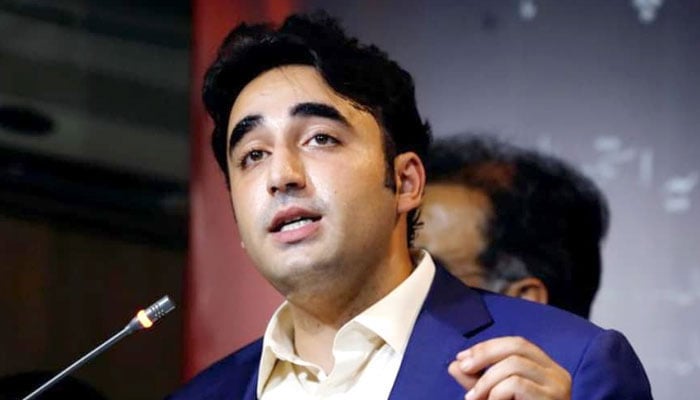
Chairman Pakistan People’s Party Bilawal Bhutto Zardari has said that his Party would vehemently oppose PTIs Federal government if it makes attempts to make Karachi a federal colony warning that if any unconstitutional step related to the Provincial Capital gets judicial cover would be tantamount to an attack on Sindh.
Addressing a press conference at Sindh Assembly building, the PPP Chairman said that instead of uniting the nation during the Coronavirus pandemic, the government is trying to snatch away the resources of the people adding that PPP’s choice had been clear since its inception as we prefer people and their rights over power, motherland over government. Our leadership walked proudly to the gallows instead of compromising on people’s rights and national interests in the past and the legacy lives on even today. “Whenever it comes to national importance, the PPP has worked for the national interest by keeping politics above the fold,” he stated at the press conference attended among others by Chief Minister Murad Ali Shah and his cabinet members Syed Nasir Shah, Saeed Ghani, Murtaza Wahab and MPA Munawar Wassan.
He said that the root of all current problems in Sindh is the result of it not getting the due share of NFC continuously as other provinces have also not been given their right. Last year, there were talks of a reduction of Rs.116 billion from the share of Sindh and this year, the share has been reduced by more than Rs.200 billion and this is being done continuously with every province.
PPP Chairman pointed out that after the 18th Amendment the provinces have been given more work and responsibilities, so the share of the NFC should be increased for further improvement in the lives of the people. “If more share is given in NFC then work will be done for the betterment of public health, education, local government and other systems but the Federal government is not ready to give that right,” he added.
He said that every time when nations go through a disaster, a global pandemic, be it the presidential, parliamentary or any other system, they stand united whatever the system of government be, the nations are united on issues like Coronavirus and monsoon floods and where there are problems, they try to help each other. “Unfortunately, even in a pandemic situation like Coronavirus in Pakistan, the rights of the people are being snatched and seeds of disunity are being sown,” he stated.
Bilawal Bhutto Zardari further said that when the unprecedented monsoon rains hit this province, which had not occurred in 10 years, caused problems in Karachi like Ghotki, Thatta and other areas, it is a matter of concern for him. “We all went through a crisis and another spell of rain came after which the Federal government thought that maybe there is a crisis in the capital of Sindh. We are very grateful to the National Disaster Management Authority (NDMA).”  He said that when the people are in trouble, the intention of the Federal government should be clear, but it is unfortunate that for the people of this province, the efforts of the PTI government look malicious.
PPP Chairman said that this is not the way politics is played during national disasters and crises. How can we deprive the people of their rights when they are going through misery? How can we take resources from them in these difficult times? Such approaches will harm national unity adding that whenever it comes to national importance, the PPP has always worked for the national interest by keeping politics above the fold.
Bilawal  Bhutto Zardari said PPP always remains in the forefront on national issues and it would severely oppose and resist PTI regime’s attempts to turn Karachi into an Islamabad’s colony. Any unconstitutional step for Sindh’s capital would not be tolerated and the people would consider it as as attack on Sindh if such unconstitutional step was given judicial cover because the wounds of the judicial murder of Shaheed Zulfikar Ali Bhutto have not healed even today and hoped that no such move will be made because the country cannot invite more trouble.
He said that undemocratic people wanted power by using the name of FATF, which could have become a black law, but we played a role and made it a positive one through our share in it and thus the law was improved. He categorically stated that the PPP would oppose any bill other than FATF and the protest was on that the members of the Assembly were not given time to read the bill adding that the three other bills presented in Parliament didn’t pertain to FATF.

https://www.ppp.org.pk/2020/08/13/ppp-to-oppose-attempts-to-turn-karachi-into-colony-of-ptis-federal-government-adding-that-judicial-cover-to-such-unconstitutional-step-would-be-tantamount-to-attack-on-sindh-chairman-ppp-bil/

What’s Pakistan without Saudi loan, oil and free royal jet rides for Imran Khan?


Pakistan was asked to repay $1bn of the Saudi loan, which it did by borrowing from China, but Qureshi called it an economic favor to the Arab nation in Covid-19.

If only Pakistani diplomacy was like Ertugrul drama series. Foreign Minister Shah Mahmood Qureshi is definitely not playing a warrior who can conquer nations with a sword. Or in his case, with words. Just ask the Pakistani Army Chief Qamar Javed Bajwa who now has to pick up the pieces and fix the mess Quereshi has created with Saudi Arabia.
There is loan, there is oil. And what is Pakistan without Saudi loans and oil? Well, there is always Kashmir, of course.
In a charged Kashmir-lost-and-not-found atmosphere on 5 August 2020, Quereshi threatened Saudi Arabia-led Organisation of Islamic Countries (OIC) that if Kashmir is not taken up at the ministerial level, then Pakistan will move forward “with or without” the Saudis. He was hinting at the Malaysian-Iranian-Turkish Muslim bloc that has been vocal on Kashmir post abrogation of Article 370 by India last year. His statement was a result of a year-long Pakistani frustration at not getting its way on Kashmir in the OIC because of India’s economic clout.
Pakistan was asked to repay $1billion of the Saudi loan, which it did by borrowing from China, but before Qureshi called it an economic favour to Saudi Arabia in the Covid-19 pandemic. Really? Pakistan donating money to Saudi Arabia is a bigger insult to the desert kingdom than forging another OIC without them. And, what’s worse, ARY News channel and its social media platforms censored foreign minister Qureshi by taking his comments down.
Pakistan, leader of Islamic ummah?
Pakistan nurses the grand delusion of being a self-proclaimed leader of Islamic ummah because it is a nuclear power. Pakistan believes it can mediate between Iran and Saudi Arabia, or can even smooth things up between the US and Iran, or end the war in Yemen. Like how? When you don’t have a penny in the pocket but you want to take up others’ causes instead of fixing your own house.
But after Quereshi’s outburst against Saudi Arabia, will the free rides in the Saudi crown prince Mohammed bin Salman’s personal jet come to an end for Pakistan Prime Minister Imran Khan? Or will this incident be another slap on the wrist, like one in Kuala Lumpur last year for trying to be part of an Islamic coalition?
But the more important question is: will the other Islamic brother-countries, like Turkey or Malaysia, pick up the tab for self-styled leader of Muslim world, Pakistan, the way Saudis did?
The Pakistan-Saudi bonding
It was in 2018 that the cash-strapped government of Imran Khan was extended a $6.2 billion package by Saudi Arabia. This included $3 billion in loans and oil on deferred payments worth $3.2 billion. These deals were sealed during the much-hyped visit of Crown Prince Mohammed bin Salman to Pakistan last February. Now, Saudi Arabia has stopped the oil supply after the deferred payments deal expired.
For decades, Pakistan relied on Saudi Arabia financially and it used the religious and cultural front to boost those ties. During the February 2019 visit when the Imran-MBS bromance was peaking, PM himself had driven the crown prince from the airport. Khan had told MBS that he was so popular in Pakistan that he could win an election here. Lucky us. Not holding back in niceties, the Crown Prince declared himself an ambassador of Pakistan in Saudi Arabia. Couldn’t believe the nation’s luck. Later, both were seen in a horse-drawn carriage, giving an image of happily-ever-afters. But then, there are no happily-ever-afters in real life.
The Pakistani journalists who had put up the photo of slain Saudi journalist Jamal Khashoggi as their Twitter display pictures to show solidarity were hounded by the Pakistani government agencies for leading a social media campaign against the royal Saudi guest. Those were the days. Pakistan couldn’t tolerate such insult to the Kingdom. PM Imran Khan had his priorities clear: Pakistan was desperate and the government needed Saudi loans to avoid defaulting. Khan had attended the 2018 Riyadh investment summit even when several others had dropped out. Every country watches its own political and economic interests first, but for some strange reason, Pakistan thinks every country should put their ‘Kashmir banega Pakistan’ interest first.
Muslim lives matter, but not in China
Imran Khan and his government stays silent over the persecution of Uighurs Muslims in China. Khan chooses to turn the other way saying: ‘Frankly, I don’t know much about it’. The reason for Pakistan’s silence over Uighurs is simple: China is a benefactor, you cannot offend China. Pakistan is indebted to China so the passion for ‘Muslim lives matter’ doesn’t apply here. Unfortunately, that is how human rights issues work.
Similarly, Saudi Arabia has economic interests in India. For Saudis, India is a viable economic partner, not a country that depends on it for bailout packages. And that Saudi Arabia is India’s fourth-largest trade partner doesn’t help Pakistan’s cause either. Same applies to Gulf countries, like the United Arab Emirates and Qatar, who also by the way, have generously extended loans to Pakistan. But the claims that Imran Khan would never ask for bheek and prefer to commit suicide over it never stand because that is exactly what Pakistan has done for survival. Beggars can’t be equal partners.
https://theprint.in/opinion/letter-from-pakistan/whats-pakistan-without-saudi-loan-oil-and-free-royal-jet-rides-for-imran-khan/480517/

Opinion: Qureshi’s Saudi criticism on Kashmir hints shift in Pakistan’s strategy for the Islamic world


SUSHANT SAREEN
20 years ago, during a meeting at the PPP office in Islamabad, Qureshi had told this writer that he was from Multan where Kashmir had no resonance.

Pakistan’s Foreign Minister Shah Mahmood Qureshi seemed hellbent on demolishing one of the pillars of his country’s foreign policy when he openly threatened Saudi Arabia to either lead the Muslim ummah and OIC against India’s constitutional reforms in Jammu and Kashmir, or else he would be left with no choice but to advise his prime minister, who has proclaimed himself as the ‘Ambassador of Kashmir’, that Pakistan must move forward and call a session of all those Islamic countries that are ready to stand with Pakistan on the Kashmir issue, “with or without” the Saudis. The unusually harsh tone of Qureshi against the Saudis, and all his dramatics – contorting his face and speaking in his usual affected manner – against a country that has for decades been a benefactor of a basket case that Pakistan has become is likely to hold serious implications, not just on Saudi-Pakistan relations, but also on Qureshi’s own political career.
Although Qureshi was quite clear that his strident stand against the Saudi’s was his personal opinion, it was endorsed by Pakistan’s foreign office which said that the minister’s statement was “a reflection of people’s aspirations and expectations from the OIC to take forward the dispute of Jammu & Kashmir internationally.” A day after his initial outburst, Qureshi softened his tone and tenor on Saudi Arabia. In a subsequent interview, even as he bent over backward to express gratitude for everything the Saudis had done for Pakistan, he clarified that because Pakistan considered Saudi Arabia as their own, a brother country, it felt entitled to remonstrate against them, something they wouldn’t do with any other country. There are reports that efforts were being made on the back channel to ensure that damage was controlled. Later, a meeting took place between the real ruler of Pakistan, Army Chief Gen Qamar Javed Bajwa and the Saudi Ambassador, and it has been revealed that Bajwa might be visiting Riyadh to smoothen ruffled feathers. While he is in Riyadh, it is expected that Bajwa will most likely push the envelope on not just seeking Saudi support in OIC on Kashmir but also a restoration of the $3.2 billion Saudi deferred oil facility which hasn’t been renewed, and appeal the Saudis to not demand the $3 billion they had loaned Pakistan for Balance of Payments support. The Saudis asking the Pakistanis to pay back what they have borrowed is a big deal because until now it has mostly been a free ride for the Pakistanis – the loans they take are never repaid to the Saudis. If now the Saudis are asking their money back, it isn’t because of the Saudi economic crisis but because of some serious strains in the bilateral relationship.
Clearly, there is something happening in the Saudi-Pakistan relationship that doesn’t quite add up. Qureshi is no green horn like many other members of Imran Khan’s cabinet. As a seasoned politician, he isn’t given to making emotional outbursts, unless of course it is with a purpose. All his pretensions of being deeply disturbed about Kashmir are only that. Around 20 years back, during a meeting at the PPP office in Islamabad, Qureshi told this writer that he was from Multan where Kashmir had no resonance and that it was an obsession only in the Raiwind to Rawalpindi belt of Punjab. Now suddenly, if he is pretending to be a bleeding heart on Kashmir, it isn’t out of love for the Kashmiris but more to peddle some agenda. This could be a personal political agenda – positioning himself as a crusader on Kashmir who is pushing for stronger domestic and international action.
Such a strident stand would burnish his ‘patriotic’ credentials and present him as an acceptable alternative to Imran Khan, if and when Imran’s ‘selectors’ decide to replace him. If his gambit succeeds, he will get credit for a robust policy on Kashmir; if he becomes the fall guy, he can present himself as a martyr to the Kashmir ‘cause’. He tried to pull something similar nearly ten years back when he rebelled against his own government on the Raymond Davis case in 2011. At that time too he was said to have been put up to play spoiler by the men in Khaki. And quite like in 2011, this time too there are rumours about the longevity of the Imran Khan government and for months there has been talk of Qureshi trying to manoeuvre himself as a possible replacement of Imran Khan. This is the Bhutto-in-Tashkent model. The problem is that it worked for Zulfikar Ali Bhutto because he was a charismatic leader, something Qureshi isn’t. Qureshi lost his own provincial assembly seat in the 2018 election and at best has a following in a couple of constituencies, and that too because of his Gaddi as a spiritual leader of a shrine.
Of course, his overweening ambitions aside, Qureshi couldn’t have been behaving the loose cannon without someone really powerful – in Pakistan this only means the military – giving him the nod. There are two or three possible explanations.
The first explanation is that this was a trial balloon. The Pakistanis have been trying hard for an year to get the OIC to play a more pro-active role on Kashmir. But the Saudis, along with the UAE and a few other important Arab countries, haven’t shown much interest. They have fobbed off the Pakistanis by getting the OIC Contact Group to issue meaningless statements. While the Saudi’s are a member of this 5 nation group, the other members are Pakistan, Turkey, Niger and Azerbaijan. Needless to say, apart from the Saudis, and to an extent Turkey, all the other countries are quite inconsequential even in the Islamic bloc. The Saudis however have not allowed any mention of Kashmir in the Mecca Declaration of OIC, nor have they allowed an extraordinary session of OIC foreign ministers on Kashmir in Pakistan, something the Pakistanis have been pitching for rather desperately. Worse, the OIC invited the Indian foreign minister Sushma Swaraj as a guest of honour in UAE – the Pakistanis boycotted that session – in early 2019 after the Balakot attack. The Saudis, Bahrain and UAE have honoured Prime Minister Narendra Modi with their highest award – the last two countries did this after the constitutional reforms in Jammu and Kashmir last August. The Pakistanis were cut to the bone but continued to try for the foreign ministers meeting. It is now believed that through Qureshi, they have tried to rattle the cage. Issuing an ultimatum to the Saudis is a gamble. If it works, and the Saudis are pressured into doing Pakistan’s bidding, the Pakistanis can crow about their diplomatic success; if the Saudis react strongly, the Pakistanis can go on their knees and apologise profusely and blame it all on Qureshi, whom the Saudis don’t like much anyway because they see him as someone who earns his wealth from a grave – the shrine whose custodian he is.
The second possible explanation is that Qureshi was signalling the beginning of a shift of strategy in Pakistan’s playbook in the Islamic world. Most Pakistanis disparage the OIC as “Oh I see”, an organisation that really delivers nothing on the causes dear to the Islamic Ummah. For some time now, there have been stirrings to build an alternative Islamic bloc which isn’t tied to or tied down by the Arabs. Among the countries that appear keen on this new bloc are Iran, Turkey and Malaysia. Both Iran and Turkey have very strained relations with the Saudis, partly for historical, sectarian, cultural and ethnic reasons, and partly for geo-political reasons. In the Islamic world, the Arabs are the top dogs, the Persians and Turkic people form the second and third rung. Countries like Pakistan and Malaysia are the bureaucratic equivalent of Class IV employees of the Ummah (or in Pakistan’s bureaucratic parlance, the below Grade 10 employees). Last year, the Pakistanis along with other countries tried to sow the seeds of an alternative OIC when a proposal was floated for a global Islamic TV channel and a summit was organised in Kuala Lumpur, where one of the issues that would be highlighted was Kashmir. The Saudis however were furious. The Saudi Crown Prince, who had given his personal aircraft to Imran Khan to travel to the UN General Assembly, took back his plane, forcing Imran Khan to travel back in a commercial airliner. Later, the Saudis warned the Pakistanis that if they dared to do go ahead with Malaysia, not only would the Saudis cut off all financial support – they gave the Pakistanis $6.2 billion in 2018-19 – but also deport Pakistani workers (who send around $5 billion every year in remittances), and replace them with Bangladeshis. Imran Khan succumbed to the threat and did not go to Malaysia. But the cracks had already appeared in the relationship. The Pakistanis were not just cut up about the lack of support on Kashmir, but also the growing closeness between Saudi Arabia and India, both political and diplomatic, and also in security and economic domain. Over the last few years, the Saudi-India relationship has strengthened – Saudi have deported terrorists and fugitives to India, the economic relationship is burgeoning, the political ties are better than any time in the past. Not just the Saudis, but also with their close allies UAE, India’s relations have become extremely close and strong. This was Pakistan’s playground and now India was crowding them out.
Apart from the India factor, there were other problems that had started to emerge in the Pak-Saudi relationship. Pakistan’s refusal to join the Saudi-UAE forces in the Yemen operations in 2015 didn’t go down well with both the Arab countries. At that time, the Chinese were sinking in money into Pakistan under the CPEC project and Pakistan’s ailing economy was given a boost. With the Chinese keeping their back – Xi Jinping had reportedly assured Nawaz Sharif that the Pakistanis that China would stand behind them in the event its ties with the Arab world unravelled – the Pakistanis felt bold enough to say no to the Saudis. The Chinese also blocked Saudis becoming a strategic partner in CPEC, something that the Pakistanis had announced after Imran Khan’s visit to Riyadh in September 2018. The Pakistanis were also chary of getting dragged into the Saudi-Iran sectarian conflict because of its repercussions inside Pakistan. Add to this, Pakistan’s growing closeness with Turkey which was emerging as an important security partner for not just Pakistan’s overt but also covert wars especially against India. With the Saudi-Turk relationship, always a little testy, going into a tailspin as a result of the Khashoggi affair, the Saudis were never going to look kindly on any compact with the Turks and Iranians. But the Pakistanis might be feeling that the time had come to break loose from the Saudi strings and exercise strategic autonomy. At the very least, hold this as a threat to make the Saudis address their concerns.
The third explanation is a rather sinister one, but cannot entirely be ruled out given Pakistan’s propensity for adventurism. The Pakistanis have for long developed deep contacts in the Saudi system. Pakistani forces are stationed in Saudi Arabia, ostensibly for training and advisory purposes. Some reports even claim the Pakistanis are there to defend the royal family. Given the divisions inside Saudi Arabia, could the Pakistanis be part of a deeper conspiracy by some other faction of the royal family? Although it sounds a little far-fetched and quite speculative, could the Pakistanis be aware of something, or even be a part of some such plan to topple the Crown Prince Mohammad bin Salman? Even the slightest possibility of something like this would mean that the presence of Pakistani security personnel in Saudi Arabia constitutes a danger to the royal family which really needs to reconsider using a mercenary army for its protection. For the Pakistanis, despite MbS having arranged Imran Khan’s meeting with US President Donald Trump and promising big investments in Pakistan, his impetuousness and his outreach to India makes him very unreliable and raises questions over the future trajectory of Saudi-Pakistan relations. Clearly, they would prefer someone more conservative at the helm in Riyadh, someone who will stick to the old template in which Pakistan was the ‘most favoured nation’.
It is entirely possible that the Pakistanis will back down from taking on the Saudis. The economic, diplomatic and political implications of going against the Saudis extend to going against virtually the entire Gulf and other Arab states. But the cracks that were already visible have widened and while they might still be papered over for some more time, they are unlikely to be repaired completely. Can India make use of this opportunity to further strengthen its relations with the Saudis and other of its close allies like the UAE?

https://theprint.in/opinion/qureshis-saudi-criticism-on-kashmir-hints-shift-in-pakistans-strategy-for-the-islamic-world/480965/

‘Pakistan obsessed with irredentism’ — India’s response to Pak envoy interview Global Times rejected


India noted that 'administrative machinery of Jammu & Kashmir had been revived, bringing about a revolution in governance and making Kashmiri people masters of their own destiny'.

The Indian embassy in Beijing Thursday reiterated that Jammu and Kashmir is an integral part of India and that Pakistan has “no locus standi” in its internal affairs, and added that change is “sweeping through” the state.
The statement was in response to an interview of Pakistan’s new ambassador to Beijing, Moin ul Haque, that was published by Global Times, the state-run leading Chinese English daily.
In the article titled ‘Urgent actions on Jammu, Kashmir needed‘, published by the Global Times on 7 August 2020, Pakistan’s Ambassador to China, H.E. Moin ul Haque, has chosen to repeat Pakistan’s lies and half-truths vis-a-vis the Union Territory (UT) of Jammu and Kashmir (J&K), which is an integral part of India and whose affairs are internal affairs of India, where Pakistan, or any other country, has no locus standi. Ambassador Haque’s misrepresentations, while not surprising, cannot conceal the significant progress that J&K has made in the year following the abrogation of Article 370 of the Indian Constitution.
In the last one year since the historic decision on 05 August 2019, several positive and affirmative union laws have been extended to J&K, resulting in the more effective protection and promotion of social, economic and political rights, especially among under-privileged sections such as women, children and minorities. People have been afforded the opportunity to elect their representatives at the grassroots level through elections to the block development councils on 24 October 2019. The administrative machinery of the UT has been revived, grievance redressal mechanisms activated and funding to grassroots level institutions eased, bringing about a revolution in governance and making the Kashmiri people masters of their own destiny.
Evidence of the change sweeping through J&K can be seen in the creation of new education and health infrastructure and opportunities. Fifty new educational institutions were established in the region over the last one year, the largest addition in 70 years. Over half a million Kashmiri students have availed government scholarship schemes
through the course of the last one year, a year-on-year increase of nearly 400%. New health infrastructure, including medical and nursing colleges,
as well as state-of-the art hospitals, will soon make affordable and high quality healthcare services a reality in the region. The government of J&K has advertised 10,000 job openings for youth at all levels, with another 25,000 in the pipeline. Concerted efforts to attract foreign investment to the region have seen over 150 MOUs concluded. Rural market interventions and leveraging of IT have brought benefits to farmers in a region known for its apples and saffron. The focus on relieving hardships has brought water and electricity connections to nearly 300,000 households in some of the remotest areas of J&K.
India’s concerted efforts to bring peace, stability and progress to J&K stand in stark contrast to Pakistan’s strategy, which is little more than a blatant and rapacious campaign of cross-border terrorism aimed at debilitating the region. Its unprovoked ceasefire violations, numbering close to 3,000 in the first seven months of 2020 alone, provide support for terrorist infiltration along the India-Pakistan Line of Control (LOC).
Terrorists recruited, trained and armed by Pakistan have disturbed peace and order in J&K, with over 450 incidents of terrorist orchestrated violence taking place since August 2019, leading to several civilian casualties. And it is in fact Pakistan that has repeatedly effected administrative and demographic changes in territories that it has occupied illegally and forcibly in J&K and Ladakh. The Pakistani obsession with irredentist pursuits has also been laid bare in its latest exercise in political absurdity on 4 August 2020, when it made untenable claims to Indian territories in the state of Gujarat and the Union Territories of J&K and Ladakh. Perhaps Ambassador Haque could consider holding up a mirror to his own “regime” and reflect on Pakistan’s own actions in the region before making ludicrous characterizations of the Indian government’s actions.

#Balochistan: #Pakistan Frontier Corps shot dead #Baloch youth

A Baloch youth has been shot dead in the district Kech area of Balochistan on Thursday in retaliation to an attack on Pakistani forces in Turbat city.
According to details pro-freedom Baloch armed groups shot targeted an FC convoy in Absar area of Turbat Balochistan which inflicted casualties of the Pakistani forces.
Sources reported that after the attack, Pakistani forces cordoned off the nearby area and arrested Mohammad Hayat Baloch from a palm orchard and shot him dead in cold blood.
Mohammad Hayat son of Mirza Baloch was a student of the University of Karachi department of Physiology.
No casualties have been reported so far.
His teacher Sadaf Ahmed described him as ‘a gem of gems’ in a Facebook post and she further maintained, “He was one of those who set standards for all the students for being humble, grateful, and respectful towards his teachers and fellow beings………
“He always used to visit me to talk about the philosophy of life and psychological aspects of youth, He always used to discuss the beauty of Baluchistan and his mom use to send dates and sweets from their village to me.
I will never forget your smile and brightest eyes my kid”
The attack on FC convoy took place on eve of 14th of August, which Pakistan regards as its independence day.
The Baloch people, however, decelebrate this day as they say that if united India was not divided and Pakistan was not carved out of India, Balochistan would still be a sovereign and independent nation.

Wednesday, August 12, 2020

Video Report - #Lebanon #Beirut Beirut explosion: 70,000 houses among buildings damaged

Video Report - #Covid-19 - UK economy in recession: Government warns of 'difficult and uncertain' recovery

Video Report - Will the #Russian #COVID-19 vaccine work?

Video Report - 'Joy in my soul': Rep. Sheila Jackson Lee on Kamala Harris as Biden's VP pick

Video Report - Joe Biden Introduces Sen. Kamala Harris (D-CA) As Running Mate

Ghazal - Jagjit Singh - HOTHON SE CHHU LO TUM

پیپلز پارٹی نے ہمیشہ نوجوان دوست پالیسیاں متعارف کروائیں، بلاول بھٹو

بلاول بھٹو زرداری نے کہا ہے کہ خوابوں کی تعبیر کے لئے درست سمت میں
قدم اٹھائیں گے تو نوجوانوں کا کل روشن ہوگا، پاکستان کی آبادی کا 64 فیصد 20 سال سے کم عمر لوگوں پر مشتمل ہے۔
نوجوانوں کےعالمی دن کےموقع پر اپنے پیغام میں بلاول بھٹو زرداری نے کہا کہ نوجوانوں کوحقیقی طور پر با اختیار بنانا چاہیے۔
بلاول بھٹو کا کہنا ہے کہ ملکی معاملات میں شراکت داری دینے کیلئے پیپلز پارٹی نے ہمیشہ نوجوان دوست پالیسیاں متعارف کروائیں۔ شہید ذوالفقارعلی بھٹو نے پورے ملک کے نوجوانوں کو متحرک کیا تھا۔
انھوں نے مزید کہا کہ شہید محترمہ بینظیر بھٹو نے نوجوانوں کے لئے تعلیم اور روزگار کے مواقع پیدا  کئے تھے۔ پیپلزپارٹی وہ واحد پارٹی ہے جس نے ملک میں سب سے زیادہ تعلیمی ادارے بنائے۔

'جمہوریت پسند خواتین صحافیوں کو زیادہ نشانہ بنایا جا رہا ہے'

مونا خان 

پاکستانی میڈیا میں کام کرنے والی خواتین صحافیوں نے کہا ہے کہ سوشل میڈیا پر ان کی کردار کشی کی جاتی ہے، ٹرول کیا جاتا ہے، ڈرایا دھمکایا جاتا ہے اور ان کے خلاف منظم مہم چلائی جاتی ہے، جس کی وجہ سے ان کا آزاد رائے کا اظہار مشکل ہو گیا ہے۔

اکستانی میڈیا میں کام کرنے والی سرکردہ خواتین صحافیوں نے کہا ہے کہ سوشل میڈیا پر ان کی کردار کشی کی جاتی ہے، ٹرول کیا جاتا ہے، ڈرایا دھمکایا جاتا ہے اور ان کے خلاف منظم مہم چلائی جاتی ہے، جس کی وجہ سے ان کا آزاد رائے کا اظہار مشکل ہو گیا ہے۔
'ویمن اِن میڈیا' نے بدھ کو سوشل میڈیا پر ایک خط میں تفصیلاً بتایا کہ انہیں کن مشکلات کا سامنا ہے۔ خط میں حکومت سے مطالبہ کیا گیا ہے کہ ایسے عناصر کو روکا جائے جو خواتین صحافیوں کو کسی بھی طریقے سے ہراساں کرنے کے مرتکب ہوں۔
 خط میں یہ بھی کہا گیا کہ تمام سیاسی جماعتیں اپنے فالوورز اور سپورٹرز کو پیغام دیں کہ وہ 'غیر اخلاقی' حرکات کرنے سے گریز کریں۔ خط میں قومی اسمبلی کی قائمہ کمیٹی برائے انسانی حقوق کو نوٹس لینے کی بھی استدعا کی گئی ہے۔

یہ خط اور اس حوالے سے ایک ہیش ٹیگ آج صبح سے ٹوئٹر پر ٹرینڈ میں ہے اور لوگ اس حوالے سے مختلف تبصرے کر رہے ہیں۔ پاکستان پیپلز پارٹی (پی پی پی) کے چیئرمین بلاول بھٹو زرداری نے خواتین صحافیوں کے خط پر ردعمل دیتے ہوئے کہا کہ 'بطور چیئرمین قائمہ کمیٹی برائے انسانی حقوق، میں نے اس معاملے کا نوٹس لیتے ہوئے خواتین صحافیوں کی نمائندوں کو کمیٹی کے آئندہ اجلاس میں طلب کیا ہے تاکہ وہ اپنے تحفظات سے آگاہ کر سکیں۔'
دوسری جانب وفاقی وزیر برائے انسانی حقوق شیریں مزاری نے اپنی ٹویٹ میں خواتین صحافیوں کو درپیش اس مسئلے کو 'افسوس ناک' قرار دیتے ہوئے کہا کہ 'اس ضمن میں وزیر اطلاعات سے بات کی ہے کہ صحافیوں کے تحفظ سے متعلق بل کو ترجیحی بنیادوں پر فعال کیا جائے۔'
انہوں نے مزید کہا کہ 'جنس کی بنیاد پر خواتین صحافیوں کی کردار کشی اور حملے ناقابل قبول ہیں اور آئین و قانون بھی اس بات کی اجازت نہیں دیتا۔'
سینیٹر شیری رحمٰن نے بھی اپنے پیغام میں کہا کہ 'سوشل میڈیا پر خواتین صحافیوں پر حملوں کے محرکات دیکھنے کی ضرورت ہے اور اس ضمن میں سینیٹ کی قائمہ کمیٹی برائے انسانی حقوق معاملے کا نوٹس لے گی۔'
اس حوالے سے سینیئر صحافی عاصمہ شیرازی نے انڈپینڈنٹ اردو سے بات کرتے ہوئے کہا کہ 'جمہوریت پسند خواتین صحافیوں کو زیادہ نشانہ بنایا جاتا ہے جس کی وجہ سے وہ محسوس کرتی ہیں کہ اس معاملے کو سامنے لایا جائے تاکہ وہ بات کرتے ہوئے خوف میں مبتلا نہ ہوں۔'
انہوں نے سوال اٹھایا کہ 'کب تک منظم مہم کو برداشت کیا جا سکتا ہے؟ صرف حکومت پر تنقیدی آوازوں کو نشانہ بنایا جا رہا ہے اس لیے اب آواز اٹھانی ہو گی۔'
عاصمہ شیرازی نے مزید کہا کہ 'آئے دن سوشل میڈیا پر خواتین صحافیوں کے خلاف کردار کشی، ہراسانی اور گالم گلوچ کی مہم نہ تو خواتین کو ڈرا سکتی ہیں اور نہ ہی انہیں سچ کہنے سے روک سکتی ہیں۔'
دیگر خواتین صحافیوں نے بھی ٹوئٹر پر اپنے خیالات کا اظہار کیا۔ جیو نیوز کی اینکر علینہ فاروق شائق کہتی ہیں کہ 'سوال کا جواب بد زبانی، گالی، ذاتی حملے اور ٹرولز کے ذریعے ہراساں کرنا نہیں ہوتا لیکن بدقسمتی سے ہمارے ہاں خواتین میڈیا ورکرز کو بہادری سے یہ برداشت کرنا پڑتا ہے۔ روز بروز یہ رجحان بڑھتا چلا جا رہا ہے اور اب ہمارے کام میں رکاوٹ بن رہا ہے، لیکن ہم ڈٹے رہیں گے۔'


U.S. citizens in Pakistan - Travel Advisory: Level 4: Do not travel:

Information for U.S. citizens in Pakistan is disseminated via the Smart Traveler Enrollment Program (STEP). Register and check your email often.
The United States Embassy and Consulates General in Pakistan remain closed for routine services for U.S. citizens. We will resume services as soon as possible but are unable to provide a specific timeline. However, we do continue to provide emergency consular services to U.S. citizens, please review our website for appointment information. Visa services are also suspended, additional information is posted on our website.
U.S. Citizens Who Want to Depart Pakistan:
  • The Government of Pakistan is now permitting commercial outbound and inbound passenger flights from all international airports except Gwadar and Turbat, effective June 20.
  • As of June 15, the U.S. Embassy is aware of the several announced commercial flight options to depart Pakistan – please see our June 15 Health Alert Update #46 – but we expect that the situation will be constantly changing. Consult with your travel agent or the airlines’ websites for flight availability. There are no direct flights from Pakistan to the United States. U.S. citizens who want to depart Pakistan should contact their preferred travel arranger or the airline directly to book tickets.
  • Several airlines have announced that passengers departing from Pakistan will need to complete a COVID test before departure – please see our July 14 Health Alert #49.
  • For U.S. citizens and Lawful Permanent Residents traveling with a U.S. visa holder, please review information about S. entry restrictions related to the COVID-19 global pandemic for flights that transit through certain countries and for entry of certain immigrant visa categories into the United States.
  • The U.S. Mission to Pakistan has repatriated more than 3,200 private U.S. citizens, Lawful Permanent Residents, and their immediate family members to the United States on ten U.S. government charter flights. The U.S. Mission to Pakistan is not planning additional charter flights to the United States.
  • Upon arrival to the United States, all international passengers will be subject to CDC screening, health observation, and monitoring requirements. For additional questions, visit CDC’s website at COVID-19 Information for Travel.
 U.S. Citizens in Pakistan:
  • Stay healthy! Transmission rates continue to increase across Pakistan. For U.S. citizens in Pakistan, we urge you to review the CDC’s recommendations to reduce your risk of contracting COVID-19.
  • On May 7, the Government of Pakistan announced an ease in some of the nationwide lockdown restrictions. Additionally, the Islamabad Capital Territory and Sindh, Punjab, Balochistan, and Khyber Pakhtunkhwa provinces have varying degrees of lockdowns and may elect to modify the Government of Pakistan’s nationwide lockdown restrictions.
  • Due to the travel disruptions caused by COVID-19, foreign nationals currently in Pakistan (to include U.S. citizens) whose Pakistani visa expired after March 15, 2020, have been granted an automatic extension until August 31, 2020.
  • U.S. citizens in Pakistan with COVID-19 symptoms, or who have tested positive for COVID-19, should follow their medical provider’s instructions. U.S. citizens in Pakistan are subject to Government of Pakistan and provincial government health care screening and treatment requirements.
  • The Embassy and Consulates General cannot arrange for the transfer of a U.S. citizen to a different hospital or release of U.S. citizen from a hospital. U.S. citizens in isolation wards or their families should speak directly to hospital staff regarding possible transfer.
Routine Consular Services:
As of March 17, the United States Embassy and Consulates in Pakistan canceled all routine consular services, including all visa services and routine services to U.S. citizens. We will resume routine services as soon as possible but are unable to provide a specific date at this time.
The Embassy and Consulates General will continue to provide emergency consular services to U.S. citizens on a case-by-case basis, including emergency U.S. passports. To schedule an emergency appointment, applicants must first contact the appropriate consular section by email to discuss the nature of their emergency. If the emergency appointment is approved, applicants will receive an email confirmation with further instructions.
Contact information is available on our website.
Entry and Exit Requirements:
Travelers arriving in Pakistan are subject to local health requirements to include COVID-19 testing on arrival and could include isolation or quarantine. The Department of State has a Global Level 4 Health Advisory – Do Not Travel recommendation in effect. U.S. citizens are not encouraged to travel to Pakistan or any other international destination outside the United States at this time.

Travelers departing Pakistan are subject to local health screening that may include a questionnaire and temperature monitoring. Passengers may be denied boarding.

Pakistan women journalists say they face online abuse by officials for criticising Imran govt

By UNNATI SHARMA

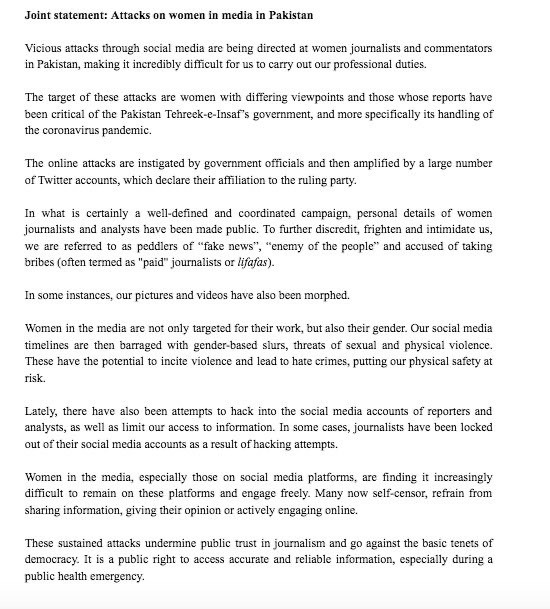
36 women journalists in Pakistan have alleged that online attacks are instigated by officials of the Imran Khan government and 'amplified by a large number of Twitter accounts'.
Several Pakistani women journalists and commentators issued a statement Wednesday condemning alleged trolling and online abuse by government officials and other Twitter users affiliated to the ruling Pakistan Tehreek-e-Insaf (PTI).
The joint statement said “vicious” online attacks at women journalists have made it “incredibly difficult” for them to carry out professional duties. It also said those who have been critical of the Imran Khan-led government and its handling of the pandemic were specifically targetted.
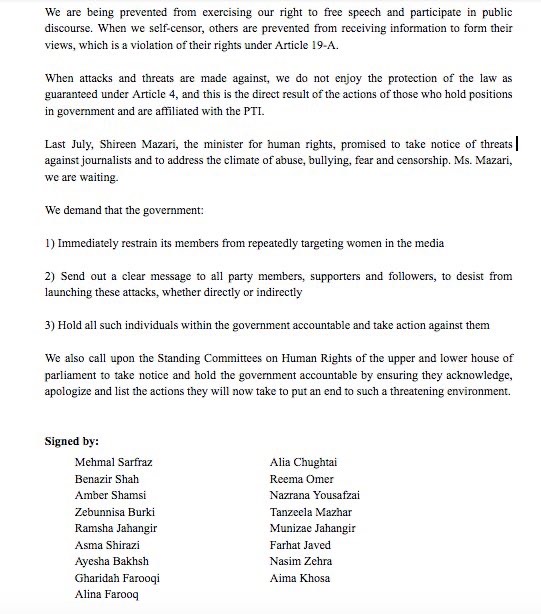
As many as 36 women journalists from Pakistan have signed the statement (at the time of publishing this report), including many award winning names such as Benazir Shah, Asma Shirazi, Mehmal Sarfraz, Ayesha Bakhsh and Amber Shamsi.
“The target of these attacks are women with differing viewpoints and those whose reports have been critical of the PTI government, and more specifically its handling of the coronavirus pandemic,” the statement read.
It also alleged that online attacks were instigated by government officials and then “amplified by a large number of Twitter accounts, which declare their affiliation to the ruling party”.
The signatories have accused the alleged abusers of morphing their photographs and videos, apart from making gender-based slurs and sexual threats.
“To further discredit, frighten and intimidate us, we are referred to as peddlers of ‘fake news’, ‘enemy of the people’ and accused of taking bribes (often termed as ‘paid’ journalists or lifafas),” the statement said.
Reacting to the statement, Pakistan’s Minister for Human Rights Shireen Mazari said abusing women because they are critical of the government “is never acceptable”.
“Disturbing to learn of women journalists being targeted and abused. Abusing women bec they are critical is never acceptable. Journalists do their job & to target them, especially gender-based abusive attacks on women journos, is absolutely unacceptable and disgusting,” she posted on Twitter.
In a subsequent tweet, Mazari also said she has requested the country’s information minister to assist in “fast-tracking our Journalist Protection Bill, which is not only an urgent need in Pakistan but an obligation under our Constitution and international law”.

‘Social media platforms must formulate policy against abuse’

The journalists have asked the Pakistani government to take action against such perpetrators and stop them from targetting women online.
Ramsha Jahangir, one of the signatories and journalist at Dawn, told ThePrint that all political parties must formulate a social media policy against harassment and abuse.
“There should be accountability for accounts affiliated to political parties hurling abuse and involved in smear,” she added.
Jahangir also said the statement, which was initially shared among 10 people, has now been made public.
Meanwhile, Pakistan Peoples Party (PPP) chairperson Bilawal Bhutto Zardari, who is also chairman of the National Assembly Standing Committee for Human Rights in Pakistan, tweeted saying he has taken note of threats to women journalists. He has also invited them to brief the committee on issues faced by them.