Friday, February 28, 2020

#AbolishBlasphemylaws - Blasphemy still a potent tool for Pakistan's hushed hardliners

BY JORIS FIORITI

Inside a small Lahore courtroom, the packed crowd attending the hearing of a blasphemy case against a Christian pastor is most notable for the absence of hard-line clerics shouting insults and demanding the death penalty.
For years, they would attend such hearings in force, seeking to pressure magistrates to convict and impose the severest sentences on anyone facing what is an incendiary charge in Pakistan.
But one year after the conclusion of the country’s most high-profile blasphemy case and a government crackdown against extremists who exploited it for political ends, the clerics are largely gone.
“Before Asia Bibi, dozens of maulanas (religious scholars) were coming to my hearings,” said the pastor Adnan Prince, who stands accused of desecrating the Koran.
“After that, they didn’t come anymore,” Prince said.
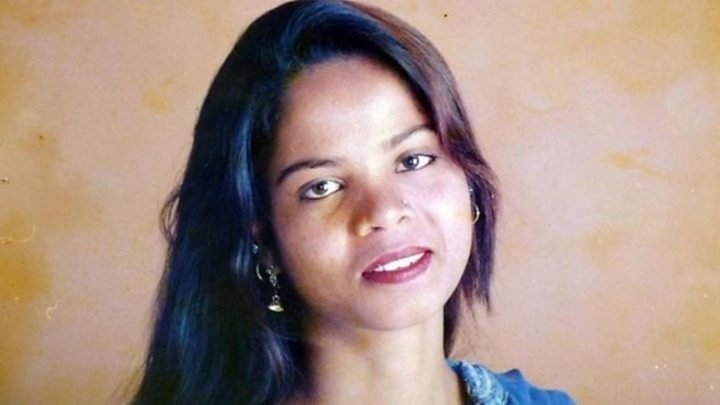
The case of Asia Bibi, a Christian woman sentenced to death for blasphemy in 2010 and acquitted by the Supreme Court in 2018, shone a global spotlight on the use — and abuse — of blasphemy laws in Pakistan.Her release was pounced on by the hard-line Islamist Tehreek-e-Labaik Pakistan party (Movement at the Service of the Prophet), which was formed five years ago and gained influence by weaponizing the blasphemy issue.The party spearheaded violent street protests against Bibi’s acquittal and called for the Supreme Court justices to be killed, but crossed the reddest of red lines by urging the overthrow of the country’s powerful army chief.A government crackdown ensued that netted thousands of TLP loyalists — a move that Prince’s lawyer, Asad Jamal, credits for the absence of the maulanas.“The voice of the (religious) far right has been muffled,” Jamal said, adding that the crackdown had sent a clear signal to the extremists who abandoned their courtroom lobbying.
But if that lowered the intimidating decibel levels in court, “the feeling of fear is still there” among the magistrates, Jamal stressed.
According to one former judge, magistrates in Pakistan’s lower courts remain very vulnerable to intimidation in blasphemy cases, given that they often live among the communities they serve.Due to the risk of being labeled blasphemers themselves if they acquit, they tend to “always convict,” said the former judge.A recent example saw a university professor, Junaid Hafeez, sentenced to death in December for insulting the Prophet Mohammed.Given that the first lawyer who agreed to represent Hafeez was murdered, his family argued there was never any prospect of receiving a fair hearing.
“Could any judge in such circumstances take the risk of doing justice?” they said in a statement.
Condemning the sentence, the Human Rights Commission of Pakistan said blasphemy laws continued to be “heavily misused” and the judicial process was “ridden by delays and pressures at the level of the lower judiciary.”The contention that many guilty rulings by magistrates in blasphemy cases are flawed has been borne out by the significant number that are overturned on appeal by higher courts.
But Pakistan’s clogged justice system means the appeal process can take years.
Last September, the Supreme Court acquitted Wajih-ul-Hassan after he had spent 18 years on death row for allegedly insulting the prophet.
And even after release from prison, freedom is a relative term when it comes to allegations of blasphemy and the vigilante violence that often surrounds them.
“In many people’s minds, even though he’s been acquitted, he’s still guilty,” said his lawyer, Nadeem Anthony. “So he has to live in hiding.”
The communities most at threat from abuses of the blasphemy law are religious minorities, including the Ahmadi sect, whose belief in a prophet after Mohammed is viewed as heresy by most mainstream Muslims.
“The vulnerability is still there and it is going to remain as long as the law is there and people accept its legitimacy,” said a spokesman for the sect, Usman Ahmad.Blasphemy is a hugely inflammatory charge in Pakistan. Merely suggesting reform of the law can trigger violence, most notably in the case of Salmaan Taseer, the governor of Pakistan’s most populous province, who was shot dead by his own bodyguard in 2011.Hanged four years ago, the bodyguard was hailed as a martyr by his supporters, who built a popular shrine in his memory on the outskirts of Islamabad.No wonder then that politicians are mostly extremely reluctant to speak out against any aspect of the blasphemy law, and Prime Minister Imran Khan notably voiced his full support for the legislation during his successful 2018 election campaign.Defending itself against accusations of pandering to extremists, the government points to the support it gave Asia Bibi after her acquittal, despite the intense pressure brought by groups like the TLP.
Bibi left Pakistan for a new life in Canada in May last year.
Extremists represent just “one percent” of the Pakistani population, insisted government spokeswoman Firdous Ashiq Awan.
“A minority of people can’t reflect the mindset of a society,” she said.
Nevertheless, the TLP secured more than 2.2 million votes in the 2018 general elections and is hopeful of winning seats in local polls later this year. The party demonstrated its influence last month by successfully blocking the release of a new film by prominent director Sarmad Khosat on the grounds that it contained blasphemous content. “Blasphemy is a point through which we attract people,” Rehman Ali Tarar, a prospective TLP candidate, said at a recent rally with thousands of party supporters in Lahore.
https://www.japantimes.co.jp/news/2020/02/28/asia-pacific/social-issues-asia-pacific/blasphemy-pakistan/#.XlmctKhKjIU

#Pakistan - #AsiaBibi: I always believed I would be freed

Asia Bibi, the Pakistani Christian woman who spent years on death row after being convicted of blasphemy, says she always believed she would be freed.
Now living in Canada, she told the BBC that she hoped she would be able to return to Pakistan one day.
Ms Bibi has released a memoir, Enfin Libre! (Finally Free), written with French journalist Anne-Isabelle Tollet.
In it, she recounts her time in jail and her brutal treatment by guards.
In one of the most disturbing incidents she recounts how she had her neck put in a brace that was tightened with a key, and was pulled about on a chain by guards.
Pakistani authorities have dismissed the allegations, saying her claims of torture were "not plausible".

Who is Asia Bibi?

  • Asia Noreen - commonly known as Asia Bibi - was accused of blasphemy after an argument with a group of women in June 2009
  • A year later she became the first woman to be sentenced to death under Pakistan's blasphemy laws, causing an international outcry
  • The death sentence was quashed by the Supreme Court in 2018, triggering violent protests by religious hardliners

Ms Bibi spoke to the BBC during a visit to France where she is promoting her new book.
She recalled how, in 2009, a longstanding dispute with neighbours culminated in a group of local women accusing her of insulting the Prophet Muhammad.
"My husband was at work, my kids were in school, I had gone to pick fruit in the orchard," she said. "A mob came and dragged me away. They made fun of me, I was very helpless."
In her book, Ms Bibi tells how she feared for her life in prison, with other inmates calling for her to be hanged. She also recalled mistreatment at the hands of the prison guards.
"I can't breathe," she writes. "My neck is compressed by a neck brace that the guard can tighten as much as he wants with a big key. A long chain drags on the dirty floor; it links my throat to the guard's handcuffs that drags me like a dog."
Ms Bibi told the BBC that her Christian faith helped her through the ordeal.
"They said change your faith, and you'll be freed. But I said no. I will live my sentence. With my faith," she said.
"I found out from my husband that the whole world was praying for me. And that even the Pope had prayed for me. That made me happy. And I found out the whole world was praying for my misery to end.
"That made me feel that their prayers would definitely free me."
Media captionAsia Bibi's escape from Pakistan death row
Ms Bibi called on Pakistan's Prime Minister Imran Khan to free anyone unjustly accused or convicted of blasphemy and to ensure that the charges are investigated properly.
"Innocents should not be punished for no reason and people who are innocent, in prison, should be freed," she said.
"During the investigation, both parties should be questioned properly because there are a lot of problems in our investigative procedures. And it is hard to tell who is on whose side."
Despite her ordeal, Ms Bibi said she still felt positively about Pakistan and hoped to return there one day.
"It was my country that freed me. That makes me proud," she said.
"I left of my own volition because I was in danger there. Anything could have happened to me at any point. So that's why I left my country. But I have the same love for my country in my heart now. I still respect my country and I want to see the day when I'm able to go back."
She also recalled her sorrow at hearing while in jail that two politicians who tried to help her - Shahbaz Bhatti and Salman Taseer - had been murdered.
"I cried a lot. I cried for more than a week for them. Even today, my heart is full of sadness for them and I miss them," she said.
But, she says she feels no bitterness to those who called for her to be killed.
"I'm not angry at all, I've forgiven everyone from my heart and there is no hardness in me, there is patience in me because I learned how to be patient after having to leave my children behind," she said.

Who are Pakistan's Christians?

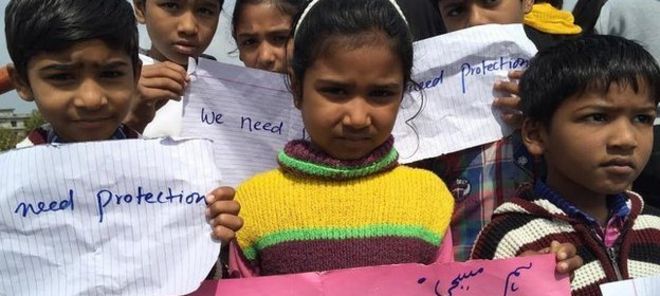
Christian children in Lahore
  • Make up 1.6% of Pakistan's predominantly Muslim population
  • Majority are descendents of those who converted from Hinduism under the British Raj
  • Most converted to escape their low-caste status and many are among the poorest in Pakistan
  • Targeting of Christians fuelled by strong anti-blasphemy laws and anger over US-led war in Afghanistan

The vast majority of those convicted of blasphemy in Pakistan are Muslims or members of the Ahmadi community who identify themselves as Muslims but are regarded as heretical by orthodox Islam.
Since the 1990s scores of Christians have also been convicted. They make up just 1.6% of the population.
The Christian community has been targeted in numerous attacks in recent years, leaving many feeling vulnerable to a climate of intolerance.
Data provided by the Centre for Social Justice (CSJ) shows a total of 720 Muslims, 516 Ahmedis, 238 Christians and 31 Hindus have been accused under various clauses of the blasphemy law from 1987 until 2017.
Pakistani authorities say blasphemy laws exist in many parts of the world and that all such cases in Pakistan are brought before the courts and follow due process.
Ms Bibi says in her book that the Christian community is despised and bullied and discriminated against.
But Pakistan says it attaches high importance to the protection of rights of minorities, which are guaranteed under its constitution.
Enfin Libre! By Asia Bibi is out now in French and other languages, and an English translation of the book will be available in September.

#AsiaBibi: #Pakistani woman jailed for #blasphemy claims asylum in #France

Jon Henley

 Emmanuel Macron invites Christian who spent eight years on death row to live in-country.


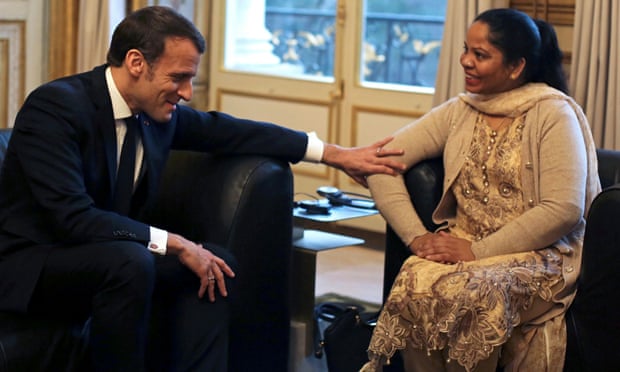
Asia Bibi, the Pakistani Christian woman who spent eight years on death row on blasphemy charges, has filed an initial application for asylum in France and been invited to live in the country by Emmanuel Macron.
But speaking after a meeting with the French president in the Elysée palace on Friday, Bibi said she had not decided where she would settle. She was acquitted last year and granted a one-year leave of stay with her family in Canada.
“I need time to think,” Bibi said. “Canada has been good to me. France has been very good to me – and France has given me a name. But for the time being I need to concentrate on my health, my family and my children’s education.”
Bibi’s case outraged Christians around the world and fanned divisions inside mainly Muslim Pakistan. The former farm labourer was sentenced to death in 2010 after Muslim labourers working with her in the fields refused to share their water because she was Christian.
An argument broke out and one woman went to a local cleric to accuse Bibi of committing blasphemy against the prophet Muhammad. Two Pakistani politicians were later killed for publicly supporting her and criticising the country’s draconian blasphemy laws.
Pakistan’s supreme court overturned the conviction in October 2018, sparking violent protests in Pakistan and calls for the judges in the case to be killed. The violence was led by the Islamic group Tehreek-e-Labbaik.
Bibi was also in France to promote her book Enfin Libre! (Finally Free!), co-written Anne-Isabelle Tollet, a French journalist who helped publicise her case with two previous books and forming an international support committee in 2015.
“I was very honoured to be received by the president, to be next to him, and to be invited to live here,” Bibi said, sitting alongside her daughter Eisha, 21, who is disabled. She was also accompanied on the trip by her husband Ashiq, 58, and her second daughter Eisham, 20.
“France is a symbol for me,” she said. “It was the first country in the world to really support me, and the country from which my name became known.” Bibi said she was also deeply honoured earlier this week to meet the mayor of Paris, Anne Hidalgo, who presented her with honorary citizenship of the city.
An Elysée official said France was “ready to welcome” Bibi if she wished, providing she met the criteria for asylum. French rules require asylum seekers to submit a request to an independent state agency, Ofpra, which decides whether it should be to granted.
It is understood that Bibi filled in the appropriate forms with her family members on Friday. Although she said she had not received any recent death threats, Islamic extremists have pledged to pursue and kill her.
In Canada, she lives with her husband and daughters in a three-bedroom apartment in an undisclosed location. She told French media this week that she was hopeful things would change to allow her and her family to return to Pakistan one day.
“I really hope for it, just the way I kept hope when I was in jail that one day I was going to be free,” she said. Bibi said she was grateful for the prayers of fellow Christians around the world who had helped her remain strong before her release.
In her book, Bibi recounts how she was kept chained in prison and jeered at by other detainees. A devout Catholic, she said she had never committed blasphemy: “I cannot even think of insulting any prophet. I didn’t say anything. It was all about a glass of water.”

UN rights chief slams Pakistan for failing to reign in violence on minorities

Even as a debate is underway in India over religious freedom owing to the contentious citizenship law protests, the UN Human Rights chief has flagged violent attacks on minorities in neighboring Pakistan.

Michelle Bachelet, the United Nations High Commissioner for Human Rights, on Thursday, said religious minorities in Pakistan continue to face violence and repeated attacks on their places of worship.
The UN High Commissioner also blamed Prime Minister Imran Khan government’s failure to amend the country’s notorious blasphemy law provisions which are often used to perpetrate violence against persons from minority communities.
While addressing the ongoing 43rd Session of the Human Rights Council in Geneva on human rights developments, Bachelet mentioned the case of Junaid Hafeez, a university lecturer in Pakistan, who was sentenced to death in December for blasphemy.
“Religious minorities in Pakistan continue to face violence, repeated attacks on their places of worship, and discrimination in law and practice,” Bachelet said.
“The (Pakistan) Government, despite recommendations from international human rights mechanisms, has not amended or repealed blasphemy law provisions which have led to violence against religious minorities, as well as to arbitrary arrests and prosecution,” the former Chilean president said in a statement on Pakistan’s controversial blasphemy law.
“The death penalty remains mandatory for blasphemy, and in December, the Multan Court sentenced Junaid Hafeez to death on a blasphemy charge, in contravention of international human rights law,” she added.
Junaid Hafeez case
Janai Hafeez, 33, a university lecturer who was arrested in March 2013, was sentenced to death for blasphemy. He was accused of posting derogatory comments about Prophet Muhammad on social media.
Hafeez’s case came under international scrutiny when his lawyer Rashid Rehman was shot dead in 2014 after agreeing to take up the case.
The accused had to be kept in solitary confinement after being repeatedly attacked by other prisoners in jail.
Hafeez completed his Master’s in the United States on a Fullbright Scholarship with a specialisation in American literature, photography and theatre. He took up the position of Bahauddin Zakariya University (BZU) in Multan where he was employed till his arrest.
Hafeez’s lawyer at the time had described the judgement as “most unfortunate”.

Thursday, February 27, 2020

Video - Is This How We Die? - Coronavirus, Continued | The Daily Show - Trevor Noah

Video Report - Is the spread of coronavirus out of control?

Dem voters: Bernie Sanders Can Beat Trump And 'Republican Decoy' Bloomberg

Video Report - #CAMPAIGN2020: #BernieSanders goes on a tear against the billionaire class

Video Report - 2020 Democrats Fight To The Finish In South Carolina

Pashto Music - Nashenas _ زخوشرابی.یم .شیخه سه.راسره.جنگ.کری.برخی

Pashto Music - Khyal Mohammad & Mah Jabeen - Sterge De Kachkol Krra Wakhla

Video - Pashto Ghazal(hamza baba) by Mehjabeen Qazalbash - Raza Che Yava

Christian “blasphemy” cases could rise under Pakistan’s new social media law

Pakistan’s government approved a new law to monitor online platforms on 28 January, which would require social media companies to remove any “unwanted and slanderous” online content within 24 hours, or six hours in “emergency cases”, prompting concerns over “blasphemy” accusations.  
Any company failing to share any data or remove any content under the Citizen Protection (Against Online Harm) Rules could be blocked or fined up to 500 million rupees (£2.5 million; $3.2 million; €3 million). 
Prime Minister Imran Khan reassured business leaders on rule changes and urged them to continue operations in Pakistan. 
A Barnabas contact flagged that this law could be a new route to falsely accuse Christians of “blasphemy”. “We already warn Christians to be careful of what they are posting. Christians are in danger of attack or arrest if potentially ‘offensive’ content is found on their Facebook pages, even if it was posted by someone else,’’ he said.
Firdous Awan, Minister of Information and Broadcasting, said that previous governments “did not know who was creating fake pages and harming socio-cultural and religious values’’. Her statement came three years after former Interior Minister, Chaudhry Nisar, had called upon Islamic countries worldwide to oppose “blasphemous” content posted on social media.
The possibility of being sentenced to death for “blasphemy” on social media is already a reality in Pakistan. In March 2013, Junaid Hafeez, 33-year-old university lecturer, known for his moderate Muslim beliefs, was arrested, accused of posting derogatory comments about Muhammad on social media. He was sentenced to death in 2019.  Taimoor Raza (30), a member of the Shia Muslim minority community, was jailed after engaging in a debate about Islam on Facebook and sentenced to death in 2017. 
Defiling the name of Muhammad carries a mandatory death penalty under section 295-C of the Pakistan Penal Code, and, under section 295-B, “wilful defilement, damage or desecration of the Quran” carries a mandatory life sentence for Muslims and non-Muslims alike.
Christians are particularly at risk of false accusations of blasphemy. Furthermore, the mere accusation of these types of “blasphemy” is enough to incite a vigilante killing by a mob or violent attacks on whole Christian communities.

Pakistani Christians attacked over church construction, 1 left partially paralyzed

By Samuel Smith

A Pakistani Christian man is partially paralyzed after a mob of Muslim men shot two Christians and attacked another with an ax for constructing a church in a village in Punjab province. 
The Union of Catholic Asia News reports that 25-year-old Azeem Gulzar is now paralyzed from the right shoulder down after he was shot in the head on Feb. 2 in Punjab’s Sahiwal district. 
Gulzar’s cousin was also shot while his uncle was attacked with an ax, according to Gulzar’s younger brother, Waseem. All three men were taken to a hospital but have since been released. 
Gulzar, a tailor, had donated a 550-square-foot plot to be used as the site of a new church for the town’s 150 Christians. However, plans for the church drew the ire of area Muslims as the plot shares a wall with a property owned by a Muslim school teacher. 
The attack came after months of disagreements between Gulzar’s family and the owner of the neighboring plot, Muhammad Liaqat. The attack also followed the Christian community’s winning of consent from a district coordinator for the church’s construction. 
However, a Muslim villager has claimed that community members were successful in getting a court to issue an injunction against the church's construction. 
Gulzar’s family built a wall and door on the construction site on Feb. 2. But later that night, about 15 Muslims descended on the property to tear down the wall. When Gulzar and his family tried to stop the destruction, they were attacked. 
“It was Sunday. We spent the whole day building the wall and finished at 7 p.m.,” Waseem told UCANews.com. “We only wanted to secure our property against any forceful occupation. Three hours later, we heard a crowd chanting on our doorstep. As we tried to explain our stance, someone resorted to aerial firing. My brothers were the next targets.”
According to the U.K.-based Centre for Legal Aid, Assistance and Settlement, both the Muslim and Christian communities in the area have accused each other of launching the attack and two different police reports have been filed related to the altercation. 
One Muslim villager told UCANews that some in the Christian community had “threatened to kill us” if they were stopped from constructing the church. 
The Muslim villager, Muhammad Aslam, claimed that the shooting of the two men was done by their “partners” in order to file a “false” police case against the Muslims trying to stop the church's construction. 
Waseem told UCANews that although his brother was released from the hospital on Monday, he is unable to communicate. 
“One of my cousins is recovering from the wound of a bullet that slightly hit his skull,” Waseem said. “My uncle was also injured with an ax. We are not rich enough to pursue lengthy court cases. Our property is the only hope we had.”
Pakistan ranks as the fifth-worst country in the world when it comes to Christian persecution, according to Open Doors USA’s 2020 World Watch List. 
Open Doors, which operates in over 60 countries, reports that there are dozens of attacks that occur each year against churches and cemeteries in Pakistan.
In November, 30 men raided St. Dominic Catholic Church in the Arifwala subdistrict of Punjab province. The church’s boundary wall and gate were destroyed and attackers took down the cross from a wall. 
In 2018, the U.S. State Department designated Pakistan for the first time as a “country of particular concern” for tolerating and engaging in egregious violations of religious freedom.
Considering that blasphemy (insulting Islam or the Islamic prophet Muhammad) is a crime punishable by death or imprisonment, the law is often abused by Muslims to settle disputes with religious minorities. Horrific mob crimes have taken the lives of Christians accused of blasphemy, including the lynching of two Christians by a mob in 2014. 
Many Christians and other religious minorities — such as peaceful Ammadiya Muslims — have fled persecution in Pakistan and are now living as refugees in Sri Lanka, Thailand and Malaysia. 

#Pakistan arrested more Basant kite flyers than terrorists this year


NAILA INAYAT
If arresting kite flyers was one of FATF's compliance requirements, then Pakistan would have transcended even the grey list to get itself on the white list.
 Terrorists like Ehsanullah Ehsan and Masood Azhar going MIA is not a bigger issue than kites and kite flyers in Pakistan. Imagine if arresting kite flyers was one of the FATF compliance requirements, then Pakistan would have transcended even the grey list and gotten itself into the white list.
Yes, spring is here, but no kites can be allowed in Pakistan’s skies. Kites were killers – of motorcyclists and Islam.

Basant in ‘Purana Pakistan’

There was a time when Lahore’s skies would welcome spring with colourful kites, while on the streets, children would chase kites falling from the sky. The excitement of planning a perfect Basant with kites, colourful thread, loudspeakers and yellow clothes would begin days in advance. It was one weekend amid the shouts of bo kata that everyone looked forward to.
Some would fly kites, while others would enjoy food. Sometimes it wouldn’t even be about flying a kite but just being on the rooftop around all the craziness. Other cities in Pakistan’s Punjab province also celebrated Basant, but it was Lahore that was the king of kite-flying festival.
By the early 2000s, during Pervez Musharraf’s push for enlightened moderation, Basant clubbed with music concerts became a huge commercial and tourist activity in Lahore.And then it was no more.
The Supreme Court of Pakistan imposed a ban on flying kites in 2005 to prevent the loss of lives caused by the chemical kite strings. These manja strings were slitting throats of two-wheeler drivers on the roads. In 2007 and 2009, the ban was lifted only to see the sport causing deaths. The religious groups took an undue advantage of this and called for a ban on Basant, which they saw as a Hindu festival against the principles of Islam.

Kite flyers, the real terrorists

Fifteen years later, the crackdown on kite flyers begins in Punjab every February with the arrival of spring. The ‘vigilant’ police officials go after poor kite flyers as if they are the real terrorists. This year alone, Punjab has reportedly seen more than 500 people booked for kite flying. Rawalpindi’s Adiala Jail is filled with 400 kite miscreants, while 2 lakh kites and 55,000 string rolls have been seized from various neighbourhoods. Many parents accuse the police of picking up their children who were only watching the sport. For the authorities, even watching someone fly a kite is abetting a crime. Devoid of much entertainment, police officers have rounded up people for the ‘crime’ of being fond of flying kites.
Basant used to be a source of income for many households in Pakistan. By 2013, around 1.5 lakh people in Lahore and about 1.8 lakh workers in Gujranwala and Kasur districts were rendered unemployed and later forced to take up other jobs. The kite flying material used to be exported to the United States and Europe, but after the ban, that demand has also vanished.
This year a petitioner moved the Lahore High Court asking for the festival to be legally recognised as a sport. His argument was that the ban infringed on his fundamental rights and impeded economic activity for millions.

A blurred memory

Instead of imposing a complete ban and running after poor kite makers and kite flyers, the government should work towards making Basant a safe cultural festival. How difficult can it be to regulate the quality of strings manufactured and designate parks or open spaces for kite flying like it is done in other countries? The government can make it obligatory for motorcyclists to equip their vehicles with antenna-like metal or wooden wires as a safety measure. There are many ways to make this sport safe but only if there is a will.
The Punjab government, year after year, goes back on its promise to lift the ban on kite flying. We have been hearing since last year that the Pakistan Tehreek-e-Insaf government in the province will move towards giving back the sport to Lahore, but to no avail. Jamaat-e-Islami, one of Pakistan’s leading Islamic political parties, views Basant as a Hindu festival in serious violation of the PTI’s manifesto that talks about making Pakistan a Madina-like state. Someone should inform Pakistan’s legislators that Basant is celebrated even in Saudi Arabia.
The festival is now a blurred memory and kite flying is viewed as an aberration, so if someone in Pakistan still wants to fly a kite, then they are on their own. There is a generation in Pakistan that has no clue about kite flying or Basant, which was once an integral part of our culture.

#Pakistan #PPP - Bilawal Bhutto Zardari inaugurates Sindh Wildlife Museum


PPP Chairman Bilawal Bhutto Zardari inaugurated Sindh Wildlife Museum. The museum was open for the public now after a hiatus of 29 years. The museum, a state-of-the-art institution housed in the Old Freemasons Lodge was located at Deen Mohammad Wafai Road, Karachi.
READ MORE: Sugar thief govt stole coronavirus protection clothing also: Hassan Murtaza Owing to its rich wildlife diversity and geographical location, Sindh province was home to a number of bird species. There were 322 bird species, 107 reptiles and 82 mammals native to Sindh province. The museum had four rooms and two huge corridor.
The main objective of opening the museum was to preserve all Sindh’s wildlife animals and birds. It also aimed to educate the younger generation.
Bilawal Bhutto Zardari also visited the reference library of the department which had rare books on the topic.
The PPP Chairman was accompanied with Local Government Minister Syed Nasir Hussain Shah, Sindh Chief Minister’s Special Assistant for Wildlife and Sports Bangul Khan Mahar and other officials.
https://nation.com.pk/27-Feb-2020/bilawal-bhutto-zardari-inaugurates-sindh-wildlife-museum

Govt takes effective measures to control #coronavirus in Pakistan - Chief Minister of Sindh Murad Ali Shah

Chief Minister of Sindh Murad Ali Shah on Thursday has said that task force has been established to control coronavirus spread across the province.
While talking to media, the CM said that two affectees of coronavirus in Pakistan have been kept in isolation ward while data of 1500 people who have recently traveled from Iran has also been gathered.
He said that the authorities will carry out complete monitoring in this regard.
The minister further told that schools across the province have been closed in a wake of the virus. The people should not get afraid of precautionary measures being taken by the government, he stated.
Earlier, Pakistan had confirmed two cases of coronavirus, the State Minister of Health said, marking the first recorded cases of the virus in the country.
READ MORE: Protest demos on Friday against persecution of Muslims in Delhi “Both cases are being taken care of according to clinical standard protocols & both of them are stable,” Zafar Mirza, tweeted. “No need to panic, things are under control.”
According to Sindh Health Department, 22-year-old Yahya took a flight to Karachi from Iran. Patient and his family were immediately placed in quarantine at a hospital.
https://nation.com.pk/27-Feb-2020/coronavirus-in-pakistan-karachi

#Coronavirus reaches #ISLAMABAD , #Pakistan

The Pakistani health authorities on Wednesday confirmed two positive cases of COVID-19 or novel Coronavirus in the country, saying both the persons tested positive for the lethal virus, one each in Karachi and Islamabad, who had traveled to Iran for pilgrimage to holy sites and on their return to the country, they tested positive for the disease. In view of the emergent situation, both Sindh and Balochistan governments have closed down all academic institutions.
“I can confirm the first two cases of coronavirus in Pakistan. Both cases are being taken care of according to the clinical standard protocols and both of them are stable. There is no need to panic, things are under control,” Special Assistant to Prime Minister Dr. Zafar Mirza said in a tweet after the Sindh health department announced that young man had been tested positive for Coronavirus in Karachi and undergoing treatment at an isolation ward of a private hospital in the city.
The Sindh health department confirmed the first patient as Syed Muhammad Yahya Jaffri, 22, a resident of Karachi who had traveled to Mashhad and Tehran in Iran, saying he flew back to Pakistan last week and developed symptoms similar to those of having the respiratory disease caused by COVID-19. “The 22-year-old Jaffri returned from Iran to Karachi by plane. He and his family have been placed in quarantine and the health department is examining all the passengers he had traveled with,” said Meeran Yousuf, a spokesperson for the Sindh Health Minister Dr. Azra Fazal Pechuho.
The Sindh health department officials informed The News that the patient left for Karachi from Tehran on 20th February 2020 and remained asymptomatic till 23rd February 2020. On February 24, he developed a productive cough and postnasal drip on 25th February 2020, following which he visited AKUH on 26th February 2020 and was promptly admitted. According to health officials, after Jafrri tested positive for the COVID-19, his family members and some friends were also quarantined. The officials confirmed that their samples were also being analysed to ascertain if they too have any trace of the infection.
The second person, who also tested positive for the fearsome disease is a resident of Islamabad and hails from Gilgit Baltistan. The patient had also traveled to Iran and returned to Pakistan last week, where he developed symptoms similar to COVID-19. He was advised to get himself examined at the Pakistan Institute of Medical Sciences, Islamabad. “The patient, in the early 50s, tested positive for COVD-19 and is undergoing treatment at an isolation ward at PIMS. Both the patients including one in Karachi and the other at Islamabad are in stable condition,” an official of the National Health Services, Regulation and Coordination confirmed.
Special Assistant to Prime Minister Dr. Zafar Mirza along with Balochistan Prime Minister Jam Kamal addressed a hurriedly called news conference in Quetta and asked the people not to panic, saying the situation is under control and both the provincial and federal governments are working jointly to prevent people from the infectious disease.Meanwhile, all the educational institutions of Balochistan have been closed down for a fortnight after which their status will be further reviewed at the end of this period, a notification of the provincial government issued. Balochistan borders Iran and Afghanwith which it shares borders porous borders and both the countries have confirmed cases of coronavirus. In a related development, Sindh Information Minister Saeed Ghani announced closing down all educational institutions across the province for Thursday and Friday (Feb 27, 28). Ghani on his twitter handle announced the closure of all academic institutions throughout Sindh for two days.In a rather strange development, personal protective equipment including masks, overalls and other material has practically vanished from Pakistani markets and pharmacies while in many areas, people said ordinary masks and other equipment were being sold at exorbitant rates.
Meanwhile, health specialists have advised people not to panic, consider coronavirus as a disease similar to flu and adopt the similar precautions including maintaining personal hygiene of washing hands regularly with soap, maintaining social distance and boosting their immunity with fruits and vegetables, drinking plenty of water and taking proper sleep.
Muhammad Qasim/ Agencies add from Rawalpindi: A resident of Skardu admitted in isolation ward for a couple of days has been confirmed positive for illness caused by 2019 novel coronavirus. The Executive Director at PIMS Dr Ansar Masood, when contacted by 'The News' late Wednesday night, however, said he has not been confirmed about positive status of the patient.
Meanwhile, a woman was admitted to hospital who was suffering from influenza in Jhelum on Wednesday. She was kept in quarantine as it was suspected that she might carry symptoms of coronavirus.
Talking to Geo News, Sindh government spokesperson Senator Murtaza Wahab confirmed the case and said: "All safety measures have been taken and we will take emergency steps after this case. Most arrangements are being made by the Centre but the Sindh government will play its part as well."
Sindh Information Minister Syed Nasir Hussain Shah said the provincial government was "working to procure the data of the infected" under Chief Minister Murad Ali Shah's orders.
Talking Geo News programme ‘Aaj Shahzeb Khanzada Kay Saath,’ Shah, the information minister, added that isolation wards were being set up in different hospitals around the province. "We are taking the data of all the people who were travelling with the infected person on his flight," he added."There are three isolation wards in Sindh, one in Civil Hospital, one in Jinnah Postgraduate Medical Centre (JPMC)), and one in AKUH (Aga Khan University Hospital). "The Provincial Disaster Management Authority (PDMA), Sindh, has also been alerted" in this regard.
With porous borders, creaking hospitals and large illiterate populations, Afghanistan and Pakistan face a potentially devastating health crisis after the new coronavirus erupted in neighbouring Iran.
Islamabad has closed official border crossings while Kabul has suspended all travel to the Islamic republic, which has reported 15 deaths out of nearly 100 infections -- making it one of the hardest hit countries outside the virus epicentre China. But experts fear the measures could prove ineffective with thousands of people -- refugees fleeing violence, pilgrims, smugglers and migrants looking for work -- likely crossing the long, poorly patrolled frontiers every day. The virus has spread to more than 25 countries, killing over 2,700 and infecting 80,000, mostly in China. But new outbreaks in Europe, the Middle East and in Asia have fanned fears of the contagion taking hold in poor nations which lack the healthcare infrastructure to cope.
Meanwhile, Senate’s Foreign Committee Chairman Mushahid Husain has said that government should adopt that kind of strategy which has been adopted by China to cope with coronavirus. While talking to the media in Karachi, he said that government should take emergency steps in this regard. He said that government should seal its borders with those countries where cases of coronavirus are found.
https://www.thenews.com.pk/print/620257-coronavirus-reaches-pakistan
#Pakistan - #Coronavirus Enters #Lahore