Sunday, December 8, 2019

Pakistan's Students Solidarity March - The march and after


Farah Zia
A week later, it appears that the purpose of the Students Solidarity March is served. The concerns raised by the students and organizers have forced everyone to sit up and take notice; a debate has started at several forums.
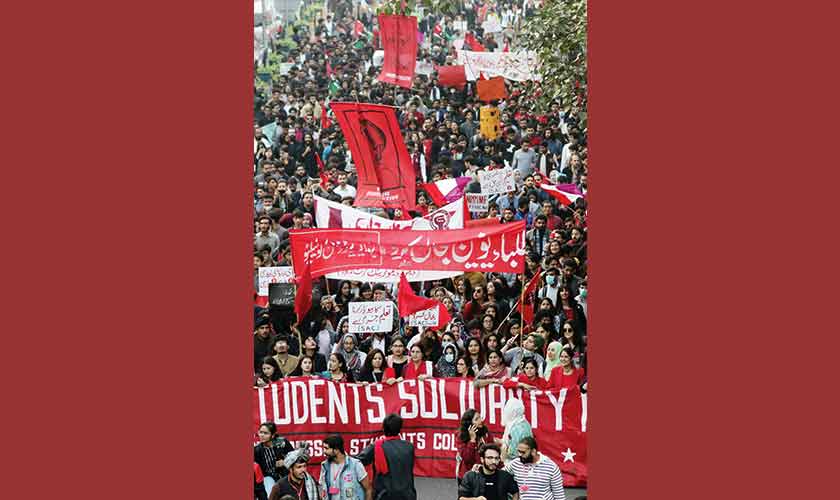
It was a sunny, expectation-laden, afternoon at Lahore’s Istanbul Chowk on November 29. The procession that stood near Nasser Bagh at 3pm was already delayed by an hour. Soon, the promised march to the Charing Cross began. The now-familiar leaders of Progressive Students’ Collective stood atop a truck, holding big microphones in their hands. As the truck started moving, everyone gathered around. A big red banner with Students Solidarity March painted on it in white was carried by young women leading the march.
As of now, the students are energized and ready to take on the mantle of leadership that they have been unjustly denied. There can be no academic freedom till students have the right to association.
The color red dominated in a crowd which seemed bigger than everyone’s expectations. No wonder the students were charged. They were joined in the march by teachers, journalists, lawyers, old guard revolutionaries, civil society activists, working classes, political workers. All genders were represented in the inclusive crowd that the Mall has not seen in recent years. Not even in the Lawyers’ Movement. The non-Punjabi youth were conspicuous by their sizeable number. A rare occasion when the ‘burgers’ mingled with their public school counterparts in a public space.
Rejuvenated by slogans of resistance, A R Rehman’s Chale Chalo and other songs blaring from the music system installed on the truck lent goosebumps-causing moments to the marchers. Keeping pace with the truck, along one side of The Mall, closed for traffic; for once they outnumbered the policemen who guard such marches.
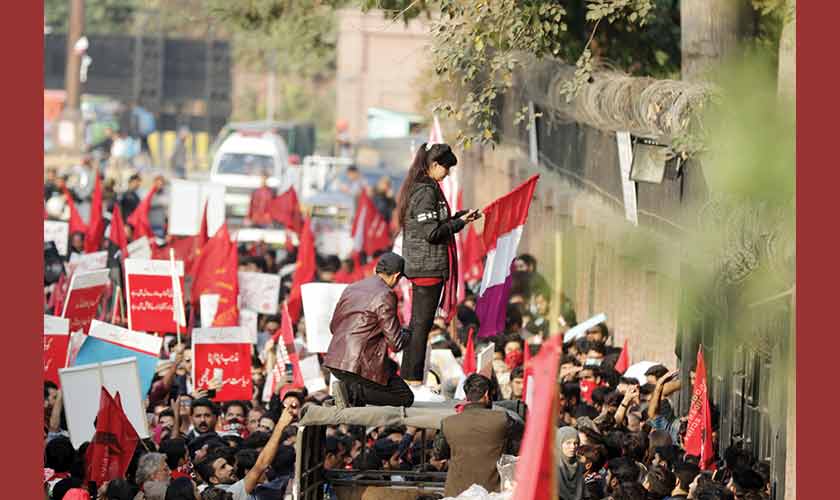
The march ended at its stated destination but the show went on. The fact that it looked like a freedom carnival had a context. There were immediate issues like; budget cuts in education and harassment of female students in Balochistan University by the administration that irked the protestors. Moreover, the apathy of the political system in tacking these issues and censorship on media resulted in one everyone chanting slogans for freedom — Azadi.
The students’ formal demands addressed more systemic issues like restoration of student unions, uniform curricula and education system, more budget for education and the demilitarisation of campuses.
The tragic collective memory of Mashal Khan’s brutal murder at the hands of his fellow students in Mardan, the continued incarceration of Junaid Hafeez in Multan on blasphemy allegations, and the stabbing to death of Professor Khalid Hameed in March at the hands of his student in Bahawalpur this year; provided an apt backdrop for the students to unite and do something about their lives. The consistent mobilisation of Progressive Students’ Collective over the last many years, the marches organised by the Pahstun Tahaffuz Movement last year, and the holding of Aurat Marches had all come together in creating this critical mass of students who came out to challenge the status quo.
By evening, it was clear that similar protests were being held in cities and towns across Pakistan, even in Gilgit-Baltistan, led by students who identify with progressive causes and were united under a Students Action Committee. Apparently, the misgivings and social media campaigns raised against them could not stop the marches from taking place.
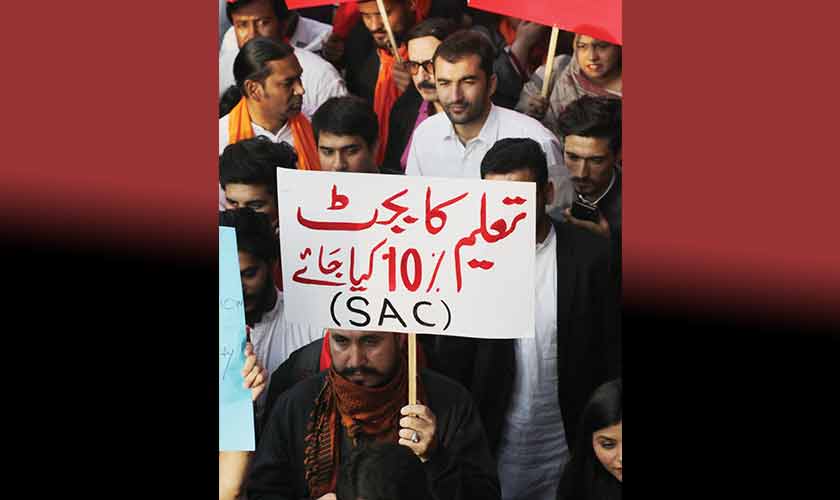
The actual crackdown began a day later, with one Pashtun speaker, a former Punjab University student, picked from the university premises, and two days later charged with sedition. More cases against some known faces like Professor Ammar Jan, Farooq Tariq and Mashal Khan’s father Iqbal Lala and hundreds of unidentified protesters were registered. A political science teacher Akhtar Khan was also arrested under the Cybercrime Act in the aftermath of the march.A week later, however, it appears that the purpose of the march is served. The issues and concerns raised by the students and organisers have forced everyone to sit up and take notice. A debate has started at several forums, particularly about the need to revive student unions in educational institutions. The high-handed acts of the government apart, ministers and even the prime minister, have underscored the need to bring back student unions albeit with a few caveats attached.But the debate will not remain confined to unions alone; it will trace its antecedents in history as it is already doing and search for future courses of action. Students insist that if the 1968 student movement that shook the foundations of a military dictator is to be seen in the light of a world-wide movement, then today’s events should also be seen in the backdrop of student awakening across the world.
Their demand for a uniform education system will inevitably raise the legitimate question about the privatisation of education, the class-based and individual-centered citizenry it produced, and the death blow it inflicted on the public sector. Attention is being drawn to how the state has tried to realise its own extreme values through education, and has hence repressed the students. Though what the country has now, as a consequence, is students who understand the world in only black and white terms, through the lens of religion and narrow nationalism.
In the week before and after the march, organisers have spoken to media-people of all hues. They have not shirked any question and, in doing so, have educated us all. In the last few decades, the producers of media have projected the problems of middle classes as ‘the’ problems of the country. Obviously, collective action, equal distribution of wealth and opportunities, social equality through education, student unions seem such alien concepts today; even the colour red is a red rag to the middle class consumers of media.
A section of media sees in the march almost a ‘conspiracy’ to launch a new political party, and that too of the ‘left’. The suggestion being that that was clearly unforgivable.
As of now, the students are energised and ready to take on the mantel of leadership that they have been unjustly denied. There can be no academic freedom till students have the right to association, they think. The complexion of the march suggests that they are seeking solidarity from their seniors and thereby learning from history. The most remarkable role, indeed, has been that of teachers. Some who are trained abroad are concerned about the student issues here, and are equal partners with them in their struggle.
Unfortunately, the state is trying to scare them both, by lodging sedition cases against them.
There can’t by anything more heady, romantic and plain right than the youth seeking equality in the world they inhabit. If not now, when? Students sorting out their own issues through consensus can give this country and its democracy the confident and moral leadership it so badly needs. The sooner the state realises this, the better.

https://www.thenews.com.pk/tns/detail/579461-the-march-and-after

Red Workers Front - Pakistan: health workers continue struggle against privatisation

A powerful movement of health workers is going on against privatisation in Pakistan. The government is snatching the basic right of healthcare from the working class in a country where already more than 80 percent of the population has no access to basic health provision. Rather than building new public hospitals and spending more on health services, the government has planned to close the health department altogether and hand it over to the private sector.
This means that hundreds of thousands of people will die across the country from minor injuries and treatable diseases due to the lack of any treatment. This also means that tens of thousands of health workers will lose their jobs and pensions and will be thrown into a life of extreme poverty and misery. The gravity of the situation has multiplied with the absence of any political party that stands against privatisation and supports the right of free healthcare for all.
In this dire situation, health workers of the Punjab and PakhtunKhwa province have come out in large numbers and have started a movement against this draconian measure of the Pakistani state. Red Workers Front is at the forefront of this struggle and has helped to bring together various unions, associations and groups of health workers in Punjab on the platform of Grand Health Alliance (GHA) to forge a united struggle against this oppressive measure. This strategy has also been replicated in PashtunKhwa, as well and GHA there is also carrying forward this struggle against the present regime.
Health conditions in Pakistan
With a population of 220 million, Pakistan is one of the poorest countries in the world. It ranks among the lowest in the human development index. The country is a nightmarish example of the horrors of capitalism and imperialist plunder. With an ever-widening gap between rich and poor and crumbling physical and social infrastructure, the country is a living hell for its working class. More than half of its population lives on less than one dollar per day. Although the masses have to suffer daily in every aspect of their lives, poor-quality and insufficient healthcare delivery is one of the most disturbing aspects of their existence.
The country spends less than two percent of its GDP on healthcare and a large portion of this spending is done by the private sector. This is not a problem for the rich and upper-middle-class, because they can afford the costly healthcare delivered by the five-star, hotel-style private hospitals - but the poor suffer and die untreated in hellish conditions. For 220 million people, the country has only 5,800 basic health units, 950 secondary care hospitals and just 22 tertiary care hospitals in the public sector. The extremely poor quality of these facilities notwithstanding, the sheer lack of quantity speaks volumes about the condition of healthcare available. There is only one bed for every 2,000 people in public hospitals. The patient-to-doctor ratio is 1:1500, and the patient-to-nursing-staff ratio is even worse. The country has one of the highest infant and maternal mortality rates in the world. Every year, some half a million children under five years of age die due to treatable diseases like dysentery, malaria, typhoid and RTI, because they don't have access to free or affordable healthcare. Every year, more than 50,000 women die during childbirth, because of the absence of maternal and child health facilities. Every year, more than 40,000 women die of breast cancer because they cannot even dream of affording the cost of treatment for this disease. More than 200,000 people die every year in road accidents because of the lack of public healthcare facilities. All this happens in a country where working masses bear one of the highest indirect tax burdens on their shoulders and around 75 percent of the annual federal budget is spent on debt servicing and military.
Privatisation
Pakistan’s meagre public healthcare facilities have been a shambles for years due to the lack of government funding, but under the recent IMF loan programme the government is trying to privatise even these dismal services for the poor. One of the basic motives lying behind this privatisation drive, on the part of the IMF and the government, is to reduce state expenditure for achieving so-called fiscal consolidation. That simply means that the government should be able to pay back its debt and interest to international and domestic lenders, while crushing the working masses under its heel in this process. Secondly, its purpose is to open up a profitable avenue of investment for private capital. For the privatisation of public hospitals, the government has proposed a draconian law called the MTI act, which it has imposed upon the Punjab Province through an undemocratic governor ordinance. In the province of PashtunKhwa (KPK), this MTI act was already partially imposed in 2015 by the then-PTI provincial government. Now, in KPK too, it is to be fully implemented and extended to all the public hospitals through a newly proposed RDHA act.
According to these acts, the status of public hospitals will be changed from public welfare to corporate institutions, which will be responsible for generating their own finances through elimination of free healthcare services and utilising the services of private health insurance companies. For this purpose, all public hospitals will be outsourced to private healthcare companies and contractors. Furthermore, the government will also receive a share of profits generated by these outsourced hospitals. While on the one hand, these brutal measures of capitalist exploitation will deprive millions of poor people from access to basic healthcare (as they are totally dependent on these public hospitals, whatever their shortcomings may be), on the other, this privatisation will also cause financial ruin for thousands of junior doctors, nurses and hospital workers working in them. A great majority will simply lose their jobs. The rest will lose their permanent employee status, along with their pensions, and will be converted into contractual, temporary or daily waged employees.
Movement against privatisation
It is under these circumstances that a powerful anti-privatisation movement of public sector health workers has arisen in Punjab and KPK. All the associations and unions of junior doctors, nurses and health workers of these two provinces have joined to form the Grand Health Alliance (GHA) in order to effectively fight against this onslaught of privatisation. Starting from roadside protests, anti-privatisation conventions and mass awareness campaigns, the GHA of both provinces was compelled to go for a strike in outpatient departments, elective radiology and laboratory services because of the repressive acts of the government, in which some workers were brutally attacked by police in KPK. The strike has now entered its 32nd day in KPK and 19th day in Punjab, and is still going strong despite all the state repression, intimidation, arrests, job terminations and poisonous propaganda through state-influenced media. Besides observing the strike, there have been repeated huge protests across all the major cities of both provinces in the past three weeks, in which tens of thousands of health workers have regularly participated despite all the measures of the state. After failing in crushing the movement through repression, the government has now resorted to the age-old, dirty tactics of trying to break the unity of health workers, and deceiving the movement through sham talks - but the workers are conscious enough that, for now, all these manoeuvres have failed.
Red Workers Front has stood shoulder to shoulder with the health workers throughout the movement. In fact, the idea of forming a GHA was first floated by the RWF in various meetings. One representative of RWF is also a member of the core committee of GHA Punjab. RWF has also helped to prepare campaigns through leaflets, brochures and posters produced by GHA Punjab. A three-minute, animated video was also launched for a mass campaign last week, explaining the disastrous impacts of this privatisation. This video also got an overwhelming response, as did the other campaign material.
Red Workers Front has also been carrying out a mass campaign for a country-wide general strike among the advanced layers of the working class for the last two years. The anti-privatisation movement of health workers has raised the opportunity to discuss the idea of a general strike against privatisation, with thousands of health workers. In fact, this idea has got a tremendous response, and important steps are being taken in this direction.
RWF is also trying to build bridges between GHA and workers’ unions and associations of various other public sector departments and institutions, which are on the hit list of privatisation. Until now, successful solidarity meetings have been arranged between the leaderships of GHA and railway unions, electricity workers (WAPDA), the school teachers’ union, the college professors and lecturers’ association and clerical staff associations. More solidarity meetings are planned with other unions, especially with telecommunication workers (PTCL), the utility stores corporation union and public insurance (State Life) workers’ unions.
We also appeal to the workers of the world for their solidarity with this anti-privatisation struggle of health workers in Pakistan. United, we are sure of a glorious victory over capitalist and imperialist forces in Pakistan and elsewhere.
Workers of the world, unite!

http://www.marxist.com/pakistan-health-workers-continue-struggle-against-privatisation.htm

Saturday, December 7, 2019

The B-52's - Love Shack

Nancy Ajram - W Maak ( The Making Of)

#BillyJoel #WeDidn #Avengers Billy Joel - We Didn't Start the Fire

\

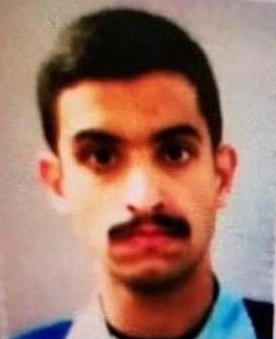
Saudi gunman reportedly called US a ‘nation of evil,’ decried support of Israel

Officials said to name attacker who killed 3 as Mohammed al-Shamrani, a Saudi Air Force officer training at Florida airbase who quoted bin Laden in a tweet prior to Friday shooting
A Saudi military student reportedly condemned the US as a “nation of evil” in an online manifesto prior to opening fire Friday at a US naval base, killing three people before being shot dead by police.
The SITE Intelligence Group, which monitors jihadist media, identified him as Mohammed al-Shamrani, saying he had posted a short manifesto on Twitter that read: “I’m against evil, and America as a whole has turned into a nation of evil.”
“I’m not against you for just being American, I don’t hate you because your freedoms, I hate you because every day you supporting, funding and committing crimes not only against Muslims but also humanity,” he wrote.
ABC News reported that investigators were working to determine if it was in fact written by the shooter.

The Twitter account that posted the manifesto — which also condemned US support for Israel and included a quote from Al-Qaeda’s deceased leader, the Saudi Osama bin Laden — has been suspended.
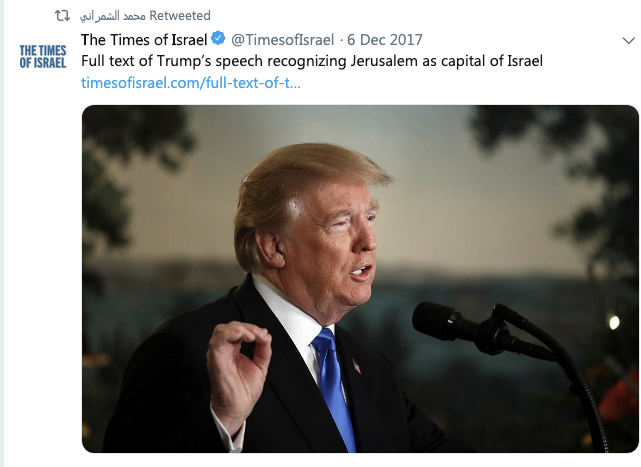
According to Rita Katz, the director of SITE, Jerusalem appeared to be a “critical point” for the attacker and one of his most recent tweets shared the text of US President Donald Trump’s December 2017 speech recognizing the city as Israel’s capital.

BREAKING: Tweet by attacker Alshamrani suggests terrorist motive. Does not claim allegiance to any group, but echos Bin Laden: "The security is a shared destiny...You will not be safe until we live it as reality in [Palestine], and American troops get out of our land."


View image on TwitterView image on Twitter
2) The issue of seems to have been a critical point of Shamrani's anger. His second-most recent of his tweets (just before his will) was an RT of Trump’s December 2017 Jerusalem speech, made sometime in the last 48 hours.


View image on Twitter

Six Saudis were detained following the shooting, including three who were seen filming the entire attack, The New York Times reported, citing a person briefed on the initial investigation.
The gunman was armed with a Glock 9mm handgun that had been purchased locally, the Times reported. It had an extended magazine and the shooter had four to six other magazines in his possession.

US law enforcement officials were digging into the background of the suspected Florida naval station shooter Friday to determine the Saudi Air Force officer’s motive and whether it was connected to terrorism.
As questions swirled about the shooting, officials said al-Shamrani was an aviation officer in the Saudi Air Force. The officials spoke on condition of anonymity to discuss an ongoing investigation.
He was attending the aviation school at Naval Air Station Pensacola, one of hundreds of international military members who are receiving training there. The shooter opened fire in a classroom building on Friday morning.
US Defense Secretary Mark Esper said in a statement that the Pentagon was continuing to monitor the Pensacola incident and was gathering additional facts on the shooting earlier this week at Pearl Harbor, when a young Navy sailor gunned down two people and then shot himself.
Esper said he is “considering several steps to ensure the security of our military installations and the safety of our service members and their families.” He provided no details.
In a separate statement, Admiral Mike Gilday, the chief of naval operations, said it has been a “devastating week” for the Navy. The US has long had a robust training program for Saudis, providing assistance in the US and in the kingdom. As of this week, there are more than 850 Saudis in the United States for various training activities. They are among more than 5,000 foreign students from 153 countries in the US going through military training. The Pentagon said Friday that al-Shamrani was in the US as part of an Air Force military sales training course, and his participation was funded by Saudi Arabia. His training began in August 2017 and was scheduled to conclude next August, and it included initial pilot training, basic aviation and English-language instruction. Foreign nationals participating in US training go through a vetting process. The Pentagon said it includes screening for any illicit drug activities, support for terrorist organizations, corruption and criminal conduct. Those who fail to pass the approval process are not issued international travel orders. The Trump administration has been aggressively helping Saudi Arabia this year, sending Patriot missile batteries and hundreds of troops there in the wake of attacks on the kingdom that officials blame on Iran.
On Friday, Trump said he got a call from Saudi King Salman, who expressed “his sincere condolences” and sent sympathies to the families of those involved. “The King said that the Saudi people are greatly angered by the barbaric actions of the shooter, and that this person in no way shape or form represents the feelings of the Saudi people who love the American people,” said Trump in a tweet. The shooting, however, shined a spotlight on what has been a sometimes rocky relationship with the kingdom. The US earlier this year agreed to send three Patriot missile batteries, dozens of fighter jets and other aircraft to Saudi Arabia. And in October, Esper visited Prince Sultan Air Base to see one of the batteries and talk about efforts to get other allies to contribute to the defense of Saudi Arabia and the Gulf region to counter threats from Iran. But the kingdom’s reputation is still damaged after the killing last year of Washington Post columnist Jamal Khashoggi at the Saudi Consulate in Istanbul. Saudi intelligence officials and a forensic doctor killed and dismembered Khashoggi on October 2, 2018, as his fiancée waited outside the diplomatic mission.
Khashoggi, long a royal court insider, had been in self-imposed exile in the US while writing critically of Saudi Crown Prince Mohammed bin Salman, son of the oil-rich nation’s King Salman.

#Saudi Terrorism - For Trump, Instinct After Florida Killings Is Simple: Protect Saudis

By David E. Sanger
Before issuing his own condolences, the president channeled the Saudi king’s and avoided any discussion of the hard questions about why the U.S. is training Saudi officers.
When a Saudi Air Force officer opened fire on his classmates at a naval base in Pensacola, Fla., on Friday, he killed three, wounded eight and exposed anew the strange dynamic between President Trump and the Saudi leadership: The president’s first instinct was to tamp down any suggestion that the Saudi government needed to be held to account. Hours later, Mr. Trump announced on Twitter that he had received a condolence call from King Salman of Saudi Arabia, who clearly sought to ensure that the episode did not further fracture their relationship. On Saturday, leaving the White House for a trip here for a Republican fund-raiser and a speech on Israeli-American relations, Mr. Trump told reporters that “they are devastated in Saudi Arabia,” noting that “the king will be involved in taking care of families and loved ones.” He never used the word “terrorism.” What was missing was any assurance that the Saudis would aid in the investigation, help identify the suspect’s motives, or answer the many questions about the vetting process for a coveted slot at one of the country’s premier schools for training allied officers. Or, more broadly, why the United States continues to train members of the Saudi military even as that same military faces credible accusations of repeated human rights abuses in Yemen, including the dropping of munitions that maximize civilian casualties. “The attack is a disaster for an already deeply strained relationship,” Bruce Riedel, a scholar at the Brookings Institution and a former C.I.A. officer who has dealt with generations of Saudi leaders, said on Saturday. It “focuses attention on Americans training Saudi Air Force officers who are engaged in numerous bombings of innocents in Yemen, which is the worst humanitarian catastrophe in the world,” he said, noting that the Trump administration had long been fighting Congress as it seeks to end American support for that war. A spotlight on the people reshaping our politics. A conversation with voters across the country. And a guiding hand through the endless news cycle, telling you what you really need to know. But even stranger, said Mr. Riedel, was “the president’s parroting of the Saudi line” before learning the results of an investigation into whether the gunman acted alone, or had allegiances to Al Qaeda or terrorist groups.
For the White House, the calculus is simple: Saudi Arabia is not only critical to world oil supplies — though no longer critical to the United States’ — it is the only regional power able to counter Iran. The result, former members of the Trump administration say, has been a dismissal of any critiques that could weaken that bond.
Mr. Trump was so quick and so eager to assure the Saudis that the relationship would continue before anyone knew how to categorize the shooting that it raised questions about how the administration would have responded if the suspect had been an Iranian, or an immigrant from Mexico. During the 2016 presidential campaign, Mr. Trump often cited the killing of a young woman in California by an undocumented immigrant as a reason to crack down on immigration and build a wall along the southern border. “Had an attack been carried out by any country on his Muslim ban, his reaction would have been very different,” said Aaron David Miller, a longtime Middle East negotiator and now a senior fellow at the Carnegie Endowment for International Peace.
“But when it comes to Saudi, the default position is to defend,” he said, “Driven by oil, money, weapons sales, a good deal of Saudi feting and flattery, Trump has created a virtually impenetrable zone of immunity for Saudi Arabia.”
It was hardly the first time Mr. Trump had shown such tendencies. After the brutal killing in Istanbul of Jamal Khashoggi, the Saudi dissident and a legal American resident, Mr. Trump and Secretary of State Mike Pompeo played down American intelligence findings that closely tied Saudi Arabia’s crown prince, Mohammed bin Salman, to the matter. The findings suggested he had connections to the members of the hit team sent to Turkey — and almost certainly played a role in ordering them to bring Mr. Khashoggi back to the country by force. Mr. Trump’s and Mr. Pompeo’s initial promises to follow the evidence wherever it led dissipated. Over the past year, Mr. Pompeo has expressed deep annoyance whenever the topic is raised. The United States was awaiting the results of a Saudi investigation, he often said, as if he expected that to offer a full accounting. And he told members of Congress that no matter the truth of what unfolded, the relationship between the kingdom and Washington was too important to be held hostage to one vicious, ill-thought-out act. No American assessment of what the Saudi leadership knew has ever been made public. Before the shooting on Friday, the White House was already fighting efforts in Congress to cut military aid to the Saudis, a reflection of anger over the Khashoggi murder and the continuing war in Yemen. But the Pensacola attack underlined the continuing instinct to protect the relationship.
“If Trump wants to convey condolences from Saudi King Salman, fine,” Mr. Miller wrote on Twitter after the shooting. “But you don’t do it on day — Americans are killed — untethered from a message of ironclad assurances from King to provide” whatever cooperation is necessary to understand the gunman and his motives. “Otherwise Trump sounds like what he has become — a Saudi apologist.’’
After Mr. Pompeo announced that he had spoken with the Saudi foreign minister, Faisal bin Farhan al-Saud, about the shooting, Martin Indyk, a former American ambassador to Israel and longtime Middle East negotiator, tweeted: “Isn’t it interesting how quick Trump and Pompeo are to broadcast Saudi government condolences for the murder of three Americans and how slow they were to criticize the Saudi government’s murder” of Mr. Khashoggi. Still, the bond between the countries is weakening, as the erosion of support in Congress shows. A negotiation over providing nuclear technology to the Saudis, a huge push early in the administration, has stalled. The chances that the military support will remain at current levels appear slim.
“The U.S.-Saudi relationship is on life support,” Mr. Riedel said, noting that it would be in jeopardy if a Democrat were to win the 2020 election. “Even Joe Biden is calling the Kingdom a ‘pariah’ that needs to be punished,” he said, referring to the former vice president, who had for decades supported a strong relationship with the Saudis.
https://www.nytimes.com/2019/12/07/us/politics/trump-pensacola-saudi-arabia.html

Music Video - Luciano Pavarotti sings "Nessun dorma" from Turandot (The Three Tenors in Concert 1994)

Video - Bernie Leads Yang, Buttigieg And Warren Among College Students - The Late Show with Stephen Colbert

Video Report - #France #EmmanuelMacron #GiletsJaunes France pension reform protests: Who will blink first?

Video Report - #YellowVests protesters march in Paris

Video Report - House Judiciary Committee releases report outlining historical arguments for impeachment

Video - 'Sabko Maloom Hai Mein Sharabi Nahin...' by Pankaj Udhas

Music Video - GHAZAL - Hungama Kyon Hain Barpa... Ghulam Ali

Music Video - Runa Laila - JUB SY GAYA HAI MAYRA ....

#Pakistan - Siege of a newspaper office

The value of a newspaper’s edition is viewed differently by every reader. People have the right to criticise or praise papers for underplaying an ‘important issue’ or overplaying a ‘petty incident’ or over the choice of words used in news stories. Their feedback helps editors improve the standard of journalism. Over the years, however, the Pakistani media is being conveyed feedback from powerful quarters in the form of disruption in circulation and broadcasting and financial strangulation. Occasionally, media houses have been vandalised and shut down and journalists beaten and arrested for ‘adverse’ reporting. Taking the hostility to a new height, a group of ‘unknown persons’ besieged a newspaper’s office in Islamabad and later demonstrated in Karachi, demanding its closure over a news story it carried about the London Bridge attack. The mob was enraged over the newspaper’s headline, “London attacker of Pakistani descent is terror convict: officials.”
There can a semantic debate on the word ‘descent’ but the news story was factually correct. When such an issue arises, the best way is to talk to the editor. The protesters could have written to the editor that the attacker, Usman Khan, was born and raised in the UK to immigrants from Pakistan and that he had nothing to do with the country. The newspaper’s reply would have settled the issue but the group chose to demonstrate outside its office in Islamabad and Karachi Press Club, brazenly chanting slogans about its ‘pro-India’ agenda. This is not the first time the said newspaper has been under fire for its factual reporting. Likewise, several TV channels have been pressured to fire their talk show hosts for generating ‘wrong’ content.
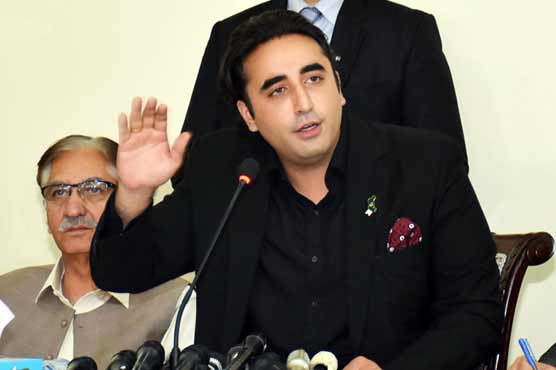
Several journalist bodies have condemned the harassment of the media. PPP Chairman Bilawal Bhutto-Zardari had the guts to call the siege an attempt to pressure the media. He noted that media houses were being threatened.
Council of Pakistan Newspapers Editors (CPNE) and the Pakistan Federal Union of Journalists have also condemned the “aggression and hooliganism” against the media. The CPNE head also noted that statements by ministers on the news story were a source of concern for the journalist community. Protesters and government quarters must realise that a free press leads to an open society and good governance. Attempts to intimidate or silence media will hurt the whole society. It is also the duty of media houses to open more communication channels with the public and incorporate their feedback in their content. https://dailytimes.com.pk/513603/siege-of-a-newspaper-office/

Don’t get fooled by Bajwa drama. Pakistan Army still the only one with a nation to itself


By SNEHESH ALEX PHILIP

Now that the dust has settled in Pakistan, and Gen Bajwa’s tenure extended for six months, a closer look reveals where the deception lies.

All nations have an army, but the Pakistan Army has a nation to itself.
So, the recent turn of events in Pakistan, where the three-year extension in tenure granted to the powerful Army Chief General Qamar Javed Bajwa was suspended by Chief Justice Asif Saeed Khosa, came as a total surprise.
It was initially said that a sense of uncertainty had gripped Pakistan. Was the Pakistani judiciary standing up against the chief of the force that controls everything in that country? It also led to fears of a possible coup in Pakistan, which is known for being run by dictators or someone like current Prime Minister Imran Khan, who is known more as a ‘selected PM’ rather than an ‘elected PM’.
Such was the enormity of the move that Pakistan’s Law Minister Farogh Naseem resigned from his position to become the lawyer for the government in support of Gen Bajwa.
The Pakistani cabinet had to meet hours after the initial verdict and there was a flurry of activities.
All these developments came to be seen as an indication that the powerful Pakistan Army was being challenged and its chief being cornered.
This also led to many, including in India’s defense and security establishment and this author, to believe that disgruntled senior officers upset with Gen Bajwa’s extension were behind the turn of events.
This was because as many as 17 three-star generals, who could have had a chance to become the chief otherwise, would end up retiring before Gen Bajwa hung his boots.
However, as they say, when it comes to dealing with a smart enemy that thrives on deniability and lies, never be taken in by what you see.


The before-after picture

Before we go further, let us pause and consider how Pakistan was seen before the drama unfolded.
Pakistan was largely seen as a terror-sponsor not doing enough to tackle the global menace of terrorism. It was seen as a failed state ruled by the ‘deep state’, a failed democracy with a controlled judiciary and a failing economy – and amid all this, there was the Imran Khan government that had no credibility.
But what is the picture that emerged after the episode involving the judiciary and the army?
Both have come out looking good. While the Pakistani judiciary is seen as independent and gutsy, the Pakistan Army, which has been criticised for being the real power, appears to be an institution that is not in control of everything in Pakistan.
The event came across as if the Army Headquarters or deep state is not the ‘real’ government and does not control the Imran Khan government.
The bigger and the more important outcome was that Pakistan was being seen as a democratic state.
Pakistan has managed to churn out a completely new image of itself, which is at odds with what it held just before the so-called clash between the judiciary, Prime Minister Imran Khan and the army chief.

An orchestrated deception

Now that the dust has settled, a closer look reveals where the deception lies.
The fact is that there is no rift in the Pakistan Army and there cannot be any rift within the force.
There has never been an occasion when a serving army chief has had to face a coup by his juniors. Of course, there is the example of former President Gen Zial-ul-Haq. But then, a number of factors were in play and his death continues to be a mystery.
As for Gen Parvez Musharraf, he found himself cornered by the deep state but he had passed on the baton of the army chief to the cunning Gen Ashfaq Parvez Kayani, the former ISI boss and the real mastermind behind the 26/11 Mumbai attacks.
Officers monitoring Pakistan closely say that anyone who disagreed with Gen Bajwa has already lost out on promotions, retired or relegated to inconsequential posts.
They believe that the entire turn of events was orchestrated by the deep state to change the image of the Pakistan Army and the Imran Khan government in the eyes of the world, while also ensuring that any legal issue regarding Gen Bajwa’s extension is settled once and for all without resorting to any sort of strong-arm tactics. It was a timely image makeover that Pakistan badly needed.
It is unimaginable that a random petitioner, advocate Riaz Hanif Rahi, would challenge the army chief and a three-member bench will take up the matter forcefully without any guaranteed protection to their future, especially their life in a country where people critical of the deep state suddenly vanish or are killed.
So, while one might continue to think that the khaki uniform in Pakistan has lost some of its sheen, remember that Gen Bajwa’s army continues to be the only army in the world with a nation to itself.

Music - Bhutto Benazir

Music Video - #PPP - Kal Bhi Bhutto Zinda Tha Aaj Bhi Bhutto Zinda Hai..

Video Report - Bilawal Bhutto Zardari Speech | 07 December 2019

#Pakistan #PPP - Selected govt cannot alleviate economic, governance crises: Bilawal Bhutto

Pakistan Peoples Party (PPP) chairman Bilawal Bhutto said that infrastructure has to be focused on to fight the economic and governance crises, and only public government can solve it.
Addressing at the ceremony of seven mega-projects, Bilawal Bhutto expressed that 10 million jobs have to be provided across the country to combat the economic crisis. “Provision of jobs is a tradition of PPP, and people will get jobs with the seven mega projects,” he said, adding that the incumbent government is encouraging only unemployment.
The scion of Bhutto dynasty asserted that the federal government facilitated billionaires with tax amnesty scheme whereas PPP launched a revolutionary Benazir Income Support Programme (BISP) for the public.
He went on to say that the ‘selected’ and incompetent government cannot alleviate the problems of people. “The country has plunged into the tsunami of inflation, while small businessmen are stuck into the storm of taxes”, he added.
PPP chairman said that the bureaucracy is suffering at the hands of the National Accountability Bureau (NAB) in the country. He maintained that Prime Minister Imran Khan has worsened the economy of Pakistan.
On the other hand, Bilawal Bhutto expressed that Sibghatullah Shah Rashidi road, Shaheed-e-Millat road and Sunset Boulevard flyover was completed in just five months. “Seven mega projects have been completed today which is vital for Karachi”, he added.
PPP chairman said that completion of all the projects is a proof of all the hard work done by provincial chief minister Syed Murad Ali Shah and his team. “PPP is doing developmental work in this environment,” he added. 

سلیکٹڈ وزیراعظم نے معیشت کو تباہ کردیا، بلاول بھٹو

پاکستان پیپلز پارٹی کے چیئرمین بلاول بھٹو زرداری نے کہا ہے کہ نالائق نا اہل سلیکٹڈ وزیراعظم نے ہماری معیشت کو تباہ کردیا ہے، معیشت کی تباہ حال صورتحال میں ہم میگا پراجیکٹس کا افتتاح کررہے ہیں۔
کراچی میں شہید ملت روڈ پر انڈر انڈر پاس کی افتتاحی تقریب سے خطاب کرتے ہوئے  بلاول بھٹو نے کہا کہ عوام کو امید تھی کہ انہیں ایک کروڑ نوکریاں ملیں گی، لیکن آج وہ ناامید ہوچکے ہیں۔
بلاول بھٹو نے کہا کہ پیپلز پارٹی سمجھتی ہے اگر ہمیں معاشی بحران کا مقابلہ کرنا ہے تو سخت محنت کرنا ہوگی، اگر بے روزگاری کا مقابلہ کرنا ہے تو مزدورں کو نوکریوں سے نکالنے کے بجائے تنخواہیں دینا ہوں گی، پیپلزپارٹی  ہر دور میں مزدور طبقے کی تنخواہوں میں اضافہ کیا۔انہوں نے کہا کہ پاکستان پیپلز پارٹی نے ہمیشہ عوام کو ریلیف دیا، جو ظلم نوجوانوں، کسانوں کے ساتھ ہورہا ہے، پیپلز پارٹی اور اس کا کارکن برداشت نہیں کرتا، پاکستان میں طاقت کا سرچشمہ عوام ہے اور ہم عوامی حکومت بنا کر رہیں گے۔
پی پی چیئرمین نے کہا کہ انڈر پاس کی تعمیر کا کام ریکارڈ مدت میں مکمل ہوا، یہ وزیر اعلیٰ سندھ کی گڈگورننس کا ثبوت ہے ، پنجاب میں شیر شاہ سوری سے پوچھیں کہ ایک سال میں کتنے منصوبوں کا افتتاح کیا ہے۔
انہوں نے کہا کہ انڈرپاس کی تعمیر سے کراچی کے عوام کو ریلیف ملے گا، ٹریفک کے مسائل کم ہوں گے، تباہ حال معاشی صورتحال کے باوجود ایک سال میں یہ منصوبہ مکمل کیا گیا، لاہور میں کتنے انڈرپاسز اور فلائی اوورز کا افتتاح کیا گیا ہے؟
بلاول بھٹو نے صحت کی صورتحال پر بات کرتے ہوئے کہا کہ ہم نے سندھ کے  چھوٹے شہروں میں اسپتال بنائے، انہوں نے وزیراعظم سے پوچھا کہ خان صاحب آپ نے کے پی میں کتنے اسپتال بنائے؟، ہم نے بے نظیر انکم سپورٹ پروگرام شروع کیا، خان صاحب آپ اس میں کٹوتی کررہے ہیں۔
بلاول نے دو ٹوک الفاظ میں کہا کہ سندھ کا معاشی قتل کیا جارہا ہے یہ برداشت نہیں کریں گے، اگر سندھ کو فنڈ ملتے تو زیادہ ترقیاتی کام ہوتے، سندھ کے ساتھ سوتیلوں جیسا سلوک کیا جارہا ہے۔
انہوں نے کہا کہ معاشی بحران کے مقابلے کے لیے نوجوانوں کو ایک کروڑ نوکریاں دینا پڑیں گی۔
بلاول بھٹو کا مزید کہنا تھا کہ بزنس کمیونٹی نیب گردی کی وجہ سے پریشان ہے، عوام مہنگائی کے سونامی میں ڈوب رہے ہیں۔

Friday, December 6, 2019

Music Video - Frank Sinatra - New York, New York.

Video Documentary - China: Power and Prosperity

Video Report - Suspected Pensacola shooter is a member of Saudi military

Video - Biden’s Iowa Brawl - Between the Scenes - Daily Show with Trevor Noah

Video - World Leaders Caught Talking S**t About Trump | The Daily Show

Music Video - Saki Saki | Woh sharabi kya sharabi | Nora Fatehi

Video - Ameer Haider Khan Hoti Speech at mardan Bakhshali

#Pakistan - Dawn comes under attack again

Protesters once again besieged Dawn’s Islamabad bureau on Friday and raised slogans against the media group and torched copies of the newspaper.
Around 100 people gathered outside the paper’s office and remained there for about 40 minutes.
“Yet another orchestrated demo against Dawn outside its office in Islamabad,” tweeted Dawn Editor Zaffar Abbas.
“Same lot, threatening tone, bigger in number & have blocked the entrance. We have informed police & have told them it’s their duty to protect our staff & property. Let’s hope someone from govt will intervene!!”
“They have just dispersed after burning some copies of Dawn,” Abbas said. “Everyone has a right to protest as long as they are not violent.”
The International Press Institute (IPI), in a statement, condemned the “threatening demonstrations”, saying: “Dawn is a bastion of independent journalism and Pakistan must guarantee the safety of its journalists.”
Journalists across various cities protested on Thursday against the siege of Dawn’s Islamabad offices by a mob earlier this week.
The mob on Monday had staged a demonstration against the publication of a news report regarding the origins of the London Bridge attacker who stabbed two persons to death last week. The charged mob, carrying banners and chanting slogans against the newspaper, had remained outside the office building for nearly three hours, besieging the premises and making the staffers hostage.

https://www.pakistantoday.com.pk/2019/12/06/dawn-comes-under-attack-again/

Pakistan is not the only victim of what Human Rights Watch has dubbed China’s “bride trafficking problem”

The New York-based human rights group has recorded cases of women from northern Myanmar being trafficked to China, where they are sold for $3,000 to $13,000 dollars. Other news reports have documented how thousands of women and girls from Cambodia, North Korea, Laos and Vietnam have also been sold into exploitation in China.
“Mum — they don’t give me a penny. They just keep me in the house. Maybe things will change when I give them a baby,” a woman from rural Cambodia messaged her mother after being lured to China on the false hope of work and wealth, the Reuters news wire reported.
A Vietnamese teenager misled and then kidnapped in Vietnam and trafficked to China told Singapore’s Channel News Asia in no uncertain terms what this fate meant.
“If you are trafficked, of course you will be raped. Probably everyone was raped,” she said. “I became a wife there [in China]. At that house, I had to obey everything they said or else I would be beaten. They beat me without fear because I am not Chinese.”
Thousands of women and girls from North Korea, some as young as 12, have been forced into marriages and prostitution, and subjected to other brutal abuse in China, in what the London-based Korea Future Initiative says is a multibillion-dollar industry there. Women and teenagers looking to flee the repressive state are a particular target.
Regionwide, traffickers prey on victims from impoverished, marginalized and minority communities, who usually have little information on what really lies ahead when a trafficker, middleman or even family member or acquaintance in on the scheme comes knocking and offers work or a new beginning abroad.
The number of single men China who in part drive these illegal networks is only growing. As The Washington Post’s Simon Denyer and Annie Gowen reported in 2018: “Out of China’s population of 1.4 billion, there are nearly 34 million more males than females — the equivalent of almost the entire population of California, or Poland, who will never find wives and only rarely have sex. China’s official one-child policy, in effect from 1979 to 2015, was a huge factor in creating this imbalance, as millions of couples were determined that their child should be a son.”
But because the victims are often from marginalized communities within their home countries, the phenomenon of bride trafficking isn’t an issue leaders are keen to discuss as part of their bilateral relationship with China, said Heather Barr, the acting co-director of Human Rights Watch’s women’s rights division.
“There’s no country in Asia that has a symmetrical relationship with China,” Barr said. “The scale of influence and economic and political power is just so different between China and other countries in the region, and particularly the countries that are, so far, on the list of where trafficked brides are coming from.”
Now with China’s Belt and Road initiative, these countries “are more indebted, often literally, to China,” she said, adding, “It’s so increasingly clear that this is an issue across the whole region.”

An investigation found Pakistani Christian women being trafficked to China as brides. Then officials shut it down.


By Miriam Berger
The evidence was overwhelming.
Investigators had a list, exclusively viewed by the Associated Press, of 629 girls and women from across Pakistan who since 2018 had been allegedly trafficked to China and forced to marry Chinese men. Once there, many victims were isolated and physically and sexually abused. Others, investigators found, were forced into prostitution.
The exploitation was lucrative for the Chinese and Pakistanis involved. Less so for the impoverished families from Pakistan’s marginalized Christian community that the trafficking rings reportedly targeted, assuming they would be vulnerable and powerless to stop it.
“The Chinese and Pakistani brokers make between 4 million and 10 million rupees ($25,000 and $65,000) from the groom, but only about 200,000 rupees ($1,500), is given to the family,” one Pakistani investigator, speaking on the condition of anonymity out of fear of reprisal, told the AP.
In June, Pakistani investigators started to prepare the case, which the AP has extensively reported on. There was real momentum to stop the alleged trafficking to China, where there’s a big demand for brides from abroad, as males far outnumber females because of the previous one-child policy and prevalence of female infanticide.
Then came the pressure from above: Shut it down.
Cash-strapped Pakistan relies on China for aid, trade and military assistance. In 2015, China launched the China-Pakistan Economic Corridor (CPEC), a $75 billion project to fund the construction of roads, power plants and other infrastructure and development initiatives. It’s part of China’s broader vision of rejuvenating the Silk Road and China’s ties to the rest of Asia through what it calls the Belt and Road initiative
The assistance, like any aid, comes with conditions both explicit and implied. In October, according to the AP’s investigation, that meant that a court in Faisalabad acquitted 31 Chinese citizens charged with human trafficking. What was the largest case against the alleged trafficking ring had swiftly fallen apart: Pakistani media curbed its coverage, while several women originally set to testify suddenly refused “because they were either threatened or bribed into silence, according to a court official and a police investigator familiar with the case,” the AP reported.
Why? Pakistani officials were afraid that pursuing the case would anger China and threaten its lucrative investments and economic cooperation, officials and activists interviewed by the AP found.
“No one is doing anything to help these girls,” one senior official, speaking on the condition of anonymity out of fear of reprisal, told the AP. “The whole racket is continuing, and it is growing. Why? Because they know they can get away with it. The authorities won’t follow through, everyone is being pressured to not investigate. Trafficking is increasing now.”
He said he had decided to come forward “because I have to live with myself. Where is our humanity?”
Saleem Iqbal, a Christian activist involved with helping the victims and families, said that some officials from Pakistan’s Federal Investigation Agency had been “transferred” and put under “immense pressure” by the government to halt their work on the case.
“When we talk to Pakistani rulers, they don’t pay any attention,” he told the AP.
Both Pakistani and Chinese officials have denied the allegations.