Sunday, November 17, 2019

Terror training camps still active in Pakistan


External affairs minister S Jaishankar's statement this week that Pakistan has developed a terrorist industry comes in the backdrop of reports that trained Lashkar-e-Taiba (LeT) suicide attackers have infiltrated Jammu and Kashmir in October and that the Jaish-e-Mohammed (JeM) leadership is in constant touch with their handlers in Rawalpindi GHQ.
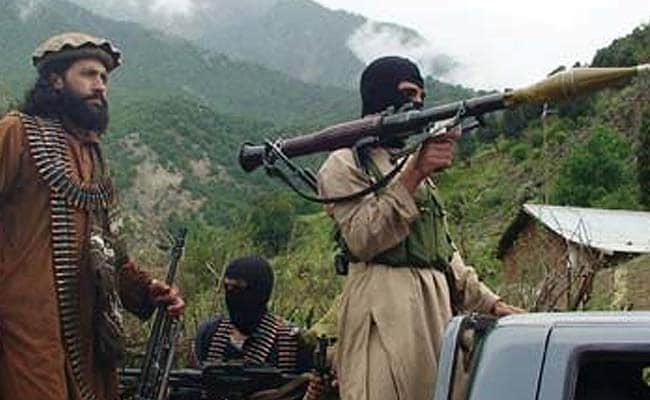
a group of people riding on the back of a truck: Pakistani soldiers guard the Gaddafi Stadium ahead of a cricket series between Pakistan and Sri Lanka, in Lahore. Image used for representational purpose only. (Photo: AP)© Provided by HT Digital Streams Limited Pakistani soldiers guard the Gaddafi Stadium ahead of a cricket series between Pakistan and Sri Lanka, in Lahore. Image used for representational purpose only. (Photo: AP)
In an interview with French newspaper Le Monde, Jaishankar said the eradication of anti-India terrorist groups is a pre-condition for dialogue with Pakistan.
South Block confirms that terror training camps of LeT, JeM and Hizbul Mujahideen are still active in Pakistan despite the public posturing of Imran Khan government. India sent a specific list of locations, including Google map co-ordinates of 24 prominent terror training camps in Pakistan to the country after the Pulwama attack but none of these camps has been shut down to date.
The names of camps include Abdulla bin Mashood (LeT); Balakot (JeM); Barali/Fagosh 1 & 2 (LeT); Barnala (HM); Bhawalpur (JeM); Batarsi camp 1 & 2 (LeT & JeM); Chelabandi (LeT/JeM/ HM) and Daura-e-Azeemat (HM). Many of these camps are located in Occupied Kashmir, Manshera, Peshawar, Bhawalpur and Lahore.
According to security agencies, JeM's operational commander Mufti Abdul Rauf Asghar along with his brother Maulana Ammar met their handlers in Rawalpindi GHQ on November 10 seeking financial help, removal of restrictions on the terror group and instructions for future action.
Indian intelligence inputs also say that two LeT suicide attackers, Osama and Abdullah infiltrated the newly created UT in early October after undergoing a so-called purification course and with the approval of senior LeT leadership.
While the hunt is on in J&K for these two, the state police has killed no less than 150 terrorists this year including 70 Pakistani nationals.
When EAM Jaishankar talked about terrorist factory, he was also talking about Pakistan's other options in targeting India. As recently as September 23, Pakistan based Ranjeet Singh Neeta's Khalistan Zindabad Force tried unsuccessfully to send a cache of AK-47 rifles, pistols, satellite phones and ammunition across the international border.
Pro-Khalistan terrorists currently being given shelter by Pakistan include Harmeet Singh and Lakhbir Singh of International Sikh Youth Federation (ISYF); Paramjit Singh Panjwar of Khalistan Commando Force (KCF); Gajinder Singh of Dal Khalsa and Wadhawa Singh Babbar of Babbar Khalsa International (BKI).
Members of Indian Mujahideen group, who planned and executed blasts in India between 2005 to 2013, are also now freely operating in Pakistan. These include Iqbal and Riyaz Bhatkal, Mohasin Choudhary, Afiff Hassan Siddibappa and Mohammed Rashid.
The fugitives taking shelter even today in Pakistan are all the principals accused in 1993 Mumbai bomb blast cases, engineered by global terrorist Dawood Ibrahim. His associates including Anees Ibrahim, Tiger Memon, Chhota Shakeel, Mohammed Dosa and Fahim Machmach also operate freely in Pakistan.
https://www.msn.com/en-in/news/newsindia/terror-training-camps-still-active-in-pakistan/ar-BBWS18H?li=AAggbRN

Imran Khan’s Pakistan is only for the military middle class, not for everyone


 21 August, 2018  

Instead of offering concrete suggestions for economic policy, Khan continues to rail against the alleged corruption of his opponents.

Imran Khan’s first address to the nation as Pakistan’s prime minister devoted more time to discussing ending corruption, improving education, and ensuring better garbage collection in cities. He said little about ending Pakistan’s reputation as a terrorist safe haven or how he might face the country’s relative global isolation.
The reason for Khan’s choice of priorities is the same as the reason why several members of his cabinet are individuals who also served in the military dictatorship of General Pervez Musharraf. The issues he listed matter to his support base, which essentially comprises the pro-military salaried class.

Most of them were comfortable during Musharraf’s rule and would be happy to be led to the lost paradise by an energetic civilian celebrity.
That is not to say corruption, lack of education and sanitation are not important issues. They are. But they are a result of Pakistan’s state of permanent crisis, not the reason.
Moreover, Pakistan’s constitution makes provincial governments responsible for education while garbage collection is the responsibility of local governments. Neither falls under the prime minister’s purview although his attention could certainly help improve service delivery in both realms.
Still, that is insufficient reason for the newly selected prime minister of a nuclear-armed country to speak like a mayor or a provincial leader and avoid addressing matters that interest the rest of the world.
Khan is the latest celebrity who has translated his success as a cricket star into high political office. That he did so with the help of Pakistan’s ubiquitous intelligence services and the military is not in doubt. But even if he had succeeded all on his own, he would have had the same handicap that celebrity leaders have everywhere else.
As Michael Gerson recently posed the question in The Washington Post in context of another celebrity leader, “Is the skill set of the celebrity suited to the reality of governing?”
“The culture of celebrity,” Gerson wrote, “elevates appearance over accomplishment”. In this culture, “rivalries and feuds are essential to the storyline,” and “it encourages theatrical bitterness. Instead of pursuing a policy vision, the first calling of the celebrity is to maintain a brand”.
Celebrities seldom get the scrutiny that politicians do before their rise to power. The celebrity, according to Gerson, is likely to use “the power of his office to pursue personal vendettas. Instead of yelling at the television when people displease him, he now has the power to hurt them in practical ways”.
Khan’s rise to power was based on painting his rivals as venal and corrupt. He has now promised to put them on trial for corruption. But, as Pakistan’s history has repeatedly shown, accusing civilian leaders of corruption with the help of a subjugated media is easier than convicting them through due process.
Within 48 hours of being sworn in, Khan discovered that his assumption of lavish expenditure on the prime minister’s official residence from the exchequer by Nawaz Sharif was wrong. Apparently, Sharif dutifully wrote cheques to reimburse his personal expenses and those of his family.
Other similar revelations probably also await. Middle class Pakistanis might like Khan’s claims about transforming the prime minister’s house into a university or reducing expenses on catering for official events. But catering expenses are a drop in the bucket of Pakistan’s huge deficit, and the gimmick of transforming a residential building into a university might end up incurring significant costs.
For several decades, salaried Pakistanis – soldiers, civil servants, doctors and engineers often employed by the government and their offspring who have grown up in government residences and cantonments – have been fed a simplified national narrative.
Pakistan, they are told, is a special country created by God and endowed with natural wealth and productive people. The common explanation for Pakistan’s relatively uninspiring economic performance is that the country’s riches are regularly plundered by corrupt politicians and civil se
Every backdoor intervention in Pakistan’s politics has been predicated on the assumption that an honest leader can help recover the billions of dollars siphoned off from the economy and stashed in bank accounts abroad, although no large-scale repatriation of stolen Pakistani wealth has ever occurred.
It is not unusual for Khan’s supporters to talk about overseas property and ‘billions of dollars’ in Swiss accounts that would, if brought back, help Pakistan become collectively wealthy.
Instead of offering concrete suggestions for economic policy, Khan continues to rail against the alleged corruption of his opponents and promises prosperity based on ‘bringing back the nation’s looted wealth’.
But this narrative ignores the economic explanations for flight of capital or why corruption in Pakistan does not result in local capital formation as it does in countries like South Korea or China. Corruption is indeed endemic in Pakistan but it is not the only explanation for Pakistan’s economic problems.
Khan will keep his base happy with such nationalist rhetoric, while ignoring questions such as why the per hectare yield of its major crops is almost half of most other countries, why Pakistanis consume 34 per cent less calories on average than the rest of the world, or why the value of Pakistan’s cotton textiles exports is less than that of Bangladesh while Pakistan is the world’s fourth largest cotton producer and Bangladesh produces negligible amount of cotton.
Fulmination against corruption has become the economic equivalent of conspiracy theories explaining the country’s insecurity. In popular sentiment, just as conspiracies have made Pakistan weak and vulnerable, its destined economic greatness has been thwarted by corruption, not poor policy choices.
But a nation’s performance depends on sensible policies, not rhetoric and God’s special endowments. Even after Khan has improved garbage collection and put all his ‘corrupt’ opponents on trial, Pakistan’s debts won’t see a drop and exports and remittances will continue to fall short.
Unless, of course, core problems discouraging investment, productivity and exports are addressed. These include religious militancy and poor relations with neighbours, which have economic consequences that Khan’s base simply does not wish to acknowledge.
On the domestic front too, Khan cannot rely on his base alone. As US political analyst, Charlie Cook, recently observed, “Politics is supposed to be an exercise in addition, not subtraction or division.”
With a razor-thin parliamentary majority (176 out of 342), Khan will soon have to reach out for support beyond his base, which might entail deals and reconciliation that he has always decried. The deal-making began even to reach that slim majority.
Pakistan’s military leadership and the judiciary have their own crisis of credibility to deal with. Having put their weight behind Khan’s election success, they cannot afford to be seen as extensions of just one political party forever.
As permanent institutions of state, the judiciary and military need to regain the respect (or at least regard) of other political groups and factions and would soon have to reach out to critics to restore political balance.
Khan’s celebrity status might not prove enough to deal with Pakistan’s myriad challenges.


#Pakistan #PPP - Bilawal says IMF policies destroyed country’s economy

  • PPP chairman says joblessness has become a major issue in the country due to poor economic policies.
  • Bilawal says PPP has no knowledge of Fazlur Rehman's plan A or C.
  • PPP cannot initiate or become part of any civil disobedience movement: Bilawal.
Pakistan Peoples Party chairman Bilawal Bhutto Zardai has said that the policies of International Monetary Fund (IMF) have brought the country's economy to the brink of destruction.
He expressed these views while speaking to media persons in Islamabad on Friday.
Bilawal said that the PTI-led government has completely destroyed Pakistan's economy and surrendered to the IMF.
The PPP chairman highlighted that joblessness has become a major issue in the country due to poor economic policies.
To a question he added, “Imran Khan will not remain prime minister for long as the people have become fed up of his ill policies," he maintained. He said the selected PM will have to step down and next year people will see a new prime minister.
Regarding JUI-F's ‘Azadi March', he said that PPP has fulfilled its responsibility regarding the protest march as its leaders participated in it from Karachi. “We have no knowledge of Maulana Fazlur Rehman's plan A or C," he remarked.  However, he pointed out that Fazlur Rehman is in contact with PML-Q leaders these days.
He said the PPP cannot initiate or become part of any civil disobedience movement.

Saturday, November 16, 2019

Video - #Books #WhoseBoat #Colbert Small Town Big News: Anti-Trump Books Disappearing From Idaho Library

Video Report - Watch Fox News hosts react to Marie Yovanovitch testimony

Video - Hundreds of protesters clash with riot police in Chile

Video Report - #Yellowvest protesters revive movement in Paris on first anniversary

Video Report - #YellowVests movement hasn’t gone anywhere and it does not intend to

Video - Haqeeqat | Cousin Marriage and Abnormal Children |

#PPP - Bakhtwar Bhutto Zardari elected as co-chair of Bhutto Legacy Foundation

A meeting of Bhutto Legacy Foundation was held at Pakistan People’s Party (PPP) central secretariat Islamabad in which a resolution was passed to add three names on the board.
According to the resolution, Bakhtwar Bhutto Zardari was elected as co-chairperson of the foundation whereas Bilawal and Aseefa Bhutto Zardari are new board members of the foundation.
Other board members of the foundation include Bashir Riaz, as chairman and Rukhsana Bangash, Barrister Masood Kausar, Prof Ijaz Ul Hassan, Taj Haider and Aurengzeb Barki.

https://www.pakistantoday.com.pk/2019/11/15/bakhtwar-bhutto-zardari-elected-as-co-chair-of-bhutto-legacy-foundation/

Fear of religious persecution forces Pakistani minorities to flee to India

MUKESH MATHRANI
A large number of Hindu immigrants reside in Jodhpur while they have relatives in bordering districts like Barmer, Jaisalmer, Jalore and Bikaner.
Policies and schemes for immigrants are not being implemented on the ground in India.


While the Imran Khan-led Pakistan government keeps raising a hullabaloo about the religious persecution and atrocities in the Kashmir region, the situation at their backyard presents quite a contrasting picture to the stance they portray. Minorities in Pakistan, especially members of the Hindu community, are immigrating to India fearing religious persecution and threat to life.
A large number of Hindu immigrants reside in Jodhpur while they have relatives in bordering districts like Barmer, Jaisalmer, Jalore and Bikaner, which are close to Pakistan. This is because of the provisions under the Foreigners (Protected Areas) Order, 1958, where the movement of foreign nationals is restricted for around 40 kilometres from the international border.
Ajmal Meghwal.
Ajmal Meghwal, 22, originally a resident of Sanghar district of Sindh province in Pakistan, settled in Rajasthan’s Jodhpur district a year ago fearing religious persecution following the death of a relative.
Ajmal stated that they were engaged in agricultural work and used to share it with a local Muslim landlord on a seasonal basis. While they had settled quite well in Pakistan, the only problem they were facing was fear of religious persecution, claimed Ajmal. It is extremely difficult for a Hindu family to live in an Islamic country, he highlighted.
While incidents of atrocities against Hindus are common, it took the killing of his aunt that triggered the decision to leave the country. Ajmal stated that about two years ago, the landlord’s son, who was trying to park his car in front of the entrance to the house, was asked by his aunt Gulan Bai to park somewhere else. However, he got angry at once and put his car in reverse and ran over her three times while crushing her intentionally, Ajmal claimed. He also warned to kill anyone who forbids him from parking his car anywhere in his ‘own’ country, Ajmal alleged.
“My family and I pleaded for justice for over a year but found that justice is not for Hindu victims in Pakistan. After losing one family member and being denied justice, we learnt a lesson and decided to move to India for a safer and peaceful life,” Ajmal added. He said that while there are financial constraints, at least there is no threat to life.
Safe, but poor
Kewal Meghwal.
Like Ajmal, Kewal Meghwal, 58, formerly a resident of Sanghar district, arrived in India about three months ago owing to the fear of religious persecution. Presently on a short-term visa permit, Kewal with his 19 family members stay in Jodhpur district.
He pointed out they worked as bonded labourers under a Muslim landlord in Pakistan and in turn witnessed and experienced multiple instances of atrocities and religious persecution. He added that he arranged for immigration documents through a middleman and fled with his whole family. They took Thar Express, a weekly train between India and Pakistan that was cancelled on August 16, after the relationship between the neighbouring countries deteriorated after the abrogation of Article 370 of the Indian constitution.
A former resident of Mirpurkhas district in Pakistan Bhimji Koli moved to India about six months ago. A businessman who used to run a flour mill and a transport business, Koli migrated after two minor girls from his family were kidnapped and forcefully converted to Islam, since he also has two sons and five daughters.
Bhimji Koli.
Presently residing in Jodhpur district on a short-term visa permit, he works as a tailor. Like Kewal’s, even Koli’s family also arrived on Thar Express.
Another former resident of Sanghar district Damaram Bheel, 80, highlighted that it is difficult to live in Pakistan with a Hindu identity.
He stated that he worked as an agricultural labourer and had witnessed unbearable disgust and persecution. He mentioned that his only son Kasturo was frustrated with such an environment and wanted to immigrate to India in hope to get rid of such religious persecution. "Whenever he used to hear about the incidents of abductions of minor Hindu girls who were forcibly converted to Islam, he couldn’t sleep for days,” added Damaram, who has three daughters.
Damaram Bheel[.He added that about three years ago, a minor boy of the family was abducted by locals and forcibly converted him to Islam. Damaram claimed that they pleaded a lot for his return, but it didn’t bear any results. He mentioned that the incident instigated Kasturo to relocate to India and they came about two years ago. He added that Kasturo passed away due to cardiac arrest last year.
He, however, stated that life for immigrants in India is difficult. Bheel mentioned that it’s not possible for the whole family to survive on the earnings of a single member. He said they manage on contributions by a few relatives, and added that there are numerous legal complications for getting a long-term visa, renewal of the passport from Pakistan’s embassy in New Delhi.
“Though I am not certain about the future of my family, I still think that I will die with the satisfaction that my growing granddaughters are at least safe here as Hindu girls,” he stated.
Religious persecution not new
While there are many media reports depicting the plight of Hindus in Pakistan during the present Imran Khan’s regime, these are not the only stories and Hindus have felt unsafe even in the past.
Ranaram Bheel, 48, who emigrated from Punjab province in Pakistan, said that he was living in Pakistan with his wife and daughter and left about a decade ago after his Muslim landlord kidnapped his wife and forcibly converted her to Islam and married her.
Ranaram Bheel.
He stated that the incident took place in 2004, after which he filed a police complaint. He claimed that the police only offered him verbal assurances whenever he approached them, while he kept receiving threats from the accused. “Finally I decided to save my daughter’s future and moved to India. Since then, I have never seen my wife or even heard her voice,” he added.
His concerns are similar to Damaram. He pointed out that there is no mechanism in place to ensure that immigrant families are looked after properly and sometimes it’s difficult to earn two meals a day. “People also avoid giving employment to us because of our immigrant identity, but despite all the hardships, I have no other option to save the future of my daughter, and I feel that in comparison to Pakistan, my daughter is safer here,” he added.
Another resident from Sanghar district Prem Bheel, 40, said that while his family was well-settled in Pakistan, migrating to India was always on their minds since 1992. He explained that his father began thinking of migrating to India after anti-Hindu riots erupted in Pakistan following the demolition of Babri Masjid in Ayodhya, Uttar Pradesh.
Prem_Bheel.
They had a shop run by family members selling cosmetic items. Prem said the temples in their town and most of the shops of Hindu families were vandalised and set on fire at that time. Even though their shop was vandalised, they managed to escape with the help of their friends. He pointed out that after that incident they started looking for ways to safely leave to India, but wasn’t able to. However, as media reports of three minor girls being abducted surfaced, they moved to India fearing religious persecution.
“One of the three girls was killed, while two were forcibly converted to Islam and married off to Muslim boys,” he highlighted. He claimed that Hindus in Pakistan are victims of religious atrocities, but nobody is there to listen to their pleas. The police neither offers them any protection nor takes any action when a crime has been committed against them.
Prem stated that they have been living in Jodhpur for the last 15 years and has faced problems due to lack of earning opportunities. He works as a scrap dealer on a push-cart and hardly earns enough to support his family. He pointed out that they are yet to receive Indian citizenship and has been caught in the red-tapism for many years.
Prem urged the Narendra Modi-led government in India to provide some relaxation in gaining citizenship to the Pakistan immigrants.
“We left Pakistan because being Hindus we weren’t safe and moved to India finding it as a safer place for Hindus. But if India doesn’t accept us, where will we go,” argued Prem.
Rehabilitation package needed
The President of the Seemant Lok Sangathan, an organisation working for the rights of immigrants from Pakistan in India, Hindu Singh Sodha stated that the situation of the Hindu minority in Pakistan is comparable to hell. However, he lamented at the condition of the Hindu immigrants in India who are living a life of poverty.
He explained that the policies and schemes for the immigrants are not being implemented on the ground. The powers of giving citizenship have been delegated nearly three years ago, but unfortunately only one-fifth of the eligible cases have been granted citizenship so far, he informed.
Hindu Singh Sodha.
“The immigrants are forced to live in utterly deplorable conditions as they don’t have citizenship and other required civil documentations. Some of the immigrants even return back to Pakistan due to the troublesome situation over here in India for the immigrant community, and have reportedly converted to Islam when they went back to Pakistan,” claimed Sodha.
He, however, added that the majority of the Hindu immigrant families from Pakistan have no other option except staying here in India in order to save themselves and their daughters.
He urged the central and state governments to ensure the rescue of the Hindus still in Pakistan, and rehabilitation of the immigrants.
He highlighted that the authorities concerned must not put hurdles in the implementation of the policies meant for immigrants in India, and the state governments must introduce and execute a robust recovery and rehabilitation package for the immigrants.

'Extreme fear and self-censorship': media freedom under threat in Pakistan


By Hannah Ellis-Petersen and Shah Meer Baloch
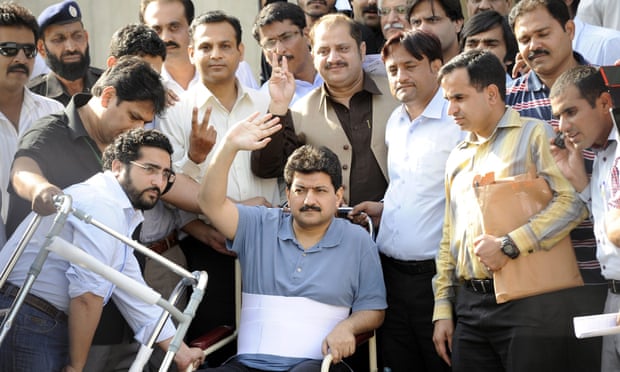
 ‘We are facing naked censorship,’ says Pakistani journalist Hamid Mir (centre), who has endured years of intimidation under previous governments. Photograph: T. Mughal/EPA
Journalists face blanked-out articles, pulled funding and channel shutdown if they dare to criticize the state
For almost five years, Talat Hussain, a well-known Pakistani journalist, hosted a popular current affairs talk show on Geo TV, openly discussing the political issues of the day. But last year all that changed. Forced to comply with a “total blackout” of news that criticised the military or the government of the new prime minister, Imran Khan, Hussain found himself unable to speak freely.
“My programmes were being repeatedly censored,” said Hussain. “I was told that any suggestion that the 2018 elections were rigged or that the army was part of the running of the government by Imran Khan was unacceptable.”
While Pakistan has a turbulent relationship with media freedom, under Imran Khan, elected as prime minister last year with strong backing from the military, censorship is felt heavier than ever before.
Journalists, activists, authors and politicians spoke to the Guardian of a climate of “extreme fear and self-censorship”, and the suppression of opposition political voices, even worse than during the military dictatorship of General Zia, who oppressively ruled Pakistan between 1977 and 1988.“I was told by Geo News administration that they could not air my analysis because the army, represented by ISPR [the media wing of the Pakistan armed forces], was very unhappy and they would shut down channel transmission if I continued to speak like I did, which they said was financially ruinous for them,” said Hussain.
“In the end they used the ruse of downsizing and asked me to reduce my team and their salaries, which I refused and left.”
Hussain’s account of direct involvement by the military and political authorities in censoring stories critical to the government was repeated by half a dozen journalists. The pressure was reportedly exerted both through direct edicts to editors and producers, to less direct but more costly interventions such as pulling TV stations from transmission, targeting advertising revenue of dissenting media or pulling newspapers from circulation.In many cases, the trend towards heavy censorship pre-dates Khan’s premiership, but he has been criticised for allowing it to continue, if not ramping it up. In 2017, Mohammed Hanif, a celebrated Pakistani novelist and satirist, was surprised to open the New York Times to find his article, titled Pakistan’s Triangle of Hate: Taliban, Army and India, had been removed and there was nothing but an empty page.
“When you see a blank space in a newspaper where your article should have been, it’s slightly terrifying,” said Hanif. “It reminds you of old-fashioned censorship that we had during military dictatorships.” Speaking of the current government, Hanif said that “censorship … is the worst we have seen”.
Dawn, Pakistan’s largest English language newspaper, suffered huge financial losses in June last year when the military restricted its distribution after they published leaks of secret military meetings.
The censoring of critical voices is not only restricted to media. Last week, an exhibition at the Karachi Biennale by the artist Adeela Suleman, called The Killing Fields of Karachi, which addressed the extrajudicial deaths of 444 people at the hands of the police chief Rao Anwar, was raided by the authorities and ordered to be shut down.
The military and government have actively denied any involvement with censoring the press or culture. Dr Firdous Ashiq Awan, special assistant to the prime minister on information and broadcasting, said: “The current PTI government is providing the best and most effective environment for freedom of speech. Journalists are free to write what they want and most news reports are against the government. These are just lies that the government is not allowing media to give coverage to opposition. The issue is that censorship is in the minds of some journalists and politicians.”
ISPR declined to give an on-the-record statement.
However, last week the broadcast regulator Pakistan Electronic Media Regulatory Authority (Pemra) was forced to backtrack on a directive issued to all TV news anchors, banning them from expressing personal views on their shows, punishable by a fine of up to 10 million rupees (£189,384), after it was publicly slammed by Reporters Without Borders as a “grotesque” example of censorship. On Friday, the Peshawar high court also ruled that Pemra’s ban on TV channels airing a press conference by Maulana Fazlur Rehman, the leader of the opposition, was illegal. Pemra did not respond to request for comment.
According to Gibran Peshimam, executive producer of one of Pakistan’s most well-known current affairs shows, Aaj Shahzeb Khanzada Kay Sath, “there are many layers of censorship by many quarters ... it’s more sophisticated, and more nuanced, than it has been in the past”. Senior management figures spoke anonymously of a draconian approach of collective punishment which was being inflicted on media organisations. If one reporter or news channel reported a story that threw the government into disrepute, the business interests of the media owners would be targeted or advertising funding withheld.
With media in Pakistan already suffering financial losses across the board, it meant pressures of self-censorship and appeasement of the government has become rife, particularly at the top levels of media organisations.
“I feel journalism is under threat more than it has ever been in Pakistan,” said Ali Haider Habib, a former senior editor at Herald, an investigative news magazine which closed down this year, allegedly due to mounting pressure from the military establishment about its critical reporting. “I have not lived through Zia’s regime but my mentors have always told me how it was known who the force behind the censorship was and people acknowledged it quite openly. Today, the censorship comes from a shadowy force that one can not even name. The number of journalists and activists who have been ‘picked up’ recently is a painful reminder of that.”The military’s hostility towards the media was demonstrated in June last year, when Maj Gen Asif Ghafoor, the director general of the ISPR, singled out dozens of journalists for their “anti-Pakistan” activity on social media. He repeated the sentiment on his own Twitter account in July this year, calling out “irresponsible” journalists, which led to the hashtag #ArrestAntiPakjournalists to trend on Twitter in Pakistan, used more than 28,000 times.
Hamid Mir, an award-winning Pakistani journalist, is no stranger to being targeted for his reporting. But even after enduring years of criminal charges and threats, including an assassination attempt in 2014, allegedly by the Pakistan intelligence services, which saw him hit with six bullets in the ribs, thigh, stomach and across his hand, Mir said he had never witnessed such brazen interference in media.
“Over the last year, we are facing naked censorship,” said Mir. It was in June this year that his political talk show Capital Talk was stopped minutes into transmission during an interview with the former president, Asif Ali Zardari, who is very critical of Khan’s administration.
“Prime minister Imran Khan was giving an interview to another channel, ARY on the same day at the same time,” he said. “I later learned that when the prime minister came to know that a Zardari interview was airing simultaneously, he asked his people to stop it and it was stopped.” An adviser to Khan later justified the decision to cut the interview because Zardari is facing trial, although this is not a standard policy. After Mir conducted a live TV phone interview with Maryam Nawaz, the daughter of the beleaguered former prime minister Nawaz Sharif and a fierce critic of Khan, he was stopped from doing live shows altogether.
Mir’s column in the Urdu daily newspaper Jang was also cut recently when he used it to criticise media censorship. “General Zia was a dictator, General Musharraf was a dictator, but Imran Khan is a democratically elected prime minister,” he said. “If he is behaving like Zia and Musharraf it is more painful. We cannot compare dictatorship with democracy. If we are facing censorship in a democracy then it is a fraud.”

US Concern Over Prevailing Terror Hubs In #Pakistan Worrisome: Report


A European think-tank report said that "Pakistan did not take sufficient action against externally-focused groups such as Lashkar e-Tayyiba (LeT) and Jaish-e-Mohammad (JeM), which continues to operate, train, organize, and fundraise on its soil."
A European think-tank has said that despite several restrictions and warnings by global watchdogs, the United States' concern over prevailing terror hubs in Pakistan is portraying a grim picture of the security situation in the region. The European Foundation for South Asian Studies (EFSAS) predicted after referring to the US State Department's recent Country Report on Terrorism in 2018, which came down heavily on Pakistan for promoting terrorism and its sluggishness in dealing with terror entities.
The report stated that "Pakistan did not take sufficient action against externally-focused groups such as Lashkar e-Tayyiba (LeT) and Jaish-e-Mohammad (JeM), which continues to operate, train, organize, and fundraise on its soil."The report also accused Islamabad of propping up "candidates overtly affiliated with LeT front organizations to contest the July general elections".Umair Jamal, the Lahore-based correspondent for The Diplomat, in an article dated November 9, elaborated on the State Department's contention.
He wrote, "Beyond rhetoric, there appears no convincing evidence that could suggest that Pakistan has choked India-focused groups' operational capability or capacity to act in the future. Arguably, the focus on Pakistan's part appears to be aimed at placing the group away from the media's glare and signifying small steps against these groups' activities as part of the state's broad plan to defang the organizations".
On Pakistan's role in Afghanistan, the State Department report said, "The Pakistani government pledged support for political reconciliation between the Afghan government and the Afghan Taliban but did not restrict the Afghan Taliban and Haqqani Network (HQN) from operating in Pakistan and threatening US and Afghan forces in Afghanistan... the Taliban and the Haqqani Network continued to launch lethal attacks throughout Afghanistan, including against US military personnel. In one of its deadliest attacks to date, Haqqani Network - an affiliate of the Taliban - killed more than 100 people after detonating an explosives-laden ambulance in Kabul in January, a week after the Taliban conducted an attack on a Kabul hotel that killed 22".
Pakistan's dubious and unhelpful role in Afghanistan was also a prominent theme in another report of the US Congressional Research Service (CRS) on the war-ravaged country.
The Congressional Research Service is tasked with preparing reports periodically on issues of importance for Congressmen to enable them to make informed decisions. This report identified Pakistan as the "most important neighbor" of Afghanistan, one which had played an active but negative role in Afghan affairs for decades. The report reiterated that "Pakistan's security services maintain ties to Afghan insurgent groups, most notably the Haqqani Network, a US-designated Foreign Terrorist Organisation (FTO) that has become an official, semi-autonomous component of the Taliban. Afghan leaders, along with US military commanders, attribute much of the insurgency's power and longevity either directly or indirectly to Pakistani support".
On Pakistan's motivations to adopt such a destructive policy vis-a-vis Afghanistan, the CRS averred that "Pakistan may view a weak and destabilized Afghanistan as preferable to a strong, unified Afghan State (particularly one led by an ethnic Pashtun-dominated government in Kabul; Pakistan has a large and restive Pashtun minority)".