Friday, November 8, 2019

Former Pakistani Attorney General Sardar Latif Khosa says Bilawal Bhutto Zardari has a bright future

Rattan Mall

‘Youth frustrated by Imran Khan’s unfulfilled promises will vote for Bilawal’
FORMER Attorney General for Pakistan Sardar Latif Khosa told The VOICE this week that even youth who were mesmerized by Pakistani Prime Minister Imran Khan are now frustrated because of the meltdown of the economy and the policies he has pursued. Khan had made “lofty promises” during the election campaign, but not one of them had been fulfilled.
Khosa, who was on a visit to B.C. this week pointed out that Khan as part of his election manifesto had promised 10 million jobs and 5 million houses. Instead the country was facing a recession and a trade deficit.
Now those very youth whom Khan had inspired to come out and vote for him in the last election were going to vote for Bilawal Bhutto Zardari, who at the age of 31 is Chairman of the Pakistan Peoples Party. Khosa called Bilawal “a young, talented and dynamic leader.”
Bilawal is the grandson of former Prime Minister Zulfikar Ali Bhutto and the son of former Prime Minister Benazir Bhutto. His father, Asif Ali Zardari, was President of Pakistan and co-chairperson of Pakistan People’s Party.
Khosa said: “I think he’s shaping up very well and he is very vibrant. He’s outspoken as well. He faces the international fora very eloquently. He has the command over languages; he has the vision and passion for politics just like his grandfather and the strength of character and perseverance of his mother. He is also courageous and conciliatory like his father. And I am sure he is going to shape up and People’s Party has a definite future. He has a very brilliant and very bright future ahead of him. He’s certainly the only young leader of the country because Imran Khan who claims to be 67 years, you can’t call him a young person!”
Khosa was pointing out a very interesting feature of Pakistan’s population. A 2018 report states “64 percent of the nation is younger than 30 and 29 percent of Pakistanis are between 15 and 29 (an age group which we define as the youth). Pakistan now has more young people than it has ever had, and this is forecasted to continue to increase until at least 2050.”
The Pakistan People’s Party is the governing party of the province of Sindh. Sindh has Pakistan’s second largest economy, while its provincial capital Karachi is Pakistan’s largest city and financial hub.
Khosa was on a three-day visit to attend the award ceremony of his son Dr. Faisal Khosa who is an Associate Professor of Radiology at University of British Columbia and is the winner of numerous national and international awards. The senior Khosa, who is a lawyer as well, was secretary of the Pakistan People’s Party for four years but decided not to run for election this time because of his professional commitments. However, he is still a member of the central executive committee of the party and also heads its lawyers’ forum. He is also the lawyer for Asif Ali Zardari and also represented Benazir Bhutto in her judicial matters. He was President of the High Court Bar Association three times and has been chairman of the Pakistan Bar Council. Khosa was also governor of Punjab – the largest province of Pakistan. His Khosa Law Chambers is the oldest law firm in the country and has branches all over the country.
THE VOICE asked Khosa about the massive protest that Imran Khan has been facing in recent days. Maulana Fazlur Rehman of the Jamiat Ulema-e-Islam (JUI-F) has been leading the “Azadi March” in Pakistan, which entered the seventh day on Wednesday, to pressure Imran Khan to resign.
Khosa said that nine Opposition parties “have united to voice their grievance because there were reservations over the electoral process that was held in which Imran Khan emerged as the victor and the Opposition had their reservations that it was not a free and fair reflection of the people’s choice.”
Nevertheless, the opposition gave the government about 15 months to deliver results, but it has consistently failed to do so. Khosa noted the irony of the current march as Imran Khan had pioneered and championed this tactic of agitation in 2014. Now Khan’s own invention has come back to haunt him.
Khosa said that the Pakistan People’s Party wants a change to take place through constitutional methods whether it’s a no-confidence motion against the Prime Minister or the government or even mid-term elections. He added that PPP remains opposed to any extraconstitutional steps for the removal of the Prime Minister.
He said the government had been “obstinately rebuffing all the demands that were being raised.” and Parliament had been “made into a rubber stamp,” because no decisions are being taken in it. The Parliamentary forums “are also being made redundant and the Opposition doesn’t have any other choice but to go on the streets.”
But he added: “I see no danger to democracy. I see no violation of the constitutional rule in the country and we stand firmly behind the Constitution. So, if Imran Khan is replaced or [not], it doesn’t matter because the state should be strong. The state institutions should be strong. Individuals come and go, so it doesn’t really matter.”
He said the opposition would like free and fair elections and that “the new Parliament that comes into power should be the voice of the people of Pakistan.”
He said that there would definitely be difficulties because the GDP growth had gone down from 5.8 per cent to 2.8 per cent. Prices were skyrocketing. “This year more than millions have been rendered jobless. … So I think there are horrendous challenges that the state of Pakistan will have to [tackle],” Khosa added.
However, he also stressed: “Certainly the opposition doesn’t want chaos, the opposition doesn’t want any clash, the opposition believes that the institutions should be impartial, neutral, independent, respected and strong. Maybe it does take some time. I am not foreseeing that the government is readily going to surrender. But sense should prevail on both the sides because from the opposition side we are always prepared to talk to the government.”
He advised the government not to “continue ridiculing the opposition and all their leaders” and added: “But from our side, we are in no hurry and we want the constitutional dispensation to prevail.”
ASKED if he anticipated any military intervention as had taken in the past, Khosa very confidently replied: “I do not see any reason [for it] this time because the Supreme Court had very emphatically taken a stand that no military intervention will be tolerated and you’ve seen already with General [Pervez] Musharraf facing a high treason case. We will always stand with our uniformed services, especially in the current scenario when there are many security challenges at the border.”
Khosa added: “Pakistan already has problems on the eastern side with India and Kashmir – India, unfortunately, annexed Kashmir by removing Article 370 from their Constitution. This was in total violation of international covenants and commitments made way back in the year 1948. India was committed to a plebiscite and unfortunately India has never held one – absolute obduracy on that. And the curfew imposed in Kashmir for the last 90 days – enslaved the people of Kashmir, not giving them the rights.”
Khosa felt that with Pakistan facing challenges on both its eastern and western sides, the army would remain neutral on the political front, especially with the judiciary “very firmly backing the constitutional dispensation and with General Pervez Musharraf’s fate still hanging [in the balance] and [he] being declared an absconder, a fugitive from law and justice, no one would like to have the same fate.” He added: “The army is very patriotic and committed and they are a professional force and Pakistani nation feels proud of their army. I don’t see the army interfering.”
REGARDING peace between India and Pakistan, Khosa recalled what he told a visiting delegation of lawyers from India when he was governor of Punjab many years ago: “I said we have thrown 1.5 billion people in the abysmal dismay of poverty over the tensions created between India and Pakistan. These borders have been created by human beings and not God and this bickering should end. Why can’t we really follow the rule of law?”
He added: “The rule of law necessarily demands that the United Nations resolution [on holding a plebiscite in Kashmir] should be acted upon and it would end the entire hatred and the bickering and all that we are spending on the mad race for armaments.”
With that money, both countries could be transformed into developed countries.
“These hate speeches must end. There should be interaction between the people of both countries. We believe in peace and amity and resolution of disputes through mutual dialogue and through discussions. So why can’t we sit and talk and resolve all these issues? There is a lot of goodwill between people of both the sides. Nobody wants this tension to escalate,” he asserted.
He wanted more exchanges of intellectuals, journalists, lawyers, Parliamentarians and showbiz people. He hoped that people from both countries would bring about peace and amity in this region because this was vital to their well-being.
“We don’t want our future generations again to go into the hate and be again inflicted by wars,” he said.

Pakistan Heading Towards A Second Bhutto Moment Courtesy Of Army – OpEd

By Dr Subhash Kapila
Pakistan Army is notorious in exterminating duly elected Pakistani Prime Ministers who politically dare to assert civilian supremacy over Pakistan Army Generals. PM Bhutto was executed in 1979 after being deposed in a military coup by General Zia. PM Nawaz Sharif was deposed in a “Judicial Coup” by Army in 2017and left to rot in Pakistani jails denied expert medical treatment.
Late Zulfiqar Ali Bhutto was President of Pakistan from 1971-1973 and Prime Minister from 1973-1977 when he was deposed in a military coup. Thereafter, on trumped up charges he was imprisoned and executed in 1979, in a retrial after being acquitted the first time.
Ailing Nawaz Sharif a three time Prime Minister of Pakistan was deposed by the Pakistan Army Generals through ISI sponsored weeks long sieges of Islamabad colluded by Imran Khan to emerge as Prime Minister. Pakistan Army considered Imran Khan would be a compliant PM not questioning Pakistan Army by “being on the same page” with them.
The final nail was getting then PM Nawaz Sharifs’ “Political Disqualification” for life by Pakistan’s judiciary forcing him to demit as PM three months short of competing his five year term. Pakistan Army Generals had assessed that in the ensuing General Elections PM Nawaz Sharif would be back as Prime Minister and he would be more emboldened to establish civilian supremacy over Pakistan Army.This time Pakistan Army did not dare a direct military coup but with collusion of then Pakistan Supreme Court Justice got him “Disqualified” on corruption charges which had yet to be proved legally in Court, three months before he could complete his full term. In my Paper at that time I was the first to term this as a “Judicial Coup”.Thereafter Former PM Nawaz Sharif stood lodged in jails and denied both bail as well as expert medical treatment. It is only lately when doctors raised alarms on his rapidly declining platelet counts and kidney disease that he was given limited bail for medical treatment, Pakistan Army did not want that the end of Nawaz Sharif takes place in jail as such a martyrdom would endow him with the halo of a “Shaheed of Punjab” felled by Pakistan Army.
Pakistan Army could get away from the contrived execution of late PM Bhutto because he hailed from Sindh and was a Shia.. This did not raise the hackles in Punjab’s Heartland Punjab Province. But ailing Former PM Nawaz Sharif hails from Punjab and his Party had ruled Punjab for years with wide political support. Can the Pakistan Army weather the political storm and disturbances likely to follow in the wake of what can be termed as a ‘slow death’ perpetrated by Pakistan Army and the colluding PM Imran Khan though from Lahore but a Pathan by descent.
Why were the Pakistan Army Generals afraid of former PM Bhutto forty years back and lately PM Nawaz Sharif? Why did the Pakistan Army need “Judicial Collusion” of Pakistan’s Supreme Court in the execution of Bhutto and the ‘slow death’ of Nawaz Sharif? Which factors embolden Pakistan Army Generals to attempt extermination of strong Prime Ministers? Why Pakistani mainstream political leaders cannot unite to put an end to Pakistan Army Generals stranglehold over Pakistan’s political dynamics?
Pakistan Army Generals were afraid of Bhutto and Nawaz Sharif because after long years in elected political office at the political helm of Pakistan they both felt politically empowered to attempt establishing civilian supremacy of the politically errant Pakistan Army Generals. Pakistan Army Generals considered this as an existential threat to their hold on Pakistan’s political governance and foreign affairs.
Pakistan Army Generals, even those with democratic instincts, were loath to return to military barracks and view civilian supremacy as a threat to their over-riding claims on outlandish oversized Defence Budgets and their vested corporate interests in the Fauji Foundation industrial empire. In short Pakistan Army Generals combine at any moment of time is hungry for political power having tasted it for decades.Furthermore, since both Bhutto and Nawaz Sharif were initially ‘political creations’ of Pakistan Army Generals they considered it as an affront that the very hand hat fed them was now ungratefully ready to bite that hand.Ironically, by the same token, Prime Ministers Bhutto and Nawaz Sharif were deposed by Pakistan Army Chiefs handpicked and selected by these two Prime Ministers bypassing Generals senior to them—General Zia ul Haq in case of Bhutto and General Qamar Bajwa in case of Nawaz Sharif. In case of PM Nawaz Sharif the Pakistan Army Chief did not resort to direct military coup but under corporate pressure of Pakistan Collegium of Corps Commanders contrived a ‘Judicial Coup” abetted by then Chief Justice of Pakistan Supreme Court.
Pakistan Army over the last seven decades having lost all wars of aggression to India and contributed to the fragmentation of the 1947 Pakistan by genocide in East Pakistan, now Bangladesh, has manged to project itself as the ‘Saviours of Pakistan & Defenders of Islamic Faith of Pakistan”. This has been achieved by Pakistan Army by a mixture of public deceit in suppressing reports like the Hamidur ur Rahman Commission condemning Pakistan Army for the breakup of Pakistan by its genocidal actions and misleading propaganda to the gullible Pakistani masses.
Pakistan Army also stands emboldened to liquidate Prime Ministers considered inconvenient to Pakistan Army or threatening its stranglehold over Pakistan’s governance mainly because it well knew that the external Powers that matter to Pakistan Army—United States earlier and China now—would not intervene to stop Pakistan Army Generals from heinous acts of exterminating their Prime Ministers. The United States and China have to historically share this blame of thwarting Pakistan’s democracy.
The last question is the most significant and that is as to why Pakistan’s mainstream political leaders have failed for seven decades to discipline the Pakistan Army Generals and establish civilian supremacy over the Army Generals. Multiple reasons can be ascribed for this failure. To begin with Pakistan Army Generals followed the British colonial practice of ‘Divide & Rule’ of the Pakistani polity. This has been achieved by a mixture of political inducements, political threats, blackmail and intimidation.
The above process could have been averted if Pakistan’s Supreme Court had the spine to uphold Constitutional provisions and democratic norms. Sadly for Pakistan, it's Supreme Court at various stages critical for Pakistan political dynamics entered into collusive suppression of democracy with Pakistan Army Generals either out of fear or own volition to further personal ends.
Pakistan today seems to be heading towards a ‘Second Bhutto Moment” where Former thrice elected PM Nawaz Sharif has virtually been on ‘death row’ and placed in a ‘slow death’ mode by denial of necessary expert medical facilities and advanced medical treatment abroad to save his life. The last minute temporary reprieve given by the Pakistan Army Generals through their selectee PM Imran Khan of temporary bail was to pre-empt Nawaz Sharif’s death in jail.
Concluding, it needs to be emphasised that Former PM Nawaz would be more dangerous dead than alive for Pakistan Army Generals as his ‘slow death’ by denial of medical treatment would make Nawaz Sharif a “Shaheed (Martyr)of Pakistan’s Heartland-Punjab” with unpredictable consequences. Turbulence so generated will not only hit Pakistan but more tellingly on China which today holds Pakistan in a colonial grip- courtesy Pakistan Army.
.
https://www.eurasiareview.com/08112019-pakistan-heading-towards-a-second-bhutto-moment-courtesy-of-army-oped/

What Can We Learn from the US State Department’s Terrorism Report on Pakistan?

By Umair Jamal 

 Pakistan took some serious criticism irrespective of the country’s efforts.
The United States Department of State recently published its annual Country Report on Terrorism. The report, which criticized Pakistan for failing to uniformly implement the Financial Action Task Force (FATF) recommendations and not taking action against regionally-focused terrorist groups, is important for several reasons.
What is encouraging for Pakistan is that the 2018 report doesn’t carry the punitive language which was prevalent in the 2017 report. For instance, the 2017 annual report notes that “Pakistan did not take sufficient action against other externally focused groups such as Lashkar e-Tayyiba (LeT) and Jaish-e-Mohammad (JeM), which continued to operate, train, organize, and fundraise in Pakistan.” In the 2018 report, however, Pakistan’s action against the JeM and LeT is described in terms of the groups still retaining their “capability and intent to target Indian and Afghan targets.” Still, the report considers Pakistan’s actions to contain regionally focused groups ineffective.
Islamabad, for its part, claims that the country has taken credible action against India-focused militant groups. During the last six months, Pakistan’s prime minister has not only condemned individuals and groups trying to endorse the use of militancy in Jammu and Kashmir, but has also termed it a threat to regional peace and Pakistan’s efforts to highlight the issue internationally.
However, beyond rhetoric, there appears no convincing evidence that could suggest that Pakistan has choked India-focused groups’ operational capability or capacity to act in the future. Arguably, the focus on Pakistan’s part appears to be aimed at placing the group away from the media’s glare and signifying small steps against these groups’ activities as part of the state’s broad plan to defang the organizations.
Moreover, the report’s content largely focuses on reminding Pakistan that a further expansion of the country’s counterterrorism actions can serve Islamabad’s interests effectively. The noted “uneven implementation” of Pakistan’s National Action Plan (NAP) against terrorism is considered flawed as it remains selective when it comes to acting against all forms of terrorist groups.
While the report may not have an impact on Pakistan’s bilateral relationship with the United States, the findings can be noticed by other institutions such as the Financial Action Task Force (FATF), where Pakistan’s fate hangs in the balance. Pakistan has another four months to implement major reforms required by the FATF to not only tighten its policy against terror financing but also to show that the country has taken verifiable actions to undermine groups such as JeM and LeT.
The report’s content concerning Pakistan’s role in Afghanistan’s instability largely focuses on the support that the Afghan Taliban and the Haqqani network enjoy from Islamabad. Interestingly, the report calls the Afghan Taliban a terrorist group that has “safe havens” in Pakistan and still targets U.S. interests. This, to an extent, confirms that for the United States, the issue of Afghanistan remains central in its relationship with Pakistan. Additionally, this also confirms that Pakistani Prime Minister Imran Khan’s personal rapport, which he developed with President Trump recently, won’t help Islamabad in evading criticism from various other state institutions in the United States.
While Imran Khan and the country’s national security establishment need to work on developing ties that can diffuse international pressures on the country, Islamabad needs to ensure that such acts are followed by comprehensive progress on the ground. Even one of Pakistan’s closest allies, China, which holds the FATF’s president warned the country of serious implications if steps are not taken to control terror financing in the country. “Pak needs to do more and faster. Pakistan’s failure to fulfill FATF global standards is an issue we take very seriously. If by February 2020, Pakistan doesn’t make significant progress, it will be put on the group’s ‘Black List,’” said Xiangmin Liu who recently become the head of the FATF.
On the whole, Pakistan took some serious criticism irrespective of the country’s efforts to manage militancy domestically. However, such reports are annual and Pakistan still has the chance to truly implement its plans that Islamabad has long talked about.
https://thediplomat.com/2019/10/the-return-of-the-pakistani-taliban/

Asif Ghafoor's audacious public dismissal of Imran Khan's waivers to Kartarpur pilgrims demolishes idea that army, govt are on 'same page'

Tara Kartha
Instead of informing the government and requesting a change in procedure, for whatever complicated reason it had in mind, the Pakistan Army simply announced that pilgrims would indeed need a passport.
Consider that when Imran Khan chose to make his first official visit to the US in a commercial aircraft, his army chief and his entourage came in their own aircraft.
When Islamabad chose to promptly release the captured Wing Commander Abhinandan, was that an Imran initiative accepted by the army or the other way around?
Pakistan can always be relied upon to provide political theatre, usually in the form of satire. There are after all few countries in the world where a prime minister makes a statement that is then immediately shot down publicly by a mere Major General. That’s however what happened recently, when Imran Khan in a burst of camaraderie directed at the Sikh community, declared that no passport would be required for the entry of pilgrims to the revered Darbar Sahib, a mere four kilometres from the Dera Baba Nanak shrine in Gurdaspur. The Pakistani Army didn’t agree.
Instead of informing the government and requesting a change in procedure, for whatever complicated reason it had in mind, it simply announced that pilgrims would indeed need a passport; and in parenthesis, the Prime Minister’s Office could go and chase itself around a tree.
Unpalatable but true. All this despite the fact that an agreement had been inked between India and Pakistan, and that all hitches, glitches and such like had been removed well before. In negotiations, India had observed that levying a fee of $20 was inappropriate given the ‘religious and spiritual’ sentiments of the pilgrims. But given that several thousand pilgrims are expected to visit the shrine, Islamabad was hardly likely to give up a nice and easy source of hard cash, that too in dollars. After all, that balance of payment crisis is not going to go away by itself.
In fact, the agreement itself finally did specify the passport as a valid document of identification, but that no visa would be required. In other words, a valid concern of Sikhs who are prone to travel far and wide on business and pleasure was addressed since no Pakistani visa would be evident on their passports. A Pakistani visa stamp is guaranteed to prevent entry into almost any country. Yes, that is the state of Pakistan.
Then came Imran Khan’s generous offer, waiving even the passport requirement and a 10-day prior notification. That when the Major General Asif Ghafoor, DG ISPR stepped in. In an interview on Pakistan Today, he was specific in observing that first, it’s a one-way corridor. No, Sikhs in Pakistan can forget about using this to come into India. Second, the entry would be legal, with due passport verification and all other official actions ensuring Pakistan ‘sovereignty’. Then came a rider with a sting. The DG ‘advised’ that this issue should not be politicised. That was directed at his own leadership, not at India who was merely wondering what the new protocol was now going to be. That was an insult to the prime minister, and no amount of talk of the two sides being like conjoined twins is going to erase that.
It’s not that Pakistan army generals have exactly kowtowed to the elected representatives at any time. For instance, the then president Asif Ali Zardari probably got a facer when he suggested that the ISI chief visit India immediately after the 26/11 Mumbai attacks. That would have been a wise move, but the ISI chief never came, nor even a deputy. But the point is that any twisting of arms of the civilian leadership was done in private. Today that veneer has disappeared. Consider that when Khan chose to make his first official visit to the US in a commercial aircraft, his army chief and his entourage came in their own aircraft.
At the meeting at the Oval Office, a Pakistani source quoted a US official as saying that the most powerful president in the world shook hands with the most powerful general in the world. At the meeting itself, there was no attempt to hide who was running the show in Pakistan. Inside Pakistan, the curtain on the civil-military relations has been raised with the army chief made part of the National Development Council. Later he also chose to confer with a group of Pakistan’s top businessmen shortly before they were to meet the prime minister. The veneer of a ‘civilian government’ has also gone. Same page? It would be difficult to find Imran anywhere in the rule book.
None of this is any surprise to Delhi who had quietly accepted the ‘selected’ prime minister's narrative. But it raises some interesting questions. When Islamabad chose to promptly release the captured Wing Commander Abhinandan, was that an Imran initiative accepted by the army or the other way around? When he seemed to most reasonably advise restraint after the Pulwama terrorist strike, was it his own script or that of a cautious army? When Khan then went to the other extreme in taking the unprecedented and disgusting step of abusing the Indian government in print and at the United Nations, was the script written by the army or the work of the foreign ministry? In short — and this is important — does the military want a Khan frothing at the mouth or one that is offering a mending of fences. From the recent ‘corrective statement’ by the DG ISPR on the Kartarpur corridor, they would rather have that table-thumping Khan as prime minister. A second issue is also clear. Any mending of fences with India will be at a pace decided by the army, not by the Prime Minister’s Office.
Oddly enough, the façade of a prime minister and army being on the ‘same page’ was blown apart by an unlikely political actor. Mufti Kifayatullah of the religious party now agitating for the removal of Khan rather sarcastically berated Major General Ghafoor on a television channel. The impassive DGISPR, apparently responding to theories of army backing of the protest, denied the army has nothing whatsoever to do with it, and rather egregiously stating that the army did not side with any political party. To which the Mufti retorted that in that case, the army should have corrected Khan when he was assuring one and all that he was on exactly and totally on the ‘same page’ as the army. He then advised the Major General to remove himself from his post.
While the officer is unlikely to follow his sage advice, there’s no doubt that the ‘same page’ story has fallen apart at its seams. That page if it ever existed, is now part of the familiar archival history of Pakistan. A leader comes in, wants to change everything, and then is changed himself. That’s the only page that exists. Too bad, they didn’t copy that to Khan from day one.
https://www.firstpost.com/india/asif-ghafoors-audacious-public-dismissal-of-imran-khans-waivers-to-kartarpur-pilgrims-demolishes-idea-that-army-govt-are-on-same-page-7621491.html

Thursday, November 7, 2019

Video - Fazal-ur-Rehman Speech in Azadi March Islamabad | SAMAA TV | 7 November 2019

Video - Chairman PPP Bilawal Bhutto Zardari addresses workers convention in Bahawalpur | 04 Nov 2019

All conspiracies against PPP hatched in Rawalpindi, Bilawal Bhutto

Pakistan Peoples Party Chairman Bilawal Bhutto Zardari has said the PTI government is not elected but selected. It has destroyed economy, leaving all segments of the society including traders in the state of anxiety.
Addressing lawyers at the Multan High Court Bar Association on Wednesday, he said the selected government has no worry about reducing people’s miseries.
The rulers do not have people’s mandate. He told the lawyers community that the country needs their role to save constitution, democracy and federation. The PPP and lawyers can jointly save the country through collective struggle. He said the PPP and lawyers have remained part and parcel in struggle against dictators for the supremacy of rule of law and parliament.
He said lawyers played a key role for the protection of people’s rights. The country is passing through 2019 and political workers are thinking about justice and empowerment of judiciary. The story of justice cannot be detached from the history of the Bhutto family. The PPP believes in respect to honorable judges. The brave judges always rejected compromise on principles despite facing life threats.
He said all conspiracies against the PPP took place in Rawalpindi. The PPP has always been victimized, targeted and hanged in Rawalpindi. He said how he could respond to workers when Rawalpindi has become centre of victimization and conspiracies against the PPP? The judiciary hanged PPP founder Zulfikar Ali Bhutto in Rawalpindi. PPP Co-chairman Asif Ali Zardari had sent a reference to the Supreme Court of Pakistan ten years ago for the retrial of Bhutto’s judicial murder. The whole Bhutto family has been waiting since long when the case is fixed for hearing. Bhutto’s judicial murder was a serious blunder and the judiciary must accept that Bhutto was innocent. The Bhutto family has been deprived of justice even after 70 years.
He said Zulfikar Ali Bhutto had given a complete code of life to the country in term of the 1973 Constitution but he was hanged. Even the judiciary could not give justice to Benazir Bhutto after her assassination in a suicide blast again in Rawalpindi, he added. Benazir launched countrywide agitation for the independence of judiciary and sacrificed her life for people’s rights.
He said the National Accountability Bureau is targeting democratic leadership instead conducting unbiased accountability in Naya Pakistan. NAB laws introduced by a dictator are ridiculing justice. The media is facing censorship. Political victimization should not have a role in Naya Pakistan, he said. The PPP chairman said Asif Ali Zardari is in jail without any charge and conviction. He said new laws are enacted to sentence the PPP leadership. He said all cases against Zardari belong to Sindh or Karachi but he is facing trial in Rawalpindi. He said Zardari has faced imprisonment for eleven years without any charge and now he is again in jail without any conviction.
He said conspiracies are being hatched to bring honorable judges under pressure for desired verdicts like in the Musharraf rule when he sacked Supreme Court of Pakistan judges. He said the country could only be saved through struggle against undemocratic forces. He said lawyers should launch struggle for the independence of judiciary. https://www.thenews.com.pk/print/551848-all-conspiracies-against-ppp-hatched-in-rawalpindi-claims-bilawal

Pakistan accused of cover-up over fresh polio outbreak

Hannah Ellis-Petersen
A source claims government plans secret vaccinations after 12 children fall prey to disease.
Officials in Pakistan have been accused of covering up an outbreak of the most dangerous strain of polio and planning a covert vaccination programme to contain the disease.According to a source in Pakistan’s polio eradication programme and documentation seen by the Guardian, a dozen children have been infected with the P2 strain of polio, which causes paralysis and primarily effects those under five. Dr Malik Safi, coordinator of the national emergency operation centre of the Pakistan polio eradication programme, confirmed the P2 outbreak, but would not give any further comment.
The P2 strain had previously been eliminated from the country. However, the new cases were allegedly kept hidden from the government and from international donors, including the UK’s Department for International Development, under direct instruction from Babar Bin Atta, the prime minister’s focal representative on polio eradication, who was last month forced to resign after he was accused of corruption. DfID has donated millions to Pakistan’s polio eradication programme.
The alleged cases, which have all resulted in paralysis, have been discovered mainly in Diamer district, with one in the capital, Islamabad.
Under Pakistani law, every new case of polio in the country has to be officially registered with the government, which then alerts international health bodies. “But to hide their negligence and their poor performance, Babar Bin Atta decided not disclose the cases to anyone,” said the source.
The re-emergence of P2 would not only be a dramatic step back in Pakistan’s fight against the polio, it would also be symptomatic of what those in the programme have described as “terrible mismanagement” under Bin Atta.Alongside Afghanistan, Pakistan is one of only two countries in the world that has not entirely eradicated polio. It was a key milestone in 2014, when Pakistan officially declared it had entirely eradicated P2 polio.Polio exists in three different strands, P1, P2, and P3, with P2 notorious as the most contagious and most vicious in its impact on those infected.According to the source within the programme, the renewed outbreak of the P2 strand came from a mismanagement of vaccines, which carry a live strain of the disease to create immunity.
After the strand was eliminated from Pakistan five years ago, all P2 vaccines should have been collected from hospitals and clinics and not used. However, it appears a P2 vaccine was administered accidentally and a child became a carrier for the disease. Tests on the new cases allegedly show the children are all carrying a form of the disease that originates in vaccine form.
“Somewhere, somebody has inaccurately used this vaccine and because of this negligence … this virus was brought back into the environment and our children are again getting infected with P2,” alleged the source.
However, it is understood that, instead of publicly declaring the renewed outbreak and beginning a public vaccination campaign, a “secret” vaccination campaign will begin on Monday in Rawalpindi and surrounding cities in an attempt at containment. It is understood that only senior members of the polio programme are aware of the P2 campaign, with others – even those who will be administering the vaccines – led to believe it is a standard P1 and P3 polio vaccination programme.
“This P2 outbreak can only be contained if they do a quality vaccination campaign, and how can you do a quality campaign if you are carrying it out in secret, without any awareness or accountability?” said the source.
“If anything goes wrong and this P2 polio spreads throughout the whole country, who will take responsibility? Will they just keep telling more lies to cover up their mistakes and put more children at risk?”Since 2018, there has been an “alarming” rise in polio cases in Pakistan, according to experts, with 77 official cases this year. Senator Ayesha Raza Farooq, who served as the prime minister’s focal person on polio eradication from November 2013 to August 2018, said Bin Atta had “ruined” the programme through corruption and mismanagement. Farooq accused the prime minister, Imran Khan, of refusing to listen to complaints against Bin Atta for the past 10 months. “PM Khan did not take heed to the programme and ignored the complaints which were coming to him against Babar Bin Atta,” she said. “They covered up the refusals and they allegedly used fake markers on kids’ to show they were vaccinated who actually were not. The damage that has been done to the programme has literally reversed many of our achievements.”
https://www.theguardian.com/global-development/2019/nov/07/pakistan-accused-of-cover-up-over-fresh-polio-outbreak

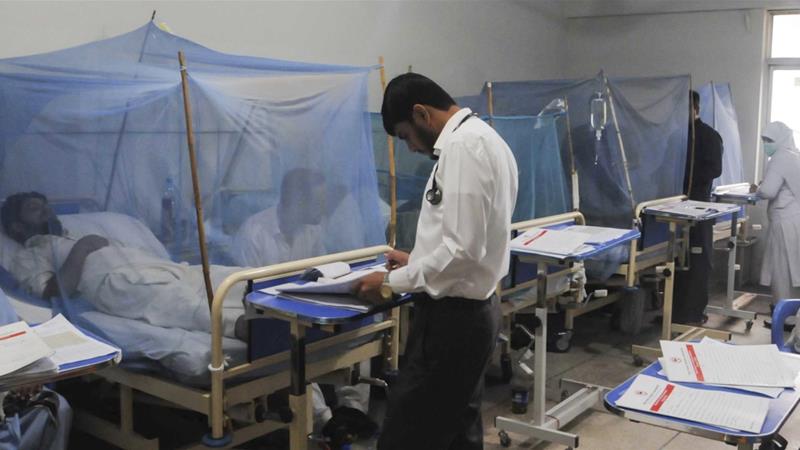
Record-high 44,000 dengue cases reported in Pakistan


Mosquito-borne infections soar to record-high number in the country this year with 66 deaths so far.
A record-breaking 44,000 people have been infected with mosquito-borne dengue in Pakistan this year, a senior health official said, as increased outbreaks linked to rising temperatures and erratic rainfall ravage other parts of Asia.
Rana Safdar, a senior official at the National Institute of Health (NIH), told AFP news agency on Wednesday the figure is a huge leap from the previous record of 27,000 infections in 2011.
Safdar said 66 people were killed by the disease so far in 2019, compared with 370 in 2011.

He blamed climate change for the surge, but would not elaborate. The government was "employing all available resources at its disposal to contain the problem", he said.
The highest number of patients was recorded in the capital, Islamabad, and the neighbouring city of Rawalpindi, where 12,433 people were found infected with the virus, with 22 deaths. 
The southern province of Sindh had 10,142 cases and 26 deaths, according to NIH data shared with local media outlet the Dawn. There were 9,260 cases in Punjab, the most populous province. 
Dr Mahseema Siddique, who treats dengue patients, blamed the government for the rise in cases, saying local authorities in Punjab and Islamabad, in particular, failed to take precautions such as covering up water reservoirs or spraying anti-dengue chemicals.
"They woke up only after hundreds of people got infected and that was too late. There are a large number of areas where spray teams could not make it," he said.

'Breakbone fever'

Dengue is transmitted mainly by the Aedes Aegypti mosquito, which thrives in densely populated tropical climates and breeds in stagnant pools of water.
Mosquitoes pick up the virus from infected humans - even asymptomatic ones - and pass it along to other people through bites.
Infections have steadily climbed across the globe since the 1970s because of rising temperatures and irregular monsoon rains linked to climate change, which allow for ideal mosquito breeding conditions.
This year outbreaks have rampaged through Southeast Asia in particular, infecting hundreds of thousands, killing hundreds, and crippling healthcare systems as governments struggle to contain the untreatable virus.
Dengue is mostly found in crowded areas, and breakneck urbanisation across the globe has helped the virus thrive.
Dubbed "breakbone fever", it inflicts suffering, with intense flu-like symptoms: severe headache, pain behind the eyes, full-body aches, high fever, nausea, vomiting, swollen glands and rashes.

Wednesday, November 6, 2019

Video - Mahmood Khan Achakzai Speech in Azadi March Islamabad | SAMAA TV | 6 November 2019

Video - Maulana Fazl-ur-Rehman Speech | 6th November 2019

Pakistan’s Massive March Calls out Military Overreach


By Daud Khattak


The Azadi March has brought the religious right and secular left together on a one-point agenda of civilian supremacy.
Pakistan’s powerful military is struggling to keep its grip on power as the country seethes with anger over the rising cost of living caused by sluggish economic growth, political victimization, narrowing space for freedom of expression, and the militarization of politics.
The military ruled Pakistan for 35 out of the country’s 70 years of history. Each military takeover – General Ayub Khan in 1958, General Zia ul Haq in 1977, and General Pervez Musharraf in 1999 — was followed by a sharp rise in people’s demand for democracy.
Over the past few years, the military’s savior image has suffered a blow due to ex-premier Nawaz Sharif’s ouster through a controversial court verdict in 2017 and the rigging allegations in the July 2018 elections. While Sharif’s political party points an accusing finger at the collusion between the judiciary and military in his removal, the other opposition parties believe the results of the July 2018 elections were manipulated in favor of Imran Khan’s Tehreek-e-Insaf or Justice Movement. Khan denies the charge.
The Khan government, meanwhile, is believed to be playing second fiddle to the military establishment, adding to the perception that Khan is being kept in power to provide civilian face to the decisions taken by the military leadership.
As the “Azadi March,” a protest by Maulana Fazlur Rahman, chief of the religious Jamiat Ulema-e-Islam party, continues in Islamabad to seek Khan’s resignation, louder calls from the political leadership are heard about the meddling in 2018 elections by the military.
The opposition parties, headed in this march by the pro-Taliban Jamiat Ulema-e-Islam party, also want fresh elections without the supervision of the military. It is the army soldiers and officers who ensure security of the polling stations during elections and till 2018, the majority of Pakistani political parties used to demand elections be held under military supervision.
The precarious health condition of Nawaz Sharif adds fuel to the fire. The 69-year-old has so far turned down all behind the scene offers to quit politics and leave Pakistan to settle abroad.
Sharif’s narrative of “Vote Ko Izzat Do,” an Urdu phrase which means accept the sanctity of the vote, is ringing across Pakistan and stoking anger against Imran Khan and his backers.


Sharif, the most popular leader in the Punjab heartland, which is also the main recruiting base for Pakistan’s armed forces, was maligned with the slogan “Modi Ka Jo Yar Hai, Ghaddar Hai” (Whoever is Modi’s friend is a traitor) for his peace overtures with archrival India.
Yet even staunch opponents of Sharif stand behind him when it comes to his “Vote Ko Izzat Do” narrative, which asks for civilian supremacy and the rule of law. Similarly, a majority of Maulana Fazlur Rahman’s supporters on various social media platforms are liberals who would never subscribe to Rahman’s religious views. The only ground for their backing is his unwavering stance on civilian supremacy.
One major reason for the decline in Khan’s popularity is his alleged secondary role to the military, besides his government’s failure so far to provide relief to the middle class and poor in terms of prices, jobs, and good governance as promised.
Khan admitted during a recent meeting with journalists that the military is standing behind him. The military’s reach is also evidence in its activities, which reach far beyond the security realm. Earlier, business tycoons met General Qamar Javed Bajwa, Pakistan’s army chief, to apprise him of their grievances. And in December 2018, Pakistan’s military spokesman advised journalists to adopt positive reporting for “just six months” and “see where the country reaches.”
In the past, those who dared to stand for the cause of civilian supremacy, civil rights, and the constitution, was labelled as traitors, anti-state, and Indian or Afghan agents. Fatima Jinnah, sister of Pakistan’s founder Mohammad Ali Jinnah, was also labeled as traitor when she challenged General Ayub Khan in 1964.
Such labeling, however, is now vehemently challenged on social media. Later this month, Hafiz Hamdullah, an ex-senator, was declared an “alien” for being an Afghan by the country’s national database registration authority NADRA, which also directed television channels not to invite Hamdullah for talk shows. Only days before, Hamdullah had criticized the security establishment in a television talk show for its role in politics.
Within hours, the name Hafiz Hamdullah was trending, with friends and foes posting on their timelines that “I am an Afghan” to express solidarity with the ex-senator. Days later, the government withdrew the order of declaring Hafiz Hamdullah an “alien.”
Mufti Kifayatullah, another political leader, accused three military dictators – Ayub, Zia, and Musharraf – of committing crimes by violating the constitution in a talk show. He was arrested the next day on charges of “hate speech” and threat to public order. Kifayatullah was later freed on bail.
On the eve of July 2018 elections,  high court judge Shaukat Aziz Siddiqui accused Pakistan’s premier intelligence agency of meddling in the political system and exerting pressure on the judiciary to keep Nawaz Sharif behind bars. A few months later, Justice Siddiqui was sacked on charges of refurbishing his official residence beyond entitlement.
From political meddling to media restrictions and interference in judiciary, the proverbial accusing finger is pointed at the establishment. The military always deny the charges of interfering in politics. Military spokesman Major General Asif Ghafoor questioned Maulana Fazlur Rahman’s comments when the latter accused the “national institutions,” a euphemism for the military, of supporting the government.
To help arrest the trend, the government has blocked interviews of key leaders such as former president Asif Ali Zardari and Maulana Fazlur Rahman on private television channels. In a fresh move, the media regulator PEMRA asked television anchors not to sit as hosts in talk shows.
These measures prove that the government and the establishment are rapidly losing their monopoly over the flow of information. Instead of getting crafted and selected information, social media is offering fair choices to common Pakistanis.
As Sharif is battling death, his “Vote Ko Izzat Do” slogan is echoing in Maulana Fazlur Rahman’s “Azadi March,” which has brought the religious right and secular left together on a one-point agenda of civilian supremacy.
However, irrespective of left or right, the ongoing struggle is seen by many in Pakistan as a struggle between the country’s powerful establishment and civilian leadership. The end, whenever it comes, will be decisive for the future course of democracy in Pakistan.

#PPP will keep fighting for democracy, says Bilawal Bhutto


Pakistan People’s Party (PPP) Chairman Bilawal Bhutto-Zardari on Wednesday reiterated his party’s resolve to continue the struggle for the rights of people.
Addressing the legal fraternity here at the high court bar, Bilawal praised the lawyers for their struggle for democracy and people’s rights. His party needed the support of lawyers and all those, who believed in the rule of law, to strengthen Pakistan and democracy, he added.
He said his grandfather Zulfikar Ali Bhutto, who had given a constitution to the country, was hanged. His mother Benazir Bhutto spearheaded the campaign for the restoration of the judiciary and sacrificed her life but didn’t make any compromises on principles for the people’s rights.
His father was also put behind the bar for 11 years without any solid case, he alleged.
Bilawal said former president Asif Ali Zardari had sent a presidential reference for reopening of the case of Shaheed Zulfikar Ali Bhutto 10 years ago.
He said the Bhutto family and the PPP had given sacrifices for the rights of the people, while dictators had overthrown its elected governments.
Former prime minister Yusuf Raza Gilani, his son member of the Punjab Assembly Musa Gilani and former Punjab governor Makhdoom Ahmad also attended the meeting.

https://www.pakistantoday.com.pk/2019/11/06/ppp-will-keep-fighting-for-democracy-says-bilawal/

#Pakistan #PPP - Bilawal asks courts to deliver justice to Benazir Bhutto


Pakistan Peoples Party (PPP) Chairman Bilawal Bhutto Zardari on Wednesday questioned that when would his mother and former prime minister Benazir Bhutto get justice.
The PPP chairperson addressed the Multan bar court association where he said he and his family have stood witness to the kind of justice imparted by the judicial system in Pakistan.
“Today, we are still talking, thinking and fighting for justice, democracy and human rights,” he said, adding: “You can’t simply separate this struggle from the Bhutto family […] those who performed the legislation were hanged.”
“We respect our honorable judges and lawyers who fought against dictatorship and stood by democracy,” he said while praising brave judges who, despite oppression, wrote dissenting notes which had put their lives at risk.
“Ten years ago, then-president Zardari sent a presidential reference to the Supreme Court to review the judicial murder of Zulfikar Ali Bhutto, but after 10 years, I went and knocked on the doors of the court and tried to become a party in the petition but we are still waiting for justice.”
“In naya Pakistan, there shouldn’t be any place for political victimisation […] in naya Pakistan, we are still facing fake cases,” he said, while asking for the release of Zardari in all cases.
“Why new laws are made for PPP?” he said.

Tuesday, November 5, 2019

#PPP Song ''ميں بھٹو ھوں''

#PPP Music Video - Kal Bhi Bhutto Zinda Tha,Ajj Bhi Bhutto Zinda Hai

Government will be responsible if anything happens to my father: Bilawal

Pakistan Peoples Party (PPP) Chairman Bilawal Bhutto Zardari on Tuesday said that the government will be responsible if anything happens to his ailing father.
He said on Twitter that former president Asif Ali Zardari has still not been given access to specialist doctors. “Our family is increasingly concerned about his health,” said the PPP chairman.
@BBhuttoZardari
 President Zardari has still not been given access to specialist doctors and personal physician. Our family is increasingly concerned about his health. If anything happens to our father this govt will be held responsible.

Aseefa Bhutto also said on Twitter that her father has had no access to doctors for six months.


My father has had no access to his doctors for 6 months.Govt purposely retracts information from his medical reports by govt doctors. As a diabetic heart patient with spinal issues, we fear for his health & have gone to Court for private doctors to be allowed to assess his health

https://dailytimes.com.pk/495286/government-will-be-responsible-if-anything-happens-to-my-father-bilawal/

Bilawal Bhutto expresses concerns over Zardari's health condition

Pakistan Peoples’ Party (PPP) Chairman Bilawal Bhutto on Tuesday has expressed his concerns over the health of his father and former president Asif Ali Zardari.
In a post on the social-networking website Twitter, the PPP leader said, “President Zardari has still not been given access to specialist doctors and personal physician. Our family is increasingly concerned about his health.”

If anything happens to our father this government will be held responsible, he warned.
President Zardari has still not been given access to specialist doctors and personal physician. Our family is increasingly concerned about his health. If anything happens to our father this govt will be held responsible.
2,773 people are talking about this
Earlier, while taking in view the health condition of Zardari, the PPP leadership had written an application to form private medical board for the checkup of ex-president.

PPP’s application stated that doctors have pointed out Zardari’s severe health issues, adding that uncontrolled sugar level can create problems for him. Government doctors also suggested to get help from a neurologist, the application told.

The PPP said that getting proper medical care is basic and legal right of every prisoner.  
On October 22, 2018, Zardari was brought to Pakistan Institute of Medical Sciences (Pims) from Adiala jail and admitted to the cardiology department’s VIP ward.

The former president had complaints of backache, weakness and anxiety.

'Extreme fear and self-censorship': media freedom under threat in PakistanHannah Ellis-Petersen and Shah Meer Baloch

By Hannah Ellis-Petersen and Shah Meer Baloch
Journalists face blanked-out articles, pulled funding and channel shutdown if they dare to criticize the state.
 For almost five years, Talat Hussain, a well-known Pakistani journalist, hosted a popular current affairs talk show on Geo TV, openly discussing the political issues of the day. But last year all that changed. Forced to comply with a “total blackout” of news that criticised the military or the government of the new prime minister, Imran Khan, Hussain found himself unable to speak freely.
“My programmes were being repeatedly censored,” said Hussain. “I was told that any suggestion that the 2018 elections were rigged or that the army was part of the running of the government by Imran Khan was unacceptable.”
While Pakistan has a turbulent relationship with media freedom, under Imran Khan, elected as prime minister last year with strong backing from the military, censorship is felt heavier than ever before.

Journalists, activists, authors and politicians spoke to the Guardian of a climate of “extreme fear and self-censorship”, and the suppression of opposition political voices, even worse than during the military dictatorship of General Zia, who oppressively ruled Pakistan between 1977 and 1988.
“I was told by Geo News administration that they could not air my analysis because the army, represented by ISPR [the media wing of the Pakistan armed forces], was very unhappy and they would shut down channel transmission if I continued to speak like I did, which they said was financially ruinous for them,” said Hussain.
“In the end they used the ruse of downsizing and asked me to reduce my team and their salaries, which I refused and left.”
Hussain’s account of direct involvement by the military and political authorities in censoring stories critical to the government was repeated by half a dozen journalists. The pressure was reportedly exerted both through direct edicts to editors and producers, to less direct but more costly interventions such as pulling TV stations from transmission, targeting advertising revenue of dissenting media or pulling newspapers from circulation.
In many cases, the trend towards heavy censorship pre-dates Khan’s premiership, but he has been criticised for allowing it to continue, if not ramping it up. In 2017, Mohammed Hanif, a celebrated Pakistani novelist and satirist, was surprised to open the New York Times to find his article, titled Pakistan’s Triangle of Hate: Taliban, Army and India, had been removed and there was nothing but an empty page. “When you see a blank space in a newspaper where your article should have been, it’s slightly terrifying,” said Hanif. “It reminds you of old-fashioned censorship that we had during military dictatorships.” Speaking of the current government, Hanif said that “censorship … is the worst we have seen”. Dawn, Pakistan’s largest English language newspaper, suffered huge financial losses in June last year when the military restricted its distribution after they published leaks of secret military meetings.
The censoring of critical voices is not only restricted to media. Last week, an exhibition at the Karachi Biennale by the artist Adeela Suleman, called The Killing Fields of Karachi, which addressed the extrajudicial deaths of 444 people at the hands of the police chief Rao Anwar, was raided by the authorities and ordered to be shut down.
The military and government have actively denied any involvement with censoring the press or culture. Dr Firdous Ashiq Awan, special assistant to the prime minister on information and broadcasting, said: “The current PTI government is providing the best and most effective environment for freedom of speech. Journalists are free to write what they want and most news reports are against the government. These are just lies that the government is not allowing media to give coverage to opposition. The issue is that censorship is in the minds of some journalists and politicians.”
ISPR declined to give an on-the-record statement.
However, last week the broadcast regulator Pakistan Electronic Media Regulatory Authority (Pemra) was forced to backtrack on a directive issued to all TV news anchors, banning them from expressing personal views on their shows, punishable by a fine of up to 10 million rupees (£189,384), after it was publicly slammed by Reporters Without Borders as a “grotesque” example of censorship. On Friday, the Peshawar high court also ruled that Pemra’s ban on TV channels airing a press conference by Maulana Fazlur Rehman, the leader of the opposition, was illegal. Pemra did not respond to request for comment.
According to Gibran Peshimam, executive producer of one of Pakistan’s most well-known current affairs shows, Aaj Shahzeb Khanzada Kay Sath, “there are many layers of censorship by many quarters ... it’s more sophisticated, and more nuanced, than it has been in the past”. Senior management figures spoke anonymously of a draconian approach of collective punishment which was being inflicted on media organisations. If one reporter or news channel reported a story that threw the government into disrepute, the business interests of the media owners would be targeted or advertising funding withheld. With media in Pakistan already suffering financial losses across the board, it meant pressures of self-censorship and appeasement of the government has become rife, particularly at the top levels of media organisations.
“I feel journalism is under threat more than it has ever been in Pakistan,” said Ali Haider Habib, a former senior editor at Herald, an investigative news magazine which closed down this year, allegedly due to mounting pressure from the military establishment about its critical reporting. “I have not lived through Zia’s regime but my mentors have always told me how it was known who the force behind the censorship was and people acknowledged it quite openly. Today, the censorship comes from a shadowy force that one can not even name. The number of journalists and activists who have been ‘picked up’ recently is a painful reminder of that.”The military’s hostility towards the media was demonstrated in June last year, when Maj Gen Asif Ghafoor, the director general of the ISPR, singled out dozens of journalists for their “anti-Pakistan” activity on social media. He repeated the sentiment on his own Twitter account in July this year, calling out “irresponsible” journalists, which led to the hashtag #ArrestAntiPakjournalists to trend on Twitter in Pakistan, used more than 28,000 times.
Hamid Mir, an award-winning Pakistani journalist, is no stranger to being targeted for his reporting. But even after enduring years of criminal charges and threats, including an assassination attempt in 2014, allegedly by the Pakistan intelligence services, which saw him hit with six bullets in the ribs, thigh, stomach and across his hand, Mir said he had never witnessed such brazen interference in media. “Over the last year, we are facing naked censorship,” said Mir. It was in June this year that his political talk show Capital Talk was stopped minutes into transmission during an interview with the former president, Asif Ali Zardari, who is very critical of Khan’s administration. “Prime minister Imran Khan was giving an interview to another channel, ARY on the same day at the same time,” he said. “I later learned that when the prime minister came to know that a Zardari interview was airing simultaneously, he asked his people to stop it and it was stopped.” An adviser to Khan later justified the decision to cut the interview because Zardari is facing trial, although this is not a standard policy. After Mir conducted a live TV phone interview with Maryam Nawaz, the daughter of the beleaguered former prime minister Nawaz Sharif and a fierce critic of Khan, he was stopped from doing live shows altogether.
Mir’s column in the Urdu daily newspaper Jang was also cut recently when he used it to criticise media censorship. “General Zia was a dictator, General Musharraf was a dictator, but Imran Khan is a democratically elected prime minister,” he said. “If he is behaving like Zia and Musharraf it is more painful. We cannot compare dictatorship with democracy. If we are facing censorship in a democracy then it is a fraud.”
https://www.theguardian.com/world/2019/nov/05/extreme-fear-and-self-censorship-media-in-pakistan-under-attack