Tuesday, October 29, 2019

#Azadi_March_Updates #AzadiMarch4CivilSupremacy: - آزادی مارچ کو پنجاب میں سکیورٹی نہیں مل رہی: جے یو آئی ف


جمعیت علمائے اسلام ۔ ف نے الزام عائد کیا ہے کہ آزادی مارچ کو پنجاب میں سکیورٹی فراہم نہیں کی جا رہی۔
جے یو آئی۔ ف کے امیر پنجاب ڈاکٹر قاری عتیق الرحمٰن نے منگل کو ملتان سے انڈپینڈنٹ اردو سے گفتگو کرتے ہوئے کہا کہ مارچ کو سندھ میں مکمل سکیورٹی فراہم کی گئی لیکن جب سے قافلے پنجاب میں داخل ہوئے ہیں، نہ مولانافضل الرحمٰن کو سکیورٹی دی جارہی ہے اور نہ ہی دیگر عہدے داروں کو تحفظ فراہم کرنے کا انتظام کیا گیا ہے۔
پنجاب انٹیلی جنس سینٹر (پی آئی سی) محکمہ داخلہ پنجاب نے پیر کو ایک خط کے ذریعے مولانا فضل الرحمن کو آگاہ کیا ہے کہ مختلف غیر ملکی انٹیلی جنس ایجنسیاں آزادی مارچ پر دہشت گرد حملہ کر سکتی ہیں۔
 خط میں خدشہ ظاہر کیا گیا کہ بھارتی ایجنسی ’را‘اور افغانستان کی’ این ڈی ایس‘مولانا فضل الرحمن کو ٹارگٹ کر سکتی ہیں اوراس مقصد کے لیے مقامی ٹارگٹ کلنگ گروپوں سے رابطہ کیا جارہا ہے۔
محکمہ داخلہ پنجاب نے یہ خط ڈی پی او رحیم یار خان کے ذریعے مولانا فضل الرحمٰن کو بھجوایا ہے، جس کے مطابق پاکستان کےکسی بھی بڑے شہر میں آزادی مارچ کو دہشت گرد حملہ کا نشانہ بنایاجا سکتا ہے۔
خط میں دعویٰ کیا کہ مولانا فضل الرحمن کو قتل کرنے کے عوض دس لاکھ ڈالرز کی آفر کی گئی ہے۔ خط میں مزید کہا گیا دہشت گردی کے لیے چمن بارڈر کے ذریعے خود کش جیکٹ بھی بھجوادی گئی ہے۔
اس کے علاوہ سکیورٹی حکام نے ایک ہدایت نامہ بھی بھجوایا، جس میں کہا گیا ہے کہ بغیر چیکنگ کے آزادی مارچ میں کسی کو شرکت کی اجازت نہیں،گاڑیوں کو اندر نہیں جانے دیاجائے گا،دوران سفر مارچ کے شرکا جلد از جلد سفر طے کریں اورجہاں رکنا ہو وہاں جگہ کو اچھی طرح چیک کیا جائے۔
تاہم، ڈاکٹر عتیق نے کہا ہے کہ حکومتِ پنجاب آزادی مارچ کو ناکام بنانے کے لیے افواہیں پھیلا رہی ہے۔
انہوں نے کہا کہ پولیس نے دہشت گردی کے خطرے سے متعلق خط تو مولانا فضل الرحمٰن کو بھیجا ہے لیکن سکیورٹی فراہم نہیں کی جا رہی۔ ’ہمارے جذبے جواں ہیں، کسی قسم کی دھمکیوں سے ڈرنے والے نہیں اور اگر کوئی ناخوشگوار واقعہ پیش آیا تو اسے حکومتی سازش سمجھا جائے گا۔‘
’حکومت سکیورٹی کیا دے گی، ہماری میڈیا کوریج پر بھی پابندی ہے، جب سے مارچ پنجاب میں داخل ہوا ہے اس کے راستوں پر انٹرنیٹ بند کیا جارہا ہے تاکہ سوشل میڈیا پر بھی ہم اپنا پیغام نہ پہنچا سکیں۔‘
انہوں نے الزام عائد کیا کہ حکومت میں غیر سنجیدہ لوگ ہیں، ان سے بات کرنا بھی مناسب نہیں سمجھتے کیونکہ انہیں سکیورٹی کا کہا جائے تو مذاق اڑاتے ہیں۔
جب ان سے پوچھا گیا کہ اتنے زیادہ لوگوں کے لاہور میں قیام اور کھانے پینے کے کیا انتظامات ہیں؟ توانہوں نے بتایاکہ مارچ کا پڑاؤ مینار پاکستان گراؤنڈ میں ہوگا،جہاں جلسہ بھی ہوگا اور مولانا فضل الرحمٰن کے علاوہ شہبازشریف،قمر الزمان کائرہ و دیگر اپوزیشن رہنما خطاب کریں گے۔
ڈی آئی جی اشفاق خان کے مطابق پولیس نے لاہور میں آزادی مارچ کے بھر پور انتظامات کر رکھے ہیں اور بدامنی کے خدشے کو مد نظر رکھتے ہوئے پولیس اہلکاروں کو الرٹ کر دیا گیا ہے۔
انہوں نے بتایاکہ آزادی مارچ کے راستوں پر چیکنگ کی جارہی ہے اور جہاں سے آزادی مارچ گزرے گا ان شاہراوں کو بند کر دیاجائے گا۔

#Azadi_March_Updates #AzadiMarch4CivilSupremacy: Pakistan's opposition protests enter third day

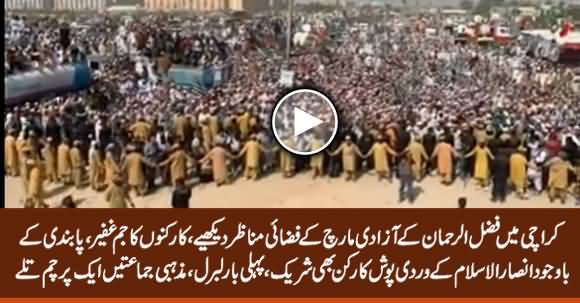
Anti-government Azadi March set out on Sunday afternoon from Karachi towards Islamabad. Thousands of people, including seminary students, are participating in the march.
Tens of thousands of protesters in Pakistan are marching to the capital Islamabad, calling on Prime Minister Imran Khan to resign over the weak economy and corruption claims.
While religious groups and political rivals in the Jamiat Ulema-i-Islam-Fazal (JUI-F) party organised the protests, virtually all parties have used the march to show their grievances during what they call the Azadi March (or Freedom March).
Marchers are expected to reach the capital on Thursday.

Pakistan traders strike over steps to boost taxes as urged by IMF

The two-day strike is the second since July called by business groups after negotiations with the government on sales tax.
Markets and many businesses closed across Pakistan on Tuesday for a strike to protest against government measures aimed at meeting demands by the International Monetary Fund (IMF) to boost tax revenues to bolster depleted public finances.
The IMF approved a $6bn loan package for Pakistan in July but warned that it would require ambitious fiscal measures and a sustained commitment to mobilise tax revenue to ensure funds for development while reducing debt.
The two-day strike is the second since July called by business groups after negotiations with the government on efforts to enforce the paying of sales tax and catching tax dodgers."This taxation system ... will bring death," Atiq Mir, president of the All Karachi Traders Alliance, which represents markets in Pakistan's biggest city, told Reuters news agency.
All major wholesale markets in the commercial hub were closed along with most shopping centres. Traders holding banners and chanting slogans against the government-held protests in cities across the country. The government of Prime Minister Imran Khan has made getting the economy back on track its main priority. The fiscal deficit has ballooned to about seven percent of the GDP and a balance of payments crisis is looming. Pakistan has long suffered from a weak tax base, with only about one percent of its 208 million population filing income tax returns and major industrial sectors dominated by powerful lobbies paying little or no tax.
The agricultural sector, for example, dominated by politically powerful landowners, makes up about 20 percent of the economy but accounts for only 0.22 percent of direct taxes, according to the World Bank.
Naeem Mir, general secretary of the All Pakistan Association of Traders, based in Lahore, said the government risked enraging voters.
"This government has increased inflation, it has raised discount rates ... it has made the life of the common man miserable because of its economic policies," Naeem said.
Among new measures angering traders is a rule requiring anyone buying items worth 50,000 rupees ($315) or more to produce identity papers, a measure aimed at helping authorities track tax evaders. Naeem said traders called for the amount to be raised to 100,000 rupees ($630) but the government has not responded.
"Why won't they listen to us? We'll protest, protest and protest," he said. "The future of the trading community and their children is at stake."
https://www.aljazeera.com/news/2019/10/pakistan-traders-strike-steps-boost-taxes-urged-imf-191029115027689.html

Monday, October 28, 2019

#PPP #BIlawalBhutto - Bilawal Bhutto Zardari's Press Conference - Oct 28, 2019

عمران خان کو رہا کرو

وزیر اعظم صاحب کی صحافی حضرات سے ملاقات ہوئی۔ وہاں انہوں نے بتایا کہ ان کا کوئی اختیار نہیں ہے کہ نواز شریف کو گھر جانے دیں یا ان کی بیٹی کو ان سے ملنے دیں۔ لیکن اسی شام خبر آئی کہ وزیر اعظم نے پنجاب کے وزیر اعلیٰ عثمان بزدار کو فون کر کے کہا ہے کہ مریم نواز کو ان کے والد سے ملنے دیا جائے۔
تحریکِ انصاف کے فیسبک گروپس میں جا کر دیکھ لیں، یا ان کے حامیوں سے بات کر کے دیکھ لیں، ان کا یہی کہنا ہے کہ نواز شریف ڈیل کر کے پاکستان سے جا رہا ہے۔ ساتھ وہ اس بات پر بھی کامل یقین رکھتے ہیں کہ عمران خان این آر او نہیں دے گا، یعنی یہ ڈیل عمران خان سے نہیں، کسی اور سے ہو رہی ہے۔
کچھ جو ذرا زیادہ ہی ’باخبر‘ ہیں، وہ آج کل دعوے کرتے دکھائی دیتے ہیں کہ کسی ’انتہائی اہم شخصیت‘ نے سابق وزیر اعظم نواز شریف سے ملاقات کرنی تھی جس کے لئے یہ بیماری کا ڈرامہ رچایا گیا اور ان کو اسپتال منتقل کیا گیا کیونکہ اس ’انتہائی اہم شخصیت‘ کو نیب کے دفتر میں نواز شریف سے ملاقات کرنا نامنظور تھا۔
ہمیشہ سچ لکھنے والے اور سچ کے سوا کچھ نہ لکھنے والے باخبر صحافی صالح ظافر نے جنگ اخبار میں یہ رپورٹ دی ہے کہ آرمی چیف جنرل باجوہ کی مولانا فضل الرحمان سے ملاقات ہوئی ہے جس میں جنرل صاحب نے مولانا کو واضح الفاظ میں بتا دیا ہے کہ عمران خان جمہوری طور پر منتخب وزیر اعظم ہیں اور کسی صورت ان کی حکومت نہیں ہٹائی جائے گی۔
اس سے کچھ دن پہلے باجوہ صاحب ہی نے ایک ملاقات میں کاروباری حضرات کو بھی ڈانٹ پلائی اور ان کو بتایا کہ وہ بالکل کسی ایسی تحریک کا حصہ بننے کی کوشش نہ کریں کہ بعد میں پچھتانا پڑے۔ انہوں نے یہاں بھی اپنے عمران خان کے پیچھے کھڑے رہنے کے عزم کو دہرایا۔ اس سے پہلے اسد عمر کو کس طرح وزیرِ خزانہ کے عہدے سے ہٹایا گیا، یہ بھی ہم سب کو یاد ہے۔
تو عمران خان صاحب کیا کر رہے ہیں؟ معیشت میں ان کا بندا ہٹا کر کسی اور کو لگا دیا گیا ہے۔ کاروباری طبقے سے معاملات آرمی چیف طے کر رہے ہیں۔ مولانا کو ڈانٹ ڈپٹ کرنے کا فریضہ بھی وہی انجام دے رہے ہیں۔ نواز شریف سے معاملات بھی ’انتہائی اہم شخصیت‘ ہی کر رہی ہے۔ تو پھر اس آزاد منش شخص کو جو کسی کی نہیں سنتا، اور سن بھی لے تو کرتا ہمیشہ اپنی ہے، جس کو نیچا نہیں بٹھایا جا سکتا، جس کو کنٹرول نہیں کیا جا سکتا، کیوں یوں ہاتھ پاؤں باندھ کے بٹھایا ہوا ہے؟
آپ نے جو کرنا ہے کرو۔ بس ہمارے بہادر، نڈر کپتان کو جانے دو۔ عمران خان کو رہا کرو۔

Ahmadi Muslim Scientist Abdus Salam - The first Pakistani Nobel laureate few have heard of

By Samira Shackle
Scientist Abdus Salam largely ignored in Pakistan because he was an Ahmadi Muslim, but new film aims to restore legacy.

Until Malala Yousafzai won the Nobel Peace Prize in 2014, there had only ever been one Pakistani Nobel laureate: the scientist Abdus Salam, who won the physics prize in 1979.
But despite being the first Pakistani to win a Nobel, his historic achievement was not celebrated in his home country. Instead, he was largely ignored due to his religious identity.
Even today, his pioneering contributions to physics are barely discussed in Pakistan.
A new documentary on Netflix, Salam, The First ****** Nobel Laureate seeks to restore Salam's legacy.
Salam shared the 1979 Nobel Prize in Physics with Sheldon Glashow and Steven Weinberg for his contribution to the electroweak unification theory.
His work paved the way for the 2012 discovery of the Higgs boson particle, which gives all other particles mass, and he helped define theories still in use today, such as the theory of the neutrino.
Omar Vandal and Zakir Thaver, the co-producers of the Netflix film, were drawn to the story as young Pakistani scientists studying in the United States.
They first heard of Salam when they read his obituaries in 1996.
"We were both science students and the tragedy is that it was not until we left Pakistan that we truly discovered Salam and his story," said Vandal.
"His story had been largely erased back home. He is not a part of the public dialogue at all."
Most, if not all, scientific enterprise and infrastructure in Pakistan owes its origin to Salam.
ZAKIR THAVER, CO-PRODUCER OF NETFLIX DOCUMENTARY
The reason for this is that Salam belonged to the Ahmadi minority, a sect of Islam that has long been persecuted in Pakistan and around the Muslim world.
The Ahmadiyya movement was founded in 1889, by Mirza Ghulam Ahmad, who died in 1908. His followers believe that he was a prophet. Most Muslims believe that the last prophet was Muhammad, who died in 632, and thus view the Ahmadis as heretics. 
"His faith was a huge part of who he was. It was very deep, very enlightened and very personal," his son, Umar Salam, told Al Jazeera. "For my father, religion and science are complementary – different types of belief system that together comprised a world view."
Controversy over the position of Ahmadi Muslims in Pakistan continued throughout Salam's life.
Born in 1926 in the city of Jhang, then part of British India, he went to university in Lahore before winning a scholarship to the University of Cambridge in the UK.
After completing his studies, he returned to become a professor of mathematics.
He decided to leave after a series of violent anti-Ahmadi riots swept across Lahore in 1953. He went back to the UK, first to Cambridge, and then to Imperial College London where he helped to set up the theoretical physics department. 
Salam loved Pakistan. He found worldwide scientific respect, yet not in his own country.
BASHARAT NAZIR, PRESS SECRETARY OF THE AHMADIYYA MUSLIM ASSOCIATION UK
Although he had left Pakistan, Salam remained closely involved with his country's most significant scientific projects.
In 1961, he established Pakistan's space programme, and in the 1970s, he was - more controversially - involved with efforts to build a nuclear weapon.
"Most, if not all, scientific enterprise and infrastructure in Pakistan owes its origin to Salam," said Thaver. 
In 1974, a law was passed declaring Ahmadis non-Muslim.
It was only at this point that Salam severed ties with the Pakistani government.
In later life, he spoke out against nuclear weapons.
When Salam won the Nobel Prize in 1979, he quoted verses from the Quran. The world saw him as the first Muslim to win a Nobel Physics prize, but his own country did not.
A repressive law further restricting the religious freedom of Ahmadis was passed in 1984.
He never criticised nor even mentioned any aspect of his treatment; nor did he ever express any resentment.
UMAR SALAM, ABDUS SALAM\'S SON
In addition to his research, Salam was passionate about encouraging scientists from similarly disadvantaged backgrounds.
In 1964 he founded the International Centre for Theoretical Physics in Trieste, Italy, to support scientists from the developing world. 
"He was warm, loving and often very funny," said Umar Salam. "He was a tireless worker, rising at 4am each morning and constantly travelling. He was not necessarily a model parent - he was simply himself. He believed in things and in people, and he made you want to do the same."
Salam's dedication to Pakistan never wavered; although he was offered British and Italian citizenship, he always retained his Pakistani passport.
"He never criticised nor even mentioned any aspect of his treatment; nor did he ever express any resentment," said Umar Salam.
When he died in 1996, Salam was buried in the Pakistani town of Rabwah, the centre of the Ahmadi community. His gravestone described him as the first Muslim Nobel laureate.
The word "Muslim" was soon scrubbed out by local authorities.
"Salam loved Pakistan. He found worldwide scientific respect, yet not in his own country," said Basharat Nazir, press secretary of the Ahmadiyya Muslim Association UK. "Peace is something that has been denied Salam in life as in death."
There are an estimated 10 million Ahmadis worldwide, based in 200 different countries, but the majority - around 4 million - remain in Pakistan.
They still face persecution, both at a state level and from vigilantes.
In 2010, a Taliban attack on two Ahmadi mosques in Lahore killed 93 people; in 2012, more than 100 Ahmadi graves were desecrated in the city.
More than 200 Ahmadis are currently in prison on charges related to their faith - it is illegal for Ahmadis to describe themselves as Muslim or to perform Muslim rituals.
Next month, the UK All Party Parliamentary Group for the Ahmadiyya Muslim Community is expected to publish a report on human rights violations against Ahmadis in Pakistan.
"It reflects how a community that helped found the country has become persecuted, explicitly targeted by federal laws," said Nazir.
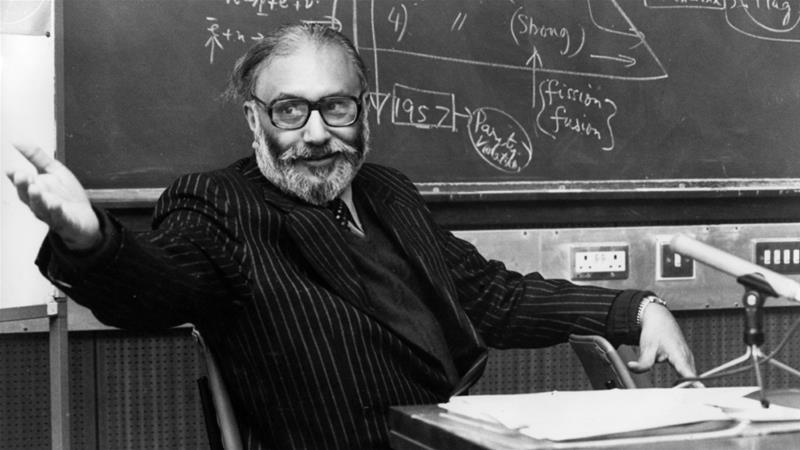
Professor Abdus Salam, of Imperial College of Science and Technology, shared the 1979 Nobel Prize for Physics with Americans Sheldon L. Glashow and Steven Weinberg.
Abdus Salam shared the 1979 Nobel Prize for Physics with Americans Sheldon L. Glashow and Steven Weinberg [Getty Images]
This continued discrimination and controversy made it difficult for the documentary makers to obtain funding from within Pakistan.
"We were offered lots of funding provided we did not touch on the Ahmadi issue. That was a no-go for us," said Thaver. 
But now that the film has been made available on Netflix, it is being watched in Pakistan.
"As you would expect, there has been anger from some quarters, but overall the reaction has been positive and there are questions about what we have lost out on," said Vandal. "People are convening in groups to watch the film, it is being screened at homes and in academic institutes. Salam is back in the imagination of the people."

Pakistani authorities demolish 70-year-old mosque of minority Ahmadi Muslims

The community laments the government’s decision to arrest one of its members who filmed the demolition. A 70-year-old worship place belonging to Pakistan’s minority Ahmadis has been demolished by the authorities in Punjab province, the community members said on Monday.
Pakistan’s Parliament in 1974 declared the Ahmadi community as non-Muslims. A decade later, they were banned from calling themselves Muslims. They are banned from preaching and even from travelling to Saudi Arabia for pilgrimage.
Ahmadi community spokesperson Saleemduddin said the worship place, which has been destroyed, was located in Bahawalpur district’s Hasilpur village, some 400 kms from here.
“The assistant commissioner of Hasilpur along with Baldia workers attacked the 70-year-old Ahmadi place of worship in Murad district and destroyed parts of the building without notice,” Saleemduddin said in a tweet.
“It is important to note that this place of worship is built on property owned by the community... It has remained the same over past many many decades,” he said.
The minority community lamented the Pakistan Tehreek-e-Insaf (PTI) government’s decision to arrest one of its members who filmed the demolition.
“Instead of initiating action against those involved in its demolition, police have arrested Ahmadi who filmed this attack under baseless charges,” Saleemduddin said, asking “how on earth filming something on a public space falls under this law?”
Pakistan Prime Minister Imran Khan often boasts about his government’s commitment regarding protecting the rights of minorities in the country.
“It is a shameless act by Pakistan’s govt. Where is your naya Pakistan. This is the naya Pakistan. Shame on you. @ImranKhanPTI,” Ahmadi activist Namatulla Nawaz said in a tweet.
The Ahmadi community has repeatedly been targeted by Islamic extremists, who view them as heretics. Last year, the government cancelled the appointment of U.S.-educated economist Atif Mian to the Economic Advisory Council after it surfaced that he belonged to the Ahmadi community.
In Pakistan, around 10 million out of the 220 million population are non-Muslims.
According to the 2017 census, Hindus constitute the largest religious minority (5 million) in Pakistan. Christians make up the second largest religious minority, with almost the same number (4.5 million) and their concentration is mostly in urban Sindh, Punjab and parts of Balochistan.
Ahmadis, Sikhs and Parsi are also among the notable religious minorities in Pakistan.
https://www.thehindu.com/news/international/pakistan-authorities-demolish-70-year-old-mosque-of-minority-ahmadis/article29813908.ece

بےنظیر بھٹو کی زندگی پر فلم، مہوش حیات نے لب کشائی کردی

پاکستانی فلمی دنیا کی مشہور اداکارہ مہوش حیات بہت جلد ملکی تاریخ کی
مشہور سیاسی شخصیت سابق وزیر اعظم بےنظیر بھٹو کی سوانح حیات پر مبنی فلم میں اُن کا کردار ادا کرنے جارہی ہیں۔
لالی ووڈ کی 36 سالہ اداکارہ نے غیر ملکی نشریاتی ادارے کو اس حوالے سے انٹرویو دیا ہے اور بتایا ہے کہ وہ جلد بے نظیر بھٹو کی سوانح حیات میں ان کا کردار نبھاتے ہوئے دکھائی دیں گی۔
مہوش حیات کا کہنا تھا کہ یہ ایک ہیرو کی کہانی ہے، بے نظیر بھٹو میرے لیے ایک ہیرو ہیں، میں ان سے بہت محبت کرتی ہوں۔
انہوں نے مزید کہا کہ ان کی سوانح حیات کی کہانی میرے لیے بہت ہی متاثر کن ہے۔
اداکارہ کا یہ بھی کہنا تھا کہ یہ موجودہ نسل اور آنے والی تمام نسلوں کے لیے ضروری ہے کہ وہ پاکستان کے لیے محترمہ بے نظیر بھٹو کی خدمات، انکی جدوجہد اور ان کامیابیوں کے بارے میں جانیں۔
اپنی گفتگو کے دوران ان کا یہ بھی کہنا تھا کہ بے نظیر بھٹو کو پہلی مسلم خاتون وزیراعظم ہونے کا اعزاز بھی حاصل ہے۔
مہوش حیات کہتی ہیں کہ بے نظیر بھٹو کا کردار نبھانا ان کے لیے سب سے مختلف کام ہوگا، بلاشبہ اس کردار کو سلور اسکرین پر لے کر آنا بہت مشکل سفر ہوگا۔
گزشتہ برس مہوش حیات نے انسٹا گرام پر ایک پوسٹ کے ذریعے بے نظیر بھٹو کی سوانح حیات پر بنائی جانے والی فلم کے بارے میں بتایا تھا۔
انہوں نے یہ بھی بتایا تھا کہ وہ اس سوانح حیات میں سابق وزیراعظم بے نظیر بھٹو کا کردار نبھاتے ہوئے دکھائی دیں گی۔
اس اعلان کے بعد سابق وزیراعظم کی بیٹی بختاور بھٹو زرداری کا شدید ردعمل سامنے آیا تھا جس میں انہوں نے کہا تھا کہ ان کی والدہ کی زندگی پر فلم بنانے کے لیے ان کے اہل خانہ سے اجازت طلب نہیں کی گئی

Sunday, October 27, 2019

Video Report - Fareed Zakaria: Here's why I support the impeachment inquiry

Video Report - #Syrian refugees in #Turkey live in fear of deportation | Focus on Europe

Video Report - What will 'Anonymous' author reveal in book 'A Warning'?

Video Report - Democrats seek to erase student loan debt

#effigy #Erdogan #Milan Pro-Kurdish demonstrators burn effigy of Erdogan in Italy

Bilawal Bhutto celebrates Diwali at gurdwara

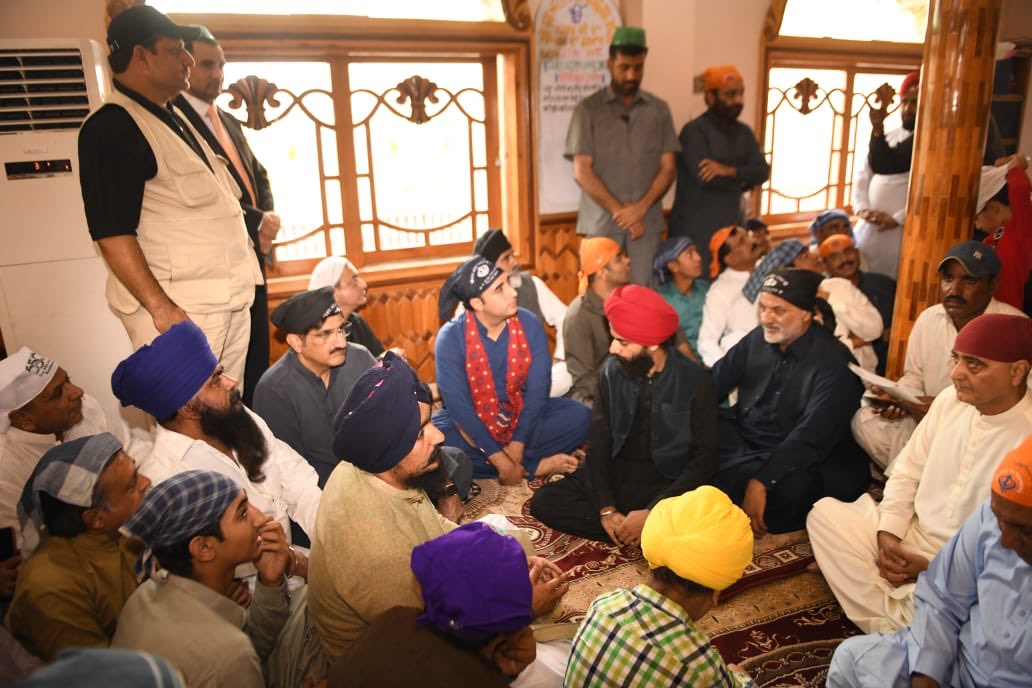
Pakistan People''s Party (PPP) chairman Bilawal Bhutto-Zardari attended a Diwali event at a Gurdwara in Sindh''s Kashmor district, here on Sunday.

According to a report in Pakistani media, Bilawal reached the Gurdwara Saheb Singh Sabha, here, with Sindh Chief Minister Syed Murad Ali Shah.
Gurdwara head Sardar Mahesh Singh welcomed the PPP chairman and presented him ''saropas'' and souvenirs.
In his address, Bilawal said he had come to present the Diwali greetings to the Hindu and Sikh communities of Pakistan. The PPP favoured equal rights for every citizen, he added.
"I thank the minority community for giving me the opportunity to celebrate Diwali at the Gurudwara", he remarked.

GDPR and the Pakistani context


Citizen’s fundamental rights of privacy of home and dignity require immediate action by the government to establish data protection.
The General Data Protection Regulation (GDPR) adopted by the European Union (EU) in 2016 is the single most important piece of legislation governing privacy of data in the world today. This is designed to give the EU citizens (and in certain instances others too) more control over their personal data, recognising that an individual’s personal data is in fact their absolute ownership. Without informed consent the processing of personal data of an EU citizen becomes a legal impossibility and any breach of this can lead to fines as steep as 20 million euros. In addition to name, address, email address, passwords, photos and videos, this regulation classifies biometric data as well as genetic data as personal data. Personal data also includes confidential health records and places it in the exclusive ownership of the user.
Hardly anyone today bothers to read the fine print which comes with using websites and apps on one’s devices. After the enforcement of the GDPR and its official compliance deadline in 2018, many of these user contracts (specifically those from EU) have become void on grounds of public policy, if these are in contravention to lawful-purpose test established by this regulation.
The GDPR establishes a single data protection regime across Europe, including the United Kingdom, which will still implement the regulation despite Brexit. What this means is that organisations within or without Europe, which may be processors or controllers handling data, are under legal obligation to prevent misuse of all personal data. The regulation seems to apply to all data handlers based in Europe with data subjects anywhere in the world and to data handlers outside Europe who may be handling data of EU citizens. In other words, if data of Pakistani data subjects is being handled by a data handler in the EU, it is subject to this law. Similarly a Pakistani data handler controlling or processing the data of an EU citizen is also subject to this law.
According to the law there are two kinds of data handlers – data controllers and data processors. A data controller is any “person, public authority, agency or other body which, alone or jointly with others, determines the purposes and means of processing of personal data” while a data processor is any “person, public authority, agency or other body which processes personal data on behalf of the controller”.  What is data processing?  Data processing involves all classification of data received from the controller. Therefore, the GDPR places specific legal obligations on the processor as it is justifiably assumed that a processor is most likely to be responsible in the event of a breach. A positive legal duty on all organisations dealing with data is to immediately inform the subject that their data may have been breached.
There are other wide-ranging rights such as the right to know how one’s information is being processed and for what purpose. Significantly, there is also the right to data portability. Thus, Article 20 of the GDPR states: “Controllers must make the data available in a structured, commonly used, machine-readable and interoperable format that allows the individual to transfer the data to another controller”. For data storage itself, there is a positive requirement for the data controller to implement “pseudonymisation” which is different from “anonymisation” – the difference being that the former is traceable while the latter is not.  Nevertheless there are artificial identifiers which help protect personal data in storage from being directly identified with the subject.  Another requirement for the controllers is to inform all data subjects how and why their data is being stored, for what purpose and under what law.  There is a further requirement for the data handler to ensure that in the event of data being transferred to an organisation outside the EU, this information is made available to the data subject. The law also gives data subjects the power to request an erasure on grounds of fundamental rights. This is called the right to erasure. The purpose as a whole is to ensure that a person’s data is fully protected. The test is simple – fundamental rights and freedoms of the data subject should out-weigh any legitimate reason or cause for data handling of the controller. The controller itself is under obligation to ensure data protection by design and this obligation begins at the time of initiation of such data handling.
In Pakistan, there is a callous disregard for data protection which is evident in the number of breaches that have been reported in recent years even from the National Database and Registration Authority (NADRA).
The regulation thus acts as a check on overreach by major corporate entities like Facebook, Twitter, Apple and Samsung etc. In short, the GDPR ensures that these companies are held liable for any use of data without informed consent of the data subject.
In our context, it must be said that in Pakistan there is a callous disregard for data protection which is evident in the number of breaches that have been reported in recent years even from the National Database and Registration Authority (NADRA). To start with, Pakistan still does not have a data protection law. A number of bodies – public and private – control and process data of Pakistani citizens with little or no legal protection. Whatever safeguards are there in various laws are conspicuous by their lack of implementation. It is quite unfortunate though because the Pakistani constitution spells out the right of privacy and dignity explicitly. Our neighbour India’s landmark Supreme Court judgment in 2017 established that privacy was a constitutional fundamental right. This now has become the basis of a new data protection legislation which is under works. Pakistan’s fundamental rights of privacy of home and dignity require immediate action by the government to step in and establish data protection.
A significant problem is that the Asian behemoths surrounding us, China and India, are also massive surveillance states. The states of China, Russia and India actually mine more data of their citizens than any other country in the world. Thus, despite the fine Supreme Court judgment, India has a completely different understanding of privacy when it comes to national security. It is rumoured that one section of the proposed Indian data protection law describes the data of Indian citizens as a national asset. One should always be circumspect about such “nationalistic” interpretations because it inevitably means that the state has the right to mine the national asset. The Indian approach is more likely to mirror China than Europe. As a result Pakistan – on the one hand, motivated by fear of India and on the other, inspired by its taller-than-Himalayas friend China – is unlikely to take a vastly different view.  An Asian GDPR, therefore, is unlikely.
Having a GDPR-type data protection law is good for innovation. It can help Pakistan establish itself as a data destination. Yet, the powers that be in our country have not even begun thinking in those terms.  Ultimately, someone is going to cut, copy and paste the Indian and possibly the Chinese laws unimaginatively, and we shall be stuck with an unworkable data protection law that will work at cross-purposes to the objective of having a data secure environment.

#Pakistan - Why do the rulers consider increase in remittances praiseworthy? - False signals


THE prime minister has praised his economic team for an ‘economic turnaround’ that comprises declines in the current account and fiscal deficits and increases in FDI and remittances. All these are misleading indicators but one is especially egregious and contradictory.
Why is the increase in remittances considered part of the economic turnaround and something that governments consider worthy of praise? Consider an airport conversation with a Pakistani working in Italy and supporting a wife and two children in Pakistan. He used to send the equivalent of Rs50,000 per month in lira for family support; now the equivalent of Rs80,000 is needed to sustain the same expenditures. The increase in remittances is an outcome of greater economic distress in Pakistan. It is a false signal reflecting economic failure, not success.
Before patting themselves on the back for ever-increasing remittances, policymakers should think through this phenomenon with understanding and empathy. Remittances grow for two reasons: individual migrants send back more money and the stock of migrants increases as more Pakistanis emigrate. The explanation for the first component has been provided above; it reflects the economic distress inflicted on working-class families by rapid inflation in Pakistan. But what is the explanation for the increasing number of Pakistanis seeking work abroad? It is the inability of the domestic economy to generate a sufficient number of jobs paying enough to sustain families of individuals entering the labour market. It is again a reflection of economic failure, not success.
Why do the rulers consider increase in remittances praiseworthy?
Consider the miseries inflicted by this phenomenon celebrated as a success of economic policy. In human terms, it involves young men separated involuntarily from their families — parents, siblings, wives, children — for long stretches, often living abroad in poor, exploitative conditions.
Many low-income workers abroad have paid huge amounts to unscrupulous middlemen. A recent ILO estimate puts the amount paid in bribes by South Asian workers in the Gulf at $15 billion. This does not include payments by individuals who are duped and fail to emigrate, inflicting huge liabilities on their families.
Even more tragic is the fate of those who get smuggled abroad and are either abandoned in remote places to be incarcerated in camps or left to suffocate in airless containers or sink aboard flimsy ferries. The stories of those who make their way back to Pakistan are harrowing — a devastating indictment of an economy and society that consigns its young to such fates.
There is yet another contradictory and ironic aspect of this phenomenon. If labour is Pakistan’s biggest exportable commodity (in 2018, remittances were $21bn versus a $14bn contribution from textiles, the largest commodity export) and our measure of success is an increase in remittances, why don’t we export even more bodies than we are doing at present? Why then make such a hue and cry about overpopulation? Should we not produce even more children and export them to earn abroad and send back remittances?
This is a rhetorical question to highlight the fact that our policymakers talk through their hats but there is a serious aspect to it as well. If we are reduced to exporting human beings for our survival, wouldn’t it make sense to invest in them to increase their productivity and market value abroad? That would mean investing in their health, education, and training as a conscious policy to increase remittances. Shouldn’t governments work to upgrade vocational skills of individuals instead of being obsessed with their moral piety, especially when all the money spent on the latter has yielded little in return besides dogmatism?
Isn’t it a hugely puzzling occurrence that in a country with a population ex­­ceeding 200 million with serious problems of underemployment, it is impossible to find a reliably competent plumber or electrician or mason? Or that Pakistani doctors working abroad are sent back as improperly certified? A programme to upgrade the skills and certifications of those wishing to emigrate would have a beneficial spillover effect on deficiencies in the local market too.
The Pakistani economy is in intensive care and the indicators the prime minister has cited as evidence of an economic turnaround have behaved in exactly the same manner as they have after almost each of the previous 22 or so IMF hospitalisations. The real turnaround requires the creation of decent jobs which, in turn, calls for structural reforms and a framework for economic growth. While this may take time, progressively driving remittances down by providing jobs at home should be adopted by the government’s team as a leading measure of the success of a real economic turnaround. Involuntary migration forced by economic desperation is a blight on the face of the nation, not something to celebrate.

#AzadiMarch #AzadiMarchAgainstPTIMafia #AzadiMarch4CivilSupremacy - Opp sets out on march towards Islamabad

Fazl says Opp has denied all govt demands, will hold a sit-in as per decisions made by the judiciary 

–PPP, ANP, and PML-N leaders join Azadi marchers, say no option but to send Imran home
–Protesters express solidarity with Kashmiri people, denounce India for rights violations
KARACHI: The anti-government march led by Jamiat Ulema-e-Islam (JUI-F) chief Maulana Fazlur Rehman on Sunday kicked off its journey from Karachi towards Islamabad, where it will stage a sit-in to protest the alleged rigging in last year general elections that saw the ruling Pakistan Tehreek-e-Insaf (PTI) rise to power.
The protest, dubbed as Azadi March, has been joined by the major opposition parties, including the Pakistan People’s Party (PPP) and Pakistan Muslim League-Nawaz (PML-N), seminaries students and others.
Besides JUI-F leadership, PPP leaders Raza Rabbani, Saeed Ghani, PML-N leaders Mohammad Zubair, Nihal Hashmi, Awami National Party (ANP) leader Shahi Syed and others, are on board the leading container.
The next stopover of the march will be Jamshoro. The march is scheduled to reach Islamabad via Sukkur and various districts of Punjab.
Fazl was initially to march on Islamabad on Oct 27, but the protest date was later changed to Oct 31 owing to the Kashmir black day.
Addressing the participants of the march, Fazl said, “We had promised to our Kashmiri brethren that we will observe a day to express solidarity with them.”
“The entire nation is on the same page on the issue of Kashmir,” he said, adding that there has been a curfew in Kashmir for the past three months. He demanded the international community take notice of human rights violations in occupied Kashmir.
Addressing the participants, he stuck to the demand of PM Imran Khan’s resignation, saying: “Hundreds of thousands have gathered in Karachi; what will the government do when people from across the country reach Islamabad?”
Imran will have to go home, he asserted.
He also commented on the dialogue held between a government-led delegation on Saturday, saying the opposition had denied all demands of the negotiation team sent by the government and will hold their sit-in as per the decisions made by the judiciary.
He also took the powers that be to the task for cancellation of the national identity card of JUI-F leader Hafiz Hamdullah, saying they installed a green card holder as the caretaker prime minister in 1993. “But, now they question our citizenship and declare us Pashtun and Afghans,” he added.
He said the opposition parties oppose such “flawed laws” as it believes in “democracy and the constitution and wants the sovereignty of the country”.
“I will announce the future course of action in Islamabad,” he said, referring to the sit-in on Oct 31 in the federal capital.
“We support positive politics. We have spent our entire life in loyalty to the country’s Constitution and we have faced extremism (in return),” he said, adding that the government will have to answer for the tactics it has been employing against the opposition.
He thanked the political leaders for participating in the march.
Addressing the crowd, ANP’s Shahi Syed said the “incompetent [PTI] government” must be thrown out to save Pakistan.
Zubair, the former governor of Sindh, said that the entire country is united against the Indian atrocities in Kashmir.
“Nawaz Sharif has instructed his workers and supporters to welcome Maulana Fazlur Rehman in every city and town of the country and become part of his Azadi March,” he said, adding that every PML-N worker will support Fazl.
PPP leader Raza Rabbani said that Kashmir’s jails are full and youngsters are being tortured but remember that movements for the right to self determination couldn’t be suppressed anywhere in the world.
The sad thing is that the Muslim community is silent on the atrocities being committed in Kashmir, he said, demanding that the community raise its voice for the Kashmiri people and support them.
“We speak about freedom in Kashmir but when I look at my own country, my heart weeps tears of blood, said Rabbani, adding that this is because he sees innocent children and women on the roads whose fathers or husbands or brothers or children have been missing for years.”
Meanwhile, thousands of supporters of opposition parties left Quetta to participate in the march. JUI-F Balochistan chief Maulana Abdul Wasey led the caravan.
“We will continue our struggle till removal of present rulers,” Maulana Wasey told reporters before leaving for Islamabad.

Huge rallies kick off in Pakistan to oust PM Imran Khan

Pakistani PM Khan faces a tough political challenge as an anti-government march to topple his government set off on Sunday. Khan's woes have been aggravated by a deteriorating economy and accusations of bad governance.
Thousands of supporters of a major religious political party gathered Sunday in Pakistan's southern city of Karachi to start an anti-government march on the capital, Islamabad.
The rally was led by Maulana Fazlur Rehman, a powerful religious figure and head of the Jamiat Ulema-e-Islam (JUI-F) party, who claims that Prime Minister Imran Khan came to power last year through rigged elections.
"Prime Minister Imran Khan will have to resign. Hundreds of thousands have gathered in Karachi; what will the government do when people from across the country reach Islamabad?" he told rally participants in Karachi.
Rehman is backed by Pakistan's major opposition parties, including the Pakistan Muslim League (PML-N) of three-time former prime minister Nawaz Sharif, and the Pakistan People's Party headed by former president Asif Ali Zardari and his son Bilawal Bhutto-Zardari.
The rally participants — expected to be in hundreds of thousands by the time they reach Islamabad — plan to stage a sit-in protest outside the capital, with a possibility of further rallying toward the prime minister house.
"I will announce the future course of action in Islamabad," Rehman said in Karachi.
Such "long marches" have become a common occurrence in Pakistan, with some religious organizations previously attempting to put the capital under siege and resorting to violence.
Although a religious leader, Rehman is a supporter of parliamentary democracy and has served under previous governments.
Khan's 'closeness' to military generals
Mufti Abrar Ahmed, a spokesman for the Jamiat Ulema-e-Islam party, said Sunday that Rehman would lead the protesters' caravan. He lashed out against Khan, saying that the "illegitimate" government came to power through the army's support.
Although the major political parties denounced last year's general election as "rigged," they chose not to immediately launch protests. But Khan's heavy-handedness against opposition politicians and the country's deteriorating economy have given them the impetus to finally attempt to dislodge his government.
Khan has been accused of receiving indirect support from the country's powerful military — a claim denied by both Khan and the army. Sharif's supporters say their party was not given a level playing field in the run-up to the July 2018 elections, with the judiciary exclusively targeting PML-N officials and the caretaker government unleashing a massive crackdown on PML-N activists.
Talking to local journalists earlier this week, Khan said the army fully backs him against the opposition's attempts to oust him.
Economic woes
Khan came to power after winning a simple majority in the 2018 parliamentary polls on promises to improve the country's economy and provide jobs. But his critics say he has so far not been able to honor his commitment to the masses.
Although Khan launched an austerity drive to reduce government expenses, critics say the move has been largely superficial, as the PM's team has no real economic plan to fix Pakistan's serious structural issues.
With inflation climbing to 8%, the rupee losing a third of its value over the past year, and foreign exchange reserves barely enough to cover two months of imports, Khan's government was forced to turn to the International Monetary Fund (IMF) in May for a bailout package.
The IMF's tough bailout conditions have been unpopular, and analysts say the opposition is now ready to use the "public anger" to remove Khan from power.
Maulana Rashid Mehmood Soomro, a JUI-F official, recently said that a World Economic Forum report found a 3% increase in corruption since Khan's Pakistan Tehreek-e-Insaf (PTI) party came to power.
"The economy has nosedived, prices of essential commodities are touching new heights and people are living in abject poverty. So it is necessary to send him [Prime Minister Khan] packing," Soomro told local media.

Saturday, October 26, 2019

Video - Bilawal Bhutto Zardari complete speech at Kandhkot Jalsa | 26 October 2019

Video - Ab Waqt Ki Zaban Hai BILAWAL

Video - Kal Bhi Bhutto Zinda Tha,Ajj Bhi Bhutto Zinda Hai

Video - #PPP - Aya Aya Bilawal Aya

#Pakistan - #PPP - Bilawal Bhutto Zardari addresses public rally in Kandhkot

Pakistan People’s Party (PPP) Chairman Bilawal Bhutto Zardari will address a public meeting in Kandhkot on Saturday (today), a private source reported.
The party organizers have finalized arrangements for the PPP public rally in Kandhkot in upper Sindh.
The local administration has stepped up security in the city ahead of the power show of the People’s Party.Bilawal Bhutto will proceed to Islamabad on the next day to visit his ailing father Asif Ali Zardari at the Pakistan Institute of Medical Sciences (PIMS) on Monday.The PPP chairman will hold meetings with party workers in Kandhkot on Sunday to discuss local and party issues, sources said.
The PPP chairman is expected to fly back to Karachi after meeting Zardari.
Bilawal Bhutto Zardari has not yet decided on attending the Azadi March though he has directed the party members of the opposition Rahber Committee to welcome the march participants in Islamabad.
According to sources, so far no formal invitation from the JUI-F chief Fazlur Rehman has been received by Bilawal to address the Azadi March.
His scheduled public rallies in South Punjab will start from Rahim Yar Khan from November 1 followed by in different cities of South Punjab.

https://dailytimes.com.pk/489995/bilawal-bhutto-zardari-to-address-public-rally-in-kandhkot-today/