Friday, October 4, 2019

Bilawal accuses PM Imran of 'undermining parliament'


PPP Chairperson Bilawal Bhutto-Zardari on Friday accused Prime Minister Imran Khan of "undermining the parliament", saying that opposition had no choice but to take to the streets.
"If you do not make the parliament functional, democratic forces will be forced to take to the streets," he said in conversation with reporters in Islamabad.
Bilawal, who was speaking after an accountability court extended his father Asif Ali Zardari's judicial remand, said the former president had in the past remained in jail for 11 years without a conviction but had "never compromised on his principles".
"No matter how many of our party leaders they arrest, we will not compromise on the 1973 Constitution or the 18th Amendment," Bilawal declared. The lawmaker said that the "tadeeli sarkar" (regime of change) had failed.
"Imran Khan promised justice but he arrested his political opponents as well as the women of their families without any conviction or trial," he said, adding that the incumbent government had ruined the economy and increased unemployment.
Bilawal said the business community was so "fed up" with the government that they went to the army chief. "Insha Allah (God willing) their problems will be solved, but this is a very bad precedent that the people are approaching general headquarters instead of the parliament," he said.
"How much burden can we place on our institutions? Every institution will have to do its job. Our defence and intelligence institutions are supposed to deal with elements that are conspiring against our country. If Khan sahib starts directing them to deal with elections, economy and foreign policy, when will they protect our borders, which is their foremost job?"
Bilawal was referring to an event had been held at the Army Auditorium in Rawalpindi yesterday. News media had reported that several businessmen had met the army chief at a dinner reception hosted by the latter. Attendees later told Dawn that he meeting had focused on areas where an economic revival could be brought about, as well as building confidence between the government and the business community.
When asked if his party will join Jamiat Ulema-e-Islam Fazl (JUI-F) Chief Fazlur Rehman's long march, Bilawal remained non-committal and said that the PPP has called a meeting to discuss "the extent to which they can help".
Rehman had announced yesterday that, as part of his campaign to take down the incumbent government, he will set out on a long march on October 27 which will culminate in Islamabad.
"We and the PML-N hoped that a joint opposition rally or protest could be held, [but] Maulana sahib has announced this march himself."
The PPP had expressed unwillingness to participate in the anti-government movement because of the inclusion of the issues of blasphemy laws and Namoos-i-Risalat on its agenda. Moreover, both the PPP and the PML-N had also opposed the idea of holding an indefinite sit-in, as the PTI did in 2014.

BEHIND THE LINES: PAKISTAN AND ISRAEL: MUCH ADO ABOUT NOTHING?


BY 

Pakistani Prime Minister Imran Khan last week dismissed speculation that his country was moving toward the establishment of open diplomatic relations with Israel. Speaking at the Asian Society in New York City last Thursday, as reported by the Middle East Eye website, Khan reiterated Pakistan’s traditional stance on the issue:

“Pakistan has a very straightforward position,” the Pakistani prime minister and former cricket star said. “It was our founder of Pakistan Quaid-i-Azam Muhammad Ali Jinnah who was very clear that there has to be just settlement, a homeland for Palestinians before Pakistan can recognize Israel.”
His remarks, according to Middle East Eye, were met with enthusiastic applause. They came amid widespread recent speculation at a possible diplomatic breakthrough between Jerusalem and Islamabad. Prominent Pakistani journalist Kamran Khan launched the rumors with a tweet on August 25, asking “Why can’t we openly debate pros cons of opening direct and overt channels of communication with the State of Israel?”
What is the background to the recent speculation, and is there a realistic chance of a breakthrough, or do Imran Khan’s remarks settle the matter in the negative?
THERE IS a school of thought in Pakistan that favors the abandonment, or at least the questioning, of Islamabad’s long rejection of formal ties with the Jewish state. Why now?
Pakistan is closely associated with the Gulf monarchies, and in particular with Saudi Arabia. The warming ties, based on pragmatic need, between Jerusalem, Riyadh and Abu Dhabi are not a secret. Some in Pakistan would clearly like to see these emulated.
Some in Islamabad have noted that Pan-Islamic solidarity against Israel does not appear to afford Pakistan many tangible benefits. The Palestinian Authority retains warm relations with India. More importantly, the Arab states have continued in their efforts to increase ties with New Delhi, despite the current crisis in Kashmir.
But in spite of that school of thought within the Pakistani elite that might favor a thaw in relations with Israel, an Israeli Embassy in Islamabad is unlikely to be opening anytime soon.
This is for two reasons: first, because of the far more powerful forces in Pakistan opposing any warming of ties; and second, because significant aspects of Pakistani behavior, the nature of the Pakistani state itself and Israel’s broader strategic ties are likely to militate against any major changes at present.Regarding the first reason, those elements of the Pakistani security establishment that are the main force in advancing the notion of ties with Israel would need to balance the fury any moves in that direction would ignite across the civilian political spectrum against the limited tangible benefits of such a move.Pakistan has one registered Jewish resident (named Fishel Benkhald). Antisemitism of a particular and virulent kind is ubiquitous and mainstream in civil society and political and media discourse. According to a 2019 Pew poll on this subject, 74% of Pakistanis regarded Jews unfavorably; 84% of the population, according to a 2017 poll by the same organization, favored the establishment of Sharia (Islamic law) as the law of the state.
The premiership of Imran Khan has itself been the subject of antisemitic conspiracy theories centering around Khan’s former wife, Jemima Goldsmith, who is of partly Jewish ancestry.
The trial balloon that Kamran Khan’s tweet seemed to represent was the immediate object of widespread condemnation from Pakistani media and Twitter users.So any serious moves toward establishing links with Israel would be likely to produce a furious, broad, societal reaction which would rock the legitimacy of the government promoting these.The tangible benefits of such an effort, meanwhile, would be limited. Improved ties with Israel might conceivably open some doors in a Washington long suspicious of links between Pakistani state agencies and Islamist terrorist groups.The Pakistani defense sector could certainly benefit from links to Israeli defense industries. But here, Israel’s burgeoning strategic partnership with India, and Indian concerns regarding Pakistan would be likely to lead to a straight Israeli choice between the two.India is an emergent regional power with a flourishing economy. It is also a country whose deepening ties with Israel include cooperation at the highest levels of the state and extend deep into the civil societies of both countries. Especially since the Mumbai attacks of 2008, there is a shared perception of a common jihadi enemy which is itself supported in whole or in part by Pakistan.
Pakistan, meanwhile, is a state whose civil society is both traditionally and currently virulently hostile to Israel and to Jews. It is also a deeply troubled, semi-dysfunctional entity. The Israeli choice, if forced to choose between the two, would not be a hard one to predict.
There are also substantive causes for Israeli concern regarding the advisability of closer relations with Pakistan.
The legendary Pakistani nuclear proliferator Abdul Qadeer Khan actively assisted the Iranian nuclear program in its early stages. Khan admitted supplying Tehran with key components to make the centrifuges needed for enriching uranium.
Khan, who remains a hero for many in Pakistan and within its establishment, said that “since Iran was an important Muslim country, we wished Iran to acquire this technology.... Iran’s nuclear capability will neutralize Israel’s power.”
The Pakistani state system is not unified. The powerful Inter-Services Intelligence maintains its own economy and runs its own system of alliances – including with the Afghan Taliban and with the Lashkar-e-Taibe group that carried out the Mumbai attacks in 2008. Thus, any increased defense sector relationship with Islamabad would run the risk of providing knowledge or even hardware to bodies associated with Islamist and anti-Western interests.
Imran Khan visited Iran in April. The visit should dispel any simplistic notions of Pakistan forming a bulwark in a Saudi and Emirati-led Sunni bloc. Islamabad declined to take any part in the Saudi-led campaign into Yemen.
Gas-hungry Pakistan also has an interest in a possible pipeline from Iran’s enormous South Pars natural gas field. A plan for the construction of such a pipeline was abandoned only in 2011, after Pakistan was subjected to pressure from Saudi Arabia, the UAE and the US.
SO BOTH Pakistani and Israeli concerns currently militate against any imminent warming of ties. Islamabad must reckon with a fiercely anti-Israel and anti-Jewish civil society and public opinion. The limited benefits, when reckoned against the cost, and Israel’s strategic alliance with India are further disincentives.Israel, meanwhile, would need to factor in the support from elements of the Pakistani state for Islamist terrorist groups, the historic role of prominent Pakistanis in proliferation of nuclear know-how to Iran, and perhaps most importantly the divided and dysfunctional nature of the Pakistani state, in which separate interests pursue separate policies with no real accountability.
For all these reasons, the active Twitter profile of Kamran Khan notwithstanding, no formalization of ties between Israel and Pakistan appears imminent.

Pakistan Gives a Pass to China’s Oppression of Muslims


Pakistani Prime Minister Imran Khan’s foreign-policy agenda carries a contradiction at its heart. Mr. Khan seeks to project himself as a global defender of Islam, but he won’t utter a peep about one of the most egregious persecutions of Muslims: China’s repression of Xinjiang’s Uighurs and its project to Sinicize Islam.
In New York last week, Mr. Khan laid out his vision in a rambling 50-minute address to the United Nations General Assembly. He defended the right of Muslim women in the West to don the hijab. “A woman can take off her clothes in [some] countries, but she can’t put on more clothes,” he said. He declared that “there is no such thing as radical Islam,” only “one Islam and that is the Islam we follow of Prophet Muhammad.”
The prime minister blamed the rise of “Islamophobia” on some “people in the West who deliberately provoked this,” in part by writing novels such as Salman Rushdie’s “The Satanic Verses.” He warned that “marginalizing Muslim communities” in Europe “leads to radicalization.” He asked the West to treat the prophet “with sensitivity” akin to how it approaches the Holocaust.
Not surprisingly, Mr. Khan devoted much of his address to attacking India for its decision in August to revoke autonomy for Jammu and Kashmir, the country’s only Muslim-majority state. He accused Indian troops of locking in Kashmiris like “animals” and warned of an impending bloodbath that could spiral into a nuclear conflict between India and Pakistan.
The prime minister will back his fervor with action. After a meeting with Turkish President Recep Tayyip Erdogan and Malaysian Prime Minister Mahathir Mohamad, Mr. Khan tweeted that the three Muslim-majority countries would set up a “BBC type English-language” television channel to highlight “Muslim issues” and “fight Islamophobia.” Through this channel, the “issue of blasphemy would be properly contextualized” and “Muslims would be given a dedicated media presence.”
Not everything that Mr. Khan says is unreasonable. You can question his florid rhetoric on Kashmir while acknowledging that India’s heavy-handed actions there have caused needless suffering. And if Pakistan and its friends wish to stand up the world’s most boring TV channel, who are we to complain?Nevertheless, Mr. Khan’s lecture to the West on how to treat its Muslim minorities is, to put it mildly, deeply hypocritical. He appears to expect Western nations to accommodate orthodox Muslim concerns by curtailing free speech and women’s rights. But China’s wholesale assault on Islam itself elicits only silence.In Xinjiang province, China has diluted the Muslim majority by shipping in millions of Han Chinese migrants. Authorities have banned names they deem overly religious, including Muhammad, as well as “abnormal” beards and veils in public for women. Uighur Muslims face punishment for fasting during Ramadan. According to detainee reports, the friendly methods employed at Chinese re-education camps for Uighurs include forcing religious believers to consume pork and alcohol.
Outside Xinjiang, the Chinese Communist Party has launched a totalitarian program to Sinicize Islam. In many places, authorities prohibit mosques and Islamic organizations from running kindergartens or after-school programs. Ningxia province in north-central China has banned public displays of the Arabic script, including the word “halal.” Along with neighboring Gansu province, Ningxia also bans the Muslim call to prayer. In Inner Mongolia, Henan and Ningxia, authorities have flattened domes and razed minarets to give mosques a more Chinese appearance.
Carved out of British India as a homeland for Muslims, Pakistan has long placed pan-Islamic causes—including the Palestinians, Bosnia and Kashmir—at the heart of its foreign policy. But when asked earlier this year by a reporter about the Uighurs, Mr. Khan claimed that he “doesn’t know much” about the issue. At the Council on Foreign Relations in New York last month he said his nation’s “special relationship” with China stops him from speaking about the Uighurs in public.
What explains this silence? First the obvious answer: Pakistan depends on China for diplomatic, military and economic support. In addition, “there’s a kind of protest reflex in some parts of the Muslim world that focuses on the West,” says Afshin Molavi, an expert on Middle East-Asia ties at Johns Hopkins University. “This reflex doesn’t exist with China.” Unfortunately for Pakistan—and luckily for the rest of us—pan-Islamism appears to be fading. Hardly any Muslim country wants to risk angering China’s touchy rulers by criticizing their policies. On Kashmir, Saudi Arabia and the United Arab Emirates, whose support Pakistan could once count on, now place economic ties with New Delhi above solidarity with Islamabad. Mr. Molavi likens pan-Islamism to a song on a “diplomatic Spotify playlist” that no longer plays well in places like Riyadh or Abu Dhabi.
This doesn’t mean that Mr. Khan should stop speaking up on behalf of his coreligionists. But if he wants to be taken seriously, he ought to focus more on China’s war on Islam and less on imaginary problems facing Muslims in the West.

Rapes and Killings of Children Haunt a Corner of Pakistan

 By Salman Masood
Child sexual abuse cases keep surfacing in one eastern district, each more shocking. The police say a man has confessed to four recent killings.
When the 8-year-old Muhammad Faizan went missing on Sept. 16, he was the fourth child to mysteriously disappear in the eastern Pakistani city of Chunian since June. Three other boys had been missing for several weeks.
Muhammad’s father, Qari Muhammad Ramzan, 39, braced for a long search. But devastating news came a day later.
Faizan’s body was found in a deserted area about two miles from his house in a poor neighborhood of Chunian in the Kasur district of Punjab Province. The autopsy revealed Faizan had been raped before being killed.
The police also found two skulls, bones and pieces of clothing near the body. Ghazala Bibi, the mother of a 9-year-old boy who had also gone missing, Ali Husnain, recognized her son’s shirt. The fathers of two other boys, ages 8 and 12, also learned their sons were victims.
The crimes have incited horror and outrage across Pakistan. Angry protests erupted in Chunian after the grisly discovery. People surrounded the local police station, blaming police neglect.
On Thursday, the police chief of Kasur, Sohail Habib Tajik, said in an interview that a 27-year-old man, Sohail Shahzad, had been arrested this week in connection with the four killings after an extensive manhunt.
“Sohail Shahzad has confessed of the killings,” Mr. Tajik said, adding that the suspect used to drive a rickshaw in Chunian and had lured the children by offering them money to collect firewood. But the arrest and reported confession do not answer the question on parents’ minds: Why does this keep happening in Kasur?
After years of disturbing attacks in the district, Kasur has become a byword for the rape and killings of children. Cases keep surfacing. And parents say they are afraid to let their children go outside. “We tie our remaining three children with a rope in the night, just to make sure that they don’t slip away from us,” said Ms. Bibi’s husband, Muhammad Afzal. The distraught parents of Kasur are bitter and angry at the police. The officials, they said, treated them with callous indifference, mostly urging them to search for the missing on their own.
Prime Minister Imran Khan even intervened, announcing on Twitter that the entire lineup of police officials in Kasur had been removed and an investigation ordered. “There will be accountability for all,” Mr. Khan said.
The streets of Chunian were deserted recently, even during daytime. Many children are now accompanied by an adult to and from school for safety. For the parents, the stress was one more worry piled on already difficult lives.
“Should we worry about earning our livelihood or worry about children’s whereabouts?” said Mr. Ramzan, a cleric in the local mosque. “It is not easy to earn a living these days.”
Inam Ghani, the additional inspector general of the Punjab police, said that Kasur is a peculiar case “because there have been serial pedophile murders.” In January 2018, Zainab Amin, 7, was raped and killed in Kasur. Her body was found in a trash site. Before her, 12 other child rape cases had been reported within roughly a mile radius. In 2015, a gang of men was arrested after reports emerged that they had sexually abused at least 200 children in a rural area of the district. The men made videos of the abuse to either sell underground or use to extort money from victims’ families.
Zainab’s murder had also incited days of angry riots in Kasur, and the government and leading political parties, including Mr. Khan’s Pakistan Tehreek-e-Insaf party, vowed never to let such attacks occur again. After 12 days, the police arrested a 24-year-old neighbor named Imran Ali. An antiterrorism court sentenced him to death in February 2018. He was hanged later that year.
It was widely expected that the case of Zainab, which had become a symbol of child sexual abuse, would result in broad police overhauls and awareness of such crimes. But more than a year later, there is no letup in reports of child abuse in this district and in the country.
“There is no child protection policy in Punjab,” said Sarah Ahmad, chairwoman of the government-run Punjab Child Protection and Welfare Bureau, adding that there was a need for tougher legislation against child abuse.
She said that the abuse was not limited to a specific place and that she is planning an awareness campaign in Kasur and other districts in the province. “Child abuse cannot be stopped in days or months,” Ms. Ahmad said. “It will take years.”
Many theories have been offered for why Kasur has a bigger problem than other places — people have blamed pornography, organized criminal gangs who sell videos of the crimes on the internet, social divisions and prostitution linked to growing cities. But police officials dismiss claims of gangs selling violent videos online. Kasur is known for its tanneries and small industry. Chunian, which is about 40 miles from Kasur city, also has a small industrial area.
Mr. Tajik, the police chief, said that rape cases were reported all over the country, but that Kasur had been spotlighted because of the evidence of serial killings. He also cited rapid urbanization in many cities and towns for a breakdown in the social order.
“The social system is broken down in most towns, especially in Kasur district,” he said. “There is no monitoring system. In Kasur district, people with large families are living in very small houses. The rents are very low and people move in and out quickly, without strict identification and vetting.” Ghosia Abad is a poor neighborhood where power cables dangle overhead in narrow alleys, with just enough space for a motorbike or rickshaw to pass. The stench of sewage wafts through the air. Most of the residents are employed as laborers or low-paid workers in nearby markets.
Ms. Bibi and her husband have been particularly devastated by their son’s killing. “Our shoes were worn out, and we almost went mad trying to find Ali Husnain,” Mr. Afzal said, teary-eyed.
His wife seemed frail and almost dazed. The family is now in debt. Their paltry savings were spent on printing posters of their son and several visits to Lahore, the provincial capital, where children from low-income families often run away to.
The police have been under enormous pressure to find those responsible for the recent disappearances. On Tuesday, Mr. Khan, the prime minister, announced a new mobile app that parents can use to report a missing child, which immediately alerts high-ranking police officers. But the police, who now have a suspect in custody and have increased the number of officers in the district, cannot allay the trauma and apprehension of the distraught parents.
Ms. Bibi said she feared the killer could come again, jump over the wall of their house, and snatch away her remaining children, two daughters and a son.
“Ali Husnain was my eldest son. He was very close to me,” she said with a deep sigh. “Now, we are left with sorrow for the rest of our lives.”

#Pakistan - 218 new #dengue cases reported across #Punjab in 24 hours

The number of dengue cases is on the rise in Punjab as 218 new patients were reported during the last 24 hours across the province. Most of them were reported in Rawalpindi, Faisalabad, Multan and Lahore.
According to the official figures, the total number of dengue patients in Punjab has reached 3,211 so far this year.
A spokesperson for the health department in Lahore said every possible treatment facility is being provided to the dengue patients and that the pace of operation to root out dengue larvae had also been accelerated.
Virus claims another life in Faisalabad
He said out of the total (3,211) dengue patients, 2,552 had been discharged from the government and private hospitals. Of the admitted patients, six were under treatment in the intensive care units (ICUs) of the hospitals due to their critical condition while others were reported to be out of danger.
The spokesman further said that during the current year, 1,386 cases had been registered against the people for showing negligence regarding presence of dengue larva and its growth. Similarly, the teams of health department also got arrested 164 people and issued warning to 31,984 others for violating anti-dengue regulations.
FAISALABAD: A 64-old-man dengue patient died at the Allied Hospital.
The deceased, identified as Saeed of Chak 197-RB, was brought to the hospital on Sept 26 and was kept in the isolation ward set up for dengue patients.
A couple of days ago, a 16-year-old boy, Aryan, had succumbed to dengue fever at the Allied Hospital. Eighteen dengue patients are currently under treatment at the hospital.
BAHAWALPUR: Four more patients tested positive for dengue fever at the Bahawal Victoria Hospital (BVH), taking the total number of patients admitted to hospital this year to 72. Out of 72, 14 are presently under treatment at the dengue ward of the hospital.
This was informed by BVH emergency ward director Dr Aamir Bokhari to Muhammad Hanif Pitafi, adviser to the chief minister of health, who paid a visit to the hospital on Saturday.
Mr Pitafi was appraised of the situation regarding dengue fever and virus in the city and its suburbs. He said a majority of dengue patients at the BVH had contracted the virus in Lahore, Islamabad and Karachi where they lived. He also went round the dengue ward at the BVH where Quaid-i-Azam Medical College Principal Prof Dr Javed Iqbal briefed him on the health delivery system at the four local health facilities working under his supervision in the city.
MUZAFFARGARH: Fifteen cases of dengue have been confirmed in the Muzaffargarh district, most of them labourers who used to work in other districts.
This was stated by Makhdoom Hassan Raza, adviser to the CM on Forests and Fisheries.
In meeting here, he said out of the 15 cases, 12 had been gone to their homes while three had been under treatment in the District Headquarters Hospital.
The doctors said there was no shortage of medicines for dengue treatment in the hospital and all patients had fully recovered except three, who were under treatment in hospital.
DHQ Hospital’s Medical Superintendent Dr Mehr Iqbal was present in the meeting.
Deputy Commissioner Dr Ehtesham Anwar formed teams that were busy checking tyre shops and water ponds in the city areas.

Thursday, October 3, 2019

Urdu Music Video - Socha tha pyar na karenge - Laadla Movie 1969 | Ahmed Rushdi

Urdu Music Video - Dil Ko Jalana Humne Chorr Diya - Armaan 1966 - Ahmad Rushdi

Waheed Murad honoured by Google’s Doodle on his birthday


Google's Doodle honoured Pakistan’s chocolate hero Waheed Murad on his 81’st birthday. Murad was the finest romantic hero who brought grace and style to Pakistani cinema.
If you hover the cursor on the Doodle, you will see ‘Waheed Murad’s 81st birthday’ written in the popup text.
Pakistani cinema is indebted to the great film actor, producer and script writer who charmed the cinema-goers with his expressions, attractive personality, tender voice and unusual acting talent.
Much before Rajesh Khanna ruled Bollywood as romantic hero, Murad had kept the film-viewers mesmerized with his magical aura. As such, he is considered one of the most famous and influential actors of South Asia. The world gave him loving title of ‘Chocolate Hero’.
Born in Karachi, Sindh, he started his filmy career when he was 21 years old. He landed in his first role as cameo in 1959 in the film Saathi.
He started working as a producer at his father's established 'Film Art' in 1961. As producer, his first film was Insaan badalta hai in 1961. His naughty facial expressions and gestures, bold romanticism and alluring performance style during picturization of songs made him immensely popular.
One of his films is Armaan, which was produced by him, made a pivotal impact on the sub-continental film industry such that the Pakistani film industry was considered as the rising star and the film made him a superstar overnight.
He won many awards for recognition of his services to the film industry while in November 2010, after a long period of 27 years after his death, the Pakistani government awarded him with Sitara-e-Imtiaz, the third highest honor and civilian award by the State of Pakistan, given in the fields of literature, arts, sports, medicine, or science.
Murad produced eleven films under his father’s established ‘Film Art’. He was the youngest film producer in the industry at that time. Most of his produced films were either Golden Jubilee or Silver Jubilee.
During the 1960s and early 1970s, he produced films like Insaan badalta hai (1961) (his first film as producer), Armaan (1966), Ehsaan (1967), Naseeb apna apna (1970) and Mastana mahi (Punjabi film of 1971). However, after Mastana Mahi he produced no film except Hero which was produced in the 1980s and was released after his death.
Murad’s acting style has the legacy of being taught in Indian and Pakistani film institutions. He is considered as one of the pioneering Rock n’ Roll stars of Pakistan. His fans term him as the cultural icon of the Pakistani Film Industry.

https://www.thenews.com.pk/latest/534872-waheed-murad-honoured-by-googles-doodle-on-his-birthday

7 ways Imran Khan’s fans tried to show Pakistanis his US visit was a success


From Indian Muslims to Rani Mukerji to a US senator, PTI supporters declared everyone was in awe of their leader Imran Khan.

Everything has changed for Pakistan’s ‘Selected’ Prime Minister Imran Khan after the recent visit to the United States.
Since Imran Khan was sworn in to power in August 2018, he has been mocked as a ‘Selected’ prime minister and not an elected one. The word selected has irked Khan and his ministers so much that the deputy chairman even banned its usage in the national assembly.
But during his recent visit to the US, ‘Senator Tony Booker’ came out in support of Khan, saying, “If he is selected then it might be the best selection ever, and if he is elected then Pakistanis are the most wise nation in the world.”

Khan wins Booker

If India’s Prime Minister Narendra Modi was taking a lap with US President Donald Trump in Houston, Pakistan had Tony Booker, who just settled the year-long debate on “selected” once and for all.
. ⁦@ImranKhanPTI⁩ . I say sir You are selected by the ALMIGHTY to lead Pakistan in the future .May the blessings of ALMIGHTY shine upon this nation . And may ALLAH guide us all .Pakistan hamesha Zindabad.🇵🇰♥️
View image on Twitter
3,047 people are talking about this
But, wait. There’s just a small glitch. Tony Booker, the US Senator, doesn’t really exist. He exists in the tweets of Pakistan Tehrik-e-Insaf (PTI) fans, not in the real world. There is one Cory Booker, US senator from New Jersey, but he hasn’t had the opportunity to weigh in on Pakistan prime minister’s status of being selected yet. Very cleverly, when people pointed out that Tony Booker wasn’t real, some of the PTI trolls started spinning the statement in Cory Booker’s name.
When Khan advises the entire world to “just Google”, it might be a good start if he could teach that to his supporters at home first. For now, Tony Booker, a fictitious senator, lives only in memes.
But the marketing of Imran Khan’s US visit is endless. When he returned, hundreds of supporters and his top cabinet colleagues landed at the Islamabad International Airport with flags and flowers, in the backdrop of welcome chants. On Twitter, hashtag #WelomeHomePMIK trended the whole day. It was a welcome fit for a king who has returned after victory on the battlefield – or in his case, after winning another World Cup. But scratch the surface, and the welcome party is also another product of the fake news factory that is today’s PTI.
Of course, when former Prime Minister Nawaz Sharif’s supporters used to welcome him at the airport, Imran Khan used to lampoon them as “darbaaris”.

Trump, Erdogan listen to world leader Khan

Imran Khan is a world leader and if you don’t know that, then you have been living under a rock. Indians can use Burnol, for President Trump and President Erdogan were “seeking advice” from our captain on the sidelines of UN General Assembly’s 74th session last week. Look at him sitting so calmly, displaying such poise. They claim that this shows how the world values the leader of Pakistan. Unprecedented, his followers say.
There is a photograph that really exists. Trump and Erdogan are leaning over and talking to each other. Except that in the real picture, there was an empty seat between Trump and Erdogan. And PTI trolls have superimposed Imran Khan’s picture in the middle.

12 Indian Muslims

The world has gone gaga over Khan’s speech, his party claims: his act, speed, timing, delivery and whatnot. He is not only the best ambassador of Kashmirs, but he is also now the voice of every Muslim in India. After all, he worries about them day and night. Indian Muslims, from wherever, are glued to their TVs, watching Khan’s UNGA speech.
They showcase a tweet with an image of an Indian Muslim family saying: “We have heard Imran Khan’s speech with our entire family in India. It is heartening to hear the words of Islam.” But no, this Muslim family from Kolkata was watching then-US President Barack Obama’s famous Cairo speech 10 years ago.
Nevertheless, if you have to show that the speech was a hit with 12 Indian Muslims, then this is the way to do it.


Time magazine cover

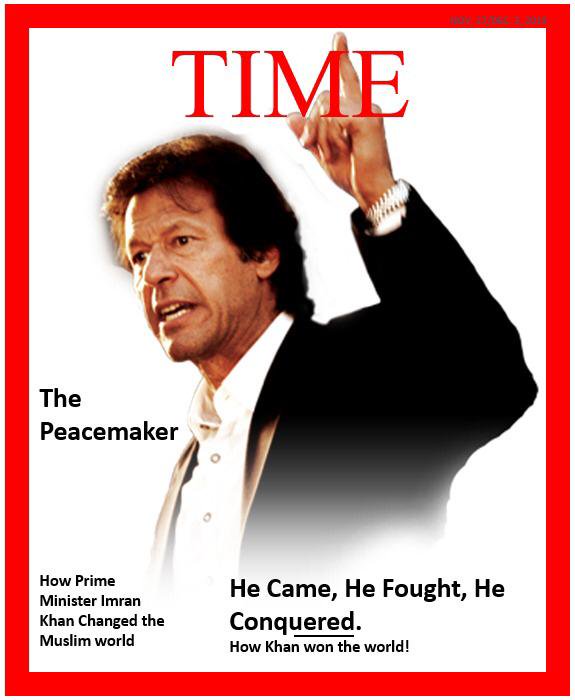
Imran Khan had just ended his UNGA speech, and it was just a matter of seconds before he made it to the cover of Time magazine. A cover showing Khan hit the social media stands, titled, “He Came, He Fought, He Conquered. How Khan won the world!” From what it looks like, the Time hasn’t done just a cover on Khan but an entire Issue, with no other stories but “How Prime Minister Imran Khan changed the Muslim world”. And by just superimposing Khan on the cover of a 2018 magazine.
Now, don’t ask about the contents of this issue because the deadline was short and the editors of Time didn’t have the time. So, you will have to live with only the cover for now. Thanks to Insafians, it is the second time in 2019 that Khan made it to Time magazine’s cover: in April, he was adjudged as one among the ‘100 most influential’ people in the world.

Rani Mukerji, a voice of reason

Ever since the advent of Twitter in Pakistan, ‘Rani Mukerji’ has been a voice of reason for PTI users. Whatever the political situation between Pakistan and India be, Rani Mukerji will give her opinion anyhow. If there is a day when you don’t understand the difference between real or fake, wait for Rani to endorse it to know it is fake for real.
“What a brilliant & tremendous speech by the Pakistani PM @ImranKhanPTI at the #UNGA. He spoke his heart out for the Oppressed Kashmiris & rightly exposed the RSS controlled regime. Wish we Indians had leadership like him,” the tweet by @RANIMUKERJI read. It doesn’t matter if her bio says ‘Parody account’ – what she posts is gospel truth for Khan supporters. The only tweet posted by the account has more than 4,000 likes and close to 2,000 retweets.

Putin-Khan dostana in US

Russian president Vladimir Putin had a rather good dinner interaction with PM Khan, as they sat together in New York, or so we are told. What all they would have talked about, we wondered. It meant good news diplomatically, right? But just as we were about to begin our celebration over this, we found that Putin wasn’t even in New York. He was in Russia with the Venezuelan President Nicolás Maduro.

Paid ad in NYT

Get a paid advertisement published, put the ad sheet on top of the front page of The New York Times, and tweet from the official party handle: “The world has started paying attention to the #KashmirIssue and that itself is a diplomatic win for Pakistan. Our only aim is to make the Kashmiri voices heard despite Modi’s attempts to silence them through media blackout in Kashmir. Today in @nytimes! #ImranKhanVoiceOfKashmir”. Once the lie is called out, simply delete the tweet. A sponsored ad, not on the front page of The New York Times.

Dengue count soars to 2,823 in Balochistan

The number of dengue cases reported in Balochistan during the current year has soared to 2,823 as three of the provincial districts remain affected.
According to Balochistan Health Department’s statistics and figures, dengue virus has affected 1,898 people in the province whereas another 925 people are suspected of being affected by the epidemic as well. So far, three people have reportedly died from the mosquito-borne disease. The Health Department stated that the dengue cases have surfaced in district Kech, Gwadar and Lasbela of which district Kech is the most affected where 1,747 cases were reported. In Gwadar, at least 872 cases were reported and approximately 204 people were affected in Lasbela district. No case has been reported from Quetta so far, according to officials. Secretary Health Balochistan Hafiz Abdul Majid has said that concrete steps are being taken to address the issue and apart from providing treatment in the affected districts, a campaign is also launched to create awareness among the people about preventive measures.
Five more dengue patients admitted to Bahawal Victoria Hospital
Apart from the anti-dengue spray, a special team from the health DG’s office has also been sent to the affected areas, officials said. They claimed the spray had been completed in all the affected districts which will help overcome the situation in the coming days.
“On the directives of Balochistan Chief Minister Jam Kamal, an effective and practical strategy has been devised and steps taken to curtail dengue are being monitored,” he said.
“Coordination with the health experts concerned is underway for the necessary technical and health assistance and all measures will be taken to deal with the situation,” the secretary health assured.
Informing about the affected districts, Hafiz Abdul said that government hospitals have been equipped with facilities and steps taken to deal with the dengue epidemic.
“There is a dire need to educate the public about dengue and the government is fulfilling its responsibilities in this regard,” he continued.
Dengue death toll hits 28 with three more fatalities
Health Secretary assured that the situation is under control and the virus will be eradicated soon. He urged the public to not be overcome by any fear and rather adopt the recommendations proposed for protection from the virus.
He said that with the cooperation of the public the dengue virus will soon be eliminated from the affected districts.
Earlier, Balochistan Health Minister Meer Naseebullah Marri also said that health department has been utilising earnest efforts to deal with the recent outbreak of dengue virus.
“Health teams have been sent to dengue-hit areas where patients are being provided quality care and medicines,” Marri said in a statement, adding that the government has been reviewing daily reports that are emerging from the affected areas.
He said the provincial government has taken immediate notice after dengue cases surfaced in Lasbela and other districts, while Incentive Care Units (ICUs) have also been established for patients affected by dengue.
https://tribune.com.pk/story/2070811/1-dengue-count-soars-2823-balochistan/