Monday, September 23, 2019

India vs. Pakistan Could Be a Nuclear War Where Billions Die


By Kyle Mizokami  
Hundreds of nuclear weapons could go flying.

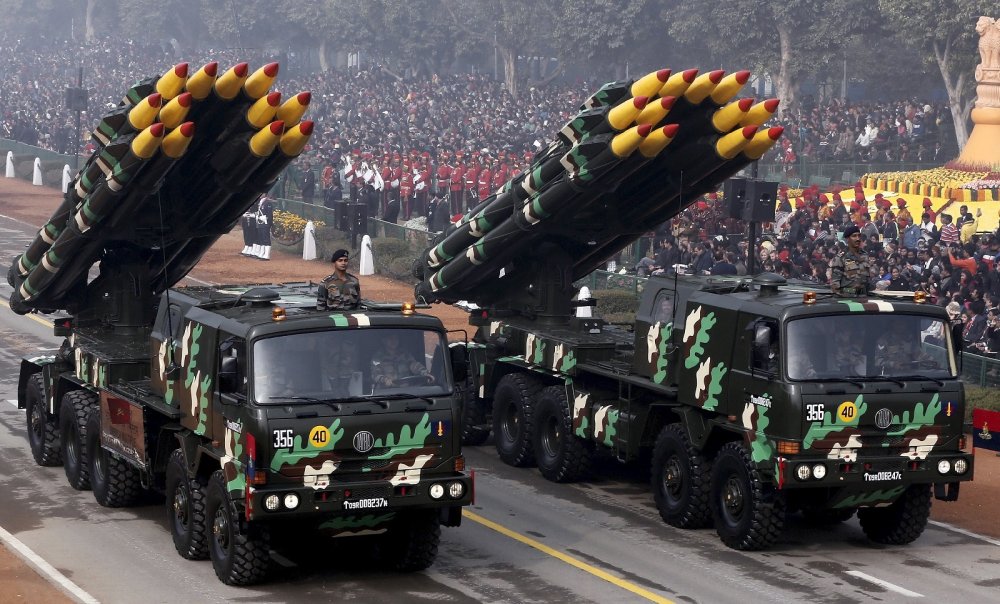
 Know This: It’s distinctly possible that any future war between India and Pakistan would involve limited action on the ground and full-scale fighting at sea and in the air. India has the upper hand in both, particularly at sea where it would have the ability to blockade Pakistani ports. Pakistan imports 83% of its gasoline consumption, and without sizable reserves the economy would feel the effects of war very quickly. An economic victory, not a purely military one might be the best way to decisively end a war without the use of nuclear weapons.
With that scenario in mind, let’s look at the five Indian weapons Pakistan would fear most in a war.
INS Vikramaditya Aircraft Carrier
Commissioned in November 2013, INS Vikramaditya is the newer and more modern of India’s two aircraft carriers. In the event of war, Vikramaditya would lead an offensive at sea designed to sweep the Pakistani Navy from the field. The nightmare scenario for Pakistan would be Vikramaditya parked off the coast of Karachi, Pakistan’s largest port, enforcing a naval blockade.
Originally built for the Soviet Navy as the anti-submarine aviation cruiser Baku, Vikramaditya was mothballed in 1996 after it became clear post-Cold War Russia could not afford to operate her. The ship was purchased by India in 2004, to be upgraded by Russian shipbuilders to a true aircraft carrier complete with angled flight deck. The updated design deleted all cruiser armament, including two 100mm deck guns, 192 SA-N-9 surface to air missiles and 12 SS-N-12 Sandbox anti-ship missiles.
Vikramaditya is 282 meters long and displaces 44,000 tons, making it less than half the displacement of American supercarriers. Nevertheless Vikramaditya’s powerful air wing is capable of executing air superiority, anti-surface, anti-ship and anti-submarine warfare. The carrier air wing is expected to consist of 24 MiG-29K or Tejas multi-role fighters and 10 anti-submarine warfare helicopters. India has ordered 45 MiG-29Ks, with the first squadron, 303 “Black Panthers” Squadron, stood up in May 2013.
INS Chakra Nuclear Attack Submarine
While INS Vikramaditya would be the visible symbol of a naval blockade, perhaps the real enforcers would be India’s force of 14 attack submarines. The most powerful of India’s submarines is INS Chakra, an Akula-II nuclear-powered attack submarine.
INS Chakra would be able to fulfill a variety of wartime tasks. It would be a real threat to Pakistan’s Navy, particularly her 11 frigates and eight submarines, only three of which are reasonably modern. Chakra is also capable of covertly laying mines in Pakistani waters and conduct surveillance in support of a blockade.
Construction of the submarine that would become Chakra began in 1993, but stalled due to lack of funding. In 2004 the Indian Navy agreed to fund the sub to completion—at a cost of $900 million—in exchange for a future 10 year lease with an option to buy. Delivery to the Indian Navy was supposed to take place in 2010, but transfer was delayed after a 2008 accident that killed 20 Russian Navy personnel and wounded another 21.
At 8,000 tons displacement, Chakra is as large as U.S. Virginia-class nuclear submarines. It has a maximum speed of 30 knots with a maximum operating depth of reportedly 520 meters. The sub not only has a customary large sonar hydrophone array on the bow, but also active and passive arrays scattered over the rest of the hull. Chakra also features a pod-mounted towed hydrophone array.
INS Chakra is armed with not only four standard diameter 533 torpedo tubes but also another four 650mm torpedo tubes. Armament includes the VA-111 Shkval supercavitating torpedo, a high speed torpedo capable of traveling at 220 knots to ranges of up 15 kilometers. Missile armament is in the form of 3M54 Klub anti-ship missiles. Chakra can carry up to 40 torpedo tube launched weapons, including mines. (Five merchant ships were struck by mines during the 1971 India-Pakistan War.) For defensive purposes, Chakra has six external tubes, each carrying two torpedo decoys.
According to the terms of the lease with Russia, Chakra cannot be equipped with nuclear weapons.
AH-64D Apache Longbow Block III Attack Helicopter
India’s recent agreement to purchase the AH-64D Apache helicopter represents a quantum leap in land firepower for the Indian Army. The Apache’s versatility means that it will be able to do everything from engage armored formations in a conventional war scenario to hunt guerrillas and infiltrators in a counterinsurgency campaign.
The Apache is one of the most battle proven attack helicopters fielded. Apache is capable of speeds of up to 171 miles an hour in high altitude environments, an important consideration in India’s mountainous terrain. The rotor blades are resistant to 12.7mm machine gun fire and the cockpit is protected from shrapnel by Kevlar shielding.
The Apache Longbow is optimized to attack and destroy armor—the mast-mounted millimeter-wave radar is capable of detecting and prioritizing up to 128 vehicle targets in a matter of seconds, then attacking up to sixteen targets in quick succession. For counterinsurgency operations, the thermal imaging sensor allows crew members to pick out individuals in ground cover and concealment.
The helicopter has four external hard points, each of which can mount four Hellfire missiles. A 30mm cannon capable of engaging light armor, soft targets or personnel is mounted underneath the helicopter chin and slaved to an optical sight worn by the pilot and gunner.
In a contract worth $1.4 billion dollars, in 2012 India agreed to purchase 22 Apache helicopters. Also included in the 2012 deal was a request for 812 Hellfire Longbow millimeter-wave radar guided missiles for use against tanks and armored vehicles and 542 Hellfires optimized for use against hard, soft and enclosed targets. Also included in the deal were 245 Stinger Block I missiles to provide an air-to-air capability.
In August, India offered to buy a further 39 Apaches, in an attempt to drive the overall unit cost down.
Su-30MKI Fighter
The Indian Air Force’s Su-30MKI air superiority fighter is meant to secure air superiority over Pakistan. The IAF has 200 Su-30MKIs in service with another 72 on order. A long-ranged, twin engine fighter with a powerful radar and formidable armament, the Su-30MKI will form the mainstay of the Indian Air Force.
The Su-30MKI is an evolution of the 1980s-era Su-27 Flanker. Thrust vectoring control and canards make the plane highly maneuverable, while the Zhuk active electronically scanned array radar makes it capable of engaging several targets at once. Complementing the Zhuk will be the Novator long-range air to air missile, capable of engaging targets at up to 300 to 400 kilometers.
The Su-30MKI has an impressive twelve hardpoints for mounting weapons, sensors and fuel tanks. The Su-30MKI is arguably superior to any fighter in the Pakistani Air Force, with the possible exception of the F-16 Block 50/52, of which Pakistan has only 18.
A portion of the Su-30MKI force has been modified for the strategic reconnaissance role. Israeli-made sensor pods reportedly give the Indian Air Force the ability to look up to 300 kilometers into Pakistan (or China) simply by flying along the border.
The Su-30MKI will grow even more lethal with the addition of the air-launched version of the BrahMos supersonic missile, currently under development. Each Su-30MKI will be capable of carrying a single BrahMos. BrahMos will give the Su-30MKI stand-off capability against ships and ground targets to ranges of 295 kilometers.
Indian Nuclear Weapons
India first tested a nuclear weapon in 1974, with the detonation of a 12 kiloton explosive device. The Indian government has been consistently tight-lipped on the status of their nuclear arsenal, and as a result a considerable amount of mystery surrounds India’s nuclear weapons.
The exact size of the arsenal is unknown but estimated to be between 90 and 110 nuclear devices. Statements by officials have lead outsiders to believe the maximum yield of Indian weapons to be around 200 kilotons, or approximately ten times the destructive power of the Hiroshima bomb.India’s first nuclear delivery systems were likely attack aircraft—first the Jaguar, then the MiG-27 and Mirage 2000. Although capable, the aircraft were vulnerable to Pakistan’s air defense network and this vulnerability likely lead to the development of the land-based missiles. It is unknown whether nuclear weapons have been fitted to the Su-30MKI, but as a non-stealthly aircraft its ability to penetrate Pakistani defenses would not be dissimilar to a Mirage 2000.Indian nuclear weapons are placed under the authority of the Strategic Forces Command. India’s primary delivery systems are land-based missiles. The Prithvi I and II liquid-fueled missiles have ranges from 150 to 350 kilometers and need half a day to prepare for launch. The Agni I, II, III and IV solid-fuel missiles are medium to intermediate range ballistic missiles with a range of 700 to 4,000 kilometers.
India is also on the verge of fielding its first ballistic missile submarine, the Arihant. Based on the Akula-I attack submarine design, Arihant has been modified to carry 12 K-15 short-range missiles or 4 K-4 intermediate-range nuclear missiles. Arihant is significant in that it will be able to patrol far beyond the range of Pakistani anti-submarine warfare capabilities. This will essentially make India’s retaliatory capability untouchable by Pakistan and thus a more credible deterrent.
India has a “no first use” policy regarding its nuclear weapons, reserving them solely for retaliation in the event of nuclear attack. Indian also adheres to a “minimum self defense” doctrine, in which the fewest nuclear weapons needed to maintain effective deterrence from attack are maintained.

Video - PM Narendra Modi's Speech | Howdy Modi Event | Address to Indian diaspora

Don’t Mess With Modi in Texas - Indian prime minister defends the takeover of Kashmir and casts scorn on Pakistan

 By Roger Cohen

Trump joins Modi as the Indian prime minister defends the takeover of Kashmir and casts scorn on Pakistan.
Who could resist an audience of more than 50,000 Indian-Americans packed into a Texas football stadium? Not Donald Trump, on the eve of an election year, so he joined the “Howdy, Modi!” party here to proclaim, with the Indian prime minister, a great future of shared values and mutual reinforcement for the world’s two largest democracies.
It was quite a rah-rah Lone Star State show, boasting Indian-Texan cheerleaders. It was also freighted with political significance. Less than two months after Narendra Modi, with strong backing from Parliament, revoked Article 370 of the Indian Constitution, eliminating the special autonomous status of the Kashmir region and clamping down on the mainly Muslim territory, Trump chose to signal approval by standing side-by-side with the prime minister.
The president got his biggest cheer by saying the United States was determined to help protect India from the threat of “radical Islamic terrorism.” As for Modi, he brought the house down when he declared that his “new India” was bidding farewell to open defecation, taxes that are an obstacle to jobs, 350,000 shell companies, 80 million fake names used to defraud the government and — wait for it — Article 370.
“This article has deprived the people of Jammu and Kashmir of development and equal rights,” Modi said. “The forces fanning terror and terrorism were exploiting the situation.”
Then, taking aim at Muslim-majority Pakistan, whose covert backing of militant groups in Kashmir goes back decades, he threw down the gauntlet to Islamabad: “India’s actions within its boundaries are causing discomfort to some people who are unable to manage their own country. These people have put their hatred for India at the center of their political agenda.”
The situation in Kashmir, a perennial South Asian flash point where war has flared more than once between India and Pakistan, has festered for a long time. Its economy is stagnant, its potential blocked. The two countries, both nuclear-armed, always blame each other for the collapse of outreach. Both Modi, since taking office in 2014, and Prime Minister Imran Khan of Pakistan, elected last year, have made conciliatory gestures and found them aborted in violence. For Modi, enough was enough.
His response has been sweeping. It appears to have involved significant human rights abuses. Several thousand Kashmiri political and business leaders have been rounded up, internet connections and mobile phone lines have been cut off, and Indian security forces have poured into the streets. Still, by Kashmiri standards, bloodshed has been limited; and India insists the communications blackout was intended to block social-media incitement to more violence.
Kashmir illustrates how the Trump administration’s indifference to human rights issues offers carte blanche to leaders like Modi. American pushback has disappeared. Modi, who talked up India’s diversity in his speech, has no incentive to keep his Hindu nationalist base in check. That could prove dangerous as he fast-forwards his country.
The question, however, is whether Modi had any choice in Kashmir and whether, over time, the revocation of an article conceived as temporary breaks the Kashmiri logjam, pries open the stranglehold of corrupt local elites and offers a better future. I think it might.
“We revoked a temporary constitutional provision that slowed down development, created alienation, led to separatism, fed terrorism and ended up as a deadly national security problem,” Subrahmanyam Jaishankar, the external affairs minister of India, told me. “We know the last 70 years did not work in Kashmir. It has bled us. It would be Einsteinian insanity to do the same thing and expect a different result.”
The reaction of Khan, the Pakistani prime minister, has been wild. Suggesting Modi has sympathy for the Third Reich, comparing him to a Fascist leader and stating that he may commit “genocide,” is to protest too much. Raising the possibility of nuclear war is reckless. All this suggests his bluff has been called.
If Pakistan is so concerned about Nazi Germany, it might begin by recognizing the State of Israel. Whether Pakistan really wants a solution in Kashmir, the region that justifies its bloated military budget, and whether it can ever transparently demonstrate that its intelligence services have stopped finding uses for radical Islamism in its various violent forms, remain open questions.
They are important questions for the United States, as it contemplates a military withdrawal from Afghanistan. A quandary for Trump now will be how to secure Pakistani support, rather than suffer an incensed Pakistan’s sabotage, if he moves forward with his promise to bring American troops home.
Modi will not turn back from his elimination of Kashmir’s autonomy. That phase of Indian history is over. Trump and Modi are both forceful, media-savvy politicians. But they are not alike. Modi, a self-made man from a poor family, is measured, ascetic, not driven by impulse. Trump was born on third base. He’s erratic, guided by the devouring needs of his ego. I’d bet on Modi to transform India, all of it, including the newly integrated Kashmir region.

Sunday, September 22, 2019

Video Report - Will the protests against Egypt's president spread?

Video Report - Millions around the globe demand action on climate change

Video Report - #YellowVests French police arrest protesters as 'yellow vests' attempt to revive movement in Paris

Video Report - [45TH WEEK] Yellow Vest protesters start fires in Paris and get tear gassed by police

Video Report - #Kalisz #LGBT #Poland Protesters 'clean streets' after first LGBT+ pride in Polish Kalisz

Pashto Music - Sardar Ali Takkar, Ghani Khan - Makh de tabaana sta

Religious intolerance has increased in Pakistan with hate narratives

By Muhammad Amir Rana

For one, patriotism cannot be reduced to religion alone without declaring non-Muslims in Pakistan as non-citizens.

The problem is that Pakistan’s state institutions do not consider the tendencies of non-violent extremism as a potent threat. The way Hindu temples were vandalised and private properties destroyed recently in Sindh’s Ghotki district is yet another reminder that the challenge of religiously inspired violent extremism is bigger than we thought. Moving beyond a shallow condemnation, the government will certainly have to act to increase the cost of committing such violence, that too on spurious grounds. Apart from the specific measure related to the Ghotki incident, two things must be done to protect all religious minorities in Pakistan from violence. First, the groups and individuals using faith to gain political and religious influence should be strictly dealt with under the law. Secondly, the state should demonstrate zero tolerance towards hate narratives being disseminated online and in other ways by extremist religious groups, individuals and their supporters. A clear, unequivocal message should be sent that the state alone is the custodian of the constitutional rights of all citizens, irrespective of their faith. The fear expressed by the majoritarian mindset that religious minorities could harm the sovereignty of Pakistan is simply baseless. For one, patriotism cannot be reduced to religion alone without declaring non-Muslims in Pakistan as non-citizens.
A general argument can be made that Pakistan’s power elites have been patronising religious, ethnic, cultural and racial disagreements to further their regime, instead of looking at the diversity of religious, cultural and societal opinion in Pakistan as a sign of inclusiveness and plurality. That has significantly damaged the country’s social fabric, mainly its humanistic values such as empathy and compassion, which safeguard individuals and societies from hate and aggression.
Irrespective of its geographical location and its religious or secular tendencies, if a society possesses a sense of majoritarian supremacy or is hyper nationalistic or harbours a collective sense of hatred and aggression, then it lacks empathy and compassion. The absence of these two attributes could push society towards chaos and anarchy.
The phenomenon of religious intolerance has its own dynamics but in recent years it has increased through its connectivity with larger extremist discourses fanned in cyberspaces. Social media platforms have increased the exposure and vulnerability of the youth to divisive and extremist ideologies. This exposure is making people sensitive about their identities. Such an identity crisis is beneficial to the radical groups. An individual needs emotional healing and anxiety caused by such exposure and tries to connect with the nearest group of like-minded people.
The small groups look towards bigger and better organised groups not only for ideological and political inspiration but also to learn organisational skills. Mian Mithu, a radical cleric from Ghotki, could be an example. He may act independently but is said to have been inspired by the Tehreek-i-Labbaik and encouraged by banned militant groups like Al Rehmat Trust, Jamaatud Dawa and charities associated with hard-line madressahs in Karachi.
These groups succeeded in building pressure on non-Muslim communities but the cleric has better cultural, religious and ethnic credentials to influence local communities. With his influence, he is regarded as capable of triggering vandalism. The problem is that Pakistan’s state institutions do not consider the tendencies of non-violent extremism as a potent threat.
There is a need to adopt a framework or narrative in Pakistan, that treats all citizens, irrespective of their ethnicity, creed and geography, with equality. Introducing courses on citizenship in education curricula, extracted from the Constitution, are greatly needed. To be precise, non-Muslims in Pakistan should be owned as an integral part of the country. Bracketing non-Muslims with India or Western countries is to contradict history: They are indigenous to the soil and their valuable contribution to this region is a chapter of Pakistan’s history.
https://www.asianage.com/opinion/oped/230919/religious-intolerance-has-increased-in-pak-with-hate-narratives.html

#Pakistan - ‘Unsilencing #Balochistan’

By Desmond Fernandes
Just over 4 years ago, “on the evening of April 24, one of Karachi’s most prominent social activists, Sabeen Mahmud, was shot dead after leaving an event called ‘Unsilencing Balochistan’ [Take 2], that her organization, The Second Floor, had arranged”. This event had been organised “after a previous roundtable on the same topic, … scheduled to include [Mama] Qadeer and [Farzana] Majeed as panellists, was cancelled at a leading private university, the Lahore University of Management Sciences (LUMS). Faculty there said they had to cancel the talk because of threats received from Pakistan’s top spy agency, the Inter-Services Intelligence [ISI]”. The Chair of the Humanities and Social Sciences Department had notified students, staff and faculty at LUMS that the event had been cancelled “on the orders of the government”.
The event had “featured [the aforementioned panellists], two of Pakistan’s most vilified human rights activists”, the Chair and General Secretary of Voice for Missing Baloch Persons, “who have worked to raise awareness about the south-western province Balochistan’s ‘missing people’”.
“Mahmud knew she was taking a risk by holding the event and discussed the possibility of ‘blowback’ with a friend … But she wrote to another friend, ‘I just want to leave everything and join the Baloch march for the rights of their missing’”.
At that time, as the Voice for Missing Baloch Persons had estimated, “around 21,000 people ha[d] gone missing in Balochistan”, with 6,000 mutilated bodies found. Two months after Sabeen Mahmud’s murder, Pakistan’s army continued “to enforce a blockade of the towns of Kolowah, Malaar, Geshkor, Zeek & Machi. No one, including town residents and district officials of the Pakistan-backed provincial government”, were “allowed access to the targeted towns. A district official, on condition of anonymity, said they were denied access to the affected areas by Pakistan Army and Frontier Corp units and were told that operations” were “still underway. District officials said the towns ha[d] been subjected to intensified bombing by the Pakistan Air Force”.
Noam Chomsky, David Barsamian, Tariq Ali and others, just a year prior to Sabeen Mahmud’s target killing, had voiced the following concern in an Open Letter:
On March 18th 2014 around 5:00 pm in Quetta, Zahid Baloch, chairperson of [the] Baloch Student Organization – Azad (BSO-A), was abducted at gunpoint. Banuk Karima, the vice-chairperson of BSO-A, witnessed the abduction. She notes, ‘Pakistan’s secret agencies and security forces abducted Zahid Baloch, I along with three other members of BSO-A witnessed the abduction’ …
According to Voice Of Baloch Missing Persons (VBMP) – an independent advocacy group run by the families of those who are missing – more than 19,000 Baloch persons are missing. Other organisations put the figure in the range of 600 to 5000. Most human rights organizations and activists accuse Pakistani secret agencies and military forces for these abductions. This fact was acknowledged by the Pakistan Supreme Court. Not only are Baloch systematically being disappeared. They are also being tortured and murdered…
Baloch activists claim that Balochistan was annexed by Pakistan on 27th March 1948 by the Pakistani army on the orders of Muhammad Ali Jinnah. The Baloch, since this date, have variously demanded either increased provincial autonomy in a confederal political system or independence. The Pakistani state has heeded neither demand. Instead, by both civilian-led governments and military dictatorship, the Baloch have been answered by bullets.
Besides the abductions, torture and murder of Baloch activists, the state has carried out major military operations in Balochistan, often in civilian areas. Alarmingly, military forces have also started raiding and destroying educational institutions. In the past four months, study centres and schools have been raided with students and teachers among those who have been abducted. Shockingly, bookshops have been raided and bookshop owners arrested. Life for students in Balochistan has become unbearable…
We … call on the Government of Pakistan to stop all military operations in Balochistan, to stop raids on educational institutions, to stop raids on bookshops, and to stop forced abductions of Baloch activists. We further call for the immediate release of Zahid Baloch and all others held by Pakistani security forces. We call on intellectuals and activists to take note of these atrocities being committed in Balochistan for which we hold the Pakistani state responsible and complicit. We appeal to all readers to raise the issue of the atrocities against the Baloch at all political and social forums.
Five years on from this assessment, the ongoing process of destruction, military operations in Balochistan, raids on educational institutions, raids on bookshops, forced abductions of Baloch activists, women, children and students and “kill and dump” targeting of the Baloch still fits the pattern of colonial genocide identified by Raphael Lemkin (who coined the term genocide) and other scholars, human rights activists and political commentators. I have already extensively documented the genocidal and politicidal context of such targeting at length in two books. For Adana Usmani, “the conflict today resembles the dynamics characteristic of any protracted clash with an occupying authority”.
It is notable that Imran Khan, when leading his party in opposition, as PTI (Pakistan Tehreek-e-Insaf) chairman in February 2016, had promised that he would act differently with regard to Balochistan if he came to power, as he understood the full scale of injustice and “the crimes against humanity” faced by the Baloch. He said, for example, and as quoted from the Pakistan Tribune newspaper, he would “fight for the rights of Balochistan, claiming he did not have an idea how rights of smaller provinces were suppressed until his party formed government in Khyber-Pakhtunkhwa [KP] … Imran assured the people of Balochistan that his party will never use force against them. [Quote]: ‘I will never start a military operation in your province but will respect your right to protest’ [end quote], he said, claiming that he understood why Balochis were struggling for their rights”.
In a speech uploaded on 26 January that same year he is heard passionately stating before an audience:
I, in 1971, when [the] Pakistani army took action in East Pakistan, I was the one who was standing with the Pakistani army, praising the soldiers, ‘they’re doing this’ and ‘great job’, and its only ‘foreigners’, ‘terrorists’ and ‘militants’ [who are being targeted]. It was three years later that we realised that the army butchered civilians – women and children. And so we’re doing exactly the same thing in Balochistan. They are bombing people. How can you bomb people? Is this an army you’re bombing? There are women and children there. But for us, it’s very important to understand how we’re just bombing our own people. Just think of the immorality of bombing villages, where there are women and children.
No one talks about, yeah … about the 6 million people [also] in the tribal area that are being bombed. Their economy has been destroyed. They are living in refugee camps. There are about 2 million internally displaced people in Pakistan. How are they surviving? All under the heading of ‘the Taliban’.
And the extra-judicial killing that is going on. How many times have you heard [about] ‘so many militants killed’. Is there any [independent] verification? Has there been any [independent] identification? Who are these people that have died?
So, this is a crime against humanity, what is going on …
Since Imran Khan became Prime Minister, of course, the army has continued to do the very same things – i.e. extra-judicial killings, abductions, disappearances, the ‘bombing’ of ‘villages, where there are women and children’ – that it was doing in 2016 when he had clearly labelled such concerns ‘a crime against humanity’. Prime Minister Imran Khan needs to ask himself the same questions that he had posed to the prime minister of the time in 2016: “How can you bomb people [in Balochistan?] … There are women and children there … Just think of the immorality of bombing villages, where there are women and children … And the extra-judicial killing that is going on. How many times have you heard [about] ‘so many militants killed’. Is there any [independent] verification? Has there been any [independent] identification? Who are these people that have died?”.
Balochwarna News and other outlets and organisations continue to document, on a weekly basis, the women and children, elders, students and others who continue to be abducted, tortured and ‘disappeared’ by Pakistan’s army of occupation and linked forces. Just think of that immorality and lack of accountability of the same government that warns India about its military occupation and shameful human rights record in Kashmir. Just two months ago, in June, the Human Rights Council of Balochistan (Hakkpaan) reported that:
In completely under-the-blanket operations, the mighty military of Pakistan has militarized the entire Balochistan, its north-western, most mineral-rich but least developed region with lowest human development. [The] military suppressed the rights movements that blame the military and the central government for their backwardness…
Balochistan seemed a war-zone during the month of May 2019 as well. We have received hundreds of reports of human rights violations [which confirmed that in May 2019 alone], … seventy persons were picked up by [the] military and forcibly disappeared. Eight of them were released later, while [the] whereabouts of 62 civilians remain unknown … Decomposed bodies of five persons were found dumped. All were beyond recognition … Silence over Balochistan has shaped [the] military’s attitude towards any rights movement all over Pakistan.
[The] military repeated [the] same in Waziristan, KPK region on 26 May 2019. It attacked a peaceful rally, killing more than a dozen and wounding more than forty-five. [The] rally was organized by [the PTM] Pashtun Tahaffuz Movement, a rights group developed in Pakistan’s KPK region. [The] leadership of the group – legislators the local people elected – were said to be the aim of the attack. One of the legislators, Ali Wazir went missing for a few days, after [the] military arrested him from the attacked protest, while the other, Mohsin Dawar was declared a wanted man. He finally surrendered himself to a court of law … [The] military, it seems, wishes to control the minds of each individual and does not [wish to] allow any space for the voices of people.
The Human Rights Council of Balochistan’s May 2019 update confirmed by name that Baloch children and university students were identified amongst the ‘disappeared’. The HRCB’s report entitled 2019 Balochistan: The State of Human Rights further confirmed from its sources that in “March 2019, sixty people were forcibly disappeared by security forces, fifteen were shot dead and seventeen unidentified bodies were recovered. The abductions include[d] women and children, particularly those who are related to campaigners and political workers. These people are often taken from their homes by the military and kept in isolation for weeks, sometimes even months. They are then moved to illegal detention centres, run that by death squads, but supervised and sponsored by the military”.
Investigative journalist Julia Micevska earlier this month, having highlighted the HRCB’s findings and arrived at the determination that Pakistan’s military “continues its ‘Kill and Dump Policy’ in Balochistan”, further concluded (and in this, she joins a large number of human rights analysts who have arrived at similar conclusions) that the construction of the Gwadar deep sea port and road infrastructure which forms “part of the planned China-Pakistan Economic Corridor (CPEC), has [additionally] resulted in untold human rights abuses that the Baloch people liken to ‘ethnic cleaning’.
“The Pakistani military has used a heavy hand to seize the resources of Baluchistan”, she reports, “especially its oil, gas and rare earth metals. Additionally, the Pakistan military regularly carries out strategic military exercises in the region, including nuclear testing and storage. Villages that block any proposed route are burnt to ashes and the people forcefully removed. It is generally believed that the military of Pakistan is beyond accountability, and cannot be controlled by any civilian institution, including the Pakistan Parliament and judiciary”.
Investigative journalists, for their part, in Balochistan, Pakistan and overseas – who cover Pakistan state-inspired terror and atrocities in Balochistan – continue to be targeted. As Shah Meer Baloch reported in November 2017 (and the situation has not improved since then): “Balochistan is the most hazardous province for journalists. According to Khalil Ahmed, president of the Balochistan Union of Journalists, 43 journalists have been killed in Balochistan, including by bomb blasts and targeted killings. Twenty-five journalists have lost their lives in targeted killings while reporting in the conflict zones in Balochistan, Ahmed said”.
Many others live under the constant fear, in Balochistan, Pakistan and internationally, of being targeted by state-inspired death-squads. In this regard, we must not forget those who have sought, despite these threats, to expose genocidal realities whilst celebrating Baloch culture and resistance towards a genocidal regime. We must not forget Dr Arif Barakzai, a member of the BSO (Baloch Student Organisation) and a lecturer at Uppsala University in Sweden who was murdered after ‘accidentally falling’ 11 floors from the balcony of his apartment in 2008. He ran the website, The Baloch Artist, dedicated to Baloch culture.
The European Commission and governments which claim to be inspired by the refrain ‘Never again!’, meanwhile, need to be publicly held to account for pursuing their own cynical geopolitical and ‘deep political’ agendas that enable these horrors against the Baloch to continue. As an Unrepresented Nations and Peoples Organization (UNPO) report entitled “Land of Forsaken Voices: The Geopolitics of Justice, Impunity and Human Rights in Balochistan” noted in 2016: “Pakistan’s partners in the West pay mere lip service to changing the horrendous status quo. Their half-hearted approach oscillates between public allegiance to international human rights norms and realpolitik based on considerations of power and economic interests”.http://balochwarna.com/2019/09/08/unsilencing-balochistan/

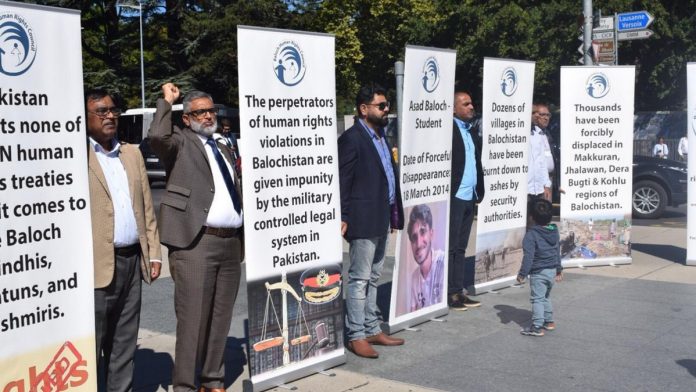
Baloch, Sindhi, Pashto groups seek Modi & Trump’s help, allege rights violations by Pakistan


Members of these groups will hold a demonstration in front of Houston’s NRG stadium, where Modi & Trump will take part in the ‘Howdy, Modi!’ event Sunday.

Representatives of Sindhi, Baloch and Pashto groups have gathered in Houston to hold a demonstration in front of the NRG stadium on Sunday to draw the attention of Prime Minister Narendra Modi and US President Donald Trump for gaining freedom from Pakistan.
Scores of members of the Balochi American, Sindhi American and Pashto American communities landed in Houston on Saturday from various parts of the US to hold the first-of-its-kind demonstration in America, wherein they will collectively urge the leaders of India and the United States to help them get freedom from Pakistan.
Members of these groups alleged on Saturday that the Pakistani establishment was carrying out gross violation of human rights against their communities.
“We demand freedom from Pakistan. India and the US should help us in the same way as India had helped the people of Bangladesh in 1971,” Nabi Baksha Baloch, the US representative of the Baloch National Movement, told PTI.
“We are here to request Prime Minister Modi and President Trump to support our cause. There has been gross violation of human rights against the Baloch people by the Pakistani government,” he said.
More than 100 Sindhi Americans arrived in Houston on Saturday. They are planning to gather outside the NRG stadium, where the “Howdy Modi” event is scheduled to be held on Sunday, with the hope that their posters and banners of freedom will catch the attention of Modi and Trump.
“This is a historic rally by the leaders of the free world — the largest and oldest democracies. We the people of Sindh want freedom from Pakistan. Just like India supported for the freedom of Bangladesh in 1971, we want a separate nation for the people of Sindh. Pakistan is a theocratic country,” Zafar Sahito, from the Jeay Sindh Mutahida Muhaz, said.

A Professor’s Killing Sends a Chill Through a Campus in Pakistan


Prof. Khalid Hameed’s devotion to teaching often led him to arrive early for work, and the day he was killed was no different. Professor Hameed, a senior English lecturer at Government Sadiq Egerton College in the Pakistani city of Bahawalpur, parked at about 8 a.m. on March 20, signed the staff room register, unlocked his office and walked in. His killer came up from behind, hitting him in the head with a heavy padlock and stabbing him several times. Professor Hameed, 59, who was six months from retirement, died immediately.
One of his students, Khateeb Hussain, was detained by the police. In a video of his interrogation, Mr. Hussain said he killed Professor Hameed — a devout Muslim, according to his family — because he had insulted Islam. Six months later, no charges have been brought against Mr. Hussain, or against a preacher from Tehreek-e-Labbaik Pakistan, a hard-line Islamic group, who the police say incited him to kill.
The murder has devastated Professor Hameed’s family and chilled his colleagues at Sadiq Egerton College. They see it as a horrifying new chapter in a campaign against liberal education, which small but influential extremist groups in Pakistan consider unacceptable. Many of the teachers are now wary of speaking freely to their students.
“Actually, this teacher was a symbol of all liberal education,” said Irshad Ahmad Tabasum, an associate professor in Professor Hameed’s department.
Professor Tabasum and some of his colleagues stressed that Professor Hameed was no provocative liberal firebrand, just a dedicated, well-liked teacher. They said the college had not previously had trouble with religious extremists, and they were at a loss to explain what could have motivated the killer.
A day before Professor Hameed’s death, anonymous pamphlets were distributed that called for banning a campus gathering that he was coordinating. The pamphlets claimed, wrongly, that men and women there would be allowed to dance together. But investigators said Mr. Hussain was not behind the pamphlets, and teachers at the college doubt there is a connection.In the video of his interrogation, Mr. Hussain — who had been pursuing a degree in English literature — said Professor Hameed “used to bark against Islam and utter derogatory remarks every day.” But he did not cite any specific comment that angered him.Like English literature classes around the world, Professor Hameed’s roamed across broad themes in philosophy, history, religion and politics, his colleagues say. They resent speculation about what he might have said that enraged Mr. Hussain, seeing it as an attempt to find justification, or at least sense, in his murder.But they also say that the shock of the killing has made them wonder about their own teaching — and that they have started to skirt potentially contentious subjects.
“For the last 25 years, I have never felt the pressure as I am feeling now,” Professor Tabasum said. He said he had long taught “Oedipus Rex” in his classes on Greek tragedy but was now worried about doing so.
“Because every single word can create a problem for you,” he said. “This is what has been inculcated in me after this incident. Before that, whatever I felt, I expressed that.”
Teachers have found themselves reluctant to let classroom discussions get too philosophical, said Mahmood Ahmed Shaheen, an assistant professor at Sadiq Egerton. “Obviously it is a fact, when such incidents happen, they affect our sensibilities, they affect our perception,” he said. “We feel a bit insecure when you are studying and discussing something in class, and particularly if it is related to religion.”
Such fears have spread well beyond Bahawalpur, a conservative city 380 miles southeast of Islamabad, the capital.
“I think that it would be wrong and foolish to think that such terrible incidents could only happen elsewhere,” said Shaista Sonnu Sirajuddin, a former professor of English literature at the University of Punjab in Lahore. “I dread and fear the time that we, too, can become victims.” Vigilantism by religious extremists has been a problem on Pakistani campuses since the 1980s military dictatorship of Gen. Mohammad Zia ul-Haq, who emboldened them with his Islamization of the country's laws, said Tahira Abdullah, a human rights activist.
“It’s just getting worse and worse, and it’s more visible now,” she said, adding that “if you invite a progressive speaker, that speaker will get shouted down, drowned out or run off campus, or not even allowed to speak.”
Two years ago, a 25-year-old student at Abdul Wali Khan University Mardan, in northwestern Pakistan, was dragged from his dormitory room and killed by a mob after rumors spread that he had posted blasphemous writing online. The student, Mashal Khan, had described himself as a humanist and covered his room at with posters of his political heroes and slogans celebrating free speech.
Professor Sirajuddin said most pressure felt by professors did not include overt threats of violence. But in Pakistan, an accusation of blasphemy can lead to mob violence or even an actual death sentence, and that is intimidating enough.
Professor Sirajuddin, who still teaches, said she had come to accept that if one day a student accused her, she would be on her own. “There will be very few people, there will probably be no one, who will have the courage to stand up and say she did not blaspheme,” she said.
Professor Hameed’s wife and four children say he was deeply religious, and that he made repeated pilgrimages to Mecca during a five-year stint working in Saudi Arabia. He often took a special interest in poor students, figuring that a degree could transform their lives and those of their families, according to colleagues and graduates of Sadiq Egerton.Mr. Hussain, who was reported to be either 20 or 21 years old, is still in custody, but formal charges have not been filed. The Tehreek-e-Labbaik Pakistan preacher who was detained on suspicion of inciting the killing, Zafar Gillani, has also not been charged and is now free on bail.
Shafiq Qureshi, the public prosecutor in the case, said the investigation report was complete and that formal charges could be filed this month. He said he hoped a court hearing would soon follow.
The case is being closely watched by students, teachers and other Pakistanis, said Diwan Asif Shahzad, an assistant English professor at Sadiq Egerton. He believes that bringing murder charges would send a strong message in defense of liberal education, but as the weeks have passed, he and other teachers have grown increasingly worried.
“We are all the way scared as to what will be the final decision,” Professor Shahzad said.

Saturday, September 21, 2019

Video - Student Debt in the U.S. Reaches an All-Time High | The Daily Show - Trevor Noah

Video Report - CrossTalk on Israel’s elections: Bye-bye Bibi?

Video Report - Can the US guarantee Gulf security?

Video Report - Joe Biden Calls For Release Of Transcripts On Trump’s Call With Ukraine President | Hardball | MSNBC

Video Report - #CNN reporter fact-checks conspiracy theory involving #Biden and #Ukraine

Music Video - NOOR JEHAN - GHAZAL - 'Tere Pyar Mein Ruswa'

Music Video - Chandani Raatain - Noor Jahan

Birth Anniversary Of Noor Jehan Being Observed


The birth anniversary of renowned singer of sub-continent Noor Jehan is being observed on Saturday (September-21)

The birth anniversary of renowned singer of sub-continent Noor Jehan is being observed on Saturday (September-21).
Melody Queen', Noor Jehan was born in 1926 on this day in Kasur. She had also performed as an actress in film industry.
Her famous films included Chan Wey, Dopatta, Mirza Ghalib, Qaidi, Baaji and Khandaan.
She sang in several languages including urdu, Punjabi and Sindhi, and recorded over 10,000 songs in her career.
She received the Life Time Achievement Award twice, besides achieving the highest Pakistani civilian awards Pride of Performance, Tamgha-e-Imtiaz and Sitara-e-Imtiaz.
She died on December 23, 2000 as a result of heart failure and was buried in Karachi.

Video - #AgyaBilawal #PakistanPeoplesParty - Ab Agya Bilawal Phir Se Chalega Teer #BilawalBhuttoZardari

Video Report - Qamar Zaman Kaira press conference

Video - Najam Sethi on Indo-Pak Trade & Relations

For Pakistan’s own good, it should stop worrying about Indian Muslims


Seventy-two years after Partition, Pakistan continues to define itself through India.

Since the creation of Pakistan would lead to a large number of Muslims staying back in India, the founders of Pakistan wondered about the rights and well-being of Indian Muslims. They propounded the “hostage theory” whereby Pakistan’s treatment of Hindus and Sikhs in the country would depend on how India treats its minorities.
An Independent India, on the other hand, always believed in granting equal rights to its minorities because it’s the right thing to do, it’s what its Constitution says, and not because it fears the repercussions for Hindus and Sikhs in Pakistan.
India did not want to define itself through Pakistan.
But, 72 years after Partition, Pakistan seems as obsessed as ever with the perpetual need to justify the two-nation theory. It is one thing for Pakistan to worry about Kashmiris, given its dispute with India over territorial claims on Kashmir. But what territorial claims does it have on Assam that it is worried about the NRC process there?
Ever since India decided to change the status of Jammu & Kashmir as a union territory under its own constitutional scheme, Pakistani Prime Minister Imran Khan has been going on and on about Hindu nationalism in India. He often makes the point that religious minorities are better off in Pakistan than in India. He makes Pakistan sound like a secular state, and India a majoritarian one. Regardless of who wins here, Pakistan is doing itself a disservice by making such a comparison in the first place. It is making its self-image incumbent upon India.
This renewed concern for Indian Muslims in Pakistan is not a fallout of the revocation of Jammu and Kashmir’s special status on 5 August 2019. In December 2018, Imran Khan told Baloch students in Islamabad, “The way Muslims are treated today in India has made people realise now why Pakistan was born.” Does he realise how insecure and unsure the Pakistani nationhood looks with a statement like that? Seventy-two years after Partition, Pakistanis are now realising why Pakistan was born?

Nauseating schadenfreude

As Narendra Modi rose to power in 2014, some Pakistani friends told me, “Achcha hua! Secular nakaab utra (Good, India is taking off its secular veil).” It’s as if they were happy that Indian secularism was threatened by Modi’s rise. How else would the two-nation theory get a spring in its step?
The trouble with the two-nation theory is that it does not seem to have a historical end-date: Not 1947, not 1971, not the Lahore Declaration and not even 5 August 2019. The two-nation theory seems to be an argument that refuses to end. The Partition continues.
Since 2014, the Pakistani schadenfreude over Hindu nationalism in India has been nauseating. It’s as if some Pakistanis are waiting with bated breath to hear of yet another case of a Muslim being lynched in India. It’s as if they are watching a spectator sport and are about to scream, ‘Two-nation theory won!’ I wonder if someone is even maintaining a score.
The rise of Hindutva in India since 2014 has definitely been a factor in determining how the Pakistani government sees India. With Modi as the Prime Minister, India-Pakistan peace seems even more impossible for Pakistan.
Imran Khan is now taking it to a new level. He’s started sounding like an opposition leader in India, ranting against Hindutva. The Nazi-inspired RSS is carrying out a project of Hindu supremacism, he says, and Modi wants to establish a Hindu Lebensraum. After they are done with Muslims, they will “come after” Dalits and Sikhs, he warned a Sikh delegation in Pakistan. Ironically, around the same time, there was a controversy over the alleged forced conversion of a Pakistani Sikh girl.

A specious concern

It does Indian Muslims no favour when Pakistan worries about them. It only makes things worse for them, reinforcing the Hindu nationalist narrative of Indian Muslims being ‘Pakistanis’. If Pakistan really cares about Indian Muslims, it should stop talking about them. Pakistan’s concern for Indian Muslims is specious and serves its own need for validation. Pakistan and Pakistanis must ask themselves what this says about their national self-identity, which still depends on the plight of Indian Muslims.
Look at Bangladesh, a country that does not use India to define itself. The result is that Bangladesh, once a basket case in the region, is today racing ahead of both India and Pakistan in its development indicators, economic growth and job creation. Confident nations don’t feel the need to define themselves in comparison to others. When Pakistan’s science minister Fawad Chaudhry celebrates the crash landing of an Indian mission to the moon, the joke is on him, and his country.

To Pak Media's Questions On Kashmir, UN Gives "Clear Opinion"


 "Our capacity is related to good offices, and good office can only be implemented when good offices is accepted," UN Secretary-General Antonio Guterres said.
The United Nations on Wednesday indicated its acknowledgement of the Indian stance that Jammu and Kashmir is a bilateral issue and said dialogue between India and Pakistan is an "absolute essential element for the solution". India had reiterated its stand on Jammu and Kashmir at the UN Human Rights Council last week and accused Pakistan of attempting to "politicise" the forum with "hysterical statements with false narratives". On Wednesday, asked by the Pakistani media about a "solution to this crisis", United Nations Secretary-General Antonio Guterres said, "Our capacity is related to good offices, and good office can only be implemented when good offices is accepted, and on the other hand it is related to advocacy and the advocacy was expressed and advocacy will be maintained".
"I will go on with the clear opinion that human rights must be fully respected in the territory and I go on with a clear opinion that dialogue between India and Pakistan is an absolute essential element for the solution," he added.
Last week, following yet another effort by Islamabad to flag Kashmir at the UN Rights Council meeting, India said: "We should call out those who are misusing this platform for malicious political agendas under the garb of human rights".
Pakistan's foreign minister Shah Mehmood Qureshi had alleged human rights violations in Jammu and Kashmir, expressing his opinion about a possible "genocide" in future.
Strongly rebutting his claims, the foreign ministry said, "Some Pakistani leaders have gone as far as calling for jihad to encourage violence in Jammu and Kashmir and third countries, in order to create a picture of genocide which even they know is far from reality". Since August, Pakistan has been unsuccessfully flagging the Centre's move to end special status of Jammu and Kashmir and bifurcate it into two union territories at various international forums.
Days after the government's announcement, at a closed-door meeting held at the UN, the participating nations -- barring China -- had sided with India, agreeing that the changes in Jammu and Kashmir were an internal matter.

In Pakistan-Held Kashmir, Growing Calls for Independence


In Pakistan-controlled Azad Jammu and Kashmir, the simple fact of the region’s name — with azad meaning free — is a declaration that Kashmiris here enjoy a liberty denied to their kin across the border, in the Indian-held portion of the disputed territory.
But even in Pakistan-held Kashmir, the message has been clear, residents say: No talk of independence will be allowed.
As an Indian crackdown on the other side of Kashmir has led to massive civil unrest and new calls for a Kashmir free from either India or Pakistan, local activists and officials say a parallel security operation is being pushed inside Pakistan.
Pakistan has long prided itself on being a champion for Kashmiris, who are predominantly Muslim. And the government has chastised India for suppressing calls for freedom in the portion of Kashmir that New Delhi controls.
But New York Times journalists who were granted rare access to Azad Jammu and Kashmir in recent days found a toughening Pakistani security response to a growing independence movement here.Residents say the upwelling is rooted in fears that their ability to reunify has been slowly slipping away ever since India increased its control of the divided territory and Pakistan did little to stop it other than to offer negotiations that India refused.
The Pakistani crackdown also has another focus, locals say: As outrage over India’s move to end Kashmiri autonomy last month has galvanized militants, Pakistani officials fear they could face international sanctions if they don’t rein in the armed groups.
On both sides of the border, Kashmiris are expressing frustration that no one is on their side.
“Both countries have gone to war over Kashmir. But Kashmiris have never had a voice in any of these disputes,” said Abdul Hakeem Kashmiri, a prominent journalist in Muzaffarabad, the capital of Pakistani-held Kashmir.
“We love the Pakistani Army and the Pakistani people, but we have our own culture. And people know what the unspoken red line is: independence,” Mr. Kashmiri said. Pro-independence demonstrations that once attracted dozens of protesters are now attracting thousands, residents say. In one case this month, some 5,000 Kashmiris tried to march to the Indian border in Poonch district in Azad Jammu and Kashmir, local police officials said. Protesters charged at Pakistani security officers while chanting, “We want freedom on this side and we want freedom on the other side,” and “Foreign oppressors, leave us alone.” Police batons cracked into the protesters, halting their advance and leading to scuffles that left 18 demonstrators and seven Pakistani police officers wounded, officials said. The protests were barely covered in Pakistani media, and mobile phone and internet were cut off for awhile in the area. One military general dismissed the demonstrators as “Indian agents.”
Despite appeals from the political leadership of Pakistan-held Kashmir to stop marching to the border area, Kashmiris say they plan to press on. They have called for massive protests on the border with India on Saturday and in early October that are expected to be the biggest demonstrations yet.
“The independence struggle on both sides of the border is being suppressed,” said Anam Zakaria, the author of “Between the Great Divide: A Journey Into Pakistan-Administered Kashmir.”
“There is a frustration that they have been on the front line of the conflict and are pawns in this greater game between India and Pakistan,” she said.
Last month, India stripped the autonomy from the portion of Kashmir it holds and strengthened New Delhi’s hold on the territory, detaining local politicians and activists and imposing a curfew and communications blockade that has entered its second month.
The protests are channeling civilian anger at the “line of control,” the de facto border that splits Kashmir between India and Pakistan, slicing through valleys dotted with wildflowers and pine trees, down the middle of rivers and through entire towns.
Sheep graze over the heavily mined boundary. Shepherds accidentally cross it, oblivious to its contours, only to be shelled by Indian or Pakistani soldiers, or detained.The line demarcates the point where, in 1947, Indian forces repelled invading Pashtun tribal fighters that Pakistan drew from its border area with Afghanistan — the beginning of a longstanding Pakistani strategy to use militant proxies to weaken its neighboring rivals.Originally, the line of control was meant to be temporary, with plans for a referendum that would allow Kashmiris to choose whether to join India or Pakistan. That vote never happened, and now, after decades of fighting, many Kashmiris fear that the temporary boundary will become a hard border, dividing the territory permanently.
“Kashmiris are trying to take their fate in their own hands. We realize that we can only rely on ourselves,” said Haris Qadeer, a young Kashmiri who joined the protests and whose newspaper in Muzaffarabad was shut down in 2017 for its pro-independence stance.
“The line of control is what separates us, it is what makes us refugees in our own country,” Mr. Qadeer said.
The police force used against protesters this month was a “preventive measure,” said the president of Azad Jammu and Kashmir, Masood Khan, saying that the police response was restrained compared with that used by Indian forces on the other side of the line, who he said at times open fire on protesters trying to cross the border, resulting in serious injuries. “There is a high degree of tolerance for dissent. There is an overwhelming pro-Pakistan sentiment in Azad Kashmir and Indian-occupied Kashmir,” Mr. Khan added. But Kashmiri nationalists are forbidden in government. Elected officials like Mr. Khan must sign a declaration before they can run for office stating that they “believe in the ideology of Pakistan” and in Kashmir’s eventually accession to become a formal part of that country.
Some here say that Pakistan’s response is also rooted in the fear that militants the Pakistani security forces once mobilized to fight India in Kashmir are gearing up again right as Pakistan faces the threat of international sanctions if it does not crack down on terrorist groups. One former Kashmiri militant said he was angry at what he saw as a hypocritical betrayal by Pakistani officials, who recently shut down the border after pushing various militants to cross it in the 1990s. The militant, who spoke on condition of anonymity out of fear of reprisal by the authorities, said Pakistan’s military had “polluted” the Kashmiri cause by using the issue as a rallying cry for various terrorist groups in Pakistan to fight India, including Lashkar-e-Taiba, which took part in later attacks against India’s parliament in 2001 and in Mumbai in 2008.
“We were freedom fighters, made up from the Kashmiri people. But then Pakistan pushed groups like Lashkar-e-Taiba on our movement. People began to confuse our struggle for freedom with a desire for terrorism,” the former militant said.Under heavy international pressure to cut links to militants, Pakistan is squeezing the jihadists who once operated freely in Muzaffarabad city, a nerve center for anti-Indian groups, locals say.
In Muzaffarabad, the local office of Hizbul Mujahedeen, a leading faction in the deadly insurgency that wracked Indian-held Kashmir in the 1990s, has been shuttered by officials since May.
“Jihad had once become a way of living,” said Manzoor Gilani, the former chief justice of Azad Jammu and Kashmir.
Now, “not every Tom, Dick and Harry can stand up and say they will go for jihad,” Mr. Gilani added. “The jihadists are now styled as terrorists. They served the interests of Pakistan at one time, but now Pakistan feels it was a bad way of doing business.”
But with India moving unilaterally to finalize its grip on Kashmir, some residents say Pakistan has chosen the worst time to shift gears.
Abdul Rashid Turabi, the former head of Jamaat-e-Islami, believed to be the political arm of the militants Hizbul Mujahedeen, insisted that his group still hoped for peace. “That and dialogue are the priorities,” he said in an interview.
But he added that time was running out for a diplomatic solution to the crisism, and that many here were unwilling to hold back.
“Narendra Modi is driving people to jihad, not me,” he said, referring to India’s prime minister.
Other residents were less restrained.
“The only solution is war,” said Muhammad Arshad Abbasi, a shopkeeper in Chakothi, one of the last border towns before the line of control. “It has been 70 years, and what has talking with India achieved? There is no way other than jihad.”