Saturday, September 21, 2019

Pakistan among 10 violent places in world

Iceland continues to top the Global Peace Index (GPI) as the world's most peaceful place.
Pakistan has slipped two places on the annual global index on peacefulness, finishing at 153 among 163 countries. The index was released on the occasion of the International Day of Peace on September 21. It's also known as World Peace Day.
In its annual report, the Institute for Economics and Peace presented a comprehensive data-driven analysis on peace, economic value, trends and how to develop peaceful societies.
The Sydney-based think-tank said the global peacefulness improved slightly in 2019. But overall peacefulness has deteriorated 3.78 per cent since 2008.
While Iceland continues to top the Global Peace Index (GPI) as the world's most peaceful place, Afghanistan has replaced Syria as the most violent place.
India, together with the Philippines, Japan, Bangladesh, Myanmar, China, Indonesia, Vietnam and Pakistan are the nine countries with the highest climate hazard risk.
India also has the seventh-highest overall natural hazard score in the world.

https://www.khaleejtimes.com/international/pakistan-among-10-violent-places-in-world

Friday, September 20, 2019

Video Report - Climate marches, US response to Saudi oil field attacks, Macron's moment, Trudeau blackface scandal

Video Report - Pharma company blamed for opioid epidemic merely slapped with fine, faces no criminal case

Video Report - Pentagon announces troop deployment to Saudi Arabia

Video - Trump Whines To Reporters About Obama's Netflix And Book Deals - with Stephen Colbert

Video - Edward Snowden - “Permanent Record” & Life as an Exiled NSA Whistleblower | The Daily Show - Trevor Noah

#HappyBirthdayBBZ - Happy Birthday Chairman Bilawal Bhutto

باجوړ بدامني: ''لکه بیا چې پخوانی حالت تکرارېږي''

 په قبایلي ضلعه باجوړ کې په دا ورستیو کې د هدفي وژنو، تښتونې او بدامنۍ زیاتو شویو پېښو د سېمې خلک اندېښمن کړي دي. د سېپتمبر پر ۱۹ مه نامالومه وسله والو د ناوګۍ له تحصیله ډاکټر جبار خان وتښتولو. په همدې ورځ د ماموندو په ترخو کې د وحیدګل په نامه یو زلمي وروست شوې مړی وموندل شو. هغه له دې درې ورځې مخکې د خپل کور له څنګه ورک شوی و.

تېره اونۍ د ماموندو په ډبر کې په بمي چاودنه کې فضل علیم په نامه یو تن وژل شوی و.
له باجوړه د قامي اسمبلۍ غړی او د واکمن تحریک انصاف سیاستوال ګل ظفر وایي، په ضلع کې امنیتي وضعه نه یوازې خرابه شوې بلکې ورځ تر بلې نوره هم خرابېږي. نوموړي د سېپتمبر پر ۲۰مه مشال رېډیو ته وویل له ناوګۍ تښتول شوی ډاکټر یې خپلوان دی چې د راخلاصولو هڅې یې کوي.
"د بدامنۍ وجه مرجر [انضمام] ده ځکه چې له دې مخکې به انتظامیې واک لرلو، اوس هېڅ نشته. نه سم د پولیسو نظام راغلی او نه هغه پخوانۍ لېویز پاتې شول."
د ۲۰۱۸ م په مې کې قبایل پر خېبر پښتونخوا ورګډ کړل شو او پولیس نظام او عدالتونه هم وروغځول شو.
په باجوړ کې په ۲۰۰۵م کې هم د بدامنۍ پېښې پيل شوی وې چې وروسته بیا په ځینو سیمو وسله وال واکمن شوي ول. هغه مهال هم د هدفي وژنو، تښتونو او نورې پېښې پکې مخې ته راتلې.
د باجوړ یو فعال او بلاګر بشیر خالوزی وایي، د بدامنۍ د پېښو تر زیاتیدو وروسته یو ځل بیا پر امنیتي پوستو د عادي خلکو تالاشۍ پیل شوي، خلک په اوږدو اوږدو قطارونو کې ودرول کیږی خو د امنیت لپاره عملي ګامونه نه پورته کیږي.
"داسې ښکاري لکه یو ځل بیا چې پخواني حالات تکرارېږي. امنیتي ځواکونه شته خو صرف تر خپلو تاڼو محدود دي. په کلیو او ښارونو کې هیڅ ګزمې نه کوي. د شپې د خلکو ورونه ټکول کېږي، هدفي وژنې او تښتونې او ویره ده."
خلوزی وایي، پخوا به د داسې حالاتو د پیدا کیدو په مهال قبایلي مشرانو د حل هڅه کوله خو په ورستیو کې دغه مشران د هغه په وینا د یو سازش د لاندې کشمیر ته استول شوي دي.
د سیمې امنیتي وضعې ته په کتوضلعې انتظامیې د ماښام نه روسته د موټرسایکل په چلولوبندیز لګولی دی.د ضلعې ډپټي کمیشنر عثمان مسود وایي، د پوره امنیت بحالولو هڅې کوي.
"په ورستیو کې ایف سي سرتیرو ټوله شپه ګزمه شورو کړې. بمي چاودنې او هدفي وژنې ورسره کمي شوي. باجوړ په پوله پرته سیمه ده نو ځکه د بل لوري نه هم طالبان راځي او دا ډول بریدونه کوي. هڅه کوو چې حالات قابو کړو."
په باجوړ کې په ۲۰۰۸ کال کې د وسله والو پر ضد پوځي عملیات شوي و. چې د هغې وروسته پوځ سیمه له وسله والو پاکه اعلان کړې او له سیمې کډه شوي زرګونه کورنۍ بېرته ستنې شوي دي.

Anti-vaxxers and ‘blackmail’ fuel polio comeback in Pakistan

Some two million Pakistani households have refused immunisations for children since April. An anti-vaccination movement rooted in suspicions of modern medicine. Unsubstantiated rumours fuelled by social media. Children infected with a disease that had been all but wiped out.
Polio is making a troubling comeback in Pakistan, and it is being driven by some of the same forces spreading measles in the United States. Two years after health officials declared they were on the verge of eradicating the crippling childhood disease from Pakistan, one of the last countries where it remains endemic, at least 58 children here have tested positive for the virus since January.That is nearly five times the total of all of last year, and the most in a calendar year since 2014 – a major setback for a US$1 billion-a-year global eradication campaign. Some two million Pakistani households have refused immunisations for children since April, when reports circulated on television channels, Facebook and Twitter that children had fallen ill after a vaccination drive at a school in the northern city of Peshawar.
None of those adverse reactions were serious enough to require hospitalisation, according to health officials.But the rumours revived long-standing myths about the dangers of vaccinations in Pakistan that the decades-long eradication effort has fought to dispel. Opponents of the Pakistani government are also using the vaccinations as a political tool to put pressure on the new Prime Minister Imran Khan. In dusty Bannu, centre of an impoverished northern district of more than 1 million people, some traders and small retailers recently threatened to boycott an upcoming round of vaccinations if authorities didn’t withdraw plans for a new sales tax.
“The new taxation system for retailers is like economic murder of our children,” said Saleem Rehman, president of a shopkeepers association. “The polio virus can disable a child and will not kill him, but our children will die of hunger if we surrender to the government’s new taxes.” Three-quarters of the new polio cases have been found in Khyber Pakhtunkhwa province and the adjacent tribal belt along the border with Afghanistan, the world’s last major corridor of polio transmission.Afghanistan has recorded 13 cases this year and is the only other country where the disease continues to infect children.Pakistani health officials have been baffled by the idea that parents would risk exposing their children to the virus to make a political statement.
“It’s a joke,” said a frustrated Aziz Memon, national chairman of the PolioPlus programme in Pakistan led by the charity Rotary International. “But these are just blackmailing tactics. The government is taking care of this in a serious way.” The resurgence of the virus has embarrassed Khan, who pledged to make polio eradication a “topmost priority” and launched a new communication strategy – backed by US$10 million from the Bill & Melinda Gates Foundation – to combat misinformation. Memon said the government has replaced anti-polio officials in poor-performing districts and redoubled efforts to win over tribal and religious leaders, some of whom have denounced vaccinations as a Western plot to sterilise Muslims. At the request of Pakistani officials, Facebook said it deleted 36 posts for spreading vaccine misinformation “that had the potential to incite violence against health workers on the ground”.
In the next round of vaccinations, due to begin in November, officials have said they would distribute food rations in poor areas to rebuild public support. In Pakistan, the door-to-door campaign to inoculate all children younger than five has been hampered by insecurity and lack of government authority in certain areas. This year alone, five polio workers have been killed. Shah Wazir, president of the Bannu Chamber of Commerce and Industry, said his organisation would boycott the next vaccination drive, because previous demonstrations against Khan’s fiscal policies haven’t worked. “This was the only way to register protest against the government’s economic policies and seek the attention of the international community,” Shah Wazir, 60, said.
Other groups in the tribal area have also tried to condition their support for polio vaccinations on political demands. One tribe in South Waziristan announced it wanted the government to build roads to connect villages to schools. Another tribe in North Waziristan demanded compensation for houses damaged in Pakistani military operations against militants. Officials said they wouldn’t negotiate with such groups or administer vaccinations by force, relying instead on the information campaign and anti-poverty efforts.
“We hope that with these changes, things move in the right direction,” Memon said.
“We are heading into the low transmission season in November and December. If we are able to do a few good rounds of vaccinations, we will be able to halt the virus.” https://www.scmp.com/news/asia/south-asia/article/3026217/anti-vaxxers-and-blackmail-fuel-polio-comeback-pakistan

Deaths in custody — the culture of police torture in Pakistan

 Haroon Janjua
Recent cases of custodial deaths have angered the Pakistani people, who are demanding immediate justice for the victims. But reforming the "police torture culture" would be a mammoth task. Haroon Janjua reports.
Muhammad Afzaal, an elderly man with a long white beard, is sitting among a group of mourners in his home in the Gorali village of Punjab's Gujranwala district, some 250 kilometers (155 miles) south of the Pakistani capital Islamabad. All these people are mourning the death of Salahuddin Ayubi, Afzaal's mentally disabled son, who was allegedly tortured to death in police custody.
60-year-old Afzaal tells DW he learnt about the news of his son's arrest on August 30 after a local news channel showed Ayubi breaking into a bank's ATM counter. A video of Ayubi mocking the CCTV camera went viral on social media. Later, police officials arrested the 27-year-old.
"They brutally murdered my son," Afzaal said.
"I saw the torture marks on my son's body. His right arm was burnt, either with hot water or electric shocks. There were bruises on his entire body," Afzaal said.
Punjab police denied torturing Ayubi and said he died a natural death. The authorities said he was behaving like a "mad person" and fell unconscious when they brought him to hospital.
"We condemn any form of violence and torture. It could be an individual act. We are investigating whether a police official was responsible for Ayubi's death," Inam Ghani, a spokesman for Punjab police, told DW.
"To avoid such acts in the future, we are introducing changes to make the police force more people-friendly and helpful," Ghani added.
A forensic report on Tuesday confirmed that Ayubi died of physical and mental torture.
Deaths in police custody
There is no credible data available on custodial deaths in Pakistan, but human rights groups point to a spike in police torture cases. They say that the "culture" of police torture is more prevalent in Pakistan's most populous Punjab province than in other parts of the country.
Ayubi's death has put a spotlight on the issue of custodial deaths in the South Asian nation.
"Ayubi's death in custody is not the first case of police torture. Custodial torture is actually a routine in Pakistan," Usama Khawar, a lawyer hired by Afzaal, told DW.
Human Rights Watch (HRW) says that members of marginalized communities are particularly at risk of police abuse.
"A lack of accountability in police excesses has fostered a culture of impunity. Pakistani police are often under-resourced and ill-equipped to deal with the challenges of the modern world. The police force needs to be modernized, and police officials involved in custodial deaths and other rights violations should be held accountable through a transparent and efficient mechanism," Saroop Ijaz, a Pakistan researcher for HRW, told DW.
Rights activists say that Pakistan lacks comprehensive legislation to prevent and criminalize police torture. Although the Police Order 2002 prohibits torture and imposes a penalty on police officials committing torture, most police officials consider themselves above the law. There is a lack of accountability in the police force. 
"Police officials involved in torture should be brought to justice, but unfortunately not a single police official in confirmed torture cases was held accountable for his actions. This shows that we don't have independent district and provincial monitoring bodies that can investigate torture allegations," Sarah Belal, the executive director of Justice Project Pakistan, told DW.
Need for police reforms
Earlier this year, police officials killed several members of the same family in Punjab's Sahiwal town on terrorism suspicion. Prime Minister Imran Khan condemned the killings and promised to initiate police reforms to avoid torture and extrajudicial killings.
"I will review the entire structure of Punjab police and start process of reforming it," Khan said in January.
But so far, no action has been taken in this regard.
Experts say that police reforms would be a long-term measure; for the short term, it is vital to pass a law to criminalize all kinds of torture, institute legal safeguards for the protection of witnesses and victims of torture, and form independent bodies to investigate torture cases.
"There is definitely a need to reform police that consider torture an 'effective method' to curb crime," underlined Belal. "Trainings, of course, can be an effective medium to sensitize police officials and make them understand that the job of police is to protect citizens and not control them," she added.
Police spokesperson Ghani says that people will soon "see positive changes in police," although to reform the entire policing system would not be easy.

#MurtazaBhuttoShaheed - Bilawal Bhutto pays tribute to Murtaza Bhutto

Chairman Pakistan Peoples Party Bilawal Bhutto Zardari has paid glowing tributes to his uncle Shaheed Murtaza Bhutto on his 23rd martyrdom anniversary which will be observed on Friday.
In his message on the day, the PPP Chairman said that Shaheed Mir Murtaza Bhutto waged a brave struggle against the dictator Zia ul Haq and suffered heavily at the hands of the dictatorial forces. At a very young age his father, former Prime Minister Shaheed Zulfikar Ali Bhutto was hanged under a conspiracy plot woven by the dictator and a part of judiciary. This ilk continues to operate in different ways against the democratic forces to crush people’s will and real mandate, he stated.

Bilawal further said that Murtaza Bhutto and his younger brother Shahnawaz Bhutto were forced into exile and were hounded where ever they went finally being martyred.
The PPP chairman said that his was the third generation of Shaheed Zulfikar Ali Bhutto’s, which also continues to be the target of the remnants of tin-pot dictator Zia under the prolonged conspiracy.
However, those inheriting Bhutto’s legacy won’t be silenced through gallows and guns or the modern ugly tactics and tools. So-called accountability for political engineering and mud-slinging against PPP leadership was the oft-repeated tool but it will fail again, he added.
Bilawal pointed out that Murtaza Bhutto was killed under a “Kill A Bhutto to Get A Bhutto” plot to dislodge people’s government led by his sister Shaheed Mohtarma Benazir Bhutto and initiate fabricated cases against former President Asif Ali Zardari.
He said that Murtaza Bhutto will remain in our memories forever as an icon of bravery and democratic struggle adding that PPP would continue democratic and human rights of the people of Pakistan without any fear.

https://www.thenews.com.pk/latest/528926-bilawal-pays-tribute-to-murtaza-bhutto-ahead-of-martyrdom-anniversary

Thursday, September 19, 2019

Video - Mike Pence’s Horse Bite & Lou Dobbs's Ass-Kissing Trump Tribute | The Daily Show - Trevor Noah

Video - Activist shuns obligatory abaya in Saudi Arabia

Video Report - #IsraelElections #BlueAndWhiteParty Gantz party says no to Netanyahu-led unity government

Video Report - Netanyahu Urges Unity Government with Gantz - TV7 Israel News 19.09.19

Trump Says ‘It’s Crazy’ to Spend $13 Million Per Inmate at Guantánamo


By Peter Baker
President Trump said on Wednesday night that “it’s crazy” that the United States spends about $13 million a year for each terrorism suspect held at the detention center at Guantánamo Bay, Cuba, and added that he would search for alternatives.
“I know about that,” Mr. Trump told reporters aboard Air Force One as he flew back to Washington after a three-day campaign trip to New Mexico and California. “I think it’s crazy. It costs a fortune to operate, and I think it’s crazy.”
But he would not say whether he would consider closing the prison at Guantánamo. “We’re looking at a lot of things,” he said without elaborating. Instead, he pointed out that his predecessor tried and failed to shutter the prison. “Look, President Obama said that Guantánamo Bay would be closed, and he never got it done.”
The president’s comments came in reaction to a report in The New York Times tabulating the expense of housing the 40 prisoners remaining at Guantánamo, who include the men accused of plotting the Sept. 11, 2001, attacks. According to the report, the government spent more than $540 million last year to hold the prisoners, including pay for the military guards, the cost of the war court and related construction expenses.
A spotlight on the people reshaping our politics. A conversation with voters across the country. And a guiding hand through the endless news cycle, telling you what you really need to know.
The cost of $13 million per prisoner almost certainly makes the detention facility at Guantánamo, which was set up by President George W. Bush’s administration in the months after 9/11 and became a public relations liability, the world’s most expensive prison.
By comparison, it cost American taxpayers in 2012 just $78,000 per inmate at the “supermax” federal prison in Colorado, where some of the nation’s most dangerous prisoners are kept and where some officials in the past have suggested transferring the Guantánamo detainees.
Mr. Bush sought to reduce the population before leaving office and released about 540 detainees, mostly transferring them to home countries like Saudi Arabia, Pakistan and Afghanistan. Mr. Obama vowed during his 2008 presidential campaign to close Guantánamo, and his administration released another 200 through a similar approach.
But Mr. Obama was blocked by Congress from transferring the remaining detainees to any federal prison in the United States amid resistance to the idea of bringing terrorists to American soil. And when Mr. Trump ran for president in 2016, he vowed to keep Guantánamo open and even to send more terrorists there, although none have actually been added to the prison since he took office.
In his comments to reporters on Wednesday night, Mr. Trump focused more on what to do with prisoners captured during the war with the Islamic State in Syria and Iraq and still held by the United States in the Middle East. The president has demanded that European allies take those prisoners who originally came from their countries. He repeated his threat to release them at the borders of those nations if they do not.
“The big decision we have now is we have thousands of people,” Mr. Trump said. “They came from other countries. We want those countries to take them back. We did them a big favor by stopping them. If they came from France, we want France to take them and to try and do whatever they have to do with them. But that’s a very expensive situation.”

Pashto Music - Sardar Ali Takkar - Umar Me Bass Dagha Wa

Indian Muslim politician tells Pakistanis to save Ahmadis first

Since August 5th, when the Indian government revoked the special status of Jammu and Kashmir (J&K), tensions among Indians and Pakistanis have spilled over to Twitter.
Pakistani Prime Minister Imran Khan has since accused the Indian government of “ethnic cleansing” of the Muslim-majority region. Khan claimed that revocation of Article 370 was an attempt to “change demography of Kashmir”.
However Indian Muslim politicians have been quick to shut down the religious approach being applied to the conflict. Salman Nizami, a Muslim politician affiliated with Indian National Congress said:
He further questioned why were Pakistanis not concerned about the persecution of Uighur Muslims by China.
https://www.rabwah.net/indian-muslim-politician-tells-pakistanis-to-save-ahmadis-first/

U.S. to withdraw and withhold funds from Afghanistan, blames corruption

U.S. Secretary of State Mike Pompeo said on Thursday the United States would withdraw about $100 million earmarked for an energy infrastructure project in Afghanistan and withhold a further $60 million in planned assistance, blaming corruption and a lack of transparency in the country.
Pompeo said in a statement the United States would complete the infrastructure project, but would do so using an “‘off-budget’ mechanism”, faulting Afghanistan for an “inability to transparently manage U.S. government resources”.
“Due to identified Afghan government corruption and financial mismanagement, the U.S. Government is returning approximately $100 million to the U.S. Treasury that was intended for a large energy infrastructure project,” he added.
The decision comes a day after the U.S. ambassador to Afghanistan, John Bass, in a tweet called out the country’s National Procurement Authority (NPA) for not approving the purchase of fuel for thermal electricity. Residents of Kabul have accused the NPA of ignoring people’s need for energy, as large parts of the city have been without power for more than seven hours every day this month.
Electricity outages have also inflicted losses for manufacturing companies and emergency health services.
“Hearing reports the National Procurement Authority won’t authorize fuel purchases for the power plant providing the only electricity in Kabul – even while the U.S. & Resolute Support help Afghan security forces enable repairs to power transmission lines. Could this be true?” Bass said in a tweet on Wednesday.
The power crisis intensified further this week after insurgents attack pylons in northern provinces. About a third of the country has been hit by blackouts.

https://www.reuters.com/article/us-usa-afghanistan-aid-withdrawal/u-s-to-withdraw-and-withhold-funds-from-afghanistan-blames-corruption-idUSKBN1W41RX

#Balochistan: #Pakistani army sexually assaulted two #Baloch girls

Baloch social media activists and news portals reporting on Balochistan issue have reported two cases of sexual assault on Baloch girls by the Pakistani army. One of the victims has, for the first time, spoken publically.
According to details, Pakistan army personnel abducted a teenage Baloch girl from her school in Maashi area of district Awaran Balochistan about a month ago.
Her school was occupied by Pakistan army after the earthquake in Awaran in 2013 and the military remains at the school to date. Pakistani forces have taken over several educational institutions across Balochistan and continue to use them as their base and torture centres.
The Pakistan army have threatened the girl’s family with dire consequences in case of reporting the issue or speaking about it publically.
In the second report a Baloch resident of Gwadar, currently studying in Karachi, has come forward with more graphic details of the Pakistani intelligence agencies assault against her and her fiancé.
Hani Gull daughter of Mohammad Arif spoke of her ordeal publically at the protest camp of Voice for Baloch Missing Persons (VBMP).
She said she was abducted along with her fiancé Mohammad Naseem from Karachi about four months ago by Pakistan ISI and other security forces. Hani Gul said she was released after three months her fiancé is still in the custody of Pakistani forces.
Sources reported that Mohammad Naseem son of Mohammad Karim is an ex-central committee member of Baloch Republican Student Organisation (BRSO) and he was abducted on 14 May 2019 from Defence area near Iqra University in Karachi.
The BRSO’s General Secretary Aftab Ahmad son of Khair Mohammad was also abducted along with Naseem. However, Aftab Ahamd has been released two months ago.
During the press conference, Hani Gull revealed that she was also abducted that night with her fiancé and his friend.
She said, “At the time of my release I tried to get my fiancé released as well but they refused to let him go. They forcibly released me alone.”
She went on to say, “We are tortured, brutalised and assaulted. The abductors were officials of ISI and intelligence agencies, I recognise their face and if I see them I can recognise and identify them.”
She said in the detention the Pakistani officials attempted to forces them to confess that they affiliated with an armed resistance group but ‘we are not affiliated with any such groups,’ she reiterated.
“Why we Baloch cannot be students or study like any other students in peace. On one hand Pakistanis say Baloch should pick up pen and study instead of picking up arms and fight, but on the other hand, they snatch our pen and books from us and put us behind bars. Why are they brutalising the Baloch people? Are Baloch also a human being?’ She added.
She said before Pakistani forces have been abducting Baloch men but they started abducting Baloch women and girls. ‘I am a female and you have abducted me. What is my crime, why have I been arrested and illegally detained? she asked.
During her press conference, she said that they [Pakistan state] are talking about Kashmir and ‘human rights violations in Kashmir’ but they cannot see what is happening in Balochistan.
Previously, there have been similar reports about the Pakistani army, FC, ISI and other forces mistreatment and misbehaviour against Baloch women during offensives on the houses of Baloch people.
http://balochwarna.com/2019/09/17/balochistan-pakistan-army-sexually-assaulted-two-baloch-girls/

EDITORIAL: #Pakistan #PPP - Khursheed Shah’s arrest and beyond

The way he was criticising the government, especially Prime Minister Imran Khan, the arrest Pakistan Peoples’ Party (PPP) MNA Syed Khursheed Shah was just a matter of time. This is the perception that the method of accountability has developed among people.

The National Accountability Bureau (NAB) arrested Shah in Islamabad in a case regarding assets beyond means. The most pressing charge against him is about an amenity plot in a housing society in Sukkur, which, as per NAB sources, the MNA converted into a residential plot, besides stashing some benami properties in the name of his front men or servants. Had the accountability watchdog been dead sure about of the authenticity of the allegation, it would have instituted a reference against the vocal MNA months ago.
Now,in days to come, we will see if Shah stands trial in Sukkur. No one knows when the ongoing inquiry against him will be converted into an investigation before a reference is filed. Just like other leaders, he will undergo of physical and judicial remand.
Shah is just an addition to the list of opposition leaders facing NAB trials, such as former prime ministers Nawaz Sharif and Shahid Khaqan Abbasi, Maryam Nawaz, former president and PPP co-chairman Asif Ali Zardari, his sister Faryal Talpur, former finance minister Miftah Ismail, Leader of the Opposition in the National Assembly Shahbaz Sharif and his son Hamza Shahbaz. Of the long list of NAB suspects, only Shahbaz Sharif has secured bail.
The fate of others seems uncertain too because the trial goes on at a snail’s pace. NAB authorities justify the arrests of suspects to accumulate tangible and intangible evidences against them, and to grill them. At the end of the day, the exercise turns out to be burden on NAB authorities. Several people picked by NAB for interrogation have later secured bail after courts see no meat in evidence in their cases. PPP leaders Sharjeel Memon and Dr Asim Husain, and PTI leaders and former provincial ministers Aleem Khan and Sibtain Khan, stand out as glaring example of NAB’s incompetence.
The arrest of Shah, a sitting MNA, at a time when the house is in session, points to the government’s disregard for the law of the land. The assembly rules state that the speaker’s permission is mandatory to arrest a parliamentarian during a session. The speaker himself has undermined the sanctity of his office by refusing to issue production orders of detained parliamentarians. History is watching the actions of all actors.
https://dailytimes.com.pk/468853/khursheed-shahs-arrest-and-beyond/

قصور میں بچوں کے اغوا، زیادتی، اور قتل کے کیس: سیربین 19 ستمبر Video Report - 2019

Govt of idiots and morons? - School kids in Pakistan are raped, killed. So Imran Khan govt and clerics recommend abayas


Police in Pakistan confirmed this week that three boys – aged eight and nine – who were missing for nearly three months were raped and killed.

In yet another absurd chain of events in Prime Minister Imran Khan’s ‘Naya Pakistan’, the ruling party’s government in Khyber Pakhtunkhwa made it mandatory for girls in public schools to ‘cover themselves up’ with a gown, abaya, veil, or chadar. The reason behind the decision gave a lot away: the government, which had already circulated its order in a district a couple of days ago, believed its measure would protect the girls from “unethical incidents”.
The Imran Khan government, which is responsible for the safety of young girls and boys, hides under tradition, religious and cultural values to pass its responsibility onto the children themselves. It seriously believes that enforcing a regressive practice on schoolgirls is the best way to protect them from harassment or abuse.But then, what is the Pakistan Tehrik-e-Insaf government if not a bag of surprise? A day after the mandatory order, Khyber Pakhtunkhwa Chief Minister Mahmood Khan did what the Imran Khan government does best: take a U-turn. And why not – after all, Imran Khan is “glad” that he is called “a prime minister of U-turns”. “Only an idiot doesn’t do any U-turns; only a moron… when he comes across a wall… only that stupid idiot keeps banging his head against the brick wall,” he proudly declares. Also read: Pakistanis happily convert girls to Islam but love marriage faces honour killing axe Govt of idiots and morons? So, should we consider PM Imran Khan’s colleagues in Khyber Pakhtunkhwa stupid for possibly seeing the wall (the protests and criticisms that the decision was sure to invite) and still choosing to bang their heads and issue the circular on what schoolgirls should wear?
Barely hours before CM Mahmood Khan ordered to withdraw the government notification following severe backlash from child rights activists and others on social and mainstream media, education adviser Ziaullah Bangash was defending the orders.
The Khyber Pakhtunkhwa government had to clarify that the order was “neither necessary nor was there logic behind it”.
Citizens should be free to decide what they want to wear and young girls should not be shamed into taking responsibility for what perverted men do. Pakistani schoolgirls all across the country have a dress code in place already, a uniform that covers every part of the body. Whether or not they wear an abaya or a hijab is not a decision for the government to make – let alone its excuse of taking the decision to prevent “unethical incidents”.
If the government thought it was addressing the issue of harassment or abuse by asking young girls to cover their bodies “properly”, then what does it suggest the young boys do because they are even more vulnerable? In 2018, Pakistan had a total of 3,832 cases of child abuse – an increase of 11 per cent from the previous year – reported in the country, according to a report by child rights advocacy group, Sahil. Of the total children abused, 2,094 were boys and 1,738 were girls, the report added. Address the real problem
Pakistani society has to first accept and then speak up what many inadvertently end up denying: child abuse is a real problem and it will not go away by making children wear a certain piece of clothing. Instead of taking concrete steps that deal with the larger issue of male perversion, the government turns to measures that only give fodder to the religious Right, which then brushes the uncomfortable truth about child abuse under the carpet.
Take for instance cleric Mufti Taqi Usmani. He first criticised the government’s recall of the abaya order, which he said was “in accordance with the teachings of Holy Quran and worthy of praise”. And then, he asked Imran Khan to intervene since the First Lady wears a ‘naqab’ and the PM himself advocates for the ‘State of Medina’.
It should be clear to anyone that dress is irrelevant. There are women wearing burqa getting harassed, those covering their head with dupattas catcalled, hijab-wearing girls being offered lifts by strangers, or those in chadars being molested in public places. The blame doesn’t rest on women, and until policymakers realise this, there won’t be much progress.
Moreover, by putting the blame on the victims, society stops the child – boy or girl – from coming forward and reporting the incident of sexual abuse. Children need to be given the confidence to talk to a trusted adult, who should be bound to report any sign of actual or potential abuse.
Laws alone not the solution
Pakistan is a signatory to the UN Convention on the Rights of the Child, having signed and ratified it in 1990. So, Pakistan is bound to have tough legislation on these issues. But having laws alone won’t help. They need to be implemented as well. Along with strengthening the implementation of existing laws in the country, the government must also focus on how to prevent these incidents of crime. At the same time, it should ensure child rights activists and experts educate parents, school teachers and members of local communities on how best to address such issues.
When six-year-old Zainab Ansari was raped and killed in Punjab’s Kasur district, it had shaken Pakistani society’s conscience. Or at least that’s what it felt like when the case became a watershed moment in Pakistan’s civilian activism, finding global support, and resulting in the rapist-killer getting hanged. But what did the outrage and justice do for the safety of other children?
Since then, thousands of such cases have been reported, with and without media or civil society registering their outrage. On Wednesday, police in Kasur confirmed that the three boys – aged eight and nine – who were missing for nearly three months were found to have been raped and killed. Their bodies were found Tuesday. The aggrieved families protest, people demand punishment for the culprits – and the cycle continues. Nothing actually gets done that would ensure the safety of children in Pakistan.

Pakistan’s verbose foreign minister ruined Kashmir case. Imran Khan at UN now the only hope


One doesn’t expect the UN to deliver justice on the horrifying human rights situation in Kashmir. Still, international opinion matters.

Imran Khan will head to New York next week to argue the case of India-administered Kashmir before world leaders at the annual UN General Assembly. It will be his first interaction with the most powerful international forum that will provide him an opportunity to highlight the plight of a subjugated people.
Most important, however, is how effectively the prime minister conveys the message, even though one doesn’t expect the UN to deliver justice. Nevertheless, international opinion matters. It is true that the recent, unprecedented international media reports have exposed the horrifying human rights situation and use of brute force by the Indian forces in the occupied territory. Yet it requires effective diplomacy to push the international community into action.
Unfortunately, we are miserably lacking in skills that require maturity and clarity of purpose. What we have witnessed so far is sheer verbosity that our foreign minister is so fond of indulging in — mainly for domestic consumption. Commenting on everything and hurling war threats is not a sign of maturity that one expects from the country’s foreign policy czar.
Should the foreign minister be declaring the Indian chief justice’s ruling on relaxing the lockdown in the occupied state as Pakistan’s victory? Such pronouncements make light of an extremely serious problem. He should have been spending more time travelling to other countries to apprise them of the situation in Kashmir, rather than making frivolous statements every five minutes just to stay in the political limelight at home. There have been hardly any outings apart from a visit to Geneva for a UN Human Rights Council session. Surely members of the council did express concern over the appalling human rights situation in occupied Kashmir, but the outcome appears to have been exaggerated.
We were never told, for instance, which 58 countries signed the joint resolution and if there was any public statement issued by the council condemning the Indian action as being inferred by the government. It needed the support of only 16 members to call a special session of the council on Kashmir. That never happened.
Talking of the nuclear war threat is highly irresponsible. We cannot scare the international community into intervening in the matter. The chaotic state the government is in is also reflected in the bombast of some other cabinet ministers.
The most prominent jewel in the crown is our railways minister who appears very keen to start a nuclear war. Instead of taking care of his own department that is in a shambles given the increasing number of train accidents, he is now preoccupied with national security and foreign policy issues.
He recently predicted a nuclear war between Pakistan and India before the end of the year. He has also claimed that Pakistan has tiny nuclear devices that could be used against the enemy forces. Such utterly nonsensical remarks on sensitive issues come in handy for those who look for any opportunity to prove us an irresponsible state. It also greatly harms our cause of fighting Kashmir’s case at international forums.
More importantly, the government must not reduce the Kashmir situation to a Pakistan-India one. The very slogan ‘Kashmir will become Pakistan’ could limit our options. It is also against the UN resolution that had called for plebiscite to allow Kashmiris to decide their own future.
While fighting Kashmir’s case, we must entirely focus on the right of self-determination for Kashmiris and their human rights. The issue should not be made into a dispute that alienates the people of Kashmir. Leave it to the Kashmiri people to decide what they want.
More than anything else, the Indian action of annexing the occupied territory and the use of brute military force to silence eight million people has brought the Kashmir issue onto the international stage. It has alienated the entire Kashmiri population. Even strict censorship and a complete lockdown have failed to stop the flow of news regarding Indian state terrorism in occupied Kashmir.
That has certainly moved the public conscience, but not necessarily helped change the policy of states dictated by their economic and geopolitical considerations. It’s also a fact that over the years, our international clout has diminished largely because of our political and economic instability. An unimaginative foreign policy has also added to our predicament. In fact, it’s a policy adrift. Nothing would please the Indian leadership more than our state of disarray.
The domination of security agencies in determining the policy direction has also been responsible for limiting our options. Even the cell formed by the government to formulate strategy on Kashmir may find a diplomatic and political approach constricted by the presence of members of the security establishment. A bipartisan parliamentary committee would have been more effective in fighting this battle on both the diplomatic and political fronts. Domestic public mobilisation is, indeed, important, but it is active international diplomacy that matters more.
It is a great opportunity for the prime minister to reach out to world leaders during the UN session and fight the case of the Kashmiri people. Imran Khan calls himself the ambassador of the Kashmir cause and that is what he needs to prove in New York. His speech at the General Assembly should be focused and powerful in substance. For the limited time allocated to the speakers one needs to be structured and precise.
The world leaders gathered at the UNGA have little patience for rambling discourses. Given his penchant for speaking extempore (at which the prime minister is not very good) even at international forums, one has doubts about the impact he would make. The prime minister will be speaking after Narendra Modi and one hopes that he doesn’t resort to polemics. Pakistan has a strong case to fight and the UNGA provides a great forum to make Kashmir’s case forcefully.
Imran Khan is also planning to speak at a public rally in New York meant to draw international attention to Indian atrocities in administered Kashmir. But one hopes that he does not bring Pakistan’s internal political matters into his address as he did during his official visit to Washington earlier this year.

Pakistan misses deadline to file resolution on Kashmir in UNHRC

Pakistan's Foreign Affairs Minister Shah Mahmood Qureshi had promised his nation a resolution on Kashmir before leaving for Geneva to attend the session.

Pakistan has missed the deadline to file a resolution on Kashmir at the ongoing United Nations Human Rights Commission. The last day to file a request for a resolution during the 42nd UNHRC session was on September 19. The session which started on September 9 concludes on September 27.
Pakistan did not file the petition as it failed to garner the minimum support of 16 nations for admission of the request. Further adoption of the resolution would have required a minimum of 24 votes.
Pakistan's Foreign Affairs Minister Shah Mahmood Qureshi had promised his nation a resolution on Kashmir before leaving for Geneva to attend the session.
Before leaving for Geneva, the Pakistani minister had claimed that he will use the UNHRC sessions to raise "Indian state-monitored genocide in Jammu and Kashmir".
Shah Mahmood Qureshi had said that he will not only raise the Kashmir issue but will also move a Kashmir "resolution", seeking support for Pakistan's case. However, he failed to deliver.

Gulalai Ismail, Feminist Hunted by Pakistan’s Authorities, Escapes to U.S.

By Jeffrey Gettleman

Her face was everywhere — on the news, at police stations and at the airports where the Pakistani government had put her on a list of the nation’s most wanted.

She has been accused of treason, though human rights defenders said that the allegations were bogus and that she was being targeted for highlighting abuses committed by Pakistan’s military. Security services were searching for her in every corner of the country, raiding her friends’ houses and closing in on her family.
But somehow Gulalai Ismail, a 32-year-old Pakistani women’s rights activist on the run, managed to slip through the dragnet last month and escape to America. She is now staying with her sister in Brooklyn and has applied for political asylum in the United States.
She is still worried about her parents back home and the underground network that secretly protected her as she moved from house to house, city to city, through countless police checkpoints, always wearing a veil over her face, her eyes barely visible.
She did not reveal how she got out, except to say, “I didn’t fly out of any airport.”
“I can’t tell you any more,” she said in an interview this week. “My exit story will put many lives at risk.”
Her ordeal sheds light on the state of human rights in Pakistan, a troubled nation with a history of brutal repression. Ms. Ismail has campaigned aggressively for women’s rights, bringing attention to rapes, disappearances and other abuses that she and many others say have been committed by Pakistan’s security forces against their own people.
The military is all-powerful in Pakistan and the country is approaching an inflection point. Pakistani officials do not like talking about Ms. Ismail — none would comment publicly for this article.
Her account of being chased out of the country does not help the government’s efforts to win diplomatic support at a time when the economy is tanking and Pakistan is begging the world to censure India for its recent moves on Kashmir, a disputed territory claimed by both Pakistan and India.It has taken Ms. Ismail some time to feel safe even in New York, she said, but she has begun to meet with prominent human rights defenders and the staffs of congressional leaders. “I will do everything I can to support Gulalai’s asylum request,” said Senator Charles Schumer, Democrat of New York. “It is clear that her life would be in danger if she were to return to Pakistan.”
Pakistani security officials said they had suspected for some time that Ms. Ismail had slipped through their fingers.
“Our guys have been after her, by all means, but she is not traceable,” said a Pakistani intelligence agent who spoke on the condition of anonymity, citing intelligence protocols. “She has gone to a place beyond our reach.”
How she did that — whether it was crossing overland into Iran or Afghanistan and then onward to Europe or America, or perhaps getting smuggled out by sea — remains a tantalizing mystery. The Pakistani government had barred her from leaving the country and tried to seal all the exits.
Ever since she was 16, Ms. Ismail has been speaking out about human rights abuses, focusing on the plight of Pakistani women and girls who suffer all kinds of horrors including forced marriages and honor killings.
In January, she aired accusations, on Facebook and Twitter, that government soldiers had raped or sexually abused many Pakistani women. She has also joined protests led by an ethnic Pashtun movement that Pakistan’s military has tried to crush. Pakistani officials have accused Ms. Ismail of sedition, inciting treason and defaming state institutions.
In late May, she became a fugitive.
It started with a phone call from a friend to her house in Islamabad, Pakistan’s capital, where she lived with her elderly parents.
“It’s all over the media, a raid team is coming, you have to leave — now!” the friend said.
Ms. Ismail scrambled out the door with no spare clothes or even a phone. “They can trace you, even when it’s off,” she said.
Was she scared?
“It was one of those moments you don’t have time to feel,” she said. “You don’t have time to be frightened, you don’t have time to be brave, you just have to act.”
She spent the next three months moving from place to place, across many different Pakistani cities, never using a phone or touching a computer, she said. She turned to a small, trusted group of friends and their contacts, staying indoors, covering her face for the few moments when she did step outside, incredibly careful each time she changed locations.
Pakistan is a heavily watched place. Roadside security checkpoints are everywhere. Ms. Ismail said she crossed hundreds of them. She recalled one incident when she showed up at the house of a friend of her father’s and when the friend answered the door and saw her standing there, he froze.
“He was so scared that he would be arrested for supporting a terrorist and his children would be arrested,” she said.
The next day the friend called a taxi and Ms. Ismail left.
“Hiding is not pleasant,” she said.
She already had a visa to the United States, where she has visited regularly, meeting prominent women including Michelle Obama. After she arrived in New York in August, she immediately holed up in her family’s house in Brooklyn, where two brothers and two sisters live.
Still, she did not want to go outside. She felt depressed and anxious. She said she didn’t feel any huge gush of relief.
She was worried about her parents, who face charges of financing terrorism and remain under heavy surveillance in Islamabad. She was also worried that a Pakistani agent or someone on the government’s side might see her on a New York street and take a picture of her — or worse.
In recent days, she said, she has been feeling much better. She still spends most of her time inside the family home, cooking mutton achaari and other Pakistani dishes.She is waiting on her asylum application. Lawyers said there was little chance that the United States would send her back to Pakistan.“In Gulalai’s case, I understand that she is charged with anti-state activities, which obviously carry a death penalty,” said Masroor Shah, a lawyer in Islamabad who has dealt with many human rights cases. “There is no likelihood based on past policies and local laws that U.S. authorities would even consider an extradition request.”
Ms. Ismail has started a new research and advocacy group, Voices for Peace and Democracy, to protect women in conflict zones. She is also thinking of law school.
But it makes her sad, a constant shadow on her life ahead, that she might never see her parents again — or Pakistan.
“When I left, I knew this was a one-way trip,” she said. “And as I was leaving, I bent down and touched the soil, and told myself, ‘This is where I belong, this is my country.”’

Wednesday, September 18, 2019

Video Report - Testosterone - new discoveries about the male hormone

Video Report - CrossTalk on Trump & Iran: ‘Locked and loaded’

Video Report - Israeli election results inconclusive - TV7 Israel News 18.09.19

Video Report - Who will be Israel's next prime minister? | Inside Story

Video Report - Has Bibi lost it? Israel vote fails to deliver majority for #Netanyahu

Video Report - Chairman PPP Bilawal Bhutto Zardari media talk | SAMAA TV | 18 Sep 2019

#Pakistani plan for media courts sparks fears for press freedom

Pakistani government plans to launch specialist media courts sparked a furious backlash on Wednesday from media and rights advocates who said the move was an attack on freedom of speech.
Government spokesman Firdous Ashiq Awan said late on Tuesday that cases against the media would be heard by the special tribunals, which would be overseen by higher courts.The All Pakistan Newspapers Society (APNS) said the move was a “black day” for the Pakistani media and that they would fight the measures in the legislature and judiciary.
“Special courts aimed at intimidating and strangulating the media and freedom of expression are not only unconstitutional but also contrary to the spirit of democracy,” Hameed Haroon, APNS president, and Sarmad Ali, APNS secretary general, said in an emailed statement.
Journalists and human rights advocates have feared the introduction of the courts amid complaints of growing pressure on broadcasters and newspapers to avoid covering critics of Prime Minister Imran Khan’s administration.
In July, opposition parties accused Khan of intimidating broadcasters into a blackout on TV coverage of his critics, after several channels were briefly taken off-air and opposition protests and news conferences passed unreported.
Khan, who took office last year, has denied censoring media and has called the accusations a “joke”.
Government spokesman Awan said in a tweet that the existing media oversight body to be replaced by the special courts had been criticized for being under state control, and that the new courts would meet judicial standards and process cases faster. “The whole process will be a true reflection of laws and high democratic values,” she said, adding that journalists could also take complaints about the government to the media courts.
But that did not quell the fears of many freedom of speech advocates, with the non-governmental watchdog Human Rights Commission of Pakistan (HRCP) saying it was alarmed.
“How are tribunals expected to maintain the media’s independence?” it said in a tweet. “Given the government’s woeful record on press freedoms, HRCP urges it to refrain from pressurizing the media further.” Pakistan’s press has had a turbulent relationship with successive governments and the powerful military for many years.
Writers and bloggers say several cases of reporters being abducted and beaten, critical columnists being denied space, advertising business cut to media houses and sackings of TV commentators have created a climate of fear and self-censorship.

https://gandhara.rferl.org/a/pakistani-plan-for-media-courts-marks-black-day-for-press-freedom/30171857.html

Bilawal slams PTI media witch-hunt, 'Niazi regime' censorship

Pakistan People's Party (PPP) Chairperson Bilawal Bhutto Zardari said Wednesday that the ruling Pakistan Tehreek-e-Insaf's (PTI) behaviour towards its opponents and critics was "reminiscent of Salem witch trials".

Bilawal, in a statement issued shortly after the National Accountability Bureau's (NAB) Rawalpindi branch arrested the party's senior leader, Khursheed Shah, from Islamabad, condemned the PTI's attempt to launch a witch-hunt against media too after having entangled the Opposition leaders through the anti-graft watchdog.
The way the PTI dealt with opponents and critics was "based on frivolity and falsehoods, the PTI’s narrative is right out of Goebbels’ propaganda playbook”, he said.
According to the NAB's sources, Shah was arrested in a case pertaining to acquiring assets beyond means of income.
Speaking about the media, the PPP chair said the ruling party was "going to go after its critics in the media through these so-called media tribunals" now that the PTI had "found an easy way to imprison its political opponents by unleashing NAB".
Terming the tribunals as "nothing but another way of silencing dissent", Bilawal said the PTI’s social media team followed the exact same path of Indian Prime Minister Narendra Modi's "bhakts" who, he said, discredited and harassed critics online.
"Now, they want to go after media organisations through these special tribunals because the media is exposing select PM’s ineptitude and incompetence," he added.
“We stand for the freedom of media. Pakistan’s media is going through its worst phase of censorship under the Niazi regime. We will not allow them to target the media so blatantly and brazenly.
"Enough is enough. The media fraternity, too, must raise its voice for their own rights. The Opposition firmly stands behind them,” Bilawal stated.

Profile: Khursheed Ahmed Shah — a politician through and through

Born in 1952, Syed Khursheed Ahmed Shah hails from Sindh’s Sukkur region, which he went on to represent as an MPA and later as MNA. He studied at Sukkur’s Islamia College and obtained the degrees of MA and LLB.
He was elected to the Sindh Assembly in 1988 during which he was made a provincial minister holding a wide range of portfolios – education, import and transport being some of them. He made his way to the parliament in 1990.
Shah also served as a federal minister for education in 1993, during slain PPP leader, Benazir Bhutto's second government. In 2008, he was elected from NA-199 (Sukkur cum Shikarpur-II), PPP and became minister for labour and human resources. He was made the federal minister for religious affairs in 2010.
In 2013, he was elected from NA-199 (Sukkur-cum-Shikarpur-II), PPP and became the leader of the opposition in the National Assembly.
He was elected to the National Assembly once again in 2018, as he won NA-206 (Sukkur-1) and is the opposition's joint nominee for speaker's position.
Shah enjoys an influential position in the PPP and was its chief whip in the 2008-2013 National Assembly. He is considered a trouble-shooter as far as relations with other parties are concerned, mainly on account of his good connections with all political parties.

https://www.dawn.com/news/1426962/profile-khursheed-ahmed-shah-a-politician-through-and-through

#PPP - Govt arrested Khursheed Shah to divert attention from failure over Kashmir: Bilawal Bhutto

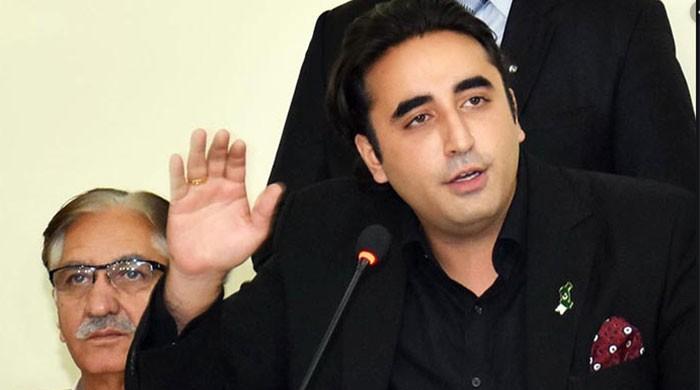
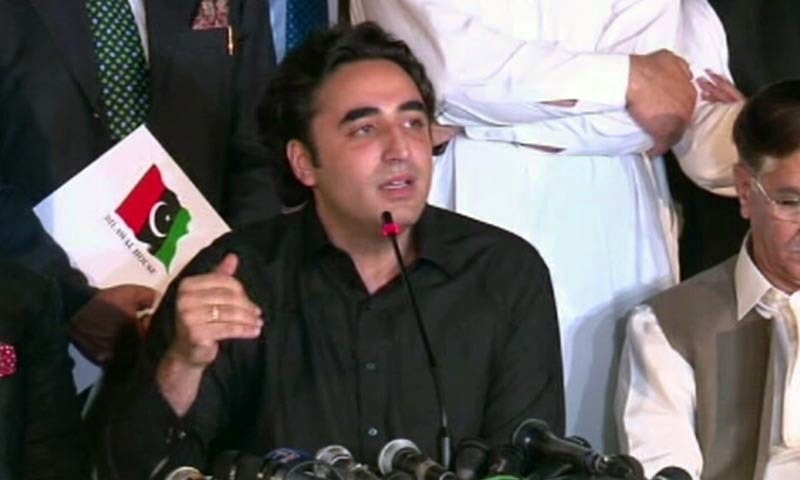
PPP chairman Bilawal Bhutto Zardari on Wednesday accused the government of trying to sabotage unity among political parties over the Kashmir issue and said that PPP MNA Syed Khursheed Shah's arrest today was an attempt to divert attention from its failure over Kashmir.
He was speaking at a press conference following a consultative session held by the party to deliberate the next course of action in the wake of the arrest.
"If you can't lead your own nation, how can you lead a cause outside the country?" asked Bilawal, addressing Prime Minister Imran Khan.
"When in your own country, the death of democracy is being witnessed, how can you save democracy in Kashmir," he continued.
"How can [the premier] raise his voice for political prisoners in Kashmir when he is arresting politicians in his own country?" asked the PPP chairman in a rebuke to the prime minister.
The National Accountability Bureau (NAB) on Wednesday arrested Shah in a case regarding his alleged assets beyond means.
The PPP stalwart was arrested in a joint operation by NAB's Rawalpindi and Sukkur chapters, DawnNewsTV reported. He will remain in NAB Rawalpindi's custody tonight.
Bilawal, during his press conference sought to provide a pattern for the alleged practice by the government in which it makes use of the National Accountability Bureau (NAB) to "hide its own failures".

https://www.dawn.com/news/1505928/govt-arrested-khursheed-shah-to-divert-attention-from-failure-over-kashmir-bilawal-bhutto
"We strongly condemn (Shah's) arrest, and especially right now, because it seems that whenever an opportunity presents itself to send a strong message to our Kashmiri brethren [...] the government uses NAB to break national unity, to aggravate the opposition and to divert the attention of the people."
"When the attack on Kashmir was still fresh (the August 5 presidential decree stripping it of its autonomous status), we could have used the joint parliamentary session platform to send a message of support [...] but the government arrested Maryam Nawaz."
He then spoke of senior PPP leader Faryal Talpur's arrest during Eid in Muzaffarabad where representatives from various parties had gone in a show of solidarity with Kashmiris.
"Another opportunity had presented itself [...] then too, Faryal Talpur was illegally shifted to jail at night from hospital," he added. "And then today again we witnessed how an effort by the Senate was made to do what — in the time of a national crisis — was simply not being done," said Bilawal, referring to a discussion held on Kashmir in the presence of representatives from all political parties.
"So the Senate took a step to discuss Kashmir and then once more, right then, Shah sahib was arrested. All so that attention is diverted from [the government's] historical failure on Kashmir," said Bilawal.