Thursday, September 19, 2019

Pakistan’s verbose foreign minister ruined Kashmir case. Imran Khan at UN now the only hope


One doesn’t expect the UN to deliver justice on the horrifying human rights situation in Kashmir. Still, international opinion matters.

Imran Khan will head to New York next week to argue the case of India-administered Kashmir before world leaders at the annual UN General Assembly. It will be his first interaction with the most powerful international forum that will provide him an opportunity to highlight the plight of a subjugated people.
Most important, however, is how effectively the prime minister conveys the message, even though one doesn’t expect the UN to deliver justice. Nevertheless, international opinion matters. It is true that the recent, unprecedented international media reports have exposed the horrifying human rights situation and use of brute force by the Indian forces in the occupied territory. Yet it requires effective diplomacy to push the international community into action.
Unfortunately, we are miserably lacking in skills that require maturity and clarity of purpose. What we have witnessed so far is sheer verbosity that our foreign minister is so fond of indulging in — mainly for domestic consumption. Commenting on everything and hurling war threats is not a sign of maturity that one expects from the country’s foreign policy czar.
Should the foreign minister be declaring the Indian chief justice’s ruling on relaxing the lockdown in the occupied state as Pakistan’s victory? Such pronouncements make light of an extremely serious problem. He should have been spending more time travelling to other countries to apprise them of the situation in Kashmir, rather than making frivolous statements every five minutes just to stay in the political limelight at home. There have been hardly any outings apart from a visit to Geneva for a UN Human Rights Council session. Surely members of the council did express concern over the appalling human rights situation in occupied Kashmir, but the outcome appears to have been exaggerated.
We were never told, for instance, which 58 countries signed the joint resolution and if there was any public statement issued by the council condemning the Indian action as being inferred by the government. It needed the support of only 16 members to call a special session of the council on Kashmir. That never happened.
Talking of the nuclear war threat is highly irresponsible. We cannot scare the international community into intervening in the matter. The chaotic state the government is in is also reflected in the bombast of some other cabinet ministers.
The most prominent jewel in the crown is our railways minister who appears very keen to start a nuclear war. Instead of taking care of his own department that is in a shambles given the increasing number of train accidents, he is now preoccupied with national security and foreign policy issues.
He recently predicted a nuclear war between Pakistan and India before the end of the year. He has also claimed that Pakistan has tiny nuclear devices that could be used against the enemy forces. Such utterly nonsensical remarks on sensitive issues come in handy for those who look for any opportunity to prove us an irresponsible state. It also greatly harms our cause of fighting Kashmir’s case at international forums.
More importantly, the government must not reduce the Kashmir situation to a Pakistan-India one. The very slogan ‘Kashmir will become Pakistan’ could limit our options. It is also against the UN resolution that had called for plebiscite to allow Kashmiris to decide their own future.
While fighting Kashmir’s case, we must entirely focus on the right of self-determination for Kashmiris and their human rights. The issue should not be made into a dispute that alienates the people of Kashmir. Leave it to the Kashmiri people to decide what they want.
More than anything else, the Indian action of annexing the occupied territory and the use of brute military force to silence eight million people has brought the Kashmir issue onto the international stage. It has alienated the entire Kashmiri population. Even strict censorship and a complete lockdown have failed to stop the flow of news regarding Indian state terrorism in occupied Kashmir.
That has certainly moved the public conscience, but not necessarily helped change the policy of states dictated by their economic and geopolitical considerations. It’s also a fact that over the years, our international clout has diminished largely because of our political and economic instability. An unimaginative foreign policy has also added to our predicament. In fact, it’s a policy adrift. Nothing would please the Indian leadership more than our state of disarray.
The domination of security agencies in determining the policy direction has also been responsible for limiting our options. Even the cell formed by the government to formulate strategy on Kashmir may find a diplomatic and political approach constricted by the presence of members of the security establishment. A bipartisan parliamentary committee would have been more effective in fighting this battle on both the diplomatic and political fronts. Domestic public mobilisation is, indeed, important, but it is active international diplomacy that matters more.
It is a great opportunity for the prime minister to reach out to world leaders during the UN session and fight the case of the Kashmiri people. Imran Khan calls himself the ambassador of the Kashmir cause and that is what he needs to prove in New York. His speech at the General Assembly should be focused and powerful in substance. For the limited time allocated to the speakers one needs to be structured and precise.
The world leaders gathered at the UNGA have little patience for rambling discourses. Given his penchant for speaking extempore (at which the prime minister is not very good) even at international forums, one has doubts about the impact he would make. The prime minister will be speaking after Narendra Modi and one hopes that he doesn’t resort to polemics. Pakistan has a strong case to fight and the UNGA provides a great forum to make Kashmir’s case forcefully.
Imran Khan is also planning to speak at a public rally in New York meant to draw international attention to Indian atrocities in administered Kashmir. But one hopes that he does not bring Pakistan’s internal political matters into his address as he did during his official visit to Washington earlier this year.

Pakistan misses deadline to file resolution on Kashmir in UNHRC

Pakistan's Foreign Affairs Minister Shah Mahmood Qureshi had promised his nation a resolution on Kashmir before leaving for Geneva to attend the session.

Pakistan has missed the deadline to file a resolution on Kashmir at the ongoing United Nations Human Rights Commission. The last day to file a request for a resolution during the 42nd UNHRC session was on September 19. The session which started on September 9 concludes on September 27.
Pakistan did not file the petition as it failed to garner the minimum support of 16 nations for admission of the request. Further adoption of the resolution would have required a minimum of 24 votes.
Pakistan's Foreign Affairs Minister Shah Mahmood Qureshi had promised his nation a resolution on Kashmir before leaving for Geneva to attend the session.
Before leaving for Geneva, the Pakistani minister had claimed that he will use the UNHRC sessions to raise "Indian state-monitored genocide in Jammu and Kashmir".
Shah Mahmood Qureshi had said that he will not only raise the Kashmir issue but will also move a Kashmir "resolution", seeking support for Pakistan's case. However, he failed to deliver.

Gulalai Ismail, Feminist Hunted by Pakistan’s Authorities, Escapes to U.S.

By Jeffrey Gettleman

Her face was everywhere — on the news, at police stations and at the airports where the Pakistani government had put her on a list of the nation’s most wanted.

She has been accused of treason, though human rights defenders said that the allegations were bogus and that she was being targeted for highlighting abuses committed by Pakistan’s military. Security services were searching for her in every corner of the country, raiding her friends’ houses and closing in on her family.
But somehow Gulalai Ismail, a 32-year-old Pakistani women’s rights activist on the run, managed to slip through the dragnet last month and escape to America. She is now staying with her sister in Brooklyn and has applied for political asylum in the United States.
She is still worried about her parents back home and the underground network that secretly protected her as she moved from house to house, city to city, through countless police checkpoints, always wearing a veil over her face, her eyes barely visible.
She did not reveal how she got out, except to say, “I didn’t fly out of any airport.”
“I can’t tell you any more,” she said in an interview this week. “My exit story will put many lives at risk.”
Her ordeal sheds light on the state of human rights in Pakistan, a troubled nation with a history of brutal repression. Ms. Ismail has campaigned aggressively for women’s rights, bringing attention to rapes, disappearances and other abuses that she and many others say have been committed by Pakistan’s security forces against their own people.
The military is all-powerful in Pakistan and the country is approaching an inflection point. Pakistani officials do not like talking about Ms. Ismail — none would comment publicly for this article.
Her account of being chased out of the country does not help the government’s efforts to win diplomatic support at a time when the economy is tanking and Pakistan is begging the world to censure India for its recent moves on Kashmir, a disputed territory claimed by both Pakistan and India.It has taken Ms. Ismail some time to feel safe even in New York, she said, but she has begun to meet with prominent human rights defenders and the staffs of congressional leaders. “I will do everything I can to support Gulalai’s asylum request,” said Senator Charles Schumer, Democrat of New York. “It is clear that her life would be in danger if she were to return to Pakistan.”
Pakistani security officials said they had suspected for some time that Ms. Ismail had slipped through their fingers.
“Our guys have been after her, by all means, but she is not traceable,” said a Pakistani intelligence agent who spoke on the condition of anonymity, citing intelligence protocols. “She has gone to a place beyond our reach.”
How she did that — whether it was crossing overland into Iran or Afghanistan and then onward to Europe or America, or perhaps getting smuggled out by sea — remains a tantalizing mystery. The Pakistani government had barred her from leaving the country and tried to seal all the exits.
Ever since she was 16, Ms. Ismail has been speaking out about human rights abuses, focusing on the plight of Pakistani women and girls who suffer all kinds of horrors including forced marriages and honor killings.
In January, she aired accusations, on Facebook and Twitter, that government soldiers had raped or sexually abused many Pakistani women. She has also joined protests led by an ethnic Pashtun movement that Pakistan’s military has tried to crush. Pakistani officials have accused Ms. Ismail of sedition, inciting treason and defaming state institutions.
In late May, she became a fugitive.
It started with a phone call from a friend to her house in Islamabad, Pakistan’s capital, where she lived with her elderly parents.
“It’s all over the media, a raid team is coming, you have to leave — now!” the friend said.
Ms. Ismail scrambled out the door with no spare clothes or even a phone. “They can trace you, even when it’s off,” she said.
Was she scared?
“It was one of those moments you don’t have time to feel,” she said. “You don’t have time to be frightened, you don’t have time to be brave, you just have to act.”
She spent the next three months moving from place to place, across many different Pakistani cities, never using a phone or touching a computer, she said. She turned to a small, trusted group of friends and their contacts, staying indoors, covering her face for the few moments when she did step outside, incredibly careful each time she changed locations.
Pakistan is a heavily watched place. Roadside security checkpoints are everywhere. Ms. Ismail said she crossed hundreds of them. She recalled one incident when she showed up at the house of a friend of her father’s and when the friend answered the door and saw her standing there, he froze.
“He was so scared that he would be arrested for supporting a terrorist and his children would be arrested,” she said.
The next day the friend called a taxi and Ms. Ismail left.
“Hiding is not pleasant,” she said.
She already had a visa to the United States, where she has visited regularly, meeting prominent women including Michelle Obama. After she arrived in New York in August, she immediately holed up in her family’s house in Brooklyn, where two brothers and two sisters live.
Still, she did not want to go outside. She felt depressed and anxious. She said she didn’t feel any huge gush of relief.
She was worried about her parents, who face charges of financing terrorism and remain under heavy surveillance in Islamabad. She was also worried that a Pakistani agent or someone on the government’s side might see her on a New York street and take a picture of her — or worse.
In recent days, she said, she has been feeling much better. She still spends most of her time inside the family home, cooking mutton achaari and other Pakistani dishes.She is waiting on her asylum application. Lawyers said there was little chance that the United States would send her back to Pakistan.“In Gulalai’s case, I understand that she is charged with anti-state activities, which obviously carry a death penalty,” said Masroor Shah, a lawyer in Islamabad who has dealt with many human rights cases. “There is no likelihood based on past policies and local laws that U.S. authorities would even consider an extradition request.”
Ms. Ismail has started a new research and advocacy group, Voices for Peace and Democracy, to protect women in conflict zones. She is also thinking of law school.
But it makes her sad, a constant shadow on her life ahead, that she might never see her parents again — or Pakistan.
“When I left, I knew this was a one-way trip,” she said. “And as I was leaving, I bent down and touched the soil, and told myself, ‘This is where I belong, this is my country.”’

Wednesday, September 18, 2019

Video Report - Testosterone - new discoveries about the male hormone

Video Report - CrossTalk on Trump & Iran: ‘Locked and loaded’

Video Report - Israeli election results inconclusive - TV7 Israel News 18.09.19

Video Report - Who will be Israel's next prime minister? | Inside Story

Video Report - Has Bibi lost it? Israel vote fails to deliver majority for #Netanyahu

Video Report - Chairman PPP Bilawal Bhutto Zardari media talk | SAMAA TV | 18 Sep 2019

#Pakistani plan for media courts sparks fears for press freedom

Pakistani government plans to launch specialist media courts sparked a furious backlash on Wednesday from media and rights advocates who said the move was an attack on freedom of speech.
Government spokesman Firdous Ashiq Awan said late on Tuesday that cases against the media would be heard by the special tribunals, which would be overseen by higher courts.The All Pakistan Newspapers Society (APNS) said the move was a “black day” for the Pakistani media and that they would fight the measures in the legislature and judiciary.
“Special courts aimed at intimidating and strangulating the media and freedom of expression are not only unconstitutional but also contrary to the spirit of democracy,” Hameed Haroon, APNS president, and Sarmad Ali, APNS secretary general, said in an emailed statement.
Journalists and human rights advocates have feared the introduction of the courts amid complaints of growing pressure on broadcasters and newspapers to avoid covering critics of Prime Minister Imran Khan’s administration.
In July, opposition parties accused Khan of intimidating broadcasters into a blackout on TV coverage of his critics, after several channels were briefly taken off-air and opposition protests and news conferences passed unreported.
Khan, who took office last year, has denied censoring media and has called the accusations a “joke”.
Government spokesman Awan said in a tweet that the existing media oversight body to be replaced by the special courts had been criticized for being under state control, and that the new courts would meet judicial standards and process cases faster. “The whole process will be a true reflection of laws and high democratic values,” she said, adding that journalists could also take complaints about the government to the media courts.
But that did not quell the fears of many freedom of speech advocates, with the non-governmental watchdog Human Rights Commission of Pakistan (HRCP) saying it was alarmed.
“How are tribunals expected to maintain the media’s independence?” it said in a tweet. “Given the government’s woeful record on press freedoms, HRCP urges it to refrain from pressurizing the media further.” Pakistan’s press has had a turbulent relationship with successive governments and the powerful military for many years.
Writers and bloggers say several cases of reporters being abducted and beaten, critical columnists being denied space, advertising business cut to media houses and sackings of TV commentators have created a climate of fear and self-censorship.

https://gandhara.rferl.org/a/pakistani-plan-for-media-courts-marks-black-day-for-press-freedom/30171857.html

Bilawal slams PTI media witch-hunt, 'Niazi regime' censorship

Pakistan People's Party (PPP) Chairperson Bilawal Bhutto Zardari said Wednesday that the ruling Pakistan Tehreek-e-Insaf's (PTI) behaviour towards its opponents and critics was "reminiscent of Salem witch trials".

Bilawal, in a statement issued shortly after the National Accountability Bureau's (NAB) Rawalpindi branch arrested the party's senior leader, Khursheed Shah, from Islamabad, condemned the PTI's attempt to launch a witch-hunt against media too after having entangled the Opposition leaders through the anti-graft watchdog.
The way the PTI dealt with opponents and critics was "based on frivolity and falsehoods, the PTI’s narrative is right out of Goebbels’ propaganda playbook”, he said.
According to the NAB's sources, Shah was arrested in a case pertaining to acquiring assets beyond means of income.
Speaking about the media, the PPP chair said the ruling party was "going to go after its critics in the media through these so-called media tribunals" now that the PTI had "found an easy way to imprison its political opponents by unleashing NAB".
Terming the tribunals as "nothing but another way of silencing dissent", Bilawal said the PTI’s social media team followed the exact same path of Indian Prime Minister Narendra Modi's "bhakts" who, he said, discredited and harassed critics online.
"Now, they want to go after media organisations through these special tribunals because the media is exposing select PM’s ineptitude and incompetence," he added.
“We stand for the freedom of media. Pakistan’s media is going through its worst phase of censorship under the Niazi regime. We will not allow them to target the media so blatantly and brazenly.
"Enough is enough. The media fraternity, too, must raise its voice for their own rights. The Opposition firmly stands behind them,” Bilawal stated.

Profile: Khursheed Ahmed Shah — a politician through and through

Born in 1952, Syed Khursheed Ahmed Shah hails from Sindh’s Sukkur region, which he went on to represent as an MPA and later as MNA. He studied at Sukkur’s Islamia College and obtained the degrees of MA and LLB.
He was elected to the Sindh Assembly in 1988 during which he was made a provincial minister holding a wide range of portfolios – education, import and transport being some of them. He made his way to the parliament in 1990.
Shah also served as a federal minister for education in 1993, during slain PPP leader, Benazir Bhutto's second government. In 2008, he was elected from NA-199 (Sukkur cum Shikarpur-II), PPP and became minister for labour and human resources. He was made the federal minister for religious affairs in 2010.
In 2013, he was elected from NA-199 (Sukkur-cum-Shikarpur-II), PPP and became the leader of the opposition in the National Assembly.
He was elected to the National Assembly once again in 2018, as he won NA-206 (Sukkur-1) and is the opposition's joint nominee for speaker's position.
Shah enjoys an influential position in the PPP and was its chief whip in the 2008-2013 National Assembly. He is considered a trouble-shooter as far as relations with other parties are concerned, mainly on account of his good connections with all political parties.

https://www.dawn.com/news/1426962/profile-khursheed-ahmed-shah-a-politician-through-and-through

#PPP - Govt arrested Khursheed Shah to divert attention from failure over Kashmir: Bilawal Bhutto

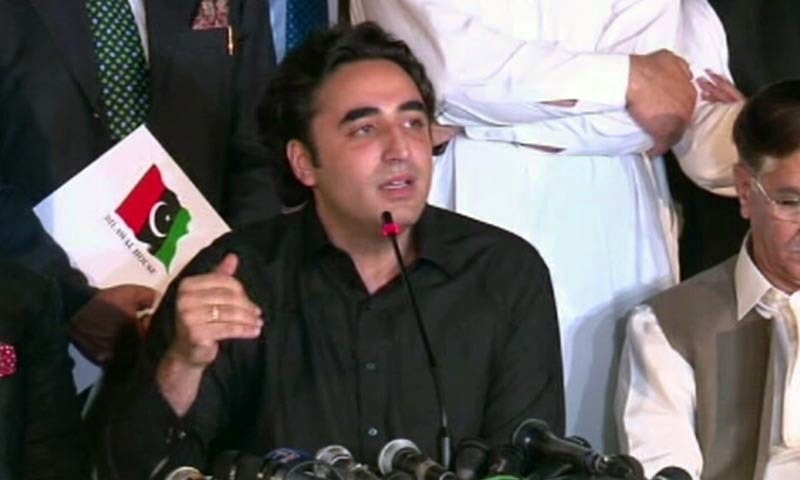
PPP chairman Bilawal Bhutto Zardari on Wednesday accused the government of trying to sabotage unity among political parties over the Kashmir issue and said that PPP MNA Syed Khursheed Shah's arrest today was an attempt to divert attention from its failure over Kashmir.
He was speaking at a press conference following a consultative session held by the party to deliberate the next course of action in the wake of the arrest.
"If you can't lead your own nation, how can you lead a cause outside the country?" asked Bilawal, addressing Prime Minister Imran Khan.
"When in your own country, the death of democracy is being witnessed, how can you save democracy in Kashmir," he continued.
"How can [the premier] raise his voice for political prisoners in Kashmir when he is arresting politicians in his own country?" asked the PPP chairman in a rebuke to the prime minister.
The National Accountability Bureau (NAB) on Wednesday arrested Shah in a case regarding his alleged assets beyond means.
The PPP stalwart was arrested in a joint operation by NAB's Rawalpindi and Sukkur chapters, DawnNewsTV reported. He will remain in NAB Rawalpindi's custody tonight.
Bilawal, during his press conference sought to provide a pattern for the alleged practice by the government in which it makes use of the National Accountability Bureau (NAB) to "hide its own failures".

https://www.dawn.com/news/1505928/govt-arrested-khursheed-shah-to-divert-attention-from-failure-over-kashmir-bilawal-bhutto
"We strongly condemn (Shah's) arrest, and especially right now, because it seems that whenever an opportunity presents itself to send a strong message to our Kashmiri brethren [...] the government uses NAB to break national unity, to aggravate the opposition and to divert the attention of the people."
"When the attack on Kashmir was still fresh (the August 5 presidential decree stripping it of its autonomous status), we could have used the joint parliamentary session platform to send a message of support [...] but the government arrested Maryam Nawaz."
He then spoke of senior PPP leader Faryal Talpur's arrest during Eid in Muzaffarabad where representatives from various parties had gone in a show of solidarity with Kashmiris.
"Another opportunity had presented itself [...] then too, Faryal Talpur was illegally shifted to jail at night from hospital," he added. "And then today again we witnessed how an effort by the Senate was made to do what — in the time of a national crisis — was simply not being done," said Bilawal, referring to a discussion held on Kashmir in the presence of representatives from all political parties.
"So the Senate took a step to discuss Kashmir and then once more, right then, Shah sahib was arrested. All so that attention is diverted from [the government's] historical failure on Kashmir," said Bilawal.

Tuesday, September 17, 2019

Music Video - The B-52's - Love Shack

Video Report - Why is Africa building a 'Great Green Wall' ? | The Stream

Video Report - Saudi attacks: Nato head warns of risks of further escalation, Trump tones down rhetoric

Video Report - #Russia #Centre2019 #drills Centre 2019: Large-scale missile drills take place in Russia

Video Report - Obama Diplomat Says Trump's Lies Undercut U.S. Security

Persian Music - من اگر کسی را داشتم 😔😔

Overcoming Pakistan's period taboo

There is no sex-education in schools and the topic is rarely discussed.
Booni, Pakistan: Bent over her hand-crank sewing machine, Hajra Bibi carefully stitches sanitary pads for the women of her mountainous village in northwestern Pakistan, one of many rural areas in the deeply conservative country where periods are still taboo.
"I am responding to a crisis," said the 35-year-old mother, sitting in front of her small, doily-covered work table in the village of Booni, close to the Afghan border.
"Before, Booni's women had no idea what sanitary towels were," she explained. Less than a fifth of women use sanitary pads in Pakistan, local charities estimate.
Traditionally women have used rags and cloth to soak up their menstrual blood, but the stigma around periods and a lack of reproductive education means hygiene standards are poor and many contracted infections.
As with other areas of rural Pakistan, menstruating women were viewed as unclean and limited in what they were able to do.
Bibi was given training to make the disposable sanitary pads, made of cotton, plastic, and cloth, by the Aga Khan Rural Support Program (AKRSP) - an NGO working with Unicef - in a scheme that aims to change attitudes to women's health.
She took up the work to support her family because her husband is disabled and they have little income. Each pad takes around 20 minutes to make and is sold for 20 rupees (13 US cents).
Initially her work disturbed the local community.

Baulking at the thought

"At first, people were asking me why I was doing this, some were insulting me," Bibi recalled.
But now, "girls in the village can talk about their periods", she said proudly, adding that she was fighting "for the basic needs of women".

Infection and education 

In Pakistan, Unicef has warned that in some cases information about menstruation has deliberately been withheld from women as a "means of protecting their chastity".
"This in turn negatively impacts their physical and emotional health," it said in a 2018 report.
Historically, the women of Booni have used cloth, but according to Bushra Ansari of AKRSP the taboo surrounding periods meant many were ashamed to dry them outside, unaware that damp cloths are a breeding ground for bacteria.
In addition, female family members often shared the same menstrual rags, increasing the risk of contracting urinary and reproductive tract infections, explained Wassaf Sayed Kakakhail, a doctor in the region.
"If there are three girls in the same family, they all use the same pieces of fabric," she said, adding many women are told not to wash during their period.
There is no sex-education in schools and the topic is rarely discussed - even between women - at homes in northern Pakistan, a particularly conservative part of the country.
According to a 2017 Unicef survey, half of young Pakistani women had no knowledge of menstruation before their periods started.
"Teen girls told us that they thought they had cancer, or a very serious illness that made them bleed," said Kakakhail.
But Mohammad Haidar Ulmulk, public health director for Chitral District, where Booni is, insisted the problem was under control.
"There may be gaps, but we try to cover them," he said, adding that the area had hundreds of health workers trying to help young women.

'Sister, mother, wife' 

The situation is different in cities, especially among the richest. But in the patriarchal Muslim country - ranked 148th out of 149 by the World Economic Forum for gender equality - and where sexist stereotypes persist, access to basic feminine hygiene products remains difficult.
In Karachi, a metropolis of twenty million people seen as the most liberal city in Pakistan, sanitary pads are easily accessible, though expensive.
Many women are still made to feel uneasy by leering shopkeepers and ask their husbands to buy them instead.
"Some people buy them late at night, others prefer to buy them in a different neighbourhood," said Sajjad Ali, 32, a store owner.
In shops like this, sanitary pads are wrapped in opaque paper, instead of in transparent bags like other products.
"Periods are treated as taboo and surrounded by mystery," said Seema Shiekh, a women's rights activist.
But she asks: "Doesn't every man have a sister, wife or a mother?"
After twenty years of battling to introduce sex education classes in Pakistan, the first lessons are finally being given in public schools in Sindh province, of which Karachi is the capital.
Among their aims will be to put an end to the fear surrounding periods in a country where the onset of menstruation is one of the main reasons girls drop out of school.
Some 28 percent of women surveyed in 2017 by Unicef indicated that they had missed school or work because of stomach pain or worry over staining their clothes.
Bibi - who is working alongside 80 other women trained to make sanitary pads - is confident things will change in Booni too.
She mused: "With this project, I have made people aware."

Game over for Pakistan’s invisible forces

By IMAD ZAFAR
This is the age of misinformation and propaganda. Their use has always been prevalent on the power chessboard of Pakistan, but now it is at a peak. The reason is that the nerve-racking battle between the mighty establishment and former prime minister Nawaz Sharif has entered the final stage.
No one wants to lose this battle, as Sharif has put everything at risk including the life and future of his daughter Maryam Nawaz, while the military establishment’s 70-year hegemony is under threat, as slowly and gradually Sharif with the help of his political allies is forcing the establishment into a dead-end street.
No one could have thought that only 14 months after sending Sharif to prison the security establishment would start backtracking from the power chessboard.
The Pakistani establishment is not simply powerful in its own right, with the controlled media and hegemony over state resources, but the current engineered discourse has been backed by Riyadh and Washington. Not a single analyst could have predicted that a regime backed by these superpowers could be defeated. However, all that changed when the establishment proved incapable of pre-empting India’s annexation of Kashmir. That proved to be the last nail in the coffin of the current political discourse.According to whistleblowers in the power corridors who do not wish to be named, there is a rift within the security establishment, with many high-ranking officials wanting not only an end to military involvement in political matters but for certain heads to roll. The announcement by Fazal-ur-Rehman, president of the Jamiat Ulema-e-Islam (F) party, of a planned “long march” to Islamabad in October and to hold a sit-in there is not a coincidence by any means. It is believed by many whistleblowers that Fazal has the backing of certain quarters within the establishment who do not want the current dispensation to continue. These people are angry over the Kashmir fiasco and the political engineering that resulted in the current political and economic turmoil in Pakistan.
However, as no one likes to give up power easily, this final round is getting uglier and uglier, with the establishment trying to persuade Sharif not to join Fazal’s long march and instead offering him deals, including new general elections in 2020 with Sharif and his daughter given a clean chit. On the other hand, Shahbaz Sharif, who is currently heading the Pakistan Muslim League-Nawaz in the absence of his older brother Nawaz and Maryam, is being asked to persuade Nawaz to accept the deal. Some compliant journalists and pro-establishment politicians are spreading misinformation about Sharif accepting the deal to get new elections in return for not backing Fazal, and that he and Maryam will leave the country for a while. Since propaganda plays a very crucial role in determining the outcome of political battles, it it probable that the establishment is using this as its last tool to recoup a game it has already lost. However, Senator Mushahid Ullah Khan, a member of PML-N, is of a different view. He told this correspondent that Sharif would never accept any deal, especially now that he has nothing left to lose and the establishment has everything to lose. Perhaps he is right: Sharif has lost his wife and his daughter and political heir Maryam Nawaz is in jail, while his own character has been assassinated. So it is the establishment that has everything to lose. It has no answer as to why the government it sponsored, headed by Pakistan Tehreek-e-Insaf (PTI), is not able to avert the economic turmoil and why there has been no sound response from Pakistan over the issue of Kashmir.
This itself is a victory for Sharif as he has been in prison for 14 months, and yet he and Maryam remain the key subjects of the TV talk shows and newspaper headlines. The inexperienced Prime Minister Imran Khan has also played into the hands of Maryam Nawaz. He not only kept Sharif alive politically by trying to hold him responsible for the PTI government’s failures but he also became unnerved by the huge public gatherings in support of Maryam.
So right now the establishment is fighting to continue its hegemony over state affairs while Sharif only needs to sit and bide his time. Meanwhile Fazal is gearing up for a massive show in Islamabad and the Kashmir issue is putting immense pressure on the establishment.
Only a man with no political acumen can make a deal with a regime that is already sinking under its own weight and errors. The Pakistan Peoples Party is an example in this regard, having succumbed to establishment pressure and betrayed the opposition many times, most recently by announcing that it will not join Fazal’s protest. Perhaps the PPP in return will get a little relief but in the long run, it will remain limited to the Sindh interior as far as electoral politics is concerned. A defiant Sharif was always going to checkmate the establishment, even from behind prison walls. But the establishment perhaps fell prey to its own propaganda and somehow started living in the hallucination that Sharif was history and the invisible forces had won the battle. The journalists who always go with the wind also kept both Khan and the establishment in the illusion of a victory that never was real but only limited to the TV screens and newspapers.
ECP ruling favors Maryam
On Tuesday, the Election Commission of Pakistan (ECP) announced its verdict on a petition for the disqualification of Maryam Nawaz as a vice-president of her party. The petition was dismissed, and she carry on as the de facto head the PML-N. But that is not likely the end of the story: Look for the pro-establishment news channels to propagate very soon that the ECP ruling is evidence that Sharif has accepted a deal.
However, in reality, Sharif is as defiant as he was before, and it seems he will eventually risk everything to win the battle for democratic supremacy in the country. The only thing Sharif needs is patience. Whether he backs Fazal’s protest or not is irrelevant, as if a prisoner is being approached to make a deal with the establishment, this clearly shows who is actually winning the battle. It is just now a matter of Sharif keeping his nerve, while the establishment will need a miracle to get out of this self-created catch-22 position.
Many observers and analysts a year and a half ago believed that the party was over for Sharif, as not only would he be sent packing but his PML-N would also be dismantled and the establishment would prevail, and many analysts endorsed Imran Khan. Perhaps they now will realize that the party was never over for Sharif but in fact the events of a year and a half ago were the beginning of the end – “game over” for the establishment on the power chessboard.
https://www.asiatimes.com/2019/09/opinion/party-was-never-over-however-it-is-game-over-for-the-invisible-forces/

Pakistan faces heat at UNHRC over religious discrimination; blasphemy laws

Islamabad may face major embarrassment at the UNHRC after an NGO submitted a petition at the session against enforced disappearances, with the Pakistan Army singled out as the biggest perpetrator behind these disappearances.

The spotlight at second phase of the ongoing UN Human Rights Council (UNHRC) session (Sept. 9-27) in Geneva is on religious discrimination and acts of enforced disappearances in Pakistan, even as Islamabad is trying hard to rake up the Kashmir issue.

The second phase of the UNHRC session involves participation of non-government organisations, and several NGOs and civil society groups have submitted petitions to the Council on rampant enforced disappearances, misuse of blasphemy laws and discrimination against religious minorities, including Christians, besides the Shia community, ET has learnt.


Islamabad may face major embarrassment at the UNHRC after an NGO submitted a petition at the session against enforced disappearances, with the Pakistan Army singled out as the biggest perpetrator behind these disappearances.
“Despite growing anger in Pakistan over the prevalence of enforced disappearances, criminalized by international charters and conventions such as the International Covenant on Civil and Political Rights and the International Convention for the Protection of All Persons from Enforced Disappearance, the government has yet to acknowledge its responsibility for hundreds of people who have been arbitrarily detained in secret places by the Pakistani army, especially the Baloch minority,” according to  a written statement submitted by Maat for Peace, Development and Human Rights Association.


“The Pakistani army continues to commit enforced disappearances on the basis of identity,” it alleges, adding 44 people in different parts of Pakistan, such as Awaran and Kech, were forcibly detained in June alone.

In April, security forces forcibly took away 59 persons from Awaran, Kech, Gwadar, Lasbela, Panjgur districts of Balochistan, according to the NGO.
Another petition before the UNHRC alleges that between 1987 and 2017, 1,500 people or more were charged with blasphemy, of which 730 were Muslims, 501 were Ahmadis, 205 Christians and 26 were Hindus.

“The blasphemy laws are worded in such manner that enable easy misuse. This accommodates false accusations initiated to settle personal scores, economic competition issues and sectarian differences. The laws are routinely used to target religious minorities for personal or political motives and result in a violation of fundamental rights,” the petition by NGO Jubilee Campaign alleges.


Last week, the wife of a deceased Pakistan Army General who belonged to the Shia community was denied permission to host a religious meet at her Karachi cantonment home.
On August 21, a group of religious minorities submitted a 10-point memorandum to the Pakistani government demanding recognition of their human rights.
The memorandum demands that the minimum marriage age be raised from 16 to 18, the creation of a federal ministry for religious minorities; a 5% quota for scholarships; protection for houses of worship; legislation to prevent discrimination in employment, education and society; designated prayer locations in public places; removal of books promoting hate against religious minorities; and criminal justice reforms  to protect women from the daily violence they face, including abductions, sexual violence and forced conversions.


Hindu medical student found dead under mysterious conditions in Pakistan

Namrita Chandani, a final year student of Bibi Asifa Dental College in Pakistan's Larkana was found dead in her hostel room. Local police said it was too early to say whether she had committed suicide or had been murdered.

In a suspected hate crime, a Hindu medical student was found dead in Pakistan's Larkana city.
Namrita Chandani, a final year student of Bibi Asifa Dental College in Larkana, was found dead in her hostel room on Monday.
Chandani, who belonged to Mirpur Mathelo, a taluka of Ghotki, was found lying on a charpai with a rope tied to her neck while her room was locked from inside.
Local police said it was too early to say whether she had committed suicide or had been murdered.
However, her family has alleged that Chandani was killed because she was a minority.
Speaking to media, her brother alleged that she had been murdered.
He said that while his sister was wearing a dupatta, the marks around her neck resembled that of a cable wire.
"There are marks on other parts of her body too like a person was holding her. We are a minority, please stand up for us," he said.
The body was shifted to the district headquarter hospital for postmortem, but the police awaited her parents to arrive from Karachi for their consent.
Chandani was discovered when her colleagues knocked at her room's door and grew worried when she did not respond for several minutes.
They somehow managed to look inside the room from the crevice in the door.
"She was neither responding to the knocking at the door nor to our shouting," her friend told the police.
The hostel's watchman later broke open the door, only to find the student lying dead.
Larkana DIG Irfan Ali Baloch has given the incident's inquiry to SSP Masood Ahmed Bangash.
The vice-chancellor of the medical college Anila Attaur Rehman said the incident appeared to be one of suicide but the police and the medico-legal report will be able to ascertain the actual cause of death after the postmortem.
In a similar incident, a student of Sindh University, Naila Rind, was found dead from her hostel room on January 1, 2017. Her body was found hanging from the ceiling fan.