Saturday, September 7, 2019

Deft diplomacy and economic realism help India sell its Kashmir and Assam policies


Pakistani Prime Minister Imran Khan last week appealed for global intervention in the country’s dispute with 
India  over Jammu and  
Kashmir.
Khan wrote in a piece for an international newspaper that failure to do so by major powers would open the door to “direct military confrontation” between the South Asian neighbours.
The article drew a muted response from the international community.
The next day
Pakistan
’s foreign minister sought to tone down the rhetoric, calling for talks with India because “war was not an option”.
The sequence of events, ending in Pakistan’s offer of conditional talks, was symbolic of India’s diplomatic upper hand.
On Thursday it will be one month since an
unprecedented shutdown
 began in the conflict-ridden Indian region, after New Delhi decided to strip the state of its autonomy and divide it in two. Communication services remain disconnected, shops and businesses shut. Families struggle to contact each other, while political leaders and activists have been detained.
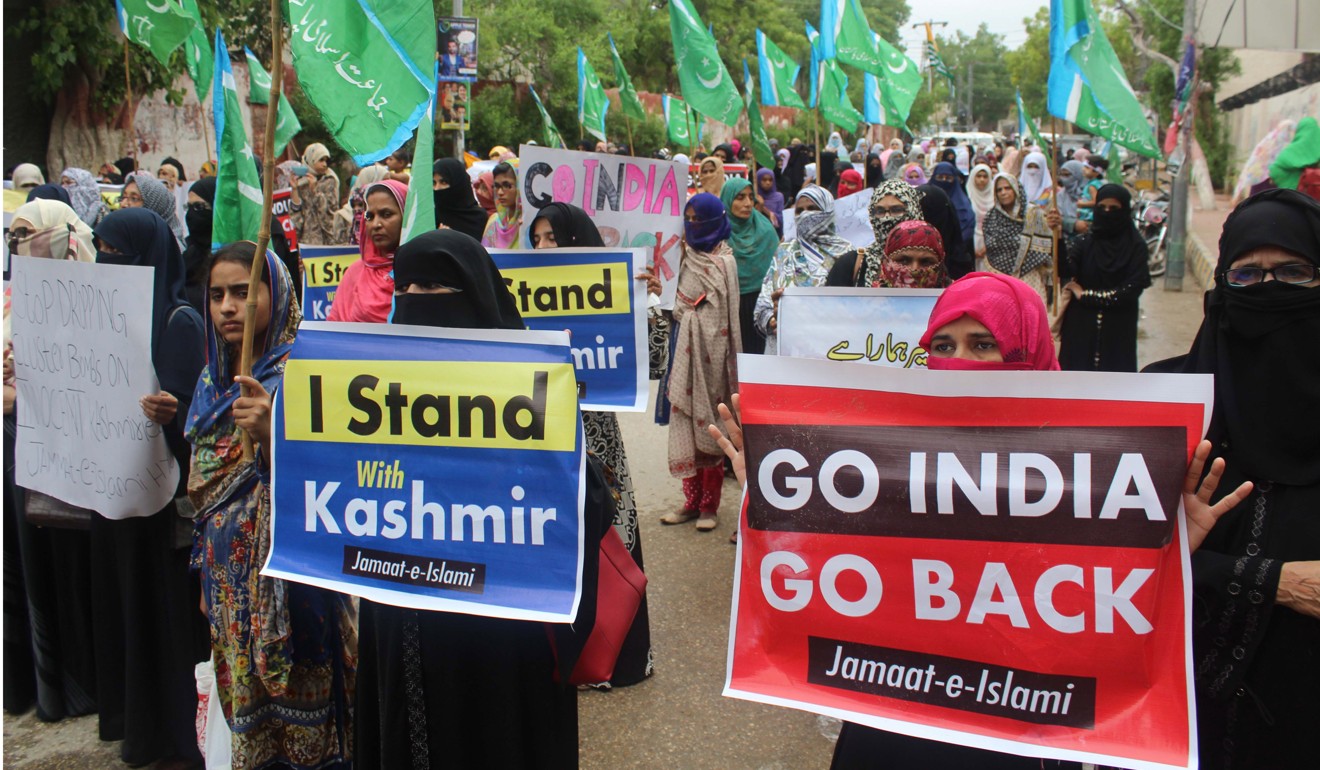
A protest in the Pakistani city of Hyderabad against India’s Kashmir policy. Photo: EPA
Despite Pakistan’s fervent appeals and even threats, India has received widespread diplomatic backing. All major global powers 
except China have refused to intervene
, echoing India’s oft-stated line that the dispute is bilateral and India’s recent move an “internal” affair.
Two of Pakistan’s closest allies, the United Arab Emirates and
Saudi Arabia
, backed India, with the UAE even bestowing its highest civilian award on Indian Prime Minister
Narendra Modi
 less than 20 days after the Kashmir move.
After almost a month of the unprecedented lockdown, which is now turning into a humanitarian crisis, how has India retained popular diplomatic support?
The answer lies in a combination of factors, from hectic diplomacy to fragmented global leadership, and plain market economics.
‘Deft diplomacy’
Chitrapu Uday Bhaskar, director of the Society for Policy Studies, a New Delhi-based think tank focusing on public policy and international relations, said India’s diplomatic efforts had ensured its decision on Kashmir was well received.
“The Modi government has been able to play its cards in a very deft manner,” he said. “However, such support is almost always transactional. They [foreign countries] expect a quid pro quo at some point in the future.”
US President Donald Trump has echoed Modi’s line that the situation in Kashmir is “under control”.
The support India has received might not be entirely organic. News reports have suggested the Modi government repeatedly shared their plans to strip Kashmir of its special status with the White House, the first indicator given as early as February.
What also helped India’s case, many believe, was Pakistan’s response.
“Pakistan displayed an overreaction, and its demand that the status quo be restored in Kashmir was an unfeasible one,” said Anil Wadhwa, former Indian ambassador to Italy and a retired secretary in the Ministry of External Affairs. “There was no chance India would roll back its decision, and hence, most countries refused to interfere.”
Money talks
Others believe a major factor driving the international community’s response was trade access to India and the opportunities it offers foreign businesses, especially in times of tariff wars and volatile global markets.
France is pushing India to buy 36 French-made Dassault Rafale fighter planes in addition to 36 jets New Delhi is manufacturing itself. For the UAE, data shows India to be its third-largest trading partner. The United States meanwhile has been pushing Delhi to allow American firms smoother access to Indian markets.
Sameer Patil, a fellow at Gateway House Indian Council on Global Relations who studies international security, said India might have taken its cue from China’s playbook.
“The size of the Indian market is a big reason behind the smooth diplomatic reception to India’s decisions on Kashmir,” Patil said. “India seems to be learning from China in the way that China uses access to its market as a lever in its foreign policy.”
Patil pointed to examples of countries with chequered records on human rights continuing to do business with every major global power.
Another factor which helped tilt the balance in India’s favour was that Pakistan’s economy is infinitely smaller than India’s, Patil added. World Bank data shows Pakistan’s economy to be worth US$313 billion – a fraction of the US$2.72 trillion of its neighbour. Pakistan’s fiscal deficit is fast rising, standing at a staggering 8.9 per cent of gross domestic product – its highest in nearly three decades.
Treading carefully
But despite the celebratory air in India around its diplomatic success, analysts believe the response could change rapidly if the emerging humanitarian crisis in Kashmir is not handled well. A greater challenge may lie ahead of India – one of ensuring unrest does not spiral out of control.
“The internal situation in Kashmir has to be handled carefully, because the international community’s response will be tailored according to that. India will have to avoid any undue use of force,” Wadhwa said.
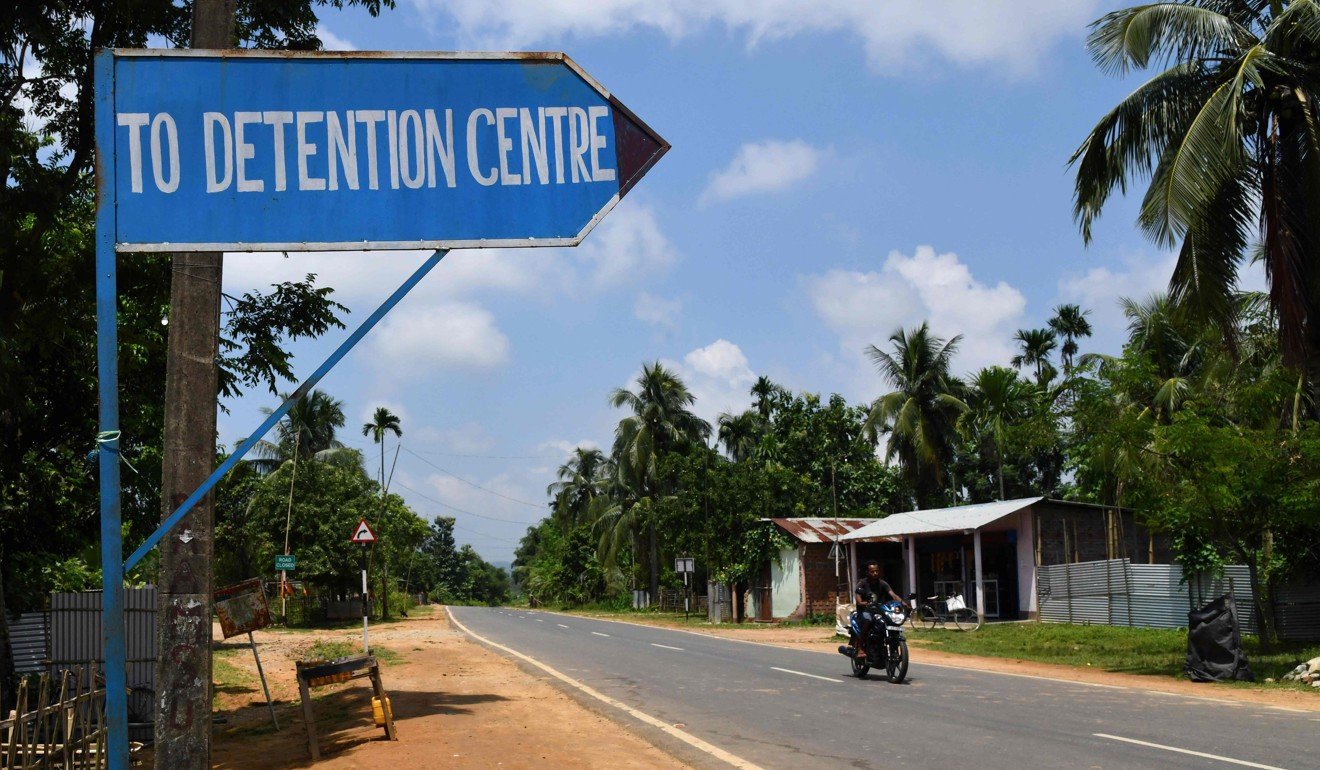
A sign points the way to a new detention centre built for people not included on the citizens register in Assam. Photo: AFP
Similar diplomatic efforts might be needed by India when it comes to its implementation of the National Register of Citizens in the northeastern state of Assam, which has left 1.9 million people on the verge of statelessness. Leaders in Modi’s Bharatiya Janata Party, including home affairs minister Amit Shah, have called for the deportation of people they call illegal immigrants, saying they have Muslim roots in neighbouring Bangladesh.
On Saturday Pakistani prime minister Khan called the national register an exercise in “ethnic cleansing” targeting Muslims, and said it should send “alarm bells ringing across the world”.
Bhaskar at the Society for Policy Studies said the course New Delhi had charted on Kashmir had created a crisis of perception.
“Many well-wishers in the international community – from academics to journalists as well as those in diplomatic circuits – have been disappointed with India’s steps,” he said. “India must realise that not everything is about image building – there is a substantive reality, and in relation to democratic integrity, India is diminished in its own eyes.”

Opinion: Israel Would Welcome Ties With Pakistan. Should India Worry?


The recurrent debate about Israel in Pakistan reflects the former’s improved international standing. The Muslim giant could become the next success in Israel’s growing acceptance around the world.
According to an op-ed in Haaretz this week, Pakistani Prime Minister Imran Khan and his military supporters are allowing a highly-censored media unprecedented freedom to discuss the possibility of establishing diplomatic relations with Israel. Such a public debate is not new. The highest-ranking Pakistani politician who advocated open diplomatic ties with Israel was the military dictator Gen. Pervez Musharraf in 2003. Over the past two decades he has urged his country to initiate such a diplomatic move. Nowadays, it seems the once-taboo subject of reassessing the position on the Jewish state is more than ever part of mainstream discourse.
Behind the scenes, Israel and Pakistan have interacted occasionally. Yet the only public meeting between officials of the two states, the famous handshake between Foreign Minister Silvan Shalom and his Pakistani counterpart Khursheed Kasuri in Turkey on September 1, 2005, did not produce a thaw in the official traditional hostile posture against Israel. This hostility is well rooted in the prevailing Muslim culture in Pakistan. Moreover, the Islamist circles in that country carry considerable political weight and vocally oppose a change in Pakistan’s foreign policy toward Israel.
Nevertheless, the recurrent debates in Pakistan over Israel reflect the latter’s improved international standing. The Pakistanis cannot ignore the shift in attitudes of the Sunni elites in the Arab world toward Israel. When in 1991 the United States convened the Madrid peace conference, all Arab states accepted the invitation and agreed to sit with the Israeli delegation, signaling a greater acceptance of Israel in a U.S.-dominated world. Egypt and Jordan signed peace treaties with Israel. The 1993 Oslo Accords between Israel and the PLO reinforced this trend of political realism.
Furthermore, it seems that Pakistani national interests dictate better relations with Jerusalem. Israel’s new relationship with India was gradually transformed into what Prime Minister Narendra Modi termed “a strategic partnership.” Israeli technology and arms well served the Indian military effort in the 1999 Kargil War against Pakistan. Moreover, the closer Indian-Israeli cooperation after the 2008 Mumbai terrorist attacks enhanced Delhi’s capacity to deal with Pakistan-induced terror. It can be argued that better relations with Israel might balance the intensified Indian-Israeli military ties.
Israel is also correctly seen as carrying some weight in Washington. U.S.-Pakistani relations are occasionally quite tense. In his new book “Call Sign Chaos: Learning to Lead,” former defense secretary and head of U.S. Central Command Jim Mattis writes: “Of all the countries I’ve known, I consider Pakistan to be the most dangerous.” The transfer of nuclear technology, the provision of a haven to Islamist radicals, the siding with China and the prospect of a nuclear arsenal falling into the hands of Islamic terrorists are not endearing this country to America. Israel can be seen as a useful tool in mitigating in Washington some of the consequences of Pakistani misbehavior. Iran is also a point of convergence. Pakistan fears less Iran, its neighbor to the west, than Israel. Yet it’s hard to imagine that Islamabad is indifferent to the possibility of having also on its western border a nuclear armed-neighbor. In addition, both countries play games with the Baluchi minorities beyond their borders and compete over influence in Afghanistan. Therefore, the Israeli campaign against Iran, which weakens an adversary, is not adverse to Pakistani interests.
Israel, a state in quest of international legitimacy for many years, has always welcomed Pakistani overtures. Pakistan is a large Muslim state, and better relations with Islamabad could be useful in further diluting the religious dimension of Israel’s regional conflict. Israel desires a normalization in relations with all capitals of the world. Furthermore, the Pakistani-Saudi special relations could be leveraged to let both states overcome their inhibitions on relations with the Jewish state.
If the Pakistani leadership is seriously considering a new approach toward Israel, it will find a responsive partner in Jerusalem. Israel has much to offer. Islamabad should know, however, that the relationship with India is extremely important and Israel will remain very sensitive to Indian concerns. India is a more important state than Pakistan.
Furthermore, Israel is unlikely to spend political capital in Washington on issues of secondary importance to its interests. At this stage, Israel has secured international legitimacy, and the expected quid pro quo for having diplomatic relations with a Muslim state, important as it may be, is commensurate with Israel’s new international status.

Friday, September 6, 2019

Music Video - #NickiMinaj - Nicki Minaj - MEGATRON

Video - Full Extended Interview: Joe Biden Talks To Stephen Colbert

Video - Trump's Hurricane Tweets Not Overburdened With Accuracy - Stephen Colbert

Video Report - Internet mocks Trump's doctored weather map

Comedy - Donald Trump’s Disastrous Hurricane Dorian Response | The Daily Show

Music Video - Ta Loy Kor de Pukhtano Ye Zema Gran afghanistan

#Pakistan - Exiting #Afghanistan


Zahid Hussain
IT may not be a Saigon moment for the American forces, yet an imminent deal with the Taliban clearing the way for gradual withdrawal of all foreign troops from Afghanistan is no less ignominious for Washington. It may not be a document of surrender, but neither is it a declaration of victory for the most powerful military power on earth.
After fighting for nearly 18 years, the Americans seem desperate to end an unwinnable war in a region often described as the “graveyard of empires”. Even if the United States believes it has not lost the war, it has not won it either. But will the accord between the US and the Taliban bring peace to a country devastated and fragmented by four decades of conflict?
In what could be termed a remarkable twist of irony, US officials sat for more than one year across the table to negotiate peace with the very insurgent leaders who the US had once declared terrorists and sought to annihilate. The presence in the negotiations of Mullah Baradar, the Taliban’s second in command who was incarcerated for nine years by the Pakistani government at the behest of the US, made the agreement possible. Among the Taliban’s negotiating team were also four former inmates of Guantanamo. The travel ban on them has just been lifted.Unsurprisingly, the Taliban see the agreement on withdrawal of foreign forces, which has been its main demand, as a victory. Although still to be approved by the Kabul government, the agreement would see 5,000 US troops leave the country within five months. The time frame for the withdrawal of the remainder of foreign troops would depend on security guarantees by the Taliban, including a pledge that the country will not become a safe haven for terror groups. According to one report, the troop withdrawal could be completed in 16 months, provided the Taliban stick to their promise.
It is still unclear what kind of political setup the Taliban would be willing to work within.
Kabul’s consent to the agreement could open a path for direct negotiations between the Taliban and Afghan officials over the country’s political future. But that would be the most difficult part of the Afghan peace process. The Ghani government was completely sidelined while the Americans directly negotiated with the Taliban. There is no word from the Taliban leadership as yet that they would be willing to talk to the Kabul government now about the future political setup.
For many Afghans the prospect of the return of Taliban rule, however exaggerated the fear may be, is disconcerting. To alleviate the concerns, chief US negotiator Zalmay Khalilzad has assured the Afghan leaders, that as part of the agreement, the US would reserve the right to assist Afghan forces should they be attacked by the Taliban.
Intriguingly, the Taliban have yet to define their political agenda, adding to a sense of confusion. There has been some indication that the conservative Islamist movement would be willing to work within a pluralistic political system. Yet there is no clarity whether the group would take part in the elections.In their interaction with various Afghan factions and delegations, the Taliban leaders have held out assurances that they recognise women’s rights and would not oppose female education, but that has not helped remove the concerns about the Taliban returning to their old ways after the withdrawal of foreign forces.Surely the Taliban political leadership appears more moderate and flexible in their views. But it is not clear whether the commanders leading the fighting would also be amenable to change. There is also the question about the modalities of the Taliban’s participation in Afghanistan’s future political power structure.It will also be important to see the Taliban’s position on the coming presidential election later this month. The campaign has remained lukewarm, as most candidates believe the polls could be delayed because of peace negotiations. It seems improbable that the Taliban would participate in the election even after an agreement.
The situation has become more complex with the Taliban having extended their control and influence over a large part of the country. Moreover, they have never ceased fighting while negotiating with the Americans.
Hours after Mr Khalilzad briefed the Afghan government on the agreement, the Taliban carried out a devastating suicide bomb attack in a high-security zone that is home to several international organisations in Kabul, killing more than a dozen people.
Meanwhile, the advance of the Taliban forces in various Afghan provinces has also intensified. The insurgents have launched assaults on two northern Afghan cities in two days, which seemed a clear attempt to increase their leverage at the negotiating table. More alarming is the escalation in terrorist attacks by the militant Islamic State group whereby it is sending a clear message that it could play the spoiler in any peace agreement. Last month the terrorist group that has a significant presence in parts of Afghanistan carried out a suicide bomb attack on a wedding celebration in Kabul, killing more than 60 people.
It was among the most horrific attacks in Afghanistan claimed by the group since it first established a foothold in the eastern part of the country. American officials are hopeful that the level of violence could be brought down after the agreement is concluded.The withdrawal of American forces from Afghanistan will also have a huge impact on regional geopolitics. The country’s strategic location has historically made it vulnerable to the involvement of outside powers and proxy battles.There is still a long way to go before peace can return to the war-torn country. Decades of conflict that have exacted a severe toll on the lives of millions of Afghans and wrought destruction cannot be ended easily even if the two sides reach an agreement. Complete withdrawal of foreign troops may have its own complications. The long war has left the country more divided. With their battlefield victories and expanding territorial control, the insurgents have certainly gained the upper hand as the Afghan endgame draws nearer.

Pakistan: JuD Another Eyewash – Analysis

By Sanchita Bhattacharya
On August 27, 2019, the Lahore High Court reportedly issued notices to the parties concerned on a petition seeking to quash the First Information Reports (FIRs) against Jamaat-ud-Dawah (JuD) ‘chief’ and Lashkar-e-Taiba (LeT) founder Hafiz Muhammad Saeed and 65 others. The Court sought replies in the matter from the Federal Government, Punjab Government and the regional headquarters of the Counter-Terrorism Department (CTD) within two weeks.
Significantly, Malik Zafar Iqbal, Secretary, Al-Infal Trust (a subsidiary of JuD), contended in his petition that there were 23 FIRs registered at different Police Stations against Hafiz Saeed and others, under false charges. He claimed that the impugned FIRs described the petitioner as the head of LeT, which, Iqbal asserted, was both factually and legally incorrect. The petition sought the quashing of all the FIRs.
On July 3, 2019, CTD had registered 23 FIRs against JuD leaders, including Saeed, on charges of terror financing, in different cities of the Punjab Province, specifically, Lahore, Gujranwala and Multan. The FIRs contained allegations of collection of funds for terrorism financing through assets/properties made and held in the names of Trusts/Non-Profit Organisations (NPO) including Al-Anfaal Trust, Dawatul Irshad Trust, and Muaz Bin Jabal Education Trust.
Saeed was arrested on July 17, 2019, by the Counter-Terrorism Police in Gujranwala, Punjab, under charges of terror financing. On August 7, 2019, the CTD of Punjab Police declared Saeed “guilty of terror financing” in the Anti-Terrorism Court (ATC) in the Gujranwala District of the Punjab Province. Presently, Saeed is being kept at Lahore’s Kot Lakhpat prison amid high security.  May 15, 2019, reports indicate that the Pakistani Government had also arrested JuD’s ‘second-in-command’ or ‘Naib Emir’, Abdul Rehman Makki, Saeed’s brother-in-law, on charges of making an extremist public speech and terror financing.
Nevertheless, given Pakistan’s past record, Saeed is likely to be freed soon.
According to various media reports, Saeed has, so far, been ‘arrested’ nine times (including the latest occasion) and released thereafter. He was last arrested on January 30, 2017. However, predictably, the Judicial Review Board of Pakistan’s Punjab province ordered his release on November 22, 2017, on the grounds that “the government was not able to present any evidence to justify [Saeed’s] continued detention.” There is little reason to believe that the Government will abruptly present any decisive evidence to the courts this time around.
Meanwhile, JuD was banned on March 7, 2019, along with seven of its affiliated groups. The organisations which were proscribed included Al-Anfaal Trust, Idara Khidmat-e-Khalaq, Al-Dawat ul Irshad, Mosques & Welfare Trust, Al-Medina Foundation, Muaz Bin Jabal Education Trust and Al-Hamad Trust. All these groups are Lahore-based. Apart from these, the Lahore-based Al-Fazal Foundation/Trust and Al-Easar Foundation were also banned for having links with the Falah-i-Insaliyat Foundation (FIF), another JuD front. The FIF, like JuD, had also been banned in March 2019 by the Pakistan Government.
The Government also ‘took control’ of JuD and FIF properties, including seminaries and mosques across the country. According to the Punjab Police, as reported on March 7, 2019, the Government seized control of 160 seminaries, 32 schools, two colleges, four hospitals, 178 ambulances and 153 dispensaries associated with JuD and FIF in Punjab. The Punjab Home Department later disclosed that the seized properties, spread across 36 Districts of the Province, were ‘taken over’ by the respective district administrations. The district administrators took control of the management and operational conduct of the properties. There was, however, no report of any change of staff in the establishments and they continued to be run by the same people who were running them previously, indicating that the takeover was a sham. Indeed, it was further clarified that the administrators’ role would only be that of a ‘supervisor’.
Significantly, Saeed was asked to keep a low profile at his Jauhar Town residence in Lahore and was barred from entering the JuD headquarters in the Markaz-e-Taiba complex in Muridke and Jamia Al Qadsia in Lahore.
The ban and the subsequent action, however, had no major impact on JuD’s functioning. Notably, soon after the ban, JuD joined hands with other groups to carry out terrorist activities on its behalf. According to an August 12, 2019, report, intelligence inputs suggested that JuD was using fringe groups for terror financing and money laundering. JuD has also been misleading the United States and global anti-terror watchdogs by using Jihadi ‘tanzeems’ (organisations) who are not on the banned list to carry out its terror-related operations.
This is not the first time that the JuD has collaborated with other groups. In the year 2011, more than 40 Islamist and right-wing parties and groups in Pakistan joined together to establish the Difa-e-Pakistan Council (DPC) or the Defense of Pakistan Council, led by the JuD, including the Ahl-e-Sunnat Wal Jamaat (ASWJ), the new name of the sectarian terror outfit Sipah-e-Sahaba Pakistan (SSP). The presence of JuD and the ASWJ in the DPC, where most of the other parties and groups were those who openly participated in national politics, was worrisome as it signified the radicalisation of Pakistani Civil Society. Indeed, the DPC openly held several anti-Shia, anti-Barelvi, anti-Ahmadi, anti-Christian public rallies in various cities of Pakistan, including, Karachi, Lahore, Rawalpindi and Multan, to promote Islamist extremism. In one such incident, as reported in February 2012, the DPC vehemently campaigned against a mosque in Rawalpindi run by the Ahmadiyya community.
Overtly, JuD acts as a socio-religious, cultural, spiritual and educational force, but underpins its armed wing, LeT. JuD’s funding sources include charities, state sponsorship, and businesses. Funds are transferred from various sources through banks, use of hawala (illegal money transactions) and by couriers. Funds are used for dawa (preaching), khidmat-e-khalq (provision of social services), and jihad, including recruitment, training, and procurement of equipment and weapons. JuD has also used social media to collect funds. According to officials, JuD’s network includes 300 seminaries and schools, hospitals, a publishing house and an ambulance service. JuD and FIF have about 50,000 volunteers and hundreds of paid workers.
Actions against externally directed terror formations in Pakistan, including the JuD led by Saeed, have long been a mere eye wash, intended to safeguard Pakistan from punitive action by international agencies and the West. In the immediate context, the Financial Action Task Force (FATF), during its meeting on June 16-21, 2019, retained Pakistan, as expected, on its ‘grey list’, along with seven other countries. A FATF spokesman categorically stated, “The FATF has decided to continue to keep Pakistan on its compliance document (i.e. Grey List) for the ICRG [International Co-operation Review Group] monitoring…” Pakistan has been on the FATF grey list for the second time since June 2018. Pakistan was first put on the grey list in 2012 and remained there for three years.
More recently, on August 23, 2019, FATF’s Asia-Pacific Group (APG) placed Pakistan on its Blacklist for its failure in meeting required global standards and its failure to combat terrorism and money laundering. Pakistan was put in the Enhanced Blacklist because the country was non-compliant in 32 of the 40 compliance associated elements of the FATF and ranked low in 10 of the 11 Effectiveness Parameters. FATF’s 40 recommendations are related to money laundering, terrorist financing, targeted financial sanctions related to terrorism & terrorist financing, financial intelligence units, etc.
Pakistan is now under pressure to avoid its entry into the FATF Blacklist in October 2019, when FATF will hold its Plenary meeting in Paris to decide on Pakistan’s status. This final FATF meeting is crucial, as it would be decided either to exclude Pakistan from the grey list, keep it there, or put the country into the blacklist.
If Pakistan lands on the list, which indicates that the country concerned is “non-cooperative” in the global fight against money laundering and terrorist financing, the FATF members could, as an ultimate recourse, even agree to restrict, target or prohibit financial transactions with Islamabad. This would not only negatively impact foreign investor sentiment but also lead to a downgrading of the country by multilateral lenders like the International Monetary Fund (IMF), World Bank, Asian Development Bank (ADB) and the European Union (EU). This would have grave consequences for Pakistan’s financial sector and its economy, which are already reeling under severe stress, with foreign investment dwindling, and funding avenues to keep the country afloat drying up. Pakistan is expected to grow at less than 3 per cent in both 2019 and 2020, according to the IMF. As of March 2019, the country’s outstanding debt was more than USD 85 billion. It has taken loans from a very large number of countries, the largest creditor being China.
In his recent visit to the US, in the month of July, Pakistan’s Prime Minister, Imran Khan admitted that about 30,000 to 40,000 “armed people”, who fought in Afghanistan or Kashmir, were in Pakistan. He also stated, “There were 40 different militant groups operating within Pakistan…” Reiterating Pakistan’s ‘commitment’ to fight terrorism, he said, “There was a watershed in Pakistani politics. In 2014, the Pakistani Taliban slaughtered 150 school children at Army Public School (in Peshawar). All the political parties signed the National Action Plan and we all decided after that, that we will not allow any militant groups to operate inside Pakistan.”
Khan’s formulation “we will not allow any militant groups to operate inside Pakistan”, is crucial. Islamabad has no doubt gone after domestic terror formations operating within the country, but has studiously protected groups operating from Pakistani soil and targeting other countries, particularly Afghanistan and India. Terrorist formations such as the JuD-LeT complex and its affiliates, Jaish-e-Muhammad, the various groupings operating under the United Jihad Council, and of course, the Taliban and Haqqani Network, continue to flourish in Pakistan, under state protection and patronage. Despite Pakistan mounting internal difficulties and looming economic catastrophe that would follow a FATF blacklisting, Islamabad remains a minimal satisfier, going through the formal motions of some elements of compliance, even as its favoured terrorist formations continue to operate with impunity.

Premier of Pakistan Imran Khan telling lies about situation of minorities in Pakistan. Part1; By Nazir S Bhatti


After revoking Article 370 by India of Kashmir, Pakistan is put on fire by Imran Khan and Pakistan Army with statements of violation of minority rights in India and praising what Pakistan provides to minorities in Pakistan. We need to analysis situation of minorities in Islamic Republic of Pakistan?

Firstly, Pakistani lawmakers targeted minorities by adopting 11th Amendment in constitution of Islamic Republic of Pakistan of 1937, when Christians, Hindus, Sikhs, Ahmadi and other religious communities in Pakistan we declared Non-Muslim; It was first step to scratch religious identities of Christians, Hindus, Sikhs, Ahmadis and others that there must be two categories of humans to be known as Muslims and Non-Muslims. This was sure to decrease share of resources of state amongst its citizens.

Secondly, This amendment in constitution bared representation of religious minorities in parliament and Muslim majority law makers were provided with a chance to nominate minority members in parliament of their choice after receiving big amount of bribes which were called party donations after revoking Separate Election System which enabled Christians to vote a Christian representative in Parliament, Hindu voters to Hindu candidates on reserved seats of parliament for minorities.

The Minority Community felt unsafe after 4th Amendment in Constitution when Ahmadi Muslims were declared Non-Muslims and other religious communities after decades met with same fate to face challenges of under title of Non-Muslims.

Lets, discuss what were issues of religious minorities after formation of Islamic Republic of Pakistan in 1973, when constitution was declared Constitution of Islamic Republic of Pakistan? Why the Muslim majority felt need to adopt a constitution of Islamic Republic of Pakistan?  

http://www.pakistanchristianpost.com/editorial-details/140

Pakistan Sikh girl not yet reunited with her family

A video of the girl's family had gone viral on social media in which one of her family members had alleged that a group of men attacked their house and she was abducted and forcibly converted to Islam.

The alleged abduction and conversion of a Sikh girl and her marriage to a Muslim man in Pakistan has taken a new twist with a top official of the Sikh community organisation clarifying on Friday that she is yet to be reunited with her family.
The Secretary General of Pakistan Sikh Gurdwara Parbhandhik Committee's (PSGPC) Ameer Singh told PTI that Jagjit Kaur is in Lahore's Darul Amaan (shelter home) and she has not been sent back to her parents' home as yet.
"We don't know who posted this tweet and who is running it," he said, referring to a post on the PSGPC 's official Twitter handle that Kaur has returned home .
"I am the Secretary General of the PSGPC and we have not issued any such statement on Twitter," Singh said.
Kaur was allegedly abducted by Mohammad Hasaan of her locality in Nankana Sahib, some 80kms from Lahore, last week and married her.
A video of the girl's family had gone viral on social media in which one of her family members had alleged that a group of men attacked their house and she was abducted and forcibly converted to Islam, triggering concerns in Pakistan as well as in India.
India said it has raised with Pakistan the issue of her abduction and forced conversion to Islam and sought for "immediate remedial action".
In response to a media query regarding the incident last week, the ministry has received a number of representations from various quarters of civil society in India, including Sikh religious bodies regarding the case.
"We have shared these concerns with the government of Pakistan and asked for immediate remedial action," Ministry of External Affairs Spokesperson Raveesh Kumar said in New Delhi.
Meanwhile, there are reports that Hasaan has divorced Kaur, thus paving the way for her return to her home.
But a source in the Governor's House told PTI that as Hassan's family was under extreme pressure from police and the government officials he divorced Kaur so that she could be sent back to her parents.
"Police had taken 10 or so relatives and friends into custody to put pressure on Hassan to divorce her... and finally Hassan gave into pressure," the source said.
Nadeem Sarwar, a counsel for Hassan, told PTI that there has been "extreme pressure" on his client to divorce Kaur but he is still resisting.
"Kaur on the other hand has not yet filed an application in the court to express her wish to go back to her parents' house," Sarwar said.
Punjab Governor Chaudhry Sarwar who has engaged both families claimed that the matter has been resolved amicably. The government is facing strong reaction from the Sikh community that is not ready to accept this marriage.
"Ahead of opening of Kartarpur corridor in connection with 550 birth anniversary of Baba Guru Nanak, the Pakistani government cannot afford annoyance of local Sikhs over this issue that created tension among the Sikhs and Muslims in Nankana Sahib," the official said.
On Monday, police did not present Kaur before a special judicial magistrate citing security reasons. On this, the magistrate adjourned the proceedings and directed the police to produce her after September 10.
According to sources, there were intelligence reports that the girl might be hurt during the court appearance by her relatives.
The Lahore High Court on Monday granted protective bail to the suspect, Hassaan till September 7 with direction to approach the relevant court in district Nankana Sahib for the relief of pre-arrest bail.
Hassan's counsel told the Lahore High Court that the FIR against him and others was lodged by the girl's family under pressure as she contracted marriage with him (Hassan) with her own free will.
"Kaur embraced Islam without any coercion and was given Muslim name Ayesha before nikhah (marriage) of the couple was solemnized. She has already recorded her statement before a judicial magistrate concerned denying the charges of abduction and forced conversion to Islam," he said.
An FIR was filed with the Nankana Police Station on Thursday last against six people for abducting and forcibly converting Kaur, daughter of a Sikh (Granthi) priest to Islam. The police arrested Arsalan, a friend of Hassan.
Earlier, Governor Sarwar met with Kaur at the shelter home and tried to persuade her to return her parents’ home but she declined. She told the governor that she loved Hassan and married him with her own free will. She said she feared for her life if she returned to her parents’ home.

Thursday, September 5, 2019

Video Music - Malika Pukhraj Aur Tahira Syed - Abhi To Main Jawan Hoon

Ghazal - Ek Bar Muskra Do - Munni Begum

Music Video - WO ISHQ JO HUM SE ROOTH GEYA - FARIDA KHANAM

Urdu Music - Iqbal Bano - Daagh-e-dil humko yaad aane lage

Music Video - Hamari Sanson Mein Aaj Tak Woh -1977 Mere Hazoor.

#Pakistan - Defence of geography, ideology interlinked: #PPP Chairman Bilawal Bhutto for following constitutional framework to ensure invincible defence of Pakistan


Chairman Pakistan Peoples Party has stated that defence of our geography and defence of our ideology are interlinked urging that all the national institutions should work within their constitutional framework to ensure an invincible defence of Pakistan.

In his message on Defence Day, the PPP Chairman said this was the day to remember the sacrifices of our martyrs, both civilians and soldiers and reinforce our commitment to defend our geography, ideology, democracy and human rights without any compromise.


Bilawal Bhutto Zardari saluted Prime Minister Shaheed Zulfikar Ali Bhutto for laying foundation of a firm nuclear programme, which today stands tall as a monumental defence against powerful adversaries. Prime Minister Shaheed Mohtarma Benazir Bhutto gifted ballistic missile programme, currently the core delivery system.


He paid glowing tributes to the martyrs of nation from the armed forces and expressed solidarity with their families, who sacrificed their near and dear ones in the defence of Pakistan.
Bilawal Bhutto Zardari pointed out that people of held Kashmir are undergoing worst kinds of human rights violations and let us not forget them as defending them is also our duty as a nation.

https://mediacellppp.wordpress.com/

The Afghanistan War Is Over, and Pakistan Has Won


By Michael Rubin
The open secret—even among those towing Trump’s line—is that the Taliban deal will bring an American exit but not peace.
The U.S. war in Afghanistan is winding down, and Pakistan has won. The basic outline of the agreement negotiated by U.S. Special Envoy Zalmay Khalilzad is nothing new: The United States withdraws its forces in exchange for a Taliban pledge not to associate with terrorism or allow Afghanistan to be used as a safe-haven for terror groups.There problems with the agreement are many. Proponents of diplomacy with the Taliban often say that wars can only end through diplomacy. “You don’t make peace with your friends. You have to be willing to engage with your enemies if you expect to create a situation that ends an insurgency,” Secretary of State Hillary Clinton explained. But the agreement outlined by Khalilzad is little different from that which Clinton administration officials struck with the Taliban in the years prior to 9/11: At the time, the Taliban promised to foreswear terrorism and quarantine Al Qaeda leader Osama Bin Laden. 

The subsequent terrorist attacks in New York and Washington underscored their insincerity. Perhaps the Taliban have changed, but not necessarily for the better, as the uptick in attacks throughout Khalilzad’s negotiations show. In many ways, President Donald Trump and Khalilzad seem to have embraced the John Kerry school of diplomacy, in which desperation for a deal substitutes for bringing leverage to bear and credibly convincing adversaries that failure to bargain will mean for them a far worse fate. A more fundamental problem is Pakistan. The Taliban would not exist without Pakistani support. While Khalilzad and diplomats shroud negotiations in the idea of bringing peace between Afghan factions, the Taliban negotiators were based in Qatar and answered to leadership in Quetta which in turn took direction from Pakistan’s Inter-Services Intelligence in Islamabad. Once upon a time, Secretary of State Colin Powell spoke about the possibility of negotiating with “moderate Taliban.” He was pilloried at the time but, even if bringing the Taliban into a big tent is now preferable, these were not the Taliban with whom Khalilzad negotiated, but rather their more extreme Pakistan-controlled cousins. Simply put, the Taliban are to Pakistan what Hezbollah is to Iran.

There is also the fundamental problem of legitimacy: The Taliban justify their insurgency and terrorism in the fact that they, and not President Ashraf Ghani’s administration, are the legitimate rulers of Afghanistan. By cutting Ghani’s elected government out of negotiations, Khalilzad played to that Taliban conceit. But the logical problem remains: If the Taliban believe they are legitimate in the eyes of the Afghan public, why not simply put their weapons down and run in the elections? The answer is simple: Most Afghans see the Taliban as foreign puppets and would never cast their ballots for them. Certainly, most Afghan women would not, nor would most Afghan ethnic groups. Americans might think of the Taliban simply as Afghan, but Afghanistan is an ethnic checkerboard, and most Afghans recognize the Taliban as Pashtun supremacists and racists willing to rape and murder minorities.Trump wants to end a war that costs $30 billion annually. 

That is admirable. Put aside the fact that there are other strategies that could be brought to bear in order to compel Pakistan to cease terror support. But the basic error in his calculation may be that he has a choice between $30 billion and zero. The open secret—even among those towing Trump’s line—is that the Taliban deal will bring an American exit but not peace. Indeed, the net result could be far greater expense down the road. The Taliban continues to embrace and incorporate Al Qaeda’s philosophy and personnel. The Taliban safe-haven remains and will now expand. Refugee flows brought by renewed civil war can destabilize neighbors. Nor is there an international consensus about what terrorism is, giving the Taliban a semantic loophole through which they could drive a truck bomb. There is a strong possibility that today’s savings could cost the American people exponentially more should a Pakistani regime and their Taliban proxies high on victory decide to expand their fight, Khalilzad’s piece of paper be damned.Nor does what happen in Afghanistan necessarily stay in Afghanistan. Speaking at the University of Hargeisa in Somaliland earlier this year, students and faculty asked repeatedly whether negotiations with the Taliban would mean that negotiations with Al-Shabab, an Al Qaeda affiliate in Somalia would be next. Even if that is not the plan, every militant group now understands that the way to advance their interests is not through the ballot box but through violence and terrorism. That is a legacy to the Taliban deal which will not be easy to overcome.
https://nationalinterest.org/blog/middle-east-watch/afghanistan-war-over-and-pakistan-has-won-77976

Pakistan's Ahmadi Muslims: The fate of Pakistani Ahmadis: Implications of Anti-Ahmadiyya Ordinance 1984


“We stand by our declarations that members of every community will be treated as citizens of Pakistan with equal rights and privileges and obligations…” (Mr Jinnah, March 1948).
Religion, being one’s matter, leaves no room for the state to interfere. According to the Universal Declaration of Human Rights 1948, “Member states have pledged themselves to achieve, in cooperation with the United Nations, the promotion of universal respect for and observance of human rights and fundamental freedoms…”Article 2 of the said Declaration provides the freedom “without distinction of any kind, such as race, colour, sex, language, religion, political or other opinion…” to the citizens of the member states.
Regrettably, since the very creation of Pakistan in August 1947, the so-called defeated religious assemblages like Ihraris, Jamat-i-Islami and Jamayat-i-Ulma-i-Islam played the religion card as a face-saving act to regain their influence in the “Islamic Republic of Pakistan.” All these religious entities had failed badly in their anti-Pakistan political agenda; leaving them with only the religion card. For that reason, they started invoking the differences within various Islamic factions and sects, exploiting the nation of Pakistan. The Shia-Sunni issues and particularly Anti-Ahmadiyya campaigns enormously distressed the social fabric of the country.
In a famous policy speech, Mr Jinnah on August 11, 1947, emphasised that “The first and the foremost thing that I would like to emphasize in this: remember that you are now a sovereign legislative body and you have got all the powers. It, therefore, places on you the gravest responsibility as to how you should take your decisions…” but unfortunately Pakistani Parliament in 1974 misused her powers conferred by the independent state of Pakistan.
On September 7, 1947, the Bhutto regime declared Ahmadis “non-Muslim” even though Ahmadiyya delegation, under Mirza Nasir Ahmad (the head of Ahmadis), proved them “Muslims” in Parliament of Pakistan. In effect, this matter was dealt with politically, not religiously. Religious forces used the parliamentary platform to regulate the beliefs and the faith of Ahmadiyya community in Pakistan, while no court of law or parliament holds the right to determine the religion, faith, beliefs of any individual or community.
Dr Mubashir Hasan, the finance minister in the Bhutto Cabinet, has confessed that it was all due to the Saudi pressure, which was an open violation of the articles 6 and 7 of the Universal Declaration of Human Rights of 1948.
The self-made Ameer-ul-Momineen Gen Zia-ul-Haq practised his extremist Islamisation policy during his 11 years rule, which augmented the miseries of the Ahmadiyya community in Pakistan. The implementation of his Anti-Ahmadiyya Ordinance of April 1984 (Ordinance No. XX of 1984) is also known as “the Anti-Islamic Activities of the Quadidiani Group, Lahori Group and Ahmadis (Prohibition and Punishment) Ordinance, 1984.”
This step exposed his peculiar resentment and hatred to counter the Ahmadis. Zia, as the power seeker, wanted the support of religious factions to prolong his rule and boost his strength. He used religion as a tool to attain his personal and political objectives. This above title of the ordinance is also reflecting its hatred for Ahmadis and their religious practices in Pakistan.
In 1984, the UN Human Rights Commission also took notice of this barbaric Ordinance, violating the basic human rights of Ahmadis. Later in 1985, the UN Human Rights Sub-Commission on the Prevention of Discrimination and Protection of Minorities investigated and found it to be the violation of the International Human Rights Charter of UN 1948.
Under this Ordinance, two new sections 298-B and 298-C were added in Pakistan Penal Code (PPC) particularly against the Ahmadis in Pakistan. They dealt with the “misuse of epithets, descriptions and titles, etc. reserved for certain holy personages or places” and “person of Quadiani group, etc. calling himself a Muslim or preaching or propagating his faith respectively”. This is an obstruction of the basic rights conferred by a state to her citizens. In the modern state system, no state has official religion but only its citizens. The state’s intervention in religious matters is considered the exploitation of the religious communities and individual’s rights.
Since 1947, no Ahmadi has ever found involved in anti-state and terrorist activities. No Ahmadi has never passed any derogatory remarks or actions against any Islamic teaching, faith or belief. They ever remain faithful to the State and the Constitution of Pakistan. Sir Muhammad Zafrullah Khan, Dr Abdul Salam and M M Ahmad are the pride of Pakistan. Ahmadis have always participated positively to ease the agonies of the beloved state of Pakistan. On the other hand, anti-Ahmadiyya laws are steadily increasing the anguishes of the Ahmadis, which are also the violation of Article 20 of the Constitution of 1973.
In the modern state system, no state has an official religion
The state supported laws and hatred against Ahmadis, impairing their lives and the status of independent citizens of an Islamic Republic. Under section 298-B, Ahmadis cannot use Islamic epithets. For example, they cannot use Islamic titles, say worship place “Masjid” and recite “Azan,” for which, Ahmadis can be convicted with imprisonment extended to three years with fine. Furthermore, under section 298-C, no Ahmadi can call him/herself ‘Muslim’ nor can he preach or propagate the Ahmadiyya faith and beliefs in the geographical boundaries of Pakistan, for which Ahmadis can be penalised with the imprisonment extended to three years with a fine.
Moreover, many Ahmadis also have been convicted under sections 295, 295-A, 295-B and 295-C of PPC. The misuse of blasphemy laws in Pakistan is a common practice, creating a sense of uncertainty and disruption in minorities because of the death penalty and life imprisonment with fine. Fanatics and extremist Mullahs are frequently using blasphemy laws to impend the minorities and tiny communities in the country. Moreover, article 260 of the Constitution of 1973 provides the definition of a Muslim in Pakistan, which Islam had defined 1400 years ago. Such a definition in the Constitution of 1973 is only imparting and augmenting the differences among the citizens of Pakistan. This pained behaviour as a nation among the fanatic classes is dividing Pakistan among Muslims and non-Muslims which is damaging the nationalism.
In response, after the promulgation of Ordinance XX of 1984 to till July 2019, 765 Ahmadis have been booked for displaying Kalima, 38 for calling Azan, 447 for posing themselves as Muslims, 161 for using Islamic epithets, 93 for offering prayers, 820 for preaching, 27 for celebrating Ahmadiyya Centenary (1989), 50 for celebrating 100 years anniversary of eclipses of sun and moon occurred in 1894 as a sign of Promised Mahdi, 315 for Blasphemy Law and 1191 booked for other cases.
Furthermore, from 1984 to December 2018, 264 Ahmadis have been killed, 388assaulted for their faith, 28 Ahmadiyya worship places (Mosques) demolished, 39 sealed by authorities, 23 set on fire or damaged, 17 forcibly occupied and 58 Ahmadiyya worship places’ construction was barred by the authorities, 39 Ahmadis bodies exhumed after burial, 70 Ahmadis’ burial was denied in common cemetery, 43 cases of incidents of Kalima removal from Ahmadis’ house and shops and 103 cases of Kalima removal from Ahmadi worship places have been reported.
The discriminatory decision of March 9, 2018, by Justice Shaukat Aziz Siddiqui, Chief Justice of the Islamabad High Court also appears as the next version of the Ordinance XX of 1984, in which he focused to identify the Ahmadis socially particularly in high-rank govt jobs with a mandatory affidavit in this regard. He banned Ahmadis to use word “Ahmadi” and also the Islamic names. His judgement bound the Ahmadis to add the word “Mirzai” or “Ghulaman-i-Mirza” in their names to differentiate with other Pakistani Muslims. In short, it was a step forward to corner the Ahmadiyya community in Pakistan. These standards of justice raising a sense of complexity in the Ahmadis. They have ever been sincere and loyal to the State of Pakistan but State has a disgusting attitude towards Ahmadis treating them as untouchables.
Ahmadis in Pakistan face discrimination and suffering from certain grave situations, Anti-Ahmadiyya laws and state-supported hatred swell their agonies. The role of extremist and fanatic Mullahs and religious assemblages further increase the hatred against Ahmadis. Ahmadis are facing discrimination in daily livelihood, jobs and particularly in the academics. In public places particularly in markets, discriminatory behaviour is a common practice. Ahmadis are denied from shops either verbally or by exhibiting stickers with discriminatory public notices; rebuking Ahmadis particularly to push them away from their shops. 1974 to 2019 democratic and authoritarian regimes are failed to improve the Ahmadiyya situations and provide them with equal stands in the social fabric of Pakistan. In spite of all this, Ahmadis are peacefully standing with the State willing to participate for the prosperity of Pakistan.