Sunday, September 1, 2019

Detained, tortured, and murdered in #Pakistan: #Balochistan's lost generation

Since 2011, hundreds of Baloch people have been disappeared only to be killed by Pakistani security forces as part of a state policy known as kill and dump.
Mehlab Baloch was nine-years-old when her father was taken. On June 28, 2009, Pakistani intelligence agents stormed Ornach Hospital and detained Deen Mohammad Baloch, who was working the night shift to serve local patients. Pakistan's intelligence agencies have never charged Deen Mohammad with a crime and deny that he was disappeared by state institutions.
"An FIR was not allowed," Mehlab Baloch says, referring to the First Information Report, the South Asian equivalent of an initial police report.
Deen Mohammad is not a unique case, an exception in Pakistan's human rights record. According to the Human Rights Council of Balochistan, 371 people have been disappeared and at least 158 have been killed by Pakistani security forces in the first six months of 2019 alone.

The human rights watchdog Amnesty International reports that since2011, hundreds of Baloch people have been disappeared only to be killed by Pakistani security forces as part of a state policy known as kill and dump.

As of March 2019, Pakistan's Commission of Inquiry on Enforced Disappearances, a state run agency, had over 2,000 unresolved cases of enforced disappearances.
Confidential documents leaked by Baloch political activists to The New Arab reveal that unreported cases of enforced disappearances exceed reported cases of abduction and extrajudicial killings.

These documents also reveal that Pakistani security forces regularly conduct operations on individual households, physically assault innocent women and children, and rely on extrajudicial death squads to subjugate Baloch civilians.

In March of 2018 alone, 20 military operations – thus far unreported – targeted civilian households and places of worship.
Anees Khaliq, a high school student in Panjgur, was abducted on March 2, 2018, allegedly by Interservice Intelligence (ISI) officials and a state-backed "death squad," revealing troubling allegations that Pakistan relies on paramilitary forces to subjugate civilians within its own territory.
Eyewitness testimony also lends credence to the allegation that Pakistan relies on extrajudicial death squads. Mama Qadeer, a Baloch activist, tells The New Arab, "Pakistan buys local Baloch people to harass, abduct, and kill Baloch activists who are fighting for independence or autonomy. This way they avoid blame."
Pakistan buys local Baloch people to harass, abduct, and kill Baloch activists who are fighting for independence or autonomy. This way they avoid blame
Since 1947, the year in which Pakistan was created as an independent state, Islamabad has fought a number of insurgencies in Balochistan, a province where some groups have demanded independence, others autonomy, and some, a more equal share of resources in Pakistan.

Balochistan remains a goldmine for Pakistan with its vast mineral and natural gas fields. Yet despite this natural wealth, the province remains the poorest in the entire country.

The most recent insurgency began in 2004 but escalated after a Baloch woman was raped by a Pakistani army official in 2005. Though a coordinated insurgency was quashed by Pakistan's intelligence and military apparatus, social unrest continues in the province with Baloch separatists viewing Pakistan as an occupying force.
Creating a lost generation
"Our life is nothing [other] than traumatic. There has been no happiness. Sometimes... you remember that your dad is still missing," Mehlab Baloch tells The New Arab.

Though only nine-years-old when her father was taken, Mehlab has become a full time activist fighting for the release of men like her father who now constitute a lost generation in Pakistan, a collective of men and women who have simply disappeared into thin air with no official state record.
In October 2013, Baloch activist, Mama Qadeer Baloch, led men, women, and children on a 'Long March' from Quetta to Pakistan's coastal city, Karachi. A grieving father himself, Mama Qadeer lost his own son to abduction in 2009.
"My son was abducted on February 13, 2009. Men showed up in four cars and took him. He stayed in the ISI's custody for three years and in 2012, his body was returned with torture marks, with cigarette burns on his back," Qadeer tells The New Arab.
As expected, activists on the 'Long March' faced violence from both Pakistani civilians and state institutions such as the ISI and Military Intelligence (MI).
Speaking about the march, Mama Qadeer told The New Arab, "We were harassed and attacked by the Pakistani army, ISI, and death squads, but we persisted. In Punjab, we faced the most difficulty. We could not find a place to stay and people would not even serve us food. Those who helped us were threatened by the ISI."
The ISI also tried to run us over with trucks and though I survived, I lost two or three of my companions," he goes on to say.
Those who helped us were threatened by the ISI
Though the threat of violence was real, Mehlab Baloch continued to fight for her father.
"I used to look at other girls my age who would hold their dad's hand as they walked to school. Better than fear, I need to do something for my dad," Mehlab Baloch said.
In 2017, Mehlab Baloch, along with her sister Sammi who was one of the leaders of the 2013 'Long March,' went on a hunger strike at the Karachi Press Club, where they demanded the release of their father.

Since 2009, Mehlab Baloch has made extensive use of social media to advocate for her father. They have organised press conferences, protests, and pursued democratic channels to secure the release of her father. Nothing, however, has worked.
Mehlab herself has faced threats and violence from Pakistan's military apparatus. In August 2018, Pakistani military officers conducted a raid on Mehlab's home where they stole family belongings and burned items they did not want to confiscate. The military even followed her to her school, where they forbade her from taking her exams, supposedly as an intimidation tactic.
"We are slaves. We have nothing. But at the end of the day, we too are humans we deserve our human rights," Mehlab says.
We are slaves. We have nothing. But at the end of the day, we too are humans we deserve our human rights
The geopolitical game and its human cost
In 2015, China and Pakistan agreed on what became known as the China-Pakistan Economic  Corridor (CPEC), a collection of infrastructure projects to be built in Pakistan.

As of 2017, CPEC was valued at 62 billion US dollars, a major investment for Prime Minister Imran Khan's government.

Since China's involvement in the fragile South Asian country, a state-sponsored policy of disappearing Baloch people has only become worse.
Balochistan serves as an important territory in China's Belt-and-Road Initiative, a component of the larger economic corridor that ends with the Gwadar Port, also located in Balochistan.


By and large, the Baloch people remain staunchly opposed to CPEC, viewing it as yet another policy by the central government that will siphon Balochistan's natural resources, land, and property.

There is also an additional fear that the central government in Islamabad is attempting a demographic transformation of the province, much like India is accused of preparing to carry out in the Kashmir Valley.

For decades, the Baloch people have accused Islamabad of exploitative resource extraction, aimed at fulfilling consumer needs in urban centers such as Lahore and Islamabad.

Though Prime Minister Imran Khan has spoken about the need for more development in the troubled province, Baloch activists remain sceptical, viewing these projects as yet another policy designed to strip the Baloch from their territorial sovereignty and their resources.
Pakistan's escalation in enforced disappearances has not quelled concerns among the Baloch people.
The Baloch have been forcibly removed from their homes so that the Chinese can build their highways. But no development has actually come to this province. It is all for the Punjabis, for the military state; they are the ones making the money
"The Baloch have been forcibly removed from their homes so that the Chinese can build their highways. But no development has actually come to this province. It is all for the Punjabis, for the military state; they are the ones making the money," Mama Qadeer tells The New Arab.
"I don't know [if my father is still alive], but my heart doesn't accept that he's dead. I am alive with the hope that he still is," says Mehlab Baloch.

Nothing seems to be standing in the way of Pakistan new infrastructure projects. Pakistan will update its infrastructure and China, in addition to an unprecedented return on its investment, will entrench itself as an empire builder in South Asia.
What no one will stop to think about is what it took to achieve this: a state-sponsored policy, not of systematic genocide, but one in which the Baloch people simply disappeared.

https://www.alaraby.co.uk/english/indepth/2019/8/16/detained-tortured-and-murdered-pakistans-lost-generation-of-balochis


#Pakistan #PPP - Let Aseefa Bhutto meet her father

This is going to be personal, no doubt. Former president Asif Ali Zardari was held by the National Accountability Bureau (NAB) in fake accounts and money laundering cases. He was then shifted to Adiyala Jail, Rawalpindi. Before being shifted to the jail from NAB custody, signs of his deteriorating health conditions had already been shown as he was unable to walk properly and carry himself well during parliamentary sessions, for which his production orders were issued after a lot of contest and conflict. But recently, his health deteriorated so much that the jail authorities had to bring him all the way from Rawalpindi to Islamabad’s PIMS hospital. There are speculations about his treatment but one thing is very clear that he is not well.Unfortunately, governments in Pakistan are in wont of accusing their rivals of corruption, bringing out the political nature of these cases. Regardless of the kind of cases the former president is facing, no logic can justify denying a woman a meeting with her father. Court orders in hand,

Aseefa Bhutto Zardari had to wrestle with the guards holding her back while her father watched by, ill and confined to bed. This is not an ideal scene for a democracy. This incident could have been gone unreported but Ms Aseefa released its details on social media. She also held a press conference in the hospital, flanked by PPP leaders Farooq H Naek and Nayyer Bukhari to explain how rudely she was denied a meeting with her ailing father.
Ms Aseefa said that the police not only held her back but also manhandled her. She said family members and lawyers of the former president were not allowed to meet him in jail. Reportedly, Mr Zardari has been suffering from heart and backbone problems in addition to many other diseases. PIMS has a history with the former president. When he was jailed for over a decade by PPP’s archrivals PML-N, he was brought to this same hospital for medical treatment and his family members used to come to this place then. Ms Aseefa has grown up seeing his father behind bars and in the hospital for a considerable period of her life. Her mother Benazir Bhutto had seen her father Zulfikar Ali Bhutto in jail in a very tragic manner.

 It seems history has taken a queer turn at this time. But the country cannot afford any more tragedies. The impression that accountability has gained a personal colour is not for nothing. The sooner the government lays off this impression, the better.

https://dailytimes.com.pk/457421/let-aseefa-meet-her-father/

#Pakistan #PPP - Rehman Malik seeks report on misconduct with Aseefa Bhutto

Chairman of the Senate Standing Committee on Interior Rehman Malik on Saturday sought a report on misconduct with Aseefa Bhutto-Zardari and manhandling of elected public representatives by security personnel and other staff and stopping her from meeting her ailing father — former president Asif Ali Zardari — at the Pakistan Institute of Medical Sciences (PIMS), Islamabad, though she had permission from the court.
Mr Malik has asked the interior secretary to submit a report on the incident in a week at the next meeting of the committee and directed the chief commissioner and the inspector general of Islamabad police, IG (prisons) of Punjab and executive director of PIMS to probe the incident and identify those involved in the incident.
Incident smacks of political vendetta, dictatorial tendencies, says PPP.
The notice says that the committee chairman is of the view that according to the jail manual, the room in a hospital where an under-trial prison is kept during his judicial remand becomes a sub-jail and the family members cannot be stopped from meeting the accused after issuance of permission from the court. He said that it was against the jail manual to stop the family members to see the accused despite having permission from the court.Senator Malik said that it was an inhumane act to stop a daughter from meeting her ailing father despite having court orders. He said that the government was indulging in vendetta against former president Zardari which is evident from the harsh attitude to his daughter, who was physically restrained from visiting her father in the hospital despite having a court order in her hand.
He also observed that violation of court orders came in the purview of contempt of court.
Meanwhile PPP parliamentary leader in the Senate Sherry Rehman has demanded immediate shifting of Mr Zardari to hospital from jail. She regretted that Mr Zardari had clandestinely been moved to jail on a wheelchair.
She said that heart arteries of the former president were blocked and deplored that his recent medical reports had not been given to his family yet.
She said the National Accountability Bureau itself had described Mr Zardari’s health as critical.
Ms Rehman said that the former president was being denied basic facilities just to torment him. However, she added, the government’s attitude to Mr Zardari and the PPP could not defeat the party’s morale.
PPP secretary general Syed Nayyar Hussain Bukhari has said that the country is suffering from the worst form of dictatorship as the Pakistan Tehreek-i-Insaf government is blatantly victimising its political opponents.
He said in a statement that the mistreatment with Aseefa Bhutto-Zardari was proof of moral corruption of the government.
As per which law a daughter was not allowed to meet her father despite having a court order, he asked and said that this act was a violation of human rights. “Such acts are always a weapon of dictatorial regimes,” Mr Bukhari said.
He concluded by saying that the “selected” government was victimising its political opponents and that this attitude of theirs sprang from a dictatorial mindset.
Meanwhile, Asif Zardari’s sister Faryal Talpur met with her family members and lawyers.
After the meeting, Advocate Zia-ul-Hussain Lanjar said that Ms Talpur had not been provided B-class in jail as per the court order and also had been denied healthcare facilities. Due to a recent heatwave in Rawalpindi, he said, Ms Faryal was suffering from skin allergy and had developed a cataract in her eye along with prior heart problems.

How #Sikhs and other minorities in #Pakistan face clear and present danger

Government sources say the nexus between mullahs and the military is what is Pakistan's current reality.
At a time when Sikhs worldwide are celebrating the 550th birth anniversary of Baba Guru Nanak, Pakistan has failed miserably in ensuring and guaranteeing the safety of the community living in the country.
The recent - and horrific - incident involving the alleged abduction of a Sikh girl, her forced conversion to Islam and marriage has served as yet another example of how vulnerable members of the Sikh as well as other minorities are in Pakistan. According to Indian government sources, behind Pakistan's tom-tomming on Kartarpur Corridor lies the real of plight of Pakistani Sikhs who can't even safely practice their faith. Be it Hazara Shias, or Ahmadis, or Christians or Hindus or Sikhs, the repeated instances of violence and discrimination against them demonstrate that Pakistan remains the bastion of religious extremists and sectarian groups, with full patronage of the country's military.
Sources also say that the nexus between mullahs and the military is what is Pakistan's current reality.
Earlier in August, a Pakistan-based NGO had highlighted Islamabad's inability to protect religious minorities. Speaking at the United Nations meet on Safety of Religious Minorities in New York, US, Human Rights Focus Pakistan President Naveed Walter claimed that his country is biased in its behaviour towards the minorities. 
At the same meet, countries like the US, UK, and Canada had expressed concerns over the treatment of religious minorities in Pakistan. (Read more here)
Ironically, Imran Khan has been shedding crocodile tears and alleging that India has been violating human rights in Jammu and Kashmir. While his false narrative has hardly cut ice with the world community, his own country's treatment of minorities lies brutally exposed.

The fate of Pakistani Ahmadis: Implications of Anti-Ahmadiyya Ordinance 1984


“We stand by our declarations that members of every community will be treated as citizens of Pakistan with equal rights and privileges and obligations…” (Mr Jinnah, March 1948). Religion, being one’s matter, leaves no room for the state to interfere. According to the Universal Declaration of Human Rights 1948, “Member states have pledged themselves to achieve, in cooperation with the United Nations, the promotion of universal respect for and observance of human rights and fundamental freedoms…” Article 2 of the said Declaration provides the freedom “without distinction of any kind, such as race, colour, sex, language, religion, political or other opinion…” to the citizens of the member states.
Regrettably, since the very creation of Pakistan in August 1947, the so-called defeated religious assemblages like Ihraris, Jamat-i-Islami and Jamayat-i-Ulma-i-Islam played the religion card as a face-saving act to regain their influence in the “Islamic Republic of Pakistan.” All these religious entities had failed badly in their anti-Pakistan political agenda; leaving them with only the religion card. For that reason, they started invoking the differences within various Islamic factions and sects, exploiting the nation of Pakistan. The Shia-Sunni issues and particularly Anti-Ahmadiyya campaigns enormously distressed the social fabric of the country.
In a famous policy speech, Mr Jinnah on August 11, 1947, emphasised that “The first and the foremost thing that I would like to emphasize in this: remember that you are now a sovereign legislative body and you have got all the powers. It, therefore, places on you the gravest responsibility as to how you should take your decisions…” but unfortunately Pakistani Parliament in 1974 misused her powers conferred by the independent state of Pakistan.
On September 7, 1947, the Bhutto regime declared Ahmadis “non-Muslim” even though Ahmadiyya delegation, under Mirza Nasir Ahmad (the head of Ahmadis), proved them “Muslims” in Parliament of Pakistan. In effect, this matter was dealt with politically, not religiously. Religious forces used the parliamentary platform to regulate the beliefs and the faith of Ahmadiyya community in Pakistan, while no court of law or parliament holds the right to determine the religion, faith, beliefs of any individual or community.Dr Mubashir Hasan, the finance minister in the Bhutto Cabinet, has confessed that it was all due to the Saudi pressure, which was an open violation of the articles 6 and 7 of the Universal Declaration of Human Rights of 1948.
The self-made Ameer-ul-Momineen Gen Zia-ul-Haq practised his extremist Islamisation policy during his 11 years rule, which augmented the miseries of the Ahmadiyya community in Pakistan. The implementation of his Anti-Ahmadiyya Ordinance of April 1984 (Ordinance No. XX of 1984) is also known as “the Anti-Islamic Activities of the Quadidiani Group, Lahori Group and Ahmadis (Prohibition and Punishment) Ordinance, 1984.” This step exposed his peculiar resentment and hatred to counter the Ahmadis. Zia, as the power seeker, wanted the support of religious factions to prolong his rule and boost his strength. He used religion as a tool to attain his personal and political objectives. This above title of the ordinance is also reflecting its hatred for Ahmadis and their religious practices in Pakistan.
In 1984, the UN Human Rights Commission also took notice of this barbaric Ordinance, violating the basic human rights of Ahmadis. Later in 1985, the UN Human Rights Sub-Commission on the Prevention of Discrimination and Protection of Minorities investigated and found it to be the violation of the International Human Rights Charter of UN 1948.Under this Ordinance, two new sections 298-B and 298-C were added in Pakistan Penal Code (PPC) particularly against the Ahmadis in Pakistan. They dealt with the “misuse of epithets, descriptions and titles, etc. reserved for certain holy personages or places” and “person of Quadiani group, etc. calling himself a Muslim or preaching or propagating his faith respectively”. This is an obstruction of the basic rights conferred by a state to her citizens. In the modern state system, no state has official religion but only its citizens. The state’s intervention in religious matters is considered the exploitation of the religious communities and individual’s rights.
Since 1947, no Ahmadi has ever found involved in anti-state and terrorist activities. No Ahmadi has never passed any derogatory remarks or actions against any Islamic teaching, faith or belief. They ever remain faithful to the State and the Constitution of Pakistan. Sir Muhammad Zafrullah Khan, Dr Abdul Salam and M M Ahmad are the pride of Pakistan. Ahmadis have always participated positively to ease the agonies of the beloved state of Pakistan. On the other hand, anti-Ahmadiyya laws are steadily increasing the anguishes of the Ahmadis, which are also the violation of Article 20 of the Constitution of 1973.
In the modern state system, no state has an official religion.
The state supported laws and hatred against Ahmadis, impairing their lives and the status of independent citizens of an Islamic Republic. Under section 298-B, Ahmadis cannot use Islamic epithets. For example, they cannot use Islamic titles, say worship place “Masjid” and recite “Azan,” for which, Ahmadis can be convicted with imprisonment extended to three years with fine. Furthermore, under section 298-C, no Ahmadi can call him/herself ‘Muslim’ nor can he preach or propagate the Ahmadiyya faith and beliefs in the geographical boundaries of Pakistan, for which Ahmadis can be penalised with the imprisonment extended to three years with a fine.
Moreover, many Ahmadis also have been convicted under sections 295, 295-A, 295-B and 295-C of PPC. The misuse of blasphemy laws in Pakistan is a common practice, creating a sense of uncertainty and disruption in minorities because of the death penalty and life imprisonment with fine. Fanatics and extremist Mullahs are frequently using blasphemy laws to impend the minorities and tiny communities in the country. Moreover, article 260 of the Constitution of 1973 provides the definition of a Muslim in Pakistan, which Islam had defined 1400 years ago. Such a definition in the Constitution of 1973 is only imparting and augmenting the differences among the citizens of Pakistan. This pained behaviour as a nation among the fanatic classes is dividing Pakistan among Muslims and non-Muslims which is damaging the nationalism.
In response, after the promulgation of Ordinance XX of 1984 to till July 2019, 765 Ahmadis have been booked for displaying Kalima, 38 for calling Azan, 447 for posing themselves as Muslims, 161 for using Islamic epithets, 93 for offering prayers, 820 for preaching, 27 for celebrating Ahmadiyya Centenary (1989), 50 for celebrating 100 years anniversary of eclipses of sun and moon occurred in 1894 as a sign of Promised Mahdi, 315 for Blasphemy Law and 1191 booked for other cases. Furthermore, from 1984 to December 2018, 264 Ahmadis have been killed, 388assaulted for their faith, 28 Ahmadiyya worship places (Mosques) demolished, 39 sealed by authorities, 23 set on fire or damaged, 17 forcibly occupied and 58 Ahmadiyya worship places’ construction was barred by the authorities, 39 Ahmadis bodies exhumed after burial, 70 Ahmadis’ burial was denied in common cemetery, 43 cases of incidents of Kalima removal from Ahmadis’ house and shops and 103 cases of Kalima removal from Ahmadi worship places have been reported.
The discriminatory decision of March 9, 2018, by Justice Shaukat Aziz Siddiqui, Chief Justice of the Islamabad High Court also appears as the next version of the Ordinance XX of 1984, in which he focused to identify the Ahmadis socially particularly in high-rank govt jobs with a mandatory affidavit in this regard. He banned Ahmadis to use word “Ahmadi” and also the Islamic names. His judgement bound the Ahmadis to add the word “Mirzai” or “Ghulaman-i-Mirza” in their names to differentiate with other Pakistani Muslims. In short, it was a step forward to corner the Ahmadiyya community in Pakistan. These standards of justice raising a sense of complexity in the Ahmadis. They have ever been sincere and loyal to the State of Pakistan but State has a disgusting attitude towards Ahmadis treating them as untouchables.
Ahmadis in Pakistan face discrimination and suffering from certain grave situations, Anti-Ahmadiyya laws and state-supported hatred swell their agonies. The role of extremist and fanatic Mullahs and religious assemblages further increase the hatred against Ahmadis. Ahmadis are facing discrimination in daily livelihood, jobs and particularly in the academics. In public places particularly in markets, discriminatory behaviour is a common practice. Ahmadis are denied from shops either verbally or by exhibiting stickers with discriminatory public notices; rebuking Ahmadis particularly to push them away from their shops. 1974 to 2019 democratic and authoritarian regimes are failed to improve the Ahmadiyya situations and provide them with equal stands in the social fabric of Pakistan. In spite of all this, Ahmadis are peacefully standing with the State willing to participate for the prosperity of Pakistan.

https://dailytimes.com.pk/444750/the-fate-of-pakistani-ahmadis-implications-of-anti-ahmadiyya-ordinance-1984/

Fear and persecution in Pakistan’s (Shia) Hazara community

Akhtar Soomro

Despite being under sectarian attack in the Balochistan​ province for the last 15 years, the besieged community still hopes for peace.
High walls around the neighbourhoods of Pakistan’s embattled Hazara community in the western city of Quetta are designed to protect them from extremist militants, but also serve as a constant reminder of the threat they face. Soldiers and security checkpoints greet visitors to Hazara Town, one of two large guarded neighbourhoods in the capital of Balochistan, a province where religious and sectarian groups often target the mostly Shia Hazaras with bombs and guns.

Despite improved security in recent years, partly because most Hazaras have moved into the guarded enclaves, hardline Sunni militants keep up attacks, such as a blast in April that killed 24 people, among them eight Hazaras.
“We are living under siege for more than one-and-a-half decades due to sectarian attacks,” says Sardar Sahil, a Hazara lawyer and rights activist. “Though all these checkposts were established for our security, we feel we were ourselves also cut off from other communities.”
Sahil carries a pistol whenever he leaves home, and relies on his faith as a second layer of security. “I kiss my mother’s hand and she kisses me too and says goodbye with her prayers and good wishes,” Sahil told Reuters at his home.
Hazaras, said to be descendants of the Mongols who swept out of central Asia to rule the subcontinent for many centuries, are easily distinguishable in Pakistan by their facial features.
That has made them vulnerable to attacks by groups such as Pakistan’s banned Lashkar-e-Jhangvi (LeJ), and Sunni militant group Islamic State, which has attacked them in both Pakistan and neighbouring Afghanistan, also home to many Hazaras.
Many community businesses that flourished in Quetta’s bustling wholesale markets have shuttered and relocated to Hazara Town or Mari Abad, another Hazara neighbourhood. But the community is defiant. Some still venture out into Quetta in search of work, while others keep businesses running.
The Quetta community held its first Hazara Culture Day recently to celebrate and showcase its history, music and traditions. The community strives to keep its protests peaceful, despite unrest stirred up by militants looking to pit people of different sects against each other, said Abdul Khaliq Hazara, chairman of the Hazara Democratic Party (HDP), which has two provincial assembly representatives.
Domestic media often portray the Hazaras as targets of sectarian attacks or holding sit-ins to demand greater protection, but the community is developing and growing, says martial arts specialist Nargis Hazara. “Every one of us has a dream, a target and aim in our heart, to change the image of Hazaras in the world, and especially in Pakistan,” added the 20-year-old who last year became Pakistan’s first winner of an Asian Games medal in karate.
Many Hazaras have joined the armed forces in Pakistan, where the community’s past and future will stay rooted despite any violence, says another martial arts expert, Mubarak Ali Shan.
“We want to serve Pakistan and despite suffering tragedies and incidents, our love for peace has not diminished,” he added.

https://www.independent.co.uk/arts-entertainment/photography/pakistan-hazara-ethnic-minority-community-quetta-a8995466.html

Pakistan could trigger Shia-Sunni violence on Muharram: Intel inputs

Ahead of Muharram, Pakistan could attempt to trigger Shia-Sunni clashes to disturb peace in the Kashmir, according to new intelligence inputs.

Pakistan could attempt to trigger Shia-Sunni clashes ahead of Muharram on September 10 to disrupt peace in the Kashmir Valley after the abrogation of Article 370, according to new intelligence inputs.
The Shia community observes Muharram by taking out processions. Shia Muslims are a minority in Kashmir.
As a precautionary measure, an alert has been issued to scale up security around Shia mosques in the Valley that could be targeted by terrorists to incite violence, said sources.
Most of the Shia mosques are located in the Budgam and Bandipora districts, and Hajin area near Srinagar.
With heavy lockdown and restrictions in the Valley, it remains unclear whether the permission for taking out processions will be granted this Muharram.
The development comes amid strict restrictions in the Valley since August 5, barring working of a few landline services. Heavy restrictions were imposed in the Valley soon after the Centre on August 5 announced the withdrawal of Article 370 of the Indian Constitution, which was passed by a Presidential Order in 1954.
The Narendra Modi-led government also announced the bifurcation of J&K into two Union Terrorities - Jammu and Kashmir and Ladakh. Article 370 granted special status to Jammu and Kashmir, under which the state had its own flag, rights and laws.
https://www.indiatoday.in/india/story/pakistan-could-trigger-shia-sunni-violence-muharram-intel-inputs-1593001-2019-08-29

#Pakistan - If #PPP leaders being tried, kept in jail then why not #PTI leaders

Pakistan Peoples Party leader and Sindh provincial Minister for Information and Labor Saeed Ghani has said that never in history it has happened that the case was tried in another province on the charges concerning Sindh Province and the accused are also being kept in a prison of another province.
Saeed Ghani was addressing a press conference with Nazir Dhoki at Sindh House Islamabad on Sunday afternoon. Information Minister Sindh Saeed Ghani said that if Peoples Party leaders are being tried and kept in jail then why not the PTI leaders from Punjab and Khyber Pakhtoonkhwa Aleema Khan, Jahangir Tareen, Asad Qaisar, Zulfi Bukhari and Punjab. Speaker Pervaiz Ilahi’s cases be tried in Sindh and they all should be incarcerated in Sindh.
He said that PPP leaders are being arrested only on charges which have neither been investigated yet nor proved but the PTI members of federal, Punjab and KP cabinets have not been arrested or tried despite charges of mega corruption. President Zardari and Ms. Faryal Talpur are being treated worse than Indian spy Kulbhushan Jadhav, Indian pilot Abhi Nandan and former spokesman of TTP Ihsanullah Ihsan. Ms. Faryal Talpur was not taken to attend Sindh Assembly session by the Punjab authorities despite her production order was issued. This is the way federation is treating representatives of Sindh, he said.
He said that Shaheed Zulfikar Ali Bhutto was also tried in Punjab. President Asif Ali Zardari was exonerated in all cases and had to suffer nearly twelve years in jail for the crimes he had never committed. Not a single accusation against him was proved in court of law. Similarly, the accusation on which President Zardari and Ms. Talpur are languishing in prison concerns Sindh but they are being kept in jail in Punjab.
The decision to send this case to Punjab was against the law and constitution, Saeed Ghani said. Saeed Ghani said that it is a joke when PTI says that PPP is not serious on Kashmir issue. No one can match the stand on Kashmir by the Chairman Bilawal Bhutto Zardari. PTI has nothing to show except false promises and shattered dreams of people of Pakistan.
Saeed Ghani said that PPP won record seats in 2018 elections in Sindh and recently defeated ‘Bhan Mati Ka tola’ in Gothki by-election. Nazir Dhoki said that the day Chairman Bilawal Bhutto Zardari went to Muzaffarabad to offer Eid prayers with his Kashmiri brethren, the very same day Ms. Faryal Talpur was shifted from hospital bed to prison at midnight. Is this is not victimization of political opponent then what could be, he asked.
https://nation.com.pk/01-Sep-2019/if-ppp-leaders-being-tried-kept-in-jail-then-why-not-pti-leaders-saeed

Saturday, August 31, 2019

Music Video - #AgyaBilawal #PPPSong #PakistanPeoplesParty - Ab Agya Bilawal Phir Se Chalega Teer

#Pakistan #PPP - Former Pak President Zardari's Daughter Alleges Manhandling on Her Visit to Meet Ailing Father

Aseefa, during a press conference on Friday, said that the health condition of her father required him to stay in the hospital for further tests and treatment.
Former Pakistan president Asif Ali Zardari's daughter has alleged manhandling by police when she went to meet him in hospital, saying that she was not allowed to meet her father who was sent back to jail despite being seriously ill, according to a media report.

Zardari, 64, was shifted to Pakistan Institute of Medical Sciences (PIMS) from Adiala Jail for medical checkup on Thursday after his son Bilawal Bhutto blamed the Imran Khan government of denying him medical facilities in the prison. However, Zardari, who is also the Pakistan Peoples Party (PPP) co-chairman, was shifted back to the jail.
Aseefa, during a press conference on Friday, said that the health condition of her father required him to stay in hospital for further tests and treatment, the Dawn newspaper reported.
Three of his arteries are completely blocked. He is suffering from severe spinal issues and other ailments, she said.
"Denial of medical right is denial of human rights and justice. It is political victimisation, she said. Aseefa later tweeted that she went to see her father with a court order but hospital doors were locked and no patients were allowed in or out, the report said. Finally managed to enter only to find police blocking stairs and elevators. Waited for my father at the elevators when police decided to form a chain to stop me for seeing him. Stopped, Pushed, manhandled by police, she tweeted.
Former prime minister Raja Pervez Ashraf, who accompanied Aseefa to the hospital, said "If something happened to Mr. Zardari, then we will hold the selected government accountable.
Zardari's son Bilawal Bhutto, who visited his father and paternal aunt Faryal Talpur earlier this week in the jail, accused the government of "attempting to kill" Zardari by denying him medical facilities in the prison.
Zardari, husband of the country's first woman prime minister Benazir Bhutto, was arrested by the National Accountability Bureau (NAB) in a corruption case on July 1. He was shifted to Adiala jail earlier this month.
According to NAB, Zardari is being investigated for his alleged involvement in extending loans and other misappropriation by Parthenon Private Limited, Park Lane Estate Private Limited and others.
The 11th president of Pakistan from 2008 to 2013 has denied any link with the fake accounts. He has said the allegation was part of a vilification campaign by Imran Khan-led ruling Pakistan Tehreek-e-Insaf (PTI) party to malign the Opposition leaders.
https://www.news18.com/news/world/former-pak-president-zardaris-daughter-alleges-manhandling-on-her-visit-to-meet-ailing-father-2292003.html

#Pakistan #PPP - Aseefa Bhutto expresses concern for her father’s life

Aseefa Bhutto Zardari on Friday told journalists that her father Asif Ali Zardari has again been shifted to prison from the hospital.
Addressing a press conference here at Zardari House, Aseefa said when she visited her father in hospital Friday morning, doctors informed her that they are being pressurized to shift back former president Zardari to jail whereas his condition requires that he should stay at the hospital for further tests and treatment. “Two medical examinations were conducted, one by NAB authorities and other by judicial authorities. Both examinations show that Zardari needs immediate medical attention,” she said. “One of the reasons is that three arteries in his heart are blocked. He also suffers from severe spinal issues as a result of 11-and-a-half years of unlawful incarceration. Due to such issues, he needs immediate medical attention,” she observed.
Aseefa Bhutto said that her family and Pakistan People’s Party (PPP) demand that former president Zardari is immediately shifted back to hospital to receive proper medical treatment. “This is his right as a citizen of Pakistan and also as former president and head of a political party and sitting MNA. Denial of his right is denial of human rights as well as justice. This is political victimisation. He is the only former president not running away from the courts and from the country,” she said. “We will like to reiterate PPP Chairman Bilawal Bhutto Zardari’s statement that it clearly shows the intent of the selected government to endanger Zardari’s life to achieve its own agenda,” she said, and warned that if anything happens to her father, the family and the party will hold the ‘selected’ government responsible and accountable.
Former prime minister Raja Pervaiz Ashraf said that government doctors have advised to keep Zardari in hospital for treatment but this government is not providing him health facilities, and demanded to shift him to the hospital immediately. Former senator Farhatullah Babar said that on the day when ‘selected PM’ was asking people to protest against human rights violations in Kashmir. he himself violated the basic rights of a former president of Pakistan. Senator Sherry Rehman said there will be consequences if ‘selected’ government does NOt give up its conduct, and warned that the government will have to face resistance by the PPP.
https://dailytimes.com.pk/457147/aseefa-bhutto-expresses-concern-for-her-fathers-life/

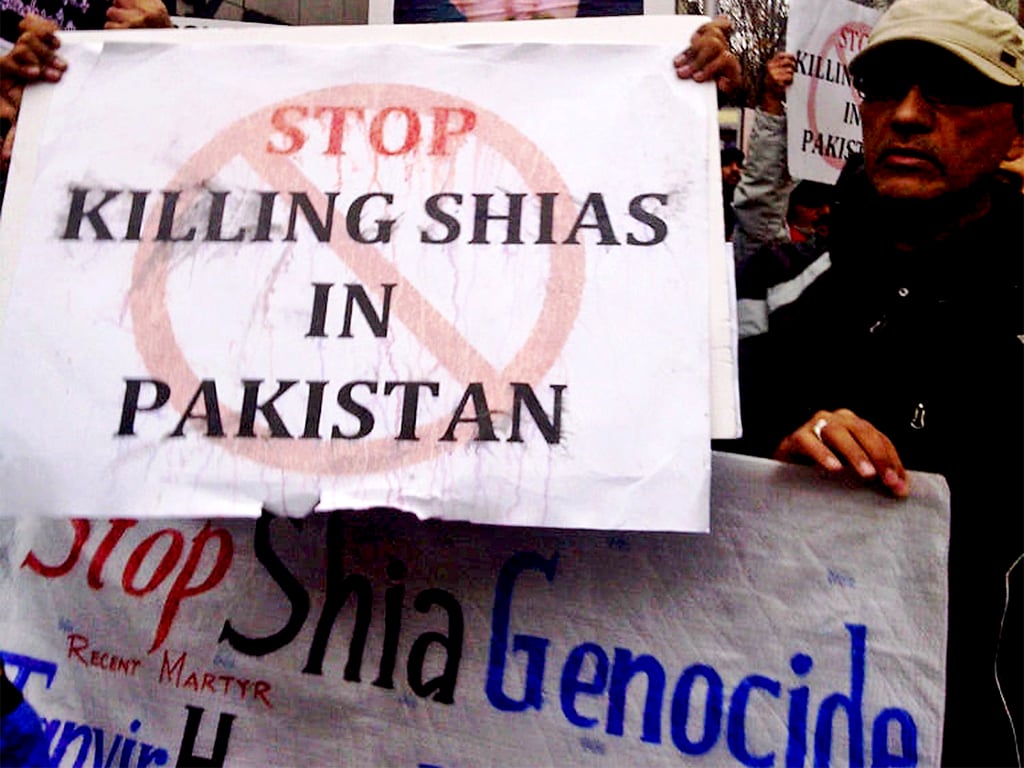
#ShiaGenocideInPakistan - Shia Doctor shot dead in Karachi's Gulshan-i-Iqbal area


A doctor belonging to the Shia community was shot dead in Gulshan-i-Iqbal on Friday, said police.
According to police, Dr Haider Askari, 58, was gunned down by two armed pillion riders at KDA Market, Block- 3, near Disco Bakery, while he was driving his car.
According to Gulshan SP Shahnawaz Chachar, the incident occurred at around 12:30pm when the doctor, a cardiac specialist, was on his way to his Gulshan-i-Iqbal residence after getting off from work at a government hospital in Korangi.
He sustained a single bullet wound on his left shoulder and was taken to Aga Khan University Hospital where he died during treatment. Later on, his body was taken to Jinnah Postgraduate Medical Centre (JPMC) to fulfil legal formalities.The Gulshan SP said investigators were focusing on two possible motives behind the murder: sectarian killing or a robbery bid.The officer opined that since the victim belonged to the Shia community and owing to the timing — with the month of Muharram around the corner — they could not rule out sectarianism as a possible motive behind the incident.
The killing might also be the outcome of an attempted robbery, he said.
SP Chachar quoting witnesses said that armed pillion riders had instructed Dr Askari — who had been driving alone — to stop his car. As he accelerated in an attempt to escape, the suspects fired a single shot. The investigators collected one spent bullet casing fired from a 30-bore pistol from the crime scene.
This was the second murder of a doctor in the city this week.
Dr Ayesha, an expatriate Pakistani, was gunned down ostensibly for resisting a house robbery by four armed men in Gulistan-i-Jauhar area.The victim had come to the city to attend the marriage ceremony of a relative when she was murdered.
MWM condemns sectarian killing
Meanwhile, Majlis-i-Wahdat Muslimeen condemned the incident, terming it a "targeted killing".
"The sectarian killing of a Shia community member in Karachi prior to Muharram-ul-Haram is regrettable," said Allama Baqar Zaidi, expressing fear that such an incident might trigger a wave of such killings.
The MWM urged the federal and provincial governments to take notice of the matter and apprehend the killers immediately.

Outrage in Punjab over Sikh girl’s ‘abduction’ in Pakistan, Amarinder wants Imran to act


Akalis issue ultimatum to Pakistani govt that Sikhs in Pakistan will protest in Lahore Saturday if the girl is not released by Friday night.

There is outrage in Punjab over allegations that a Sikh girl has been abducted and forcibly converted to Islam through marriage in Pakistan.
While Chief Minister Captain Amarinder Singh has demanded strict and firm action against the perpetrators, the Akalis have given an ultimatum to the Pakistani government that if the girl is not released by Friday night, Sikhs in Pakistan will protest in Lahore Saturday.
The minor Sikh girl, Jagjit Kaur, was allegedly abducted and forced to change her religion. She is from Nankana Sahib in Pakistan and is the daughter of granthi (head priest) Bhagwan Singh of Gurdwara Sri Tambu Sahib.
The incident has drawn the attention of Sikhs worldwide and sparked anger in the community.
Union Minister Harsimrat Kaur Badal has taken up the issue with Foreign Affairs Minister Dr S. Jaishankar. Terming the act as being shameful, Harsimrat said Pakistan Prime Minister Imran Khan should immediately take action against the perpetrators.
Shiromani Akali Dal (SAD) leader and Delhi Sikh Gurdwara Management Committee (DSGMC) president, Manjinder Singh Sirsa, who led a delegation to meet officials in the foreign affairs ministry Friday said Sikhs will hold a protest in front of the Governor’s house in Lahore where an international conference is being organised.
“I have received telephonic calls from the father and the brother, Manmohan Singh, of the abducted girl as their family is in trauma,” Sirsa said. “They want the safe return of the girl.”
He said Indian officials were in touch with the acting High Commissioner of Pakistan on the issue.
MEA spokesperson Raveesh Kumar said India has shared its concerns with Pakistan over the issue.
“The ministry has received a number of representations from various quarters of civil society in India, including Sikh religious bodies in India, at the reports of the incident of abduction and forced conversion of a minor Sikh girl in Pakistan. We have shared these concerns with the Government of Pakistan and asked for immediate remedial action,” he said.

CM wades into row

Punjab Chief Minister Captain Amarinder Singh has also urged the foreign affairs minister to take up the issue with his counterpart at the earliest.
“Shocking incident of a Sikh girl being kidnapped & forced to convert to Islam in Nankana Sahib, Pakistan,” he tweeted. “Call upon @ImranKhanPTI to take firm and immediate action against the perpetrators. Request @DrSJaishankar to strongly take up the issue with his counterpart at the earliest.”
Shocking incident of a Sikh girl being kidnapped & forced to convert to Islam in Nankana Sahib, Pakistan. Call upon @ImranKhanPTI to take firm and immediate action against the perpetrators. Request @DrSJaishankar to strongly take up the issue with his counterpart at the earliest.
6,321 people are talking about this

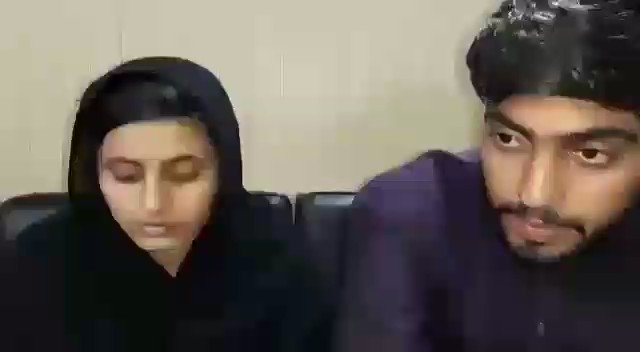
A video of the girl’s purported wedding to a Muslim boy Zulfiqar Ali has gone viral. In the video, she is saying that she has married the boy without any pressure and has adopted Islam on her own volition.
Sirsa, however, alleged that the video was clearly made under duress and the girl has been forced to give her consent to the marriage.
Not only the Hindu girls are forcibly converted to Islam in Pakistan but SIKH Girls also. A daughter of a Granthi of in Sahib was missing for past 3 days has surfaced on Thursday after marrying a Muslim man & embrassing Islam . @MEAIndia @HMOIndia
4,106 people are talking about this
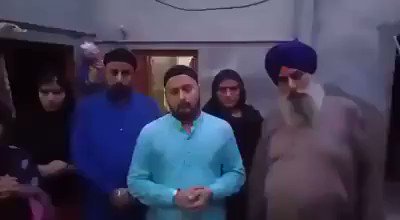
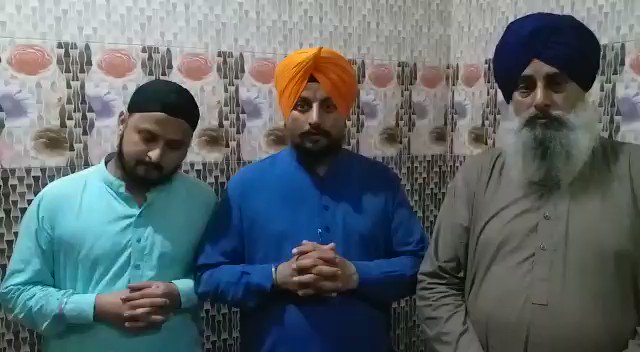
The girl’s family also released a video regarding the incident Thursday alleging that the girl was forcibly picked up from their house. Manmohan Singh, the girl’s brother, said the persons who had come to pick up the girl threatened her that in case she refused, the entire family would be forced to convert to Islam. He requested the Prime Minister Imran Khan and the army chief General Qamar Bajwa to intervene in the matter and return the girl safely back to her family.
: Family of Sikh Girl Jagjit Kaur who was abducted in Pakistan and forcibly converted to Islam speaks out. Family calls upon @ImranKhanPTI and Pakistan Army Chief to act or else the incident could impact both and Kashmir.
6,034 people are talking about this