Sunday, August 25, 2019

#Pakistan - Fixing #polio vaccine hesitancy

Samia Altaf
THAT Pakistani parents mark their children’s fingers because they do not want them to be vaccinated is correct. That this outright refusal and other forms of vaccine hesitancy is the cause of poor vaccination rates is incorrect. It is a symptom of the larger and critical underlying problem, one that that Bill Gates calls “sub-optimal management and increased community resistance to vaccination”.
The question is why are parents hesitant or why do they refuse a lifesaving service for their children, one that comes to their doorstep? Because they are suspicious of the system which they feel is not aligned with the best interests of their child.
What makes them think so?
To explore possible answers to this question, funded by the Shahid Hussain Foundation, the Lums faculty has completed a research study in a low-income district, Kasur. The results provide a range of reasons on the demand side and the supply side of vaccine delivery, for vaccine refusal and hesitancy. The study also reveals what “sub-optimal management” looks like and how it can be fixed.On the demand side, there is parental ignorance and distrust of the health delivery system, and on the supply side there is a stunted and inappropriate programme design that is managed in an inconsistent and sub-optimal fashion.
Parents are suspicious of a system which they feel is not aligned with the best interests of their child.
Parents understand that children can be visited by disease, and need medical treatment to rid them of it. While familiar with the treatment, parents are ignorant of disease prevention, so it does not make sense to them to give medicine (vaccine) to healthy children. They are not aware of the side effects of vaccines — rash, fever, pain at the injection site, lethargy, loss of appetite, occasional diarrhoea, which they attribute to vaccines. Some parents attribute malformation in children to vaccines.
Parents are suspicious of the way the health system operates to deliver vaccines. When they take the child to a health centre for a health problem, even when their child suffers side effects from the vaccine, the system is unresponsive. The local health centre is closed or there is no doctor or no medicine. The resulting suspicion of the same system that yesterday came to their home to give them medicine (vaccine) especially polio drops is understandable.
People’s health-seeking behaviour is crucial to their propensity to accept vaccines. This behaviour is based on knowledge and credibility in guidance of wise elders, who pass on traditional knowledge and who are believed more than the representatives of an unresponsive system.
While the vaccines are pushed on children, parental concerns remain unanswered. Why would I give medicine to my healthy child? Why do you give so many vaccinations together? What if the vaccine gave the disease to my child? My child was premature/of low birth weight — given that he was so small, wouldn’t the vaccines be dangerous for him? Why immunise him against diseases that we don’t see in our community? Since these questions are not answered satisfactorily, parents think there has to be some other reason for this very aggressive dispensation of medicine (vaccine).
Parents want to retain ownership of their children’s well-being. If they feel judged we lose them. “When someone can actually answer my questions, and not just bully and shame me, then I’ll consider it,” said one mother of three children less than five years of age. Weight loss and addiction psychologists have learnt that direct health advice never works. To change health-seeking behaviour you need to work with people’s anxieties and respect their opinions.
On the supply side there are the usual problems of poor infrastructure — the absence of routine vaccination service, lack of effective monitoring of supplies, inadequate supervision of vaccinators, chronic staff absenteeism and difficulties in maintaining the cold chain due to electricity failure that leads to new problems. For example, vaccines stored in freezers in Basic Health Units or Rural Health Centres are placed in ice buckets during frequent power breakdowns. Maybe the cold chain is maintained, but this action adds another problem: the water unglues the labels from the vials. Parents can see this and are rightly suspicious of potential harm.
Vaccinators are not part of the health system and are hired for vaccination drives; inadequately trained with little supervisory support, they have many problems in the field. For instance, they claim they are not paid on time. Or they are expected to pay for their transport. Mid-level managers cannot solve problems in the field, since they do not have the required authority.
The confusion is compounded because the EPI and polio eradication, as vertical programmes are directly under federal authority. Programme activities are decided in advance, donors provide the earmarked unchangeable funding, specific to a particular activity. Even though not directly responsible for the programme, district and provincial administration are expected to ensure results.The prime minister has said that the “government will take 100 per cent ownership of the programme, from disease control to eradication, and 100pc accountability would be assured across the board”. Hopefully, his team will take this seriously and take into account the information from the field in the ‘various initiatives’ taken for ‘perception management’, and in their in plans to deal with ‘anti-vaccine propaganda’. Large objectives are fine, the devil is really in the detail.
We need to understand that if we do not push through to eradicate polio, there is a danger that polio can re-emerge in the world — as measles did recently in US. To successfully eradicate polio and other communicable diseases, the authorities need to rework the programme’s design and field activities in light of real-life constraints on the demand and supply side. Detailed and specific education programmes about disease prevention and vaccination schedules focused on parents, to be delivered consistently by trained and credible staff, should be the first component of this reworking.

https://www.dawn.com/news/1501526/fixing-polio-vaccine-hesitancy

#Pakistan - Five new polio cases reported, toll mounts to 58

  • The children have zero histories of essential immunisation against the virus
  • Three cases were reported in KP, two in Sindh
Three days after Microsoft co-founder Bill Gates expressed concerned over the rise of polio cases in Pakistan, five new cases have emerged in the country, taking the total number to 58 in 2019 whereas the total count of polio cases in KP alone stands at 44 now.
According to reports on Sunday, three cases were reported in Khyber Pakhtunkhwa (KP) whereas two were reported in Sindh. In KP, the cases were reported in Hangu, North Waziristan and Bannu, whereas in Sindh the cases were reported in Hyderabad.
According to the details, one wild poliovirus has been isolated from a stool sample of 18 months old girl, resident of Mainij Khel UC Dallan, Tehsil Thal, District Hangu.
Likewise, two new polio cases have been notified from Bannu Division one each from Bannu district and North Waziristan.
The laboratory has confirmed poliovirus in the 30 months old boy, resident of Dinor, Tehsil Miralai, District North Waziristan and 18 months female from Tehsil Wazir District Bannu.
 None of the children have a history of dose for essential immunisation and are undernourished as well.
According to a report last week, more than 25 cases had surfaced in KP alone, mostly in Bannu division which remains highly-affected by the virus.
Bannu had recorded 11 cases and North Waziristan six, followed by Torghar with three and one each from DI Khan, Hangu, Lakki Marwat, Shangla, Bajaur and Khyber Agency.
The reason for a recent spike in such incidents is attributed to anti-vaccination propaganda in the province.
Emergency Operations Center (EOC) Khyber Pakhtunkhwa Coordinator Kamran Afridi on Friday said that approximately 0.7 million children couldn’t get the vaccination in KP due to refusal from their parents or guardians.
“Refusal and fake marking of children are the major reasons for the increasing number of cases reported in Pakistan. Vaccination is essential for us to safeguard the future of our children and every Pakistani has to play their part in this mission,” read a statement issued on the latest polio immunisation campaign.

Pakistan’s militant challenge in Kashmir


By SAJJAD QAYYUM
Government has little control over extremists and anger is growing over India’s move in the disputed territory.
Pressure is mounting on Pakistan to contain militants itching for a fight with arch-nemesis India amid growing calls for action in its escalating dispute with New Delhi over Kashmir.Only last week, hundreds rallied in Pakistani Kashmir, calling for armed retaliation over India’s decision to revoke the special autonomy granted to its portion of the Muslim-majority region.
Delhi’s move earlier this month upended a decades-old paradigm with nuclear-armed rival Pakistan, which also claims the former princely state, and left Islamabad scrambling for international support against the move.
But in the mosques and marketplaces of Muzaffarabad in Pakistani-administered Kashmir, the calls for jihad are gaining momentum – even as analysts warn that any militant violence could backfire on Islamabad.
Radicalizing a new generation
“If India doesn’t stop the oppression then, God willing, it will find us there with guns,” protester Tariq Ismail told AFP at a march organized by the US-designated terrorist group Hizb-ul-Mujahideen.
Residents elsewhere in the city suggested that India’s move was set to radicalize a new generation, years after the insurgency that began in the 1980s in Indian-held Kashmir claimed the first of tens of thousands of lives.
“I have six children. I will send them for jihad … God willing our morale is gaining momentum,” said Muhammad Amjad, a 47-year-old former militant.
Bilouri Begum, 41, lost her husband, cousin and nephew to the earlier fighting.
“I brought up my sons. God willing, I will send them (for jihad) and will also go with them,” she said, tears rolling down her cheeks.
Support for violence
Pakistan’s most high-profile news anchor, Hamid Mir, hosted three former Pakistani diplomats on his show on Geo News this week, all of whom supported violent resistance in Indian-held Kashmir.
“Even if people go from Pakistan (to join) a legitimate resistance, that’s legal,” argued former ambassador to the US Ashraf Qazi.
Kashmir has been divided between India and Pakistan since independence in 1947. They have fought two full-scale wars and countless skirmishes over it.Washington and New Delhi have long accused Islamabad of fanning the insurgency in Indian-held Kashmir, and of weaponizing jihadist groups as proxies to attack India.
The deadliest such attack came in Mumbai in 2008, when militants from Pakistan-based Lashkar-e-Taiba killed more than 160 people.
Any fresh militant attack at this delicate moment “will have severe implications for Pakistan,” security analyst Amir Rana told AFP. Insurgents nearly triggered an all-out war in February after a suicide bombing claimed by Pakistan-based militants in Indian Kashmir sparked tit-for-tat air strikes – the first between nuclear-armed powers.
Waiting for an opportunity
A militant strike would probably hit Pakistan’s economy hard, as it balances a new IMF bailout and tries to avoid being blacklisted by a terror financing watchdog later this year. Rana warned that India was waiting for “any opportunity” to exploit Pakistan’s history with militancy.
Prime Minister Imran Khan has already warned that India could stage a deceptive “false flag” operation in order to justify attacking Pakistan, vowing to “fight until the end” if that happens.
The powerful Pakistani military has long held Kashmir as a defining issue against India. But whether the Pakistani security establishment has the militants firmly on a leash is debatable. “I don’t think the jihadists are under the full control of the government, they never were,” Ahmed added.
Kashmir militancy expert Myra MacDonald likened Islamabad’s hold on the militants to “turning on and off a leaky tap – no matter what Pakistan does, you will still get some water dripping from it.”It is possible for the military to tighten its grip, she argued, pointing to a period of peace negotiations from 2003-2007, when violence dropped. But Kashmir tends to be unpredictable.“In the run-up to the Mumbai attacks, for example, the jihadi groups were getting restless and needed a spectacular attack to keep their supporters happy,” she explained.
“Like big corporates, these groups need to advertise their brand from time to time in order to get money and support. That risk will remain until they are fully dismantled.”
“Any jihadist activity in Kashmir will cause huge damage to Pakistan both diplomatically and economically,” analyst Khalid Ahmed said.

https://www.asiatimes.com/2019/08/article/pakistans-militant-challenge-in-kashmir/

India & Pakistan must solve Kashmir crisis among themselves, without 3rd party provocations – Macron

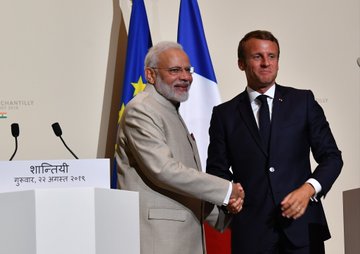
The Kashmir crisis can and must be solved bilaterally, between India and Pakistan, so any third parties seeking to interfere despite the risk of inciting more violence should stay clear, French President Emmanuel Macron stressed.
“We would like to support any policy that keeps the situation stable and free from terror,” Macron said at a joint press conference at Chateau de Chantilly on Thursday after meeting Prime Minister Narendra Modi.
India and Pakistan will have to find a solution to the issue and no third party should interfere or incite violence in the region.
Tensions between the two nuclear neighbors have reached a peak this month after New Delhi revoked a constitutional provision (Article 370) that stipulated Jammu and Kashmir’s autonomy over its internal administration, integrating the volatile region into the central government system.
Outraged by the move, Pakistani Prime Minister Imran Khan reached out to the US, seeking mediation efforts from the Trump administration. President Donald Trump has since repeatedly tried to play peacemaker in the Kashmir crisis, but Modi’s government has refused to accept the offer, insisting that US has no role to play in India’s internal affairs.
During Thursday’s press conference, Modi did not directly touch on the Kashmir tensions, but he did state that India, like France, remains committed to fighting terrorism.

Imran Khan was right. Modi did resolve the Kashmir issue once and for all: Reham Khan


If this is how Pakistan was going to gift away Kashmir to India, why did it prolong the agony for 70 years?


Just when you thought that things couldnʼt possibly get any worse, the strong men who rule us demonstrated their ability to surprise us with their diplomacy and concern for humanity.
As I watched our cricketing hero Imran Khan invite the big man in the White House to mediate on Kashmir, I knew the celebration would be short-lived and this will come back to haunt him.
In less than a month since then, India stripped Kashmir of its special status and won the war with a single flourish of the pen. Jammu and Kashmir’s geography changed overnight as it was demoted to a union territory and its autonomy was snatched away.
The Valley has largely remained cut-off from the world for over a fortnight now. There are rumours that many men with suspicious links have been picked up.
From a humanitarian point of view, this is a gross violation of civil liberties and freedoms. But as a strategy for building an empire, it has been very successful. We can cry as much as we want, but why are we surprised?

Modi delivered on his promise

Narendra Modi did what he said he would do. Love him or hate him, he delivered on his promise. His party’s manifesto had promised abrogation of Article 370 if voted back to power. He made his intentions clear in all his interviews.
So, when a leading news channel asks me if “Modi has bowled a googly to Imran”, my simple answer is No.
I have personally found these cricketing references tiresome and to compare the human catastrophe in Kashmir to a googly is particularly distasteful. But to use the same analogy, I would say the selectors knew they were bypassing merit when they chose a bowler as their opening batsmen.

Young Pakistanis are angry

What is shocking is that in the past 70 years, Pakistani children have been force-fed a dream of ‘Kashmir banega Pakistan’.
Overseas Kashmiris from Srinagar sussed it out a long time ago that no one was serious about listening to their demands. They told me how disillusioned they were and that they were just being used as human shields.
My email and WhatsApp have been flooded with angry, disappointed messages from young Pakistanis – If this is how they were going to gift away Kashmir to India, why were they prolonging the agony of women and children for 70 years?
I donʼt have the heart to remind them that I did warn them through my TV shows and during private conversations.
I had seen the competencies of those drawing hefty official salaries and informal benefits for championing the Kashmir cause in the US and the UK, and was far from being impressed.
Indeed, I had withdrawn from events organised for Kashmir over the past two years, knowing fully well that these were just opportunities for lavish dinner and empty sloganeering, not to mention free travel.
One Kashmiri crew member remembered my show from February 2016 wherein I had discussed Imran Khanʼs plan for a three-way split of Kashmir.
Some remembered my comment after the new PM gave interviews to Indian journalists on the sidelines of the groundbreaking ceremony for Kartarpur corridor last year. These young men called me up to say: “Maʼam every word you said is turning out to be true”. I replied, “Pray that my words don’t come true”.

Imran Khan says he knew it all

To add insult to injury, the Pakistan PM stood up in parliament during a joint session only to confess that he was aware of Modi’s plans in Kashmir. For the benefit of the public, he went in great detail to convince us that he was guilty as charged.
He admitted that from the minute he took office, he was repeatedly shunned by an arrogant Modi. Post-Pulwama, he was convinced that there was no hope of a friendship with Modi.
One wonders why then did the Kaptaan campaign for Modi before the general elections in India.
In April first week, the skipper assured the world that Modi would resolve the issue of Kashmir if re-elected. Since Imm the Dimm is a nickname Imran detests, one must assume that his prediction was based on a careful analysis of the information available to him as the great leader.
After all his party frequently brags about the wonderfully agreeable symbiotic relationship  the government shares with the military leadership.
And he was right. Modi did resolve the issue once and for all. Closing the door on any future dialogue on Kashmir.
So unprepared and clueless were the news channels in Pakistan that they started a news campaign on the possible death of separatist leader Yasin Malik who has been in prison for months now.
But, of course, our PM knew it all, he claims.

Clean bowled or fixed match?

Now Imran Khan has taken to Twitter and parliament to educate us on the ideology of the RSS, which he says resembles that of Nazi Germany.
Keen followers of the Kaptaan know by now that Germany and the world wars are his area of expertise. It could be his subject of choice on the TV show ‘Mastermind’ once he hangs up his PM cloaks.
Of course judging by his first year in power, he seems to be planning for at least a decade of progress under his visionary leadership.
One is hesitant to raise a humble question in an environment where TV anchors like Najam Sethi find even their YouTube shows being taken down.
I will dare to regardless.
If the writing was on the wall, why did the skipper not change his placing in the field?
Why could he not find a gap to score a boundary?
Was he clean bowled by Modi or was it a fixed match?

Saturday, August 24, 2019

Video - Monologue: Get On My Lawn | Bill Maher says he's “glad” David Koch is dead.

Video - Marianne Williamson - Running for President on a Morality-Driven Platform | The Daily Show

Video Report - Marianne Williamson: US economy skewed in favor of few people

Video Report - #G7Summit #GlobalLeaders G7 Summit: Divisions expected at global meet

Video Report - Thousands protest against G7 summit over group’s economic policies

Music Video - NOOR JAHAN - ZINDAGI KAY SAFAR MEIN AKELAY - ZEBA

Fake 'Pinky Marks' The Newest Problem In Pakistan’s Push To Eradicate Polio

Frud Bezhan 
Militant violence, anti-vaccination conspiracies, and religious hard-liners have long thwarted a drive to once-and-for-all eradicate the crippling polio disease in Pakistan.

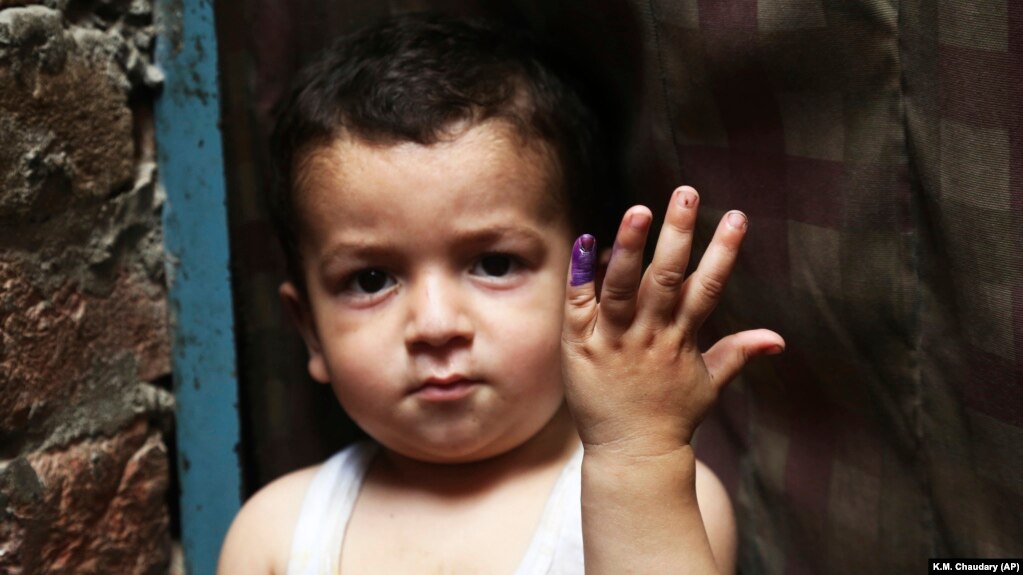
But now, vaccination teams in the South Asian nation of some 220 million people face a new obstacle: fake marker pens.Polio workers say parents who are suspicious of the government’s immunization campaigns have acquired special markers used by health workers to put a colored dot on the left pinky fingers of children after they have been vaccinated.
Health workers say parents opposed to the vaccinations are marking their children's pinkies to make it appear they have been vaccinated when, in fact, they weren't. The deception causes vaccination teams to skip over children who need to be vaccinated -- thereby preventing the disease from being eliminated in the country.

With the disappearance of wild polio cases in Nigeria in recent years, Pakistan and Afghanistan are currently the only countries in the world where new polio cases are found.

The issue with the fake markers in Pakistan highlights the varied obstacles that are keeping Pakistan from eliminating polio -- a childhood virus that leads to deformed limbs, paralysis, and even death.

Thorough vaccination campaigns in recent years have dramatically reduced the number of polio cases in Pakistan, with only a dozen cases recorded last year.

Militant Stronghold
But that number has jumped to 45 cases this year. Of those, 35 were found in the northwestern province of Khyber Pakhtunkhwa, a poor and religiously conservative region that was once a stronghold of militant groups like Al-Qaeda and the Pakistani Taliban.

Many residents of the province, which lies along the porous border with Afghanistan, have been suspicious of the polio vaccine, with conservative Islamic clerics and militants claiming it is a Western conspiracy to harm or sterilize children.

Dr. Imtiaz Ali Shah, the head of the provincial government's Polio Monitoring Cell in Khyber Pakhtunkhwa, warns that fake polio markers are the newest threat to anti-polio efforts.

"Our immunization teams first ask the parents if their children are vaccinated,” says Shah. “To confirm this, we check if the children have marks on their fingers. If they do, then it means they were vaccinated. But then we realized that some parents had applied fake marks on their children before polio teams arrived to their areas.”
Shah says suspicions were raised when 17 of the 45 polio cases recorded this year came from the same town -- Bannu -- a city of 50,000 in the country’s northwest.

In the past, the town has been the scene of deadly attacks on polio workers and militants are known to be active in the area.

Shah brought a team of health officials to Bannu to recheck if the children who had marks on their fingers had actually been vaccinated.

“When we checked some children, we found out that they were not immunized,” he says.

Shah says the provincial government in Bannu is making plans to address the issue of the fake pinky marks. In the past, polio teams would report to police the parents who refused to immunize their children.

But polio workers have since stopped registering complaints with authorities. He also says the government has launched a media campaign targeting parents, clerics, and school teachers in a bid to dispel the myths about the vaccinations.

In April, a vaccination drive in the province was thwarted after a mass panic was created by rumors of children fainting or vomiting after they were immunized.

As the rumors spread, thousands of panicked parents rushed their children to hospitals in the provincial capital, Peshawar, forcing the health facilities to declare emergencies. The rumors turned out to be wildly exaggerated.
Public health studies in Pakistan have shown that maternal illiteracy and low parental knowledge about vaccines -- together with poverty and rural residency -- are the factors that most commonly influence whether parents vaccinate their children against the polio virus.
Anti-vaccination propaganda has also been fueled by a distrust of Western governments who fund vaccine programs -- including after the CIA reportedly staged a fake hepatitis-vaccination campaign in 2011 to confirm the location of Al-Qaeda leader Osama bin Laden, who lived in Abottabad, where he was killed by U.S. SEALs.

Since then, some clerics have even issued fatwas saying that children who become paralyzed or die from polio are "martyrs" because they refused to be tricked by a "Western conspiracy."
Pakistani militants have also propagandized that Western-made vaccines contain pig fat or alcohol, which are both forbidden in Islam.

Militants in Pakistan have kidnapped, beaten, and assassinated dozens of vaccinators or their armed police escorts in recent years in a bid to stop local anti-polio campaigns.

Pakistan’s ruling party PTI tweets old Kashmir video, claims violence over Article 370


The video has been made by clubbing two separate clips that were uploaded on YouTube in 2017 and 2018.

Pakistan’s ruling party Pakistan Tehreek-e-Insaf (PTI) Saturday shared an old, edited video on Twitter, showing violent protests in Kashmir and claimed that people in the Valley were being attacked by the Indian Army.
“Curfews and media blackout cannot contain revolutions that emerge as a result of grave human rights violations. Yet Indian Govt continues to alienate Kashmir. Unarmed men, women, children being attacked by Indian Army. Inhumane! #Kashmir,” PTI tweeted.
At the time of publishing this report, the tweet had over 3,000 shares and 4,000 likes.
The video was even shared by Khaleej Mag, a digital media company based in Dubai, Kuwait, Qatar and Dublin.

Fact check

The video has been edited by clubbing two videos that were uploaded on YouTube in 2017 and 2018.
Pakistan’s attempts to claim that abrogation of Article 370 has led to violence in the valley by using old videos comes at a time when its attempts to garner international support have proved to be futile. Most countries have asked India and Pakistan to settle the matter bilaterally.
The international community, however, has also asked India to ensure that no human rights violations take place in the Valley.
Meanwhile, on Friday a US State Department official said, “We do expect the issue of India-Pakistan relations to come up (during Modi-Trump meet in France). The President will likely want to hear from Prime Minister Modi on how he plans to reduce regional tensions and uphold respect for human rights for Kashmir as part of India’s role as the world’s largest democracy.”
“India’s decision to rescind Article 370 in Kashmir is an internal decision, but certainly with regional implications. And President Trump will likely want to hear how Prime Minister Modi intends to calm regional tensions in light of this significant move,” the official said, adding that India should lift the communication blackout from the Valley.
The official also said that President Trump has urged Pakistan to “to prevent the infiltration of militants across the Line of Control that divides Kashmir and to crack down on groups on its territory that have attacked India in the past”

#Pakistan's #Kashmir hypocrisy


The Hazaras – Afghanistan’s oppressed minority


By NOSHIN RAD

NOSHIN RAD calls attention to the plight of the Hazara people, a racially persecuted minority faced with Islamist genocide and government indifference.

OFTEN when we hear about Afghanistan, words such as destruction, war, poverty, bloodshed and death are used to describe the country.
Before the country’s civil war which began in April 1992, Afghanistan was blossoming and people of different ethnic groups were accorded their human rights, including access to education and jobs that were not available to them before, allowing for families to better sustain themselves.
However, when the civil war broke out, different warlords comprising of the mojahedin, and later the Taliban, occupied Afghanistan, implementing their own brutal laws and extreme religious views.
The Taliban rule of the late 1990s came to an end in 2001, after September 11, when the US invaded the country along with its Nato allies, under the pretext of bringing peace, stability and freedom to all Afghans, especially women.
Today, sadly, the situation has not vastly improved, with instability still plaguing the country almost two decades after Nato troops arrived in Afghanistan.
And for one group of Afghans, the Hazaras, the conflict has become even more intolerable, with their deaths and suffering continuing to rise.
The Hazara people are one of 50 ethnic groups in Afghanistan, but can also be found in Iran and Pakistan, with the majority being adherents of Shia Islam. They speak Dari (a dialect of Farsi) and/or Hazaragi.
Many people ask where the Hazaras originate from, and that is a difficult question to answer, because no-one really knows their origins and there is a lot of speculation among scholars and historians.
Many academics and political scientists claim that the Hazaras are descendants of Moghol soldiers who came to Afghanistan with Genghis Khan’s army in the 13th century; this is also the most accepted theory about their descent.
Others argue that the Hazaras are mixed descendants of Turko-Mogholi war settlers, who built and lived in army bases in central Afghanistan.
However, what distinguishes the Hazaras from other groups are their distinct ethnic features.
In Afghanistan, the Hazara people are the third-largest ethnic group after Pashtuns and Tajiks, but as a result of discrimination and segregationist policies by many different Afghan rulers, the Hazara people have remained one of the most underdeveloped groups, politically, economically and socially in the country.
Until the 1890s, the Hazara people were autonomous and in full control of all areas within their region known as Hazarajat, which lies mostly to the west and north-west of Kabul.
However, after the 1890s, they were ruthlessly subjugated, at the behest of the Sunni king Abdur Rahman Khan, who issued a religious decree declaring Shias to be infidels and thus legitimate targets in war.
From 1888-93, a period known as the Hazara uprisings, the well-known scholar Sayed Askar Mousavi argues that Amir Abdur Rahman and his army massacred or forced out more than half of the Hazara population.
It was not until 1923 that Hazara slavery was abolished, but still the community were excluded from contributing to, and benefiting from, the development of Afghanistan, and were not viewed as equal citizens.
Up until this day the Hazaras are under continued attack by two terrorist groups, the Taliban and Isis (both are Sunni Islamic fundamentalist organisations) and are also neglected by the Afghan government.
Last year in October, the Taliban launched an offensive and attack in Hazarajat.
It first began in Uruzgan province, and then continued on to Jaghori and Malistan, two districts in Ghazni province. These were two provinces considered to be among the safest areas in Afghanistan for the Hazara people.
Jaghori’s 600,000 people are poor and live in an isolated area that does not have paved roads or electricity lines, but has an abundance of orchards of almond trees and apple trees.
The province had been known for being peaceful. Specifically, the implementation of educational schemes for both sexes has been a successful example for the rest of the country. School attendance is almost universal among girls and much higher than the Afghan average for boys.
When the Taliban attacked last year, the area’s successful schools were burned down, houses were looted and destroyed, as well as communications antennas being knocked down. Hundreds of civilians were killed and thousands internally displaced.
Those who managed to escape either went with cars over dusty mountain roads or fled by foot in freezing temperatures.
Most families fled to cities like Ghazni, Bamyan and Kabul, where there was little to no food, medicine or shelter. While the inhabitants of these cities extended their helping hands, the government turned a blind eye towards these helpless individuals for weeks, until eventually the army arrived and assisted the Hazara population.
Last Saturday, a wedding took place in the Dubai City wedding hall in western Kabul, in a predominately Hazara neighbourhood.
While children, women and men were dancing to their favourite Afghan wedding songs at the joyous occasion, a suicide bomber attacked the wedding, where over 80 guests were killed and over 180 injured.
Isis claimed responsibility for the attack, the deadliest to hit the capital in 2019.
Interestingly, these attacks are mentioned in the media as attacks on the Afghan people; media framing is important here, given that historically the term Afghan was synonymous with Pashtun, and is still used as an exclusionary term by some Pashtun nationalists.
This is problematic as an entire country composed of different ethnic groups is being referred to by a term which signals a monopoly of power and the enforcement of an Afghan identity on non-Afghans, as well as denying the multitude of identities of the diverse communities within the country.
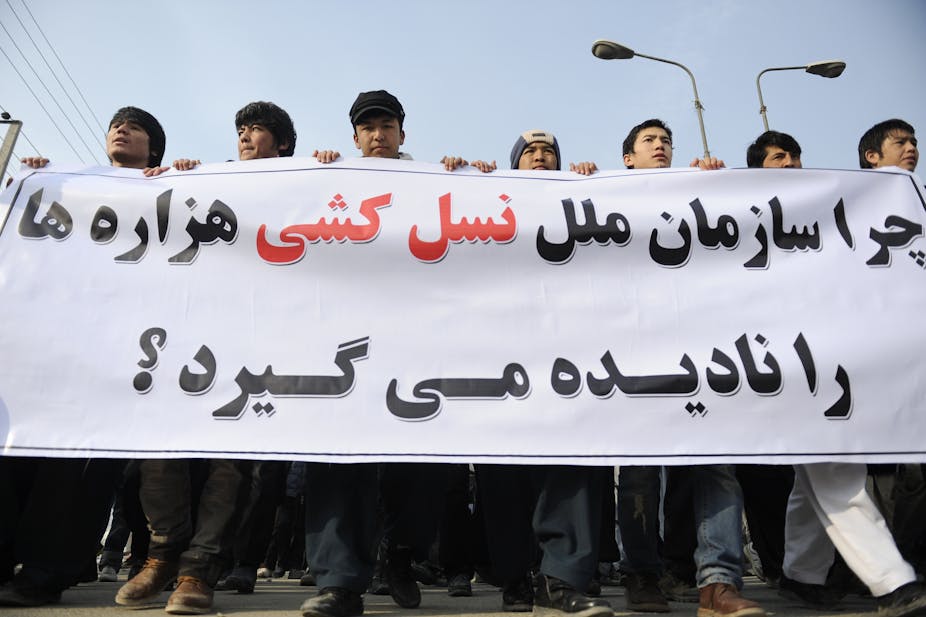
Therefore, it is important to call these attacks what they are — a racially motivated attack on a minority, who are subject to institutional oppression, marginalisation, persecution and massacres.
The group of people who have benefitted from these oppressive structures are now given platforms in Europe and the US, and they refuse to acknowledge the prejudice fuelling the attacks, and in turn claiming that there is no racism in Afghan society.
As long as such Afghan journalists and so-called experts are given public platforms where they refuse to acknowledge the divisions in Afghan society such as race and ethnicity, while the government does nothing to acknowledge the targeting of Hazaras by the Taliban and Isis, these people are inadvertently undermining the true nature of the suffering being inflicted on the Hazara people.
Of course there are attacks in which non-Hazaras are victims of suicide bombings, but they are mostly in the form of “collateral damage” during attacks on the government and the US and Nato forces.
Other ethnic groups in Afghanistan suffer from poverty and conflict, but they are not solely targeted based on their ethnicity. They have not been pushed to the bottom of the social hierarchy because of their ethnicity, culture and religion.
In order to move forward, it is important to recognise and understand the history of the Hazara people.
The Hazaras are not merely attacked because of their religious beliefs, otherwise there would also be regular attacks against non-Hazara Shias.
The Hazara people are undeniably attacked because of their ethnicity. They are not seen as “real” Afghans.
The answer to why the Hazara people have been targeted by different Afghan governments may lie in the fact that they are the central ethnic group that could potentially challenge and threaten the country’s dominant powers.
This in part explains the decades of social isolation, displacement, oppression and persecution of the Hazara people by successive Afghan regimes: if we do not denounce this a collective, we are also to blame for its continuation.