
Thursday, August 8, 2019

Kashmir Banega Pakistan: A dream sold to brainwash us since childhood now lies in tatters


30 years on, Pakistan’s Kashmir policy has borne no fruits for regular Pakistanis, other than polarising society and instilling hate against India.

When the Narendra Modi government scrapped the special status of Jammu and Kashmir and announced its decision to turn the state into a Union Territory Monday, it caught the thekedars of Kashmir in Pakistan off guard. The reactions from the Imran Khan government were anything but serious, that too for a piece of land they once called their own.
Honestly, losing cricket matches to India have had better reactions in Pakistan. But the bigger question is: can Imran Khan’s government run without a Kashmir cause, as the saying goes ‘hukoomat petrol se nahin, Kashmir cause se chalti hai’.
Everyone in the ruling elite sold the ‘Kashmir banega Pakistan’ chooran to the best of their benefit – those in the Pakistani military to keep themselves viable, the politicians to use it during elections, the religious cartel to fan anti-Hindu sentiments, and the ordinary Pakistani to just watch all of them make hay.

Brainwashing since childhood

‘Kashmir banega Pakistan’ is what we were told as kids. ‘But how will it become a part of Pakistan when it is in India?’ We would ask. ‘Kashmir hamari shahrag hai (Kashmir is the jugular vein of Pakistan)’. So how are we managing to survive without this vein? The questions, we were told, had no answers, so they better not be asked either.
Growing up in the 1990s, our daily dose of brainwashing involved a 20-minute programme on Kashmir after the 9pm news on Pakistan Television. With Nusrat Fateh Ali Khan’s Iss duniya k gham jane kab hu gy kam playing in the background, we saw agonising images of Kashmir. It would eulogise Mirwaiz Umar Farooq, Yasin Malik, Syed Ali Shah Geelani and other Kashmiri leaders – we were told that these men were the real heroes.
‘Our heart should bleed for Kashmir,’ was the loud and clear message. But how can the heart bleed for something that was only a state-imposed reality? We would think.
The rulers of Pakistan came and went but what remained unchanged was Pakistan’s Kashmir cause. A cause for which daring to be indifferent amounted to blasphemy of sorts.
Once a year, Pakistanis would get a day to free Kashmir. Every 5 February, they show solidarity with their Kashmiri brethren. School tableaux depict innocent Kashmiri girls singing folk songs and out of nowhere come Indian soldiers firing gunshots to arouse pathos in the audience.
The happenings of Kashmir Day always remained unclear – a national holiday which seemed just like any other off day. Kashmir Day would involve everything other than liberating Kashmir. Waking up late, watching Indian films, and hanging out with friends was our contribution to the cause of Kashmir.
And then there were the poster boys of Kashmir freedom movement. Hafiz Saeed, Syed Salahuddin or Ahmed Ludhianvi from banned militant outfits taking out processions, apprising the Pakistanis of the Kashmir issue. But why would you preach to the converted already?

What Pakistan’s Kashmir policy achieved

Now, nearly three decades later, Pakistan’s Kashmir policy has borne no fruits for regular Pakistanis, other than polarising the society on the basis of jihad and instilling hate against India. The government of Pakistan expects the inflation-battling awaam to reunite for the Kashmir cause. But why?
Whether or not your heart bleeds for your own ethnic (Shias, Ahmadis, Christians, Hindus) and religious minorities (Pashtuns, Baloch, Hazaras, Mohajir), your heart must bleed for the Kashmiris. It doesn’t matter whether the Kashmiris want it or not.
Prime minister Imran Khan, who recently concluded what we were told was a successful visit to the United States, now finds himself answerless in front of the roaring opposition in Parliament. While he had pleaded US President Donald Trump of mediating on Kashmir issue, he now doesn’t know what actually happened with him. Clueless as ever, in his streetfighter style, the premier told what Narendra Modi’s BJP has done wasn’t cool, and like an astrologer, he also told what could happen. But what was missing as usual was what his plan was. Being unable to do anything about India’s constitutional amendment is one thing; giving sermons about the past quite another.
Pushing the international community to raise the issue of Kashmir is a lost cause, as is evident from the last 70 years of UN General Assembly outings. Also, Pakistan’s recent foreign policy debacles don’t help the cause either. Imran Khan, who had called on Malaysian Prime Minister Mahathir bin Mohamad for help, forgot how Mahathir had categorically said when he had visited Pakistan that he won’t take sides in the Kashmir conflict. Mahathir had also said that the reason for Malayisa’s success was that it isn’t in conflict with any of its neighbours.
During the Indian parliamentary election, Imran Khan had reiterated that Narendra Modi could solve the Kashmir issue. Like an astrologer, Khan got it right. The new measures from New Delhi signal towards etching the Line of Control into a permanent international boundary and like the Punjab and Bengal, Kashmir now too is partitioned.
#India - #Modi reaches out to youth, women & govt employees of J&K, Ladakh with promise of jobs, benefits


PM Modi assures people that those who believe in the Indian Constitution will have the right to a good life, but said there would be no rethink on Article 370.

Prime Minister Narendra Modi made a massive outreach to youth, women, government employees and other people in the new Union Territories of Jammu and Kashmir and Ladakh, seeking to drive home the message that the abrogation of Article 370 will bring them great opportunities in terms of employment, investment and infrastructure development.
This would go a long way in the making of a “new J&K” alongside “new India”, Modi said.
In his 38-minute televised address to the nation, the PM made it amply clear that there was no room for any rethink on his government’s decision, and that naysayers would not be indulged.
“Freedom from Article 370 is the truth… Those who believe in the Indian Constitution will have the right to a good life,” Modi said.
He said Article 370 was a hurdle for the development of Kashmir. “It gave only separatism, terrorism, nepotism and corruption to the people of Jammu & Kashmir. Jammu, Kashmir and Ladakh could not develop like the rest of the country. But now, the future of the citizens here will improve,” he said, adding that Kashmir, which was known as paradise on earth, would again “attract the world”.
The PM also talked about timely elections in Jammu and Kashmir, while clarifying that Union Territory status for Jammu and Kashmir was “temporary”. However, Ladakh will continue to be a UT.

Outreach to the youth

Modi focussed on addressing the youth of J&K, in a clear effort to prevent a repeat of past instances of violence and stone-pelting. He said the youth of Jammu, Kashmir and Ladakh will now get employment opportunities as more state-owned and private companies will be encouraged to set up shop, and vacant posts will be filled up.
“We will start the process to fill all vacant government posts, which will benefit the youth of Jammu and Kashmir,” Modi said.
“The Centre’s priority will be to ensure that government employees and the J&K Police get equal facilities as enjoyed by government employees and police of other states.”
The PM said this will mean that J&K government employees will get to enjoy facilities such as LTC, house rent allowance, education allowance and health schemes.
The Prime Minister’s Special Scholarship Scheme will be extended so that more youth can take advantage of it.
“Local youth will receive employment. Public sector units and big private sector companies will be encouraged to create jobs for the local youth in the state,” he said.
Besides this, Modi said the Army and paramilitary forces will also hold job rallies to recruit local youth.
“Sport training and scientific education will help the youth of J&K to showcase their talent across the world,” he said.
He also urged the Hindi, Telugu and Tamil film industries to shoot in J&K, and emphasised that his government would undertake reforms to make both J&K and Ladakh the biggest tourist destinations in the world. 

Political aspects

Addressing the political aspects of the move, Modi said it will result in the replacement of existing “dynasties”, and give opportunities to the youth to participate in the electoral process.
“During elections, SCs, STs and individuals from other backward communities in other regions would enjoy special benefits, but it didn’t happen in Jammu and Kashmir,” he said.
“Democracy in our nation is really strong. But you would be surprised to know that in J&K, there are thousands of people who could not vote in elections or contest them.”
He reassured the people that “your representatives will come from amongst you”, and expressed confidence that the panchayats will do splendid work after the scrapping of Article 370.
“Panchayats are doing a good job in J&K. Thanks to them, development projects have been implemented speedily,” he said.

Pakistan used Article 370 as a weapon

Modi alleged that Pakistan had used Article 370 as a weapon.
“In the last three decades, almost 42,000 innocent people lost their lives. This figure would bring tears to anyone’s eyes. While they lost their lives, J&K and Ladakh didn’t see the development they should have,” he said.
The PM’s statement comes a day after Pakistan downgraded diplomatic ties with India, asked high commissioner Ajay Bisaria to return to New Delhi, and suspend bilateral trade with India. India had withdrawn the Most Favoured Nation trade status from Pakistan in the aftermath of the Pulwama terror attack on 14 February.

Eid greetings

The PM also wished the people on the upcoming occasion of Eid-ul-Adha.
“I assure the people of J&K that slowly and surely, the situation will return to normal. Eid is close by and I congratulate the people on the occasion of Eid. The government is trying to ensure that the people of J&K face no difficulties in celebrating Eid,” he said.
“There are a few people who are trying to disrupt the situation, but our own brothers and sisters are giving them a befitting reply. Things will improve slowly and their problems will also be reduced.”

Video - Bilawal Bhutto Blasts Imran Khan On Maryam Nawaz Arrest

Wednesday, August 7, 2019

Video - #Colbert America's Gun Culture Is Melting Down

Video - What Causes Mass Shootings? | The Daily Show

Video - Don Lemon calls out Fox News for defending Trump's rhetoric

Video - #TimRyan #MitchMcConnell Rep. Tim Ryan shreds Mitch McConnell: Where are your guts?

Video - Biden: What has Trump done? He's poured fuel on the fire

Video - Zulfiqar Ali Bhutto Speech About Kashmir Issue

Engel & Menendez Statement on Status of Jammu and Kashmir

In response to the steps India has taken to revise the status of Jammu and Kashmir, Representative Eliot L. Engel, Chairman of the House Foreign Affairs Committee, and Senator Bob Menendez, Ranking Member of the Senate Foreign Relations Committee, today issued the following statement:


“As the world’s largest democracy, India has an opportunity to demonstrate for all its citizens the importance of protecting and promoting equal rights, including freedom of assembly, access to information, and equal protections under the law. Transparency and political participation are the cornerstones of representative democracies, and we hope the Indian government will abide by these principles in Jammu and Kashmir. And at the same time Pakistan must refrain from any retaliatory aggression—including support for infiltrations across the Line of Control—and take demonstrable action against the terrorist infrastructure on Pakistan’s soil.”

India can live with Pakistan expelling its envoy. The challenge is in Kashmir

Pakistan is seeking to escalate tensions over Kashmir by expelling India’s envoy. It’s a drastic step but India can live with it for now. It’s not unprecedented and ties are anyway not at their best. The Modi government should instead focus on tackling the internal challenges in post-Article 370 Kashmir.

By scrapping Article 370, Modi is going for a failed European model of nation building


Modi govt’s Kashmir move is a fundamental reorientation of the way India handles diversities. The entire country is now Union’s territory.

Eight years ago, I co-authored a book, Crafting State-Nations, with two great scholars of comparative politics, professors Alfred Stepan and Juan Linz. The book argued that the world needed to learn from the Indian model of democratic engagement with deep diversities. The new Kashmir doctrine announced by the Narendra Modi government Monday effectively puts paid to that model.
The ‘New India’ is saying goodbye to its own unique model of nation-building in favour of an outdated and disastrous European model.

The old nation-state model

Let me summarise the argument. All over the world, we face a difficult question: how can democracies accommodate deep socio-cultural diversity within one state? This issue is faced not just by countries like India that have inherited deep religious, linguistic, ethnic and cultural diversities. The small and hitherto homogenous countries in Europe and North America also face this challenge today, thanks to large-scale immigration.
We have inherited an old wisdom on how to handle diversities. First evolved in Europe, this wisdom tells us every state must contain within itself one and not more than one culturally homogenous nation, that every state should be a nation, and that every nation should be a state. This understanding informed the rise of modern nation-states in Europe. So, the ‘nation-state’ model is a political-institutional approach that tries to make the political boundaries of the state and the presumed cultural boundaries of the nation match. How do you do that? Nation-states solved this problem of diversity by privileging one sociocultural identity with the help of soft assimilation, coercion or violence. This is what happened in Italy, in France and most infamously in Germany. This is why nationalism gets such a bad name in Europe.
But this is not the only model. There are many successful democratic states in the world today that do not conform to this nation-state model. The list would include Canada, Spain and Belgium, though India is a prime example of this new model of nation-building.

A new state-nation model

This new model involves a political-institutional approach that respects and protects multiple socio-cultural identities. Instead of stream-rolling difference, this approach recognises the legitimate public and even political expression of regional, linguistic, ethnic and cultural diversities. This model focuses on mechanisms to accommodate competing or conflicting claims of different groups, while fostering a ‘we-feeling’ for the country as a whole. In our book, we called this new model ‘state-nation’.
India was a classic state-nation model. Instead of trying to copy European nations, our freedom struggle recognised and celebrated our diversities. Our nationalist leaders insisted that India did not need one language or one culture to be a nation. This gave birth to the cliché of “unity in diversity”.
The Indian Constitution duly reflected this understanding of nationhood. Multiplicity of religious practices was recognised and protected by incorporating minority rights in the chapter on Fundamental Rights.
Linguistic diversity was acknowledged by adopting several official languages rather than one national language. Regional and cultural diversity was secured by adopting ‘asymmetrical’ federalism, i.e., a federal arrangement that recognises special situation of different states and makes unique arrangements to accommodate their specific needs.
One of these provisions of a very special arrangement for Jammu and Kashmir under Article 370 is well known. But we forget that Article 371 makes similar extra-ordinary arrangements for Nagaland, Mizoram and Sikkim, besides special provision for disadvantaged communities or regions in Assam, Arunachal Pradesh, Manipur, Andhra Pradesh, Gujarat, Karnataka and Maharashtra. Allowing for different kinds of differences lay at the heart of the state-nation called India.

A Union’s territory

All this changed Monday. Or rather, the Kashmir doctrine unveiled Monday put an official seal on what was coming in bits and pieces for long. The Modi government has made no secret of its desire for simultaneous elections to Parliament and state assemblies under ‘One Nation One Election’.
We have had a proposal to extend the National Register of Citizens, a special solution to a peculiar problem in Assam, to the rest of the country. This might be called ‘One Nation, One Citizenship’. Reforms in agricultural markets are called ‘One Nation, One Market’. So, it is not a coincidence that the new Kashmir policy is framed as ‘One Nation, One Constitution’. Let there be no confusion about it: what we have witnessed Monday is not just a radical shift in the Kashmir policy, we are witnessing a fundamental reorientation of the way we handle diversities. The entire country is now the Union’s territory.
This is the heart of what is wrong with what the Modi government seeks to do in Kashmir. The problem is not just that it violates the letter of the Constitution. As many lawyers have pointed out, Article 370(3) clearly mandates that the President can modify Article 370 only on recommendation by the constituent assembly of J&K (which ceased to exist in 1956).
Article 3 says that the boundaries of a state can be changed only after referring the matter to the state assembly. In this instance, the Central government has acted on its own recommendation. In doing so, it has also violated the basic spirit of the Constitution. The underlying idea is that you do not determine the fate of the people without their representatives getting a chance to discuss it.

Unity in singularity

In the case of Jammu and Kashmir, this was a sacred covenant: the special status of the state will not be changed without the express consent of their elected representatives. Doing so at a moment when the state assembly stands dissolved, when the political leaders are in detention and when the entire state is under information blackout, is a betrayal of Constitutionalism.
Above all, it amounts to abandoning the state-nation model of living with deep diversities.
Religious diversity is a problem; minorities need to be put in their place. Any assertion of regional diversity is potentially secessionist; it needs to be crushed. Ideological dissent is a no-no; it needs to be shut up. We have turned our back to at least one century of audacity to think that India need not replicate European templates.
Just when India has acquired the economic clout to command a seat at the global centre stage, its leaders meekly surrender to a failed European model of how to build a nation. The good old ‘Unity in Diversity’ is replaced by ‘Unity in Singularity’. The ‘new India’ looks like a faded copy of a very old Europe. The trouble, of course, is that by the time we have managed to copy the sahebs, they have moved on. And that, as Ashis Nandy would remind you, is the ultimate tragedy of the colonised mind.

Video - Raza Rabbani Strong Speech on #Kashmir In Joint Session

Video - Mian Iftikhar Hussain - Joint Session on #Kashmir Reaction

Video - Bilawal Bhutto And Maulana Fazal Ur Rehman Joint Press Conference On Kashmir Issue

Video Report - Asif Ali Zardari speech in national assembly Today | 7 August 2019

کشمیر کیلئے اپنا خون دیں گے، بلاول بھٹو


پاکستان پیپلز پارٹی کے چیئر مین بلاول بھٹو زر داری نے کہا ہے کہ کشمیر کیلئے اپنے خون کے نذرانے سے بھی گریز نہیں کرینگے۔

کشمیر میں کلسٹر بموں سے حملہ، ہزاروں فوجیوں کی تعیناتی، انٹرنیٹ اور مواصلاحات کے نظام کو معطل کرنا بھارت کے نظریہ سیکولر کے منافی ہے،’گجرات کا قصائی‘ اعلیٰ عہدے پر فائر ہوا اور پاکستان نے نریندر مودی کی انتہا پسندانہ سوچ کو سمجھنے میں کوتاہی کی، مودی بھارت کا قصائی تو تھا ہی آج کشمیر کا قصائی بن گیا، ہمارے جزوی اختلافات ایک طرف لیکن مسئلہ کشمیر پر پوری دنیا کے مسلمان ایک ہیں۔ پاکستان پیپلز پارٹی کے چیئرمین بلاول بھٹو نے پارلیمنٹ کے مشترکہ اجلاس سے خطاب کرتے ہوئے کہاکہ پاکستان کو مسئلہ کشمیر موثر انداز میں اقوام متحدہ اٹھانا چاہیے، عالمی برادری کو مقبوضہ کشمیر میں بھارتی جارحیت اور ظالم و ستم کے خلاف اپنا کردار ادا کرے،انتہائی اہم مسئلے کے باوجود شاہد خاقان عباسی اور رانا ثناء اللہ سمیت دیگر اراکین قومی اسمبلی موجود نہیں، حیران کن بات ہے مودی کی کامیابی کیلئے ہمارے وزیراعظم دعاگو تھے، وزیرخارجہ ملک میں نہیں شیریں مزاری کو وزیر خارجہ بنادیں۔

Chairman Bilawal asks PM Imran to show leadership; PPP is standing with Kashmir Cause

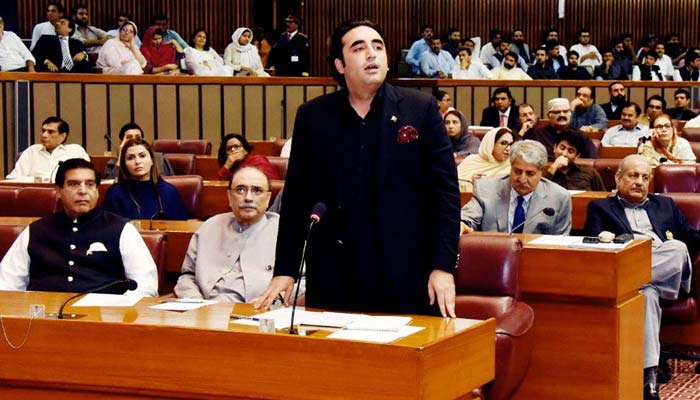
Chairman Pakistan Peoples Party Bilawal Bhutto Zardari has asked Prime Minister Imran Khan to rise to the occasion and provide leadership for the Kashmir cause instead of only one tweet and speech in the National Assembly.
Chairman Bilawal speaking in the National Assembly said that it is unfortunate that Speaker of the House was unable to complete the House as former Prime Minister Shahid Khaqan Abbasi, PML-N leader Rana Sanaullah and two representatives from South and North Waziristan are absent even today. Similarly, the House was incomplete on the occasion when the budget was presented in the Parliament.
Addressing the Kashmir issues he said that India has been using cluster bombs on innocent Kashmiris, educational institutions are closed, every kind of communication has been cut off, extra Indian troops have been sent to Kashmir and all the known political leaders have been arrested. The revoking of article 370 of the Indian constitution is an attack on the ideology of India, UN and international laws, democracy and the right of self determination of Kashmiri people. This opens the door to make Kashmiris a minority in their own land. This will not be accepted by the Kashmiri people, we the Pakistanis and the people of India should also follow suit in rejecting this treacherous act.
Shaheed Zulfikar Ali Bhutto is renowned for fighting for the Kashmir cause as he had said that we share history, geography, religion, blood and culture with the Kashmiri people. We will not remain silent at the time when Kashmiri brothers and sisters are calling us for help. It is unfortunate that PM Imran Khan did not give any policy statement in the House and the foreign minister is not even in the country.
Chairman PPP said that Prime Minister Modi is an extremist ruler who is the butcher of Gujrat and now occupies the post of Indian Prime Minister. He asked that if Pakistan had ever elected an extremist Prime Minister like Modi then would have India welcomed it? India has become an occupying force in Kashmir. Modi’s mandate is a hate mandate, he has been inflicting harm on Kashmiri people for the last five years and it is ironic that our PM Imran Khan was hoping and praying for his re-election. Modi has arrested the entire Kashmir leadership because every Kashmiri considers India’s act as illegal and the former Chief Minister of Kashmir Mehbooba Mufti has said that the day India revoked article 370 is the darkest day of Indian democracy.
Bilawal Bhutto Zardari asked Pakistani government to take drastic diplomatic actions and must engage United Nations and demand for a special session of OIC so that we can demonstrate that every Muslim country is united on Kashmir issue. He said that a commission should be constituted to investigate human rights violations in Kashmir. He also asked international community to take notice of Indian action.
Chairman PPP said Simla Agreement says that no side will take unilateral action. PPP hopes that Pakistani PM will put forward the case of Kashmir at all international forums but unfortunately, the government is just boasting the photo session of the US visit and is busy in crushing the Opposition. He said that we stand at the crossroads of history. The history will ask us where we were when Kashmiri youth were showered with pellet guns and bombed with cluster bombs.
We have only two options left now, Chairman Bilawal stated. Either to accept aggressive, treacherous and extremist Modi’s hegemony desert our Kashmiri brethren and live a life of humiliation or to rise to the occasion and reject Modi’s ideology. The latter is the honorable option, he said. Pakistan must act wisely as India has lost its credibility and legitimacy as a democratic state by revoking article 370. We have to speak as one voice, Pakistani voice. We must shun all our differences and unite for our Kashmiri brethren. We had a PM who had said that we will fight for ten thousand years for Kashmir cause, he concluded.

https://mediacellppp.wordpress.com/2019/08/06/chairman-bilawal-asks-pm-imran-to-show-leadership-ppp-is-standing-with-kashmir-cause/

Tuesday, August 6, 2019

بھارتی اقدام، عالمی قوانین، کشمیر اور جمہوریت پر حملہ ہے،مودی کے اقدام کو کشمیر مانتا ہے اور نہ ہی پاکستان، : بلاول بھٹو

چیئرمین پیپلزپارٹی بلاول بھٹو زرداری کا کہنا ہے کہ مقبوضہ کشمیر میں مودی قصائی ظلم کی آگ سے کھیل رہا ہے۔چیئرمین پیپلزپارٹی بلاول بھٹو زرداری کا کہنا ہے کہ مقبوضہ کشمیر میں مودی قصائی ظلم کی آگ سے کھیل رہا ہے۔
پارلیمنٹ کے مشترکہ اجلاس میں اظہار خیال کرتے ہوئے چیئرمین پیپلزپارٹی بلاول بھٹو زرداری کا کہنا تھا کہ مودی قصائی ظلم کی آگ سے کھیل رہا ہے، ایک قلم کی جنبش سے بھارت نےایک پینڈورا باکس کھول دیا، بھارت نے عالمی قوانین کی کھلم کھلا دھجیاں اڑائیں اور بین الاقوامی قوانین کی خلاف ورزی کرتے ہوئے کشمیریوں پرظلم کیا، بھارت کےاس اقدام کو نہ کشمیرمانتا ہے نہ پاکستان۔
بلاول بھٹو زرداری کا کہنا تھا کہ کشمیر کی تمام سیاسی قیادت کو قید کر دیا گیا، اور وہاں مزید ہزاروں فوجی تعینات کر دئیے گئے، نہتے کشمیریوں پر کلسٹر بموں سے حملہ کیا گیا، وادی میں موبائل فون سروس اور انٹرنیٹ بند ہے، مودی سرکار کا اقدام عالمی قوانین کی خلاف ورزی ہے، لیکن حیران کن طور پر پاکستانی حکومت کی پالیسی ابھی تک واضح نہیں، حکومت نے ابھی تک کوئی قانون سازی نہیں کی، کشمیر کے مسئلے پر وزیراعظم کی ٹویٹ سے کام نہیں چلے گا، وزیراعظم کی آج کی تقریر بھی ناکافی ہے، تاریخ ہم سے پوچھے گی جب کشمیر پر کلسٹر بم برسائےجا رہے تھے اس وقت ہم کہاں تھے، کشمیر کی شناخت بدلی جارہی تھی تو اس وقت ہم نے مجرمانہ خاموشی کیوں اختیار کی۔
 چیئرمین پی پی پی نے کہا کہ افسوس کی بات ہےکہ اتنےاہم اجلاس میں تمام ارکان موجود نہیں، پارلیمنٹ کے مشترکہ اجلاس میں خطاب کے لیے وزیر خارجہ نہیں، عمران خان وزیر خارجہ شاہ محمود قریشی کی اس کشیدہ صورتحال میں وطن واپس بلائیں ۔ پاکستان کو کشمیر کے معاملے پر ٹھوس اقدامات اٹھانے ہوں گے، پاکستان کو کوشش کرنی ہوگی اقوام متحدہ جا کر قراردادوں پر عملدرآمد کرائے اور انسانی حقوق کی خلاف ورزیوں پر خصوصی کمیشن سے تحقیقات کرائی جائیں۔  ہم کشمیریوں کی چیخ وپکارپر خاموش نہیں رہیں گے، ہمیں ایک قوم کی طرح کھڑا ہونا ہوگا، اس طرح کے مواقع پر قومیں بنا کرتی ہیں۔
ان کا کہنا تھا کہ گجرات کا قصائی آج بھارت کا وزیراعظم بنا بیٹھا ہے، یہ کیسے ہوسکتا ہے کہ مودی کے دوبارہ منتخب ہونے پر مسئلہ کشمیر کے حل کی امید رکھی جائے، پاکستان یو این میں آواز اٹھاتا رہے، او آئی سی کا خصوصی اجلاس بلایا جائے، اقوام متحدہ کی قرارداد کےتحت کشمیر متنازع علاقہ ہے، پاکستان وزرائے خارجہ کی سطح پر او آئی سی کا اجلاس بلانے کا مطالبہ کرے، حکومت انکوائری کمیشن کے لئے سلامتی کونسل میں معاملہ اٹھائے.
بلاول بھٹو زرداری کا کہنا تھا کہ شیریں مزاری کو وزیرخارجہ بنائیں، تو شاید وہ معاملہ بہترطریقےسے چلا سکے، ہماری حکومت ہوتی تو صرف ٹوئٹ کرتے تو خان صاحب ہمارے ساتھ کیا کرتے، عمران خان سے گزارش ہے بھرپورجذبے سے کشمیر کاز پر کام کریں.
 انہوں نے کہا کہ صدر مملکت کا شکریہ کہ انہوں نے پارلیمنٹ کا مشترکہ اجلاس بلایا، اسپیکر صاحب آپ کا شکریہ، آپ نے سابق صدر آصف زرداری کا پروڈکشن آرڈر جاری کیا۔
پی پی چیئرمین نے کہا کہ افسوس کی بات ہے کہ انتہائی اہم موقع پر بھی سارے ممبران اسمبلی اس وقت ایوان میں موجود نہیں، رانا ثنا اللّہ ،سابق وزیراعظم شاہد خان قان عباسی اور دوسرے ارکان کے پروڈکشن آرڈر جاری نہیں کئے جاسکے۔

Video - Chairman Bilawal asks PM Imran to show leadership; PPP is standing with Kashmir Cause


Chairman Pakistan Peoples Party Bilawal Bhutto Zardari has asked Prime Minister Imran Khan to rise to the occasion and provide leadership for the Kashmir cause instead of only one tweet and speech in the National Assembly.
Chairman Bilawal speaking in the National Assembly said that it is unfortunate that Speaker of the House was unable to complete the House as former Prime Minister Shahid Khaqan Abbasi, PML-N leader Rana Sanaullah and two representatives from South and North Waziristan are absent even today. Similarly, the House was incomplete on the occasion when the budget was presented in the Parliament.
Addressing the Kashmir issues he said that India has been using cluster bombs on innocent Kashmiris, educational institutions are closed, every kind of communication has been cut off, extra Indian troops have been sent to Kashmir and all the known political leaders have been arrested. The revoking of article 370 of the Indian constitution is an attack on the ideology of India, UN and international laws, democracy and the right of self determination of Kashmiri people. This opens the door to make Kashmiris a minority in their own land. This will not be accepted by the Kashmiri people, we the Pakistanis and the people of India should also follow suit in rejecting this treacherous act.
Shaheed Zulfikar Ali Bhutto is renowned for fighting for the Kashmir cause as he had said that we share history, geography, religion, blood and culture with the Kashmiri people. We will not remain silent at the time when Kashmiri brothers and sisters are calling us for help. It is unfortunate that PM Imran Khan did not give any policy statement in the House and the foreign minister is not even in the country.
Chairman PPP said that Prime Minister Modi is an extremist ruler who is the butcher of Gujrat and now occupies the post of Indian Prime Minister. He asked that if Pakistan had ever elected an extremist Prime Minister like Modi then would have India welcomed it? India has become an occupying force in Kashmir. Modi’s mandate is a hate mandate, he has been inflicting harm on Kashmiri people for the last five years and it is ironic that our PM Imran Khan was hoping and praying for his re-election. Modi has arrested the entire Kashmir leadership because every Kashmiri considers India’s act as illegal and the former Chief Minister of Kashmir Mehbooba Mufti has said that the day India revoked article 370 is the darkest day of Indian democracy.
Bilawal Bhutto Zardari asked Pakistani government to take drastic diplomatic actions and must engage United Nations and demand for a special session of OIC so that we can demonstrate that every Muslim country is united on Kashmir issue. He said that a commission should be constituted to investigate human rights violations in Kashmir. He also asked international community to take notice of Indian action.
Chairman PPP said Simla Agreement says that no side will take unilateral action. PPP hopes that Pakistani PM will put forward the case of Kashmir at all international forums but unfortunately, the government is just boasting the photo session of the US visit and is busy in crushing the Opposition. He said that we stand at the crossroads of history. The history will ask us where we were when Kashmiri youth were showered with pellet guns and bombed with cluster bombs.
We have only two options left now, Chairman Bilawal stated. Either to accept aggressive, treacherous and extremist Modi’s hegemony desert our Kashmiri brethren and live a life of humiliation or to rise to the occasion and reject Modi’s ideology. The latter is the honorable option, he said. Pakistan must act wisely as India has lost its credibility and legitimacy as a democratic state by revoking article 370. We have to speak as one voice, Pakistani voice. We must shun all our differences and unite for our Kashmiri brethren. We had a PM who had said that we will fight for ten thousand years for Kashmir cause, he concluded.
https://mediacellppp.wordpress.com/2019/08/06/chairman-bilawal-asks-pm-imran-to-show-leadership-ppp-is-standing-with-kashmir-cause/

Video - #BilawalBhutto #PPP Bilawal Bhutto Zardari aggressive speech in Joint session of Parliament | 06 Aug 2019

Balakot, economic crisis, IMF deal batter Pakistan rupee as it falls 16% to 160/$ since Feb


 and 

Pakistan rupee depreciated by 50% in Dec 2017-July 2019. With forex reserves left for one-and-a-half months of imports, Pakistan faces balance of payments crisis.

The Pakistan rupee has dropped to 160 against the dollar on the back of ballooning deficits and tough conditions imposed by the International Monetary Fund (IMF) for a $6-billion bailout to aid the nation’s ailing economy, among other factors.
The Pakistan rupee (PKR) has fallen 16 per cent since February, depreciating by 50 per cent between December 2017 and July 2019. 
On 11 December 2017, approximately 105 PKR could have purchased $1. In 2018, the exchange rate increased to around 139 PKR per USD. Towards the end of June this year, this exchange rate peaked at about 163 PKR per USD. 
A host of factors have contributed to this slide, including tensions with India in the wake of the 14 February Pulwama attack by the Pakistan-based Jaish-e-Mohammed (JeM) and New Delhi’s retaliation with the Balakot air strikes, which hurt sentiments in the currency markets. 
With forex reserves sufficient to only service one-and-a-half months of imports, Pakistan is facing a balance of payments crisis, which occurs when a country’s imports exceed its exports and it doesn’t have sufficient capital inflows to finance the gap. This forces the country to deplete the nation’s forex reserves to bridge the deficit, known as current account deficit. 
With the fiscal deficit — more expenditures than revenue — on the rise as well, Pakistan is in the midst of serious twin-deficit problem. 
Slowing growth and rising inflation are also stoking fears of stagflation, creating a dilemma for policymakers because monetary policy cannot tackle both problems at once. 
Pakistan’s GDP is expected to grow at around 3-3.3 per cent in the year ending June 2019, as against 5.5 per cent in the year-ago period. Inflation, measured by the consumer price index, is also on the rise. 
In June 2019, it was around 9 per cent, as against 5 per cent in the year-ago period, according to State Bank of Pakistan data. 
To add to the country’s woes, the trading community is rattled by the austerity measures introduced by the Imran Khan government in keeping with the IMF’s conditions for the recent $6 billion bailout, Pakistan’s 13th since the late 1980s. 
The conditions included expanding the tax base — just about 1 per cent of Pakistanis reportedly pay tax — and cutting some preferential subsidies, while mandating the production of ID documents for purchases of over PKR 50,000 to cut tax evasion and traders’ resentment has manifested in backlash against the administration, including a nationwide strike last month.
Another condition was to end government intervention in fixing the exchange rate and let it be determined by the market.

Occasional interventions

Pakistan has been running a current account deficit for some time now. Between the financial years 2015 and 2017, its current account deficit increased from $3.12 billion to $12.49 billion. 
In a market-driven freely-floating exchange rate system, an increase in current account deficit puts downward pressure on the currency of a country. 
Pakistan, however, doesn’t exactly follow this model, and the State Bank of Pakistan, the country’s central bank, “occasionally intervenes in the foreign exchange market” to “quell excessive volatility and to ensure the smooth functioning of the foreign exchange market”.   
During the period in question, Pakistan deliberately kept its currency overvalued. 
In 2016, according to the IMF, Pakistan’s currency was overvalued by as much as 20 per cent. To achieve this, Pakistan kept pumping foreign currency into the market, even at the cost of a significant depletion of its foreign exchange reserves. 
According to a report in Dawn this March, “When Ishaq Dar was Pakistan’s finance minister between 2013 and 2017, he ensured that the dollar’s price stayed around 105 rupees.” 
It quoted a State Bank of Pakistan official as saying that “…he [Ishaq Dar] was fixated on keeping the exchange rate at 105 rupees… Every time there was even a slight movement in the exchange rate, our team would fly to Islamabad — sometimes even on Sundays — to explain its reasons to the finance minister”. 
And to finance the current account deficit, Pakistan tapped into foreign capital inflows like “bilateral loans from friendly countries, bond auctions in foreign markets and the privatisation of state-owned enterprises”, the report added.
In November 2017, Dar resigned, and his resignation was followed by a series of devaluations. 
By this time, the costs of debt servicing, which represent capital outflows, had increased. 
According to a July 2018 report in Scroll, foreign exchange reserves came under added pressure“as a result of problems on both current and financial accounts”, and “declined from $16.14 billion on 30 June 2017 to $10.26 billion  on 14 June 2018”. 
In this context, devaluation became important. A devaluation can help in partly offsetting current account deficits by improving exports by making them cheaper, and reducing imports, which then become costlier. However, neither of the two things seem to have happened for Pakistan.    

Further fall in rupee?

The weakening foreign exchange position sent a negative signal to the market, leading to an increased demand for the dollar and depreciation of PKR. 
Similar sentiment was again seen in May this year when Pakistan accepted the IMF bailout and PKR breached the 150-per-dollar mark on the expectation that Islamabad would move towards a market-determined exchange rate, as demanded by the IMF.  
Economist Kaiser Bengali, who has worked with various Pakistani governments, noted in a Bloomberg report this May that “this knee-jerk reaction of the market will continue…”. 
“Given our large deficit and high debt ratio, the rupee will continue to decline. The rupee will be 200 a dollar by year-end,” he added. 

However, another expert, Ahmed Ateeq, head of treasury at Karachi-based Pak Brunei Investment Co, offered a different view, saying, “The rupee will hover around 150 for now but we may see a 5%-6% drop by year-end that is normal for a nation like Pakistan”.

China and Muslim countries silent, Pakistan alone protests Kashmir move

Ajai Shukla 


Pakistani analysts demandg to know whether Imran Khan and Donald Trump discussed New Delhi's plans for J&K during their meeting in Washington on July 22.

The government’s abrogation of the provisions of and the bifurcation of Jammu & Kashmir (J&K) into two union territories – Ladakh and J&K – has evoked little response from governments across the world.
Pakistan has been the only country to condemn New Delhi’s move. Declaring that “Indian Occupied is an internationally recognized disputed territory”, the Ministry of Foreign Affairs (MOFA) in Islamabad stated: “As the party to this international dispute, Pakistan will exercise all possible options to counter the illegal steps.”
While Pakistan has long sought to internationalise the Kashmir dispute, Islamabad will be introspecting about whether its apparently successful ploy – in which Prime Minister got President Donald Trump to offer his services in mediating the Kashmir dispute – actually caused New Delhi to move quicker in abrogating Kashmir’s special status.
Pakistani analysts are demanding to know whether Khan and Trump discussed New Delhi’s plans for J&K during their meeting in Washington on July 22, and whether the Pakistan Army was aware of the impending announcement.
“Question is what was DGISI (director general of Pakistan’s Inter-Services Intelligence) doing that he couldn’t gather the intel[ligence] regarding what India had planned in Kashmir? Why did it come as a surprise?” asked Ayesha Siddiqa, the acclaimed author of Pakistan Inc., a book on the Pakistan Army’s business dealings.
Islamabad’s criticism of New Delhi’s bifurcation of J&K is weakened by its own restructuring in 1970 of Pakistan Occupied Kashmir (POK), from which it carved out a federally administered chunk of territory that it designated the “Northern Areas”. New Delhi is now mirroring that Pakistani move, by carving out Ladakh from J&K and designating it a union territory that will be directly administered from New Delhi.
In 2009, President Asif Zardari renamed the Northern Areas as Gilgit-Baltistan and granted the territory a degree of autonomy. However, local activists protest vocally that power continues to rest with the centrally-appointed governor, not the elected assembly.
There was silence too from the Organistation of Islamic Countries (OIC), which tends to be supportive of Pakistan. On August 4, the OIC had stated it was “deeply concerned about the deteriorating situation in the Indian occupied Jammu & Kashmir, including reports of deployment of additional paramilitary forces and use of banned cluster munition by Indian forces to target civilians.” However, the OIC has not reacted to the actual scrapping of 
Beijing has remained silent, even though New Delhi has changed the status of Ladakh. claims large parts of Ladakh, such as the Aksai Chin plateau.
In 1963, Pakistan ceded to a 6,000 square kilometre chunk of J&K, called the Shaksgam Valley. In countering New Delhi’s protests at the occupation of its claimed territory, states that its control of Shaksgam is contingent on the final resolution of the J&K dispute. However, Shaksgam will now fall within the union territory of Ladakh, not in J&K.
In contrast to the silence from the international powers, the Indian notification on J&K has been reported widely in the world media, including amongst the lead stories in BBC, CNN and Al Jazeera.