
Saturday, July 27, 2019

Last Resort: India and Pakistan's Informal Schools


By 

NEW DELHI / KARACHI / JAIPUR / MULTAN — In a slum on the outer periphery of Gurgaon, far away from all the trappings of luxury, lives Pooja — a young bright-eyed girl who dreams of a better life. Like many her age, Pooja is not privileged to receive education at a private school. The 15-year-old hails from a family of poor migrants who have never witnessed the miracles of education.
Pooja is enrolled at a small makeshift school with a frail structure and temporary ceiling that shivers when strong winds blow.
“I want to become a teacher,” she says in a brittle voice.
Her face glows with joy every time she talks about her school. Pooja’s school is no ordinary school. She receives education at a mobile school.
Across the Radcliffe line in Maripur, Karachi, approximately, 1,000 kilometers away from Pooja, lives Roshail Atta Mahommad. The 17-year-old’s life has an uncanny resemblance to Pooja’s situation. She too has defied all social and cultural odds for education. Roshail, like Pooja, wants to become a teacher and contribute to her community’s well-being.
Even after 70 years of independence, millions of children in India and Pakistan are deprived of education. Both countries are confronting the perils of their failure to educate their citizens, notably the poor. Pooja and Roshail are among the deprived generation who were left out of the state-run education system in their respective countries.
The two may be divided by the border, but they are united by the failure of their governments to fulfill their basic fundamental right to education.
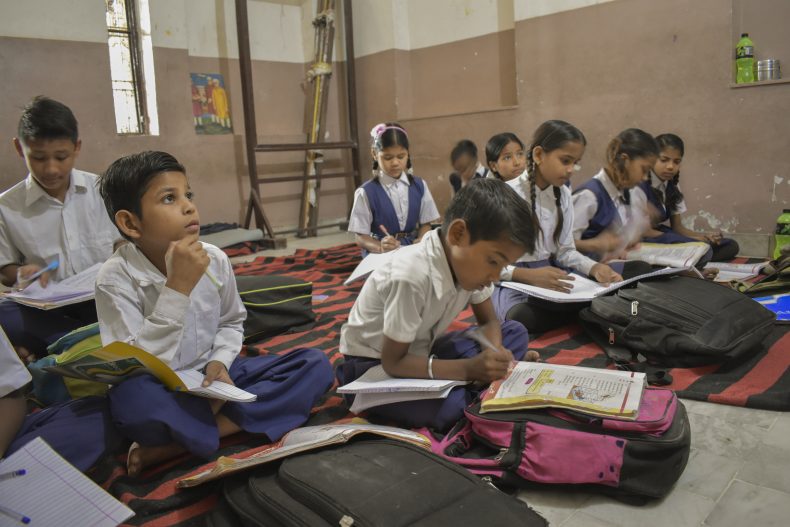
Children study in an informal school in Jaipur. The classrooms don’t have benches in order to accommodate more children.
For decades governments in India have made tall symbolic promises about improving the state of education in India. They’ve conceived policies and plans that have been nothing more than toothless paper tigers. The Bharatiya Janta Party (BJP)-led government in Delhi has slashed education spending by nearly 50 percent in the last 4 years. Such misplaced national priorities deprive many like Pooja of education — a promised universal birthright.
Echoes of similar hollow political promises are also responsible for the burgeoning education crisis in Pakistan.
The two nuclear rivals inherited innumerable common issues. Education is one of them. In many ways their approaches to the issue have been similar too. The two arch-rivals have identical laws that ensure free and compulsory education but little has been done to implement them. The Right to Education Act, 2009 (RTE) in India recognizes free and compulsory education for children between the age of 6 and 14, under Article 21a of the Indian Constitution. Similarly, in Pakistan Article 25-A of the constitution guarantees the right to free education to all children between the ages of 5 to 16. The right to education was enacted, in both countries, with the idea to improve the state of education, but it has been haunted by procedural inefficiencies.
According to Academy of Educational Planning and Management (AEPAM) report, an estimated 22.8 million children are out of school between 5 and 16 in Pakistan and those who do go to school haven’t even achieved the basic learning levels.
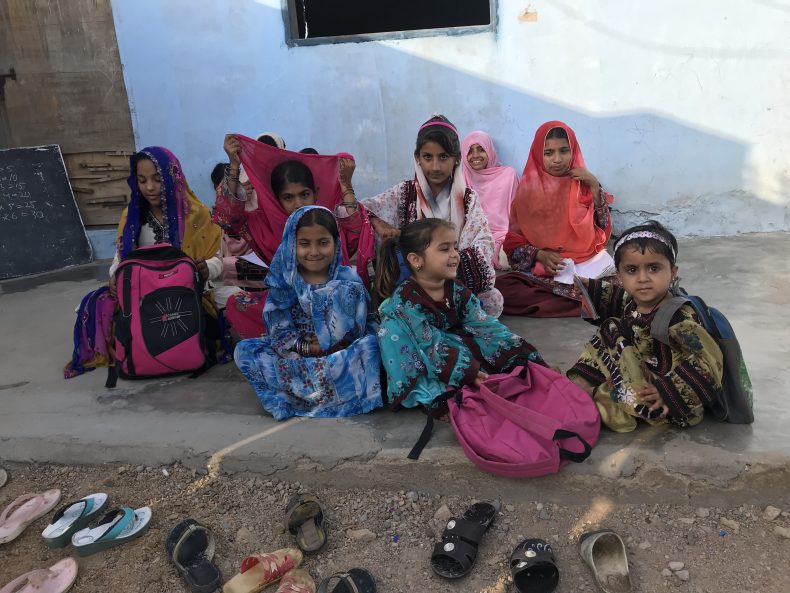
Students prepare to go back home after a productive day at their makeshift school, the Tikri Education Center outside Karachi.

The Heroes

When governments fail to deliver fundamental rights, people rise to help their communities. Sandeep Rajput in India and Gamwar Baloch in Pakistan are two such heroes.
The mobile school, run by Rajput, 41, is a free education facility on wheels. Rajput is known for chasing illiteracy in decrepit areas of Gurgaon in an old public bus. The decommissioned vehicle, once used by commuters, is now reconfigured to serve as a classroom on wheels. It is equipped with small tables and everything else a teacher might need to run a classroom. Rajput’s school on wheels, as it’s commonly known, is also recognized by the National Institute of Open Schooling (NIOS).
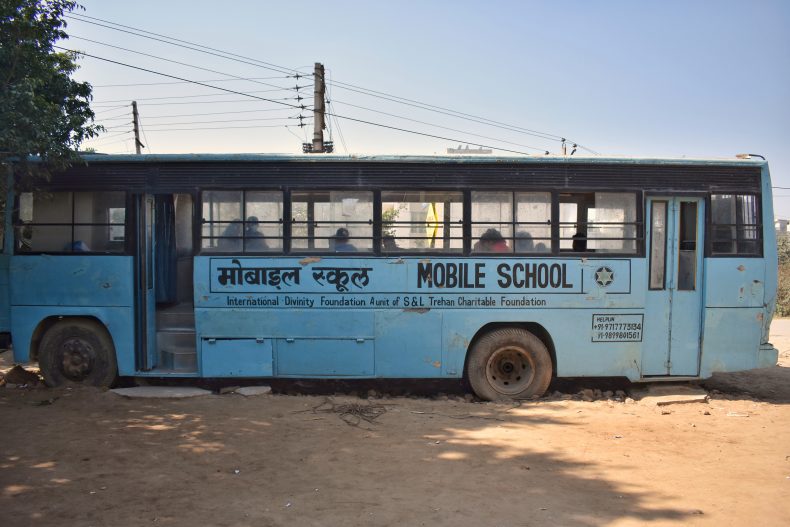
This converted bus acts as a mobile classroom for children.
Rajput blames the government for failing to support free education. “The school in this area was visited by a local commissioner once who made tall promises but we’re still waiting for him to deliver upon them.”
With limited resources, Rajput claims that the school is self-sufficient and runs with the help of independent donors or funds provided by corporate organizations.
“So what if they can’t go to a school, we can ensure that a school reaches their doorsteps and that’s where our mobile school plays a crucial role,” Rajput says passionately.
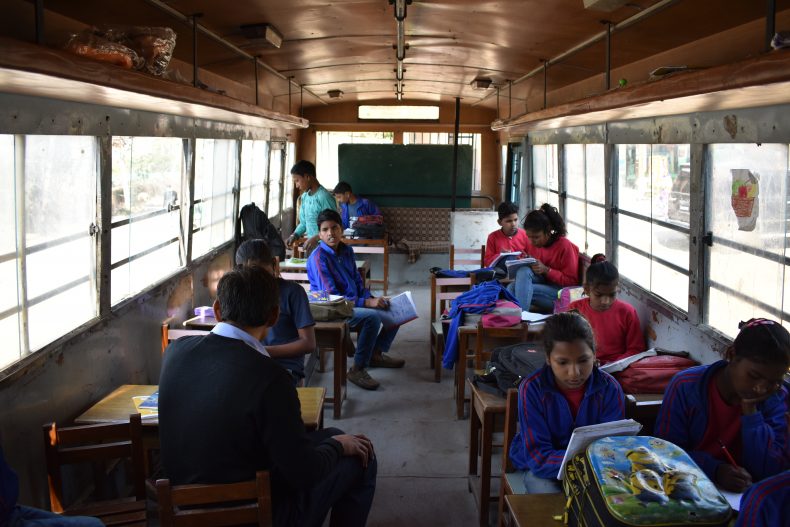
A busy day in class for Mobile School students in Gurgaon.
Like Rajput, Pakistan too has a warrior, who fights against an unfair educational system. In 2013, Gamwar Baloch, 21, established a makeshift school named “Tikri Education Center.” The school provides free education to the deprived students in Maripur — a neighborhood of Kiamari town in Pakistan’s southern port city of Karachi. Baloch helps those who have been neglected by the state and are at the very bottom of Pakistan’s social ladder.
Infrastructure is weak at her school. There are no benches and there are no desks. All of her 300 students are seated on the floor during class hours. Roshail was one of those students who survived the challenges and made it through. She now teaches along with Baloch, who is supported by a staff of three permanent teachers at the school.
“I don’t want girls from my community to suffer or struggle for education,” says Roshail, who has joined Baloch’s small army of heroes fighting the war against illiteracy in Maripur.
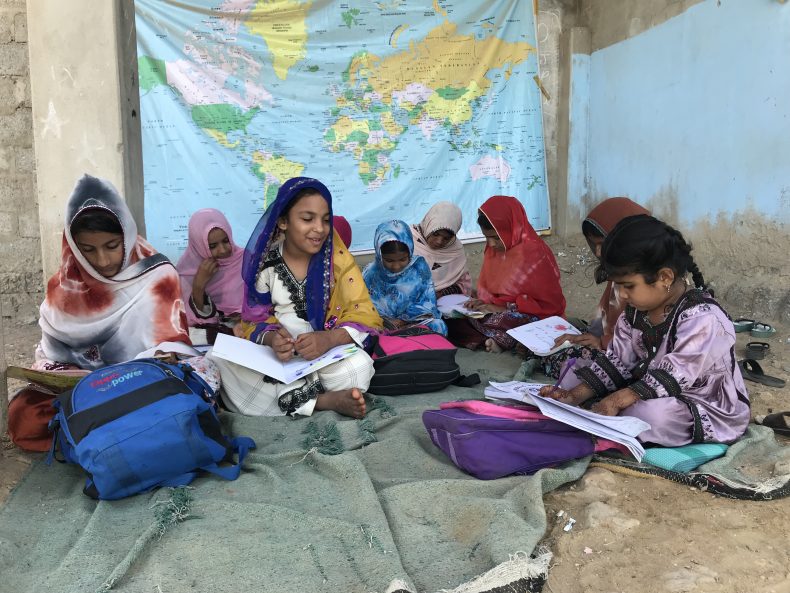
Students at Tikri Education Center.
Despite all the political promises of promoting equality, education has become a crucial marker of inequality in both India and Pakistan. In Rajasthan, education remains a distant dream for Pooja and many like her.
“I want to pursue so many things but that is not possible,” she says with a tinge of hopelessness in her voice.

The Struggle

In her hostel-cum-school building, Shivani has found a quiet corner for herself to study in a big shared room. She has her medical entrance examination approaching in 15 days. Her days are spent surrounded by medical books piled on top of each other. She is not an ordinary girl and her struggle sets her apart from the 200,000 other medical aspirants. The 19-year-old recollects childhood memories of her father abandoning her after her mother’s death, and a careless family structure. Her past hasn’t deterred her spirits.
Shivani was enrolled in a makeshift school in Jaipur, Rajasthan, when she was four years old. After several years of teaching students in open spaces, parks, under makeshift tents, the school finally moved to a three-story building in 2008 where she studies and resides along with many children who have been deprived of education by an unfair state-run system. The school is run by 66-year-old Vimla Kumawat, whom the children fondly refer to as “Dadi.” The school has been named Sewa Bharati Bal Vidyalaya after the organization Sewa Bharati, which is one of the major donors of the school.
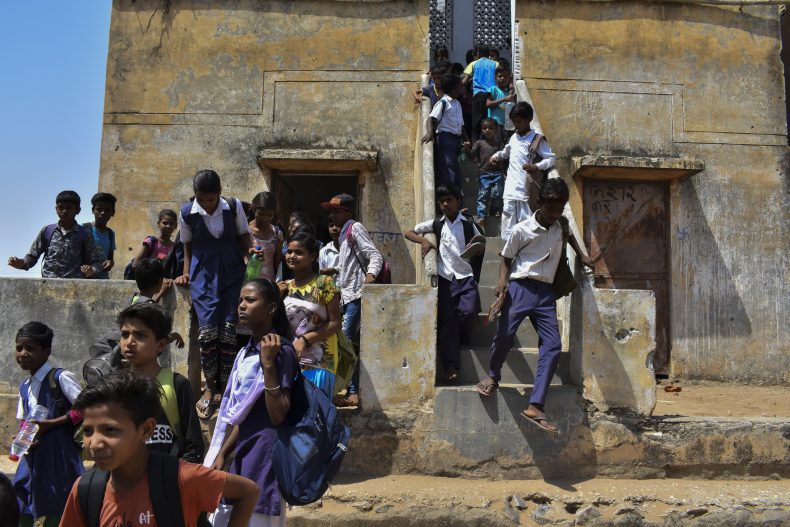
Children rush back home after a busy day at their informal school in Jaipur.
The stories of struggle by children of marginalized communities in India and Pakistan have an uncanny resemblance. Away from the deserts of Rajasthan, India, along the banks of Chenab river, resides Mohammed Siddiq, who is the founder of Ujala foundation — a temporary school for underprivileged students in Multan. One such student is Iqra whose illiterate parents dreamed of educating their daughter. Owing to financial constraints, they couldn’t provide for her education. However, Siddiq’s makeshift school ensured that children like Iqra do not remain deprived of education.
Now she vows to help children who belong to the bottom of Multan’s multilayered society where Saddiq’s makeshift school is their only hope and individuals like her are saviors.
Initiatives by local superheroes like Vimla Kumawat and Mohammed Siddiq play a pivotal role in the lives of children who are struggling to acquire good education — a fundamental and promised constitutional right in Pakistan and India.
Shivani’s journey from a life of ignominy as a ragpicker to a medical aspirant studying in a premier coaching institute of the city is a journey from the margins to the mainstream. However, the community in which she was born, Valmiki (Dalit), is still hesitant to allow girls to study.
“If Shivani clears her medical entrance, it will be a beacon of hope for the children and motivate them to push their boundaries,” remarks Kumawat, her eyes carrying a hope for a better future.
To win Shivani’s admission in a medical coaching program, Kumawat waited two days at the reception of the coaching institute in the hope that she would get a fee waiver. The journey hasn’t entirely been easy for Kumawat. Coping with the lack of money, she has had a tough time managing the needs and expenses.
“There have been days when I couldn’t even provide the students with notebooks but I’ve never given up,” says Kumawat with her usual politeness and unwavering resolve to fight the battle against an unfair education system in India.
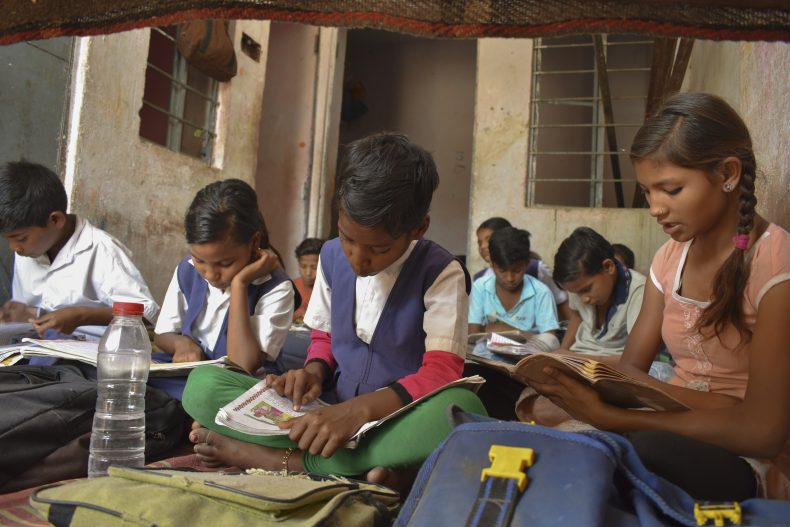
In this informal school in Jaipur, close to 30 students are crammed in a 10×10 room.
Siddiq faces a similar situation in Pakistan. He does not receive any support from any organization, “I believe that education of underprivileged children is the society’s responsibility,” says Siddiq.
Vimla Kumawat’s school in Jaipur’s Mahesh Nagar has another branch on the outskirts of the pink city, in Baksawala. The area is inhabited by people from the Dalit community, who live in slums. Their homes are located along the main road and the nearest government school is one-and-half kilometers away.
“Parents are reluctant to send their children to government school because they have to cover this distance by foot,” says Ashok, the upkeeper of Baksawala makeshift school. The school at Baksawala has no permanent structure. Children study under a tree or out in the open, fighting the high temperatures in Rajasthan.
Ashok runs the school with two more volunteers. They found an abandoned building for children to study. The children are crammed in tiny congested rooms with little space for movement. A small window and the classroom door act as the only source of natural light and air.
When it comes to the deficiencies in the education system, K. B. Kothari, managing trustee of Pratham Education Foundation, a charitable trust that works toward the provision of quality education to underprivileged children in India, puts the blames squarely on the political leadership in the country.
“The major responsibility for this [failure] must be attributed to political leadership at all levels,” Kothari says.
Nevertheless, both India and Pakistan have heroes like Kumawat and Siddiq, and warriors like Shivani and Iqra. They stand tall against all odds and against all failures.
“I used to roam around garbage for rag-picking,” Shivani recalls without batting an eye. “I dream of becoming a doctor now,” she says, with a visible glow on her face.
This story is a collaboration by journalism students of AJK MCRC, Jamia Millia Islamia (India) and the Center for Excellence in Journalism (Pakistan). The team members include Madhuraj, Sarah Khan, Babrah Muskan Naikoo, and Tehseen Abbas.

Imran Khan govt took away a chance from Pakistan’s terror-infested FATA to join mainstream


FATA had its first provincial election in Pakistan’s history last week. But rigging and military crackdown made sure the region remains open for Taliban.

The recent election in Pakistan’s former tribal districts was an opportunity for millions to vote their representatives into the Khyber Pakhtunkhwa provincial assembly for the first time in the country’s history. The 20 July election was a key marker in the ongoing merger of Federally Administered Tribal Areas, or FATA, with the Khyber Pakhtunkhwa province to bring the region into Pakistan’s constitutional and administrative mainstream.
But with reports of massive rigging, this historic election turned out to be a lost opportunity for not only Pakistan but also for the international community. Widely regarded as a terror-infested territory bordering Afghanistan, a clean election in FATA could have potentially overturned the dirty strategic games being played there for long, and also provided a critical window in case Doha peace talks come undone.

FATA’s troubled past

Until May last year, the erstwhile FATA was ruled directly by the President of Pakistan under a set of colonial-era laws, including the draconian and discriminatory Frontier Crimes Regulation, which runs contrary to all provisions of fundamental rights and due process in the Constitution of Pakistan.
FATA was infested with several militant groups like the Tehrik-i-Taliban Pakistan (TTP) and Haqqani network. It also served as the base and launch pad for the ‘mujahideen’ of the 1980s fighting then USSR-backed Babrak Karmal regime in Afghanistan, and later the USSR itself. Pakistani police or the courts of law had no jurisdiction in this land, which was governedthrough tribal Maliks and government-appointed political agents. Hence, the seven districts in FATA region have remained severely underdeveloped, with some of the poorest socio-economic indicators to show in the country. The region has also been an information black hole, primarily serving as a place from where strategic policies with regards to Afghanistan were devised.
Until 1997, voting rights in FATA were not uniform, with only a few thousand tribals allowed to vote or contest elections as ‘Independents’. It was only in August 2009 that then-President Asif Ali Zardari announced the lifting of the ban on political activities in FATA, supposedly keeping his wife and former Prime Minister Benazir Bhutto’s wish. Zardari, however, couldn’t implement it because of the military’s resistance.
FATA remained the place from where the entire infrastructure of ‘jihad’ – the militant-producing madrassas like the Haqqania – continued to thrive.

Robbed by a rigged election

Political parties were finally allowed into FATA in 2011 – two years after Zardari’s announcement.
Therefore, the 2019 election, being the first under a constitutional decree and thus a redressal mechanism, should have served as a watershed to ‘open up’ FATA. It should have become the moment that gave its people genuine representation in the local assembly to have their grievances heard by mainstream Pakistan. But this process was subverted with heavy rigging to bring in Imran Khan’s Pakistan Tehreek-e-Insaf (PTI) and some ‘Independent’ puppets while keeping out popular candidates belonging to the Awami National Party (ANP), Pakistan People’s Party (PPP), and the Pashtun Tahafuz Movement (PTM).
Barring PTI candidates, all were harassed with arrests, FIRs, threats or simply prevented from campaigning through the imposition of curfews. The environment in the run-up to the election was made so harsh and frightening that not a single party president or chairman could visit and campaign for their candidates.
PTI candidates, on the other hand, campaigned under military protection or under the aegis of armed good Taliban. None of this is recorded in the mainstream press or media. Journalists like Adnan Bitani and Ihsan Tipu Mehsud (who covers Khyber Pakhtunkhwa for The New York Times) and several activists from Waziristan have, however, recorded these violations and manipulation of the election in the form of videos, narrating arrests, attacks, harassment, and election-day rigging on social media.
The PTI Candidate Naseer Wazir staging firing of his victory by Good Taliban with heavy weaponary in WANA Wazirstan. They have violated all the rules & laws of ECP. How will National & KP Govt respond to this. Injustice in Justice Party Rule.
Protests by supporters of the Pashtun Tahafuz Movement ahead of the election revealed a curious and worrying development – that of an attempt to re-Talibanise the tribal region as a launch-pad for attacks in Afghanistan and as a counter-force to the PTM itself, which demands peace in the area and resists the Taliban. Until the end-game in Afghanistan, that is the successful installation of the Taliban in Kabul as part of a coalition government through the US-Taliban ‘peace negotiations’ – the security establishment does not want to open up the FATA.

Keeping the Taliban’s base intact

An isolated, unrepresented black hole FATA, in particular in North and South Waziristan, would then continue to serve as the Taliban’s base for a new wave of attacks on neighbouring Afghan provinces of Khost, Paktia, Paktika, etc should the Doha talks fail for any reason. The Haqqani network is stationed in these two former agencies of FATA. So, if the Taliban are not catapulted into Kabul, they will at least rule the provinces to continue their march towards the capital.
Towards this aim, ingenuous election rigging plans were conceived and executed. For example, the population census of FATA of 2017 wiped out half the population of the region, which politicians and activists of the area have estimated to be at least 10 million based on the government’s own numbers of refugees leaving from or returning to the tribal areas after various operations. This effectively robbed the region of its due number of seats in the national and provincial legislatures during the delimitation exercise ahead of the merger.
Mohsin Dawar, the massively popular PTM activist and member of the national assembly from North Waziristan, managed to table and get the 26th constitutional amendment bill passed unanimously. The bill had sought to increase the erstwhile FATA’s seat share from 6 to 12 in the national assembly and from 16 to 24 in the Khyber Pakhtunkhwa provincial assembly. But he was thwarted by Senate Chairman Sadiq Sanjrani’s efforts to repeatedly withdraw the bill from the agenda. The bill ultimately became redundant because the Senate never got a chance to act on it. Had the bill passed into an Act, Mohsin and PTM’s popularity would have further soared, leading to a clean sweep by the PTM in the provincial election.
One of the biggest attacks on the fairness of the recent election was the May 26 Khar Qamar incident, when MNAs Ali Wazir, Mohsin Dawar and activists of the PTM came under military fire. Thirteen people, including two children, were killed (the military says three); Wazir and Dawar were ‘arrested’ and prevented from campaigning for their candidates in FATA. They remain in prison to this day.
What happened in the FATA election, therefore, has domestic as well as international implications. Domestically, a transparent and genuine election would eventually have led to the presence of the Taliban, their bases, and the military’s illegal internment centres in the erstwhile FATA to be exposed. From the transnational perspective, it was important to keep options open in case of a collapse of the Doha talks.

10 Pakistani soldiers killed in two separate incidents: Military


Six killed by rebels while patrolling near the Afghan border in North Waziristan, while four were killed in Balochistan.
Ten Pakistani soldiers have been killed by armed rebels in two separate incidents on Saturday in the country's northwestern and southwestern provinces, the military said.
Six soldiers patrolling near the Afghan border were killed in North Waziristan when the attackers opened fire from the Afghan side, according to a statement by Pakistan military's Inter-Services Public Relations (ISPR).
The statement said "terrorists from across the border" fired on a patrol near Gurbaz in the North Waziristan region.
Separately, the military said four paramilitary troops were killed in the southwestern province of Balochistan during a combing operation against the armed fighters.
The rebels fired on the soldiers during the operation between Hushab and Turbat areas in Balochistan. A senior army officer was among those killed.
The North Waziristan ambush was claimed by the Pakistan Taliban, known by the acronym TTP, Reuters news agency said. The group is separate from the Taliban across the border in Afghanistan.
Waziristan - once a focal point in the so-called "war on terror" - held provincial elections for the first time earlier this month, a key step in bringing the northwestern region into the political mainstream after years of turmoil fuelled by an armed rebellion.

The United States has long insisted the area provides safe havens to armed groups, including the Taliban and al-Qaeda - an allegation Islamabad denies.
In recent years, Pakistani forces have conducted a series of operations against armed groups, including the Pakistan Taliban, in the North Waziristan region. While officials say the area has largely been pacified, small scale attacks continue to take place.
Balochistan is an important part of transport and energy projects that form part of China's Belt and Road Initiative, which has brought $57bn of investment to Pakistan.
Balochistan is rife with ethnic, sectarian and separatist attacks, and a number of armed groups, including the Pakistan Taliban and the Balochistan Liberation Army, operate in the province.

Survey: Over 50% families in #Pakistan cannot have two meals a day

According to the National Nutrition Survey 2018, poverty keeps more than 50 per cent of Pakistani families from having two meals a day.

HIGHLIGHTS

  • Nearly half of all the families in Pakistan are unable to meet their nutritional needs
  • Poverty keeps more than 50 per cent of Pakistani families from having two meals a day
  • 40.2 per cent of all children in Pakistan are affected by chronic malnutrition
Nearly half of all households in Pakistan are unable to meet their nutritional needs, the first ever survey of its kind in the country has revealed.
According to the National Nutrition Survey 2018, poverty keeps more than 50 per cent of Pakistani families from having two meals a day, leading to severe dietary deficiencies, the Express News reported.
As a result, as many as 40.2 per cent of all children in the country are affected by chronic malnutrition and stunted growth, which inhibits both their cognitive and physical development, the exercise carried out by the Ministry of National Health Services (NHS) revealed.
The survey also discovered that 36.9 per cent of Pakistani households remain food insecure and lack reliable access to affordable nutritious food in sufficient amounts.
To counter the nutritional emergency as quickly as possible, the federal government has drafted a food fortification bill for the first time in Pakistan's history, Pakistan Pediatric Association (PPA) Secretary General Dr Khalid Shafi said.
The bill, among other things, will make addition of micronutrients mandatory in items like flour and ghee, he said.
Among the key findings of the survey is that only 48.4 per cent of women in Pakistan breastfeed their children during infancy. It also found malnutrition to be at least partially a hereditary issue as women who lacked necessary nutrients in their diet gave birth to weak children.
Four out of every 10 children under the age of five in Pakistan were discovered to be affected by stunted growth and lack of education and awareness was found to be a significant factor behind this.
The study also discovered dietary discrimination in the favour of boys over girls in a significant number of families in the country.
The objective of the survey was to draw the attention of policymaking institutes towards the ever-growing problem of malnutrition among Pakistani children.

Friday, July 26, 2019

Opinion: Trump Gave Pakistan What It Wanted, But Afghan Peace Is Far From Guaranteed


SHAMILA N. CHAUDHARY
On Tuesday, Pakistani Prime Minister Imran Khan wrapped up a three-day visit to Washington, D.C., at the invitation of President Trump. The much-anticipated visit followed last year's cuts in U.S. aid to Pakistan and wrangling between the two leaders on Twitter, where Trump accused Pakistan of deceit and Khan retorted that Pakistan wasn't to blame for U.S. failures in Afghanistan.
And it was, of course, Afghanistan that figured centrally in Khan's visit, which took place as U.S.-led peace talks continue with the Afghan Taliban. When describing U.S. policy in Afghanistan in a talk on Tuesday, Khan invokedAlbert Einstein's definition of insanity: doing the same thing over and over and expecting different results. Khan wanted to let everyone know that under his watch and Trump's leadership, the insanity was now over.By the time he wrapped up his visit, Khan had secured what Pakistan has always wanted: a seat at the table on Afghanistan, and the Pakistani perspective acknowledged. (Trump even said he'd like to mediate between India and Pakistan over the disputed territory of Kashmir, something India sees as a purely bilateral issue. The State Department later walked Trump's statement back).
The extent to which Pakistan will go to protect what it has gained this week remains to be seen, as does the extent to which the U.S. will want to keep Pakistan happy. This week, Khan hinted at a future meeting in which he would engage directly with Afghan Taliban leadership. If so, such a meeting would present a tremendous opportunity for Pakistan to cement its seat at the table in the broader infrastructure of the peace talks. The United States will unequivocally appreciate and capitalize on the additional channel of communication to pressure the Afghan Taliban — something to which Trump alluded on Monday during his press conference with Khan.
"I think Pakistan is going to help us out to extricate ourselves," Trump said, later remarking that he preferred this to his "plans on Afghanistan that if I wanted to win that war, Afghanistan would be wiped off the face of the Earth. It would be gone. It would be over in — literally, in 10 days. And I don't want to do — I don't want to go that route."
Khan likes to point out that he long supported a political solution in Afghanistan, before any other leader or government did. Likewise, Trump repeatedly calls out the failure of the Obama administration in prioritizing nation-building over ending the war. Their overlapping perspectives have created a convergence on Afghanistan in which Trump offers Pakistan a legitimate role — perhaps a longstanding one — in shaping the future of Afghanistan.
Pakistan's interest in Afghanistan's future relates to its concerns about the Indian presence there, which it believes poses direct threats to its security. Moving forward, India will continue to feature prominently in how Pakistan views Afghanistan.
But also driving Pakistan's interest in shaping Afghanistan's future is a pragmatic desire to gain influence in a rapidly fluctuating and complex geopolitical environment. When Pakistan looks to Afghanistan, it doesn't only see India. It also sees China, the United Arab Emirates, Iran, Saudi Arabia and other countries involved in a pursuit of transit routes, mineral extraction, port development and more.
Furthermore, no single country — namely, the United States — picks the winners and losers. Rather, current and future geopolitical competition in Afghanistan is defined by all countries playing all sides with each other, and by Afghanistan itself.
It is within this context that Pakistan must redefine itself from a pariah state that created and bolstered the Afghan Taliban — stoking U.S. anger and mistrust — to a collaborative, regional actor that engages all stakeholders and centers of power in Afghanistan and the region.
With these motivations in mind, Pakistan doesn't need to think twice about whether or not to pressure the Afghan Taliban to acquiesce to American demands for a cease-fire and engaging in an intra-Afghan dialogue.
The Trump-Khan view of how the war ends in Afghanistan strikes an important point — that Pakistan's interests and challenges in Afghanistan demand more attention than previous American governments afforded it. This week, Trump seemed to remedy that. But in the future, factors external to U.S.-Pakistan relations will test this spirit of renewed pragmatism.Pakistan's strained relations with the Afghan government, the Afghan government's own intra-Afghan dialogue and the involvement of other interlocutors such as China all demand a careful diplomatic approach that considers the multiple relationships in play. To date, those relationship dynamics fluctuate from friendly and collaborative to antagonistic and disengaged. The future likely holds more of the same. And if the United States and Pakistan move too fast on their track, Pakistan will lose what little political space and legitimacy it holds with the Afghan government — and the United States will lose another avenue toward pressuring the Afghan Taliban.Khan and Trump's focus on Afghanistan this week overshadowed the question of Pakistan-based militancy, which might have yielded more criticism from the Trump administration had Pakistan not recently detained anti-India militant leader Hafiz Saeed — and had Trump been less eager to take credit for it, as he did on Twitter.
Herein lies a fundamental roadblock in Pakistan securing its seat at the table: American demands of Pakistan to fight militancy extend beyond the Afghan Taliban to include Pakistan-based groups that threaten India. The White House fact sheet covering Monday's Trump-Khan meeting says as much: "Pakistan has taken some steps against terrorist groups operating within Pakistan. It is vital that Pakistan take action to shut down all groups once and for all."
Previous U.S. governments have similarly pursued Pakistan's collaboration in Afghanistan alongside asking Pakistan to eliminate the ability of Pakistan-based militants to operate on its territory. In that regard, the Trump administration is no different, offering Pakistan a say on Afghanistan in exchange for action against the likes of Saeed, who has been jailed and released numerous time before. Neither the Bush nor Obama administrations succeeded in pursuing both. The chance for failure remains high for Trump as well.
https://www.npr.org/2019/07/24/744575066/opinion-trump-gave-pakistan-what-it-wanted-but-afghan-peace-is-far-from-guarante

#Pakistan - Imran Khan's first year in office: U-turns and oppression


By Taha Siddiqui
In the first year of Khan's tenure Pakistan regressed in many ways, especially in terms of the economy and human rights.
 It has been a year since Imran Khan became Pakistan's prime minister following what many consider the dirtiest general election in the country's 73-year history, with opposition parties and international observers alleging that it was the all-powerful Pakistan military that made the former cricketer's victory possible.
Khan's campaign slogan was "Naya (new) Pakistan", but a year into his premiership he is nowhere close to building a new Pakistan. What is worse, the country has regressed in many ways during his tenure, especially in terms of the economy, political stability and the state of human rights in the country.
Khan also walked back on many of his campaign promises in his first year in office. These reversals gained him the embarrassing nickname "U-turn Khan" and forced him to publicly defend his record, saying: "A leader who does not take 'U-turns' [in the best interests of the nation] is not a 'real leader'."
However, none of Khan's many U-turns have helped Pakistan in any way.

Sinking the economy

Khan's biggest blunder so far was on the economic front - the country's currency is in a devaluation spiral and has lost 35 percent of its value in just one year. The situation got so bad that Khan had to reshuffle his ministerial cabinet and remove the finance minister he had marketed for years as the solution to Pakistan's financial woes.
As a candidate, Khan had promised to fix Pakistan's sinking economy without taking any foreign loans. However, his government broke all previous records by borrowing $16bn in just one year - the highest ever external borrowing in any fiscal year since Pakistan's creation in 1947.
Over the last year, the country's economic growth rate has also halved - down to 3.3 percent, the lowest in nine years. Meanwhile, the government's trade and fiscal deficit continue to widen.
Khan knows the problem lies with revenue generation, as many well-off citizens do not pay taxes in the country. But the rich continue to evade taxes and are not interested in paying up, leaving the poor to pay more through indirect taxation, creating more poverty and further discontent among the masses.
While the country goes through this financial meltdown, Khan is also adding to the country's political volatility, further damaging the economy.

Silencing the opposition

Before he came to power, Khan repeatedly said the country was not progressing because of corrupt politicians who had stashed their wealth abroad and promised to bring back this stolen money. Once in power, he did go after some of these politicians, but the authorities have been unable to find anything substantive to return.
Moreover, many corrupt members of Khan's party have not faced any probes. Also, it has recently been claimed that, in some cases, the "accountability" judges were blackmailed into convicting Khan's political opponents without substantial evidence of wrongdoing. All this led many in Pakistan to brand Imran Khan's accountability drive a political witch-hunt aimed at silencing the opposition.  
In the last year, the military and the government also used other charges to implicate and silence opposition figures. Rana Sanaullah,  who is a prominent parliamentarian and vocal critic of Khan's government, for example, was recently arrested for allegedly trafficking drugs by the military-run anti-narcotics force. Sanaullah had predicted his detention a few days before, stating that he was going to be arrested soon and the government was contemplating under what charges to detain him.
This wave of political crackdowns ignited a people's movement in Punjab, the largest province in the country. Thousands of people, led by Maryam Nawaz Sharif, the daughter of the imprisoned former Prime Minister Nawaz Sharif, took to the streets across Pakistan on July 25 to protest the new government's assault on opposing voices.
Ms Sharif had recently taken to social media to ask those who wish "to live in a free, democratic and just Pakistan" to join her movement. "I shall be leading protest rallies across Pakistan that will not only ask for justice for Nawaz Sharif but demand rule of law, freedom of expression, end to manipulation of the entire system to punish public representatives, stealing people's mandate, imposition of selected," she said on Twitter.
However, while some of the opposition protests were covered live by Pakistan's domestic news television channels, the Nawaz-led main demonstration in the city of Quetta was not covered by Pakistani media. The blackout was due to a federal cabinet order earlier this month banning coverage of opposition political leaders who are under investigation for corruption.
Given the ongoing deterioration of media freedoms in Pakistan, not many journalists are willing to go against the government's wishes. Earlier this month, three news channels that ignored the cabinet order and covered a news conference by Ms Sharif were taken off the air, demonstrating the current government's disturbing dictatorial tendencies.
However, its not only the Pakistani journalists who suffer at the hands of a government hellbent on silencing all opposing voices. 

Attacking human rights activists

Pakistani human rights activists who speak up about the rule of law and people's rights are also being targetted by the authorities. Gulalai Ismail, an award-winning women rights activist, is currently in hiding for supporting the plight of the Pashtun community, Pakistan's second-largest ethnic group, through the Pashtun Tahaffuz (protection) Movement, the PTM.
PTM has been protesting for over a year, demanding accountability for the military's actions in the tribal belt near the Afghanistan-Pakistan border where the Pakistan Army has been conducting operations since 9/11 with no civilian oversight.
But, instead of listening to their demands, both the military and the government went on an assault against the movement, ordering the media to not to cover any of their protests and arresting their leaders. Two of the movement's parliamentarians, Mohsin Dawar and Ali Wazir, were recently imprisoned for allegedly attacking a military check-post, even though video evidence of the incident clearly shows that the soldiers opened fire on them first as they were passing through with a group of unarmed demonstrators.
Before coming into power, Khan had appeared at a PTM rally, promising to take up the movement's cause. In fact, he campaigned against the Pakistan military's operations himself for years and blamed the leadership's decision to partner with the US in imposing the so-called war on terror, which resulted in Pashtun suffering. 
However, after becoming prime minister, he swiftly forgot his promises and abandoned the Pashtun cause. He now seems to be following the same path as previous governments, unequivocally supporting the Pakistan military's actions on the tribal belt. He also recently went to the US for the first time as prime minister and agreed to work with Washington "to bring peace and economic stability in South Asia", seemingly forgetting how he used to accuse the US of destroying peace in Pakistan.
So why has Khan made so many U-turns and become almost a different person after only a year in power?
How did his ruling party, Pakistan Tehreek-e-Insaaf (PTI), go from being the party of change to being the party of "the establishment", meaning the country's all-powerful military?
It appears that the country's powerful generals, known to influence politics from behind the scenes, have installed Khan as prime minister to be able to control the country while keeping up the pretence of democracy. Khan is forced into making so many U-turns because it is not him taking the decisions and determining policies, the establishment is. 
But there seems to be one thing that Pakistan's generals are failing to understand: A country as diverse as Pakistan can not flourish while its civilian rulers are being manipulated by the military behind the scenes.
Pakistani democracy cannot prosper until the media is free, human rights protections are robust and  elected officials are allowed to make decisions without any external pressure. The Pakistani people will not tolerate being ruled by puppet governments forever. While Khan seems to have survived politically his first year in office, if he does not change course and meet the demands of the Pakistani people he promised to serve, he may not be so lucky in the near future.

Bees, Bulls, And Blogs: Pakistan's Media Crisis

How Pakistan Is Playing Washington—Again

BY MICHAEL HIRSH, LARA SELIGMAN
Trump thinks he can get Imran Khan to help as he exits Afghanistan. History suggests otherwise.

 This week, U.S. President Donald Trump held out extravagant hopes to Pakistani Prime Minister Imran Khan, suggesting he wanted to resume security aid, multiply bilateral trade many times over, and even try to mediate the decades-old Kashmir issue with India (claiming, falsely, that Indian Prime Minister Narendra Modi had asked him for help).
Trump’s friendly display represented a major presidential entreaty with a singular goal: to induce Pakistan “to help us out to extricate ourselves” from neighboring Afghanistan, as the president put it.
To many experts and former U.S. officials dealing with Pakistan, Trump’s pleas had a familiar ring and promised similar results: Islamabad will smile and say yes to most things, and then go on with its close relationship with the Taliban—including welcoming the radical Islamist forces as they retake Kabul following a U.S. withdrawal.
“They are so good at this game—literally rope a dope,” said Vipin Narang, a political science professor at the Massachusetts Institute of Technology. “Their incentive is to bait and bleed the United States and extract as many goodies (at one point a nuclear arsenal) out of us as they can. And we have been baited and bled for 40 years. This is the most profitable franchise in Pakistani history.”Former U.S. Ambassador to Afghanistan Ryan Crocker, who has said he experienced Pakistani duplicity firsthand when the U.S. Embassy in Kabul was attacked—allegedly by what Crocker called “Pakistan-based insurgents”—said he views Trump’s outreach as part of an awkward departure plan that all sides will see through.“I have had this sense from the start that by going into talks with the Taliban, without the Afghan government being there, we’ve effectively been saying, ‘We surrender.’ I see this as a pretty clumsily managed part of that overall endeavor,” Crocker told Foreign Policy.
Pakistan, Crocker added, may well induce the Taliban—who will be willing to go along—to accede to U.S. demands that the militants no longer attack U.S. forces, but that will only be a ruse to accelerate an American departure. And no matter what Khan might promise Trump, the Pakistani Inter-Services Intelligence agency and military will continue to oversee their active support of the Taliban, he said.
“They will look forward to the Taliban taking over the country,” Crocker said. “That’s been behind their almost two-decade refusal to clamp down on the [Taliban] leadership.” Still, some experts said any effort to bring the troops home from Afghanistan requires Pakistan’s help.
“Trump might well be getting played, but Trump’s clumsy lies might still usefully support what [U.S. envoy Zalmay] Khalilzad is doing with the Taliban and Kabul,” said James Schwemlein, a nonresident scholar in the South Asia program at the Carnegie Endowment for International Peace, referring to Washington’s special envoy to Afghanistan.
https://foreignpolicy.com/2019/07/24/how-pakistan-is-playing-washington-again/

Bilawal urges people to rebel against 'selected govt'

With the opposition marking July 25 as a “black day” when the public’s mandate was allegedly stolen in last year’s general election, Pakistan Peoples Party (PPP) chairman Bilawal Bhutto-Zardari has come out calling for citizens to stand up against the “selected government”.
“July 25 will always live on in infamy as the day that a selected government was imposed on the public through blatant rigging,” Bilawal said in his address in Jinnah Ground, Karachi on Thursday.
The scion of the Bhutto political dynasty lambasted Prime Minister Imran Khan for “making the lives of Pakistani miserable”. “The government has not only dropped an inflation bomb but also shamed the country’s name on the international stage with his [Imran’s] antics.”
The PPP chairman thanked the masses for coming out in their droves on the call of the opposition, terming this to be the “clearest sign that this government has been rejected in their eyes”.
Opposition parties, Bilawal added, had always come together to fight for the nation’s interests in the past.
“Today we have also banded together for the sake of the Pakistani people,” he said.
We all have our own manifestos and political ideologies but we all share the same patriotism,” the PPP chief added.
Bilawal said democracy was under threat, adding that,”Your [Pakistanis rights] are being infringed upon.”
He said the Pakistan Tehreek-e-Insaf (PTI) government had joined hands with other parties it had previously deemed to be the country’s enemies.
“If you come into power after election rigging then what else can I call this government but selected,” Bilawal cried out to the crowd.
He claimed PM Imran was “powerless” in forming his own cabinet and was compelled to roll out a budget on the whims and wishes of the International Monetary Fund (IMF).

‘The prime minister’s a hypocrite who has lied so much he has forgotten what the truth is anymore,” he claimed.
عمران صرف جھوٹا ہی نہیں بلکہ منافق ہے۔ جسے اپنا وزیر نکالنے کا اختیار نہ ہو، اپنا بجٹ بنانے کا اختیار نہ ہو، جسکی کابینہ میں الیکٹڈ سے زیادہ سلیکٹڈ ہوں، اسے سلیکٹڈ نہ کہوں تو کیا کہوں۔ایسی جعلی حکومت کو ہم نہیں مانتے۔@bbhuttozardari