Friday, April 19, 2019

#Pakistan - #Shiagenocide #Hazara Holocaust

“Mark my words, if you let an innocent die and it doesn’t bother you, You, my friend are worse than the killer
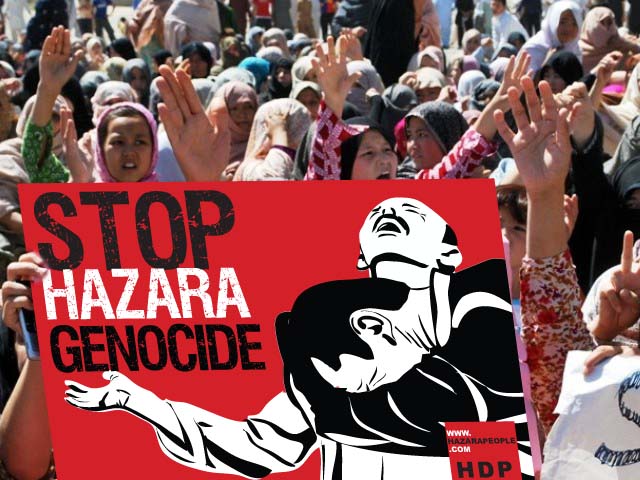
Pakistan is famous around the world for its natural beauty and sightseeing. One beautiful sight is located in Hazara, Quetta. “Bahisht e Zainab” is the place that gives goosebumps to the viewers because of the colors, flags and hanging bells. When the wind blows it casts a spell on people. But it’s not the beauty that makes it a distinct place. It’s the story. Bahisht e Zainab is a graveyard. A graveyard is full of Hazara community’s people who lost their lives to suicide bombs and target killings.
The people of Hazara have been there in Quetta for the past two centuries. Their mass migration occurred during the Anglo-Afghan wars. Since then they have set up their beautiful, organised and educated community in the mountains. Hazara people are known for their excellence in various fields of life especially sports like judo, karate, and boxing. They have provided the country with international recognition in these fields. Women in Hazara are equal in their social, political and economic statuses. The community is distinctively well educated and civilised as compared to many others in the country.
But the life of these beautiful and lively people have been turned into a living hell. They are an open target of genocide and murder by their fellow countrymen. It all started during  the regime of Zia ul Haq when bigotry and radicalism reached its peak and there were posters on the walls of Quetta calling the Shia community as infidels or “Kafir”. In 1999 the car of the provincial minister Sardar Nisar Ali Hazara was attacked along with his driver and bodyguard. Though he survived it marked the beginning of the targeted killing of Hazaras.
The worst phase of target killing started in 2003 when they were attacked by a radical Sunni sect. There were massive attacks especially targeted on Imam bargah. The recent attack on Firday 12th April 2019 marked the death of another 20 citizens adding up to the mark of almost 650 people who lost their lives. The mastermind behind these attacks Ahl e Sunnatwal Jamaat (ASWJ) is a banned organisation formerly known as Sipah e Sahaba and is actively and openly working against the Shia community in Pakistan. They had distributed pamphlets to people highlighting their agenda of Shia genocide and asking for contributions.
ASWJ is a religious and active political party as well. They had their Minister Mawiya Azam Tariq in Jhang who was later arrested over charges of a failed attempt of launching terror attacks. However, he was released. Ramzan Mengal who openly accepted the responsibility of Shia genocide in Hazara was also released two days before the recent attack. A fallacy is propagated by ASWJ that killing a Shia would open 7 doors of paradise for the killer.
Despite the efforts of law enforcement authorities, no fruitful advancement could be gained regarding the security of the people. The people of Hazara community are so accustomed to the deaths and burial rituals that the graveyards are no longer the sight of horror for them as these people have found their lives within the dismay. Their graveyards now represent their culture, life, and vigor. Markets are formed near them, children play while elders walk around the graves as if nothing tragic the dead bodies have seen.Bahisht e Zainab is not just a graveyard. It’s a scar that marks the horrific bloodshed of these humans that were seen as a threat to some supernatural religious powers. It’s a symbol of the undeserved misery. This community is reminiscent of an ongoing holocaust. And for generations, they will have tales of how beautiful souls were subjected to brutality and the state and its authority remained a silent spectator.Hazara is bleeding. And it will continue to bleed unless the last soul is diminished or if miraculously the Islamic Republic of Pakistan decides to come to the aid of its citizen. It seems impossible since the perpetrators are under the kind umbrella of the state itself. But it’s inevitable. If not now then when? Should we wait for the verdict to be given against our religious thoughts as well or should we take action? Should we ignore the increasing death tolls or should we voice our protest? Our answer will be our future sooner or later. Let’s choose wisely!

ARGUMENT- #Pakistan - Poor Nation, Rich Army

BY 

This Republic Day, Pakistan should consider why it remains underdeveloped as its military booms.

On March 23, Pakistan will celebrate its Republic Day with the same “zeal and fervor” as it does every year. As usual, the Pakistani military will come out in full force, with joint parades by the Army, the Air Force, and the Navy. The ostentatious marches will include a display of Pakistan’s nuclear-capable missile system, an air show, and gun salutes to local and international dignitaries present for the occasion.
The extravaganza is always broadcast live on local television channels, set to the fanfare of new propaganda songs produced especially for the event by the military’s media wing. It is rare for the public to question these theatrics—but doing so is more urgent than ever.

Pakistan is going through some serious financial turmoil. Over the last few months, Prime Minister Imran Khan has crisscrossed the globe in search of aid to shore up the economy. Before one recent trip, he even acknowledged the country’s desperation for foreign money. Meanwhile, the country’s finance minister, Asad Umar, has been busy negotiating a new bailout package with the International Monetary Fund—Pakistan has been in the care of the IMF for 22 years out of the last 30. Inflation is at a four-year high, reaching over 8 percent, and Islamabad believes that it could tick even higher.


One-third of Pakistan’s population lives under the poverty line, and the country is ranked at 150 out of 189 countries in the latest United Nations Human Development Index.

 Although Pakistan’s recent economic woes are troubling, the country has faced similar pressures for years. One-third of its population lives under the poverty line, and the country is ranked at 150 out of 189 countries in the latest United Nations Human Development Index. The national debt stands at around $100 billion, while its foreign exchange reserves are a meager $15 billion. The value of the Pakistani rupee, one of the worst-performing currencies in Asia, has dropped 31 percent since 2017.
Yet anyone watching the parade on March 23 may believe that all is well. And they certainly won’t get the impression that the military is, in fact, behind many of the country’s economic problems. But after debt servicing, the military is Pakistan’s biggest economic burden. Already, over 20 percent of the annual budget officially goes to the military, but the armed forces have been pushing for more every year. Just in the last budget cycle, it won a 20 percent hike in its yearly allocation. The actual expense of the military is even higher, but it is hidden by moving some of the expenses to other budget lines. The parliament neither seriously debates the military budget nor subjects its spending to audit. By contrast, the country spends less than 5 percent of GDP on social services like education and health care, well below the regional average.

The military mainly protects itself by keeping the threat of India alive. The two nuclear-armed neighbors have been in conflict since the partition of South Asia in 1947. The militaries have fought four wars, with three of them over Kashmir valley. Even though Pakistan initiated these conflicts, it has told the public that it was only countering Indian aggression. In recent years, Pakistan has avoided a direct war, perhaps because it lost all previous ones. But it relies on militant groups based in Pakistan to keep tensions alive. This February offered a glimpse of such dynamics at play. In turn, the Pakistani Army gets the perfect excuse for its oversized burden on the country’s economy. Like a mafia protection racket, the military creates its own demand.

But it is not just the military’s budget that is eating away at the resources of a country that it has directly ruled for half of Pakistan’s 72 years of existence. Today, the armed forces’ empire has expanded well beyond its traditional role in security. It runs about 50 commercial entities. The military’s main business arm, the Fauji Foundation, has seen enormous growth. According to Bloomberg, its assets grew 78 percent between 2011 and 2015, and it has annual income over $1.5 billion. The military-backed organization has stakes in real estate, food, and the communications industry.

It appears that the business wing of the military is expanding even more under the Khan government. Khan’s critics allege that the military backed his candidacy and now, in return, enjoys relative freedom to do what it wants. There is plenty of evidence to back those claims.
Reuters recently reported that the Pakistani Army is moving into another lucrative industry: mining and oil exploration. Khan’s government is reportedly facilitating the arrangements by giving the military preferential treatment during negotiations.

Pakistan’s economy to weigh on region’s growth: IMF official

Pakistan’s economy is projected to slow down significantly and weigh on the region’s aggregate growth rate, says Jihad Azour, director of the Middle East and Central Asia department at the International Monetary Fund.
At a recent talk on the economic outlook for the Middle East, North Africa, Afghanistan, and Pakistan (MENAP) region, Azour argued that global economic headwinds were making policy efforts more urgent and challenging for MENAP.
For oil importers in this region, growth is expected to ease to 3.6 per cent this, from 4.2pc in 2018, in part due to weaker global economic environment.
Azour noted that in many oil-importing countries, rising debt levels were becoming a more urgent challenge for macroeconomic stability and high debt was also limiting fiscal space for critical investments in health, education, infrastructure, and social programmes.
These budget pressures underscored the urgency of lifting medium-term growth with structural reforms such as measures to improve business environment and governance, enhance labour market flexibility, and strengthen market competition, the IMF argued.
In MENAP, “slowing global growth and trade, as well as geopolitical tensions and other potential external shocks, will pose economic challenges,” the director said, adding “These trends heighten the urgency of implementing reforms that bolster economic resilience and secure inclusive growth.”
In a related report, the IMF also sounded alarm on global debt. Noting that global debt had now reached $164 trillion or 225pc of global GDP, the Fund warned that the world’s public and private sectors were more in debt now than at the 2008 financial crisis, when global debt/GDP peaked at 213pc.
While advanced economies were responsible for most global debt, in the last 10 years emerging markets have been responsible for most of the increase with China alone having contributed 43pc to the rise in total global debt since 2007.
The report stressed the need to reduce the burden of debt in both private and public sectors to improve the resilience of global economy and urged countries with high debt to increase revenues or curb excessive spending.
“This is especially relevant where current economic growth exceeds long-run potential growth,” it added, while also stressing the need for governments to maintain investments in education, health, and infrastructure, either by “re-prioritising spending or broadening the tax base.”
Acknowledging that to achieve sustainable growth, these countries will require additional public spending, the report urged them to “pursue smarter and more agile policies to facilitate change.”

Ex-Dictator's Aide Named Pakistan Finance Chief Amid IMF Talks

Shaikh will now take on the role of lead negotiator for what would be Pakistan’s 13th IMF support program since the late 1980s. His predecessor, the former chief executive officer of Pakistani conglomerate Engro Corp., had been subjected to a campaign of negative media coverage from unnamed government sources that fueled speculation he would be moved as the economy continued to falter.
The new finance adviser has been thrown “in the middle of a storm as IMF talks are on,” Asad Sayeed, director at the Karachi-based Collective for Social Science Research consultancy, said by phone. “The economy is in a kind of crunch and important structural reforms wouldn’t be easy to implement.”
At least two Pakistani local newspaper columnists recently said Umar had displeased the powerful military, which is alleged to have backed Khan during the elections and continues to hold an over-sized influence over the economy and foreign policy. Pakistan’s credit score was downgraded by S&P Global Ratings last month, citing deterioration in the economic outlook and delay in securing an IMF program.
“In the eight months, there were some decisions that gave good results and some that didn’t,” Umar said in a press conference just after announcing his resignation on Twitter. “I request that whoever becomes the new finance minister and makes difficult decisions, support them and don’t think everything will be fixed within three months.”
Discussions with the IMF have twice stalled over various disagreements, such as exchange rate policy. Yet an agreement seemed closer recently and Umar was in Washington for talks with the lender last week, ahead of an IMF delegation visit to Islamabad at the end of April. A deal is now likely to be delayed again.
IMF Delay
“It will most likely get prolonged as the new finance minister will take time to understand, grasp things,” Vaqar Ahmed, the executive director at the Sustainable Development Policy Institute in Islamabad, said before Shaikh’s appointment was announced. Since coming to power in August, Khan’s government has faced a balance-of-payments crisis and a depleted treasury that has thwarted the former cricket legend’s plans to expand social welfare support across the South Asian nation.
However, Islamabad secured a temporary reprieve thanks to loans and funding from friendly countries, such as Saudi Arabia and the United Arab Emirates.
https://www.bloomberg.com/news/articles/2019-04-18/pakistan-finance-minister-steps-down-from-cabinet-amid-imf-talks

#Pakistan #PPP - Ms. Christine Chung called on Chairman PPP

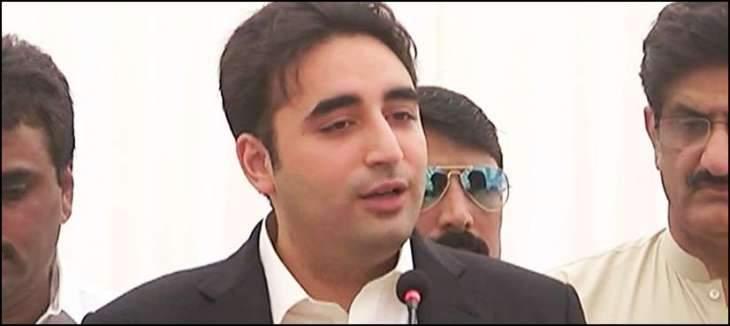
Representative of United Nation’s High Commissioner for Human Rights for South Asia, Ms. Christine Chung called on Chairman Pakistan Peoples Party, Bilawal Bhutto Zardari at Zardari House Islamabad and congratulated him for being elected as the Chairman Human Rights Committee of National Assembly.
Senator Farhatullah Babar, Senator Mustafa Nawaz Khokhar, and Ms. Malaika Raza were also present at the meeting. During this meeting Chairman Bilawal Bhutto Zardari said PPP has always raised its voice for human rights. He said that he has always supported human rights and will continue to do so.

Thursday, April 18, 2019

After 18 Years, It Is Past Time To Face The Truth About Afghanistan

By Charles Ray
If we hope to finally reach the day American troops can pack up their belongings and come back to their families, Washington must start viewing the war with clear eyes.
Last week, three U.S. service members were killed in an improvised explosive device attack near Bagram Air Base, an operation subsequently claimed by the Taliban. The deaths of Christopher Slutman of Newark, Delaware, Robert A. Hendriks of Locust Valley, New York, and Benjamin S. Hines of York, Pennsylvania take the number of U.S. troop fatalities in Afghanistan this year to seven.
It’s the latest grim reminder of a war that has proceeded on an almost autopilot for more than a decade and a half. Hitting its 17th anniversary last October, the conflict has gone on for such a long time that new recruits are being reminded by their drill sergeants about why the United States is involved.
The American people are justifiably exhausted by the Afghanistan conflict, which continues every year with little light at the end of the tunnel. U.S. policy has been defined throughout by muddled thinking, hubris about what the United States can achieve, and an endless stream of troop deployments in support of a strategy that holds little if any chance at success.
The amount of resources and attention Washington has allocated in pursuit of the unattainable—a fully democratic Afghanistan free of corruption and patrimony, governed by the rule of law rather than the rule of the gun—would be the stuff of comedies if it weren’t for the price tag attached to the effort: 2,242 U.S. troop fatalities, tens of thousands of additional injuries (many life-altering), and nearly $1 trillion in American treasure.
U.S. officials owe the soldiers and diplomats in the field and the American people at home a realistic appraisal of what Washington can accomplish in a country that has been in the throes of armed conflict for four decades. If we hope to finally reach the day American troops can pack up their belongings and come back to their families, Washington must start viewing the war with clear eyes. Several hard truths about Afghanistan are in order.
First and foremost, what the United States has been doing in Afghanistan for so many years hasn’t been working. The fact this statement even needs to be made is disturbing given the enormous cost in lives and treasure involved.
Given the state Afghanistan is in today after so many years of American military involvement, it should have been abundantly obvious a long time ago that U.S. policy in Afghanistan is like a leaky ship treading rough oceans. Despite the almost unlimited spending Washington has poured into the country, Afghanistan remains stuck in a precarious existence.The security situation is as bad as it has ever been, and it appears there is very little the U.S. military can do about it. The Pentagon has tried several strategies over successive administrations, running the gambit from nightly joint U.S.-Afghan special forces operations in remote corners of the country to a significantly resourced counterinsurgency campaign in the Taliban heartland. None have produced positive effects beyond a few insurgent leaders taken off the battlefield and a few months of quiet. Indeed, many of the same forward operating bases U.S. troops built during the 2010-2011 surge are now deserted by Afghan forces, left to rot, or occupied by the Taliban.
Secondly, for Afghanistan to have any sense of hope, security, and economic prosperity in the future, military solutions need to be tossed aside and replaced with politics. Neither the U.S. military nor the Afghan security forces have the power to kill every last Taliban fighter or pummel the insurgency into a surrender. The Taliban, also, don’t have the ability to outgun the Afghan government. We are in a stalemate precisely because of these dynamics.
Unless the mindset changes, the stalemate and the violence will merely continue for another four decades. Washington could theoretically deploy 500,000 U.S. soldiers in Afghanistan, and it would only have a short-term effect.
An inclusive, Afghan-led and Afghan-owned political dialogue is the only forum through which the fuel of the war can be drained from the tank. Ambassador Zalmay Khalilzad’s months-long talks with the Taliban hold tremendous promise. After a 16-day negotiating stretch, Khalilzad intimated that the Taliban were willing to formally break their two-decade long relationship with al-Qaeda in exchange for a U.S. troop withdrawal.
The Trump administration’s decision to buck conventional orthodoxy and meet face-to-face with the insurgency in peace negotiations was a daring move, but one that can open doors to a more comprehensive discussion between the Afghans themselves. The peace talks, however, must be anchored around a basic reality: the United States cannot, and should not, insist on a perfect Afghanistan. American troops aren’t responsible for defending Afghanistan in perpetuity or serving as the beat cops of Afghan democracy.
While the United States should deliver a stern message to the Taliban that any peace deal should include guarantees of protection for Afghan minorities, women’s rights, and the rule of law, all of these issues will ultimately depend on the degree to which Afghanistan’s politicians, tribal leaders, fighting factions, militia leaders, and civil society activists can find a compromise everyone can live with.
The United States should do everything in its power to ensure that intra-Afghan talks have the best possible chance of success, including pushing the Afghan government to formalize an inclusive negotiating team to bring Kabul into the talks as quickly as possible. Washington encouraging the U.N. Security Council to temporarily remove travel sanctions on senior Taliban negotiators is the kind of low-cost but necessary accelerant to the peace process.
Last but not least, policymakers in Washington must remember that the United States will continue to be a major player in Afghanistan even without U.S. troops on Afghan soil. American troops sitting in bases may help buy the United States some influence in the country, but it also contributes to the false premise that withdrawing those troops will automatically result in withdrawing American influence.
This thinking is not only dangerous, but shortchanges the non-military tools in America’s arsenal that are just as critical to maintaining U.S. staying power. The talent and experience of America’s diplomats and the relationships U.S. officials have cemented with their Afghan colleagues will all ensure that America retains significant leverage in Afghanistan.
The sooner Washington accepts all of these hard truths, the sooner our men and women in uniform can come home from Afghanistan after so many years at war. Continuing the status quo is not an option.
https://thefederalist.com/2019/04/17/18-years-past-time-face-truth-afghanistan/

#Pakistan - Government fails to reduce growing unemployment in Balochistan

By: Yousaf Ajab Baloch
Saeed Ahmed,28, was one of the toppers among National Testing Candidate’s for teaching posts in Union Council Chatkan of Panjgur district, in 2015. Allegedly he was refused to be posted as a teacher, due to the non-availability of vacant post at his UC. This did not happen only in district Panjgur, however, almost in all districts of Balochistan various toppers in UCs were refused to be given their rights to be appointed as a teacher. The denial to almost 332 candidates resulted in peaceful protests in all districts of Balochistan.
The protests continued for more than twenty months in different districts of Balochistan and later they set a camp in front of Quetta Press club in 2018, demanding justice against merit.
The nonviolent protest could not get attention of Balochistan government. It not only resulted hopelessness among the NTS pass candidates but Saeed Ahmed committed suicide by burning himself in Panjgur Bazar as a protest on 5th September 2018, against injustice. Later burn injuries caused his death in a week.
On 30th November 2014, some 4259 vacant posts of Junior Vernacular Teacher(JVT), Senior English Teacher(SET), Junior English Teacher(JET) and others were announced through NTS, the applicants paid Rs 1000 for each post and nearly 93000 applications were submitted. Through this estimation the level of unemployment can be measured in Balochistan.
Tanweer Baloch one of the members of All Balochistan NTS Youth Action Committee told the scribe that the eligibility criteria for candidates was conditioned on UC base, however, more than three hundred toppers in different UCs have not been appointed. The NTS candidates, appeared in the tests on UC level but later they were not appointed.
“In order to adjust their favorite candidates, the district authorities had concealed posts and a limited number of vacant posts were announced in the newspapers.
And later on the name of DRC and CRC many fake and favorite candidates were appointed through illegal way,” Tanweer Baloch alleged.
Muhammad Khalid, another active member of All Balochistan NTS Youth Action Committee told that they had postponed their protest on assurance of Chief minister of Balochistan Jam Kalam Khan. “We were guaranteed that our concerns will be removed within two or three months but now one moth has completed but no development has been witnessed in this regard.”
Muhammad Khalid claimed that NTS candidates had number of proves where the appointments were against the merit and the candidates with low marks were posted. There seemed complete violation of merit in all the districts of Balochistan.
The office bearers of NTS youth Action Committee demanded that appointments of the of the candidates should be based on the merit list published on NTS website. The vacant posts earlier 2014 should be filled by appointing UC based toppers or they should be placed in newly established or schools. The decisions made by DRC or CRC should be called null and wide. The UC based toppers should be appointed if the new vacancies are announced.
There is great pearl of increased desperateness among educated youth in Balochistan if they are not provided their due rights and jobs. The seven recognized universities in Balochistan graduate more than 29,000 students annually, where nearly 10000 of them are female, however, less than 2000 of them can get jobs but the others remain jobless. This keeps the amount of jobless youth increasing.
As Balochistan in the first official report on multi-dimensional poverty has been marked poverty hit. As per the report, over two-third of the people in Balochistan, i.e., 71 percent of the population lives in multi-dimensional poverty. Out of 32 districts in Balochistan, only Quetta has Incidence of Poverty (IOP) of around 50 percent, while the remaining districts have IOP over 70 percent.
It was a ray of hope for jobless people in Balochistan when in the last government in December 2016, the Balochistan’s chief secretary Saifullah Chattha directed the authorities concerned to take measures for filling 35,000 vacant posts in government departments. Though a policy was also framed for the recruitment tests for posts of grade 11 to 15 through National Testing Service (N.T.S) and for
Grade 16 and above through Balochistan Public Service Commission (B.P.S.C) but time proved that no serious measures were taken and impossibility spread among youth and graduates.
Currently there are more than dozens of associations of graduates who have been struggling for jobs in different departments in Balochistan.
One of the graduates of Water Resources Management and member of the Water Resources Management Graduate’s Association Arif Mengal told the writer that HEC initiated Faculty of Water Resources Management in 2006 Lasbella University of Agriculture and Water Managements (LUAWMS) Uthal Balochistan. The output of the faculty was around 300 but unfortunately due attention was not giving to the full fledge water managers of LUAWMS which is symbol of non-serious attitude of policy makers.
He added: “The ultimate result of non-seriousness and ignorance persisted because the graduates are wandering here and there in search of any operational and applicable field & travelling in search of employments.
Arif Mengal told that They were not being utilized in the any of relevant fields in this duration of 10 years although the critical issue of water crises was prevailing in Balochistan. “LUAWM is one of institute which can provide potential graduates to the following departments of Irrigation, Agriculture, Public Health Engineering, WASA, Environmental protection agency.” Arif Mengal added.
Such as Chief Minister of Balochistan Jam Kama has said that for Balochistan youth, 9,000 to 10,000 vacancies would be announced in the February. The government has been working on different sectors to provide jobs to the youth of Balochistan”.
It should be noted that in a recent meeting with the prime minister, CM Kamal raised the job quota issue which currently stands at six per cent approx. 18,000 jobs in federal services.
Similarly, Balochistan Minister for Science and Information Technology, Population Welfare Sardar Abdul Rehman Khetran shared in a press conference that recruitment process for more than 20,000 vacant positions would be completed by June2019 to reduce unemployment from the province. This should be noted that President All Balochistan NTS Action Committee Saiful Rehman, General Secretary Khadim Hussain, Tanveer Baloch, Muhammad Anwar Khan Khilji were also present on the occasion. The minister expressed thanks to the NTS Action Committee for ending their 10 months long protest on his request.
Giving hopes to youths in Balochistan continued last month. Federal Minister for Defence Production Zubaida Jalal shared a news that plans were being finalized under the public-private partnership to eradicate unemployment in Balochistan. She said that 20000 thousand new jobs would be awarded in the coming months.
A source on condition of anonymity told that bureaucracy is huge obstacle in announcement and filling of the vacant posts in Balochistan. Because all the last chief ministers Dr Malik Baloch, Sardar Sanullah Zehri, Abdul Qudoos Bizenjo tried their level best but could not get success to get announced and fill the posts.
“Currently there are thousands of vacant positions in education, health, Livestock, Revenue, home, agriculture and some other departments but it seems impossible until there is willingness of administration,” he added.
Though the scribe continuously tried to know provincial governments stance on the issue and future plans of the current government, but Bushra Rindh, the spokes persons of Balochistan Government did not response on the issue. However, Member of the ruling party and Balochistan Home minister Mir Ziaullah Langove expressed current efforts of government of Balochistan.
Talking to the Baloch Zindh Mir Ziaullah Langove said that it had been a great accomplishment of their government that lifted the ban that had been imposed on recruitment in all government departments. “Our government has approved nearly 35000 new recruitments in all government departments where merit will be top priority in new appointments.” Mir Ziaullah added.
“Government of Balochistan, Services and General Administration Department issued a Notification in December 2018 in connection with Restoration of Recruitment Process-Communication of Details of Vacant Posts BPS-01 to BPS-15,” Mir Ziaullah langove added.
Answering another question about Recruitment in the home department in Balochistan, he said that 10000 job vacancies will be announced in Balochistan Levies Force to cope with the alarming issue of unemployment in Balochistan. These job opportunities will not only enable youth in Balochistan to get a job but also provide services for nation.

#Balochistan: Nine people abducted from Kech and Nushki

Pakistani forces have abducted at least nine people from Balochistan’s district Kech and Chaghai on Friday.
According to details, the FC (Frontier Corps) and intelligence agencies have carried out offensives in Kohaad region of Tump in district Kech Balochistan.
The victims have been named as Heyatan son of Abdi, Niaz son of Qadirdad, Rashid son of Dilmurad, Mehran son of Rasul Bakhsh, Ezzat son of Khorsheed, Hameed son of Shahdad and Siddique.
Meanwhile, unknown assailants, driving a white Vigo car, have abducted a 13-year-old boy from Dalbandin city.

Pakistan: Gunmen kill 14 on passenger bus

Dozens of gunmen were involved in the attack in the restive Baluchistan province. A separatist group has claimed responsibility.
Gunmen ambushed a passenger bus in southwest Pakistan on Thursday, killing 14 people. A local official said it was unclear who was behind the shooting.
The men reportedly entered the bus, demanded to see everyone's IDs, and then commenced their attack on specific passengers. It remains unknown what ethnicity or denomination the assailants were marking.
Baloch separatists claimed responsibility for the attack later on Thursday. The insurgents seek Baluchistan's "independence" from Islamabad and are known to target the security services and people from Punjab, as they tend to make up the bulk of soldiers stationed in Baluchistan.
The separatists claim that the government does not evenly distribute the region's resources. There are also Islamist extremists active in the area, who have launched attacks on minority Shiite Muslims in the past.

‘Modi ka yaar and ghaddar’ - Immature, traitor & Modi agent: How Pakistan sees Imran Khan for his BJP love this election


Even the few who stand in support of PM Imran Khan in this hour of political isolation say it was avoidable to support Modi publicly.

Pakistan Prime Minister Imran Khan’s statement in support of Narendra Modi for a second term could well be a Congress ploy, according to India’s Defence Minister Nirmala Sitharaman. But this claim of a conspiracy adds to the woes of Imran Khan, whose words are not being taken as very smart back home in Pakistan.
Academics, lawyers and journalists of Pakistan are calling Imran Khan’s remark a diplomatic blunder while leaders of Islamist parties have started dubbing him as ‘Modi ka yaar and ghaddar’ (friend of Modi and traitor) – a slogan Imran Khan had repeatedly chanted to taunt his main political opponent Nawaz Sharif during the election campaign of July 2018.
With no let-up in criticism, Pakistan Foreign Minister Shah Mahmood Qureshi had to clarifythat Imran Khan was quoted out of context, but this has failed to produce the desired effect on Khan’s political opponents.
Perhaps, this is why the Sindh Assembly (Pakistan’s second largest provincial assembly) Monday passed a resolution against PM Khan, less than a week after his pro-BJP statement, declaring him an “election agent” of PM Modi.
“If someone expects that the BJP government will be helpful to resolve (the) Kashmir issue, then he lives in fool’s paradise,” says Dr Hasan Askari, a leading political scientist.
But Askari is quick to dispel notions that Imran Khan’s statement will create any domestic trouble for the BJP. Askari knows that the BJP enjoys the support “mostly of Right-wingers”. “You know, this kind of vote-bank remains intact in almost all cases,” says the former caretaker chief minister of Punjab, Pakistan.
The matter, however, is not quite as simple as people have made it out to be. Abid Saqi, the former president of Lahore Bar Association, claims PM Imran Khan did not seem to assert the ‘conventional wisdom’ that Right-wing parties take bold steps to resolve domestic and international issues — the ‘Nixon goes to China’ argument — and nor did he make an abrupt statement similar to his past record.
Saqi said that Imran Khan made the comment based on the sense of assurance provided by the international powers.
In a private conversation with me, the senior lawyer clamed that Islamabad was assured by global powers during the recent face-off between India and Pakistan following the 14 February Pulwama attack that they will help resolve the Kashmir issue after NarendraModi is re-elected as India’s prime minister.
“A settlement on the lines of much debated Musharraf-Vajpayee formula could be agreed between India and Pakistan if the BJP again comes into power,” Saqi said.
Then there are some who say Imran Khan acted immaturely by making a statement that seasoned politicians would always steer clear of.
“Since he is not acquainted with diplomatic wisdom and norms, he voiced his opinion about Modi openly. Pakistan and India are presently in a state of war under Modi’s regime and wishing him another tenure is manifestation of confusion on diplomatic front,” says Shoaib Saleem, another senior lawyer and writer.
Saleem points to the political obstacle a statement like this creates for Imran Khan. “What if (Rahul Gandhi’s) Congress-led alliance wins the elections?” The lawyer’s question imagines the scenario where, after endorsing the BJP, Imran Khan is in a situation where he might have to initiate a dialogue on the Kashmir issue — but with the Congress instead of the BJP. In a political advice of sorts, Saleem tells Imran Khan to “learn at the earliest” that it’s the state, and not individuals, that matters. “Modi’s alleged friendship with Nawaz Sharif was detrimental for Pakistan but Imran Khan’s longing for him will cure our core issue… this is nothing less than a paradox.”

Religious leaders weigh in too

Imran Khan has similarly irked the Islamists who lashed out at him, saying there was ‘zero chance’ of any resolution of the Kashmir issue if Modi’s BJP wins the election for the second term.
Jamaat-e-Islami central leader Ameerul Azeem says that at a time when the BJP was bent upon repealing Article 370, Pakistan’s prime minister wished for the party to come into power.
Azeem says Imran Khan’s endorsement of Modi came on “the directions of the international lobby and business tycoon who wanted to see Modi in power”.
The condemnation of PM Khan’s statement by Tehreek-e-Labbaik Pakistan, which emerged as the biggest religious party in terms of vote-bank in Pakistan’s general election of 2018, comes with Indian and Kashmiri Muslims in mind. Spokesperson Ijaz Ashrafi flaysKhan for ‘rubbing salt on (their) wounds by issuing statement in favour of Modi”.

Supporters say ‘avoidable’

But such widespread condemnation doesn’t mean Imran Khan is left all alone in Pakistan. Some like Sohail Warraich, a leading journalist and TV anchor, reiterate PM Khan’s statement verbatim because they were “timely and accurate”, while some like Iqtidar Gilani, a journalist from The Nation, say the PM was “right in his claim” but could have avoided voicing it out nevertheless.
According to Warraich, Khan did not intentionally issue the statement to create some damageto the BJP’s poll campaign.
“A party like the Congress will not go to the extreme due to fear of backlash from the Right-wing parties. The past experience strengthens this idea. The Congress ruled India for such a long time and during that period, we saw meaningless dialogue. It was during the BJP’s rule that Pervez Musharraf and Atal Bihari Vajpayee reached close to an agreement on the Kashmir issue,” says Iqtidar Gilani.

#Pakistan - #PTI’s first wicket has fallen, Opp leaders say after Asad Umar’s ouster

Opposition leaders said on Thursday that the ouster of Asad Umar as finance minister and other major changes in Prime Minister Imran Khan’s cabinet had exposed the Pakistan Tehreek-e-Insaf (PTI) government’s competence in managing the country’s economic and governance challenges.
Pakistan Muslim League-Nawaz (PML-N) President and Leader of the Opposition in the National Assembly Shehbaz Sharif said that Pakistan’s economy was being held hostage by ego, arrogance and stubbornness.
“Imran Khan Niazi should set aside his ego, arrogance and stubbornness and concentrate on the economy,” Sharif said.
Shehbaz added that he had made an offer to improve the economy since day one. “If time had not been wasted we wouldn’t have been facing such economic devastation.”
The PML-N leader said that more adverse economic situation will be encountered by the nation if further time is wasted.
Congratulating the nation over Umar’s ouster, Pakistan People’s Party (PPP) Chairman Bilawal Bhutto-Zardari said the first wicket had fallen.
“The government’s entire team will return to the pavilion before the end of 50 overs,” he said, adding that Prime Minister Imran is unable to handle his team and the government.
“The selected PM is neither able to run the economy nor foreign affairs. Imran has pushed the country into a severe crisis. After the financial crisis, severe governance crisis has appeared in the country,” added the PPP chairman.
Former finance minister Ishaq Dar said that Asad Umar’s stepping down as the finance minister of the country reflected “cowardice”.
In his statement, Dar accused Umar of misleading the nation since 2014, adding, “Asad Umar remained the finance minister for eight months and laid distorted facts before the nation”.
He noted that there was only one month left in presentation of budget, while the agreement with International Monetary Fund (IMF) was also in its final stages.
“It was not appropriate for Asad Umar to leave the ground this way,” the former finance minister said.
He further said his party pointed to Imran Khan’s “lies” over the past three weeks.
“We pointed to the dropping of inflation bomb on the masses. We also gave suggestions to the government as to how could the economy be fixed,” Dar recalled.
“They did not listen to anything, and today, Asad Umar is resigning, which is inappropriate.”
“With the change of ministers, Imran Khan cannot escape responsibility of this economic catastrophe,” he said.
PML-N spokesperson Marriyum Aurangzeb said the “real problem” lies not with the finance minister, but the prime minister.
In a tweet, Aurangzeb said Umar’s removal is an admission by the PM that “his policies have created an economic crisis.”
PML-N Senator Ayesha Raza Farooq stated a change in one of the most important cabinets is “not a good omen”.
Umar was removed as the finance minister on Thursday after facing mounting criticism in recent weeks over the state of Pakistan’s economy.
Bakhtawar Bhutto-Zardari took a jibe at the PTI government, saying the prime minister should appoint his sister “Aleema Khan as the new finance minister so she can sa-lie this whole mess together”.

#PAKISTAN - #PTI’s U-turn exposes PEMRA’s wrong allegations of ‘fake news’

The tableau of constant U-turns by the Pakistan Tehreek-e-Insaf (PTI) government is still on display. The composition of the cabinet has indeed changed even though the ever-eager Pakistan Electronic Media Regulatory Authority (PEMRA) served legal notices on some media outlets on April 16. This action was taken over the airing of a news item regarding a possible cabinet reshuffle.
The PEMRA remained insistent that the report on the cabinet reshuffle was “fake news”. However, the “fake news” allegation is now proved to be completely unfounded after the departure of the finance minister from the cabinet. Asad Umar has now stepped down from his post and refused to take the new portfolio of the energy minister. While showing complete faith in the leadership of the prime minister by declaring him the “best hope for Pakistan” on Twitter, the former minister also announced that he had obtained the PM’s consent to decline the offer of a new ministry.
With Asad Umar now having receded to the background – at least for now – the focus has shifted to a legal drama entangling the PEMRA and its eagerness to issue a show cause notice over a news item that turned out to be “not-so-fake” after all. Both the PEMRA and Information Minister Fawad Chaudhry had been irked by the news items aired by some media networks regarding a cabinet reshuffle. Fawad Chaudhry himself has now lost his portfolio and will use his ‘expertise’ in science and technology. In tandem with the information minister, PEMRA declared the news to be false and claimed that both the channels were in sheer disregard of the Electronic Media Code of Conduct 2015 and also liable for a violation of PEMRA Ordinance 2002 and PEMRA Rules 2009. The media outlets were also instructed to respond within seven days, and the chief executive officers (CEOs) of both outlets were told to ensure personal appearance or to send their respective representatives at PEMRA’s headquarters in Islamabad on April 22.

Pakistan’s Finance Minister Resigns Amid Economic Crisis


Pakistan Finance Minister Asad Umar has resigned days after returning home from crucial talks with the International Monetary Fund (IMF) on a financial bailout package to avert a national balance of payments crisis.
While formally announcing his decision to leave Thursday at a hurriedly arranged news conference in Islamabad, Umar explained that he was asked to take the energy minister position instead of finance as part of a Cabinet reorganization.
Umar acknowledged his successor would have to make "some difficult decisions" to deal with economic challenges facing Pakistan.
Prime Minister Imran Khan's eight-month-old administration has faced sustained criticism from political opponents, independent commentators and the business community over the government's handling of the economic crisis facing the country. Much of that criticism was leveled against Umar.
Umar returned this week from Washington, where his delegation fleshed out details of Pakistan's next IMF bailout package that he said could be up to $8 billion.
Critics blamed the outgoing minister for taking months to finalize the IMF deal, saying the delay shattered investor confidence in Pakistan's economy. But speaking Thursday, Umar defended his performance.
"We have finalized the IMF agreement on much better terms than before.I have made these decisions.I refused to take the decisions that would have crushed the nation," Umar said without elaborating.
He said that an IMF mission is expected to visit Islamabad later this month to work out more details "since all major issues had been settled and documented," he said.
13th bailout
The long-delayed package would be Pakistan's 13th IMF bailout since the late 1980s and comes with a worsening economic outlook for the South Asian nation of more than 200 million people.
Former finance minister Salman Shah, while commenting on Umar's resignation, noted a lack of effective financial strategy was slowing down the economy, deterring all sorts of investments, fueling inflation and unemployment in Pakistan.
Late Thursday, the government made the formal announcement about the Cabinet reorginization, re-allocating certain portfolios and appointing new ministers as well as several special advisors to the prime minister. They included Abdul Hafeez Sheikh as advisor on finance to Khan. Sheikh served as finance minister of Pakistan under a previous government. Khan has also appointed Ijaz Ahmed Shah as his full time interior minister.

Video - Bilawal Bhutto Congratulates Nation on Asad Umar Stepping Down as Finance Minister

اسد عمر کو ہٹانے کے مثبت نتائج ہوں گے، بلاول بھٹو

چیئرمین پاکستان پیپلز پارٹی بلاول بھٹو زرداری نے کہا ہے کہ اسد عمر کو ہٹانے کے مثبت نتائج ہوں گے،امید ہے کالعدم تنظیموں سے تعلق رکھنے والے باقی وزیروں کو بھی ہٹایا جائے گا۔
میڈیا سے گفتگو کرتے ہوئے بلاول بھٹو زرداری کا کہنا تھا کہ حکومت کو 8 ماہ بعد احساس ہوا کہ ان کی معاشی پالیسیاں غلط ہیں۔
چیئرمین پی پی نے امید ظاہر کی ہے کہ اسد عمر کو ہٹانے سے معاشی صورتحال بہتر ہوگی۔
https://jang.com.pk/news/630373-bilawal-bhutto-reacts-on-finance-minister-asad-umars-departure