Friday, April 12, 2019

In Pakistan, the problem of forced conversions

Mehmal Sarfraz

The recent conversion of two girls from Hinduism to Islam in Sindh has once again compelled the country to explore the possibilities of enacting a law to prevent forced conversions. But it is an uphill task, reports Mehmal Sarfraz
For the Hindus of Sindh in Pakistan, March 20, the day Holi was celebrated, was a riot of colours. But for the Meghwars, it marked the beginning of a nightmare when two sisters, Reena Meghwar and Raveena Meghwar, suddenly disappeared from their home in Daharki, a city in Ghotki district of Sindh. Their disappearance not only brought back the spotlight on a persisting problem in the country, but also led to an online spat between Pakistan and India, which only recently saw simmering tensions reach a dangerous peak.
After a fruitless search for his sisters, Shaman, his father, and others from the community finally decided to go to the neighbourhood police station to lodge a complaint. The Station House Officer (SHO) there assured them on March 20 that the culprits would be caught. But when this did not look likely, the community staged a protest, forcing the SHO to file an FIR the next day against six men, three of them unknown, for abduction of the sisters.
Reena and Raveena, who are popular among their ten siblings, belong to a poor family. Their father is a tailor at a local clothes shop and makes PKR 400 (equivalent to about ₹200) for every suit he stitches. Shaman is a salesman, and earns PKR 10,000 per month. He is the only one in the family who has completed matriculation. A younger brother works at a motorcycle shop and does not earn much. The entire family’s monthly income is between PKR 15,000 and 20,000. Apart from being poor, what further puts them at a disadvantage is that they are Hindus, the largest minority community in Pakistan. Sindh is home to nearly 90% of Pakistan’s Hindu population and has a literacy rate of 55%.
The same day that the FIR was filed, a video of the two girls reading aloud the Kalima surfaced on social media. “We have converted to Islam,” the two of them said, the colours of Holi still on their cheeks. It emerged that both the girls had left home and travelled to Rahim Yar Khan district in Punjab. It is unclear who took them there or accompanied them. There, they got married to Safdar Ali and Barkat Ali, both of whom were already married and have children. Safdar and Barkat’s first wives left them as soon as news of the nikkah became public. The wedding took place on March 22 at an office of the Sunni Tehreek, a religious organisation, after the Bharchundi madrassa converted the girls to Islam. What remains a matter of dispute is the age of the two girls. While Shaman insists that his sisters are minors, the girls have claimed that they are above 18.
In Pakistan, the problem of forced conversions
 
As though this rapid turn of events was not enough to digest for the Meghwars, the two sisters then filed a petition in the Islamabad High Court on March 25 seeking protection from their family. The court ordered the government to protect the sisters until the matter was resolved.
Meanwhile, a war of words erupted between India and Pakistan, with India’s External Affairs Minister Sushma Swaraj seeking a report from the Indian envoy in Pakistan on the case, and Pakistan’s Information Minister Fawad Chaudhry retorting that this was an “internal issue”. Pakistan Prime Minister Imran Khan ordered a probe to determine if the girls were abducted and then forcibly converted.

The issue of conversion

India’s concern about the case was echoed on April 2 by the Chief Justice of the Islamabad High Court, Athar Minallah, who, when the sisters were produced before the court, asked, “Why are such incidents repeatedly being reported from one district [Ghotki] of the Sindh province?”
His is a valid question. According to the People’s Human Rights Organisation, seven teenage Hindu girls have been kidnapped from Sindh province in the last two months alone, and forcibly converted to Islam.
The court formed a commission to establish the facts of the Reena-Raveena case. The commission presented its interim report to the court, soon after which the sisters were allowed to go back to their husbands. The court concluded that the girls were not forcibly converted. Das says his family is unhappy with the decision as they were not heard by the court.
Khawar Mumtaz, Chairperson of the National Commission on the Status of Women, who was part of the commission, says the sisters were sure about their decision. They knew before getting married that the two men were already married, she says. “These girls were institutionally facilitated. Everything appeared to have been well planned: they were taken to a religious seminary and travel arrangements were made for them. Besides, Dargah Pir Bharchundi Sharif [where the girls were converted] is known for such practices.” The court has asked the commission for a larger report on the issue of conversions on May 14.

The role of madrassas

A 2015 report by the South Asia Partnership-Pakistan in collaboration with Aurat Foundation found that that at least 1,000 girls are forcibly converted to Islam in Pakistan every year. The report stated that the conversions take place in the Thar region, particularly in the districts of Umerkot, Tharparkar, Mirpur Khas, Sanghar, Ghotki and Jacobabad. People convert due to financial and economic reasons, the report said. It identified landlords, extremist religious groups, weak local courts and an insensitive administration as working together.
While in south Sindh, particularly in Umerkot and Tharparkar, the Hindus are mostly poor, in the north they are better off. Largely, it is girls from low-caste, poor Hindu families who are forcibly converted.
The Hindus in these regions say that two madrassas — Dargah Pir Bharchundi Sharif and Dargah Pir Sarhandi — are “symbols of terror and fear”. Harris Khalique, writer and Secretary General of the Human Rights Commission of Pakistan, says madrassas provide an “institutional backing and that cannot happen if the state does not allow that. I rest the responsibility of such incidents squarely on the state, which fails its citizens.” These conversions reflect a potent mix of patriarchy, economic deprivation, and religious hierarchy, he says. “Most of these girls come from Scheduled Castes. The men they marry are mostly financially better off. Even if they are just marginally better off, they belong to a more privileged segment of society. It becomes a power dynamic.”
Under-age girls from poor farming communities are especially vulnerable to conversions, says senior journalist Shahzeb Jillani. “Wealthy Muslim farmers see them as fair game for abductions, rape, and prolonged sexual exploitation in captivity. Some notorious religious establishments proudly validate these alleged crimes. State institutions, the police and politicians have encouraged the trend by looking the other way,” he says.
Jillani points out that Mirpur Khas, Tharparkar and Umerkot see the highest number of conversions. “The Pakistani military has traditionally viewed this population with suspicion,” he says. “Jamiat Ulema-e-Islam-Fazl runs a large well-funded madrassa, especially for new Muslim convert families near Chhor. In recent years, the army has increased its direct and indirect presence in the region by encouraging more madrassas and Islamic charity work. Jamaat-ud-Dawah and Falah-e-Insaniat Foundation are among those outfits whose presence and field work has expanded in Thar during the last five years.” Therefore, the conversion of Hindu girls in border regions has to be seen in the context of these wider developments and the Pakistani state’s security fears and paranoia vis-à-vis India, he adds.
Pakistan Tehreek-e-Insaf’s lawmaker Ramesh Kumar Vankwani, who founded the Pakistan Hindu Council, goes back in history to blame General Zia-ul-Haq for the present plight of minorities in Pakistan. “Minorities started to feel like ‘minorities’ during his time. As a result, low-caste Hindus were exploited by powerful people in the area. From 23% at the time of Partition, Hindus constitute around 5-6% of the total population today,” he says.
Speaking of the role of madrassas, Vankwani says these institutions often give money to people to convert Hindu girls to Islam. “Whenever a Muslim boy runs away with a Hindu girl, the girl is taken in by one of the three madrassas and provided shelter,” he says. “Nobody has taken notice of the threats given to the Hindu community.”
Unlike in countries like Malaysia, where there is a process in place for conversions, there is no such process in Pakistan, Vankwani points out. “In Malaysia, those who want to convert submit an application/affidavit saying they are adults and want to change their religion. The process takes around three months. Then, a statement is recorded by a civic authority. Conversions cannot take place without the consent of the family in case of a minor. What kind of society is this where you convert and then don’t allow them to meet their families and also get them married off within a short span of time?”
Asad Jamal, a lawyer, says madrassas should be prohibited from issuing conversion certificates. “Such an act should be penalised. Any law on forced conversions must have such a provision. Unless this is done, the market of conversions established by retrogressive religious groups will continue to flourish. It sustains their politics,” he says.
Journalist Munizae Jahangir, who has conducted several shows on forced conversions, recalls reporting on a case many years ago in which three young girls from a poor Hindu family were offered boarding by a madrassa after converting to Islam. When Jahangir asked the girls why they had converted, she says they told her that they had done so after watching a popular TV show on ‘Quran TV’. While people have the freedom to convert, there is also a system that facilitates the process, Jahangir says.
Not all conversions are forced though. According to a report by Ayesha Tanzeem published in the Voice of America, “Some minor girls eloped with Muslim men against their family’s wishes and changed their religion since marriage between a Muslim and a Hindu is not allowed in Islam. The parents often claimed kidnapping, since local police were unlikely to take action if it was determined the girls left willingly.” Thus, determining whether or not a case of conversion is forced or voluntary is often tricky.

Preventing child marriage

Many believe that a crucial differentiation must be made between cases of conversion of minor girls and adult women. Legal expert Reema Omer says that in cases of conversion of minor girls, the primary failure is in ensuring the implementation of the law against child marriage. Conversion becomes a secondary issue in these cases, she says. “This includes the lax attitude of families as well as the state on timely birth registrations. It also includes the state’s apathy in ensuring that such marriages are stopped and the perpetrators are penalised.”
Given the conflicting reports on Reena and Raveena’s age, the question to be asked is, why were their births not registered soon after they were born? While Das says birth certificates were “not really a priority for the family”, locals say the process of registering births and deaths is cumbersome. This omission is what allows families to get away with child marriage, says Omer.
A medical report presented before the court stated that the two girls are not minors. In addition, a source in the Sindh government told The Hindu on the condition of anonymity that Reena and Raveena’s call data show that they were regularly in touch with the men they married. The police also claim that the girls married of their own free will. Das and his family refuse to believe this. “We had never seen these men. We saw them for the first time in the nikkahvideo,” Das says.
Sulema Jahangir, an advocate of the High Courts in Pakistan, says that while conversions of underage girls is a cause for concern, there are also instances of older women converting voluntarily to Islam to escape an abusive marriage, hinting at the complexities involved in the issue. When the Sindh Hindu marriage law was being debated a few years ago, a lot of Hindu groups protested against allowing women the right to divorce and remarry. Some experts believe that it is important not to give the state greater control over women’s lives.
Chaudhry says minorities face problems everywhere in the world. “In this case, we have once again proved that the state of Pakistan stands with its minorities and marginalised communities/groups. The state has not abdicated its responsibility. The only problem is that if an adult takes a decision herself/himself, and gives a statement in the court of law, then we cannot interfere in such cases. Our policy, though, is very clear on minority rights — we are against any forced conversions and we will not let that happen,” he says.
A Pakistan Tehreek-e-Insaf lawmaker says on the condition of anonymity that the Prime Minister is not too keen to dwell on this issue fearing backlash from powerful religious groups.

Pending legislation

Three years ago, the Sindh Assembly unanimously passed the Sindh Criminal Law (Protection of Minorities) Bill, 2015, which made forced conversions punishable by law. But following a backlash from conservative Muslim groups, the legislation never saw the light of the day.
Asad Jamal, a lawyer, says the main failure lies in preventing child marriage. But what makes the situation trickier is the fact that the the minimum age for marriage varies across regions. In Punjab, it is 16 for girls and 18 for boys. In Sindh, it is 18 for both girls and boys. In Khyber Pakhtunkhwa and Balochistan, the legal marriageable age for girls is 14 in accordance with the original Child Marriage Restraint Act of 1929. “There is a law against child marriage, but it is inadequate,” says Jamal. “All child marriages under the age of 18 should be prohibited and declared invalid.”
Murtaza Wahab, adviser on information and law to the Sindh Chief Minister, says that in principle, the Sindh government has decided to reconsider the forced conversions Bill. “We will start the consultation process again. We will have consultations with the Hindu community as well as those from the religious school of thought regarding the age limit for conversions, which was the main bone of contention the last time around,” he says.
Pakistan’s lawmakers are slowly realising that until such time that a law is enacted on conversions and strictly implemented, it will be an uphill task to put a stop to forced conversions.

Amnesty International - #Pakistan: #QuettaAttack #HazaraCommunity #Hazara community must be protected

Responding to the horrific bombing of an open-air marketplace in a neighbourhood where many members of Shi’a Hazara community live in Quetta that killed at least 16 people and wounded several others on the morning of 12 April 2019, Amnesty International’s Deputy South Asia Director, Omar Waraich, said:
This horrific loss of life is a painful reminder of the threats that Quetta’s Hazara community continues to face. 
Omar Waraich, Amnesty International's Deputy South Asia Director
“This horrific loss of life is a painful reminder of the threats that Quetta’s Hazara community continues to face. Targeted for their religion by sectarian armed groups, they have suffered many such tragedies over several years. Each time, there are promises that more will be done to protect them, and each time those promises have failed to materialize.
“Prime Minister Imran Khan’s government has made important commitments to protect all religious groups in the country. Those commitments must translate now into policies to effectively protect the Hazaras of Quetta, ending more than a decade of bloodshed that has scarred their community.”

Video - Chairman #PPP Bilawal Bhutto Zardari address public gathering in District #Ghotki

#Quetta #QuettaBlast #QuettaBleeds #QuettaAttack - Bilawal Bhutto Zardari “Condemn the terrorist attack in #Quetta.

Pakistan People’s Party (PPP) Chairman
Bilawal Bhutto-Zardari wrote on Twitter: “Condemn the terrorist attack in Quetta. The government must stop dragging its feet & take action to counter violent extremism. Thoughts and prayers with the families of the victims.”

#Hazaras stage sit-in after #Quetta suicide blast

Hazaras are staging a sit-in at the Western bypass following Friday morning’s suicide blast in Quetta’s Hazarganji area.
At least 20 people, including a Frontier Constabulary officer and two children, were killed in the explosion.
The protesters said that the government has failed to protect the people. The community has been a target of attacks for the last 20 years and over 3,000 of its members have been killed, they said.
They said that they have been restricted to only their areas and can’t even go to the markets to buy anything or send their children to colleges or schools.
Some members of civil society are also attending the sit-in to express solidarity with the Hazaras.
The protesters said that they won’t end their sit-in until their demands are met.

#Pakistan - #Balochistan bleeds again as bomber targets #Hazaras


At least 20 people were killed and over 48 others were injured in a suicide attack targeting members of the minority Shia Hazara community in Quetta’s Hazarganji market on Friday.
The attack claimed the lives of nine Hazara and one Frontier Corps (FC) soldier who was deputed for the community’s security, Deputy Inspector General (DIG) Abdul Razzaq Cheema told reporters. The 10 others who lost their lives included shopkeepers, businessmen and citizens working or residing in the area. Four FC soldiers were among the injured.
DIG Cheema said the blast targeted the Hazara ethnic community.
However, Balochistan Home Minister Ziaullah Langove, who held a press conference later in the day, said that the blast was not targeting “a specific community”.
“Our guess is that no specific community was targeted. Marri Baloch and FC personnel were among those killed as well. The numbers of the Hazara community were just greater,” Langove said.
He also described the blast as a suicide attack.
Qadir Nayil, a Hazara community leader, asked the government for provision of better protection.
“Once again our people were the target and once again we will have to bury our dear ones,” he said.
“We demand more security from the government and all those involved in today’s act of terrorism should be found and punished.”
Following the explosion, a high-level meeting chaired by Balochistan Chief Minister Jam Kamal reviewed the security measures.
It was decided in the meeting that the affected families will be given immediate financial assistance and that the provincial government will bear the treatment cost of those injured.
Furthermore, it was decided that closed-circuit television (CCTV) cameras will be immediately installed at the Hazarganji market and other public places. Action on terrorists’ hideouts and against their leaders will also be boosted, the caucus affirmed.
The Hazarganji neighbourhood has been witness to similar attacks in the past. Hazara shopkeepers are known to stock vegetables and fruits from the Hazarganji bazaar to sell at their own shops. They are provided a security escort to and from Hazarganji since they are constantly under threat of attack.
The attack came after a lull of at least a year in attacks against Hazaras, though there have been isolated shootings.
PROTESTS IN QUETTA:
Following the bomb blast, the Hazara community, Shia organisations and civil society issued a call of protest in Quetta and Karachi.
In Quetta, the protesters held a sit-in near the western by-pass in the morning which had not ended by the time the copy went to the press.
The participants said the government had failed to protect them in spite of a number of major attacks targetting the community in addition to target killings. They said they won’t end their sit-in until the government provided them justice.
After the attack, Hazara rights activist Jalila Haider, on his Twitter handle, said they would protest outside Quetta Press Club against the persecution and would march towards Islamabad if needed.
Pakistan People’s Party (PPP) Chairman Bilawal Bhutto-Zardari wrote on Twitter: “Condemn the terrorist attack in Quetta. The government must stop dragging its feet & take action to counter violent extremism. Thoughts and prayers with the families of the victims.”

Balochistan Governor Amanullah Khan Yasinzai, Chief Minister Mir Jam Kamal Khan and Punjab Chief Minister Usman Buzdar also condemned the attack in the strongest words.

Pakistan Market Bomb Blast Kills at Least 16 People in Quetta


    At least 16 people were killed when a bomb ripped through a vegetable market in Quetta in southwestern Pakistan early Friday, officials said. Eight of the dead were Hazaras, a Shiite Muslim minority group that has repeatedly been the target of Sunni extremists.
    There was no immediate claim of responsibility for the attack, which also injured at least 30 people. But Lashkar-e-Jhangvi, a banned militant Sunni group, has often carried out attacks against Hazaras in Quetta, the capital of Baluchistan Province.
    For years, the Hazaras have lived in a state of perpetual fear in Quetta, and promises made by successive governments have failed to ensure their safety.
    While terrorist attacks have declined significantly in the past year across the country, Friday’s attack was a grim reminder that the Hazaras continue to remain vulnerable to militant violence and that the security provided to them remains inadequate.
    A senior police official said the bomb went off in a sack of potatoes, and that the victims included shopkeepers and customers at the vegetable market. One paramilitary soldier was also killed in the blast.
    The police ruled out a suicide bombing and said they were investigating whether a remote control or a timed device had set off the bomb.
    Abdul Razzaq Cheema, a senior police official, said that people belonging to the Hazara group come daily in a convoy to the vegetable market from Hazara Town, a walled enclave on the outskirts of Quetta, and that they are provided with security. The bomb that went off Friday morning ignited when vegetables were being loaded during the early market rush. The attack was widely condemned by government officials and rights groups.
    “This horrific loss of life is a painful reminder of the threats that Quetta’s Hazara community continues to face,” Amnesty International said in a statement. “Each time, there are promises that more will be done to protect them, and each time those promises have failed to materialize.”

    Thursday, April 11, 2019

    Video Report - Putin Says Sanctions Won't Stop Russia's Arctic Development

    Video Report - #BlackHole First ever image of a Black Hole revealed

    Video Report - Bernie Sanders talks about what his "Medicare for All" plan will do

    Video Report - #JamalKhashoggi #SaudiArabia Jamal Khashoggi: The Silencing of a Journalist

    Video Report - #sudanuprising 🇸🇩 Sudan: Bashir removed but what comes next? | The Stream

    Minorities Continue To Suffocate: Forced Conversions Of #Hindu Girls In #Pakistan

    It was not long ago when the world was celebrating Jacinda Arden on how she handled the Christchurch attack. Like the rest of the world, she was hailed as a heroine by Pakistanis too, who were overjoyed to witness a white woman leader donning a headscarf, quoting Prophet Muhammad, declaring Islam as a peaceful religion and uniting in solidarity with the Muslim minority in New Zealand over the horrid terrorist attack. 

    Following an interesting turn of events, not long after the Christchurch incident Pakistan was presented with an opportunity of its own to demonstrate the spirit of diversity, acceptance and empathy like New Zealand and Jacinda Ardern’s in the form of the case of forceful conversions and marriage of two underage Hindu girls from Gotki, Sindh. However, this is not where Ardern fandom will flourish.
    In 1947, Pakistan and India were formed after a long battle of ideologies (see: the two-nation theory). It was established that Muslims and Hindus cannot survive together anymore (after previously living together for centuries, ironically) and therefore, need to have their own separate countries. 67 years after, both the countries seem to have not moved on from that juncture and continue to have similar issues. Be it the Hindu minority in Pakistan or the Muslim community in India, time and again, both have to prove their loyalty towards their respective countries.
    ACCORDING TO THE THEIR FAMILY, THE TWO GIRLS WERE FORCIBLY CONVERTED TO ISLAM AND MARRIED OFF TO ALREADY MARRIED MEN.
    The most recent examples of this are two 13 and 15-year-old Hindu sisters, Reena and Raveena from Pakistan’s province of Sindh. According to the girls’ family, the two were forcibly converted to Islam and married off to already married men on 20th March. However, as reported by various media outlets, the two girls are neither underaged nor forcibly converted to Islam or married – they fell in love with these men and eloped with them according to their own free will and also converted to Islam to be married legally to their lovers. A video circulated on social media featuring two burqa-clad girls testifies the same. 
    However, this case raises various red flags. In the past as well, there have been numerous cases of forced conversions to Islam and young girls being married to Muslim men. A similar case took place in 2009 in Punjab where a 15-year-old girl, Gajri was forcibly converted and married to a Muslim man – amongst various other cases of a similar pattern.
    Human rights activist from Sindh, Seema finds this ironic. While talking to FII, she said, “It’s kind of funny to note that only young, impressionable girls between the ages of 10-16 are ‘impressed’ by the teaches of Islam and decide to run away from homes and convert. We do not see men or even adult women from the Hindu community do the same. This pattern suggests that there is something false with the narrative and it needs to be investigated deeper.” Seema also points out that in a country where children under 18-years cannot vote, are not eligible for driving licenses, or cannot even purchase a mobile SIM, allowing the marriage of those who are under 18 and especially considering the conversion of religion as a plausible justification is almost weaponisation of religion.
    Chaman Lal, Chairperson FAITH, says that this issue has been prevalent since the last 40 years in the country, however, it is only recently that due to social media these issues are being brought to the mainstream society. While labelling the perpetrators of these conversions as “white collar terrorists who use religion as a shield to hide their ugly, ulterior motives”, Lal says that such incidents terrorise the entire community and create great barriers for not only girls from the Hindu community but also boys, in terms of education and career opportunities. He also states that these incidents are deliberate efforts to oppress an already marginalised community so that they cannot escape the cycle and question their oppressors.
    The issue of forced conversions is not only oppressing the Hindu community in transparent manners by instilling fear but also acts in a systemic manner. It strips these young Hindu women of their agency and creates great barriers in their educational endeavours. The fear of forced conversions also gives way to the issue of early marriages in the community. This vicious cycle ensures that Hindu women are not ever empowered enough. It ensures that they do not get educated, have careers, learn about their rights and attain the power to fight back, rather they are married off young, uneducated, poor and underprivileged; therefore, planting a system that oppresses this community, particularly women and making sure that they cannot escape it. 
    THE ISSUE OF FORCED CONVERSIONS STRIPS THESE YOUNG HINDU WOMEN OF THEIR AGENCY AND CREATES GREAT BARRIERS IN THEIR EDUCATIONAL ENDEAVOURS. 
    Rachna, women’s rights activist and researcher at Wish Foundation tells FII that the plight of forced conversions is not just about religious tug-of-war and systemic oppression of the Hindu community in Pakistan but also about gender violence that these young girls face. “They (young girls) are subjected to severe gender violence. Many a times, they are abducted and sexually violated by powerful men with political influences who record them being harassed and then blackmail them into either converting to Islam and marrying Muslim men or to extend sexual favours against their will.” Rachna also pointed out the inefficient role of police authorities and the loopholes in the judicial system that facilitates the oppressors and makes it difficult for the victims to take legal action.
    A human rights activist, on the condition of anonymity, told FII how the conversion of Hindu girls is used as a political tool as well. They said, “This issue spreads beyond educational barriers and fears of harassment and forced conversions. It is forcing Hindu families to migrate from Pakistan to India because they fear for their lives and dignities. They are told that they belong to India as Indian muslims are told that they belong to Pakistan.” They also added that when these Hindu families migrate, they leave behind their properties and resources which are then acquired by land mafias; therefore, the issues of forced conversions have other, underlying aspects to it as well. Naming Ayub Jan Sirhindi and Mian Mitho of Barchundi Sharif shrine as prominent players in this situation, they told FII that such forces have religious and political affluences to terrorise and oppress the Hindu community and there is not much that is being done to stop them. 
    Though Pakistan has an often-ignored law that bans child marriage, there is yet no such legislation in place to curb forced marriages. Jibran Nasir, the human rights activist and lawyer from Pakistan, believes that the resolution of the issue of forced conversions in Pakistan lie in the judiciary alone. He states that in a democratic state (especially one that is an Islamic republic), people cannot be asked to give up practising their religion, neither can they be told to not preach it. He tells FII, “If someone wants to convert to Islam by will, there should be a proper, legal system in place to facilitate that and to ensure that it is done out of will and not due to other pressures. A magistrate should be required to carry out the conversion and not only a moulana.” By doing this, the practice of forced conversions can be halted to a great extent.   
    Three days before the creation of Pakistan on 11 August 1947, the founder of Pakistan, Muhammad Ali Jinnah or as Pakistanis fondly call him, Quaid-e-Azam (the great leader), said in his speech, “You are free. You are free to go to your temples; you are free to go to your mosques or to any other place of worship in this state of Pakistan. You may belong to any religion or caste or creed – that has nothing to do with the business of the state.” Perhaps it’s time for Pakistanis to bring the vision of their Quaid to life by putting an end to the persecution and systemic oppression of religious minorities in the country and giving them their long-due rights.

    #Pakistani Regime supports ‘jihad university’ - Funds for Haqqania


    THE relationship between the PTI and the late Maulana Samiul Haq’s party is not new.
    While the ruling party may have initially been drawn to the murdered cleric’s JUI-S due to the mutual animus between the PTI and the JUI-F, the KP government appears to be constant in its support for Darul Uloom Haqqania, the controversial seminary located in Nowshera and known as ‘jihad university’.
    This sobriquet is, of course, well earned, as the madressah has been churning out fighters since the days of the Afghan jihad, while it counts members of the Afghan Taliban amongst its alumni.
    As reported in this paper on Wednesday, the KP government has diverted Rs30m meant for higher secondary schools and given them to the Haqqania madressah. This would be the third time the KP administration has showered its munificence on the seminary; in the 2016-17 budget, it had allocated a whopping Rs300m, while in February, Rs277m were reportedly allocated to the Haqqania madressah.
    It is not clear if contributing funds to seminaries — that too have courted a fair bit of controversy over the years — is part of the PTI’s naya Pakistan vision.
    By all means, madressahs need to be mainstreamed, so that their alumni can contribute to the national economy along with studying religious subjects.
    However, mainstreaming must be done across the board, and state largesse must not be limited to handpicked seminaries, that too with political considerations underlying the generosity.
    More importantly, funds should not be diverted from the education department at the cost of mainstream schools.
    The PTI should realise that these are public funds and not those of the party; therefore, it needs to explain to taxpayers why money meant for secondary schools is ending up subsidising a madressah.
    Furthermore, when the prime minister has hinted that he wants to take Pakistan in a more tolerant direction, is giving funds to a madressah with such a hard-core reputation the best way to go about it?

    #Pakistan - #PTI in la-la land


    By Zahid Hussain
    THE magic wand has not worked. The promise of change has turned into a nightmare. Still, there is no shortage of self-congratulations. The eight-month rule of the PTI has so far been a lesson in how to blunder through.
    It is not just about incompetence and inexperience but also about the self-righteousness that has become the hallmark of the Khan government. The promise of instant good governance is far from being fulfilled; instead, chaos and paralysis have stalled even the regular functioning of the administration. The drift seems unstoppable. The performance of the government shows the limits of populism.
    Imran Khan is now doing everything that he had criticised the previous governments for. He is launching the same kind of tax amnesty schemes that he had vehemently opposed in the past. He had labelled such schemes as ‘legalised corruption’. Has it now been declared kosher? For him, taking U-turns is a sign of leadership.
    His so-called austerity drive has been flaunted by the PTI government in Punjab that has recently ordered a new fleet of 70 luxury cars for provincial ministers. The total cost of these new vehicles is certainly much higher than the money fetched by the auction of the Prime Minister House vehicles that he had declared were symbols of status quo that needed to be broken. A ‘humble’ background has not stopped his handpicked chief minister in Punjab from attempting to secure substantial benefits for his life after the high post.
    The drift seems unstoppable. The performance of the government shows the limits of populism.
    Once described as relatively better governed than the rest of Pakistan, the country’s biggest and most powerful province has now gone down the ladder. Multilateral and donor agencies find it much harder to deal with a provincial administration lacking leadership. Being under the constant scrutiny of the National Accountability Bureau, the bureaucracy is not willing to put its neck out and take responsibility for any decision that may land it in trouble.
    It’s not much different in KP. The PTI government, which is serving its second term in the province, is implicated in a deplorable scandal involving the metro bus project that was launched in 2017. The cost of the project that is yet to be completed is nearly Rs70 billion. A recent report by an inspection team has revealed massive mismanagement of funds and other flaws in the project. To the anti-corruption crusaders, the scandal in their backyard does not seem to bother them very much. That also reinforces allegations of a politically driven accountability exercise against the opposition leaders.
    With the induction of Ijaz Shah, the federal cabinet now looks more representative of the legacy of the Musharraf era. The former IB chief has certainly not been appointed on any political merit. The overwhelming presence of old faces in the cabinet raises questions about Khan’s promise to break with the status quo and introduce a new generation of leaders.
    While in opposition, Khan had vowed to bring aboard talented technocrats from among Pakistani expatriates, but after the Atif Mian episode, no one is willing to come here. Given people like Shah and his ilk in government, professionals would hardly be motivated to come forward to serve the country. The PTI is no different from any other status quo party, though it may be less tainted.
    Nothing quite puts into perspective the la-la land in which the Khan government operates than the latest claim by the finance minister that the economy is out of “intensive care” and on the path to recovery. “The crisis is over,” Asad Umar declared before his departure to Washington for the final rounds of talks with the IMF for a bailout package.
    This wildly optimistic declaration came as inflation approached double digits, the rupee plunged to a record low against the dollar, and the stock market appeared in a state of free fall. Revenue collection has shown a record shortfall of more than Rs300 billion in the last nine months. And the economic growth rate is likely to decelerate to 3.4 per cent this financial year, and further down to 2.7pc next year, according to a World Bank report. Given this state of affairs, the economy is certainly not out of the woods as the finance minister has indicated.Part of the problem may be attributed to the ‘pain of stabilisation’, but it is mostly to do with the voodoo economics practised by the government and the state of uncertainty that has been fuelled by its inaction. Domestic investment remains low for that reason. There are few signs of any reforms being undertaken or incentive being provided by the government that could spur investment.
    Massive cuts in the development budget have also been a cause of slow economic growth. A high inflation rate combined with low economic growth could lead to stagflation with dire consequences. Surely, the borrowing from friendly countries has helped avoid default on the repayment of foreign loans, but it is short-term relief as new debts continue to accumulate. The current account deficit will remain a major problem, despite the finance minister’s claim of plugging the gap. Pakistan’s external debt has crossed $100bn and is predicted to grow further.
    More worrisome is the worsening unemployment problem because of the sluggish economy and high population growth rate. The PTI’s promise to create five million new jobs seems far-fetched in this situation. Yet Faisal Vawda, the federal minister minister for water resources, has announced that there will be such a spurt of employment opportunities in the next couple of weeks that there will be more jobs than people needing them.
    He might have been inspired by his prime minister’s statement that Pakistan was on the verge of discovering huge reserves of oil and gas that may change the fate of the country by making it a part of oil-exporting nations. The minister who is fond of riding motorbikes and maintains a collection of expensive sports cars is ironically a part of the ‘crazy crew’ in the la-la land that the PTI operates in.

    Women are suffering silently in Pakistan – is #MeToo the answer?


    Saba Karim Khan
    Inclusiveness and an appreciation of cultural nuances are key to changing attitudes in a society where harassment is the norm.
    When I was in seventh grade in Pakistan, a classmate tapped my best friend’s shoulder and remarked: “Nice bra”. We were 12, and accustomed to friendships with boys. But youthful idealism meant less tolerance for unsolicited sexual innuendo. We marched to the headteacher’s office ready to change the world, only to be asked to repeat verbatim, several times, the words that had been spoken.
    “These things happen in co-education,” we were told. The headteacher downsized our trauma, reducing our complaint to a cheap, inflated scandal. The boy escaped without punishment and the message was clear: girls, pick your battles.
    Two decades later, when the #MeToo movement gained global appeal, I recalled those words. Did we make a mistake by not escalating it further? Did our school fail us by trivialising the issue and not acting? Would things have played out differently if the headteacher wasn’t male? Should we have told our families? Would I advise my daughters to act differently today?
    I now realise that a 12-year-old complimenting my friend’s lingerie was symptomatic of something insidious: the taboo surrounding sexual harassment and the muting of women’s voices in Pakistan. Due to the fear of “log kia kahein gay” (what will people say), women suffer silently and are conditioned to normalise harassment.
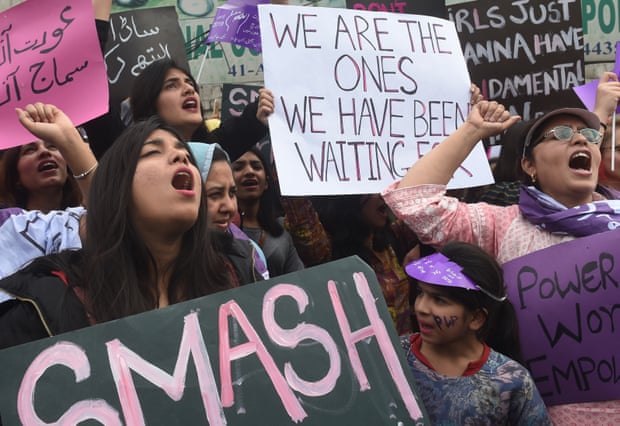
    When they do protest they are further abused and threatened, as was the case following the women’s day marches last month.
    Harassment in Pakistan isn’t a tragedy reserved for the jahil (illiterate), although they are particularly vulnerable. We need an all-encompassing movement.
    Over the years, I have become increasingly aware of how institutions are complicit in the silence that surrounds harassment. Schools, governments, families, religious leaders – all perpetuate the belief that sons are more valuable than daughters. While Muslim scholars prescribe non-marital intimacy as “haram”, families avoid having conversations about sex with their children. And then there are the parents who believe that hushing up and speedily marrying-off daughters who are victims is the only solution. The result? Sexual harassment becomes a way of life and those who speak up are labelled “troublemakers”.
    Pakistan requires its own exposé for this to change. But is #MeToo the answer? We seem to be torn between two possible choices.
    The first would be to clone the top-down #MeToo playbook from western counterparts and apply it to cliques – mostly elitist circles. But what happens to those who don’t understand this feminist rhetoric? What about those facing daily abuse, who often believe that they are the property of men and that they are justifiably abused?
    By replicating a movement developed in a vastly different context, we end up neglecting those most susceptible to harassment. Such a movement is unlikely to achieve scale and generate grassroots impact.
    The second future we can choose is to strengthen the momentum of #MeToo and use it as a springboard to spark a more inclusive, organic movement, mindful of local settings and nuances. A movement that reaches the lowest rungs of society can offer a voice to those who most desperately need one. How would this happen? By implementing sex education programmes in government schools, and investing resources to train both sexes about what constitutes harassment and consent, and how important it is to speak up, in a language they understand. Only when men work alongside women do we stand a chance of diminishing taboos surrounding shame and honour, and generating a movement from within.
    If we successfully adapt the #MeToo spirit to our own surroundings, the victory in developed countries can go beyond speaking up – it can provide a toolkit that ensures when an individual says “No”, their response must be accepted and respected. Only then can we hope for a different future in Pakistan, one of courage rather than fear.

    Currency, forex, growth in free fall: Economy is Pakistan’s real crisis, IMF only saviour


    Pakistan has reserves for just two months of imports, and also faces a current account, fiscal deficit, inflation crisis.

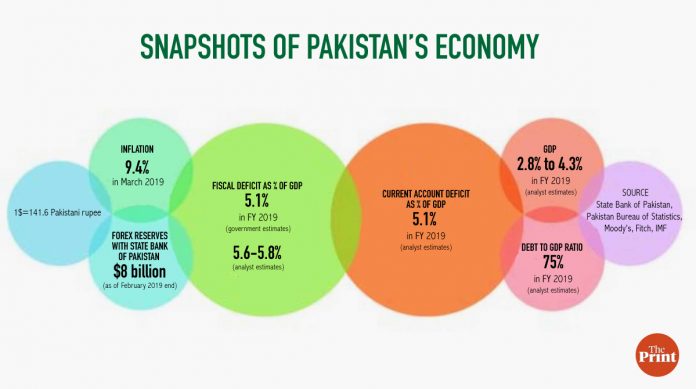
    Pakistan’s economy has been in a free fall for long but things are only getting worse — its current account and fiscal deficit is widening, inflation is rising, it’s facing a ballooning external debt and the foreign exchange reserves are dwindling. In short, it’s a serious crisis.
    In its World Economic Outlook report released Tuesday, the International Monetary Fund (IMF) revised downwards its growth projections for Pakistan to 2.8 per cent for 2018-19 and 2.9 per cent for 2019-20. It cited “ongoing macroeconomic adjustment challenges” for its revised projections.
    The report comes even as Prime Minister Imran Khan-led government rushes to complete negotiations with the IMF for a bailout.
    With its rising fuel import bill following a devaluation of the Pakistani rupee and a downgrade in the sovereign rating by rating agencies, Pakistan’s dependence on international assistance, especially bilateral help from countries like the United Arab Emirates (UAE), Saudi Arabia and China, has been continuously rising.
    As of end February 2019, Pakistan’s foreign exchange reserves stood at more than $8 billion — adequate to service around 2 months of imports — as against over $12 billion just a year ago.
    The Pakistani rupee has also depreciated by nearly 40 per cent against the dollar in the last two years as international pressure forced the Pakistani central bank, State Bank of Pakistan, to allow the rupee to devalue — it was trading at around 141 to a dollar Wednesday, nearly half the value of the Indian currency.
    Put next to a subdued economic growth, all these factors are exerting pressure on the Imran Khan government to bring in structural reforms to check its twin deficit issue as well as complete its negotiations with the IMF at the earliest to provide certainty to the markets.

    Fiscal deficit issue

    In the last four months, the ratings agencies too have downgraded the sovereign rating of Pakistan.
    Fitch expects Pakistan’s fiscal and current account deficit to be at 5.6 per cent and 5.1 per cent of GDP respectively in 2018-19 (financial year ending June).
    In its statement supporting the rating downgrade to non-investment grade ‘B-’ from ‘B’ in December, Fitch had said, “The downgrade reflects heightened external financing risk from low reserves and elevated external debt repayments, as well as a continued deterioration in the fiscal position, with a rising debt/GDP ratio.
    “A successful conclusion of ongoing negotiations on IMF support could help stabilise external finances, but the programme would then face significant implementation risk.”
    Fitch had also flagged the rising debt to GDP ratio, which is expected to cross 75 per cent of GDP by end 2018-19, as well as the rapid increase in external borrowings.
    The Imran Khan government had estimated to bring down the fiscal deficit to 5.1 per cent of GDP in FY19 from 6.6 per cent in the previous fiscal.
    While announcing its rating action in February, Standard and Poor’s (S&P) had flagged the risks to growth citing “diminishing stimulatory impact of the investments associated with the CPEC (China Pakistan Economic Corridor), negative fiscal impulse as the government looks to rein in its deficit, and declining economic sentiment”.
    “Growth will also be constrained by domestic security challenges and long-lasting hostility with neighbouring India and Afghanistan,” S&P had added.
    Another rating agency, Moody’s, in its credit opinion for Pakistan dated 22 March, highlighted the heightened external vulnerability risk.
    “Foreign exchange reserves have fallen to low levels and, absent significant capital inflows, will not be replenished over the next 12-18 months. Low reserve adequacy threatens continued access to external financing at moderate costs, in turn potentially raising government liquidity risks,” it said.

    ‘Pure politics’

    Speaking to ThePrint, Ashfaque Hasan Khan, a member of the Economic Advisory Council (EAC) to PM Khan said the fiscal deficit has always been a problem for Pakistan and this is contributing to the current account deficit.
    However, he disagreed with the government over the need to seek assistance from the IMF.
    “The government had already planned in their mind that they will go to the IMF. They made only a half-hearted attempt to correct the balance of payments gap,” he said, adding that the foreign exchange reserves with Pakistan are adequate to meet its import requirements.
    But Khan attributed the series of rating downgrades and downward revision in growth outlook as “pure politics”.
    Abid Qaiyum Suleri, another EAC member, said the balance of payment and forex for current fiscal year have been arranged.
    “However, going to IMF will be important for next fiscal year’s balance of payment,” he said.
    Both the current account deficit and fiscal deficit have been curtailed and are lower than last year, said Suleri.
    “However, structural issues of economy (especially energy circular debt and loss making public sector units) need to be addressed either within or outside IMF umbrella.”

    Wednesday, April 10, 2019

    Video - Bilawal Bhutto Speech at Thar Coal power plant inauguration ceremony | 10 April 2019

    Video - CM sindh Murad Ali Shah addresses Thar Coal power plant inauguration ceremony

    Imran Khan will have to go home: Zardari

    Indicating his party’s intent to oust the Pakistan Tehreek-e-Insaf government from the centre, Pakistan People’s Party (PPP) Co-chairman Asif Ali Zardari Wednesday said that Prime Minister Imran Khan will have to go home.
    “If we did not do this, then the coming generations will not forgive us,” the PPP co-chairman said while speaking to the press after a meeting with Jamiat Ulema Islam-Fazl (JUI-F) chief Maulana Fazlur Rehman. “And if we did not do this, then some other force might do so. Kaptaan will have to go home,” he added. When asked as to how much time they will give to the government, Zardari said there is a season for everything, adding that it will be only after Ramazan and Muharram.
    Regarding the current situation of the country, he maintained that if the government is not pushed back now, then it will result in an irreparable loss to the country. Speaking of the meeting, Zardari said he has always had Fazl’s blessings, adding, “However, I am not sure whether he is an elder to me or I am to him”.
    Speaking to the newsmen, Fazl said the meeting with Zardari is a routine one. “We are not in a position to give any surprise. Today, it was just a dinner invite,” he said. “I had also met Mian Sahib and discussions were held therein too. Several issues pertaining to the country were discussed, regarding which there is harmony among us.” The JUI-F chief said they are united to rid the nation of fake leaders, adding that meetings will be held in the future as well and the political agenda will be taken forth. “Whoever is a friend of Modi is a traitor,” he replied, when asked about PM’s comment regarding Narendra Modi’s victory in general election in India.

    #Pakistan - #PPP will not allow to close down Benazir Employees Stock Option Scheme

    Former President of Pakistan and President Pakistan Peoples Party Parliamentarians Asif Ali Zardari has expressed concern over the government reportedly putting an end to the Benazir Employees Stock Option Scheme. The former President said that the PTI government is snatching the rights of the people like vultures circling their prey. He said that the government should not have any intention to gulp the 28 billion rupees of the hardworking workers and people. The main purpose of the scheme was to facilitate the government employees, he said.
    The former President said that Benazir Employees Stock Option Scheme is a part of BISP and by ending it; the government is making clear that it does not want its employees working in industries to benefit from the scheme. He said that he is warning the people who still hold grudges against Shaheed Mohtarma Benazir Bhutto to not seize the earnings of the people. He concluded by saying that the PPP will strongly condemn from within and outside the Parliament if such a step is taken.