M WAQAR.....
"A man's ethical behavior should be based effectually on sympathy, education, and social ties; no religious basis is necessary.Man would indeed be in a poor way if he had to be restrained by fear of punishment and hope of reward after death."
--Albert Einstein !!!
NEWS,ARTICLES,EDITORIALS,MUSIC... Ze chi pe mayeen yum da agha pukhtunistan de.....(Liberal,Progressive,Secular World.)''Secularism is not against religion; it is the message of humanity.''
تل ده وی پثتونستآن
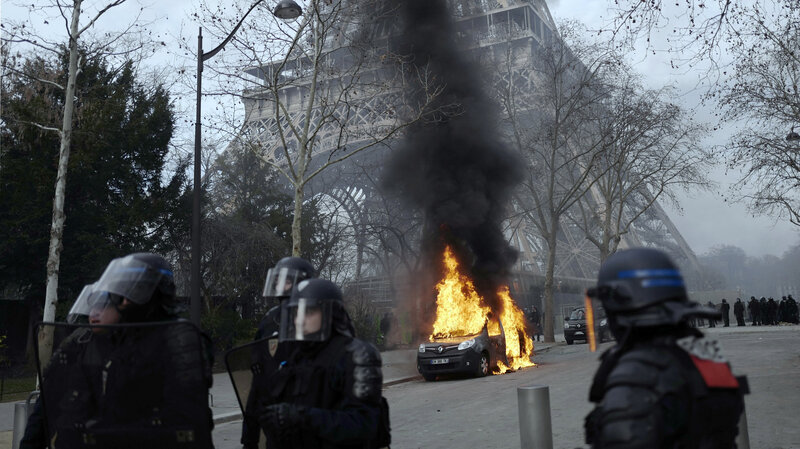
A yellow vest protester was severely injured on Saturday in the streets of Paris, as police shot teargas at protesters who were trying to knock down a barrier at the French parliament.
The man's hand was nearly blown off when he picked up a tear gas grenade and it exploded, according to NPR's Eleanor Beardsley.
The AP reports police said the injured protester lost four fingers.
In a graphic video of the aftermath, French paramedics are seen gathered around the injured protester at the National Assembly gates, providing emergency medical treatment and preventing onlookers from getting too close.
Another protester recently suffered an eye injury from being hit by a rubber bullet.
The yellow vest protests began in mid-November, spurred by anger over high gas prices in rural areas where people depend on their cars because of no access to public transportation.
Now, in their 13th consecutive week, the protests have become a sort of an uprising against the French President, Emmanuel Macron, who is seen as out of touch with common people.
This weekend, demonstrators set fire to multiple trash cans and an anti-terror military car. France's interior Christophe Castaner tweeted his indignation over the car being set on fire saying,"These attacks are intolerable."
Indignation et dégoût. Les militaires de la mission Sentinelle protègent au quotidien nos compatriotes du risque terroriste. Ces attaques sont intolérables. Tout sera mis en œuvre pour que leurs auteurs soient appréhendés et jugés.
Police said 31 protesters were arrested on Saturday but the AP reports France's Interior Ministry said this week's protest was significantly smaller than last week's. Representatives for the yellow vest movement dispute that claim, according to the BBC.
By the time the 2018 elections arrived it was clear to anyone who could access ww.sbp.org.pk/ that the country’s forex reserves were fast shrinking to below the danger point. Intelligent newspaper readers were aware that the country was badly indebted. There were editorial comments and columns in newspapers like ours criticising the finance minister’s policy of keeping the rupee overvalued. The economists who were critical of the PMLN’s policies were writing articles on government’s failure to urgently selloff the major loss making public sector enterprises. Others castigated its failure to broaden the tax net for fear of annoying powerful lobbies.
The PTI however boasted of a team of highly knowledgeable economic experts who had avowedly prepared policies to turn the economy around despite all these problems. The party promised everyone a pie the sky like 10 million jobs for the unemployed and five million housing units for the poor. Two months before the elections the party announced a slew of pledges that included Fata’s expeditious merger with KP, bifurcation of Punjab province, a development package for Karachi and a programme for alleviation of poverty besides a number of steps for improvement of the economy. All these projects require mega bucks.
The Federal Finance Secretary told the NFC moot on Wednesday that in the current fiscal year the government would pay Rs3.6 trillion on account of debt servicing and defence spending that is equal to 68.2pc of the current fiscal year’s revised budget. The two expenditures however are equal to 121pc of the net federal revenues. The finance ministry has to borrow to pay salaries, pensions, run hospitals, schools and build roads. Every penny that the centre spends on development is borrowed either from the banks or foreign sources.
The cabinet has now vowed to increase the defence budget. The only way it can satisfy both the voters and the army is by raising taxes in a big way, drastically improving exports and selling off major loss making public enterprises. Alternately it will have to go begging for more loans. In any case it is going to be a tight rope walk. Wining the elections was easy, governing the country is much more difficult.
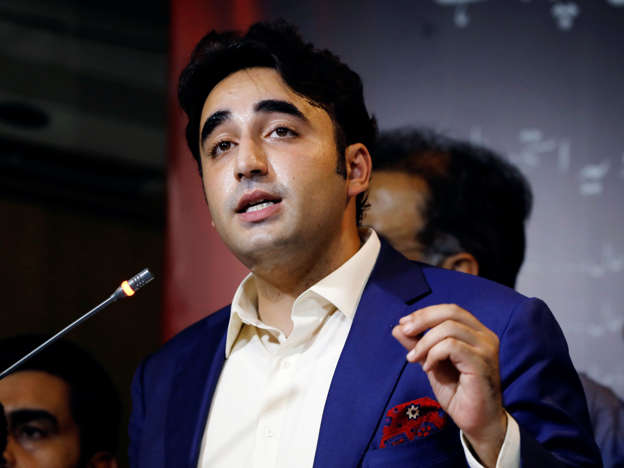
Chairman Pakistan Peoples Party Bilawal Bhutto Zardari has strongly condemned the arrest of Lahore-based academic Dr Ammar Ali Jan for participating in a protest. In a statement, the PPP Chairman said that handcuffing, arrests and killings of academicians by PTI government shows the ugliest form of victimization perpetrated under any regime in the past. Bilawal Bhutto Zardari demanded immediate release of Dr Ammar Ali Jan and asked the government to desist from taking illegal and inhuman actions against the democratic rights of protest by the civil society. He expressed solidarity with the family and friends of Dr Ammar Ali Jan and assured them every possible support from his Party. It may be recalled here that Ammar Ali Jan is the son of Dr Khalid Javed Jan a renowned poet who wrote the poem “Main Baghi hu Main Baghi hu” And he is still working as General Secretary PPP Culture Wing, Punjab. https://mediacellppp.wordpress.com/
Pakistan Peoples Party chairman Bilawal Bhutto Zardari, while expressing concern over the current situation in the country, said Pakistan needs to come out of its security state mentality.
The PPP leader was speaking at the Institute of Peace in Washington.
He urged the country’s policymakers to take advantage of the country’s geostrategic position and trade with countries that border Pakistan. “If we follow this path, we have the potential to be the future trade hub of the world.”The PPP leader also spoke of the issues that face Pakistan’s fledgling democracy and how his party plans to tackle them.“Today in Pakistan, we are experiencing a curtailing of our freedoms, freedom of expression, liberty and justice are increasingly being compromised. We are witnessing censorship, the likes of which we have never before.”
“We are already witnessing indigenous organic movements spawning across the country where citizens, tired of being persecuted have begun to push back. And this is what we need, we need to keep speaking up, we need to keep fighting back, keep challenging the forces that seek to silence us.”
Pakistan will bear the repercussions of state-sponsored stifling of dissent and curbing of freedoms of speech, movement, and association for generations, added the PPP chairperson.
“One area that is not talked about much, but which nonetheless is a reality, are civil-military relations in Pakistan. My party is conscious that this issue has to be addressed for long-term democratic and political stability.”
Bilawal further said he has proposed that all parties come together and work out a new charter of democracy to deal with such issues.
Bilawal also highlighted the need to curb extremism, ensure implementation of the National Action Plan (NAP) and the state of Pakistan’s economy.
In particular, he mentioned the youth bulge in the population. Over 60% of our population is considered youth and with a projected growth rate of 3%, our economy is not equipped to handle that level of unemployment, said the PPP chairperson while expressing concern over the country’s economic health.
A journalist from Pakistan has been forced to seek refuge in Malaysia after getting into trouble with authorities there over his damning exposure of scandals involving powerful individuals.
Syed Fawad Ali Shah, who wrote for The Nation, an English daily published from Lahore, said his life was threatened in Pakistan, a country where 27 journalists were murdered between 2011 and last year according to the US-based Committee to Protect Journalists.
Fawad’s troubles began in 2008 when he decided to investigate cases of missing persons. His work eventually led him to believe that the authorities were involved in the disappearance of these individuals, many of whom were accused of everything from spying for the Americans and Indians, to working for the Taliban.
“In 2008, I interviewed four to five families and I continued this till 2010 as I moved on to other news organisations.
“I found similarities in their stories,” he said.
Three years later, on Jan 10, 2011, while waiting for a bus from Allahabad to Peshawar, he was confronted by four men claiming to be from the Federal Investigation Agency (FIA), a powerful intelligence body under the interior ministry. They forced him into an unmarked vehicle and drove off.
He said he was detained in a small basement for three months and 18 days, and tortured with various methods including electrocution.
“I was in a total mess after all the beatings. Till this day, I have no idea how I survived,” he said.
He said during his detention, officers were carrying files of the Pakistan secret service, the Inter-Service Intelligence, and not of FIA.
They accused him of working with the “enemy of the state”, which could either be Indians, Americans or the Taliban group from Afghanistan.
Fawad was eventually released with a warning: stop writing about missing persons, and give up journalism.
So he did. He started doing odd jobs instead.
“But I couldn’t keep silent over the massive injustice happening in the country. So I left for Thailand in August 2011 with US$2,500 that I had saved.”
From Thailand, he travelled to Penang where he worked at a company monitoring CCTVs, earning RM1,100 monthly.
After a month, he approached the United Nations High Commission For Refugees (UNHCR) where he was interviewed 18 times, with each interview lasting four to five hours.
In 2014, he was recognised as a refugee and issued a UNHCR card.
When contacted, a senior police officer based in Peshawar, who wanted to remain anonymous, said Fawad had written about topics that stepped on the toes of corrupt officials, including terrorism, money laundering and the mafia.
“Journalists here often face death threats, especially those who write about the mafia and crime among the top echelons,” he told FMT.
In 2017, Reporters Sans Frontieres ranked Pakistan at number 139 out of 180 countries in its World Press Freedom Index.
‘I want a normal life’
Today, Fawad, 37, awaits news of his application for asylum in the US.
He said his frustrations grow each day, and there is nothing he can do in Malaysia which does not recognise refugees.
“I can’t work legally. I cannot get married. I am left hanging. All for what? For fighting for my country,” he said.
But Fawad still does what he likes best: exposing the scandals by Pakistan’s powerful elite. He continues to write for a bilingual English-Urdu news portal, Hamariweb.com.
The downside is that the “secret service” will harass his family members on his whereabouts, he said.
Fawad hopes that the US, or any other country for that matter, will consider his application so that he can start a new life.
“I don’t want to live as a refugee. I want to work. I have so much to offer but my life is at a standstill.”
When contacted, UNHCR refused to comment, saying it is not their policy to share the individual details of refugees.
A Pakistani journalist under scrutiny for anti-government social media posts was beaten and seized outside his home on Saturday, his son said, in the latest sign of pressure on media.
Rizwan Razi, who worked for private Din TV in the city of Lahore, was being investigated for “defamatory and obnoxious” comments about the judiciary, government and intelligence services, according to Pakistan’s law enforcement agency.
However, there was no official confirmation he had been arrested.
“My father went out of home to see off friends,” his son Osama told Reuters of the incident on Saturday morning.
“When the friends left, unknown persons, riding a black Honda Civic car, thrashed and dragged him in the car and fled away ... I ran after the car but could not do anything.”
Pakistani journalists say they face an increasingly hostile climate since the vote last year that saw Prime Minister Imran Khan’s Pakistan Tehreek-e-Insaf (PTI) take power.A report from the Federal Investigation Agency (FIA), dated Saturday and seen by Reuters, said Razi had previously been questioned about his Twitter comments. It said authorization had been granted to register a case against him.
His account @RaziDada appeared to be offline on Saturday.
FIA officials in Lahore referred questions to the main office in Islamabad, where officials could not be reached.
Khan’s government replaced the party of ousted former Prime Minister Nawaz Sharif, who was at odds with the powerful military and is currently serving a seven-year prison sentence for corruption.The increased official pressure has come at a difficult time for the media in general as advertising revenues have plunged and newsroom budgets been slashed.Government officials say Pakistan has an independent media and the military denies pressuring journalists.In a separate case, Ammar Ali Jan, an academic also based in Lahore, was arrested over his involvement in a protest at the death of Arman Loni, a regional leader of the Pashtun Tahaffuz Movement. He was later released on bail.
A message on Ammar’s Facebook page on Saturday said he was taken at 4 a.m. “I am a law-abiding citizen and will not be deterred in the fight for justice,” it said.
Police official Azhar Naveed confirmed the brief detention and bail, which followed other arrests over the protests earlier this week. He said Ammar was charged with taking part in a rally, blocking a road and making “anti-state” speeches.
Lahore-based professor Dr Ammar Ali Jan was released after being arrested by the Gulberg police early Saturday morning.
A case has been registered against him under the Punjab Sound Systems Regulation Act, 2015, Section 16 (dissemination of rumours) of the Maintenance of Public Order Ordinance and sections 147 (rioting), 149 (every member of unlawful assembly guilty of offence committed in prosecution of common object), 290 (public nuisance) and 291 (continuance of nuisance after injunction to discontinue) of the Pakistan Penal Code.
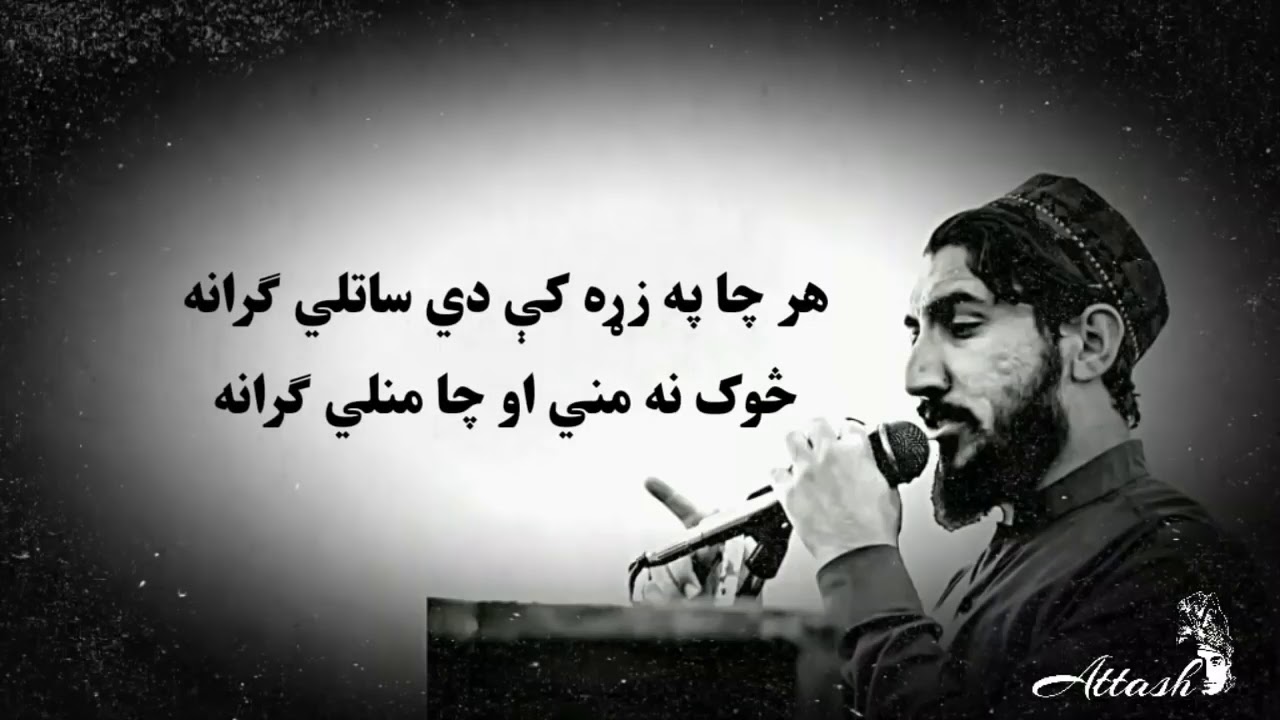
He is young and handsome, with a Che Guevara-esque beard. And he wears a distinctive cap, a cap that has become the symbol of the Pashtun struggle against the Pakistan government. He is studying to be a doctor, like Che. But the similarities end here because, unlike the Argentine revolutionary, Manzoor Pashteen does not believe in guerrilla warfare or weapons. The protest of the ethnic group under the umbrella of the Pashtun Tahafuz Movement (PTM) founded by Manzoor and some of his closest friends, commenced more than a year ago, and it has been peaceful even though many of them have been arrested, harassed, beaten up or even killed by police. The last one to die, on February 2, was Armam Loni.
“The State killed our friend and member of PTM,” says Pashteen. “And they are not even letting us lodge an FIR against his killer, a police officer retired from the Pakistani army. We were harassed while going to attend his funeral. They even shot at my car.”
In the following days, police cracked down on protesters in several Pakistani cities. On February 5, five PTM members were arrested in Islamabad, outside the National Press Club, for no reason, says Manzoor.
“The same day in the same city there was a protest by mujahideen fighters in solidarity with Kashmir. The security forces didn’t disturb them but tortured and arrested the peaceful non-violent PTM members asking for human and civil rights,” he says.
The PTM took to the streets exactly a year ago after the killing in a fake encounter of Naqeebullah Mehsud, a peaceful PTM activist and aspiring model. Mehsud, according to his assassins, was a terrorist. “Pakistani agencies and Pakistani army,” says Manzoor, “are doing this in a systematic way. They target someone, accuse him of being a terrorist, raise false allegations, and then they kill him with impunity. This is what they call war on terror. Taliban commanders are sharing the same camps with the Pakistani army, none of them is targeted. In my area, out of 88 so-called Taliban killed by the army, only one was real Taliban. All the others were civilian, common people.”
The PTM was started by Manzoor and his friends in their college days, after their houses were first raided and then razed to rubble by the army during the “war on terror”. They were staging demonstrations at the university. For years, the locals caught in the conflict feared speaking out about such acts, until the PTM burst onto the scene. Its tactics and objectives caught the imagination of the media, and drew support from across the spectrum. But then a crackdown began and the media too was forced to black out the group.
Manzoor has been arrested a couple of times and his family has been told that he is mentally unstable. He has been blatantly called up a number of times by members of the ISI and ordered to stop protesting, because, “’Otherwise the morale of our troops will go down. Stop, if you don't want to face consequences.’ But I told them, ’I don't care for my life. You can kill me, torture me, beat me up but I will go on until the end, denouncing what you are doing to my people. Stop killing innocents, stop humiliating our women, stop making people disappear, stop cutting the throat of our elders. Stop hosting the Taliban in your fort’.”
He was released, eventually, and the protest went on. The PTM is asking the government to stop enforced disappearances, to stop extrajudicial killings, to send the ‘missing’ people to court and, if they are found guilty of something, to punish them according to the law. They are asking the State to stop killing and torturing people during the 'search for terrorists’, to remove landmines from their land, to be allowed to lodge an FIR against the culprits. They are asking the world to take notice of their situation. The result is they are called “foreign agents” by the same State that should give them justice. However, Manzoor is very clear on the matter: “RAW and India are supposed to be our worst enemies, according to them. But Kulbhushan Jadhav who, they say, is an Indian spy, is not a missing person and has not been extrajudicially killed. If we are RAW agents, we should at least be granted the same treatment.”
The protest will continue, even though everyone’s life is at risk. Manzoor says he is not afraid to die. “They will not kill me now, not when so many people are on the streets and the press and the rest of the world are aware of our fight. But I cannot rule out the possibility of being killed by somebody else, by non-state actors, Taliban or jihadis. But my life is not important. They can kill me, but they cannot kill the movement. Our struggle will go on till the last man, the last day.”
The Christian woman freed by Pakistan's Supreme Court three months after acquitting her on a blasphemy charge has been transferred from her previous location near the capital by security forces, unable to leave Pakistan to join her daughters in Canada, a friend said Saturday.
Aman Ullah, who said he spoke to Asia Bibi by telephone Friday, said the 54-year-old Bibi is being held in a room in southern Karachi. He said Bibi, who spent eight years on death row, is frustrated and frightened, uncertain of when she will be able to leave Pakistan.
"She has no indication of when she will leave ... they are not telling her why she cannot leave," said Ullah, who fled the country Friday after receiving threats from religious radicals angered by his assistance to Bibi, which began while she was on death row.
Ullah has been a liaison between Bibi and European diplomats, who have sought to assist her. The Associated Press also spoke to Bibi by telephone following her October acquittal with the assistance of Ullah.
Bibi's ordeal began in 2009 when two fellow farmworkers refused to drink from the same container as a Christian woman. There was a quarrel and the two Muslim women later accused Bibi of blasphemy. The Supreme Court on Oct. 31 last year, however, acquitted Bibi and last month the high court rejected an appeal by a radical religious party to review her acquittal. The Supreme Court judges charged there were widespread inconsistencies in the testimony against Bibi saying had the case not been so sensitive the accusers would face perjury charges. Bibi has steadfastly maintained her innocence.
That court decision should have given Bibi her freedom, but Ullah said diplomats were told that her departure from Pakistan, where she feels her life would be in danger, would come not in the "short term but in the medium term," said Ullah.
He said Bibi told him she is locked in one room of a house.
"The door opens at food time only," said Ullah, and she is allowed to make phone calls in the morning and again at night. He said she usually calls her daughters.
There was no immediate response from the government but Bibi's case has brought international attention to Pakistan's controversial blasphemy law, which carries an automatic death sentence for a conviction of insulting Islam. However, there have been widespread complaints that the law is used to settle scores and that it targets the country's minorities, including Shiite Muslims.
The mere suggestion of blasphemy can incite mobs to kill. After Bibi's October acquittal the radical Tehreek-e-Labbaik party called its followers onto the streets where they protested for three days demanding Bibi's immediate execution as well as the death of the judges who acquitted her. The party leadership also advocated overthrowing the government of Imran Khan and incited the military against the army chief.
Since then the leadership has been arrested along with dozens of their followers for inciting violence.
Ullah, a rights activist, first began aiding those falsely charged with blasphemy when his wife was wrongly accused. Since then, he has helped several people gain their freedom but Bibi's prominence brought him to the attention of religious radicals.
In recent months, he has been physically assaulted, gunmen have opened fire on his home, and several religious radicals attacked his home. Ullah said he fears being attacked again or charged with blasphemy.
Bibi hopes to be able to join her daughters in Canada, where they have been granted asylum.
U.S. withdrawal from Afghanistan would leave a power vacuum filled by terrorists.
In his State of the Union address, President Donald Trump tied the withdrawal of U.S. troops to a peaceful settlement in Afghanistan. For a famously mercurial president, that may be no guarantee. But if the United States goes ahead with this course, negotiations should focus on fashioning a peace deal that can last instead of seeking a fig leaf to justify U.S. withdrawal.
At present, the framework agreement looks all too much like the negotiated exit of the Soviet Union three decades ago under the cover of the 1988 Geneva Accords. The Soviet withdrawal brought no peace or reconciliation to Afghanistan, and unless backed up with serious precautionary measures, neither will the U.S. exit.
The desire of Trump and his supporters to not act as “the world’s policeman” is understandable. But they fail to realize that the United States cannot be a global leader unless it has a global role—even if that is more as umpire than policeman. Trump’s trumpeted withdrawal from the Middle East and Afghanistan is not compatible with his talk of winning.
U.S. priorities in talks with the Afghan Taliban should be to seek a cease-fire, the release of Western hostages held by the Taliban, and an accommodation between the insurgents and the lawful Afghan government. Pakistani-created safe havens for the Afghan Taliban also need to be eliminated—a measure that can only be achieved through a hard conversation with Islamabad.
But the framework agreement announced by Trump’s special envoy for Afghan reconciliation, Zalmay Khalilzad, after initial talks with the Taliban reflected different priorities. It proposed the withdrawal of U.S. troops in return for a Taliban guarantee that Afghan territory would never be used by terrorists. But trusting the Taliban, at this point, would be sheer naiveté; the United States would be offering up an extraordinary concession—withdrawal—in return for a highly unreliable promise.
U.S. withdrawal without conditions being fulfilled would only signal America’s defeat and retreat. Jihadis across the world would celebrate such a deal as the vanquishing of a second global superpower at their hands.
In Afghanistan, the aftermath of a U.S. cut and run would probably be no different than the Soviet withdrawal in 1989. The people of Afghanistan will fight to forestall the return of the Taliban’s Islamic emirate. From their perspective, it might be better if the Americans withdraw without a deal that lets the Taliban into Kabul through the back door.
The framework agreement has already come under severe criticism. The veteran U.S. diplomat Ryan Crocker described it as tantamount to surrender. James Dobbins, who served as special representative for Afghanistan and Pakistan under President Barack Obama and was at one point responsible for negotiations with the Taliban, also warned against rushing into an Afghan deal.
Khalilzad dealt with the criticism by suggesting that there were elements of his talks with the Taliban that were just not known to the critics. “The path to peace doesn’t often run in a straight line,” he tweeted, adding that the situation in Afghanistan was complex and “like all sensitive talks, not everything is conducted in public.”
Khalilzad is an experienced and competent diplomat. But like all diplomats, he only executes policy, and the room for him to apply his experience is limited by the preferences of his boss.
The very fact that a U.S. presidential envoy has been negotiating with them has given the Taliban a degree of legitimacy. Accepting their assurance about not letting terrorists use Afghan soil implies that the terrorist acts perpetrated by the Taliban and their Haqqani network—including attacks on the U.S. Embassy in Kabul and American civilians—are now forgotten and forgiven.
Why do some protests get reported in Pakistan and others not? M Ilyas Khan examines a story of human rights abuses the media is reluctant to cover and the authorities do not want to be told.
Pakistan's vibrant, at times almost cacophonic media, is struggling to report a fundamental contradiction in state policy.
This was at its most visible this week outside Islamabad's National Press Club.
An open ground outside the club premises - which some call Pakistan's Hyde Park because it is used for gatherings and protests - was occupied by a few hundred students from religious seminaries linked to a banned militant group.
They were holding an event to mark Kashmir Day, an official holiday in Pakistan which is observed to highlight human rights violations by Indian security forces in Indian-administered Kashmir.
But on the periphery of the Kashmir rally, police were busy spotting and arresting young men they suspected had come to attend another rally due to be held at the same venue.
Far from being militants, they were members or supporters of a rights movement that has been highlighting abuses by Pakistan's own military, in the ethnic Pashtun regions along the border with Afghanistan.
By the end of Tuesday, more than 30 activists of the Pashtun Tahaffuz (Protection) Movement, or PTM, had been rounded up, thrown in a police truck and taken to a police station.
The drama unfolded against the backdrop of speeches from the Kashmir rally in which speakers listed rights violations in Kashmir by the Indian army, and right in front of the eyes of the waiting media.
Dozens of television and newspaper photographers raced from one end to another trying to capture each arrest on camera.
But it was just their journalistic instincts kicking in - not a race to be first to actually cover the drama.
Because, while their TV channels thoroughly covered Kashmir Day events all over the country, including Islamabad, none of the videos of the arrests of the activists made it to the TV screens. Nor did they make headlines in the morning newspapers.
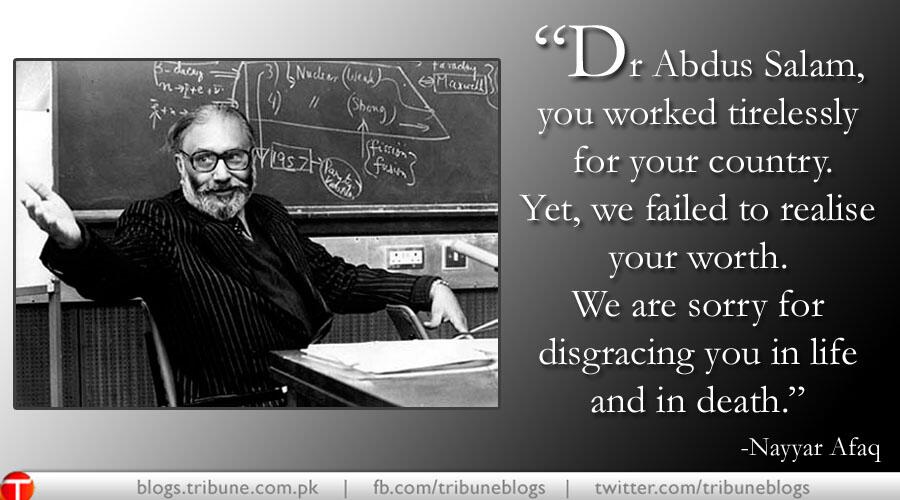
Last week was the Pakistani Nobel Laureate Abdus Salam’s 93rd birth anniversary and since I was reading about his work I decided to write a column about science today.
Whenever Dr Salam’s name comes up in Pakistan, we discuss his religious beliefs but not his scientific contributions. The fact is that he was an outstanding scientist and has rightly earned respect in international academic circles for his seminal contribution to particle physics. His religious beliefs are irrelevant to his scientific achievements.
Now a little science to introduce you to a portion of Salam’s work: everything we interact with – from the air we breathe to the food we eat to the cement used in our homes – is made up of atoms, the smallest, indivisible part of matter. The iron grill in our home is made up of billions of iron atoms that make the element iron. The gold ring you’re wearing is made up of billions of gold atoms that make the element gold. However, the water we drink is a combination of two elements – oxygen and hydrogen – and is formed when two atoms of hydrogen combine with one atom of oxygen to form one molecule of water.
All atoms, whether those of iron or oxygen, are composed of a central nucleus (containing protons and neutrons) that is orbited by negatively-charged electrons. The electron orbit is so far away from the nucleus that an atom is mostly empty space. For example, if a nucleus were the size of a cricket ball the electron orbit would be 2.25 miles away.
The electron was first discovered in 1897 by the English scientist Joseph Thomson. Then in 1914, New Zealander Ernest Rutherford discovered the positively-charged proton. His student James Chadwick discovered the neutron in 1932.
An American physicist Murray Gell-Mann theorised that protons and neutrons are themselves made up of three quarks each. Hence, we can say that quarks along with electrons and similar particles are the basic building blocks of nature.
Nature has four fundamental forces: first, the strong nuclear force that keeps quarks confined within protons and neutrons and also binds protons and neutrons to form the atomic nucleus; second, the electromagnetic force that makes negatively-charged electrons orbit positively-charged nucleus; third, the weak nuclear force that causes radioactivity and converts neutrons to protons; and, fourth, gravity that makes matter attract each other and keeps large masses together.Physicist James Maxwell came up with the formulation for the electromagnetic force in 1873. The first successful theory of the strong nuclear force was put forth by the Japanese physicist Hideki Yukawa in 1935.
The third fundamental force, the weak nuclear force, was worked on by the distinguished Italian physicist Enrico Fermi and brilliant American physicists Richard Feynman and Maurice Gell-Mann. But it was our own Professor Abdus Salam who, along with Steven Weinberg working independently, correctly formulated and predicted that the weak force and the electromagnetic force were different manifestation of the same force at lower temperatures. And indeed it was experimentally confirmed some years later that, at high enough temperatures, these two forces are the same.
Gravity was first ‘discovered’ by the greatest scientist of all time, Sir Isaac Newton in 1760. (Newton also invented calculus. His German contemporary Gottfried Leibniz also independently invented calculus but Newton, not a particularly nice man, did all he could to deny Leibniz any credit for his invention. No controversy however exists regarding the father of algebra, Persian scholar Muhammad ibn Musa al-Khwarizmi – who in the ninth century wrote his book ‘Kitab al-mukhtasar fi hisab al-jabr wal-muqabala’ in Baghdad. The word algebra is derived from the word al-Jabr).
Newton’s theory of gravitation, while path-breaking, was not completely accurate and it was left to the great German-Swiss physicist, Albert Einstein, to give an accurate theory of gravity. Einstein’s theories of relativity were revolutionary and suggested that time and space (or one’s position in space) are both relative, that we live in a four-dimensional world with three spatial and one temporal dimensions, that the faster you move through space the slower you move through time, meaning that a person who travels close to the speed of light will age much more slowly than a person not moving as fast, and that gravity causes massive bodies to actually curve space. Einstein also discovered the universal speed limit, which is the speed of light, and gave us a formula that converts mass into energy.
Around the same time that Einstein was working on his theory of gravity, many European scientists including Max Planck, Werner Heisenberg, Wolfgang Pauli, Niels Bohr and Einstein himself were working on a new theory called the quantum theory or quantum physics. It says that particles such as electrons behave both like discrete particles as well as waves. These theories gave rise to some unintuitive results, such as the fact that when travelling from point A to B, an electron doesn’t just travel through the straight path but simultaneously travels on all possible paths. Or that if we know the exact speed of a particle we can’t know its location. Or that electrons orbiting a nucleus in an atom can’t just orbit anywhere but can only do so at discrete intervals.Einstein’s theory of gravity has been very successful in predicting the large-scale structure of the universe and numerous experiments have supported this theory. Equally successful has been the quantum theory predicting the behaviour of fundamental particles such has electrons etc. Countless experiments have supported the quantum theory.
The only trouble is that both these theories are incompatible at some level. Scientists are, therefore, busy finding a new theory that encapsulate both these theories but isn’t internally contradictory. One such candidate is string theory which posits all particles as tiny one-dimensional vibrating strings. String theory also hypothesises that the world we live in is made up of not three but ten or more dimensions. So far, string theory has not had any experimental success so it is not accepted as a valid explanation of physical phenomenon.
I wrote the names of scientists here purposely to give readers a flavour of the paucity of Muslim or Pakistani names among the discoverers of natural phenomena. And what’s worse is that even 71 years after Independence we are not on the right track yet.
While brilliant scientists around the world are studying how electrons can behave as both waves and particles, and how we can tell what distant stars are made of by studying the wavelength of light emanating from those stars, we have 3.5 million kids in madressahs to whom we teach no science. And we have millions more in fancy English-medium or government-run Urdu-medium schools where rote memorisation is the method of choice and where kids are mostly taught to remain incurious about the natural world around us.
Why is Pakistan poor? Why is our life expectancy up to 15 years less than Japan? Why do we have such high infant mortality? Because we don’t produce enough (or any) Newtons, Einsteins, Feynmans and Salams.
گزشتہ ہفتے پاکستان کے نوبیل انعام یافتہ سائنسدان، ڈاکٹر عبدالسلام کی 93ویں سالگرہ تھی۔ حالیہ دنوں اُن کے کام کا مطالعہ کرتے ہوئے میں نے سائنس کے موضوع پر کالم لکھنے کا فیصلہ کیا ہے۔ جب بھی پاکستان میں ڈاکٹر صاحب کا نام لیا جاتا ہے تو ہم اُن کی سائنسی خدمات کی بجائے اُن کے مذہبی عقائد پر بحث شروع کردیتے ہیں۔ڈاکٹر سلام ایک ممتاز سائنسدان تھے۔ دانشور حلقے اُن کی فزکس پر کام، خاص طور پر اس کے بنیادی ذرات کی دریافت، کے معترف ہیں۔ یہاں میں قارئین کے ساتھ ڈاکٹر سلام کے کام کا کچھ ذکر کرنا چاہوں گا۔ آپ کا دنیا کی جس چیز سے بھی واسطہ پڑتا ہے۔ ہر چیز مادے کے چھوٹے چھوٹے ذرات، ایٹموں سے بنی ہے۔ تاہم پانی جو ہم پیتے ہیں، اُس میں دوعناصر ہیں۔ آکسیجن اور ہائیڈروجن۔ پانی کا ایک مالیکیول ہائیڈروجن کے دو اور آکسیجن کے ایک ایٹم پر مشتمل ہوتا ہے۔
تمام ایٹم، چاہے وہ لوہے کے ہوں یا آکسیجن کے، میں ایک مرکزہ(نیوکلیس )ہوتا ہے، جو پروٹانز اور نیوٹرانز پر مشتمل ہوتا ہے۔ اس کے گرد منفی چارج والے ذرات گردش کرتے ہیں۔ یہ ذرات الیکٹران کہلاتے ہیں۔ الیکٹرانز کا مدار نیوکلیس سے کافی دور ہوتا ہے۔ اس لیے ایٹم کا زیادہ ترحصہ خالی ہوتا ہے۔ مثال کے طور پر اگر نیوکلیس کا حجم ایک کرکٹ بال جتنا ہو تو الیکٹرانز کا مدار اس سے 2.25 میل دورہوگا۔
الیکٹرانز کو سب سے پہلے ایک انگریز سائنسدان، جوزف تھامسن نے 1897ء میں دریافت کیا تھا۔ 1914ء میں نیوزی لینڈ کے ایک سائنسدان، ردرفورڈ نے مثبت چارج رکھنے والا ذرہ پروٹان، اور اُن کے شاگرد، جیمز چاڈوک نے 1932ء میں نیوٹران دریافت کیا۔ ایک امریکی سائنسدان، مرے گلیمن نے تھیوری پیش کی کہ پروٹانز اور نیوٹرانز بذاتِ خود تین بنیادی ذرات سے مل کر بنے ہیں۔ چنانچہ ہم کہہ سکتے ہیں یہ ذرات اور الیکٹرانز فطرت کے ساختی اجزا ہیں۔
فطرت میں چار بنیادی قوتیں کارفرما ہیں۔ پہلی طاقتور نیوکلیئر طاقت ہے جو بنیادی ذرات کو نیوٹرانز اور پروٹانز کے اندر جوڑے رکھتی ہے۔ یہی طاقت نیوٹرانز اور پروٹانز کو باہم جوڑ کر نیوکلیس بناتی ہے۔ دوسری طاقت الیکٹرومیگنیٹک ہے، جو منفی چارج رکھنے والے الیکٹرانز کو مثبت چارج رکھنے والے پروٹانز کے گرد مدار میں گردش کرنے پر مجبور کرتی ہے۔ تیسری ایک کمزور ایٹمی طاقت ہے جو نیوٹرانز کو پروٹانز میں تبدیل کرتی ہے۔ چوتھی طاقت کششِ ثقل ہے جو تمام مادے اور مادی اجسام کو باہم مربوط رکھتی ہے۔
ماہرِ طبیعات جیمز میکسویل نے 1873ء میں الیکٹرومیگنیٹک طاقت کا فارمولہ وضع کیا۔ طاقتور ایٹمی طاقت کی پہلی کامیاب تھیوری ایک جاپانی سائنسدان، ہدیکی یکوانے 1935ء میں پیش کی۔ تیسری بنیادی طاقت، جو کمزور ایٹمی طاقت ہے، پر اطالوی سائنسدان انریکو فرمی اور ممتاز امریکی سائنسدانوں، رچرڈ فینمین اور میرس گلمین نے کام کیا۔ لیکن یہ ہمارے پروفیسر عبدالسلام تھے جنہوں نے سٹیون ونبرگ کے ساتھ مل کر آزادنہ طور پر کام کرتے ہوئے درست فارمولہ وضع کیا، اور پیش گوئی کی کہ کمزور ایٹمی طاقت اور الیکٹرومیگنیٹک طاقت دراصل ایک ہی طاقت کے کم درجہ حرارت پر مختلف مظاہر ہیں۔ کچھ سال بعد تجربات نے اس بات کی تصدیق کردی کہ بہت بلند درجہ حرارت پر یہ دونوں طاقتیں یکساں ہوجاتی ہیں۔
کشش ِثقل کو سب سے پہلے دنیا کے عظیم ترین سائنسدانوں میں ایک، سرآئزک نیوٹن نے 1760 ء میں دریافت کیا۔ نیوٹن نے ریاضیاتی تجزیہ بھی وضع کیا۔ اُن کے جرمن ہم عصر، گوٹفریڈلبنز نے اپنے طور پر کام کرتے ہوئے اس پیش رفت میں اپنا کردار ادا کیا، لیکن نیوٹن جو بطور انسان بہت وضع دار نہیں تھے، لیبنز کو اس کا کریڈٹ دینے کی بجائے اس کا سہرا اپنے سر سجالیا۔ تاہم الجبرے کی اختراع کے حوالے سے ایسا کوئی تنازع نہیں ہے۔ایرانی اسکالر، محمد ابن موسیٰ الخوارزمی نے بغداد میں نویں صدی میں ’’کتاب المختصر فی حساب الجبروالمقابلہ‘‘ تصنیف کی تھی۔ الجبرا اسی لفظ، ’’الجبر‘‘ سے مشتق ہے۔
نیوٹن کی کششِ ثقل کی تھیوری اگرچہ ایک بہت بڑی پیش رفت تھی، لیکن مکمل طور پر درست نہ تھی۔ اسے درست کیا عظیم جرمن سائنسدان، البرٹ آئن اسٹائن نے۔ آئن اسٹائن کی ریلٹیویٹی کی تھیوریوں نے سائنسی تصورات میں انقلاب برپا کردیا۔ ان کے مطابق وقت اور خلا (یا کسی کی خلامیں پوزیشن ) دونوں باہم مربوط ہیں۔ ہم ایک چہار جہتی دنیا میں رہتے ہیں جس میں تین مکانیت سے تعلق رکھتی ہیں جبکہ چوتھی متغیر جہت ہے۔ ہم جتنی تیز رفتاری سے خلا میں حرکت کریں، وقت کی رفتار اتنی ہی سست ہوجائے گی۔ اس کا مطلب ہے کہ ایک شخص، جو روشنی کی رفتار سے سفر کرتا ہے، اس کی عمر کا وقت اُس شخص کی نسبت سست رفتاری سے گزرے گا جو روشنی کی رفتار سے سفر نہیں کررہا ہوگا۔ نیز کششِ ثقل اجسام کو خلا میں منحنی راستے پر حرکت کرنے پر مجبور کرتی ہے۔ آئن اسٹائن نے کائنات کی رفتار کی حد بھی دریافت کی۔ یہ روشنی کی رفتار ہے۔ اُنھوں نے دنیا کو وہ شہرہ آفاق فارمولہ دیا جو مادے کو توانائی میں تبدیل کرتا ہے۔
آئن اسٹائن کششِ ثقل کی تھیوری کامیابی سے کائنات کے وسیع نظام کی پیش گوئی کرتی ہے اور لاتعداد تجربات اس کی سچائی کی تصدیق کرچکے ہیں۔ اسی طرح کوانٹم تھیوری بھی بنیادی ذرات کی حرکیات کو کامیابی سے بیان کرتی ہے۔ اس کی تصدیق بھی لاتعدا د تجربات سے ہوچکی ہے۔ واحد مشکل یہ تھی کہ یہ تھیوریز کسی نہ کسی درجے پر ناموافق ہوجاتی ہیں۔ چنانچہ سائنسدان کسی نئی تھیوری کی تلاش میں ہیں جو ان تھیوریز کی وضاحت کردے، لیکن بنیادی طور پر ان کی مخالفت نہ کرے۔ ایسی تھیوریز میں سے ایک اسٹرنگ تھیوری ہے۔ یہ تھیوری فرض کرتی ہے کہ تمام ذرات یک جہتی تھرتھرانے والی اسٹرنگ تشکیل دیتے ہیں۔ اس کے مطابق دنیا، جس میں ہم رہتے ہیں، تین نہیں بلکہ دس یا اس سے بھی زیادہ جہتیں رکھتی ہے۔ فی الحال اسٹرنگ تھیوری کی کسی تجربے سے تصدیق نہیں ہوسکی ہے۔ چنانچہ یہ ابھی فزکس کی شرح میں سند نہیں رکھتی ہے۔ سائنسی تحقیق کا سفر جاری ہے۔